In 2004 a newly discovered hominin fossil from the Indonesian island of Flores made headlines worldwide. Although an adult, it was tiny – about a metre tall, had a commensurately small brain (the size of a grapefruit), had made tools and hunted small elephants and giant rats. Dates from the cave floor sediments that had entombed it gave ages as young as 13 to 11 thousand years and as far back as 850 ka. So H. floresiensis was regarded as being the last human to share the Earth with us; that is, if it was a different species rather than a product of evolutionary shrinkage of anatomically modern humans stranded and isolated on the island for a very long time. Then there was talk among locals of the legendary Ebo Go-Go, with whom their ancestors had shared the island – they had arrived between 35 to 55 thousand years ago.
Homo floresiensis (the “Hobbit”) ( credit: Wikipedia)
Unsurprisingly, a major controversy raged in palaeoanthropology circles, between those who demanded either island dwarfism or congenital deformity of modern humans, and the other camp focused on many anatomical differences that pointed to a bona fide companion to later immigrants who perhaps survived into modern times. The ‘Hobbit’ became a cause celebre, but many of the original protagonists are now left with the proverbial egg on their faces. The cave sediments turn out to have a much more complex stratigraphy than previously thought, following further excavations led by the original discoverer Thomas Sutikna of the Pusat Penelitian Arkeologi Nasional in Jakarta Indonesia (Sutikna, T. and 19 others 2016. Revised stratigraphy and chronology for Homo floresiensis at Liang Bua in Indonesia. Nature, v. 532, p. 366-369.
Liang Bua cave on Flores island, Indonesia, where the remains of Homo floresiensis were discovered in 2003. (credit: Wikipedia)
The delayed appearance of the revision is hardly surprising, given the lengthy political squabbles surrounding access to the site. And neither are the outcomes, for cave sediments are notoriously tricky because of their episodic reworking by cave floods and roof falls, together with the difficulty in finding materials suited to dating in tropical settings. The original charcoal used in radiocarbon dating and sand grains subject to the thermoluminescence method were in fact from a unit that lies unconformably against the stratum that hosted the fossils. More sophisticated luminescence dating of the actual fossil-hosting sediments yield ages between 100 to 60 ka, tool-bearing units range from 190 to 50 ka. The origins of H. floresiensis are thus pushed back beyond the date of supposed colonisation by H. sapiens, and remain an open question.
The Kepler Space Telescope launched in 2009 was designed to detect and measure planetary bodies orbiting other stars. It was hoped that it would help slake the growing thirst for signs of alien but Earth-like worlds, extraterrestrial life and communications from other sentient beings. Results from the Kepler mission have, however, fostered a growing awareness that all is not well with the simple, Laplacian formation of planetary systems. For a start not one of the thousands of exoplanets revealed by Kepler is in a planetary system resembling the Solar System, let along sharing crucial attributes with the Earth. Giant planets occur around only a tenth of the stars observed, and even fewer in stable, near-circular orbits. Although it is early days in the quest for Earth- and Solar System look-alikes, some unexpected contrasts with the Solar System are emerging. For instance, many of the systems have far more mass in close orbit around their star, including gas giants with orbital periods of only a few days and giant rocky planets. Such configurations defy the accepted model for the Solar System where an outward increase in the proportion of volatiles and ices was thought to be the universal rule. Could these ‘hot Jupiters’ have formed further out and then somehow been dragged into scorching proximity to their star? Answers to this and other questions have been sought from computer simulations of the evolution of nebulas. Inevitably, the software has been applied to that of the Solar System, and the results are, quite literally, turning ideas about its early development inside out (Batygin, K., Laughlin, G. & Morbidelli, A., 2016. Born of chaos. Scientific American, v. 314(May 2016), p. 20-29).
An artist’s impression of a protoplanetary disk (credit: Wikipedia)
It seems that at some stage in its growth from the protoplanetary disk the gravitational influence of a planet creates mass perturbations in the remainder of the disk. These feed back to the planet itself, to others and different parts of the disk to create complex and continuously evolving motions; individual planets may migrate inwards, outwards or escape their star’s influence altogether in a chaotic, unpredictable dance. Ultimately, some balance emerges, although that may involve the star engulfing entire worlds and other bodies ending up in interstellar space. It may also end up with worlds dominated by ‘refractory’ materials – i.e. rocky planets like Earth – orbiting further from their star than those composed of ‘volatiles’. In the case of the early Solar System the modelling revealed Jupiter and Saturn drifting inwards and dragging planetesimals, dust, ice and gas with them to create a gap in the protoplanetary disk. Within about half a million years the two giant planets became locked in their present orbital resonance, which changed the distribution of angular momentum between them and reversed their motion to outward. The clearing of mass neatly explains the asteroid belt and Mars’s otherwise inexplicably small size.
One of the characteristics emerging from Kepler’s discoveries is that ‘super Earths’ orbit close to their star in other systems. Had they existed in the early Solar System the inward drive of Jupiter and Saturn and their ‘bow wave’ of smaller bodies would have had consequences. Swarms of matter from the ‘bow wave’ captured and dissipated angular momentum from the super Earths and dissipated it within a few hundred thousand years, thereby pushing them into death spirals to be consumed by the Sun. This explains what by comparison with Kepler data is a mass deficit in the inner Solar System. The rocky planets – Mercury, Venus, Earth and Mars – accreted from the leftovers, perhaps over far longer periods than previously thought.
Intense bombardment of the Moon and the Earth took place during the first half billion years after they had formed, rising to a crescendo in its later stages. Formation of the mare basins brought it to a sudden close at 3.8 Ga, which coincides with the earliest evidence for life on Earth. Lunar evidence indicates that this Late Heavy Bombardment spanned 4.1 to 3.8 Ga. Previously explained by a variety of unsatisfying hypotheses it forms part of the new grand modelling of jostling among the giant planets. Once Jupiter and Saturn together with Uranus and Neptune had stabilised, temporarily, they accumulated lesser orbital perturbations from an outlying disk of evolving dust and planetesimals throughout the Hadean Eon. Ultimately, around 4.1 Ga, the giant planets shifted out of resonance, pushing Jupiter slightly inwards to its current orbit and thrusting the other 3 further outwards. Incidentally, this may have flung another giant planet out of solar orbit to the void. Over about 300 million years they restabilised their orbits through gravitational interaction with the Kuiper belt but at the expense of destabilising the icy bodies within it. Some fled inwards as a barrage of impactors, possibly to deliver much of the water in Earth’s oceans. By 3.8 Ga the giants had settled into their modern orbital set-up; hopefully for the last time.
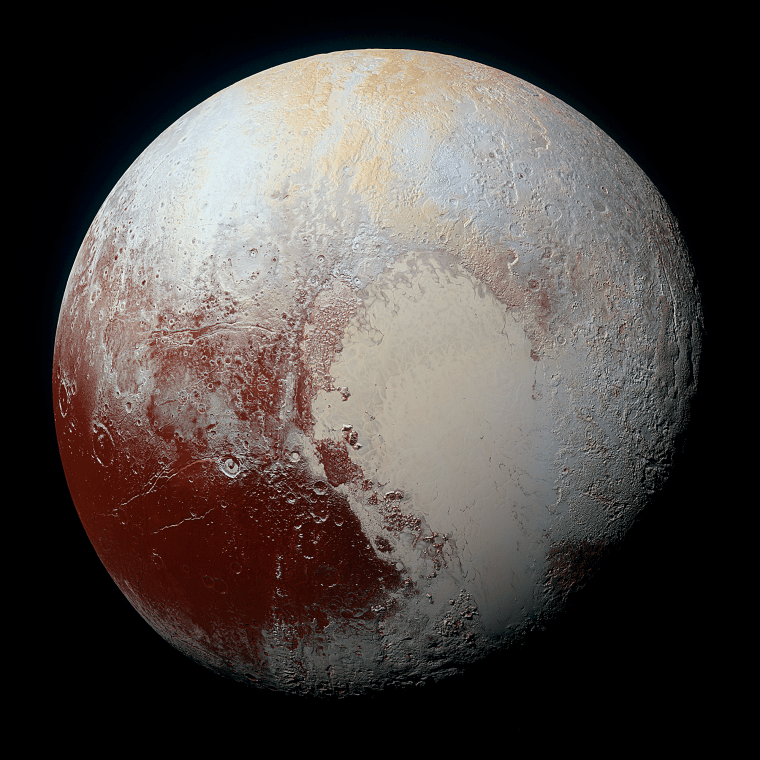
About 9 months ago NASA’s New Horizons spacecraft flew past the binary dwarf planets Pluto and Charon more than 9 years after launch. Everyone knew they would be frigid little worlds but the great risk was that they might turn out to be geologically boring. The relief when the first images finally arrived – New Horizons’ telecoms are pretty slow – was obvious on the faces at mission control. Even non-Trekkies, such as me, will be thrilled by the first in-depth, illustrated account (Moore, J.M. and 41 others 2016. The geology of Pluto and Charon through the eyes of New Horizons. Science, v. 351, p. 1284-1293), part of a five-article summary of early findings; the other 4 are on-line and scheduled for full publication later (summaries in Science, 18 March 2016, v. 351, p. 1280-1284). A gallery of images can be seen here and an abbreviated summary of the series here.
Pluto imaged in approximately natural colour by New Horizons. (credit: NASA)
They are astonishing places, even at a resolution of only about 1 km (270 m for some parts), and only one fully illuminated hemisphere was imaged for each because of the short duration of the fly-by. Pluto is by no means locked in stasis, for one of its largest features, Sputnik Planum, is so lightly cratered that is must be barely 10 Ma old at most. It is a pale, heart-shaped terrane dominated by smooth plains, which have a tiled or cellular appearance, with flanking mountains up to 9 km high that appear to be a broken-up chaos. Much of it is made of frozen nitrogen, carbon monoxide and methane. The dominant nitrogen ice has low strength which accounts for the large area of very low relief. The highly angular mountains are water ice that is buoyant and stronger relative to the others making up Sputnik Planum. Across the plain are areas of pitting and blades that seem to have formed by ice sublimation (solid to gas phase transitions) much like terrestrial snow or ice fields that have begun to degrade, and there are even signs of glacier-like flow.
4 Ga old cratered, upland terranes surrounding Sputnik Planum display grooved, ‘washboard’ and a variety of other surface textures reminiscent of dissection. The may have formed by long-term lateral flow (advection) of nitrogen ice and perhaps some melting. It is in this rugged part of Pluto that colour variation is spectacular, with yellows, blues and reds, probably due to deposition of hydrocarbon ‘frosts’ condensed from the atmosphere. That Pluto is still thermally active is shown by a few broad domes with central depressions that suggest volcanism, albeit with a magma made of ices. Areas of aligned ridges and troughs provide signs of tectonics, possibly extensional in nature.
Charon imaged in approximately natural colour by New Horizons. (credit: NASA)
Charon shows little sign of remaining active and capable of remoulding its surface. The hemisphere that has been imaged is spectacularly bisected by a 200 km wide belt of roughly parallel escarpments, ridges and troughs with a relief of about 10 km. Superimposed by large craters the extensional system probably dates back to the early history of the outer Solar System. Dominated by water ice it seems that Charon’s surface may have lost any more volatile ices by sublimation and loss to space. This suggests that superficial differences between two small worlds of similar density may be explained by Charon’s lower mass and gravitational field, resulting in the loss of its most volatile components that partly veneer the surface of Pluto.
Being hugely distant from any other sizeable body it is likely that the energy used to form cryovolcanic eruptions and deform the surface of both dwarf planets is due to internal radioactivity. Their similar mean density around 1.9 implies rocky cores that could host the required unstable isotopes. Being the only Kuiper Belt objects that have been closely examined naturally suggests that the rest of the myriad bodies that clutter it are similar. There are currently as many as 9 other sizable bodies suspected of eccentrically orbiting the Sun in the Kuiper Belt, including one that may be ten times more massive than Earth – a candidate for a ninth planet to replace Pluto, which was removed from that status following redefinition in 2006 of what constitutes a bona fide planet.
Palaeogeneticists certainly have the bit between their teeth as DNA sequencing methods become faster and more productive and statistical methods of sequence analysis and comparison are made more powerful. Only last month I reported on the two-way breeding unearthed from the data on single-chromosome DNA extracted from Croatian and Spanish Neanderthals, as well as some of the tangible inheritance from Neanderthals found in living non-African people. Now a team of statisticians, anthropologists and genetic sequencers have applied the new approaches to the genomes of over 1500 non-Africans, including 35 living Melanesian people from Papua-New Guinea (Vernot, B. and 16 others 2016. Excavating Neandertal and Denisovan DNA from the genomes of Melanesian individuals. Science, v. 351 doi:10.1126/science.aad9416). Melanesians had previously shown evidence of hybridization with both Neanderthals and Denisovans. The most interesting outcome is that the analyses pointed towards yet more instances of interbreeding between ancestors of modern non-Africans and Neanderthals. Many East Asians have 3 Neanderthals in their family trees, for Europeans and South Asians the score is 2, while Melanesians show descent from one Neanderthal and one Denisovan. Moreover, it emerges that interbreeding episodes were at different times among different populations since anatomically modern humans migrated from Africa, beginning perhaps as long ago as 130 ka and recurring later, after different regional groups of AMH had proceeded on their separate ways.
Melanesia, a cultural and geographical area in the Pacific. (credit: Wikipedia)
A second study (Sankararaman, S. et al. 2016. The combined landscape of Denisovan and Neanderthal ancestry in modern humans. Current Biology, v. 26, p. 1-7) has teased out evidence for Denisovan ancestry among South Asians, their admixture with Melanesians after that group acquired Neanderthal forebears, and significant signs of dwindling fertility among hybrid males.
Early 2016 has been very fertile as regards palaeoanthropology. Katherine Zink and Daniel Lieberman of Harvard University focus on the small teeth of Homo erectus and later humans, wondering if they arose following a major shift in culinary practices (Zink, K.D. & Lieberman, D.E. 2016. Impact of meat and lower Palaeolithic food processing techniques on chewing in humans. Nature, v. 531, p. 500-503). Their work is based on experiments to discover how much chewing is needed to make it possible to swallow different uncooked foodstuffs (assuming that cooking did not arise until after 500 ka). It seems that simply introducing meat to the diet would have reduced mastication by around 13% (2 million chews) per year, with a 15% reduction in applied chewing force. Simply slicing and pounding takes out another 750 thousand annual chews and gives a 12% fall in average biting force. So, here’s a link between tools and human gnashers as well as with development of the hand. Fascinating, perhaps, but every hominin species since 7 Ma old Sahelanthropus tchadensis had far smaller canine teeth than are the norm among non-hominin living and fossil apes. Something else was going on with dentition during our evolution, which may have been a loss of the need for threatening teeth. From ‘Do that again and I’ll bite you’, to ‘Let’s chew this over’…
Readers may recall my occasional rants over the years against the growing bandwagoning for an ‘Anthropocene‘ epoch at the top of the stratigraphic column. I , for one, was delighted to find in the latest issue of GSA Today a more sober assessment of the campaign by two stratigraphers who are well placed to have a real say in whether or not the ‘Anthropocene’ is acceptable, one serving on the International Commission on Stratigraphy, the other on the North American Commission on Stratigraphic Nomenclature (Finney, S.C. & Edwards, L.E. 2016. The “Anthropocene” epoch: Scientific decision or political statement? GSA Today, v. 26 (3–4).
These days, leading British politicians burdened with power have a tendency to show outwardly that they are, if little else, earnest. When busy with economic and industrial policy they wear tailored day-glo hi-viz suits and shiny new hard hats. During the great 2015 floods of Northern England, their garb was off the peg North Face gear and green wellington boots. And, of course, for social policy a hoodie is de rigueur. Rosy-cheeked Prime Minister David Cameron has been extremely earnest about fracking for shale gas for several years, and in the petroleum industry the appropriate signal of a leading politician’s enthusiasm is to wear a rigger’s blue jumpsuit; ‘We’re going all out for shale’ Cameron has said. Given the explosive success of shale-gas exploitation in North America over the last decade that’s not very surprising, but do not expect to see him looking earnestly at an exploration rig again any time soon.
Cameron’s excitement began when in 2011 the Advanced Resources Institute (ARI) in Washington DC released the results of its consultancy for the US Department of Energy on global shale-gas prospects. The star prospect in Europe was Poland, well endowed with subsurface shales, which according to ARI, had more than 5 trillion cubic metres of technically recoverable reserves, enough to satisfy Polish consumption for more than 300 years. In 2013, ARI suggested 17 trillion m3 beneath Britain, albeit only 0.7 trillion that was amenable to fracking (about a decade’s worth of British gas consumption). But still the hype was maintained. An article in the 3 March 2016 issue of Nature(Inman, M. 2016. Can fracking power Europe. Nature, v. 531, p. 22-24) tempers enthusiasm a great deal more.
The Polish Geological Institute revised the country’s reserves down to a tenth of ARI’s estimate. After an initial frenzy of interest following the ARI report, when exploration licences covered a third of Poland, during 2013 and 2014 major companies relinquished licences for fracking en masse. Their exploratory activities had been disappointing because of the depth of burial (2-5 km compared with 1-2 km in the US) and unfavourably high clay content and strength of the target shales. The less thrilling ARI prospects for Britain did not excite major petroleum players at all, what interest there is being from ‘juniors’ such as Cuadrilla. The British Geological Survey, which has huge archives of geological information, both surface and subsurface, has assessed the three main British shale-gas ‘plays’ and comes up with a reserve figure of between 24 and 68 trillion m3. But that high figure is based on the situation in mid-west North American shale-gas fields, where the geology is a great deal simpler than here. In Britain, orogenies at the end of the Carboniferous and the outermost ripples of that which formed the Alps in late Mesozoic and Palaeogene times created far more deformation than beneath the central plains of North America. Widespread faults, even though few in Britain have large displacements, pose two sets of problems. As the minor earthquakes set off by fracking in the tectonically simple Fylde area of western Lancashire indicate, pumping fluids into faulted rock can release pent-up elastic strain. But such leakage into faults and smaller fractures may also cause the injection pressure to fall, making the fracking process less efficient.
Fracking information sheet from the British Geological Survey
Inman reports that fracking is now moribund throughout Europe, partly because of the disappointing results and also because environmental concerns for densely populated regions have spurred widespread moratoria, including those in three of Britain’s four nations; Scotland, Wales and Northern Ireland. The only current European fracking activity is in England, conducted by a handful of junior companies. A stumbling block in England actually lies with the quality of subsurface data for what has been described at the most close examined geology in the world. Since the early 1980s there has been a succession of onshore licensing rounds for oil and conventional gas, the 14th of which is still active. The early ones were accompanied by a great deal of seismic reflection surveying, mainly using the truck mounted ‘Vibroseis’ method where the ground is mechanically thumped rather than subject to explosive shot firing that is favoured in sparsely populated areas. According to BGS, the guardians of the onshore seismic exploration repository, compared with the onshore seismic data available in North America that for Britain is ‘sparse, and fairly poor’.
Note: Earth-Pages will be closing as of early July, but will continue in another form at Earth-logs
Increasingly sophisticated analysis of existing genomes from Neanderthal and Denisovan fossil bone, together with new data on single-chromosome DNA extracted from Croatian and Spanish Neanderthals continues to break new ground.
According to genome comparison between a Siberian specimen and modern humans, a population from which Neanderthals emerged separated from that which led to anatomically modern humans (AMH) sometime between 550 and 765 ka, although the fossil record can only confirm that divergence was before 430 ka. The comparison famously showed that Neanderthals contributed to modern, non-African humans between 47 and 75 ka, that is after the exodus of AMH from Africa that spread our species throughout all continents except Antarctica. This genetic exchange is thought to have taken place somewhere in the Middle East, which seems to have been a major staging post for our spread further east and also westward to Europe. A similar indication of liaison between Denisovans and AMH migrants is restricted to modern Melanesians, and probably took place in eastern Asia before 45 ka, when modern people began crossing from Eurasia to New Guinea and Australia. Neanderthal-Denisovan comparison suggests that those distinct groups separated between 380 and 470 ka ago (recently revised from an earlier estimate).
In both cases the gene flow was from the older groups to humans. Further examination of Siberian Neanderthal genomes now indicates that a reverse exchange occurred more than 100 ka ago (Kuhlwilm, M. and 21 others 2016. Ancient gene flow from early modern humans into Eastern Neanderthals. Nature, v. 530, p. 429-433). But the single-chromosome DNA from Croatian and Spanish Neanderthals shows no such sign This instance of two-way exchange is significant in another way: it took place before direct evidence of the generally accepted departure of African migrants to populate the rest of the world. At about 100 ka there is fossil evidence of possible AMH-Neanderthal cohabitation of the Levant, followed by a period with fossil evidence for Neanderthal presence there but not modern humans. Because stone tools from northern Arabia are dated as far back as 125 ka and closely resemble those associated with archaic modern humans, there is a possibility that AMH migration was far earlier than previously thought and passed through the Levant en route to points east.
Another tantalizing aspect of Neanderthal-modern human genetics is the tangible legacy of interbreeding with non-African humans. The first sign was that the gene (mc1r) that confers red hair on those of us blessed, or otherwise, with it may have Neanderthal origins, thus making us extremely proud of that heritage. The same gene is implicated in northern modern humans having developed pale skin, which might embarrass ‘white supremacists’! Similar studies in Svante Paabo’s lab at the Max Planck Institute for Evolutionary Anthropology in Leipzig also suggested 15 genome regions that include those involved in energy metabolism, possibly associated with type 2 diabetes; cranial shape and cognitive abilities, perhaps linked to Down’s syndrome, autism and schizophrenia; wound healing; skin, sweat glands, hair follicles and skin pigmentation; and barrel chests. There is more…
Joshua Akey of the University of Washington, Seattle, and evolutionary genomicist Tony Capra of Vanderbilt University in Nashville hit on the idea of ‘mining’ archived genetic information from more than 28 thousand living people for traces of 6000 Neanderthal DNA variants and comparing the results with physical traits and diseases logged in the human database (reported by Gibbons, A. 2016. Neanderthal genes linked to modern diseases. Science, v. 351, p. 648-9). On the plus side, Neanderthal ancestry may help boost immune responses to fungi, parasites and bacteria. Inheritance of enhanced blood coagulation, although greatly assisting recovery from wounds and hemorrhage when giving birth, confers a proclivity to heart attacks and strokes. Neanderthals also passed on ‘weak bladders’, solar keratoses that confer skin cancer risk, a tendency to malnutrition from modern diets low on meat and nuts, depression triggered by jet lag(!) and even a tendency to nicotine addiction. But a ‘pure’ line of modern human descent, shared by most Africans, also has its positive and negative heritable traits.
About 1.3 billion years ago two small black holes, each weighing in at about 30 solar masses, ran into one another and fused. At that time Earthly life forms had neither mouths nor anuses, nor even a nervous system, and they were not much bigger than a sand grain. The distant collision involved rapid acceleration of considerable masses. A century ago Albert Einstein predicted that the movement of any matter in the universe should perturb space-time in a wave-like form that travels at the same speed as light. Well, he was right for, at 9:50:45 universal time on 14 September 2015, four exquisitely engineered mirrors deployed in the two set-ups of a Laser Interferometer Gravitational-Wave Observatory (LIGO) in Louisiana and Washington states in the US minutely shuddered, first in the Deep South and 0.007 seconds later in the Pacific Northwest. The signal lasted 0.25 seconds and, when rendered as sound, comprised a sort of chirrup starting at 35 Hz and rising to 250 Hz before an abrupt end. Five months later, and silent internationally shared theoretical verification, the story was released to the back slapping, stamping and pawing the air that we have come to expect from clever, ambitious and persuasive people who have spent a great deal of our money and have something to show for it. So now we know that the universe is probably throbbing – albeit very, very, very quietly – with gravitational waves generated by every single motion that has taken place in the whole of ‘recorded’ history since the Big Bang. Indeed, it is claimed, LIGO-like machines may one day detect the big wave itself if, that is, it hasn’t already passed through the solar system. Recall, 13.7 billion years ago the Big Bang didn’t take much longer than this comparatively mundane collision at 1.3 Ga . Physicists are going to have a lot to ponder on now they have a lever to get yet greater funds. To put all this in perspective, the detected chirrup had been traveling for 1.3 Ga, and so too must the actual place in the universe where it took place: I guess we will never know where it is now or what damage or otherwise may have been visited upon planetary systems in its vicinity, if indeed it had even the slightest recognisable geological or ecological consequence.
So, onto the mundane world of glaciology and climate change.
Tibet is the third greatest repository of glacial ice on the surface of the Earth’s continents. It is the focus of one of the planet’s greatest climatic system, the South Asian. While much of the Plateau hasn’t borne glaciers continuously throughout even the last glacial cycle, it is becoming clear that its western margin has remained cold enough to retain ice throughout an even longer period. In the Kunlun mountains is a 200 km2 ice cap known as the Guliya. At the start of detailed glacial stratigraphic ventures in 1990s, focused mainly on Greenland and Antarctica, analysis of a core from the Guliya ice cap yielded dates extending back to 130 ka, before the start if the last interglacial. This section lies above ice that at the time could not be dated reliably other than to show that it may be older than about 750 ka. This stemmed from its lack of the radioactive 36Cl formed, similarly to 14C, by cosmic-ray interactions with stable 35Cl in atmospheric salt aerosols: such cosmogenic chlorine can be used for radiometric dating of ice younger than 750 ka.
A News Feature in the 29 January issue of Science (Qiu, J. 2016. Tibet’s primeval ice. Science, v. 351, p. 436-439) focused on the preliminary results of an expedition, led by Yao Tandong of the Institute of Tibetan Plateau Research, Beijing and Lonnie Thompson of Ohio State University, Columbus, to drill a further five ice cores at Guliya in September 2015, one of which penetrated ove 300 m of glacial ice. It is now possible to date ice layers back to a million years using argon isotopes. Combined with stable isotope and other measurements through the cores, the dating should provide a huge amount of new information on the evolution of the monsoon, which is currently understood only vaguely. Such information would sharpen models of how the monsoon system works and even hint at how it might change during a period of anthropogenic warming. An estimated 1.4 billion people – a fifth of humanity – who live in the Indian subcontinent, China and SE Asia depend for their food-production on the monsoon.
With less humanitarian urgency but equally fascinating is the discovery that, as well as sea-ice, the central Arctic Ocean once hosted vast ice shelves during the last-but-one glacial episode (Jakobsson, M. and 24 others 2016. Evidence for an ice shelf covering the central Arctic Ocean during the penultimate glaciations. Nature Communications, v. 7, doi:10.1038/ncomms10365. Clues emerged from multibeam sonar bathymetry that created detailed images of topography on the floor of the Arctic Ocean. These revealed sets of parallel ridges on the shallowest parts of the polar basin, thought to have formed when moving ice shelves grounded. The depths of the grooved areas indicate ice thicknesses up to and exceeding 1 km. The grooves look very similar to the large-scale lineaments that formed on the surface of the Canadian Shield when the Laurentide ice sheet ground its way from zones of glacial accumulation. Grounding of an ice shelf would have resulted in its thickening in the upflow direction as a result of plastic deformation of the ice, tending to lock the flow and direct ice escape over the deeper parts of the Arctic basin.
Antarctic Ice Shelf (credit: Wikipedia)
Back-tracking the grooves defines the ice shelf’s source regions in the northern Canadian islands, north Scandinavia and the lowlands of eastern Siberia as well as regional flow patterns and the extent of floating continental ice. The last is a major surprise: at over 4 million km2 it was four times larger than all modern Antarctic ice shelves. The ice moved to ‘escape’ to the North Atlantic Ocean through the Fram Strait between East Greenland and Svalbard (Spitzbergen). Dating sediment stratigraphy in the grooved areas using magnetic and fossil data shows that the ice shelves existed between 160 and 140 ka during the penultimate glacial maximum. For such a mass of glacial ice to be expelled into the Arctic Ocean implies that a great deal more snow fell on its fringes then than during the last glacial maximum. Another possibility is that the huge mass of floating ice regulated the salinity and density of the upper Atlantic in a different way from the periodic iceberg ‘armadas’ that characterized the last glacial epoch and help account for a whole number of sudden warming and cooling events.
Related articles
Domack, E. 2016. A great Arctic ice shelf. Nature, v. 530, p. 163-164.
Tiny, 4.4 billion year old zircon grains extracted from much younger sandstones in Western Australia are the oldest known relics of the Earth system. But they don’t say much about early tectonic processes. For that, substantial exposures of rock are needed, of which the undisputedly oldest are the Acasta gneisses 300 km north of Yellowknife in Canada’s North West Territories, which have an age of slightly more than 4 Ga. The ‘world’s oldest rock’ has been something of a grail for geologists and isotope geochemists who have combed the ancient Archaean cratons for 5 decades. But since the discovery of metasediments with an age of 3.8 Ga in West Greenland during the 1970s they haven’t made much headway into the huge time gap between Earth’s accretion at 4.54 Ga and the oldest known rocks (the Hadean Eon).
Continental cratons (orange) where very-old rocks are likely to lurk. (credit: Wikipedia)
There have been more vibrant research themes about the Archaean Earth system, specifically the issue of when our planet settled into its modern plate tectonic phase A sprinkling of work on reconstructing the deep structural framework of Archaean relics has convinced some that opposed motion of rigid, brittle plates was responsible for their geological architecture, whereas others have claimed signs of a more plastic and chaotic kind of deformation of the outer Earth. More effort has been devoted to using the geochemistry of all the dominant rocks found in the ancient cratons, seeking similarities with and differences from those of more recent vintage. There can be little doubt that the earliest processes did form crust whose density prevented or delayed it from being absorbed into the mantle. Even the 4.4 Ga zircons probably crystallized from magma that was felsic in composition. Once trapped by buoyancy at the surface and subsequently wrapped around by similarly low density materials continental crust formed as a more or less permanent rider on the Earth’s deeper dynamics. But did it all form by the same kinds of process that we know to be operating today?
Plate tectonics involves the perpetual creation of rigid slabs of basalt-capped oceanic lithosphere at oceanic rift systems and their motions and interactions, including those with continental crust. Ocean floor cools as it ages and becomes hydrated by seawater that enters it. The bulk of it is destined eventually to oppose, head-to-head, the motions of other such plates and to deform in some way. The main driving force for global tectonics begins when an old, cold plate does deform, breaks, bends and drives downwards. Increasing pressure on its cold, wet basaltic top transforms it into a denser form: from a wet basaltic mineralogy (feldspar+pyroxene+amphibole) to one consisting of anhydrous pyroxene and garnet (eclogite) from which watery fluid is expelled upwards. Eclogite’s density exceeds that of mantle peridotite and compels the whole slab of oceanic lithosphere to sink or subduct into the mantle, dragging the younger parts with it. This gravity-induced ‘slab pull’ sustains the sum total of all tectonic motion. The water rising from it induces the wedge of upper mantle above to melt partially, the resulting magma evolves to produce new felsic crust in island arcs whose destiny is to be plastered on to and enlarge older continental masses.
Relics of eclogites and other high-pressure, low-temperature versions of hydrated basalts incorporated into continents bear direct and unchallengeable witness to plate tectonics having operated back to about 800 Ma ago. Before that, evidence for plate tectonics is circumstantial and in need of special pleading. Adversarial to-ing and fro-ing seems to be perpetual, between geoscientists who see no reason to doubt that Earth has always behaved in this general fashion and others who see room for very different scenarios in the distant past. The non-Huttonian tendency suggests an early, more ductile phase when greater radioactive heat production in the mantle produced oceanic crust so fast that when it interacted with other slabs it was hot enough to resist metamorphic densification wherever it was forced down. Faster production of magma by the mantle without slab-pull could have produced a variety of ‘recycling’ turnover mechanisms that were not plate-tectonic.
One thing that geochemists have discovered is that the composition of Archaean continental crust is very different from that produced in later times. In 1985 Ross Taylor and Scott McLennan, then of the Australian National University, hit on the idea of using shales of different ages as proxies for the preceding continental crust from which they had been derived by long erosion. Archaean and younger shales differed in such a way that suggests that after 2.5 Ga (the end of the Archaean) vast amounts of feldspar were extracted from the continent-forming magmas. This left the later Precambrian and Phanerozoic upper crust depleted in the rare-earth element europium, which ended up in a mafic, feldspar-rich lower crust. On the other hand, no such mass fractionation had left such a signature before 2.5 Ga. Another ANU geochemist, now at the University of Maryland, Roberta Rudnick has subsequently carried this approach further, culminating in a recent paper (Tang, M., Chen, K and Rudnick, R.L. 2016. Archean upper crust transition from mafic to felsic marks the onset of plate tectonics. Science, v. 351, p. 372-375). This uses nickel, chromium and zinc concentrations in ancient igneous and sedimentary rocks to track the contribution of magnesium (the ‘ma’ in ‘mafic’) to the early continents. The authors found that between 3.0 to 2.5 Ga continental additions shifted from a dominant more mafic composition to one similar to that of later times by the end of the Archaean. Moreover, this accompanied a fivefold increase in the pace of continental growth. Such a spurt has long been suspected and widely suggested to mark to start of true plate tectonics: but an hypothesis bereft of evidence.
A better clue, in my opinion, came 30 years ago from a study of the geochemistry of actual crustal rocks that formed before and after 2.5 Ga (Martin, H. 1986. Effect of steeper Archean geothermal gradient on geochemistry of subduction-zone magmas. Geology, v. 14, p. 753-756). Martin showed that plutonic Archaean and post-Archaean felsic rocks of the continental crust lie in distinctly different fields on plots of their rare-earth element (REE) abundances. Archaean felsic plutonic rocks show a distinct trend of enrichment in light REE relative to heavy REE as measures of the degree of partial melting decreases, whereas the younger crustal rocks show almost constant, low values of heavy REE/light REE whatever the degree of melting. The conclusion he reached was that while in the post Archaean the source was consistent with modern subduction processes – i.e. partial melting of hydrated peridotite in the mantle wedge above subduction zones – but during the Archaean the source was hydrated, garnet-bearing amphibolite of basaltic composition, in the descending slab of subducted oceanic crust. Together with Taylor and McLennan’s lack of evidence for any fractional crystallization in Archaean continental growth, in contrast to that implicated in Post-Archaean times.
The geochemistry forces geologists to accept that a fundamental change took place in the generation and speed of continental growth at the end of the Archaean, marking a shift from a dominance of melting of oceanic, mafic crust to one where the upper mantle was the main source of felsic, low-density magmas. Yet, no matter how much we might speculate on indirect evidence, whether or not subduction, slab-pull and therefore plate tectonics dominated the Archaean remains an open question.
The magnitude 7.8 Gorkha earthquake hit much of the Himalayan state of Nepal on 25 April 2015, to be followed by one of magnitude 7.3 150 km to the east 18 days later. As would have happened in any high-relief area both events triggered a huge number of landslides as well as toppling buildings, killing almost 9000 people and leaving 22 000 injured in the capital Kathmandu and about 30 rural administrative districts. Relief and reconstruction remain hindered 9 months on in many of the smaller villages because they are accessible only by footpaths. Nepal had remained free of devastating earthquakes for almost 6 centuries, highlighting the perils of long quiescence in active plate-boundary areas.
Damage in Kathmandu, Nepal, after the Gorkha earthquake in May 2015 (Credit: CNN)
The International Charter: Space and Major Disasters consortium of many national space agencies was activated, resulting in one of the largest ever volumes of satellite images ranging from 30 to 1 m resolution to be captured and made freely available for relief direction, analysis and documentation. This allowed more than 7500 volunteers to engage in ‘crowd mapping’ coordinated by the Humanitarian OpenStreetMap Team (HOT) to provide logistic support to the Nepal government, UN Agencies and other international organizations who were swiftly responding with humanitarian relief. Most important was the location of damaged areas using ‘before-after’ analysis and assessing possible routes to remote areas. The US NASA and British Geological Survey with Durham University coordinated a multinational effort by geoscientists to document the geological, geophysical and geomorphological factors behind the mass movement of debris in landslides etc that was triggered by the earthquakes, results from which have just appeared (Kargel, J.S. and 63 others 2016. Geomorphic and geological controls of geohazards induced by Nepal’s 2015 Gorkha earthquake. Science, v. 351, p. 140 – full text purchase).
The large team mapped 4312 new landslides and inspected almost 500 glacial lakes for damage, only 9 had visible damage but none of them showing signs of outbursts. As any civil engineer might have predicted, landslides were concentrated in areas with slopes exceeding 30° coincided with high ground acceleration due to the shaking effect of earthquakes. Ground acceleration can only be assessed from the actual seismogram records of the earthquakes, though slope angle is easily mapped using existing digital elevation data (e.g. SRTM). It should be possible to model landslide susceptibility to some extent over large areas by simulation of ground shaking based on various combinations of seismic magnitude and epicenter depth modulated by maps of bedrock and colluvium on valley sides as well as from after-the-event surveys. The main control over distribution of landslides seems to have been the actual fault mechanism involved in the earthquake, assessed from satellite radar interferometry, with the greatest number and density being on the downthrow side (up to 0.82 m surface drop): the uplifted area (up to 1.13 m) had barely any debris movements. Damage lies above deep zones where brittle deformation probably takes place leading to sudden discrete faults, but is less widespread above deep zones of plastic deformation.
The geoscientific information gleaned from the Gorkha earthquake’s effects will no doubt help in assessing risky areas elsewhere in the Himalayan region. Yet so too will steady lithological and structural mapping of this still poorly understood and largely remote area. As regards the number of lives saved, one has to bear in mind that few people buried by landslides and collapsed buildings survive longer than a few days. It seems that rapid response by geospatial data analysts to the logistics of relief and escape has more chance of positive humanitarian outcomes.
In the same issue of Science appears another article on Nepalese seismicity, but events of the 12th to 14th centuries CE (Schwanghart, W. and 10 others 2016. Repeated catastrophic valley infill following medieval earthquakes in the Nepal Himalaya. Science, v. 351, p. 147-150). As the title suggests, this relates to recent geology beneath a valley floor in which Nepal’s second city Pokhara is located. It lies immediately to the south of the 8000 m Annapurna massif, about 50 km west of the Gorkha epicentre. Sections through the upper valley sediments reveal successive debris accumulations on scales that dwarf those moved in the 2015 landslides. Dating (14C) of interlayered organic materials match three recorded earthquakes in 1100, 1255 and 1344 CE, each estimated to have been of magnitude 8 or above. The debris is dominated by carbonate rocks that probably came from the Annapurna massif some 60 km distant. They contain evidence of extreme pulverisation and occur in a series of interbeds some fine others dominated by clasts. The likelihood is that these are evidence of mass movement of a more extreme category than landslides and rockfalls: catastrophic debris flows or rock-ice avalanches involving, in total, 4 to 5 km3 of material.
The original saying emerged in Shakespeare’s Henry IV Part 2 (Act 5, Scene 3) during a jocular exchange when Ancient Pistol brings news from Court to Sir John Falstaff and other old codgers at dinner in Gloucestershire. Falstaff: ‘What wind blew you hither, Pistol?’ Pistol: ‘Not the ill wind which blows no man to good’. In the present context it seems anthropogenic CO2 emissions have staved off the otherwise inevitable launch of another glacial epoch. Climate-change deniers will no doubt pounce on this in the manner of a leopard seizing a tasty young monkey.
Penny Ice Cap on Baffin Island ( credit: Wikipedia)
Climatologists at the Institute for Climate Impact Research in Potsdam, Germany, Potsdam University and the Santa Fe Institute in New Mexico, USA set out to develop a means for predicting the onset of ice ages (Ganopolski, A. et al. 2016. Critical insolation-CO2 relation for diagnosing past and future glacial inception. Nature, v. 529, p. 200-203) Many researchers have concluded from the oxygen isotope data in marine sediments, which tracks changes in the volume of glacial ice on land, that the end of previous interglacial periods by inception of prolonged climatic cooling may be attributed to reduction of solar heating in summer at high northern latitudes. This conclusion stems from Milankovic’s predictions from the Earth’s astronomically controlled orbital parameters and fits most of previous interglacial to glacial transitions. But summer insolation at 65°N is now more or less at one of these minima, with no signs of drastic global cooling; rather the opposite, as part of 7 thousand years of constant global sea level during the Holocene interglacial.
The latest supercomputer model of the Earth System (CLIMBER-2) has successfully ‘predicted’ the last eight ice ages from astronomical and other data derived from a variety of climate proxies. It also forecasts the next to have already begun, if atmospheric CO2 concentration was 240 parts per million; the level during earlier interglacials most similar to that in which we live. But the pre-industrial level was 280 ppm and the model suggests that would have put off the return of huge ice caps in the Northern Hemisphere for another 50 thousand years – partly because the present insolation minimum is not deep enough to launch a new ice age with that CO2 concentration – making the Holocene likely to be by far the longest interglacial since ice-age cycles began about 2.5 Ma ago. Based on current, industrially contaminated CO2 levels and a rapid curtailment of carbon emissions the model suggests no return to full glacial conditions within the next 100 ka and possibly longer; a consequence of the sluggishness of natural processes that draw-down CO2 from the atmosphere.
Simulation of the Earth at a glacial maximum. (Photo credit: Wikipedia)
So, does this indicate that unwittingly the Industrial Revolution and subsequent growth in the use of fossil fuels tipped the balance away from global cooling that would eventually have made vast tracts of both hemispheres uninhabitable? At first sight, that’s the way it looks. But the atmospheric carbon content of the 17th century would have resulted in much the same long drawn out Holocene interglacial; an unprecedented skipping of an ice age in the period covering most of the history of human evolution. This raises a question first posed by Bill Ruddiman in 2003: did human agriculture and associated CO2 emission begin the destabilisation of the Earth system shortly after Holocene warming and human ingenuity made farming and herding possible since about 10 thousand years ago?
But, consider this, the CLIMBER-2 Earth System model is said to be one of ‘intermediate complexity’ which is shorthand for one that relies on the ages-old scientific method of reductionism or basing each modelled scenario on modifying one parameter at a time. Moreover, for many parameters of the Earth’s climate system – clouds, dust, the cooling effect of increased winter precipitation as snow, and much else – scientists are pretty much in the dark (Crucifix, M. 2016. Earth’s narrow escape from a big freeze. Nature, v. 529, p. 162-163). Indeed it is still not certain whether CO2 levels have a naturally active or passive role in glacial-interglacial cycles, or something more complex than the simple cause-effect paradigm that still dominates much of science.
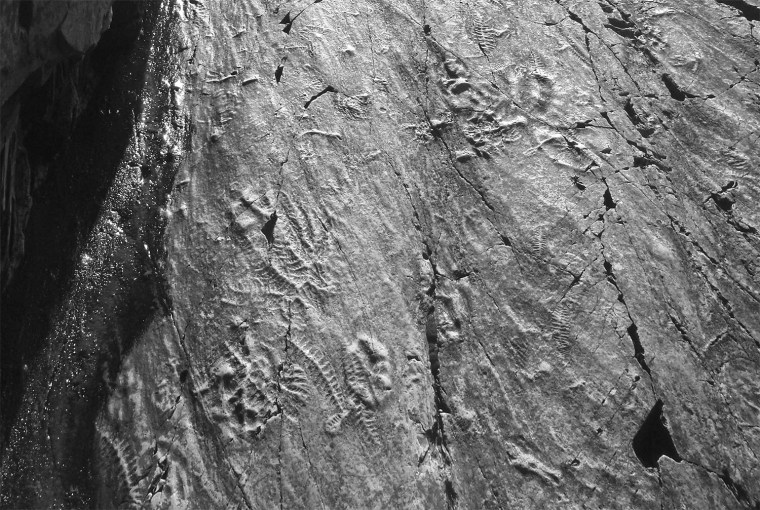
About 635 Ma ago fossils of large-bodied organisms first appeared in the geological record: some quilt like, others with a crude bilateral symmetry, more looking like ‘mud-filled bags’ and ribbed discs but none that can easily be distinguished as animals, plants or colonial microorganisms. First found abundantly in the Ediacara Hills of South Australia, hence their sack-name the Ediacaran biota, it now seems that they were distributed globally in the late Neoproterozoic Era. Interpreting their metabolism is risky enough – some are reckoned to be animals that absorbed nutrients through their skin, others said to be dependent on photosynthesis – but a controversy has raged for many years over the kind of environment in which they thrived. In a detailed 2012 study of sedimentary structures petrography in the South Australian sandstones from which they were first described, Gregory Retallack of the University of Oregon inferred that some lived on land and are now found in palaeosols: they include Spriggina, Dickinsonia and Charnia that are among the most favoured candidates for being animals or some kind. Others inhabited shallow water. Anticipating fiery disputes a Nature editorial appeared in same issue in which Retallack published his paper .
Rich fossil assemblage of the Ediacaran Mistaken Point Formation, Newfoundland. (Credit: Alex Liu, Earth Sciences, University of Bristol)
Retallack has now moved on to the even more fossil-rich Ediacaran sediments of Newfoundland (Retallack, G.J 2016. Ediacaran sedimentology and paleoecology of Newfoundland reconsidered. Sedimentary Geology, v. 333, p. 15-31). Eye-wateringly detailed sequence stratigraphy of the now famous Mistaken Point locality and others suggests that the ecosystem there was an intertidal salt marsh. In detail it contains evidence for shallow-water graded bedding, signs of regular storms and perhaps tsunamis together with interbedded palaeosols and subaerial volcanic crystal tuffs whose feldspars survive intact. The palaeosols can be subdivided into several pedogenic types akin to those used to classify modern soils. Unlike the arid setting of the South Australian Ediacaran sediments, whose palaeosols show signs of freezing, the Newfoundland package indicates humid, cool-temperature climes
As in Australia, the palaeosols are rich in Ediacaran fossils, including the best known; the leaf-like Charnia and its discoidal support structure that appears in Retallack’s reconstruction of the environment in an analogous way to salt-tolerant shrubs in modern tidal flats. They occur together with encrusting fossils that bear some resemblance to modern foliose fungi or lichens. Further chuntering in the palaeontological community seems inevitable, but the sedimentological observations alone knock one hypothesis on the head: it has been said that the graded bedding common to both major Ediacaran assemblages constitutes evidence for deep marine origins from turbidity currents. But there is further compost in which controversy may thrive, in that Retallack ascribes the repeated palaeosols to glacially controlled sea-level fluctuations: the Newfoundland sequence contains two diamictites interpreted as tillite, one dated at ~583 Ma the other undated but at the top of the sequence.
Regular readers will know that I have strong views on attempts to burden stratigraphy with a new Epoch: the Anthropocene. The central one is that the lead-in to a putsch has as much to do with the creation of a bandwagon, to whose wheels all future geologists will be shackled, as it does to any scientific need for such a novelty. Bound up as it is with the fear that Earth may be experiencing its sixth mass extinction, the mooted Anthropocene will likely become a mere boundary marked by future stratigraphers as a Global Boundary Stratotype Section and Point or GSSP between the existing Holocene Epoch and that sequence of sedimentary strata and their fossil record that will be laid down on top of it. Or not, if humanity becomes extinct should the economically induced, dangerous modifications of our homeworld of the last few decades or centuries not be halted. Either way, it defies the stratigraphic ‘rule book’.
No one can deny that humanity’s activities are now immensely disruptive to surface geological processes. Nor is it possible to rule out such disruptive change to the biosphere in the near-future that a latter-day equivalent of the K/Pg or end-Permian events is on the cards: such confidence does not spring from the interminable succession of grand words and global inaction reiterated in December 2015 by the UN Paris Agreement on economically-induced climate change. Still, it was a bit of a relief to find that palaeontological evidence, or rather statistics derived from the fossil record in North American sedimentary rocks since the Carboniferous, emphasises that there is no need for the adoption of Anthropocene as an acceptable geological adjective.
To ecologists, extinctions are not the be all and end all of disruption of the biosphere. Major shifts in life’s richness are also recorded by the way entire ecosystems become disrupted. A classic, if small-scale, example is that way in which the ecosystem of the US Yellowstone National Park changed since the eradication by 1926 of the few hundred grey wolves that formerly preyed mainly on elk. In the 20 years since wolf reintroduction to the Park in 1995 the hugely complex but fragile Yellowstone ecosystem has showed clear signs of recovery of its pre-extirpation structure and diversity.
A consortium of mainly US ecologists, led by Kathleen Lyons of the National Museum of Natural History at the Smithsonian Institution in Washington DC, has assessed linkages between species of fossil animal and plants since the Carboniferous (S.K. Lyons and 28 others, 2015. Holocene shifts in the assembly of plant and animal communities implicate human impacts. Nature, published on-line 16 December 2015 doi:10.1038/nature16447). They found that of the 350 thousand pairs of species that occurred together at different times throughout the late Palaeozoic to the last Epoch of the Cenozoic, the Holocene, some pairs appeared or clustered together more often than might be expected from random chance. Such non-random association suggests to ecologists that the two members of such a pair somehow shared ecological resources persistently, hinting at relationships that helped stabilise their shared ecosystem. For most of post-300 Ma time an average of 64% of non-random pairs prevailed, but after 11.7 ka ago – the start of the Holocene – that dropped to 37%, suggesting a general destabilisation of many of the ecosystems being considered. This closely correlates with the first human colonisation of the Americas, the last of the habitable continents to which humans migrated. This matches the empirical evidence of early Holocene extinctions of large mammals in the Americas, which itself is analogous to the decimation of large fauna in Australasia during the late Pleistocene following human arrival from about 50 to 60 ka ago. Significant human-induced ecological impact seems to have accompanied their initial appearance everywhere. The ecological effects of animal domestication and agriculture in Eurasia and the Americas mark the Holocene particularly. In fact, in Europe the presence of Mesolithic hunter gatherers is generally inferred, in the face of very rare finds of artefacts and dwellings, from changes in pollen records from Holocene lake and wetland sediments, which show periods of tree clearance that can not be accounted for by climate change.
There is no need for Anthropocene, other than as a political device.
Anyone viewing news that covered the adoption of the Paris Agreement on climate change on 11 December 2015 would have seen clear evidence of the reality of the old saw, ‘There was dancing in the streets’. Not since the premature celebration of the landing of the Philae spacecraft on comet 67P/Churyumov–Gerasimenko 11 months before has there been such public abandonment of normal human restraint. In the case of ‘little Philae’ the object of celebration sputtered out three days after landing, albeit with the collection of some data. Paris 2015 is a great deal more important: the very health of our planet and its biosphere hangs on its successful implementation. At 32 pages long, by UN standards the document agreed to by all 196 UN Member States is pretty succinct considering everything it is supposed to convey to its signatories and the human race at large.
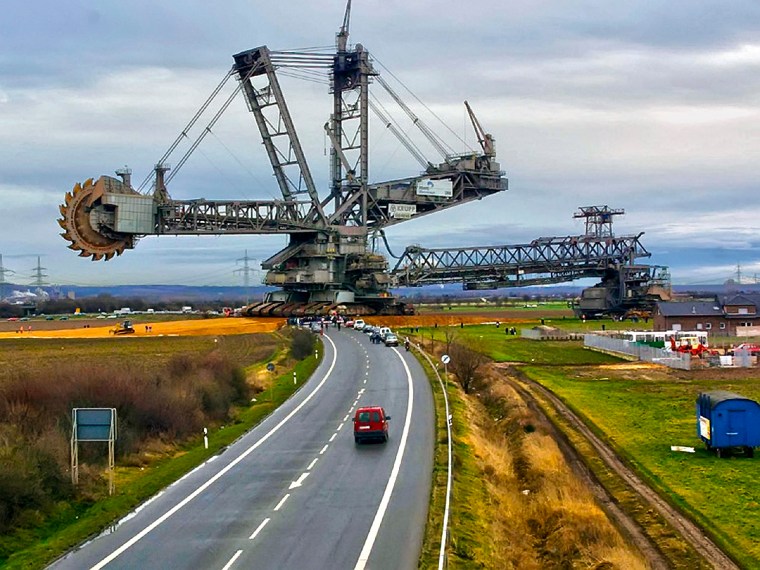
The Bagger 288 bucket wheel reclaimer moves from one lignite mine to another in Germany.
One central and, by most scientific criteria, the most important technology needed as a stopgap before the longed-for adoption of carbon-free energy generation does not figure in the diplomatic screed: carbon capture and storage (CCS) is not mentioned once. Indeed, only 10 Member States have included it in their pledge or ‘intended nationally determined contribution’ (INDC) – Bahrain, Canada, China, Egypt, Iran, Malawi, Norway, Saudi Arabia, South Africa and the United Arab Emirates. Only three of them are notable users of coal-fired power stations for which CCS is most urgent. An article in the January 2016 issue of Scientific American offers an explanation of what seems to be a certain diplomatic timidity about this highly publicized stop-gap measure (Biello, D. 2016. The carbon capture fallacy. Scientific American, v. 314(1) 55-61). David Biello emphasizes the urgency of CCS from more industries than fossil fuel power plants, cement manufacture being a an example. He focuses on the economics and logistics of one of very few CCS facilities that may be on track for commissioning (33 have been shut down or cancelled worldwide since 2010).
The Kemper power station in Mississippi, USA is the most advanced in the US, as it has to be to burn the strip-mined, wet, brown coal or lignite that is its sole fuel. The chemistry it deploys is quite simple but technologically complex and expensive. So Kemper survives only because it aims to sell the captured CO2 to a petroleum company so that it can be pumped into oil fields to increase dwindling production. However, its extraction costs US$1.50 per tonne, while naturally occurring, underground CO2 costs US$0.50 to pump out. Moreover, Kemper’s power output at US$11 000 per kW of generating capacity is three times more expensive than that for a typical coal-fired boiler. Mississippi Power is lucky, in that it only needs to pipe the gas 100 km to its ‘partner’ oil field; a pretty small one producing about 5 000 barrels per day. Some coal plants are near oil fields, but the majority are not. To cap it all, only about a third of the CO2 production is likely to remain in long-term underground storage.
Because Kemper has, predictably, hit the financial buffers (almost US$4 billion over budget) to avoid bankruptcy it has raised electricity prices to its customers by 18%. Without the projected revenue from its partnered oil field it would go belly up. Even in the happy event of financial break-even, in carbon terms it would be subsidising the oilfield to produce…CO2! But the sting in the tail of Biello’s account of this ‘flagship’ project is that the plant is currently neither burning coal nor capturing carbon: it uses natural gas…
Although Alfred Wegener first began to present his ideas on Continental Drift in 1912 his publication in 1915 of The Origin of Continents and Oceans (Die Entstehung der Kontinente und Ozeane) is generally taken as the global launch of his hypothesis. Apart from support from Alexander du Toit and Arthur Holmes, geoluminaries of the day panned it unmercifully because, in the absence of evidence for a driving mechanism, he speculated that his proposed ‘urkontinent’ (primal continent) Pangaea had been split apart by a centrifugal mechanism connected to the precession of Earth’s rotational axis. This ‘polflucht’ (flight from the poles) is in fact far too weak to have any such influence. Wegener’s masterly assembly of geological evidence for former links between the major continents was ignored by the critics, suggesting that their motive for excoriation of his suggested mechanism was as much spite against an ‘outsider’ as a full consideration of his hypothesis. It must have been hurtful in the extreme, yet Wegener defended himself with a series of revised editions that amassed yet more concrete evidence. What is often overlooked, even now that his ideas have become part of the geoscientific canon, is that in his initial Geologische Rundschau paper in 1912 he mused that the floor of the Atlantic is continuously spreading by tearing apart at the mid-Atlantic Ridge where ‘relatively fluid and hot sima’ rises. Strangely, he dropped that idea in later works. Anyhow, neither 2012 nor 2015 was celebrated in the manner of the centenary-and-a-half of Darwin’s On the Origin of Species: 2009 was marked by palaeobiologists and geneticists metaphorically dancing in the streets, if not foaming at the mouth. There have been a few paragraphs, and some minor symposia about Wegener’s dragging geology out of the 18th century and into the 20th, but that’s about it. The best centenary item I have seen is by Marco Romano and Richard Cifelli (Romano, M. & Cifelli, R.L. 2015. 100 years of continental drift. Science, v. 350, p. 916-916).
In the shape of plate tectonics the Earth sciences hosted what was truly a revolution in science, albeit 50 years on from its discoverer’s announcement. It was through the persistent agitation by his tiny band of supporters, that the upheaval was unleashed when the revelations from palaeomagnetism, seismology and many other lines of evidence were resolved as plate tectonics by the discovery of ocean-floor magnetic stripes by Vine, Matthews and Morley in 1963. Despite an explosion of papers that followed, elaborating onthe new theory and showing examples of its influence on ‘big’ geology , counter-revolutionary resistance lasted almost to the first years of the new century. By then so much evidence had emerged from every geological Eon that opponents looked truly stupid. Even so, the skepticism among those sub-disciplines that were ‘left out’ of geodynamic thought continued to blurt out with the emergence of other exciting aspects of the Earth’s history. I remember that, when three of us in the Open University’s Department of Earth Sciences proposed in 1994 that the influence of impacts by extraterrestrial objects ought to figure in a new course on the evolution of Earth and Life we were sneered at as ‘whizz-bang kids’ by those more earth-bound. Trying belatedly in 1996 to introduce students to another revolutionary development – the use of sedimentary and glacial oxygen isotopes in unraveling past climate change – became a huge struggle in the OU’s Faculty of Science. It went to the press eventually and for 2 years our students had the benefit. But the murmuration of dissent ended with a force-majeur re-edit of the course, by someone who had played no role in its development, expunged the lot and changed the ‘offending’ section back to the way it had been a decade before. As they say: ho hum!
Oddly, in the last 15 years or so of trying to follow in Earth-Pages what I considered to be the most exciting developments in the geosciences, it has become increasing difficult to find papers in the top journals that are truly ground-breaking. Of course that may just be ageing and a certain cynicism that often companies it. From being spoiled for choice week after week it has become increasingly difficult from month to month to maintain the standards that I have set for new work. Has Earth science entered the fifth phase of a ‘paradigm shift’ predicted by philosopher Thomas Kuhn in his 1962 book The Structure of Scientific Revolutions? According to him once a science has entered a period when there is little consensus on the theories that might lie at the root of natural processes there is a drift in opinion to a few conceptual frameworks that seem to work, albeit leaving a lot to be desired. Weaknesses at the frontier between theory and empirical knowledge become increasingly burdensome as a result of the steady plod of ‘normal science’ until the science in question reaches a crisis. If existing paradigms fail repeatedly, science is ripe for the metaphorical equivalent of a ‘Big Bang’: maybe an entirely new discovery or hypothesis, or an idea that has been suppressed which new data fits better than any others that have been common currency. Plate Tectonics is the second kind. After the revolution much is reexamined and new lines of work emerge, until in Kuhn’s 5th phase scientists return to ‘normal science’. That looks like a pretty good story, on paper, but other forces are at work in science; external to scientific objectives. Most of these are a blend of economics, political ideologies and managerial ‘practicalities’. If the Earth sciences have entered the doldrums of novelty, I suspect it is these forces that are bearing some kind of glum fruit.
The old concept of academic freedom has gone by the board. Institutions demand that research is externally funded – the more the better as the institution, at least in the UK, demands a kind of tax (40% of that proposed) supposedly to cover corporate overheads including salaries of support staff. If an academic doesn’t pull in the dosh, she is not much favoured. If the individual doesn’t publish regularly either, there is a weasel sanction: Josephine Soap is declared ‘research inactive’. Consortia of researchers are more and more in vogue: managers and funders like ‘team players’, so individuals who are bright and confident enough to ‘stick their necks out’ cannot do that in a consortium publication and as often as not are ‘left on the bench’. Risk taking is more dangerous now and to stay ‘research active’, and in many cases of non-tenured posts getting a salary, an individual, even a few like-minded colleagues have to publish 2 or 3 papers a year.
It’s worth mentioning that open access publishing is not just all the rage, it has become more or less compulsory. Of course, it has some benefits for scientists in less well-heeled countries, but there is a downside. You have to raise the cash demanded by journals for the privilege or potentially universal access – at least US$1000 a pop, depending on a journals Impact Factor, and that of course is an odiously essential corporate consideration – and having done that woe betide those who do not publish and spend it. Academic publishing is the most profitable sector of the trade, the more so as print is supplanted by electronic delivery – the 50 free reprints is a thing of the past. So there are more and more journals and each of them strives to get out more issues per year, and of course those have to be filled. To me, this all adds up to more and more ‘pot-boiler’ articles and a tendency to maximise the flesh rendered from the body of research work and into the pot. Taken together with the stresses of commodification in higher education and the now vertical corporate structures from which it is constituted, it shouldn’t be a surprise that excitement and inspiration are at a premium in the weekly and monthly output of such a marginal science as that concerned with how the world works.
At the end of the 1970’s I was invited by the Deputy Director of the Geological Survey of India (Southern Region) to participate in the Great Postal Symposium on the Cuddapah Basin: a sort of harbinger of the Internet and Skype, but using snail-mail. Feeling pretty honoured and most intrigued I accepted; not that I knew the first thing about the subject. A regular stream of foolscap mimeographed contributions kept me nipping out of my office to check my pigeon hole for about 6 months. I learned a lot, but felt unable to comment. Four years on I was taken across the Cuddapahs by my first research student – a budding moto-cross driver with a morbid fear of bullock carts – en route from the Archaean low-grade greenstone-granite terrains of Karnataka for a peek at the fabled charnockites near Chennai (then Madras). A bit of a round-about route but spurred by my memories of the Great Postal Symposium. Sadly, the detour was marred for me by a severe case of sciatica brought on by manic driving, the state of the trans-Cuddapah highway and a misplaced gamma-globulin shot to ward off several varieties of hepatitis: I mainly blamed the nurse who demanded that I drop my drawers and bravely take the huge needle in a buttock – they do these things more humanely these days. Anyhow, apart from seeing many dusty villages build of slates perfect enough to make a full-size snooker table, my mind was elsewhere and I have long regretted that.
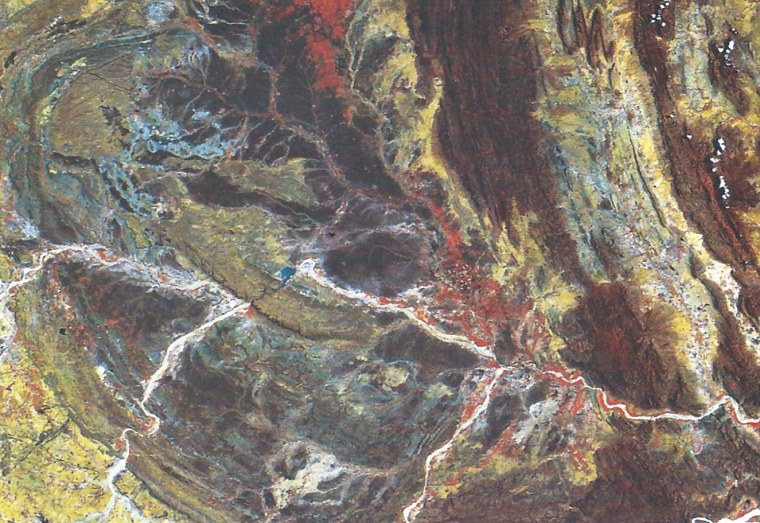
Landsat image mosaic showing part of the Cuddapah Basin.
Hosting possibly the world’s only diamondiferous Precambrian conglomerate, the Cuddapah Basin contains a 5 km thickness of diverse sedimentary strata, but no tangible fossils. It rests unconformably on the Archaean greenstone-granite terrain of the Dharwar Craton and so is Proterozoic in age; an Eon that spans 2 billion years. The middle of the lowest sedimentary formations (the Papaghni and Chitravati Groups) contains volcanic rocks dated at ~1.9 Ga; another group is cut by a ~1.5 Ga granite, and hitherto the youngest dateable event is the emplacement of 1.1 Ga kimberlites that sourced the diamonds in the conglomerate. Until recently the stratigraphy has been known in some detail, but how to partition it in Proterozoic time is barely conceivable with just three dates in the middle parts that span 800 Ma. All that can be said about the base of the Cuddapah sediments is that they are younger than the 3.1 to 2.6 Ga Archaean rocks beneath. Since the uppermost beds are truncated by a huge thrust system that shoved deep crustal granulites over them their minimum age is equally vague.
Structurally, the Basin began to form on a stable continent underpinned by the Dharwar Craton, but when that collided with Enderbyland in Antarctica, as part of the accretion of the Gondwana supercontinent, sedimentation may have been in an entirely different setting. Indeed, some of the sediments have been carried over the undisturbed part of the basin by a major thrust system. To explore both sedimentary and tectonic evolution Australian, Indian and Canadian geoscientists combined to sample and radiometrically date the entire pile (Collins, A.S. and 13 others 2015. Detrital mineral age, radiogenic isotopic stratigraphy and tectonic significance of the Cuddapah Basin, India. Gondwana Research, v. 28, p. 1294-1309). By precisely dating detrital micas and zircons from the sediments the team was able to check the source region of sedimentary grains as well as to establish a maximum age for each major stratigraphic unit. This helped establish a 3-part sedimentary and tectonic history. The earliest sediments came from the cratonic area to the west, but there are signs that collisional orogeny between 1590 and 1659 Ma produced a new sedimentary source in metamorphic rocks forming to the east. A return to westward provenance marked the youngest sedimentary setting. This enabled the team to suggest a dual evolution of the Basin, first as an extensional rift opening at the east of what is now the Dharwar craton followed by collisional orogeny that transformed the setting to that of a foreland basin, analogous to the Molasse basin in front of the Alps during Cenozoic times, ending with tectonic inversion when extension changed to compression and thrusting.
But to what extent did the work improve the age subdivision of the Cuddapah Basin? Apparently very little, which may be down to a problem with dating detrital minerals. If magmatic and metamorphic evolution was continuous in the areas from which sediments moved, then the youngest grain is a good guide to the maximum age of the sediment being analysed. The more strata are analysed in this way the better the detail of sedimentary timing. But two tectonic terrains are unlikely to produce zircons time and time again during a period approaching a billion years. The data indicate only 3 or 4 episodes of ‘zirconogenesis’ in the sedimentary hinterlands, between about 900 to 1940 Ma. Apart from helping correlate sedimentary formations that were previously deemed stratigraphically different – which did help in tectonically unravelling this complex major feature – several hundred isotopic analyses of zircons and micas have give much the same timing as was known already in more precise terms from stratigraphy assisted by a few dozen conventional radiometric dates.
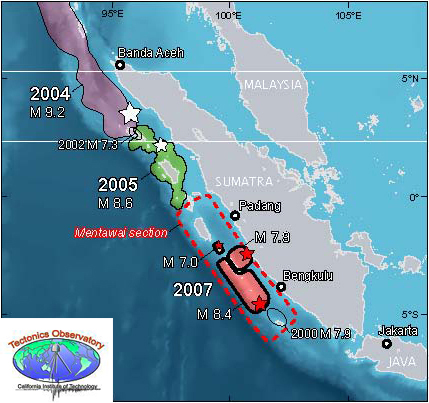
More than a decade after the 26 December 2004 Great Aceh Earthquake and the Indian Ocean tsunamis that devastating experience and four more lesser seismic events (> 7.8 Magnitude) have show a stepwise shift in activity to the SE along the Sumatran plate boundary. It seems that stresses along the huge thrust system associated with subduction of the Indo-Australian Plate that had built up over 200 years of little seismicity are becoming unlocked from sector to sector along the Sumatran coast. Areas further to the SE are therefore at risk from both major earthquakes and tsunamis. A seismic warning system now operates in the Indian Ocean, but the effectiveness of communications to potential victims has been questioned since its installation. However, increasing sophistication of geophysical data and modelling allows likely zones at high risk to be assessed.
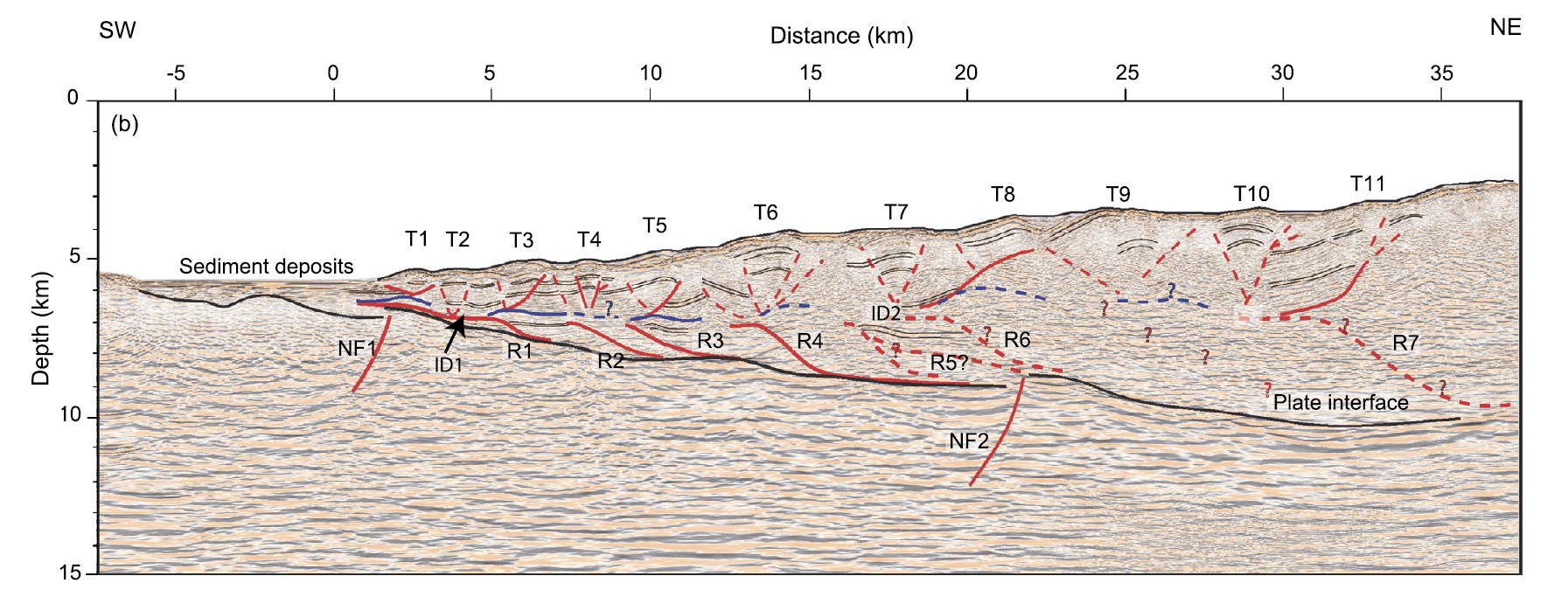
One segment is known to have experienced giant earthquakes in 1797 and 1833 but none since then. What is known as the Mentawai seismic gap lies between two other segments in which large earthquakes have occurred in the 21st century: it is feared that gap will eventually be filled by another devastating event. Geophysicists from the Institut de Physique du Globe de Paris and Nanyang Technological University in Singapore have published a high-resolution seismic reflection survey showing the subduction zone beneath the Mentawai seismic gap (Kuncoro, A.K. et al. 2015. Tsunamigenic potential due to frontal rupturing in the Sumatra locked zone. Earth and Planetary Science Letters, v. 432, p. 311-322). It shows that that the upper part of the zone, the accretionary wedge, is laced with small thrust-bounded ‘pop-ups’. The base of the accretionary wedge shows a series of small seaward thrusts above the subduction surface itself forming ‘piggyback’ or duplex structures.
Seismic reflection profile across part of the Sumatra plate boundary, showing structures produced by past seismicity. (credit: Kuncoro et al. 2015, Figure 3b)
The authors model the mechanisms that probably produced these intricate structures. This shows that the inactive parts of the plate margin have probably locked in stresses equivalent to of the order of 10 m of horizontal displacement formed by the average 5 to 6 cm of annual subduction of the Indo-Australian Plate over the two centuries since the last major earthquakes. Reactivation of the local structures by release of this strain would distribute it by horizontal movements of between 5.5 to 9.2 m and related 2 to 6.6 m vertical displacement in the pop-ups. That may suddenly push up the seafloor substantially during a major earthquake, thereby producing tsunamis. Whether or not this is a special feature of the Sumatra plate boundary that makes it unusually prone to tsunami production is not certain: such highly resolving seismic profiles need to be conducted over all major subduction zones to resolve that issue. What does emerge from the study is that a repeat of the 2004 Indian Ocean tsunamis is a distinct possibility, sooner rather than later.
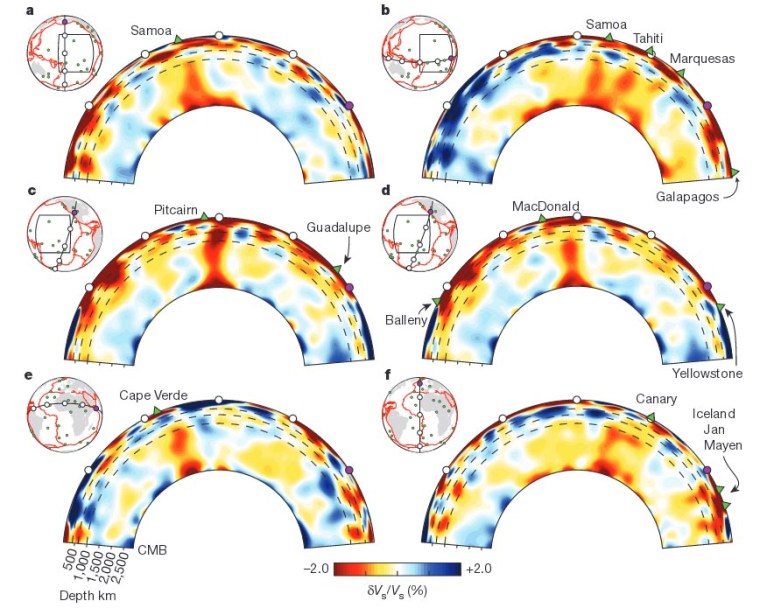
Although no one can be sure about the details of processes in the Earth’s core what is accepted by all is that changes in core dynamics cause the geomagnetic field to change in strength and polarity, probably through some kind of physical interaction between core and deep mantle at the core-mantle boundary (CMB). Throughout the last 73 Ma and especially during the Cenozoic Era geomagnetism has been more fickle than at any time since a more or less continuous record began to be preserved in the Jurassic to Recent magnetic ‘stripes’ of the world ocean floor. Moreover, they came in bursts: 5 in a million years at around 72 Ma; 10 in 4 Ma centred on 54 Ma; 17 over 3 Ma around 42 Ma; 13 in 3 Ma at ~24 Ma; 51 over a period of 12 Ma centring on 15 Ma. During the Late Jurassic and Early Cretaceous the core was similarly ‘busy’, the two time spans of frequent reversals being preceded by quiet ‘superchrons’ dominated by the same normal polarity as we have today i.e. magnetic north being roughly around the north geographic pole.
The Cenozoic history of magnetic reversals – black periods were when geomagnetic field polarity was normal and white when reversed. (credit: Wikipedia)
Until recently geomagnetic ‘flips’ between the two superchrons were regarded as random , perhaps suggesting chaotic behaviour at the CMB. But such a view depends on the statistical method used. A novel approach to calculating reversal frequency through time, however, shows peak-trough pairs recurring 5 times through the Cenozoic Era, approximately 13 Ma apart: maybe the chaos is illusory (Chane, J. et al. 2015. The 13 million year Cenozoic pulse of the Earth. Earth and Planetary Science Letters, v. 431, p. 256-263). So, here is a kind of yardstick to see if there may be any connection between core processes and those at the surface, which Chen of the Fujian Normal University, Fushou China and Canadian and Chinese colleagues compared with the very detailed Cenozoic oxygen-isotope (δ18O) record preserved by foraminifera in ocean-floor sediments, which is a well established proxy for changes in climate. Removing the broad trend of cooling through the Cenozoic resulted in a plot of more intricate climatic shifts that matches the geomagnetism record in both shape and timing of peak-trough pairs. It also turns out, or so the authors claim, that both measures correlate with changes in the rate of Cenozoic subduction of oceanic lithosphere (a measure of plate tectonic activity), albeit negative – peaks in magnetism and climate connecting with slowing in the pace of tectonics.
The analyses involved some complicated maths, but taken at face value the correlations beg the questions why and how? Long-term climate change contains an astronomical signal, encapsulated in the Milankovich hypothesis which has been tested again and again with little room for refutation. So is this all to do with gravitational influences in the Solar System. More exotic still is the possibility of 13 Ma cyclicity linking the Milankovich mechanism with the vaster scale of the Sun’s orbit oscillating through the disc of the Milky Way galaxy and theoretical hints of a mysterious role for dark matter in or near the galaxy. Or, is it a relationship in which climate and the magnetic field are modulated by plate tectonics through varying volcanic emissions of greenhouse gases and the deep effect of subduction on processes at the CMB respectively? To me that seems more plausible, but it is still as exceedingly complex as the maths used to reveal the correlations.
Many of the vast wastes of northern Canada and Scandinavia that were ground to a paste by ice sheets during the last glacial cycle show peculiar features that buck the general glacial striation of the Shield rocks. They are round-topped ridges that wind apparently aimlessly across the tundra. In what is now a gigantic morass, the ridges form well-drained migration routes for caribou and became favourite hunting spots for the native hunter gatherers: in Canada they are dotted with crude simulations of the human form, or inugoks, that the Innuit erected to corral game to killing grounds. Where eroded they prove to be made of sand and gravel, which has proved an economic resource in some areas lacking in building aggregate, good but small examples being found in the Scottish Midland Valley that have served development of Glasgow and Edinburgh. They were given the Gaelic name eiscir meaning ‘ridge of gravel’ (now esker) from a few examples in Ireland.
Eskers form from glacial meltwater that makes its way from surface chasms known as moulins to the very bottom of an ice sheet where water flows much in the manner of a river, except in tubes rather than channels. Where the ice base is more or less flat the tubes meander as do normal sluggish rivers, and like them the tubes deposit a proportion of the abundant sediment derived by melting glacial ice. Once the ice sheet melts and ablates away, the sediments lose the support of the tube walls and flop down to form the eponymous low ridges: the reverse of the sediment filled channels of streams that have either dried up or migrated. Eskers are one of the features that shout ‘glacial action’ with little room for prevarication.
The classic form of eskers in the Phlegra Montes of Mars. (credit: Figure 6 in Gallagher and Balme, 2015)
Glacial terrains on Mars have been proposed for some odd looking surfaces, but other processes such as debris flows are equally attractive. To the astonishment of many, Martian eskers have now been spotted during systematic interpretation of the monumental archives of high-resolution orbital images of the planetary surface (Gallagher, C. & Balme, M. 2015. Eskers in a complete, wet-based glacial system in the Phlegra Montes region, Mars. Earth and Planetary Science Letters, v. 431, p. 96-109). The discovery is in a suspected glacial terrain that exhibits signs of something viscous having flowed on low ground around higher topographic features, bombardment stratigraphy suggests a remarkable young age for the terrain or about 150 Ma ago: the Amazonian. Ice and its effects are not too strange to suggest for Mars which today is pretty much frigid, except for a few suggestions of active flow of small watery streams. Eskers demand meltwater in abundance, and Gallagher and Balme attribute some of the other features in the Phlegra Montes to wet conditions. However, the eskers are a one-off, so far as they know. Consequently, rather than appealing to some climatic warm up to explain the evidence for wetness, they suggest that the flowing water tubes resulted from melting deep in the ice as a result of locally high heat flow through the Martian crust, which is a lot more plausible.
Caves figure highly in discoveries of hominin remains, fossil riches from those near Johannesburg in South Africa and at Atapuerca in northern Spain having set the world of palaeoanthropology reeling in the last few months. As often as not the caves chosen by hominins for day-to-day living, refuge or ritual, places where carnivores dragged some of our early relatives, or into which they fell accidentally, formed in limestones. There are few places so well endowed with karst features than southern China, a fair number of caves in them having rich deposits of bat guano to which farmers have beaten well-trodden paths to dig it out for fertiliser. One such is Fuyan Cave in Daoxian County, Hunan. Manure mining there had done a great deal of the heavy work faced by archaeologists, having stopped when it reached a hard layer of calcite speleothem or flowstone that underpaves more or less the entire cave floor. Initial trial investigations found three clearly human teeth at the surface, encouraging further work. Digging through the flowstone revealed sediments rich in fossils, mainly teeth which preserve better than other remains in humid conditions. As well as teeth from a variety of mammals, large and small, 47 human teeth emerged. Close study revealed dental features that are irrefutably those of anatomically modern humans (Liu, W. and 13 others 2015. The earliest unequivocally modern humans in southern China. Nature, doi:10.1038/nature15696). Remarkably, many of the teeth are in far better condition than my own, and those of many living people with access to dental expertise.
Some of the Daoxian human teeth. (Credit: Song Xing and Xiu-jie Wu of the 1Key Laboratory of Vertebrate Evolution and Human Origins at the Chinese Academy of Sciences)
The true significance of the excavation emerged only when 230Th dating revealed the age of the flowstone cap to the old cave sediments. A small stalagmite protruding from its surface yielded a minimum age of ~80 ka: by far the oldest date for anatomically modern human remains outside of Africa and the eastern Mediterranean. The dating produced older ages around 120 ka with equally good precision. Before this discovery the date of migration of Africans to populate Eurasia was thought to be about 60 ka from imprecise dating based on genetics of a range of living Eurasians and Africans – a ‘molecular clock’ – and the earliest sign of humans found in Australia. Consequently, finds in South India of artefacts beneath 74 ka ash from the super-eruption of the Mount Toba caldera have been regarded by many, other than the finders, as having been made by Homo erectus. Dates of 100 ka for modern human occupation of the Levant were thought to represent a failed attempt at migration out of Africa by a northern route. Both these important findings now take on renewed significance. Yet a 30 to 40 ka time gap between the Fuyan people and the previous dates for the earliest signs of migration into China, Borneo and Australia (40-50 ka) begs the question, ‘Did this early group of far-travelled migrants survive to become ancestors of modern Chinese people?’ There are many possible scenarios that only future discoveries might validate: simply goiung extinct; failure to survive the encounter with earlier migrants, such as H. erectus or the Denisovans; assimilation into those older populations.
Mitochondrial DNA-based chart of large human migrations: the consensus before these new data. Numbers are millennia before present. ( credit: Wikipedia)
As if to counter this, a multinational group of collaborators have sequenced and analysed the genome from a 4500 year-old male skeleton discovered in the Mota Cave of the Gamo highlands of southern Ethiopia (Llorente, M.G. and 18 others 2015. Ancient Ethiopian genome reveals extensive Eurasian admixture throughout the African continent. Science, DOI: 10.1126/science.aad2879). Comparison with what is now a virtual library of living human genomes showed that this man’s genetic make-up most closely matched that of the Ari, a tribe living in the area today. What was most interesting is that part of the modern Ari genome – between 4 to 7% – is not present in the 4500 year-old sequence. Instead, it matches those of modern Sardinians and a prehistoric German farmer. Yet it occurs in people living not only in Ethiopia, but also in central, western and southern Africa to varying degrees. There seems to have been a ‘backflow’ of people into the whole of Africa from Eurasia, estimated to have occurred some 3500-4000 years ago and probably involving a large influx. By that time farming was already established in Africa, so the migrants may have had some advantage, either culturally or physically, to encourage their wide spread through the continent.
In tropical climates, DNA is likely to break down quickly and little if any fossil DNA has been recovered from prehistoric Africans. In this case, burial in a cave at high elevation may have helped preserve it, but also the target for extraction was the petrous bone from the inner ear whose density seems to allow DNA a better change of long-term survival. With continually improving DNA analysis and sequencing techniques more news is surely going to emerge from past African populations.
Luis and Walter Alvarez at the end-Mesozoic Boundary (credit: Wikipedia)
It was 35 years back that father and son team Luis and Walter Alvarez upset a great many geoscientists by suggesting that a very thin layer of iridium-rich mud that contained glass spherules and shocked mineral grains was evidence for a large meteorite having struck Earth. They especially annoyed palaeontologists because of their claim that it occurred at the very top of the youngest Cretaceous and that the mud was spread far and wide in deep- and shallow-marine stratigraphic sequences and also in those of continental rocks. It marked the boundary between the Mesozoic and Cenozoic Eras and, of course, the demise of the dinosaurs and a great many more, less ‘sexy’ beasts. Luis was a physicist, his son a proper geologist and their co-researchers were chemists. It can hardly be said that they stole anyone’s thunder since the issue of mass extinctions was quiescent, yet their discovery ranks with that of Alfred Wegener; another interloper into the closed-shop geoscientific community. They got the same cold-shoulder treatment, but massive popular acclaim as well, even from a minority of geologists who welcomed their having shaken up their colleagues, 15 years after the last ‘big thing’: plate tectonics. And then the actual site of the impact was found by geophysicists in a sedimentary basin in the Gulf of Mexico off the small town of Chicxulub on the Yucatan peninsula.
Chicxulub impact – artist impression (credit: Wikipedia)
As they say, ‘the rest is history’ and a great many geoscientists didn’t just jump but pounced on this potential bandwagon. Central to this activity was the fact that, within error, the ages of the impact, the mass extinction and a vast pile of continental lavas in western India, the Deccan Traps, were more or less the same (around 66 Ma). Flood basalt events are just about as dramatic as mega-impacts because of their sheer scale, of the order of a million cubic kilometres; that they were exuded in a mere million years or so, but in only a few tens of stupendous lava flows; and they are far beyond the direct experience of humans, blurting out only every 30 Ma or so. This periodicity roughly tallies with mass extinctions, great and small, through the Mesozoic. There have been two large bands of enthusiasts engaged in the causality of the end-Mesozoic die-off – the extraterrestrials and the parochialists who favoured a more mundane, albeit cataclysmic snuffing-out. Mass extinctions in general have been repeatedly examined, and in recent years it has become clear that most of those since 250 Ma ago seem to be associated with basalt-flood events and are purely terrestrial in origin. As regards the event that ended the Mesozoic, it has proved difficult to resolve whether to point the finger at the Deccan Traps or the Chicxulub impact. Both might have severely damaged the biosphere in perhaps different ways, so a ‘double whammy’ has become a compromise solution.
Deccan flood basalts forming the Western Ghats in Maharashtra, India (credit: Wikipedia)
Unsurprisingly, a lot of effort from different quarters has gone into charting the progress of the Deccan volcanism. Some dating seemed at one stage to place the bulk of the volcanism significantly before the mass extinction and impact, others had them spot on and there were even signs of an hiatus in eruptions at the critical juncture. The problem was geochronological precision of the argon-argon method of radiometric dating that is most used for rocks of basaltic composition: many labs cannot do better than an uncertainty of 1%, which is ±0.7 Ma for ages around the end of the Mesozoic, not far short of the entire duration of these huge events. Some Deccan samples have now been dated to a standard of ±0.1 Ma by the Ar-Ar lab at the Department of Earth and Planetary Sciences, University of California-Berkeley (Renne, P.R. et al. 2010. State shift in Deccan volcanism at the Cretaceous-Paleogene boundary, possibly induced by impact. Science, v. 350, p. 76-78). The results, between 65.5 to 66.5 Ma, nicely bracket the K/T (now K/Pg) boundary age of 66.04±0.04 Ma. It looks like the double whammy compromise is the hypothesis of choice. But there is more to mere dating.
Renne and colleagues plot the ages against their position in the volcanic stratigraphy of the Deccan Traps in two ways: against the estimated height from base in the pile and against the estimated volume of the erupted materials as it built up – the extent and thickness of successive flows varies quite a lot. The second plot provided a surprise. After the K/Pg event the mean rate of effusion – the limited number of individual flows capped by well-developed soils shows that the build-up was episodic – doubled from 0.4±0.2 to 0.9±0.3 km3 yr-1. Despite the much larger uncertainty in the extent and volume of individual lava Formations than that of their ages, this is clearly significant. Does it imply that the Chicxulub impact somehow affected the magma production from, the mantle plume beneath the Deccan? It had been suggested early in the debate that the antipodean position of the lava field relative to that of Chicxulub may indicate that the huge seismicity from the impact triggered the Deccan magma production. Few accepted that possibility when it first appeared. However, Renne and co. do think it deserves another look, at least at the possibility of some linked effect on the magmatism. Perhaps the magma chamber was somehow enlarged by increased global seismicity; other chambers could have been added; magma might have been ‘pumped’ out more efficiently, or a combination of such effects. The ‘plumbing’ of flood basalt piles is generally hidden, but huge dyke swarms in Precambrian times have been suggested as feeders to long-eroded flood basalts. Seismicity of the scale produced by asteroid impacts can do a lot of damage. The Chicxulub impactor at around 10 km diameter would have carried energy a million times greater than that of the largest thermonuclear bomb, equivalent to an earthquake of Magnitude 12.4 that would have been a thousand times more powerful than the largest recorded earthquake with tectonic causes. Extensional faulting sourced in this fashion in the Deccan area may have increased the pathways along which magma might blurt out.
Related articles
Duncan, R. 2015. Deadly combination. Nature, v. 527, p. 172-173.
Despite the excitement raised by the discovery of remnants of 15 individuals of Homo naledi in a South African Cave the richest trove of hominin fossils remains that of Sima de los Huesos (‘pit of bones’) in northern Spain. In 2013 bone found in that cave from one of 28 or more individuals of what previous had been regarded as H. heidelbergensis, dated at around 400 ka, yielded mitochondrial DNA. It turned out to have affinities with mtDNA of both Neanderthals and Denisovans, especially the second. The data served to further complicate the issue of our origins, but were insufficient to do more than throw some doubt on the significance of H. heidelbergensis as a distinct species: nuclear DNA would do better, it was hoped by the palaeo-geneticists of the Max Planck Institute for Evolutionary Anthropology in Leipzig. Now a small fragment of those data (about 1 tro 2 million base pairs) have been presented to a London meeting of the European Society for the Study of Human Evolution – though not yet in a peer-reviewed journal. Anne Gibbons summarised the formal presentation in the 18 September 2015 issue of Science (Gibbons, Ann 2015. Humanity’s long, lonely road. Science, v. 349, p. 1270).
One of the best preserved discoveries in the Sima de los Huesos, Atapuerca (Spain). (credit: Wikipedia)
The partial nuclear DNA is a great deal more like that of Neanderthals from much more recent times than it is of either Denisovans and modern humans. It seems most likely that the Sima de los Huesos individuals are early Neanderthals, which implies that the Neanderthal-Denisovan split was earlier than 400 ka. That might seem to be just fine, except for one thing: Neanderthal and Denisovan DNA are much more closely related to each other than to that of ourselves. That implies that the last common ancestor of the two archaic human species must have split from the ancestral line leading to modern humans even further back in time: maybe 550 to 765 ka ago and 100 to 400 ka earlier than previously surmised. This opens up several interesting possibilities for our long and separate development. Since Neanderthals and perhaps Denisovans emigrated from Africa to Eurasia several glacial cycles ago, maybe people genetically en route to anatomically modern humans did so too. The Neanderthal and Denisovan genomes suggest that they interbred with each other and that could have been at any time after the genetic split between them. Famously, they also interbred with direct ancestors of living Eurasians, but there is no genetic sign of that among living Africans. The evidence suggests that the insertion of archaic genetic material was into new migrants from Africa around 100 to 60 ka ago at different points along their routes to Europe and East Asia. But, obviously, it is by no means clear cut what passed between all three long-lived groups nor when. It is now just as possible that surviving, earlier Eurasians on the road to modern humans passed on their own inheritance from relationships with Neanderthal and Denisovan to newcomers from Africa. But none of these three genetic groups ever made their way back to Africa, until historic times.
The Cosgrove volcanic track on a natural-colour image mosaic of Australia (credit: Drew Whitehouse, NCI National Facility VizLab)
It is sometimes forgotten that not only oceanic lithosphere provides evidence for hot spot tracks, probably because they are so obvious as island and seamount chains on bathymetric maps. They are not so clear on continents, either because of erosion of volcanoes or topography dominated by features that predate volcanism, but they account for about 20% of proposed tracks. Eastern Australia seems well endowed; four of them marked by a variety of volcanic structures that trend parallel to the Indo-Australian Plate’s NNE Cenozoic drift powered by the Southeast Indian Ridge that separates it from the Antarctic Plate. The timing of the volcanism along the proposed tracks is also highly persuasive. The longest of the tracks, extending about 2000 km SSW from Cape Hillsborough on the coast of central Queensland through New South Wales to Cosgrove in Victoria, is marked by sporadic volcanoes whose age decreases from Late Eocene in the north to Late Miocene in Victoria.
Unlike oceanic hot-spot tracks, those on continents are not continuous lines of volcanic occurrences. The Cosgrove track has several volcanic gaps, up to 650 km wide. This kind of patchy feature once encouraged hot-spot sceptics to question the tectonic affinities of what they regarded as fortuitous alignments. Where volcanic age trends consistent with the hypothesis emerged such doubts have faded into the background academic ‘noise’. In the case of the Cosgrove track all but one of the dates of volcanism tally quite well with the Cenozoic absolute motion of the Indo-Australian Plate and their position along the track (Davies, D.R. et al 2015. Lithospheric controls on magma composition along Earth’s longest continental hotspot track. Nature, v. 525, p. 511-514). Yet the objective of the authors, from the Australian National University and the University of Aberdeen in Britain, was not merely to establish the alignment as a hot-spot track, but to suggest what may have resulted in its marked patchiness.
The geochemistry of lavas from the volcanoes turns out to be of two fundamentally different types: ‘common-or-garden’ basalts in the case of Queensland and peculiar potassium-rich basalts containing the K-feldspathoid leucite in New South Wales and Victoria. Why these compositional differences occur where they do emerged very clearly when their positions were plotted on a new map of the thickness variations of the eastern Australian continental lithosphere. The ordinary basalts rest on the thinnest lithosphere (£110 km), whereas the leucitites are underlain by considerably thicker lithosphere (~135 km). This suggests that the rising mantle whose partial melting produced the magmas was halted at different depths, different geochemical ‘signatures’ of basalts depending on the pressure of melting. The most interesting outcome, albeit one based on an absence of evidence, is that the very large volcanic gaps along the track are each above much thicker lithosphere (>150 km). At those depths a rising mantle plume would be much less likely to begin melting.
The week of 7 to 11 September 2015 was one of the most news-rich of the year. To name but two issues: the plight of tens of thousands of refugees fleeing Africa and the Middle East to Europe was made worse by total confusion, little action and downright obstruction by some of the most privileged governments on Earth ; in Britain one of the most exciting political dramas in decades – the leadership elections of the Labour Party – were reaching a climax of press and political skulduggery because of the unexpected direction both had taken. Something else burst onto the media scene that was, if anything, even more out-of-the-blue to the majority of people on Thursday 10 September: the remains of at least 15 individuals of a new hominin species found in a near-inaccessible cave were announced by a multinational team of geologists and anthropologists. The feature that ensured its wide publicity in competition with some pretty serious political and humanitarian developments was the suggestion that the corpses had been ritually laid to rest by beings that lived maybe 2 million years ago. This major scientific stir arose from the publication of two lengthy papers by the open-access, electronic journal eLife (Berger, L. R. and 46 others 2015. Homo naledi, a new species of the genus Homo from the Dinaledi Chamber, South Africa. eLife DOI: 10.7554/eLife.09560. Dirks, P.H.G.M. and 23 others 2015. Geological and taphonomic context for the new hominin species Homo naledi from the Dinaledi Chamber, South Africa. eLife, DOI: 10.7554/eLife.09560).
Artist’s reconstruction of the face of Homo naledi (credit: John Gurche artist, Mark Thiessen photographer, National Geographic)
Homo naledi (naledi means ‘star’ in the Sotho language: the find was in the Rising Star cave system near Johannesburg) is known in more anatomical detail than any early hominin, and most closely resembles H. habilis and H. rudolphensis discovered 3 to 4 thousand miles away in Tanzania and Kenya. The Dinaledi deposit remains undated but likely to come out at around 2 Ma or older. The sheer wealth of anatomical detail, including complete foot- and hand-bone remains from individuals, evidence for a range of ages at death, and plenty of dental and cranial information, actually poses a taxonomic problem of comparison with remains of other early hominins. Most of them are fragmentary, and it seems likely that once a precise date is obtained H. naledi will assume greater importance in comparative anatomy. Comparison with australopithecines is easier because of their abundant remains, and H. naledi is clearly distinct from that clade as regards gait, chewing, overall physiognomy (see reconstruction video) and cranial dimensions, but does have some australopithecine affinities. They were certainly different from their near geographic neighbour Au. sediba, also found in a cave deposit within the great swath of Palaeoproterozoic limestones near Johannesburg, where the Cradle of Humankind UNESCO World Heritage Site is situated. The brain of Homo naledi was on a par with those of australopithecines as regards volume, yet larger than that of H. floresiensis: it does seem that brain size is not necessarily related to the uses to which it is put.
Interestingly, it is reported that only the most diminutive members of the research team were able to enter the chamber where the remains were found because of the narrowness of the connecting passage. Also, access from the main cave system involved an upward ‘U-bend’, so that although water could – and did from time to time – enter the chamber in the past, it is unlikely that coarse material such as large bones could simply have been washed in, the more so as the chamber is on a minor spur from the main system and its outlet is through small floor drains that could not sustain torrential flow. Nor is there any direct access from the ground surface to this part of the system. Some of the more fragile body parts, such as a hand, are still articulated, which suggests a non-violent movement to the chamber. There are no signs of physical trauma to any of the bones, ruling out action by carnivores or transport by violent floods, nor any indicative of de-fleshing as by cannibalism. However, before fossilisation, many of the bones had been gnawed by beetles and snails. This combination of features leads to the possibility that corpses may have been deliberately placed in the chamber. If they had been, then to get to deepest recess of the cave system and find the Denalidi Chamber required illumination: fire brands. That the chamber was actually a living space is highly unlikely because of its remoteness from the surface. One big question that cannot be answered is whether or not such possible disposal was by ritual or simply for sanitary arrangements. Another possibility, not considered by the authors is seeking refuge from predators and becoming trapped in the desperately constricted space.
The possibility of ritual burial is clearly what has seized headlines. Yet few palaeoanthropologists will accept that: only Neanderthals and anatomically modern humans are definitely considered to have adopted such a practice, in the last hundred thousand years. The association of a bifacial stone tool with 350 ka old H. heidelbergensis remains at Atapuerca in northern Spain has been suggested to be the earliest evidence for ritual burial, but is not widely accepted. There are no reports of artefacts in the Dinaledi Chamber.
One of the pioneers of plate tectonics, W. Jason Morgan, recognised in the 1970s that chains of volcanic islands and seamounts that rise from the ocean floor may have formed as the movement of lithospheric plates passed over sources of magma that lay in the mantle beneath the plates. He suggested that such hotspots were fixed relative to plate movements at the surface and likened the formation of chains such as that to the west of the volcanically active of the Hawaiian ‘Big Island’ to linear scorching of a sheet of paper moved over a candle flame. If true, it should be possible to use hotspots as a framework for the absolute motion of lithospheric plates rather than the velocities of individual plates relative to the others. But Morgan’s hypothesis has been debated ever since he formulated it. A test would be to see whether or not plumes of rising hot material in the deep part of the mantle can be detected. This became one of the first objectives of seismic tomography when it was devised in the last decade of the 20th century: a method that uses global earthquakes records to detect parts of the mantle where seismic waves traveled faster or slower than the norm: effectively patches of hot (probably rising) and cold rock. The first such evidence was equally hotly debated, one view being that the magma sources beneath oceanic islands such as Hawaii and Iceland were actually related to plate tectonics and that the hotspot hypothesis had become a kind of belief system.
Global distribution of hotspots ( credit: Wikipedia)
The problem was that mantle plumes supposedly linked to magmatic hotspots in the upper mantle would be so thin that they would be difficult to detect even with seismic tomography. Geophysicists have been trying to sharpen up seismic resolution partly by using supercomputers to analyse more and more seismic records and also by improving the theory about how seismic waves interact with 3-D mantle structure. This has culminated in more believable visualisation of mantle structure (French, S.W. & Romanowicz, B. 2015. Broad plumes rooted at the base of the Earth’s mantle beneath major hotspots). The two researchers from the University of California at Berkeley in fact showed something different, but still robust support for Morgan’s 40-year old ideas. Instead of thin plumes, they have been able to show much broader conduits beneath at least 5 and maybe more active ends of hotspot chains. The zones extend upwards from the core-mantle boundary to about 1000 km below the Earth’s surface, where some bend sideways towards hotspots, perhaps as a result of another kind of upper mantle circulation.
The sources of these hot columns at the core-mantle boundary appear to be zones of very low shear-wave velocities; i.e. almost, but not quite molten blobs. French and Romanowicz suggest that the columns are extremely long-lived and may even have a chemical dimension – as in the hypothesis of mantle heterogeneity. Another interesting feature of their results is that the striking vertical linearity of the columns could indicate that the overall motion of the lower mantle is extremely sluggish and punctured by discrete convection.