Former Senior Lecturer at British Open University, research in remote sensing of arid lands, groundwater exploration, Precambrian tectonics and geochemistry
The DNA of anatomically modern humans (AMH) differs from that of chimpanzees by a mere 1.2%; they are our closest relatives. This similarity has allowed geneticists to estimate roughly when the two groups diverged from their last common ancestor. A 2016 study suggested 9.3 to 6.5 Ma ago, whereas a 2025 estimate using a different approach suggested 6.3 to 5.5 Ma. Broadly speaking, the divergence took place sometime during the Late Miocene. But that does not mean that the chimp-human last common ancestor resembled either as they are today. The later hominins are different from each other, and fossil chimps of any age are extremely rare.
All living organisms carry the distant past in this manner, ultimately linking them to the Last Universal Common Ancestor (LUCA) of Hadean times. The last two decades have witnessed demonstration of such ancestral genetic connections between the three most recent hominin groups found outside of Africa: AMH, Neanderthals and Denisovans. Most living non-Africans possess 1 to 2 % Neanderthal ancestry and the genomes of Asians and people from Oceania have 0.5 to 5% Denisovan ancestry.
Intriguingly, the DNA of some individuals living in sub-Saharan Africa contains evidence of their ancestors’ introgression with archaic humans, which were neither Neanderthal nor Denisovan. Because DNA is prone to decay in hot climates, none has been extracted from African fossils of earlier Homo, despite their abundance and diversity. Such genetic ancestors have appropriately been termed ‘ghosts’. A group of geneticists from the University of California Berkeley and Johns Hopkins University, Maryland USA have deployed a DNA analytical technique aimed at identifying traces of this archaic ‘ghost lineage’ (Yulin Zhang et al. 2026. Recovering signatures of archaic hominin introgression using ancestral recombination graphs. Science, v. 393, article eaef8874; DOI: 10.1126/science.aef8874)
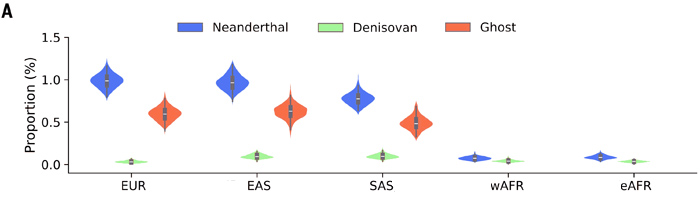
Proportion of archaic ancestry per genome in modern populations from Europe (EUR), East Asia (EAS), South Asia (SAS), West Africa (wAFR) and East Africa (eAFR). Credit: based on Yulin Zhang et al. Fig. 2A
Yulin Zhang and colleagues have devised a novel means of exploring ‘ancestral recombination graphs’ (ARG), called TRACE, which enables them to attempt reconstructions of this hidden history. Ideally, this should be based on archaic reference genomes, such as those of Neanderthals and/or Denisovans, so they devised a ‘work around’ in the absence of any such reference data. They tested their methodology by attempting to filter out the Neanderthal and Denisovan DNA contributed to all genomes of non-African individuals. The results tallied closely with those using earlier methods. The methodology also picked up contributions from both in small amounts (~0.1 %) within the sub-Saharan African data, presumably from individual AMH that migrated back into Africa in the last 65 ka, which had been identified using earlier methodologies. But as well as identifying the previously discovered DNA from an unknown (ghost) lineage in modern Africans’ genomes, their method also found it in those from Europe, East Asia and South Asia. The fact that the ghost DNA segments are shorter than those of Neanderthal and Denisovan origin suggests that the introgression events responsible for them are older. Logically, it can be inferred that they predated modern humans’ leaving Africa, and that is backed-up by similar proportions in non-African genomes.
Applying the last common ancestor approach to the data, Yulin Zhang et al. estimated that the ghost archaic introgression into African human ancestry occurred about 800 ka ago, perhaps involving African Homo heidelbergensis. That date is also roughly when Neanderthals and Denisovans split from a common ancestor. Intriguingly the analysis hinted at an earlier introgression, around 1.8 Ma, that involved interaction of Denisovans with an even more archaic – indeed ‘super-archaic’ – hominin group, perhaps Homo erectus. The most certain conclusion to be drawn from the study is that late-hominin evolution was far more complex than previously imagined. If any remotely related groups met in the course of their migrations, then it seems that interbreeding was almost inevitable.
Palaeoanthropology may be at the beginning of a leap forward based on the DNA of living people and AI-type investigation. It will be spurred on if DNA from more fossils emerges, especially any of late Homo erectus. Even without such a breakthrough, genetic data from the living clearly have plenty more to tell us.
All that there is – a little-finger bone – of the first Denisovan to be discovered using its DNA analysis in 2008
From Europe to Siberia, Neanderthal remains have gradually accumulated since the first 1856 find in Germany’s Neander Valley. Not only are there plenty of them, there are many near-complete skeletons. So we know a great deal about them, including their intimate relations with anatomically modern humans when the two met outside of Africa. Modern people throughout Eurasia are hybrid as a result. The Denisovans, on the other hand, were only discovered through genetic analysis in 2008 of a finger bone and a few teeth from the eponymous cave in western Siberia. Significant traces of AMH-Neanderthal interbreeding emerged in 2010 from segments of their DNA (between 1 to 4 %) being found in living people whose ancestry lies beyond sub-Saharan Africa. Within a few months the same kind of genetic exploration revealed that AMH and Denisovans also interbred. It is now known that the DNA of indigenous people living on Pacific islands and in Australia, South, Central and East Asia and the Americas contains Denisovan segments (up to 5% in the Philippines)
Until 2019 the only tangible remains of Denisovans amounted to a finger bone, a toe bone and three molars. They were then joined by a partial lower jaw from a Tibetan cave, containing one tooth that yielded protein data that roughly matched those from Denisova Cave: not as convincing as DNA, but sufficient. About a decade ago Taiwanese fishers of the Penghu Channel between Taiwan and China began to collect ancient bones from their trawl nets, including those of hominins. In 2025 proteomic data from a Penghu hominin mandible again showed plausible Denisovan characteristics. For years Chinese palaeoanthropologists had been pondering on ancient, very robust skulls that had been discovered then hidden in the 1930s, and only recently re-emerged. One from Harbin, dubbed Homo longi or ‘Dragon Man’ had been dated at 146 ka. It had abundant dental calculus (plaque), which yielded mitochondrial DNA that matched that of Siberian Denisovan remains. At last the Denisovans had a face! There are many similar skulls in China, which had previously been assigned to H. erectus or a range of local ‘species’ but are yet to be subject to genetic and proteomic analysis. So it is possible that Denisovans may be ‘hiding’ in plain sight!
Rear and frontal views of Denisovan partial thigh bones trawled from the Penghu Channel. Left tibia, right femur. The pilaster ridge shows on the right-most image. Credit: Kaifu et al. Fig 2.
Now, once again thanks to Taiwanese trawling (and research by joint Japanese and Taiwanese consortia) two hominin upper-leg bones –a femur and a tibia – have entered the Denisovan collection from the seafloor off Penghu. They are about 45 ka old, and assigned to two separate Denisovan individuals using the proteins of bone collagen. This is a particularly interesting development because upper leg bones are a guide to stature (Yousuke Kaifu and 11 others 2026. Denisovan leg bones from Taiwan reveal large body size. bioRxiv, preprint; DOI: 10.64898/2026.08.07.743438). The leg bones are the largest known from East Asian Pleistocene hominins: i.e. H. erectus and H. sapiens. The femur suggests an individual ~1.8 m tall, weighing around 83 kg, the tibia someone larger (1.9 m and 91 kg). Other commentators have suggested a stature of up to 2.3 m. A ridge of the femur known as its pilaster, to which major muscles are attached, is especially pronounced. This suggests enhanced mobility akin to that in modern hunter-gatherers. A separate preprint about the Penghu leg bones (Minoru Yoneda et al. 2026. Habitat and feeding ecology of a Denisovan from Late Pleistocene Taiwan. bioRxiv, preprint; DOI: 10.64898/2026.08.07.743455) uses carbon and nitrogen isotopes in the tibia to assess the individual’s diet. He/she ate a lot of terrestrial animal protein, but little in the way of aquatic resources. The late Pleistocene ages of the leg bones strongly suggests that the individuals may have encountered modern humans, and the two papers speculate on possible gene flow between Denisovans and AMH.
Let’s hope that this work encourages a flurry of research into other Pleistocene hominin bones from China. Proteomics are not as revealing as ancient DNA, but proteins are sufficiently robust to remain undecayed for hundreds of ka in climates that DNA does not survive for long
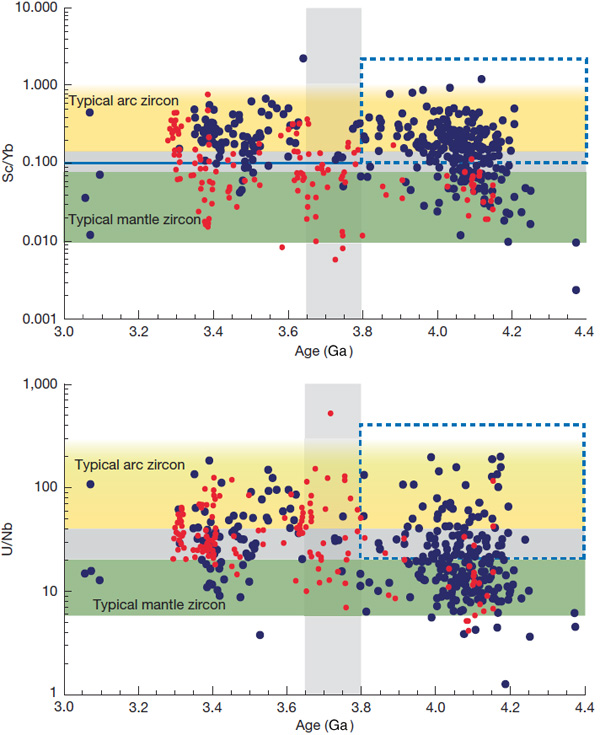
In early July 2026 I commented on a quite plausible hypothesis that energy from repeated impacts played the primary role in forming the first Hadean crust. That would also help explain why rocks from those early times are vanishingly rare: they may have been remelted and recrystallised numerous times. But there are Hadean zircon grains from the Archaean Jack Hills sandstone of Western Australia that have underpinned a cottage industry for some geochemists for three decades. Such grains must have crystallised from magma, and inherited trace elements from the igneous processes that formed them. An experiment to test the early impact-melt hypothesis appears in a new publication soon to appear in Nature (Szumila, I. and 11 others 2026. A missing continental impact melt sheet signal in the early Earth detrital zircon record. Nature Communications, In press. DOI: 10.1038/s41467-026-76529-w). Led by Ian Szumila of the Carnegie Institute, Washington DC a group of geochemists from the US, UK and Canada compared a range of elements in zircons from the well-established 1.85 Ga impact melt sheet at Sudbury – the largest of its kind preserved on Earth – with those from more typical, internal igneous processes. They used the data from these known settings to ‘train’ a machine-learning model that can be applied to ancient, detrital zircon grains: the ‘unknowns’ with ages between 3.2 to 4.3 Ga.
The Sudbury complex is made up of a basal sheet of mafic igneous rocks (norite and quartz gabbro) and an upper granitic (granophyre) sheet. Essentially, trace-element data from Sudbury zircons result from ‘exogenous’ melting triggered by a massive impact, whereas those formed by internal magmatic processes are of ‘endogenous’ origin. Finding statistically different geochemical features is, however, a tall order as earlier investigations demonstrate. One study comparing the titanium concentration in Sudbury and Hadean zircons found that crystallisation temperatures of those in the accredited impact melt sheet differed from those of Hadean age. This suggested impact melting was not a primary source for the Hadean crystals. Another based on mineral inclusions in the two populations of zircons did support Hadean impact melting, as did a repeat of the Ti approach to crystallisation temperatures. Szumila et al.’s approach using a more sophisticated comparison of a wider range of the zircons’ trace elements seeks to resolve the issue: their U/Yb, Th/U, Yb, and Gd/Yb ratios.
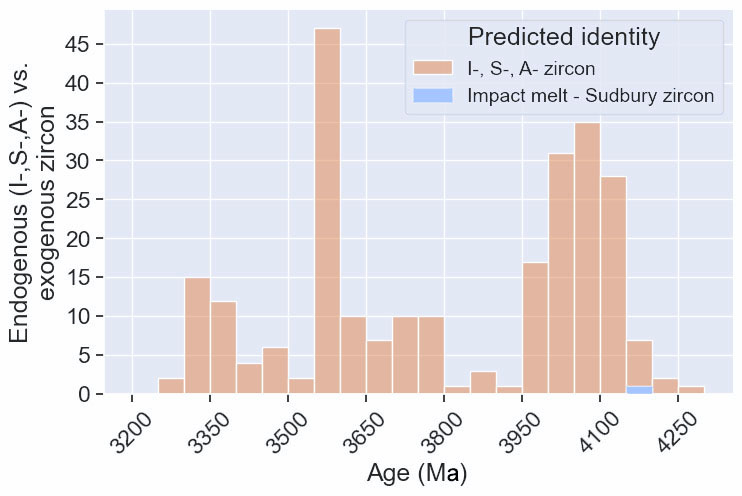
Predicted identity of detrital zircons dated to between 3200 and 4300 Ma: endogenous – pink; exogenous – blue. Credit Szumila et al. Fig 4.
Of the 250 detrital zircon grains dated between 3200 to 4300 Ma-old only a single 4150 Ma-old grain was assigned to an exogenous/impact origin. Apparently, the repeated impact-melt hypothesis for the formation of Earth’s original, Hadean crust is not supported by this experiment. Maybe it did happen, indeed the lunar cratering proxy record for Hadean bombardment of the Earth is unchallengeable. Possibly repeated mega-impacts obliterated and churned up their predecessors’ legacy thereby thermally modifying the tiny zircon grains’ geochemistry before erosion freed them to early and repeatedly reworked sediments. Such a conclusion begs the question of whether or not sustained bombardment repeatedly heated surface water or even boiled it away episodically. On that hangs the vexed question of when self-reproducing organic chemistry was able to result in the earliest life forms: I doubt we will ever know when that fait accompli happened …
Palaeontologists became aware that the fossil record was marked by bursts of extinctions as data about fossil diversity through time steadily grew. That it did was a matter of dogged collection wherever field work was possible, identifying different species, classifying them, publishing the data and cataloguing them, each with a leavening of dispute. Only when those databases had become increasingly global and been collated in digital form did it become possible to chart the course of evolution in a comprehensive and comprehensible manner. First, that was simply as time series then in relation to other kinds of geological record, such as those of broad sea-level and climatic changes, environmental geochemistry, tectonics and relatively short-lived events such as large igneous provinces (LIPs) and asteroid impacts.
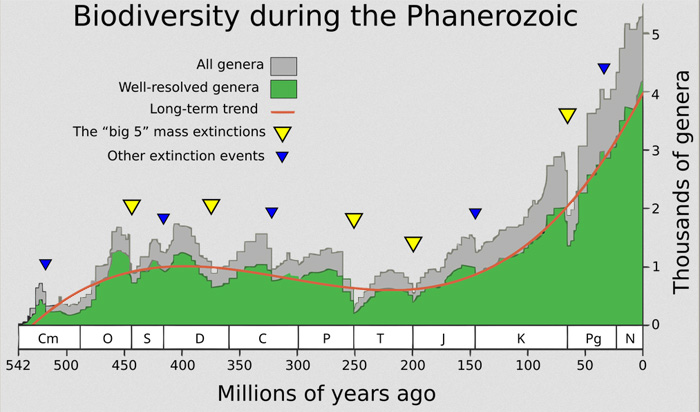
The fluctuation of life on Earth during Phanerozoic Eon: the last 542 Ma. Credit: Wikimedia Commons
‘Everyone knows’ the ‘Big Five’ mass extinctions: at the ends of the Ordovician (a loss of 85% of species at ~444 Ma); Devonian (70% of species at ~369 Ma); Permian (81% of species at 252 Ma); Triassic (70% of species at 201 Ma); and Cretaceous (75% of species at 66 Ma) Periods. The magnitudes relate to marine life, the terrestrial fossil record being more incomplete and less reliable. And there have been many lesser bursts of extinction and evolutionary radiations that followed to replenish and further diversify life. Extinction peaks signify sudden environmental change for which several plausible ‘causes’ have been suggested: asteroid impact, LIPs, ocean anoxia and a few others involving astronomical factors. Biodiversity during the Phanerozoic was always in a state of flux, but with progressive increases after each major crisis to modern times. There are many physical or abiotic processes that may have influenced biodiversity. So there is much uncertainty in the interplay of cause and effect, in much the same way as fluctuations in the world economy since the Industrial Revolution are difficult to fathom, even though financial data are much more precise and limited. Fossil and environmental data are plagued by heterogeneity, irregular sampling and the uncertainties in geochronology and the largely geochemical proxies deployed to monitor past environmental change. Another factor is the plain fact that, as well as abiotic processes, life itself affects environments; again economics – e.g. the interplay of supply, demand and price – offers stark lessons about the reductionism that still dominates much scientific discourse.
A multinational group led by mathematician Ivan Sudakow of the Open University have analysed carbon and oxygen data from the last 539 Ma – the Phanerozoic Eon – to model how the link between the carbon cycle and Earth’s climate relates to the fossil record. Rather than trying to grapple with a reductionist approach, i.e. ‘cause and effect’, they have attempted to show how the ‘backdrop’ to evolution varied through time: how the Earth System was organised during the half-billion years of ‘visible life’ (Sudakow, I. Et al. 2026. Transitions between persistent climate–carbon regimes coincide with elevated Phanerozoic biosphere vulnerability. Nature Communications v. 17, article 7559; DOI: 10.1038/s41467-026-75655-9). They omit the 100 Ma-long Ediacaran Period (635 to 539 Ma) when tangible life was abundant, if primitive. A measure of biotic vulnerability derived from the fossil record is central to their comparative analysis. It conflates the turnover of genera with biotic diversity. The authors suggest that a high turnover at a time of low diversity indicates high vulnerability. The Ediacaran fauna is nowhere near as diverse as those following the Cambrian Explosion and simply vanished from the record at the end of the Neoproterozoic, hence its omission.
Biotic vulnerability through the five ‘mega-climate’ states of the Phanerozoic, and the ‘Big Five’ mass extinction events. Credit: Sudakow et al. 2026; Fig. 5
The methodology, data plots and language used by Sudakow et al. are pretty obscure for a general geological audience and thus for me! Be that as it may, their complex analysis leads them to suggest plausibly that climate and the carbon cycle remained in persistent states during five long periods: Cambrian–Upper Ordovician (539–447 Ma); Upper Ordovician–lowermost Carboniferous (447–358 Ma); Carboniferous–Middle Triassic (358–239 Ma). Middle Triassic–early Palaeogene (239–57 Ma); Post-Palaeogene (57–0 Ma). Biotic vulnerability fluctuated within them, the largest mass extinctions occurring when it rose to peaks towards the start and/or end of each persistent climate-carbon state. But their work grossly simplifies the vast complexity of interwoven biotic and abiotic processes. It leaves out global changes in sea-level, the varying supply of elements released to the oceans by continental weathering – nutrients (N, K, P and Fe), toxins (e.g. Hg and S) and skeleton-building elements (e.g. Si, Ca and Mg) – and fluctuations in dissolved oxygen that reflect varying redox conditions; to name but four. Each of them would impact on life in different ways, and each can be parameterised in detail by geochemical data from sedimentary rocks
So, a useful test for the authors’ hypothesis would be to perform the same kind of analysis using, for instance, well-documented sea-level changes since the Early Cambrian, which would have shifted the availability and location of ecological niches. Likewise, the course of super-continent accretion and break up. There are also Phanerozoic time series for the oxygenation of seawater, especially for deep-water sediments, which show irregular pulses of anoxia, some of which are implicated in extinctions such as the end-Permian. And there are more data that are relevant to the co-evolution of Earth and life. I would not be surprised if such studies produced different scenarios from those arising from investigations of just surface average temperature (SAT) and the carbon cycle. No doubt others will follow where Sudakow et al. have led. Perhaps that team has plans to diversify its approach.
A cautionary philosophical question, however, is, ‘How far can rationalisation, even using mathematically sophisticated methods, hope to unravel geological history and past fluctuations in the biosphere?’
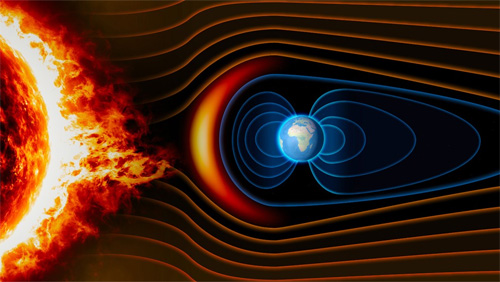
Earth’s magnetic field diverts charged particles in the solar ‘wind’
The aspect of geomagnetism that is most familiar to geologists is the magnetic field’s repeated reversals of polarity. It manifests as the magnetic ‘striping’ of modern ocean floors: key to the discovery of plate tectonics. Relatively easy to measure in intricate detail using modern magnetometers, the ‘stripes’ record plate motions back to about the Middle Jurassic (~165 Ma). There are some examples of polarity reversals from Meso- and Neoproterozoic continental rocks but not a continuum. Measuring the direction of remanent magnetism in rock samples in ancient blocks of crust allow geologists to assess their former positions and orientation relative to magnetic poles of the past, and thus evidence of ancient continental drift. Measuring the intensity of past geomagnetism – its field strength – is more difficult than either. That is critically important for Earth’s biosphere because the magnetic field deflects high-energy charged particles from the Sun and cosmic rays that would otherwise reach the surface. Without a geomagnetic field it is possible that living cells could not survive. Even with the modern protective efficiency of geomagnetism, such particles are a likely source of genetic mutations in DNA: a key requirement of biological evolution.
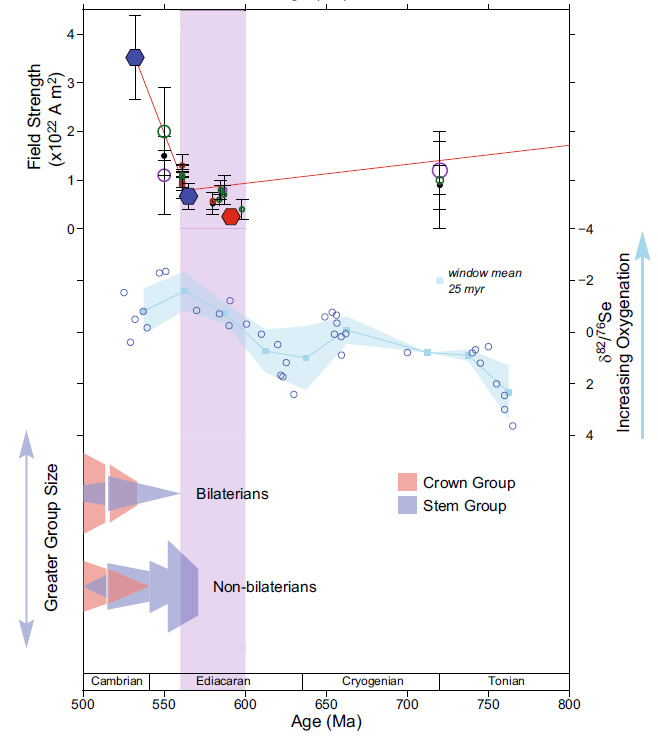
In 2022 an extremely low magnetic field strength – about 15 times less than it is today – was found in a 565 Ma-old anorthosite intrusion from Quebec, Canada that crystallised in the late Ediacaran Period. Samples from as far back as 3500 Ma in the Archaean showed a slow decline in field strength that culminated in its near vanishing in the Ediacaran. This fostered speculation that maybe increased genetic mutation by such an extraterrestrial bombardment of primitive eukaryote cells may have triggered the evolution of the multicelled Ediacara Fauna and perhaps even the first single-celled eukaryotes. A follow up in 2024 by a multinational group of scientists analysed minerals in igneous rocks from South Africa (2054 Ma) and Brazil (591 Ma) to check the magnetic-field strength in the Palaeoproterozoic Era and the Ediacaran Period (Wentao Huang and 16 others, 2024. Near-collapse of the geomagnetic field may have contributed to atmospheric oxygenation and animal radiation in the Ediacaran Period. Nature Communications: Earth and Environment, v. 5, article 207; DOI: 10.1038/s43247-024-01360-4). A more recent study by British and Brazilian geophysicists (Lloyd, S.J. et al. 2026. Earth’s magnetic field remained weak for 40 million years after the Cambrian radiation, Science Advances, v. 12, article eaeg2325; DOI: 10.1126/sciadv.aeg2325) suggested that field strength remained very low until about 505 Ma in the late Cambrian.
The very low magnetic field strength during the Ediacaran (pink), selenium isotope proxy for oxygen availability and radiation of bilaterian and non-bilaterian animals. (Credit: Wentao Huang et al., Fig 3b)
The slow decline in magnetic field strength during the Precambrian probably reflects slowing of turbulent motion in the early, completely molten core as it cooled. Eventually, at the time of very low magnetic field strength around 565 Ma the solid inner core slowly began to form through crystallisation of Fe-Ni alloy, reaching about half its present radius by the end of the Ordovician Period (~450 Ma). This roughly 100 Ma period encompasses the emergence of the Ediacara Fauna and the Cambrian ‘Explosion’ when the basal groups of almost all ‘modern’ eukaryote phyla evolved. Such a geologically swift burst of evolution now seems to be connected to more rapid genetic mutation when the Earth almost lost its ability to be shielded from radiation by its magnetic field. Natural selection had a wealth of options to test, promote or snuff out. To plagiarise the Duke of Wellington, it may have been ‘the nearest run thing you ever saw in your life’. But according to Wentao Huang et al. another beneficial factor for eukaryote evolution may have been that solar-wind bombardment could have split water into its component oxygen and hydrogen. Being so light, hydrogen would have been driven into outer space leaving Earth’s atmosphere with more oxygen, which is vital for eukaryotes.
Ocean floors, especially those of the Pacific and Indian oceans, are bespattered by tens of thousands of seamounts and volcano-based islands. Some of them define chains roughly aligned with the direction of sea-floor spreading and whose age of activity changes progressively along the chains. A few include bends linked to past changes in plate motions (see: The Great Bend of the Pacific Ocean Floor; May 2009). There are also vast, drowned plateaus, which mark oceanic equivalents of flood-basalt provinces on continents. The July 2026 issue of Nature Geoscience is dominated by four papers that are focused on such magmatism within oceanic plates, together with several commentaries and a striking cover image. The findings reported by the authors are briefly summarised by the Issue’s editor and two News & Views items (Editor 9 July 2026. Emerging insights on oceanic intraplate volcanism. Nature Geoscience v. 19, p. 739; DOI: 10.1038/s41561-026-02051-9; Ito, G. 2026. The deep link between intraplate volcanism and plate tectonics. Nature Geoscience v. 19, p. 743-744; DOI: 10.1038/s41561-026-02027-9. Whittaker, J. 2026. Linking plates to plumes in the Cretaceous Pacific. Nature Geoscience v. 19, p. 745-746: DOI: 10.1038/s41561-026-02026-w).
Fig 3-D simulation of geodynamics beneath the Pacific and Indian Ocean floors on the cover of the July 2026 Issue of Nature Geoscience. Credit: Hao Dong, Institute of Geology and Geophysics, Chinese Academy of Sciences.
Age-progressive seamount chains have been ascribed since the birth of plate tectonics to the movement of an oceanic plate over ‘hot spots’ or mantle plumes. Yet the vast majority of sea mounts are apparently distributed at random. They have posed a bone of contention for oceanographers. One of the papers proposes a clear explanation (Hao Dong et al. 2026. Deep mantle plume origin of oceanic intraplate volcanism. Nature Geoscience v. 19, p. 828-836; DOI: 10.1038/s41561-026-02006-0. See also: Iyer, D, 2026 New 270‑Million‑Year Simulation Reveals Hidden Heat Zones Behind Thousands of Seamounts. Bioscience/Marine Science10 June 2026). The authors, based at the Institute of Geology and Geophysics of the Chinese Academy of Sciences, have produced a simulation of changing mantle dynamics beneath the Indian and Pacific Oceans over the last 290 Ma. In their model, hot mantle rising from the core-mantle boundary has repeatedly interacted with the oceanic upper mantle and lithosphere. This rise of hot mantle seems not always to manifest as discrete plumes from the depths. Rather it diffusely heats the asthenosphere to produce large-scale hot regions over which clusters of isolated seamounts formed while the thermal anomaly remained. They liken them to “seamount breweries”, and posit fragmentation of the rising mass of hot mantle, sometimes at depth or within the upper mantle. Such mechanisms drift with the overall mantle and lithospheric flow, so that seamount-volcanoes continue to develop, provided the ‘brewing zones’ retain sufficient heat.
But what might have launched such rising deep mantle? Another study notes that seamount volcanism is more voluminous on ocean floors that once passed over large low-shear-velocity provinces (LLSVPs) in the lowermost mantle beneath Africa and the Pacific Ocean (Conrad, C.P. & Domeier, M. Seamount volcanism associated with Earth’s basal mantle structures. Nature Geoscience v. 19, p. 822-827; DOI: 10.1038/s41561-026-02007-z) These massive deep-mantle provinces are hotter than their surroundings so they are less rigid, which is why seismic S-waves travel more slowly through them. They also lie on opposite sides of the Earth and may have done so for several billion years. Two other, independent studies in the same issue of Nature Geoscience also imply a connection to the deep mantle (Jinchang Zhang et al. 2026. Ontong Java Plateau formed by a thermochemical mantle plume. Nature Geoscience v. 19, p.846-854; DOI: 10.1038/s41561-026-02019-9; Dingshan Deng et al. 2026. Vigorous mantle convection triggered the Cretaceous Pacific large igneous provinces. Nature Geoscience v. 19, p. 837-845; DOI: 10.1038/s41561-026-02016-y).
Extrusion of large igneous provinces (LIPs) on the floor of the Pacific Ocean peaked during the Early Cretaceous. Dingshan Deng and colleagues modelled mantle flow that links subduction, plume activity and mid-ocean ridge activity, which suggests that deep-mantle upwelling peaked around 130 to 125 Ma ago and was driven by increased subduction around the ocean’s margin. This slowed down the rate of spreading at mid-ocean ridges so that heat had to be dissipated by increased melting elsewhere to outpour magma that created LIPs such as the Ontong Java Plateau. The article by Jinchang Zhang et al. focuses on the Ontong Java Plateau, the largest such volcanogenic structure known on Earth. Long regarded as having been produced by a huge buoyant, hot plume, they calculate that such a phenomenon would have had to have uplifted the ocean floor above sea level. That clearly did not happen. To reconcile the sheer volume of magma production with extrusion on deep ocean floor, the authors considered a denser and hotter source mantle, perhaps 135 to 200°C higher than ambient mantle temperature. One possibility is that it had incorporated a lot of older subducted slab materials and was hot enough to thermally erode the plate on which the Ontong Java Plateau was emplaved.
In the 70 years since ideas on plate tectonics began to develop the approach has changed. It began in a ‘compartmentalised’ fashion: spreading at mid-ocean ridges; descent at subduction zones; hot spots and mantle plumes, and so on. Most, if not all Earth scientists involved in this scientific revolution adhered to a reductionist philosophy; i.e. breaking down the hugely complex Earth system into simpler components – the whole is the sum of its parts – an approach begun in the 17th century by by René Descartes. Now, instead of a focus on and separation of cause and effect, it is becoming clearer that the Earth system is fundamentally one of global interconnections, in continuous motion and change. A change in one part inescapably rebounds on all the others, so that the system continually evolves. The tools available to geoscientists have evolved too.
Map of the Rising Star cave system in Gautong Province South Africa. The yellow dot marks the chamber where Homo naledi fossils were first found; the red one is the site of a new discovery. (Credit: Elliott et al 2021, PaleoAnthropology. Issue 1.64, Fig. 1)
In September 2015 a barrage of publicity announced the remarkable unearthing of the remains of 15 diminutive hominins (see: The ‘star’ hominin of South Africa; September 2015). Subsequently this number rose to at least 24. It was named Homo nadeli, from the floor sediments of an almost inaccessible chamber in the Rising Star cave system of South Africa. In many respects the individuals seemed to share affinities with both australopithecines and the earliest known human, but subsequent dating to 335 to 236 ka proved they were not a ‘missing link’. Many near-complete skeletons suggested that they were similar in many ways to members of the genus Homo. Like H. floresiensis they may have evolved during protracted isolation from their contemporary hominins, perhaps even early modern humans. Nevertheless, it was indeed one of the most dramatic palaeoanthropological discoveries of the 21st century. But its celebrety is as much for the extraordinary efforts of women archaeologists small and lithe enough to wriggle through a maze of extremely narrow cave passages: and the deft PR skills of the leader of the discovering expedition, Lee Berger.
The skeletal remains in the remote chamber were near-complete, with little sign of physical trauma, except gnawing by snails and beetles. Few hominin bones have turned up in the more accessible parts of the cave. One likely explanation was that a living H. naledi group had deliberately carried the bodies through the cave system for burial – at less than 1.5 m tall with a slender build they could have done this far more easily than the modern excavators, but they must have used firebrands to light their way. It was alternatively suggested that a group of them, panicked by large predators, may have scrambled deep into the cave to hide, and suffocated as CO2 built-up to toxic levels, as happens occasionally to trapped speleologists. But another twist has arisen, more than a decade after the discovery.
Applying the large spectrum of modern forensic analysis to such a wealth of bones takes time. One approach, genetic sequencing, demands a great deal of patience. None of the bones preserved ancient DNA, probably because of their age and the high ambient temperatures and humidity of burial at low latitudes. A team led by Palesa Madupe of the Max Planck Institute for Evolutionary Anthropology, Leipzig, Germany then resorted to extracting protein from tooth enamel of 20 individuals (Madupe, P. and 20 others 2026. Proteomic analysis of dental enamel from 20 Homo naledi individuals shows no male markers. Cell, v. 189, p. 1-10; DOI: 10.1016/j.cell.2026.05.044). One dental protein amelogenin (or AMEL) in every analysed hominin species has separate male and female types (AMELX and AMELY), analogous to Y and X chromosomes. Rather than being of mixed sex, the bodies were all women: even the few infants. So, what can that one-in-a-million finding imply?
One of the leaders of the Rising Star team (Lee Berger) had suggested since 2015 that H. naledi had purposefully buried its dead. He now suggests that the species separated sexes in their death rituals. For beings with brains about the size of chimps that seems unlikely to some critics. The earliest evidence for separate mortuary practices only appears in late-Neolithic burials. Moreover, the first evidence for any kind of human inhumation is about 100 ka later than Rising Star at a Neanderthal site in Israel. A possibly more plausible explanation is that H. naledi men were simply too big to reach the burial chamber, i.e. that the species was sexually dimorphic. If so, then why are there no remains of men in more easily accessed parts of the cave system? There remains one other scientific possibility: perhaps H. nadeli had only one type of AMEL and the genes responsible for it – i.e. the L variety was shared between both sexes. Palesa Madupe had previously found AMELY in tooth enamel from a 2 Ma-old South African hominin, so considers that possibility to be highly unlikely. All other approaches seem to be a matter of opinion about cultural practices of which we know little. One seems useful. If H. naledi had a high female to male ratio, perhaps females died at ‘home’, while male hunters were killed while hunting and then eaten by large predators … Further suggestions via Leave a comment.
The Hadean Eon (~4.6 to 4.0 Ga) is short on rocks that represent it. In fact geologists only know of a single 20 km2 outcrop within that age span (~4.3 Ga): the Nuvvuagittuq Greenstone Belt (~4.3 Ga)on the eastern shore of Hudson Bay. Even that age remains disputed. But a few, tiny detrital zircon grains extracted from much younger sandstones yield an age range up to 4.4 Ga: barely enough to refute James Hutton’s ‘No vestige of a beginning’. So, the Hadean is long on speculation, most based on less than 3% of all the detrital zircon grains that have been dated. What zircons can tell us is based on their isotopic geochemistry, their trace-element content and even tinier granules of a few other minerals that they encapsulate. The data from them suggest the presence of some kind of felsic magma production that crystallised at low temperatures (~700° C) and was exposed to watery fluids. All very vague compared with what can be gleaned with confidence from post-4.0 Ga rock exposures. But there is a sound astronomical context and a theory based on geophysical and geochemical processes known from experiment and observation of later geology, that can shed a little light.
The planetary system began to form by gravitational accretion of material in a protoplanetary disc of pre-solar gas and dust. The first step would have been gravitational sticking together of dust particles. Fast when this cloud was dense but slowing as the available starting material was depleted by growing planetesimals. This early accretion would easily have radiated away the heat generated by the gravitational potential energy that was released. But that became less effective as the accreting bodies grew to sizes of tens to hundreds of kilometres. Studies of meteorites, formed by collisions of larger planetesimals, show that they became hot enough to melt their contents and even to undergo internal, geochemical differentiation. The current view of the next step is that gravitational perturbations associated with Jupiter drove bodies ranging from asteroidal to Mars size into chaotic motion through the Solar System. Assembly of protoplanets thereafter was dominated by collisions. In the case of the proto-Earth this involved its collision with another, Mars-sized body, to result in the formation of the Moon and the early Earth, each initially enveloped by magma oceans. This event can be considered to be the starting point for all subsequent geological processes on both bodies. But that did not ‘calm down’ planetary bombardment. Plenty of large asteroids were still around: their size range can be judged roughly from those that remain in the Asteroid Belt, that are up to 940 km across in the case of the dwarf planet Ceres. This repository of Hadean objects is what motivated Tim Johnson of Curtin University, Western Australia and three Australian colleagues to ponder on the influence on the Hadean Earth of far more bodies, large and small, hurtling around the early Solar System (Johnson, T.E. et al. 2026. Impact heating and the hidden Hadean. Science, v. 392, p. 1408-1412; DOI: 10.1126/science.aeb5402. PDF requests to tim.johnson@curtin.edu.au).
The impact history of the Earth has largely been expunged by tectonics, erosion and sedimentary burial. Johnson et al. assumed an early impact flux from the almost pristine ‘stratigraphy’ of lunar cratering scaled up to the roughly 13 times greater gravitational pull of the Earth. They calculated that energy being released by impacts and partly incorporated into the Earth during the Hadean outweighed that being generated by internal radioactive decay by several orders of magnitude. Hadean tectonics was thus thermally dominated by impact energy, whose supply probably fluctuated wildly because of different sizes of impacting bodies. By far the largest crater on the Moon – the South Pole-Aitken basin – is 2500 km across. It formed about 4.3 Ga ago when a body 200 km wide struck the lunar surface. Being larger and having a greater gravitational pull, Earth would have suffered up to ten collisions of this magnitude.
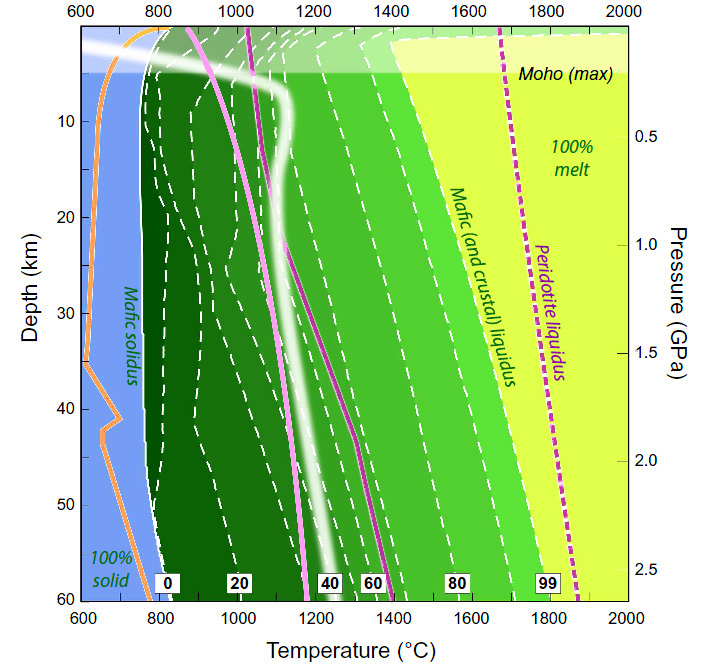
In Archaean and later times tectonics became the main means of shedding ‘smoothly’ generated internal radiogenic heating. Dated lunar rock samples strongly suggest that such awesome bombardment lasted until the early Archaean, around 3.8 Ga ago. Traces of this Late Heavy Bombardment are anomalous tungsten isotopes in gneisses of that age from West Greenland (see: Tungsten and Archaean heavy bombardment; July 2002). Internal heating now governs the physical behaviour of rock: whether it is ductile or brittle. Modern-style lithosphere is brittle, hence plate tectonics. The mantle beneath, in the long term, behaves in a ductile fashion, hence convection. As thermal energy built up with each massive impact neither thermal conduction nor bulk convection in the deeper mantle – i.e. the general state of Earth’s present thermal balance – would have been sufficient to check its effects. Rock would need to melt and magma move rapidly in vast amounts to the surface to dissipate energy by radiation into space: by far the most efficient planet-cooling process. The authors also modelled the geotherm – the variation of temperature with depth – established by conductive heat loss and radiation from the surface under Hadean conditions. This is shown in the figure and explained below.
Melting conditions in an early Hadean basaltic crust. Credit: Johnson et al., Fig 4
The thick white line is the modelled conductive geotherm for the ‘coolest’ impact-heating scenario; a usually safe scientific approach. The thin white line shows beginning of melting of hydrous basaltic crust: the ‘mafic solidus’ – the blue area to its left remains solid. The dark to light green shading towards the right marks increasing percentages of basalt melting in 10% steps (dashed white lines). The palest area at right represents a completely molten crust, beyond the ‘mafic liquidus’. The dashed purple line is the liquidus of mantle peridotite. Moving leftwards, the solid purple, pink and orange lines represent the beginning of melting (solidus) for peridotite, anhydrous basalt and sodium-rich granite respectively
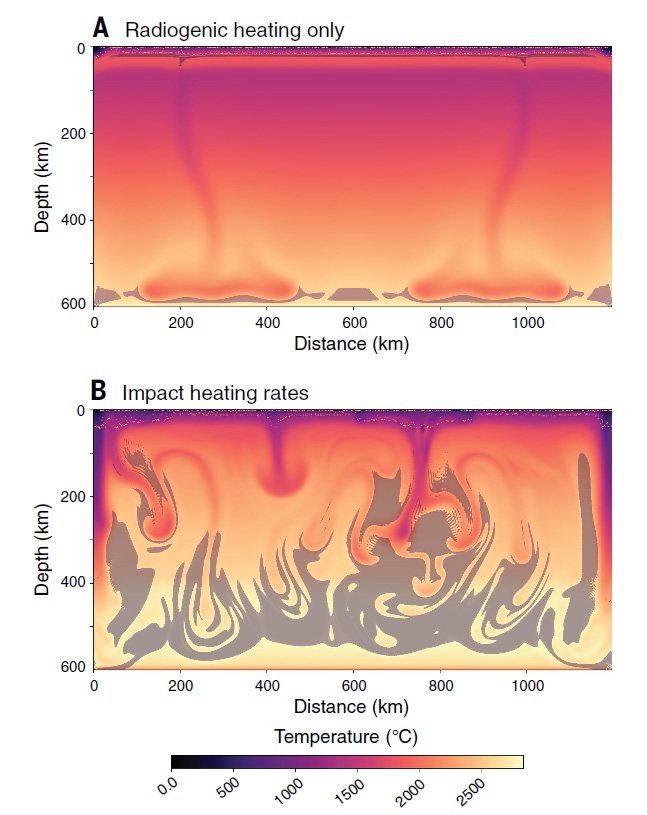
The modelled Hadean geotherm shows very rapid temperature increase down to about 7.5 km. It passes across the solidi of granite, hydrous basalt, anhydrous basalt and mantle peridotite: everything begins to melt. Clearly, whatever its composition, the uppermost Hadean crust would have been in a partially molten condition below about 3.5 km. At depths of 10 km or more, between 40 to 70 % of basalt would be molten. The distinction between brittle and ductile becomes meaningless in the light of Johnson et al.’s analysis of Hadean impact heating. Not only does the modelling rule out any rigid lithosphere and plate tectonics during the Hadean, it also explains the almost complete absence today of tangible Hadean rock. In particular, continental crust dominated by granitic rocks was probably recycled continually and literally into the Hadean ‘melting pot’. Convection would have dominated Hadean tectonics, but rather than taking the modern form of isolated plumes it would have been chaotic.
Simulated convective patterns for a Hadean upper mantle subject only to radiogenic heating (A) compared with its dynamic behaviour when heated by continuous heavy bombardment The grey areas represent dense residues left by very high degrees of partial melting at more shallow depths (B). Credit: Johnson et al., Fig 3 A and B.
Suddenly, beginning about 3.9 Ga a rich record of albeit disputed tectonics emerges during the Palaeoarchaean and then evolves onwards to modern planetary behaviour. The heavy bombardment had stopped.
In 1967 the American biologist Lyn Margulis developed an idea that had been considered earlier in the 20th century. It proposed that the complex architecture of eukaryote cells had arisen by several simpler prokaryote cells becoming incorporated inside a membrane to form other bodies or organelles that co-existed and interacted. That is, a complex of mutual dependence within a cell wall, called endosymbiosis. For instance, the mitochondria of modern animal cells resemble a class of aerobic bacteria or Proteobacteria (gram-negative bacteria), some of which are responsible for several modern diseases, such as tick-bite fevers. Another is the resemblance of the photosynthesising chloroplasts of plants to cyanobacteria. A similar origin might apply to eukaryote nuclei and other organelles inside eukaryote cells; some have their own DNA molecules. I summarised Margulis’s late-20th century concept of endosymbiosis in my 1999 book Stepping Stones.
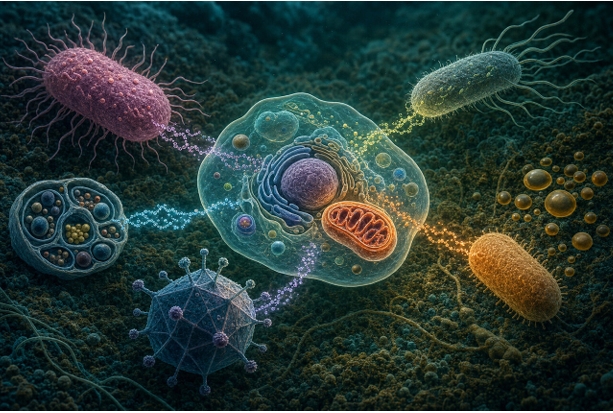
AI generated cartoon of symbiogenesis. Credit PhysOrg
Since then the rapid development of genome analysis has seen major advances in the field now known as symbiogenesis. In the most general sense, that is now regarded as a sequence of mergers between early members of the two prokaryote domains of Archaea and Bacteria: not a simple topic! In 2017 a group of archaeons called Promethearchaeati – ‘Asgard’ for short – were found to contain proteins – and thus the genes that produce them – akin to those in eukaryotes. So the Asgards are prime candidates for a role in symbiogenesis. Their symbiotic merger with a Proteobacteria may have begun the evolution of all eukaryotes. The entry of cyanobacteria – a candidate for chloroplasts – into one of the evolving groups divided plants from animals. A new AI analysis of thousands of genomes in living microbial organisms by Catalan scientists in Barcelona has enabled them to flesh-out and critique this hypothesis to a remarkable extent (Bernabeu, M. et al. 2026. Gene ancestries reveal diverse microbial associations during eukaryogenesis. Nature, v. 654; DOI: 10.1038/s41586-026-10639-9). Their work possibly revolutionises the study of biological evolution
Moisès Bernabeu and his three colleagues drastically ‘pruned’ the eukaryotic tree of life, which over-represents animals and species found in common ecosystems. They also stripped the limited number of eukaryote genomes of genes that do simple jobs or are closely related – i.e. those that seem to duplicate large sections from the oldest, ancestral genes. Two further ‘edits’ enabled the team to judge from their analysis what sort of roles may have been played by the genetics of the last eukaryote common ancestor (LECA). At this level of simplification it appeared that our ancestors inhabited oxygenated environments and got their energy by eating other organisms or their dead remains.
About 30% of the genes in eukaryotes seem to be unique to them and evolved after LECA had emerged. Many of the rest came from diverse prokaryote organisms. Alphaproteobacteria (previously termed ‘purple’ bacteria) and the Asgard archaea figure strongly, together with a range of other bacteria. As suggested previously, a vital process could have been transfer of genes from one prokaryote to another. Bernabeu et al.’s study highlights waves of such gene transfers prior to LECA’s acquisition of mitochondria, widely deemed to have been incorporation of an early proteobacterium. They also provide evidence for a central role played by giant viruses in enabling such gene transfers, also hypothesised previously.
Rather than being a simple case of a ‘one-off’ symbiosis between two separate prokaryotes, an archaeon and a bacterium, with the other organelles and genes added during a later evolutionary stage, the genesis of LECA was probably a long and complex interaction that involved diverse participants. It also seems certain that all the prokaryotes must have interacted in a stable, long-lived ecosystem for such a complex process to reach a tangible and enduring outcome after innumerable fits and starts. That oxygen became such an essential inorganic ‘player’ clearly suggests a microbial-mat ecosystem of organisms that involved oxygenic photosynthesis. The whole ecosystem and its members, pro- and eukaryotic, seem likely to have been evolving together, like modern ecosystems but on a microscopic scale. All this may have taken millions of years during the Palaeoproterozoic Era (2.5 to 1.6 Ga)
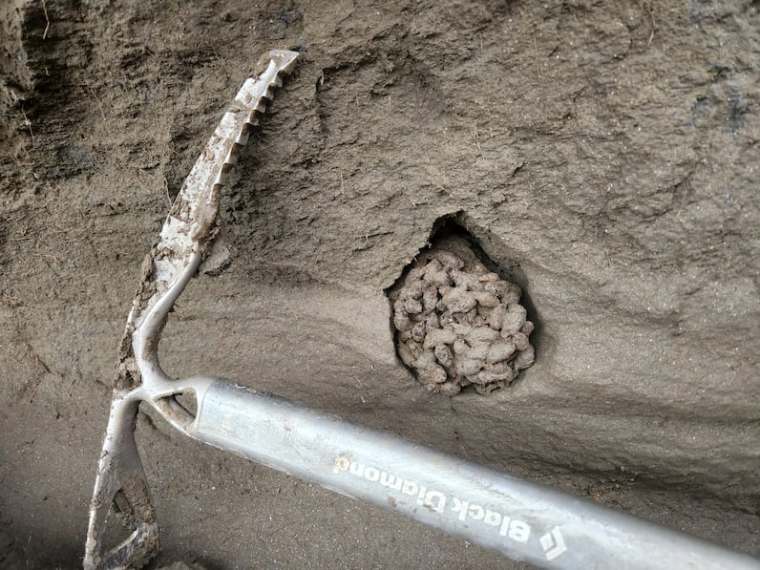
Lately, North American ground squirrels have been observed hunting, dismembering and eating voles. European tree squirrels also have a side that negates their nut-nibbling popular personae. They regularly take fledglings from bird nests. No more Mr Cute Squirrel then! In fact they’ll eat just about anything, including roadkill and even washed-up dead whales. A team of forensic ecologists from Canada, Sweden, Denmark and the US has harnessed this trait into a possibly ground-breaking study of how the Yukon Territory ecosystem evolved during the Pleistocene since 700 ka ago (Murchie, T.J. and 15 others 2026. Ground squirrel coprolites preserve complex archives of ancient environmental DNA over 700,000 years. Nature Communications, v. 17, article 4868; DOI: 10.1038/s41467-026-72977-6). Between 2007 and 2021 Tyler Murchie and colleagues collected ground squirrels’ faecal pellets from 14 latrine chambers or middens in their ancient burrows in a sequence of permafrost layers at the famous Klondike goldfields. The uppermost layers were dated using the 14C method, and for samples from deeper levels – older than 50 ka – using volcanic ash layers in the frozen sediments. Fourteen of the samples spanning 17 to 700 ka ago yielded fragmentary DNA from the squirrels’ diet.
Ground-squirrel midden in tunnelled permafrost. Credit Scott Cocker, University of Alberta)
Obviously this was dominated by their own DNA and gut bacteria, but contained fragments from an astonishing range of organisms that they had eaten. There were signs of at least 200 plant species: trees, shrubs grasses and flowering herbs known from the Pleistocene ‘mammoth steppe’ and tundra. Animal DNA included that from spiders, ants, moths, beetles, and grasshoppers, together with parasitic worms. But the most astonishing range of their appetites covers a great many mammals. As well as small mammals, such as mice, there are also signs of bison, mammoths, horses, sheep, wolves, and big cats having been eaten. It hardly needs to be emphasised that the Pleistocene ground squirrels did not hunt and overwhelm such prey, but they certainly did not reject a free meal of carrion lying on the tundra.
The wealth of species unwittingly archived by ground squirrels’ tendency to hide their droppings within their burrow systems offers a novel means of tracking the evolution of the ecosystem of which they were a part. It seems to outweigh the use of DNA extraction from soil horizons or even fossil bones. But to take matters further would require many more samples spread more evenly through the history of the mammoth steppe and tundra – most of the samples are from the last 90 ka. The Klondike goldfields are not representative of the whole of Arctic North America, being in a rugged terrain. Moreover, the Yukon Territory was repeatedly glaciated, as was the Canadian Shield itself. So, intact permafrost sequences spanning even the last glacial period are rare.
The notion of large-scale use of hydrogen as an energy source has a surprisingly long history. It was first proposed by J.B.S. Haldane in 1923, who envisaged electrolysis of water – releasing hydrogen and oxygen – using power from wind turbines to address this renewable source’s highly variable output effectively by storing it in the form of hydrogen. Since the only other output is oxygen, a hydrogen economy might seem to avoid global warming from the current release of greenhouse gases. However, as a 2023 post on Earth-logs concluded, of all the means for mass production and use of hydrogen only one source is a truly ‘green’ energy source: that emitted from rock by natural processes: so-called ‘white’ hydrogen. It is known to be generated by the breakdown of the mineral olivine [(Fe,Mg)2SiO4] by water in the absence of oxygen:
3Fe2SiO4 + 2H2O → 2 Fe3O4 + 3SiO2 +3H2
A more complex reaction is the hydration of olivine to the mineral serpentine [Mg3Si2O5(OH)4], which also yields hydrogen. Olivine is the most important mineral in the Earth’s mantle and abundant in crustal basalts and ultramafic rocks too. Oceanic lithosphere (ophiolites) added by tectonics to the continental crust form obvious targets for seeking natural hydrogen seepage. Yet such surface gas escapes have been documented only from a few sites, including an irrigation well in rural Mali that emitted gas containing 98% hydrogen, and a few natural springs from the Oman ophiolite.
The latest study may have taken the hydrogen economy to a literally deeper level (Sherwood Lollar, B. & Warr, O. 2026. Decadal record of continental H2 reservoirs reveals potential for subsurface microbial life and natural H2 exploration. Proceedings of the National Academy of Sciences, v. 123, article e2603895123; DOI: 10.1073/pnas.2603895123. PDF requests to owarr@uOttawa.ca and/or barbara.sherwoodlollar@utoronto.ca). Over fifteen years Barbara Sherwood Lollar and Oliver Warr of the Universities of Toronto and Ottawa, Canada monitored gas released by 35 boreholes originally drilled to assess and plan mining of an orebody in Precambrian basement rocks at Kidd Creek near Timmins, Ontario. On average, each of the boreholes released 8 kg of hydrogen per year. Scaled up to the mine’s 15 thousand exploratory boreholes, the mine itself is estimated to be yielding 140 metric tons of the gas annually. That could provide 4.7 gigawatts of energy per annum, sufficient for the needs of more than 400 Canadian homes.
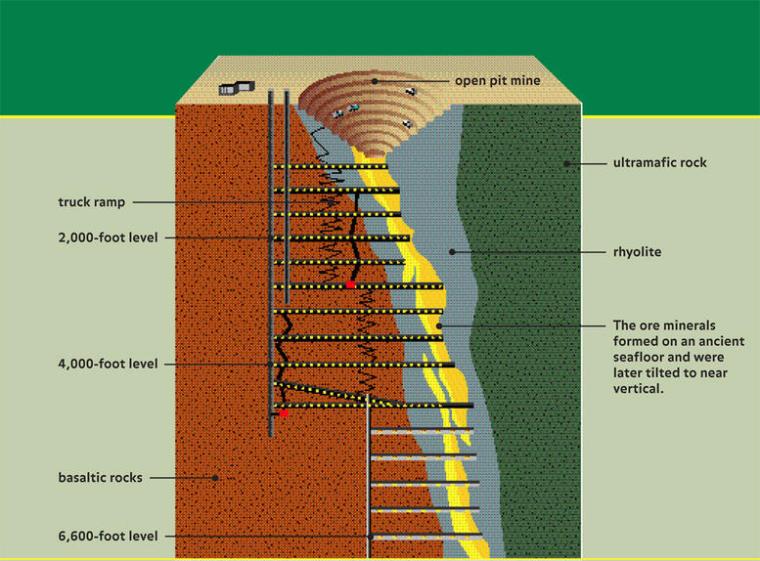
Schematic cross section through the Kidd Creek Mine, Ontario, Canada. Source American Museum of Natural History
The Timmins mining district is typical of Archaean greenstone belts in the Canadian Shield and in cratons across the world: supracrustal rocks including ultramafic and mafic volcanics and a variety of metasedimentary rocks. The Timmins district is historically Canada’s largest gold producer, but also hosts ores of many other metals. The Kidd Creek Cu-Ag-Zn mine is one of the deepest in North America, which penetrates interlayered felsic, mafic, ultramafic, and metasedimentary rocks to a depth of 2.9 km below the surface. The ores formed by submarine hydrothermal processes around 2.7 Ga ago. The sampled boreholes were drilled horizontally at mine levels between 2.04 to 2.9 km below the surface to penetrate the ore zone and its mafic-ultramafic host rocks. Rather than yielding gas, the holes release briny fluids in which hydrogen, helium and various hydrocarbon gases are dissolved. They are similar to fluids issuing from other deep mines, but differ in showing their formation mainly to be through inorganic reactions with the bed rock rather than as a result of microbial metabolism that exploits a variety of chemical interactions in the ore, such as reduction of sulfate ions to sulfide. The authors have studied hydrogen yields from a number of other mines in mafic-ultramafic rocks, which are comparable with Kidd Creek. So it may be that hydrogen in vast volumes is being emitted by existing and abandoned metal mines in such igneous terrains.
Sherwood Lollar and Warr authoritatively outline the economic potential of hydrogen production for remote communities and mines in greenstone-belt terrains. They also assess active serpentinisation of ophiolites and kimberlites by near-surface groundwater and associated microbial ecosystems as hydrogen sources, the few that have been studied seeming to produce even larger amounts of hydrogen. But they also note that their closer proximity to the surface means that these geological features are generally ‘open-systems’ prone to rapid loss of gases. However, in the manner of hydrocarbon gas fields, some ophiolites may host large amounts of hydrogen if they are capped by younger clay-rich sedimentary strata. Whatever, the global warming of what might be called the ‘Hydrocarbon Age’ is set to become a disaster. Breaking its death grip should be the principal economic agenda, which requires the most rapid turn to long-term energy alternatives. Natural hydrogen could be a part of that, and hopefully the work of Sherwood Lollar and Warr, and others like them, should lead to determined exploration and assessment of this novel physical resource. In Scandinavia a Nordic Hydrogen Route is being proposed. This Swedish-Finnish initiative is based on the Scandinavian Shield and its greenstone terrains and numerous mines driven into them. One would hope that its entrepreneurs are considering naturally emitted hydrogen rather than or as well as sources given other coloured labels.
That Earth has always been such an active planet is largely due to water having continually being shifted into the mantle by subduction of oceanic lithosphere. Emplaced at temperatures around 1200°C the basaltic crust and ultramafic rocks of the lithospheric mantle become hydrothermally altered by interaction with the ocean, so that they contain a range of hydrous minerals. The mantle is estimated to contain between a quarter and four times the present volume of all ocean water. The vast bulk of the mantle is not undergoing partial melting at any one time. Most magmatic activity is linked to plate tectonics through linear belts such as those along oceanic rift systems and above subduction zones, with a small proportion at ocean islands above isolated mantle plumes and similarly, though more sparsely above hot spots below continents. Such plume-related magmatism has at intervals in the past been vastly bigger than now, forming flood-basalt provinces and ocean-floor plateaus, such as the Deccan Traps and the Ontong Java Plateau; some linked to extinction events. The particular role of water in mantle melting is its reduction in the temperature at which melting begins at depth: ‘dry’ mantle does not melt but remains solid, albeit ductile. Two recent studies have provided important insights into previously unsuspected roles that water can play deep in the mantle.
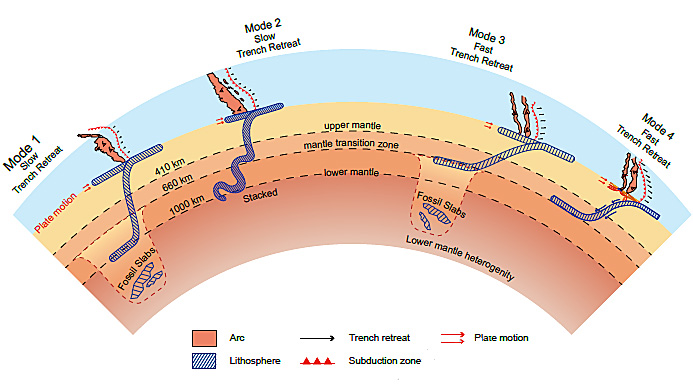
Four different modes of subduction. Credit: Li et al. Fig 6
Jianfeng Yang of the Chinese Academy of Science and colleagues from China and University of Padua, Italy provide evidence that ancient subducted slabs that gather at the mantle transition zone (MTZ) may trigger ocean-island and ocean-plateau volcanism (Yang, J. et al. 2026. Subduction legacies in the mantle transition zone modulate intraplate oceanic volcanism. Nature Communications, in press; DOI: 10.1038/s41467-026-73403-7). In fact there is a multiplicity of modes wherein subducted slabs interact with the MTZ, some are retained within it while, in one way or another, others eventually pass through it to the deeper mantle. Long-dead relics of subduction zones trapped there form ‘reservoirs’ of water 410 to 660 km below the surface at concentrations far higher (1 to 3 %) than does pristine mantle (less than 0.1%). It is stored as OH ions in dense mafic minerals, such as ringwoodite a high-pressure form of olivine (Mg2SiO4) containing up to 2.6 % of OH ions, and bridgmanite (MgSiO3), which forms once subducted slabs pass into the mantle transition zone. If that transformed lithosphere rises above about 410 km, such minerals transform back into anhydrous olivine, thereby liberating their water. At such depths, where temperature in the surrounding dry mantle is about 1800°C the emergence of water triggers a decrease in the temperature at which the ancient slab and also the surrounding mantle can melt. The authors cite evidence that such a process has contributed to the Azores oceanic plateau where the crust is 10 to 20 km thick. It is conceivable that a similar process of deep water ‘recycling’ may have been associated with continental flood basalts. Yang et al.’s new insight may also help unravel hitherto puzzling geochemical anomalies in other kinds of basaltic igneous rocks, such as those which well-up at mid ocean ridges to form modern oceanic crust.
Slabs that descend deeper into the mantle retain their dense mafic minerals and thus the water trapped within them. That water may eventually be involved in transformations at much higher pressures and temperatures, as deep as the core-mantle boundary. One possibility is their retention in mantle plumes that rise from the CMB to facilitate partial melting once they pass through the MTZ
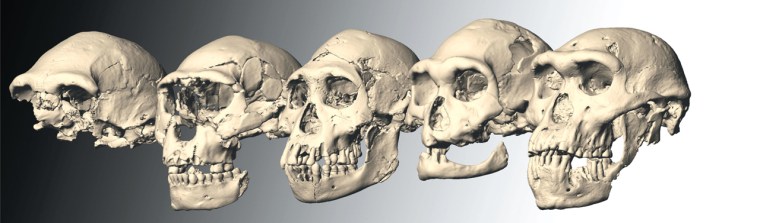
Hominin fossils referred to as Homo erectus have been found in Africa, Central Europe and China. Those from Africa have also been attributed to H. ergaster and by some to ‘African H. erectus’– a point of lingering dispute and confusion. The African lineage spanned a long time period after appearing around 1.7 Ma ago, possibly to as late as 0.6 Ma. The confusion deepened with the discovery of similar, well-preserved remains at Dmanisi in Georgia that are actually older (1.77–1.85 Ma) than the African specimens. But they are so anatomically diverse that the five skulls might easily be assigned to five different hominin species had they been found at separate locations. Asia is again very odd in an H. erectus context. The species was first proposed in 1891 by Eugene Dubois from remains in sediments oof the Solo River near Trinil in Java – he originally suggested the name Pithecanthropus erectus. Remarkably, the Solo sediments were dated at 53 to 27 ka in 2019, so did Homo erectus co-exist with anatomically modern humans (AMH) on Java? Similarly heavy-browed crania emerged from several sites in China. Curiously, the first complete Denisovan cranium, found near Harbin in China matched H. erectus in the eyebrow department. However, mtDNA from its dental plaque and bone proteomics tie in with those found in fragments from the eponymous Denisova Cave in Siberia and with a fragmentary mandible from Tibet. Without such evidence, and were itnot so young (146 ka), most palaeoanthropologists would probably have called the Harbin individual H. erectus, There are quite a few records of older Chinese hominin crania, dubbed H. erectus on anatomical grounds, including one dated at 1.7 Ma. There are a great many oddities and contradictions that need resolving.
Skulls of Homo erectus from Dmanisi , Georgia (credits; M.S. Ponce de Leon & P.E. Zollkofer, University of Zurich)
The cranium found near Harbin, China belonged to a Denisovan. Credit: Hebei Geo University
On 13 May 2026 a team led by palaeogeneticist Qiaomei Fu of the Chinese Academy of Sciences published data on proteins and amino acids yielded by enamel from six teeth of these ancient Chinese fossils, which emerged from three localities of Middle Pleistocene age (580 to 400 ka) (Fu, Q. and 11 others 2026. Enamel proteins from six Homo erectus specimens across China. Nature, v. 10.1038/s41586-026-10478-8). One is from the Zhoukoudian Cave near Beijing, famous for ‘Peking Man’, the primary reference for the anatomy of Asian H. erectus. Older fossils are unlikely to yield meaningful data of this kind because of chemical degradation; the reason why DNA has so far proved elusive from these specimens. Tooth enamel is extremely durable and can protect proteins and amino acids. Since both are produced by genes on DNA they are proxies for variants of those long-vanished genes
The key protein in the supposed H. erectus teeth isameloblastin which is involved in the formation of tooth enamel. The ameloblastin of all six teeth shared two amino acid variants; one previously unknown in other hominin lineages and perhaps unique to H. erectus, the other has been identified in Denisovans. Fu and colleagues suggest that the original bearers of the teeth – presumed to be H. erectus – had interbred with Denisovans and passed on the second variant gene. In turn that had been passed on to Asian AMH with some of whom Denisovans had interbred; remarkably 21% of living people on the Philippine archipelago carry that gene. The authors go on further to suggest that their findings support the notion that H. erectus was the source by gene-flow for ‘super-archaic’ sections of DNA found in actual Denisovan DNA from one member of that group. That is certainly a possibility, but is not the only one.
Neither the proteomics nor the morphology of the teeth, nor the anatomy of the fossils that accompany them in any way prove that they are from actual 400 ka old Homo erectus individuals. That would require at the very least protein analyses from specimens that definitely pre-date the divergence of Denisovans from Neanderthals about 600 ka ago. Remarkably, proteins have been extracted from a ~1.8 Ma old tooth yielded by the Dmanisi H. erectus site in Georgia, but that failed to reveal anything useful in this context. Maybe future work on older Chinese hominin teeth could resolve the issue. Another hypothesis is that the bearers of the analysed teeth were a population of Denisovans who themselves developed genetic variations rather than inheriting them. Proteomics is at about the same stage in its development as human genomics was before 2010 in the run-up to discovering Neanderthal and Denisovan genomes. But in the case of H. erectus the problem began with biologists’ long record of trying to simplify the natural world, especially fossils, through ‘lumping’ rather than ‘splitting’.
Humans that science has designated as different species were capable of interbreeding over tens and hundreds of thousand years, probably repeatedly and maybe habitually. That fact makes it hard to defend the concept of their speciation. There were few environments where they could not thrive, yet their migrations spread small numbers over vast areas. Continually shifting, isolated populations would diverge genetically and physically, the more so the fewer individuals were banded together. Occasionally populations would meet: an opportunity for celebration, and more, for conscious beings facing the rigours of exploration with neither territory nor resources to defend.
During the past 539 Ma (the Phanerozoic Eon) Earth’s geological history saw the explosion of rapidly evolving life in the oceans and on the land. The pace of that evolution swung up and down through a complex sequence of extinctions and adaptive radiations. They resulted from many intertwined inorganic changes: tectonics; impacts; igneous events; global climate change; atmosphere and sea-water composition. Although palaeoclimatic knowledge has become ever more detailed over the last few decades, its most important record, the varying temperature of the land surface and oceans, is lacking in precision. The timing of climatic events is not the issue, but the magnitude of changes in global mean surface temperature. The latter is largely down to the main tool in assessing past temperatures: the isotopic composition of oxygen (δ18O) in marine fossils. In particular, the record for the Lower Palaeozoic has remained stubbornly odd. In the Cambrian and Ordovician Periods it implies that low-latitude seawater temperatures reached levels of 40 to 50 °C, that seem literally life threatening: phytoplankton at the base of modern marine ecosystems die at water temperatures above 35°C. Yet the fossil record is teeming throughout the Lower Palaeozoic at all latitudes. Some manner of imprecision in the oxygen-isotope method gives the impression of wild fluctuations and a dramatic overall cooling of the planet through the Phanerozoic: the temperature record as it stands seems implausible.
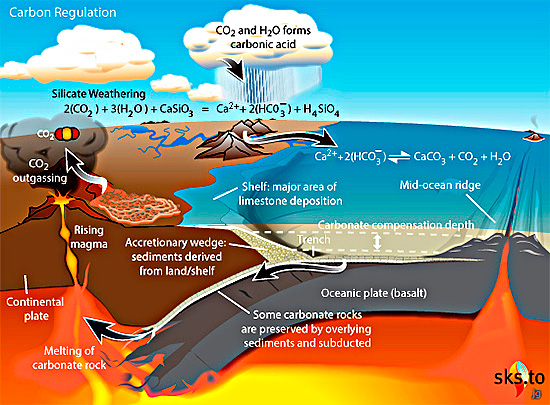
The carbonate-silicate cycle within the longer-term carbon cycle. Source: Wikimedia Commons
A group of palaeoclimatologists from China, the UK, Australia and the US have combined a variety of geochemical proxies, sedimentary records and climate modelling to correct the marine-carbonate δ18O record (Zheng, D. and 12 others 2026. Tight regulation of Earth’s long-term temperature over Phanerozoic time. Nature Communications, in press 4 May 2026; DOI: 10.1038/s41467-026-72672-6). Their approach is based on a chemical index of alteration (CIA), i.e. a measure of the degree of chemical weathering of the source for sedimentary rocks. The CIA compares their content of immobile aluminium oxide (Al2O3) with calcium, sodium and potassium oxides that are more easily moved in solution. Analyses of recent river sediments show a positive correlation between CIA and local temperature, so CIA in ancient sedimentary rocks is a potential proxy for the ambient temperature of the region from which those sediments were derived. The CIA also depends on other factors, such as the intensity of physical erosion and transport. However, allowing for these factors in modern environments does not affect the correlation with ambient temperature: the method remains robust. The geochemical data from sedimentary rocks required to use CIA as an independent check on O-isotope derived temperature are available in abundance from all continents for most of the Phanerozoic.
The study by Zheng et al. suggests that throughout the Phanerozoic global mean temperature remained consistently within the 10 to 30°C range. Thus Palaeozoic ocean temperatures were comparable with those of the succeeding Mesozoic and Cenozoic Eras. The team concludes that various negative feedback processes inherent in the Earth System have been able to regulate its surface temperature through the Phanerozoic. The most important of these is climate-dependent silicate weathering in which acidic rain – produced by CO2 dissolved from the atmosphere – breaks down silicates to yield dissolved bicarbonate ions that combine with calcium and magnesium ions to precipitate carbonates. Such a process draws down the main greenhouse gas from the atmosphere. There are other aspects of the carbon cycle that also draw down atmospheric CO2 and reduce the greenhouse effect, such as burial of organic debris. Tectonics also shapes climate by modulating both silicate weathering and CO2 emissions from volcanic activity.
It should be emphasised that anthropogenic global warming is proceeding at a far higher rate than natural negative feedback processes. We simply cannot rely on silicate weathering to reverse whatever climatic outcome results from what the current global economy does so very quickly. Yet the findings by Zheng et al. do seem likely to force a change in thinking about climate change on a geological timescale.
Octopuses defy common sense. They are invertebrate molluscs, so we don’t expect them to show well-developed intelligence, which they do. As well as tiptoeing around on their eight tentacles, they can move at high speed using a kind of backwards jet propulsion and some are even able to cross dry land.. Each of their tentacles has a sort of brain, as well their central one: distributed, semi-autonomous cognition in which their tentacles taste, touch, and move independently. Three hearts circulate their blue blood. Masters of swift camouflage using specialised skin cells that contain different coloured pigments, which behave like pixels in a TV screen. Octopuses can also rapidly manipulate their body texture and shape. They also seem to use such bizarre displays to communicate mood, at the very least.
Shape-shifting octopuses can squeeze through gaps far smaller than their own size to hide from both predators and their prey, which also makes them escapologists far outranking Harry Houdini. Their eyes look like those of goats, with horizontally linear pupils, although they evolved separately from the eyes of other animals. Satan is said to have goat-eyes, hence the colloquial name for an octopus: devil fish. Mariners of old (and maybe some of the present day) reputedly feared giant octopuses to be capable of crushing ships and devouring the crew: the Kraken! Even small octopuses possess greater intelligence than a dog: some seem to enjoy playing, building dens, negotiating mazes and watching the antics of humans …
Since they are almost entirely soft flesh, the fossil record of octopuses is unsurprisingly meagre, apart from their jaws that use chitinous ‘beaks’ to munch their victims. The evolution of other cephalopods, for instance ammonites and squids, is better known from their external and internal skeletal remains and extends back to the Cambrian Period. So collecting and analysing fossil octopus jaws is the only option for palaeontologists. Shin Ikegami of Hokkaido University, together with Jörg Mutterlose of Ruhr University in Bochum Germany and eight other Japanese scientists, developed a new approach to supplement data on octopus jaws previously excavated from Cretaceous strata on Hokkaido and Vancouver Islands. (Ikegami, S. and 9 others 2026. Earliest octopuses were giant top predators in Cretaceous oceans. Science, v. 392, p. 406-410; DOI: 10.1126/science.aea6285).
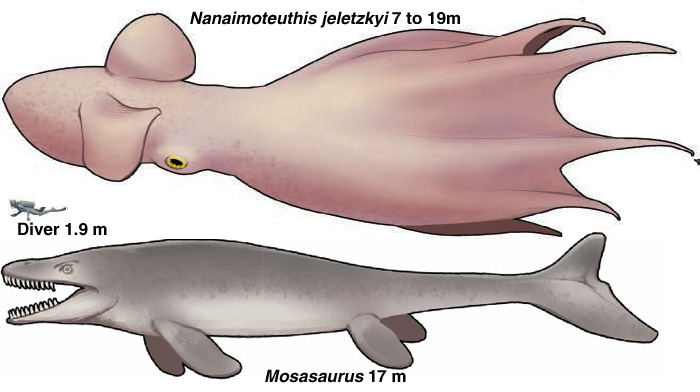
Cretaceous marine predators (at maximum estimated size) with a scuba diver for scale. Credit: After Ikegami et al. Fig. 4, and Jacobs 2026.
Ikegami et al. ground layer by layer through Japanese and Canadian sedimentary rocks to produce 3-D tomographic models of fossil beaks within them – quicker CT scanning proved inefficient in showing details. All the ‘beaks’ showed signs of wear from cracking the harder bones of their prey. Assuming that the same variation of beak size and body mass as in modern octopuses is relevant to those of Cretaceous age, the researchers came up with an astonishing result. Cretaceous octopuses reached huge sizes. They estimated one Nanaimoteuthis jeletzkyito have been 19 metres long, roughly the size of an articulated truck. During the Cretaceous Period the top predator of the oceans had long been supposed to have been the formidable marine reptile Mosasaurus at around 15 m long.
We know what mosasaurs ate from fossilised stomach contents of two specimens: more or less anything, including other substantial marine reptiles, sharks, cephalopods and even other mosasaurs, some whole, some dismembered. As for Nanaimoteuthis and other giant Cretaceous octopuses, reconstructed from their fossilised beaks, there is little obvious evidence for what they ate, other than it would have had to have been in large amounts. Judging from the wear exhibited by their beaks at least a proportion of their diet was crunched up shells and bones of ammonites and fish. Modern octopus species, both small and moderately large, have other sorts of feeding strategies. Some eat planktonic animals, others drill holes in shells and suck out their innards rendered to the texture of a ‘smoothie’ by corrosive saliva.
It is not surprising that the media have made quite a fuss of these Cretaceous ‘krakens’, some suggesting that they preyed on formidable marine reptiles such as mosasaurs. That would definitely have made them ‘top’ marine predators. Yet such massive, moving mounds of nourishing flesh would have made them a worthwhile catch for a whole school of toothy reptiles and sharks. The modern sperm whale is known to devour giant squid at the great depths to which they can dive, as witnessed by numerous cephalopod beaks in their stomachs. So it is equally possible that the octopus beaks found in Cretaceous sediments of Hokkaido were excreted by marine reptiles
Our hominin ancestors in Africa first fashioned tools about 3.5 Ma ago. Since then regular intake of animal protein through hunting, followed by the later discovery of fire and cooking, may progressively have encouraged the evolution of larger hominin brains. Both behavioural leaps would have reduced the length of the ‘working day’ needed to sustain hominin groups. That would have lengthened opportunities for cognitive reflection. social life and culture, and thus further evolution. They also expanded the opportunities for migration, beginning with Homo ergaster venturing beyond Africa at least 1.8 Ma ago. Hominins evolved to such an extent that several separate species occupied our home world at any one time until about 45 thousand years ago. After that only H. sapiens occupied Africa, Eurasia and Australasia.
Such protracted and meandering evolution and dispersal clearly involved episodic physiological and cultural changes, but all we have to go on are fragmentary fossil remains and artifacts of various kinds. DNA has yet to be extracted from hominin bones older than 400 ka (an early Neanderthal from northern Spain). Though H. sapiens first appeared in Morocco about 300 ka ago, DNA from our species dates back to only 45 ka (western and central Europe). What is today termed ‘ancient’ human DNA, is actually very young and restricted to climate zones where its decomposition has been slow. At present there is little point in analysing fossil material from tropical and subtropical latitudes; the DNA is degraded beyond recovery by even the most up-to-date techniques. Fascinating as discussion of human evolution is, in reality most is merely inferred from comparative anatomy and anthropological interpretation.
By 45 ka the heavy evolutionary lifting had been done, resulting in anatomically modern humans, but we have little, if any, chance of explaining in genetic terms how it was achieved. There has been much speculation about the conditions, particularly climatic ones, which may have driven the changes. During the last 2.6 Ma – the Quaternary Period – global climate has been the most changeable in the last 300 Ma. Ice ages have come and gone, first in 40 ka cycles and during the last million years every 100 ka. Much more rapid changes, such as millennial Dansgaard-Oeschger cycles, appeared during each glacial episode, the last being the Younger Dryas between 12.9 and 11.7 ka. For a long while ideas on the drivers of human evolution have been dominated by those concerning environmental stress. Unsurprisingly, genetic change has also been ascribed to such a Darwinian-ecological cause: adaptability to adversity. To test such a hypothesis requires genetic data, of course. But, except for the climatically more stable Holocene Epoch since 11.7 ka, ancient human genomes are in very short supply.
Renowned researcher into ancient human genetics David Reich of the Harvard Medical School in Boston, USA has collated more than 15 thousand ancient human genomes extracted from the remains of individuals who lived and died in Europe and parts of the Middle East during the last ten thousand years. These have been analysed statistically in the context of ‘directional selection’. This is a type of natural selection that occurs when one version of a gene – an allele – confers an extreme form of a trait. If it proves advantageous it rapidly gets passed on to more descendants than do less advantageous alleles, and thus rises in frequency across a population. This differs from other causes of gene frequency changes, such as human migration, population mixing, and random genetic fluctuations that occur in small populations. Well-known examples of directional selection are rapid changes among European Peppered moths, African cichlid fish, Alaskan Sockeye salmon and Big Cats which change over time in response to variations in their habitats. A human example is a genetic variant that maintains the ability to digest the sugar lactose in milk beyond infancy, which enables many modern Europeans to digest milk throughout their lives. The algorithm needed to separate signs of directional selection from other types of genetic change was developed by Ali Akbari, a computational geneticist also at Harvard Medical School. A recent paper by Akbari, Reich and colleagues in the US, Iran, Germany, and Austria (Akbari, A. and 15 others 2026. Ancient DNA reveals pervasive directional selection across West Eurasia. Nature, advance online publication; DOI: 10.1038/s41586-026-10358-1) seems set dramatically to change the research into recent human evolutionary genetics.
Akbari et al. discovered that directional selection has driven the spread or decline of hundreds of gene variants in human populations throughout Western Europe in the last ten millennia. In particular, selection accelerated with the adoption of farming rather than a hunter-gatherer lifestyle. Among the gene variants are those connected with light skin, red hair, risk of celiac disease – linked to gluten in cereals – susceptibility to gout, resistance to leprosy, baldness, rheumatoid arthritis and alcoholism. There are many more (see Figure 3 in the paper): the team identified 479 gene variants affected by directional selection, some that can be explained by changes in lifestyle, others less explicable and yet more that underlie complex traits such as mental illness and cognition. Some of the variants sprang up and were sustained in the population, others rose and then dwindled. The Neolithic began a period of fundamental life style changes in Europe, summed up as a shift from hunting and foraging to farming of cereals and livestock, as early as about 10 ka ago in what is now Türkiye. The pace of genetic changes of this kind reached a peak around the Bronze Age, perhaps because human activities in Europe became more complex then with the mass migration westwards of Yamnaya horse- and wagon-using people from the steppes to dominate Europe
The shift from small wandering bands to living in settlements was a drastic change from a lifestyle that had continued throughout all previous human history. So, it is hardly surprising that there was a major shift in humans’ genetic makeup. But such a change in human labour was not unique to Europe and is known to have occurred on all inhabited continents, with the exception of Australia, at different times during the Holocene. Other regional genetic databases can be analysed in much the same way, once sufficient ancient DNA is collected in Asia, Africa and the Americas. Yet not much is available. The authors comment: ‘A variant that now correlates to household income or years of schooling [remarkably, there are some!] had to have meant something different in the Stone Age. So these results do not mean that Europeans evolved to be smarter or healthier.’ Moreover, the research results in the paper seem likely to be amplified as the data set is so large and complex.
Around 20 thousand years ago, the Earth began to emerge from the grip of the Last Glacial Maximum (LGM). Huge ice sheets had locked up so much water that sea level was then about 125 m lower than it is today. At 12,870 years ago the warming and sea-level rise were reversed for 1,170 years in the Northern Hemisphere: an episode of near-full glacial conditions known as the Younger Dryas (YD). The adjectives ‘sudden’ or ‘abrupt’ grossly understate the pace of initial cooling – 3°, 6° and 15° C in North America, Europe and Greenland, respectively. Isotopic evidence from Greenland ice cores suggest that the cooling took place over three years or less. Such a degree of precision stems from the continuous annual layering in the Greenland ice cap. As far as humans were concerned, this would have been catastrophic for hunter gatherers following game northwards in Eurasia and North America as conditions ameliorated during the seven thousand years since the LGM. The archaeological record, or rather the lack of one, for what are now temperate zones suggests humans either retreated south or were blotted out.
There is no counterpart for the YD in the end stages of early glacial episodes. Some authors have suggested that it was the outcome of an appropriately catastrophic geological event, such as a large meteorite strike, as proposed in 2007 (See: Whizz-bang view of Younger Dryas; July 2007). This hypothesis gained traction in 2013, at least for its authors, with the discovery of anomalously high concentrations of the noble metal platinum (Pt) and other platinum Group metals, such as iridium (Ir) at or around the start of the YD in the GISP2 ice core. New research on this anomaly (Green, C.E. et al 2025. A possible volcanic origin for the Greenland ice core Pt anomaly near the Bølling-Allerød/Younger Dryas boundary. PLOS One, v. 20, article e0331811; DOI: 10.1371/journal.pone.0331811) offers a different scenario. Charlotte Green of Royal Holloway, University of London and colleagues from universities in the UK, Germany and Austria examine the timing of this Pt spike and its detailed geochemistry.
The ‘killer’ observation is that the anomaly occurs in ice that formed 45 years after the onset of the Younger Dryas and has a spread of about 14 years. Whatever kind of event released the platinum, it definitely did not somehow trigger the onset of the YD. Moreover, the anomaly was significantly deficient in iridium compared with a wide range of meteorites and terrestrial igneous rocks. It also differed markedly in other elements, such as lutetium and hafnium, and in all three elements in melt rocks and ejecta sediments associated with five proven impact structures. The closest match is to volcanic gas condensates from a recent eruption of a submarine volcano near Tonga
Both the GISP2 and NGRIP cores through the Greenland ice also record a large, 12-year long spike in sulfate of volcanic origin spread across the very start of the YD. That roughly matches the age of an explosive eruption, which formed the circular Laacher See in the Eifel volcanic field in Germany. That eruption is thought to have blasted 6.3 km3 of highly alkaline magma into the atmosphere: about the magnitude of the 1991 Pinatubo eruption, but insufficient to yield the size and duration of the sulfate spike that coincides with the start of the YD. The sulfate anomaly suggests a far larger, currently unknown eruption at 12,870 years ago. The Pt and Ir data from the Laacher See event rule it out as a source for the younger Pt anomaly in the GISP2 ice core. One possibility is a nearby Icelandic subglacial fissure eruption at that time.
So, as regards what started the Younger Dryas, there is support for a very large, but so-far unknown volcanic event, and an as yet unresolved, perturbation in the Atlantic Meridional Overturning Circulation (AMOC) resulting from drainage of a huge glacial lake in northern North America (see: The Younger Dryas and the Flood; June 2006), but no support whatever for an impact event. Climatology of the distant past is always likely to be difficult to pin down. That is because, as now, it involves linkages between a large number of variables: not only physical ones, but issues of biogeochemistry, the inner Earth, the rest of the solar system and even cosmology. That is, it is as complex as human affairs and their history. Common sense, linear thinking and the like, simply will not do.
Seismic tomography provides no evidence that slabs of oceanic lithosphere descend intact through the whole mantle to the core-mantle boundary. It might once have happened when they were capped by abundant high-density rocks, such as Precambrian banded-iron formations. A great many actively descending slabs have been shown to cease sinking, slide sideways and accumulate at depths around 660 and 1000 km. Until recently these discontinuities were been generally ascribed to transitions in the structure of the dominant mafic mineral olivine (Mg2SiO4) in mantle peridotite induced by increasing pressure and temperature. The resulting increases in mantle density supposedly form barriers to further slab descent. Pressure-induced mineral transitions in the slabs themselves that increase their density, such as pyroxene to garnet, may somehow be inhibited thereby leading to stagnation in slab descent. That may be true for the 660 km discontinuity, but for stagnation at 1000 km deep no such density-changing mineral transitions have shown up in high-P high-T mineralogical experiments. Some other process must therefore be responsible for slab descent to that depth. Recent work by geoscientists at several universities in China gives insights into what may be going on (Li, J., Li, K., Li, J. et al 2026. Dual slab stagnation depths controlled by grain-size-induced sporadic low-viscosity zones at around 1000 km depth. Nature Communications DOI: 10.1038/s41467-026-69987-9).
Four different modes of subduction at island arcs. Credit: Li et al. Fig 6
Jing Li and colleagues have focussed on the possibility that changes in the bulk viscosity of the mantle may play an important role. Their approach is twofold: experimental mineral physics and geodynamic modelling. Results suggest that recrystallization in the mantle when deeply penetrating slabs pass through it may patchily reduce the mantle’s grain size and thus its viscosity; the more so with larger volumes of subducted slab material. In turn, the resulting physical heterogeneity probably disrupts the steady downward passage of the slabs; fine-grained, less viscous zones ‘lubricating’ slab penetration, unchanged zones hindering it. The authors link such hypothetical micro-structural processes to modes of subduction that are currently active. They consider four modes of active subduction beneath island arcs with either a slow or a fast rate of trench retreat (see Figure). A slowly retreating trench system combined with low-viscosity patches at depth (Mode 1) results in penetration below 660 km and slab stagnation at 1000 km. Slow trench retreat with a homogenous lower mantle (Mode 2) gives rise to penetration and buckling of the descending slab between 660 and 1000 km. Fast trench retreat with a deeper low-viscosity zone (Mode 3), or with a homogeneous lower mantle (Mode 4) both result in slab stagnation at 660 km.
The models developed by Jing Li et al convincingly simulate various results of seismic tomography beneath island arcs. Interestingly, they suggest that the eventual assimilation of older slab materials into the deeper mantle (‘fossil’ slabs) may play a major role in mineral comminution and reduced mantle strength. That may leave behind low viscosity zones that later subduction may exploit. In fact, there are signs of possible fossil slabs in seismic tomograms more than 1000 km below the present Pacific Ocean floor in the form of zones of high P-wave velocity.
This work shows that plate tectonics is far from ‘done-and-dusted’, the mantle being far from uniform in its properties. Li et al’s results potentially open up new insights into whole-mantle convection, in which older tectonic events influence plate motions that are currently operating and the triggering of plumes rising from the deepest mantle. It also hints that such complex physical mixing of subducted material into the mantle may have resulted in the geochemical heterogeneities that increasingly emerge from analysis of magmas with ultimate origins in the mantle.
Followers can now download newly posted annual logs for Human Evolution and Migrations covering the years 2022 to 2025. By downloading them you can get a clear idea of how palaeoanthropology has moved forward since the Covid pandemic.
Enjoy the experience if you have the time and inclination!
Over the last few decades improved analytical techniques have made it possible to analyse tiny mineral grains for a variety of trace elements and several isotopes. Zircons obtained directly from crushed granitic igneous rocks vary in chemistry according to the magmatic processes that generated them and their tectonic context. Elevated ratios between uranium and niobium (U/Nb) and scandium and ytterbium (Sc/Yb) are characteristic of zircons in intermediate granites. These contain 52 to 63 % SiO2 – between mafic and felsic magmas – which formed by melting of hydrated mafic crust in settings akin to modern continental arcs; i.e. in subduction zones. But such partial melting can also take place where the base of continental crust delaminates and ‘drips’ into the mantle. That process is part of what is known as stagnant lid tectonics, believed by many to have been important in the Palaeoarchaean and Hadean. Such a process would have involved nearly anhydrous conditions and thus different geochemical partitioning of elements in the magmas and minerals that crystallised from them. Exposures of crystalline continental crust become increasingly rare further back in geological time, and there are none older than 4.0 Ga – i.e. of Hadean age – with a granitic component. Consequently studying the generation of continental crust in the Hadean and the early Archaean is almost entirely dependent on ancient zircons that found their way into much younger sedimentary rocks. The most famous of these occur as detrital grains in the 3.6 Ga Jack Hills conglomerate of Western Australia. Others have been extracted from similar ~3.3 Ga sedimentary rocks in the Barberton Greenstone Belt of South Africa and Eswatini.
Cartoon of possible Hadean stagnant lid tectonics, dominated by mantle plumes. (Credit: Bédard, J.H. 2018, Fig 3B, DOI: 10.1016/j.gsf.2017.01.005)
John Valley of the University of Wisconsin-Madison, USA, and co-workers from the US, Germany, Australia and France have worked on a large number of zircons newly extracted from Jack Hills. They have radiometrically dated them, and analysed Nb, Sc, U and Yb trace elements and hafnium (Hf) and oxygen isotopes Together with data from earlier studies, including Barberton zircons, they have teased out some remarkable insights into ‘continent-forming’ magmatism as far back in time as 4.4 billion years ago (Valley, J.W. and 11 others 2026. Contemporaneous mobile- and stagnant-lid tectonics on the Hadean Earth. Nature, Open access; DOI: 10.1038/s41586-025-10066-2). More than 70% of the >4.0 Ga Jack Hills zircons have elevated U/Nb and Sc/Yb ratios, which suggest that they formed in a setting akin to continental-arc subduction (CAS) zones, to produce now-vanished Hadean continental crust. The remainder seem to represent processes at mid-ocean ridge (MOR) and oceanic island (OI) settings. In contrast, the bulk of Barberton zircons of Hadean age show OI affinities, with only around 22% showing Nb–Sc–U–Yb signatures of probable CAS origins. From about 4.4 to 3.8 Ga two distinct forms of continental crust generation seem to have operated on Earth. In the erosional source region for the Barberton zircons their host granites seem to have formed during the Hadean and Eoarchaean by remelting of foundered lower crust, i.e. probably in a stagnant-lid-like tectonic setting. But at around 3.6 Ga they ‘flip’ to a subduction-like setting. The zircons yielded by Jack Hills conglomerates suggest substantially different conditions: alternating CAS and OI settings during the Hadean and a fall-off in crust generation during the Eoarchaean (4.0 to 3.8 Ga).
Plots of Sc/Yb and U/Nb against ages of zircons (vertical scale logarithmic). Black points are from Jack Hills, red from Barberton. The yellow field represents zircons formed in subduction zones; green suggests stagnant lid tectonics; grey the overlap between the two settings. Credit: Valley et al. Fig 3 a and b.
The mixed Hadean zircon signatures from Jack Hills possibly indicate that they were derived by erosion and transport from several distinct terranes that had been generated by two different processes: some kind of upper crustal recycling and stagnant lid tectonics. Meanwhile, that part of the Hadean Earth represented by the Barberton zircons may have been a long-lived regime of stagnant lid tectonics, replaced by dominant subduction at the end of the Eoarchaean. Yet the data suggest that into the Palaeoarchaean (3.6 to 3.2 Ga) and perhaps later, lid tectonics continued to operate somewhere, but at no time after 4.4 Ga was the Earth entirely subject to lid tectonics. Likewise, the authors insist that subduction was not of the plate-tectonic style, referring to some form of recycling of hydrated upper crustal mafic and ultramafic rocks into the mantle to undergo partial melting. Plate tectonics as we know it probably developed later in the Archaean. The early Earth had much higher heat flow than in later times, and thus the lithosphere was more ductile rather than brittle. The essence of modern tectonics is a series of rigid plates that extend down to the asthenosphere. When they deform it is largely through brittle failure of the entire lithosphere.
The great megalithic structure is the centrepiece of a vast ritual landscape on a 780 km2 plateau known as Salisbury Plain, underpinned by Cretaceous limestone: the largest remaining area of calcareous grassland in northwest Europe. The earliest sign that the Plain was used for ritual purposes dates to ten thousand years ago (8,000 BCE), when Mesolithic hunter gatherers erected large wooden posts to define by an E-W line the Sun’s rise and setting at the equinoxes. The area seems to have been continuously populated until 4,000 BCE when the first Neolithic farmers settled the Plain and began building burial mounds (barrows) to celebrate notable individuals and families.
The Stonehenge monument began as a circular cemetery around 3,100 BCE. Its development to the astonishing structure that remains largely intact today occupied the Neolithic populace and succeeding Bronze Age immigrants for the next 1,600 years. This involved setting up and then repeatedly shuffling around several kinds of boulders or megaliths. The first, around 2,600 BCE, were 2 to 3 tonne blocks mainly of igneous rock (the ‘bluestones’), now known to have originated from outcrops of Ordovician volcanics in Pembrokeshire about 230 km to the west. Next to arrive was a 6 tonne grey-green sandstone slab, now lying flat (hence its being named the ‘Altar’ Stone) beneath a fallen, far bigger megalith,. Once thought to be of Welsh provenance – in the Brecon Beacons 150 km to the west – the Altar Stone is now beyond a shadow of doubt to have come from Devonian strata in northern Scotland, possibly Orkney. The final erection of 30 truly enormous ‘sarsens’ to create Stonehenge’s signature circle and inner ‘horseshoe’ of vertical slabs capped by lintels took place between 2,600 to2 400 BCE. Weighing up to 50 tonnes, the sarsens are locally derived from remnants of Lower Eocene (~55 Ma) sands cemented by chemically precipitated silica (SiO2) that once covered much of southern England.
After 1,600 BCE, serious fiddling with the various stones, the bluestones in particular, ceased. The monument may have remained in some form of use during the Iron Age: it could hardly have been ignored. The first record of antiquarian interest is from the late 17th century and continued sporadically until systematic excavation of archaeological features on the Plain got underway during the 19th century and continues to the present.
Much recent literature has concentrated on what Stonehenge was for and how it was built, leading to a rich eclecticism and a little experimentation. But given the size of its stones and the obviously exotic nature of some of them, there have been disputes between those who consider them to have been brought by natural means and those who suggest collective human endeavour. The latter would have involved vast amounts of labour, shifting the bluestones over 250 km, entire community muscle power to drag the locally occurring sarsens about 25 km from their probable source, and a journey of at least 700 km to get the Altar Stone in place. Since none of the stones could conceivably have been moved by river flow, the only natural alternative for their transport is by glacial action.
Such an ice-transport theory rests on at least one of the several known advances of Pleistocene ice sheets having reached as far south as Salisbury Plain and deposited upon it glacial till that contains material from NE Scotland and South Wales. The most obvious indicators of glacial transport are large erratic boulders strewn far from their source down a previous ice stream that their distribution helps to reconstruct. In Northern Britain a great many megaliths that people erected long ago are glacial erratics of one kind or another. Of course, glacial tills contain grains of all sizes ripped and ground from the course of glacial flow. No so obvious, but equally capable of revealing transportation paths. After ice sheets melt, the till that they dump is eroded so that exotic rock and mineral grains enter drainage systems, some to remain in stream sediments. Two geologists based at Curtin University in Perth, Western Australia collected river sands from four active drainage systems on Salisbury Plain to test the glacial-transport hypothesis for the Stonehenge megaliths (Clarke, A.J.I. & Kirkland, C.L. 2026. Detrital zircon–apatite fingerprinting challenges glacial transport of Stonehenge’s megaliths. Communications Earth & Environment, v. 7, article 54; DOI: 10.1038/s43247-025-03105-3).
Using standard mineral-separation techniques – removal of low-density minerals (mainly quartz and feldspar) and those that are magnetic – Anthony Clarke and Christopher Kirkland mounted and polished samples of the remaining high-density grains embedded in resin. Using automated X-ray spectroscopy they identified grains of two minerals, zircon and apatite, that can be dated using uranium and lead isotopes. Zircons are virtually absent from the underlying Chalk although phosphorus-rich horizons in that rock sometimes contain apatite, a complex calcium phosphate. Both minerals are commonly found in igneous and metamorphic rocks and, being chemically resistant and hard, are often present in sediments derived by erosion of such parent rocks. The authors analysed U-Pb isotopes using laser ablation plasma mass spectrometry of suitable grains of each mineral. The U-Pb data from 250 apatite grains revealed a dominant age peak at 60 Ma, roughly the base of the once overlying Palaeogene sediments. Far fewer grains hint at older ages (175, 215, 300 and 625 Ma) in the Mesozoic, Palaeozoic and Neoproterozoic. The 550 analysed zircons span an age range from the Silurian to Palaeoproterozoic (432 to 1870 Ma), with a few outliers as young as 285 Ma and as old as 3396 Ma.
These data seem to suggest that they can support virtually any glacial transport hypothesis, including that of the Altar Stone, let alone the Stonehenge bluestones. However, that would be to misunderstand the complexity of sediment transport in relation to their original provenance. Erosion from a bedrock source leads to transport and deposition in sedimentary rock. Later uplift and erosion of that secondary host rock is followed by later sediment transport to another rock repository and so on and so forth through the entire geological history of Britain, across its jumble of many tectonic terranes and the effects of numerous orogenic episodes! The Salisbury Plain chalk lands were covered by Palaeogene sedimentary rocks of the London Basin. And, lo and behold, one of those younger sediments, the Thanet Formation sandstones, tell much the same U-Pb story as do the modern river sediments of Salisbury! Those Palaeocene sands elsewhere directly overlie the Chalk and, in some localities on Salisbury Plain, still do today in the form of the chemically cemented sarsens. About 50 Ma ago (early Eocene) the Palaeocene rocks and those beneath were broadly buckled by the outermost ripples of the Alpine orogeny. Once eroded from above the Plain they would certainly have delivered that signature to the mercy of subsequent back and forth river transport. And indeed the sarsens, hard to miss in that landscape, perhaps still do so. Yet no one has thought to examine their content of heavy-mineral grains.
It does seem to me that the authors, perhaps inadvertently, walked into a sedimentological minefield in a vain attempt to put the lid on the fractious debate about human- versus glacial-transport of the Stonehenge megaliths. It is not their data that fling down a ‘challenge’ to the latter hypothesis (see their Conclusions), but the widely accepted absence of even the tiniest nugget of bluestone or Devonian sandstone on the vast and heavily excavated ritual landscape of Salisbury Plain, or indeed in the gravels of the streams that currently drain the Plain. But this where the plot thickens. A recent paper by one of the proponents of the glacial hypothesis (John, B.S. 2024. A bluestone boulder at Stonehenge: implications for the glacial transport theory. E&G Quaternary Science Journal v. 73, p. 117-134;DOI: 10.5194/egqsj-73-117-2024) describes a small piece of bluestone (22 × 15 × 10 cm) that was found during excavations at Stonehenge in 1924 and mysteriously ‘rescued’ by a Robert Newall and stored in his attic for almost 50 years, eventually examined by geologists and then returned to the attic. In 1976, two years before his death Newall passed it to the curator of Salisbury Museum ‘for safe keeping’. Brian John claims that its shape and surface texture suggests glacial transport. It also has several percussion scars suggesting that it had been worked, perhaps by someone hoping to make a stone tool. Unsurprisingly, Johns succeeded in provoking a storm of criticism from archaeologists largely of the human-transport wing of the controversy. And then there is the Mumbles Erratic, found at the eponymous Mumbles headland to the west of Swansea Bay. It too looks like a ‘bluestone’, but is it an erratic or from a Neolithic ship wreck carrying bluestones from Pembrokeshire?
Maximum extent of glaciation in SW Britain during the Anglian Stage 478 to 424 ka ago (Credit: Wikipedia Commons)
A great deal of work by British glaciologists has established the flow patterns and extent of major ice sheets, but only for four onshore, even though there is offshore evidence for repeated glaciation back as far as 2.5 Ma ago. The most extensive of these was the Anglian Stage between 478 and 424 ka ago. The figure above shows that the Irish Sea Glacier did not reach the Stonehenge area, but it did cross Pembrokeshire to reach Somerset on the eastern side of the Bristol Channel. Bluestone erratics may have been much more easily available than blocks hewn at their source in SW Wales, an hypothesis that is currently in vogue. Nope, the quest is not over …
These days only a fool or a scoundrel would deny anthropogenic global warming and its primary outcome of inevitable sea-level rise. Yet no agency, either national or international, has set out to attempt a detailed global assessment of coastal vulnerability. There is no shortage of relevant data to do that – from remote sensing, digital elevation models, simulations of tides and wave height from meteorological data and much else. Thankfully, a team of geomorphologists, climate scientists, sociologists and economists from The Netherlands and France, led by Vindhya Basnayake of the University of Twente, The Netherlands, have taken up the challenge (Basnayake, V. et al. 2026. A global assessment of coastal vulnerability and dominant contributors. Nature Communications, in-press manuscript; DOI: 10.1038/s41467-025-67275-6).
About 10% of the world’s population – a bit less than a billion – live in coastal zones at less than 10 m elevation above mean sea level, and two-fifths that may bear the brunt of future rise. Coastal flooding and erosion threaten landforms, ecosystems and built infrastructure. Both physical effects of sea-level rise potentially may disrupt population centres, livelihoods and marine and coastal industries. More frequent and severe storms driven by global warming are also expected to increase the frequency and intensity of coastal hazards over time. Basnayake et al. have developed a Coastal Vulnerability Index (CVI) to express the hazard presented by future flooding and erosion to all coastal areas. The CVI is based on geomorphology, geology, coastal slope, coastal relief, wave height, and relative sea level change. It also integrates the local adaptive capacity and community resilience from socioeconomic and geopolitical data. Importantly CVI values are calculated at 1 km intervals along the global coastline at over 350 thousand locations. The approach used by the team incorporates from previous analyses time series for wave and tide heights and for changing sediment supply. The fine spatial resolution of data allows for identification of critical micro-regions – even within generally less vulnerable countries. Such a nuanced approach shows up the complexity of coastal risk that one-size-fits-all approaches are destined to miss.
Steep coastal slopes are less vulnerable than gentle ones, which allow greater penetration by marine hazards. The more rugged coastal terrain, the less vulnerable the coast is by acting like a large scale breakwater. Mean wave height controls the energy impinging on a coast, and is affected by wave ‘fetch’, so that ocean-facing coasts are more vulnerable than more enclosed locations. Offshore seismicity, as in island arcs, increases vulnerability to tsunamis. Tidal range has a counterintuitive effect, large ranges reducing the time a coast is in direct contact with the sea, whereas low ranges place the sea next to land for much longer. Although global sea level is destined to rise uniformly, some coasts are rising through tectonic or glacio-eustatic uplift, while others are actively subsiding; so relative sea-level change is used to address vulnerability. Other considerations assessed by Basnayake et al. are subsidence due to coastal groundwater extraction, the presence of protective coastal vegetation such as mangroves, and the influence of deltas and estuaries.
Coastal vulnerability by country: dark blue – very low; green – low; yellow – moderate; orange – high; dark red – very high. (Credit: Basnayake et al. Fig 2a)
The figure above summarises the results of the CVI study on a country-by-country basis. Eurasia is surprisingly the least vulnerable continent in this respect, especially Britain and Norway that are so exposed to the fierce North Atlantic. That is partly due to those countries high adaptive capacity and communal resilience, but mainly to their rugged and deeply indented western coasts; a legacy of glaciation. It’s important to note that coloration on the figure can be misleading. For instance, the higher resolution data pinpoint extremely high vulnerability of stretches of coast dominated by low-lying deltas, such as those of Pakistan, India, Myanmar and SE Asia. Equally surprising is the high vulnerability of North America at similar latitudes; somewhat ironic for the heartland of climate-change denial. High resolution also points to counterintuitive hazards; for instance coastal defences sometimes exacerbate vulnerability by increasing erosion on nearby undefended stretches and by hindering sediment movement. Increased onshore infrastructure boosts runoff and erosion in the coastal realm and displaces natural buffers, such as coastal forest, to storm surges: perhaps partly responsible for the high vulnerability of coasts around the hurricane belt of the Gulf of Mexico and Caribbean. Of the nineteen countries with greatest vulnerability 12 are in West Africa and NE South America and 2 in the Caribbean area. The paper is well worth reading, to get a flavour of the complexity involved and the vast magnitude of the task of ameliorating risk of coastal devastation that lies ahead in the next decades.
For decades, most of the news concerning our deep ancestry emerged from discoveries in sub-Saharan Africa at sites in Zambia, Tanzania, Kenya, South Africa, Ethiopia. The first week of 2026 decisively shifted that focus northwards to Chad and Morocco in two separate publications.
In 2002 ago the world of palaeoanthropology was in turmoil following the first discovery of fragments of what was then thought to be a hominid, or great-ape, cranium in Chad dated at around 7 Ma ago (Brunet, M. and 37 others 2002. A new hominid from the Upper Miocene of Chad, central Africa. Nature, v. 4418, p. 145-151;DOI:10.1038/nature00879). When pieced together the cranium looked like a cross between that of a chimpanzee and an australopithecine. Some suggested that the creature may have been a ‘missing link’ between the hominids and hominins; perhaps the ultimate ancestor of humans. Sahelanthropus tchadensis (nicknamedToumaï or ‘hope of life’ in the local Goran language) was undoubtedly enigmatic. The ‘molecular-clock’ age estimate for the branching of hominins from a common ancestor with chimpanzees was, in 2002, judged to be two million years later the dating of Sahelanthropus, so controversy was inevitable. Another point of contention was the size of Sahelanthropus’s canine teeth: too large for australopithecines and humans, but more appropriate for a gorilla or chimp. Moreover, Toumaï showed no indisputable evidence for having been bipedal. The Chadian site subsequently yielded three lower jaw bones and a collection of teeth, a partial femur (leg bone) and three fragmentary ulnae (forearm bones). The finds suggested that as many as five individuals had been fossilised. The femur gave an unresolved hint of an upright gait, yet the ulnas suggested Toumaï might equally have been arboreal; as could also be said for the australopithecines.
Reconstructed skull of Sahelanthropus tchadensis. (Credit: Didier Descouens, University of Toulouse)
All the limb bones of Toumaïhave now been anatomically compared with those of hominins and apes (Williams S.A. et al. 2026. Earliest evidence of hominin bipedalism in Sahelanthropus tchadensis.Science Advances, v. 12, article eadv0130; DOI: 10.1126/sciadv.adv0130). Scott Williams of New York University and co-workers from other US institutions show that although the leg bones are much the same size as those of chimpanzees, their proportions were more like those of hominins. They also showed features around the knees and hips needed for bipedalism and an insertion point for a tendon for the gluteus maximus muscle (buttock) vital for sustained upright locomotion, similar to the femurs of Orrorin tugenensis (see: Orrorin walked the walk; May 2008) and Ardipithecus ramidus. Unfortunately, an intact Sahelanthropus cranium showing a foramen magnum – where the skull attaches to the spine – continues to elude field workers. Its position distinguishes upright gait definitively.
The second new advance concerns the joint ancestry of Neanderthals, Denisovans and anatomically modern humans (AMH), whose ancient genetics crudely suggest a last common ancestor living between 765 to 550 ka. This had previously been attributed to Homo antecessor found in the Gran Dolina cave at Atapuerca in northern Spain, roughly dated between 950 ka and 770 ka. (Incidentally, Gran Dolina has yielded plausible evidence of cannibalism). A novel possibility stems from hominin fossils excavated from a cave in raised-beach sediments near Casablanca in Morocco (Hublin, JJ. and 28 others, 2026 Early hominins from Morocco basal to the Homo sapiens lineage. Nature, v. 649 ; DOI: 10.1038/s41586-025-09914-y). The fossil-bearing sediments contain evidence for a shift in the Earth’s magnetic field (the Brunhes–Matuyama reversal) dated at 773 ka, much more precisely than the Atapuerca age span for H. antecessor. Jean-Jacques Hublin of CNRS in Paris and his multinational colleagues report that the fossils are similar in age to H. antecessor, yet are morphologically distinct, displaying a combination of primitive traits and of ‘derived features reminiscent of’ later Neanderthal, Denisovan and AMH fossils. The differences and shared features suggest that there may have been genetic exchanges between the Moroccan and Iberian population over a considerable period. The most obvious route would have been across the Straits of Gibraltar, but would have required some kind of water craft. An important question is ‘which population gave rise to the other?’
Artistic reconstruction of a juvenile Homo antecessor, Based on skeletal remains from Gran Dolina Cave
Larger and more robust hominin remains in Algeria dated at 1,000 ka – H. heidelbergensis? – resemble those found near Casablanca. They may have evolved to the latter. Similar possible progenitors to Iberian Homo antecessor have yet to be found in Western Europe. Homo erectus appeared in Georgia and Romania between 2.0 and 1.9 Ma, but the intervening million years or more have yielded no credible European forebears of H. antecessor. For the moment, incursion of a North African population into Europe followed by sustained contact is Hublin et al’s favoured hypothesis, rather than a European origin for Homo antecessor. For Neanderthals and Denisovans to have originated from such an African group, as has been suggested, requires finds of African fossils with plausible resemblance to what are predominantly Eurasian groups. The Iberian population migrated far and wide in Western Europe, as witnessed by stone tools and footprints dating to between 950 to 850 ka in eastern England. So it is equally possible that the Iberian group were progenitors of Neanderthals and Denisovans in Eurasia itself. At least for the moment, ancient genomes of the two H. antecessor groups are unlikely to be found in either Iberian or African fossils of the same antiquity. But, as usual, that will not stifle debate: a resort to the adage ‘absence of evidence is not evidence of absence’ seems appropriate to several research teams!
The oldest anatomically modern human fossils dated at ~300 ka, were also discovered in Morocco (see: Origin of anatomically modern humans, June 2017). Their isolation in the NW corner of the African continent poses a similar conundrum, as since then such beings went on to occupy wide areas of sub-Saharan Africa and then the world.
I must have been about ten years old when I last saw a ‘lucky dip’ or ‘bran tub’ at a Christmas fair. You paid two shillings (now £0.1) to rootle around in the bran for 30 seconds and grab the first sizeable wrapped object that came to hand:. In my case that would be a cheap toy or trinket, but you never knew your luck as regards the top prize. There is a small asteroid called 101955 Bennu, about half a kilometre across, whose orbit around the Sun crosses that of the Earth. So it’s a bit scary, being predicted to pass within 750,000 km of Earth in September 2060 and has a 1 in 1,880 chance of colliding with us between 2178 and 2290 CE. Because Earth-crossing asteroids are a cheaper target than those in the Asteroid Belt, in 2016 NASA launched a mission named OSIRIS-REx to intercept Bennu, image it in great detail, snaffle a sample and ultimately return the sample to Earth for analysis. This wasn’t a shot in the dark, as a lot of effort and funds were expended to target and then visit Bennu. But unlike me at the fair ground, NASA will be very happy with the outcome.
The asteroid Bennu, showing its oblate spheroidal shape, due to rotation, and its rubbly structure. Source: NASA/Goddard/University of Arizona via Wikimedia Commons
Bennu is a product of what might be regarded as ‘space sedimentation’, indeed a kind of conglomerate, being made up of boulders up to 58 m across set in gravelly and finer debris or ‘regolith’. High-resolution images revealed veins of carbonate minerals in the boulders. They suggest hydrothermal activity in a much larger parent body – one of many proto-planets accreted from interstellar gas and dust as the Solar System first began to form over 4.5 billion years ago. Its collision with another sizeable body knocked off debris to send a particulate cloud towards the Sun, subsequently to clump together as Bennu by mutual gravitational attraction. The carbonate veins can only have formed by circulation of water inside Benno’s parent.
The ‘REx’ in the mission’s name is an acronym for ‘Regolith Explorer’. Sampling was accomplished on 20 October 2020 by a soft landing that drove a sample into a capsule, and then OSIRIS-REx ‘pogo-sticked’ off with the booty. The capsule was dropped off by parachute after the mission’s return on 24 September 2023, in the manner of an Amazon delivery by drone to a happy customer. So, you can understand my ‘lucky dip’ metaphor. And NASA certainly was ‘lucky’ as the contents turned out to be astonishing, as related two years later by the analytical team in the US, led by NASA’s Angel Mojarro (Mojarro, A. et al. 2025.Prebiotic organic compounds in samples of asteroid Bennu indicate heterogeneous aqueous alteration. Proceedings of the National Academy of Science, v. 122, article e2512461122; DOI: 10.1073/pnas.2512461122).
The rock itself is made from bits of carbonaceous chondrite, the most primitive matter orbiting the Sun. It contains fifteen amino acids, including all five nucleobases that make up RNA and DNA – adenine (A), guanine (G), cytosine (C), thymine (T) and uracil (U) – as in AUGC and AGCT. Benno’s complement of amino acids included 14 of the 20 used by life on Earth to synthesise proteins. The fifteenth, tryptophan, has never confidently been seen in extraterrestrial material before. Alkylated polycyclic aromatic hydrocarbons, also found in Bennu, are seen in abundance in interstellar gas clouds and comets by detecting their characteristic fluorescence when illuminated by mid-infrared radiation from hot stars using data from the Spitzer and James Webb Space Telescopes. These prebiotic organic compounds have been suggested to have played a role in the origin of life, but exposure to many produced by human activities are implicated in many cancers and cardiovascular issues. A second paper by Japanese biochemists and colleagues from the US was also published in early December 2025 (Furukawa, Y. and 13 others 2025. Bio-essential sugars in samples from asteroid Bennu. Nature Geoscience, v. 12, online article; DOI: 10.1038/s41561-025-01838). The authors identified several kinds of sugars in a sample from Bennu, including ribose – essential for building RNA – and glucose. Bennu also contains formaldehyde – a precursor of sugars – perhaps originally in the same brines in which the amino acids formed.
Yet another publication coinciding with the aforementioned two focuses on products of the oldest event in the formation of Bennu: its content of pre-solar grains (Nguyen, A.N. et al. 2025. Abundant supernova dust and heterogeneous aqueous alteration revealed by stardust in two lithologies of asteroid Bennu. Nature Astronomy, v. 9, p. 1812-1820; DOI: 10.1038/s41550-025-02688-3). In 1969 a 2 tonne carbonaceous chondrite fell near Allende in Mexico. The largest of this class ever found, it contained tiny, pale inclusions that eight years of research revealed to represent materials completely alien to the Solar System. They are characterised by proportions of isotopes of many elements that are very different from those in terrestrial materials. The anomalies could only have formed by decay of extremely short-lived isotopes that highly energetic cosmic rays produce in a manner analogous to neutron bombardment: they are products of nuclear transmutation. It is possible to estimate when the parent isotopes produced the anomalous ‘daughter’ products. One study found ages ranging from 4.6 to 7.5 Ga: up to three billion years before the Solar System began to form. It is likely that the grains are literally ‘star dust’ formed during supernovae in nearby parts of the Milky Way galaxy. Bennu samples contain six-times more presolar grains than any other chondritic meteorites. Nguyen et al. geochemically teased out grains with different nucleosynthetic origins. These ancient relics point to Bennu’s formation in a region of the presolar cloud that preceded the protoplanetary disk and was a mix of products from several stellar settings.
The results from asteroid Bennu support the key idea that that amino acid building blocks for all proteins and the nucleobases of the genetic code, together with other biologically vital compounds arose together in a primitive asteroid. Its evolution provided the physical conditions, especially the trapping of water, for the interaction of simpler components manufactured in interstellar clouds. Such ‘fertile’ planetesimals and debris from them almost certainly accreted to form planets and endowed them with the potential for life. What astonishes me is that Bennu contains the five nucleobases used in terrestrial genetics and 70% of the amino acids from which all known proteins are assembled by terrestrial life. But, as I try to explain in my book Stepping Stones: The Making of Our Home World, life as we know it arose, survived and evolved through a hugely complex concatenation of physical and chemical events lasting more than 4.5 billion years. The major events and the sequences in which they manifested themselves may indeed have been unique. Earth is a product of luck and so are we!