Surface temperature self-regulated by the Earth System during the Phanerozoic

During the past 539 Ma (the Phanerozoic Eon) Earth’s geological history saw the explosion of rapidly evolving life in the oceans and on the land. The pace of that evolution swung up and down through a complex sequence of extinctions and adaptive radiations. They resulted from many intertwined inorganic changes: tectonics; impacts; igneous events; global climate change; atmosphere and sea-water composition. Although palaeoclimatic knowledge has become ever more detailed over the last few decades, its most important record, the varying temperature of the land surface and oceans, is lacking in precision. The timing of climatic events is not the issue, but the magnitude of changes in global mean surface temperature. The latter is largely down to the main tool in assessing past temperatures: the isotopic composition of oxygen (δ18O) in  marine fossils. In particular, the record for the Lower Palaeozoic has remained stubbornly odd. In the Cambrian and Ordovician Periods it implies that low-latitude seawater temperatures reached levels of 40 to 50 °C, that seem literally life threatening: phytoplankton at the base of modern marine ecosystems die at water temperatures above 35°C. Yet the fossil record is teeming throughout the Lower Palaeozoic at all latitudes. Some manner of imprecision in the oxygen-isotope method gives the impression of wild fluctuations and a dramatic overall cooling of the planet through the Phanerozoic: the temperature record as it stands seems implausible.
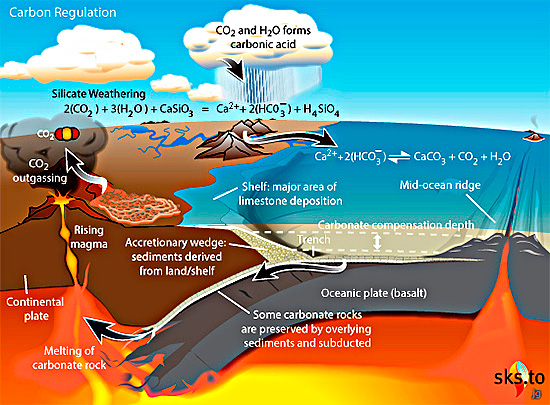
The carbonate-silicate cycle within the longer-term carbon cycle. Source: Wikimedia Commons

A group of palaeoclimatologists from China, the UK, Australia and the US have combined a variety of geochemical proxies, sedimentary records and climate modelling to correct the marine-carbonate δ18O record (Zheng, D. and 12 others 2026. Tight regulation of Earth’s long-term temperature over Phanerozoic timeNature Communications, in press 4 May 2026; DOI: 10.1038/s41467-026-72672-6). Their approach is based on a chemical index of alteration (CIA), i.e. a measure of the degree of chemical weathering of the source for sedimentary rocks. The CIA compares their content of immobile aluminium oxide (Al2O3) with calcium, sodium and potassium oxides that are more easily moved in solution. Analyses of recent river sediments show a positive correlation between CIA and local temperature, so CIA in ancient sedimentary rocks is a potential proxy for the ambient temperature of the region from which those sediments were derived. The CIA also depends on other factors, such as the intensity of physical erosion and transport. However, allowing for these factors in modern environments does not affect the correlation with ambient temperature: the method remains robust. The geochemical data from sedimentary rocks required to use CIA as an independent check on O-isotope derived temperature are available in abundance from all continents for most of the Phanerozoic.

The study by Zheng et al. suggests that throughout the Phanerozoic global mean temperature remained consistently within the 10 to 30°C range. Thus Palaeozoic ocean temperatures were comparable with those of the succeeding Mesozoic and Cenozoic Eras. The team concludes that various negative feedback processes inherent in the Earth System have been able to regulate its surface temperature through the Phanerozoic. The most important of these is climate-dependent silicate weathering in which acidic rain – produced by CO2 dissolved from the atmosphere – breaks down silicates to yield dissolved bicarbonate ions that combine with calcium and magnesium ions to precipitate carbonates. Such a process draws down the main greenhouse gas from the atmosphere. There are other aspects of the carbon cycle that also draw down atmospheric CO2 and reduce the greenhouse effect, such as burial of organic debris. Tectonics also shapes climate by modulating both silicate weathering and CO­2 emissions from volcanic activity.

It should be emphasised that anthropogenic global warming is proceeding at a far higher rate than natural negative feedback processes. We simply cannot rely on silicate weathering to reverse whatever climatic outcome results from what the current global economy does so very quickly. Yet the findings by Zheng et al. do seem likely to force a change in thinking about climate change on a geological timescale.

See also: Earth’s long-term temperature kept tight control. Scienmag; 4 May 2026

Carbon emissions: It’s an ill wind…

The original saying emerged in Shakespeare’s Henry IV Part 2 (Act 5, Scene 3) during a jocular exchange when Ancient Pistol brings news from Court to Sir John Falstaff and other old codgers at dinner in Gloucestershire. Falstaff: ‘What wind blew you hither, Pistol?’ Pistol: ‘Not the ill wind which blows no man to good’. In the present context it seems anthropogenic CO2 emissions have staved off the otherwise inevitable launch of another glacial epoch. Climate-change deniers will no doubt pounce on this in the manner of a leopard seizing a tasty young monkey.

Auyuittuq National Park: Penny Ice Cap
Penny Ice Cap on Baffin Island ( credit: Wikipedia)

Climatologists at the Institute for Climate Impact Research in Potsdam, Germany, Potsdam University and the Santa Fe Institute in New Mexico, USA set out to develop a means for predicting the onset of ice ages (Ganopolski, A. et al. 2016. Critical insolation-CO2 relation for diagnosing past and future glacial inception. Nature, v. 529, p. 200-203) Many researchers have concluded from the oxygen isotope data in marine sediments, which tracks changes in the volume of glacial ice on land, that the end of previous interglacial periods by inception of prolonged climatic cooling may be attributed to reduction of solar heating in summer at high northern latitudes. This conclusion stems from Milankovic’s predictions from the Earth’s astronomically controlled orbital parameters and fits most of previous interglacial to glacial transitions. But summer insolation at 65°N is now more or less at one of these minima, with no signs of drastic global cooling; rather the opposite, as part of 7 thousand years of constant global sea level during the Holocene interglacial.

The latest supercomputer model of the Earth System (CLIMBER-2) has successfully ‘predicted’ the last eight ice ages from astronomical and other data derived from a variety of climate proxies. It also forecasts the next to have already begun, if atmospheric CO2 concentration was 240 parts per million; the level during earlier interglacials most similar to that in which we live. But the pre-industrial level was 280 ppm and the model suggests that would have put off the return of huge ice caps in the Northern Hemisphere for another 50 thousand years – partly because the present insolation minimum is not deep enough to launch a new ice age with that CO2 concentration – making the Holocene likely to be by far the longest interglacial since ice-age cycles began about 2.5 Ma ago. Based on current, industrially contaminated CO2 levels and a rapid curtailment of carbon emissions the model suggests no return to full glacial conditions within the next 100 ka and possibly longer; a consequence of the sluggishness of natural processes that draw-down CO2 from the atmosphere.

English: Ice age Earth at glacial maximum. Bas...
Simulation of the Earth at a glacial maximum. (Photo credit: Wikipedia)

So, does this indicate that unwittingly the Industrial Revolution and subsequent growth in the use of fossil fuels tipped the balance away from global cooling that would eventually have made vast tracts of both hemispheres uninhabitable? At first sight, that’s the way it looks. But the atmospheric carbon content of the 17th century would have resulted in much the same long drawn out Holocene interglacial; an unprecedented skipping of an ice age in the period covering most of the history of human evolution. This raises a question first posed by Bill Ruddiman in 2003: did human agriculture and associated CO2 emission begin the destabilisation of the Earth system shortly after Holocene warming and human ingenuity made farming and herding possible since about 10 thousand years ago?

But, consider this, the CLIMBER-2 Earth System model is said to be one of ‘intermediate complexity’ which is shorthand for one that relies on the ages-old scientific method of reductionism or basing each modelled scenario on modifying one parameter at a time. Moreover, for many parameters of the Earth’s climate system – clouds, dust, the cooling effect of increased winter precipitation as snow, and much else – scientists are pretty much in the dark (Crucifix, M. 2016. Earth’s narrow escape from a big freeze. Nature, v. 529, p. 162-163). Indeed it is still not certain whether CO2 levels have a naturally active or passive role in glacial-interglacial cycles, or something more complex than the simple cause-effect paradigm that still dominates much of science.