Frozen squirrel excrement excites Pleistocene ecologists

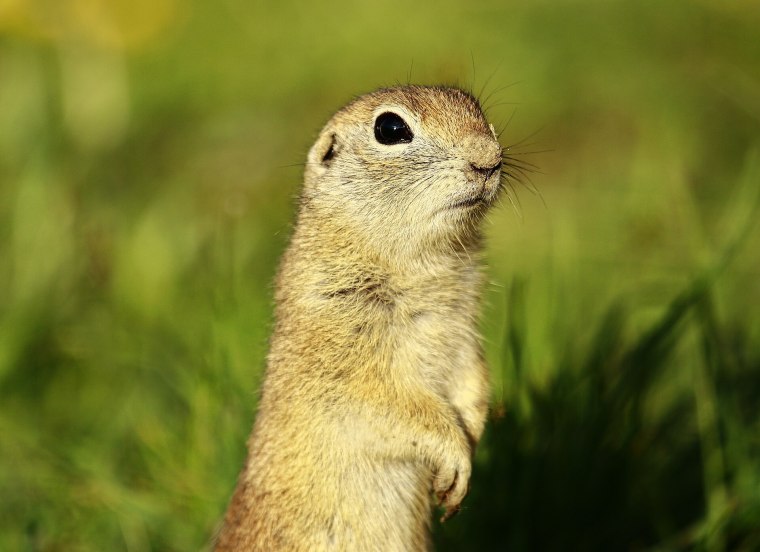
An arctic ground squirrel (Urocitellus parryii)

Lately, North American ground squirrels have been observed hunting, dismembering and eating voles. European tree squirrels also have a side that negates their nut-nibbling popular personae. They regularly take fledglings from bird nests. No more Mr Cute Squirrel then! In fact they’ll eat just about anything, including roadkill and even washed-up dead whales. A team of forensic ecologists from Canada, Sweden, Denmark and the US has harnessed this trait into a possibly ground-breaking study of how the Yukon Territory ecosystem evolved during the Pleistocene since 700 ka ago (Murchie, T.J. and 15 others 2026. Ground squirrel coprolites preserve complex archives of ancient environmental DNA over 700,000 yearsNature Communications, v. 17, article 4868; DOI: 10.1038/s41467-026-72977-6). Between 2007 and 2021 Tyler Murchie and colleagues collected ground squirrels’ faecal pellets from 14 latrine chambers or middens in their ancient burrows in a sequence of permafrost layers at the famous Klondike goldfields. The uppermost layers were dated using the 14C method, and for samples from deeper levels – older than 50 ka – using volcanic ash layers in the frozen sediments. Fourteen of the samples spanning 17 to 700 ka ago yielded fragmentary DNA from the squirrels’ diet.
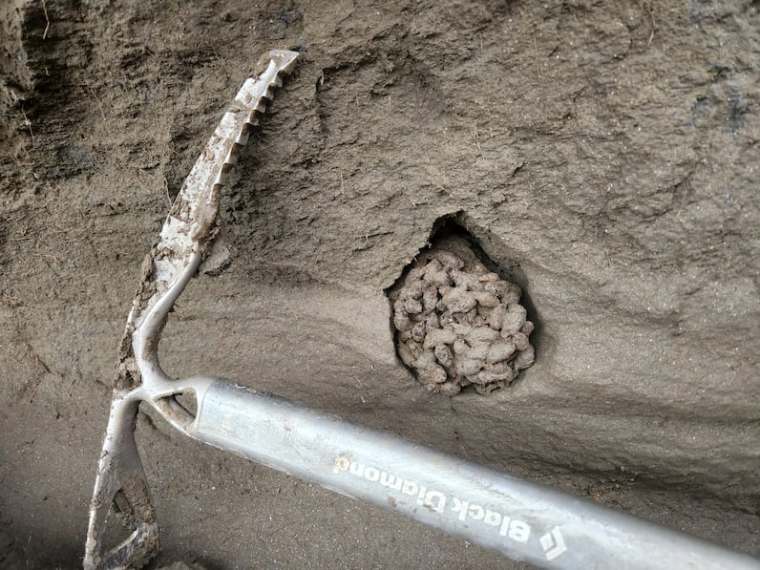
Ground-squirrel midden in tunnelled permafrost. Credit Scott Cocker, University of Alberta)

Obviously this was dominated by their own DNA and gut bacteria, but contained fragments from an astonishing range of organisms that they had eaten. There were signs of at least 200 plant species: trees, shrubs grasses and flowering herbs known from the Pleistocene ‘mammoth steppe’ and tundra. Animal DNA included that from spiders, ants, moths, beetles, and grasshoppers, together with parasitic worms. But the most astonishing range of their appetites covers a great many mammals. As well as small mammals, such as mice, there are also signs of bison, mammoths, horses, sheep, wolves, and big cats having been eaten. It hardly needs to be emphasised that the Pleistocene ground squirrels did not hunt and overwhelm such prey, but they certainly did not reject a free meal of carrion lying on the tundra.

The wealth of species unwittingly archived by ground squirrels’ tendency to hide their droppings within their burrow systems offers a novel means of tracking the evolution of the ecosystem of which they were a part. It seems to outweigh the use of DNA extraction from soil horizons or even fossil bones. But to take matters further would require many more samples spread more evenly through the history of the mammoth steppe and tundra – most of the samples are from the last 90 ka. The Klondike goldfields are not representative of the whole of Arctic North America, being in a rugged terrain. Moreover, the Yukon Territory was repeatedly glaciated, as was the Canadian Shield itself. So, intact permafrost sequences spanning even the last glacial period are rare.

See also: A snapshot in time: Ancient ground squirrel droppings, dating back 700,000 years, reveal rich details about evolutionary history of the Arctic. EurekAlert 9 June 2026.

Pleistocene megafaunal extinctions – were humans to blame?

Australia and the Americas had an extremely diverse fauna of large beasts (giant wombats and kangeroos in Australia; elephants, bears, big cats, camelids, ground sloths etc in the Americas) until the last glaciation and the warming period that led into the Holocene interglacial. The majority of these megafauna species vanished suddenly during that recent period. To a lesser extent something similar happened in Eurasia, but nothing significant in Africa. Because the last glacial cycle also saw migration of efficient human hunter-gatherers to every other continent except Antarctica, many ecologists, palaeontologists and anthropologists saw a direct link between human predation and the mass extinction (see Earth-Pages of April 2012. Earlier humans had indeed spread far and wide in Eurasia before, and the crude hypothesis that the last arrivals in Australasia and the Americas devoured all the meatiest prey in three continents had some traction as a result: predation in Eurasia and Africa by earlier hominids would have made surviving prey congenitally wary of bipeds with spears. In Australia and the Americas the megafauna species would have been naive and confident in their sheer bulk, numbers, speed and, in some cases, ferocity. Other possibilities emerged, such as the introduction of viruses to which faunas had no immunity or as a result of climate change, but none of the three possibilities has gained incontrovertible proof. But the most popular, human connection has had severe knocks in the last couple of years. A fourth, that the extinctions stemmed from a comet impact proved to have little traction.

English: s were driven to extinction by and hu...
Megafauna in a late-Pleistocene landscape including woolly mammoths and rhinoceroses, horses, and cave lions with a carcass. (credit: Wikipedia)

Since the amazing success of analysing the bulk DNA debris in sea water – environmental DNA or eDNA – to look at the local diversity of marine animals, the analytical and computing techniques that made it possible have been turned to ancient terrestrial materials: soils, permafrost and glacial ice. One of the first attempts revealed mammoth and pre-Columbian horse DNA surviving in Alaskan permafrost, thanks to the herds’ copious urination and dung spreading. Several articles in the 24 July 2015 issue of Science review ancient DNA advances, including eDNA from soils that chart changes in both fauna and flora over the last glacial cycle (Pennisi, E. 2015. Lost worlds found. Science, v. 349, p. 367-369). Combined with a variety of means of dating the material that yield the ancient eDNA, an interesting picture is emerging. The soil and permafrost samples potentially express ancient ecosystems in far more detail than would fossil animals or pollens, many of which are too similar to look at the species level and in any case are dominated by the most abundant plants rather than showing those critical in the food chain.

Nunavut tundra
Plants of the Arctic tundra in Nunavut, Canada (Photo credit: Wikipedia)

The first major success in palaeoecology of this kind came with a 50-author paper using eDNA ‘bar-coding’ of permafrost from 242 sites in Siberia and Alaska IWillerslev, E. and 49 others 2014. Fifty thousand years of Arctic vegetation and megafaunal diet. Nature, v. 506, p. 47-51. doi:10.1038/nature12921). Dividing the samples into 3 time spans – 50-25, 25-15 (last glacial maximum) and younger than 15 ka – the team found these major stages in the last glacial cycle mapped an ecological change from a dry tundra dominated by abundant herbaceous plants (forbs including abundant anemones and forget-me-not), to a markedly depleted Arctic steppe ecosystem then moist tundra with woody plants and grasses dominating. They also analysed the eDNA of dung and gut contents from ice-age megafauna, such as mammoths, bison and woolly rhinos, where these were found, which showed that forbs were the mainstay of their diet. Using bones of large mammals 6 member of the team also established the timing of extinctions in the last 56 ka (Cooper, A. et al. 2015. Abrupt warming events drove Late Pleistocene Holarctic megafaunal turnover. Science, DOI: 10.1126/science.aac4315), showing 31 regional extinction pulses linked to the rapid ups and downs of climate during Dansgaard-Oeschger cycles in the run-up to the last glacial maximum. By the end of the last glacial maximum, the megafauna were highly stressed by purely climatic and ecological factors. Human predation probably finished them off.