Balanced boulders and seismic hazard

The seismometer invented by early Chinese engineer Zhang Heng

China has been plagued by natural disasters since the earliest historical writings. Devastating earthquakes have been a particular menace, the first recorded having occurred in 780 BC . During the Han dynasty in 132 CE, polymath Zhang Heng invented an ‘instrument for measuring the seasonal winds and the movements of the Earth’ (Houfeng Didong Yi, for short): the first seismometer. A pendulum mechanism in a large bronze jar activated one of eight dragons corresponding to the eight cardinal and intermediate compass directions (N, NE, E etc.) so that a bronze ball dropped from its mouth to be caught by a corresponding bronze toad. The device took advantage of unstable equilibrium in which a small disturbance will produce a large change: akin to a pencil balanced on its unsharpened end. Modern seismometers exploit the same basic principle of amplification of small motions. The natural world is also full of examples of unstable equilibrium, often the outcome of chemical and physical weathering. Examples are slope instability, materials that are on the brink of changing properties from those of a solid to a liquid state (thixotropic materials – see: Mud, mud, glorious mud August 2020) and rocks in which stress has built almost to the point of brittle failure: earthquakes themselves. But there are natural curiosities that not only express unstable equilibrium but have maintained it long enough to become … curious! Perched boulders, such as glacial erratics and the relics of slow erosion and weathering, are good examples. Seismicity could easily topple them, so that their continued presence signifies that large enough tremors haven’t yet happened.

A precarious boulder in coastal central California (credit: Anna Rood & Dylan Rood, Imperial College London)

Now it has become possible to judge how long their delicate existence has persisted, giving a clue to the long-term seismicity and thus the likely hazard in their vicinity (Rood, A.H. and 10 others 2020. Earthquake Hazard Uncertainties Improved Using Precariously Balanced Rocks. American Geological Union Advances, v. 1, ePDF e2020AV000182; DOI: 10.1029/2020AV000182). Anna Rood and her partner Dylan of Imperial College London, with colleagues from New Zealand, the US and Australia, found seven delicately balanced large boulders of silica-rich sedimentary rock in seismically active, coastal California. They had clearly withstood earthquake ground motions for some time. Using multiple photographs to produce accurate digital 3D renditions and modelling of resistance to shaking and rocking motions, the authors determined each precarious rock’s probable susceptibility to toppling as a result of earthquakes. How long each had withstood tectonic activity shows up from the mass-spectrometric determination of beryllium-10 isotopes produced by cosmic-ray bombardment of the outer layer. Comparing its surface abundance relative to that in the rock’s interior indicates the time since the boulders’ first exposure to cosmic rays. With allowance for former support from surrounding blocks, this gives a useful measure of the survival time of each boulder – its ‘fragility age’.

The boulder data provide a useful means of reducing the uncertainties inherent in conventional seismic hazard assessment, which are based on estimates of the frequency of seismic activity, the magnitude of historic ‘quakes, in most cases over the last few hundred years, and the underlying geology and tectonics. In the study area (near a coastal nuclear power station) the data have narrowed uncertainty down to almost a half that in existing risk models. Moreover, they establish that the highest-magnitude earthquakes to be expected every 10 thousand years (the ‘worst case scenario’) were 27% less than otherwise estimated. This is especially useful for coastal California, where the most threatening faults lie off shore and are less amenable to geological investigation.

See also:  Strange precariously balanced rocks provide earthquake forecasting clues. (SciTech Daily; 1 October 2020) 

Supernova at the start of the Pleistocene

This brief note takes up a thread begun in Can a supernova affect the Earth System? (August 2020). In February 2020 the brightness of Betelgeuse – the prominent red star at the top-left of the constellation Orion – dropped in a dramatic fashion. This led to media speculation that it was about to ‘go supernova’, but with the rise of COVID-19 beginning then, that seemed the least of our worries. In fact, astronomers already knew that the red star had dimmed many times before, on a roughly 6.4-year time scale. Betelgeuse is a variable star and by March 2020 it brightened once again: shock-horror over; back to the latter-day plague.

When stars more than ten-times the mass of the Sun run out of fuel for the nuclear fusion energy that keeps them ‘inflated’ they collapse. The vast amount of gravitational potential energy released by the collapse triggers a supernova and is sufficient to form all manner of exotic heavy isotopes by nucleosynthesis. Such an event radiates highly energetic and damaging gamma radiation, and flings off dust charged with a soup of exotic isotopes at very high speeds. The energy released could sum to the entire amount of light that our Sun has shone since it formed 4.6 billion years ago. If close enough, the dual ‘blast’ could have severe effects on Earth, and has been suggested to have caused the mass extinction at the end of the Ordovician Period.

Betelgeuse is about 700 light years away, massive enough to become a future supernova and its rapid consumption of nuclear fuel – it is only about 10 million years old – suggests it will do so within the next hundred thousand years. Nobody knows how close such an event needs to be to wreak havoc on the Earth system, so it is as well to check if there is evidence for such linked perturbations in the geological record. The isotope 60Fe occurs in manganese-rich crusts and nodules on the floor of the Pacific Ocean and also in some rocks from the Moon. It is radioactive with a half-life of about 2.6 million years, so it soon decays away and cannot have been a part of Earth’s original geochemistry or that of the Moon. Its presence may suggest accretion of debris from supernovas in the geologically recent past: possibly 20 in the last 10 Ma but with apparently no obvious extinctions. Yet that isotope of iron may also be produced by less-spectacular stellar processes, so may not be a useful guide.

There is, however, another short-lived radioactive isotope, of manganese (53Mn), which can only form under supernova conditions. It has been found in ocean-floor manganese-rich crusts by a German-Argentinian team of physicists  (Korschinek, G. et al. 2020. Supernova-produced 53Mn on Earth. Physical Review Letters, v. 125, article 031101; DOI: 10.1103/PhysRevLett.125.031101). They dated the crusts using another short-lived cosmogenic isotope produced when cosmic rays transform the atomic nuclei of oxygen and nitrogen to 10Be that ended up in the manganese-rich crusts along with any supernova-produced  53Mn and 60Fe. These were detected in parts of four crusts widely separated on the Pacific Ocean floor. The relative proportions of the two isotopes matched that predicted for nucleosynthesis in supernovas, so the team considers their joint presence to be a ‘smoking gun’ for such an event.

The 10Be in the supernova-affected parts of the crusts yielded an age of 2.58 ± 0.43 million years, which marks the start of the Pleistocene Epoch, the onset of glacial cycles in the Northern Hemisphere and the time of the earliest known members of the genus Homo. A remarkable coincidence? Possibly. Yet cosmic rays, many of which come from supernova relics, have been cited as a significant source of nucleation sites for cloud condensation. Clouds increase the planet’s reflectivity and thus act to to cool it. This has been a contentious issue in the debate about modern climate change, some refuting their significance on the basis of a lack of correlation between cloud-cover data and changes in the flux of cosmic rays over the last century. Yet, over the five millennia of recorded history there have been no records of supernovas with a magnitude that would suggest they were able to bathe the night sky in light akin to that of daytime. That may be the signature of one capable of affecting the Earth system. Thousands that warrant being dubbed a ‘very large new star’are recorded, but none that ‘turned night into day’. The hypothesis seems to have ‘legs’, but so too do others, such as the slow influence on oceanic circulation of the formation of the Isthmus of Panama and other parochial mechanisms of changing the transfer of energy around our planet

See also: Stellar explosion in Earth’s proximity, eons ago. (Science Daily; 30 September 2020.)

Severe COVID-19 associated with Neanderthal inheritance?

News broke in 2010 about evidence from modern and ancient DNA samples that showed some anatomically modern humans who left Africa before 40 thousand years ago to have interbred with the Neanderthal occupants of Eurasia (see: Yes, it seems that they did …; May 2010). In 2011 it turned out that the same had happened when AMH migrants in Asia met with Denisovans (see: Snippets on human evolution; November 2011). The resulting human hybrids went on to spread their new genes as they populated East Asia, Australasia and the Americas. Genomes of thousands of living people from these continents all show varying proportions – but generally less than about 5% – of genetic contributions from one or the other and in some cases both. Some of the modern humans who remained in Africa also had a similar opportunity. A few Neanderthals did set foot in Africa sharing their genes with its original inhabitants, but those venturing far from their normal range had already interbred with early ‘out-of-Africa’ AMH migrants about 150 to 100 thousand years ago, as had  AMH returning from Eurasia around 20 ka ago. Five widespread groups of modern Africans (but not all) carry up to 0.3% of the Neanderthal genome. Moreover, the ancestors of some living Africans had also exchanged genes with as-yet unknown archaic humans (see also: Everyone now has their Inner Neanderthal; February 2020).

Personally, I reacted to the news with a sense of pride. Neanderthals were tough, survivors of several hundred thousand years of climatic extremes hunting fearsome prey, and they probably had an intellect as advanced as that of the AMH with whom they mingled. My little bit of Neanderthal has conferred several advantages including resistance to Eurasian pathogens, but also has its downside, such as a tendency to depression and excessive blood clotting. But an unedited paper released in advance of publication by the journal Nature suggests that my pride turns out to include an unwelcome element of hubris.

Early in the COVID-19 pandemic, genetic research on over 3000 individuals, whose symptoms were severe enough for them to be hospitalised – a high proportion of whom sadly died – revealed that there was more to their being prone to severe symptoms than age, co-morbidities, gender and ethnicity. A short segment (around 50,000 base pairs long) on the DNA of their chromosome-3 is significantly associated with severe COVID-19 outcomes. Svante Pääbo, the leader of the team than reconstructed the Neanderthal and Denisovan genomes and discovered their presence in living people, and his co-author, Hugo Zeberg, have linked this segment to a stretch in the Neanderthal genome (Zeberg, H. & Pääbo, S. 2020. The major genetic risk factor for severe COVID-19 is inherited from Neanderthals. Nature, accelerated preview; DOI: 10.1038/s41586-020-2818-3). One gene included in the segment plays a role in the human immune response and another is linked to the way the coronavirus invades human cells, but how they influence health outcomes in COVID-19 victims is yet to be established. Sixteen percent of Europeans and 30% of South Asians carry the segment. If infected, they are at higher risk of severe outcomes than the rest of the population. That the relatively small segment still persists 40 ka after Neanderthals became extinct suggests that it has not always conferred high risk: probably because it once conferred significant advantages, perhaps by protecting against other, now extinct pathogens. A fitness benefit is passed on through natural selection

The pandemic has yet to run its course and genetic research, such as that by Zeberg and Pääbo, takes second place to that aiming at lessening the effects of the disease and developing vaccines that, hopefully, will wipe it out. The country-by-country statistics of COVID-19 morbidity and mortality are shaky, but an interesting feature may be emerging. Although there have been many cases in Africa, where health services are under developed, it seems that deaths as a proportion of infections are significantly lower there than in the more advanced countries. Hopefully that will continue, perhaps as a result of lower Neanderthal inheritance.

See also: Sample, I. 2020. Neanderthal genes increase risk of serious Covid-19, study claims. (The Guardian, 30 September 2020)

Photosynthesis, arsenic and a window on the Archaean world

At the very base of the biological pyramid life is far simpler than that which we can see.  It takes the form of single cells that lack a nucleus and propagate only by cloning: the prokaryotes as opposed to eukaryote life such as ourselves. It is almost certain that the first viable life on Earth was prokaryotic, though which of its two fundamental divisions – Archaea or Bacteria – came first is still debated. At present, most prokaryotes metabolise other organisms’ waste or dead remains: they are heterotrophs (from the Greek for ‘other nutrition’). But there are others that are primary producers getting their nutrition by themselves, exploiting the inorganic world in a variety of ways: the autotrophs. Biogeochemical evidence from the earliest sedimentary rocks suggests that, in the Archaean prokaryotic autotrophs were dominant, mainly exploiting chemical reactions to gain energy necessary for building carbohydrates. Some reduced sulfate ions to those of sulphide, others combined hydrogen with carbon dioxide to generate methane as a by-product. Sunlight being an abundant energy resource in near-surface water, a whole range of prokaryotes exploit its potential through photosynthesis. Under reducing conditions some photosynthesisers convert sulfur to sulfuric acid , yet others combine photosynthesis with chemo-autotrophy. Dissolved material capable of donating electrons – i.e. reducing agents – are exploited in photosynthesis: hydrogen, ferrous iron (Fe2+), reduced sulfur, nitrite, or some organic molecules. Without one group, which uses photosynthesis to convert CO2 and water to carbohydrates and oxygen, eukaryotes would never have arisen, for they depend on free oxygen. A transformation 2400 Ma ago marked a point in Earth history when oxygen first entered the atmosphere and shallow water (see: Massive event in the Precambrian carbon cycle; January, 2012), known as Great Oxygenation Event (GOE). It has been shown that the most likely sources of that excess oxygen were extensive bacterial mats in shallow water made of photosynthesising blue-green bacteria that produced the distinctive carbonate structures known as stromatolites. These had formed in Archaean sedimentary basins for 1.9 billion years. It has been generally assumed that blue-green bacteria had formed them too, before the oxygen that they produced overcame the reducing conditions that had generally prevailed before the GOE. But that may not have been the case …

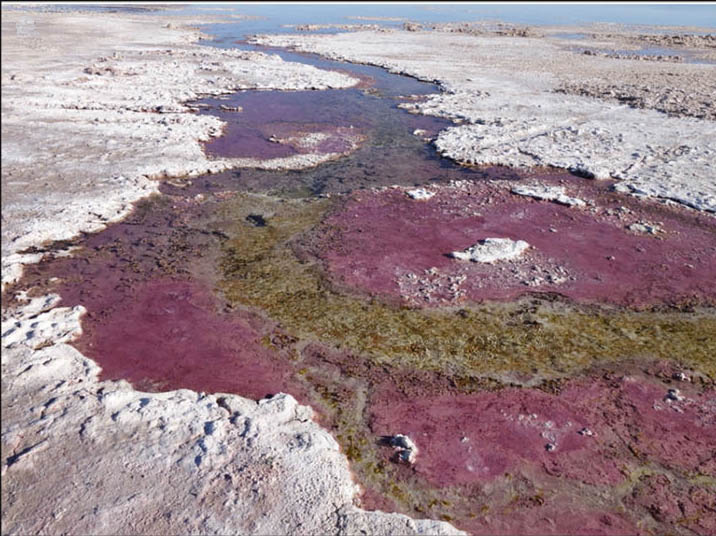
Microbial mats made by purple sulfur bacteria in highly toxic spring water flowing into a salt-lake in northern Chile. (credit: Visscher et al. 2020; Fig 1c)

Prokaryotes are a versatile group and new types keep turning up as researchers explore all kinds of strange and extreme environments, for instance: hot springs; groundwater from kilometres below the surface and highly toxic waters. A recent surprise arose from the study of anoxic springs laden with dissolved salts, sulfide ions and arsenic that feed parts of hypersaline lakes in northern Chile (Visscher, P.T. and 14 others 2020. Modern arsenotrophic microbial mats provide an analogue for life in the anoxic ArcheanCommunications Earth & Environment, v. 1, article 24; DOI: 10.1038/s43247-020-00025-2). This is a decidedly extreme environment for life, as we know it, made more challenging by its high altitude exposure to high UV radiation. The springs’ beds are covered with bright-purple microbial mats. Interestingly the water’s arsenic concentration varies from high in winter to low in summer, suggesting that some process removes it, along with sulfur, according to light levels: almost certainly the growth and dormancy of mat-forming bacteria. Arsenic is an electron donor capable of participating in photosynthesis that doesn’t produce oxygen. The microbial mats do produce no oxygen whatever – uniquely for the modern Earth – but they do form carbonate crusts that look like stromatolites. The mats contain purple sulfur bacteria (PSBs) that are anaerobic photosynthesisers, which use sulfur, hydrogen and Fe2+ as electron donors. The seasonal changes in arsenic concentration match similar shifts in sulfur, suggesting that arsenic is also being used by the PSBs. Indeed they can, as the aio gene, which encodes for such an eventuality, is present in the genome of PSBs.

Pieter Visscher and his multinational co-authors argue for prokaryotes similar to modern PSBs having played a role in creating the stromatolites found in Archaean sedimentary rocks. Oxygen-poor, the Archaean atmosphere would have contained no ozone so that high-energy UV would have bathed the Earth’s surface and its oceans to a considerable depth. Moreover, arsenic is today removed from most surface water by adsorption on iron hydroxides, a product of modern oxidising conditions (see: Arsenic hazard on a global scale; May 2020): it would have been more abundant before the GOE. So the Atacama springs may be an appropriate micro-analogue for Archaean conditions, a hypothesis that the authors address with reference to the geochemistry of sedimentary rocks in Western Australia deposited in a late-Archaean evaporating lake. Stromatolites in the Tumbiana Formation show, according to the authors, definite evidence for sulfur and arsenic cycling similar to that in that Atacama springs. They also suggest that photosynthesising blue-green bacteria (cyanobacteria) may not have viable under such Archaean conditions while microbes with similar metabolism to PSBs probably were. The eventual appearance and rise of oxygen once cyanobacteria did evolve, perhaps in the late-Archaean, left PSBs and most other anaerobic microbes, to which oxygen spells death, as a minority faction trapped in what are became ‘extreme’ environments when long before they ‘ruled the roost’. It raises the question, ‘What if cyanobacteria had not evolved?’. A trite answer would be, ‘I would not be writing this and nor would you be reading it!’. But it is a question that can be properly applied to the issue of alien life beyond Earth, perhaps on Mars. Currently, attempts are being made to detect oxygen in the atmospheres of exoplanets orbiting other stars, as a ‘sure sign’ that life evolved and thrived there too. That may be a fruitless venture, because life happily thrived during Earth’s Archaean Eon until its closing episodes without producing a whiff of oxygen.

See also: Living in an anoxic world: Microbes using arsenic are a link to early life. (Science Daily, 22 September 2020)

Did early humans learn to cook in Olduvai Gorge?

Olduvai Gorge in northern Tanzania was for many years the stamping ground of the famous Leakey family and many other anthropologists because of it richness in the skeletal remains and the tools of the earliest members of our genus Homo. The first of these, H. habilis, appears in the Olduvai stratigraphic sequence at around 2 Ma: older examples are now known from localities in Kenya and South Africa taking the species back to about 2.4 Ma. ‘Handy Man’ got the Latinised nickname from its association with abundant stone tools, albeit of a very primitive kind. Oldowan tools are of the ‘let’s bash a couple of pebbles together to get a cutting edge’ kind, dating back to 3.4 Ma (but without evidence of who made them then) and as easily-made disposable tools they linger in the archaeological record until the Neolithic and even modern times. Homo habilis had a brain size little larger than that of australopithecines and some authorities deem them to be such.

Olduvai also yielded the earliest of a more ‘brainy’ species H. ergaster (‘Action Man’), which coexisted with habilis for a few hundred thousand years from around 2 Ma. Initially they also left Oldowan tools. Then, around 1.7 Ma at Olduvai, ergaster began making another stone artefact, the symmetrical bifacial ‘axe’ – probably a multipurpose tool and possibly an object of ritual significance, according to some researchers. Whichever, to make one required visualising the finished item within a shapeless lump of hard rock, and making them required great dexterity: and still does for stone knappers. The biface or ‘Acheulean’ tool originates with one of humanity’s greatest cognitive leaps and lay at the centre of the human toolkit for well over a million years. After being made first in Olduvai by African H. ergaster biface artefacts then spread throughout the continent with H. erectus (probably a direct descendent) and beyond its shores with succeeding humans, up to and including the earliest H. sapiens. How did what seems to be a ‘golden spike’ in human culture first take material form in Olduvai? The possibility of an answer stems from pure serendipity and the development of new research tools.

A flint bifacial stone artefact from the Palaeolithic of Norfolk, UK, which incorporates a bivalve fossil

That the Olduvai Gorge has drawn in several generations of researchers lies in its geology. As well as the sediments deposited by rivers and in ephemeral lakes that characterised a broadly speaking savannah environment, from 2 to 1 Ma there were at least 31 major volcanic eruptions that deposited lavas and a wide range of volcanic ash beds. These have enabled precise dating to calibrate in minute detail the evolution of a highly productive environment and the flora and fauna that it supported during the early Pleistocene. A recently developed technique involves identification of a variety of fatty acids or lipids – natural oils, waxes and steroids – using gas chromatography. Lipids are the remaining ‘biomarkers’ of plants and microorganisms that once lived in an ecosystem. Ainara Sistiaga of the Massachusetts Institute of Technology and the University of Copenhagen, with colleagues from Denmark, Spain, the US and Tanzania, set out to document ecological variation at Olduvai over a million-year interval using this approach. Among the microbial biomarkers they stumbled on something of possibly great importance (Sistiaga, A. and 10 others 2020. Microbial biomarkers reveal a hydrothermally active landscape at Olduvai Gorge at the dawn of the Acheulean, 1.7 Ma. Proceedings of the National Academy of Sciences, v. 117, published online; DOI: 10.1073/pnas.2004532117).

The palaeo-landscape of Olduvai, as revealed by lipid analysis, was highly diverse and rich in grasses, palms shrubs, aquatic flora and edible plants, watered by spring-fed rivers. It supported a diverse fauna including large herbivores (supported by fecal biomarkers): ideal for hominin subsistence. Sistiaga et al. focus in their paper on samples from the 1.7 Ma sedimentary and volcanic sequence (the Lower Augitic Sandstones – augite is an igneous pyroxene) that contains remains of H. ergaster, the oldest bifacial artefacts, and dismembered carcases of hominin prey animals. The surprise that emerged from the volcanoclastic sandstones included lipids produced by a range of bacterial species that only thrive in modern hot springs, such as those at Yellowstone and on the North Island of New Zealand. At three sample sites biomarkers for one particular hyperthermophile were found (Thermocrinis ruber), which can only live in water between 80 to 95°C. This and the other heat-loving bacteria also require water chemistry that, if cool, is drinkable.

Artist’s impression of Homo ergaster cooking an antelope in a 1.7 Ma hot spring at Olduvai Gorge, Tanzania (credit: Tom Björklund, MIT)

The implication is obvious: the ancient Olduvai hot springs were capable of thoroughly cooking meat and vegetables. The importance for humans is that cooking both tenderises meat and tough tubers and roots and breaks down carbohydrates and proteins to make them more easily and efficiently digestible. The brain capacity of H. ergaster was significantly greater than that of H. habilis, and at the average 800 cm3 about 2/3 that of anatomically modern humans. An increase in the input of easily digested protein, fats and carbohydrates may have fuelled that growth and, in turn, the cognitive capacity of H. ergaster. Not only the Western Rift Valley of Tanzania but the whole of the East African Rift System is liberally dotted with hydrothermal vents and also with hominin-rich sites.

See also: Chu, J. 2020. Did our early ancestors boil their food in hot springs? (MIT News, 15 September 2020)

End-Triassic mass extinction: evidence for oxygen depletion on the ocean floor

For British geologists of my generation the Triassic didn’t raise our spirits to any great extent. There’s quite a lot of it on the British Geological Survey 10-miles-to-the-inch geological map (South Sheet) but it is mainly muds, sandstones or pebble beds, generally red and largely bereft of fossils. For the Triassic’s 50 Ma duration following the end-Permian extinction at 252 Ma Britain was pretty much a desert in the middle of the Pangaea supercontinent. Far beyond our travel grants’ reach, the Triassic is a riot, as in the Dolomites of Northern Italy. Apart from a day trip to look at the Bunter Pebble Beds in a quarry near Birmingham and several weeks testing the load-bearing strength of the Keuper mudstones in the West Midlands (not far off zero) in a soil-mechanics lab, we did glimpse the then evocatively named Tea Green Marl (all these stratigraphic names have vanished). Conveniently they outcrop by the River Severn estuary, below its once-famous suspension bridge and close-by the M5 motorway. Despite the Tea Green Marl containing a bone bed with marine reptiles, time didn’t permit us to fossick, and, anyway, there was a nearby pub … The formation was said to mark a marine transgression leading on to the ‘far more interesting Jurassic’ – the reason we were in the area. We were never given even a hint that the end of the Triassic was marked by one of the ‘Big Five’ mass extinctions: such whopping events were not part of the geoscientific canon in the 1960s.

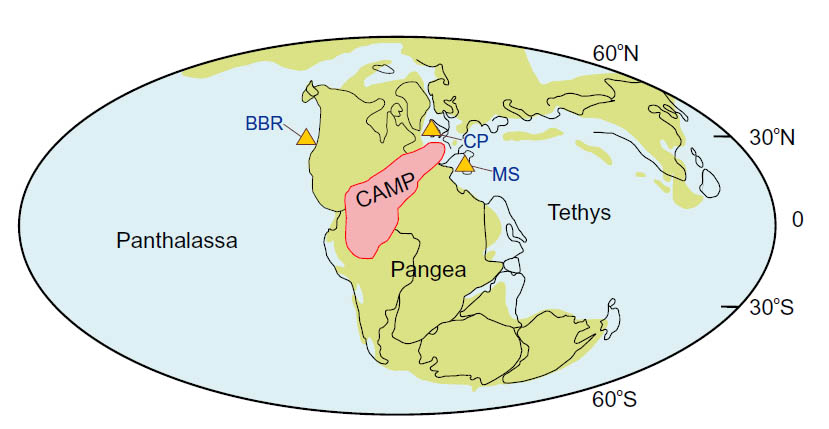
Pangaea just before the start of Atlantic opening at the end of the Triassic, showing the estimated extend of the CAMP large igneous province. The pink triangles show the sites investigated by He and colleagues.

At 201.3 Ma ago around 34 % of marine genera disappeared, comparable with the effect of the K-Pg extinction that ended the Mesozoic Era. Extinction of Triassic terrestrial animals is less quantifiable. Early dinosaurs made it through to diversify hugely during the succeeding Jurassic and Cretaceous Periods. Probably because nothing famous ceased to be or made its first appearance, the Tr-J mass extinction hasn’t captured public attention in the same way as those with the K-Pg or the P-Tr acronyms.  But it did dramatically alter the course of biological evolution. The extinctions coincided with a major eruption of flood basalts known as the Central Atlantic Magmatic Province (CAMP), whose relics occur on either side of the eponymous ocean, which began to open definitively at about the same time. So, chances are, volcanic emissions are implicated in the extinction event, somehow (see: Is end-Triassic mass extinction linked to CAMP flood basalts? June 2013). Tianchen He  of Leeds University, UK and the China University of Geosciences and British and Italian colleagues have studied three Tr-J marine sections on either side of Pangaea: in Sicily, Northern Ireland and British Columbia (He, T. and 12 others 2020. An enormous sulfur isotope excursion indicates marine anoxia during the end-Triassic mass extinction. Science Advances, v. 6, article eabb6704; DOI: 10.1126/sciadv.abb6704). Their objective was to test the hypothesis that CAMP resulted in an episode of oceanic anoxia that caused the many submarine organisms to become extinct. Since eukaryote life depends on oxygen, a deficit would put marine animals of the time under great stress. Such events in the later Mesozoic account for global occurrences of hydrocarbon-rich, black marine shales – petroleum source rocks – in which hypoxia thwarted complete decay of dead organisms over long periods. However there is scant evidence for such rocks having formed ~201 Ma ago. Such as there is dates to about 150 ka younger than the Tr-J boundary in an Italian shallow marine basin. The issue of evidence is compounded by the fact that there are no ocean-floor sediments as old as that, thanks to their complete subduction as Pangaea broke apart in later times and its continental fragments drifted to their present configuration.

But there is an indirect way of detecting deep-ocean anoxia, in the inevitable absence of any Triassic and early Jurassic oceanic crust. It emerges from what happens to the stable isotopes of sulfur when there are abundant bacteria that use the reduction of sulfate (SO42-) to sulfide (S2-) ions. Such microorganisms thrive in anoxic conditions and produce abundant hydrogen sulfide, which in turn leads to the precipitation of dissolved iron as minute grains of pyrite (FeS2). This biogenic process selectively excludes 34S from the precipitated pyrite. As a result, at times of widespread marine reducing conditions seawater as a whole becomes enriched in 34S relative to sulfur’s other isotopes. The enrichment is actually expressed in the unreacted sulfate ions, and they may be precipitated as calcium sulfate or gypsum (CaSO4) in marine sediments deposited anywhere: He et al. focussed on such fractionation. They discovered large ‘spikes’ in the relative enrichment of 34S at the Tr-J boundary in shallow-marine sedimentary sequences exposed at the three sites. Moreover, they were able to estimate that the conditions on the now vanished bed of the Triassic ocean that gave rise to the spikes lasted for about 50 thousand years. The lack of dissolved oxygen resulted in a five-fold increase in pyrite burial in the now subducted ocean-floor sediments of that time. The authors suggest that the oxygen depletion stemmed from extreme global warming, which, in turn, encouraged methane production by other ocean-floor bacteria and, in a roundabout way, other chemical reactions that consumed free dissolved oxygen. Quite a saga of a network of interactions in the whole Earth system that may hold a dreadful warning for the modern Earth and ourselves.

Diamonds and the deep carbon cycle

When considering the fate of the element carbon and CO2, together with all their climatic connotations, it is easy to forget that they may end up back in the Earth’s mantle from which they once escaped to the surface. In fact all geochemical cycles involve rock, so that elements may find their way into the deep Earth through subduction, and they could eventually come out again: the ‘logic’ of plate tectonics. Teasing out the various routes by which carbon might get to mantle is not so easily achieved. Yet one of the ways it escapes is through the strange magma that once produced kimberlite intrusions, in the form of pure-carbon crystals of diamond that kimberlites contain. A variety of petrological and geochemical techniques, some hinging on other minerals that occur as inclusions, has allowed mineralogists to figure out that diamonds may form at depths greater than about 150 km. Most diamonds of gem quality formed in unusually thick lithosphere beneath the stable, and relatively cool blocks of ancient continental crust known as cratons, which extends to about 250 km. But there are a few that reflect formation depths as great as 800 km that span two major discontinuities in the mantle (at 410 and 660 km depth). These transition zones are marked by sudden changes in seismic speed due to pressure-induced transformations in the structure and density of the main mantle mineral, olivine.

Diamond crystal containing a garnet and other inclusions (Credit: Stephen Richardson, University of Cape Town, South Africa)

Carbon-rich rocks that may be subducted are not restricted to limestones and carbon-rich mudstones. Far greater in mass are the basalts of oceanic crust. Not especially rich in carbon when they crystallised as igneous rocks, their progress away from oceanic spreading centres exposes them to infiltration by ocean water. Once heated, aqueous fluids cause basalts to be hydrothermally altered. Anhydrous feldspars, pyroxenes and olivines react with the fluids to break down to hydrated-silicate clays and dissolved metals. Dissolved carbon dioxide combines with released calcium and magnesium to form pervasive carbonate minerals, often occupying networks of veins. So there has been considerable dispute as to whether subducted sediments or igneous rocks of the oceanic crust are the main source of diamonds. Diamonds with gem potential form only a small proportion of recovered diamonds. Most are only saleable for industrial uses as the ultimate natural abrasive and so are cheaply available for research. This now centres on the isotopic chemistry of carbon and nitrogen in the diamonds themselves and the various depth-indicating silicate minerals that occur in them as minute inclusions, most useful being various types of garnet.

The depletion of diamonds in ‘heavy’ 13C once seemed to match that of carbonaceous shales and the carbonates in fossil shells, but recent data from carbonates in oceanic basalts reveals similar carbon, giving three possibilities. Yet, when their nitrogen-isotope characteristics are taken into account, even diamonds that formed at lithospheric depths do not support a sedimentary source (Regier, M.E. et al. 2020. The lithospheric-to-lower-mantle carbon cycle recorded in superdeep diamonds. Nature, v. 585, p. 234–238; DOI: 10.1038/s41586-020-2676-z). That leaves secondary carbonates in subducted oceanic basalts as the most likely option, the nitrogen isotopes more reminiscent of clays formed from igneous minerals by hydrothermal processes than those created by weathering and sedimentary deposition. However, diamonds with the deepest origins – below the 660 km mantle transition zone – suggest yet another possibility, from the oxygen isotopes of their inclusions combined with those of C and N in the diamonds. All three have tightly constrained values that most resemble those from pristine mantle that has had no interaction with crustal rocks. At such depths, unaltered mantle probably contains carbon in the form of metal alloys and carbides. Regier and colleagues suggest that subducted slabs reaching this environment – the lower mantle – may release watery fluids that mobilise carbon from such alloys to form diamonds. So, I suppose, such ultra-deep diamonds may be formed from the original stellar stuff that accreted to form the Earth and never since saw the ‘light of day’.

Monitoring ground motions with satellite radar

By using artificially generated microwaves to illuminate the Earth’s surface it is possible to create images. The technology and the theory behind this radar imaging are formidable. After about 30 years of development using aircraft-mounted transmission and reception antennas, the first high resolution images from space were produced in the late 1970s. Successive experiments improved and expanded the techniques, and for the last decade radar surveillance has been routine from a number of orbiting platforms. Radar has two advantages over optical remote sensing: being an active system it can be done equally effectively day or night; it also penetrates cloud cover, which is almost completely transparent to microwaves with wavelengths between a centimetre and a metre. The images are very different from those produced by visible or infrared radiation, the energy returns from the surface being controlled by topography and the roughness of the surface. One of many complicating factors is that images can only be produced by oblique illumination.  That, together with deployment of widely separated transmission and reception antennas, opens up the possibility of extracting very-high precision (millimetre) measurements of topographic elevation.
In 1992 radar data from two overpasses of the European ERS-1 satellite over California were processed to capture interference due to changes in the ground elevation during the time between the two orbits: the first interferometric radar or InSAR. It revealed the regional ground motions that resulted from the magnitude 7.3 Landers earthquake at 4:57 am local time on June 28, 1992. For the last decade InSAR has become a routine tool to monitor globally both lateral and vertical ground movements, whether rapid, as in earthquakes, or slow in the case of continental plate motions, subsidence or the inflation of volcanoes prior to eruptions. Juliet Biggs and Tim Wright, respectively of the Universities of Bristol and Leeds, UK, have summarised InSAR’s potential (Biggs, J. & Wright, T.J. 2020. How satellite InSAR has grown from opportunistic science to routine monitoring over the last decade. Nature Communications, v. 11, p. 1-4; DOI: 10.1038/s41467-020-17587-6).

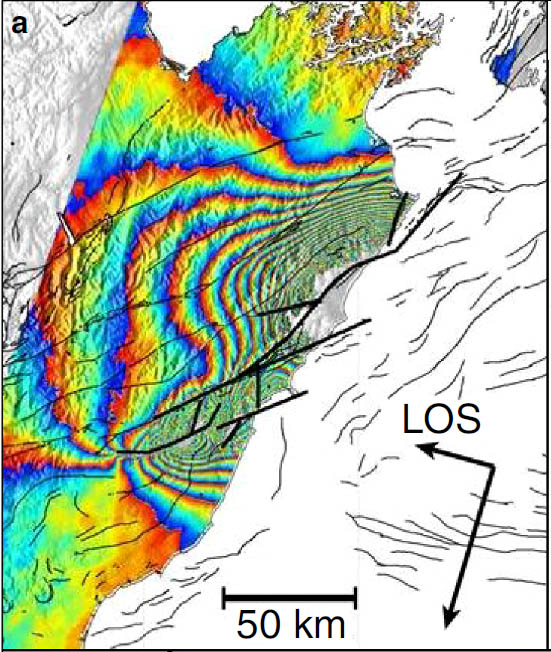
Ground motions associated with the 2016 Kaiköuea earthquake on the South Island of New Zealand. Each colour fringe represents 11.4 cm of displacement in the radar line-of-sight (LOS) direction. Known faults are shown as thick black lines (Credit: Hamling et al. 2017. Complex multifault rupture during the 2016 Mw 7.8 Kaikōura earthquake, New Zealand. Science, v. 356, article eaam7194; DOI: 10.1126/science.aam7194)

Since the ERS-1 satellite discovered the ground motions associated with the Landers earthquake, InSAR has covered more than 130 large seismic events. Although the data post-dated the damage, they have demonstrated the particular mechanics of each earthquake, allowing theoretical models to be tested and refined. In the image above it is clear that the motions were not associated with a single fault in New Zealand: the Kaikoura earthquake involved a whole network of them, at least at the surface. Probably, displacement jumped from one to another; a complexity that must be taken into account for future events on such notorious fault systems as those in densely populated parts of California and Turkey.

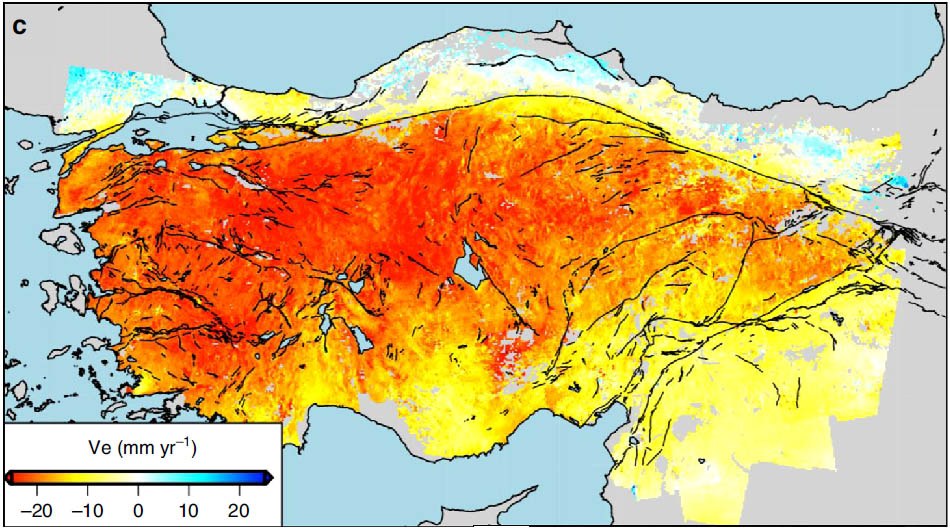
East to west speed of the Anatolian micro-plate south of the North Anatolian Fault derived from the first five years of the EU’s Sentinel-1 InSAR constellation. Major known faults shown by black lines (Credit: Emre, O. et al. 2018. Active fault database of Turkey. Bulletin of Earthquake Engineering, v. 16, p. 3229-3275; DOI: 10.1007/s10518-016-0041-2)

Since its inception, GPS has proved capable of monitoring tectonic motions over a number of years, but only for widely spaced, individual ground instruments. Using InSAR alongside years’ worth of GPS measurements helps to extend detected motions to much finer resolution, as the image above shows for Asiatic Turkey. An important parameter needed for prediction of earthquakes is the way in which crustal strain builds up in regions with dangerously active fault systems.

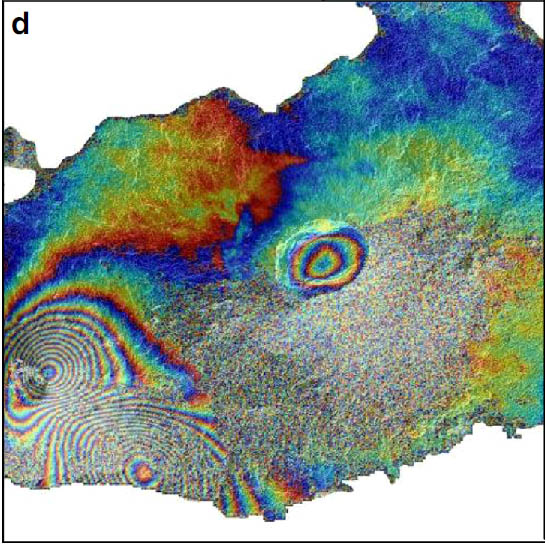
InSAR image of the Sierra Negra volcano on Isabela Island in the Galapagos Archipelago, at the time of a magma body intruding its flanks. Each colour fringe represents 2.8 cm of subsidence in the LOS direction (Credit: Anantrasirichai, N. et al. 2019. A deep learning approach to detecting volcano deformation from satellite imagery using synthetic datasets. Remote Sensing of Environment, v. 230, article 111179; DOI: 10.1016/j.rse.2019.04.032)

Volcanism obviously involves the movement of large masses of magma beneath the surface before eruptions. GPS and micro-gravity measurements show that charging of a magma chamber causes volcanoes to inflate so InSAR provides a welcome means of detecting the associated uplift, even if it only a few centimetres, as show by the example above from the Galapagos Islands. A volcano’s flanks may bulge, which could presage a lateral eruption or a pyroclastic flow such as that at Mount St Helens in 1980. Truly vast eruptions are associated with calderas whose ring faults may cause collapse in advance.

The presence of cavities beneath the surface, formed by natural solution of limestones, deliberately as in extraction of brines from salt deposits or after subsurface mining, present subsidence hazards. There have been several series of alarming TV programmes about sinkhole formation that demonstrate sudden collapse. Yet every case will have been preceded by years of gradual sagging. InSAR allows risky areas to be identified well in advance of major problems. Indeed estate agents (realtors) as well as planners, civil engineers and insurers form a ready market for such survey.

Natural sparkling water and seismicity

For all manner of reasons, natural springs have fascinated people since at least as long ago as the Neolithic. Just the fact that clear water emerges from the ground to source streams and great rivers seems miraculous. There are many occurrences of offerings having been made to supernatural spirits thought to guard springs. Even today many cannot resist tossing in a coin, hanging up a ring, necklace or strip of cloth beside a spring, for luck if nothing else. Hot springs obviously attract attention and bathers. Water from cool ones has been supposed to have health-giving properties for at least a couple of centuries, even if they stink of rotten eggs or precipitate yellow-brown iron hydroxide slime in the bottom of your cup. Spas now attribute their efficacy to their waters’ chemistry, and that depends on the rocks through which they have passed. Those in areas of volcanic rock are generally the most geochemically diverse: remember the cringe-making adverts for Volvic from the volcanic Chain des Puys in the French Auvergne. Far more ‘posh’ are naturally carbonated waters that well-out full of fizz from pressurised, dissolved CO2. Internationally the best known of these is Perrier from the limestone-dominated Gard region of southern France. Sales of bottled spring waters are booming and the obligatory water-chemistry data printed on their labels form  a do-it-yourself means of regional geochemical mapping (Dinelli, E. et al. 2010. Hydrogeochemical analysis on Italian bottled mineral waters: Effects of geology. Journal of Geochemical Exploration, v. 107, p. 317–335; DOI: 10.1016/j.gexplo.2010.06.004) But it appears from a study of variations in CO2 output from commercial springs in Italy that they may also help in earthquake prediction (Chiodini, G. et al. 2020. Correlation between tectonic CO2 Earth degassing and seismicity is revealed by a 10-year record in the Apennines, Italy. Science Advances, v. 6, article eabc2938; DOI: 10.1126/sciadv.abc2938).

Italy produces over 12 billion litres of spring water and the average Italian drinks 200 litres of it every year. There are more than 600 separate brands of acqua minerale produced in Italy, including acqua gassata (sparkling water). Even non-carbonated springs emit CO2, so it is possible to monitor its emission from the deep Earth across wide tracts of the country. High CO2 emissions are correlated worldwide with areas of seismicity, either associated with shallow magma chambers or to degassing from subduction zones. There are two possibilities: that earthquakes help release built-up fluid pressure or because fluids, such as CO2 somehow affect rock strength. Giovanni Chiodini and colleagues have been monitoring variations in CO2 release from carbonated spring water in the Italian Apennines since 2009. Over a ten-year period there have been repeated earthquakes in the area, including three of magnitude 6.0 or greater. The worst was that affecting L’Aquila in April 2009, the aftermath of which saw six geoscientists charged with – and eventually acquitted of – multiple manslaughter (see: Una parodia della giustizia?, October 2012). It was this tragedy that prompted Chiodini et al.’s unique programme of 21 repeated sampling of gas discharge rates at 36 springs, matched to continuous seismograph records. The year after the L’Aquila earthquake coincided with high emissions, which then fell to about half the maximum level by 2013. In 2015 emissions began to rise to reach a peak before earthquakes with almost the same magnitude, but less devastation, on 24 August and 30 October 2016. Thereafter emissions fell once again. This suggests a linked cycle, which the authors suggest is modulated by ascent of CO2 that originates from the melting of carbonates along the subduction zone that dips beneath central Italy. They suggest that gas accumulates in the lower crust and builds up pressure that is able to trigger earthquakes in the crust.

The variation in average emissions across central Italy (see figure above) suggests that there are two major routes for degassing from the subduction zone, perhaps focussed by fractures generated by previous crustal tectonic movements. In my opinion, this study does not prove a causal link, although that is a distinct possibility, which may be verified by extending this survey of degassing and starting similar programmes in other seismically active areas. Whether or not it might become a predictive tool depends on further work. However, other studies, particularly in China, show that other phenomena associated with groundwater in earthquake-prone areas, such as rise in well-water levels and an increase in their emissions of radon and methane, correlate in a similar manner.

‘Mud, mud, glorious mud’

Earth is a water world, which is one reason why we are here. But when it comes to sedimentary rocks, mud is Number 1. Earth’s oceans and seas hide vast amounts of mud that have accumulated on their floors since Pangaea began to split apart about 200 Ma ago during the Early Jurassic. Half the sedimentary record on the continents since 4 billion years ago is made of mudstones. They are the ultimate products of the weathering of crystalline igneous rocks, whose main minerals – feldspars, pyroxenes, amphiboles, olivines and micas, with the exception of quartz – are all prone to breakdown by the action of the weakly acidic properties of rainwater and the CO2 dissolved in it. Aside from more resistant quartz grains, the main solid products of weathering are clay minerals (hydrated aluminosilicates) and iron oxides and hydroxides. Except for silicon, aluminium and ferric iron, most metals end up in solution and ultimately the oceans.  As well as being a natural product of weathering, mud is today generated by several large industries, and humans have been dabbling in natural muds since the invention of pottery some 25 thousand years ago.  On 21 August 2020 the journal Science devoted 18 pages to a Special Issue on mud, with seven reviews (Malakoff, D. 2020. Mud. Science, v. 369, p. 894-895; DOI: 10.1126/science.369.6506.894).

Mud carnival in Brazil (Credit: africanews.com)

The rate at which mud accumulates as sediment depends on the rate at which erosion takes place, as well as on weathering. Once arable farming had spread widely, deforestation and tilling the soil sparked an increase in soil erosion and therefore in the transportation and deposition of muddy sediment. The spurt becomes noticeable in the sedimentary record of river deltas, such as that of the Nile, about 5000 years ago. But human influences have also had negative effects, particularly through dams. Harnessing stream flow to power mills and forges generally required dams and leats. During medieval times water power exploded in Europe and has since spread exponentially through every continent except Antarctica, with a similar growth in the capacity of reservoirs. As well as damming drainage these efforts also capture mud and other sediments. A study of drainage basins in north-east USA, along which mill dams quickly spread following European colonisation in the 17th century, revealed their major effects on valley geomorphology and hydrology (see: Watermills and meanders; March 2008). Up to 5 metres of sediment build-up changed stream flow to an extent that this now almost vanished industry has stoked-up the chances of major flooding downstream and a host of other environmental changes. The authors of the study are acknowledged in one Mud article (Voosen, P. 2020. A muddy legacy. Science, v. 369, p. 898-901; DOI: 10.1126/science.369.6506.898) because they have since demonstrated that the effects in Pennsylania are reversible if the ‘legacy’ sediment is removed. The same cannot be expected for truly vast reservoirs once they eventually fill with muds to become useless. While big dams continue to function, alluvium downstream is being starved of fresh mud that over millennia made it highly and continuously productive for arable farming, as in the case of Egypt, the lower Colorado River delta and the lower Yangtze flood plain below China’s Three Gorges Dam.

Mud poses extreme risk when set in motion. Unlike sand, clay deposits saturated with water are thixotropic – when static they appear solid and stable but as soon as they begin to move en masse they behave as a viscous fluid. Once mudflows slow they solidify again, burying and trapping whatever and whomever they have carried off. This is a major threat from the storage of industrially created muds in tailings ponds, exemplified by a disaster at a Brazilian mine in 2019, first at the site itself and then as the mud entered a river system and eventually reached the sea. Warren Cornwall explains how these failures happen and may be prevented (Cornwall, W. 2020. A dam big problem.  Science, v. 369, p. 906-909; DOI: 10.1126/science.369.6506.906). Another article in the Mud special issue considers waste from aluminium plants (Service, R.F. 2020. Red alert. Science, v. 369, p. 910-911; DOI: 10.1126/science.369.6506.910). The main ore for aluminium is bauxite, which is the product of extreme chemical weathering in the tropics. The metal is smelted from aluminium hydroxides formed when silica is leached out of clay minerals, but this has to be separated from clay minerals and iron oxides that form a high proportion of commercial bauxites, and which are disposed of in tailings dams. The retaining dam of such a waste pond in Hungary gave way in 2010, the thixotropic red clay burying a town downstream to kill 10 people. This mud was highly alkaline and inflicted severe burns on 150 survivors. Service also points out a more positive aspect of clay-rich mud: it can absorb CO2 bubbled through it to form various, non-toxic carbonates and help draw down the greenhouse gas.

Muddy sediments are chemically complex, partly because their very low permeability hinders oxygenated water from entering them: they maintain highly reducing conditions. Because of this, oxidising bacteria are excluded, so that much of the organic matter deposited in the muds remains as carbonaceous particles. They store carbon extracted from the atmosphere by surface plankton whose remains sink to the ocean floor. Consequently, many mudrocks are potential source rocks for petroleum. Although they do not support oxygen-demanding animals, they are colonised by bacteria of many different kinds. Some – methanogens – break down organic molecules to produce methane. The metabolism of others depends on sulfate ions in the trapped water, which they reduce to sulfide ions and thus hydrogen sulfide gas: most muds stink. Some of the H2S reacts with metal ions, to precipitate sulfide minerals, the most common being pyrite (FeS2). In fact a significant proportion of the world’s copper, zinc and lead resources reside in sulfide-rich mudstones: essential to the economies of Zambia and the Democratic Republic of Congo. But there are some strange features of mud-loving bacteria that are only just emerging. The latest is the discovery of bacteria that build chains up to 5 cm long that conduct electricity (Pennisi, E. 2020. The mud is electric. Science, v. 369, p. 902-905; DOI: 10.1126/science.369.6506.902). The bacterial ‘nanowires’ sprout from minute pyrite grains, and transfer electrons released by oxidation of organic compounds, effectively to catalyse sulfide-producing reduction reactions. NB Oxygen is not necessary for oxidation as its chemistry involves the loss of electrons, while reduction involves a gain of electrons, expressed by the acronym OILRIG (oxidation is loss, reduction is gain). It seems such electrical bacteria are part of a hitherto unsuspected chemical ecosystem that helps hold the mud together as well as participating in a host of geochemical cycles. They may spur an entirely new field of nano-technology, extending, bizarrely, to an ability to generate electricity from moisture in the air.

If you wish to read these reviews in full, you might try using their DOIs at Sci Hub.

Can a supernova affect the Earth System?

The easy answer is yes, simply because chemical elements with a greater relative atomic mass than that of iron are thought to be created in supernovae when dying giant stars collapse under their own gravity and then explode. Interstellar dust and gas clouds accumulate their debris. If the clouds are sufficiently dense gravity forms clumps that may become new stars and the planets that surround them. Matter from every once-nearby supernova enters these clouds and thus contributes to the formation of a planet. This was partly proven when pre-solar grains were found in the Murchison meteorite, some of which are as old as 7.5 billion years (Ga) – 3 Ga older than the Solar System (see: Mineral grains far older than the Solar System; January 15, 2020). Murchison is a carbonaceous chondrite, a class of meteorite which likely contributed lots of carbon-based compounds to the early Earth, setting the stage for the emergence of life. It has been estimated that a near-Earth supernova (closer than 1000 light years) would have noticeable effects on the biosphere, mainly because of the effects on atmospheric composition of the associated high-energy gamma-ray burst. That would create sufficient nitrogen oxides to destroy the ozone layer that shields the surface from harmful radiation. There are reckoned to have been 20 nearby supernovae during the last 10 Ma or so from the presence of anomalously high levels of the isotope 60Fe in marine sediment layers on the Pacific floor. Yet there is no convincing evidence that they coincided with detectable extinctions in the fossil record. But supernovae have been suggested as a possible cause of more ancient mass extinctions, such as that at the end of the Ordovician Period (but see: The late-Ordovician mass extinction: volcanic connections; July 2017).

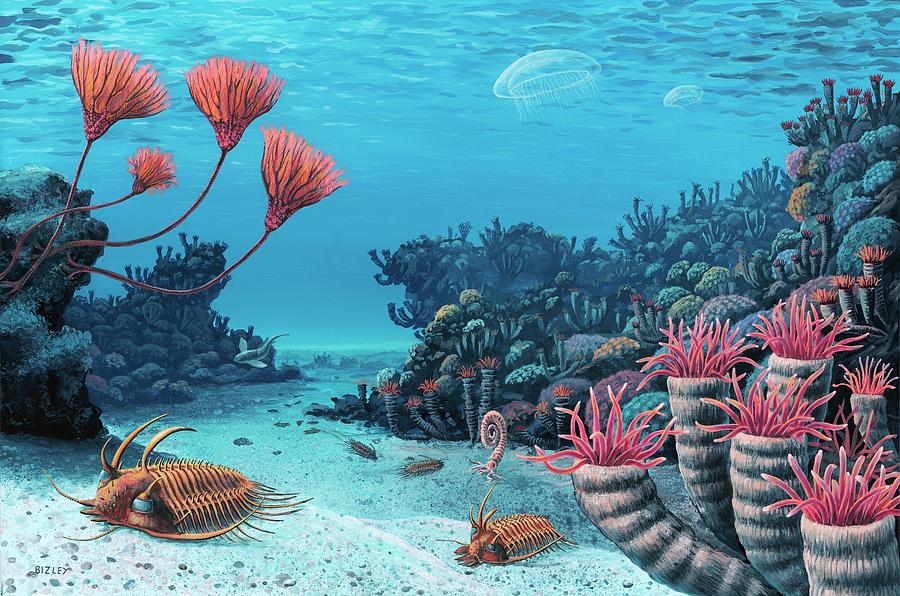
Diorama of an Early Devonian reef with tabulate and rugose corals and trilobites (Credit: Richard Bizley)

The Late Devonian is generally accepted to be one of the ‘Big Five’ mass extinction events. However, unlike the others, the event was a protracted decline in biodiversity, with several extinction peaks). In particular it marked the end of Palaeozoic reef-building corals. Some have put down the episodic faunal decline to the effects of species moving from one marine basin to another as global sea levels fluctuated: much like the effects of the ‘invasion’ of the coral-eating Crown of Thorns sea urchin that has helped devastate parts of the Great Barrier Reef during present-day global warming (see: Late Devonian: mass extinction or mass invasion? January 2012). Recently, attention has switched to evidence for ultra-violet damage to the morphology of spores found in the strata that display faunal extinction; i.e. to the possibility of the ozone layer having been lost or severely depleted. One suggestion has been sudden peaks in volcanic activity, hinted at by spikes in the abundance of mercury of marine sediments. Brian Fields of the University of Illinois, with colleagues from the USA, UK, Estonia and Switzerland, have closely examined the possibility and the testability of a supernova’s influence (Fields. B.D. et al. 2020.  Supernova triggers for end-Devonian extinctions. Proceedings of the National Academy of Sciences, v. 117, article 202013774; DOI: 10.1073/pnas.2013774117).

They propose the deployment of mass-spectrometric analysis for anomalous stable-isotope abundances in the sediments that contain faunal evidence for accelerated extinction, particularly those of 146Sm, 235U and the long-lived plutonium isotope 244Pu (80 Ma hal-life). They suggest that the separation of the extinction into several events, may be a clue to a supernova culprit. A gamma-ray burst would arrive at light speed, but dust – containing the detectable isotopes –  although likely to be travelling very quickly would arrive hundred to thousands of years later, depending on the distance to the supernova. Cosmic rays generated by the supernova, also a possible kill mechanism, given a severely depleted ozone layer, travel about half the speed of light. Three separate arrivals for the products of a single stellar explosion are indeed handy as an explanation for the Late Devonian extinctions. But someone needs to do the analyses. The long-lived  plutonium isotope is the best candidate: even detection of a few atoms in a sample would be sufficient proof. But that would require a means of ruling out contamination by anthropogenic plutonium, such as analysing the interior of fossils. But would even such an exotic discovery prove the sole influence of a galactic even?

Centenary of the Milanković Theory

A letter in the latest issue of Nature Geoscience (Cvijanovic, I. et al. 2020. One hundred years of Milanković cycles, v. Nature Geoscience , v.13p. 524–525; DOI: 10.1038/s41561-020-0621-2) reveals the background to Milutin Milanković’s celebrated work on the astronomical  driver of climate cyclicity. Although a citizen of Serbia, he had been born at Dalj, a Serbian enclave, in what was Austro-Hungary. Just before the outbreak of World War I in 2014, he returned to his native village to honeymoon with his new bride. The assassination (29 June 2014) in Sarajevo of Archduke Franz Ferdinand by Bosnian-Serb nationalist Gavrilo Princip prompted Austro-Hungarian authorities to imprison Serbian nationals. Milanković was interned in a PoW camp. Fortunately, his wife and and a former Hungarian colleague managed to negotiate his release, on condition that he served his captivity, with a right to work but under police surveillance, in Budapest. It was under these testing conditions that he wrote his seminal Mathematical Theory of Heat Phenomena Produced by Solar Radiation; finished in 1917 but remaining unpublished until 1920 because of a shortage of paper during the war.

Curiously, Milanković was a graduate in civil engineering — parallels here with Alfred Wegener of Pangaea fame, who was a meteorologist — and practised in Austria. Appointed to a professorship in Belgrade in 1909, he had to choose a field of research. To insulate himself from the rampant scientific competitiveness of that era, he chose a blend of mathematics and astronomy to address climate change. During his period as a political prisoner Milanković became the first to explain how the full set of cyclic variations in Earth’s orbit — eccentricity, obliquity and precession — caused distinct variations in incoming solar radiation at different latitudes and changed on multi-thousand-year timescales. The gist  of what might have lain behind the cyclicity of ice ages had first been proposed by Scottish scientist James Croll almost half a century earlier, but it was Milutin Milanković who, as it were, put the icing on the cake. What is properly known as the Milanković-Croll Theory triumphed in the late 1970s as the equivalent of plate tectonics in palaeoclimatology after Nicholas Shackleton and colleagues teased out the predicted astronomical signals from time series of oxygen isotope variations in marine-sediment cores.

Appropriately, while Milanković’s revoluitionary ideas lacked corroborating geological evidence, one of the first to spring to his support was that other resilient scientific ‘prophet’, Alfred Wegener. Neither of them lived to witness their vindication.

The Younger Dryas and volcanic eruptions

The issue of the Younger Dryas (YD) cold ‘hiccup’  between 12.9 to 11.7 thousand years (ka) ago during deglaciation and general warming has been the subject of at least 10 Earth-logs commentaries in the last 15 years (you can check them via the Palaeoclimatology logs). I make no apologies for what might seem to be verging on a personal obsession, because it isn’t. That 1200-year episode is bound up with major human migrations on all the northern continents: it may be more accurate to say ‘retreats’. Cooling to near-glacial climates was astonishingly rapid, on the order of a few decades at most. The YD was a shock, and without it the major human transition from foraging to agriculture might, arguably, have happened more than a millennium before it did. There is ample evidence that at 12.9 ka ocean water in the North Atlantic was freshened by a substantial input of meltwater from the decaying ice sheet on northern North America, which shut down the Gulf Stream (see: Tracking ocean circulation during the last glacial period, April 2005; The Younger Dryas and the Flood, June 2006). Such an event has many supporters. Less popular is that it was caused by some kind of extraterrestrial impact, based on various lines of evidence assembled by what amounts to a single consortium of enthusiasts. Even more ‘outlandish’ is a hypothesis that it all kicked off with radiation from a coincident supernova in the constellation Vela in the Southern sky, which is alleged to have resulted in cosmogenic 14C and 10Be anomalies at 12.9 ka. Another coincidence has been revealed by 12.9 ka-old volcanic ash in a sediment core from a circular volcanogenic lake or maar in Germany (see: Did the Younger Dryas start and end at the same times across Europe? January 2014). Being in a paper that sought to chart climate variations during the YD in a precisely calibrated and continuous core, the implications of that coincidence have not been explored fully, until now.

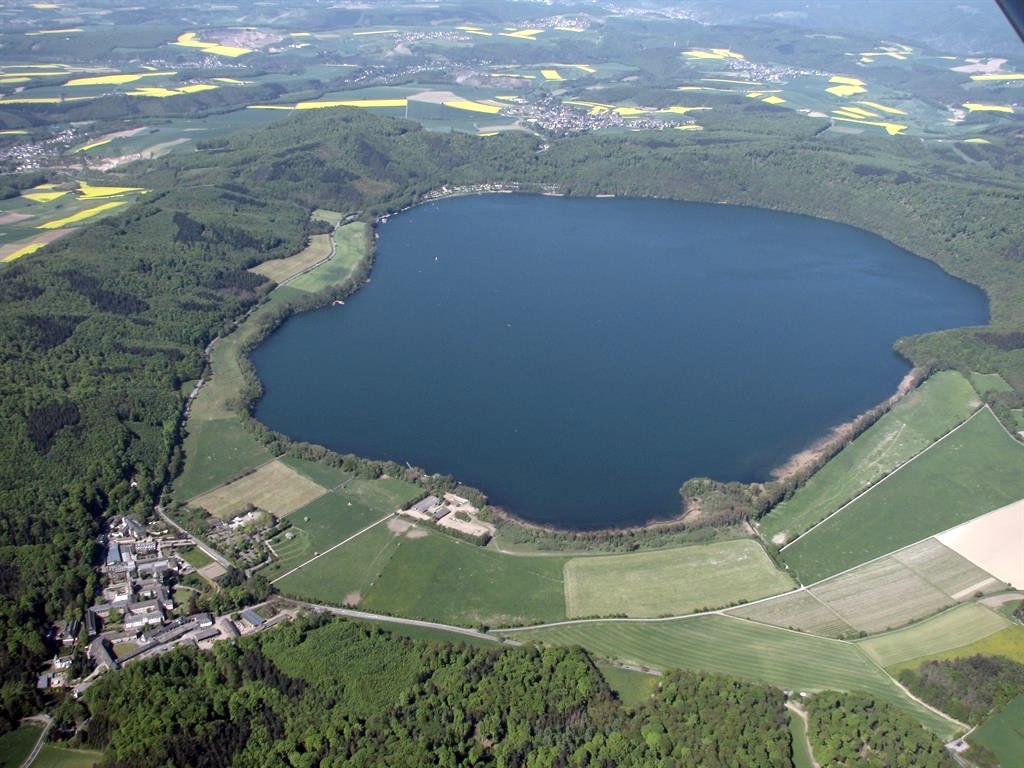
The Laacher See caldera lake in the recently active Eifel volcanic province in western Germany

A consortium of geochemists from three universities in Texas, USA has worked for some time on cave-floor sediments in Hall’s Cave, Texas as they span the YD. In particular, they sought an independent test of evidence for the highly publicised and controversial causal impact in the form of anomalous concentrations of the highly siderophile elements (HSE) osmium, iridium, platinum, palladium and rhenium (Sun, N. et al. 2020. Volcanic origin for Younger Dryas geochemical anomalies ca. 12,900 cal B.P.. Science Advances, v. 6, article eaax8587; DOI: 10.1126/sciadv.aax8587). There is a small HSE ‘spike’ at the 12.9 ka level, but there are three larger ones that precede it and one at about 11 ka. Two isotopes of the element osmium are often used to check the ultimate source of that element through the 187Os/188Os ratio, as can the relative proportions of the HSE elements compared with those in chondritic meteorites. The presence of spikes other than at the base of the YD does not disprove the extraterrestrial causal hypothesis, but the nature of those that bracket the mini-glacial time span not only casts doubt on it, they suggest a more plausible alternative. The 187Os/188Os data from each spike are ambiguous: they could either have arisen from partial melting of the mantle or from an extraterrestrial impact. But the relative HSE proportions point unerringly to the enriched layers having been inherited from volcanic gas aerosols. Two fit dated major eruptions of  the active volcanoes Mount Saint Helens (13.75 to 13.45 ka) and Glacier Peak (13.71 to 13.41 ka) in the Cascades province of western North America. Two others in the Aleutian and Kuril Arcs are also likely sources. The spike at the base of the YD exactly matches the catastrophic volcanic blast that excavated the Laacher See caldera in the Eifel region of western Germany, which ejected 6.3 km3 of sulfur-rich magma (containing 2 to 150 Mt of sulfur). Volcanic aerosols blasted into the stratosphere then may have dispersed throughout the Northern Hemisphere: a plausible mechanism for climatic cooling.

Sun et al. have not established the Laacher See explosion as the sole cause of the Younger Dryas. However, its coincidence with the shutdown of the Gulf Stream would have added a sudden cooling that may have amplified climatic effects of the disappearance of the North Atlantic’s main source of warm surface water. Effects of the Laacher See explosion may have been a tipping point, but it was one of several potential volcanic injections of highly reflective sulfate aerosols that closely precede and span the YD.

See also: Cooling of Earth caused by eruptions, not meteors (Science Daily, 31 July 2020)

Kicking-off planetary Snowball conditions

Untitled-1
Artist’s impression of the glacial maximum of a Snowball Earth event (Source: NASA)

Twice in the Cryogenian Period of the Neoproterozoic, glacial- and sea ice extended from both poles to the Equator, giving ‘Snowball Earth’ conditions. Notable glacial climates in the Phanerozoic – Ordovician, Carboniferous-Permian and Pleistocene – were long-lived but restricted to areas around the poles, so do not qualify as Snowball Earth conditions. It is possible, but less certain, that Snowball Earth conditions also prevailed during the Palaeoproterozoic at around 2.4 to 2.1 billion years ago. This earlier episode roughly coincided with the ‘Great Oxidation Event’, and one explanation for it is that the rise of atmospheric oxygen removed methane, a more powerful greenhouse gas than carbon dioxide, by oxidizing it to CO2 and water. That may well have been a consequence of the evolution of the cyanobacteria, their photosynthesis releasing oxygen to the atmosphere. The Neoproterozoic ‘big freezes’ are associated with rapid changes in the biosphere, most importantly with the rise of metazoan life in the form of the Ediacaran fauna, the precursor to the explosion in animal diversity during the Cambrian. Indeed all major global coolings, restricted as well as global, find echoes in the course of biological evolution. Another interwoven factor is the rock cycle, particularly volcanism and the varying pace of chemical weathering. The first releases CO2 from the mantle, the second helps draw it down from the atmosphere when weak carbonic acid in rainwater rots silicate minerals (see: Can rock weathering halt global warming, July 2020). All such interplays between major and sometimes minor ‘actors’ in the Earth system influence climate and, in turn, climate inevitably affects all the rest. With such complexity it is hardly surprising that there is a plethora of theories about past climate shifts.

As well as a link with fluctuations in the greenhouse effect, climate is influenced by changes in the amount of solar heating, for which there are yet more options to consider. For instance, the increase in Earth’s albedo (reflectivity) that results from ice cover, may lead through a feedback effect to runaway cooling, particularly once ice extends beyond the poorly illuminated poles. Volcanic dust and sulfate aerosols in the stratosphere also increase albedo and the tendency to cooling, as would interplanetary dust. More complexity to befuddle would-be modellers of ancient climates. Yet it is safe to say that, within the maelstrom of contributory factors, the freeze-overs of Snowball conditions must have resulted from our planet passing through some kind of threshold in the Earth System. Two theoretical scientists from the Department of Earth, Atmospheric, and Planetary Sciences at the Massachusetts Institute of Technology have attempted to cut through the log-jam by modelling the dynamics of the interplay between the ice-albedo feedback and the carbon-silicate cycle of weathering (Arnscheidt, C.W. & Rothman, D.H. 2020. Routes to global glaciation. Proceedings of the Royal Society A, v. 476, article 0303 online; DOI: 10.1098/rspa.2020.0303). Their mathematical approach involves two relatively simple, if long-winded, equations based on parameters that express solar heating, albedo, surface temperature and pressure, and the rate of volcanic outgassing of CO2; a simplification that sets biological processes to one side.

Unlike previous models, theirs can simulate varying rates, particularly of changes in solar energy input. The key conclusion of the paper is that if solar heating decreases faster than a threshold rate the more a planet’s surface water is likely to freeze from pole to pole. The authors suggest that a Snowball Earth event would result from a 2% fall in received solar radiation over about ten thousand years: pretty quick in a geological sense. Such a trigger might stem from a volcanic ‘winter’ scenario, an increase in clouds seeded by spores of primitive marine algae or other factors. The real ‘tipping point’ would probably be the high albedo of ice. There is a warning in this for the present, when a variety of means of decreasing solar input have been proposed as a ‘solution’ to global warming.

Because the Earth orbits the Sun in the ‘Goldilocks Zone’ and is volcanically active even global glaciation would be temporary, albeit of the order of millions of years. The cold would have shut down weathering so that volcanic CO2 could slowly build up in the atmosphere: the greenhouse effect would rescue the planet. Further from the Sun, a planet would not have that escape route, regardless of its atmospheric concentration of greenhouse gases: a neat lead-in to another recent paper about the ancient climate of Mars (Grau Galofre, A. et al. 2020. Valley formation on early Mars by subglacial and fluvial erosion. Nature Geoscience, early online article; DOI: 10.1038/s41561-020-0618-x)

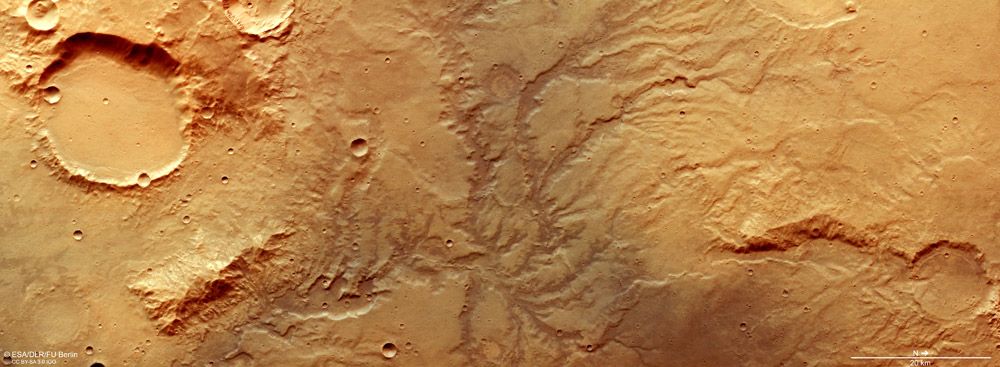
A Martian channel system: note later cratering (credit: European Space Agency)

There is a lot of evidence from both high-resolution orbital images of the Martian surface and surface ‘rovers’ that surface water was abundant over a long period in Mars’s early history. The most convincing are networks of channels, mainly in the southern hemisphere highlands. They are not the vast channelled scablands, such as those associated with Valles Marineris, which probably resulted from stupendous outburst floods connected to catastrophic melting of subsurface ice by some means. There are hundreds of channel networks, that resemble counterparts on Earth. Since rainfall and melting of ice and snow have carved most terrestrial channel networks, traditionally those on Mars have been attributed to similar processes during an early warm and wet phase. The warm-early Mars hypothesis extends even to interpreting the smooth low-lying plains of its northern hemisphere – about a third of Mars’s surface area – as the site of an ocean in those ancient times. Of course, a big question is, ‘Where did all that water go?’ Another relates to the fact that the early Sun emitted considerably less radiation 4.5 billion years ago than it does now: a warm-wet early Mars is counterintuitive.

Anna Grau Galofre of the University of British Columbia and co-authors found that many of the networks on Mars clearly differ in morphology from one another, even in small areas of its surface. Drainage networks on Earth conform to far fewer morphological types. By comparing the variability on Mars with channel-network shapes on Earth, the authors found a close match for many with those that formed beneath the ice sheet that covered high latitudes of North America during the last glaciation. Some match drainage patterns typical of surface-water erosion, but both types are present in low Martian latitudes: a suggestion of ‘Snowball Mars’ conditions? The authors reached their conclusions by analysing six mathematical measures that describe channel morphology for over ten thousand individual valley systems. Previous analyses of individual systems discovered on high-resolution images have qualitative comparisons with terrestrial geomorphology

See also: Chu, J. 2020. “Snowball Earths” May Have Been Triggered by a Plunge in Incoming Sunlight – “Be Wary of Speed” (SciTech Daily 29 July 2020); Early Mars was covered in ice sheets, not flowing rivers, researchers say (Science Daily, 3 August 2020)

2019 Annual Logs added

I have now compiled all the Earth-logs posts from 2019 into PDFs for the categories: Geohazards; Geomorphology; Human Evolution; Miscellaneous; Palaeobiology; Palaeoclimatology; Physical Resources; Planetary Science; Sediments and Stratigraphy, and Tectonics. They are available for download through the Annual logs pull-down in the main menu – just select a category, then scroll down to the 2019 list of contents and click on the link.

I hope this format is useful for reference purposes.

Isotopic clues to diet of early hominins

‘We are what we eat’ is certainly a truism, but it is neither a trope nor a cliché. The phrase is especially appropriate when scientists examine isotopes of a variety of elements in bones or teeth. For instance the relative proportions of two stable isotopes of the metal strontium – 87Sr and 86Sr – differ from place to place in soil because 87Sr is the daughter isotope of radioactive 87Rb. The older the rock from which a soil has formed the more of the radioactive rubidium isotope will have decayed. Not only does this increase the 87Sr/ 86Sr ratio in the rock and the soil derived from it, but vegetation inherits it too. So it gets into an animal’s diet and ultimately its teeth. A human who has migrated will carry the ratio of the geology of her early home geology in her adult teeth – fully developed by about 13 years-old – to wherever she dies. Likewise, the different oxygen isotopes in rainwater, which result from climate variation, end up in teeth thanks to what a person ate before adulthood. The two ‘signatures’ together allowed archaeologists to backtrack the famous ‘Amesbury Archer’, who may have brought Bronze Age culture to Britain, back to the Alps of Central Europe. Just what a human diet comprised can be roughly assessed from the carbon and nitrogen isotopes in collagen that fossil bone sometimes preserves: the proportion of seafood relative to the meat of land herbivores and the amount of terrestrial grains, nuts and fruits. The trouble is, collagen degrades with the age of human remains and another approach is needed to assess the diets of our distant forebears.

Calcium isotope data from early hominins and some modern primates. Increasingly negative values of δ44/42Ca signify lower values of the ratio compared with a standard. (Credit: Martin et al. 2020; Fig. 1)

It turns out that calcium isotopes in teeth, which do not degrade over extremely long time spans, offer clues to diet. In particular the dental 44Ca/42Ca ratio decreases as its hosts rise in the food chain; effectively as the meat content in their diet increases. This approach has been applied to the hominin and non-human primate fauna of the Turkana Basin in Kenya (Martin, J.E. et al. 2020. Calcium isotopic ecology of Turkana Basin hominins. Nature Communications, v. 11, article 3587; DOI: 10.1038/s41467-020-17427-7). The shores of a large lake in the vicinity of modern Lake Turkana were occupied from 3.5 to about 2 Ma ago by early Homo, australopithecines, paranthropoids and baboons. Using dental Ca isotopes fails to distinguish Australopithecus anamensis and Kenyanthropus platyops, whereas carbon isotopes suggest that the first had a purely C3 plant diet – fruiting plants that thrive under cool, wet conditions, as beneath woodland canopies – whereas Kenyanthropus foraged on both these and the C4 plants – many grasses and sedges – that favour open, well-lit grassland. The 44Ca/42Ca ratios in Homo teeth span a wide range of values that point to omnivory and even a high dietary meat content: a similar isotopic pattern to those of fossil baboons and geladas. Paranthropus boisei is definitely the odd-one-out, among both ancient and modern primates, and even among paranthropoids as a whole. It most likely had a specialised diet. Its teeth show wear patterns that suggest soft plant material, which seems to rule out grasses which are abrasive. Perhaps it fed on succulent semi-aquatic plants of the lake shore. When Mary Leakey first discovered P. boisei in 1959, she and husband Louis considered that its huge molars with thick enamel indicated that it ate hard vegetable matter, hence its original nickname ‘Nutcracker Man’. It also had hands capable of precise manipulation, indeed the association of the first specimen with Oldowan-type stone tools led to speculation that it had made them. Some specimens are associated with long bones with worn ends, suggesting that they may have used them for digging.

Earliest Americans, and plenty of them

Who the first Americans were is barely known outside of the tools that they left in the archaeological record. For most of the late 20th century US researchers claimed that the first people to migrate into the Americas produced stone tools of the Clovis culture that first appear just before the Younger Dryas cold period, around 13.2 to 12.9 thousand years (ka) ago. The hallmark of Clovis culture is the finely-worked stone spear point, and its association with butchered large mammals: the Clovis people were apparently big-game hunters  Despite other, albeit less convincing, signs of earlier human habitation, this notion ossified for a seemingly irrefutable reason. To reach the Americas from NE Asia on foot, these people would have had to cross the Bering Straits via the Beringia land bridge exposed as sea level fell during the Last Glacial Maximum (LGM). That would have taken them to Alaska, but an exit to the south remained blocked by the huge Laurentian ice sheet until around 13 ka. Once an ice-free route had opened, the Clovis people migrated quickly to reach the site from which they take their name in New Mexico. But other archaeological sites discovered in the last couple of decades, extending as far south as Chile, have yielded ages that clearly predate the Clovis culture (see: Clovis First hypothesis dumped, May 2008). Beneath a Clovis-bearing layer at a site in Texas excavators unearthed thousands of totally different tools reliably dated to as far back as 15.5 ka (see: Clovis first hypothesis refuted, May 2011). This opened the realistic possibility that the earliest migrants had not necessarily walked from Asia, but may have followed a marine route along the Pacific coast and spread eastwards as opportunities presented themselves.

Now Mesoamerica has convincingly verified migration more than twice as long ago as that which littered North America with Clovis tools. It emerged from the Chiquihuite Cave 2.7 km high in the Astillero Mountains of northern Mexico. Almost 2000 stone artefacts were found throughout a 3 m thick layer of sediment beneath the cave floor that spans 27 to 13  ka, (Ardelean, C.F. and 27 others 2020. Evidence of human occupation in Mexico around the Last Glacial Maximum. Nature, v. 584 p. 87–92; DOI: 10.1038/s41586-020-2509-0). The technology revealed by the tools is more primitive than that of the Clovis culture. Artefacts occur throughout the layer, which extends back in time from the Younger Dryas, through the preceding period of warming and the LGM itself. Although colder than the present equitable climate of the high mountain valleys of Northern Mexico environmental data obtained from the layer show that it was viable for occupation through the LGM. Of the 42 highly precise and accurate radiocarbon dates those from some of the stratigraphically deepest part of the layer exceed 33 ka, which the authors suggest may establish the initial human occupation of the cave. Incidentally, although the paper was published online in July 2020 it was submitted to Nature in October 2018. That is a very long time in the editorial and review process. There is no indication as to why there was such a delay: maybe an indication of some continuing defence of the Clovis First hypothesis among the reviewers …

Dated pre-Clovis sites in Mexico and North America and possible expanding distribution of people from 31.3 to 14.2 ka (Credit; Becerra-Valdivia and Higham; Extended Data Fig. 4)

The radiocarbon dating in the paper was carried out at the state-of-the-art accelerator mass spectrometer unit at the University of Oxford, UK, by two of the co-authors (Lorena Becerra-Valdivia and Thomas Higham). They too published a Nature paper in late July 2020, which discusses their new dating of 42 archaeological sites in North America and Siberia (Becerra-Valdivia, L. & Higham, T. 2020. The timing and effect of the earliest human arrivals in North America. Nature, v. 584, p. 93-97; DOI: 10.1038/s41586-020-2491-6). In Mesoamerica and North America (the Clovis heartland) their results suggest that, as in Chiquihuite Cave, ‘people were present in different settings before, during and immediately following the LGM’, their ranges increasing over time. These people would likely not have followed the same route suggested for the later Clovis people, i.e. across Beringia and then parallel to the topographic grain in the Western Cordillera, ice-cap melting permitting. An interesting suggestion by Becerra-Valdivia and Higham is that post-LGM expansion in numbers and range of these early American contributed to the famous extinction of the North American Pleistocene megafauna. Dating the extinctions of different genera suggests that disappearance of the megafauna may not have been a single event during the Younger Dryas, but seems to have been during at least two other episodes peaking at about 40 and 24 ka. Both the ecological devastation supposedly associated with the Clovis people and the impact theory for its cause depend on a single event.

See also:  Gruhn, R. 2020. Evidence grows for early peopling of the Americas. Nature, v. 584, p. 47-48; DOI: 10.1038/d41586-020-02137-3; Rincon, P. 2020. Earliest evidence for humans in the Americas (BBC News, 22 July 2020); Keys, D. 2020. Humans reached the Americas 11,000 years earlier than previously thought, archaeologists discover (Independent, 22 July 2020)

Submarine landslides and formation of the East African Rift System

The East African Rift System (Credit: P.C. Neupane, M.Sc thesis 2011; Fig. 1)

East Africa is traversed from the Afar Depression in the north to Malawi in southern Africa by several great depressions bounded by active normal fault systems: grabens in the old terminology. They are regions of active crustal extension and thinning decorated by chains of active volcanoes. The last 50 years has witnessed more than 3400 major earthquakes (magnitude 4 to 7); unsurprising for the Earth’s largest active continental rift system. In Afar, the East African Rift system links to two others that have extended sufficiently to create oceanic crust: the Red Sea and the Gulf of Aden rifts. Afar is the site of the best documented tectonic triple junction. In Ethiopia, the rifting began after the whole of the Horn of Africa and Yemen had been smothered by continental flood basalts 30 Ma ago, during the Oligocene Epoch. The East African rifts are repositories for younger sediments that contain a continuous record of hominid evolution from about 5 Ma ago. This is no coincidence, for adjacent bulging of the continental crust resulted both from its unloading by thinning along the rifts and the buoyancy conferred by high heat flow in the mantle beneath. The uplifted areas have risen as high as 4 kilometres elevation (in Ethiopia), and present some of the world’s most spectacular land forms. This N-S barrier disrupted earlier climatic patterns that had much of tropical Africa blanketed by dense woodland and resulted in a strongly seasonal climate during the last few million years and the development of open savannah land. Put simply, open grassland with widely spaced trees was no place for diminutive forest apes to scamper on all-fours. Being able to leg-it nimbly on two gave the apes that developed such a gait a decisive evolutionary advantage: the rest, as they say, is human evolutionary history.

The extension and rapid uplift along the rift flanks to this day pose severe risk of landslides. Indeed, some are so large as to resemble fault blocks in their own right. Vast amounts of the upper crust have been stripped off by rapid erosion driven by the uplift. The debris has not only ended-up on the rift floors as sedimentary fill but far more has made its way eastward to be deposited on the Indian Ocean continental shelf. Until recently, piecing together the history of rifting and uplift has been restricted to the rifts themselves and their adjacent flanks. Such terrains have extremely complex and usually discontinuous geological sequences, so signs of the onset of extensional tectonics and uplift may differ from region to region. Agreement is limited to some time between 25 and 17 Ma. The whole tectonic process may, in fact, have begun at different times along the length of the rift. A clearer picture should emerge from studies of the post-30 Ma sedimentary pile along the Indian Ocean continent shelf. A sure-fire way of getting the needed data is from offshore areas that are prospective for oil and natural gas. Such is the case off the Tanzanian coastline at the southern limit of the rift system.

Seismic reflection profile parallel to the Tanzanian coastline with the Mafia mega-slide highlighted in green (Credit: Maselli et al. 2020; Fig. 5) Click to view full resolution

The Tanzania Petroleum Development Corporation and Shell have conducted seismic reflection surveys and drilled some test wells to the SE of Zanzibar Island, an area of major deposition from the eastward flowing Ruaha–Rufiji and Rovuma Rivers. Vittorio Maselli of Dalhousie University in Halifax Nova Scotia and colleagues from the UK, Italy and the Netherlands analysed a wealth of data from these surveys, to discover one of the biggest landslides on Earth (Maselli, V. and 10 others 2020. Large-scale mass wasting in the western Indian Ocean constrains onset of East African rifting. Nature Communications, v. 11, article 3456; DOI: 10.1038/s41467-020-17267-5). The Mafia mega-slide is represented in seismic profiles by a sedimentary unit, up to 300 m thick. It has a highly irregular base that cuts across strata in late-Oligocene to early-Miocene (25-23 Ma) sediments. It covers an area of more than 11,600 km2 and has a volume of at least 2500 km3. The unit’s upper surface is also irregular, suggesting that the unit’s thickness varies considerably. Younger sediments are draped across the irregular top of the slide body. In other, parallel sections the deposit is absent. Unlike the clearly bedded nature of sediments above and below it, the seismic response of the slide deposit is featureless, except for zones of chaotic stratification that reveal slump-folds. Nor is this the only sign of major submarine slides: there are others of lesser extent that predate the base of the Pliocene (5.3 Ma).

A mass movement of this magnitude would have generated a tsunami larger than that which possibly wiped out Mesolithic habitation on the east coast of Britain 8200 years ago due to the even larger Storegga Slide at the edge of the Norwegian continental shelf. The Mafia slide event would have flooded wide tracts of the East African coast. Its estimated age, between 22.9 to 19.8 Ma, is roughly coeval with the initiation of volcanism in the Tanzanian segment of the East African Rift and the onset of rifting and uplift of its flanks. It was probably launched by a major earthquake (>7 on the Richter scale). Such is the pace of current deposition and the thickness of sedimentary build-up since the Pliocene, there is a danger of future slides, albeit of lesser magnitude: the system continues to be seismically active, with recently recorded quakes offshore of Tanzania.

Can rock weathering halt global warming?

The Lockdown has hardly been a subject for celebration, but there have been two aspects that are, to some extent, a comfort: the trickle of road traffic and the absence of convection trails. As a result the air is less polluted and much clearer, and the quietness, even in cities, has been almost palpable. Wildlife seems to have benefitted and far less CO2 has been emitted. Apart from the universal tension of waiting for one of a host of potential Covid-19 symptoms to strike and the fact that the world economy is on the brink of the greatest collapse in a century, it is tempting to hope that somehow business-as-usual will remain this way. B*gger the gabardine rush to work and the Great Annual Exodus to ‘abroad’. The crisis in the fossil fuel industry can continue, as far as I am concerned, But then, of course, I am retired, lucky to have a decent pension and live rurally. Despite the health risks, however, global capital demands that business-as-it-was must return now. A planet left to that hegemonic force has little hope of staving off anthropogenic ecological decline. But is there a way for capital to ‘have its cake and eat it’? Some would argue that there are indeed technological fixes. Among them is sweeping excess of the main greenhouse gas ‘under the carpet’ by burying it. There are three main suggestions: physically extracting CO2 where it is emitted and pumping it underground into porous rocks; using engineered biological processes in the oceans to take carbon into planktonic carbohydrate or carbonate shells and disposing the dead remains in soil or ocean-floor sediments; enhancing and exploiting the natural weathering of rock. The last is the subject of a recent cost-benefit analysis (Beerling, D.J. and 20 others 2020. Potential for large-scale CO2 removal via enhanced rock weathering with croplands. Nature, v. 583, p. 242–248; DOI: 10.1038/s41586-020-2448-9).

Carbon dioxide in the rock cycle (Credit: Skeptical Science, in Wikipedia)

Research into the climatic effects of rock weathering has a long history, for it represents one of the major components of the global carbon cycle, as well as the rock cycle. Natural chemical weathering is estimated to remove about a billion metric tons of atmospheric carbon annually. That is because the main agent of weathering is the slightly acid nature of rainwater, which contains dissolved CO2 in the form of carbonic acid (H2CO3). This weak acid comprises hydrogen ions (H+), which confer acidity, that are released by the dissolution of CO2 in water, together with HCO3ions (bicarbonate, now termed hydrogen carbonate). During weathering the hydrogen ions break down minerals in rock. This liberates metals that are abundant in the silicate minerals that make up igneous rocks – predominantly Na, Ca, K, and Mg – as their dissolved ions, leaving hydrated aluminium silicates (clay minerals) and iron oxides as the main residues, which are the inorganic basis of soils. The dissolved metals and bicarbonate ions may ultimately reach the oceans. However, calcium and magnesium ions in soil moisture readily combine with bicarbonate ions to precipitate carbonate minerals in the soil itself, a process that locks-in atmospheric carbon. Another important consequence of such sequestration is that it may make the important plant nutrient magnesium – at the heart of chlorophyll – more easily available and it neutralises any soil acidity built-up by continuous agriculture.  But carbon sequestration naturally achieved by weathering amounts to only about a thirtieth of that emitted by the burning of fossil fuels, and we know that is incapable of coping with the build-up of anthropogenic CO2 in the atmosphere: it certainly has not since the start of the Industrial Revolution.

What could chemical weathering do if it was deliberately enhanced?  One of the most common rocks, basalt, is made up of calcium-rich feldspar and magnesium-rich pyroxene and olivine. In finely granulated form this mix is particularly prone to weathering, and the magnesium released would enrich existing soil as well as drawing down CO2. Hence the focus by David Beerling and his British, US and Belgian colleagues on systematic spreading of ground-up basalt on cropland soils, in much the same way as crushed limestone is currently applied to reverse soil acidification. It is almost as cheap as conventional liming, with the additional benefit of fertilising: it would boost to crop yields. The authors estimate that removal of a metric ton of CO2 from the atmosphere by this means would cost between US$ 55 to 190, depending on where it was done. One of their findings is that the three largest emitters of carbon dioxide – China, the US and India – happen to have the greatest potential for carbon sequestration by enhanced weathering. Incidentally, increased fertility also yields more organic waste that itself could be used to increase the actual carbon content of soils, if converted through pyrolysis to ‘biochar’ .

It all sounds promising, almost ‘too good to be true’. The logistics that would be needed and the carbon emissions that the sheer mass of rock to be finely ground and then distributed would entail, for as long as global capital continues to burn fossil fuels, are substantial, as the authors admit. The grinding would have to be far more extreme than the production of igneous-rock road aggregate. Basalt or related rock is commonly used for resurfacing motorways, not especially well known for degrading quickly to a clay-rich mush. It would probably have to be around the grain size achieved by milling to liberate ore minerals in metal mines, or to produce the feedstock for cement manufacture: small particles create a greater surface area for chemical reactions. But there remains the issue of how long this augmented weathering would take to do the job: its efficiency. Experimental weathering to test this great-escape hypothesis is being conducted by a former colleague of mine, using dust from an Irish basalt quarry to coat experimental plots of a variety of soil types. After two months Mg and Ca ions were indeed being released from the dust, and tiny fragments of olivine, feldspar and pyroxene do show signs of dissolution. Whether this stems from rainwater – the main objective – or from organic acids and bacteria in the soils is yet to be determined. No doubt NASA is doing much the same to see if dusts that coat much of Mars can be converted into soils  Beerling et al. acknowledge that the speed of weathering is a major uncertainty. Large-scale field trials seem some way off, and are likely to be plagued by cussedness! Will farmers willingly change their practices so dramatically?

See also: Lehmann, J & Possinger, A. 2020. Removal of atmospheric CO2 by rock weathering holds promise for mitigating climate change. Nature, v. 583, p. 204-205; DOI: 10.1038/d41586-020-01965-7

Note (added 15 July 2020): Follower Walter Pohl has alerted me to an interesting paper on using ultramafic rocks in the same way (Kelemen, P.B. et al. 2020. Engineered carbon mineralization in ultramafic rocks for COremoval from air: Review and new insights. Chemical Geology, v.  550, Article 119628; DOI:10.1016/j.chemgeo.2020.119628). Walter’s own blog contains comments on the climatic efficacy of MgCO3 (magnesite) formed when olivine is weathered.

Turmoil in Roman Republic followed Alaskan volcanic eruption

That activities in the global political-economic system are now dramatically forcing change in natural systems is clear to all but the most obdurate. In turn, those changes increase the likelihood of a negative rebound on humanity from the natural world. In the first case, data from ice cores suggests that an anthropogenic influence on climate may have started with the spread of farming in Neolithic times. Metal pollution of soils had an even earlier start, first locally in Neanderthal hearths whose remains meet the present-day standards for contaminated soil, and more extensively once Bronze Age smelting of copper began. Global spread of anomalously high metal concentrations in atmospheric dusts shows up as ‘spikes’ in lead within Greenland ice cores during the period from 1100 BCE to 800 CE. This would have resulted mainly from ‘booms and busts’ in silver extraction from lead ores and the smelting of lead itself. In turn, that may reflect vagaries in the world economy of those times

Precise dating by counting annual ice layers reveals connections of Pb peaks and troughs with major historic events, beginning with the spread of Phoenician mining and then by Carthaginians and Romans, especially in the Iberian Peninsula. Lead reaches a sustained peak during the acme of the Roman Republic from 400 to 125 BC to collapse during widespread internal conflict during the Crisis of the Republic. That was resolved by the accession of Octavian/Augustus as Emperor in 31 BCE and his establishment of Pax Romana across an expanded empire. Lead levels rose to the highest of Classical Antiquity during the 1st and early 2nd centuries CE. Collapse following the devastating Antonine smallpox pandemic (165 to 193 CE) saw the ice-core records’ reflecting stagnation of coinage activity at low levels for some 400 years, during which the Empire contracted and changed focus from Rome to Constantinople. Only during the Early Medieval period did levels rise slowly to the previous peak.

The Okmok caldera on the Aleutian island of Umnak (Credit: Desert Research Institute, Reno, Nevada USA)

Earth-logs has previously summarised how natural events, mainly volcanic eruptions, had a profound influence in prehistory. The gigantic eruption of Toba in Sumatra (~73 ka ago) may have had a major influence on modern-humans migrating from Africa to Eurasia. The beginning of the end for Roman hegemony in the Eastern Mediterranean was the Plague of Justinian (541–549 CE), during which between 25 to 50 million people died of bubonic plague across the Eastern Empire. This dreadful event followed the onset of famine from Ireland to China, which was preceded by signs of climatic cooling from tree-ring records, and also with a peak of volcanogenic sulfate ions in the Greenland and Antarctic ice caps around 534 CE. Regional weakening of the populace by cold winters and food shortages, also preceded the Black Death of the mid-14th century. In the case of the Plague of Justinian, it seems massive volcanism resulted in global cooling over a protracted period, although the actual volcanoes have yet to be tracked down. Cooling marked the start of a century of further economic turmoil reflected by lead levels in ice cores (see above). Its historical context is the Early Medieval equivalent of world war between the Eastern Roman Empire, the Sassanid Empire of Persia and, eventually, the dramatic appearance on the scene of Islam and the Arabian, Syrian and Iraqi forces that it inspired (see: Holland, T. 2013. In the Shadow of the Sword: The battle for Global Empire and the End of the Ancient World. Abacus, London)

An equally instructive case of massive volcanism underlying social, political and economic turmoil has emerged from the geochemical records in five Greenlandic ice cores and one from the Siberian island of Severnaya Zemlya (McConnell, J.R. and 19 others 2020. Extreme climate after massive eruption of Alaska’s Okmok volcano in 43 BCE and effects on the late Roman Republic and Ptolemaic Kingdom. Proceedings of the National Academy of Sciences, recent article (22 June 2020); DOI: 10.1073/pnas.2002722117). In this case the focus was on ice layers in all six cores that contain sulfate spikes and, more importantly, abundant volcanic dust, specifically shards of igneous glass. Using layer counting, all six show major volcanism in the years 45 to 43 BCE. The Ides (15th) of March 44 BCE famously marked the assassination of Julius Caesar, two years after the Roman Republic’s Senate appointed him Dictator, following four years of civil war. This was in the later stages of the period of economic decline signified by the fall in ice-core levels of Pb (see above). The Roman commentator Servius reported “…after Caesar had been killed in the Senate on the day before, the sun’s light failed from the sixth hour until nightfall.” Other sources report similar daytime dimming, and unusually cold weather and famine in 43 and 42 BCE.

As well as pinning down the date and duration of the volcanic dust layers precisely (to the nearest month using laser scanning of the ice cores’ opacity), Joseph McConnell and the team members from the US, UK, Switzerland, Germany and Denmark also chemically analysed the minute glass shards from one of the Greenlandic ice cores. This has enabled them to identify a single volcano from 6 possible candidates for the eruption responsible for the cold snap: Okmok, an active, 8 km wide caldera in the Aleutian Islands of Alaska. Previous data suggest that its last major eruption was 2050 years ago and blasted out between 10 to 100 km3 of debris, including ash. Okmok is an appropriate candidate for a natural contributor to profound historic change in the Roman hegemony. The authors also use their ice-core data to model Okmok’s potential for climate change: it had a global reach in terms of temperature and precipitation anomalies. Historians may yet find further correlations of Okmok with events in other polities that kept annual records, such as China.

See also: Eruption of Alaska’s Okmok volcano linked to period of extreme cold in ancient Rome (Science Daily, 22 June 2020); Kornei, K. 2020. Ancient Rome was teetering. Then a volcano erupted 6,000 miles away. (New York Times, 22 June 2020)

Did an impact affect hunter gatherers at the start of the Younger Dryas?

Whether or not the return to a glacial climate between 12.8 and 11.7 thousand years (ka) ago, known as the Younger Dryas (YD), was triggered by some kind of extraterrestrial impact has been a hot and sometimes fractious issue since 2007 (see: Whizz-bang view of Younger Dryas; Earth-logs, July 2007). Before then the most favoured causal mechanism was a shutdown of the Gulf Stream’s Arctic warming influence as a result of some kind of catastrophic flooding of fresh water into the North Atlantic. That would have lowered the density of surface waters, thereby preventing them from sinking to drive the deep circulation that draws surface water from the tropics into high northern latitudes (see: The Younger Dryas flood; May 2010). In 2008 the melt-water flood supporters were sufficiently piqued by the suggestion of a hitherto unsuspected impact event to mount a powerful rejoinder (see: Impact cause for Younger Dryas draws flak; May 2008), casting doubt on the validity of the data that had been presented. It seemed like a repeat of the initial furore over claims for a ‘mountain falling out of the sky’ wiping out the dinosaurs and much else. Yet, like the claims by Alvarez pere et fils for the K-T impact, accumulated weight of evidence published by its protagonists eventually has given the idea of an impact trigger for the YD a measure of respectability. This began with evidence of an impact crater beneath the Greenland icecap (see: Subglacial impact structure in Greenland: trigger for Younger Dryas?; November 2018), then signs of a 12.8 ka fire storm in Chile followed by geochemical evidence from South Carolina, USA for a coinciding impact (see: More on the Younger Dryas causal mechanism; November 2019).

Colour-coded subglacial topography from radar sounding over the Hiawatha Glacier of NW Greenland, showing a possible impact crater (Credit: Kjaer et al. 2018; Fig. 1D)

The YD played havoc with humans who had begun to repopulate northern Europe from their Ice Age refuges in the south and those who had first ventured into the Americas  across the Beringia land bridge between Siberia and Alaska. The climate decline was extremely rapid, spanning a mere decade or so, and many would have been trapped to perish in what again became frigid steppe land. There is now evidence that late-Palaeolithic to Mesolithic hunter gatherers living far south of the reglaciated zone also suffered devastation at the start of the YD (Moore, A.M.T. and 13 others 2020. Evidence of Cosmic Impact at Abu Hureyra, Syria at the Younger Dryas Onset (~12.8 ka): High-temperature melting at > 2,200 °C. Nature Science Reports, v. 10, p. 1-22; doi: 10.1038/s41598-020-60867-w). Abu Hureyra is a tell – a mound settlement – originally on the banks of the Euphrates in northern Syria. It now lies beneath Lake Assad, but was excavated in the early 1970s to reveal a charcoal-littered habitation surface with signs of a settlement and some cultivation. Charcoal from archived samples yielded a precise radiocarbon age of 12825 ± 55 ka, coinciding with the start of the YD. The sediment from the habitation floor also contained signs compatible with ejecta from a high-energy impact: tiny diamonds and glass spherules. Analyses of the glass by the authors suggests that it formed at a temperature up to 2200°C, far greater than that of magma associated with a volcanic eruption or in hearths used by the inhabitants. However, others have analysed the glass and suggest more mundane temperatures that could be explained more simply by accidental burning of thatched huts. That possibility might explain the lack of other impact indicators, such as shocked mineral grains and anomalous geochemistry, particularly the platinum-group metals that were the original ‘smoking gun’ for the K-T boundary event and other major impacts. Incidentally, these crucial indicators have been reported from other YD sites investigated by several members of the team behind this paper. My view is that what seems to be a remarkable coincidence will not settle the matter, but will probably draw the same kind of ‘flak’ as did others on this topic. It is hardly likely that new samples will be collected from the now submerged Abu Hureyra site.

See also: Cometary Debris may have destroyed Paleolithic settlement 12,800 years ago (Science News. 2 July 2020)

Fossil fuel, mercury and the end-Palaeozoic catastrophe

Siberian flood-basalt flows in the Putorana Plateau, Taymyr Peninsula, Russia. (Credit: Paul Wignall)

The end of the Permian Period (~252 Ma ago) saw the loss of 90% of marine fossil species and 70% of those known from terrestrial sediments: the greatest known extinction in Earth’s history. In their naming of newly discovered life forms, palaeontologists can become quite lyrical. Extinctions, however, really stretch their imagination. They call the Permo-Triassic boundary event ‘The Great Dying’. Why not ‘Permageddon’? Sadly, that was snaffled in the 1980s by an astonishingly short-haired heavy-metal tribute band. Enough bathos … The close of the Palaeozoic left a great many ecological niches to be filled by adaptive radiation during the Triassic and later Mesozoic times. Coinciding with the largest known flood-basalt outpouring – the three million cubic kilometres of Siberian Traps – the P-Tr event seemed to be ‘done and dusted’ after that possible connection was discovered in the mid 1990s. Notwithstanding, the quest for a gigantic, causative impact crater continues (see: Palaeobiology Earth-logs, May, September and October 2004), albeit among a dwindling circle of enthusiasts. The Siberian Traps are suitably vast to snuff the fossil record, for their eruption must have belched all manner of climate-changing gases and dusts into the atmosphere; CO2 to encourage global warming; SO2 and dusts as cooling agents. There is also evidence of a role for geochemical toxicity (see: Nickel, life and the end-Permian extinction, June 2014). The extinctions accompanied not only climate change but also a catastrophic fall in atmospheric oxygen content (see: Homing in on the great end-Permian extinction, April 2003; When rain kick-started evolution, December 2019). Recovery of the biosphere during the early Triassic was exceedingly slow.

Research focussed on the P-Tr boundary eventually uncovered an element of pure chance. Shales in Canada that span the boundary show major, negative δ13C excursions in the carbon-isotope record that coincide with fly ash in the analysed layers. This material is similar in all respects to that emitted from coal-fired power stations (see: Coal and the end-Permian mass extinction, March 2011). The part of Siberia onto which the flood basalts were erupted is rich in Permian coal measures and oil shales that lay close to the surface 252 Ma ago. The coal ash and massive emissions of CO2 may have resulted from their burning by the flood basalt event. Now evidence has emerged that this did indeed happen (Elkins-Tanton, L.T. et al. 2020. Field evidence for coal combustion links the 252 Ma Siberian Traps with global carbon disruption. Geology, v. 48, early publication; DOI: 10.1130/G47365.1).

The US, Canadian and Russian team found large quantities of burnt coal and woody material, and bituminous blobs in 600 m thick volcanic ashes at the base of the Siberian traps themselves. They concluded that the magma chamber from which the flood basalts emerged had incorporated sizeable volumes of the coal measures, leading to their combustion and distillation. This would have released CO2 enriched in light 12C due to isotopic fractionation by biological means, i.e. its δ13C would have been sufficiently negative to affect the carbon locked up in the Canadian P-Tr boundary-layer shales that show the sharp isotopic anomalies. The magnitude of the anomalies suggest that between six to ten thousand billion tons of carbon released as CO2 or methane by interaction of the Siberian Traps with sediments through which their magma passed could have created the global δ13C anomalies. That is about one tenth of the organic carbon originally locked in the Permian coal measures beneath the flood basalts

Another paper whose publication coincided with that by Elkins-Tanton et al. suggests that environmental mercury appears to have followed the same geochemical course as did carbon at the end of the Palaeozoic Era (Dal Corso, J. and 9 others 2020. Permo–Triassic boundary carbon and mercury cycling linked to terrestrial ecosystem collapse. Nature Communications, v. 11, paper 2962; DOI: 10.1038/s41467-020-16725-4). This group, based at Leeds and Oxford Universities, UK and the University of Geosciences in Wuhan, China, base their findings on biogeochemical modelling of the global carbon and mercury cycles at the end of the Permian. Their view is that the coincidence in marine sediments at the P-Tr boundary of a short-lived spike in mercury and an anomaly in its isotopic composition with the depletion in 13C, described earlier, shows an intimate link between mercury and the biological carbon cycle in the oceans at the time. They suggest that this synergy marks ecosystem collapse and derives ‘from a massive oxidation of terrestrial biomass’; i.e. burning of organic material on the land surface. Their modelling hints at huge wildfires in equatorial peatlands but also a role for the Siberian flood-basalt volcanism and the incorporation of coal measures into the Siberian Trap magma chamber.

A protein clue to H. antecessor’s role in human evolution

Homo_antecessor child
Forensic reconstruction of the remains of a Homo antecessor child from Gran Dolina Cave in northern Spain (credit Élisabeth Daynès, Museo de la Evolución, Burgos, Spain)

The older a fossil, no matter how well preserved it is, the less chance it has to contain enough undegraded DNA for it to be extracted and sequenced using the most advanced techniques. At present the oldest fossil DNA not to have passed its ‘sell-by’date is that of a 560 to 780 thousand year-old horse’s legbone found in Canadian permafrost. For human remains the oldest mtDNA is that of a ~430 ka individual from the Sima de los Huesos in northern Spain (see: Mitochondrial DNA from 400 thousand year old humans; Earth-logs December 2013). But there is another route to establishing genetic relatedness from the amino-acid sequences of proteins recovered from ancient individuals (see: Ancient proteins: keys to early human evolution?). Fossil teeth have proved to be good repositories of ancient protein and are the most commonly found hominin fossils.

A key species for unravelling the origins of the three most recent human groups (ourselves, Neanderthals and Denisovans) is thought to be Homo antecessor who inhabited the Gran Dolina Cave in the Atapuerca Mountains in northern Spain between about 1.2 Ma and 800 ka ago (see: Human evolution: bush or basketwork? Earth-logs, January 2014). Palaeoanthropologists excavated 170 skeletal fragments from six individuals in the most productive layer at Gran Dolina. Incomplete facial bones suggest a ‘modern-like’ face, although the remains as a whole are insufficient to reconstruct the oldest Europeans with sufficient detail to place them in anatomical relation to the younger groups. But there are several teeth. One of them, a permanent molar, has yielded informative proteins (Welker, F. and 26 others 2020. The dental proteome of Homo antecessor. Nature, v. 580, p. 235-238; DOI: 10.1038/s41586-020-2153-8) and has been dated to between 772 to 949 ka.

Amino acids in the dental proteins, sequenced using mass spectrometry, were compared with those of other hominins. Because protein sequences are coded by an animal’s genome they are a ‘proxy’ for DNA. The outcome is that the Gran Dolina proteins are roughly equally related to Denisovans, Neanderthals and ourselves, suggesting that, although the younger three groups are closely related, H. antecessor is an ‘outlier’. Being significantly older, it is likely to be the common ancestor of all three. Another species with close anatomical affinities is H. heidelbergensis (700 to 300 ka) found in Africa as well as in Europe. Its mtDNA (see: Mitochondrial DNA from 400 thousand year old humans; Earth-logs December 2013) matches that of Denisovans better than it does Neanderthals, yet without protein and full-genome analysis all that can be concluded is that it may be an intermediary between H. antecessor and the well known interbreeding triad of more recent times.

We are getting closer to a documented web of interrelationships between humans in general whose time span from 2 Ma ago is now well established. The remaining genetic link to be documented is that to H. erectus, the longest lived and most travelled of all ancient humans. Frido Welker and co-workers also had a shot at the proteomics of one of the first humans known to have migrated from Africa, using an isolated, presumably H. erectus, molar found at the 1.77 Ma site at Dmanisi in the Caucasus foothills of Georgia. Although inconclusive in placing that precociously intrepid group firmly in the human story, the fact that dental proteins were discovered is cause for optimism.

See also: Campbell, M. 2020. Protein analysis of 800,000-year-old human fossil clarifies dispute over ancestors (Technology Networks, 1 April 2020)

What controls the height of mountains?

‘Everybody knows’ that mountains grow: the question is, ‘How?’ There is a tale that farmers once believed that they grew from pebbles: ‘every year I try to rid my field of stones, but more are back the following year, so they must grow’… Geoscientists know better – or so they think[!] – and for 130 years have referred to ‘orogeny’, a classically-inspired term (from the Ancient Greek óros and geneia – high-ground creation’) adopted by the US geologist Grove Gilbert. It incorporates the concept of crustal thickening that results from lateral forces and horizontal compression. Another term, now rarely used, is ‘epeirogeny’ (coined too by G.K. Gilbert), wherein the continental surface rises or falls in response to underlying gravitational forces. That could include: changing mantle density over a hot, rising plume; detachment or delamination into the mantle of dense lower lithosphere; loading or unloading by ice during glacial cycles. Epeirogeny is bound up with isostasy, the maintenance of gravitational balance of mass in the outermost Earth.

A small part of the High Himalaya (credit: Access-Himalaya)

In 1990, Peter Molnar and Philip England pointed out that the incision of deep valleys into mountain ranges results in stupendous and rapid removal of mass from orogenic belts, which adds a major isostatic force to mountain building (Molnar, P. & England, P. 1990. Late Cenozoic uplift of mountain ranges and global climate change: chicken or egg? Nature, v. 346, p. 29–34; DOI: 10.1038/346029a0). In their model, the remaining peaks are driven higher by isostasy. They, and others, coupled climate change with compressional tectonics in a positive feedback that drives peaks to elevations that they would otherwise never achieve. Molnar and England’s review saw complex interplays contributing to mountain building, accompanying chemical weathering even changing global climate by sequestering atmospheric CO2 into the minerals that it produces. As well as the height of peaks in active zones of crustal shortening and thickening, such as the Himalaya, Molnar and England’s theory explained the aberrant high peaks at the edge of high plateaus that are passively subject to erosion. Examples of the latter are the isolated peaks beyond the eastern edge of the Ethiopian Plateau that locally have the greatest elevation than the flood basalts that form the plateau: unloading around these peaks has caused them to rise isostatically.

Thirty years on, this paradigm is being questioned, at least as regards active orogens (Dielforder, A. et al. 2020. Megathrust shear force controls mountain height at convergent plate margins. Nature, v. 582, p. 225–229; DOI: 10.1038/s41586-020-2340-7). Armin Dielforder and colleagues at the German Research Centre for Geosciences in Potsdam and The University of Münster consider that overall mountain height is sustained by interactions between three forces. 1. They are prevented from falling apart under their own weight or being pushed up further against gravity by lateral tectonic force. 2. Climate controlled erosion limits mountain height by removing material from the highest elevations. 3. Isostasy keeps the mountains ‘afloat’ above the asthenosphere. The authors have attempted to assess and balance all three major forces that determine the overall elevation of mountain belts.

At a convergent plate margin where one plate is shoved beneath another, the megathrust above the subduction zone behaves in a brittle fashion, with associated friction, towards the surface. At depth this transitions to a zone of ductile deformation dominated by viscosity. A major assumption in this work is that stress in the crust below a mountain belt is neutral; i.e. horizontal, tectonic compression is equal to the weight of the mountains themselves and thus to their height. So, the greater the tectonic compressive force the higher the mountain range that it can support. The test is to compare the actual elevation with that predicted from plate-tectonic considerations. For 10 active orogenic belts there is a remarkable correspondence between the model and actuality. the authors conclude that variation over time of mountain height reflects log-term variations in the force balance, in which they find little sign of a climatic/erosional control. But that doesn’t resolve the issue satisfactorily, at least for me.

The study focuses on the mean elevation, and this leaves out the largest mountains; for instance, their maximum mean elevation for the Himalaya is about 5.46 km (in fact for a narrow  NE-SW swath that may not be representative of the whole range). Yet the Himalaya contains 10 of the world’s highest mountains, all over 8 km high and 50 peaks that top 7 km, adjacent to the Tibetan Plateau. The mean elevation of the whole Himalayan range is 6.1 km. Consequently, it seems to me, the range’s maximum mean elevation must be somewhat higher than that reported by Dielforder et al.  The difference suggests that non-tectonic forces do contribute significantly to Himalayan terrain

See also:  Wang, K. 2020. Mountain height may be controlled by tectonic force, rather than erosion. Nature, v. 582, p. 189-190; DOI: 10.1038/d41586-020-01601-4

Geochemistry and the Ediacaran animals

Hopefully, readers will be fairly familiar with the sudden appearance of the Ediacaran fauna – the earliest abundant, large animals – at the start of the eponymous Period of the Neoproterozoic around 635 Ma. If not, use the Search Earth-logs box in the side bar to find extensive coverage since the start of the 21st century. A June 2019 Earth-logs review of the general geochemical background to the Ediacaran Period can be found here. Ten years ago I covered the possible role of the element phosphorus (P) – the main topic here – in the appearance of metazoans (see: Phosphorus, Snowball Earth and origin of metazoans – November 2010).

One of the major changes in marine sedimentation seen during the Ediacaran was a rapid increase in the deposition on the ocean floor of large bodies of P-rich rock (phosphorite), on which a recent paper focuses (Laakso, T.A. et al. 2020. Ediacaran reorganization of the marine phosphorus cycle. Proceedings of the National Academy of Sciences, v. 117, p. 11961-11967; DOI: 10.1073/pnas.1916738117). It has been estimated that on million-year time scales phosphorites remove only a tiny amount of the phosphorus carried into the oceans by rivers. So, conversely, an increase in deposition of marine P-rich sediment would have little effect on the overall availability of this essential nutrient from the oceans. The Ediacaran boost in phosphorites suggests a connection between them and the arrival of totally new ecosystems: the global P-cycle must somehow have changed. This isn’t the only change in Neoproterozoic biogeochemistry. Thomas Laakso and colleagues note signs of slightly increased ocean oxygenation from changes in sediment trace-element concentrations, a major increase in shallow-water evaporites dominated by calcium sulfate (gypsum) and changes in the relative proportions of different isotopes of sulfur.

Because all marine cycles, both geochemical and those involving life, are interwoven, the authors suggest that changes in the fate of dead organic matter may have created the phosphorus paradox. Phosphorus is the fifth most abundant element in all organisms after carbon, hydrogen, nitrogen and oxygen, followed by sulfur (CHNOPS), P being a major nutrient that limits the sheer bulk of marine life. Perhaps changes to dead organic matter beneath the ocean floor released its phosphorus content, roughly in the manner that composting garden waste releases nutrients back to the soil. Two chemical mechanisms can do this in the deep ocean: a greater supply of sinking organic matter – essentially electron donors – and of oxidants that are electron acceptors. In ocean-floor sediments organic matter can be altered to release phosphorus bonded in organic molecules into pore water and then to the body of the oceans to rise in upwellings to the near surface where photosynthesis operates to create the base of the ecological food chain.

Caption The Gondwana supercontinent that accumulated during the Neoproterozoic to dominate the Earth at the time of the Ediacaran (credit: Fama Clamosa, at Wikimedia Commons)

There is little sign of much increase in deep-ocean oxygen until hundreds of million years after the Ediacaran. It is likely, therefore, that increased availability of oxidant sulfate ions (SO42-) in ocean water and their reduction to sulfides in deep sediment chemically reconstituted the accumulating dead organic matter to release P far more rapidly than before. This is supported by the increase in CaSO4 evaporites in the Ediacaran shallows. So, where did the sulfate come from? Compressional tectonics during the Neoproterozoic Era were at a maximum, particularly in Africa, South America, Australia and Antarctica, as drifting continental fragments derived from the break-up of the earlier Rodinia supercontinent began to collide. This culminated during the Ediacaran around 550 Ma ago with assembly of the Gondwana supercontinent. Huge tracts of it were new mountain belts whose rapid erosion and chemical weathering would have released plenty of sulfate from the breakdown of common sulfide minerals.

So the biological revolution and a more productive biosphere that are reflected in the Ediacaran fauna ultimately may have stemmed from inorganic tectonic changes on a global scale