How did African humans survive the 74 ka Toba volcanic supereruption?

The largest volcanic eruption during the 2.5 million year evolution of the genius Homo, about 74 thousand years (ka) ago, formed a huge caldera in Sumatra, now filled by Lake Toba. A series of explosions lasting just 9 to 14 days was forceful enough to blast between 2,800 to 6,000 km3 of rocky debris from the crust. An estimated 800 km3 was in the form of fine volcanic ash that blanketed South Asia to a depth of 15 cm. Thin ash layers containing shards of glass from Toba occur in marine sediments beneath the Indian Ocean, the Arabian and South China Seas. Some occur as far off as sediments on the floor of Lake Malawi in southern Africa. A ‘spike’ of sulfates is present at around 74 ka in a Greenland ice core too. Stratospheric fine dust and sulfate aerosols from Toba probably caused global cooling of up to 3.5 °C over a modelled 5 years following the eruption. To make matters worse, this severe ‘volcanic winter’ occurred during a climatic transition from warm to cold caused by changes in ocean circulation and falling atmospheric CO2 concentration, known as a Dansgaard-Oeschger event.

There had been short-lived migrations of modern humans out of Africa into the Levant since about 185 ka. However, studies of the mitochondrial DNA (mtDNA) of living humans in Eurasia and Australasia suggest that permanent migration began about 60 ka ago. Another outcome of the mtDNA analysis is that the genetic diversity of living humans is surprisingly low. This suggests that human genetic diversity may have been sharply reduced globally roughly around the time of the  Toba eruption. This implies a population bottleneck with the number of humans alive at the time to the order of a few tens of thousands (see also: Toba ash and calibrating the Pleistocene record; December 2012). Could such a major genetic ‘pruning’ have happened in Africa? Over six field seasons, a large team of geoscientists and archaeologists drawn from the USA, Ethiopia, China, France and South Africa have excavated a rich Palaeolithic site in the valley of the Shinfa River, a tributary of the Blue Nile in western Ethiopia. Microscopic studies of the sediments enclosing the site yielded glass shards whose chemistry closely matches those in Toba ash, thereby providing an extremely precise date for the human occupation of the site: during the Toba eruption itself (Kappelman, Y. and 63 others 2024. Adaptive foraging behaviours in the Horn of Africa during Toba supereruption. Nature, v. 627; DOI: 10.1038/s41586-024-07208-3).

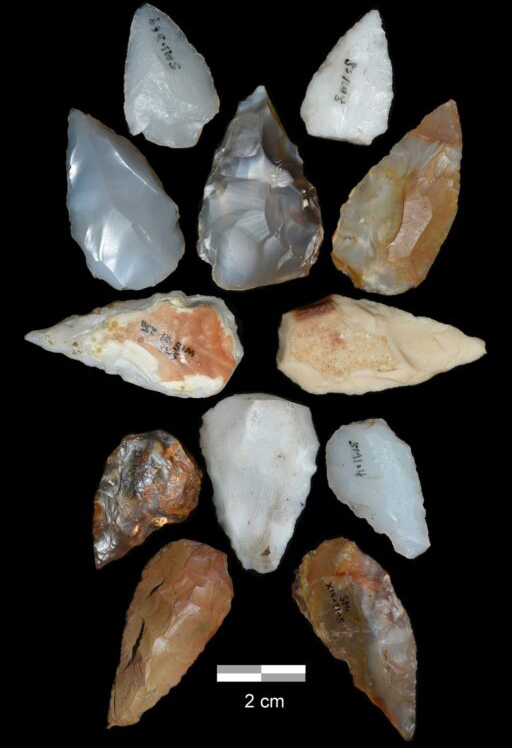
Selection of possible arrowheads from the Shinfa River site (Credit: Kappelman et al.; Blue Nile Survey Project)

The artifacts and bones of what these modern humans ate suggest a remarkable scenario for how they lived. Stone tools are finely worked from local basalt lava, quartz and flint-like chalcedony found in cavities in lava flows. Many of them are small, sharp triangular points, some of which show features consistent with their use as projectile tips that fractured on impact; they may be arrowheads, indeed the earliest known. Bones found at the site are key pointers to their diet. They are from a wide variety of animal, roughly similar to those living in the area at present: from monkeys to giraffe, guinea fowl to ostrich, and even frogs. There are remains of many fish and freshwater molluscs. Although there are no traces of plant foods, clearly those people who loved through the distant effects of Toba were well fed. Although a period of global cooling may have increased aridity at tropical latitudes in Africa, the campers were able to devise efficient strategies to obtain victuals. During wet seasons they lived off terrestrial prey animals, and during the driest times ate fish from pools in the river valley. These are hardly conditions likely to devastate their numbers, and the people seem to have been technologically flexible. Similar observations were made at the Pinnacle Point site in far-off South Africa in 2018, where Toba ash is also present. Both sites refute any retardation of human cultural progress 74 ka ago. Rather the opposite: people may have been spurred to innovation, and the new strategies may have allowed them to migrate more efficiently, perhaps along seasonal drainages. In this case that would have led them or their descendants to the Nile and a direct route to Eurasia; along ‘blue highway’ corridors as Kappelman et al. suggest.

Yet the population bottleneck implied by mtDNA analyses is only vaguely dated: it may have been well before or well after Toba. Moreover, there is a 10 ka gap between Toba and the earliest accurately dated migrants who left Africa – the first Australians at about 65 ka. However, note that there is inconclusive evidence that modern humans may have occupied Sumatra by the time of the eruption.  Much closer to the site of the eruption in southeast India, stone artifacts have been found below and above the 74 ka datum marked by the thick Toba Ash. Whether these were discarded by anatomically modern humans or earlier migrants such as Homo erectus remains unresolved. Either way, at that site there is no evidence for any mass die-off, even though conditions must have been pretty dreadful while the ash fell. But that probably only lasted for little more than a month. If the migrants did suffer very high losses to decrease the genetic diversity of the survivors, it seems just as likely to have been due to attrition on an extremely lengthy trek, with little likelihood of tangible evidence surviving. Alternatively, the out-of-Africa migrants may have been small in number and not fully representative of the genetic richness of the Africans who stayed put: a few tens of thousand migrants may not have been very diverse from the outset.

The ‘Anthropocene Epoch’ bites the dust?

The International Commission on Stratigraphy (ICS) issues guidance for the division of geological history that has evolved from the science’s original approach: that was based solely on what could be seen in the field. That included: variations in lithology and the law of superposition; unconformities that mark interruptions through deformation, erosion and renewed deposition; the fossil content of sediments and the law of faunal succession; and more modern means of division, such as geomagnetic changes detected in rock over time. That ‘traditional’ approach to relative time is now termed chronostratigraphy, which has evolved since the 19th century from the local to the global scale as geological research widened its approach. Subsequent development of various kinds of dating has made it possible to suggest the actual, absolute time in the past when various stratigraphic boundaries formed – geochronology. Understandably, both are limited by the incompleteness of the geological record – and the whims of individual geologists. For decades the ICS has been developing a combination of both approaches that directly correlates stratigraphic units and boundaries with accurate geochronological ages. This is revised periodically, the ICS having a detailed protocol for making changes.  You can view the Cenozoic section of the latest version of the International Chronostratigraphic Chart and the two systems of units below. If you are prepared to travel to a lot of very remote places you can see a monument – in some cases an actual Golden Spike – marking the agreed stratigraphic boundary at the ICS-designated type section for 80 of the 93 lower boundaries of every Stage/Age in the Phanerozoic Eon. Each is a sonorously named Global Boundary Stratotype Section and Point or GSSP (see: The Time Lords of Geology, April 2013). There are delegates to various subcommissions and working groups of the ICS from every continent, they are very busy and subject to a mass of regulations

Chronostratigraphic Chart for the Cenozoic Era showing the 5 tiers of stratigraphic time division. The little golden spikes mark where a Global Boundary Stratotype Section and Point monument has been erected at the boundary’s type section.

On 11 May 2011, the Geological Society of London hosted a conference, co-sponsored by the British Geological Survey, to discuss evidence for the dawn of a new geological Epoch: the Anthropocene, supposedly marking the impact of humans on Earth processes. There has been ‘lively debate’ about whether or not such a designation should be adopted. An Epoch is at the 4th tier of the chronostratigraphic/geochronologic systems of division, such as the Holocene, Pleistocene, Pliocene and Miocene, let alone a whole host of such entities throughout the Phanerozoic, all of which represent many orders of magnitude longer spans of time and a vast range of geological events. No currently agreed Epoch lasted less than 11.7 thousand years (the Holocene) and all the others spanned 1 Ma to tens of Ma (averaged at 14.2 Ma). Indeed, even geological Ages (the 5th tier) span a range from hundreds of thousands to millions of years (averaged at 6 Ma). Use ‘Anthropocene’ in Search Earth-logs to read posts that I have written on this proposal since 2011, which outline the various arguments for and against it.

In the third week of May 2019 the 34-member Anthropocene Working Group (AWG) of the ICS convened to decide on when the Anthropocene actually started. The year 1952 was proposed – the date when long-lived radioactive plutonium first appears in sediments before the 1962 International Nuclear Test-Ban Treaty. Incidentally, the AWG proposed a GSSP for the base of the Anthropocene in a sediment core through sediments in the bed of Crawford Lake an hour’s drive west of Toronto, Canada.   After 1952 there are also clear signs that plastics, aluminium, artificial fertilisers, concrete and lead from petrol began to increase in sediments. The AWG accepted this start date (the Anthropocene ‘golden spike’) by a 29 to 5 vote, and passed it into the vertical ICS chain of decision making. This procedure reached a climax on Monday 4 March 2024, at a meeting of the international Subcommission on Quaternary Stratigraphy (SQS): part of the ICS. After a month-long voting period, the SQS announced a 12 to 4 decision to reject the proposal to formally declare the Anthropocene as a new Epoch. Normally, there can be no appeals for a losing vote taken at this level, although a similar proposal may be resubmitted for consideration after a 10 year ‘cooling off’ period. Despite the decisive vote, however, the chair of the SQS, palaeontologist Jan Zalasiewicz of the University of Leicester, UK, and one of the group’s vice-chairs, stratigrapher Martin Head of Brock University, Canada have called for it to be annulled, alleging procedural irregularities with the lengthy voting procedure.

Had the vote gone the other way, it would marked the end of the Holocene, the Epoch when humans moved from foraging to the spread of agriculture, then the ages of metals and ultimately civilisation and written history. Even the Quaternary Period seemed under threat: the 2.5 Ma through which the genus Homo emerged from the hominin line and evolvd. Yet a pro-Anthropocene vote would have faced two more, perhaps even more difficult hurdles: a ratification vote by the full ICS, and a final one in August 2024 at a forum of the International Union of Geological Sciences (IUGS), the overarching body that represents all aspects of geology.  

There can be little doubt that the variety and growth of human interferences in the natural world since the Industrial Revolution poses frightening threats to civilisation and economy. But what they constitute is really a cultural or anthropological issue, rather than one suited to geological debate. The term Anthropocene has become a matter of propaganda for all manner of environmental groups, with which I personally have no problem. My guess is that there will be a compromise. There seems no harm either way in designating the Anthropocene informally as a geological Event. It would be in suitably awesome company with the Permian and Cretaceous mass extinctions, the Great Oxygenation Event at the start of the Proterozoic, the Snowball Earth events and the Palaeocene–Eocene Thermal Maximum. And it would require neither special pleading nor annoying the majority of geologists. But I believe it needs another name. The assault on the outer Earth has not been inflicted by the vast majority of humans, but by a tiny minority who wield power for profit and relentless growth in production. The ‘Plutocracene’ might be more fitting. Other suggestions are welcome …

See also: Witze, A. 2024. Geologists reject the Anthropocene as Earth’s new epoch — after 15 years of debate. Nature, v. 627, News article; DOI: 10.1038/d41586-024-00675-8; Voosen, P. 2024. The Anthropocene is dead. Long live the Anthropocene. Science, v. 383, News article, 5 March 2024.

A new explanation for the Neoproterozoic Snowball Earth episodes

The Cryogenian Period that lasted from 860 to 635 million years ago is aptly named, for it encompassed two maybe three episodes of glaciation. Each left a mark on every modern continent and extended from the poles to the Equator. In some way, this series of long, frigid catastrophes seems to have been instrumental in a decisive change in Earth’s biology that emerged as fossils during the following Ediacaran Period (635 to 541 Ma). That saw the sudden appearance of multicelled organisms whose macrofossil remains – enigmatic bag-like, quilted and ribbed animals – are found in sedimentary rocks in Australia, eastern Canada and NW Europe. Their type locality is in the Ediacara Hills of South Australia, and there can be little doubt that they were the ultimate ancestors of all succeeding animal phyla. Indeed one of them Helminthoidichnites, a stubby worm-like animal, is a candidate for the first bilaterian animal and thus our own ultimate ancestor. Using the index for Palaeobiology or the Search Earth-logs pane you can discover more about them in 12 posts from 2006 to 2023. The issue here concerns the question: Why did Snowball Earth conditions develop? Again, refresh your knowledge of them, if you wish, using the index for Palaeoclimatology or Search Earth-logs. From 2000 onwards you will find 18 posts: the most for any specific topic covered by Earth-logs. The most recent are Kicking-off planetary Snowball conditions (August 2020) and Signs of Milankovich Effect during Snowball Earth episodes (July 2021): see also: Chapter 17 in Stepping Stones.

One reason why Snowball Earths are so enigmatic is that CO2 concentrations in the Neoproterozoic atmospheric were far higher than they are at present. In fact since the Hadean Earth has largely been prevented from being perpetually frozen over by a powerful atmospheric greenhouse effect. Four Ga ago solar heating was about 70 % less intense than today, because of the ‘Faint Young Sun’ paradox. There was a long episode of glaciation (from 2.5 to 2.2 Ga) at the start of the Palaeoproterozoic Era during which the Great Oxygenation Event (GOE) occurred once photosynthesis by oxygenic bacteria became far more common than those that produced methane. This resulted in wholesale oxidation to carbon dioxide of atmospheric methane whose loss drove down the early greenhouse effect – perhaps a narrow escape from the fate of Venus. There followed the ‘boring billion years’ of the Mesoproterozoic during which tectonic processes seem to have been less active. in that geologically tedious episode important proxies (carbon and sulfur isotopes) that relate to the surface part of the Earth System ‘flat-lined’.  The plethora of research centred on the Cryogenian glacial events seems to have stemmed from the by-then greater complexity of the Precambrian Earth System.

Since the GOE the main drivers of Earth’s climate have been the emission of CO2 and SO2 by volcanism, the sedimentary burial of carbonates and organic carbon in the deep oceans, and weathering. Volcanism in the context of climate is a two-edged sword: CO2 emission results in greenhouse warming, and SO2 that enters the stratosphere helps reflect solar radiation away leading to cooling. Silicate minerals in rocks are attacked by hydrogen ions (H+) produced by the solution of CO2 in rain water to form a weak acid (H2CO3: carbonic acid). A very simple example of such chemical weathering is the breakdown of calcium silicate:

CaSiO3  +  2CO2  + 3H2O  =  Ca2+  +  2HCO3  +  H4SiO4  

The reaction results in calcium and bicarbonate ions being dissolved in water, eventually to enter the oceans where they are recombined in the shells of planktonic organisms as calcium carbonate. On death, their shells sink and end up in ocean-floor sediments along with unoxidised organic carbon compounds. The net result of this part of the carbon cycle is reduction in atmospheric CO2 and a decreased greenhouse effect: increased silicate weathering cools down the climate. Overall, internal processes – particularly volcanism – and surface processes – weathering and carbonate burial – interact. During the ‘boring billion’ they seem to have been in balance. The two processes lie at the core of attempts to model global climate behaviour in the past, along with what is known about developments in plate tectonics – continental break-up, seafloor spreading and orogenies – and large igneous events resulting from mantle plumes. A group of geoscientists from the Universities of Sydney and Adelaide, Australia have evaluated the tectonic factors that may have contributed to the first and longest Snowball Earth of the Neoproterozoic: the Sturtian glaciation (717 to 661 Ma) (Dutkiewicz, A. et al. 2024. Duration of Sturtian “Snowball Earth” glaciation linked to exceptionally low mid-ocean ridge outgassing. Geology, v. 52, online early publication; DOI: 10.1130/G51669.1).

Palaeogeographic reconstructions (Robinson projection) during the early part of the Sturtian global glaciation: LEFT based on geological data from Neoproterozoic terrains on modern continents; RIGHT based on palaeomagnetic pole positions from those terrains. Acronyms refer to each terrains, e.g. Am is Amazonia, WAC is the West African Craton. Orange lines are ocean ridges, those with teeth are subduction zone. (Credit: Dutkiewicz et al., parts of Fig. 1)

Shortly before the Sturtian began there was a major flood volcanism event, forming the Franklin large igneous province, remains of which are in Arctic Canada. The Franklin LIP is a subject of interest for triggering the Sturtian, by way of a ‘volcanic winter’ effect from SO2 emissions or as a sink for CO through its weathering. But both can be ruled out as no subsequent LIP is associated with global cooling and the later, equally intense Marinoan global glaciation (655 to 632 Ma) was bereft of a preceding LIP. Moreover, a world of growing frigidity probably could not sustain the degree of chemical weathering to launch a massive depletion in atmospheric CO2. In search of an alternative, Adriana Dutkiewicz and colleagues turned to the plate movements of the early Neoproterozoic. Since 2020 there have been two notable developments in modelling global tectonics of that time, which was dominated by the evolution of the Rodinia supercontinent. One is based largely on geological data from the surviving remnants of Rodinia (download animation), the other uses palaeomagnetic pole positions to fix their relative positions: the results are very different (download animation).

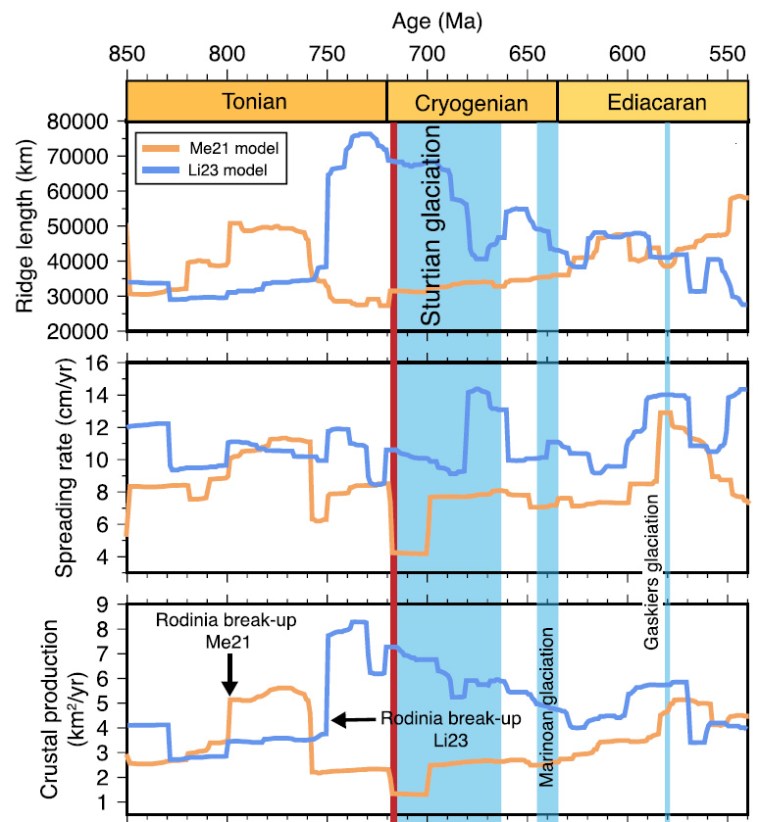
Variations in ocean ridge lengths, spreading rates and oceanic crust production during the Neoproterozoic estimated from the geological (orange) and palaeomagnetic (blue) models. Credit: Dutkiewicz et al., parts of Fig. 2)

The geology-based model has Rodinia beginning to break up around 800 Ma ago with a lengthening of global constructive plate margins during disassembly. The resulting continental drift involved an increase in the rate of oceanic crust formation from 3.5 to 5.0 km2 yr-1. Around 760 Ma new crust production more than halved and continued at a much slowed rate throughout the Cryogenian and the early part of the Ediacaran Period.  The palaeomagnetic model delays breakup of the Rodinia supercontinent until 750 Ma, and instead of the rate of crust production declining through the Cryogenian it more than doubles and remains higher than in the geological model until the late Ediacaran. The production of new oceanic crust is likely to govern the rate at which CO2 is out-gassed from the mantle to the atmosphere. The geology-based model suggests that from 750 to 580 Ma annual CO2 additions could have been significantly below what occurred during the Pleistocene ice ages since 2.5 Ma ago. Taking into account the lower solar heat emission, such a drop is a plausible explanation for the recurrent Snowball Earths of the Neoproterozoic. On the other hand, the model based on palaeomagnetic data suggests significant warming during the Cryogenian contrary to a mass of geological evidence for the opposite.

A prolonged decrease in tectonic activity thus seems to be a plausible trigger for global glaciation. Moreover, reconstruction of Precambrian global tectonics using available palaeomagnetic data seems to be flawed, perhaps fatally. One may ask, given the trends in tectonic data: How did the Earth repeatedly emerge from Snowball episodes? The authors suggest that the slowing or shut-down of silicate weathering during glaciations allowed atmospheric CO2 to gradually build up as a result of on-land volcanism associated with subduction zones that are a quintessential part of any tectonic scenario.

This kind of explanation for recovery of a planet and its biosphere locked in glaciation is in fact not new. From the outset of the Snowball Earth hypothesis much the same escape mechanisms were speculated and endlessly discussed. Adriana Dutkiewicz and colleagues have fleshed out such ideas quite nicely, stressing a central role for tectonics. But the glaring disparities between the two models show that geoscientists remain ‘not quite there’. For one thing, carbon isotope data from the Cryogenian and Ediacaran Periods went haywire: living processes almost certainly played a major role in the Neoproterozoic climatic dialectic.

Neanderthals and the earliest ‘plastic’ handles

February 2024 was a notable month for discoveries about ancient technology: first that of an ancient tool probably used in rope making and now signs of the use of a composite ‘plastic’ material in stone-tool hafts. Both are from Neanderthal sites in France, the first dated around 52 to 41 ka and the second in the Le Moustier rock shelters of the Dordogne – the type locality for the Mousterian culture associated with Neanderthals (Schmidt, P. et al. 2024. Ochre-based compound adhesives at the Mousterian type-site document complex cognition and high investment. Science Advances, v. 10, article ead10822; DOI: 10.1126/sciadv.adl0822), dated at around 56 to 40 ka. The second discovery resulted from the first detailed analysis of unstudied artifacts unearthed from Le Moustier in 1907 by Swiss archaeologist Otto Hauser that had been tucked away in a Berlin Museum.

Patrick Schmidt of the University of Tubingen in Germany and colleagues  from Germany, the US and Kazakhstan identified stone artifacts that show traces of red and yellow colorants. At first sight it could be suggested that they are decorations of some kind. However, they coat only parts of the stone flakes and are sharply distinct from the fresh rock surface and the sharpest edges. Another feature discovered during chemical analysis is that the colour is due to iron hydroxides (goethite) but this ochre is mixed with natural bitumen: the coating is a composite of an adhesive and filler not far different from what can be purchased in any hardware store.

LEFT: Stone flake from the Le Moustier site in France, partly coated with a reddish iron-rich colorant. RIGHT: Experimental stone flakes with 55:44 mix of goethite and bitumen (top) and pure bitumen (bottom) being handled. (Credit: Schmidt et al. Figs 1A, 3).

The authors tested the properties of the mixtures against those of bitumen alone – an adhesive known to have been used along with various tree resins to haft blades to spears in earlier times. In particular they examined the results of ‘cooking’ the substances. Whether unheated or ‘cooked’ a mixture of ochre and bitumen is up to three times stronger than pure bitumen. A further advantage is that the mixed ingredients are not sticky when cooked and cooled, whereas bitumen remains sticky, as the illustration clearly shows. Anyone who has handled a stone blade realises how sharp they are, and not just around the cutting edges. So Schmidt and colleagues tried to use the composite material as a protective handle when stone flake tools were gripped for cutting or carving. The composite handles worked well on scrapers and blades, even in the softer, ‘uncooked’ form

Similar composite adhesives are known from older sites in Africa associated with anatomically modern humans, but not for this particular, very practical use. It is perhaps possible that the use of bitumen mixed with ochre was brought into Europe by AMH migrants and adopted by Neanderthals who came into contact with them. Yet the limestones of the Dordogne valley yield both bitumen in liquid and solid forms, and ochers are easily found because of their striking colours. Long exposure of petroleum seeps drives off lighter petroleum compounds to leave solid residues that can be melted easily to tarry consistency. So there is every reason to believe that Neanderthals developed this technology unaided. As Schmidt has commented, “Compound adhesives are considered to be among the first expressions of the modern cognitive processes that are still active today”.

Changing Atlantic Ocean currents may threaten Gulf Stream warming of Europe

Climate during the last Ice Age was continually erratic. Generally fine-grained muds cored from the floor of the North Atlantic Ocean show repeated occurrences of layers containing gravelly debris. These have been ascribed to periods when ice sheets on Greenland and Scandinavia calved icebergs at an exceptionally fast rate, to release coarse debris as they melted while drifting to lower latitudes. These ‘iceberg armadas’ (known as Heinrich events) left their unmistakable signs as far south as Portugal. Their timing correlates with short-lived (1 to 2 ka) warming-cooling episodes (Dansgaard-Oeschger events) recorded in Greenland ice cores that involved variations in air temperature of up to 15°C. The process that resulted in these sudden climate shifts seems to have been changing ocean circulation brought about by vast amounts of fresh water flooding into the Arctic and North Atlantic Oceans. This lowered seawater density to the extent that its upper parts could not sink when cooled. It is this thermohaline circulation that drags warmer surface water northwards, known as the Atlantic Meridional Overturning Circulation (AMOC), part of which is the Gulf Stream. When it fails or slows the result is plummeting temperatures at high latitudes. The last major AMOC shutdown was after 8 ka of warming that followed the last glacial maximum. Between 12.9 and 11.7 ka major glaciers grew again north of about 50°N in the period known as the Younger Dryas, almost certainly in the aftermath of a flood to the Arctic Ocean of glacial meltwater from the Canadian Shield. Around 8.2 thousand years ago human re-colonisation of Northern Europe was set back by a similar but lesser cooling event.

The Atlantic Meridional Overturning Circulation (AMOC). Red – warm surface currents; cyan – cold deep-water flow. (Credit: Stefano Crivellari)

Three researchers at Utrecht University, the Netherlands have issued an early warning that the AMOC may have reached a critical condition (Van Westen, R.M., Kliphuis, M & Dijkstra, H.A. 2024. Physics-based early warning signal shows that AMOC is on tipping course. Science Advances, v. 10, article adl1189; DOI: 10.1126/sciadv.adk1189). Previous modelling of AMOC has suggested that only rapid, massive decreases in the salinity of North Atlantic surface water near the Arctic Circle could shut down the Gulf Stream in the manner of Younger Dryas and Dansgaard-Oeschger events. René van Westen and colleagues have simulated the effects of steady, long-term addition of fresh water from melting of the Greenland ice sheet. They ran a sophisticated Earth System model for six months on the Netherlands’ Snellius super computer. Their model used a slowly increasing influx of glacial meltwater to the Atlantic at high northern latitudes.

The various feedbacks in the model eventually shut down the AMOC, predicted to result in cooling of NW Europe by 10 to 15 °C in a matter of a few decades. Yet to achieve that required the model to simulate more than 2000 years of change. It took 1760 years for a persistent AMOC transport of 10 to 15 million m3 s-1 to drop over a century or so and reach near-zero. That collapse involved around 80 times more melting of Greenland’s ice sheet than at present. Yet their modelling does not take into account global warming: including that factor would have exceeded their budgeted supercomputer time by a long way. Melting of the Greenland ice sheet is, however, accelerating dramatically

Van Westen et al. have shown the possibility that steadily increasing ice-sheet melting can, theoretically, ’flip’  the huge current system associated with the Atlantic Ocean, and with it regional climate patterns. The tangible fear today is of a more than 1.5°C increase in global surface temperature, yet a warming-induced failure of AMOC may cause local annual temperatures to fall by up to ten times that. Rather than the currently heralded disappearance of sea-ice from the Arctic Ocean, it may spread in winter to as far south as the North Sea. The only way of forecasting in detail what may actually happen – and where – is ever-more sophisticated and costly modelling of ocean currents and ice melting in a warming world. Uncertain as it stands, the work by van Westen and colleagues may well be ignored: perhaps as a ‘thing we dinnae care to speak aboot’.

See also: Le Page, M. 2024. Atlantic current shutdown is a real danger, suggests simulation. New Scientist, 9 February 2024; Watts, J. 2024. Atlantic Ocean circulation nearing ‘devastating’ tipping point, study finds. The Guardian, 9 February 2024.

Earliest evidence for rope making: a sophisticated tool

Even at my age, if I rummage through pockets of various bits of outdoor clothing there’s a good chance I’ll find a handy length of string that I have scavenged at some time. It’s a just-in-case thing, which I learned from my father and grandad. One can hardly imagine a hunter-gatherer not having string or lengths of sinew for that very reason. Cordage has many other uses than merely securing something: bags, mats, nets, snares, fabric, baskets, huts made of sticks and fronds, and even watercraft. Yet archaeological evidence for twine is exceedingly rare. The oldest known string – made of bark fibres – was found wrapped around a stone tool at a 52 to 41 ka Neanderthal site in the Rhône valley 120 km north-west of Marseille. Rope is somewhat more difficult to make as it requires twisting together several lengths of simpler cordage. Once that skill is cracked a rope maker is on the verge of engineering!

The reassembled rope-making tool from Hohle Fels Cave (Credit: Conard & Rots, Fig 2)

In 2015 archaeologists unearthed several pieces of worked mammoth ivory from the Hohle Fels Cave in SW Germany. They were dated to between 40 to 35 ka and associated with Aurignacian stone tools made by modern humans. Fifteen pieces could be fitted together to yield a 20 cm long ‘baton’. First believed to be some kind of ritual object, the fact that 4 circular holes had been bored through the ‘baton’ suggested it must have had some practical use, perhaps for straightening wooden shafts. Then it became clear that each hole was surrounded by spirals of carefully carved, V-shaped notches. Nicholas Conard and Veerle Rots of the University of Tubingen realised that the object may have been used for making rope using a technique known from the Egyptian pharaonic period into medieval times (Conard, N.J. & Rots, V. 2024. Rope making in the Aurignacian of Central Europe more than 35,000 years ago. Science Advances, v. 10, article adh5217; DOI: 10.1126/sciadv.adh5217).

Frame from a movie showing how the tool may have been used to make ropes. The three ‘feeders’ twist foliage clockwise whereas the fourth pulls and imparts an anticlockwise twist to the three stands. (Credit: Conard & Rots, Supplementary material, Fig S15)

After a little practice, four people were able to make sturdy rope using a replica of the tool. Three twisted together fibrous materials, such as the stems and leaves of bulrushes (Typha), and pushed the rough cordage through the intact holes. A fourth person pulled the cordage through and counter-twisted the three strands into rope about 1.5 cm thick – thicker rope would also have required a tool with more holes and more operators. The spiral grooves maintained the initial clockwise rotation of each strand of cordage, so that when all three were twisted together in an anticlockwise sense the counter rotation held the rope together firmly. Remarkably, the small team were able to produce 5 m of rope in 10 minutes. Other common kinds of fibrous plant material, such as linden and willow were used successfully. Incidentally, the tool squeezed edible starch from the foliage of bulrushes. But it seems that this particular rope-making took only performed well for coarse materials. Making rope from finer firbres, such as animal sinew, nettle, flax and hemp would probably have required another design with smaller holes.

A movie of the manufacturing process can be downloaded.

An astronomical background to flood basalt events and mass extinctions?

Michael Rampino and Ken Caldeira of New York University and the Carnegie Institute have for at least three decades been at the forefront of studies into mass extinctions and their possible causes, including flood-basalt volcanism, extraterrestrial impacts and climate change. As early as 1993 the duo reported an ubiquitous 26-million year cycle in plate tectonic and volcanic activity. In Rampino’s 2017 book Cataclysms: A New Geology for the Twenty-First Century the notion of a process similar to Milutin Milankovich’s prediction of Earth’s orbital characteristics underpinning climate cyclicity figured in his thinking (see Shock and Er … wait a minute, Earth-logs, October 2017). Rampino postulated then that this longer-term geological cyclicity could be linked to gravitational changes during the Solar System’s progress around the Milky Way galaxy. He was by no means the first to turn to galactic forces, Johann Steiner having made a similar suggestion in 1966. The notion stems from the Solar System’s wobbling path as it orbits the centre of the Milky Way galaxy about every 250 Ma, which may result in its passage through a vast layered variation in several physical properties aligned at right angles to galactic orbital motions. This grand astronomical theory is ‘a story that will run and run’; and it has. It is possible that the galaxy has corralled dark matter in a disc within the galactic plane, which Rampino and Caldeira latched onto that notion a year after it appeared in Physical Review Letters in 2014.

As I commented in my brief review of Rampino’s book: “As for Rampino’s galactic hypothesis, the statistics are decidedly dodgy, but chasing down more forensics is definitely on the cards.” Indeed they have been chased in a recent review by the pair and their colleague Sedelia Rodriguez (Rampino, M.R., Caldeira, K. & Rodriguez, S. 2023. Cycles of ∼32.5 My and ∼26.2 My in correlated episodes of continental flood basalts (CFBs), hyper-thermal climate pulses, anoxic oceans, and mass extinctions over the last 260 My: Connections between geological and astronomical cycles. Earth-Science Reviews, v. 246 ; DOI: 10.1016/j.earscirev.2023.104548; reprint available on request from Rampino). They base their amplified case on much more than radiometric dates of continental flood basalt (CFB) events matched against the stratigraphic record of biotic diversity. Among the proxies are published measurements of mercury and osmium isotope anomalies in oceanic sediments that are best explained by sudden increases in basaltic magma eruption; signs of deep ocean anoxia; new dating of marine and non-marine extinctions in the fossil record, and episodes of sudden extreme climatic heating.

Statistical analysis of the ages of anoxic events and marine extinctions has yielded cycles of 32.5 and 26.2 Ma, those for CFBs having a 32.8 Ma periodicity. A note of caution, however: their data only cover the last 266 Ma – about one orbit of the solar system around the galactic centre. The authors attribute their interpretation of the cycles “to the Earth’s tectonic-volcanic rhythms, but the similarities with known Milankovitch Earth orbital periods and their amplitude modulations, and with known Galactic cycles, suggest that, contrary to conventional wisdom, the geological events and cycles may be paced by astronomical factors”.

Whether or not a detailed record of appropriate proxies can be extended back beyond the Late Permian, remains to be seen. The main fly-in-the-ointment is the tendency of CFB provinces to form high ground so that they are readily eroded away. Pre-Mesozoic signs of their former presence lie in basaltic dyke swarms that cut through older  crystalline continental crust. The marine sedimentary record is somewhat better preserved. A search for distinctive anomalies in osmium isotopes and mercury concentrations, which are useful proxies for global productivity of basaltic magmas, will be costly. Moreover, dating will depend to a large degree on the traditional palaeontology of strata, which in Palaeozoic rocks is more difficult to calibrate precisely by absolute radiometric dating.

Darwin’s ‘warm little pond’: a new discovery

There may still be a few people around today who, like Aristotle did, reckon that frogs form from May dew and that maggots and rats spring into life spontaneously from refuse. But the idea that life emerged somehow from the non-living is, to most of us, the only viable theory. Yet the question, ‘How?’, is still being pondered on. Readers may find Chapter 13 of Stepping Stones useful. There I tried to summarise in some detail most of the modern lines of research. But the issue boils down to means of inorganically creating the basic chemical building blocks from which life’s vast and complex array of molecules might have been assembled. Living materials are dominated by five cosmically common elements: carbon, hydrogen, oxygen, nitrogen and phosphorus – CHONP for short. Organic chemists can readily synthesise countless organic compounds from CHONP. And astronomers have discovered that life is not needed to assemble the basic ingredients: amino acids, carbon-ring compounds and all kinds of simpler CHONP molecules occur in meteorites, comets and even interstellar molecular clouds. So an easy way out is to assume that such ingredients ended up on the early Earth simply because it grew through accretion of older materials from the surrounding galaxy. Somehow, perhaps, their mixing in air, water and sediments together with a kind of chaotic shuffling did the job, in the way that an infinity of caged monkeys with access to typewriters might eventually create the entire works of William Shakespeare.  But, aside from the statistical and behavioural idiocy of that notion, there is a real snag: the vaporisation of the proto-Earth’s outer parts by a Moon-forming planetary collision shortly after initial accretion.

In 1871 Charles Darwin suggested to his friend Joseph Hooker that:

          ‘… if (and Oh, what a big if) we could conceive in some warm little pond, with all sorts of ammonia and phosphoric salts, light, heat, electricity, etc., present that a protein compound was chemically formed, ready to undergo still more complex changes, at the present day such matter would be instantly devoured or absorbed, which would never have been the case before living creatures were formed’.

Followed up in the 1920s by theorists Alexander Oparin and J.B.S. Haldane, a similar hypothesis was tested practically by Harold Urey and Stanley Miller at the University of Chicago. They devised a Heath-Robinson simulation of an early atmosphere and ocean seeded with simple CHONP (plus a little sulfur) chemicals, simmered it and passed electrical discharges through it for a week. The resulting dark red ‘soup’ contained 10 of the 20 amino acids from which a vast array of proteins can be built. A repeat in 1995 also yielded two of the four nucleobases at the heart of DNA – adenine and guanine.  But simply having such chemicals around is unlikely to result in life, unless they are continually in close contact: a vessel or bag in which such chemicals can interact. The best candidates for such a containing membrane are fatty acids of a form known as amphiphiles. One end of an amphiphile chain has an affinity for water molecules, whereas the other repels them. This duality enables layers of them, when assembled in water, spontaneously to curl up to make three dimensional membranes looking like bubbles. In the last year they too have been created in vitro (Purvis, G. et al. 2024. Generation of long-chain fatty acids by hydrogen-driven bicarbonate reduction in ancient alkaline hydrothermal vents. Nature Communications (Earth & Environment), v. 5, article 30; DOI: 10.1038/s43247-023-01196-4).

Cell-like membranes formed by fatty acid amphiphiles

Graham Purvis and colleagues from Newcastle University, UK allowed three very simple ingredients – hydrogen and bicarbonate ions dissolved in water and the iron oxide magnetite (Fe3O4) – to interact. Such a simple, inorganic mixture commonly occurs in hydrothermal vents and hot springs. Bicarbonate ions (HCO3) form when CO2 dissolves in water, the hydrogen and magnetite being generated during the breakdown of iron silicates (olivines) when  ultramafic igneous rocks react with water:

3Fe2SiO4 + 2H2O → 2 Fe3O4 + 3SiO­2 +3H2

Various simulations of hydrothermal fluids had previously been tried without yielding amphiphile molecules. Purvis et al. simplified their setup to a bicarbonate solution in water that contained dissolved hydrogen – a simplification of the fluids emitted by hydrothermal vents – at 16 times atmospheric pressure and a temperature of 90°C. This was passed over magnetite. Under alkaline conditions their reaction cell yielded a range of chain-like hydrocarbon molecules. Among them was a mixture of fatty acids up to 18 carbon atoms in length. The experiment did not incorporate P, but its generation of amphiphiles that can create cell-like structures are but a step away from forming the main structural components of cell membranes, phospholipids.

When emergence of bag-forming membranes took place is, of course, hard to tell. But in the oldest geological formations ultramafic lava flows are far more common than they are today. In the Hadean and Eoarchaean, even if actual mantle rocks had not been obducted as at modern plate boundaries, at the surface there would have been abundant source materials for the vital amphiphiles to be generated through interaction with water and gases: perhaps in ‘hot little ponds’. To form living, self-replicating cells requires such frothy membranes to have captured and held amino acids and nucleobases. Such proto-cells could become organic reaction chambers where chemical building blocks continually interacted, eventually to evolve the complex forms upon which living cells depend.

Why did the largest ever primate disappear?

Chinese apothecary shops sell an assortment of fossils. They include shells of brachiopods that when ground up and dissolved in water allegedly treat rheumatism, skin diseases, and eye disorders. Traditional apothecaries also supply  ‘dragons’ teeth’, said by Dr Subhuti Dharmananda, Director of the Institute for Traditional Medicine in Portland, Oregon to treat epilepsy, madness, manic running about, binding qi (‘vital spirit’) below the heart, inability to catch one’s breath, and various kinds of spasms, as well as making the body light, enabling one to communicate with the spirit light, and lengthening one’s life. Presumably have done a roaring trade in ‘dragons’ teeth’ since they were first mentioned in a Chinese pharmacopoeia (the Shennong Bencao Jing) from the First Century of the Common Era. In 1935 the anthropologist Gustav von Koenigswald came across two ‘dragons’ teeth’ in a Hong Kong shop. They were unusually large molars and he realised they were from a primate, but far bigger (20  × 22 mm) than any from living or fossil monkeys, apes or humans.

Eventually, in 1952 (he had been interned by Japanese forces occupying Java), von Koenigswald formally described the teeth and others that he had found. Their affinities and size prompted him to call the former bearer the ‘Huge Ape’ (Gigantopithecus). By 1956 Chinese palaeontologists had tracked down the cave site in Guangxi province where the teeth had been sourced, and a local farmer soon unearthed a complete lower jawbone (mandible) that was indeed gigantic. More teeth and mandibles have since been found at several sites in Southern and Southeast Asia, with an age range from about 2.0 to 0.3 Ma. Anatomical differences between teeth and mandibles suggest that there may have been 4 different species. Using mandibles as a very rough guide to overall size it has been estimated that Gigantopithecus may have been up to 3 m tall weighing almost 600kg.

Above: Size comparison of G. blacki with a 1.8 m tall human male; NB G.blacki probably walked on all fours, as do living orangutans when they rarely descend from the forest canopy. (Credit: Frido Welker) Below: Mandible of Gigantopithecus blacki from India (Credit: Prof. Wei Wang, Photo retouched by Theis Jensen)

Plaque on some teeth contain evidence for fruit, tubers and roots, but not grasses, which suggest suggest that Gigantopithecus had a vegetarian diet based on forest plants. Mandibles also showed affinities with living and fossil orangutans (pongines). Analysis of proteins preserved in tooth enamel confirm this relationship (Welker, F. and 17 others 2019. Enamel proteome shows that Gigantopithecus was an early diverging pongine. Nature, v.576, p. 262–265; DOI: 10.1038/s41586-019-1728-8). It was one of the few members of the southeast Asian megafauna to go extinct at the genus level during the Pleistocene. Its close relative Pongo the orangutan survives as three species in Borneo and Sumatra. Detailed analysis of material from 22 southern Chinese caves that have yielded Gigantopithecus teeth has helped resolve that enigma (Zhang, Y. and 20 others 2024. The demise of the giant ape Gigantopithecus blacki. Nature, v. 625; DOI: 10.1038/s41586-023-06900-0).

At the time Gigantopithecus first appeared in the geological record of China (~2.2 Ma), it ranged over much of south-western China. The early Pleistocene ecosystem there was one of diverse forests sufficiently productive to support large numbers of this enormous primate and also the much smaller orangutan Pongo weidenreichi.  By 295 to 215 ka, the age of the last known Gigantopithecus fossils, its range had shrunk dramatically. The teeth show marked increases in size and complexity by this time, which suggests adaptation of diet to a changing ecosystem. That is confirmed by pollen analysis of cave sediments which reveal a dramatic decrease in forest cover and increases in fern and non-arboreal flora at the time of extinction. One physical sign of environmental stress suffered by individual late G. blacki is banding in their teeth defined by large fluctuations of barium and strontium concentrations relative to calcium. The bands suggest that each individual had to change its diet repeatedly over its lifetime. Closely related orangutans, on the other hand survived into the later Pleistocene of China, having adapted to the changed ecosystem, as did early humans in the area. It thus seems likely that Gigantopithecus was an extreme specialist as regards diet, and was unable to adapt to changes brought on by the climate becoming more seasonal. Today’s orangutans in Indonesia face a similar plight, but that is because they have become restricted to forest ‘islands’ in the midst of vast areas of oil palm plantations. Their original range seems to have been much the same as that of Gigantopithecus, i.e. across south-eastern Asia, but Pongo seems to have gone extinct outside of Indonesia (by 57 ka in China) during the last global cooling and when forest cover became drastically restricted.

When giant worms roamed the seas!

At the start of the Cambrian Period animal life began to diversify from that of the Ediacaran world. For the first time sediments on the seafloor were explored for sustenance, leading to a variety of burrows that disrupted fine depositional layers. The basal Cambrian sandstones found in Britain and elsewhere are pervasively bioturbated: good evidence for the start of a ‘Worm world’ that marks the Precambrian-Phanerozoic boundary. That is probably a misnomer for the shallow seabed of that time, as fossils of burrowers with a variety of hard parts turn up in the oldest Cambrian sequences. Also appearing for the first time are tooth-like microfossils that took on such a range of bizarre shapes that they have long been used for correlating sedimentary strata in the absence of larger creatures. Some of these conodonts have been attributed to early vertebrates akin to modern lampreys and hag fish, but others may have been the grasping mouth-spines of a group of predatory worms which also survive to the present: chaetognaths. Apart from these oral spines chaetognaths lack hard parts, so anatomical details of ancient ones are only found in sites of exquisite preservation or lagerstätten. In such rare, tranquil places soft tissues such as muscles may be preserved by phosphatisation during decay.

Reconstruction of Timorebestia koprii showing its musculature, nerve system and mouthparts, It probably propelled itself by fluttering its outer and rear flaps, much like a modern flatfish. Credit: Park et al., Fig 4

One of the earliest Phanerozoic lagerstätten (Sirius Passet) occurs in northern Greenland. It is curiously named after the Sirius Dog Sled Patrol, an elite pair of naval troops with a sledge and 12 dogs that enforces Danish sovereignty over the Greenlandic shore of the Arctic Ocean. The Sirius Passet fauna includes a monstrous chaetognath over 30 cm long (Park, T.-Y. S. and 12 others 2024. A giant stem-group chaetognath. Science Advances, v. 10 article eadi6678; DOI: 10.1126/sciadv.adi6678). It is called Timorebestia koprii (Timorebestia is Latin for ‘terror beast’) and was related to the living, but tiny, arrow worms that prey on zooplankton in modern oceans. This description and moniker may seem to be somewhat hyperbolic, but Timorobestia outranks in size any Early Cambrian predatory arthropods. It was probably high in the Early Cambrian trophic pyramid, but was soon relegated by the later Cambrian rise of trilobites and then of cephalopods and eventually jawed vertebrate fishes in the Silurian. One specimen contained shells of a swimming arthropod whose protective spines did not deter the ‘terrible’ chaetognath from swimming them down.

See also: ‘Giant’ predator worms more than half a billion years old discovered in North Greenland. Science Daily, 3 January 2024.