Flourishing life during a Snowball Earth period

That glacial conditions were able to spread into tropical latitudes during the late Neoproterozoic, Cryogenian Period is now well established, as are the time spans of two such events. http://earth-pages.co.uk/2015/05/21/snowball-earth-events-pinned-down/ But what were the consequences for life that was evolving at the time? That something dramatic was occurring is signalled by a series of perturbations in the carbon-isotope composition of seawater. Its relative proportion of 13C to 12C (δ13C) fell sharply during the two main Snowball events and at other times between 850 to 550 Ma. Since 12C is taken up preferentially by living organisms, falls in δ13C are sometimes attributed to periods when life was unusually suppressed. It is certain that the ‘excursions’ indicate that some process(es) must have strongly affected the way that carbon was cycled in the natural world.

English: Earth, covered in ice.
Artist’s impression of a Snowball Earth as it would appear with today’s continental configuration adjacent to the East Pacific Ocean. (Photo credit: Wikipedia)

The further sea ice extended beyond landmasses during Snowball events the more it would reduce the amount of sunlight reaching the liquid ocean and so photosynthesis would be severely challenged. Indeed, if ice covered the entire ocean surface – the extreme version of the hypothesis – each event must have come close to extinguishing life. An increasing amount of evidence, from climate- and oceanographic modelling and geological observation, suggests that a completely icebound Earth was unlikely. Nevertheless, such dramatic climate shifts would have distressed living processes to the extent that extinction rates were high and so was adaptive radiation of survivors to occupy whatever ecological niches remained or came into being: evolution was thereby speeded up. The roughly half-billion years of the Neoproterozoic hosted the emergence and development of multicellular organisms (metazoan eukaryotes) whose cells contained a nucleus and other bodies such as mitochondria and the chloroplasts of photosynthesisers. This hugely important stage of evolution burst forth shortly after – in a geological sense – the last Snowball event, during the Ediacaran and the Cambrian Explosion. But recent investigations by palaeontologists in glaciogenic rocks from China unearthed a rich diversity of fossil organisms that thrived during a Snowball event (Ye, Q. et al. 2015. The survival of benthic macroscopic phototrophs on a Neoproterozoic snowball Earth. Geology, v. 43, p. 507-510).

The Nantuo Formation in southern China contains glaciogenic sedimentary rocks ascribed to the later Marinoan glaciation (640 to 635 Ma). Unusually, the pebbly Nantuo glaciogenic rocks contain thin layers of siltstones and black shales. The fact that these layers are free of coarse fragments that floating ice may have dropped supports the idea that open water did exist close to glaciated landmasses in what is now southern China. Palaeomagnetic measurements show that the area was at mid-latitudes during the Marinoan event. The really surprising feature is that they contain abundant, easily visible fossils in the form of carbonaceous ribbons , disks, branching masses and some that dramatically resemble complex multi-limbed animals, though they are more likely to be part of an assemblage of algal remains. Whatever their biological affinities, the fossils clearly signify that life happily flourished beneath open water where photosynthesis provided a potential base to a food chain, though no incontrovertible animals occur among them.

See also: Corsetti, F.A. 2015. Live during Neoproterozoic Snowball Earth. Geology, v. 43, p. 559-560.

Two happy events for plate tectonics

In an era where fears of rising sea level and loss of land are growing it is a great pleasure to announce (albeit several years late) the birth of two new islands. They emerged close to the axis of the Red Sea in Yemeni territory as new members of the volcanic Zubair Islands during episodic eruptions that began on 18 December 2011. First to form was dubbed Sholan (‘One who is Blessed’ in Arabic – a girl’s name), which ceased to be active a month later. Further submarine volcanism began on 28 September 2013, with another island, Jadid (‘New’ in Arabic – a boy’s name), breaking surface in October 2013. The double event has been described in great detail by geoscientists based at King Abdullah University of Science and Technology, Saudi Arabia (Xu, W. 2015. Birth of two volcanic islands in the southern Red Sea. Nature Communications, DOI: 10.1038/ncomms8104. After rapid growth during their initial eruptive phases both islands underwent significant marine erosion once quiescent, but seem set to remain as part of the Zubair archipelago.

'Before and after' images of the Zubair archipelago in the southern Red Sea. (Left from Bing maps, right (February 2014) from Google Earth)
‘Before and after’ images of the Zubair archipelago in the southern Red Sea. (Left from Bing maps, right (February 2014) from Google Earth)

Analysis of small earthquakes that happened during the islands’ growth together with Interferometric iradar surveys that showed coincident ground movements among the islands suggest that both eruptions took place along an active north-south fracture system, probably part of axial rifting system of the Red Sea. In more detail, magma seems to have moved upwards along N-S fissures similar to those that now show up as dykes cutting lavas on the older islands in the area. The local fracture patterns are oblique to the main Red Sea Rift that trends NNW-SSE, possibly as a result of non-linear stress trajectories in the Arabia-Africa rifting. In almost all respects the volcanism and mechanism of intrusion and effusion closely resemble that reported recently from a terrestrial setting in the nearby Afar Depression. The slow spreading Red Sea Rift rarely manifests itself by volcanism, so these events reveal a previous unsuspected zone of active melting in the mantle beneath the Zubair archipelago.

Stone tools go even further back

Shortly after it seemed that the maker of the earliest stone tools (2.6 Ma) may have been Australopithecus africanus, thanks to a novel means of analyzing what hominin hands may have been capable of, some actual tools have turned up from even earlier times (Harmand, S. and 20 others 2015. 3.3-million-year-old stone tools from Lomekwi 3, West Turkana, Kenya. Nature, v. 521, p. 310-315). Their age is comparable with that (3.4 Ma) of animal bones from Dikika, Ethiopia showing cut marks and signs of deliberate breaking, which had previously been controversial as they suggested that local Australopithecus afarensis of a similar age had made them. What the authors claim to be ‘a new beginning to the known archaeological record’ almost a million years earlier than the first appearance of Homo fossils in the Lake Turkana area seems to point in that direction. But A. afarensis has not been found in that area, although a hominin known as Kenyanthropus platyops with roughly the same age as the tools has.

Australopithecus afarensis reconstruction
Reconstruction of Australopithecus afarensis (Photo credit: Wikipedia)

Almost 150 fine-grained basaltic artefacts turned up at the Lomekwi site, which may have been where knappers habitually worked as many of them were fragments or debitage. The cores from which flakes had been struck are large, weighing on average 3.1 kg. It seems that the tool makers may have been forcefully pounding out edged tools for a variety of uses, unlike the single-use hammer stones used by chimpanzees today. Compared with the well known Oldowan tools, however, these are cruder and made by a different knapping technique that seems not to have focused on exploiting the conchoidal fracturing that produces the sharpest tools and is a feature of the later Oldowan tools.

English: Chopper: one of the earliest examples...
Oldowan ‘chopper’ from Melka Kunture, Ethiopia. (credit: Wikipedia)

Frederick Engels, whose 1876 essay The Part played by Labour in the Transition from Ape to Man was among the first works to take Darwin’s ideas on human origins forward, would have had a field day with the new evidence. For him the vital step was freeing of the hands by a habitual bipedal gait and their manipulation of objects – together with changes to the hands that would arise by such a habit. What the first tool maker looked like, doesn’t really matter: the potential that act conferred was paramount. Nevertheless, there is a big step between early hominins and humans, from relatively small brains to those of H. erectus that were on the way to modern human capacity. The Lomekwi tools and the improved Oldwan artefacts spanned 1.7 Ma at least before H. erectus revolutionised manufacture to produce the bi-facial Acheulian hand ‘axe’, and going beyond that took almost a million years of little change in both tools and anatomy until the emergence of archaic modern humans.

Note added 28 May 2015: Within a week palaeoanthropologists’ focus shifted to the Afar Depression in Ethiopia where a new species of hominin has emerged from Pliocene sediments dated to between 3.3 and 3.5 Ma (Haile-Selassie, Y et al. 2015. New species from Ethiopia expands Middle Pliocene hominin diversity. Nature, v. 521, p. 483-488. doi:1038/nature14448). Australopithecus deyiremeda is represented by fragments of two lower- and one upper jaw plus several other lower facial specimens. So the species is differentiated from other hominins by dentition alone, but that is unmistakably distinct from extensive data on Au. afarensis which lived within a few kilometres over the same period. Until the last 15 to 20 years it was thought that Au. afarensis was the sole hominin around in the Middle Pliocene of East and Central Africa, but now it seems there may have been as many as five, the three mentioned above, plus Au. bahrelghazali from Chad and an as yet undesignated fossilised foot from Afar. For possibly three closely related species to coexist in Afar is difficult to understand: possibly they occupied different niches in the local food web or employed different strategies (Spoor, F. 2015. The middle Pliocene gets crowded. Nature, v. 521, p. 432-433). Another question is: did they all make and use tools? For the Lomekwi tools K. platyops is a candidate, but for the cut marks on bones at Dikika in Afar there are at least two: Au. afarensis and Au. deyiremeda. So multiple tool makers living at the same time suggests some earlier originator of the ‘tradition’.

Note added 4 June 2015: Add southern Africa into the equation and there is yet more breaking news about coeval hominin diversity. US, Canadian, South African and French collaborators have finally started to resolve the achingly complex stratigraphy of the fossil-rich Sterkfontein cave deposits in South Africa by using a novel approach to estimating ages of materials’ last exposure to cosmic rays (Granger, D.E. et al. 2015. New Cosmogenic burial ages for Sterkfontein member 2 Australopithecus and Member 5 Oldowan. Nature, v. 522, p. 85-88). Specifically, they managed to date the tumbling into a deep sinkhole of a recently found, almost complete skeleton of an australopithecine. It still resembles no other some 70 years after a less complete specimen was found by Raymond Dart in the mid 1940s. It was first informally dubbed ‘Little Foot’ and then Au. prometheus and up to now has been regarded as an odd contemporary of 2.2 Ma old Au. africanus. The new dating gives an age of about 3.7 Ma: so at least 6 hominids occupied Africa in the Middle Pliocene. It is beginning to look like a previously unsuspected time of sudden diversification.

A certain shyness about research misconduct in the UK

Since Earth Pages was launched at the start of the 21st century there have been highly publicised cases of gross misconduct by researchers, including plagiarism, ‘massaging ‘data and even sabotaging the work of others, as well as lesser cases where publications were withdrawn or removed from journals. The most notorious have been from the USA, Japan, the Netherlands and a number of other advanced countries. But sharp practices in science are not well known in the UK; indeed I can’t recollect more than one case that reached the same degree of coverage as the most notorious instances. Yet, in 2009, Daniele Fanelli of the University of Edinbugh reported the results of her analysis of accessible information from the UK about this matter. She found that about 2% of British scientists, who had been interviewed or answered questionnaires, answered ‘Yes’ when asked if they ever fabricated or falsified research data, or if they altered or modified results to improve the outcome. Up to one third admitted other questionable practices or knew of them having been committed by colleagues. Fanelli doesn’t refer to more grievous matters such as sabotage or exploitation of students’ work.

The silence from British Universities on research misconduct has become such an embarrassment that it was a subject of an Editorial and a News In Focus Report in the 21 May issue of Nature . While there are guidelines that urge British universities to publish annual reports of their investigations into misconduct, for 2013-14 only 12 such reports have been published : of the 88 universities contacted by the informal UK Research Integrity Office, 30 institutions responded to UKRIO’s survey. These reports covered 21 investigations, mostly unspecified, with 5 cases of plagiarism, 2 of falsification, 2 concerning authorship, 1 of fabrication and 1 breach of confidentiality. Three were upheld and 3 are pending.

These figures speak loudly for themselves: misconduct by researchers (and academics in general) is something that the halls of British academe ‘dinnae care to speak aboot’. As the author of UKRIO’s survey observed, ‘It’s just not credible’, although many of the universities that she contacted claim that such reports were in progress. A likely story… We all know that the ‘filthy snout’ (Tom Wolfe The Bonfire of the Vanities) does ‘come popping to the surface’, but is buried in confidentiality by university Research Committees, leaving any victims dangling in a sorry psychological state and allowing journals’ peer review system to catch any perpetrators before they reach the press, which it is rarely able to do. It takes a case as severe as that of Andrew Wakefield’s fraudulent 1998 paper in the Lancet associating the MMR vaccine with autism to see justice done.

Snowball Earth events pinned down

The Period that lasted from 850 to 635 million years ago, the Cryogenian, takes its name from evidence for two and perhaps three episodes of glaciation at low latitudes. It has been suggested that, in some way, they were instrumental in the decisive stage of biological evolution from which metazoan eukaryotes emerged: the spectacular Ediacaran fossil assemblages follow on the heels of the last such event Although controversies about the reality of tropical latitudes experiencing ice caps have died away, there remains the issue of synchronicity of such frigid events on all continents, which is the central feature of so-called ‘Snowball Earth’ events. While each continent does reveal evidence for two low latitude glaciations – the Sturtian (~710 Ma) and the later Marinoan (~635 Ma) – in the form of diamictites (sediments probably dropped from floating ice and ice caps) it has proved difficult to date their start and duration. That is, the cold episodes may have been diachronous – similar conditions occurring at different localities at different times. Geochronology has, however, moved on since the early disputes over Snowball Earths and more reliable and precise dates for beginnings and ends are possible and have been achieved in several places (Rooney, A.D. et al. 2015. A Cryogenian chronology: Two long-lasting synchronous Neoproterozoic glaciations. Geology, v. 43, p. 459-462).

One computer simulation of conditions during a...
Computer simulation of conditions during a Snowball Earth period. (credit: Macmillan Publishers Ltd: Hyde et al., Nature 405:425-429, 2000)

Rooney and colleagues from Harvard and the University of Houston in the USA used rhenium-osmium radiometric dating in Canada, Zambia and Mongolia. The Re-Os method is especially useful for sulfide minerals as in the pyritic black shales that occur extensively in the Cryogenian, generally preceding and following the glacial diamictites and their distinctive carbonate caps. Combined with a few ages obtained by other workers using the Re-Os method and U-Pb dating of volcanic units that fortuitously occur immediately beneath or within diamictites, Rooney et al. establish coincident start and stop dates and thus durations of both the Sturtian and Marinoan glacial events: 717 to 660 Ma and 640 to 635 Ma respectively on all three continents. Their data is also said to refute the global extent and even the very existence of an earlier, Kaigas glacial event (~740 Ma) previous recorded from diamictites in Namibia, the Congo, Canada and central Asia. This assertion is based on the absence of diamictites with that age in the area that they studied in Canada and their own dating of a diamictite in Zambia, which is one that others assigned to the Kaigas event

The dating is convincing evidence for global glaciation on land and continental margins in the Cryogenian, as all the dates are from areas based on older continental crust. But the concept of Snowball Earth, in its extreme form, is that the oceans were ice-capped too as the name suggests, which remains to be convincingly demonstrated. That would only be achieved by suitably dated diamictites located on obducted oceanic crust in an ophiolite complex. Moreover, there are plenty more Cryogenian diamictites on other palaeo-continents and formed at different palaeolatitudes that remain to be dated (see here)

Earthquake hazard news

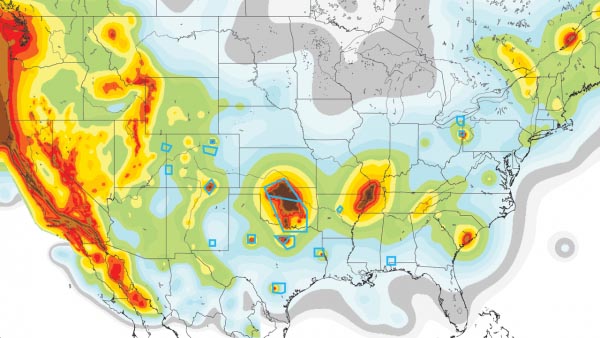
Assessments of seismic risk have relied until recently on records of destructive earthquakes going back centuries and their relationship to tectonic features, mainly active faults. They usually predict up to 50 years ahead. The US Geological Survey has now shifted focus to very recent records mainly of small to medium tremors, some of which have appeared in what are tectonically stable areas as well as the background seismicity in tectonically restless regions. This enables the short-term risk (around one year) to be examined. To the scientists’ surprise, the new modelling completely changes regional maps of seismic risk. The probabilities in the short-term of potentially dangerous ground movements in 17 oil- and gas-rich areas rival those in areas threatened by continual, tectonic jostling, such as California. The new ‘hot spots’ relate to industrial activity, primarily the disposal of wastewater from petroleum operations by pumping it into deep aquifers.

USGS map highlighting short-term earthquake risk zones. Blue boxes indicate areas with induced earthquakes (source: US Geological Survey)

Fluid injection increases hydrostatic pressure in aquifers and also in the spaces associated with once inactive fault and fracture systems. All parts of the crust are stressed to some extent but the presence of fluids and over-pressuring increases the tendency for rock failure. While anti-fracking campaigners have focussed partly on seismic risk – fracking has caused tremors around magnitudes 2 to 3 – the process is a rapid one-off injection involving small fluid volumes compared with petroleum waste-water disposal. All petroleum production carries water as well as oil and gas to wellheads. Coming from great depth it is formation water held in pores since sedimentary deposition, which is environmentally damaging because of its high content of dissolved salts and elevated temperature. Environmental protection demands that disposal must return it to depth.

The main worry is that waste water disposal might trigger movements with magnitudes up to 7.0: in 2011 a magnitude 5.6 earthquake hit a town in oil-producing Oklahoma and damaged many buildings. Currently, US building regulations rely on earthquake risk maps that consider a 50-year timescale, but they take little account of industrially induced seismicity. So the new data is likely to cause quite a stir. These are changing times, however, as the oil price fluctuates wildly. So production may well shift from field to field seeking sustainable rates of profit, and induced seismicity may well change as a result.

None of these areas are likely to experience the horrors of the 25 April 2015 magnitude 7.8 earthquake in Nepal. However, it also occurred in an area expected to be relatively stable compared with the rest of the Himalayan region. The only previous major tremor there was recorded in the 14th century. This supposedly ‘low-risk’ area overlies a zone in which small tremors or microearthquakes occur all the time. Such zones – and this one extends along much of the length of the Himalaya – seem to mark where fault depths are large enough for displacements to take place continually by plastic flow, thereby relieving stresses. Most of the large earthquakes have taken place south of the microseismic zone where the shallow parts of the Indian plate are brittle and have become locked. The recent event is raising concerns that it is a precursor of further large earthquakes in Nepal. Its capital Kathmandu is especially susceptible as it is partly founded on lake sediments that easily liquefy.

Note added: 13 May 2015. Nepal suffered another major shock (magnitude 7.3) on 12 May in the vicinity of Mount Everest. It too seems to have occurred in the zone of microearthquakes formerly thought to mark a zone where the crust fails continually bu plastic deformation thereby relieving stresses. Kathmandu was this time at the edge of the shake zone

Two large, reorganised landscapes

Where tectonic processes proceed quickly it is only to be expected that the land surface undergoes dramatic changes and that big features form. Exactly which processes lay behind very striking landforms may have been worked out long ago; or old ideas from the heyday of geomorphology have perhaps lingered longer than they should. Two tectonically active regions that have a long history of study are the Himalaya and Iceland: one a model of long-lived and rapid uplift driven by collisional tectonics; the other likewise, as a product of extension and rapid build-up of flood basalt flows. Major features of both have been shown to be not quite what they seem.
Substantial parts of the India-Asia collision zone contain broad patches of high, low-relief plateaus separated by deeply incised river gorges. In its eastern parts rise 3 of the largest rivers in SE Asia: the Yangtse; the Mekong and the Salween, which flow roughly parallel to the east and south-east for about 1000 km from their sources in the Tibetan Plateau. Their trajectories partly follow some enormous strike-slip fault that accommodated the relative motion of two continent-bearing plates over the last 50 million years. As well as the crustal thickening that attended the collision, vast amounts of uplifted material have been eroded from the three major gorges. Thickening and unloading have been the key to producing the largest tracts of high land on the planet. Yet between the gorges and their many tributaries in the eastern part of the collision zone are many tracts of high land with only moderate relief rather than sharp ridges. Because the Eurasian plate prior to India’s impact might reasonably be expected to have been only moderately high, if not low lying, and with a mature and muted landscape, a long-lived theory has been that these elevated plateaus are uplifted relics of this former landscape that were dissected by progressively deepening river incision. Much the same idea has been applied to similar mega features, and even coincident peaks in more completely eroded highlands.

Drainage basins of the Yangtse, Mekong and Salween rivers, with low-relief surfaces in buff and cream. Figure 1 in Yang et al. 2015 (credit: Nature)

In the India-Asian collision zone the supposedly ‘relic’ plateaus have been used to reconstruct the pre-collision land surface and the degree of bulging it has undergone since. However, the advent of accurate digital terrain elevation data has enabled the modelling of not only the large rivers but also of the tributary streams that make up major drainage. As well as the directional aspects of drainages their along-channel slopes can be analysed (Yong, R. et al. 2015. In situ low-relief landscape formation as a result of river network disruption. Nature, v. 520, p. 526-529). Rong Yang of the Swiss Federal Institute of Technology and colleagues from the same department and Ben-Gurion University of the Negev, Israel have been able to show that matters are far more complex than once believed. The tributary drainages of the Yangtse, Mekong and Salween gorges appear to have been repeatedly been disrupted by the complexities of deformation. One important factor has been drainage capture or piracy, in which drainages with greater energy erode towards the heads of their catchments until they intercept a major drainage in another sub-basin, thereby ‘stealing’ the energy of the water that it carries. The ‘pirate’ stream then erodes more powerfully in its lower reaches, whereas the basin burgled of much of its energy becomes more sluggishly evolving thereafter and increasingly left anomalous high in the regional terrain: it evolves to liken what previously it had been supposed to be – a relic of the pre-collision landscape.
Many of the rivers in Iceland occupy gorges that contain a succession of large waterfalls. Upstream of each is a wide rock terrace, and downstream the gorge is eroded into such a terrace. Much of Iceland is composed of lava flows piled one above another, as befits the only substantial land that straddles a constructive plate margin – the mid-Atlantic Ridge. Being famous also for its substantial ice caps that are relics of one far larger during the last glacial maximum, it has proved irresistible for geomorphologists to assign the gorge-fall-terrace repetition to gradual uplift due to isostatic rebound as the former ice cap melted and unloaded the underlying lithosphere. As relative sea-level fell each river gained more gravitational potential energy to cut back up its channel, which resulted in a succession of upstream migrating waterfalls and gorges below them. Individual lava flows, being highly resistant to abrasion cease to be affected once cut by a gorge; hence the terraces. But it is now possible to establish the date when each terrace first became exposed to cosmic-ray bombardment, using the amount of cosmogenic 3He that has accumulated in the basalts that form the terrace surfaces (Baynes, E.R. et al. 2015. Erosion during extreme flood events dominates Holocene canyon evolution in northeast Iceland. Proceedings of the National Academy of Science, doi:10.1073/pnas.1415443112).

Valley of Jökulsá á Fjöllum past Dettifoss, Jö...
Gorge incised in basalt flows, Jökulsárgljúfur National Park, Iceland (credit: Wikipedia)

The British-German team from the University of Edinburgh and Deutsches GeoForschungsZentrum, Potsdam worked on terraces of the Jökulsárgljúfur canyon, discovering that three terraces formed abruptly in the Holocene, at 9, 5 and 2 ka ago, with no evidence for any gradual erosion by abrasion. Each terrace was cut suddenly, probably aided by the highly jointed nature of the overlying lava flow that would encourage toppling of blocks given sufficient energy. The team suggests that each represents not stages in uplift, but individual megafloods, perhaps caused by catastrophic glacial melting during subglacial eruptions or failures of dams formed by moraines or ice lobes.

What followed the Giant Impact (read Lord Mayor’s Show)?

The dominance of the Lunar Highlands by feldspar-rich anorthosites, which form when feldspars that crystallise from magmas float because of their lower density, gave rise to the idea that the Moon initially formed as a totally molten mass. That this probably resulted because the early Earth collided with a Mars-sized protoplanet stems from the almost identical chemical composition of the lunar and terrestrial mantles, as worked out from the composition of younger basalts derived from both, together with the vast energy needed to support a large molten planetary body condensing from a plasma cloud orbiting the Earth. Such a giant impact is also implicated in the final stages of core formation within the Earth.

Artist's depiction of the giant impact that is...
Artist’s depiction (after William K. Hartmann) of the giant impact that is hypothesized to have formed the Moon. (credit: Wikipedia)

A core formed from molten iron alloyed with nickel would have acted as a chemical attractor for all other elements that have an affinity for metallic iron: the siderophile elements, such as gold and platinum. Yet the chemistry of post-moon formation basaltic melts derived from the Earth’s mantle contain considerably more of these elements than expected, a feature that has led geochemists to wonder whether a large proportion of the mantle arrived – or was accreted – after the giant impact.

A tool that has proved useful in geochemistry on the scale of entire planets – well, just the Earth and Moon so far – is measuring the isotopic composition of tungsten, a lithophile metal that has great affinity for silicates. One isotope is 182W that forms when a radioactive isotope of hafnium (182Hf) decays. The proportion of 182W relative to other tungsten isotopes has been shown to be about the same in Lunar Highland anorthosites as it is in the Earth’s mantle. This feature is believed to reflect Moon formation and its solidification after the parent 182Hf had all decayed away: the decay has a half-life of about 9 Ma and after 60 Ma since the formation of the Solar System (and a nearby supernova that both triggered it and flung unstable isotopes such as 182Hf into what became the Solar nebula) vanishingly small amounts would remain.

Oddly, two papers on tungsten and Earth-Moon evolution, having much the same aims, using similar, newly refined methods and with similar results appeared in the same recent issue of Nature (Touboul, M. et al. 2015. Tungsten isotopic evidence for disproportional late accretion to the Earth and Moon. Nature, v. 520, p. 530-533. Kruijer, T.S. et al. 2015. Lunar tungsten isotopic evidence for the late veneer. Nature, v. 520, p. 534-537). The two of them present analyses of glasses produced by large impacts into the lunar surface and probably the mantle, which flung them all over the place, maintaining the commonality of the ventures that might be explained by there being a limited number of suitable Apollo samples. Both report an excess of 182W in the lunar materials: indeed, almost the same excess given the methodological precisions. And, both conclude that Moon and Earth were identical just after formation, with a disproportional degree of later accretion of Solar nebula material to the Earth and Moon.

So, there we have it: it does look as if Earth continued to grow after it was whacked, and there is confirmation. Both papers conclude, perhaps predictably, that the early Solar System was a violent place about which there is much yet to be learned…

St Paul and the meteorite?

Dateline: Chelyabinsk, Russia 09.20 15 February 2013. As in many parts of Russia drivers in this Oblast in the Urals Economic District use an in-car camera during rush hour, hopefully to have proof of innocence in the event of a traffic accident. On this day, such cameras recorded a massive fireball streaking low across a clear, frosty sky. Some people on foot were temporarily blinded by its light, about 4 times that sunlight, and others were thrown off their feet by a large shock wave. Travelling at about 20 km s-1 the fireball exploded, the blast shattering windows where people were gazing at the remarkable sight, about 1500 needing medical treatment. This event is the first in modern times to record the atmospheric entry of a superbolide and air blast, probably similar to what happened in the deserted area of Tunguska in Siberia on 30 June 1908.

Meteor trail and fireball seen over industrial estate in Chelyabinsk, Russia (credit: Russia Today)

Cut to the Levant in the 1st century of the Common Era: on the road to Damascus a Jewish fundamentalist with Roman citizenship, sworn to destroy the early Christian movement, is on a mission to arrest Christians and take them in chains to Jerusalem. Saul witnesses a great light in the sky and a deafening sound that he believes is the voice of Jesus, saying ‘Saul, Saul, why persecutest thou me?’(Acts 9:4). He is flung off his feet, struck blind and convinced of the error of his calling. Three days later, in Damascus ‘…there fell from his eyes as it had been scales: and he received sight forthwith, and arose, and was baptized’ (Acts 9:18), taking the name Paul.

The conversion of Saul by Michaelangelo

William Hartmann of the Planetary Science Institute at the University of Arizona, among the first planetary scientists to propose the giant impact origin for the Moon (see next item) and in his case to visualise it in a famous painting, has drawn a somewhat obvious hypothesis linking the two events (Hartmann, W.K. 2015. Chelyabinsk, Zond IV, and a possible first-century fireball of historical importance. Meteoritics and Planetary Science, v. 50, p. 368-381: doi: 10.1111/maps.12428). These days such a scary observation is easily rationalised as a natural phenomenon, but in earlier times Hartmann believes such a shock would have convinced witness of the almighty power of the supernatural ‘in terms of current cultural conceptions’. He suggests that Saul of Tarsus may, at the time, have been struggling with his conscience about his attacks on his countrymen: hence his conversion. The phrase ‘ scales fell from his eyes’ has entered common parlance for sudden changes in mental state and attitude: in fact it matches an outcome of severe photokeratitis of the eye’s epithelial coating, the dead tissue eventually becoming detached, when clear sight is restored to some sufferers.
While claiming to have no intention of undermining anyone’s spiritual beliefs, Hartmann suggests that such rare and spectacular events are capable of having emotionally changed influential figures of the past and thereby re-routing the course of history. Hartmann cites modern cases of lesser bolide-entry phenomena, such as destruction of satellites over the US and Russia, which some witnesses misreported as rockets with lighted windows; i.e. UFOs. There are plenty of medieval cases where spiritual connotations were widely attached to strange natural phenomena. I have heard accounts from people living in Asmara, capital of Eritrea, who ascribed saintly intervention to a full solar halo with sun dogs connected by cruciform arcs on a misty morning in 1991. This occurred a few days before the occupying Ethiopian forces surrendered to Eritrean nationalist forces whose struggle for self determination had lasted for the previous three decades.

The dinosaur they could not kill: Brontosaurus is back

It would be pretty safe to say that everyone has heard of Brontosaurus, but in the 1970s the genus vanished from the palaeobiology lexicon. The ‘Bone Wars’ of post-Civil War US palaeontology stemmed from the astonishing prices that dinosaur skeletons fetched. The frenzy of competition to fill museums unearthed hundreds of specimens, but the financial enthusiasm did not extend to painstaking anatomy. Finding a new genus meant further profit so a slapdash approach to taxonomy might pay well. So it did with the dinosaur family Diplodocidae for Othniel Marsh, one of the fossil marauders. He along with his main competitor, Edward Cope, was a wizard fossicker, but lacked incentive to properly describe what he unearthed. In 1877 Marsh published a brief note about a new genus that he called Apatosaurus, then hurried off to for more booty. Two years later he returned from the field with another monster reptile, and casually made a brief case for the ‘Thunder Lizard’, Brontosaurus. Unlike his usage of ‘Deceptive Lizard’ for Apatosaurus, the English translation of Brontosaurus caught the public imagination and lingers to this day as the archetype for a mighty yet gentle, extinct beast. Yet, professional palaeontologists were soon onto the lax ways of Marsh and Cope, and by 1903 deemed Brontosaurus to be taxonomically indistinguishable from Apatosaurus, and as far as science was concerned the ‘Thunder Lizard’ was no more.

Illustration of a Brontosaurus (nowadays calle...
Artist’s impression of a Brontosaurus . The idea that it was wholly or mostly aquatic is now considered outdated. (credit: Wikipedia)

But, the legacy of frenzied fossil collecting of a century or more ago is huge collections that never made it to display, which form rich pickings for latter-day palaeontologists with all kinds of anatomical tools now at their disposal: the stuff of almost endless graduate studies. Emanuel Tschopp of the New University of Lisbon with colleagues took up the challenge of the Diplodocidae by examining 49 named specimens and 32 from closely related specimens as controls, measuring up to 477 skeletal features (Tschopp, E. et al. 2015. A specimen-level phylogenetic analysis and taxonomic revision of Diplodocidae (Dinosauria, Sauropoda). PeerJ, v. 3, doi10.771/peerj.857). An unintended consequence was their discovery that 6 specimens of what had become Apatosaurus excelsus (formerly Marsh’s Brontosaurus) differed from all other members of its genus in 12 or more key characteristics. It seems to taxonomists a little unfair that Brontosaurus should not be resurrected, and that looks likely.

Had this been about almost any other group of fossils, with the exception perhaps of the ever-popular tyrannosaurs, the lengthy paper would have passed unnoticed except by specialist palaeontologists. In a little over a week the open-access publication had more than 17 thousand views and 3300 copies were downloaded.

See also: Balter, M. 2015. Bully for Brontosaurus. Science, v. 348, p. 168

Magma rushed into largest layered intrusion

Chances are that the platinum in the catalytic converter that helps prevent your car emitting toxic gases in its exhaust fumes came from a vast igneous intrusion in South Africa known as the Bushveldt complex. The world’s most important source of noble metals formed by repeated differentiation of huge volumes of mafic magma to form thin, dense layers rich in sulfides, platinum group metals and chromium ore set in very thick layers of barren gabbro and other mafic to ultramafic rock. The intrusion is exposed over an area the size of Ireland and formed about 2 billion years ago. Its 370 000 to 600 000 km3 volume suggests that it was the magma chamber that fed flood basalts that erosion has since eroded away. Successive pulses of basaltic magma built up a total thickness of about 8 kilometres of layered rock.

English: black Chromitite and grey anorthosite...
Layered igneous rocks in the Bushveld Complex (credit: Wikipedia)

The final product of the Bushveldt differentiation process was minute pockets of material of more felsic composition trapped within overwhelmingly larger amounts of gabbro. One of the elements that ended up in these roughly granitic inclusions was zirconium that mafic minerals are unable to accommodate while basaltic magma is crystallising. That formed minute crystals of the mineral zircon (ZrSiO4) in the residual pockets, which in turn locked up a variety of other elements, including uranium. Zircon can be dated using uranium’s radioactive decay to form lead isotopes, its refusal to enter chemical reactions after its crystallisation makes U/Pb dates of zircon among the most reliable available for geochronology and the precision of such dates has become increasingly exquisite as mass spectrometry has improved. So, the Bushveldt complex now has among the best records of magma chamber evolution (Zeh, A. et al. 2015. The Bushveld Complex was emplaced and cooled in less than one million years – results of zirconology, and geotectonic implications. Earth and Planetary Science Letters, v. 418, p. 103-114).

Like a number of younger large igneous provinces, the Bushveldt complex took a very short time to form, about 950 thousand years at 2055 Ma ago. That is from magma emplacement to final crystallization when the zircon ages were set, so the accumulation of magma probably took only 100 thousand years. This suggests that magma blurted into the lower crust at an average rate of around 5 cubic kilometers per year, and quite probably even faster if the magmatism was episodic. It requires a major stretch of the imagination to suggest that this could have occurred by some passive process. Instead, the authors have suggested that while a plume of mantle material rose from well below the lithosphere a large slab of lower lithosphere, formed from dense eclogite, broke off and literally fell into the deeper mantle. The resulting changes in stress in the lower lithosphere would have acted as a pump to drive the plume upwards, causing it to melt as pressure dropped, and to squirt magma into the overlying continental crust. Although the authors do not mention it, this is reminiscent of the idea of large igneous provinces having sufficient power to eject large masses from the Earth’s surface: the Verneshot theory, recently exhumed in late 2014. The main difference is that the originators of the Verneshot theory appealed to explosive gas release.

A new explanation for banded iron formations (BIFs)

The main source for iron and steel has for more than half a century been Precambrian rock characterised by intricate interlayering of silica- and iron oxide-rich sediments known as banded iron formations or BIFs. They always appear in what were shallow-water parts of Precambrian sedimentary basins. Although much the same kind of material turns up in sequences from 3.8 to 0.6 Ga, by far the largest accumulations date from 2.6 to 1.8 Ga, epitomised by the vast BIFs of the Palaeoproterozoic Hamersley Basin in Western Australia. This peak of iron-ore deposition brackets the time (~2.4 Ga) when world-wide evidence suggests that the Earth’s atmosphere first acquired tangible amounts of free oxygen: the so-called ‘Great Oxidation Event’. Yet the preservation of such enormous amounts of oxidised iron compounds in BIFs is paradoxical for two reasons: the amount of freely available atmospheric oxygen at their acme was far lower than today; had the oceans contained much oxygen, dissolved ions of reduced Fe-2 would not have been able to pervade seawater as they had to for BIFs to have accumulated in shallow water. Iron-rich ocean water demands that its chemical state was highly reducing.

Oblique view of an open pit mine in banded iron formation at Mount Tom Price, Hamersley region Western Australia (Credit Google earth)

The paradox of highly oxidised sediments being deposited when oceans were highly reduced was resolved, or seemed to have been, in the late 20th century. It involved a hypothesis that reduced, Fe-rich water entered shallow, restricted basins where photosynthetic organisms – probably cyanobacteria – produced localised enrichments in dissolved oxygen so that the iron precipitated to form BIFs. Later work revealed oddities that seemed to suggest some direct role for the organisms themselves, a contradictory role for the co-dominant silica-rich cherty layers and even that another kind of bacteria that does not produce oxygen directly may have deposited oxidised iron minerals. Much of the research focussed on the Hamersley BIF deposits, and it comes as no surprise that another twist in the BIF saga has recently emerged from the same, enormous repository of evidence (Rasmussen, B. et al. 2015. Precipitation of iron silicate nanoparticles in early Precambrian oceans marks Earth’s first iron age. Geology, v. 43, p. 303-306).

The cherty laminations have received a great deal less attention than the iron oxides. It turns out that they are heaving with minute particles of iron silicate. These are mainly the minerals stilpnomelane [K(Fe,Mg)8(Si, Al)12(O, OH)27] and greenalite [(Fe)2–3Si2O5(OH)4] that account for up to 10% of the chert. They suggest that ferruginous, silica-enriched seawater continually precipitated a mixture of iron silicate and silica, with cyclical increases in the amount of iron-silicate. Being such a tiny size the nanoparticles would have had a very high surface area relative to their mass and would therefore have been highly reactive. The authors suggest that the present mineralogy of BIFs, which includes iron carbonates and, in some cases, sulfides as well as oxides may have resulted from post-depositional mineral reactions. Much the same features occur in 3.46 Ga Archaean BIFs at Marble Bar in Western Australia that are almost a billion years older that the Hamersley deposits, suggesting that a direct biological role in BIF formation may not have been necessary.

More on BIFs and the Great Oxidation Event

Anthropocene: what (or who) is it for?

The made-up word chrononymy could be applied to the study of the names of geological divisions and their places on the International Stratigraphic Chart. Until 2008 that was something of a slow-burner, as careers go. It all began with Giovanni Arduino and Johann Gotlob Lehman in the mid- to late 18th century, during the informal historic episode known as the Enlightenment. To them we owe the first statements of stratigraphic principles and the beginning of stratigraphic divisions: rocks divided into the major segments of Primitive, Secondary, Tertiary and Quaternary (Arduino). Thus stratigraphy seeks to set up a fundamental scale or chart for expressing Earth’s history as revealed by rocks. The first two divisions bit the dust long ago; Tertiary is now an informal synonym for the Cenozoic Era; only Quaternary clings on as the embattled Period at the end of the Cenozoic.  All 11 Systems/Periods of the Phanerozoic, their 37 Series/Epochs and 85 Stages/Ages in the latest version of the International Stratigraphic Chart have been thrashed out since then, much being accomplished in the late 19th and early 20th centuries. Curiously, the world body responsible for sharpening up the definition of this system of ‘chrononymy’, the International Commission on Stratigraphy (ICS), seems not to have seen fit to record the history of stratigraphy: a great mystery. Without it geologists would be unable to converse with one another and the world at large.

Yet now an increasing number of scientists are seriously proposing a new entry at the 4th level of division after Eon, Era and Period: a new Epoch that acknowledges the huge global impact of human activity on atmosphere, hydrosphere, biosphere and even lithosphere. They want it to be called the Anthropocene, and for some its eventual acceptance ought to relegate the current Holocene Epoch, in which humans invented agriculture, a form of economic intercourse and exchange known as capital and all the trappings of modern industry, to the 5th division or Stage. Earth-pages has been muttering about the Anthropocene for the past decade, as charted in a number of the links above, so if you want to know which way its author is leaning and how he came to find the proposal an unnecessary irritation, have a look at them. Last week things became sufficiently serious for another comment. Simon Lewis and Mark Maslin of the Department of Geography at University College London have summarised the scientific grounds alleged to justify an Anthropocene Epoch and its strict definition in a Nature Perspective (Lewis, S.J. & Maslin, M.A. 2015. Defining the Anthropocene. Nature, v. 519, p. 171-180).-=, which is interestingly discussed in the same Issue by Richard Monastersky.

Lewis and Maslin present two dates that their arguments and accepted stratigraphic protocols suggest as candidates for the start of the Anthropocene: 1610 and 1964 CE, both of which relate to features that are expressed by geological records that should last indefinitely. The first is a decline and eventual recovery in the atmospheric CO2 level recorded in high-resolution Antarctic ice core records between 1570 and 1620 CE that can be ascribed to the decline in the population of the Americas’ native peoples from an estimated 60 to 6 million. This result of the impact of European first colonisation – disease, slaughter, enslavement and famine – reduced agriculture and fire use and saw the regeneration of 5 x 10⁷ hectares of forest, which drew down CO2 globally. It also coincides with the coolest part of the Little Ice Age from 1594-1677 CE. They caution against the start of the Industrial Revolution as an alternative for a ‘Golden Spike’ since it was a diachronous event, beginning in Europe. Instead, they show that the second proposal for a start in 1964 has a good basis in the record of global anthropogenic effects on the Earth marked by the peak fallout of radioactive isotopes generated by atomic weapons tests during the Cold War, principally 14C with a 5730 year half life, together with others more long-lived. The year 1964 is also roughly when growth in all aspects of human activity really took off, which some dub in a slightly Tolkienesque manner the ‘Great Acceleration’. [There is a growing taste for this kind of hyperbole, e.g. the ‘Great Oxygenation Event’ around 2.4 Ga and the ‘Great Dying’ for the end-Permian mass extinction]. Yet they neglect to note that the geochronological origin point for times past has been defined as 1950 CE when nucleogenic 14C contaminated later materials as regards radiocarbon dating, which had just become feasible.   Lewis and Maslin conclude their Perspective as follows:

To a large extent the future of the only place where life is known to exist is being determined by the actions of humans. Yet, the power that humans wield is unlike any other force of nature, because it is reflexive and therefore can be used, withdrawn or modified. More widespread recognition that human actions are driving far-reaching changes to the life-supporting infrastructure of Earth may well have increasing philosophical, social, economic and political implications over the coming decades.

So the Anthropocene adds the future to the stratigraphic column, which seems more than slightly odd. As Richard Monastersky notes, it is in fact a political entity: part of some kind of agenda or manifesto; a sort of environmental agitprop from the ‘geos’. As if there were not dozens of rational reasons to change human impacts to haul society back from catastrophe, which many people outside the scientific community have good reason to see as  hot air on which there is never any concrete action by ‘the great and the good’. Monastersky also notes that the present Anthropocene record in naturally deposited geological materials accounts for less than a millimetre at the top of ocean-floor sediments. How long might the proposed Epoch last? If action to halt anthropogenic environmental change does eventually work, the Anthropocene will be  very short in historic terms let alone those which form the currency of geology. If it doesn’t, there will be nobody around able to document, let alone understand, the epochal events recorded in rocks. At its worst, for some alien, visiting planetary scientists, far in the future, an Anthropocene Epoch will almost certainly be far shorter than the 104 to 105 years represented by the hugely more important Palaeozoic-Mesozoic and Mesozoic-Cenozoic boundary sequences; but with no Wikipedia entry.

Not everybody gets a vote on these kinds of thing, such is the way that science is administered, but all is not lost. The final arbiter is the Executive Committee of the International Union of Geological Sciences (IUGS), but first the Anthropocene’s status as a new Epoch has to be approved by 60% of the ICS Subcommission on Quaternary Stratigraphy, if put to a vote. Then such a ‘supermajority’ would be needed from the chairs of all 16 of the ICS subcommissions that study Earth’s major time divisions. But first, the 37 members of the Subcommission on Quaternary Stratigraphy’s ‘Anthropocene’ working group have to decide whether or not to submit a proposal: things may drag on at an appropriately stratigraphic pace. Yet the real point is that the effect of human activity on Earth-system processes has been documented and discussed at length. I’ll give Marx the last word in this ‘The philosophers have only interpreted the world, in various ways. The point, however, is to change it’. A new stratigraphic Epoch doesn’t really seem to measure up to that…

Genus Homo pushed back nearly half a million years

Bill Deller, a friend whose Sunday is partly spent reading the Observer and Sunday Times from cover to cover, alerted me to a lengthy article by Britain’s doyen of paleoanthropologists Chris Stringer of the Natural History Museum. (Stringer, C. 2015. First human? The jawbone that makes us question where we’re from. Observer, 8 March 2015, p. 36). His piece sprang from two Reports published online in Science that describe about 1/3 of a hominin lower jaw unearthed – where else? – in the Afar Depression of Ethiopia. The discovery site of Ledi-Geraru is a mere 30 km from the most hominin-productive ground in Africa: Hadar and Dikika for Australopithecus afarensis (‘Lucy’ at 3.2 Ma and ‘Selam’ at 3.3 Ma, respectively); Gona for the earliest-known stone tools (2.6 Ma); and the previously earliest member of the genus Homo, also close to Hadar.

On some small objects mighty tales are hung, and the Ledi-Geraru jawbone and 6 teeth is one of them. It has features intermediate between Australopithecus and Homo, but more important is its age: Pliocene, around 2.8 to 2.75 Ma (Villmoare, B. And 8 others. Early Homo at 2.8 Ma from Ledi Geraru, Afar, Ethiopia. Science Express doi: 10.1126/science.aaa1343). The sediments from which Ethiopian geologist Chalachew Seyoum, studying at Arizona State University, extracted the jawbone formed in a river floodplain. Other fossils suggest open grassland rich with game, similar to that of the Serengeti in Tanzania, with tree-lined river courses. These were laid down at a time of climatic transition from humid to more arid conditions, that several authors have suggested to have provided the environmental stresses that drove evolutionary change, including that of hominins (DiMaggio, E.N. and 10 others 2015. Late Pliocene fossiliferous sedimentary record and the environmental context of early Homo from Afar, Ethiopia. Science Express doi: 10.1126/science.aaa1415).

Designating the jawbone as evidence for the earliest known member of our genus rests almost entirely on the teeth, and so is at best tentative awaiting further fossil material. The greatest complicating factor is that the earliest supposed fossils of Homo (i.e. H. habilis, H rudolfensis and others yet to be assigned a species identity) are a morphologically more mixed bunch than those younger than 2 Ma, such as H. ergaster and H. erectus. Indeed, every one of them has some significant peculiarity. That diversity even extends to the earliest humans to have left Africa, found in 1.8 Ma old sediments at Dmanisi in Georgia (Homo georgicus), where each of the 5 well-preserved skulls is unique.  The Dmanisi hominins have been likened to the type specimen of H. habilis, but such is the diversity of both that is probably a shot in the dark.

English: Cast replica of OH 7, the type specim...
Replica of OH 7, the deformed type specimen of Homo habilis. (credit: Wikipedia)

Coinciding with the new Ethiopian hominin papers a study was published in Nature the same week that describes how the type specimen of H. habilis (found, in close association with crude stone tools and cut bones, by Mary and Lewis Leakey at Olduvai Gorge, Tanzania in 1960) has been digitally restored from its somewhat deformed state when found (Spoor, F. et al. 2015. Reconstructed Homo habilis type OH 7 suggests deep-rooted species diversity in early Homo. Nature, v. 519, p. 83-86, doi:10.1038/nature14224). The restored lower jaw and teeth, and part of its cranium, deepened the mysterious diversity of the group of fossils for which it is the type specimen, but boosts its standing as regards probable brain size from one within the range of australopithecines to significantly larger –~750 ml compared with <600 ml – about half that of modern humans. The habilis diversity is largely to do with jaws and teeth: it is the estimated brain size as well as the type specimen’s association with tools and their use that elevates them all to human status. Yet, the reconstruction is said by some to raise the issue of a mosaic of early human species. The alternative is an unusual degree of shape diversity (polymorphism) among a single emerging species, which is not much favoured these days. An issue to consider is: what constitutes a species? For living organisms morphological similarity has to be set against the ability for fertile interbreeding. Small, geographically isolated populations of a single species often diverge markedly in terms of what they look like yet continue to be interfertile, the opposite being convergence in form by organisms that are completely unrelated.

Palaeontologists tend to go largely with division on grounds of form, so that when a specimen falls outside some agreed morphological statistics, it crosses a species boundary. Set against that the incontrovertible evidence that at least 3 recent human species interbred successfully to leave the mark in all non-African living humans. What if the first humans emerging from, probably, a well-defined population of australopithecines continued to interbreed with them, right up to the point when they became extinct about 2 Ma ago?

On a more concrete note, the Ledi Geraru hominin is a good candidate for the maker of the first stone tools found ‘just down the road’ at Gona!

Wet spells in Arabia and human migration

In September 2014, Earth Pages  reported how remote sensing had revealed clear signs of extensive fossil drainage systems and lakes at the heart of the Arabian Peninsula, now the hyper-arid Empty Quarter (Rub al Khali). Their association with human stone artifacts dated as far back as 211 ka, those with affinities to collections from East Africa clustering between 74-90 ka, supported the sub-continent possibly having been an early staging post for fully modern human migrants from Africa. Member of the same archaeological team based at Oxford University have now published late Pleistocene palaeoclimatic records from alluvial-fan sediments in the eastern United Arab Emirates that add detail to this hypothesis (Parton, A. ­et al. 2015. Alluvial fan records from southeast Arabia reveal multiple windows for human dispersal. Geology, advance online publication doi:10.1130/G36401.1).

The eastern part of the Empty Quarter is a vast bajada formed from coalesced alluvial fans deposited by floods rising in the Oman Mountains and flowing westwards to disappear in the great sand sea of dunes. Nowadays floods during the Arabian Sea monsoons are few and far between, and restricted to the west-facing mountain front. Yet, older alluvial fans extend far out into the Empty Quarter, some being worked for aggregate used in the frantic building boom in the UAE. In one of the quarries, about 100 km south of the Jebel Faya Upper Palaeolithic tool site , the alluvial deposit contains clear signs of cyclical deposition in the form of 13 repeated gradations from coarse to fine waterlain sediment, each capped by fossil soils and dune sands. The soils contain plant remains that suggest they formed when the area was colonized by extensive grasslands formed under humid conditions.

Dating the sequence reveals that 6 of the cycles formed over a 10 thousand-year period between 158 to 147 ka, which coincides with a peak in monsoon intensity roughly between 160 and 150 ka during the glacial period that preceded the last one. Three later cycles formed at times of monsoon maxima during the last interglacial and in the climatic decline leading to the last glacial maximum, at ~128 to 115 ka, 105 to 95 ka, 85 to 74 ka. So, contrary to the long-held notion that the Arabian Peninsula formed a hostile barrier to migration, from time to time it was a well watered area that probably had abundant game. Between times, though, it was a vast, inhospitably dry place.

English: SeaWiFS collected this view of the Ar...
Satellite view of the Arabian Peninsula. The Oman mountains sweep in a dark arc south eastwards from the Staits of Hormuz at the mouth of the Persian Gulf. The brownish grey area to the south of the arc is the bajada that borders the bright orange Empty Quarter (credit: NOAA)

The authors suggest that the climatic cyclicity was dominated by a 23 ka period. As regards the southern potential migration route out of Africa, via the Straits of Bab el Mandab, which has been highly favoured by palaeoanthropologists lately, opportunities for migration in the absence of boats would have depended on sea-level lows. They do not necessarily coincide with wet windows of opportunity for crossing the cyclically arid Arabian peninsula that would allow both survival and proceeding onwards to south and east Asia. So far as I can judge, the newly published work seems to favour a northward then eastward means of migration, independent of fluctuations in land-ice volume and sea level, whenever the driest areas received sufficient water to support vegetation and game. In fact most of NE Africa is subject to the Arabian Sea monsoons, and when they were at their least productive crossing much of Ethiopia’s Afar depression and the coastal areas of Eritrea, Sudan and Egypt would have been almost as difficult as the challenge of the Empty Quarter.

A tsunami and NW European Mesolithic settlements

About 8.2 ka ago sediments on the steep continental edge of the North and Norwegian Seas slid onto the abyssal plain of the North Atlantic. This huge mass displacement triggered a tsunami whose effects manifest themselves in sand inundations at the heads of inlets and fjords along the Norwegian and eastern Scottish coasts that reach up to 10 m above current sea level. At that time actual sea level was probably 10 m lower than at present as active melting of the last glacial ice sheets was still underway: the waves may have reached 20-30 m above the 8.2 ka sea level. So powerful were the tsunami waves in the constricted North Sea that they may have separated the British Isles from the European mainland by inundating Doggerland, the low-lying riverine plain that joined them before global sea level rose above their elevation at around the same time. Fishing vessels plying the sandbanks of the southern North Sea often trawl-up well preserved remains of land mammals and even human tools: almost certainly Doggerland was prime hunting territory during the Mesolithic, as well as an easily traversed link to the then British Peninsula. Mesolithic settlements close by tsunami deposits are known from Inverness in Scotland and Dysvikja north of Bergen in Norway and individual Mesolithic dwellings occur on the Northumberland coast. The tsunami must have had some effect on Mesolithic hunter gatherers who had migrated into a game-rich habitat. The question is: How devastating was it.

English: Maelmin - reconstruction of Mesolithi...
Reconstruction of Mesolithic hut based on evidence from two archaeological sites in Northumberland, UK. (credit: Lisa Jarvis; see http://www.maelmin.org.uk/index.html )

Hunter gatherers move seasonally with favoured game species, often returning to semi-permanent settlements for the least fruitful late-autumn to early spring season. The dominant prey animals, red deer and reindeer also tend to migrate to the hills in summer, partly to escape blood-feeding insects, returning to warmer, lower elevations for the winter. If that movement pattern dominated Mesolithic populations then the effects of the tsunami would have been most destructive in late-autumn to early spring. During warmer seasons, people may not even have noticed its effects although coastal habitations and boats may have been destroyed.

Splendid Feather Moss, Step Moss, Stair Step Moss
Stair-step moss (credit: Wikipedia)

Norwegian scientists Knut Rydgren and Stein Bondevik from Sogn og Fjordane University College, Sognda devised a clever means of working out the tsunami’s timing from mosses preserved in the sand inundations that added to near-shore marine sediments. (Rydgren, K. & Bondevik, S. 2015. Most growth patterns and timing of human exposure to a Mesolithic tsunami in the North Atlantic. Geology, v. 43, p. 111-114). Well-preserved stems of stair-step moss Hylocomium splendens still containing green chlorophyll occur, along with ripped up fragments of peat and soil, near the top of the tsunami deposit which has been uplifted by post-glacial isostatic uplift to form a bog. This moss grows shoots annually, the main growth spurt being at the end of the summer-early autumn growing season. Nineteen preserved samples preserved such new shoots that were as long as or longer than the preceding year’s shoots. This suggests that they were torn up by the tsunami while still alive towards the end of the growing season, around late-October. All around the North Sea Mesolithic people could have been returning from warm season hunting trips to sea-shore winter camps, only to have their dwellings, boats and food stores devastated, if indeed they survived such a terrifying event.

Glacial cycles and sea-floor spreading

The London Review of Books recently published a lengthy review (Godfrey-Smith, P. 2015. The Ant and the Steam Engine. London Review of Books, v. 37, 19 February 2015 issue, p. 18-20) of the latest contribution to Earth System Science by James Lovelock, the man who almost singlehandedly created that popular paradigm through his Gaia concept of a self-regulating Earth (Lovelock, J. A Rough Ride to the Future. Allen Lane: London; ISBN 978 0 241 00476 0). Coincidentally, on 5 February 2015 Science published online a startling account of the inner-outer-inner synergism of Earth processes and climate (Crowley, J.W. et al. 2015. Glacial cycles drive variations in the production of oceanic crust. Science doi:10.1126/science.1261508). In fact serendipity struck twice: the following day a similar online article appeared in a leading geophysics journal (Tolstoy, M. 2015. Mid-ocean ridge eruptions as a climate valve. Geophysical Research Letters, doi:10.1002/2014GL063015)

Both articles centred on the most common topographic features on the ocean floor, abyssal hills. These linear features trend parallel to seafloor spreading centres and the magnetic stripes, which chart the progressive additions to oceanic lithosphere at constructive margins. Abyssal hills are most common around intermediate- and fast-spreading ridges and have been widely regarded as fault-tilt blocks resulting from extensional forces where cooling of the lithosphere causes it to sag towards the abyssal plains. However, some have suggested a possible link with variations in magma production beneath ridge axes as pressure due to seawater depth varied with rising and falling sea level through repeated glacial cycles. Mantle melting beneath ridges results from depressurization of rising asthenosphere: so-called ‘adiabatic’ melting. Pressure changes equivalent to sea-level fluctuations of around 100-130 m should theoretically have an effect on magma productivity, falls resulting in additional volumes of lava erupted on the ocean floor and thus bathymetric highs.

English: A close-up showing mid-ocean ridge to...
Formation of mid-ocean ridge topography, including abyssal hills that parallel the ridge axis. (credit: Wikipedia)

A test of this hypothesis would be see how the elevation of the sea floor adjacent to spreading axes changes with the age of the underlying crust. John Crowley and colleagues from Oxford and Harvard Universities and the Korea Polar Research Institute analysed new bathymetry across the Australian-Antarctic Ridge, whereas Maya Tolstoy of Columbia University performed similar work across the Southern East Pacific Rise. In both studies frequency analysis of changes in bathymetry through time, as calibrated by local magnetic stripes, showed significant peaks at roughly 23, 41 and 100 ka in the first study and at 100 ka in the second. These correspond to the well known Milankovitch periods due to precession, changing axial tilt and orbital eccentricity: persuasive support for a glacial control over mid-ocean ridge magmatism.

Enlarged by 100% & sharpened file with IrfanView.
Periodicities of astronomical forcing and global climate over the last million years (credit: Wikipedia)

An interesting corollary of the observations may be that pulses in sea-floor eruption rates emit additional carbon dioxide, which eventually percolates through the ocean to add to its atmospheric concentration, which would result in climatic warming. The maximum effect would correspond to glacial maxima when sea level reached its lowest, the reduction in pressure stimulating the greatest magmatism. One of the puzzling features of glacial cycles over the last million years, when the 100 ka eccentricity signal dominates, is the marked asymmetry of the sea-level record; slowly declining to a glacial maximum and then a rapid rise due to warming and melting as the Earth changed to interglacial conditions. Atmospheric CO2 concentrations recorded by bubbles in polar ice cores show a close correlation with sea-level change indicated by oxygen isotope data from oceanic sediments. So it is possible that build-up of polar ice caps in a roundabout way eventually reverse cooling once they reach their greatest thickness and extents, by modulating ocean-ridge volcanism and thereby the greenhouse effect.

January 2015 photo of the month

Angular unconformity on the coast of Portugal at Telheiro Beach (credit: Gabriela Bruno)
Angular unconformity at Telheiro Beach, Portugal (credit: Gabriela Bruno)

This image posted at Earth Science Picture of the Day would be hard to beat as the definitive angular unconformity. It shows Upper Carboniferous  marine metagreywackes folded during the Variscan orogeny overlain by Triassic redbeds. Structurally it is uncannily similar to Hutton‘s famous unconformity at Siccar Point on the coast of SE Scotland, although the tight folding there is Caledonian in age and the unconformable redbeds are Devonian in age.

Human-Neanderthal cohabitation of the Levant

The earliest known remains of anatomically modern humans outside of Africa were found unearthed from the Skhul and Qafzeh caves in what is now northern Israel. Their context was that of deliberate burial at a time when climate was cooling from the last interglacial, between 90 to 120 ka. The Levant was also the repository for a number of well-preserved Neanderthal skeletons, most dating to between 35-65 ka, including ten individuals at Shanidar in today’s northern Iraq, some of whom were also deliberately buried including one whose grave reputedly contained evidence for a floral tribute. The 25 ka gap between the two populations has previous been regarded as evidence for lack of contact between them. However, the Tabun Cave in modern Israel has yielded tools attributed to Neanderthal Mousterian culture that may indicate their intermittent presence from 200 to 45 ka, and fossils of two individuals dated at ~122 and ~90 ka. The remains at Skhul and Qafzeh are significantly more rugged or robust than African contemporaries and have been considered possible candidates for Neanderthal-modern human hybrids. But whatever their parentage, it seems they became extinct as the climate of the Levant dried to desert conditions around 80 ka.

View of the exterior of Shanidar Cave, taken d...
Entrance to the Shanidar Cave, northern Iraq, occupied by Neanderthals between 35-65 ka (credit: Wikipedia)

A more promising overlap between modern human and Neanderthal occupation comes with the discovery by a group of Israeli, US, Canadian, German and Austrian scientists of a much younger anatomically modern human cranium from the Manot Cave, also in northern Israel (Herschkovitz, I. and 23 others 2015. Levantine cranium from Manot Cave (Israel) foreshadows the first European modern humans. Nature (online) doi:10.1038/nature14134). The cranium has a U-Th radiometric age of ~55 ka, well within the time span of Neanderthal occupation. Moreover, Manot Cave is one of a cluster of occupied sites in northern Israel, with separations of only a few tens of kilometres: undoubtedly, this individual and companions more than likely met Neanderthals. The big question, of course, is did the neighbours interbreed? If so the Levant would be the confirmed as the probable source of hybridisation to which the DNA of non-African living humans points. There may be a insuperable difficulty in taking this further: it is thought that the high temperatures of the region, despite its dryness, may have destroyed any chance of reconstructing ancient genomes. Yet one of the first Neanderthal bones to yield useful genetic material was from Croatia, which is not a great deal cooler in summer.

Convincing, indirect evidence for early toolmakers

A surprising number of animals pick up items from their surroundings and use them, mainly to get at otherwise inaccessible foodstuffs. What sets humans apart from such tool users is that we make them and for a long time part of our repertoire has been tools used to make other tools; so-called ‘machine tools’. An example is a piece of antler used to pressure-flake flint to give a stone blade a better edge, a more recent one is the increasing use of robots on assembly lines. Making a tool is impossible for a bird with only its beak and ill-adapted feet, while even a chimpanzee lacks various forms of grip needed for precisely directed force and manipulation. It was Frederick Engels who first focussed on the importance of the hand being freed to evolve the capacity for manual labour by the permanent adoption of an upright posture and gait, in his essay The Part Played by Labour in the Transition from Ape to Man written in 1876.

The earliest tools known turned up in 2.6 Ma old sediments at Gona in NE Ethiopia, while evidence for tool use is well accepted from cracked and sliced bones found in sediments dated at 2.5 Ma from Bouri in the same region. In neither case can the finds be tied to fossil remains of the makers and users, the earliest direct link emerging from famous Olduvai Gorge in western Tanzania, where crude Oldowan tools and worked bones occur with incomplete remains of a hominin, dubbed Homo habilis (‘handy man’) because of this association. Somewhat more controversial are bones that show cuts and scrape marks plus signs of having been cracked open that were found in a 3.4 Ma context at Dikika, also in Ethiopia, within the same sedimentary horizon as the young Australopithecus afarensis known as Selam (‘Hello’). The Dikika material is little different from 0.9 to 1.2 Ma younger bones at Bouri and Olduvai: the controversy seems to stem more from its much greater age and association with hominins deemed by some to have been incapable of creating tools.

English: Main division on the (right) human hand.
Bone structure of the (right) human hand. (credit: Wikipedia)

An entirely novel approach to the issue of the first tools and their makers, which with little doubt would have tickled Engels no end, is a careful anatomical and physiological examination of fossil hominin hand bones in comparison with those of chimps and living humans (Skinner, M.M. et al. Human-like hand use in Australopithecus africanus. Science, v. 347, p. 395-399). The bones being scrutinized are the five metacarpals that form the links in the palms from muscles of the forearm to finger and thumb movements and thus to various kinds of grip. In humans there are a host of ways of gripping objects from the precision of opposed thumb and finger pinching, especially that using the forefinger, to the squeezing power grip that wraps thumb and all fingers around an object and makes a fist. The best a chimp can do is grabbing a branch, to which its knuckle-walking hands are well adapted. The tips of the metacarpals are mechanically loaded according to the types of grip used repeatedly in life and that works to modify the physical density of the tips’ spongy bone tissue in patterns that vary according to habitual usage of the hand and its digits. This new approach is reputedly far more diagnostic than the actual shape of metacarpal bones, and requires high-resolution CT scanning.

Known early human and Neanderthal tool-makers show very similar patterns: in fact they suggest far more heavy loading through various kinds of grip than the metacarpals of humans from the modern period. In 1.8 to 3.0 Ma old A. africanus and Paranthropus robustus (a gorilla-like but bipedal australopithecine) from South Africa metacarpals suggest that both were habitually using a tree-climbing grip, much as chimpanzees do, but more closely resembled modern human and Neanderthal committed tool users. Both were certainly capable of using forceful precision grips to make and use tools up to 0.5 Ma earlier than the date of the earliest known tools. So far the technique has not been applied to the palm bones of earlier hominins such as A. afarensis (2.9-3.9 Ma) and Orrorin tugenensis (~6 Ma). Despite the suggestion of tool-making capability­, agreeing that it did take place in non-Homo hominins must await finds of tools, as well as signs of their use, in close association with fossil remains of their makers. The Dikika association is simply not enough. Yet, some bipedal being must have made tools before the date of the earliest ones (~2.6 Ma) discovered at Gona. Look at it this way: it is a lucky archaeologist who discovers every piece of evidence for a fundamental social change at one site. The fact that, by definition, the vast bulk of Pliocene and Pleistocene sediments that may contain the key evidence is either buried by younger material or was a victim of erosion, means that the chance of resolving the origin of the fundamental feature of human behaviour is tiny. The chance that scientists will continue looking is astronomically higher.

Reconstructing the structure of ancient vegetation canopies

One of the central measures used to describe modern ecosystems is the ratio of foliage area to that of the ground surface – the leaf area index (LAI) – which expresses the openness of vegetation canopies. A high LAI helps to retain moisture in the soil, partly by shading and cooling the surface to reduce evaporation and partly by stopping surface soil from being battered to a concrete-like consistency by heavy rain, which reduces the amount of water that can infiltrate. It is possible to estimate LAI across today’s entire land area using satellite image data but a proxy for palaeoecological LAI has remained hard to find.

English: Creative Commons attribution "ph...
Hemispherical photograph used to calculate modern canopy cover. (credit: Wikipedia; photo by S.B. Weiss)

The outer coating of leaves in well-shaded (high LAI) areas tends to have protective or pavement cells that are larger and have more complicated shapes than does that of leaves in more open canopies. The framework of leaf cells is silica-based and made up of structures known as phytoliths whose morphologies vary in much the same way as the cells that they support. So theoretically it is possible to use fossil phytoliths in terrestrial sediments to estimate LAI variations through time in local canopies, but first the approach needs a means of calibration from living ecosystems. The vegetation of Central American Costa Rica varies through the entire range of possible LAI values, which leads to varying amounts of sunlight available to the leaves of cover plants. Measuring the area and the degree of shape-complexity of phytoliths in modern soils there shows that each is positively correlated with LAI.

Lowland Paca near Las Horquetas, Costa Rica. F...
A modern herbivorous mammal (lowland paca) from dense forest in Costa Rica. (Photo credit: Wikipedia)

Putting this approach to use in the Cenozoic terrestrial sediments of Patagonia, US and Argentinean palaeoecologists aimed to examine how the evolution of the teeth of herbivorous mammals – a major feature in their speciation – linked to changes in vegetation structure (Dunn, R.E. et al. 2015. Linked canopy, climate and faunal change in the Cenozoic of Patagonia. Science, v. 347, p. 258-261). Using phytoliths they were able to show that in the Eocene the area was covered by dense, closed forest canopies that gradually became more open towards the end of the Eocene to be replaced by open forest and shrubland habitats in the Oligocene and Miocene, with a brief period of regreening. It was during the period of more open vegetation that tooth structure underwent the most change. Chances are that the vegetation shifts began in response to the onset of Antarctic glaciation at the beginning of the Oligocene Epoch and related climate change at the northern margin of the Southern Ocean. Changes in the herbivore teeth may have been in response to the increasing amount of dust adhering to leaves as canopies became more open and soil increasingly dried out.

Bicentenary of the first national geological map

It’s good to know that the geosciences have had revolutionising developments to match those of the rest of science. Forget the Battle of Waterloo in 1815, which of course was ‘the nearest-run thing you ever saw in your life’ when the Brits were saved from defeat by the timely arrival of the Prussians: This year we can celebrate one that literally put geology on the map, kicked-off the systematic exploration for every kind of physical resource, thereby putting a great deal of money in the pockets of coal, petroleum and metal moguls and making geology a career rather than a pastime. In 1815 William Smith published A Delineation of the Strata of England and Wales with part of Scotland, which despite the title was a map showing the basic geology and structure of the whole of England and Wales: the first ever map showing accurately the distribution of rocks for an entire country. The original, at 2.6 by 1.8 m, dominates the main staircase at Burlington House, the home of the Geological Society of London.

William Smith's A Delineation of the Strata of England and Wales with part of Scotland (1815)
William Smith’s A Delineation of the Strata of England and Wales with part of Scotland (1815)

Tom Sharpe has nicely summarized the key facts surrounding Smith’s masterpiece (Sharpe, T. 2015. The birth of the geological map. Science, v. 347, p. 230-232). One feature that I certainly did not know was that the colour scheme for the different stratigraphic units was based on the dominant colour of the rocks themselves, such as purples for the abundant slates of the Lower Palaeozoic, brown and red for the Old- and New Red Sandstone, greys and blacks for the Coal Measures and green for the Greensand, which until quite recently remained widely used to signify Cambrian, Ordovician and Silurian; Devonian and Permian; Upper Carboniferous and Cretaceous.

Although celebrated today, Smith’s map was panned by the gentlemen geologists of the Geol Soc, who attempted to do a better job, but failed ignominiously. William Smith was not a leisured chap of the Enlightenment, but worked for a living surveying coal mines, navigating canals and draining fens. Despite their antipathy, the Fellows of the Geological Society of London knew a good earner when they saw one and plagiarized Smith’s work and undercut his regular price for his map. As a result he ended up in a London debtors’ prison. Even on the day of his release in 1819, bailiffs seized his house and its contents. The Geol Soc eventually did honour Smith with its Wollaston Medal in 1831, its then president Adam Sedgwick dubbing him ‘the Father of English Geology’: by that time geology had become a profession…

Verneshots (huge volcanic gas blasts) ten years on

One of the most daring hypotheses of modern geosciences: is that of the ‘Verneshot’ reported by Earth Pages in 2004.  Jason Phipps Morgan and colleagues explored the possible consequences of a build-up of volatiles in plume-related magmas at the base of thick continental lithosphere beneath cratons, prior to the eruption of continental flood basalts. They suggested that pressure would eventually result in an explosive release at a lithospheric weak point, followed by collapse above the plume head that would propagate upwards, at hypersonic speeds. Modelling the forces involved, the authors of the novel idea considered that they would be sufficient to fling huge rock masses into orbit.  Verneshots might neatly explain the circumstances around mass extinctions, such as their coincidence with continental flood basalt events; large impact structures, most likely at the antipode of the event; global debris layers containing shocked rock, melt spherules; unusual element suites and compounds (including fullerenes); and enough toxic gas to cause biological devastation.

Ten years on, Verneshots are back, again in the prestigious journal Earth and Planetary Science Letters, and this time among the co-authors are Morgan père et fils (W. Jason a founder of plate tectonics, and Jason P. who launched the idea). This time the yet-to-be –accepted hypothesis comes with evidence of an extremely unusual and fortuitous kind (Vannucchi, P. et al. 2015. Direct evidence of ancient shock metamorphism at the site of the 1908 Tunguska event. Earth and Planetary Science Letters, v. 409, p. 168-174). The origin of the paper lies in an attempt to verify reports of shocked quartz in samples collected close to the centre of the 2000 km2 devastation that resulted from what is now accepted to have been a comet or asteroid air-burst explosion in June 1908 in the Tunguska region of Siberia. Apart from a disputed 300 m crater in the area, the Tunguska Event left no long-lived sign: it ‘merely’ knocked over millions of trees. However, its epicenter lay in a 10 km depression ringed by hills, that has been suggested to be a volcanic centre associated with the end-Permian Siberian Traps.

Trees knocked down and burned over hundreds of square km by the 1908Tunguska Event (credit: Leonid Alekseyevich Kulik deceased)
Trees knocked down and burned over hundreds of square km by the 1908 Tunguska Event (credit: Leonid Alekseyevich Kulik deceased)

The reported shocked quartz locality turned out to associated with an isolated occurrence of quartz-rich sand and rounded clasts of quartzite that contains sedimentary structures. The occurrence is surrounded by basalts of the Siberian Traps, yet is situated topographically above them. The quartzite is thought to be Permian terrestrial sandstone that commonly underlies much of the remaining extent of Siberian Traps.

Quartzite clasts do indeed contain shocked quartz, together with pseudotachylite glass veinlets, quartz and feldspar crystal growth on sedimentary grains and silica-rich glassy spherules. These features are not uniquely diagnostic of shock metamorphism, but are oddly absent from the surrounding Siberian Traps nearby, which suggests that whatever formed them predated the final eruptive stages of the end-Permian large igneous province. Indeed it would be unlikely that airburst of some extraterrestrial bolide in 1908 could produce the metamorphic features of the quartzites without setting ablaze the trees that it felled. A second possibility, that the Tunguska Depression is a Permo-Triassic impact crater and the quartzites being part of an associated central uplift runs into the unlikely coincidence of lying less than 5 km from the 1908 epicentre.

A third hypothesis is that the Tunguska Depression is a massive diatreme associated with a Verneshot. Another odd association lies 8 km to the south of the epicentre, a carbonatite that is one of many, along with smaller pipe-like structures all possibly linked to magmatic gas escape. The Tunguska Event, a mighty puzzle in its own right, may perhaps be eclipsed. Will silence return as it did after the original Verneshot hypothesis was published? Quite possibly, but another quirk about the Siberian Traps was reported by Earth Pages in mid-2014. In a contribution to a link between this massive end-Permian volcanic effusion and the Permian-Triassic mass extinction it was noted that in the Chinese sedimentary repository of evidence for the extinction there is an isolated spike in the abundance of nickel  that is almost certainly of volcanic origin, but only the one when repeated flood basalt events perhaps ought to have led to a series of nickel anomalies. One huge volcanic gas release as the Siberian Traps were building up?

Bibliometrics: the numbers game

In mid-December, British universities, their constituent units and departments, and most academics experienced the same kind of traumatic day familiar to 18-year olds awaiting the examination results on which their advancement to higher education, or not, depended. December 18th, 2014, was REF-Day. Since its predecessor (RAE-Day), 8 years before, a vast – by university standards – effort went into preparing bids on a department-by-department basis to rank them nationally and conflate individual assessments to build a sort of institutional league table for research excellence; hence REF stands for Research Excellence Framework (the RAE was the less meritorious-sounding Research Assessment Exercise). It resembled the Guide Michelin or Automobile Association star system for restaurants and hotels or guest houses. The reason for the 8-year frenzy of activity was that the outcomes aimed to inform the selective allocation of governmental research funding. Unsurprisingly, this kind of competition stemmed from the Tory government of Margaret Thatcher, which in 1986 set the scene for ‘performance-related’ funding rather than that based on peer review of each individual bid for major grants, which preceded it.

To itemise each aspect of the way the REF worked could take the majority of Earth Pages readers to an early and ignoble grave. It centred on departmental selection from its full-time researchers of those who were deemed to be ‘research active’ and those who were not, the former having to select four recently published works or ‘outputs’. They had to self-assess each according to its ‘impact’, defined as ‘an effect on, change or benefit to the economy, society, culture, public policy or services, health, the environment or quality of life, beyond academia’. Institutions vetted and bundled individual submissions, collated them in the subject areas designated by the REF, then sent them off to ‘REF Central’, where they were to be reviewed by subject-specialist panels that gave out the stars for each submitted item of work: **** = world-leading (30% were deemed to be); *** = internationally excellent (46%); ** = recognized internationally (20%); * = recognized nationally (3%); unclassified = below the standard of national recognition (1% – presumably those obviously lacking star quality were weeded out at institution level). There were more than 190 thousand ‘outputs’, which begs the questions; Were all of them read by at least one specialist panel member? Against what standards were they judged?

On average, each of the roughly 1000 panelists would have had to consider about 190 outputs in greater depth than a casual skim, or more if some were read by several panelists. Outputs were rated ‘in terms of their “originality, significance and rigour”, with reference to international research quality standards’, ‘the “reach and significance” of impacts on the economy, society and/or culture’ and the part they played in their department’s contribution to ‘the vitality and sustainability… of the wider discipline or research base’. On paper – and believe me, REF Central produced plenty of wordy PDFs of guidance – this level of scrutiny makes the adjective ‘daunting’ seem a bit of an understatement. Entering into this spirit of things in the gleeful manner of a Michelin or AA assessor does seem to me a bit hard to grasp. I wonder if the panels in reality just checked each submission for signs of an overly hubristic vision of self-worth.

To some extent, the issue of each output’s citation count or other bibliometric measure must at some stage have come into REF reckoning, and here is what spurred me to defy normal cautions about boredom as a contributor to general organ failure. Physicist Reinhard Werner of Leibniz University in Hanover, Germany believes that deciding on funding and hiring, or firing, needs to steer well-clear of impact factors, citations and other kinds of bibliometrics (Werner, R. 2015 The focus on bibliometrics makes papers less useful. Nature, v. 517, p. 245). Scientists cite other works for many reasons, some worthy and some less so. But it is rare that in doing so we express any opinion on the overall significance of the work that we choose to cite. Yet, conversely, a researcher can choose a field, phrase some findings and submit to such and such journal that will boost their citation frequency and impact. Just by writing about some mundane topic in a publicly accessible way, reviewing the work of lots of other people, or simply writing about this or that topic as observed or measured in an especially highly populous country where science is really booming does much the same thing. Werner makes a telling point, ‘When we believe that we will be judged by silly criteria, we will adapt and behave in silly ways’. Although he does not touch on the absurdities of the REF – why on Earth would he? – Werner comments on distortion of the job market, and peer-reviewed journals. He also pleas for a return to proper scrutiny of scientific merit and, I suspect, for cutting hubris off at the roots.

Judging earthquake risk

The early 21st century seems to have been plagued by very powerful earthquakes: 217 greater than Magnitude 7.0; 19 > Magnitude 8.0 and 2 >Magnitude 9.0. Although some lesser seismic events kill, those above M 7.0 have a far greater potential for fatal consequences. Over 700 thousand people have died from their effects: ~20 000 in the 2001 Gujarat earthquake (M 7.7); ~29 000 in 2003 Bam earthquake (M 6.6); ~250 000 in the 2004 Indian Ocean tsunami that stemmed from a M 9.1 earthquake off western Sumatra; ~95 000 in the 2005 Kashmir earthquake (M7.6); ~87 000 in the 2008 Sichuan earthquake (M 7.9); up to 316 000 in the 2010 Haiti earthquake (M 7.0); ~20 000 in the 2011 tsunami that hit NE Japan from the M 9.0 Tohoku earthquake. The 26 December 2004 Indian Ocean tsunamis spelled out the far-reaching risk to populated coastal areas that face oceans prone to seismicity or large coastal landslips, but also the need for warning systems: tsunamis travel far more slowly than seismic waves and , except for directly adjacent areas, there is good chance of escape given a timely alert. Yet, historically http://earthquake.usgs.gov/earthquakes/world/most_destructive.php, deadly risk is most often posed by earthquakes that occur beneath densely populated continental crust. Note that the most publicised earthquake that hit San Francisco in 1906 (at M 7.8) that lies on the world’s best-known fault, the San Andreas, caused between 700 and 3000 fatalities, a sizable proportion of which resulted from the subsequent fire. For continental earthquakes the biggest factor in deadly risk, outside of population density, is that of building standards.

English: A poor neighbourhood shows the damage...
A poor neighbourhood in Port au Prince, Haiti following the 2010 earthquake measuring >7 on the Richter scale. (credit: Wikipedia)

It barely needs stating that earthquakes are due to movement on faults, and these can leave distinct signs at or near to the surface, such as scarps, offsets of linear features such as roads, and broad rises or falls in the land surface. However, if they are due to faulting that does not break the surface – so-called ‘blind’ faults – very little record is left for geologists to analyse. But if it is possible to see actual breaks and shifts exposed by shallow excavations through geologically young materials, as in road cuts or trenches, then it is possible to work out an actual history of movements and their dimensions. It has also become increasingly possible to date the movements precisely using radiometric or luminescence means: a key element in establishing seismic risk is the historic frequency of events on active faults. Some of the most dangerous active faults are those at mountain fronts, such as the Himalaya and the American cordilleras, which often take the form of surface-breaking thrusts that are relative easy to analyse, although little work has been done to date. A notable study is on the West Andean Thrust that breaks cover east of Chile’s capital Santiago with a population of around 6 million (Vargas, G. Et al. 2014. Probing large intraplate earthquakes at the west flank of the Andes. Geology, v. 42, p. 1083-1086). This fault forms a prominent series of scarps in Santiago’s eastern suburbs, but for most of its length along the Andean Front it is ‘blind’. The last highly destructive on-shore earthquake in western South America was due to thrust movement that devastated the western Argentinean city of Mendoza in 1861. But the potential for large intraplate earthquakes is high along the entire west flank of the Andes.

Vargas and colleagues from France and the US excavated a 5 m deep trench through alluvium and colluvium over a distance of 25 m across one of the scarps associated with the San Ramon Thrust. They found excellent evidence of metre-sized displacement of some prominent units within the young sediments, sufficient to detect the effects of two distinct, major earthquakes, each producing horizontal shifts of up to 5 m. Individual sediment strata were dateable using radiocarbon and optically stimulated luminescence techniques. The earlier displacement occurred at around 17-19 ka and the second at about 8 ka. Various methods of estimation of the likely earthquake magnitudes of the displacements yielded values of about M 7.2 to 7.5 for both. That is quite sufficient for devastation of now nearby Santiago and, worryingly, another movement may be likely in the foreseeable future.