Amber, palaeontologists and a military dictatorship

Most people are familiar with the term ‘blood diamonds’, meaning diamonds clandestinely exported from areas infested by the lethal activities of military and paramilitary forces. Indeed such conflicts are often fuelled by the large profits to be made from trading diamonds.  One such source was in Sierra Leone during the civil war of 1991-2002. Others include Liberia, Côte d’ Ivoire, Angola and the Democratic Republic of Congo. Like illicit money, gemstones can be ‘laundered’ and find their way into conventional trade. To some extent the blood diamond trade has been slowed down by a programme of certification of packaged uncut diamond ‘rough’ by bona fide producers, and banning the sale of uncertified rough. The Kimberley Programme has been criticised because certificates can be issued in corrupt ways, so that blood diamonds probably still make their way to the international diamond markets: certification may hold no fears for those who force people to ine at gun point. However, because diamonds often show geochemical signatures and minute inclusions of other minerals that are unique to individual pipe-like intrusions of kimberlite that carry deep-mantle material to the surface. So, it is technically possible – but costly – to check for suspect rough. Such controls do not apply to other gemstones. A major source of very-high value gems is Myanmar (formerly Burma), whose widely condemned military dictatorship may be engaged in their unethical trade, including smuggling to neighbouring Thailand and China to avoid scrutiny.
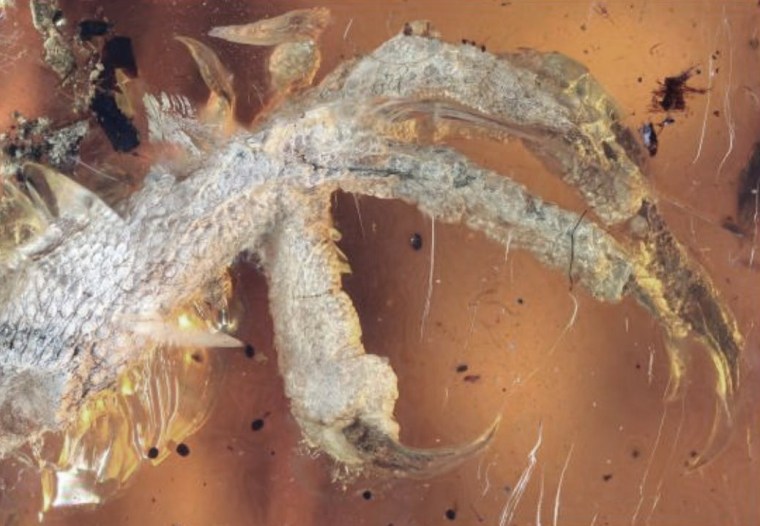
Foot of bird chick preserved in Cretaceous amber from Kachin, Myanmar. Credit: Pinterest, Xing Lida, China University of Geosciences)

Myanmar is well endowed with sedimentary deposits that contain amber, the solidified resin from a variety of now extinct trees. Oddly, completely clear amber has low intrinsic value: it is semi-precious, albeit attractive. But it often contains inclusions of vegetation fragments, insects, feathers and small vertebrates, of interest to palaeontologists. Myanmar amber is especially interesting as it is dated to the Middle Cretaceous (~130 Ma), older than that found around the Baltic Sea (Eocene ~44 Ma), which was the main source for European jewellery since the 12th century, and that from Canada (Upper Cretaceous ~80 Ma). Myanmar amber has been used decoratively and medicinally in China since the 3rd century CE, and in Europe since prehistoric times. It is attractive but quite common, so historically amber never commanded high prices but was widely used as a trade item. Since the publicity attending the supposed extraction of dinosaur DNA from the bodies of reptile parasites to resurrect dinosaurs in Steven Spielberg’s 1993 film Jurassic Park, public and scientific interest in amber has boomed. It is primarily the exquisite preservation of encased organisms that piques the interest of palaeontologists. Papers that rely on the Myanmar amber have grown in number over the last ten years, despite the country being infamous for military repression of tribal and religious groups in its rural areas.

One of the most conflict-riven areas is the northern state of Kachin where the most interesting amber to palaeontologists is collected by the Kachin people of the Hukawng Valley. Government forces have been in conflict with the Kachin Independence Army since the 1960s, most particularly for control of the amber industry. A recent paper has focussed on the ethical issue of publications based on fossil-bearing amber from the area (Dunne, E.M. et al. 2022. Ethics, law, and politics in palaeontological research: The case of Myanmar amber. Communications Biology, v. 5, article no. 1023; DOI: 10.1038/s42003-022-03847-2).

In 2010 the military began forcibly to take over mines in Kachin.  Between 2014 and 2021 the annual number of publication underwent a tenfold growth from between 10 to 15 to over 150, despite the fact that in 2015 the government in Yangon prohibited removal of fossils from the country. But the export laws exempt gemstones, so the growing demand for fossiliferous amber is clearly reflected in its supply to foreign scientists.  Rare specimens that include vertebrate remains command prices up to US$100,000. The Myanmar amber trade is now estimated at around US$ 1 billion per annum. The Myanmar military took over all the mines in 2017, and is clearly the main supplier to palaeontologists.

In the seven-year period, only 3 papers out of 872 included contributors from Myanmar, which also suggests an element of ‘parachute science’: unsurprisingly Myanmar-based scientists also find it difficult to visit the Kachin area. Before 2014 most of the 69 publications involved scientists in the US; since then, the top spot has been occupied by Chinese scientists who have amassed 417. It seems clear that there is a web of contacts linking together the source of Myanmar amber, its market and science. In 2020 the Society of Vertebrate Paleontology called for a moratorium on publishing data from Kachin sources. But since then there is little sign that palaeontologists have taken any notice.

See also: Ortega, R.P. 2022. Violent conflict in Myanmar linked to boom in fossil amber research, study claims. Science v. 378, p.10-11; DOI: 10.1126/science.adf0973 (This commentary includes opinion that seeks to mitigate the views of Emma Dunne and colleagues)

Geoscience academic under threat

While she was US Secretary of State from 2009 to 2013, Hilary Clinton the 2016 Democrat candidate for presidential office habitually used her private email server to send and receive messages, both personal and concerning affairs of state. She did not activate a state.gov email account for the official stuff, saying that it was ‘for convenience’ as her Blackberry smartphone could only access on account. More than 30 thousand undeleted e-mails were hacked by ‘persons unknown’ and appeared on Wikileaks in early 2016, with more in late October 2016, to become one of several issues central to the 2016 US presidential campaign. This practice was twice exonerated by the FBI, despite her account proving to be insecure and the risk to state secrets.

Hans Thybo, President of the European Geophysical Union and a widely esteemed professor of seismology at the University of Copenhagen, was not so lucky. He was fired by the University authorities, allegedly for using his private email account for work-related issues and advising a postdoctoral fellow that criticising the University’s management was ‘legitimate’. More than 1000 academic colleagues have petitioned the University of Copenhagen to reverse its decision and reinstate Thybo, and his case was central to the lead editorial A creeping corporate culture in Nature of 15 December 2016.

Anyone connected for more than a few years with academic life in probably every university on the planet will be conscious of the spread of a culture of bureaucratic control, corporatism and commodification in what formerly were largely self-governing institutions of higher education and research. The trend is in line with increasing, omnidirectional economic pressures stemming from the aftermath of the 2007-8 global financial crisis. But it is not entirely new. My own experience suggests it is partly a logical outcome of leading academics becoming increasingly prone to saying ‘Yes’; at best simply disengaging from dispute with a growing managerial caste within education and research, at worst by opportunistically joining it. A serious disjuncture has developed between teachers and researchers and the managers and business administrators in institutions of higher education. Symptomatic of this kind of schism was the recent passing of a motion of no confidence in the Vice Chancellors Executive of Britain’s Open University by its unionised academic and academic-related staff, following disastrous bungling of a new means of tuition of its entirely non-residential undergraduates in the current academic year. Those who were to implement the measures were inadequately consulted by the leading managers, most of whom had little experience of how the OU had functioned successfully since it received its Charter in 1969.

In Britain, checks and balances on the requirements of management and faculty historically centred on their Senate, once the primary academic authority of universities, in which all members of both academic and non-academic sectors freely debated and passed judgement on new directions and the abandonment of practices that had been found wanting. In most institutions, the Senate has been reduced since the mid 1980s to a mere fraction of staff, who, after nomination, are elected by the various components of the institution, together with unelected, ex officio, members of senior management. In practice, Senates now generally act as a ‘rubber stamp’ for decisions of the top echelons, much in the manner of business corporations.

Part of the new culture attempts to regulate electronic communications. An example of such an IT regulation states that the institution ‘… may monitor all data, systems and network traffic at any time …’, i.e. it claims ownership of work-related communication. No wonder Hans Thybo fell foul of his university. Should outside pressure persuade the authorities of the University of Copenhagen to reinstate him, that would be a significant blow against what has become an unwholesome aspect of learning and scholarship.

Impact factors: cat out of bag?

Two articles in the 14 July issue of Nature make interesting reading for those concerned about many universities’  and education ministries’ enthusiasm for bibliometrics as proxies for research excellence (E-P, January 2015) and their place in the academic equivalent of the Guides Michelin’s star system. Such institutions have become increasingly obsessed by ‘impact factors’. These are a metric applied to individual science journals, and are really quite simple: the average number of citations that articles published by a journal in the previous two years have received in the current year. So, it is supposed, if you get a paper published in a journal with a high impact factor, that can be deemed to be a ‘good thing’; it must it be more excellent than one published in a journal with a lower impact factor. That is a statistically very naive view. Indeed the first article by Nature regular Ewen Callaway (Callaway, E., 2016. Publishing elite turns against impact factor. Nature, v. 535, p. 210-211) implies that it is downright stupid. Citations do not follow a normal distribution; the majority of papers receive far fewer entries in reference lists than the mean of all those published, and that stats have a long tail towards papers with very large numbers of citations. The impact factor is strongly biassed by the much smaller number of papers the ‘go viral’, generally because they excite interest and often point many researchers in new directions. Take the top two science journals, Nature and Science: respectively their impact factors this year are 38.1 and 34.7, but in both 75% of all papers that they published cited less times than the mean. Indeed, a fair number got no citations at all. PLoS Genetics, an on-line, open-access journal of the Public Library of Science, whose throughput of papers is far higher than those of both Nature and Science has a much lower impact value (6.7) but only 65% receive fewer that number citations.

But there seems to be something a bit more sinister going on, to do with massaging the citations for individual papers to give the impression of ‘high impact’ and a long ‘shelf life’ for their influence. The sort of ‘gaming’ that goes on is covered by Mario Biagioli, of the University of California, Davis (Biagioli, M., 2016. Watch out for cheats in the citation game. Nature, v. 535, p. 203). Would you believe that some authors supply journal editors with e-mail addresses for ‘sock-puppet’ peer reviewers to get into print in the first place, and suggest additional references to other work by the authors? There’s more, with rings that effectively trade fake reviews in exchange for citations of the reviewers papers; a lot worse than the familiar practice of self citation. It isn’t necessarily the case that such papers are themselves fraudulent in some way, but to milk the citations cow and tart-up CVs. Biagioli believes that this tendency emerges partly from the drive towards collaborative papers with huge numbers of authors, which again institutions demand in order to be able to say that its research output is international in scope and ‘world-leading’, without being transparently hyperbolic. But skillful individuals can build up bloated reputations with relatively little effort; it’s also possible to guess who they might be. Properly unmasking what Biagioli terms ‘post-production misconduct’ is possible, but only by mining journal databases for evidence, which takes a lot of time. Some of this data analysis is done by journals themselves, pour encourager les autres I suppose, but rarely reported. Biagioli mentions new watchdog groups, Retraction Watch and PubPeer, the latter fostering post-production peer review. But such groups may themselves be gamed, because the ‘pursuit of excellence’ has a competitive side too: overweeningly ambitious academics have tended, until recently, to do the ‘proper thing’ by stabbing one another in the chest in plain view …

A ‘proper’ stratigraphic view of the ‘Anthropocene’

Readers may recall my occasional rants over the years against the growing bandwagoning for an  ‘Anthropocene‘ epoch at the top of the stratigraphic column. I , for one, was delighted to find in the latest issue of GSA Today a more sober assessment of the campaign by two stratigraphers who are well placed to have a real say in whether or not the ‘Anthropocene’ is acceptable, one serving on the International Commission on Stratigraphy, the other on the North American Commission on Stratigraphic Nomenclature (Finney, S.C. & Edwards, L.E. 2016. The “Anthropocene” epoch: Scientific decision or political statement? GSA Today, v. 26 (3–4).

A certain shyness about research misconduct in the UK

Since Earth Pages was launched at the start of the 21st century there have been highly publicised cases of gross misconduct by researchers, including plagiarism, ‘massaging ‘data and even sabotaging the work of others, as well as lesser cases where publications were withdrawn or removed from journals. The most notorious have been from the USA, Japan, the Netherlands and a number of other advanced countries. But sharp practices in science are not well known in the UK; indeed I can’t recollect more than one case that reached the same degree of coverage as the most notorious instances. Yet, in 2009, Daniele Fanelli of the University of Edinbugh reported the results of her analysis of accessible information from the UK about this matter. She found that about 2% of British scientists, who had been interviewed or answered questionnaires, answered ‘Yes’ when asked if they ever fabricated or falsified research data, or if they altered or modified results to improve the outcome. Up to one third admitted other questionable practices or knew of them having been committed by colleagues. Fanelli doesn’t refer to more grievous matters such as sabotage or exploitation of students’ work.

The silence from British Universities on research misconduct has become such an embarrassment that it was a subject of an Editorial and a News In Focus Report in the 21 May issue of Nature . While there are guidelines that urge British universities to publish annual reports of their investigations into misconduct, for 2013-14 only 12 such reports have been published : of the 88 universities contacted by the informal UK Research Integrity Office, 30 institutions responded to UKRIO’s survey. These reports covered 21 investigations, mostly unspecified, with 5 cases of plagiarism, 2 of falsification, 2 concerning authorship, 1 of fabrication and 1 breach of confidentiality. Three were upheld and 3 are pending.

These figures speak loudly for themselves: misconduct by researchers (and academics in general) is something that the halls of British academe ‘dinnae care to speak aboot’. As the author of UKRIO’s survey observed, ‘It’s just not credible’, although many of the universities that she contacted claim that such reports were in progress. A likely story… We all know that the ‘filthy snout’ (Tom Wolfe The Bonfire of the Vanities) does ‘come popping to the surface’, but is buried in confidentiality by university Research Committees, leaving any victims dangling in a sorry psychological state and allowing journals’ peer review system to catch any perpetrators before they reach the press, which it is rarely able to do. It takes a case as severe as that of Andrew Wakefield’s fraudulent 1998 paper in the Lancet associating the MMR vaccine with autism to see justice done.

Any excuse to return to the Moon

Humans first set foot on the Moon 45 years ago, yet by 42 years ago the last lunar astronaut left: by human standards staffed lunar exploration has been ephemeral. Yet for several reasons – romantic and political – once again getting living beings onto other worlds has become an obsession to some, in much the same manner that increasing numbers of countries seem hell-bent in increasing the redundancy of equipment in orbit; redundant because many of the satellites being launched all do much the same thing, especially in the remote sensing field. It’s all a bit like the choice between buying a Ferrari or hiring a perfectly serviceable vehicle when needed – prestige is high on the list of motivators. A new obsession is extraterrestrial mining and some very rich kids on the block are dabbling in that possibility: James Cameron of Aliens and Avatar fame (both films with space mining in the plot); a bunch of Google top dogs; billionaire entrepreneurs and oligarchs with cash to burn. Resource exploitation has also motivated Indian, Russian and Chinese interest in a return to the Moon, at least at an exploratory level.

NASA's proposed Moon colony concept from early...
NASA’s proposed Moon colony concept from early 2001 (image: NASA)

The main prospective targets have been water, as a source of hydrogen and oxygen through electrolysis to make portable rocket fuel, and helium, especially its rare isotope He-3, for use in fusion reactors. Helium is more abundant on the Moon than it is on Earth: only 300 grams of He-3 per year leaks out of the Earth’s depths. On the Moon there may be as much as 50 parts per billion in its dusty regolith cover where it remains supercooled in areas of permanent shadow. But to get a ton of it would require shifting 150 million tons of regolith. A decade ago geologists suggesting that metals might be mined on the Moon – noble metals and rare-earth elements have been mooted (the latter’s export being embargoed by Earth’s main producer China) – would have been laughing stocks, but now they get air time. Yet none of these materials occur on the Moon in the type of ore deposit found on Earth; if they did the anomalous nature of such enrichments on a body devoid of vegetation would have ensured their detection already. Even if there were lunar ore bodies, anyone with a passing familiarity with resource extraction knows just how much waste has to be shifted to make even a super-rich deposit economic on Earth, and that vast amounts of water are deployed in enriching the ‘paying’ metal to levels fit for smelting. For instance, while the rise in gold price since it was detached from a fixed link with paper money in 1971 has enabled very low concentrations to be mined, the methods involve grinding ore in water and then dissolving the gold in sodium cyanide solution, re-precipitating it on carbon made from coconut husks, redissolving and then precipitating the gold again by mixing the ‘liquor’ with zinc dust. Dry ore processing methods – based on density, magnetic and electrical properties – are hardly used in major mining operations nowadays.

The other, and perhaps most important issue with lunar or asteroid mining is that the undoubtedly high costs of whatever beneficiation process is deemed possible must be offset against income from the product; i.e. determined by market price on the home world which would have to be far higher than now. Such a rise in price would work to make currently uneconomic resources here worth mining, and anyone who believes that mining on the Moon would ever be competitive in that capitalist scenario risks being en route to the chuckle farm. Unless, of course, their motive is an exclusivist hobby par excellence and the bragging rights that accompany it – a bit like big game hunting, but the buzz coming from risking their billions rather than their lives.

But it turns out that a refocus on bringing stuff back from the Moon is not confined to floating stock on the financial markets. There are academic efforts to rationalise the Dan Dare spirit. There aren’t many scientific journals with a level of kudos to match the Philosophical Transactions of the Royal Society, the first journal in the world exclusively devoted to science and probably the longest running since it was established in 1665 at the same time as the Royal Society itself. Recently one of its thematic issues dubbed ‘‘Shock and blast: celebrating the centenary of Bertram Hopkinson’s seminal paper of 1914’  (Hopkinson, B. 1914. A method of measuring the pressure produced in the detonation of high explosives or by the impact of bullets. Philosophical Transactions of the Royal Society A v. 213, p. 437-456) a paper appeared that examines the likelihood of fossils surviving the shocks of a major impact (Burchell, M.J. et al. 2014. Survival of fossils under extreme shocks induced by hypervelocity impacts. Philosophical Transactions of the Royal Society A v. 372, 20130190 Open Access).

The authors, based at the University of Kent, UK, used a high-velocity air gun to fire quite fragile fossils of diatoms frozen in ice into water at speeds up to 5.34 km s-1. They then looked at solids left in the target to see if any recognisable sign of the fossils remained. Even at the highest energies of impact some diatomaceous material did indeed remain. Their conclusion was that meteorites derived by large impacts into planetary bodies, such as those supposedly from Mars or the Moon, could reasonably be expected to carry remnants of fossils from the bodies, had the impact been into sedimentary rock and that the bodies had supported living organisms that secreted hard parts. My first thought was that the paper was going to resurrect the aged notion of panspermia and a re-examination of the ALH84001 meteorite found in Antarctica claimed in 1996 to contain a Martian fossil (and believed by then US President Bill Clinton). Likewise it might be cited in support of the similar claim, made by panspermia buff Chandra Wickramasinghe, regarding fossils reputedly in a meteorite that fell in Sri Lanka on 29 December 2012: widely regarded as being mistaken. Yet Wickramasinghe’s team reported diatoms in the meteorite!

The Martian meteorite ALH84001 shows microscop...
The Martian meteorite ALH84001 shows microscopic features once suggested to have been created by life. (credit: Wikipedia)

However, Burchell has suggested that their results open up the possibility of meteorites on the Moon that had been blasted there from Earth might preserve terrestrial fossils. Moreover, such meteorites might preserve fossils from early stages in the evolution of life on Earth, since when both rocks and whatever they once contained have been removed by erosion or obliterated by deformation and metamorphism on our active planet. ‘Another reason we should hurry back to the Moon’ says Kieren Torres Howard of New York’s City University…

Geology and creationism

Anti-evolution car in Athens, Georgia
Creationist car in Athens, Georgia (credit:Amy Watts via Wikipedia)

Creationism is a topic about which I would not normally comment for much the same reason that once prompted pub landlords to have a sign behind the bar reading ‘No politics, no religion’. Yet geology has played an historically central role in the debate about Genesis vs Science. An excellent summary of how this emerged and was fundamentally resolved in favour of scientific endeavour, even if the ‘Genesisists’ have not been entirely rooted out,  appeared in the Geological Society of America’s GSA Today in November 2012 (Montgomery, D.R. 2012. The evolution of creationism. GSA Today, v. 22, p. 4-9).

Starting with Steno’s break with a literal acceptance of Genesis in 1669, the dominant view grew among clerics as well as scientists – ‘back in the day’ often one and the same – that the Earth was far older and its history one of changing natural processes. That outlook prevailed to strengthen through the late-18th and 19th centuries. Of course there was a tendency among ‘people of the Book’ somehow to blend their religious and scientific views, along the line that ‘scientific revelations that contradicted biblical interpretations provided natural guidance for better interpreting scripture’. But by the end of the 19th century there were very few literal creationists though a great many Christians who endorsed attempts to reconcile biblical text and geology.  Yet long after the Reverend William Buckland finally admitted in the mid-19th century that his imagination had ruled his zealous quest for evidence of a Noachian Flood and abandoned a literal idea of that and other aspects of Genesis there remained a persistent dribble of creationism.

Young-Earth Creationism
A wry view of Young-Earth Creationism (Photo credit: seriouscher)

That minor current split in the 20th century into a ‘tanky’ tendency that defended young-Earth creation and a global flood in the last ten thousand years, and a more ‘moderate’ wing of ‘old-Earth’ creationists. ‘Old-Earthers’ happily accept geological evidence of great antiquity, but maintain that God made it for eventual use by humanity; i.e. it had just sat around awaiting Adam and Eve being expelled from Eden. Both wings evolved along equally bizarre paths using a logic that boils down to a blend of perversity and simply ignoring any contrary evidence, such as that unearthed by Buckland long before. For instance when confronted by the fact that the deepest parts of the oceans contain less sediment than has accumulated on the continents, they defy gravity by insisting that ocean basins were eroded out by the Flood and then deposited with all their internal structures intact on higher ground.

Unsurprisingly, most creationists believe that there has been a centuries-long conspiracy by scientists to mislead the rest of humanity. Were it not for the fact that more than 40% of people in the United States believe in young-Earth creation, David Montgomery’s account of what is now a somewhat one-sided yet stupidly lively debate as regards true evidence would be amusing. His concluding sentence, ‘How many creationists today know that modern creationism arose from abandoning faith that the study of nature would reveal God’s grand design for the world?’ is probably one of the best ways of enraging any creationist who tries to enlighten you: he/she will certainly not just go away, but in the foam they generate you should be able to make good your escape.

Una parodia della giustizia?

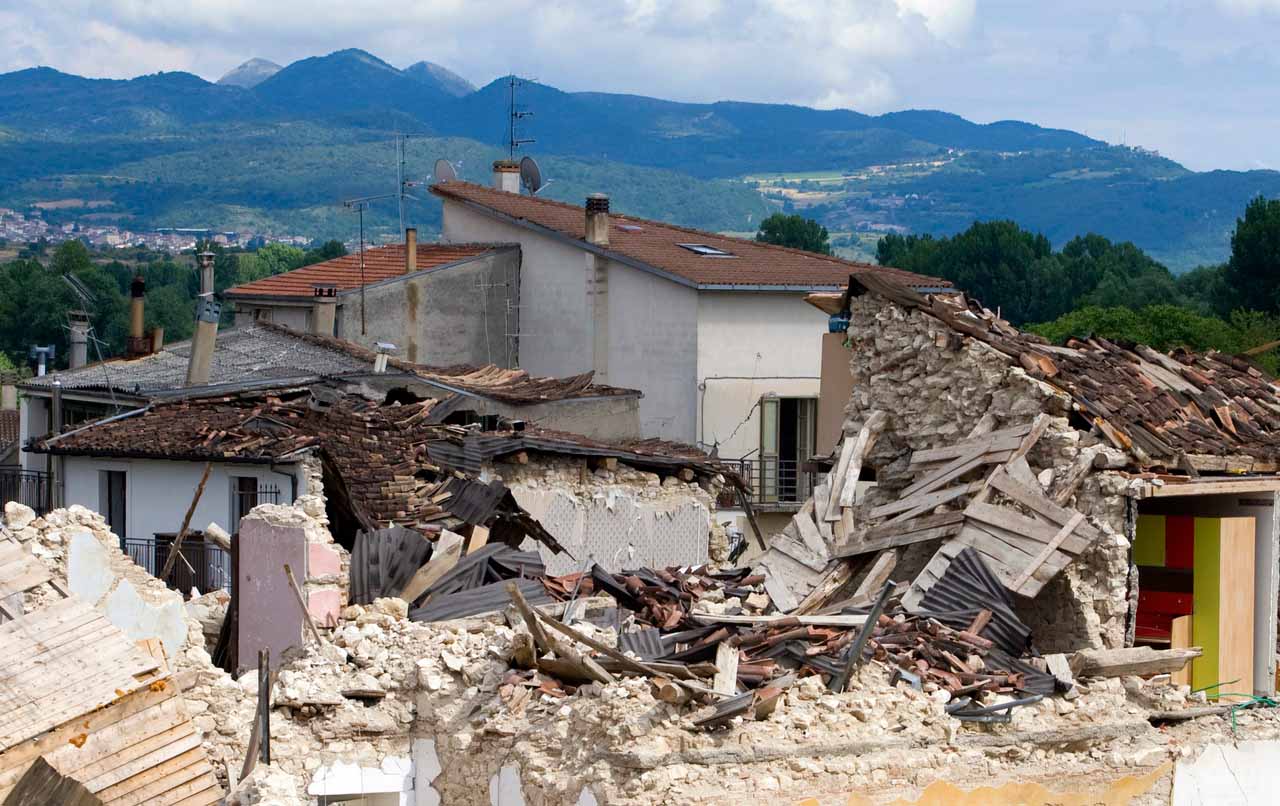
Damage caused by the L’ Aquila earthquake of 6 April 2009. (credit: Reuters)

Lying above a destructive plate margin, albeit a small one, Italy is prone to earthquakes. Seismometers detect a great many of low magnitude that no one notices and that do no obvious damage to buildings. From 2006 to autumn 2008 the Abruzzo region on the eastern flank of the Appenine mountains of central Italy experienced a background of one low-magnitude tremor every day (Papadopoulos, G.A. et al. 2010. Strong foreshock signal preceding the L’Aquila (Italy) earthquake (Mw 6.3) of 6 April 2009. Natural Hazards and Earth System Sciences, v. 10, p. 19-24). In the following 6 months the rate more than doubled but the epicentres continued to be almost randomly situated. Things changed dramatically in the 10 days following 27 March 2009: the pace increased to twenty times the normal ‘background’ and epicentres clustered directly beneath the regional capital L’ Aquila (population 73 thousand) close to a known fault line. At 3.32 am on 6 April 2009 the Paganica fault failed less than 10 km below L’ Aquila, directing most of the Magnitude 6.3 energy at the town. This was the deadliest earthquake in Italy for three decades; 308 people died 1500 were injured and 40 thousand found themselves homeless. Silvio Berlusconi, not a man to flinch from controversy, commented on German TV about the homeless, ‘Of course, their current lodgings are a bit temporary. But they should see it like a weekend of camping’.

English: Silvio Berlusconi in a meeting with J...
Former Italian President Silvio Berlusconi (credit: Wikipedia)

L’ Aquila has a dismal history of seismic damage, having been devastated before: 7 times since the 14th century. Having grown on a foundation of lake-bed sediments, notorious for amplifying ground movements, the city was clearly in a high-risk status in much the same manner as Mexico City. Shaken several times before and built with no regard to seismicity, much of L’ Aquila’s centuries-old building stock was incapable of resisting the event of 6 April 2009: up to 11 thousand building were damaged, some collapsing completely.

Not only was the earthquake preceded by an increasing pace of foreshocks, but many local people reported strange ‘earth lights’ during the months beforehand (Fidani, C. The earthquake lights (EQL) of the 6 April 2009 Aquila earthquake, in Central Italy.Natural Hazards and Earth System Sciences, v. 10, p. 967-978). In fact, so many sightings were made that plans have been outlined for a CCTV monitoring network in rural areas.

So, this disaster was not short of signs that all was not well in Abruzzo, in a seismic sense: historical precedent; poor urban siting; foreshocks and oddities that have come to be associated with impending energy release. But was this litany sufficient to predict the place, date, and magnitude of what was coming? Plate tectonics, local structural geology and worldwide seismicity allow geophysicists to assess risk from earthquakes in the same way as hydrologists can outline flood-prone areas: literally on flood plains. Yet there are few if any records of a devastating earthquake having been predicted anywhere with sufficient accuracy to allow evacuation and mitigation of death and injury. That is despite the fact that teams of seismologists in the western US, Japan, Italy and several other well-off countries continually monitor seismic events even with a power many orders of magnitude less than those which kill or injure. Such bodies are faced with a dreadful choice in the face of evidence like that summarised above: warn tens of thousands to evacuate, organise such an exodus in a few days and prepare accommodation for them, or advise that similar seismic escalations rarely lead to massive damage with an estimate of the probability of risk. Both choices are guesswork for there are no rigorous equations that spell ‘doom’ or ‘all clear’ from such data. Earthquakes are not rainstorms or hurricanes, as 250 thousand dead people on the shores of the Indian Ocean bear grim witness.

Despite broad knowledge of the deep uncertainty associated with earthquakes and volcanic eruptions – no longer privy to specialist scientists these days, even in the least developed parts of the world – the Italian authorities saw fit to prosecute six earth scientists and a public official for multiple manslaughter.  Because they provided “inaccurate, incomplete and contradictory” information about what might have been the aftermath of tremors felt ahead of 6 April 2009 earthquake, a regional court sentenced all of them to six years in prison – two years more than even the prosecution demanded – and they are to pay the equivalent of £6.7 million in compensation. This was not a jury verdict, but the decision of a single judge, Marco Billi. No scientist, even one poring over data from the Large Hadron Collider in search of the Higgs boson, would every claim that what they report is perfectly accurate, complete and incontrovertible. The L’Aquila Seven never said they were certain that no earthquake would ensue, and the city’s people were well aware of what risk they faced in much the same way that Neapolitans living on the slopes of Vesuvius know that one day they may be incinerated.

This is a travesty of justice so bizarre that one must look to the famous adage of Roman Law: qui bono? Certainly not the victims and their mourners, and definitely not science because any sensible Italian geophysicist will in future simply play dumb. There is already a huge world wide outcry, not just from outraged scientists.

Added 25 October 2012: The 12 October issue of Science carried a lengthy summary of proceedings early in the trial (Cartlidge, E. 2012. Aftershocks in the courtroom. Science, v. 338, p. 185-188). Read Nature‘s editorial on the L’ Aquila verdict here and further comment.

Is there misconduct in geoscientific research?

English: The City of Dreaming Spires from Boar...
Dreaming Spires (credit: Steve Daniels via Wikipedia)

Brian Deer, the British investigative journalist who exposed Andrew Wakefield’s methods that implicated the MMR vaccine as a cause of autism, has broadened his scope to research misconduct throughout science (Deer, B. 2011. Doctoring the evidence: what the scientific establishment doesn’t want you to know. The Sunday Times, 12 August 2012, p. 16). His article comes in the wake of several related articles in leading scientific journals (Enserink, M. 2012. Fraud-detection tool could shake up psychology. Science, 6 July 2012, p. 21-22. Macilwain, C. 2012. The time is right to confront misconduct. Nature, 2 August 2012, p. 7. Godlee, F.  2012.Helping institutions tackle research misconduct. The British Medical Journal, 10 August 2012). The focus has shifted in the last decade from a major campaign against plagiarism by students tempted by the information largesse of Wikipedia, Google and other electronic treasure troves to unwholesome behaviour among university academics. In an age when redundancy at universities has become an issue for the first time in nine centuries, many academics – frenzied by looming cuts – are engaged in a Gaderene rush for promotion and funding. The now obligatory stream of ‘learned’ papers seeks to justify their own puff and, equally as important, the puff of their departments, faculties and institutions trying to blag their corporate way through funding shortages. Misconduct is the child of education-as-commodity.

There are three mortal sins of academic fraudulence: plagiarism, including self-plagiarism (see Self-plagiarism, 6 January 2011); data falsification, including fiddling with those of other people (see Sabotage in Science, 4 November 2010), and fabrication of data, such as starting with a made-up graph and then using it to create plausible values in a table. Venial sins include publishing much the same data and interpretations again and again. The last highlights one of the reasons why miscreants get away with their chicanery and benefit from it; sloppy academic editing and even sloppier peer review.

Deer observes that ‘The science establishment’s consensus is that there is no need for outside scrutiny because … science is above that kind of misconduct that has tainted the Roman Catholic church, politics, the press and, of course, the banks.’ But, as in these notorious cases, the lid is coming off scientific misconduct, largely through the bravery of ‘whistle-blowers’ within the system. Yet the offenders who have been unmasked were unfortunate enough to work in institutions that have appropriate investigative mechanisms and the will at high office to use them. That determination to maintain the highest ethical standards is perhaps not as widespread as it once was.

Geoscientists have yet to figure much in the rogues’ gallery of malfeasants, except for the odd light-fingered palaeontologist. That may have something to do with the vagueness of much of their scope, epitomised by the trajectory of a lithological boundary on a geological map of poorly exposed ground. Indeed, virtually every aspect of the science is open to many interpretations, and errors of omission are perhaps more common than those of commission – any field worker knows that they will inevitably have missed something. But there are quantitative, laboratory-based aspects of the science, such as radiometric dating, that are more readily scrutinised for malpractice. In the early days of using radioactive isotopes and their daughter products to work out an age for an igneous or metamorphic event a common analytical tool was the isochron plot, as in the Rb-Sr method. A ‘good’ age was signified by all the data points falling on or very close to the line of best fit from which an age was calculated. Consequently, there may well have been cases where errant data were conveniently ‘lost’, but there was no way of telling.

That it did happen emerged from the honesty of those isotope geochemists who openly admitted that some mass-spectrometry runs had been omitted because the samples showed some signs of ‘contamination’ or ‘open-system behaviour’. For that they were merely taken to task by those who disagreed with their findings, but excused by those whose ideas the results supported: ethically honest. But how many Rb-Sr runs never made it to a published data table? Things are now a great deal more sophisticated than the days of punched tape and IBM cards in the geochemistry lab, geophysical software and that used for the growing cottage industry of process modelling. So much data and such a wealth of corrections that vast spreadsheets develop in the course of analysis, correction and calculation: few peer reviewers are going to go through data-processing steps with a fine-tooth comb, even if they have been lodged in public data repositories. Such settings provide ample scope for data invention, ‘fiddling’, ‘fudging’ and, in labs with a cavalier attitude to security, stealing but little way of pinning down any malpractice: that is, unless a culprit is either carelessly overconfident or a serial offender. A simple test that any peer reviewer might apply, most usefully at random, is to ask for a copy of laboratory notes associated with a manuscript. If one is not forthcoming, then suspicions will arise naturally.

A measure of just how much dodgy behaviour may go on is a survey conducted by Daniele Fanelli of the Institute for the Study of Science, Technology & Innovation, at the University of Edinburgh (Fanelli, D. 2009. How Many Scientists Fabricate and Falsify Research? A Systematic Review and Meta-Analysis of Survey Data. PLoS ONE, 4, e5738 http://www.plosone.org/article/info%3Adoi%2F10.1371%2Fjournal.pone.0005738). In it he found that up to a third of all researchers admit – anonymously – to engaging in shoddy practices, while around 2% admitted to having fabricated, falsified or modified data or results at least once. When asked off the record about colleagues, 85% of researchers reported suspicious behaviour known to them, 14% for data falsification.

English: Ivory Towers Now owned by King's Coll...
Ivory Towers, Chancery Lane, London. (credit: Colin Smith via Wikipedia)

Time cannot be far off when the red laser-beam spot moves across geoscience labs and individual geoscientists. Are they audited by disinterested peers and in such a small tightly-knit discipline are there such individuals? Do managing academics scrupulously keep records themselves and demand that their research fellows do likewise? Are there victims or witnesses brave enough to blow the whistle on any spite, fraud or slovenly methods, or will our science remain in its habitual state of bliss?

Self plagiarism

Some scientists have enormous publication records, a notorious case being one who claimed personal discovery of the HIV virus. During the 1980s, this person managed to figure as an author in up to 90 papers a year, despite mainly travelling back and forth to conferences. If the same name appears again and again in publications – it makes little difference where it figures in the list of authors – it is that name that is remembered as an “authority”. In some cases such an accolade is deserved, in others it is engineered by a variety of devices: the same data can be used over and over (most blatantly if those data are ‘engineered in the first place); a place in an authors’ list can result from being a ‘guest’, in the manner of a faded star, ‘down on their luck’, who pops up with a one-line cameo in a film (I rule out Alfred Hithcock’s appearance as a bystander in every film that he made); by nicking the ideas and words of others; through the device of self plagiarism. The last is an especially cunning ploy, as it also saves time crafting text. The italicized sentence above is an example self-plagiarised from the March 2002 issue of EPN (Credit where credit is due?), but as a blogger I can do that with a clear conscience; Earth Pages News is highly unlikely to get me into the ‘Professoriat’, especially my inability to resist occasional items such as this! Having provided the original source reference, I am safe from universal condemnation.

Potentially the game is up for plagiarists and pot-boilers in peer-reviewed journals through scanning software (e.g. Turnitin) that checks text against web-available journals. Self-plagiarism may well be an oxymoron, but it serves as CV fodder as well as creating academic redundancy. It hit the news (Reich, E.S. 2010. Self-plagiarism case prompts calls for agencies to tighten rules. Nature, v. 468, p. 745) because of a case in Canada where an author’s peer-reviewed portfolio was found to contain 20 instances. No academic censure ensued, but three of his papers were retracted. Using the Déjà Vu facility to check biomedical literature has resulted in 79 thousand cases of duplicated wording in abstracts and titles alone, and the eventual retraction of almost 100 articles. Seemingly, journal editors are allowing repeated use of text in the ‘methods’ sections of papers, so a geochemist minor co-author, who gets a ride for a small contribution based on use of a particular piece of equipment might be safe in that regard, there being safety in numbers. Yet as the use of anti-plagiarism software spreads into the wider on-line literature its original targets, undergraduate and graduate students, may decide that the biter ought to be bit and turn the cyber searchlight on their ‘betters’…

Sabotage in Science

Scientists are supposedly objective but a recent case in Michigan USA sheds a worrying light on a dark reality of research. A former post-doctoral researcher at the Ann Arbor campus of the University of Michigan has been found guilty of changing the experimental results of a PhD student who worked in the same lab; the charge was malicious destruction of personal property, which in the USA usually means vandalism. The postdoc claims his otherwise inexplicable actions stemmed from internal pressures and that he intended to slow down the student’s work (Maher, B. 2010. Sabotage. Nature, v. 467, p. 516-518). At first the student believed that she was making mistakes herself, but then realised some unknown person had swapped labels on her samples. When she aired her suspicions she was told she was being paranoid and going through a bad patch in her studies. She persisted despite such resistance, until her supervisor alerted the university’s security officers. They launched an investigation into the student herself! After two interrogations and a lie-detector test, the university police installed cameras in the lab, which led to the culprit being caught red-handed.

Research misconduct is notoriously difficult to apprehend, institutional authorities often balk at clear evidence and end up in what amounts to a whitewash to protect the institution’s integrity. Daniele Fanelli of the University of Edinburgh UK has made a study of malpractice in science, ranging from this kind of willful derailing of a research project to withholding information and vindictive reviews that are rarely considered misconduct. She has found that up to 30% of scientists admit (anonymously) to lesser but still baleful issues, and a staggering 70% say they have witnessed deliberate damage to fellow researchers. This malice that dare not speak its name, even were it to be rarer than Famelli has discovered, is a blight that should be recognised by institutional authorities rather than ignored or actually turned against the complainants.

Crowd Science

Malice and/or mendacity are not the sole ways to get on unfairly. A mild form is somehow to join a team, preferably with a role that involves little actual work. ‘Brownie-points’ in the promotion stakes are guaranteed nowadays by authorship in peer-reviewed journals: senior or sole author is best; next being in a small authors list in a journal that demands an account of the role of each; but even being an also-ran or last of a great many can go nicely on your CV. Does one have to have some je ne sais quoi to be accepted by a team? Well it depends on what the quois might be. Some might say seniority or prestige as that helps the paper to be accepted; others that having the only accessible scientific machine for the topic more or less guarantees a place; but is it possible merely to lurk in the corridor and still get on board?

The vast majority of author lists are surely completely honest, but there is a definite tendency for them to get longer as time goes by. During the days when analysis of lunar rocks from the Apollo Missions was booming a team of geochemists – the Lunatic Asylum – was formed at the California Institute of Technology (incidentally, in 1920 Caltech changed its name from Throop University – after Amos Gager Throop, former Mayor of Pasadena). Its founder and leader was and remains Gerry Wasserburg, and occasionally papers were published under the anonymity of the group, so it is hard to tell just how many of them were involved. The Atlas experiment at the CERN Large Hadron Collider has given rise to a paper authored by 230 individuals from 169 institutions (The ATLAS Collaboration et al. 2008. The ATLAS Experiment at the CERN Large Hadron Collider. Journal of Instrumentation, v. 3, doi: 10.1088/1748-0221/3/08/S08003), but that consortium does not hold the record. As far as I know, the biscuit is taken, for the moment, by Members of the Genetic Investigation of ANthropocentric Traits (GIANT) consortium (Allen, H.L et al. 2010. Hundreds of variants clustered in genomic loci and biological pathways affect human height. Nature, v. 467, p. 832-838) whose title is self-explanatory. Of its 7 pages, 3 are taken up by the names of its 287 authors, their 203 institutions and a not inconsiderable number of funding agencies. At just under 3000 words (not including the names and affiliations of the authors), each author on average has just over 10 words to their name. Interestingly, 10 of the authors (the first 6 and last 4 ) ‘contributed equally to this work’ – how is not specified, and 4 authors are each affiliated with 5 institutions. By comparison, geosciences is definitely little league as regards collaborative ventures, but opportunities there surely are.


Watch out, watch out, there are burglars about

f the major journals are anything to go by, the gravest crime that scientists can commit is to make up data and publish the results after peer review. The only thing worse in the eyes of us ‘academics’ is to publish the same makey-up data several times without being rumbled by referees. Once discovered, all the hammers of hell fall on the miscreant: they lose their jobs; their faces are splashed on the news pages of Nature and Science; they are blackballed internationally and can never work in academic circles again. Pretty harsh treatment for what, after all, is a good old-fashioned con (and often one of some ingenuity). In general, most of us love a rascally grifter, so long as they haven’t trousered our life savings. So why is the academic equivalent of the death penalty reserved for what is little different from getting a gullible public to believe that politicians act in the best interests of humanity? If any geologist looked deeply into his or her conscience most would find several cases where they had fudged a bit of data – marked a geological boundary on a map where there was barely a shred of evidence, for instance. We have all speculated well beyond the realms of reality, and often that has passed peer review easily. It is in the very nature of a dominantly observational science to do the odd bit of grifting and have it accepted.

What we detest in real life is the burglar, who desecrates our homes and work. Having anything stolen leaves a life-long trauma and a feeling of being somehow dirtied. In our academic world, theft is called plagiarism. It is most generally applied these days to the actions of students who snip bits and pieces from published sources to get a good mark from a term-paper or dissertation. Like the fabricator of data, they are generally hammered if caught at it. Yet there is a real theft that damages its victims rather than merely soiling the ‘clean image’ of education, and these victims are usually ‘junior partners’ in research. It is rife, and in one form is actually condoned and even encouraged. These days many research students are forced to more or less sign away their intellectual property to their supervisors, often a sizeable posse most of whom do very little, if anything at all. If a research student wants to publish the posse must be in the list of authors. Many commentators have noted that this riding on the backs of the inexperienced is how CVs are built up and fast-track promotion is achieved. It could be called the ‘pillion passenger’ route to greatness. But this kind of institutionalised pillaging is by no means the worst form that plagiarism can take. Far worse is to find out accidentally that one’s original ideas, data, or graphics are being published or uttered by someone else without any acknowledgement, especially if they have yet to be published.

The police rarely catch a burglar, and even less-often recover stolen goods. Similarly, victims of this worst form of academic plagiarism also know that having the record properly set straight is unlikely. The academic burglar excuses him/herself with the defence that, “there is no copyright over ideas”. To accuse such charlatans invites being actioned for libel, because of legal vagueness over intellectual property. Last month I witnessed an attempted burglary at a conference in London. In that case the burglar not only published purloined ideas previously but clearly fed his student those ideas. Unwittingly, she presented them, suitably tarted up, but with him as second author – i.e. trying to have his cake and eat it. All would have gone smoothly for the snaffler, but for one thing. The victim was there and gave the genuine presentation only 30 minutes before the blagged one hit the floor. Quite clearly, she knew what she was talking about whereas the coached presenter obviously did not. Thanks to two or three acute, and honest people in the audience, the game was up. The perpetrator of the burglary was, in the most polite (and legal) fashion, academically savaged with not inconsiderable relish. In a way, justice was done, but not entirely.

Anyone who attempts to build a career by theft needs to be stopped in their tracks, but in the ‘halls of academe’ only con-artists who are caught have the book thrown at them. So, keep your eyes and ears open in 2008, on behalf of others as well as yourself, for that is the only way metaphorically to give burglars a touch of the old Black and Decker about the knee caps.

Anonymous referees

Anyone who submits their first paper to a journal soon becomes aware of the “peer review” process: probably the single greatest contributor to academic suspicion and anxiety.  Of course, these “peers” fall into two categories: the “esteemed colleague” (helpful); the “witless wonder” (negative, and prone to crushing your paper).  Write a book, a play or an operatic score, and your critics in the media have a name.  You could even find out where they keep their pet rabbit.  They are accountable. Yet, editors of journals claim to have a “duty of confidentiality” towards those referees who opt for anonymity: guess which category most often does. At one time or another, most academics asked for critiques by learned journals only to recommend rejection have succumbed to “taking the veil”.  Equally, there are few researchers who have not suffered a similar fate to one they may have meted out themselves.  Learning by experience is not necessarily a strong point among scientists.  A typical case came to my notice recently, but the identity of one faceless and repugnant referee eventually became clear.  I know him well.  He too had suffered acute stress from a grossly delayed manuscript and the vicious comment of an anonymous referee some years back, yet saw fit to indulge his own spleen when offered a place in the shade: goodness only knows why, but in this case I have my suspicions.

The whole scientific community grows increasingly uneasy about anonymous peer-review, and the abuse that it sometimes makes possible. Examples are deliberate delays by unnamed referees engaged in similar research or related commercial activity, plagiarism, incompetence and the self-indulgence of gratuitously destructive and belittling comment.  It is the near-universal policy of referee anonymity that allows these unwholesome practices to fester and grow.  Most journals give their referees the option of coming out of the closet, or remaining smugly behind its door.  Some assume anonymity, so that a referee has to ask explicitly for their name to be revealed.  Anonymous referees are simply moral cowards, along with editors of the journals that give them a cloak. What do they fear?  Are direct questions about their comments cause for timidity?

Referee malpractice can be removed completely by editors refusing to allow referees to skulk behind anonymity. Now, in the UK at least, it seems possible to challenge this unwholesome editorial prerogative, because of the Freedom of Information Act 2000 (2002 Scotland), which came into force on 1 Jan 2005, and the Data Protection Act 1998.  Resorting to the Acts ought not to be necessary as regards the activities of scholarly journals, yet editors continue to defend the more faceless of their referees.  No doubt there would be a temporary shortage of referees should compulsory “outing” become the norm, but it would remove those who do engage in malpractice.  The most important result would be an increase in objectively constructive comment, which softens the blow of a rejection slip by showing a way forward to authors.   Peer-review should work both ways, and should be seen to be honest.


Protecting your intellectual property

Long ago, most students entered research by thinking up their own project, albeit with advice from potential supervisors.  That is rarely possible today, for many reasons.  Instead, gifted students are recruited to research topics proposed to funding agencies by established scientists.  More often than not, such projects slot into an overall strategy centred on an academic’s career or the ambitions of a research group.  There are advantages in having the sometimes undivided attention of a “boss”, a structured approach to work within a broader framework, access to a group’s equipment and funding, and support from several co-thinkers.  With the old style, there were risks in “ploughing a lone furrow”, such as abandonment by a disenchanted supervisor (the enchanted ones could be even more worrying).  The single most important advantage of designing your own project, hard and risky as that might be, was one of possession from the outset.  Such responsibility develops qualities that are otherwise not easy to get: independence of thought and action, time-management,  resourcefulness, an ability to argue your case, and self-discipline – if you can really “hack” it.  Except for the indolent and irrecoverably stupid, most people can, given some knowledge of where their subject is going and thesine qua non of curiosity.  In those “old days”, the risks were more than offset by the advantage of ownership, and it was rare for postgraduates not to be successful, and the majority gained their doctorates within three years.  Today, up to a third of enrolled graduate students withdraw or fail their degrees, and hardly any complete inside this reasonable period.

Funding agencies now demand guarantees that their outlay bears fruit.  They increasingly direct lines of research, so that studentships follow previous funding.  The funders are more accountable, and by the iron logic of the marketplace so too must be the recipients.  The upshot is continual assessment of research performance by departments, the creation of “centres of excellence”, and the crushing of departments that do not measure up to an amoebic growth of criteria and guidelines.  So, for anyone keen on testing their abilities to the limit and following their curiosity, the options are increasingly limited.  Even if you have independent means, it is now a very rare department that encourages self-motivated research by students, or even by its established staff.  In truth, most academics find it hard to be independent, because they no longer have the security that once guaranteed freedom of thought, action and expression.  In Britain, if an academic began their career or earned promotion after 20 November 1987, they can be dismissed solely on grounds of redundancy, rather than “with good cause”, which was the rock on which tenure used to be based.  “Gross moral turpitude” was, I believe, the operative and infinitely more expressive phrase in US institutions.  So for your average supervisor the world has turned upside down.  Now it’s a case of “publish or perish”, larded with citation and impact records, and bringing cash into your institution to boost its research assessment.  There are very few academics with the energy, imagination, brass neck and wit to jump through all these hoops and remain sanely independent.  So we see a growth of hidden but nonetheless unwholesome vices adopted by some to survive and prosper in this deranged environment.  There are many victims, but the new researcher is most at risk.  During the festive season it is customary to give and receive advice, as well as greetings.  Here is some that concerns the vice that dare not speak its name –plagiarism – in the form of a bestiary to help you memorise potentially risky people.

  1. Chameleons Check out potential supervisors.  The Science Citation Index will reveal their record of sole or senior authorship of papers (notreviews).  If they are what they claim to be, that will dominate.  Relative to that, how many times does their name appear within multi-author papers, of which they are not senior author?  If the latter dominates, their reputation probably rests on offering technical facilities that they control, or the research talents of other people.  You may find individuals who have a short publication list of either kind.  They are either at the start of their career, or beyond all human help (except perhaps your own).
  2. Beavers Never let anyone else do any work for you, unless they are a kindly technician (who then deserves at least an acknowledgement).  Where possible, keep your research materials under your personal control – in some institutions burial is a useful tactic.
  3. Curlews Be suspicious of a supervisor who shares your findings with the rest of a team; either you do that yourself or not at all.
  4. Moles Although communication with others is an essential aspect of research, until you are ready to submit a paper for peer review, do not reveal all in seminars and conferences.  Pay particular attention to your posters.  At every conference you will see people photographing them, whom you can safely assume are after your ideas.
  5. Hamsters Beware the friendly soul offering, without being asked, to read your first draft of a paper.  Instead, plead with the most curmudgeonly academic around, the one who hammers your every utterance, for he or she will probably be honest.
  6. Tapeworms Do not allow your supervisor to routinely add their name or others in a research team to your papers.  Authorship is not based on advice, basic training in research techniques or discussion of your work.  That is your supervisor’s duty of care, and a good one should give far more than they take. Acknowledgements are the place to express gratitude for such assistance.  Authors have to do real work, both analytical and intellectual, to deserve a place in the list.
  7. Squirrels Insist that your supervisor lets you read all drafts of their papers that bear on your own field, to check that your findings are not included, as well as to learn.  If your work appears, you have a right to authorship.
  8. Weasels Be aware of the relationships among academics and post-docs in your department, and theirs with others in outside institutions.  Keep an eye on “networking”, which often involves mutual sharing of information as well as gossip, particularly if joint bids for funding are in the offing.
  9. Ravens It is easy to be pressured overtly and subtly, particularly in a large research group.  That may be beneficial, but can be to get you to toe the “party line”.

10.  Wolverines Never tolerate anything that seems like plagiarism, manipulation, obstruction, exploitation, bullying or harassment.   Best to confront politely yet firmly the person responsible, but that is not easy.  Finding someone who can help is not easy either.  Your institution may well have a policy of pastoral care based on designated individuals, who are deemed to be disinterested and trustworthy.  In the real world there is a culture of protecting long-term colleagues, which extends throughout a university; you are transitory…  In case of difficulty, ask to change your pastoral advisor.  Other students of longer standing may know who is straight, or have similar experiences.  Whatever, it is essential that you get honest support to resolve such problems.  One useful tactic is to air your grievances as accurately as possible in writing, with a copy to someone that you can trust.

11.  Diverse enchanted beasts The most difficult obstacle to ownership can be, oddly, the genuinely honest, kindly and enthusiastic supervisor.  Because of their greater experience and breadth of knowledge, your work can easily become their obsession, usually because of their frustration with your progress.  They will not steal your thunder consciously, but can easily end up driving you rather than the other way round.  If you want to become their creature, fine.  If not, then you have battles ahead, but they will serve both of you well!


Credit where credit is due?

A recent book (Crewdson, J.  2002.  Science Fictions: A Scientific Mystery, a Massive Cover-up and the Dark Legacy of Robert Gallo.  Little, Brown; Boston) describes the role of pulling (and enhancing) rank in the history of HIV’s discovery.  In fact there were two histories: the real one in which two post-docs in Gallo’s lab, Bernie Poiesz and Frank Ruscetti, succeeded in isolating human T-cell leukaemia virus – the seminal step on the road to HIV; the “engineered” history, in which credit for the discovery seemed to pass entirely to Robert Gallo.  However that particular revision of reality emerged, building rank through annexation of credit is not uncommon in academic circles.  Peter Lawrence of the Medical Research Council Laboratory of Molecular Biology, Cambridge University has expanded on Crewdson’s careful investigation to produce a useful warning, particularly for beginning and junior researchers in all disciplines (Lawrence, P.A. 2002.  Rank injustice.  Nature, v. 415, p. 835-836).

Lawrence’s thesis is that the scientific community allows experienced researchers to take advantage of the inexperienced, so that credit generally flows up the ladder of rank.  Part of the problem is that graduate students, and even post-docs, nowadays rarely generate projects themselves and increasingly work under the control rather than the guidance of a supervisor, team leader or major grant holder.  It is not always a case of high-ranking scientists mendaciously grasping credit for discoveries made by underlings, for various practices make misplaced credit inevitable.  Lawrence lists a whole number of these.  For me, one is particularly interesting.  It centres on how to stick in one’s peers’ memory.  If the same name appears again and again in publications – it makes little difference where it figures in the list of authors – it is that name that is remembered as an “authority”.  During the 1980s, Gallo managed to figure as an author in up to 90 papers a year, despite mainly travelling back and forth to conferences.

Most people’s view is that whoever does most of the work, discusses its ramifications and draws conclusions should be the first author in a list.  But are they the “senior” author?  In terms of rank that is often not the case, and one need only scan the publications of a large research team to see the same name appearing again and again, often in last position; that of the “owner” of the lab or the funds.  What they have done to appear on the list is rarely clear, but by sheer number of appearances it is their name that is remembered, and more importantly these days, figures in measures of productivity.  As they say, it is a “win-win” scenario.  Any paper, in whose list of authors the “name” appears, that meets peer acclaim serves to boost that “names” citation rating too.  If such a paper turns out to be sloppy or even fraudulent, then someone safe among the “also-rans” can shrug off responsibility.

The same issue’s Editorial (Thoughts on (dis)credits.  Nature, v. 415, p. 819) quotes from a letter submitted by Max Perutz (Peter Lawrence’s former “boss”), shortly before his death on 6 February 2002.  Perutz spent the first 25 years of his career in the Cavendish Laboratory at Cambridge, headed by Ernest Rutherford and then W.L. Bragg, neither of whom put their names on papers to which they had not contributed, despite the fact that a whole number represented epochal breakthroughs inspired by them.  And nor did Perutz.  That generosity damaged none of their careers or reputations, but made them properly respected, admired and fondly remembered.  Will careers based on annexation of credit (an excellent euphemism!) find the same fate?

Popper refuted

In mid-Victorian times, Lord Kelvin peered down his nose at Charles Lyell’s estimation of sedimentation rate from the historic silting of the port of King’s Lynn, as a means to judge the vast time span represented by the stratigraphic column.  His words were not kind; “…when you cannot measure [what you are speaking about], when you cannot express it in numbers, your knowledge is of a meagre and unsatisfactory kind”.  Geologists cringed, particularly when Kelvin went on to reckon an age of 20 to 40 Ma for the Earth based on its cooling from a molten mass, using the physical laws of conduction and radiation.  He was fundamentally wrong on most counts, partly because he knew nothing of radioactive heat generation nor convective heat transfer.  Sadly his corpse could not be revived to eat his mean-spirited words.  Nonetheless, the gibe of Earth scientists’ being “unscientific” has stuck.  We rarely stick to the “scientific method”, reputedly stemming from the Elizabethan philosopher, Francis Bacon and his rationalization of the inductive method of reductionist experimentation.  There are few universal “truths” in Earth history, and the interweaving of limitless processes with a vast spectrum of rates, scales and magnitudes renders reductionism absurd.  Even more prone to reductio ad absurdem is the chemist Karl Popper’s supposedly logical insight that “proper” science rigorously subjects hypotheses to a “risky test”; an experiment that should yield evidence of refutation if the notion is unsound.  Popper’s method of falsification consigns to the dustbin of research any hypothesis which fails the test, with the corollary that in is not “best practice” to seek confirmation for a hypothesis.

Carol Cleland of the University of Colorado (Cleland, c.e. 2001.  Historical science, experimental science, and the scientific method.  Geology, v. 29, p. 987-990) demolishes the “recipe-book” approach to science, which has laid a dead hand on not only the Earth sciences, from the standpoint of philosophy and reality.  She starts from the position of Thomas Kuhn, by pointing out that, for Popper, the whole of Newtonian celestial mechanics should have bitten the dust when 19th century astronomers discovered that the orbit of Uranus deviated from Newtonian prediction.  A sustained search for reasons why concluded that there must be gravitational forces from planets beyond Uranus, and sure enough astronomers discovered Neptune.

There is an air of bullying about the “scientific method”, which has warped investigations and dulled imagination and curiosity for centuries.  It provides ammunition for those who carp and pontificate from the sidelines, and in many cases from positions of considerable power.  Cleland does us all a service by discussing philosophical matters of science in the context of the realities that confront us all, in an accessible way.  Her analogy is Holmesian detection (Sherlock was a deductionist, by the way, proceeding from the general to the particular), which discovers events and proceeds to trace their circumstances – the search, to my mind, for the artillery rather than a single “smoking gun” is far richer than the events themselves, because that deepens our sense of context for particular events, however dramatic they might seem to be.