Magmatism and water in the mantle

That Earth has always been such an active planet is largely due to water having continually being shifted into the mantle by subduction of oceanic lithosphere. Emplaced at temperatures around 1200°C the basaltic crust and ultramafic rocks of the lithospheric mantle become hydrothermally altered by interaction with the ocean, so that they contain a range of hydrous minerals. The mantle is estimated to contain between a quarter and four times the present volume of all ocean water. The vast bulk of the mantle is not undergoing partial melting at any one time. Most magmatic activity is linked to plate tectonics through linear belts such as those along oceanic rift systems and above subduction zones, with a small proportion at ocean islands above isolated mantle plumes and similarly, though more sparsely above hot spots below continents. Such plume-related magmatism has at intervals in the past been vastly bigger than now, forming flood-basalt provinces and ocean-floor plateaus, such as the Deccan Traps and the Ontong Java Plateau; some linked to extinction events. The particular role of water in mantle melting is its reduction in the temperature at which melting begins at depth: ‘dry’ mantle does not melt but remains solid, albeit ductile. Two recent studies have provided important insights into previously unsuspected roles that water can play deep in the mantle.
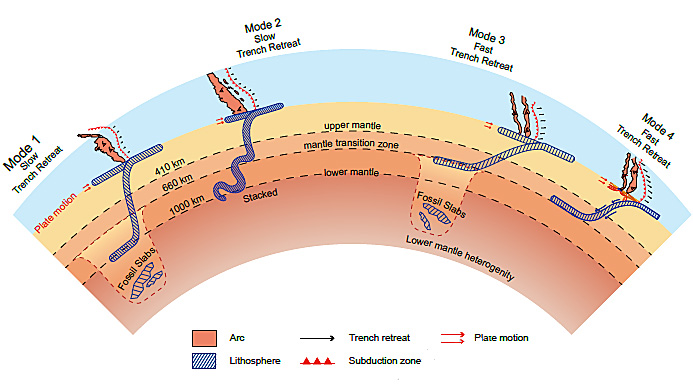
Four different modes of subduction. Credit: Li et al. Fig 6

Jianfeng Yang of the Chinese Academy of Science and colleagues from China and University of Padua, Italy provide evidence that ancient subducted slabs that gather at the mantle transition zone (MTZ) may trigger ocean-island  and ocean-plateau volcanism  (Yang, J. et al. 2026.  Subduction legacies in the mantle transition zone modulate intraplate oceanic volcanism. Nature Communications, in press; DOI: 10.1038/s41467-026-73403-7). In fact there is a multiplicity of modes wherein subducted slabs interact with the MTZ, some are retained within it while, in one way or another, others eventually pass through it to the deeper mantle.  Long-dead relics of subduction zones trapped there form ‘reservoirs’ of water 410 to 660 km below the surface at concentrations far higher (1 to 3 %) than does pristine mantle (less than 0.1%). It is stored as OH ions in dense mafic minerals, such as ringwoodite a high-pressure form of olivine (Mg2SiO4) containing up to 2.6 % of OH ions, and bridgmanite (MgSiO3), which forms once subducted slabs pass into the mantle transition zone. If that transformed lithosphere rises above about 410 km, such minerals transform back into anhydrous olivine, thereby liberating their water. At such depths, where temperature in the surrounding dry mantle is about 1800°C the emergence of water triggers a decrease in the temperature at which the ancient slab and also the surrounding mantle can melt. The authors cite evidence that such a process has contributed to the Azores oceanic plateau where the crust is 10 to 20 km thick. It is conceivable that a similar process of deep water ‘recycling’ may have been associated with continental flood basalts. Yang et al.’s new insight may also help unravel hitherto puzzling geochemical anomalies in other kinds of basaltic igneous rocks, such as those which well-up at mid ocean ridges to form modern oceanic crust.

Slabs that descend deeper into the mantle retain their dense mafic minerals and thus the water trapped within them. That water may eventually be involved in transformations at much higher pressures and temperatures, as deep as the core-mantle boundary. One possibility is their retention in mantle plumes that rise from the CMB to facilitate partial melting once they pass through the MTZ

See also: Subduction legacies shape intraplate ocean volcanoes. Scienmag, 20 May 2026

Damp Earth: hydrous minerals in deep mantle rock

A large number of water-oriented tropes have been applied to Earth for ‘artistic effect’, ranging from Waterworld to the Blue Planet, but from a geoscientific perspective H2O in its many forms – liquid, solid, gas, supercritical fluid and chemically bound – has as much influence over the way the world works as do its internal heat production and transfer. Leaving aside surface processes, the presence of water has dramatic effects on the temperature at which rocks – felsic, mafic and ultramafic – begin to melt and deform and on the rates of important chemical reactions bound up with internal processes.

For a long while many geologists believed that the oceans were the product of water being transferred from the mantle by degassing through volcanoes so that the deep Earth has steadily been desiccated. But now it has become clear that such is the rate at which subduction can shift water back to the mantle that the entire volume of modern ocean water may have been cycled back and forth more than 3 times in Earth history (see Subduction and the water cycle). Besides, it is conceivable that accretion of cometary material up to about 3.8 Ga may have delivered the bulk of it.

An important aspect of the deep part of the water cycle concerns just how far into the mantle subduction can transport this most dominant volatile component of our planet. Ultra high-pressure experimental petrology has reached the stage when conditions at depths more than halfway to the core-mantle boundary (pressures up to 50 GPa) can be sustained using diamond anvils surrounding chemical mixtures that approximate mantle ultramafic materials. Previously, it was thought that serpentinite, the hydrous mineral most likely to be subducted, broke down into magnesium-rich, anhydrous silicates at around 1250 km down. This would prevent the deepest mantle from gaining any subducted water and retaining any that it had since the Earth formed. A team of Japanese geochemists has discovered a hint that hydrous silicates can, through a series of phase changes, achieve stability under the conditions of the deepest mantle (Nishi, M. 2014. Stability of hydrous silicate at high pressures and water transport to the deep lower mantle. Nature Geoscience, v. 7, p. 224-227). Their experiments yielded a yet unnamed mineral (phase H or MgSiH2O4) from approximate mantle composition that could remain stable in subducted slabs down to the core-mantle boundary. This development may help explain why the lowermost mantle is able to participate in plume activity through reduction in viscosity at those depths.

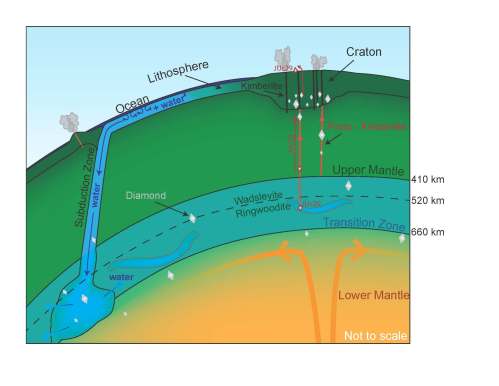
A parallel discovery concerns conditions at the base of the upper mantle; the 410 to 660 km mantle seismic transition zone. It comes from close study of a rare class of Brazilian diamonds that have been swiftly transported to the Earth’s surface from such depths, probably in kimberlite magma pipes, though their actual source rock has yet to be discovered. These ultra-deep diamonds prove to contain inclusions of mantle materials from the transition zone (Pearson, D.G. and 11 others 2014. Hydrous mantle transition zone indicated by ringwoodite included within diamond. Nature, v. 507, p. 221-224). Australian geochemist Ted Ringwood pioneered the idea in the 1950s and 60s that the mantle transition zone might be due to the main mantle mineral olivine ((Mg,Fe)2SiO4) being transformed to structures commensurate with extremely high pressures, including one akin to that of spinel. Such a mineral was first observed in stony meteorites that had undergone shock metamorphism, and was dubbed ringwoodite in honour of its eponymous predictor. Yet ringwoodite had never been found in terrestrial rocks, until it turned up in the Brazilian diamonds thanks to Pearson and colleagues.

Partial cross-section of the Earth showing the location of ringwoodite in the mantle. Credit: Kathy Mather
Partial cross-section of the Earth showing the location of ringwoodite in the mantle Credit: Kathy Mather

Earlier experimental work to synthesise ultra-deep minerals discovered that ringwoodite may contain up to 2% water (actually OH groups) in its molecular lattice: an astonishing thing for material formed under such extreme conditions. The ringwoodite inclusions in diamond show infrared spectra that closely resemble its hydrous form. From this it may be inferred that the 401-660 km transition zone contains a vast amount of water; roughly the same as in all the oceans combined, though the find is yet to be confirmed in a wider selection of diamonds. One of the puzzles about diamondiferous kimberlites is that the magma must have been rich in water and carbon dioxide. That can now be explained by volatile-rich materials at the depths where diamonds form, But that does not necessarily implicate the whole transition zone: there may be pockets ripe for kimberlitic magma formation in a more widely water-poor mantle.

Keppler, H. 2014.  Earth’s deep water reservoir. Nature , v. 507, p. 174-175

Enhanced by Zemanta