Were giant octopuses top predators during the Cretaceous?

Octopuses defy common sense. They are invertebrate molluscs, so we don’t expect them to show well-developed intelligence, which they do. As well as tiptoeing around on their eight tentacles, they can move at high speed using a kind of backwards jet propulsion and some are even able to cross dry land.. Each of their tentacles has a sort of brain, as well their central one: distributed, semi-autonomous cognition in which their tentacles taste, touch, and move independently. Three hearts circulate their blue blood. Masters of swift camouflage using specialised skin cells that contain different coloured pigments, which behave like pixels in a TV screen. Octopuses can also rapidly manipulate their body texture and shape. They also seem to use such bizarre displays to communicate mood, at the very least.

Shape-shifting octopuses can squeeze through gaps far smaller than their own size to hide from both predators and their prey, which also makes them escapologists far outranking Harry Houdini. Their eyes look like those of goats, with horizontally linear pupils, although they evolved separately from the eyes of other animals.  Satan is said to have goat-eyes, hence the colloquial name for an octopus: devil fish. Mariners of old (and maybe some of the present day) reputedly feared giant octopuses to be capable of crushing ships and devouring the crew: the Kraken! Even small octopuses possess greater intelligence than a dog: some seem to enjoy playing, building dens, negotiating mazes and watching the antics of humans …

Since they are almost entirely soft flesh, the fossil record of octopuses is unsurprisingly meagre, apart from their jaws that use chitinous ‘beaks’ to munch their victims. The evolution of other cephalopods, for instance ammonites and squids, is better known from their external and internal skeletal remains and extends back to the Cambrian Period. So collecting and analysing fossil octopus jaws is the only option for palaeontologists. Shin Ikegami of Hokkaido University, together with Jörg Mutterlose of Ruhr University in Bochum Germany and eight other Japanese scientists, developed a new approach to supplement data on octopus jaws previously excavated from Cretaceous strata on Hokkaido and Vancouver Islands. (Ikegami, S. and 9 others 2026. Earliest octopuses were giant top predators in Cretaceous oceans. Science,  v. 392, p. 406-410; DOI: 10.1126/science.aea6285).
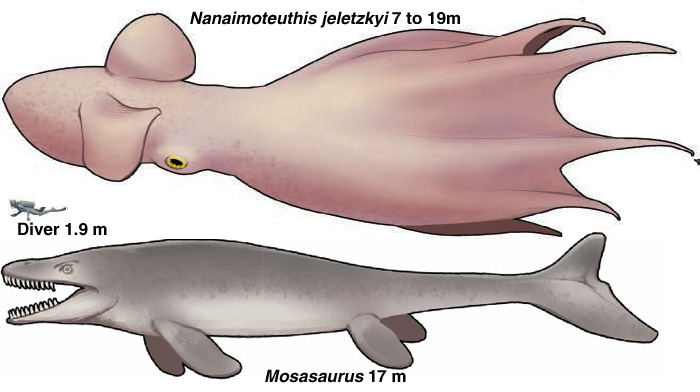
Cretaceous marine predators (at maximum estimated size) with a scuba diver for scale. Credit: After Ikegami et al. Fig. 4, and Jacobs 2026.

Ikegami et al. ground layer by layer through Japanese and Canadian sedimentary rocks to produce 3-D tomographic models of fossil beaks within them – quicker CT scanning proved inefficient in showing details. All the ‘beaks’ showed signs of wear from cracking the harder bones of their prey. Assuming that the same variation of beak size and body mass as in modern octopuses is relevant to those of Cretaceous age, the researchers came up with an astonishing result. Cretaceous octopuses reached huge sizes. They estimated one Nanaimoteuthis jeletzkyi to have been 19 metres long, roughly the size of an articulated truck. During the Cretaceous Period the top predator of the oceans had long been supposed to have been the formidable marine reptile Mosasaurus at around 15 m long.

We know what mosasaurs ate from fossilised stomach contents of two specimens: more or less anything, including other substantial marine reptiles, sharks, cephalopods and even other mosasaurs, some whole, some dismembered. As for Nanaimoteuthis and other giant Cretaceous octopuses, reconstructed from their fossilised beaks, there is little obvious evidence for what they ate, other than it would have had to have been in large amounts. Judging from the wear exhibited by their beaks at least a proportion of their diet was crunched up shells and bones of ammonites and fish. Modern octopus species, both small and moderately large, have other sorts of feeding strategies. Some eat planktonic animals, others drill holes in shells and suck out their innards rendered to the texture of a ‘smoothie’ by corrosive saliva.

It is not surprising that the media have made quite a fuss of these Cretaceous ‘krakens’, some suggesting that they preyed on formidable marine reptiles such as mosasaurs. That would definitely have made them ‘top’ marine predators. Yet such massive, moving mounds of nourishing flesh would have made them a worthwhile catch for a whole school of toothy reptiles and sharks. The modern sperm whale is known to devour giant squid at the great depths to which they can dive, as witnessed by numerous cephalopod beaks in their stomachs. So it is equally possible that the octopus beaks found in Cretaceous sediments of Hokkaido were excreted by marine reptiles

See also: Jacobs, P. 2026. Truck-size octopuses stalked Cretaceous seas. Science, v. 392, 23 April 2026; DOI: 10.1126/science.z8o79rn; Devlin, H. 2026. ‘Kraken-like’ giant octopuses 100m years ago crunched bones of prey. The Guardian, 23 April 2026.

A cuddly tyrannosaur

Feathered Dinosaurs 1
Feathered dinosaur Deinonychus (Photo credit: Aaron Gustafson)

Feathered and fluffy dinosaurs in the families that may have led to birds have become almost commonplace, thanks to wonderful preservation in some Chinese Mesozoic sedimentary rocks (see http://earth-pages.co.uk/2003/03/01/flying-feathers/)  and what has become a cottage industry for local people, under professional direction. Most have been small theropods in the Coelurosauria taxonomic branch that span the Jurassic and Cretaceous Periods. The famous Lower Cretaceous Liaoning lagerstätte in NE China recently yielded something truly awesome: three well-preserved specimens of a feathered dinosaur almost as large as the giant tyrannosaurs of the Late Cretaceous (i.e. > 1 tonne in life) (Xu, X. et al.2012. A gigantic feathered dinosaur from the Lower Cretaceous of China. Nature, v. 484. P. 92-95). In fact Yutyrannus huali (‘beautiful feathered tyrant)is a member of the same subgroup as the Upper Cretaceous T. rex and was clearly a top predator in its day. Equally fortuitous is that the three specimens  comprise one with a living body weight of about 1.4 t, the other two being between 500 and 600 kg. Various differences between the largest and the two smaller individuals suggest that thee find represents two generations, the largest perhaps 8 years older than the two smaller ones. All three preserve densely packed filaments suggesting that they were fluffy rather than truly feathered. So why the difference from its probably scaly relative tyrannosaurs from about 50 Ma later?

Around 125 Ma global climate was considerably cooler than the Late Cretaceous greenhouse world, Liaoning probably having mean annual air temperatures around 10°C compared with 18°C late in the Period. Yutyrannus huali and some of its contemporary theropods probably evolved high TOG insulation to ensure all-season sprightliness. It is also possible that a display function was also involved, as seems to have been the case for other dinosaurs.

Very persistent cycles

Carboniferous shale
Carboniferous shale (Photo credit: tehsma)

The last of five written papers in my 1967 final-year exams was, as always, set by the ‘Prof’.  One question was ‘Rock and rhythm: discuss’ – it was the 60s. Cyclicity has been central to observational geology, especially to stratigraphy, the difference from that era being that rhythms have been quantified and the rock sequences they repeat have been linked to processes, in many cases global ones. The most familiar cyclicity to geologists brought up in Carboniferous coalfields, or indeed any area that preserves Carboniferous marine and terrestrial rocks, is the cyclothem of, roughly, seat-earth – coal – marine shale – fluviatile sandstone – seat-earth and so on. Matched to the duration of Carboniferous to Permian glaciations of the then southern hemisphere, and with the relatively  new realisation that global sea level goes down  and up as ice caps wax and wane, the likeliest explanation is eustatic regression and transgression of marine conditions in coastal areas in response to global climate change. Statistical analysis of cyclothemic sequences unearths frequency patterns that match well those of astronomical climate forcing proved for Pleistocene glacial-interglacial cycles.

The Milankovich signals of the Carboniferous are now part of the geological canon, but rocks of that age more finely layered than sediments of the tropical continental margins do occur. Among them are rhythmic sequences interpreted as lake deposits from high latitudes, akin to varves formed in such environments nowadays. Those from south-western Brazil present spectacular evidence of climate change in the Late Carboniferous and Early Permian (Franco, D.R. et al. 2012. Millennial-scale climate cycles in Permian-Carboniferous rhythmites: Permanent feature throughout geological time. Geology, v. 40, p. 19-22). They comprise couplets of fine-grained grey quartz sandstones from 1-10 cm thick interleaved with black mudstones on a scale of millimetres, which together build up around 45 m of sediment. Their remanent magnetism and magnetic susceptibility vary systematically with the two components. Frequency analysis of plots of both against depth in the sequence show clear signs of regular repetitions. Low-frequency peaks reveal the now well-known influence of astronomical forcing of Upper Palaeozoic climate, but it is in the lower amplitude, higher frequency part of the magnetic spectrum that surprises emerge from a variety of peaks. They are reminiscent of the Dansgaard-Oeschger events of the last Pleistocene glacial, marked by sudden warming and slow cooling while world climate cooled towards the last glacial maximum (~1.5 ka cyclicity) and Heinrich events, the ‘iceberg armadas’ that occurred on a less regular 3 to 8 ka basis. There are also signs of the 2.4 ka solar cycle. The relatively brief cycles would have been due to events in a very different continental configuration from today’s – that of the supercontinent Pangaea – and their very presence suggests a more general global influence over short-term climate shifts that has been around for 300 Ma or more.

OSTM/Jason-2's predecessor TOPEX/Poseidon caug...
El Niño effect on sea -surface temperatures in the eastern Pacific Ocean. Image via Wikipedia

Closer to us in time, and on a much finer time scale are almost 100 m of finely laminated shales from the marine Late Cretaceous of California’s Great Valley (Davies, A. et al. 2012. El Niño-Southern Oscillation variability from the late Cretaceous Marca Shale of California. Geology, v. 40, p. 15-18). The laminations contain fossil diatoms: organisms that are highly sensitive to environmental conditions and whose species are easily distinguished from each other. It emerges from studies of the diatoms in each lamination set that they record an annual cycle of seasonal change related to marine upwellings and their varying strengths, with repeated evidence for influx of fine sediment derived from land above sea level and for varying degrees of bioturbation that suggests periods of oxygenation. Spectral analysis of the intensity of bioturbation, which assumes the lamina are annual, and other fluctuating features reveals peaks that are remarkably close to those of the ENSO cyclicity that operates at present, at 2.1-2.8 and 4.1-6.3 a, as well as repetitions with a decadal frequency.

The annual cycles bear similar hallmarks to those imposed by the monsoonal conditions familiar from modern California, which fluctuated in the Late Cretaceous in much the same way as it does now – roughly speaking, alternating El Niño and La Niña conditions. That is not so surprising, as the relationship between California and the Pacific Ocean in the Cretaceous would not have been dissimilar from that now. The real importance of the study is that it concerns a period in Earth’s climate history characterised by greenhouse conditions, that some predict would create a permanent El Niño – an abnormal warming of surface ocean waters in the eastern tropical Pacific that prevents the cold Humboldt Current along the Andean coast of South America from supplying nutrient to tropical waters. The very cyclicity recorded by the Marca Shale strongly suggests that the ENSO is a stable feature of the western Americas. Recent clear implications of ENSO having teleconnections that affect global climate, on this evidence, may not break down with anthropogenic global warming. This confirms similar studies from the Palaeogene and Neogene Periods.