Teeth found in Chinese caves reveal a connection between Homo erectus and Denisovans

Hominin fossils referred to as Homo erectus have been found in Africa, Central Europe and China. Those from Africa have also been attributed to H. ergaster and by some to ‘African H. erectus’– a point of lingering dispute and confusion. The African lineage spanned a long time period after appearing around 1.7 Ma ago, possibly to as late as 0.6 Ma. The confusion deepened with the discovery of similar, well-preserved remains at Dmanisi in Georgia that are actually older (1.77–1.85 Ma) than the African specimens. But they are so anatomically diverse that the five skulls might easily be assigned to five different hominin species had they been found at separate locations. Asia is again very odd in an H. erectus context. The species was first proposed in 1891 by Eugene Dubois from remains in sediments oof the Solo River near Trinil in Java – he originally suggested the name Pithecanthropus erectus.  Remarkably, the Solo sediments were dated at 53 to 27 ka in 2019, so did Homo erectus co-exist with anatomically modern humans (AMH) on Java? Similarly heavy-browed crania emerged from several sites in China. Curiously, the first complete Denisovan cranium, found near Harbin in China matched H. erectus in the eyebrow department. However, mtDNA from its dental plaque and bone proteomics tie in with those found in fragments from the eponymous Denisova Cave in Siberia and with a fragmentary mandible from Tibet. Without such evidence, and were itnot so young (146 ka), most palaeoanthropologists would probably have called the Harbin individual H. erectus, There are quite a few records of older Chinese hominin crania, dubbed H. erectus on anatomical grounds, including one dated at 1.7 Ma. There are a great many oddities and contradictions that need resolving.
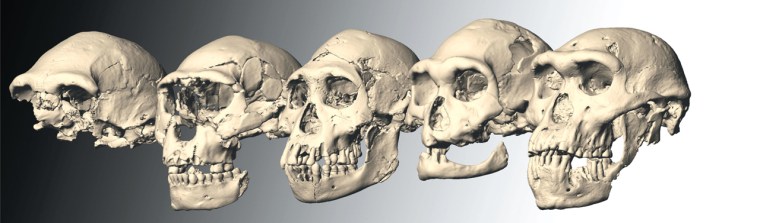
Skulls of Homo erectus from Dmanisi , Georgia (credits; M.S. Ponce de Leon & P.E. Zollkofer, University of Zurich)
The cranium found near Harbin, China belonged to a Denisovan. Credit: Hebei Geo University

On 13 May 2026 a team led by palaeogeneticist Qiaomei Fu of the Chinese Academy of Sciences published data on proteins and amino acids yielded by enamel from six teeth of these ancient Chinese fossils, which emerged from three localities of  Middle Pleistocene age (580 to 400 ka) (Fu, Q. and 11 others 2026. Enamel proteins from six Homo erectus specimens across ChinaNature, v.  10.1038/s41586-026-10478-8). One is from the Zhoukoudian Cave near Beijing, famous for ‘Peking Man’, the primary reference for the anatomy of Asian H. erectus. Older fossils are unlikely to yield meaningful data of this kind because of chemical degradation; the reason why DNA has so far proved elusive from these specimens. Tooth enamel is extremely durable and can protect proteins and amino acids. Since both are produced by genes on DNA they are proxies for variants of those long-vanished genes

The key protein in the supposed H. erectus teeth isameloblastin which is involved in the formation of tooth enamel. The ameloblastin of all six teeth shared two amino acid variants; one previously unknown in other hominin lineages and perhaps unique to H. erectus, the other has been identified in Denisovans. Fu and colleagues suggest that the original bearers of the teeth – presumed to be H. erectus – had interbred with Denisovans and passed on the second variant gene. In turn that had been passed on to Asian AMH with some of whom Denisovans had interbred; remarkably 21% of living people on the Philippine archipelago carry that gene. The authors go on further to suggest that their findings support the notion that H. erectus was the source by gene-flow for ‘super-archaic’ sections of DNA found in actual Denisovan DNA from one member of that group. That is certainly a possibility, but is not the only one.

Neither the proteomics nor the morphology of the teeth, nor the anatomy of the fossils that accompany them in any way prove that they are from actual 400 ka old Homo erectus individuals. That would require at the very least protein analyses from specimens that definitely pre-date the divergence of Denisovans from Neanderthals about 600 ka ago. Remarkably, proteins have been extracted from a ~1.8 Ma old tooth yielded by the Dmanisi H. erectus site in Georgia, but that failed to reveal anything useful in this context. Maybe future work on older Chinese hominin teeth could resolve the issue. Another hypothesis is that the bearers of the analysed teeth were a population of Denisovans who themselves developed genetic variations rather than inheriting them. Proteomics is at about the same stage in its development as human genomics was before 2010 in the run-up to discovering Neanderthal and Denisovan genomes. But in the case of H. erectus the problem began with biologists’ long record of trying to simplify the natural world, especially fossils, through ‘lumping’ rather than ‘splitting’.

Humans that science has designated as different species were capable of interbreeding over tens and hundreds of thousand years, probably repeatedly and maybe habitually. That fact makes it hard to defend the concept of their speciation. There were few environments where they could not thrive, yet their migrations spread small numbers over vast areas. Continually shifting, isolated populations would diverge genetically and physically, the more so the fewer individuals were banded together. Occasionally populations would meet: an opportunity for celebration, and more, for conscious beings facing the rigours of exploration with neither territory nor resources to defend.

See also: What Homo erectus teeth from three Chinese caves tell us about who we are. Anthropology.net, 13 May 2026; Curry, A. 2026. Ghost of long-extinct ancestor lives on in people today. Science, v.  392, p. 677-678; DOI:10.1126/science.zuwthcn; Timmer, J. 2026. Protein in Homo erectus teeth suggests Denisovans gave us some of their DNA. Arstechnica, 13 May 2026; Marshall, M. 2026. Ancient teeth hint at links between Denisovans and Homo erectus. New Scientist 13 May 2026

Chinese skull confirmed as Denisovan

For over a century Chinese scientists have been puzzling over ancient human skulls that show pronounced brow ridges. Some assigned them to Homo, others to species that they believe were unique to China. A widely held view in China was that people now living there evolved directly from them, adhering to the ‘Multiregional Evolution’ hypothesis as opposed to that of ‘Out of Africa’. However, the issue might now have been resolved. In the last few years palaeoanthropologists have begun to suspect that these fossilised crania may have been Denisovans, but none had been subject to genetic and proteomic analysis. The few from Siberia and Tibet that initially proved the existence of Denisovans were very small: just a finger bone and teeth.  Out of the blue, teeth in a robust hominin mandible dredged from the Penghu Channel between Taiwan and China yielded protein sequences that matched proteomic data from Denisovan fossils in Denisova Cave and Baishiya Cave in Tibet, suggesting that Denisovans were big and roamed  widely in East Asia. In 2021 a near-complete robust cranium came to light that had been found in the 1930s near Harbin in China and hidden – at the time the area was under Japanese military occupation. It emerged only when its finder revealed its location in 2018, shortly before his death. It was provisionally called Homo longi or ‘Dragon Man’. Qiaomei Fu of the Institute of Vertebrate Paleontology and Paleoanthropology in Beijing and her colleagues have made a comprehensive study of the fossil.

The cranium found near Harbin, China belonged to a Denisovan. Credit: Hebei Geo University

It is at least 146 ka old, probably too young to have been H. erectus, but predates the earliest anatomically modern humans to have reached East Asia from Africa (~60 ka ago). The Chinese scientists have developed protein- and DNA extraction techniques akin to those pioneered at the Max Planck Institute for Evolutionary Anthropology in Leipzig. It proved impossible to extract sufficient ancient nuclear DNA from the cranium bone for definitive genomic data to be extracted, but dental plaque (calculus) adhering around the only surviving molar in the upper jaw did yield mitochondrial DNA. The mtDNA matched that found in Siberian Denisovan remains (Qiaomei Fu et al. 2025. Denisovan mitochondrial DNA from dental calculus of the >146,000-year-old Harbin cranium. Cell, v. 188, p. 1–8; DOI: 10.1016/j.cell.2025.05.040). The bone did yield 92 proteins and 122 single amino acid polymorphisms, as well as more than 20 thousand peptides (Qiaomei Fu and 8 others 2025. The proteome of the late Middle Pleistocene Harbin individual. Science, v. 388: DOI: 10.1126/science.adu9677). Again, these established a molecular link with the already known Denisovans, specifically with one of the Denisova Cave specimens. Without the painstaking research of the Chinese team, Denisovans would have been merely a genome and a proteome without much sign of a body! From the massive skull it is clear that they were indeed big people with brains much the same size as those of living people. Estimates based on the Harbin cranium suggest an individual weighing around 100 kg (220 lb or ~15 stone): a real heavyweight or rugby prop!

The work of Qiaomei Fu and her colleagues, plus the earlier, more limited studies by Tsutaya et al., opens a new phase in palaeoanthropology. Denisovans now have a genome and well-preserved parts of an entire head, which may allow the plethora of ancient skulls from China to be anatomically assigned to the species. Moreover, by extracting DNA from dental plaque for the first time they have opened a new route to obtaining genomic material: dental calculus is very much tougher and less porous than bone.

See also: Curry, A. ‘Dragon Man’ skull belongs to mysterious human relative. 2025. Science, v. 388; DOI: 10.1126/science.z8sb68w. Smith K. 2025. We’ve had a Denisovan skull since the 1930s – only nobody knew. Ars Technica, 18 June 2025. Marshall, M. 2025. We finally know what the face of a Denisovan looked like. New Scientist 18 June 2025.

Middle Palaeolithic Neanderthals and Denisovans of East Asia

During the Middle Palaeolithic (250 to 30 ka) anatomically modern humans (AMH) and Neanderthals were engaged in new technological developments in Europe and Africa as well as in migration and social interaction. This is reflected in the tools that they left at occupation sites and the fact that most living non-Africans carry Neanderthal DNA. One of the major cultural developments was a novel means of manufacturing stone implements. It developed from the Levallois technique that involved knapping sharp-edged flakes of hard rock from larger blocks or cores. A type of tool first found at a Neanderthal site near La Quina in France is a thick flake of stone with a broad, sharp edge that shows evidence of having been resharpened many times. Most other flake tools seem to have been ‘one-offs’ that were discarded after brief usage. The Quina version was not only durable but seems to have been multipurpose. Analysis of wear patterns on the sharpened edges suggest that they were deployed in carving wood and bone, removing fat and hair from animal hides, and butchery. Such scrapers have been found over a wide area of Europe, the Middle East and NE Asia mostly at Neanderthal sites, including the famous Denisova Cave of southern Siberia that yielded the first Denisovan DNA as well as that of Neanderthals.

Making a typical Quina scraper and related tools. The toolmaker would flake pieces of stone off the core and then carefully shape the Quina scraper. (Image credit: Pei-Yuan Xiao)

Until now, the early humans of East Asia were thought not to have proceeded beyond more rudimentary tools during the Middle Palaeolithic: in fact that archaeological designation hasn’t been applied there. Recent excavations at Longtan Cave in south-west China have forced a complete revision of that view (Ruan, Q.-J., et al. 2025. Quina lithic technology indicates diverse Late Pleistocene human dynamics in East Asia. Proceedings of the National Academy of Sciences, v. 122, article e2418029122; DOI: 10.1073/pnas.2418029122). The Longtan site has yielded more than fifty scrapers and the cores from which they had been struck that clearly suggest the Quina technology had been used there. They occur in cave sediments dated at between 60 and 50 ka. As yet, no human remains have been found in the same level at Longtan, although deeper levels dated at 412 ka have yielded hominin crania, mandibular fragments, and teeth, that have been suggested to be Homo erectus.

Quina type tools in East Asia may previously have been overlooked at other hominin sites in China: re-examination of archived tool collections may show they are in fact widespread. The technology could have been brought in by migrating Neanderthals, or maybe it was invented independently by local East Asian hominins. Because most living people in China carry Denisovan DNA in the genomes so perhaps that group developed the technique before interbreeding with AMH immigrants from the west. Indeed there is no reason to discard the notion that  early AMH may have imported the Quina style. A lot of work lies ahead to understand this currently unique culture at Longtan Cave. However, interpretation of another discovery published shortly after that from Longtan has spectacularly ‘stolen the thunder’ of the Qina tools, and it was made in Taiwan …

Right (top) and downward (lower) views of the partial Penghu mandible. Credit: Yousuke Kaifu University of Tokyo, Japan and Chun-Hsiang Chang Tunghai University, Taichung, from Tsutaya et al. Fig. 1 (inset)Taiwan.

About 10 years ago, Taiwanese fishers trawling in the Penghu Channel between Taiwan and China were regularly finding bones in their nets. Between 70 to 10 ka and 190 to 130 ka ago much lower sea level due to continental ice cap formation exposed the Penghu seabed. Animals and humans were thus able to move between the East Asian mainland and what is now Taiwan. The bones brought to the surface included those of elephants, water buffaloes and tigers, but one was clearly a human lower jawbone (mandible). Its shape and large molar teeth are very different from modern human mandibles and molars. A multinational team from Japan, Denmark, Taiwan and Ireland has extracted proteins from the mandible to check its genetic affinities (Tsutaya, T. and 14 others 2025. A male Denisovan mandible from Pleistocene Taiwan. Science, v. 388, p. 176-180; DOI: 10.1126/science.ads3888). Where DNA has not been preserved in bones proteomics is a useful tool, especially if results are matched with other bones that have yielded both DNA and protein sequences. In the case of the Penghu mandible, proteins from its teeth matched those of Denisovans from the Denisova Cave in Siberia which famously yielded the genome of this elusive human group. They also matched proteins from a rib found in Tibet associated with Denisovan mitochondrial DNA in cave sediments that enclosed the bones.

The three sites (Denisova, Baishiya Cave in Tibet and Penghu Channel) that have produced plausible Denisovan specimens span a large range of latitudes and altitudes. This suggests that Denisovans were capable of successful subsistence across much of East Asia. The Penghu mandible and teeth are similar to several hominin specimens from elsewhere in China that hitherto have been attributed to H. erectus. Apart from the Denisovan type locality, most of the sites have yet to be accurately dated. Having been immersed in sea water for thousands of years isotopes used in dating have been contaminated in the Panghu specimen. It can only be guessed to have lived when the seabed from which it was recovered was dry land; i.e. between 70 to 10 ka and 190 to 130 ka. China was undoubtedly occupied by Homo erectus during the early Pleistocene, but much younger fossils have been attributed to that species by Chinese palaeoanthropologists. Could it be that they are in fact Denisovans? Maybe such people independently developed the Quina knapping technique

See also: Marwick, B. 2025.  Unknown human species in East Asia used sophisticated tools at the same time Neanderthals did in Europe. Live Science, 31 March 2025; Ashworth. J. 2025. Denisovan jawbone helps to reveal appearance of ancient human species. Natural History Museum News 11 April 2025.

A fully revised edition of Steve Drury’s book Stepping Stones: The Making of Our Home World can now be downloaded as a free eBook