
Octopuses defy common sense. They are invertebrate molluscs, so we don’t expect them to show well-developed intelligence, which they do. As well as tiptoeing around on their eight tentacles, they can move at high speed using a kind of backwards jet propulsion and some are even able to cross dry land.. Each of their tentacles has a sort of brain, as well their central one: distributed, semi-autonomous cognition in which their tentacles taste, touch, and move independently. Three hearts circulate their blue blood. Masters of swift camouflage using specialised skin cells that contain different coloured pigments, which behave like pixels in a TV screen. Octopuses can also rapidly manipulate their body texture and shape. They also seem to use such bizarre displays to communicate mood, at the very least.
Shape-shifting octopuses can squeeze through gaps far smaller than their own size to hide from both predators and their prey, which also makes them escapologists far outranking Harry Houdini. Their eyes look like those of goats, with horizontally linear pupils, although they evolved separately from the eyes of other animals. Satan is said to have goat-eyes, hence the colloquial name for an octopus: devil fish. Mariners of old (and maybe some of the present day) reputedly feared giant octopuses to be capable of crushing ships and devouring the crew: the Kraken! Even small octopuses possess greater intelligence than a dog: some seem to enjoy playing, building dens, negotiating mazes and watching the antics of humans …
Since they are almost entirely soft flesh, the fossil record of octopuses is unsurprisingly meagre, apart from their jaws that use chitinous ‘beaks’ to munch their victims. The evolution of other cephalopods, for instance ammonites and squids, is better known from their external and internal skeletal remains and extends back to the Cambrian Period. So collecting and analysing fossil octopus jaws is the only option for palaeontologists. Shin Ikegami of Hokkaido University, together with Jörg Mutterlose of Ruhr University in Bochum Germany and eight other Japanese scientists, developed a new approach to supplement data on octopus jaws previously excavated from Cretaceous strata on Hokkaido and Vancouver Islands. (Ikegami, S. and 9 others 2026. Earliest octopuses were giant top predators in Cretaceous oceans. Science, v. 392, p. 406-410; DOI: 10.1126/science.aea6285).
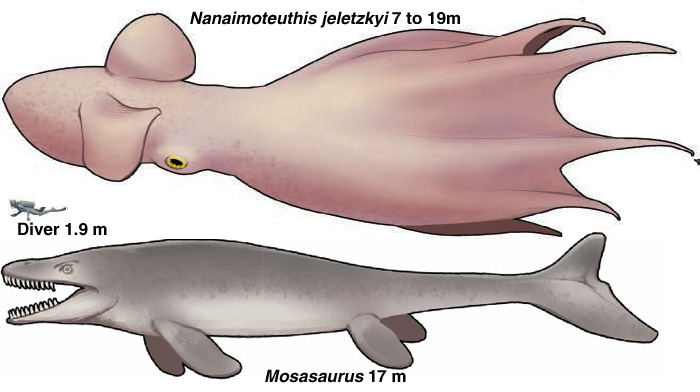
Ikegami et al. ground layer by layer through Japanese and Canadian sedimentary rocks to produce 3-D tomographic models of fossil beaks within them – quicker CT scanning proved inefficient in showing details. All the ‘beaks’ showed signs of wear from cracking the harder bones of their prey. Assuming that the same variation of beak size and body mass as in modern octopuses is relevant to those of Cretaceous age, the researchers came up with an astonishing result. Cretaceous octopuses reached huge sizes. They estimated one Nanaimoteuthis jeletzkyi to have been 19 metres long, roughly the size of an articulated truck. During the Cretaceous Period the top predator of the oceans had long been supposed to have been the formidable marine reptile Mosasaurus at around 15 m long.
We know what mosasaurs ate from fossilised stomach contents of two specimens: more or less anything, including other substantial marine reptiles, sharks, cephalopods and even other mosasaurs, some whole, some dismembered. As for Nanaimoteuthis and other giant Cretaceous octopuses, reconstructed from their fossilised beaks, there is little obvious evidence for what they ate, other than it would have had to have been in large amounts. Judging from the wear exhibited by their beaks at least a proportion of their diet was crunched up shells and bones of ammonites and fish. Modern octopus species, both small and moderately large, have other sorts of feeding strategies. Some eat planktonic animals, others drill holes in shells and suck out their innards rendered to the texture of a ‘smoothie’ by corrosive saliva.
It is not surprising that the media have made quite a fuss of these Cretaceous ‘krakens’, some suggesting that they preyed on formidable marine reptiles such as mosasaurs. That would definitely have made them ‘top’ marine predators. Yet such massive, moving mounds of nourishing flesh would have made them a worthwhile catch for a whole school of toothy reptiles and sharks. The modern sperm whale is known to devour giant squid at the great depths to which they can dive, as witnessed by numerous cephalopod beaks in their stomachs. So it is equally possible that the octopus beaks found in Cretaceous sediments of Hokkaido were excreted by marine reptiles
See also: Jacobs, P. 2026. Truck-size octopuses stalked Cretaceous seas. Science, v. 392, 23 April 2026; DOI: 10.1126/science.z8o79rn; Devlin, H. 2026. ‘Kraken-like’ giant octopuses 100m years ago crunched bones of prey. The Guardian, 23 April 2026.


