
During the past 539 Ma (the Phanerozoic Eon) Earth’s geological history saw the explosion of rapidly evolving life in the oceans and on the land. The pace of that evolution swung up and down through a complex sequence of extinctions and adaptive radiations. They resulted from many intertwined inorganic changes: tectonics; impacts; igneous events; global climate change; atmosphere and sea-water composition. Although palaeoclimatic knowledge has become ever more detailed over the last few decades, its most important record, the varying temperature of the land surface and oceans, is lacking in precision. The timing of climatic events is not the issue, but the magnitude of changes in global mean surface temperature. The latter is largely down to the main tool in assessing past temperatures: the isotopic composition of oxygen (δ18O) in marine fossils. In particular, the record for the Lower Palaeozoic has remained stubbornly odd. In the Cambrian and Ordovician Periods it implies that low-latitude seawater temperatures reached levels of 40 to 50 °C, that seem literally life threatening: phytoplankton at the base of modern marine ecosystems die at water temperatures above 35°C. Yet the fossil record is teeming throughout the Lower Palaeozoic at all latitudes. Some manner of imprecision in the oxygen-isotope method gives the impression of wild fluctuations and a dramatic overall cooling of the planet through the Phanerozoic: the temperature record as it stands seems implausible.
A group of palaeoclimatologists from China, the UK, Australia and the US have combined a variety of geochemical proxies, sedimentary records and climate modelling to correct the marine-carbonate δ18O record (Zheng, D. and 12 others 2026. Tight regulation of Earth’s long-term temperature over Phanerozoic time. Nature Communications, in press 4 May 2026; DOI: 10.1038/s41467-026-72672-6). Their approach is based on a chemical index of alteration (CIA), i.e. a measure of the degree of chemical weathering of the source for sedimentary rocks. The CIA compares their content of immobile aluminium oxide (Al2O3) with calcium, sodium and potassium oxides that are more easily moved in solution. Analyses of recent river sediments show a positive correlation between CIA and local temperature, so CIA in ancient sedimentary rocks is a potential proxy for the ambient temperature of the region from which those sediments were derived. The CIA also depends on other factors, such as the intensity of physical erosion and transport. However, allowing for these factors in modern environments does not affect the correlation with ambient temperature: the method remains robust. The geochemical data from sedimentary rocks required to use CIA as an independent check on O-isotope derived temperature are available in abundance from all continents for most of the Phanerozoic.
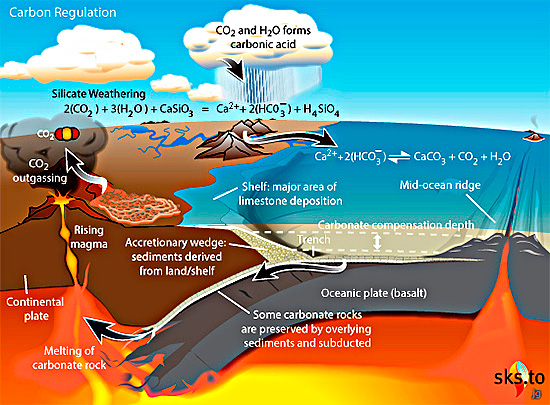
The study by Zheng et al. suggests that throughout the Phanerozoic global mean temperature remained consistently within the 10 to 30°C range. Thus Palaeozoic ocean temperatures were comparable with those of the succeeding Mesozoic and Cenozoic Eras. The team concludes that various negative feedback processes inherent in the Earth System have been able to regulate its surface temperature through the Phanerozoic. The most important of these is climate-dependent silicate weathering in which acidic rain – produced by CO2 dissolved from the atmosphere – breaks down silicates to yield dissolved bicarbonate ions that combine with calcium and magnesium ions to precipitate carbonates. Such a process draws down the main greenhouse gas from the atmosphere. There are other aspects of the carbon cycle that also draw down atmospheric CO2 and reduce the greenhouse effect, such as burial of organic debris. Tectonics also shapes climate by modulating both silicate weathering and CO2 emissions from volcanic activity.
It should be emphasised that anthropogenic global warming is proceeding at a far higher rate than natural negative feedback processes. We simply cannot rely on silicate weathering to reverse whatever climatic outcome results from what the current global economy does so very quickly. Yet the findings by Zheng et al. do seem likely to force a change in thinking about climate change on a geological timescale.
See also: Earth’s long-term temperature kept tight control. Scienmag; 4 May 2026


