A major boost for the ‘Hydrogen Economy’?

The notion of large-scale use of hydrogen as an energy source has a surprisingly long history. It was first proposed by J.B.S. Haldane in 1923, who envisaged electrolysis of water – releasing hydrogen and oxygen – using power from wind turbines to address this renewable source’s highly variable output effectively by storing it in the form of hydrogen. Since the only other output is oxygen, a hydrogen economy might seem to avoid global warming from the current release of greenhouse gases. However, as a 2023 post on Earth-logs concluded, of all the means for mass production and use of hydrogen only one source is a truly ‘green’ energy source: that emitted from rock by natural processes: so-called ‘white’ hydrogen.  It is known to be generated by the breakdown of the mineral olivine [(Fe,Mg)2SiO4] by water in the absence of oxygen:

3Fe2SiO4 + 2H2O → 2 Fe3O4 + 3SiO­2 +3H2

A more complex reaction is the hydration of olivine to the mineral serpentine [Mg3Si2O5(OH)4], which also yields hydrogen. Olivine is the most important mineral in the Earth’s mantle and abundant in crustal basalts and ultramafic rocks too. Oceanic lithosphere (ophiolites) added by tectonics to the continental crust form obvious targets for seeking natural hydrogen seepage. Yet such surface gas escapes have been documented only from a few sites, including an irrigation well in rural Mali that emitted gas containing 98% hydrogen, and a few natural springs from the Oman ophiolite.

The latest study may have taken the hydrogen economy to a literally deeper level  (Sherwood Lollar, B. &  Warr, O. 2026. Decadal record of continental H2 reservoirs reveals potential for subsurface microbial life and natural H2 exploration. Proceedings of the National Academy of Sciences, v. 123, article e2603895123; DOI: 10.1073/pnas.2603895123. PDF requests to owarr@uOttawa.ca and/or barbara.sherwoodlollar@utoronto.ca). Over fifteen years Barbara Sherwood Lollar and Oliver Warr of the Universities of Toronto and Ottawa, Canada monitored gas released by 35 boreholes originally drilled to assess and plan mining of an orebody in Precambrian basement rocks at Kidd Creek near Timmins, Ontario. On average, each of the boreholes released 8 kg of hydrogen per year. Scaled up to the mine’s 15 thousand exploratory boreholes, the mine itself  is estimated to be yielding 140 metric tons of the gas annually. That could provide 4.7 gigawatts of energy per annum, sufficient for the needs of more than 400 Canadian homes.
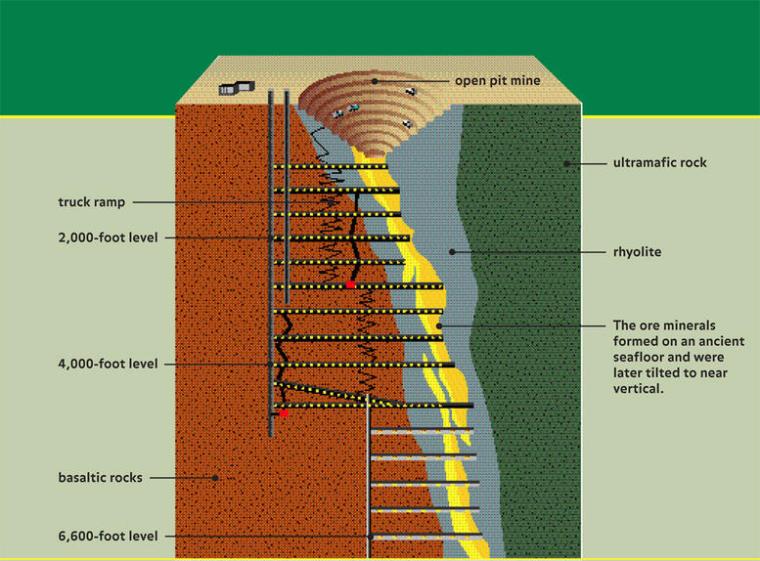
Schematic cross section through the Kidd Creek Mine, Ontario, Canada. Source American Museum of Natural History

The Timmins mining district is typical of Archaean greenstone belts in the Canadian Shield and in cratons across the world: supracrustal rocks including ultramafic and mafic volcanics and a variety of metasedimentary rocks. The Timmins district is historically Canada’s largest gold producer, but also hosts ores of many other metals. The Kidd Creek Cu-Ag-Zn mine is one of the deepest in North America, which penetrates interlayered felsic, mafic, ultramafic, and metasedimentary rocks to a depth of 2.9 km below the surface. The ores formed by submarine hydrothermal processes around 2.7 Ga ago. The sampled boreholes were drilled horizontally at mine levels between 2.04 to 2.9 km below the surface to penetrate the ore zone and its mafic-ultramafic host rocks. Rather than yielding gas, the holes release briny fluids in which hydrogen, helium and various hydrocarbon gases are dissolved. They are similar to fluids issuing from other deep mines, but differ in showing their formation mainly to be through inorganic reactions with the bed rock rather than as a result of microbial metabolism that exploits a variety of chemical interactions in the ore, such as reduction of sulfate ions to sulfide. The authors have studied hydrogen yields from a number of other mines in mafic-ultramafic rocks, which are comparable with Kidd Creek. So it may be that hydrogen in vast volumes is being emitted by existing and abandoned metal mines in such igneous terrains.

Sherwood Lollar and Warr authoritatively outline the economic potential of hydrogen production for remote communities and mines in greenstone-belt terrains. They also assess active serpentinisation of ophiolites and kimberlites by near-surface groundwater and associated microbial ecosystems as hydrogen sources, the few that have been studied seeming to produce even larger amounts of hydrogen. But they also note that their closer proximity to the surface means that these geological features are generally ‘open-systems’ prone to rapid loss of gases. However, in the manner of hydrocarbon gas fields, some ophiolites may host large amounts of hydrogen if they are capped by younger clay-rich sedimentary strata. Whatever, the global warming of what might be called the ‘Hydrocarbon Age’ is set to become a disaster. Breaking its death grip should be the principal economic agenda, which requires the most rapid turn to long-term energy alternatives. Natural hydrogen could be a part of that, and hopefully the work of Sherwood Lollar and Warr, and others like them, should lead to determined exploration and assessment of this novel physical resource. In Scandinavia a Nordic Hydrogen Route is being proposed. This Swedish-Finnish initiative is based on the Scandinavian Shield and its greenstone terrains and numerous mines driven into them. One would hope that its entrepreneurs are considering naturally emitted hydrogen rather than or as well as sources given other coloured labels.

See also: Canada’s Billion-Year-Old Rocks Could Hold the Future of Clean Energy. Sci Tech Daily, 21 May 2026.

Global natural hydrogen resources: a CO2 free future??

The idea of a ‘Hydrogen Economy’ has been around for at least six decades, its main attraction being that when hydrogen is burned it combines with oxygen to form H2O. It might seem to be the ultimate ‘green’ energy source, but it is currently being touted by governments and petroleum companies in what is widely regarded as ‘green washing’. The technology favoured by that axis uses steam reforming of the methane that dominates natural petroleum gas, through the reaction:

CH4 + H2O  → CO + 3H2

It’s actually not much different from producing coke gas from coal, which began in the 19th century and is now largely abadoned. Because carbon monoxide (CO) reacts with atmospheric oxygen to form CO2 this process is by no means ‘green’ and is properly referred to as ‘grey’ hydrogen. Only if the CO is stored permanently underground could steam reforming not add to greenhouse warming. That puts the approach in the same category as ‘carbon capture and storage’, with all the possible difficulties inherent in that technology, which has yet to be demonstrated on a large scale. Such hydrogen is classified as a ‘blue’. Colour coding hydrogen is described nicely by the British National Grid. They give another six varieties. Green and yellow hydrogen are produced by electrolysing water using wind or solar power respectively. The pink variety uses nuclear power in the same fashion. Black or brown hydrogen is that produced by coking coal or stewing-up brown coal (lignite) which amazingly are contemplated in Australia and Germany. There is even a turquoise variety can be produced if methane is somehow turned into hydrogen and solid carbon using renewables. There is another category (white) which is hydrogen produced by a variety of natural, geochemical processes.

Distribution of ophiolites around the Eastern Mediterranean and Black Seas. Many orogenic belts are endowed to a similar extent. (Credit: Gültekin Topuz, Istanbul Technical University)

Earth-logs discussed white hydrogen in March 2023 when news emerged of gas that was 98% hydrogen leaking from a water borehole in Mali. The local people harnessed this surprising resource to generate electricity for their village. It also emerges in springs from ultramafic rocks, having formed through weathering of the mineral olivine:

3Fe2SiO4 + 2H2O → 2 Fe3O4 + 3SiO­2 +3H2

Much the same reaction occurs beneath the ocean floor where hydrothermal fluids alter basalts and in geothermal springs that emerge from onshore basalt lavas. Such ‘white’ hydrogen emissions are widespread. So an unknown, but possibly huge amount of hydrogen is leaking into the atmosphere continuously. Because of its tiny nucleus – just a single proton – atmospheric hydrogen quickly escapes to outer space: what a waste! Equally as interesting is that inducing the breakdown of ultramafic rock to yield hydrogen, by pumping water and carbon dioxide into them, may also be a means of leak-free carbon sequestration. This produces the complex mineral serpentine and magnesium carbonate. The reaction gives off heat and so is self sustaining until pumping is stopped.

It has been estimated that by 2050 the annual global demand for hydrogen will reach 530 million t.  Just how big is the potential resource to meet such a demand? Natural weathering and hydrothermal processes have always functioned. Some of the hydrogen produced by them may have built-up in reservoirs like the one in Mali, some is escaping. Neither the magnitude of annual natural generation of hydrogen nor the amount trapped in porous sedimentary rocks are known in any detail. A recent survey of how much may be trapped gives a range from 103 to 1010 million metric tons (Ellis, G.S. & Gelman, S.E. 2024. Model predictions of global geologic hydrogen resources. Science Advances, v. 10, article eado0955; DOI: 10.1126/sciadv.ado0955), most probably 5.6 trillion t. If only a tenth of that is recoverable, replacing fossil-fuel energy with that from white hydrogen to achieve net-zero CO2 emissions would be sustainable for about 400 years. That magnitude of trapped hydrogen reserves well exceeds all proven reserves of natural gas.

This estimate assumes using only hydrogen that has been naturally produced and stored beneath the Earth’s surface. Basalts and ultramafic rocks exposed at the land surface as ophiolites – ancient oceanic crust thrust onto continental crust – are abundant on every continent. Inducing hydrogen-producing chemical reactions in them by pumping water and CO2 into them is little different from the technology being used in fracking. This potential resource is effectively limitless. Combined with renewable energy technology, a hydrogen economy has no conceivable need for fossil fuels, except as organic-chemistry feedstock. Such a scenario for stabilising climate is almost certainly feasible. It could use the capital, technology and skills currently deployed by the petroleum industry that is currently driving society and the Earth in the opposite direction. It is capable of drilling 10 km below the continental surface or the ocean floor, and even into the Earth’s mantle that is made of . . . ultramafic rock.

Best wishes for the festive season to all Earth-logs followers and visitors

Naturally occurring hydrogen: an abundant green fuel?

Burning hydrogen produces only water vapour, so it is not surprising that it has been touted as the ultimate ‘green’ energy source, and increasingly attracts the view that the ‘Hydrogen Economy’ may replace that based on fossil fuels. It is currently produced from natural gas by ‘steam reforming’ of methane that transforms water vapour and CH4 to hydrogen and carbon monoxide. That clearly doesn’t make use of the hydrogen ‘green’ as the CO becomes carbon dioxide because it reacts with atmospheric oxygen; it is termed ‘grey hydrogen’. But should it prove possible to capture CO and store it permanently underground in some way then that can be touted as ‘blue hydrogen’ thereby covering up the carbon footprint of all the rigmarole in getting the waste CO into a safe reservoir. However, if carbon-free electricity from renewables is used to electrolyse water into H and O the hydrogen aficionados can safely call it ‘green hydrogen’.   It seem there is a bewildering colour coding for hydrogen that depends on the various options for its production: ‘yellow’ if produced using solar energy; ‘red’ if made chemically from biowaste; ‘black’ by coking coal using steam; ‘pink’ is electrolysis using nuclear power; and even ‘turquoise’ hydrogen if methane is somehow turned into hydrogen and solid carbon using renewables – a yet-to-be-developed technology! Very jolly but confusing: almost suspiciously so!

But not to be forgotten is the ‘white’ variety, applied to hydrogen that is emitted by natural processes within the Earth. Eric Hand, the European news editor for the major journal Science has written an excellent Feature article about ‘white’ hydrogen in a recent issue (Hand, E. 2023. Hidden hydrogen. Science, v. 379, article adh1460; DOI: 10.1126/science.adh1460). Hand’s feature is quirky, but well-worth a read. It is based on the proceedings of a Geological Society of America mini-conference about non-petroleum, geological energy resources  held in October 2022. He opens with a bizarre anecdote related by a farmer who lives in rural Mali. The only drilling that ever went on in his village was for water, and many holes were dry. But one attempt resulted in ‘wind coming out of the hole’. When a driller looked in the hole, the ‘wind’ burst into flame – he had a cigarette in his mouth. The fire burned for months. Some 20 years later the story reached a Malian company executive who began prospecting the area’s petroleum potential, believing the drilling had hit natural gas. Analysis of the gas revealed that it was 98% hydrogen – now the village has electricity generated by ‘white’ hydrogen.

Mantle rock in the Oman ophiolite, showing cores of fresh peridotite, surrounded by brownish serpentinite and white magnesium carbonate veins (credit: Juerg Matter, Oman Drilling Project, Southampton University, UK)

So how is hydrogen produced by geological processes? Some springs in the mountains of Oman also release copious amounts of the gas. The springs emerge from ultramafic rocks of the vast ophiolite that was emplaced onto the Arabian continental crust towards the end of the Cretaceous. The lower part of this obducted mass of oceanic lithosphere is mantle rock dominated by iron- and magnesium-rich silicates, mainly olivine [(Mg,Fe)2SiO4 – a solid solution of magnesium and iron end members]. When saturated with groundwater in which CO2 is dissolved olivine breaks down slowly but relentlessly. The hydration reaction is exothermic and generates heat, so is self-sustaining. Olivine’s magnesium end member is hydrated to form the soft ornamental mineral serpentine (Mg3Si2O5(OH)4) and magnesium carbonate. Under reducing conditions the iron end member reacts with water to produce an iron oxide, silica and hydrogen:

3Fe2SiO4 + 2H2O → 2 Fe3O4 + 3SiO­2 +3H2

Gases emanating from mid-ocean ridges contain high amounts of hydrogen produced in this way, for example from Icelandic geothermal wells. But Mali is part of an ancient craton, so similar reactions involving iron-rich ultramafic rocks deep in the continental crust are probably sourcing hydrogen in this way too. Hydrogen production on the scale of that discovered in Mali seems to be widespread, with discoveries in Australia, the US, Brazil and the Spanish Pyrenees that have pilot-scale production plants. The US Geological Survey has estimated that around 1 trillion tonnes of ‘white’ hydrogen may be available for extraction and use

Hydrogen, like other natural gases, may be trapped below the surface in the same ways as in commercial petroleum fields. But petroleum-gas wells emit little if any hydrogen mixed in with methane. That absence is probably because petroleum fields occur in deep sedimentary basins well above any crystalline basement. The geophysical exploration that discovers and defines the traps in petroleum fields has never been deployed over areas of crystalline continental crust because as far as the oil companies are concerned they are barren. That may be about to change. There is another exploration approach: known hydrogen seepage seems to deter vegetation so that the sites are in areas of bare ground, which have been called ‘fairy circles’. These could be detected easily using remote sensing techniques.

Artificially increasing serpentine formation by pumping water into the mantle part of ophiolites, such as that in Oman, and other near-surface ultramafic rocks is also a means of carbon sequestration, which should produce hydrogen as a by-product (see: Global warming: Can mantle rocks reduce the greenhouse effect?, July 2021). A ‘two-for-the-price-of-one’ opportunity?