Feathered and fluffy dinosaurs in the families that may have led to birds have become almost commonplace, thanks to wonderful preservation in some Chinese Mesozoic sedimentary rocks (see http://earth-pages.co.uk/2003/03/01/flying-feathers/) and what has become a cottage industry for local people, under professional direction. Most have been small theropods in the Coelurosauria taxonomic branch that span the Jurassic and Cretaceous Periods. The famous Lower Cretaceous Liaoning lagerstätte in NE China recently yielded something truly awesome: three well-preserved specimens of a feathered dinosaur almost as large as the giant tyrannosaurs of the Late Cretaceous (i.e. > 1 tonne in life) (Xu, X. et al.2012. A gigantic feathered dinosaur from the Lower Cretaceous of China. Nature, v. 484. P. 92-95). In fact Yutyrannus huali (‘beautiful feathered tyrant)is a member of the same subgroup as the Upper Cretaceous T. rex and was clearly a top predator in its day. Equally fortuitous is that the three specimens comprise one with a living body weight of about 1.4 t, the other two being between 500 and 600 kg. Various differences between the largest and the two smaller individuals suggest that thee find represents two generations, the largest perhaps 8 years older than the two smaller ones. All three preserve densely packed filaments suggesting that they were fluffy rather than truly feathered. So why the difference from its probably scaly relative tyrannosaurs from about 50 Ma later?
Around 125 Ma global climate was considerably cooler than the Late Cretaceous greenhouse world, Liaoning probably having mean annual air temperatures around 10°C compared with 18°C late in the Period. Yutyrannus huali and some of its contemporary theropods probably evolved high TOG insulation to ensure all-season sprightliness. It is also possible that a display function was also involved, as seems to have been the case for other dinosaurs.
Asbestos mine tailingsat Thetford in Quebec, Canada.(Photo credit: Wikipedia)
Not many people would like to visit a waste heap at an asbestos mine. That is not because waste heaps are generally boring but all forms of asbestos are carcinogens when inhaled. Encountering pits in the tailings that emits puffs of warm air would cause health and safety alarm bells to ring. Yet that is exactly what has attracted researchers to the huge asbestos mining complex at Thetford in Quebec, Canada: the air leaving the vents can be extremely depleted in carbon dioxide (Pronost, J. and 10 others 2012. CO3-depleted warm air venting from chrysotile milling waste (Thetford Mines, Canada): Evidence for in-situ carbon capture and storage. Geology, v. 40, p. 275-278). More precisely, the depletion – down to less than 10 parts per million (ppm) compared with normal atmospheric levels of 385 ppm – occurs in winter, when the puffing pits emit warm air far above the frigid air temperatures encountered in winter Quebec. The chrysotile must be reacting with groundwater and CO2, and is therefore a potential means of using near-surface natural materials for carbon capture and storage (CCS). The end product is an innocuous carbonate – Mg5(OH)2(CO3)4·4H2O – and dissolved silica. Quite a find, it might seem, as the reaction is exothermic too: CCS plus geothermal energy plus safe decomposition of a major environmental hazard. In fact any magnesium-rich silicates are likely to undergo the same carbonation reaction, especially if ground-up to increase the net surface area exposed to moist air.
The parent asbestos rock at Thetford is a metamorphic derivative from mantle ultramafic rocks in an ophiolite, and the asbestos insulation business, both for extremely hazardous blue (crocidolite) and less dangerous white (chrysotile) asbestos has been hugely profitable since the 19th century. Consequently, wherever there are altered ophiolites, generally in collision-zone orogenic belts, asbestos has been exposed either naturally or through mining and processing. There are many related cancer ‘hot spots’ in populous mining areas of Canada, India, the Alps and southern Africa, and in dry climates even natural exposures pose considerable risk. Could these blighted areas take on a new role in lessening the chance of global warming? About 30 billion tonnes of CO2 are emitted by burning fossil fuels each year. To keep pace, at the current atmospheric concentration of CO2, some 75 trillion tonnes of air would have to react annually with about 100 billion tonnes of magnesian silicate, making this form of CCS the largest industry on the planet (http://www.newscientist.com/article/mg21428593.800-stripping-co2-from-air-requires-largest-industry-ever.html).
Another factor tempering somewhat forced optimism for CCS as a way of having our fossil fuel cake and eating it is that direct injection of greenhouse gases into deep storage may have an unforeseen down-side. Deep drilling and injection of fluids may trigger earthquakes. The alarm raised by small yet disturbing seismicity accompanying sites for shale-gas development by ‘fracking’ (http://earth-pages.co.uk/2011/11/04/fracking-check-list/ and http://earth-pages.co.uk/2011/10/14/britain-to-be-comprehensively-fracked/) has died down to some extent following detailed analysis of small earthquakes around drilling sites. It turns out that they are triggered not by the drilling itself but the subsurface disposal of the large amounts of fluids that have to be passed through the oil shales to make the tight rock permeable to gas (Kerr, R.A. 2012 Learning how to NOT make earthquakes. Science, v. 23 p. 1436-1437). Safe subsurface disposal requires injection wells penetrating 1 to 3 km below the surface, often below the cover of sedimentary strata and into crystalline basement. Such hard rocks store elastic strain induced by burial and tectonics, and release it when lubricated by fluids, especially if they contain dormant faults. Once impermeable rock can thus be hydrofractured in the same manner as ‘fracked’ gas-prone shales and old, often unsuspected faults reactivate: a catastrophic prospect for injected CO2. In sedimentary sequences, drilling CCS wells into porous rocks capped by impermeable ones – the scenario for ‘safe’ gas storage – could also induce ‘fracking’ of the sealing rocks and thereby causing leakage (see also http://www.newscientist.com/article/dn21633-fracking-could-foil-carbon-capture-plans.html).
Cast of footprints, probably of Au. afrensis, from the famous trackway of Laetoli in Tanzania (Photo credit: GIRLintheCAFE)
Much of what palaeoanthropologists have surmised about the evolution of humans and their hominin forebears has come from fossils of their heads. Crania, jaws and teeth can reveal a lot about human ancestors and related species, and inevitably smart modern humans would dearly like to know how brainy and clever they were and when possible intellectual changes, such as the acquisition of language, might have taken place. But only the rest of the body gives us clues about what they did and potentially might have done. If, like Darwin, and following his lead Frederick Engels (http://www.marxists.org/archive/marx/works/1876/part-played-labour/index.htm), we believe that the single most important development was adopting an upright gait and thereby freeing the hands to manipulate the world, then fossil hands and feet are of very high importance. Yet they are among the most fragile appendages consisting of a great many separate bones, each being small enough to be transported by flowing water once soft tissues decay and a corpse falls apart. And they are easily bitten off by scavengers. Heads are a lot bigger, heavier and robust, and being round and smooth, quite difficult for, say, a hyena or porcupine to gnaw. Moreover, disaggregated hominin foot and hand bones are not easy to recognise in fossiliferous sediments, especially if they have been scattered far and wide: the big prize being heads jaws and teeth, professional hominin hunters become expert at spotting them, but not necessarily the other 80% of skeletons.
Artists reconstruction of female Ardipithecus ramidus (Photo credit: Mike Licht, NotionsCapital.com)
So, the discovery of hominin hands or feet is a rare cause for celebration. A new partial foot has turned up in the hominin ‘bran-tub’ that is the Afar depression of NE Ethiopia (Haile-Selassie, Y. et al. 2012. A new hominin foot from Ethiopia shows multiple Pliocene bipedal adaptations. Nature, v. 483, p. 565-569) and has caused quite a stir. It is significantly different from the few other feet known from the hominin record. Moreover, it adds a sixth design to those already know, leaving out those of chimps, taken as likely to be similar to those of our shared common ancestor, Homo sapien, Neanderthals and H. erectus whose feet are much the same. While being easily distinguished from the feet of Homo species, those of australopithecines are sufficiently like them in basic morphology to suggest that Au. africanusand sediba both walked the savannas as upright as we do. But one of the earlier hominins, Ardipithecus ramidus, also from Afar but dated at more than 4 Ma, has provided an almost complete foot whose geometry , including a spayed-out, short big toe capable of grasping, almost certainly indicates that the creature was equally at home in trees as it was on the ground. Ardipithecus walked upright, but probably could not run as its gait placed the side of the foot on the ground, much like a chimpanzee, instead of proceeding heel-to-toe as we do (Lieberman, D.E. 2012. Those feet in ancient times. Nature, v. 483, p. 550-551). The new find seems similar, although better adapted for upright walking. Yet no other body parts have been found so it has not been assigned to a species, though it almost certainly represents a new one. The excitement concerns its age, which at 3.4 Ma is within the time range of Australopithecus afarensis, a family of which left the famous trackway at Laetoli in Tanzania whose foot prints strongly suggest full adaptation to human-like gait: walking, running and abandonment of partially habitual life in the trees.
It seems therefore that the multiplicity of co-existing hominins from 2 million years ago to very recently existed much further back in their evolutionary history. That raises several possibilities, among which is the possibility of repeated evolution of bipedality, hinted at by some similarities to the feet of modern gorillas in that of the newly found foot. Another implication is that simply being able to walk upright did not lead quickly to a tool-making ability because the earliest stone tools capable of cutting through meat, skin and sinew did not arise until 2.6 Ma. Like fossils of feet, those of hominin hands are extremely rare. The first crucial evidence of a hand with potential to manipulate objects delicately and with purpose is around 2 Ma, with the astonishingly well preserved hand of a young Au. sediba unearthed in South Africa (http://earth-pages.co.uk/2011/10/12/another-candidate-for-earliest-direct-human-ancestor/). Frustratingly, the 2.6 Ma tools are not associated with fossil hominins, and the Au. sediba skeletons had no tools.
Archaean gneisses from West Greenland (Photo credit: Wikipedia)
When continents first appeared; the pace at which they grew; the tectonic and magmatic processes responsible for continental crust, and whether or not crustal material is consumed by the mantle to any great extent have been tough issues for geologists and geochemists to ponder on for the last four decades. Clearly, continental material was rare if not absent in the earliest days of the solid Earth, otherwise Hadean crust should have been found by now. Despite the hints at some differentiated, high silica rocks that may have hosted >4 billion-year old zircon crystals from much younger sediments, the oldest tangible crust – the Acasta Gneiss of northern Canada – just breaks the 4 Ga barrier: half a billion years short of the known age of the Earth (http://earth-pages.co.uk/2008/11/01/at-last-4-0-ga-barrier-broken/). Radiometric ages for crustal rocks steadily accumulated following what was in the early 1970s the astonishing discovery by Stephen Moorbath and colleagues at Oxford University and the Geological Survey of Greenland of a 3.8 billion year age for gneisses from West Greenland. For a while it seemed as if there had been great pulses that formed new crust, such as one between 2.8 and 2.5 Ga (the Neoarchaean) separated by quieter episodes. Yet dividing genuinely new material coming from the mantle from older crust that later thermal and tectonic events had reworked and remelted required – and still does – lengthy and expensive radiometric analysis of rock samples with different original complements of radioactive isotopes.
One approach to dating has been to separate tiny grains of zircon from igneous and metamorphic rocks and date them using the U-Pb method as a route to the age at which the rock formed, but that too was slow and costly. Yet zircons, being among the most intransigent of Earth materials, end up in younger sedimentary rocks after their parents have been weathered and eroded. It was an investigation of what earlier history a sediment’s zircons might yield that lead to the discovery of grains almost as old as the Earth itself (http://earth-pages.co.uk/2011/12/21/mistaken-conclusions-from-earths-oldest-materials/http://earth-pages.co.uk/2005/05/01/zircon-and-the-quest-for-life%E2%80%99s-origin/). That approach is beginning to pay dividends as regards resolving crustal history as a whole. Almost 7000 detrital zircon grains separated from sediments have been precisely dated using lead and hafnium isotopes. Using the age distribution alone suggests that the bulk of continental crust formed in the Precambrian, between 3 and 1 Ga ago, at a faster rate than it formed during the Phanerozoic. However, that assumes that a zircon’s radiometric age signifies the time of separation from the mantle of the magmas from which the grain crystallised. Yet other dating methods have shown that zircon-bearing magmas also form when old crust is remelted, and so it is important to find a means of distinguishing zircons from entirely new blocks of crust and those which result from crustal reworking. It turns out that zircons from mantle-derived crust have different oxygen isotope compositions from those which crystallised from remelted crust.
An example of ages of detrital zircons from sediments, in this case from five Russian rivers (credit: Wikipedia)
Bruno Dhuime and colleagues from St.Andrew’s and Bristol universities in the UK measures hafnium model ages and δ18O values in a sample of almost 1400 detrital zircons collected across the world from sediments of different ages (Dhuime, B. et al. 2012. A change in the geodynamics of continental growth 3 billion years ago. Science, v. 335, p. 1334-1336). Plotting δ18O against Hf model age reveals two things: there are more zircons from reworked crust than from mantle-derived materials; plotting the proportion of new crust ages to those of reworked crust form 100 Ma intervals through geological time reveals dramatic changes in the relative amounts of ‘mantle-new’ crust being produced. Before 3 Ga about three quarters of all continental crust emerged directly from the mantle. Instead of the period from 3 to 1 Ga being one of massive growth in the volume of the crust, apparently the production rate of new crust fell to about a fifth of all crust in each 100 Ma time span by around 2 Ga and then rose to reach almost 100% in the Mesozoic and Cenozoic. This suggests that the late Archaean and most of the Proterozoic were characterised by repeated reworking of earlier crust, perhaps associated with the repeated formation and break-up of supercontinents by collision orogeny and then tectonic break up and continental drift.
Dhuine and colleagues then use the record of varying new crust proportions to ‘correct’ the much larger database of detrital zircon ages. What emerges is a well-defined pattern in the rate of crustal growth through time. In the Hadean and early Archaean the net growth of the continents was 3.0 km3 yr-1, whereas throughout later time this suddenly fell to and remained at 0.8 km3 yr-1. Their explanation is that the Earth only came to be dominated by plate tectonic processes mainly driven by slab-pull at subduction zones after 3 Ga. Subduction not only produces mantle-derived magmas but inevitably allows continents to drift and collide, thereby leading to massive deformation and thermal reworking of older crust in orogenic belts and an apparent peak in zircon ages. The greater rate of new crust generation before 3 Ga may therefore have been due to other tectonic processes than the familiar dominance of subduction. Yet, since there is convincing evidence for subduction in a few ancient crustal blocks, such as west Greenland and around Hudson’s Bay in NE Canada, plate tectonics must have existed but was overwhelmed perhaps by processes more directly linked to mantle plumes.
Elevation map of the South Pole-Aitken basin on the Moon, from the NASA/SDIO probe Clementine mission. magenta and blue show the lowest elevation rising through a rainbow spectrum to red, the highest elevations
The South Pole and the farside of the Moon contain, at 2500 km across and 13 km deep, the largest impact structure in the Solar System: the South Pole-Aitken (SPA) basin. Being partly camouflaged by many later craters up to several 100 km across, typical of the lunar far side and the lunar highlands in general, the SPA basin formed early in the Moon’s cratering history, and is unlike the mare basins of the near side that are filled with basalt lavas. The light colour of the lunar highlands into which the SPA basin was excavated signifies that they are dominated by almost pure feldspar in the form of anorthosite rock. These anorthosites are prime evidence for the former melting of much if not all of the Moon at the time of its formation: low-density feldspar with a very high melting point could only have accumulated with the degree of purity of anorthosite if early-formed crystals floated to the top of the magma ocean.
Total magnetic field strength at the surface of the Moon from the NASA Lunar Prospector mission
The other feature of feldspars is that they are among the least magnetic of minerals, so it came as a surprise that the northern rim of the SPA basin is studded with positive magnetic anomalies (Wieczorek, M.A. et al. 2012. An impactor origin for lunar magnetic anomalies. Science, v. 335, p. 1212-1215). Lunar samples returned by the Apollo Programme are consistently lacking in all but the weakest remanent magnetism, suggesting that the Moon either never had a magnetic field or if it did the field was extremely weak. Even if it did once have a magnetic field, the anomaly patterns are small with high amplitude and reminiscent of a target hit by a shotgun blast. Similar anomalies are scattered on the near side.
The SPA basin is elliptical, suggesting that the projectile responsible for it struck at an oblique angle. The far=side magnetic anomalies cluster exactly where impact modelling would suggest for debris displaced by impact from a northward travelling body. The interpretation arrived at by Mark Wieczorek of the Parisian Institut de Physique du Globe and colleagues from MIT and Harvard University in the US is that the anomalies mark landing sites for large fragments of an easily magnetised, iron-rich asteroid that excavated the basin. Moreover, the same impact might explain magnetic anomalies much further from the basin, on the lunar near side. The remaining mystery is how fragments of the impactor came to be magnetised. The impact would have ensured their being heated well above the temperature of the Curie point at which even the most magnetically susceptible materials lose their magnetisation. The most likely possibility is that the fragments attained their magnetised state at a time when the moon did have a core-generated magnetic field, albeit weak.
In late 2010 it emerged from genomic studies of a finger bone from Denisova Cave in eastern Siberia that a probably archaic human group had shared genes with ancestors of some modern humans who colonised West Pacific islands around 45 Ka ago, well before the last glacial maximum. Melanesians, including tpeople living in Papua-New Guinea have DNA that contains on average around 6% contributed from fertile interbreeding with Denisovans. This ancient groups are suggested by comparative studies of their and Neanderthal mitochondrial DNA to have split from them as lond as a million years ago. Now it seems possible that much more complete fossils of Denisovans may have been discovered in China (Curnoe, D. And 16 others 2012. Human Remains from the Pleistocene-Holocene Transition of Southwest China Suggest a Complex Evolutionary History for East Asians. PLoS ONE, http://www.plosone.org/article/info:doi/10.1371/journal.pone.0031918).
Skull from Red Deer Cave in Guanxi Province, southern China. Darren Curnoe
A block of sediment from Longlin Cave in Guanxi Province in southern China that was collected more than 30 years ago, has yielded skull fragments whose reconstruction reveals a most unusual individual, very different from anatomically modern humans, Neanderthals and from H. erectus. It had a wide flat face with highly prominent cheek bones, strong brow ridges and a diminutive chin. Remains of three other individuals found by recent excavations in Maludong (Red Deer) Cave 300 km to the south of Longlin share similar characteristics. Yet there are similarities to moderns, for instance CT-scans show that the brain likely had a height and frontal lobes similar to ours, but different from Neanderthals.
These are not truly ancient fossils; radiocarbon and uranium-series dating give an age range from 14.3 to 11.5 ka, around the time of the Younger Dryas cold episode that preceded the Holocene. These two individuals lived when East Asia had long been home to fully modern humans.
The finds perhaps open a major new focus for human evolution, directed towards less-well studied older fossils from elsewhere in the East including those referred to by Jonathan Kingdon as ‘Mapas’ from both southern and northern China. Certainly it will boost palaeoanthropological research within China
The earliest known ancestors of modern horses occur in Palaeogene mammal-rich terrestrial sediments of the northwestern US, particularly those of the Wind and Bighorn Basins. The first with clear horse-like features was Sifrhippus (formely Eohippus, or Hyracotherium), but famously it had four hoofed toes and was about the size of a household cat. Subsequent development to a single load-bearing toe has long formed one of the classic cases for evolution. Sifrhippus lived at the end of the Palaeocene. From the large numbers of well-preserved skeletons, this was a herding animal. The large numbers of fossils have also made it a candidate for testing a hypothesis that individuals of a mammal and bird species become smaller as climate warms: Bergmann’s Rule. The background to this view is that in modern warm-blooded or endothermic animal species individuals tend to be smaller the closer they are to the Equator.
The end of the Palaeocene was marked by a now well-documented rise in global surface temperature that left a marked sign of increased 13C in sediments spanning the Palaeocene-Eocene boundary, which is widely believed to have resulted from massive exhalations of methane from the seafloor. Bergmann’s Rule arose because there appears to be a general decrease in size of most mammal fossils through the P-E Thermal Maximum. Sifrhippus lived through the event and indeed did undergo 30% decrease in size at the start of the carbon-isotope shift marking the PETM. Moreover, after the isotopic excursion its fossils indicate a 70% increase in size (Secord, R. and 8 others 2012. Evolution of the earliest horses driven by climate change in the Paleocene-Eocene Thermal Maximum. Science, v. 335, p. 959-962).
The study was of Sifrhippus and other mammals over a period representing several thousand generations. It broke new ground in two ways: it used the size of the horses’ teeth to estimate body mass, and teeth of a variety of mammals afforded systematic measurements of both carbon and oxygen isotopes. The carbon isotopic analyses pin-pointed the span of the PETM locally, while oxygen isotopes charted local changes in average temperature. The results show remarkable coherence with Bergmann’s Rule, but reveal other interesting aspects of the PETM in North America. Oxygen-isotope in the teeth of different mammal species give some idea of their diet and habitat. Sifrhippus shows the highest enrichment of 18O in its teeth, which suggests that it ate leaves from which water evaporation selectively removed the lighter 16O, i.e. in open, dry areas. Another ubiquitous fossil, Coryphodon, consistently has lower 18O than other mammals, signifying that it was water-loviong and ate aquatic plants, i.e. not subject to evaporation. Matching O-isotopes for the two species across the PETM shows a greater shift in 18O for Sifrhippus than for Coryphodon, which suggests that hidden in the O-isotope record of temperature is information about rainfall variations during the PETM. To further support Bergmann’s Rule, changes in the size of Sifrhippus, do not correlate with the aridity index. So it seem that heat alone was responsible for dwarfing – the other possibility considered by the researchers was that decreased availability or quality of diet could have been responsible.
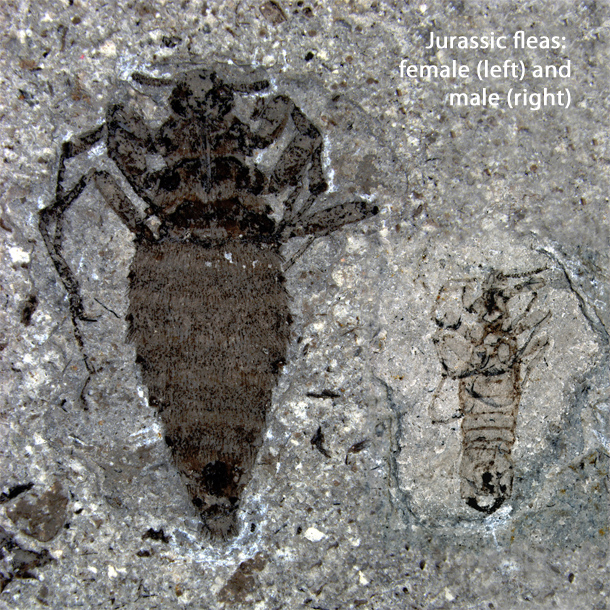
Giant Mesozoic fleas from China, 1.4 and 0.8 cm long. From Huang et al. (2012)
Strange as it might seem, rather than bringing to mind the opening pages of Michael Crichton’s Jurassic Park ancient fleas suggest to me Frederick Engels’s Dialectics of Nature(1883). In his lampoon of determinism, which might today be directed at a famous evolutionary biologist, Engels wrote:
‘…last night I was bitten by a flea at four o’clock in the morning, and not at three or five o’clock, and on the right shoulder and not on the left calf – these are all facts which have been produced by an irrevocable concatenation of cause and effect, by an unshatterable necessity of such a nature indeed that the gaseous sphere, from which the solar system was derived, was already so constituted that these events had to happen thus and not otherwise.’
But a paper about fossil fleas from the time of the dinosaurs was always going to catch the eye (Huang, D. et al. 2012. Diverse transitional giant fleas from the Mesozoic era of China. Nature, v. 483, p. 201-204), and that they come from China does have an element of inevitability that arises from that country’s rich endowment with sites of exceptional preservation. The fleas are not at all like the shiny creatures that are so difficult to trap in the fur of a cat’s ear, and they are big: up to 2 cm long. Two species come from Middle Jurassic and one from the Lower Cretaceous. The fascinating thing about fleas, however, is that they evolved to live and thrive in fur and feathers. This niche is signified by their claws, whose form and articulation avoid entanglement with fibres: which is why cat fleas are so nimble. While cat fleas are flattened laterally to help them slip though fur and have powerful legs that allows them to leap from host to host, the Mesozoic fleas are flat from back to front and are not so leggy.
Cat flea ~1.5 mm long. Image via Wikipedia
Being so large, it seems unlikely that these Mesozoic fleas would have parasitized mammals that were probably far smaller on average than now. But by the Jurassic fossil evidence, largely from China, shows that dinosaurs had developed feather-like cover. Their evolution itself created a niche occupied thereafter by fleas and other bloodsuckers. They are wingless relatives of flies (Order: Diptera) that first appear in the Triassic fossil record, both thought to have stemmed from more primitive scorpionflies (Order: Mecoptera)
Evidence for the earliest colonisation of the continents by plants is in the form of spores and body fragments from terrestrial sediments of Middle Ordovician age (~470 Ma) (Rubinstein, C. et al. 2010. Early Middle Ordovician evidence for land plants in Argentina (eastern Gondwana). New Phytologist, v.188, p. 365-369)suggest that the first vegetation cover involved simple ground-hugging plants that lacked stems of roots, very like the liverworts that I struggle to deter from my gravel drive. Vinegar is the only solution, preferably boiling, but that does not harm their spores and inevitably they re-emerge. Rearranging the gravel, of a pale pink limestone, is one of a very few means of keeping fit that I can bear, and I suppose the liverworts spice that up a little: but I do detest them. Part of their irritation is that they form an impermeable coating to what once was a passable if minor aquifer that channelled rainfall that would otherwise repeat the house-flooding that greeted me within a day of my moving in. So it was with some solemnity that I read a paper on how these damnable organisms transformed the Ordovician continental surface and the geomorphological processes that shaped it (Gibling, M.R. & Davies, N.S 2012. Palaeozoic landscapes shaped by plant evolution. Nature Geocience, v. 5, p. 99-105).
Sedimentologists have shown that rivers of earlier times formed wide tracts of ephemeral braided channels that transported and reworked sands and gravels that were not hampered by any vegetable binding agent. Floods merely accelerated the braiding and spread coarse sediment across valley floors, repeated spates washing out almost of the fines to take them ultimately to the continental shelves: there are few if any relics of Cambrian and older muddy floodplains. Moreover, untrammelled by vegetation any remaining fine material would be picked up by wind, even in humid climates, to meet the same marine fate. Overbank deposits of silts and clays, unsurprisingly, demand banks over or through which floodwater escapes from defined channels and is then delayed by low gradients away from the main flow, so to deposit the fines carried by its sluggish speed. Except in arid terrains where braided channels are still the rule, in succeeding geological time evidence grows for nowadays familiar channels, meanders with point bars and eroded opposite banks, levées and floodplains on every conceivable scale. Apparently, they became conspicuous in Silurian times and then forming 30% of all fluvial sediments by the Devonian.
Meanwhile, plants were diversifying though evolution of vascular systems that transport sap up supporting structures that emerged in parallel eventually to form trunks and branches. The consequent rise in volume and in area exposed to sunlight and photosynthesis of a plant’s tissues increased the potential to draw CO2 from the air, witnessed by changes in carbon isotopes that show carbon burial rising shortly after the mid-Ordovician from far lower values in earlier times. (Incidentally, it seems likely that such meagre colonisers as early liverworts thrived sufficiently to contribute to the cooling in the Upper Ordovician that led to sporadic glacial episodes). Preservation of wood in peats – liverworts are not implicated in any kind of fossil-fuel production – helped to maximise carbon burial by the end of the Palaeozoic Era. But trees make logs and, carried by rivers, logjams. By the Upper Carboniferous effects of damming become common in fluvial sediments, which seemed to serve the formation of islands within wide river channels.
By the present day, vegetation has come to dominate all but the most arid river systems. Even in central Australia sturdy gums able only to get water from below ephemeral river beds end up defining the flow regime and stabilising it on low relief plains that would otherwise be ravaged by sheet floods every rainy season. The authors support stratigraphic observations through the use of scaled down models of channels in vegetated areas by the cunning use of alfalfa seeded to sprout during simulated dry conditions then resuming channel flow in a flume tank.
Fossils tree stumps from Gilboa, New York (Photo credit: Dougtone)
The earliest substantial trees, represented by wood fragments rarely assignable to any particular structure, occur in the Middle Devonian (385-400 Ma). Although some groups can be differentiated, how their encompassing woodland ecosystems looked has been a mystery until recently . Being ‘priitive’ it has been assumed to be very simple, unlike the well-documented forests of the Carboniferous coal swamps. But, once in a while, a site of exceptional preservation is unearthed, one such being a palaeosol that clearly formed on the floor of a Middle Devonian woodland exposed by quarrying in New York state, USA (Stein, W.E. et al. 2012. Surprisingly complex community found in the mid-Devonian fossil forest at Gilboa. Nature, v. 483, p. 78-81). Once backfill accumulated during the quarry’s active life was removed it became possible to plot the arrangement of roots systems of the last trees to live at the site before inundation and preservation. Together with other plant material found in the ancient soil, the growing sites have been reconstructed to assess the full ecosystem involved. It was a great deal more complex than previously thought possible, with a series of tiers formed by three large tree types: tall, lollipop-like Eospermatopteris; smaller lycopsid-like trees and subsurface propagators related to gymnosperms that sprouted to form an understorey that may have climbed the larger trees in the manner of vines. Its setting was akin to that of modern mangrove swamps – by the sea – subject to sea-level change that inundated, killed and preserved the coastal woodland.
The last of five written papers in my 1967 final-year exams was, as always, set by the ‘Prof’. One question was ‘Rock and rhythm: discuss’ – it was the 60s. Cyclicity has been central to observational geology, especially to stratigraphy, the difference from that era being that rhythms have been quantified and the rock sequences they repeat have been linked to processes, in many cases global ones. The most familiar cyclicity to geologists brought up in Carboniferous coalfields, or indeed any area that preserves Carboniferous marine and terrestrial rocks, is the cyclothem of, roughly, seat-earth – coal – marine shale – fluviatile sandstone – seat-earth and so on. Matched to the duration of Carboniferous to Permian glaciations of the then southern hemisphere, and with the relatively new realisation that global sea level goes down and up as ice caps wax and wane, the likeliest explanation is eustatic regression and transgression of marine conditions in coastal areas in response to global climate change. Statistical analysis of cyclothemic sequences unearths frequency patterns that match well those of astronomical climate forcing proved for Pleistocene glacial-interglacial cycles.
The Milankovich signals of the Carboniferous are now part of the geological canon, but rocks of that age more finely layered than sediments of the tropical continental margins do occur. Among them are rhythmic sequences interpreted as lake deposits from high latitudes, akin to varves formed in such environments nowadays. Those from south-western Brazil present spectacular evidence of climate change in the Late Carboniferous and Early Permian (Franco, D.R. et al. 2012. Millennial-scale climate cycles in Permian-Carboniferous rhythmites: Permanent feature throughout geological time. Geology, v. 40, p. 19-22). They comprise couplets of fine-grained grey quartz sandstones from 1-10 cm thick interleaved with black mudstones on a scale of millimetres, which together build up around 45 m of sediment. Their remanent magnetism and magnetic susceptibility vary systematically with the two components. Frequency analysis of plots of both against depth in the sequence show clear signs of regular repetitions. Low-frequency peaks reveal the now well-known influence of astronomical forcing of Upper Palaeozoic climate, but it is in the lower amplitude, higher frequency part of the magnetic spectrum that surprises emerge from a variety of peaks. They are reminiscent of the Dansgaard-Oeschger events of the last Pleistocene glacial, marked by sudden warming and slow cooling while world climate cooled towards the last glacial maximum (~1.5 ka cyclicity) and Heinrich events, the ‘iceberg armadas’ that occurred on a less regular 3 to 8 ka basis. There are also signs of the 2.4 ka solar cycle. The relatively brief cycles would have been due to events in a very different continental configuration from today’s – that of the supercontinent Pangaea – and their very presence suggests a more general global influence over short-term climate shifts that has been around for 300 Ma or more.
El Niño effect on sea -surface temperatures in the eastern Pacific Ocean. Image via Wikipedia
Closer to us in time, and on a much finer time scale are almost 100 m of finely laminated shales from the marine Late Cretaceous of California’s Great Valley (Davies, A. et al. 2012. El Niño-Southern Oscillation variability from the late Cretaceous Marca Shale of California. Geology, v. 40, p. 15-18). The laminations contain fossil diatoms: organisms that are highly sensitive to environmental conditions and whose species are easily distinguished from each other. It emerges from studies of the diatoms in each lamination set that they record an annual cycle of seasonal change related to marine upwellings and their varying strengths, with repeated evidence for influx of fine sediment derived from land above sea level and for varying degrees of bioturbation that suggests periods of oxygenation. Spectral analysis of the intensity of bioturbation, which assumes the lamina are annual, and other fluctuating features reveals peaks that are remarkably close to those of the ENSO cyclicity that operates at present, at 2.1-2.8 and 4.1-6.3 a, as well as repetitions with a decadal frequency.
The annual cycles bear similar hallmarks to those imposed by the monsoonal conditions familiar from modern California, which fluctuated in the Late Cretaceous in much the same way as it does now – roughly speaking, alternating El Niño and La Niña conditions. That is not so surprising, as the relationship between California and the Pacific Ocean in the Cretaceous would not have been dissimilar from that now. The real importance of the study is that it concerns a period in Earth’s climate history characterised by greenhouse conditions, that some predict would create a permanent El Niño – an abnormal warming of surface ocean waters in the eastern tropical Pacific that prevents the cold Humboldt Current along the Andean coast of South America from supplying nutrient to tropical waters. The very cyclicity recorded by the Marca Shale strongly suggests that the ENSO is a stable feature of the western Americas. Recent clear implications of ENSO having teleconnections that affect global climate, on this evidence, may not break down with anthropogenic global warming. This confirms similar studies from the Palaeogene and Neogene Periods.
Last year Earth Pages News reported a rationalisation of the way in which geological time is signified (Rationalising geological time 7 May 2011). A working group set up by the International Union of Pure and Applied Chemistry (IUPAC) and the International Union of Geological Sciences (IUGS) defined the year as the base unit, standardizing it to the time in seconds between one solstice and the next at the equator for year 2000 (3.1556925445 × 10⁷ s) thereby linking it to the Système international d’unités or SI base unit of the second, itself defined in terms of behaviour of the caesium atom. It is to be signified by ‘a’ for annus (year in Latin) and preceded by ‘k’, ‘M’ and ‘G’ for thousands, millions and billion years, complying with the SI progression in steps of 103 for units.
The sticking point for some, mainly in the US (e.g. Science magazine and many geoscientists there) is that the ka, Ma, Ga symbols are to apply not only to times before the present but also to spans of geological time. Since the agreed convention is incorporated into SI it has almost the force of law for scientists , so that the Cretaceous Period will be said to have begun at 145.5±4.0 Ma ago, ended at 65.5±0.3 Ma ago and was 80 Ma long, instead of the latter being in m.y., m.yr., mya or Myr according to what seem to have been personal quirks or those of scientific journals.
Somewhat florid reaction against the rationalisation (Christie-Blick, N. 2012 Geological time conventions and symbols. GSA Today, v. 22 (February 2012 issue), p. 28) seems to have flowed from a deliberation on the IUPAC-IUGS proposal (in Prague, Spring 2010) by a lesser world body: the International Commission on Stratigraphy’s (ICS) International Subcommission on Stratigraphic Classification (ISSC). The meeting voted 16 to 2 to reject the proposal – a substantial number of voting members abstained – claiming that it violated SI ‘rules’ regarding base- and derived units. The issue, on reaching the ICS meeting, as the same Prague workshop, seems to have been greeted by a 50:50 split. A closed meeting of the ICS Bureau (now we can begin to see the kind of thinking involved here…) on the workshop’s last day unanimously adopted the motion ‘We neither accept nor reject the IUGS-IUPAC Task Group’s recommendation to apply Ma, generally, as the unit of deep time. We accept the argument for Ma as a single unit for time but would recommend flexibility, allowing for the retention of Ma as specific notation for points in time (i.e., dates) and myr as a unit of time denoting duration. We agree with the spirit of this statement’ [my italics]. ‘Neither accepting nor rejecting’ is something familiar from minutes of the Central Committee of the former USSR, being rumoured to have been Joseph Vissarionovich Stalin’s favoured formulation in moments of uncertainty: a little like the old ‘Belfast Question’, ‘Are you for us or against us’ from someone whose politics is not entirely clear.
An argument proffered by Christie-Blick is, ‘No one objects to the storming of the Bastille on 14 July 1789 (a date) or to the construction of Stonehenge from 2600–1600 BC (an interval specified by two dates). In the case of the latter, we say that the job took 1000 years, not 1000 BC.’ This forgets something quite practical: geochronologist rarely if ever, ‘neither accept nor reject’ AD, BC BCE, or CE but express time in years before present, with the odd convention that ‘the present’ was 1950, before atmospheric testing of thermonuclear devices. What is wrong with the answer to the question, ‘When did the Cretaceous begin?’ being 145.5 Ma ago, or ‘80 Ma’ in answer to, ‘How long did it last?’ Who would prefer the alternative to the second question – 80 (choose your preferred symbol from the following: m.y., m.yr., mya. Myr., million years or millions of years)?
One of the interesting things about the beaver is that its obsession with civil engineering may have a profound effect upon landscape. Before Europeans set foot in North America, it is estimated that up to 400 million of them inhabited the continent. The ponds that they create by building the dams in which they live securely, encourage sedimentation. It is quite possible that this creates recognisable stratigraphic formations; but no-one really knows as active and wet beaver habitats hide what lies beneath them. It is clearly urgent to obtain this intelligence: the Geological Society of America’s monthly Geology contained in its first issue for 2012 a paper that indeed probes the legacy of large rodents long gone (Kramer, N. et al. 2012. Using ground penetrating radar to ‘unearth’ buried beaver dams. Geology, v. 40, p. 43-46).
The target for surveillance was the eponymous Beaver Meadows in Colorado, USA, and not only did the researchers from Colorado State University deploy ground-penetrating radar, but used the seismic reflection method as well, to quantify volumes of beaver-induced sedimentation. Fortunately, despite their past presence in some strength, beavers no longer frequent Beaver Meadows and no ethical lines in the sand were crossed. Beaver and elk seemingly have long competed for the meagre resources of Beaver Meadows, the rodent having finally succumbed locally to determined efforts by the elk to consume the beavers’ victuals. As disconcerted and no doubt sulking beavers failed to maintain their dams and lodges, the water table fell, further encouraging the elk. Eventually, at some time after the Beaver Survey of 1947, the last of them moved to new meadows. Their ravages (see http://animal.discovery.com/videos/fooled-by-nature-beaver-dams.html) of what would otherwise be dense woodland have, however, made it possible for geophysicists to try out their sophisticated kit on a new and thorny issue: they ran 6 km of GPR and seismic profiles.
A beaver. Image via Wikipedia
In much the same way as larger scale geophysical data are interpreted for petroleum traps, signs of hydrocarbons, mighty listric faults and zones of tectonic inversion, the beaver-oriented sections potentially yield considerable insight to the trained eye. There are indeed beaverine sedimentary aggradations of Holocene age above the local glacial tills. Beneath Beaver Meadow they amount to as much as 50% of post-glacial sediment. Apparently, the deposits have a linear element that follows the local drainages.
Modern Santorini and the drowned Thera caldera. Image via Wikipedia
A burning topic for Bronze Age archaeologists, such as the delightful Bettany Hughes – biographer of Helen of Troy, is the explosive collapse of the volcano Thera (modern Santorini) whose distant effects (ash and tsunamis)wiped out the Minoan civilisation of Crete around 1600 BCE, giving rise to Plato’s legend of Atlantis. It was a big one alright, hurling of the order of 60 km3 of pulverised magma skywards, though not the largest historic eruption: that involved 160 km3 from the Tambora volcano on Indonesia’s island of Sumbawa in 1815. The inhabitants of Santorini simply disappeared, after evacuating their homes during precursor earthquakes and small eruptions, which were then buried beneath many metres of tephra when Thera literally ‘blew its top’. Little ash fell on Crete, yet its northern coast shows clear signs of a major tsunami. The reason for such an engulfing wave is revealed by the nature of Thera’s eruption: after evacuating magma, the edifice collapsed to form a caldera clearly revealed by the elliptical bay around which the remnants stand as the various islands of Santorini. Caldera formation would have displaced vast amounts of sea water.
Santorini has been well studied by volcanologists, still being an astonishingly awesome spectacle as well as preserving the full record of the eruption and the archaeology that it buried (http://santorini-eruption.org.uk/). Empirical research reveals four distinct eruptive phases probably over a period of a few months. The explosive force of the final catastrophe probably resulted from seawater reaching the sub-volcanic magma chamber: not a difficult feat of imagination. What has not been known is how the magma evolved over times leading up to the cataclysm, and that is a knotty issue for all volcanoes that pose a major threat because of evidence for repeated and perhaps cyclic activity. A new technique is now capable of lifting the veil on such purely magmatic evolution, and is based on the changes that took place in minerals that crystallised over lengthy periods while the magma cooled slowly at depth but was periodically added to (Druitt, T.H et al. 2012. Decadal to monthly timescale of magma transfer and reservoir growth at a caldera volcano. Nature, v. 482, p. 77-80).
Such phenocrysts are commonly found in fragments of pumice that make up Theran tephra, and they are commonly zoned in a concentric fashion, especially those of the mineral feldspar, each zone marking a phase of growth that occasionally traps samples of magma in the form of now glassy inclusions. The zones mark chemical changes in the magma as new pulses are added in the sub-volcanic chamber, and sometimes temperature changes and loss of gas. Although the zone boundaries a are expected to be sharp in terms of chemical differences, in practice they are blurred as a result of element diffusion at high temperatures. Diffusion is a predictable process and so the degree of blurring indicates the time at which a new zone formed relative to that of eruption and cooling, when diffusion would have stopped abruptly. Rates of high-temperature diffusion depend on the element concerned. So using a suite of trace elements in feldspar zones gives a variety of chronometers. A fast-diffusing element such as Mg can chart changes of the order of decades to months, while a more sluggish trace element – for instance titanium – can examine changes on longer timescales.
The results obtained by the authors present a surprise: although Thera had last erupted catastrophically 18 ka previously, additional magma recharged the volcano only in the last few decades before it extinguished life on Santorini and set the Minoan civilisation on a downward spiral. Indeed, magma continued to be added even in the last few months. Calderas, such as that at Yellowstone in the western US, to which are linked ancient ash layers covering areas hundreds and thousands of kilometres away, pose threats as large and even bigger than Thera. If Thera is anything to go by, they lie in repose long after an eruption and signs of recharge may herald eruption in the near future. The Yellowstone caldera, that has lain dormant for 640 ka is indeed showing signs of magmatic ‘stoking’, as the Earth’s surface there is slowly bulging. It produced ‘supereruptions’ that dwarfed Thera at 2.1 Ma (2500 km3), 1.3 Ma (280 km3) and 0.6 ka (1000 km3). For each of these and several other calderas there are abundant tuffs that carry phenocrysts, whose zonation is yet to be checked for signs of past behaviour by their local magma chambers.
The later part of the Devonian (the Frasnian and Famennian Stages) once marked the second largest marine mass extinction (~375 Ma) of the Phanerozoic Eon: it was one of the ‘Big Five’. For the last decade the drop in marine biodiversity in that interval has come under scrutiny: partly because it may have involved several events; no well-supported extinction mechanism has emerged; and extinctions seem have been concentrated on three animal groups – trilobites, brachiopods and reef corals. Something large did happen, as reef-building corals almost disappeared and coral reefs only returned with the rise of modern (scleractinian) corals in the Mesozoic. While the end of the Devonian still figures widely as having experienced a mass extinction event, more detailed palaeontological work at the genus and species level suggests another possibility.
‘Officially’ a mass extinction event must exceed the background extinction rate throughout the Phanerozoic and be above that in immediately preceding and following stages: statistically significant, that is. They always give rise to a marked reduction in biodiversity, but another mechanism can do that without extinctions suddenly increasing. The rate at which new species emerge can fall below that of species extinctions, when the overall number of living species falls. As far as ecosystems are concerned both processes are equally severe, but the causes may be very different.
Brachiopod from the Devonian of Ohio, USA. Image via Wikipedia
Reviewing detailed records of Devonian species of two genera of brachiopods and one bivalve genus (50 species in all) in five North American stratigraphic sequences, Alycia Stigall of Ohio University, USA noted apparently significant variations in the local assemblages (Stigall, A. L. 2012. Speciation collapse and invasive species dynamics during the Late Devonian ‘Mass Extinction’. GSA Today, v. 22(1), p. 4-9). Speciation overall fell in the Frasnian and the preceding Givetian, while rate of extinction barely changed. For the three studied genera ,speciation reached low values in the Frasnian and Famennian, but that was accompanied by an equally large fall in extinctions. In this narrow sample we seem to be seeing not an extinction crisis but one of biodiversity. Why?
The Late Devonian saw repeated ups and downs in sea level, which repeatedly connected and disconnected shallow- to moderate-depth marine basins. The fossil record shows repeated cases of species from one basin colonising another, each invasion accompanying rapid marine transgression.. One means whereby species arise is through prolonged isolation of separate populations of the ancestral species through independent genetic drift and mutation. The episodic connection of basins may have prevented such allopatric speciation. Interestingly, the invading species were dominantly animals with a broad tolerance for environmental conditions.
Whether this mechanism applied to all three main animal groups whose diversity plummeted in Late Devonian times remains to be seen, and it begs the question ‘why didn’t it happen among other animal groups that were less affected by whatever the events were?’ One of the problems associated with decreasing biodiversity in modern marine (and terrestrial) settings is growth in the numbers of invasive species, so the work on 375 Ma fossils might help understand and mitigate current ecological issues. The only difference is that for many of the hyper-successful invader species the means of invasion has been provided by human activities. brachiopod brachioopod
In 2011 there was a growing trickle of news about various kinds of research malpractice: data fabrication, falsification and obfuscation (not reporting adverse outcomes); plagiarism (http://earth-pages.co.uk/2008/01/01/watch-out-burglars-about/) ; repeated publication of data, text and diagrams (self-plagiarism); ‘guest’ contributors; plus other kinds of scientific fraud and chicanery (http://en.wikipedia.org/wiki/Scientific_misconduct). Motives are many, from malice to laziness, but more often than not are a mixture of ambition, greed, jealousy, desperation and paranoia that increasingly form the downside of academic life – not the least in science. Life is so hard in a career dominated by promotion, which in academe rests on: publication lists; peer citations; journal impact factors; institutional income generation and, let’s face it, by the kind of individual self-regard and hubris that drives people to seek fame and celebrity. The wider population has grown accustomed to this as bystanders watching Big Brother, the X-Factor and Fame Academy.
Fiddling research has reached such a level as to provoke the world’s most prestigious research outlet, Nature, to include an editorial on the topic (Editorial 19 January 2012. Face up to fraud. Nature, v. 481, p. 237-238), albeit after a first lead about the Antarctic Treaty at the centenary of the race to the South Pole, and followed by a puff for articles in the same issue on how to get research funding from the public or philanthropists.
As many scientists suspect, in fact what does emerge about research malpractice is the tip of the proverbial iceberg, some admitting to wandering from the path of righteousness themselves (but not saying how or where). One mild form is making unsubstantiated claims: a great many geologists (including me) have trodden very thin ice in this regard (unless they wisely included the ‘Get Out of Jail’ verb ‘to speculate’), but few innocent bystanders, if any, have met a horrid fate as a result of resultant health and safety ‘issues’. A great deal that should not does get through peer-review to enter the canon of whichever discipline. Academic fraud is a quasi-crime with few risks of detection, though punishment can be swingeing, in the manner of being cast into the ‘dark place’.
According to Nature, what makes Britain seem to be a haven of academic honesty is the risk that both journals and ‘whistleblowers’ face from libel laws, should deeds and authors be named and linked. Moreover, certain kinds of gross malpractice never reach peer-reviewed publication. Examples are: malicious falsification of someone else’s data by a perpetrator with access to the data on, say, a lab server; swapping analytical sample labels; destroying lab records(http://earth-pages.co.uk/2010/11/04/sabotage-in-science-4/); petty theft of ideas (on which there is no formal copyright), for instance through copying poster presentations at conferences; misuse of peer-review privileges – generally anonymous (http://earth-pages.co.uk/2006/08/01/anonymous-referees-2/); menacing a presenter at a conference or disrupting their presentation. Victims of such actions rarely have any redress, unless the perpetrator is actually caught ‘in flagrante delicto’, so to speak (http://earth-pages.co.uk/2010/11/04/sabotage-in-science-4/).
‘Whistle blowers’ or complainants then face the defensive mechanisms of the academic world: not dissimilar to those of the musk ox. How far you get as regards redress depends to a large extent on the seniority of the perpetrator. An extremely brave friend cited, with abundant evidence, his vice-chancellor for gross cronyism: he was soon ‘on the cobbles’ with the VC (male) remaining ‘virgo intacto. Yet an Industrial Tribunal took a very dim view of the whole affair: my pal paid off his mortgage and lives well in retirement from the compensation awarded by the tribunal. It takes an exceptionally brave graduate student to take on their supervisor(s) for malfeasance (or even the lesser misfeasance and nonfeasance – http://en.wikipedia.org/wiki/Misfeasance). The likely best outcome (after long and harrowing procedures) is a kind of bribe – more time to complete – but most victims just disappear without completing. Unless the perpetrators are low on the academic scale (they might get a reprimand at worst), promotion to management or enhanced early retirement is a common response by senior management to mounds of incontrovertible evidence of guilt. The oddest fate for someone flying high in the institutional firmament was rumoured to be a posting to a far-flung outpost of the former British Empire: but I digress…
The geosciences seem immune to research malpractice, which may reflect at best the small numbers involved in the discipline or at worst because no-one notices, or cares for that matter. Unless, that is, dear reader, you know different… Most important, for graduate students who are the most usual victims: protect yourselves (http://earth-pages.co.uk/2003/12/01/protecting-your-intellectual-property-2/).
Mars: with and without dust storms in 2001. Image via Wikipedia
Once every 13 years on average dust blots out most of the surface of Mars turning it into an orange ball. The last such planet-encircling dust storm occurred in 2001, but lesser storms spring up on a seasonal basis. Yet Martian seasons have very different weather from terrestrial ones because of the greater eccentricity of Mars’s orbit, as well as the fact that its ‘weather’ doesn’t involve water. When Mars is closest to the Sun solar heating is 20% greater than the average, for both hemispheres. The approach to that perihelion marks the start of the dust season which last a half the Martian year. Unsurprisingly, the sedimentary process that dominates Mars nowadays is the whipping up and deposition of sand and dust, though in the distant past catastrophic floods – probably when subsurface ice melted – sculpted a volcanic landscape pockmarked with impact craters up to several thousand kilometres across. Waterlain sediments on early Mars filled, at least in part, many of the earlier craters and probably blanketed the bulk of its northern hemisphere that is the lowest part of the planet and now devoid of large craters. Erosion and sedimentation since that eventful first billion years has largely been aeolian. Some areas having spectacular dunes of many shapes and sizes, whereas more rugged surfaces show streamlined linear ridges, or yardangs (http://earth-pages.co.uk/2011/05/08/winds-of-change/), formed by sand blasting. Most of the dust on Mars is raised by high winds in the thin atmosphere sweeping the great plains and basins, and, by virtue of Stokes’s law, the grains are very much smaller than on Earth.
The dustiest times on Earth, which might have blotted out sizeable areas from alien astronomers, in the last million years have been glacial maxima, roughly every 100 ka with the latest 20 ka ago. Layering in the Antarctic ice core records such dust-dominated frigid periods very precisely. Less intricate records formed away from the maximum extent of ice sheets as layers of fine sediment known as loess, whose thickness variations match other proxy records of palaeoclimate nicely. Loess, either in place or redeposited in alluvium by rivers, forms the most fertile soil known – when the climate is warm and moist. The vast cereal production of lowland China and the prairies of North America coincides with loess: it may seem strange but a large proportion of 7 billion living humans survive partly because of dust storms during glacial periods of the past.
Being derived from rock-forming minerals dust carries with it a diverse range of chemical elements, including a critical nutrient common on land but in short supply in ocean water far offshore: iron in the form of oxide and hydroxide coatings on dust particles – the dust coating your car after rain often has a yellow or pinkish hue because of its iron content. Even when the well-known ‘fertilizer’ elements potassium, nitrogen and phosphorus are abundant in surface ocean water, they can not encourage algal phytoplankton to multiply without iron. Today the most remote parts of the oceans have little living in their surface layers because of this iron deficiency. Yet oceanographers and climatologists are pretty sure that this wasn’t always the case. They are confident simply because reducing the amount of atmospheric carbon dioxide and its greenhouse effect to levels that would encourage climate cooling and glacial epochs needed more carbon to be buried on the ocean floors than happens nowadays, and lifeless ocean centres would not help in that.
Saharan dust carried over the Atlantic Ocean by a tropical cyclone. Image via Wikipedia
At present, the greatest source of atmospheric dust is the Sahara Desert (bartholoet, J. 2012. Swept from Africa to the Sahara. Scientific American, v. 306 (February 2012), p. 34-39). Largely derived from palaeolakes dating from a Holocene pluvial episode, Saharan dust accounts for more than half the two billion metric tonnes of particulate atmospheric aerosols dispersed over the Earth each year. Located in the SE trade-wind belt, the Sahara vents dust clouds across the Atlantic Ocean, most to fall there and contribute dissolved material to the mid-ocean near-surface biome but an estimated 40 million t reaches the Amazon basin, contributing to fertilising the otherwise highly leached tropical rain-forest soils. While over the ocean the high albedo of dust adds a cooling effect to the otherwise absorbent sea surface. Over land the fine particles help nucleate water droplets in clouds and hence encourages rainfall. The climatic functions of clouds and dusts are probably the least known factors in the climatic system, a mere 5% uncertainty in their climatic forcing may mean the difference between unremitting global warming ahead or sufficient cooling by reflection of solar radiation to compensate for the cumulative effects of industrial CO2 emissions.
Recording amounts of dust from marine sediments quantitatively is very difficult and impossible in terrestrial sediments, but superb records tied accurately to time at annual precision exist in ice sheets. Low dust levels in Greenland and Antarctic ice tally well with the so-called ‘Medieval Climate Anomaly’ (a warm period) whereas through the 13th to 19th centuries (the ‘Little Ice Age’) more dust than average circulated in the atmosphere. Crucially, for climate change in the industrial era, there has been a massive spike in dust reaching near-polar latitudes since the close of the 18th century during the period associated with signs of global warming: a counterintuitive relationship, but one that is difficult to interpret. The additional dust may well be a result of massive changes in land use across the planet following industrialised agricultural practices and growing population. There are several questions: does the additional dust also reflect global warming with which it is correlated, i.e. evaporation of the huge former lakes in the Sahara (e.g. Lake Chad); is the dust preventing additional greenhouse warming that would have taken place had the atmosphere been clearer; is it even the ‘wrong kind of dust’, which may well reflect short-wave solar radiation away but also absorbs the longer wavelength thermal radiation emitted by the Earth’s surface, i.e. an aerosol form of greenhouse warming. Needless to say, neither clouds nor dust can be factored into climate prediction models with much confidence.
Recent earthquakes in the US mid-west around New Madrid Missouri. Image via Wikipedia
Almost all devastating earthquakes within living memory and the tsunamis that ensued from some of them have occurred where tectonic plates meet and move past one another either horizontally through strike-slip motion or vertically as a result of subduction. This link between real events and the central theory of global dynamics gives an impression of inherent predictability about where damaging and deadly earthquakes might happen, if not the more useful matter of when the lithosphere might rupture. Such confidence is potentially highly dangerous: the most deadly earthquake in recorded history killed at least 800 thousand people in China’s Shanxi Province in 1556 when according to a description written shortly afterwards, ‘… various misfortunes took place… In some places, the ground suddenly rose up and formed new hills, or it sank abruptly and became new valleys. In other areas, a stream burst out in an instant, or the ground broke and new gullies appeared…’. Shanxi is far from any plate boundary. A study of Chinese historic records covering the last two millennia (Liu, M. et al. 2011. 2000 years of migrating earthquakes in North China: How earthquakes in midcontinents differ from those at plate boundaries. Lithosphere, v. 3, p. 128-132) shows a pattern to the position of large intraplate events. Rather than occurring along lines as do those at plate boundaries, earthquakes ‘hopped’ from place to place without affecting the same areas twice. Liu and colleagues consider this almost random pattern to result from reactivation of interlinked faults through broad-scale and gradual tectonic loading of the crust by far off plate movements. After a short period of reactivation one fault locks so that energy build-up is eventually released by another in the plexus of crustal weaknesses.
The best studied site of such intraplate seismicity lies midway along the Mississippi valley in the mid-US, between St Louis and Memphis. In 1811 and 1812 four Magnitude 7 to 8 earthquakes struck, the most affected place being the small township of New Madrid on the banks of the great river where mud and sand spouted from numerous sediment volcanoes. No-one died there but tremors were felt over a million square kilometers, bells ringing spontaneously as far away as Boston and Toronto. It is now known that this section of the Mississippi basin lies above a graben that affects the ancient basement beneath the alluvial sediments, one of whose faults was reactivated, perhaps in an analogous way to the hypothesis about Chinese seismicity. A coauthor in Liu et al. (2011), Seth Stein of Northwestern University, Illinois, believes stress redistribution through a Mid-western fault network was responsible and other events are likely at some uncertain time in the future on this and other areas underpinned by ancient fault complexes. Indeed sporadic ‘quakes up to Magnitude 7 have affected the eastern US and Canada and the Atlantic seaboard since European settlement. But since the largest of the New Madrid quartet of earthquakes, populations have grown across the likely areas of tenuous risk and future ones could have extremely serious consequences for which it is difficult to plan by virtue of unpredictability of both place and timing: in some respects a more worrying prospect than is the case where major events are inevitable – sometime – as along the San Andreas Fault. There are few, if any, major conurbations worldwide that could be considered seismically safe if the theory of networked stress redistribution through otherwise inert parts of continental crust is borne out.
In some respects the theory is a small-scale version of the suggested mechanical linkage through all major plate boundaries that has been suggested by some to account for the clustering in time of great earthquakes – around and above Magnitude 8 – around the globe. Since 2000 great earthquakes have occurred on subduction zones beneath Sumatra, the Himalaya, the Andes, Central America, Alaska, New Guinea, the mid-Pacific, Japan and the Kurile islands, on the strike-slip system that cuts New Zealand and in the intraplate setting of the 2008 Sichuan earthquake in China. Almost all plate boundaries link up globally, but although it seems likely that stress is redistributed along boundaries, especially between adjacent segments, as documented for the great Anatolian fault system of Turkey and the Indonesian subduction zone, a mechanism that transmits stress beyond individual plates seems unlikely.
Cyanobacteria: earliest producers of oxygen in the Precambrian. Image via Wikipedia
The entire eukaryote domain of life, from alga to trees and fungi to animals, would not exist had it not been for the emergence of free oxygen in the oceans and atmosphere about 2.4 billion years ago; thanks in large part to the very much simpler photosynthetic blue-green bacteria. The chemistry behind this boils down to organisms being able to transfer electrons from elements and compounds in the inorganic world to build organic molecules incorporated in living things. Having lost electrons the inorganic donors become oxidised, for instance ferrous iron (Fe2+ or Fe-2) becomes ferric iron (Fe3+ or Fe-3) and sulfide ions (S2-) become sulfate (SO42-) and the organic products that receive electrons principally involve reduction of carbon, on the OilRig principal – Oxidation involves loss of electrons, Reduction involves gain. Since the Great Oxygenation Event (GOE), ferric iron and sulfate ions now account for 75% of oxidation of the lithosphere and hydrosphere while free oxygen (O2) is a mere 2-3 % (Hayes, J.M. 2011. Earth’s redox history. Science. V. 334, p. 1654-1655; an excellent introduction to the geochemistry involved in the GOE and the carbon cycle). Free oxygen is around today only because more of it is produced than is consumed by its acting to oxidize ferrous iron and sulfide ions supplied mainly by volcanism, and carbon-rich material exposed to surface processes by erosion and sediment transport.
Eukaryote life has never been snuffed out for the last two billion years or so, but it has certainly had its ups and downs. To geochemists taking the long view oxygen might well seem to have steadily risen, but that is hardly likely in the hugely varied chemical factory that constitutes Earth’s surface environments, involving major geochemical cycles for carbon, iron, sulfur, nitrogen, phosphorus and so on, that all inveigle oxygen into reactions. Tabs can be kept on one of these cycles – that involving carbon – through the way in which the proportions of its stable isotopes vary in natural systems. If all geochemistry was in balance all the time, all materials that contain carbon would show the same proportions of 13C and 12C as the whole Earth, but that is never the case. Living processes that fix carbon in organic compounds favour the lighter isotope, so they show a deficit of 13C relative to 12C signified by negative values of δ13C. The source of the carbon, for instance CO2 dissolved in sea water, thereby becomes enriched in 13C to achieve a positive value of δ13C, which may then be preserved in the form of carbonates in, for instance, fossil shells that ended up in limestones formed at the same time as organic processes were favouring the lighter isotope of carbon. Any organic carbon compounds that ocean-floor mud buried before they decayed (became oxidised) conversely would add their negative δ13C to the sediment. Searching for δ13C anomalies in limestones and carbonaceous mudrocks has become a major means of charting life’s ups and downs, and also what has happened to buried organic carbon through geological time.
A most interesting time to examine C-isotopes and the carbon cycle is undoubtedly the period immediately following the GOE, in the Palaeoproterozoic Era (2500 to 1600 Ma). From around 2200 to 2060 Ma the general picture is roughly constant, high positive values of δ13C (~+10‰): more organic carbon was being buried than was being oxidised to CO2. However, in drill cores through the Palaeoproterozoic of NW Russia carbonate carbon undergoes a sharp decline in its heavy isotope to give a negative δ13C (~-14‰) while carbon in organic-rich sediments falls too (to~-40‰): definitely against the general trend (Kump, L.R. et al. 2011. Isotopic evidence for massive oxidation of organic matter following the Great Oxidation Event. Science. V. 334, p. 1694-1696). Oxygen isotopes in the carbonates affected by the depletion in ‘heavy’ carbon show barely a flicker of change: a clear sign that the 13C δ13C deficit is not due to later alteration by hydrothermal fluids, as can sometimes cause deviant δ13C in limestones. It is more likely that a vast amount of organic carbon, buried in sediments or dissolved in seawater was oxidised to CO2 faster than biological activity was supplying dead material to be buried or dissolved. In turn, the overproduction of carbon dioxide dissolved in seawater to affect C-isotopes in limestones. Such an event would have entailed a sharp increase in oxygen production to levels capable of causing the oxidation (~ 1% of present levels). Yet this was not the time of the GOE (2400 Ma) but 300-400 Ma later. A possible explanation is a burst in oxygen production by more photosynthetic activity, perhaps by the evolution of chloroplast-bearing eukaryotes much larger than cyanobacteria.
The Neoproterozoic lagerstätte in the Doushantuo Formation in the south of China was until recently thought to be a source of astonishing information about Earth’s earliest animals (See Ancestral animal? in EPN August 2004) that preceded the appearance of those with hard parts at the start of the Phanerozoic. It contains well-preserved fossils that resemble embryos, algae, acritarchs, and small bilaterians. Dated at between 580 to 600 Ma(See Age range of early fossil treasure trove in EPN February 2005), the Doushantuo directly overlies cap carbonates representing the emergence of Earth’s climate from a Snowball epoch represented by a tillite beneath the carbonate sequence. A detailed examination using synchrotron X-ray tomography of the putative animal embryos does show clear signs of cell doubling or palintomy (Huldtgren, T. et al.2011. Fossilized nucluei and germination structures identify Ediacaran ‘animal embryos’ as encysting protists. Science. V. 334, p. 1696-1699) but also internal cell features most likely to be nuclei, but which have no counterparts in animal embryos. The organisms which the fossils most resemble are indeed eukaryotes, but of a kind separate from animals known as Holozoa. Yet there are striking resemblances with eukaryotes more distant from animals, such as the modern Volvox, a type of alga (Butterfield, N.J. 2011. Terminal developments in Ediacaran embryology. Science. V. 334, p. 1655-1656), that developed from an ancestor further back in time than the separation of metazoan animals from holozoans.
The oldest materials on the planet are tiny zircon grains that were washed into conglomerate in Western Australia about 2650 to 3050 Ma ago. It wasn’t the fact that the grains are zircons, which are among the most durable materials around, but the range of ages that they revealed when routinely analysed. U-Pb dating of detrital zircons is a well tested means of finding the provenance of sedimentary materials as an indicator of orogenic and igneous events that formed the crust from which they were eroded. In the original study of the Jack Hills zircons some showed ages that might reasonably have been expected from late sediments in an Archaean craton: around 3.5 billion years is about the maximum age for orogenic events there. What astonished all geoscientists was that a proportion of the grains gave ages of more than 4 billion years, some as old as 4.4 Ga: here was a window on the missing first half billion years of Earth history, the Hadean.
Subsequent work on yet more zircons confirmed the original age span but other kinds of analysis led to a variety of claims: that continental crust was around in abundance within 100 Ma of Earth having formed; geothermal heat =flow was not especially high; liquid water was available for geological processes, including the origin of life; plate tectonics may have started early…. The topic has cropped up several times in EPN sincethe issue of 1 January 2001. Quite a lot of the claims emerged from studies of other minerals enclosed by the ancient zircons, such as quartz and micas, and now they have been checked again by geochemists from Western Australia (Rasmussen, B. et al. 2011. Metamorphic replacement of mineral inclusions in detrital zircons from Jack Hills, Australia: Implications for the Hadean Earth. Geology, v. 39, p. 1143-1146). It turns out that the inclusions formed at temperatures well below those of magmas, between 350 to 490°C: more like those of metamorphism. Indeed, uranium-bearing rare-earth phosphate minerals, xenotime and monazite, also locked in the zircons not only turn out to be metamorphic in origin too (both are also formed magmatically) but date to between 2700 and 800 Ma.
While the Hadean zircon dates remain robust, a closer look at their inclusions shows that they did not remain geochemically closed systems thereafter. It was on the assumption of zircons being geological ‘time capsules’ that much of the excitement rested. Even using the presence of zircons from 4.4 Ga – they are most common in granites but do occur in mafic and intermediate igneous rocks – to suggest early ‘sialic’ continental crust is suspect. Despite having some tiny bits from Earth’s early days, it seems we are none the wiser.
Artists impression of the Milky Way viewed along its axis. Image via Wikipedia
Palaeoclimatologists are quite content that an important element in controlling the vagaries of climate is due to gravitational forces that cyclically perturb Earth’s orbit, it axial tilt and the way the axis of rotation wobbles in a similar manner to that of a gyroscope. The predictions about this by James Croll in the late 19th century, which were quantified by Milutin Milankovich during his incarceration during World War I, triumphed when the predicted periods of change were found in deep-sea floor sediment records in 1972. Authors of ideas that link Earth system changes to the progress of the Solar system through the Milky Way galaxy haven’t had the same accolades. One of the first to suggest a galactic link was Joe Steiner (Steiner, J. 1967. The sequence of geological events and the dynamics of the Milky Way Galaxy. Journal of the Geological Society of Australia, v. 14, p. 99–132.) but his work is rarely credited.
There has been an upsurge of interest in the last decade or so. In a recent issue of New Scientist Stephen Battersby reviews what galactic ‘forcings’ may have accomplished during the 4.5 billion-year history of our world (Battersby, S. 2011. Earth odyssey. New Scientist, v. 212 (3 December issue), p. 42-45). Having formed probably much closer to the galactic centre than its current position the Solar System has drifted, perhaps even ‘surfed’ gravitationally, outwards to reach its present ‘suburban’ position in one of the spiral arms. There are regularities to the now stabilised orbital movements: once every 200 million years the Solar System completes a full orbit; this orbit wobbles across the hypothetical plane of the galactic disc by as much as 200 light years, moving with and against the Milky Way’s cosmic motion. It has proved impossible so far to detect any sign of the orbital 200 Ma periodicity in events on the Earth, and most attention has centred on the wobble.
Steiner suggested that this motion may have crossed different polarities of the galactic magnetic field, perhaps triggering the periodicity of geomagnetic changes in polarity, but this now seems unlikely. However, his suggestion that glacial epochs, such as those in the Palaeo- and Neoproterozoic, at the end of the Palaeozoic Era and at present, may have resulted from the Solar System’s passage through dust and gas banding in the Milky Way continues to have its attractions (e.g. Pavlov, A.A. et al. 2005. Passing through a giant molecular cloud: “Snowball” glaciations produced by interstellar dust, Geophysical Research Letters, v. 32, p. L03705). The direction of motion relative to the Milky Way’s cosmic drift governs the exposure to cosmic rays that result from a kind of ‘bow-shock’ ahead of the galaxy
Stellar motion through the Milky Way is semi-independent so that from time to time the Solar System may have been sufficiently close to regions of dense dust and gas that nurture the formation of super-massive stars. These huge objects quickly evolve to end in supernovae, proximity to which would have exposed life to ‘hard’ X- and γ-rays and would be trigger for mass extinction, for instance by accompanying cosmic rays in destroying the ozone protection from UV radiation from the Sun.
The dynamism of the Earth and the resulting complexity of its surface processes makes it a poor place to look for physical signs of galactic influences. No so the Moon: for almost 4.5 billion years it has been a passive receptor for virtually anything that the cosmos could fling at it, and so geologically inert that its surface layers may well preserve a complete ‘stratigraphic’ record of all kinds of process. Should lunar landings with geological capabilities once more prove economically possible, or politically useful, that hidden history could be read.
A new approach to 14C dating at the Oxford Radiocarbon Accelerator Unit at the University of Oxford UK, combined with detailed analysis of human teeth to distinguish fully modern human remains from those of Neanderthals has pushed back the date and pace of migration into Europe by people whose tools define the Aurignacian and Italian Uluzzian technologies. These are the earliest modern-human cultures found in Europe, but some of the tools are similar to those produced by Neanderthals (Châtelperronian culture), raising the possibility of transfer of technologies between the two groups. So, without confirmation from human remains of the anatomical affinities the would be doubts about using tools of these kinds to signify the presence at a site of full modern humans. Teeth found decades ago at caves in SW England and southern Italy prove, on detailed comparative study, to be from ‘moderns’ (Higham, T. And 12 others 2011. The earliest evidence for anatomically modern humans in northwestern Europe. Nature, v. 479, p. 521-524; Benazzi, S. And 13others 2011. Early dispersal of modern humans in Europe and implications for Neanderthal behaviour. Nature, v. 479, p. 525-528).The new carbon-isotope method efficiently eliminates chemical contamination of material by post-fossilisation processes and so tend to increase the measured age of samples. The two studies produced exciting results: dates of occupation between 42-43 and 43-45 ka from SW England and southern Italy respectively. Together with results from other sites throughout central and southern Europe, the discovery shows that widespread colonisation was accomplished in three to five thousand years by migrants probably from the Levant, who may have travelled along three routes fanning out from the Bosporus in modern Turkey: along the Danube; along the Adriatic coast; from southern Greece to the ‘heel’ of Italy.
In early 2011 a group of archaeologists led by Simon Armitage of the University of Birmingham, UK reported stone tools from a cave in the United Arab Emirates for which they derived possible ages of 125, 95 and 40 ka (see Human migration in EPN for January 2011). The older dates were coeval with anatomically modern humans in the Levant, but the tools themselves showed features that could not be matched decisively with those from any other sites, including those in the Leant, though they most resembled collections from East and NE Africa. Armitage and colleagues suggested that the people who occupied the UAE cave had crossed the Red Sea at the time of the glacial maximum around 130 ka, at a time of unprecedented low sea level. A recent paper adds considerable weight to this idea(Rose, J.I. and 9 others 2011. The Nubian Complex of Dhofar, Oman: An African Middle Stone Age Industry in Southern Arabia at http://www.plosone.org/article/info%3Adoi%2F10.1371%2Fjournal.pone.0028239). Jeffrey Rose, also of the University of Birmingham, and colleagues from Ukraine, US, UK, Germany, the Czech Republic and Australia excavated site in Dhofar southern Oman, much closer to the Straits of Bab el Mandab than the UAE. Chert tools found in the area are of the Levallois type, specifically resembling closely those found widely in the Nile Valley of southern Egypt and northern Sudan, and in the Afar Depression of Ethiopia, in deposits dated between 128 to 74 ka. The Omani tools yielded an optically stimulated luminescence age of about 106 ka. This nicely confirms that Africans had moved far beyond the confines of their home continent by the last interglacial episode, with the route to South Asia open to them along the shores of the Persian Gulf and Indian Ocean. However, the route that they had taken could equally have been around the head of the Red Sea as across the Bab el Mandab.
Petroglyphs in desert varnish near Las Vegas, Nevada, USA. Image via Wikipedia
Early occupants of semi-arid areas found a cultural use for what is one of geology’s greatest annoyances: desert varnish. Annoying because once developed it leaves an extremely durable brownish to black, shiny coating over rock surfaces: be they dunite, marble or quartzite, sandstone or granite, desert outcrops all look very much the same. You have to bash them unmercifully to see the true texture and mineralogy, and, except on images of thermally emitted infrared, remote sensing doesn’t help as the varnish has the same reflectance whatever the wavelength of radiation. Yet to the former inhabitants of dry lands – and latter day ‘taggers’ – desert varnish has been irresistible for millennia. Lightly peck away with a sharp pebble – and some ability to depict your thoughts – and you can leave an almost indelible sign that you and your ideas were at that very rock face: a petroglyph, picked out for all time in the manner of chalk on a blackboard. Even more spectacular, given an oversight of a varnished cobbly plain and it is possible to magnify your tag, or whatever petroglyphs once signified, a hundredfold or more. That happened on the famous Nazca Plain of Peru and continues to do so in especially dry places in the south-western US, as around Lake Havasu City in Arizona. Varnish forms only on the exposed face of cobbles, the downward side remaining more or less the original rock’s colour; generally lighter. Turn over the cobbles in an organised way, with a degree of persistence as well as talent and you too can make your mark on Google Earth! (Do not pass this on to Banksy – it doesn’t hurt the ecosystem, but will annoy the authorities immensely).
Ancient art depicting a hummingbird on the Nazca Plain, Peru. Image via Wikipedia
For all this period of artistic endeavour, stretching back in some places to the Palaeolithic, it now seems that desert varnish also records how environments have changed as well as the religiosity, humour or downright egotism of its inhabitants (Dickerson, R. 2011. Desert varnish – nature’s smallest sedimentary formation. Geology Today, v. 27 (November-December issue), p. 216-219). As well as reviewing how the varnish forms (see also Desert varnish in EPN May 2008, in Subjects: GIS and Remote Sensing)., Dickerson flags-up the little-known fact that the minute layers produced as varnish imperceptibly develops record changes in environmental conditions – wet, dry and middling – and, moreover they can be dated precisely despite being extremely thin (e.g. Liu, T. & Broeker, W.S. 2008. Rock varnish microlamination dating of late Quaternary geomorphic features in the dry lands of wester USA. Geomorphology, v. 93, p. 501-523). Liu and Broeker were able to match variations in the colour of varnish layers with important climatic episodes of the Northern Hemisphere, such as the Younger Dryas and other warming-cooling, dry-wet shifts as far back as the Last Glacial Maximum. Their approach offers a chance of dating petroglyphs and thereby cultural changes during critical stages in the history of modern human migrations, occupations and abandonments, even when no artefacts or bones remain. That is because once made, petroglyphs gradually become varnished themselves.
A terrane boundary close to the Nile in the Sudan, detected by radar from the Space Shuttle: the Keraf Suture. From NASA
Undoubtedly the best exposed and one of the biggest examples, the accretionary orogen of the Arabian-Nubian Shield (ANS) is a witness to the creation of a supercontinent from the remnants of an earlier one. At about 1 Ga, most of the Earth’s continental material was clumped together in the Rodinia supercontinent that existed for a quarter of a billion years. At a time of massive mantle upheaval that left most crust of that age affected by basaltic magmatism, in the form of lava flows and dyke swarms, Rodinia began to break up at 800 Ma to scatter continental fragments. Subduction zone accommodated this continental drift to form many ocean and continental-margin volcanic arcs. The ANS is a repository for many of these arcs which episodically accreted between earlier cratons to the west in Africa and those comprising Somalia and the present Indian subcontinent. Primarily the terranes are oceanic in origin and formed in the aftermath of the dismemberment of Rodinia, although a few slivers of older, reworked crust occur in Saudi Arabia and Yemen. Among the various components are ophiolites marking sutures and other major tectonic features of the orogen. The shape of the Shield is unlike that of any other major orogen of later times, for it shrinks from a width estimated at ~2000 km in Arabia to the north to vanish just south of the Equator in southern Kenya. This ‘pinched’ structure has suggested to some that the bulk of the new crust was forced laterally northwards when the African and Indian cratons collided, in the manner of toothpaste from a trodden-on tube.
Today the ANS is a harsh place, some off-limits to geologists either for political reasons or the sheer hostility and remoteness of the environment. Yet a picture has emerged, bit by bit, over the last 30 years. So a detailed review of the most extensive and varied part from 7° to 32°N and 26° to 50°E – in Egypt, Saudia Arabia, eastern Sudan, Eritrea, Yemen and northern Ethiopia is especially welcome (Johnson, P.R. et al. 2011. Late Cryogenian–Ediacaran history of the Arabian–Nubian Shield: A review of depositional, plutonic, structural, and tectonic events in the closing stages of the northern East African Orogen. Journal of African Earth Sciences, v. 61, p. 167-232). Peter Johnson himself compiled a vast amount of information during his career with the US Geological Survey Mission in Saudi Arabia and has blended the inevitably diverse ideas of his 7 co-workers – but by no means all the ideas that are in the literature. The result is a readable and well illustrated account of how the ANS assembled tectonically during times when a near-global glaciation took place, and the first macroscopic animals appear in the fossil record. Tillites and other glaciogenic rocks from the Marinoan ‘SnowBall’ occur from place to place in the ANS, as do banded iron formations that made a surprise return after a billion-year or longer absence in the Cryogenian Period . Coincidentally, glacial conditions returned to the region twice in Ordovician and Carboniferous to Permian times, forming distinctive, tectonically undisturbed sediments in the Phanerozoic cover that unconformably overlies the Neoproterozoic orogen.
Except in a few areas only recently explored, geologists have assiduously dated events in the ANS, showing nicely that all the basement rock formed after 800 Ma, and that orogenic events culminated before the start of the Cambrian period, although one or two unusual granites intruded as late as the Ordovician. The deformation is immense in places, with huge nappes, often strike-slip shear zones and exposure ranging from the lowest metamorphic grade to that in which water and granitic magma was driven from the lower Pan African crust. The range of exposed crustal levels stems partly from the tectonics, but owes a lot to the 2-3 km of modern topographic relief, unique to NE Africa and Arabia. Yet it is not uncommon to come upon delicate features such as pillowed lavas, conglomerates and finely laminated volcanoclastic tuffs. Following tectonic welding, more brittle deformation opened subsiding basins that contain exclusively sedimentary rocks derived from the newly uplifted crust, both marine and terrestrial in formation (basins of this type, in Eritrea and Ethiopia, unfortunately do not figure in the regional maps). Much of the ANS is currently the object of a gold rush, encouraged by a rising world price for the ‘inflation-proof’ comfort blanket provided by the yellow metal. Consequently, newcomers to the stampede will be well advised to mug-up on the regional picture of occurrences and gold-favourable geology provided in the review, and may be interested by other exploration possibilities for rare-earth metals and other rising stars on the London Metal Exchange, such as tin, which are often hosted in evolved granites, that stud the whole region.
In March 2011 EPN reported in Human migration a puzzle relating to evidence for modern human occupation of Arabia on the southern shore of the Persian Gulf during the last Eemian interglacial at 125 and 95 ka. At that time sea level would have been as it is now, discouraging any attempt to cross the Red Sea via the Straits of Bab el Mandab; a widely suggested short-cut from East Africa to the rest of the world. Around 125 ka modern humans were making a living from coastal resources in Eritrea, leaving abundant stone tools in shoreline deposits at the head of the Gulf of Zula, and in the Sodmein Cave on Egypt’s Red Sea coast. They had also reached the famous Qafzeh and Skhul caves of Mount Carmel in today’s Israel around 100 thousand years ago. A route out of Africa through the Levant has not been widely favoured and the humans of Qafzeh and Skhul have been suggested to have reached a geographic cul-de-sac with no eastward exit because of the aridity of the Arabian Peninsula. Yet once in the Levant they could have skirted the desert interior by following the east coast of the Red Sea, and ‘strandloped’, as Jonathan Kingdon has dubbed following the coastline. But continuous access to fresh water would still have been essential.
The shores of the Red Sea preserve many examples of uplifted coral reefs, indeed signs of human presence in Eritrea occur in such a terrace. Being extremely porous, reef terraces are potential aquifers and a sign that they may have sourced freshwater springs is the conversion of the intricate coral skeletons from one form of calcium carbonate to another; original aragonite changes to calcite in the presence of fresh water, a complete replacement being estimated to take a thousand years of continual contact with fresh water. This change allowed Boaz Lazar and Mordechai Stein of the Hebrew University of Jerusalem and the Geological Survey of Israel to check for the presence of freshwater coastal springs in the past (Lazar, B. & Stein, M. 2011. Freshwater on the route of hominins out of Africa revealed by U-Th in Red Sea corals. Geology, v. 39, p. 1067-1070). Their test site was a series of uplifted reefs near Aqaba on the Red Sea coast of Jordan. The authors determined variations in the 230Th/238U ratio in the reefs relative to that of 234U/238U and showed open-system addition of 230Th and 234U during the aragonite to calcite recrystallization, that results in an isotopic compositional trend charting the timing of any alteration. Thus, the original age of reef terraces can be backtracked, revealing at Aqaba successively higher terraces formed recently and at 120, 142 and 190 ka. The oldest of the terraces seems to have been flooded with fresh water at the start of the Eemian interglacial (~140 ka), and may have been a source of springs that would have served the earliest human travellers well. It remains to use Lazar and Stein’s approach at other reef terraces along the postulated northern exit route for the earliest modern human emigrants from Africa and, more important, to find traces of their passage.
Added 21 December 2011. The likely route for leaving Africa got a push towards the Bab el Mandab with publication of evidence for a greener south Arabia at several times in the late Pleistocene (Rosenberg, T.M. and 8 others 2011. Humid periods in southern Arabia: Windows of opportunity for modern human dispersal. Geology, v. 39, p. 1115-1118). On the eastern edge of the now hyper-arid Rub al Khali are a series of former lakes with thin sediments. When first discovered they yielded radiocarbon ages of fossil molluscs of around 40 to 20 and 10.5 to 6 ka. However recent dating using optically stimulated luminescence (OSL) of the dune sands between which occur lacustrine muds and silts suggest that the lakes were water-filled for lengthy periods before those ages – radiocarbon dating can be reset to younger ages by precipitation of carbonates on older fossils. The OSL results show wet periods around 80, 100 and 125 ka, suggesting that around these times the Intertropical Convergence Zone was pulled northwards so taking seasonal monsoon rains well into the Arabian Peninsula. They tie in nicely with a variety of other parameters, including the timing of lowstands of the Red Sea. This created episodes a few thousand years long that would have been conducive to humans living there and passing through en route to Asia around eastern Arabia and perhaps to the Levant up the west side of the sub-continent. Potential occupancy was shut off by long arid periods, which might have allowed only pulses of migration. Had such episodic diffusion occurred it might have left a record in human DNA that ongoing and planned population genetic research may reveal.