The earliest signs that hominins had colonised the island of Luzon in the Philippines took the form of crude stone tools found around half a century ago. Re-excavation of one of the sites uncovered yet more tools buried in a river-channel deposit, along with remains of a butchered rhinoceros dated at around 700 ka by two methods (see Clear signs of a hominin presence on the Philippines at around 700 ka May 2018). The primitive nature of the tools and their age suggested that Asian Homo erectus had managed to reach the Philippine archipelago, despite it being separated from larger islands by deep water. Even during large falls in sea level (up to 130 m) during glacial periods that exposed Sundaland, which linked the larger islands of Indonesia to mainland Eurasia, at best only a narrow stretch of sea (~20 km) connected the Philippines to the wider world. For most of the time since the earliest known colonisation any hominins on the islands would have been cut off from other populations.
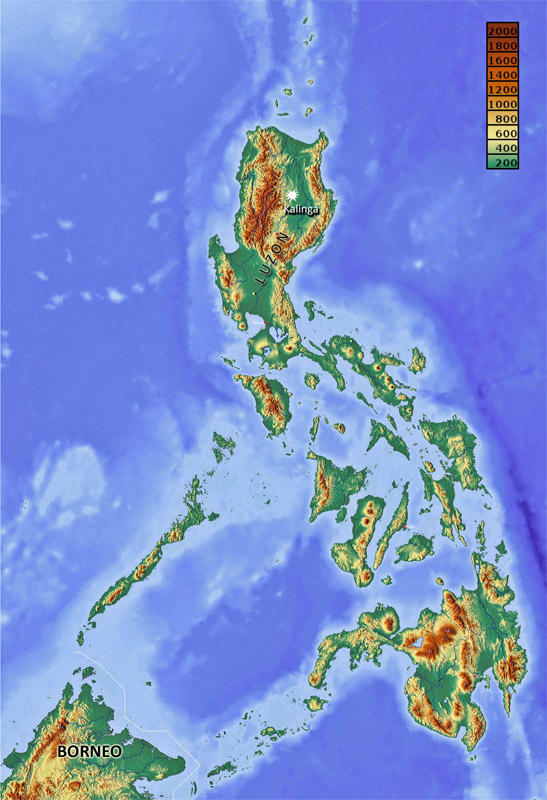
Topography of the Philippines, showing location of the Kalinga site. Palest blue sea may have been above sea level only during extreme glacial maxima. (credit: Wikipedia)
The first hominin fossil found by archaeologists in 2007 was a 67 ka old toe bone (metatarsal) in cave sediments from Northern Luzon. It was undoubtedly from Homo, but which species was unclear. More recent excavations added a mere 12 fossil fragments, probably from three individuals; 7 teeth, 4 adult finger- and toe bones and part of the femur of a juvenile (Détroit, F. and 8 others 2019. A new species of Homo from the Late Pleistocene of the Philippines. Nature, v. 568, p. 181–186; DOI: 10.1038/s41586-019-1067-9). The finger bones, being curved, are unlike those of modern humans and H. erectus. The teeth are even more different; for instance the premolars show two or three roots – ours have but one – and their unusually tiny molars only a single root. The combined features are sufficiently distinct to suggest a separate species (H. luzonensis). The small teeth may indicate that the adults may have been even smaller that the ‘Hobbits’ of Flores and anatomically different.
Like H. floresiensis, as a result of isolation the new human species probably evolved to become small, possibly from very low number of H. erectus original colonisers. But an even stranger possibility is suggested by their curved toe and finger bones. They may have been habitual climbers as much as walkers – unlike us and H. erectus. Could that indicate that their ancestors left Africa already distinct from the rest of Late Pleistocene humans? That is also a disputed hypothesis for the origins of H. floresiensis remains of whom are more complete. Similarly, they pose the issue of how their progenitors managed to get to the archipelago: deliberately by boat or being carried there clinging in desperation to vegetation torn-up by tsunamis and transported seawards by the back-wash.
The New Yorker magazine normally features journalism, commentary, criticism, essays, fiction, satire, cartoons, and poetry. So it is odd that this Condé Nast glossy for the chattering classes snaffled online what may be the geological scoop of the 21st century so far (Preston, D. 2019. The day the dinosaurs died. The New Yorker 8 April 2019 issue). The paper that lies at the centre of the story had not been published and nor had the issue of The New Yorker in which Douglas Preston’s story was scheduled for publication. The very day (29 March 2019) that Britain was thwarted of its Brexit moment the world’s media was frothing with news about the end of another era; the Mesozoic. The paper itself was published online on April Fools’ Day with a title that is superficially arcane (DePalma, R.A. and 11 others 2019. A seismically induced onshore surge deposit at the KPg boundary, North Dakota. Proceedings of the National Academy of Science, early online publication;p DOI: 10.1073/pnas.1817407116). But its contents are the stuff of dreams for any aspiring graduate student of palaeontology; the Indiana Jones opportunity.
An ‘onshore surge deposit’ occurs at many Western Hemisphere sites where the K-Pg boundary outcrops in terrestrial or shallow-marine sediments. The closer to the Chicxulub crater north of Mexico’s Yucatan Peninsula the more obvious they are, for they result from the tsunamis that immediately followed the asteroid impact. Lead author Robert DePalma, now of the University of Kansas, became focussed on the dinosaur-rich, Late Cretaceous Hell Creek Formation of North Dakota as an undergraduate. Accepted for graduate studies he was directed to a project on the fauna of lacustrine sediments close to the K-Pg boundary layer, which is well-known in the area, and that’s what he has been engaged with ever since. In 2012 he was guided to a remarkable locality by a rockhound, disappointed because it exposed extremely fossil-rich sediments but was so soft that none could be extracted intact with a hammer and chisel. It turned out to have resulted from a surge along a sinuous river that had washed debris onto a point-bar deposit at the inside of a meander. The debris includes remains of both marine and terrestrial organisms and shows clear signs of having been swept upriver, i.e. from the sea and possibly the result of a tsunami. Being capped by a thin, iridium-rich layer of impactite, the 1.5 metre surge deposit is part of the K-Pg boundary layer, and probably represented only a few hours before being blanketed by ejecta.
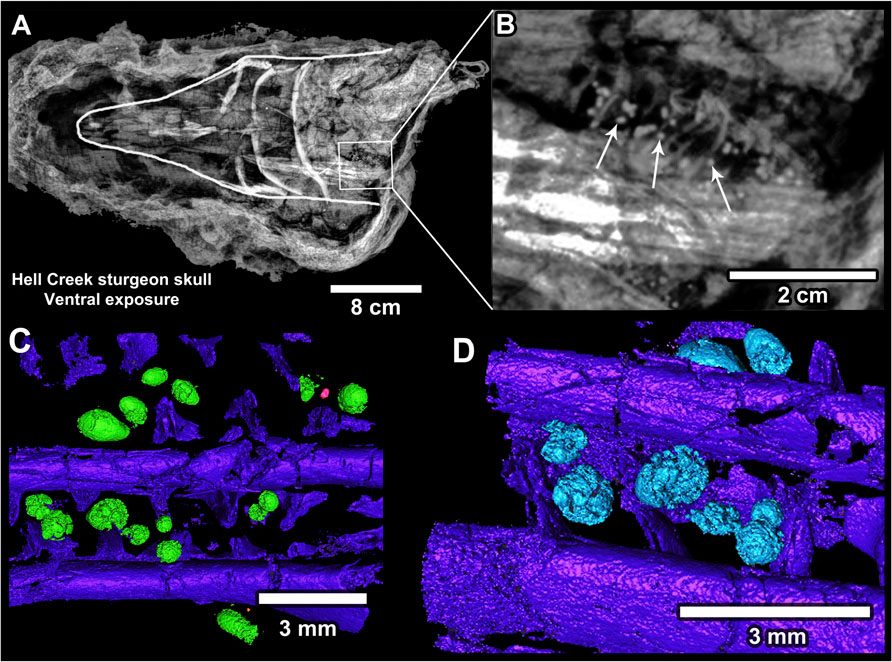
This Event Deposit comprises two graded, fining-upwards units and thus two distinct surges, with a thin mat of vegetation fragments immediately below the Ir-rich clay cap that also contains sparse shocked quartz grains. The Event Deposit contains altered glass spherules throughout, which cgradually become smaller higher in the 1.5 m sequence. Some of the larger spherules produced ‘micro-craters’ in the sediments. Fossils include marine ammonite fragments (some still nacreous) and freshwater fish (paddlefish and sturgeon). The fish are so complete as to suggest an absence of scavengers. The paper itself contains little of the information that dominated Preston’s New Yorker article and the global media coverage. This included clear evidence that the fish ingested spherules, found clogging their gills and possible causing their death. There are examples of spherules embedded in amber formed from plant sap, which suggests sub-aerial fall of ejecta, and among the marine faunal samples are teeth of fish and reptiles (see DePalma et al’s Supplemental Data). The most startling finds reported by Preston are nowhere to be found in DePalma et al’s paper or its supplement. These include possible dinosaur feathers; a fragment of ceratopsian dinosaur skin attached to a hip bone; a burrow containing a mammal jaw that penetrates the K-Pg boundary layer; dinosaur remains, including an egg (complete with embryo) and hatchlings of dinosaurian groups found at deeper levels in the Hell Creek Formation. Previously, palaeontologists had found no dinosaur remains less than 3 m below the K-Pg boundary layer anywhere on Earth, prompting the suggestion that they had become extinct before the near-instantaneous effects of Chicxulub, and were perhaps victims of the general effects of the Deccan Trap volcanism. If verified in later peer-reviewed publications, DePalma et al’s work would help resolve the gradual vs sudden hypotheses for the end-Cretaceous mass extinction.
X-ray and CT images of impact spherules in the gills of a fossil sturgeon from the Tanis K-Pg site, North Dakota (credit DePalma et al. 2019; Fig. 6)
Preston reports some academic scepticism about DePalma’s work, and emphasises his showmanship at conferences; for instance, he named the site ‘Tanis’ after the ancient city in Egypt featured in the 1981 film Raiders of the Lost Ark. There are geophysical queries too. If the inundation was by the on-shore effects of a tsunami it doesn’t tally with the abundance of ejecta fallout of glass spherules: tsunamis propagate in shallow seawater at speeds less than 50 km h-1 and more slowly still in channels, whereas impact ejecta travel much faster. This is acknowledged in the paper’s supplement, and the paper refers to a seiche wave activated by seismic waves associated with the Chicxulub impact which could have arrived in North Dakota at about the same time as its ejecta blanket. The paper’s authorship includes the imprimatur of other authorities in different geoscientific fields, including Walter Alvarez, jointly famed with his father Luis for the discovery of the K-Pg boundary horizon and its impact connections in 1981. So it carries considerable weight. No doubt further comment and further papers on the Tanis site will emerge: DePalma has yet to complete his PhD. It may become the lagerstätte of the K-Pg extinction; in DePalma’s words, ‘It’s like finding the Holy Grail clutched in the bony fingers of Jimmy Hoffa, sitting on top of the Lost Ark.’ …
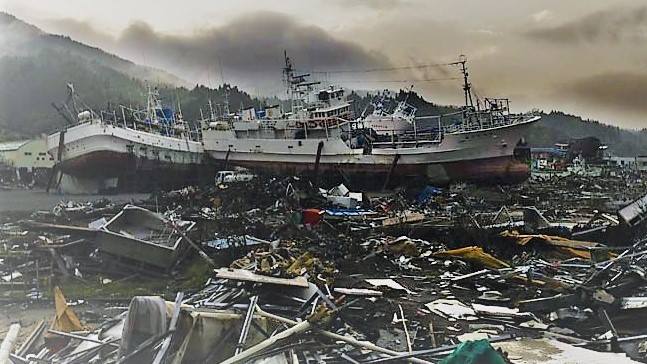
A sign that an earthquake is taking place is pretty obvious: the ground moves. Seismometers are now so sensitive that they record significant seismic events at the far side of the world. The Richter magnitude scale commonly used to assign the power of an event is logarithmic, and the difference between each unit represents an approximately 32-fold change in the energy released at the source, so that a magnitude 6.0 earthquake is 32 times more powerful than one rated as magnitude 5.0. Because seismic motion affects a mass of rock it also perturbs the gravitational field. So, theoretically, gravimeters should also be able to detect an earthquake. Seismic waves travel at a maximum speed of about 6 to 8 km s-1 about 20 times the speed of sound, yet changes in the gravitational field propagate at the speed of light, i.e. almost instantaneously by comparison. The first ground disturbances of the magnitude 9.0 Tohoku-Oki earthquake of NE Japan on 11 March 2011 hit Tokyo about 2 minutes after the event began offshore. Although that is a quite short time it would be sufficient for people to react and significantly reduce the earthquake’s direct impact on many of them. A seismic gravity signal would give that warning. The full horror of Tohoku-Oki was unleashed by the resulting tsunami waves, whose speed in the deep ocean water off Japan was about 800 km hr-1 (0.22 km s-1). An almost real-time warning would have allowed 40 times more time for evasion.
Devastation in NE Japan caused by the Tohoku-Oki tsunami in March 2011
Japan is particularly well endowed with advanced geophysical equipment because of its notorious seismic and volcanic hazards. The first data to be analysed after Tohoku-Oki were understandably those from Japan’s large array of seismometers. The records from two super-sensitive gravimeters, between 436 and 515 km from the epicentre, were examined only recently. These instruments measure variations in gravity as small as a trillionth of the average gravitational acceleration of the Earth using a superconducting sphere suspended in a magnetic field, capable of detecting snow being cleared from a roof. Masaya Kimura and colleagues from Tokyo University and other geoscientific institutes in Japan undertook the analyses of both seismic and gravity data (Kimura, M. et al. 2019. Earthquake‑induced prompt gravity signals identified in dense array data in Japan. Earth Planets and Space, v. 71, online publication. DOI: 10.1186/s40623-019-1006-x). The gravimeter record did show a statistically significant perturbation at the actual time of the earthquake, albeit after complex processing of both gravity and seismographic data.
That only 2 superconducting gravimeters detected the event in real-time is quite remarkable, despite the need for a great deal of processing. It amounts to a test of the concept that such instruments or others based on different designs and deployed more widely may eventually be deployed to give prompt warnings of seismic events that could save thousands.
The base of the Cambrian has long been defined as the level where abundant shelly fossils and most phyla first occur in the stratigraphic record. That increase in diversity led to the nickname ‘Cambrian Explosion’, despite the fact that sheer numbers and diversity of lesser taxa took a long time to rise to ‘revolutionary’ levels. Yet a great deal of animal evolution was going on during the preceding Proterozoic Era that was revealed once palaeobiological research blossomed in rocks of that age range. Today, the earliest occurrences, or at least hints, of quite a few phyla can be traced to the last 100 Ma of the Precambrian. Clearly, the Cambrian Explosion needs a fresh look now that so many data are in. Any palaeontologist would benefit from reading a Perspective article in the latest issue of Nature Ecology & Evolution (Wood, R. and 8 others 2019. Integrated records of environmental change and evolution challenge the Cambrian Explosion. Nature Ecology & Evolution, v. 3, online publication; DOI: 10.1038/s41559-019-0821-6)
Rachel Wood of Edinburgh University and co-authors working elsewhere in Britain, Canada, Japan and Finland sift the growing wealth of fossil and trace-fossil evidence that predate the start of the Cambrian. They also consider the geochemical events that stand out in the Ediacaran Period that succeeds the Snowball Earth events of the Cryogenian. Their account recognises that the geochemical changes – principally a series of carbon-isotope (δ13C) excursions – may have resulted from tectonic changes. The carbon-isotope data mark a series of short-lived penetrations of oxygen-rich conditions deep into the ocean water column and longer periods of oxygen-starved deep water. Such perturbations in oceanic redox conditions ‘speed-up’ thorough the late-Ediacaran into the Cambrian: a profound and protracted transition from the Neoproterozoic world to that of the Phanerozoic. Over the same time span there is a ‘progressive addition of biological novelty’ in the form and function of the evolving biota, so that each successive assemblage builds on the earlier advances.
The fossil evidence suggests that the earliest Ediacaran fauna was metazoan but with no sign of bilaterian affinities (i.e. having ‘heads’ and ‘tails’). The rise of bilaterians of which most animal phyla are members occupied the later Ediacaran , with the first evidence of locomotion – and almost by definition animals with ‘fore’ and ‘aft’ – being around 560 Ma. Each discrete shift from more to less oxic conditions in the oceans seems to have knocked-back animal life, the reverse being accompanied by diversification of survivors. Oxygenation at the very start of the Cambrian marked the beginnings of a diversification clearly manifested by animals capable of biomineralisation and the secretion of hard parts with clear patterns. Such ‘shelly faunas’ are present in the latest Ediacaran sediments but with a multiplicity of seemingly arbitrary forms, although trace fossils suggest soft-bodied animals did have definite morphological pattern.
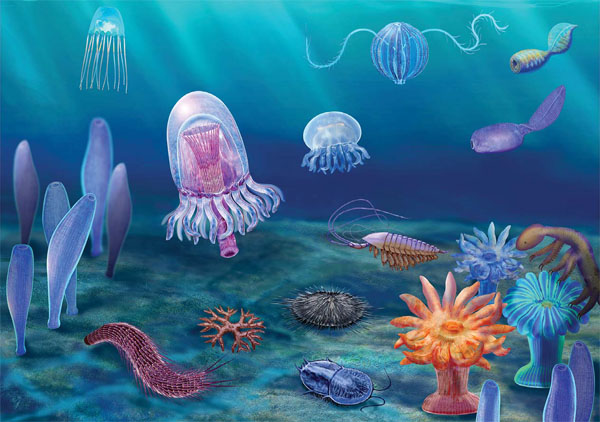
Diorama of the Lower Cambrian Qingjiang fauna (Credit: Fu et al. 2019; Fig 4)
Adding yet more information to early metazoan history is the recently discovered Cambrian Qingjiang lagerstätte of Hubei Province in southern China dated at 518 Ma; similar in its exquisite preservation to the Burgess (508 Ma) and Chengjiang (518 Ma) biotas (Fu, D. and 14 others 2019. The Qingjiang biota—A Burgess Shale-type fossil Lagerstätte from the early Cambrian of South China. Science, v. 363, p. 1338-1342; DOI: 10.1126/science.aau8800). The two previously discovered Cambrian lagerstättes are notable for their very diverse arthropod and sponge faunas. That at Qingjiang adds an abundance of cnidarians, jellyfish, sea anemones, corals and comb jellies, rare in the other two biotas, plus kinorhynchs or mud dragons – moulting invertebrates known only from Cambrian and modern sediments. The fossils at Qingjiang include only about 8% of the taxa of the same age found at Chengjiang, suggesting different environments
The idea of a sudden, discrete explosive event in the history of life, which coincided with the start of the Cambrian, now seems difficult to support. This should not damage the status of 541 Ma as the start of the Phanerozoic because stratigraphy basically gives form to the passage of time and has done since its emergence in the 19th century, so keeping the names of the divisions is essential to continuity.
Because the configuration of continents inevitably affects the ocean currents that dominate the distribution of heat across the face of the Earth, tectonics has a major influence over climate. So too does the topography of continents, which deflects global wind patterns, and that is also a reflection of tectonic events. For instance, a gap between North and South America allowed exchange of the waters of the Pacific and Atlantic Oceans throughout the Cenozoic Era until about 3 Ma ago, at the end of the Pliocene Epoch, although the seaway had long been shallowing as a result of tectonics and volcanism at the destructive margin of the eastern Pacific. That seemingly minor closure transformed the system of currents in the Atlantic Ocean, particularly the Gulf Stream, whose waxing and waning were instrumental in the glacial-interglacial cycles that have persisted for the last 2.5 Ma. This was partly through its northward transport of saltier water formed by tropical evaporation that cooling at high northern latitudes encouraged to sink to form a major component of the global oceanic heat conveyor system. Another example is the rise of the Himalaya following India’s collision with Eurasia that gave rise to the monsoonal system dominating the climate of southern Asia. The four huge climatic shifts to all-pervasive ice-house conditions during the Phanerozoic Eon are not explained so simply: one during the late-Ordovician; another in the late-Devonian; a 150 Ma-long glacial epoch spanning much of the Carboniferous and Permian Periods, and the current Ice Age that has lasted since around 34 Ma. Despite having been at the South Pole since the Cretaceous Antarctica didn’t develop glaciers until 34 Ma. So what may have triggered these four major shifts in global climate?
Five palaeoclimatologists from the University of California and MIT set out to find links, starting with the most basic parameter, how atmospheric greenhouse gases might have varied. In the long term CO2 builds up through its emission by volcanoes. It is drawn down by several geological processes: burial of carbon and carbonates formed by living processes; chemical weathering of silicate minerals by CO2 dissolved in water, which forms solid calcium carbonate in soil and carbonate ions in seawater that can be taken up and buried by shell-producing organisms. Rather than comparing gross climate change with periods of orogeny and mountain building, mainly due to continent-continent collisions, they focused on zones that preserve signs of subduction of oceanic lithosphere – suture zones (Macdonald,F.A. et al. 2019. Arc-continent collisions in the tropics set Earth’s climate state. Science, v. 363 (in press); DOI: 10.1126/science.aav5300 ). Comparing the length of all sutures active at different times in the Phanerozoic with the extent of continental ice sheets there is some correlation between active subduction and glaciations, but some major misfits. Selecting only sutures that were active in the tropics of the time – the zone of most intense chemical weathering – results in a far better tectonic-climate connection. Their explanation for this is not tropical weathering of all kinds of exposed rock but of calcium- and magnesium-rich igneous rocks; basaltic and ultramafic rocks. These dominate oceanic lithosphere, which is exposed to weathering mainly where slabs of lithosphere are forced, or obducted, onto continental crust at convergent plate margins to form ophiolite complexes. The Ca- and Mg-rich silicates in them weather quickly to take up CO2 and form carbonates, especially in the tropics. Through such weathering reactions across millions of square kilometres the main greenhouse gas is rapidly pulled out of the atmosphere to set off global cooling.
Top – variation in the total length of active, ophiolite-bearing sutures during the Phanerozoic; middle – length of such sutures in the tropics; bottom – extent of Phanerozoic glaciers. (Credit: Macdonald et al. 2019; Fig.2
Rather than the climatic influence of tectonics through global mountain building, the previous paradigm, Macdonald and colleagues show that the main factor is where subduction and ophiolite obduction were taking place. In turn, this very much depended on the configuration of continents on which ophiolites can be preserved. The most active period of tectonics during the Mesozoic, as recorded by the global length of sutures, was at 250 Ma – the beginning of the Triassic Period – but they were mainly outside the tropics, when there is no sign of contemporary glaciation. During the Ordovician, late-Devonian and Permo-Carboniferous ice-houses active sutures were most concentrated in the tropics. The same goes for the build-up to the current glacial epoch.
As shown by oxygen-isotope records from marine sediments, before about 1.25 Ma global climate cycled between cold and warm episodes roughly every 41 ka. Between 1.25 to 0.7 Ma these glacial-interglacial pulses lengthened to the ~100 ka periods that have characterised the last seven cycles that were also marked by larger volume of Northern Hemisphere ice-sheet cover during glacial maxima. Both periodicities have been empirically linked to regular changes in the Earth’s astronomical behaviour and their effects on the annual amount of energy received from the Sun, as predicted by Milutin Milankovich. As long ago as 1976 early investigation of changes of oxygen isotopes with depth in deep-sea sediments had revealed that their patterns closely matched Milankovich’s hypothesis. The 41 ka periodicity matches the rate at which the Earth’s axial tilt changes, while the ~100 ka signal matches that for variation in the eccentricity of Earth’s orbit. 19 and 24 ka cycles were also found in the analysis that reflect those involved in the gyroscope-like precession of the axis of rotation. Surprisingly, the 100 ka cycling follows by far the weakest astronomical effect on solar warming yet the climate fluctuations of the last 700 ka are by far the largest of the last 2.5 million years. In fact the 2 to 8 % changes in solar heat input implicated in the climate cycles are 10 times greater than those predicted even for times when all the astronomical influences act in concert. That and other deviations from Milankovich’s hypothesis suggest that some of Earth’s surface processes act to amplify the astronomical drivers. Moreover, they probably lie behind the mid-Pleistocene transition from 41 to 100 ka cyclicity. What are they? Changes in albedo related to ice- and cloud cover, and shifts in the release and absorption of carbon dioxide and other greenhouse gases are among many suggested factors. As with many geoscientific conundrums, only more and better quality data about changes recorded in sediments that may be proxies for climatic variations are likely to resolve this one.
Adam Hazenfratz of ETH in Zurich and colleagues from several other European countries and the US have compiled details about changing surface- and deep-ocean temperatures and salinity – from δ18O and Mg/Ca ratios in foraminifera shells from a core into Southern Ocean-floor sediments – that go back 1.5 Ma (Hazenfratz, A.P. and 9 others 2019. The residence time of Southern Ocean surface waters and the 100,000-year ice age cycle. Science, v. 363, p. 1080-1084; DOI: 10.1126/science.aat7067). Differences in temperature and salinity (and thus density) gradients show up at different times in this critical sediment record. In turn, they record gross shifts in ocean circulation at high southern latitudes that may have affected the CO2 released from and absorbed by sea water. Specifically, Hazenfratz et al. teased out fluctuations in the rate of mixing of dense, cold and salty water supplied to the Southern Ocean by deep currents with less dense surface water. Cold, dense water is able to dissolve more CO2 than does warmer surface water so that when it forms near the surface at high latitudes it draws down this greenhouse gas from the atmosphere and carries it into long-term storage in the deep ocean when it sinks. Deep-water formation therefore tends to force down mean global surface temperature, the more so the longer it resides at depth. When deep water wells to the surface and warms up it releases some of its CO2 content to produce an opposite, warming influence on global climate. So, when mixing of deep and surface waters is enhanced the net result is global warming, whereas if mixing is hindered global climate undergoes cooling.
The Southern Ocean, where most dissolved and gaseous carbon dioxide are emitted and absorbed by seawater (Credit: British Antarctic Survey)
The critical factor in the rate of mixing deep with surface water is the density of that at the surface. When its salinity and density are low the surface water layer acts as a lid on what lies beneath, thereby increasing the residence time of deep water and the CO2 that it contains. This surface ‘freshening’ in the Southern Ocean seems to have begun at around 1.25 Ma and became well established 700 ka ago; that is, during the mid-Pleistocene climate transition. The phenomenon helped to lessen the greenhouse effect after 700 ka so that frigid conditions lasted longer and more glacial ice was able to accumulate, especially on the northern continents. This would have made it more difficult for the 41 ka astronomically paced changes in solar heating to have restored the rate of deep-water mixing to release sufficient CO2 to return the climate to interglacial conditions That would lengthen the glacial-interglacial cycles. The link between the new 100 ka cyclicity and very weak forcing by the varying eccentricity of Earth’s orbit may be fortuitous. So how might anthropogenic global warming affect this process? Increased melting of the Antarctic ice sheet may further freshen surface waters of the Southern Ocean, thereby slowing its mixing with deep, CO2-rich deep water and the release of stored greenhouse gases. As yet, no process leading to the decreased density of surface waters between 1.25 and 0.7 Ma has been suggested, but it seems that something similar may attend global warming.
Predictably, the dialogue between the supporters of the Deccan Trap flood basalts and the Chicxulub impact as triggers that were responsible for the mass extinction at the end of the Mesozoic Era (the K-Pg event) continues. A recent issue of Science contains two new approaches focussing on the timing of flood basalt eruptions in western India relative to the age of the Chicxulub impact. One is based on dating the lavas using zircon U-Pb geochronology (Schoene, B. et al. 2019. U-Pb constraints on pulsed eruption of the Deccan Traps across the end-Cretaceous mass extinction. Science, v. 363, p. 862-866; DOI: 10.1126/science.aau2422), the other using 40Ar/39Ar dating of plagioclase feldspars (Sprain, C.G. et al. 2019. The eruptive tempo of Deccan volcanism in relation to the Cretaceous-Paleogene boundary. Science, v. 363, p. 866-870; DOI: 10.1126/science.aav1446). Both studies were initiated for the same reason: previous dating of the sequence of flows in the Deccan Traps was limited by inadequate sampling of the flow sequence and/or high analytical uncertainties. All that could be said with confidence was that the outpouring of more than a million cubic kilometres of plume-related basaltic magma lasted around a million years (65.5 to 66.5 Ma) that encompassed the sudden extinction event and the possibly implicated Chicxulub impact. The age of the impact, as recorded by its iridium-rich ejecta found in sediments of the Denver Basin in Colorado, has been estimated from zircon U-Pb data at 66.016 ± 0.050 Ma; i.e. with a precision of around 50 thousand years.
The Deccan Traps in the Western Ghats of India (Credit: Wikipedia)
Because basalts rarely contain sufficient zircons to estimate a U-Pb age of their eruption, Blair Schoene and colleagues collected them from palaeosols or boles that commonly occur between flows and sometimes incorporate volcanic ash. Their data cover 23 boles and a single zircon-bearing basalt. Sprain et al. obtained 40Ar/39Ar ages from 19 flows, which they used to supplement 5 ages obtained by their team in previous studies that used the same analytical methods and 4 palaeosol ages from an earlier paper by Schoene’s group.
The zircon U-Pb data from palaeosols, combined with estimates of magma volumes that contributed to the lava sequence between each dated stratigraphic level, provide a record of the varying rates at which lavas accumulated. The results suggest four distinct periods of high-volume eruption separated by long. periods of relative quiescence. The second such pulse precedes the K-Pg event by up to 100 ka, the extinction and impact occurring in a period of quiescence. A few tens of thousand years after the event Deccan magmatism rose to its maximum intensity. Schoene’s group consider that this supports the notion that both magmatism and bolide impact drove environmental deterioration that culminated in mass extinction.
The Ar-Ar data derived from the basalt flows themselves, seem to tell a significantly different story. A plot of basalt accumulation, similarly derived from dating and stratigraphy, shows little if any sign of major magmatic pulses and periods of quiescence. Instead, Courtney Sprain’s team distinguish an average eruption rate of around 0.4 km3 per year before the K-Pg event and 0.6 km3 per year following it. Yet they observe from climate proxy data that there seems to have been only minor climatic change (about 2 to 3 °C warming) during the period around and after the K-Pg event when some 75% of the lavas flooded out. Yet during the pre-extinction period of slower effusion global temperature rose by 4°C then fell back to pre-eruption levels immediately before the K-Pg event. This odd mismatch between magma production and climate, based on their data, prompts Sprain et al. to speculate on possible shifts in the emission of climate-changing gases during the period Deccan volcanism: warming by carbon dioxide – either from the magma or older carbon-rich sediments heated by it; cooling induced by stratospheric sulfate aerosols formed by volcanogenic SO2 emissions. That would imply a complex scenario of changes in the composition of gas emissions of either type. They suggest that one conceivable trigger for the post-extinction climate shift may have been exhaustion of the magma source’s sulfur-rich volatile content before the Chicxulub impact added enough energy to the Earth system to generate the massive extrusions that followed it. But their view peters out in a demand for ‘better understanding of [the Deccan Traps’] volatile release’.
A curious case of empiricism seeming to resolve the K-Pg conundrum, on the one hand, yet pushing the resolution further off, on the other …
We have become accustomed to thinking that up to 90% of organisms were snuffed out by the catastrophe at the Permian-Triassic boundary 252 Ma ago. Those are the figures for marine organisms, whose record in sediments is the most complete. It has also been estimated to have lasted a mere 60 ka, and the recovery in the Early Triassic to have taken as long as 10 Ma. There are hints of three separate pulses of extinction related to: initial gas emission from the Siberian Traps; coal fires; and release of methane from sea-floor gas hydrates at the peak of global warming. Various terrestrial sequences record the collapse of dense woodlands, so that the Early Triassic is devoid of coals that are widespread in the preceding Late Permian. A new detailed study of terrestrial sediments in the Sydney Basin of eastern Australia reveals something new (Fielding, C.R. and 10 others 2019. Age and pattern of the southern high-latitude continental end-Permian extinction constrained by multiproxy analysis. Nature Communications, v. 10, online publications: DOI: 10.1038/s41467-018-07934-z).
The distinctive, tongue-like form of Glossopteris leaves that dominate the coal-bearing Permian strata of the southern coninents. Their occurrence in South America, Africa, India, Australia, New Zealand, and Antarctica prompted Alfred Wegener to suggest that these modern continents had been united in Pangaea by Permian times: a key to continental drift. (Credit: Getty Images)
Christopher Fielding or the University of Nebraska-Lincoln and colleagues focused on pollens, geochemistry and detailed dating of the sedimentary succession across the P-Tr boundary exposed on the New South Wales coast. The stratigraphy is intricately documented by a 1 km deep well core that penetrates a more or less unbroken fluviatile and deltaic sequence that contains eleven beds of volcanic ash. The igneous layers are key to calibrating age throughout the sequence (259.10 ± 0.17 to 247.87 ± 0.11 Ma using zircon U-Pb methods). The pollens change abruptly from those of a Permian flora, dominated by tongue-like glossopterid plants, to a different association that includes conifers. The change coincides with a geochemical ‘spike’ in the abundance of nickel and a brief change in the degree of alteration of detrital fledspars to clay minerals. The first implicates the delivery of massive amounts of nickel to the atmosphere, probably by the eruption of the Siberian Traps , which contain major economic nickel deposits. The second feature suggests a brief period of warmer and more humid climatic conditions. A third geochemical change is the onset of oscillations in the abundance of 13C that are thought to record major changes in plant life across the planet. These features would have been an easily predicted association with the 252 Ma mass extinction were it not for the fact that the radiometric dating places them about 400 thousand years before the well-known changes in global animal life. Detailed dating of the Siberian Traps links the collapse of Glossopteris and coal formation to the earliest extrusion of flood basalts, which suggests that the animal extinctions were driven by cumulative effects of the later outpourings
More than 50 years ago a group of schoolchildren discovered a fronded fossil (Charnia) in the Precambrian rocks of Charnwood Forest in the English Midlands. Since then it has been clear that multicellular life originated before the Cambrian Period, when the first tangible life had previously been considered to have emerged. Discovery of the rich Ediacaran fauna of quilted, baglike and disc-like animals in 635 Ma old Neoproterozoic sediments in South Australia, and many other occurrences re-established the start of the ‘carnival of animals’ in the Ediacaran Period (635 to 541 Ma). It happened to follow the climatic and environmental turmoil of at least two Snowball Earth episodes during the preceding Cryogenian Period (850 to 635 Ma), which has led to a flurry of suggestions for the transition from protozoan to metazoan life. Yet, applying a ‘molecular-clock’ approach to the genetic differences between living metazoan organisms seems to suggest a considerable earlier evolutionary event that started ‘life as we know it’. That may have been confirmed by a discovery in much older sediments in Gabon, West Africa.
A sequence of shallow-marine sediments in the Francevillian Series in Gabon was laid down at a time of fluctuating sea level around 2100 Ma ago, when the upper oceans had become oxygenated. In them are black shales that preserve an abundance of intricate sedimentary features. Among them are curious stringy structures rich in crystalline pyrite (Fe2S). They are infilled wiggly tubes that lie in the shale bedding. CT scans reveal that the bedding has been flattened around the tubules as it became lithified. So the tubes formed while the sediment was wet and soft (El Albani, A. and 22 others 2019. Organism motility in an oxygenated shallow-marine environment 2.1 billion years ago. Proceedings of the National Academy of Sciences, online preprint; DOI: 10.1073/pnas.1815721116). They look very like burrows. Up to 5 mm across, they can be considered large by comparison with almost all organisms known from that time. The exception comes from the same stratigraphic Series in Gabon. In 2010, El Albani and colleagues published an account of fossils preserved by pyrite that look like fried eggs, 1 to 2 cm across, with scalloped edges. Internal structures revealed by CT scanning include radial slits in the ‘whites’ and folding within the central ‘yolk’. That paper reported the geochemical presence in the host shales of steranes, which are breakdown products of steroids that are unique to eukaryotes. Could these organisms and the wiggly tube-like trace fossils indicate the presence of the earliest metazoans in the Francevillian Series?
Palaeoproterozoic fossils from the Francevillian Series in Gabon. Top: greytone photographs of burrow-like trace fossils (Credit: El Albani et al. 2019; Fig.1). Bottom: colour photograph and 3 CT scans of discoidal fossil (Credit: El Albani et al. 2010; Fig. 4).
Until the discoveries in Gabon, the oldest organic structure that had been suggested to be a metazoan was the rare Grypania, a spiral, strap-like fossil found in a variety of strata ranging in age from 1870 to 650 Ma. Being made of a structureless ribbon of graphite, Grypania seems most likely to have been made by colonial bacteria. The two Gabon life forms cannot be disposed of quite so easily. The discoids have organised structures rivalling those in Ediacaran animals, while the wiggly tubes clearly seem to indicate something capable of movement. In both cases preservation is by iron sulfide, which suggests the presence at some stage of chemo-autotrophic bacteria that reduce sulfate ions to sulfide. Could these not have formed mats taking up irregular discs and plates? The burrows may have been formed by unicellular eukaryotes, one type of which – the slime moulds – is capable of aggregating together to form multi-celled reproductive structures as well as living freely as single amoeba. Some form slug-like masses that are capable of movement; not metazoans, but perhaps their precursors.
Denisova Cave was named to commemorate an 18th century hermit called Denis, who used it as his refuge. The culmination of more than four decades of excavation, which followed the discovery there of Mousterian and Levallois tools there, has been the explosion onto the palaeoanthropological scene of Denisovan genomics, beginning in 2010 with sequenced DNA from a child’s finger bone. The same layer yielded Neanderthal DNA from a toe bone in 2013. Another layer yielded similar evidence in 2018 of an individual who had a Neanderthal father and a Denisovan mother. Application of the new technique of peptide mass fingerprinting, or zooarchaeology by mass spectrometry (ZooMS), to small, unidentifiable bone fragments from the cave sediments revealed further signs of Denisovan occupation and the first trace of anatomically modern humans (AMH). So far the tally is 4 Denisovans (two female children and two adult males), a Neanderthal woman and the astonishing hybrid. Analyses of the sediments themselves showed traces of both Neanderthal and Denisovan mtDNA from deeper in the stratigraphy than levels in which human fossils had been found, but which contained artefacts. The discovery of the first Denisovan DNA revealed that AMH migrants from Africa who reached the West Pacific islands about 65 ka ago carried fragments of that genome. As well as hybridising with Neanderthals some of the people who left Africa had interbred with Denisovans sufficiently often for genetic traces to have survived. Yet, until now, the ages of the analysed samples from the cave remained unknown.
That is no surprise for two reasons: cave sediments are complex, having been reworked over millennia to scramble their true stratigraphy; most of the organic remains defied 14C dating, being older than its maximum limit of determination. However, using alternative approaches has resulted in two papers in the latest issue of Nature. The first reports results from two methods that rely on the luminescence of grains of quartz and feldspar when stimulated, which measures the time since they were last exposed to light (Jacobs, Z. and 10 others 2019. Timing of archaic hominin occupation of Denisova Cave in southern Siberia. Nature, v. 565, p. 594-599; DOI: 0.1038/s41586-018-0843-2). Over 280 thousand grains in 103 sediment samples from different depths and various parts of the cave system have yielded a range of ages from 300 to 20 ka that span 3 glacial-interglacial cycles except for a few gaps, giving rough estimates of the timing of hominin occupation shown by fossils and soil layers that contain DNA. The youngest evidence for Denisovans is shown to be roughly 50 ka; a time when AMH was present elsewhere in Siberia. They lived at a time halfway between the 130 ka interglacial and the last glacial maximum. Two Neanderthals, a Denisovan and the hybrid occupied the site during the 130 ka interglacial. Soils from the previous warm episode from 250 to 200 ka contain both Neanderthal and Denisovan DNA traces. The oldest occupancy, marked by the presence of a Denisovan bone sample, was 300 ka ago, once again midway between an interglacial and a glacial maximum.
All the hominin remains found in Denisova Cave: Note the common scale. (Credit: Douka et al. 2019; extended data Figure 1)
The second paper (Douka, K. and 21 others 2019. Age estimates for hominin fossils and the onset of the Upper Palaeolithic at Denisova Cave. Nature, v. 565, p. 640–644; DOI: 10.1038/s41586-018-0870-z) focused on direct dating of the hominin fossils themselves – and thus their DNA content, important in trying to piece together timings of genetic mixing. In the absence of radiocarbon dates from the bones themselves because of most specimens’ >50 ka ages, except in the case of the youngest whose 14C age is at the 50 ka limit. They resorted to a hybrid technique based on a means of modelling fossils’ ages from differences in mtDNA between the specimens and that in the youngest hominin, which, luckily, was dateable by radiocarbon means. Weighted by dating of the actual sediments that contain them, the differences should become greater for successively older fossils because of random mutations: a variant of the ‘molecular clock’ approach. It’s complicated and depends on assuming that mitochondrial mutation rate was the same as that in modern humans. Unsurprisingly the results are imprecise, but sufficient to match the hominin fossil occurrences with different environmental conditions
Pollen grains and vertebrate fossils from various levels in the cave system demonstrate the wide climatic and ecological conditions in which the various hominins lived. The warmest episodes supported broad-leafed forest, offering maximum resources for hominin survival. Those between interglacial and full glacial conditions were much less benign, with alternating dry and wet cold conditions that supported open steppe ecosystems. The oldest Denisovan occupation was at the close of a period of moderately warm and humid conditions that supported mixed conifer and broad-leafed trees that gave way to reduced tree cover.
As well as the presence of stone tools sporadically through the sedimentary sequence, in the youngest levels there are bone rings and pendants made from deer teeth; clearly ornamental items. Did the late Denisovans make them or do they signify anatomically modern human activity? Radiocarbon ages do not give a concrete answer, one of the pendants is about 45 ka old with an error that puts it just within the range of age variation of the oldest Denisovan fossil. No AMH remains have been found in Denisova Cave, but remains of a modern human male have been found at Ust’-Ishim, in NW Siberia. At 45 ka, he represents the earliest arrival of AMH in northern Asia. So it may have been members of this new population that left ornaments in Denisova, but, for the moment, artistic Denisovans are a possibility.
Further deployment of rapid screening for hominin bone fragments using the ZooMS method and analyses for traces of DNA in soils is likely to expand the geographic and time ranges of Denisovans and other close human relatives. Denisova Cave formed in Silurian limestones of the Altai Range, and there are other caves in those hills …
Related article: Dennel, R. 2019. Dating of hominin discoveries at Denisova. Nature, v. 565, p. 571-572; DOI: 10.1038/d41586-019-00264-0)
Massive open online courses (MOOCs for short) first mooted in 2006, surfaced with something of a pop in 2012. Intended to be open to all with Internet access, they promised a renaissance of higher education with the ’best’ professors, educational technologies and materials, flexibility, innovative assessment and accreditation (if chosen), no entry requirements, and very low cost at a time of relentlessly rising fees for conventional study. And they did not require attendance, although certificates of successful completion may be a currency for acceptance in conventional HE. They could be about literally anything at a variety of levels and involving a range of study times. By the end of 2016 MOOC programs had been set up by more than 700 universities worldwide, and around 58 million students had signed up to one of more courses. The general business model is described as ‘freemium’; i.e. a pricing strategy whereby a product or service is provided free of charge, with a premium charged for certification. There are innumerable variants of this model. The top providers are mainly consortia linking several universities and other academic and cultural entities. Futurelearn, although wholly owned by the formerly world-leading distance-learning distributor the British Open University, has 157 partners in Britain and globally. Its venture into the field involved its investing several tens of million UK pounds at start-up, which some believe was the source of its current financial difficulties.
The 11 January issue of Science published a brief account of the fortunes of a range of MOOC providers (Reich, J. & Ruipérez, J.A. 2019. The MOOC pivot. Science, v. 363, p. 130-131; DOI: 10.1126/science.aav7958) using data from edX that links Harvard University and MIT. The vast majority of learners who chose MOOCs never return after their first year. Growth in the market is concentrated almost entirely in affluent countries, whereas the model might seem tailor-made, and indeed vital, for less fortunate parts of the world. Completion rates are very low indeed, largely as a result of poor retention: since 2012 drop-out rates in the first year are greater than 80%. In the data used in the study both enrollments and certifications from 2012 to last year rose to peaks in the first three years (to 1.7 million and 50 thousand respectively) then fell sharply in the last two years (to <1 million and <20 thousand, respectively). Whatever the ‘mission’ of the providers – was it altruistic or seeking a revenue stream? – the MOOC experience seems to be falling by the wayside. Perhaps many students took MOOCs for self-enlightenment rather than for a credential, as their defenders maintain. Well, the figures suggest that few saw fit to continue the experience. Surely, if knowledge was passed on at a level commensurate with participants requirements in a manner that enthused them, a great many would have signed up for ‘more of the same’: clearly that didn’t happen.
The authors conclude with, ‘Dramatic expansion of educational opportunities to underserved populations will require political movements that change the focus, funding, and purpose of higher education; they will not be achieved through new technologies alone.’
The nickel in stainless steel, the platinum in catalytic converters and the gold in jewellery, electronic circuits and Fort Knox should all be much harder to find in the Earth’s crust. Had the early Earth formed only by accretion and then the massive chemical resetting mechanism of the collision that produced the Moon all three would lie far beyond reach. Both formation events would have led to an extremely hot young Earth; indeed the second is believed to have left the outer Earth and Moon completely molten. All three are siderophile metals and have such a strong affinity for metallic iron that they would mostly have been dragged down to each body’s core as it formed in the early few hundred million years of the Earth-Moon system, leaving very much less in the mantle than rock analyses show. This emerged as a central theme at the Origin of Life Conference held in Atlanta GA, USA in October 2018. The idea stemmed from two papers published in 2015 that reported excessive amounts in basaltic material from both Earth and Moon of a tungsten isotope (182W) that forms when a radioactive isotope of hafnium (182Hf), another strongly siderophile metal, decays. Hafnium too must have been strongly depleted in the outer parts of both bodies when their cores formed. The excesses are explained by substantial accretion of material rich in metallic iron to their outer layers shortly after Moon-formation, some being in large metallic asteroids able to penetrate to hundreds of kilometres. Hot iron is capable of removing oxygen from water vapour and other gases containing oxygen, thereby being oxidised. The counterpart would have been the release of massive amounts of hydrogen, carbon and other elements that form gases when combined with oxygen. The Earth’s atmosphere would have become highly reducing.
Had the atmosphere started out as an oxidising environment, as thought for many decades, it would have posed considerable difficulties for the generation at the surface of hydrocarbon compounds that are the sine qua non for the origin of life. That is why theories about abiogenesis (life formed from inorganic matter) hitherto have focussed on highly reducing environments such as deep-sea hydrothermal vents where hydrogen is produced by alteration of mantle minerals. The new idea revitalises Darwin’s original idea of life having originated in ‘a warm little pond’. How it has changed the game as regards the first step in life, the so-called ‘RNA World’ can be found in a detailed summary of the seemingly almost frenzied Origin of Life Conference (Service, R.F. 2019. Seeing the dawn. Science, v. 363, p. 116-119; DOI: 10.1126/science.363.6423.116).
Isotope geochemistry has also entered the mix in other regards, particularly that gleaned from tiny grains of the mineral zircon that survived intact from as little as 70 Ma after the Moon-forming and late-accretion events to end up (3 billion years ago) in the now famous Mount Narryer Quartzite of Western Australia. The oldest of these zircons (4.4 Ga) suggest that granitic rocks had formed the earliest vestiges of continental crust far back in the Hadean Eon: Only silica-rich magmas contain enough zirconium for zircon (ZrSiO4) to crystallise. Oxygen isotope studies of them suggest that at that very early date they had come into contact with liquid water, presumably at the Earth’s surface. That suggests that perhaps there were isolated islands of early continental materials; now vanished from the geological record. A 4.1 Ga zircon population revealed something more surprising: graphite flakes with carbon isotopes enriched in 12C that suggests the zircons may have incorporated carbon from living organisms.
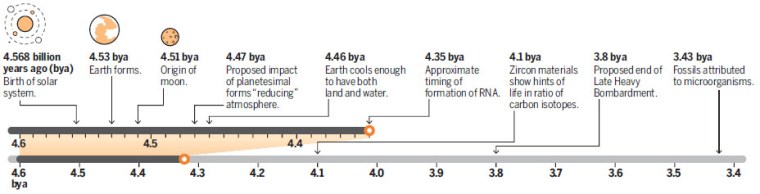
A possible timeline for the origin of life during the Hadean Eon (Credit: Service, R.F. 2019, Science)
Such a suite of evidence has given organic chemists more environmental leeway to suggest a wealth of complex reactions at the Hadean surface that may have generated the early organic compounds needed as building blocks for RNA, such as aldehydes and sugars (specifically ribose that is part of both RNA and DNA), and the amino acids forming the A-C-G-U ‘letters’ of RNA, some catalysed by the now abundant siderophile metal nickel. One author seems gleefully to have resurrected Darwin’s ‘warm little pond’ by suggesting periodic exposure above sea level of abiogenic precursors to volcanic sulfur dioxide that could hasten some key reactions and create large masses of such precursors which rain would have channelled into ‘puddles and lakes’. The upshot is that the RNA World precursor to the self-replication conferred on subsequent life by DNA is speculated to have been around 4.35 Ga, 50 Ma after the Earth had cooled sufficiently to have surface water dotted with specks of continental material.
There are caveats in Robert Services summary, but the Atlanta conferences seems set to form a turning point in experimental palaeobiology studies.
Because it is so geologically active the Earth progressively erases signs of asteroid and comet impacts, by erosion, burial or even subduction in the case of the oceanic record. As a result, the number of known craters decreases with age. To judge the influence of violent extraterrestrial events in the past geologists therefore rely on secondary outcomes of such collisions, such as the occasional presence in the sedimentary record of shocked quartz grains, glassy spherules and geochemical anomalies of rare elements. The Moon, on the other hand, is so geologically sluggish that its surface preserves many of the large magnitude impacts during its history, except for those wiped out by later such events. For instance, a sizeable proportion of the lunar surface comprises its dark maria, which are flood basalts generated by gigantic impacts around 4 billion years ago. Older impacts can only be detected in its rugged, pale highland terrains, and they have been partially wiped out by later impact craters. The Moon’s surface therefore preserves the most complete record of the flux and sizes of objects that have crossed its orbit shared with the Earth.
The Earth presents a target thirteen times bigger than the cross sectional area of the Moon so it must have received 13 times more impacts in their joint history. Being about 81 times as massive as the Moon its stronger gravitational pull will have attracted yet more and all of them would have taken place at higher speeds. The lunar samples returned by the Apollo Missions have yielded varying ages for impact-glass spherules so that crater counts combined with evidence for their relative ages have been calibrated to some extent to give an idea of the bombardment history for the Earth Moon System. Until recently this was supposed to have tailed off exponentially since the Late Heavy Bombardment between 4.0 to 3.8 billion years ago. But the dating of the lunar record using radiometric ages of the small number of returned samples is inevitably extremely fuzzy. A team of planetary scientists from Canada, the US and Britain has developed a new approach to dating individual crater using image data from NASA’s Lunar Reconnaissance Orbiter (LRO) launched in 2009 (Mazrouei, S. et al. 2019. Earth and Moon impact flux increased at the end of the Paleozoic. Science, v. 363, p. 253-257; DOI: 10.1126/science.aar4058).
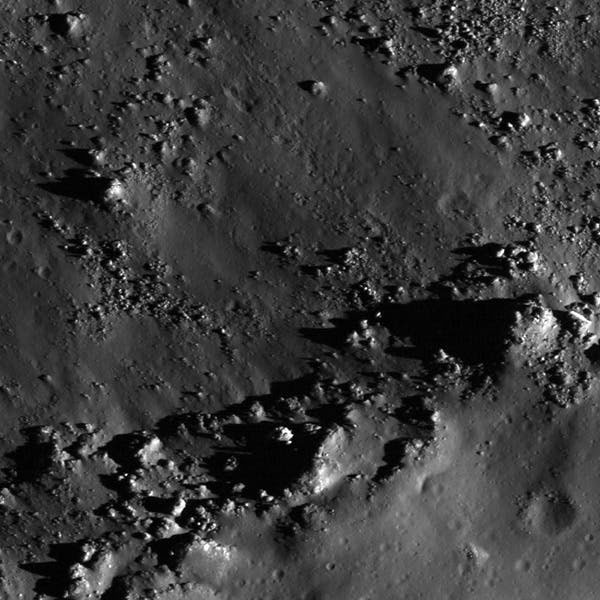
The method that they devised is, curiously, based on thermal imagery from the LRO’s Diviner instrument which records the Moon’s surface temperature. Comparison of day- and night-time temperatures produces a measure of surface materials’ ability to retain heat known as thermal inertia. A material with high thermal inertia stays warmer for longer at night. When a crater forms it partly fills with rock fragments excavated by the impact. When fresh these are full of large blocks of rock that were too massive to be blasted away. But these blocks are exposed to bombardment by lesser projectiles for the lifetime of the crater, which steadily reduces them to smaller fragments and eventually dust. Blocks of solid rock retain significantly more solar heat than do gravelly to dust-sized materials: thermal inertia of the crater floor therefore decreases steadily with age.
Blocky surface of a relatively young lunar crater (Credit: NASA)
As well as day- and night thermal data provided by the Diviner instrument, from which thermal inertia values are calculated, the LRO deploys two cameras that capture black and white images of the surface in the visible range, with a resolution of about a metre. They enable the blockiness of crater floors to be estimated. Sara Mazrouei and colleagues measured blockiness and thermal inertia of the floors of 111 craters more than 10 km across, ages of nine of which had been modelled independently using counts of smaller craters that subsequently accumulated on their floors shown by even finer resolution images from the Japanese Kaguya orbiter. Their results are surprising. About 290 Ma ago the rate of large impacts on the Moon increased by a factor of 2.6. This might explain why the Neoproterozoic and Palaeozoic Eras are deficient in terrestrial craters. Another inference from the results is that the number of objects in Earth-crossing orbits suddenly increased at the end of the Carboniferous. Maybe that resulted from an episode of collisions and break-up of large bodies in the Asteroid Belt or, perhaps, some kind of gravitational perturbation by Jupiter. The age-distribution of large craters on Earth is no help because of their ephemeral nature. Moreover, apart from Chicxulub that is bang on the K-Pg boundary, there is little evidence of an increase in impact-driven mass extinctions in the Mesozoic and Cenozoic. Nor for that matter did igneous activity or sediment deposition undergo any sudden changes. There are sediments that seem to have formed as a result of tsunami devastation, but none greater in magnitude than could have been caused by major earthquakes. Or … maybe geologists should have another look at the stratigraphic record.
The rift systems of Ethiopia, Kenya and Tanzania, and the limestone caverns near Johannesburg, South Africa have a long history of intensive archaeological study, rewarded by many finds of hominin skeletal remains and artifacts over the last century. Each region lays claim to be the birthplace of humans, that in South Africa being grandiloquently dubbed ‘The Cradle of Humankind’. Of course, the realistic chances of making discoveries and careers draws scientists and funds back to these regions again and again: a kind of self-fulfilling prophesy fueled by the old miners’ adage, ‘to find elephants you must go to elephant country’. The key site for the earliest stone tools was for a long time Tanzania’s Olduvai Gorge, thanks to finds of deliberately shaped choppers, hammer stones and sharp edges from about 2 Ma ago in close association with remains of Homo habilis by the Leakeys. Termed ‘Oldowan’, signs of this industry emerged from 2.6 Ma sediments in the Afar Depression of Ethiopia in 2010, but with no sign of who had made them. By 2015 the cachet of ‘first tools’ moved to Lomekwi on the shore of Lake Turkana in Kenya, dated to 3.3 Ma but again with no evidence for a maker. In fact the oldest evidence for the use of tools emerged with the 2010controversial discovery at Dikika in Afar of 3.4 Ma old bones that carry cut marks, but no sign of tools nor whoever had used them. However remains of Australopithecus afarensis occur only a few kilometers away.
Excavations outside the East African Rift System and South Africa are still few and far between, especially from before 1 Ma. The High Plateaus of eastern Algeria include one ancient site, near Ain Hanech, which yielded 1.8 Ma Oldowan stone artifacts as long ago as 1992. A nearby site at Ain Boucherit takes the North African record back to 2.4 Ma with both Oldowan tools and cut-marked bones of horse and antelope (Sahnouni, M. and 12 others 2018. 1.9-million- and 2.4-million-year-old artifacts and stone tool–cutmarked bones of from Ain Boucherit, Algeria. Science, v. 362, p. 1297-1301; DOI: 10.1126/science.aau0008). Tool makers had clearly diffused across what is now the Sahara Desert by that time. Given the distance between the Lomekwi and Dikika sites in East Africa that is hardly a surprise, provided climatic conditions were favourable. Michel Brunet’s discovery in 3.3 Ma old sediments of an australopithecine (Au. bahrelghazali) in central Chad demonstrates that early hominins were quite capable of spreading across the African continent. Yet, to wean palaeoanthropologists and their sponsors from hitherto fruitful, ‘elephant’ areas to a more ‘blue skies’ approach is likely to be difficult. There are plenty of sedimentary basins in Africa that preserve Miocene to Recent sediments that may yet turn up fossils and artifacts that take the science of human origins and peregrinations further and possibly in unexpected taxonomic directions
Pterosaurs, which include the pterodactyls and pteranodons, were the first vertebrates to achieve proper, flapping flight. In the popular imagination they are regarded as ‘flying dinosaurs’, whereas the anatomy of the two groups is significantly different. The first of them appeared in the Upper Triassic around 235 Ma ago, at roughly the same time as the earliest known dinosaurs. The anatomical differences make it difficult to decide on a common ancestry for the two. But detailed analysis of pterosaur anatomy suggests that they share enough features with dinosaurs, crocodiles and birds for all four groups to have descended from ancestral archosaurs that were living in the early Triassic, and they survived the mass extinction at the end of that Period. Birds, on the other hand, first appear in the fossil record during the Upper Jurassic 70 Ma later than pterosaurs. They are now widely regarded as descendants of early theropod dinosaurs, which are known commonly to have had fur and feathers.
Pterosaurs leapt into the public imagination in the final chapter of Sir Arthur Conan Doyle’s Lost World with a clatter of ‘dry, leathery wings’ as Professor George Challenger’s captive pterodactyl from northern Brazil’s isolated Roraima tepui plateau made its successful bid for escape from a Zoological Institute meeting in Queens Hall. Yet, far from being leathery, pterosaurs turned out, in the late 1990’s, to have carried filamentous pycnofibres akin to mammalian hair. Widespread reports in the world press during the week before Christmas in 2018 hailed a further development that may have rescued pterosaurs from Conan Doyle’s 1912 description before it sprang from its perch:
It was malicious, horrible, with two small red eyes as bright as points of burning coal. Its long, savage mouth, which it held half-open, was full of a double row of sharp-like teeth. Its shoulders were humped, and round them was draped what appeared to be a faded grey shawl. It was the devil of our childhood in person.
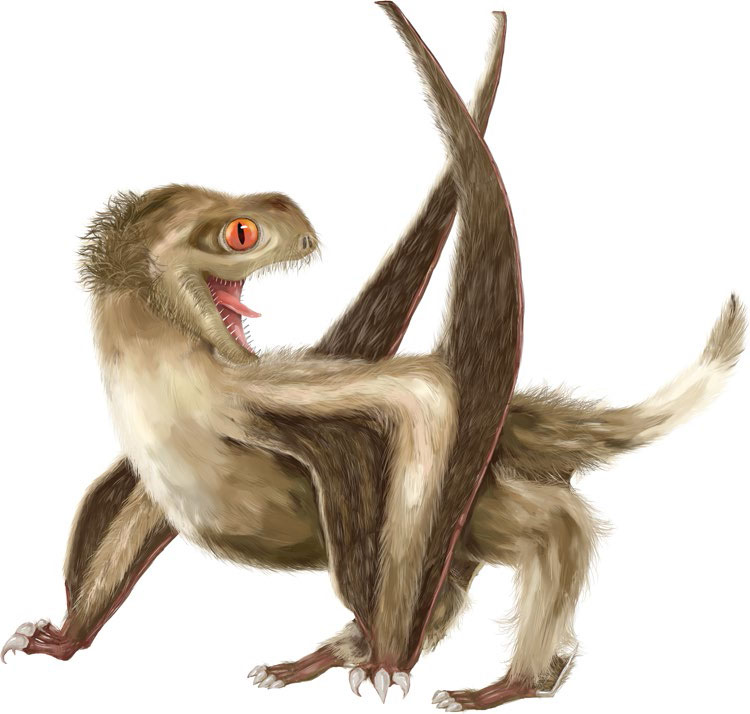
Two specimens from the Middle to Upper Jurassic Yanliiao lagerstätte in China show far more (Yang, Z. and 8 others 2018. Pterosaur integumentary structures with complex feather-like branching. Nature Ecology & Evolution, v. 3, p. 24-30; DOI: 10.1038/s41559-018-0728-7). Their pycnofibres show branching tufts, similar to those found in some theropods dinosaurs, including tyrannosaurs. They also resemble mammalian underfur fibres, whose air-trapping properties provide efficient thermal insulation. Both body and wings of these pterosaurs are furry, which the authors suggest may also have helped reduce drag during flight, while those around the mouth may have had a sensory function similar to those carried by some living birds. Moreover, some of the filaments contain black and red pigments.
Artist’s impression of a Jurassic anurognathid pterosaur from China (Credit: Yang et al 2018; Fig. 4)
Pterosaurs may have independently developed fur and feathers; a case of parallel evolution in response to similar evolutionary pressures facing dinosaurs, birds and mammals. Alternatively, they may have had a deep evolutionary origin in the common ancestors of all these animal groups as far back as the Upper Carboniferous and Lower Permian.
Radiocarbon dating is the most popular tool for assessing the ages of archaeological remains and producing climatic time series, as in lake- and sea-floor cores, provided that organic material can be recovered. Its precision has steadily improved, especially with the development of accelerator mass spectrometry, although it is still limited to the last 50 thousand years or so because of the short half-life of 14C (about 5,730 years,). The problem with dating based on radioactive 14C is its accuracy; i.e. does it always give a true date. This stems from the way in which 14C is produced – by cosmic rays interacting with nitrogen in the atmosphere. Cosmic irradiation varies with time and, consequently, so does the proportion of 14C in the atmosphere. It is the isotope’s proportion in atmospheric CO2 gas at any one time in the past, which is converted by photosynthesis to dateable organic materials, that determines the proportion remaining in a sample after decay through the time since the organism died and became fossilised. Various approaches have been used to allow for variations in 14C production, such as calibration to the time preserved in ancient timber by tree rings which can be independently radiocarbon dated. But that depends on timber from many different species of tree from different climatic zones, and that is affected by fractionation between the various isotopes of carbon in CO2, which varies between species of plant. But there is a better means of calibration.
The carbonate speleothem that forms stalactites and stalagmites by steady precipitation from rainwater, sometimes to produce visible layering, not only locks in 14C dissolved from the atmosphere by rainwater but also environmental radioactive isotopes of uranium and thorium. So, layers in speleothem may be dated by both methods for the period of time over which a stalagmite, for instance, has grown. This seems an ideal means of calibration, although there are snags; one being that the proportion of carbon in carbonates is dominated by that from ancient limestone that has been dissolved by slightly acid rainwater, which dilutes the amount of 14C in samples with so called ‘dead carbon’. Stalagmites in the Hulu Cave near Nanjing in China have particularly low dead-carbon fractions and have been used for the best calibrations so far, going back the current limit for radiocarbon dating of 54 ka (Cheng, H. and 14 others 2018. Atmospheric 14C/12C during the last glacial period from Hulku Cave. Science, v. 362, p. 1293-1297; DOI: 10.1126/science.aau0747). Precision steadily falls off with age because of the progressive reduction to very low amounts of 14C in the samples. Nevertheless, this study resolves fine detail not only of cosmic ray variation, but also of pulses of carbon dioxide release from the oceans which would also affect the availability of 14C for incorporation in organic materials because deep ocean water contains ‘old’ CO2.
Modern Tibetans thrive in the rarefied air at altitudes above 4 km partly because they benefit from a genetic mutation of the gene EPAS1, which regulates haemoglobin production. Surprisingly, the segment of Tibetan’s DNA that contains the mutation matches that present in the genome of an undated Denisovan girl’s finger bone found in the eponymous Siberian cave. The geneticists who made this discovery were able to estimate that Tibetans inherited the entire segment sometime in the last 40 thousand years through interbreeding with Denisovans, who probably were able to live at high altitude too. Wherever and whenever this took place the inheritance was retained because it clearly helped those who carried it to thrive in Tibet. The same segment is present in a few percent of living Han Chinese people, which suggests their ancestors and those of the Tibetans were members of the same group some 40 ka ago, most of the Han having lost the mutation subsequently.
That inheritance would have remained somewhat mysterious while the existing evidence for the colonisation of the Tibetan Plateau suggested sometime in the Holocene, possibly by migrating early farmers. A single archaeological site at 4600 m on the Plateau has changed all that (Zhang, X.L. and 15 others 2018. The earliest human occupation of the high-altitude Tibetan Plateau 40 thousand to 30 thousand years ago. Science, v. 362, p. 1049-1051; DOI: 10.1126/science.aat8824). The dig at Nwya Devu, which lies 250 km NW of Lhasa, has yielded a sequence of sediments (dated by optically stimulated luminescence at between 45 to 18 thousand years) that contains abundant stone tools made from locally occurring slate. The oldest coincides roughly with the age of the earliest anatomically modern human migrants into northern China, so the earliest Tibetans may well have been a branch of that same group of people, as suggested by the DNA of modern Tibetan and Han people. However, skeletal remains of both humans and their prey animals are yet to emerge from Nwya Devu, which leaves open the question of who they were. Anatomically modern humans or archaic humans, such as Denisovans?
The tools do not help to identify their likely makers. Slate is easy to work and typically yields flat blades with sharp, albeit not especially durable, edges; they are disposable perhaps explaining why so many were found at Nwya Devu. None show signs of pressure flaking that typify tools made from harder, more isotropic rock, such as flint. Yet they include a variety of use-types: scrapers; awls; burins and choppers as well as blades. The lack of associated remains of prey or hearths is suggested by the authors to signify that the site was a workshop; perhaps that will change with further excavation in the area. The age range suggests regular, if not permanent, occupancy for more than 20 ka
Related articles: Gibbons, A. 2014. Tibetans inherited high-altitude gene from ancient human. Science News,2 July 2014, Zhang J-F. & Dennell, R. 2018. The last of Asia conquered by Homo sapiens. Science, v. 362, p. 992-993; DOI: 10.1126/science.aav6863.
Between 541 and 543 CE, during the reign of the Roman Emperor Justinian, bubonic plague spread through countries bordering the Mediterranean Sea. This was a decade after Justinian’s forces had had begun to restore the Roman Empire’s lost territory in North Africa, Spain, Italy and the present-day Balkans by expeditions out of Byzantium (the Eastern Empire). At its height, the Plague of Justinian, was killing 5000 people each day in Constantinople, eventually to consume 20 to 40% of its population and between 25 to 50 million people across the empire. Like the European Black Death of the middle 14th century. The bacterium Yersinia pestis originated in Central Asia and is carried in the gut of fleas that live on rats. The ‘traditional’ explanation of both plagues was that plague spread westwards along the Silk Road and then with black rats that infested ship-borne grain cargoes. Plausible as that might seem, Yersinia pestis, fleas and rats have always existed and remain present to this day. Trade along the same routes continued unbroken for more than two millennia. Although plagues with the same agents recurred regularly, only the Plague of Justinian and the Black Death resulted in tens of million deaths over short periods. Some other factor seems likely to have boosted fatalities to such levels.
Monk administering the last rites to victims of the Plague of Justinian
Five years before plague struck the Byzantine historian Procopius recorded a long period of fog and haze that continually reduced sunlight; typical features of volcanic aerosol veils. Following this was the coldest decade in the past 2300 years, as recorded by tree-ring studies. It coincides with documentary evidence of famine in China, Ireland, the Middle East and Scandinavia.. A 72 m long ice core extracted from the Colle Gnifetti glacier in the Swiss Alps in 2013 records the last two millennia of local climatic change and global atmospheric dust levels. Sampled by laser slicing, the core has yielded a time series of data at a resolution of months or better. In 536 an Icelandic volcano emitted ash and probably sulfur dioxide over 18 months during which summer temperature fell by about 2°C. A second eruption followed in 540 to 541. ‘Volcanic winter’ conditions lasted from 536 to 545, amplifying the evidence from tree-ring data from the 1990’s.
The Plague of Justinian coincided with the second ‘volcanic winter’ after several years of regional famine. This scenario is paralleled by the better documented Great Famine of 1315-17 that ended the two centuries of economic prosperity during the 11th to 13th centuries. The period was marked by extreme levels of crime, disease, mass death, and even cannibalism and infanticide. In a population weakened through malnutrition to an extent that we can barely imagine in modern Europe, any pandemic disease would have resulted in the most affected dying in millions. Another parallel with the Plague of Justinian is that it followed the ending of four centuries of the Medieval Warm Period, during which vast quantities of land were successfully brought under the plough and the European population had tripled. That ended with a succession of major, sulfur-rich volcanic eruption in Indonesia at the end of the 13th century that heralded the Little Ice Age. Although geologists generally concern themselves with the social and economic consequences of a volcano’s lava and ash in its immediate vicinity– the ‘Pompeii view’ – its potential for global catastrophe is far greater in the case of really large (and often remote) events.
Chemical data from the same ice core reveals the broad economic consequences of the mid-sixth century plague. Lead concentrations in the ice, deposited as airborne pollution from smelting of lead sulfide ore to obtain silver bullion, fell and remained at low levels for a century. The recovery of silver production for coinage is marked by a spike in glacial lead concentration in 640; another parallel with the Black Death, which was followed by a collapse in silver production, albeit only for 4 to 5 years.
Radar microwaves are able to penetrate easily through several kilometres of ice. Using the arrival times of radar pulses reflected by the bedrock at glacial floor allows ice depth to be computed. When deployed along a network of flight lines during aerial surveys the radar returns of large areas can be converted to a grid of cells thereby producing an image of depth: the inverse of a digital elevation model. This is the only means of precisely mapping the thickness variations of an icecap, such as those that blanket Antarctica and Greenland. The topography of the subglacial surface gives an idea of how ice moves, the paths taken by liquid water at its base, and whether or not global warming may result in ice surges in parts of the icecap. The data can also reveal topographic and geological features hidden by the ice (see The Grand Greenland Canyon September 2013).
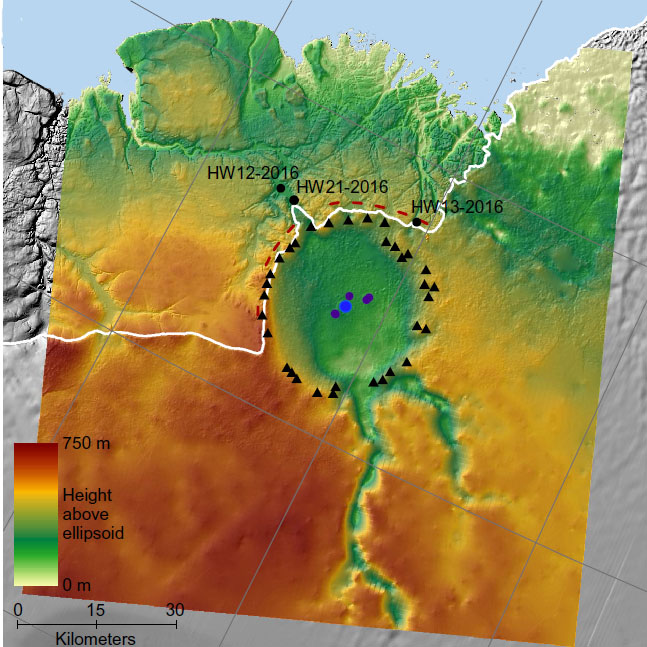
Colour-coded subglacial topography from radar sounding over the Hiawatha Glacier of NW Greenland (Credit: Kjaer et al. 2018; Fig. 1D)
Such a survey over the Hiawatha Glacier of NW Greenland has showed up something most peculiar (Kjaer, K.H. and 21 others 2018. A large impact crater beneath Hiawatha Glacier in northwest Greenland. Science Advances, v. 4, eaar8173; DOI: 10.1126/sciadv.aar8173). Part of the ice margin is an arc, which suggests the local bed topography takes the form of a 31km wide, circular depression. The exposed geology shows no sign of a structural control for such a basin, and is complex metamorphic basement of Palaeoproterozoic age. Measurements of ice-flow speeds are also anomalous, with an array of higher speeds suggesting accelerated flow across the depression. The radar image data confirm the presence of a subglacial basin, but one with an elevated rim and a central series of small peaks. These are characteristic of an impact structure that has only been eroded slightly; i.e. a fairly recent one and one of the twenty-five largest impact craters on Earth.. Detailed analysis of raw radar data in the form of profiles through the ice reveals that the upper part is finely layered and undisturbed. The layering continues into the ice surrounding the basin and is probably of Holocene age (<11.7 ka), based on dating of ice in cores through the surrounding icecap. The lower third is structurally complex and shows evidence for rocky debris. Sediment deposited by subglacial streams where they emerge along the arcuate rim contain grains of shocked quartz and glass, as well as expected minerals from the crystalline basement rocks. Some of the shocked material contains unusually high concentrations of transition-group metals, platinum-group elements and gold; further evidence for impact of extraterrestrial material – probably an iron asteroid that was originally more than 1 km in diameter. The famous Cape York iron meteorite, which weighs 31 t – worked by local Innuit to forge harpoon blades – fell in NW Greenland about 200 km away.
The central issue is not that Hiawatha Glacier conceals a large impact crater, but its age. It certainly predates the start of the Holocene and is no older than the start of Greenland glaciation about 2.6 Ma ago. That only Holocene ice layers are preserved above the disrupted ice that rests immediately on top of the crater raises once again the much-disputed possibility of an asteroid impact having triggered the Younger Dryas cooling event and associated extinctions of large mammals in North America at about 12.9 ka (see Impact cause for Younger Dryas draws flak May 2008). Only radiometric dating of the glassy material found in the glaciofluvial sediments will be able to resolve that particular controversy.
A range of indirect evidence has been used to suggest that life originated deep in the oceans around hydrothermal vents, such as signs of early organic matter in association with Archaean pillow lavas. One particularly persuasive observation is that a number of proteins and other cell chemicals are constructed around metal sulfide groups. Such sulfides are common around hydrothermal ‘smokers’ associated with oceanic rift systems. Moreover, Fischer-Tropsch reactions between carbon monoxide and hydrogen produce quite complex hydrocarbon molecules under laboratory conditions. Such hydrogenation of a carbon-bearing gas requires a catalyst, a commonly used one being chromium oxide (see Abiotic formation of hydrocarbons by oceanic hydrothermal circulationMay 2004). It also turns out that fluids emitted by sea-floor hydrothermal systems are sometimes rich in free hydrogen, formed by the breakdown of olivine in ultramafic rocks to form hydroxylated minerals such as serpentine and talc. The fact that chromium is abundant in ultramafic rocks, in the form of its oxide chromite, elevates the possibility that Fischer-Tropsch reactions may have been a crucial part of the life-forming process on the early Earth. What is needed is evidence that such reactions do occur in natural settings.
A white carbonate mound forming at the Lost City hydrothermal vent field on the Mid-Atlantic Ridge (Credit: Baross 2018)
One site on the mid-Atlantic ridge spreading centre, the Lost City vent field, operates because of serpentinisation of peridotites exposed on the ocean floor, to form carbonate-rich plumes and rocky towers; ‘white smokers’. So that is an obvious place to test the abiotic theory for the origin of life. Past analyses of the vents have yielded a whole range of organic molecules, including alkanes, formates, acetates and pyruvates, that are possible precursors for such a natural process. Revisiting Lost City with advanced analytical techniques has taken the quest a major step forward (Ménez, B. et al. 2018. Abiotic synthesis of amino acids in the recesses of the oceanic lithosphere. Nature, advance online publication; DOI: 10.1038/s41586-018-0684-z). The researchers from France and Kazakhstan focused on rock drilled from 170 m below the vent system, probably beyond the influence of surface contamination from living organisms. Using several methods they detected the nitrogen-containing amino acid tryptophan, and that alone. Had they detected other amino acids their exciting result would have been severely tempered by the possibility of surface organic contamination. The formation of tryptophan implies that its abiotic formation had to involve the reduction of elemental nitrogen (N2) to ammonia (NH3). Bénédicte Ménez and colleagues suggest that the iron-rich clay saponite, which is a common product of serpentine alteration at low temperatures, may have catalysed such reduction and amino-acid synthesis through Friedel–Crafts reactions. Fascinating as this discovery may be, it is just a step towards confirming life’s abiogenesis. It also permits speculation that similar evidence may be found elsewhere in the Solar System on rocky bodies, such as the moons Enceladus and Europa that orbit Saturn and Jupiter respectively. That is, if the rock base of hydrothermal systems thought to occur there can be reached.
Related article: Baross, J.A. 2018. The rocky road to biomolecules. Nature, v. 564, p. 42-43; DOI: 10.1038/d41586-018-07262-8.
The most widespread risk from natural hazards is, with little doubt, that posed by ground instability; landslides and landslips; mudflows; rock avalanches and a range of other categories in which large volumes of surface material are set in motion. They can be triggered by earthquakes, volcanism or heavy rainfall that changes the physical properties of rock and soil. Not only steep slopes pose a risk, for some affect ground with quite gentle topography, as witness the terrible scenes from Sulawesi triggered by the 28 September 2018 magnitude 7.5 earthquake beneath the Minhasa Peninsula. This set in motion mudflows on gently sloping ground when the seismic waves caused liquefaction of unconsolidated sediments that not only shattered dwellings by the lateral motion, but whole communities sank into the slurry with little trace. The rapid events left a death toll confirmed at 2010 people with about 5000 missing, feared to have been swallowed by the earth. In the last 9 months mass movement has resulted in fatalities in many places, the most publicised being in Uganda, Japan, Philippines, Sulawesi, Ethiopia, Sumatra, South India, Bangladesh, California, Nepal, and the list grows as it does every year.
Types of mass movement (Credit: US Geological Survey
As well as purely natural causes, human activities, such as deforestation, excavations and dumping of materials, greatly exacerbate risks. The South Wales former coal-mining communities commemorate every year the collapse of a mine spoil heap on a steep hillside on 21 October 1966 that engulfed a primary school at Aberfan, killing 116 small children and 28 adults. Wherever they occur, there seems to be little chance of escape for those in their path. Slowly it has become possible for geoscientists to outline areas that are potentially at risk from catastrophic mass wastage, sometimes from the distribution of scars of previous events on remotely sensed images, but increasingly by multivariate analysis of landscapes in terms of the factors that may contribute to future ground failures. The principal ones are: topographic slope and relief; annual rainfall, especially the likely precipitation in a single day; vegetation cover, particularly by trees; strength of surface rock and soils, including degrees of consolidation, interbedding and water content; geological structure, such as the trajectory of faults, degree of jointing and the dip of strata. Modelling risk has to grapple with the global scale of the problem, which cannot be addressed in the least developed regions by piecemeal local studies, although those are urgent, of course, in areas with recorded instances of catastrophic ground failure. Regional studies can screen vast areas of probably low risk so that meagre resources can focus on those that appear to be most dangerous to populated places.
Degree of risk from landslides of all types in the northern part of the East African Rift System (Credit: Broeckx et al. 2018; Fig. 6)
Belgian engineering geologists and GIS specialists have assembled a monumental risk assessment of Africa, together with a bibliography of all published work on mass movement across the continent (Broeckx, J. et al. 2018. A data-based landslide susceptibility map of Africa. Earth-Science Reviews, v. 185, p. 102-121; DOI: 10.1016/j.earscirev.2018.05.002). They point out that Google Earth’s 3-D viewing potential at fine spatial resolution provides a free and rapid means of mapping scars of previous earth movements in considerable detail over areas that data analysis suggests to be susceptible. Their paper provides continent-scale maps of the parameters that they used as well as maps showing several versions of their risk analysis. The supplementary data to the paper include downloadable, full-resolution maps of landslide susceptibility.
TerraSAR-X and Tandem-X satellites fly close to each other some 500km above the Earth
In 2007 and 2010 two radar-imaging satellites were launched by the German space agency DLR, TerraSAR-X and Tandem-X respectively. After 2010 both orbited in close, side-by-side formation, sometimes as little as 200 m apart. With one acting as a both a transmitter and receiver of microwave pulses, the other as a receiver, this set up allowed the two signals returning from the Earth’s surface to be matched. The slightly different positions of the platforms results in a time difference at which a pulse reflected from a point on the Earth’s surface reaches the two receiving antennas. This difference varies according to the topographic elevation of the point – in effect analogous to the parallax shift captured in conventional stereoscopic images but measured by the interference between the two signals. Although involving far more complex computation, such radar interferometry produces estimates of each point’s elevation and ultimately a 3-dimensional image of the Earth’s surface. After a period of commercial operation, DLR has decided to make part of the data available free of charge. Both systems use microwaves with a wavelength of around 3 cm (9.65 GHz frequency), which allows topographic elevation to be measured to a precision of ±1 m. Using orbits that cross the poles, each at an angle to the Equator, allows swaths from the dual system eventually to cover the whole planet, in the manner of winding a ball of string. Eventually, the data will permit the detection of vertical movements of one kind or another when multiple coverage of the Earth becomes available. However, the expected lifetime of the platforms is limited, so DLR plans to launch two 23.6 cm interferometric radar satellites to assess dynamic processes occurring on the Earth’s surface.
Side illuminated, colour-coded TanDEM-x elevation model of part of the Sahara desert, in the Tamanrasset province of central Algeria
The resolution of radar interferometry in the two dimensions of a map depends on many factors, some of which stem from the complex processing of the raw data. DLR global data is presented at three resolutions (pixel size): 12 m, the finest; 30 m and 90 m. For local acquisition even finer resolution is possible. Only the 90 m version is being released for free use. The first interferometric radar elevation data to be made freely available was from the NASA Shuttle Radar Topography Mission (SRTM) that was accomplished from the US Space Shuttle Endeavour in 2000, using a single instrument that incorporated two antennas separated by a 60 m long mast deployed from the Shuttle. SRTM acquired data only between latitudes 60° N and 60° S, using 23.6 cm L-band radar. As well as omitting high latitudes, the SRTM design limited actual elevation precision to about 4 m compared with the ±1 m from TerraSAR-X/TanDEM-X. SRTM data with a two-dimensional resolution of 30 m are freely available from the US Geological Survey.
Full global elevation data with a 30 m 2-D resolution and elevation precision of ±9 m have also been produced by the optical stereoscopic potential of the US-Japan ASTER imaging system and are freely available to all via the US Geological Survey. Unlike data produced by radar missions, the optical stereoscopic data from ASTER depend on cloud-free, daytime conditions, and accurate derivation of parallax can be prevented by areas of rugged terrain in deep shadow at the 10 am local-time when images are acquired.
Despite the limitation of TerraSAR-X/TanDEM-X elevation data to a 90 m 2-D resolution, and the consequent loss of textural detail in landscapes, they appear to have the edge in terms of completeness and vertical precision. To get elevation data from DLR requires personal registration after reading a lengthy screed of documentation about data acquisition.
Silcrete flake from Blombos with crosshatching drawn in red ochre. (Credit: C. Foster)
The Blombos Cave 300 km east of Cape Town is where the earliest signs of art produced by anatomically modern humans were found (see Snippets on human evolution October 2011). The most publicized was a shaped piece of ochre etched with a hashed pattern of lines (Henshilwood, C.S. et al. 2018. An abstract drawing from the 73,000-year-old levels at Blombos Cave, South Africa. Nature v. 561, online; DOI: 10.1038/s41586-018-0514-3). This and the ochre-processing workshop where it was found gave a date of about 100 ka, Now another item has hit the newsrooms; a ground piece of flinty silcrete that shows signs of being the product of knapping, on which has been drawn a similar pattern, which resembles the now ubiquitous ‘hashtag’ associated with Twitter. The level in the excavation from which it was removed gives an age of about 75 ka. Like the earlier artifact, it involved the use of ochre but in a way that has been said to be an example of drawing or painting, rather than etching. It is likely to have been produced by a sharpened piece of solid ochre, perhaps a kind of crayon
For some reason the object has been hyped as the earliest example of art and of advanced cognitive abilities. But the pattern is not as complex as that on the original etched ochre block from Blombos, or even those on a freshwater mussel from Trinil in Java that could have =been made by associated Homo erectus between 430 and 500 ka ago. This does not take the context at Blombos into account. There is ample evidence that ochre, along with charcoal and burnt seal bone, was being ground there and made into paint found in an abalone shell. It can be surmised that such paint was used for some kind of decoration that has not yet been discovered. That is quite possibly because it was used for body paint as similar materials are still widely used. Now anyone – male or female – who uses cosmetics today, be it foundation, lipstick, eye-liner and -shadow or the truly fabulous make-up used by the Kathakali performers of Kerala, takes an age to try and to decide on which of an almost imperceptible range of shades to apply. Ochres are like that, as any native Australian artist will tell you.
Lord Rama face paint in Kathakali
To me, the most likely origins of both kinds of Palaeolithic hashtag are: in the case of the ‘drawing’, checking the colour and ‘grindability’ of a sharpened piece of red ochre before use; and for the etched block, using a sharp tool to grind off small amounts from what may have been a well-used block of an especially valued hue.
A revised and updated edition of Steve Drury’s book Stepping Stones: The Making of Our Home World can now be downloaded as a free eBook
Two bone fragments from the Denisova Cave – the former abode of an 18th century Russian hermit called Denis – in the Altai region of Siberia yielded ancient DNA. One matches that from previously analysed Neanderthal remains and the other a genome that could only be ascribed to a hitherto unknown ancient-human population, now known as the Denisovans. Since their discovery further analysis of both modern and ancient DNA has shown that modern humans living outside of Africa contain a few percent of DNA from both ancient-human groups. Soon after leaving Africa some of their ancestors interbred with both; indeed a 40 ka-old modern-human jaw from Romania revealed genetic evidence that the individual had a Neanderthal great-great grandparent. Their descendants spread far and wide to populate Eurasia, Australasia and the Americas. Using the ancient DNA to peer back in time suggests that Neanderthals and Denisovans diverged from a common ancestor between 470 and 380 ka, itself having split from modern-human ancestry between 770 to 550 ka. Denisovan DNA also contains evidence that its ancestry included segments that could only have come from a totally unknown hominin species. Interestingly, DNA from the Neanderthal bone fragment found at Denisova contains fragments from an anatomically modern-human.
Tourists at the entrance to Denisova Cave, Russia (credit: Wikipedia)
With such riches from tiny fragments of human bones unearthed from the Denisova Cave, it is no surprise that the team led by Svante Pääbo at the Max Planck Institute for Evolutionary Anthropology in Leipzig, Germany, has subsequently analysed others that showed signs of human proteins. The latest ‘takes the biscuit’. A fragment of limb bone from someone who was at least 13 years old yielded DNA commensurate with their having been the child of a Neanderthal mother and a Denisovan father (Slon, V. and 18 others 2018. The genome of the offspring of a Neanderthal mother and a Denisovan father. Nature, v. 560, published on-line; doi: 10.1038/s41586-018-0455-x). Their child was a girl, who has been nicknamed ‘Denny’ by the team, though ‘Denise’ might seem more appropriate. The only clues to what her father, or any Denisovan, might have looked like stem from a few teeth and a skull fragment from the cave that have yielded Denisovan DNA. The teeth are much larger and the skull fragment is thicker than those of Neanderthals, suggesting that Denisovans were distinctly bigger and more robust than even the sturdy Neanderthals.
The father came from a population related to a later Denisovan found in the cave – the first to be sequenced. This suggests long-term occupancy of the area by Denisovans. But his genome also carries traces of Neanderthal ancestry. Surprisingly, the mother is more closely related to Croatian Neanderthals, rather than to an earlier Neanderthal found in the cave. Neanderthals were clearly capable of migrating between Europe and eastern Eurasia; more than 5000 km in this case. Even though very few archaic humans have been genetically sequenced it is beginning to look as if genetic mixing between diverse hominin groups in the last half million years was common, when they actually met. A custom of marrying outside a closely related group (exogamy) has been popular throughout recorded history; indeed it makes sound genetic sense. With the tiny human population density during the Late Pleistocene, it may then have been cause for mutual celebration. As documented in Chapters 2 and 3 of David Reich’s Who We Are and How We Got Here (Oxford University Press, 2018) human origins since about 470 ka until the present chart a history of episodic migrations and genetic mixing that certainly makes nonsense of earlier ideas of ‘racial purity’ and casts doubt even on the term ‘species’ as regards members of the genus Homo.
If we are ever to discover who the Denisovans were and what they looked like, the evidence is likely to come from East Asia at latitudes where climate favours preservation of DNA. Advanced sequencing equipment and techniques are now operational in China, where suspected Denisovan remains have been found
Africa is not only a large continent, but is subdivided into many different climatic zones and ecosystems and these have changed drastically over the last 2 Ma. It is further subdivided by terrain features, such as the courses of major rivers, large plateaus, tectonic rift systems and the mountains that frequently define their flanks. Getting around Africa is not easy today, was more difficult before modern transport, and many geomorphic provinces may have been mutually inaccessible in the distant past. For instance, the Sahara Desert forms a major barrier to travellers on foot because access to surface water is non-existent except at widely spaced oases. Without boats or rafts the Nile and Congo cannot be crossed for a thousand miles or more. Migration was perhaps a very rare event outside of periods of widespread humid climates or when great environmental stress forced people either to move or perish. Despite these physical and ecological divisions and barriers palaeoanthropologists have, until recently, tended to regard the evolution of Homo sapiens and earlier human and hominin species as having occurred within single populations: a linear view forced on them by scanty fossil remains and limited methodologies. Logically, when human numbers were small Africa probably had several isolated population Physical isolation would have engendered genetic isolation in which our ancestors evolved for tens of thousand years.
Anatomically modern human (AMH) remains found at Jebel Irhoud in Morocco turned out to be 315 ka old, displacing those from Ethiopia (190 ka) as the earliest known examples of AMH. Several more archaic H. sapiens fossils have turned up in southern Africa and as far afield as the Middle East, suggesting that the early evolution of AMH was in an Africa-wide context rather than in one area – the rift system of Ethiopia and Kenya – from which a new species radiated outwards. This breadth of finds has encouraged Eleanor Scerri of Oxford University and her many international colleagues to resurrect what was once a widely discarded hypothesis; a multiregional model of modern human origins, originally proposed to have arisen from pre-sapiens groups in Eurasia by Milford Wolpoff but which was sunk once genetic connections among living humans turned out to be rooted in Africa. (Scerri, E.M.L. and 22 others 2018. Did our species evolve in subdivided populations across Africa, and why does it matter? Trends in Ecology & Evolution, v. 33, p. 582-594; (PDF) doi: 10.1016/j.tree.2018.05.005). Scerri et al’s model is sited in Africa and the paper’s authors include several leading palaeoanthropologists who once opposed multiregionalism and established the Recent African Origin hypothesis on the back of the early genetic data.
Different early AMH cranium shapes: left Jebel Irhoud, Morocco (315 ka), right Qafzeh, the Levant (85 ka) (credit: Scerri et al, 2018; Figure 1)
From region to region in Africa, the oldest AMH crania show significant differences from each other, but within a distinct combination of features that clearly distinguish us from our fossil relatives and ancestors, such as Homo heidelbergensisfrom Zimbabwe and the primitive-looking H. naledifound in a South African cave in 2015. Improved dating now shows that the Zimbabwean H. heidelbergensis andH.naledi remains are roughly the same age as the Jebel Irhoud AMH specimens. The first has long been held as the progenitor of AMH and descended from H. antecessor, perhaps the common ancestor for AMH, Neanderthals and Denisovans about 700 ka ago. The three human species cohabited Africa early in the evolutionary history of AMH. It is now abundantly clear from ancient and modern genomes that AMH, Neanderthals and Denisovans interbred in Eurasia. The proximity in time and space of earlier African AMH to two more ancient human species opens up a similar possibility earlier in the emergence of all living humans. There is evidence for that too: Yoruba people living in West Africa, whose genomes have been analysed, carry up to 8% of genetic ancestry that originated in an unidentified ancient population that was non-sapiens. At present, DNA analysis with the same high precision and information content from other living Africans has not been performed, and deterioration of ancient DNA in African climates has so far thwarted genomic studies of ancient African fossils.
The new view of our origins points to repeated hybridisation involving other coexisting human species, as well as evolution in isolation, from the outset. It continued through later times while Neanderthals and Denisovans survived. Even recent human genetic history is peppered with intermingling of a great variety of migrants passing through all the habitable continents. Another issue: In the earliest times, were cultures exchanged as well as genes? The first appearance of AMH coincides with that of a new stone technology (Levallois technique), moving away from the earlier dominance by handaxes towards more delicate, leaf-shaped points, that characterise the African Middle Stone Age. Similar techniques reached Europe with the Neanderthals. Was this an invention of the earliest AMH or a joint venture?
You can find an excellent review of these issues in the September 2018 issue of Scientific American (Wong, K. 2018. Last hominin standing. Scientific American, v. 319(3), p. 56-61) along with several other articles on human evolution.
A revised and updated edition of Steve Drury’s book Stepping Stones: The Making of Our Home World can now be downloaded as a free eBook