Neanderthal elephant hunters

In the 1980s miners in the Neumark-Nord area of Saxony-Anhalt, central Germany uncovered an extensive assemblage of animal bones and stone tools in opencast ‘brown coal’ (lignite) workings. Archaeologists working over a ten-year period recovered bones from an estimated 70 straight-tusked elephants (Palaeoloxodon antiquus), as well as many other large herbivores, while huge bucket-wheel excavators advanced through the deposit. Most of the elephants were adult males, some preserved as entire skeletons others as disarticulated bones. Weighing as much 15 tonnes – equivalent to ten medium SUVs – and standing up to 4 m high at the shoulder, they were twice as large as the biggest modern African elephants and had far longer legs. Being so tall they could browse vegetation up to 8 metres above the ground surface using an 80 cm tongue as well as a long trunk and their huge tusks.

The lignite deposits formed in marshes and shallow lakes that occupied low-lying depressions left in the wake of retreating glaciers during the last (Eemian) interglacial (130 to 115 ka ago). The warming encouraged temperate forest to extend much further north than it does today. The fauna too would have changed substantially once the ice sheets began to retreat. For instance, mammoths that grazed low tundra vegetation during the preceding ice age disappeared from Central Europe to be replaced by straight-tusked elephants migrating from much further south that had plenty of trees, shrubs and grasses to feed on, as did other herbivores. So the central European plains teemed with big game. The marshes and lakes had little outflow and became depleted in oxygen so that dead vegetation built up to form extensive peat deposits: just the conditions for organic preservation.

Artistic impression of Neanderthal elephant butchery site (Credit: Tom Bjorklund, Science)

The Neumark-Nord sites yielded literally tonnes of fossils, including 3400 elephant bones. But these were not simply the remains of animals that had become bogged down and died of exhaustion. Sabine Gaudzinski-Windheuser and Lutz Kindler of the Johannes Gutenberg University of Mainz, Germany and Katherine MacDonald and Wil Roebroeks of Leiden University, Netherlands have examined every bone for signs of post-mortem modification by humans (Gaudzinski-WindHeuser, S. et al. 2023. Hunting and processing of straight-tusked elephants 125.000 years ago: Implications for Neanderthal behaviour. Science Advances, v. 9, article add8186; DOI: https://doi.org/10.1126/sciadv.add8186). Some bones are so large as to require a forklift to shift or turn them in the laboratory. Most of the bones bear deliberate cut marks made by stone blades: far more than signs of gnawing by carnivores. Neanderthals had got to them before scavengers. The density of cuts and gouges suggests that almost every scrap of meat and fat had systematically been harvested from the corpses, even the fat-rich feet and brains. The sheer number of cuts needed to skin and deflesh the elephants strongly suggests that their meat was fresh: rotten meat could simply have been pulled from the skin and bone quite easily. Little was left for scavengers to gnaw.

Each elephant would have yielded enough meat and fat for an estimated 2500 portions, each with a calorific value of around 4000 kcal. To fully butcher each beast and then to dry and/or smoke the produce can be estimated – by comparison with such work on a modern African elephant – would take around 1500 person hours. To achieve that would require 3 to 5 days of very heavy labour by 25 people. Some means of preservation would have been needed, unless hundreds of people had scoffed the lot at one or two sittings. The authors consider the bounty to imply  that a considerably larger collective of Neanderthals than the previously estimated ~25 per band probably benefitted from a single elephant, whether it was eaten on the spot or preserved in some way and either carried off or cached. But 70 elephants …?

The geographic context suggests a pile of corpses built up in lignite close to or on a lake shore had accumulated over a lengthy period. Using likely sedimentation rates backed by counting of annual tree rings from stumps in the lignite the authors estimate that the pile formed over about 300 years at a rate of one kill every 5 to 6 years. But this site is one of several found in the Neumark-Nord area, albeit not quite so large, and there are probably more, either remaining buried or destroyed by the brutal lignite mining technique. Taking on a herd of animals would be far more risky than hunting individuals. This is where the sex of the elephant remains gives an idea of the hunters’ strategy. Those that could be sexed – about 23  – were all adult males that were estimated to be from 20 to 50 or more years old. By analogy with African elephants, adult male are generally solitary, only joining herds of females and offspring when one or more is at oestrus. Male straight-tusked elephants were more than twice the mass of adult females and when keeping themselves to themselves would have been a safer and more profitable target than females and juveniles in a herd. Solitary males would have been easy to approach, being confidant  that their size would deter direct predation by the largest carnivores, such as lions. In a peaty swamp, simply driving an individual into deep mud would bog it down to be dispatched by spear thrusts. The earliest known thrusting spears have been unearthed in similar lignite beds 200 km away.

This study adds to growing understanding of Neanderthal culture. It suggests that they were not just opportunistic and wandering foragers but regularly combined resources to focus on a specific, very high-value prey. Maybe that was restricted to the special peat-swamp environment of what is now central Germany, but it speaks of an ability to plan and orchestrate spectacular communal events. And they performed such feats again and again. They were the masters of Europe through three of four glacial-interglacial cycles.

Curiosity rover hints at the carbon cycle on Mars

The Mars Science Laboratory carried by the Curiosity rover is still functioning 10 years after a jetpack lowered Curiosity onto the surface of Gale crater. It includes a system aimed at scooping and drilling samples of soil and rock from the sedimentary strata deposited in the lake that once filled the crater about 3.5 to 3.8 billion years ago. The system on the rover is also capable of analysing the samples in various ways. A central objective of the mission was to obtain data on oxygen and carbon isotopes in carbon dioxide and methane released by heating samples, which uses a miniature mass spectrometer. In early 2022 a paper on Martian carbon isotopes was published in the Proceedings of the National Academy of Sciences (PNAS) that I have only just found (House, C.H. et al. 2022. Depleted carbon isotope compositions observed at Gale crater, Mars. Proceedings of the National Academy of Sciences, v. 119, article e2115651119; DOI: 10.1073/pnas.2115651119). PNAS deemed it to be one of the 12 most important of its articles during 2022.

Oblique view of Curiosity’s landing site in Gale crater on Mars, from which the rover has traversed the lower slopes of Mount Sharp. Credit: NASA-Jet Propulsion Laboratory

Carbon isotopic analyses chart the type and degree of fractionation between carbon’s two stable isotopes 12C and 13C. This is expressed by their relative abundances to one another in a sample and in a reference standard, signified by δ13C. The measure is a natural tracer of both inorganic and biological chemical processes: hence the potential importance of the paper by Christopher House and colleagues from the University of California, San Diego. The thin atmosphere of Mars contains both CO2 and traces of CH4, so a carbon cycle is part and parcel of the planet’s geochemical functioning. The ‘big question’ is: Did that involve living processes at any stage in the distant past and even now? Carbon held in various forms within Mars’s ancient rocks and soils may provide at least a hint, one way of the other. At the very least it should say something about the Martian carbon cycle.

House et al. focus on methane released by heating 22 samples drilled from sandstones and mudstones traversed by Curiosity up a slope leading from the floor of Gale crater towards its central peak, Mount Sharp.  The sampled sedimentary rocks span a 0.5 km thick sequence. Carbon in the expelled methane has δ13C values that range from -137 to +22 ‰ (per mil). Samples from six possibly ancient exposed surfaces were below -70 ‰. This depletion in 13C is similar to the highly negative δ13C that characterises carbon-rich sediments on Earth that were deposited at the Palaeocene-Eocene boundary. That anomaly is suspected to have resulted from releases of methane from destabilised gas hydrate on the sea floor during the Palaeocene–Eocene Thermal Maximum. Organic photosynthesis takes up ‘light’ 12C in preference to 13C, thereby imparting low δ13C to organic matter. In the case of the Mars data that might seem to point to the lake that filled Gale crater 3.5 to 3.8 billion years ago has contained living organisms of some kind. Perhaps on exposed surfaces of wet sediment primitive organisms consumed methane and inherited its δ13C. Some Archaean sediments of about the same age on Earth show similar 13C depletion associated with evidence for microbial mats that are attributed to the activities of such methanotrophs.

Before exobiologists become too excited, no images of possible microbial mats in Gale crater sediments have been captured by Curiosity. Moreover, there are equally plausible scenarios with no recourse to once-living organisms that may account for the carbon-isotope data,. Extreme depletion in 13C is commonly found in the carbon within meteorites, almost certainly inherited from the interstellar dust from which they accreted. It is estimated that the solar system passes through giant molecular clouds every 100 Ma or so: the low δ13C may be inherited from interstellar dust. Alternatively, because Mars has an atmosphere almost entirely composed or CO2 – albeit thin at present – various non-biological chemical reactions driven by sunlight or electrically charged particles may have reduced that gas to form methane and other compounds based on C-H bonds. Carbon dioxide still in Mars’s atmosphere is highly enriched in 13C, suggesting that earlier abiotic reduction may have formed 13C-depleted methane that became locked in sediments. Yet such an abundant supply of inorganic methane may have encouraged the evolution of methanotrophs, had life emerged on early Mars. No one knows …

It’s becoming a cliché that, ‘We may have to await the return of samples from the currently active Perseverance rover, or a crewed mission at some unspecifiable time in the future. The Curiosity carbon-isotope data keep the lamp lit for those whose livelihoods have grown around humans going to the Red Planet.

End-Ordovician mass extinction, faunal diversification, glaciation and true polar wander

Enormous events occurred between 460 and 435 Ma around the mid-point of the Palaeozoic Era and spanning the Ordovician-Silurian (O-S) boundary. At around 443 Ma the second-most severe mass extinction in Earth’s history occurred, which eliminated 50 to 60% of all marine genera and almost 85% of species: not much less than the Great Dying at the end of the Permian Period. The event was accompanied by one of the greatest biological diversifications known to palaeontology, which largely replaced the global biota initiated by the Cambrian Explosion. Centred on the Saharan region of northern Africa, Late Ordovician glacial deposits also occur in western South America and North America. At that time all the current southern continents and India were assembled in the Gondwana supercontinent, with continental masses that became North America, the Baltic region, Siberia and South China not far off: all the components that eventually collided to form Pangaea from the Late Silurian to the Carboniferous.

The mass extinction has troubled geologists for quite a while. There are few signs of major volcanism having been involved, although some geochemists have suggested that very high mercury concentrations in some Late Ordovician marine sediments bear witness to large, albeit invisible, igneous events. No large impact crater is known from those times, although there is a curious superabundance of extraterrestrial debris, including high helium-3, chromium and iridium concentrations, preserved in earlier Ordovician sedimentary rocks, around the Baltic Sea. Another suggestion, poorly supported by evidence, is destruction of the atmospheric ozone layer by a gamma-ray burst from some distant but stupendous supernova. A better supported idea is that the oceans around the time of the event lacked oxygen. Such anoxia can encourage solution of toxic metals and hydrogen sulfide gas. Unlike other mass extinctions, this one was long-drawn out with several pulses.

The glacial epoch also seems implicated somehow in the mass die-off, being the only one known to coincide with a mass extinction. It included spells of frigidity that exceeded those of the last Pleistocene glacial maximum, with the main ice cap having a volume of from 50 to 250 million cubic kilometres. The greatest of these, around 445 Ma, involved a 5°C fall in global sea-surface temperatures and a large negative spike in δ13C in carbon-rich sediments, both of which lasted for about a million years. The complex events around that time coincided with the highest ever extinction and speciation rates, the number of marine species being halved in a short space of time: a possible explanation for the δ13 C anomaly. Yet estimates of atmospheric CO2 concentration in the Late Ordovician suggests it was perhaps 8–16 times higher than today; Earth should have been a warm planet then. One probable contributor to extreme glacial conditions has been suggested to be that the South Pole at that time was well within Gondwana and thus isolated from the warming effect of the ocean. So, severe glaciation and a paradoxical combination of mass extinction with considerable biological diversification present quite an enigma.

A group of scientists based in Beijing, China set out to check the palaeogeographic position of South China between 460 and 435 Ma and evaluate those in  O-S sediments at locations on 6 present continents (Jing, X., Yang, Z., Mitchell, R.N. et al. 2022. Ordovician–Silurian true polar wander as a mechanism for severe glaciation and mass extinction. Nature Communications, v. 13, article 7941; DOI: 10.1038/s41467-022-35609-3). Their key tool is determining the position of the magnetic poles present at various times in the past from core samples drilled at different levels in these sedimentary sequences. The team aimed to test a hypothesis that in O-S times not only the entire lithosphere but the entire mantle moved relative to the Earth’s axis of rotation, the ‘slippage’ probably being at the Core-mantle boundary [thanks to Steve Rozario for pointing this out]. Such a ‘true polar wander’ spanning 20° over a mere  2 Ma has been detected during the Cretaceous, another case of a 90° shift over 15 Ma may have occurred at the time when Snowball Earth conditions first appeared in the Neoproterozoic around the time when the Rodinia supercontinent broke up and a similar event was proposed in 1994 for C-O times albeit based on sparse and roughly dated palaeomagnetic pole positions.

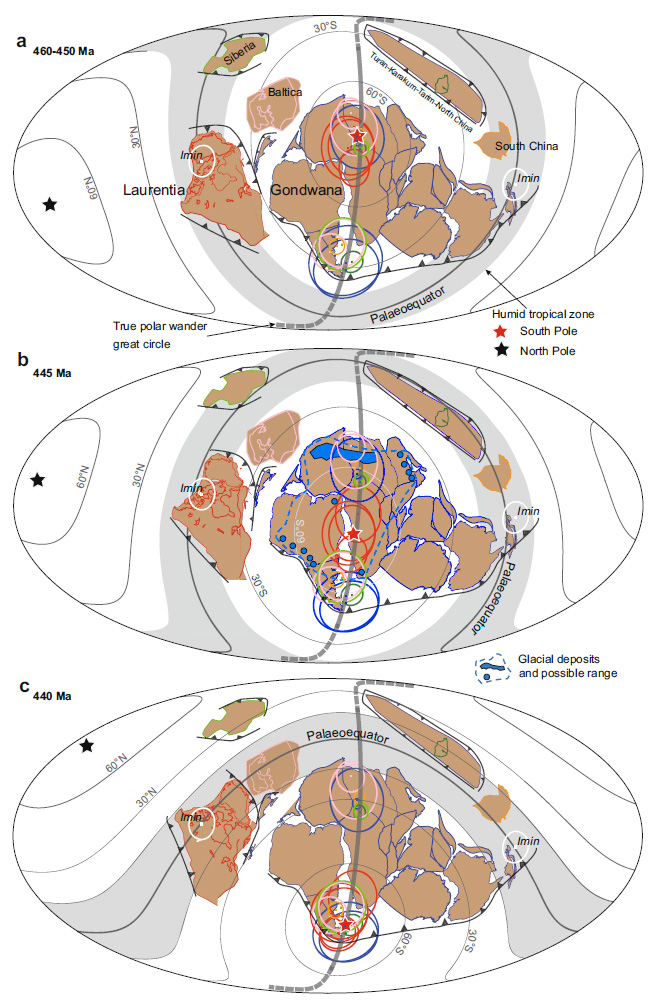
Xianqing Jing and colleagues report a wholesale 50° rotation of the lithosphere between 450 and 440 Ma that would have involved speeds of about 55 cm per year. It involved the Gondwana supercontinent and other continental masses still isolated from it moving synchronously in the same direction, as shown in the figure. From 460 to 450 Ma the geographic South Pole lay at the centre of the present Sahara. At 445 Ma its position had shifted to central Gondwana during the glacial period. By 440 Gondwana had moved further northwards so that the South Pole then lay at Gondwana’s southernmost extremity.

Palaeogeographic reconstructions charting true polar wander and the synchronised movement of all continental masses between 460 and 440 Ma. Note the changes in the trajectories of lines of latitude on the Mollweide projections. The grey band either side of the palaeo-Equator marks intense chemical weathering in the humid tropics. Credit Jing et al. Fig 5.

As well as a possible key to the brief but extreme glacial episode this astonishing journey by a vast area of lithosphere may help account for the mass extinction with rapid speciation and diversification associated with the O-S boundary. While the South Pole was traversing Gondwana as the supercontinent shifted the ‘satellite’ continental masses remained in or close to the humid tropics, exposed to silicate weathering and erosion. That is a means for extracting CO2 from the atmosphere and launching global cooling, eventually to result in glaciation over a huge tract of Gondwana around 445 Ma. Gondwana then moved rapidly into more clement climatic zones and was deglaciated a few million years later. The rapid movement of the most faunally diverse continental-shelf seas through different climate zones would have condemned earlier species to extinction simultaneous adaptation to changed conditions could have encouraged the appearance of new species and ecosystems. This does not require the catastrophic mechanisms largely established for the other mass extinction events. It seems that during the stupendous, en masse slippage of the Earth’s lithosphere plate tectonic processes still continued, yet it must have had a dynamic effect throughout the underlying mantle.

Yet the fascinating story does have a weak point. What if the position of the magnetic poles shifted during O-S times from their assumed rough coincidence with the geographic poles? In other words, did the self-exciting dynamo in the liquid outer core undergo a large and lengthy wobble? How the outer core’s circulation behaves depends on its depth to the solid core, yet the inner core seems only to have begun solidifying just before the onset of the Cambrian, about 100 Ma before the O-S events. It grew rapidly during the Palaeozoic, so the thickness of the outer core was continuously increasing. Fluid dynamic suggests that the form of its circulation may also have undergone changes, thereby affecting the shape and position of the geomagnetic field: perhaps even shifting its poles away from the geographic poles …

Annual logs for 2020 and 2021 added

For ease of access to annual developments within the general topics that Earth-logs covers I have now compiled all the Earth-logs posts from 2020 and 2021 into the categories: Geohazards; Geomorphology; Human Evolution; Magmatism; Palaeobiology; Palaeoclimatology; Physical Resources; Planetary Science; Remote Sensing; Sediments and Stratigraphy, and Tectonics. You can download them by ‘hovering’ over the Annual logs pull-down in the main menu and clicking on a category, whose index page will appear. Then scroll down to the 2020 or 2021 entry and click on the link to the PDF.

I hope that readers find this option useful in showing how each general topic has developed over the 21st century so far. Of course, it is based on my personal view of what constitute important developments published in international journals

Best wishes for 2023.

Steve Drury

Environmental DNA reveals ecology in Northern Greenland from 2 Ma ago

The closest land to the North Pole is Peary Land in northern Greenland. Today, much of it is a polar desert and is bare of ice, so field geology is possible during the Arctic summer. It is one of the last parts of the northern hemisphere to have been mapped in detail. The bedrock ranges in age from the Mesoproterozoic to Upper Cretaceous, although the sequence is incomplete because of tectonic events and erosion during the Phanerozoic Eon. Its complex history has made Peary Land a draw for both structural geologists and stratigraphers. Apart from glacial tills the youngest rocks are estuarine sediments deposited in the early Pleistocene, between two glacial tills. They define one of the earliest known interglacials, roughly between 1.9 and 2.1 Ma, which lasted for an estimated 20 ka. Late Pliocene (3.4 Ma) sediments from around the Arctic Ocean have yielded rich fossil fauna and flora that suggest much warmer conditions – 10°C higher than those at present – before repeated glaciation began in the Northern Hemisphere. The sediments in Peary Land are fossiliferous, plant remains indicating a cover of coniferous trees, but animal fossils are restricted to small invertebrates: the tangible palaeontology offers slim pickings as regards assessing environmental conditions and the ecosystem.

One means of exploring faunal and floral diversity is through sampling and analysing DNA buried in sediments and soils rather than in fossils – plants shed pollen while animals spread their DNA via dung and urine. This approach has met with extraordinary success in revealing megafaunas that may have been decimated by humans newly arrived in the Americas. Even more remarkable was the ability of environmental DNA from cave sediments to reveal the former presence of individual humans who once lived in the caves and thus assess their numbers and relatedness. Such penetrating genetic ‘fingerprinting’ only became possible when new techniques to extract fragments of DNA from sediments and splice them to reconstruct genomes had been developed. But to apply them to material some two million years old would be a big ask; The oldest known DNA sequence had been recovered in 2021 from the molar of a 1.1 Ma old mammoth preserved in permafrost – a near-ideal source. A large multinational team under the supervision of Eske Willerslev (currently of Cambridge University, UK) took on the challenge, despite two million years of burial being likely to have degraded genetic material to minuscule fragments absorbed on the surface of minerals (Kjær, K.H. and 38 others 2022. A 2-million-year-old ecosystem in Greenland uncovered by environmental DNA. Nature, v 612, p. 283–291; DOI: 10.1038/s41586-022-05453-y). But it transpired that quartz grains have a good chance of ‘collecting’ bits of DNA and readily yielding them to the extraction media. The results are extraordinary.

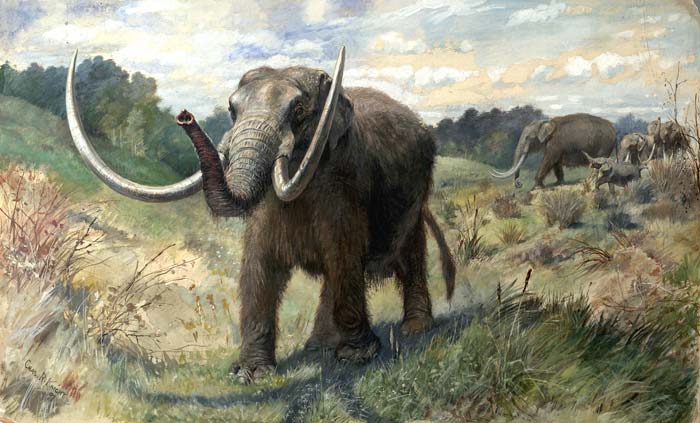
Reconstruction of an American mastodon herd by American painter of large extinct fauna Charles R. Knight

The DNA extraction turned-up signs of 70 vascular plants, including poplar, spruce and yew now typically found at much lower latitudes, alongside sedges, shrubs and birch-tree species that still grow in Greenland. The climate was substantially warmer than it is now. The fauna included elephants – probably mastodons (Mammut) but not mammoths (Mammuthus) and caribou, as well as rabbits, geese and various species of rodents. There were even signs of ants and fleas. The overall assemblage of plants has no analogue in modern vegetation, perhaps because of the absence of anthropogenic influences, such as fires, the smaller extent of glaciations, their shorter duration and less established permafrost during the early Pleistocene. The last factor could have allowed a quicker and wider spread of coniferous-deciduous woodland, found today in NE Canada. In turn this spread of vegetation would have drawn in herds of large herbivores, later mastodons being known to have been wide-ranging forest dwellers. Willerslev suggests that the study has a potential bearing on how ecosystems may respond to climate change.

Consider Homo erectus …

Championed as the earliest commonly found human species and, apart from anatomically modern humans (AMH), the most widespread through Africa and Eurasia. It also endured longer (~1.75 Ma) than any other hominin species, appearing first in East Africa around 2 Ma ago, the youngest widely accepted fossil – found in China – being around 250 ka old. The ‘erects’ arguably cooked their food and discovered the use of fire 1.7 to 2 Ma ago. The first fossils discovered in Java by Eugene Dubois are now known to be associated with the oldest-known art (430 to 540 ka) The biggest issue surrounding H. erectus has been its great diversity, succinctly indicated by a braincase capacity ranging from 550 to 1250 cm3: from slightly greater than the best endowed living apes to within the range of AMH. Even the shape of their skulls defies the constraints placed on those of other hominin species. For instance, some have sagittal crests to anchor powerful jaw muscles, whereas others do not. What they all have in common are jutting brow ridges and the absence of chins along with all more recently evolved human species, except for AMH.

This diversity is summed up in 9 subspecies having been attributed to H. erectus, the majority by Chinese palaeoanthropologists. Chinese fossils from over a dozen sites account for most of the anatomical variability, which perhaps even includes Denisovans, though their existence stems only through the DNA extracted from a few tiny bone fragments. So far none of the many ‘erect’ bones from China have been submitted to genetic analysis, so that connection remains to be tested. Several finds of diminutive humans from the Indonesian and Philippine archipelagos have been suggested to have evolved from H. erectus in isolation. All in all, the differences among the remains of H. erectus are greater than those used to separate later human species, i.e. archaic AMH, Neanderthals, Denisovans, H. antecessor etc. So it seems strange that H. erectus has not been split into several species instead of being lumped together, in the manner of the recently proposed Homo bodoensis. Another fossil cranium has turned up in central China’s Hubei province, to great excitement even though it has not yet been fully excavated (Lewis, D. 2022. Ancient skull uncovered in China could be million-year-old Homo erectus. Nature News 29 November 2022; DOI: 10.1038/d41586-022-04142-00; see also a video). Chances are that it too will be different from other examples. It also presents a good excuse to consider H. erectus.

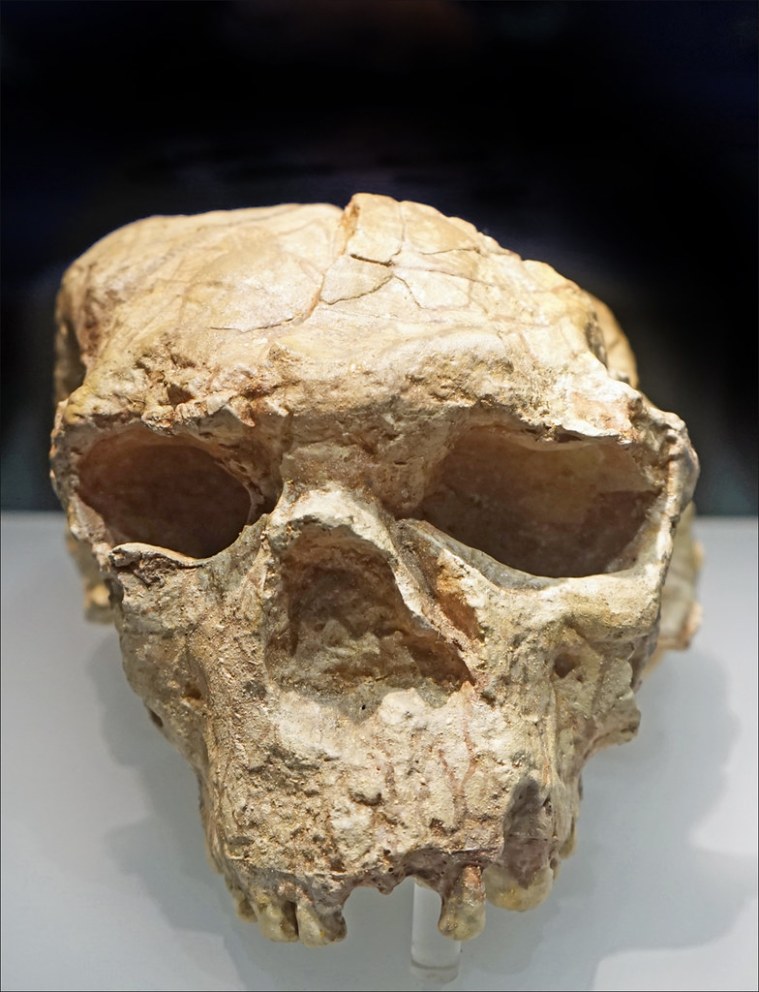
Cranium of a Chinese Homo erectus, somewhat distorted by burial, from a site close to the latest find. (Credit: Hubei Museum, Wuhan, China)

The complications began in Africa with H. ergaster, the originator of the bifacial or Acheulean multi-purpose stone tool at around 1.6 Ma (see: Flirting with hand axes; May 2009), the inventor of cooking and discoverer of the controlled use of fire. ‘Action Men’ were obviously smarter than any preceding hominin, possibly because of an increase of cooked protein and plant resources that are more easily digested than in the raw state and so more available for brain growth. The dispute over nomenclature arose from a close cranial similarity of H. ergaster to the H. erectus discovered in Java in the 19th century: H. erectus ergaster is now its widely accepted name. In 1991-5 the earliest recorded hominins outside Africa were found at Dmanisi, Georgia, in sediments dated at around 1.8 Ma (see: First out of Africa; November 2003) Among a large number of bones were five well-preserved skulls, with brain volumes less than 800 cm3 (see: An iconic early human skull; October 2013). These earliest known migrants from Africa were first thought to resemble the oldest humans (H.habilis) because of their short stature, but now are classified as H. erectus georgicus. They encapsulate the issue of anatomical variability among supposed H. erectus fossils, each being very different in appearance, one even showing ape-like features. Another had lost all teeth from the left side of the face, yet had survived long after their loss, presumably because others had cared for the individual.

The great variety of cranial forms of the Asian specimens of H. erectus may reflect a number of factors. The simplest is that continuous presence of a population there for as long as 1.5 Ma inevitably would have resulted in at least as much evolution as stemmed from the erects left behind in Africa, up to and including the emergence of AMH in North Africa about 300 ka ago. If contact with the African human population was lost after 1.8 Ma, the course of human evolution in Africa and Asia would clearly have been different. But that leaves out the possibility of several waves of migrants into Asia that carried novel physiological traits evolved in Africa to mix with those of earlier Asian populations. From about 1 Ma ago a succession of migrations from Africa populated Europe – H. antecessor, H. heidelbergensis, and Neanderthals and then AMH. So a similar succession of migrants could just as well have gone east instead of west on leaving Africa. Asia is so vast that migration may have led different groups to widely separated locations, partially cut-off by mountain ranges and deserts so that it became very difficult for them to maintain genetic contact. Geographic isolation of small groups could lead to accelerated evolution, similar to that which may have led to the tiny H. floresiensis and H. luzonensisdiscovered on Indonesian and Philippine islands.

 Another aspect of the Asian continent is its unsurpassed range of altitude, latitude and climate zones. Its ecologically diversity offers a multitude of food resources, and both climate and elevation differences pose a range of potential stresses to which humans would have had to adapt. The major climate cycles of the Pleistocene would have driven migration across latitudes within the continent, thereby mixing groups with different physical tolerances and diets to which they had adapted. Equally, westward migration was possible using the Indo-Gangetic plains and the shore of the Arabian Sea: yet more opportunities for mixing between established Asians and newly arrived African emigrants.

How did the earliest animals feed?

Among the strange early animals of the latest Precambrian, known as the Ediacaran fauna, is the slug-like Kimberella. Unlike most of its cohort, which are impressions in sediment or trace fossils,  Kimberella is a body fossil in which can be seen signs of a front and back, i.e. mouth and anus (See also: A lowly worm from the Ediacaran?). In that respect they are the same as us: bilaterians both. Indeed, Kimberella may be one of the oldest of our broad kind that we will ever be able to see. Rare examples have fans of grooves radiating from their ‘front’. It may have grated its food, a bit like a slug does, but drew it in to its mouth. Some enthusiasts have likened the little beasty to a JCB digger, able to rotate and rake stuff into its mouth. In that case, Kimberella would have moved ‘backwards’ while feeding. If it can be likened to any modern animals, it may be a simple mollusc.

A Kimberella fossil, about 10 centimetres long, and a speculative reconstruction showing its feeding apparatus.

Other Ediacaran animals show no such mouth-gut-anus symmetry. Some have tops and bases, but most show no symmetry at all, being flaccid bag-like creatures. Palaeontologists provisionally suggest that they are primitive sponges, ctenophores, placozoans and cnidarians. Such animals excrete through pores on their surfaces and draw food in either through a simple mouth or their skins. The early bilaterians probably ‘grazed’ on bacterial or algal mats, but until now that has been conjectural. Ilya Bobrovskiy of the Australian National University and colleagues from Russia and Australia have managed to extract and analyse biomarker chemicals contained in well-preserved specimens of three Ediacaran animals from strata on the White Sea coast of Russia (Bobrovskiy, I. et al. 2022. Guts, gut contents, and feeding strategies of Ediacaran animals. Current Biology, v. 32,   ; DOI: 10.1016/j.cub.2022.10.051). Biomarkers are molecules, such as fatty acids, phospholipids, triglycerides, hopanes and steranes, that definitively indicate metabolic processes of once living organisms, sometimes referred to as ‘molecular fossils’. Their varying proportions relative to one another are key to recognising the presence of different groups of organisms.

Specifically, hopane molecules are the best indicators of the former metabolism of bacteria whereas steranes (based on linked chains of carbon atoms bonded in rings) are typical products of degradation of sterols in eukaryotes. One sterane group involving 27 carbon atoms (C27 steranes) are typically formed when and animal dies and decays.   C28 and C29 steranes likely form when algae decay, as when they are digested in the gut of a herbivore. Specimens of one of the Ediacaran animals analysed by the team – Dickinsonia – contained far more C27 steranes than C28 and C29, a sign of biomarkers associated with its decay. It probably absorbed food, weirdly, through its skin. Kimberella and a worm-like animal – Calyptrina – had sterane proportions which suggested that they digested algae or bacteria in a gut, as befits bilaterians. Simple as they may appear, these are among the earliest ancestors of modern animals, including us: of course!

See also: Lu, D. 2022. The real paleo diet: researchers find traces of world’s oldest meal in 550m-year-old fossil. The Guardian, 22 November 2022.;  World’s oldest meal helps unravel mystery of our earliest animal ancestors. scimex, 23 November 2022

Early land plants and oceanic extinctions

In September 2022 Earth-logs highlighted how greening of the continents affected the composition of the continental crust. It now seems that was not the only profound change that the first land plants wrought on the Earth system. Beginning in the Silurian, the spread of vegetation swept across the continents during the Devonian Period. From a height of less than 30 cm among the earliest species by the Late Devonian the stature of plants went through a large increase with extensive forests of primitive tree-sized conifers, cycads, horsetails and sporiferous lycopods up to 10 m tall. Their rapid evolution and spread was not hampered by any herbivores. It was during the Devonian that tetrapod amphibians emerged from the seas, probably feeding on burgeoning terrestrial invertebrates. The Late Devonian was marked by five distinct episodes of extinction, two of which comprise the Devonian mass extinction: one of the ‘Big Five’. This affected both marine and terrestrial organisms. Neither flood volcanism nor extraterrestrial impact can be linked to the extinction episodes. Rather they marked a long drawn-out period of repeated environmental stress.

Phytoplankton bloom off the east coast of Scotland ‘fertilised’ by effluents carried by the Tay and Forth estuaries.

One possibility is that a side effect of the greening of the land was the release of massive amounts of nutrients to the seas that would have resulted in large-scale blooms of phytoplankton whose death and decay depleted oxygen levels in the water column. That is a process seen today where large amounts of commercial fertilisers end up in water bodies to result in their eutrophication. Matthew Smart and others from Indiana University-Purdue University, USA and the University of Southampton, UK, geochemically analysed Devonian lake deposits from Greenland and Scotland to test this hypothesis (Smart, M.S. et al. 2022. Enhanced terrestrial nutrient release during the Devonian emergence and expansion of forests: Evidence from lacustrine phosphorus and geochemical records. Geological Society of America Bulletin, v. 134, early release article;  DOI: 10.1130/B36384.1).

Smart et al. show that in the Middle and Late Devonian the lacustrine strata show cycles in their abundance of phosphorus (P an important plant nutrient) that parallel evidence for wet and dry cycles in the lacustrine basins. The cycles show that the same phosphorus abundance patterns occurred at roughly the same times at five separate sites. This may suggest a climatic control forced by changes in Earth’s orbital behaviour, similar to the Milankovich Effect on the Pleistocene climate and at other times in Phanerozoic history. The wet and dry intervals show up in the changing ratio between strontium and copper abundances (Sr/Cu): high values signify wet conditions, low suggesting dry. The wet periods show high ratios of rubidium to strontium (Rb/Sr) that suggest enhanced weathering, while dry periods show the reverse – decreased weathering.

When conditions were dry and weathering low, P built up in the lake sediments, whereas during wet conditions P decreases; i.e. it was exported from the lakes, presumably to the oceans. The authors interpret the changes in relation to the fate of plants under the different conditions. Dry periods would result in widespread death of plants and their rotting, which would release their P content to the shallowing, more stagnant lakes. When conditions were wetter root growth would have increased weathering and more rainfall would flush P from the now deeper and more active lake basins. The ultimate repository of the sediments and freshwater, the oceans, would therefore be subject to boom and bust (wet and dry) as regards nutrition and phytoplankton blooms. Dead phytoplankton, in turn, would use up dissolved oxygen during their decay. That would lead to oceanic anoxia, which also occurred in pulses during the Devonian, that may have contributed to animal extinction.

See also: Linking mass extinctions to the expansion and radiation of land plants, EurekaAlert 10 November 2022; Mass Extinctions May Have Been Driven by the Evolution of Tree Roots, SciTechDaily, 14 November 2022.

Family links among the Neanderthals of Siberia

Caves used by the Neanderthals of southern Siberia: A – location map; B – Chagyrskaya Cave; C – Okladnikov Cave. (Credit: adapted from Skov et al.; Extended Data Fig. 1)

The early focus on Neanderthals was on remains found in Western Europe from the 19th century onwards. That has shifted in recent years to southern Siberia in the foothills of the Altai mountains, despite the fossils’ fragmentary nature: a few teeth and bits of mandible. The Denisova Cave became famous not just because it contained the easternmost evidence of Neanderthal occupation but through the genetic analysis of a tiny finger-tip bone. It proved not to be from a Neanderthal but a distinctly different hominin species, dubbed Denisovan (see: Other rich hominin pickings; May 2010). What Denisovans looked like remains unknown but genetic traces of them are rife among living humans of the western Pacific islands and Australia, whose ancestors interbred with Denisovans, presumably in East Asia. Modern people indigenous to Europe and the Middle East have Neanderthal genes in their genomes. Other bone fragments from Denisova Cave also yielded Neanderthal genomes, and the cave sediments yielded traces of both groups (see: Detecting the presence of hominins in ancient soil samples; April 2017). Then in 2018 DNA extracted from a limb bone from the cave clearly showed that it was from a female teenager who had had a Neanderthal mother and a Denisovan father (see: Neanderthal Mum meets Denisovan Dad; August 2018). These astonishing and unexpected finds spurred further excavations and genetic analysis in other caves within 100 km of Denisova Cave. This was largely led by current and former co-workers of Svanti Pääbo, of the Max Planck Institute for Evolutionary Anthropology, Leipzig, Germany: Pääbo was awarded the 2022 Nobel Prize in Physiology or Medicine for his coordination of research and discoveries concerning ancient human genomes. Their enormous field and laboratory efforts have paid astonishingly valuable dividends (Skov, L. and 34 others 2022. Genetic insights into the social organization of Neanderthals. Nature v. 610, p. 519–525; DOI: 10.1038/s41586-022-05283-y).

To the previously analysed 18 Neanderthal genomes from 14 archaeological sites across Eurasia (including Denisova Cave) Skov et al. have added 13 more from just two sites in Siberia (the Chagyrskaya and Okladnikov caves). Each site overlooks valleys along which game still migrates, so they may have been seasonal hunting camps rather than permanent dwellings: they are littered with bison and horse bones. Tools in the two 59-51 ka old human occupation levels are different from those at the older (130 to 91 Ka) Denisova Cave about 100 km to the east. As at the much older site, human fossils include several teeth and fragments of bones from jaws, hands, limbs and vertebrae. The detailed genomes recovered from 17 finds shows them to be from 14 individuals (12 from Chagyrskaya, 2 from Okladnikov).

Chagyrskaya yielded evidence for 5 females (3 adults and 2 children) and 7 males (3 children and 4 adults). One female estimated to have lost a premolar tooth when a teenager was the daughter of a Chagyrskaya adult male. He, in turn, was brother or father to another male, so the girl seems to have had an uncle as well. Another male and female proved to be second-degree relations (includes uncles, aunts, nephews, nieces, grandparents, grandchildren, half-siblings, and double cousins). The two people from Okladnikov were an adult female and an unrelated male child. The boy was not related to the Chagyrskaya group, but the woman was, her former presence at that cave lingering in its cave-sediment DNA. None of the newly discovered individuals were closely related to six of the seven much older Denisova Cave Neanderthals, but the Okladnikov boy had similar mtDNA to one individual from Denisova.

Further information about the Chagyrskaya group came from comparison of DNA in Y-chromosomes and mitochondria. The father of the teenage girl had two types of mtDNA – the unusual characteristic of heteroplasmy – that he shared with two other males. This suggests that three of the males shared the same maternal lineage – not necessarily a mother – and also indicates that they lived at roughly the same time. The mtDNA recovered from all Chagyrskaya individuals was much more varied than was their Y-chromosome DNA (passed only down male lineage). One way of explaining that would be females from different Neanderthal communities having migrated into the Chagyrskaya group and mated with its males, who largely remained in the group: a ‘tradition’ known as patrilocality, which is practised in traditional Hindu communities, for instance.

So, what has emerged is clear evidence for a closely related community of Neanderthals at Chagyrskaya, although it cannot be shown that all were present there at the same time, apart from the five who show first- or second-degree relatedness or mitochondrial heteroplasmy. Those represented only by individual teeth didn’t necessarily die there: adult teeth can be lost through trauma and deciduous teeth fall out naturally. There was also some individual physical connection between the two caves: The Okladnikov woman’s DNA being in the sediment at Chagyrskaya. Looking for DNA similarities more widely, it appears that all individuals at Chagyrskaya may have had some ancestral connection with Croatian Neanderthals, as did the previously mentioned mother of the Denisovan-Neanderthal hybrid girl. Four of the Chagyrskaya individuals can also be linked genetically to Neanderthals from Spain, more so than to much closer individuals found in the Caucasus Mountains. So, by around 59-51 ka the results of a wave of eastward migration of Neanderthals had reached southern Siberia. Yet the apparent matrilineal relatedness of the Okladnikov boy to the much older Neanderthals of Denisova Cave suggests that the earlier group continued to exist.

The new results are just as fascinating as the 2021 discovery that ancient DNA from Neolithic tomb burials in the Cotswolds of SW England suggests that the individual skeletons represent five continuous generations of one extended family. The difference is that they were farmers tied to the locality, whereas the Siberian Neanderthals were probably hunter gatherers with a very wide geographic range.  Laurits Skov and his colleagues have analysed less than one-quarter of the Neanderthal remains already discovered in Chagyrskaya and Okladnikov caves and only a third of the cave deposits have been excavated. Extracting and analysing ancient DNA is now far quicker, more detailed and cheaper than it was in 2010 when news of the first Neanderthal genome broke. So more Neanderthal surprises may yet come from Siberia. Progress on the genetics of their anatomically-modern contemporaries in NE Asia has not been so swift.

See also:  Callaway, E. 2022. First known Neanderthal family discovered in Siberian cave.  Nature online 19 October 2022.

Origin of animals at a time of chaotic oxygen levels

Every organism that you can easily see is a eukaryote, the vast majority of which depend on the availability of oxygen molecules. The range of genetic variation in a wide variety of eukaryotes suggests, using a molecular ‘clock’, that the first of them arose between 2000 to 1000 Ma ago. It possibly originated as a symbiotic assemblage of earlier prokaryote cells ‘bagged-up’ within a single cell wall: Lynn Margulis’s hypothesis of endosymbiosis. It had to have happened after the Great Oxygenation Event (GOE 2.4 to 2.2 Ga), before which free oxygen was present in the seas and atmosphere only at vanishingly small concentrations. Various single-celled fossil possibilities have been suggested to be the oldest members of the Eukarya but are not especially prepossessing, except for one bizarre assemblage in Gabon. The first inescapable sign that eukaryotes were around is the appearance of distinctive organic biomarkers in sediments about 720 Ma old. The Neoproterozoic is famous for its Snowball Earth episodes and the associated multiplicity of large though primitive animals during the Ediacaran Period (see: The rise of the eukaryotes; December 2017).

The records of carbon- and sulfur isotopes in Neo- and Mesoproterozoic sedimentary rocks are more or less flat lines after a mighty hiccup in the carbon and sulfur cycles that followed the GOE and the earliest recorded major glaciation of the Earth. The time between 2.0 and 1.0 Ga has been dubbed ‘the Boring Billion’. At about 900 Ma, both records run riot. Sulfur isotopes in sediments reveal the variations of sulfides and sulfates on the seafloor, which signify reducing and oxidising conditions respectively.  The δ13C record charts the burial of organic carbon and its release from marine sediments related to reducing and oxidising conditions in deep water. There were four major ‘excursions’ of δ13C during the Neoproterozoic, which became increasingly extreme. From constant anoxic, reducing conditions throughout the Boring Billion the Late Neoproterozoic ocean-floor experienced repeated cycles of low and high oxygenation reflected in sulfide and sulfate precipitation and by fluctuations in trace elements whose precipitation depends on redox conditions. By the end of the Cambrian, when marine animals were burgeoning, deep-water oxic-anoxic cycles had been smoothed out, though throughout the Phanerozoic eon anoxic events crop up from time to time.

Atmospheric levels of free oxygen relative to that today (scale is logarithmic) computed using combined carbon- and sulfur isotope records from marine sediments since 1500 Ma ago. The black line is the mean of 5,000 model runs, the grey area represents ±1 standard deviations. The pale blue area represents previous ‘guesstimates’. Vertical yellow bars are the three Snowball Earth events of the Late Neoproterozoic (Sturtian, Marinoan and Gaskiers). (Credit: Krause et al., Fig 1a)

The Late Neoproterozoic redox cycles suggest that oxygen levels in the oceans may have fluctuated too. But there are few reliable proxies for free oxygen. Until recently, individual proxies could only suggest broad, stepwise changes in the availability of oxygen: around 0.1% of modern abundance after the GOE until about 800 Ma; a steady rise to about 10% during the Late Neoproterozoic; a sharp rise to an average of roughly 80% at during the Silurian attributed to increased photosynthesis by land plants. But over the last few decades geochemists have devised a new approach based on variations on carbon and sulfur isotope data from which powerful software modelling can make plausible inferences about varying oxygen levels. Results from the latest version have just been published (Krause, A.J. et al. 2022. Extreme variability in atmospheric oxygen levels in the late Precambrian. Science Advances, v. 8, article 8191; DOI: 10.1126/sciadv.abm8191).

Alexander Krause of Leeds University, UK, and colleagues from University College London, the University of Exeter, UK and the Univerisité Claude Bernard, Lyon, France show that atmospheric oxygen oscillated between ~1 and 50 % of modern levels during the critical 740 to 540 Ma period for the origin and initial diversification of animals. Each major glaciation was associated with a rapid decline, whereas oxygen levels rebounded during the largely ice-free episodes. By the end of the Cambrian Period (485 Ma), by which time the majority of animal phyla had emerged, there appear to have been six such extreme cycles.

Entirely dependent on oxygen for their metabolism, the early animals faced periodic life-threatening stresses. In terms of oxygen availability the fluctuations are almost two orders of magnitude greater than those that animal life faced through most of the Phanerozoic. Able to thrive and diversify during the peaks, most animals of those times faced annihilation as O2 levels plummeted. These would have been periods when natural selection was at its most ruthless in the history of metazoan life on Earth. Its survival repeatedly faced termination, later mass extinctions being only partial threats. Each of those Phanerozoic events was followed by massive diversification and re-occupation of abandoned and new ecological niches. So too those Neoproterozoic organism that survived each massive environmental threat may have undergone adaptive radiation involving extreme changes in their form and function. The Ediacaran fauna was one that teemed on the sea floor, but with oxygen able to seep into the subsurface other faunas may have been evolving there exploiting dead organic matter. The only signs of that wholly new ecosystem are the burrows that first appear in the earliest Cambrian rocks. Evolution there would have ben rife but only expressed by those phyla that left it during the Cambrian Explosion.

There is a clear, empirical link between redox shifts and very large-scale glacial and deglaciation events. Seeking a cause for the dramatic cycles of climate, oxygen and life is not easy. The main drivers of the greenhouse effect COand methane had to have been involved, i.e. the global carbon cycle. But what triggered the instability after the ‘Boring Billion’? The modelled oxygen record first shows a sudden rise to above 10% of modern levels at about 900 Ma, with a short-lived tenfold decline at 800 Ma. Could the onset have had something to do with a hidden major development in the biosphere: extinction of prokaryote methane generators; explosion of reef-building and oxygen-generating stromatolites? How about a tectonic driver, such as the break-up of the Rodinia supercontinent? Then there are large extraterrestrial events … Maybe the details provided by Krause et al. will spur others to imaginative solutions. See also: How fluctuating oxygen levels may have accelerated animal evolution. Science Daily, 14 October 2022