Frozen squirrel excrement excites Pleistocene ecologists

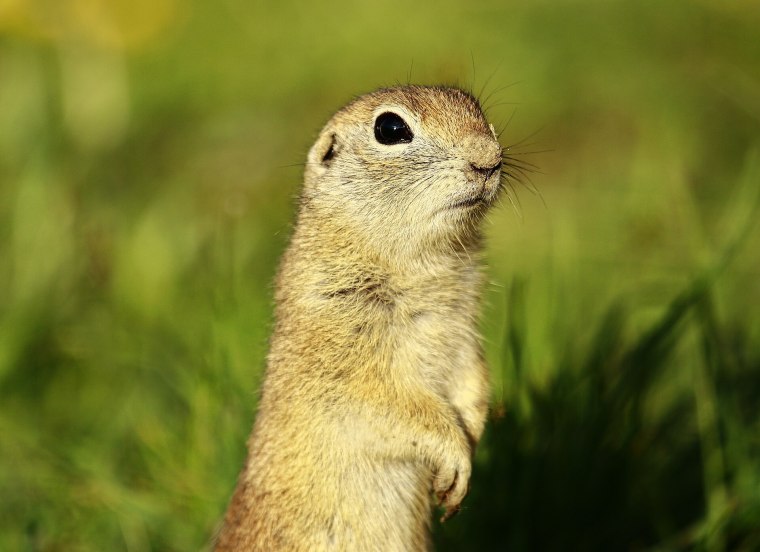
An arctic ground squirrel (Urocitellus parryii)

Lately, North American ground squirrels have been observed hunting, dismembering and eating voles. European tree squirrels also have a side that negates their nut-nibbling popular personae. They regularly take fledglings from bird nests. No more Mr Cute Squirrel then! In fact they’ll eat just about anything, including roadkill and even washed-up dead whales. A team of forensic ecologists from Canada, Sweden, Denmark and the US has harnessed this trait into a possibly ground-breaking study of how the Yukon Territory ecosystem evolved during the Pleistocene since 700 ka ago (Murchie, T.J. and 15 others 2026. Ground squirrel coprolites preserve complex archives of ancient environmental DNA over 700,000 yearsNature Communications, v. 17, article 4868; DOI: 10.1038/s41467-026-72977-6). Between 2007 and 2021 Tyler Murchie and colleagues collected ground squirrels’ faecal pellets from 14 latrine chambers or middens in their ancient burrows in a sequence of permafrost layers at the famous Klondike goldfields. The uppermost layers were dated using the 14C method, and for samples from deeper levels – older than 50 ka – using volcanic ash layers in the frozen sediments. Fourteen of the samples spanning 17 to 700 ka ago yielded fragmentary DNA from the squirrels’ diet.
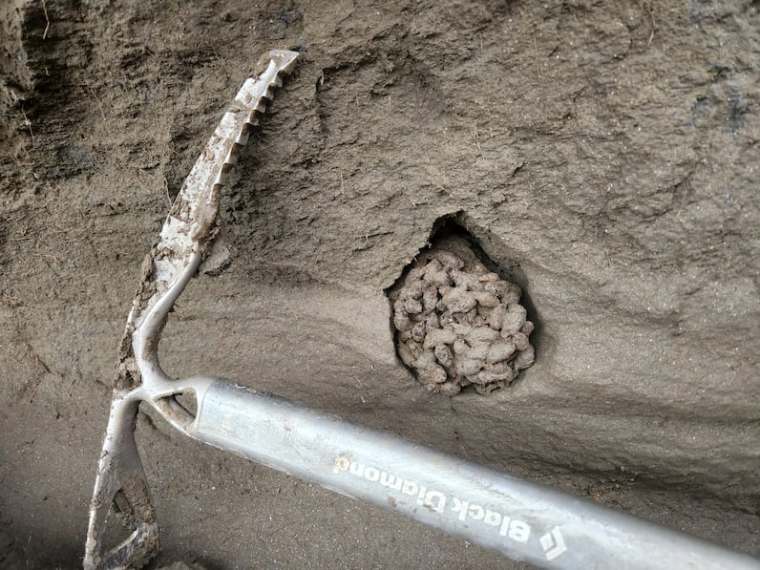
Ground-squirrel midden in tunnelled permafrost. Credit Scott Cocker, University of Alberta)

Obviously this was dominated by their own DNA and gut bacteria, but contained fragments from an astonishing range of organisms that they had eaten. There were signs of at least 200 plant species: trees, shrubs grasses and flowering herbs known from the Pleistocene ‘mammoth steppe’ and tundra. Animal DNA included that from spiders, ants, moths, beetles, and grasshoppers, together with parasitic worms. But the most astonishing range of their appetites covers a great many mammals. As well as small mammals, such as mice, there are also signs of bison, mammoths, horses, sheep, wolves, and big cats having been eaten. It hardly needs to be emphasised that the Pleistocene ground squirrels did not hunt and overwhelm such prey, but they certainly did not reject a free meal of carrion lying on the tundra.

The wealth of species unwittingly archived by ground squirrels’ tendency to hide their droppings within their burrow systems offers a novel means of tracking the evolution of the ecosystem of which they were a part. It seems to outweigh the use of DNA extraction from soil horizons or even fossil bones. But to take matters further would require many more samples spread more evenly through the history of the mammoth steppe and tundra – most of the samples are from the last 90 ka. The Klondike goldfields are not representative of the whole of Arctic North America, being in a rugged terrain. Moreover, the Yukon Territory was repeatedly glaciated, as was the Canadian Shield itself. So, intact permafrost sequences spanning even the last glacial period are rare.

See also: A snapshot in time: Ancient ground squirrel droppings, dating back 700,000 years, reveal rich details about evolutionary history of the Arctic. EurekAlert 9 June 2026.

Environmental DNA reveals ecology in Northern Greenland from 2 Ma ago

The closest land to the North Pole is Peary Land in northern Greenland. Today, much of it is a polar desert and is bare of ice, so field geology is possible during the Arctic summer. It is one of the last parts of the northern hemisphere to have been mapped in detail. The bedrock ranges in age from the Mesoproterozoic to Upper Cretaceous, although the sequence is incomplete because of tectonic events and erosion during the Phanerozoic Eon. Its complex history has made Peary Land a draw for both structural geologists and stratigraphers. Apart from glacial tills the youngest rocks are estuarine sediments deposited in the early Pleistocene, between two glacial tills. They define one of the earliest known interglacials, roughly between 1.9 and 2.1 Ma, which lasted for an estimated 20 ka. Late Pliocene (3.4 Ma) sediments from around the Arctic Ocean have yielded rich fossil fauna and flora that suggest much warmer conditions – 10°C higher than those at present – before repeated glaciation began in the Northern Hemisphere. The sediments in Peary Land are fossiliferous, plant remains indicating a cover of coniferous trees, but animal fossils are restricted to small invertebrates: the tangible palaeontology offers slim pickings as regards assessing environmental conditions and the ecosystem.

One means of exploring faunal and floral diversity is through sampling and analysing DNA buried in sediments and soils rather than in fossils – plants shed pollen while animals spread their DNA via dung and urine. This approach has met with extraordinary success in revealing megafaunas that may have been decimated by humans newly arrived in the Americas. Even more remarkable was the ability of environmental DNA from cave sediments to reveal the former presence of individual humans who once lived in the caves and thus assess their numbers and relatedness. Such penetrating genetic ‘fingerprinting’ only became possible when new techniques to extract fragments of DNA from sediments and splice them to reconstruct genomes had been developed. But to apply them to material some two million years old would be a big ask; The oldest known DNA sequence had been recovered in 2021 from the molar of a 1.1 Ma old mammoth preserved in permafrost – a near-ideal source. A large multinational team under the supervision of Eske Willerslev (currently of Cambridge University, UK) took on the challenge, despite two million years of burial being likely to have degraded genetic material to minuscule fragments absorbed on the surface of minerals (Kjær, K.H. and 38 others 2022. A 2-million-year-old ecosystem in Greenland uncovered by environmental DNA. Nature, v 612, p. 283–291; DOI: 10.1038/s41586-022-05453-y). But it transpired that quartz grains have a good chance of ‘collecting’ bits of DNA and readily yielding them to the extraction media. The results are extraordinary.

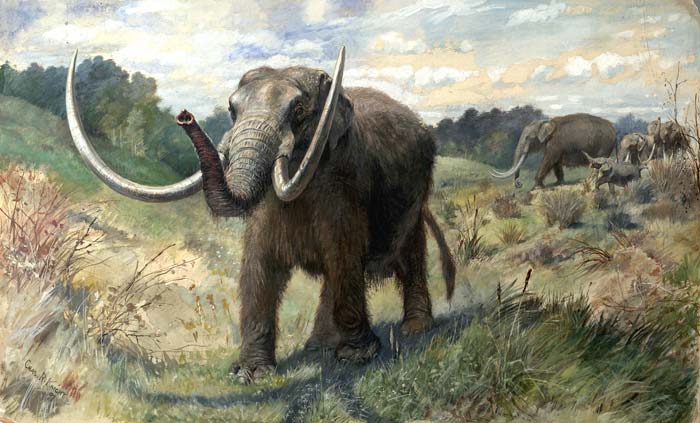
Reconstruction of an American mastodon herd by American painter of large extinct fauna Charles R. Knight

The DNA extraction turned-up signs of 70 vascular plants, including poplar, spruce and yew now typically found at much lower latitudes, alongside sedges, shrubs and birch-tree species that still grow in Greenland. The climate was substantially warmer than it is now. The fauna included elephants – probably mastodons (Mammut) but not mammoths (Mammuthus) and caribou, as well as rabbits, geese and various species of rodents. There were even signs of ants and fleas. The overall assemblage of plants has no analogue in modern vegetation, perhaps because of the absence of anthropogenic influences, such as fires, the smaller extent of glaciations, their shorter duration and less established permafrost during the early Pleistocene. The last factor could have allowed a quicker and wider spread of coniferous-deciduous woodland, found today in NE Canada. In turn this spread of vegetation would have drawn in herds of large herbivores, later mastodons being known to have been wide-ranging forest dwellers. Willerslev suggests that the study has a potential bearing on how ecosystems may respond to climate change.

More Denisovan connections

In 2006 mining operations in NE Mongolia uncovered a human skull cap with prominent brow ridges. After having been dubbed Mongolanthropus because of its primitive appearance and then suggested to be either a Neanderthal of Homo erectus. Radiocarbon dating in 2019 then showed the woman to be around 34,500 years old and the accompanying sequencing of its mtDNA assigned her to a widespread Eurasian haplotype of modern humans. Powdered bone samples ended up in Svante Paabo’s renowned ancient-DNA lab at the Max Planck Institute for Evolutionary Anthropology in Leipzig and yielded a full genome (Massilani, D. and 14 others 2020. Denisovan ancestry and population history of early East Asians. Science, v. 370, p. 579-583; DOI: 10.1126/science.abc1166). From this flowed some interesting genetic history.

Skull cap of a female modern human from Salkhit in Outer Mongolia, which superficially resembles those of Homo erectus from Java (Credit: Massilani et al. Fig 1a; © Institute of Archaeology, Mongolian Academy of Sciences)

First was a close overall resemblance to living East Asians and Native Americans, similar to that of an older individual from near Beijing, China. This confirmed the antiquity of the East Eurasian population’s split from that of the west, yet contained evidence of some interbreeding with West Eurasians to the extent of sharing 25% of DNA and with Neanderthals. The two specimens also contained evidence of Denisovan ancestry in their genomes, but fragments that are more akin to those in living people in East Asia than to those of Papuans and Aboriginal Australians: these were definitely cosmopolitan people! The simplest explanation is two distinct minglings with Denisovans: that involving ancestors of Papuans and Australian being the perhaps earlier, en route to their arrival at least 60 thousand years on what became an island continent in the run-up to the last glacial maximum. Be that as it may, two separate Denisovan populations interbred with modern human bands. Further genetic connections with ancient Northern Siberian humans suggests complex movement across the continent, probably inevitable because these hunter-gatherers would have followed prey animals on their seasonal migrations, which would have been longer than today because of climatic cooling. The same can be surmised for Denisovans which would have increased the chances of contact

See also: Denisovan DNA in the genome of early East Asians (Science Daily, 29 October 2020)

In May 2019 (Denisovan on top of the world) I wrote about a human lower jaw that a Buddhist monk had found in a cave at a height of 3.3 km on the Tibetan plateau. Analysis of protein traces in the teeth it retained suggested that it was Denisovan. Like the earlier small remnants from Siberia, dating this putative Denisovan precisely proved to be impossible. The jawbone was at least 160 ka old from the age of speleothem carbonate encrusting it. Excavation of the sediment layers from Baishiya Cave has enabled a large team of Chinese, Australian, US and Swedish scientists to try out the ‘environmental DNA’ approach pioneered by the Max Planck Institute for Evolutionary Anthropology (see: Detecting the presence of hominins in ancient soil samples, April 2017). The cave confirmed occupation by Denisovans from mtDNA found in layers dated using radiocarbon and optically stimulated luminescence methods. Denisovan mtDNA turned up in four layers dated at ~100, ~60 and possibly as young as 45 ka, as well at that from a variety of other mammals (Zhang, D. and 26 others. Denisovan DNA in Late Pleistocene sediments from Baishiya Karst Cave on the Tibetan Plateau. Science, v. 370, p. 584-587; DOI: 10.1126/science.abb6320).  Denisovans were clearly able to live at high elevations for at least 100 thousand years: long enough to evolve the metabolic processes essential to sustain living in low-oxygen conditions, which it has been suggested was passed on to ancestral modern Tibetans.