
In 1967 the American biologist Lyn Margulis developed an idea that had been considered earlier in the 20th century. It proposed that the complex architecture of eukaryote cells had arisen by several simpler prokaryote cells becoming incorporated inside a membrane to form other bodies or organelles that co-existed and interacted. That is, a complex of mutual dependence within a cell wall, called endosymbiosis. For instance, the mitochondria of modern animal cells resemble a class of aerobic bacteria or Proteobacteria (gram-negative bacteria), some of which are responsible for several modern diseases, such as tick-bite fevers. Another is the resemblance of the photosynthesising chloroplasts of plants to cyanobacteria. A similar origin might apply to eukaryote nuclei and other organelles inside eukaryote cells; some have their own DNA molecules. I summarised Margulis’s late-20th century concept of endosymbiosis in my 1999 book Stepping Stones.
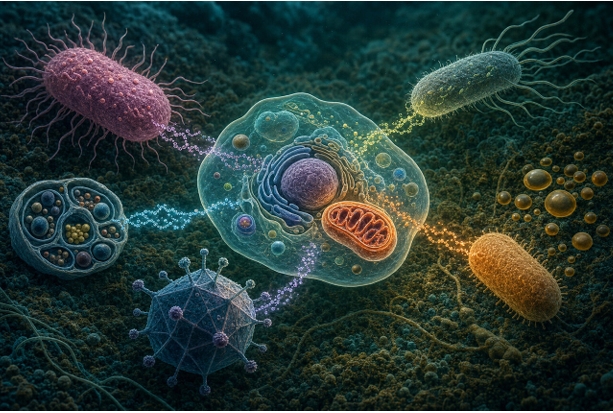
Since then the rapid development of genome analysis has seen major advances in the field now known as symbiogenesis. In the most general sense, that is now regarded as a sequence of mergers between early members of the two prokaryote domains of Archaea and Bacteria: not a simple topic! In 2017 a group of archaeons called Promethearchaeati – ‘Asgard’ for short – were found to contain proteins – and thus the genes that produce them – akin to those in eukaryotes. So the Asgards are prime candidates for a role in symbiogenesis. Their symbiotic merger with a Proteobacteria may have begun the evolution of all eukaryotes. The entry of cyanobacteria – a candidate for chloroplasts – into one of the evolving groups divided plants from animals. A new AI analysis of thousands of genomes in living microbial organisms by Catalan scientists in Barcelona has enabled them to flesh-out and critique this hypothesis to a remarkable extent (Bernabeu, M. et al. 2026. Gene ancestries reveal diverse microbial associations during eukaryogenesis. Nature, v. 654; DOI: 10.1038/s41586-026-10639-9). Their work possibly revolutionises the study of biological evolution
Moisès Bernabeu and his three colleagues drastically ‘pruned’ the eukaryotic tree of life, which over-represents animals and species found in common ecosystems. They also stripped the limited number of eukaryote genomes of genes that do simple jobs or are closely related – i.e. those that seem to duplicate large sections from the oldest, ancestral genes. Two further ‘edits’ enabled the team to judge from their analysis what sort of roles may have been played by the genetics of the last eukaryote common ancestor (LECA). At this level of simplification it appeared that our ancestors inhabited oxygenated environments and got their energy by eating other organisms or their dead remains.
About 30% of the genes in eukaryotes seem to be unique to them and evolved after LECA had emerged. Many of the rest came from diverse prokaryote organisms. Alphaproteobacteria (previously termed ‘purple’ bacteria) and the Asgard archaea figure strongly, together with a range of other bacteria. As suggested previously, a vital process could have been transfer of genes from one prokaryote to another. Bernabeu et al.’s study highlights waves of such gene transfers prior to LECA’s acquisition of mitochondria, widely deemed to have been incorporation of an early proteobacterium. They also provide evidence for a central role played by giant viruses in enabling such gene transfers, also hypothesised previously.
Rather than being a simple case of a ‘one-off’ symbiosis between two separate prokaryotes, an archaeon and a bacterium, with the other organelles and genes added during a later evolutionary stage, the genesis of LECA was probably a long and complex interaction that involved diverse participants. It also seems certain that all the prokaryotes must have interacted in a stable, long-lived ecosystem for such a complex process to reach a tangible and enduring outcome after innumerable fits and starts. That oxygen became such an essential inorganic ‘player’ clearly suggests a microbial-mat ecosystem of organisms that involved oxygenic photosynthesis. The whole ecosystem and its members, pro- and eukaryotic, seem likely to have been evolving together, like modern ecosystems but on a microscopic scale. All this may have taken millions of years during the Palaeoproterozoic Era (2.5 to 1.6 Ga)
See also: Timmer, J. 2026. The first complex cells had genes from a complex mix of species. Arstechnica.com, 11 June 2026; Microbial alliances, not mitochondria alone, may have built first eukaryotic cells. Phys.org, 10 June 2026.


 Earth-logs