News about when subduction began

Tangible signs of past subduction take the form of rocks whose mineralogy shows that they have been metamorphosed under conditions of high pressure and low temperature, and then returned to the surface somehow. Ocean-crust basaltic rocks become blueschist and eclogite. The latter is denser than mantle peridotite so that oceanic lithosphere can sink and be recycled. That provides the slab-pull force, which is the major driver of plate tectonics. Unfortunately, neither blueschists nor eclogites are found in metamorphic complexes older than about 800 Ma. This absence of direct proof of subduction and thus modern style plate tectonics has resulted in lively discussion and research seeking indirect evidence for when it did begin, the progress of which since 2000 you can follow through the index for annual logs about tectonics. An interesting new approach emerged in 2017 that sought a general theory for the evolution of silicate planets, which involves the concept of ‘lid tectonics’. A planet in a stagnant-lid phase has a lithosphere that is weak as a result of high temperatures: indeed so weak and warm that subduction was impossible. Stagnant-lid tectonics does not recycle crustal material back to its source in the mantle and it simply builds up the lithosphere. Once planetary heat production wanes below a threshold level that permits a rigid lithosphere, parts of the lid can be driven into the mantle. The beginnings of this mobile-lid phase and thus plate tectonics of some kind involves surface materials in mantle convection: the may be recycled.

Cartoon of possible Hadean stagnant lid tectonics, dominated by mantle plumes. (Credit: Bédard, J.H. 2018, Fig 3B, DOI: 10.1016/j.gsf.2017.01.005)

A group of geochemists from China, Canada and Australia have sought evidence for recycled crustal rocks from silicon and oxygen isotopes in the oldest large Archaean terrane, the  4.0 Ga old Acasta Gneiss Complex in northern Canada (Zhang, Q. and 10 others 2023. No evidence of supracrustal recycling in Si-O isotopes of Earth’s oldest rocks 4 Ga ago. Science Advances, v.9, article eadf0693; DOI: 10.1126/sciadv.adf0693). Silicon has three stable isotopes 28Si, 29Si, and 30Si. As happens with a number of elements, various geochemical processes are able to selectively change the relative proportions of such isotopes: a process known as isotope fractionation. As regards silicon isotopes used to chart lithosphere recycling, the basic steps are as follows: Organisms that now remove silicon from solution in seawater to form their hard parts and accumulate in death as fine sediments like flint had not evolved in the Archaean. Because of that reasonable supposition it has been suggested that seawater during the Archaean contained far more dissolved silicon than it does now. Such a rich source of Si would have entered Archaean oceanic crust and ocean-floor sediments to precipitate silica ‘cement’. The heaviest isotope 30Si would have left solution more easily than the lighter two. Should such silicified lithosphere have descended to depths in the mantle where it could partially melt the anomalously high 30Si would be transferred to the resulting magmas.

Proportions of 30Si in zircons, quartz and whole rock for Acasta gneisses (coloured), other Archaean areas (grey) and Jack Hills zircons (open circles. Vertical lines are error bars. (Credit: simplified from Zhang et al. Fig 1)

Stable-isotope analyses by Zhang et al. revealed that zircon and quartz grains and bulk rock samples from the Acasta gneisses, with undisturbed U-Pb ages, contain 30Si in about the same proportions relative to silicon’s other stable isotopes as do samples of the mantle. So it seems that the dominant trondhjemite-tonalite-granodiorite (TTG) rocks that make up the oldest Acasta gneisses were formed by partial melting of a source that did not contain rocks from the ocean crust. Yet the Acasta Gneiss Complex also contains younger granitic rocks (3.75 to 3.50 Ga) and they are significantly more enriched in 30Si, as expected from a deep source that contained formerly oceanic rocks. A similar ‘heavy’ silicon-isotope signature is also found in samples from other Archaean terranes that are less than 3.8 Ga old. Thus a major shift from stagnant-lid tectonics to the mobile-lid form may have occurred at the end of the Hadean. But apart from the Acasta Gneiss Complex only one other, much smaller Hadean terrane has been discovered, the 4.2 Ga Nuvvuagittuq Greenstone Belt. It occupies a mere 20 km2 on the eastern shore of Hudson Bay in Canada, and appears to be a sample of Hadean oceanic crust. It does include TTG gneisses, but they are about 3.8 Ga old and contain isotopically heavy silicon. So it seems unlikely that testing this hypothesis with silicon-isotope data from other Hadean gneissic terranes will be possible for quite a while, if at all.

Geochemical evidence for the origin of eukaryotes

Along with algae, jellyfish, oak trees, sharks and nearly every organism that can be seen with the naked eye, we are eukaryotes. The cells of every member of the Eukarya, one of the three great domains of life, all contain a nucleus – the main location of genetic material – and a variety of other small bodies known as organelles, such as the mitochondria of animals and the chloroplasts of plant cells. The vast bulk of organisms that we can’t see unaided are prokaryotes, divided into the domains of Bacteria and Archaea. Their genetic material floats around in their cells’ fluid. The DNA of eukaryotes shares some stretches with prokaryotes, but no prokaryotes contain any eukaryote genetic material. This suggests that the Eukarya arose after the Bacteria and Archaea, and also that they are a product of evolution from prokaryotes, probably by several combining in symbiotic relationships inside a shared cell membrane. Earth-logs has followed developments surrounding this major issue since 2002, as reflected in some of the posts linked to what follows. 

While prokaryotes can live in every conceivable environment at the Earth’s surface and even in a few kilometres of crust beneath, the vast majority of eukaryotes depend on free oxygen for their metabolism. Logically, the earliest of the Eukarya could only have emerged when oxygen began to appear in the oceans following the Great Oxidation Event around 2.4 billion years ago. That is more than a billion years after the first prokaryotes had left their geological signature in the form of curiously bulbous, layered carbonate structures (stromatolites), probably formed by bacterial mats. The oldest occur in the Archaean rocks of Western Australia as far back as 3.5 Ga, and disputed examples have been found in the 3.7 Ga Isua sediments of West Greenland. The oldest of them are thought to have been produced through the anoxygenic photosynthesis of purple bacteria (See: Molecular ‘fossils’ and the emergence of photosynthesis; September 2000), suggested by organic molecules found in kerogen from early Archaean sediments. Later stromatolites (<3.0 Ga) have provided similar evidence for oxygen-producing cyanobacteria.

Acritarchs are microfossils of single-celled organisms made of kerogen that have been found in sediments up to 1.8 billion years old. Features protruding from their cell walls distinguish them from prokaryote cells, which are more or less ‘smooth’: acritarchs have been considered as possible early eukaryotes. Yet the oldest undisputed eukaryote microfossils – red and green algae – are much younger (about 1.0 Ga). A means of estimating an age for the crown group from which every later eukaryote organism evolved – last eukaryotic common ancestor (LECA) – is to use an assumed rate of mutation in DNA to deduce the time when differences in genetics between living eukaryotes began to diverge: i.e. a ‘molecular clock’. This gives a time around 2 Ga ago, but the method is fraught with uncertainties, not the least being the high possibility of mutation rates changing through time. So, when the Eukarya arose is blurred within the so-called ‘boring billion’ of the early Proterozoic Eon. A way of resolving this uncertainty to some extent is to look for ‘biomarker’ chemicals in the geological record that provide a ‘signature’ for eukaryotes.

A new study has been undertaken by a group of Australian, German and French scientists to analyse sediments ranging in age from 635 to 1640 Ma from Australia, China, Asia, Africa, North and South America (Brocks, J.J and 9 others 2023. Lost world of complex life and the late rise of the eukaryotic crown. Nature, v. 618, p. 767–773; DOI: 10.1038/s41586-023-06170-w; contact for PDF). Their chosen biomarkers are sterols (steroids) that regulate eukaryote cell membranes. Some prokaryotes also synthesise steroids but all of them produce hopanepolyols (hopanoids), which eukaryotes do not. The key measures for the presence/absence of eukaryote remains in ancient sea-floor sediments is thus the relative proportions of preserved steroids and hopanoids, together with those for the breakdown products of both – steranes and hopanesthat are, crudely speaking, carbon ‘skeletons’ of the original chemicals.

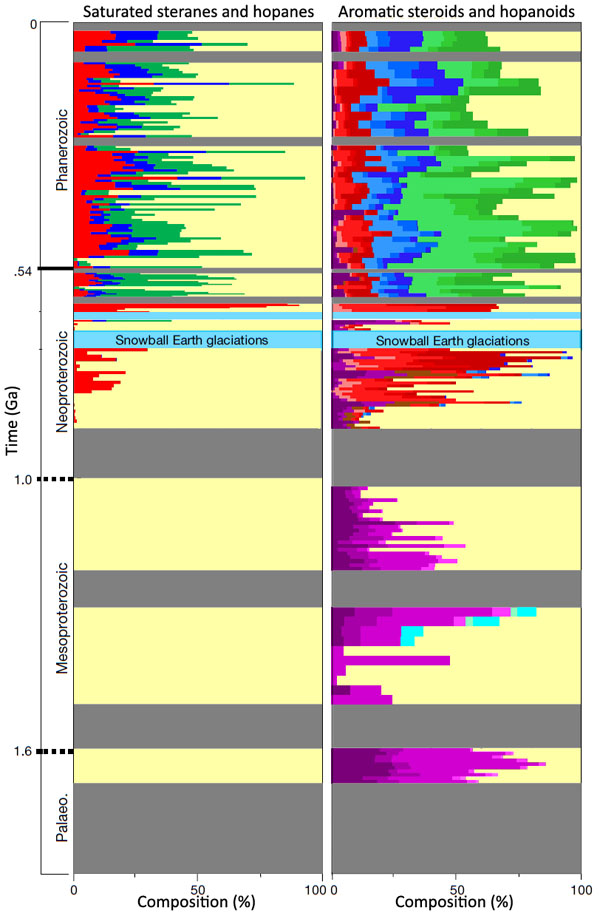
Proportions of biomarkers in sediments from present to 1.64 Ga. Cholesteroids – reds; ergosteroids – blues; stigmasteroids – greens; protosteroids magentas, hopanoids – yellows; unsampled – grey. Snowball glaciations are shown in pale blue. (Credit: Simplified from Figure 3 in Brocks et al.)

Interpretation of the results by Jochen Brocks and colleagues is complicated, and what follows is a summary based partly on an accompanying Nature News & Views article(Kenig, F. 2023. The long infancy of sterol biosynthesis. Nature, v. 618, p. 678-680; DOI: 10.1038/d41586-023-01816-1). The conclusions of Brocks et al. are surprising. First, the break-down products of steroids (saturated steranes) that can be attributed to crown eukaryotes (left on the figure above) are only present in sediments going back to about 200 Ma before the first Snowball Earth event (~900 Ma). Before that only hopanes formed by hopanoid degradation are present: a suggestion that LECA only appeared around that time – the authors suggest sometime between 1 and 1.2 Ga. That is far later than the time when eukaryotes could have emerged: i.e. once there was available oxygen after the Great Oxidation Event (~2.4 to 2.2 Ga). So what was going on before this? The authors broke new ground in analysis of biomarkers by being able to detect signs of the presence of actual hopanoids and steroids of several different kinds. Steroids were present as far back as 1.6 Ga in the oldest sediments that were analysed.

Steroids of crown eukaryotes are represented by cholesteroids, ergosteroids and stigmasteroids. All three are present throughout the Phanerozoic Eon and into the time of the Ediacaran Fauna that began 630 Ma ago. In that time span they generally outweigh hopanoids, thus reflecting the dominance of eukaryotes over prokaryotes. Back to about 900 Ma, only cholesteroids are present, together with archaic forms that are not found in living Eukarya, termed protosteroids.  Before that, only protosteroids are found. Moreover, these archaic steroids are not present in sediments that follow the Snowball Earth episodes (the Cryogenian Period).

Thus, it is possible that crown group eukaryotes – and their descendants, including us – evolved from and completely replaced an earlier primitive form (acritarchs?) at around the time of the greatest climatic changes that the Earth had experienced in the previous billion years or more. Moreover, the Cryogenian and Ediacaran Periods seem to show a rapid emergence of stigmasteroid- and ergosteroid production relative to cholesteroid: perhaps a result of explosive evolution of the Eukarya at that time. The organisms that produced protosteroids were present in variable amounts throughout the Mesoproteroic. Clearly there need to be similar analyses of sediments going back to the Great Oxygenation Event and the preceding Archaean to see if the protosteroid producers arose along with increasing levels of molecular oxygen. The ‘boring billion’ (2.0 to 1.0 Ga) may well be more interesting than previously thought.

Early modern human fossils from a Laotian cave and the eastward ‘out-of-Africa’ migration

Finding human fossils in SE Asia is rare because its tropical climate generally results in decomposition of bones. Up to now the oldest known anatomically modern human (AMH) found beyond the Middle East is from Australia and has been dated to 65 ka. Other, less convincing candidates for the earliest appearance of AMH in Asia are scattered teeth found in Chinese caves that yielded dates of up to 139 ka: their assignment to AMH and the reliability of their dating are disputed. Now a large team of scientists from the USA, Germany, Australia, South Africa, France, Denmark and Laos have unearthed convincing but fragmented AMH bones among a jumble of diverse animal fossils in sediment flooring Tam Pà Ling cave  in northern Laos (Friedline, S.E. and 30 others 2023. Early presence of Homo sapiens in Southeast Asia by 86–68 kyr at Tam Pà Ling, Northern Laos. Nature Communications, v. 14, article 3193; DOI: 10.1038/s41467-023-38715-y). Several dating techniques reveal ages of the AMH samples that range from 46 to 77 ka, and potentially as far back as 86 ka. It is conceivable that the oldest are from the population that subsequently reached Australia. Far to the west of Laos in Greece, Israel and Arabia an earlier AMH presence goes back as far as 90 to 210 ka. Moreover, palaeoclimatic studies suggest many opportunities for eastward migration since 290 ka ago that AMH emigrants may have exploited. Once beyond regions around Arabia and the Gulf, which were periodically hyperarid, the journey to the rest of Asia was probably continuously habitable throughout the last two glacial-interglacial cycles.

Entrance to Tam Pà Ling cave in northern Laos (credit: Demeter et al.; Fig S1)

Another aspect of the AMH record in southern and SE Asia is that the individuals represented seem to have been anatomically very varied (Demeter, F. et al. 2023. Early Modern Humans and Morphological Variation in Southeast Asia: Fossil Evidence from Tam Pa Ling, LaosPLOS ONE, v. 10, article e0121193. DOI:10.1371/journal.pone.0121193). This may suggest that migration was by significantly different groups at different times. Oddly, the earliest known examples have more ‘modern’ characteristics than younger ones that appear somewhat ‘archaic’. The age of the fossils conflicts with the 60 ka age reconstructed from genetic evidence for the main diffusion across Eurasia and Australasia. One possibility is that there were several pre-60 ka migrations, descendents of these early populations having been replaced or assimilated by a later, larger numbers of AMH migrants. At 74 ka the Sumatran Toba supervolcano erupted about 2,800 km3 of ash to blanket a vast area and cause global cooling that could have more than decimated migrating AMH groups. Alternatively the 60 ka ‘genetics’ date is not correct, as suggested by the minimum date of 65 ka for the earliest Australians. Such a conflict of evidence will surely spur further excavation: as one researcher observed about Laos, ‘There are thousands of caves to explore’.

See also: Coleman, J. 2023. Laos cave fossils prompt rethink of human migration map. Nature, v.618; DOI: 10.1038/d41586-023-01903-3; Ashworth, J. 2023. Fossils reveal early modern humans in southeast Asia 77,000 years ago. Natural History Museum’s Discover, 15 June 2023.

Did Precambrian BIFs ‘fall’ into the mantle to trigger mantle plumes?

How the Earth has been shaped has depended to a large extent on a very simple variable among rocks: their density. Contrasts in density between vast rock masses are expressed when gravity attempts to maintain a balance of forces. The abrupt difference in elevation of the solid surface at the boundaries of oceans and continents – the Earth’s hypsometry – stems from the contrasted densities of continental and oceanic crust: the one dominated by granitic rocks (~2.8 t m-3) the other by those of basaltic composition (~ 3.0 t m-3). Astronomers have estimated that Earth’s overall density is about 5.5 t m-3 – it is the densest planet in the Solar System. The underlying mantle makes up 68% of Earth’s mass, with a density that increases with depth from 3.3 to 5.4 t m-3 in a stepwise fashion, at a number of discontinuities, because mantle minerals undergo changes induced by pressure. The remaining one third of Earth’s mass resides in the iron-nickel core at densities between 9.5 to 14.5 t m-3. Such density layering is by no means completely stable. Locally increased temperatures in mantle rocks reduce their density sufficiently for masses to rise convectively to be replaced by cooler ones, albeit slowly. By far the most important form of convection affecting the lithosphere involves the resorption of oceanic lithosphere plates at destructive margins, which results in subduction. This is thought to be due to old, cold oceanic basalts undergoing metamorphism as pressure increases during subduction. They are transformed at depth to a mineral assemblage (eclogite) that is denser (3.4 to 3.5 t m-3) than the enveloping upper mantle. That density contrast is sufficient for gravity to pull slabs of oceanic lithosphere downwards. This slab-pull force is transmitted through oceanic lithosphere that remains at the surface to become the dominant driver of modern plate tectonics. As a result, extension of the surface oceanic lithosphere at constructive margins draws mantle upwards to partially melt at reduced pressure, thus adding new basaltic crust at mid-ocean rift systems to maintain a form of mantle convection. Seismic tomography shows that active subducted slabs become ductile about 660 km beneath the surface and below that no earthquakes are detected. Quite possibly, the density of the reconstituted lithospheric slab becomes less than that of the mantle below the 660 km discontinuity. So the subducted slab continues by moving sideways and buckling in response to the ‘push’ from its rigid upper parts above. But it has been suggested that some subducted slabs do finally sink to the core-mantle boundary, but that is somewhat conjectural.

Typical banded iron formation

There are sedimentary rocks whose density at the surface exceeds that of the upper mantle: banded iron formations (BIFs) that contain up to 60% iron oxides (mainly Fe2O3) and have an average density at the surface of around 3.5 t m-3. BIFs formed mainly in the late Archaean and early Proterozoic Eons  (3.2 to 1.0 Ga) and none are known from the last 400 Ma. They formed when soluble iron-2 (Fe2+) – being added to ocean water by submarine hydrothermal activity –was precipitated as Fe3+ in the form of iron oxide (Fe2O3) where oxygen was present in ocean water. With little doubt this happened only in shallow marine basins where cyanobacteria that appeared about 3.5 Ga ago had sufficient sunlight to photosynthesise. Until about 2.4 Ga the atmosphere and thus the bulk of ocean water contained very little oxygen so the oceans were pervaded by soluble iron so that BIFs were able to form wherever such biological activity was going on. Conceivably (but not proven), that BIF-forming biochemical reaction may even have operated far from land in ocean surface water, slowly to deposit Fe2O3 on the deep ocean floor. After 2.4 Ga oxygen began to build in the atmosphere after the Great Oxidation Event had begon. That time was also when the greatest production of BIFs took place. Strangely, the amount of BIF in the geological record fell during the next 600 Ma to rise again to a very high peak at 1.8 Ga. Since there must have been sufficient soluble iron and an increasing amount of available oxygen for BIFs to form throughout that ‘lean’ period the drop in BIF formation is paradoxical. After 1.0 Ga BIFs more or less disappear. By then so much oxygen was present in the atmosphere and from top to bottom in ocean water that soluble iron was mostly precipitated at its hydrothermal source on the ocean floor. Incidentally, modern ocean surface water far from land contains so little dissolved iron that little microbiological activity goes on there: iron is an essential nutrient so the surface waters of remote oceans are effectively ‘wet deserts’.

Plots of probability of LIPs and BIFs forming at the Earth’s surface during Precambrian times, based on actual occurrences (Credit: Keller, et al., modified Fig 1A)

Spurred by the fact that if a sea-floor slab dominated by BIFs was subducted it wouldn’t need eclogite formation to sink into the mantle, Duncan Keller of Rice University in Texas and other US and Canadian colleagues have published a ‘thought experiment’ using time-series data on LIPs and BIFs compiled by other geoscientists (Keller, D.S. et al. 2023. Links between large igneous province volcanism and subducted iron formations. Nature Geoscience, v. 16, article; DOI: 10.1038/s41561-023-01188-1.). Their approach involves comparing the occurrences of 54 BIFs through time with signs of activity in the mantle during the Palaeo- and Mesoproterozoic Eras, as marked by large igneous provinces (LIPs) during that time span. To do this they calculated the degree of correlation in time between BIFs and LIPs. The authors chose a minimum area for LIPs of 400 thousand km2 – giving a total of 66 well-dated examples. Because the bulk of Precambrian flood-basalt provinces, such as occurred during the Phanerozoic, have been eroded away, most of their examples are huge, well-dated dyke swarms that almost certainly fed such plateau basalts. Rather than a direct time-correlation, what emerged was a match-up that covered 74% of the LIPs with BIFs that had formed about 241 Ma earlier. They also found a less precise correlation between LIPs associated with 241 Ma older BIFs and protracted periods of stable geomagnetic field, known as ‘superchrons’. These are thought by geophysicists to be influenced by heat flow through the core-mantle boundary (CMB).

The high bulk density of BIFs at the surface would be likely to remain about 15 % greater than that of peridotite as pressure increased with depth in the mantle. Such slabs could therefore penetrate the 660 mantle discontinuity. Their subduction would probably result in their eventually ‘piling up’ in the vicinity of the CMB. The high iron content of BIFs may also have changed the way that the core loses heat, thereby triggering mantle plumes. Certainly, there is a complex zone of ultra-low seismic velocities (ULVZ) that signifies hot, ductile material extending above the CMB. Because BIFs’ high iron-content makes them thermally highly conductive compared with basalts and other sediments, they may be responsible. Clearly, Keller et al’s hypothesis is likely to be controversial and they hope that other geoscientists will test it with new or re-analysed geophysical data. But the possibility of BIFs falling to the base of the mantle spectacularly extends the influence of surface biological processes to the entire planet. And, indeed, it may have shaped the later part of its tectonic history having changed the composition of the deep mantle. The interconnectedness of the Earth system also demands that the consequences – plumes and large igneous provinces – would have fed back to the Precambrian biosphere. See also: Iron-rich rocks unlock new insights into Earth’s planetary history, Science Daily, 2 June 2023

New drill core penetrates the Mohorovičić Discontinuity (the ‘Moho’)

In 1909 Croatian geophysicist Andrija Mohorovičić examined seismograms of a shallow earthquake that shook the area around Zagreb. To his surprise the by-then familiar time sequence of P-waves followed by the slower S-waves appeared twice on seismic records up to 800 km away. The only explanation that he could come up with was that the first arrivals had travelled directly through the crust to the detector whereas the second set must have followed a longer path: it had travelled downwards to be refracted to reach the surface when it met rocks denser than those at the surface. His analysis revealed a sharp boundary between the Earth’s crust and its mantle at a depth of about 54 km below what was then Yugoslavia. Later workers confirmed this discovery and honoured its discoverer by naming it the Mohorovičić Discontinuity. Difficulty with pronouncing his name resulted in a geological nickname: ‘the Moho’. It can be detected everywhere: at 20 to 90 km beneath the continental surface and 5 to 10 km beneath the ocean floor, thus distinguishing between continental and oceanic crust.

In the late 1950s accelerating geological and oceanographic research that would culminate in the theory of plate tectonics turned its focus on drilling down to the Moho in much the same way as a lust for space travel spawned getting to the Moon. The difference was that the proposers of what became known as the Mohole Project were members of what amounted to a geoscientific glee club (The American Miscellaneous Society), which included a member of the well-financed US National Science Foundation’s Earth Science Panel. The idea emerged shortly after the Soviet Union had launched the Sputnik satellite and rumours emerged that it was proposing deep drilling into the continental crust beneath the Kola Peninsula.  The Mohole’s initial target was the 3.9 km deep floor of the Caribbean off Guadalupe in Mexico and required advanced methods of stabilisation for a new oceanographic ship that was to host the drilling rig.

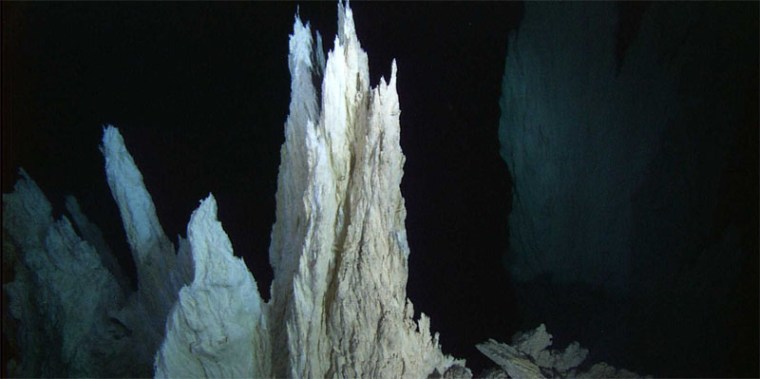
Huge (tens of metres high) pillars or ‘chimneys’ of carbonates formed by the Lost City hydrothermal vent near the mid-Atlantic ridge (Credit: ETH Zurich)

The Mohole was spudded in 1961, but the deepest of five holes reached only 200 m beneath the sea floor. It recovered Miocene sediments and a few metres of basalt. Deep water drilling was somewhat more complicated than expected and about US$ 57 million was spent fruitlessly. The project was disbanded in 1966 with considerable acrimony and schadenfreude. Nonetheless, the Mohole fiasco made technical advances and did demonstrate the feasibility of offshore drilling. The petroleum industry benefitted and so did oceanography with the globe-spanning deep-sea drilling of ocean floor sediments. The sediment cores produced the 200 million-year exquisitely detailed record of climate change and vast amounts of geochemical data from the basaltic oceanic crust. In 2005 JOIDES (the Joint Oceanographic Institutions for Deep Earth Sampling) had another crack at the Moho. That venture centred on the intersection of the Mid-Atlantic Ridge and the Atlantis Fracture Zone close to the ‘Lost City’ hydrothermal vent. The area around the vent is the site of a huge low-angled extensional fault that has partly dragged the basaltic ocean crust off the mantle beneath causing it to bulge. This provided an excellent opportunity to drill through the Moho. All went well, but 54 days of drilling yielded 1.4 km of basalt but nothing resembling mantle rock. So, again, the Moho had thwarted Science (and research economics). But finally it is beginning to reveal it secrets (see: Voosen, P. 2023. Ocean drillers exhume a bounty of mantle rocks. Science, v. 380 (News) p. 876-877; DOI: 10.1126/science.adi9899

The area around the ‘Lost City’ vent was originally chosen for drilling to examine the chemical processes going on there. Hydrogen emitted by serpentinisation of mantle rocks can combine with carbon monoxide in hydrothermal fluids to create a wide variety of organic compounds, which could be the initial building blocks for the origin of life. As part of the International Ocean Drilling Programme JOIDES decided to launch IODP Expedition 399 to re-examine the area around ‘Lost City’ in more detail. The expedition first tried to continue drilling the 2005 hole, but failed yet again. Finally a new drill site aimed at penetrating the extensional detachment. Within a few days the drill bit punched into mantle rocks and over a 6-week period the expedition had recovered a kilometre of core. The technical accounts for each week of drilling give a flavour of what it must be like to be a part of such a ship-borne expedition as well as describing what emerged in the drill core. It seems like a bit of a jumble, dominated by the mineral olivine– the principal characteristic of the ultramafic mantle – almost pure in the rock dunite and mixed with pyroxenes in various kinds of peridotite. There are also coarse-grained rocks that contain plagioclase feldspar, which cut through the ultramafic materials – gabbros, troctolites and norites.  They are relics of intrusive basaltic magmas that did not make it to the seabed. The samples are variably altered by interaction with watery hydrothermal fluids, with lots of serpentine, talc and even asbestos: the drilling presented a health hazard for a few days. The rocks have been metamorphosed under pressure-temperature conditions of greenschist to amphibolite facies and subject to ductile deformation, probably because of the effect of extensional deformation. Whatever, there is plenty of material to be analysed, including for signs of microbial activity. So, the dreams of a 1950s academic drinking fraternity (they were all men!) have finally been realised. But since those pre-plate-tectonic times many geologists have seen and collected much the same, even putting their index fingers on the Moho itself in the time-honoured fashion. Intricate 3-D geology in ophiolite complexes such as that in Oman, provide such opportunities at the much lower cost of air travel, Land Cruiser hire and camping. Indeed what we know of the structure of the oceanic lithosphere – pillow lavas, sheeted dyke complexes, gabbro cumulates and serpentinised ultramafic mantle – has come from such bodies thrust onto continental crust at ancient plate margins. So, why the celebration in this case? They are the first samples of mantle from young oceanic lithosphere; the rocks of ophiolites may not have formed at mid-ocean ridges. These should give clues to the long-term magmatism that has created the vast abyssal basins that the mantle eventually reabsorbs by subduction. Then, of course, there is the link to biogenic processes at constructive margins that underpinned the return to the active hydrothermal venting at ‘Lost City’.

Flash: Huge rockslide imminent in Swiss village of Brienz

The rockslide above Brienz in eastern Switzerland marked by a white surface bare of vegetation. Credit CHRISTOPH NÄNNI, TIEFBAUAMT GR, SWITZERLAND via the BBC

On 9 May 2023 the authorities of the Albula/Alvra municipality in the Swiss canton of Graubünden informed people living in the small village of Brienz that they must evacuate the area by 18 May as the threat of rock falls from the mountain beneath which they live had triggered a red alert. By 13 May all 130 dwellings had been abandoned.

The danger is posed by an estimated 5 million tons of rock associated with a developing landslide that is now estimated to be moving at around 32 m per year. The village itself had long been creeping down slope at a few centimetres each year, but recently its church spire had begun to tilt and buildings became riven by cracks. Seemingly, engineering attempts to mitigate the hazards have been unsuccessful, and large boulders have already tumbled into the vicinity of Brienz.

Being situated beneath a crumbling scree slope devoid of vegetation that had been developing since the last glaciation, the geological risk to the village comes as no surprise to its population and local authority. The local geology has a thick limestone resting on the thinly bedded Flysch – a metamorphosed sequence of fine-grained turbidites – from which groundwater escapes very slowly, thereby becoming lubricated. A curved (listric) failure zone has developed beneath the exposed mountainside, hence the danger. Acceleration on the listric surface began about 20 years ago.

At least the people of Brienz have been moved to safety, unlike 144 school children and adults in the mining village of Aberfan in South Wales. On 21 October 1966 they were crushed to death by coal-mining waste that suddenly flowed from waste tips on the steep valley side above the village. In that case no warning was given by the National Coal Board authorities who allowed  the tipping witout a thought for its geological consequences.

See also: Petley, D. 2023. The very large incipient rockslide at Brienz in Switzerland. The Landslide Blog (10 May 2023)

Origin of the genus Homo: a Paranthropus link?

Reconstruction of a Paranthropus head (Credit: Jerry Humphrey, Pinterest)

Paranthropoids had large, broad teeth and pronounced cheekbones plus a bone crest on the top of their skulls that were the attachments for powerful jaw muscles, much as in modern gorillas. Unlike gorillas they were definitely bipedal and were more similar to australopithecines. They have been called ‘robust’ australopithecines but they were not significantly taller or heavier. The first to be unearthed at Olduvai, Tanzania in 1959 (Paranthropus boisei) was dubbed ‘Nutcracker Man’ by its finder, and many have implied that paranthropoids’ teeth and powerful jaws were signs of a vegetarian diet that needed a lot of chewing. Yet their teeth do not show the microscopic pitting associated with living primates that eat hard plant parts and nuts, or the heavy wear that results from eating grasses. They probably ate soft plants, such as semi-aquatic succulents or tubers, but meat-eating that causes little dental wear cannot be ruled out. Some specimens are associated with long bones of other animals whose ends are worn, suggesting that they may have used them as tools for digging. Plant remains found at paranthropoid sites suggests that they inhabited woodland, together with coexisting australopithecines. They were around in the form of three successive species from 2.9 to 1.2 Ma, outlasting australopithecines. The later paranthropoids coexisted with Homo habilis and H. erectus: they were clearly just as successfully adapted to their surroundings as were early humans.

In early 2023 evidence was published that associated Oldowan stone tools with remains of Paranthropus, together with deliberately defleshed and cut bones (see also): though association is not proof of a direct link. Interestingly, the hand of a P. robustus found in the Swartkrans cave system in South Africa is consistent with a human-like precision grip, i.e. it had an opposable thumb. Swarkrans also yielded the earliest evidence for the deliberate use of fire about 1.5 Ma ago, associated with remains of both P. robustus and H. erectus. All this suggests that a case could be made for paranthropoids’ being human ancestors – supporting evidence has just been published (Braga, J. et al. 2023. Hominin fossils from Kromdraai and Drimolen inform Paranthropus robustus craniofacial ontogeny. Science Advances, v. 9, article eade7165; DOI: 10.1126/sciadv.ade7165).

Fossil-bearing breccias beneath the floor of the Kromdraai cave in the Cradle of Humankind World Heritage Site 45 km NW of Johannesburg, South Africa yielded the first near-complete P. robustus skull in 1938, another being found in cave breccias at the nearby Drimolen quarry. These deposits also contained remains of four infants assigned to the species, whose teeth and cranial parts were at different stages of juvenile development (ontogeny). José Braga of the University of Toulouse, France and co-workers from South Africa and the USA compared this growth sequence with those teased out from immature specimens of Australopithecus africanus and early Homo.Their tentative conclusion is that Paranthropus robustus is more closely related to early humans than to australopithecines of the same stratigraphic age.

Skull of a probable adult female P. robustus (left) with that of H. habilis (centre) and A. africanus (right). Credits: all from Wikipedia pages

So, it now seems possible that paranthropoids are not ‘robust’ australopithecines in an acceptable, taxonomic sense. Their closer resemblance in early development to early humans, together with their association with early stone tools used for defleshing prey animals, together with evidence for possible their use of fire, further strengthens their candidacy for an ancestral link to humans. The best preserved skulls of Homo habilis and a female P. robustus (males of that species show the distinctive saggital crest) do show close similarities, that of a roughly contemporary A. africanus having distinctly wider cheeks than both. All three species were in life probably of much the same weight and stature (30 to 40 kg and 110 to 130 cm) but H. habilis had a significantly larger brain volume (500 to 900 cm3) than the other two (each ~450 cm3). However, this isn’t proof that the genus Homo evolved from a paranthropoid ancestor. That would require genetic evidence, unlikely to be extracted from specimens because DNA seems to degrade more quickly under the conditions of the tropics than at high latitudes. Debate on ultimate human origins will probably be endless. Perhaps it would make more sense simply to accept that early humans weren’t the only ‘smart kids on the palaeoanthropological block’, one of which left no issue after 1.2 Ma ago.

See also: Handwerk, B. 2023. Who made the first stone tool kits? Smithsonian Magazine, 8 February 2023, article 180981606

Music based on earthquake waves

Many readers will have heard the vibration signal of an earthquake, as recorded by a seismometer, and replayed through a speaker: listen to some examples here. They are eerily like the sounds of falling, multi-storey buildings. Scary, especially if you think of the horrors of the devastation in SE Turkiye and NE Syria caused by the 6 February 2023 magnitude 7.8 event on the East Anatolian Fault system

Since P-waves are very like sound waves, audibly converting the one to the other is relatively simple. However, earthquakes are rarely single events, each major one being preceded by foreshocks and followed by aftershocks, both recurring over weeks or months. Highly active areas are characterised by earthquake swarms that can go on continuously, as happens with sea-floor spreading at mid-ocean ridges. In the case of Yellowstone National Park there are continual quakes, but there the seismicity results from magma rising and falling above a superplume. Most of such swarm-quakes are diminutive, so playing the speeded-up signal through a loudspeaker just sounds like a low, tremulous hiss.

Domenico Vicinanza a physicist at the Anglia Ruskin University in Cambridge UK specialises in creating music from complex scientific data, including those from CERN’s Large Hadron Collider in Geneva, to help interpret them. He has recently turned his hand to the Yellowstone earthquake swarm, converting the amplitudes and frequencies of its real-time seismograph to notes in a musical score: listen to the results here. They are surprisingly soothing, perhaps in the manner of the song of the humpback whale used by some to help with their chronic insomnia.

See also:  Davis, N. Rock concert: Yellowstone seismic activity to be performed on live flute, The Guardian; 8 May 2023

Extraction of ancient human DNA from artefacts

The Denisova cave in southern Siberia is now famous for the evidence that it has provided for Neanderthals and Denisovans and their interbreeding based on DNA recovered from their bones, even a tiny finger bone of the latter. Indeed we would not know of the former existence of Denisovans without such a clue. Scientists at the Max Planck Institute for Evolutionary Anthropology in Leipzig, responsible for both breakthroughs, also pioneered the extraction of hominin DNA from soil in the cave. Now they have refined the intricate extraction of genetic material to such an extent that detailed hominin DNA sequences can be analysed from ornaments worn by ancient people, in much the same manner as applied in forensic studies of crime scenes (Essel, E. and 22 others 2023. Ancient human DNA recovered from a Palaeolithic pendant. Nature, early release 3 May 2023; DOI: 10.1038/s41586-023-06035-2).

Elk-tooth pendant found at Denisova cave, before cleaning and DNA extraction (top) and after the ‘washing’ procedure (bottom). Credit: Essel et al., Fig 1.

Russian archaeologists who continue to work at Denisova cave found a pierced pendant made from the tooth of a Siberian elk or wapiti during the 2019 field season. It was sent to Leipzig, where the palaeogenetics team had been trying to extract the DNA of whoever had worn personal artefacts found in French and Bulgarian caves. Their efforts had been unsuccessful, but such an object from Denisova clearly spurred them on. When someone wears next to the skin objects made of porous materials their sweat and the DNA that it carries seeps into the pores. If the materials decay very slowly, as do bone and especially teeth, genetic material can, in principle be extracted. But crushing up important ancient objects is not an option: for such rarities the extraction has to be non-destructive. It can only be done by ‘washing’ it in reagents that do not themselves break down DNA. Elena Essel and her many colleagues experimented with many ‘brews’ of reagents and repeated immersion at steadily rising temperature (up to 90°C). This releases genetic material in a stepwise fashion, allowing separation of contaminants in the host sediment from that which had penetrated into the tooth’s pores from whoever made the pendant and the wearer, and the animal from which it came

 Analysis of the recovered material yielded elk mtDNA, which was compared with that from four other ancient elks of known ages. This suggested that the elk had lived between 19 and 25 ka ago, thereby indirectly dating the time when the pendant was made and worn. A surprisingly large amount human DNA showed that the wearer was a female who was genetically allied with ancient anatomically modern humans who lived further east in Siberia at about that time.

Obviously this astonishing result opens up a wide vista for archaeology, though not from Palaeolithic burials, which are extremely rare. But artefacts of various kinds are much more common that actual human remains. Because the technique is non-destructive museums may be more willing to make objects in their collections available for analysis. Maybe the approach will be restricted to porous bone or tooth ornaments worn for long periods by individuals. Yet stone tools that were handled continually could be a more important target, depending on the rock from which they were made and its porosity.

See also: Lesté-Lasserre, C.. DNA from 25,000-year-old tooth pendant reveals woman who wore it. New Scientist, 3 May 2023.

Hydrogen and how the Earth formed

A third piece with hydrogen as its focus in a couple of months? Well, from a galactic perspective there’s a lot of it about. Modern cosmology suggests that only 4.6% of the energy in the universe consists of elemental atoms made of protons, neutrons and electrons, dwarfed by dark energy and dark matter that are something of mystery. But of the more familiar energy equivalent, tangible matter (as in E=mc2), 74% of the universe is hydrogen, 24% is helium and the other 92 elements amount to just 2%. That tiny proportion of heavier elements was created by nucleosynthesis within stars from the two products of the Big Bang (H and He). Nuclear fusion reactions formed those with atomic numbers (protons in their nuclei) up to that of iron (26), whereas the heavier elements were created through neutron- and proton capture when the largest stars destroyed themselves cataclysmically as supernovae. Yet the planet whose surface we inhabit contains only minute amounts of helium and elemental hydrogen. Of course water at and beneath the surface, in the form of atmospheric vapour and locked within minerals retains some of the cosmically available hydrogen. But current estimates suggest that hydrogen accounts for a mere 0.03% of Earth’s mass. Despite the fact that some forms of radioactive decay generate alpha particles that become helium it forms a vanishingly small proportion of terrestrial mass.

The solar system formed around 4.6 billion years ago by a complex gravitational accretion of the gas and dust of an interstellar cloud: mainly H and He. Its dynamic collapse resulted in gravitational potential energy being transformed into heat: in the case of the Sun, sufficient to set off self-sustaining nuclear fusion. As a body grows in this way so does its gravity and thus the speed needed for matter to escape from its pull (escape velocity). As temperature increases so does the speed at which atoms of each element vibrate; the lower the atomic mass the faster the vibration and the greater the chance of escape. So the ‘blend’ of elements that an astronomical body retains during its early evolution depends on its gravity and its surface temperature. The Sun is so massive that very little has escaped its pull, despite a surface temperature of about 5 to 6 thousand degrees Celsius. Its composition is thus close to the cosmic average. Those of the giant planets Jupiter, Saturn, Uranus and Neptune are not far short because of their large gravities and low surface temperatures. Even today, the smaller Inner Planets are unable to cling on to elemental hydrogen and helium and nearly all that is left of the matter from which they formed is the 2% of heavier cosmic elements locked into solids, liquids and gases.

Processes in the early solar system were far more complicated than they are today. In the mainly gaseous disc, from which the solar system evolved, gravity dragged matter towards its centre. That eventually ignited nuclear fusion of hydrogen to form our star. More remote from its gravitational pull vortices aggregated dust into bodies known as planetesimals that in turn accreted to larger protoplanets. Solar gravity dragged gas from the inner solar system leaving rocky protoplanets, whereas gas was able to be attracted to the surface of what became the gas giants where their gravity outweighed that of the far-off Sun. This was complicated by a sort of Milankovich Effect on steroids in which protoplanets continuously changed their orbits and underwent collisions. The best known of these was between the protoEarth and a Mars-sized body that formed the Earth-Moon system, both bodies having deep magma oceans as a result of the huge energy focussed on them by the collision. What may have happened to the protoplanet that became Earth before the Moon-forming collision has been addressed by three geoscientists at the University of California Los Angeles and the Carnegie Institution for Science Washington DC, USA (Young, E.D. et al. 2023. Earth shaped by primordial H2 atmospheres. Nature, v. 616, p. 306–311; DOI: 10.1038/s41586-023-05823-0 [PDF request to: eyoung@epss.ucla.edu]).

A thick hydrogen-rich atmosphere’s interacting chemically with a protoplanet (left). A possible later stage (right) where iron oxide in the magma ocean of the Early Hadean after Moon formation oxidises a hydrogen atmosphere to form surface water (Credit: Sean Raymond 2023, Fig 1)

The focus of the work of Edward Young, Anat Shahar and Hilke Schlichting is directed at the possibility that the Earth-forming protoplanets originally retained thick hydrogen atmospheres. They use thermodynamic modelling of the equilibrium between hydrogen and silicate magma oceans that had resulted from the energy of their accretion. The authors’ main assumption is that insufficient time had elapsed during accretion for the protoplanets to cool and crystallise: a distinct possibility because loss of accretionary heat by thermal radiation would have been ‘blanketed’ by actively accreting dust and gas in orbit around the growing protoplanets. Effectively, the equilibrium would have been chemical in nature: reactions between highly reducing hydrogen and oxidised silicate melts or even vaporised rock evaporated from the very hot surface. The authors suggest that protoplanets bigger than Mars (0.2 to 0.3 times that of Earth) could retain a hydrogen-rich atmosphere long enough for the chemical reactions to come to a balance, despite high temperatures. There would have been no shortage of hydrogen at this early stage in solar system evolution: perhaps as much as 0.2% percent the mass of the Earth surrounding a protoplanet about half its present size.

Two outcomes may have emerged. Reaction between hydrogen and anhydrous silicates could produce H2O in amounts up to three times that currently in the Earth’s oceans, some locked in the magma ocean, some in the dense atmosphere. A by-product would have been iron oxide, giving the current mantle its oxidising properties known from the geochemistry of basaltic magmas.  Hydrogen might also have dissolved in molten iron alloys, thereby contributing to the nascent core. That second outcome would help explain why the modern core is less dense than expected for iron-nickel alloy, both solid and liquid. In fact densities calculated by geophysicists from the speeds of seismic waves that have travelled through the core are 5 to 10% percent lower than expected for the alloy. So the core must contain substantial amounts of elements with low atomic numbers.

Several other possibilities have been suggested to account for Earth’s abundance of water. Two popular ideas are comets arriving in the ‘settled’ times of the Hadean or by original accretion of hydrous chondrite meteorites, whose hydrogen isotope proportions match those of ocean water. Hydrogen as the light element needed in the core is but one possibility along with oxygen, sulfur and other ‘light’ elements. Also, the oxidising potential of the modern mantle may have resulted from several billion years of wet lithosphere being subducted. To paraphrase Sean Raymond (below), ‘other hypotheses are available’!

See also: Raymond, S.N. 2023. Earth’s molten youth had long-lasting consequences. Nature (News & Views), v. 616, p. 251-252; DOI: 10.1038/d41586-023-00979-1 [PDF request to: rayray.sean@gmail.com]