The production of geoscientists: a cautionary tale from the Open University

Despite global recession, worldwide job opportunities for geoscientists are increasing faster than the number of available applicants. In the US the Bureau of Labor Statistics predicts 21% growth in this sector in 2010-2020 (Perkins, S. 2011. Geosciences: Earth works.  Nature, v. 473, p. 243–244). That figure does not include jobs freed-up by retirement: the demographics of employed geoscientists in the petroleum and mining industries are skewed markedly to the over-40s, peaking at age 50.

The American Geological Institute’s Geoscience Workforce Program has reported that the regions that produce most geoscience graduates, the US, Europe, Russia and China, are not meeting their domestic needs let alone global requirements. The demand stems from the traditional petroleum and mineral industries that are booming, together with the renewable energy sector and growing concern about environmental hazards and impacts attending global warming.

An editorial (Rare Earth scientists) in the December 2012 issue of Nature Geoscience is headlined, ‘Not enough young people enter the geosciences. A passion for the subject should be sparked early on.’ It then comments that the decline in young people studying the geosciences at school stems from Earth science not being taken seriously, under-education of their teachers and budgetary sacrifice of geoscience to preserve the more ‘traditional’ science subjects. The leading article concludes, ‘On an increasingly vulnerable planet, governments need to teach the young people of their country an understanding of the Earth’s basic make-up and dynamics, along with inspiring a fascination for its age and beauty. How else can we expect humanity to survive the Anthropocene?’

Open University
Creative work on the Open University campus (Photo credit: ianonline)

For over 40 years the Open University has been a key UK educator in geoscience. Since 1971 a total of about 170 thousand, mainly British students have studied at home through the OU for a science-based degree. Discovering tectonics, Earth structure, geology and palaeontology through studying the Science Foundation Course must have been a thrilling experience because since 1972, when the OU began to offer a level-2 course in Geology, around 30 thousand of its science ‘beginners’ decided to find out more; an average enrolment of 760 per year. The OU’s Department of Earth Sciences added more level-2 courses so that by 2000, students could also study economic geology (The Earth’s Physical Resources – 18 500 students from 1974 to 2009, averaging 544 per year), planetary science (The Earth: Structure, Composition and Evolution- 14 100 students from 1981 to 2005, averaging 590 per year) and Earth-system science (Earth and Life –7121 students from 1997 to 2006, averaging 712 per year).

After 1981 Open University students could, and many did, aim for a geoscience-oriented degree that also took in three, more advanced, level-3 studies. These were Oceanography (12 121 students from 1989 to 2012, averaging 505 per year), stratigraphy (The Geological Record of Environmental Change – 7968 students from 1976 to 2012, averaging 295 per year) and Earth’s internal processes (Understanding the Continents – 6994 students from 1976 to 2012, averaging 259 per year).

In this way the Open University became one of the world’s largest single providers of geoscience education, if not the largest: in the whole of the United States fewer than 3000 first degrees majoring in geoscience are awarded annually. Yet from its inception the OU’s Department of Earth Sciences had never claimed to be training professional geologists: had it been, its graduates would have significantly affected the world’s employment opportunities in the discipline. In fact that claim could never have been made, for one simple reason: distance learning for part-time students would always struggle to provide the volume of hands-on practical training that is the quintessence of this pre-eminently field- and lab-based discipline. Nevertheless the OU’s range of residential schools where practical activities were intensively provided for went a good way towards filling this gap.

English: Waterfall Geologists, from the Open U...
Open University students at the now defunct Geology summer school, inspecting a fault. (Photo credit: Wikipedia)

So, to those unfamiliar with the realities of the OU milieu it will seem odd that in 2012 the world’s largest provider of distance learning axed all residential courses right across the science spectrum, including those in practical geoscience. But to those directly involved this move was the logical final step in a series of changes since 2001. Before that, for those courses that included a residential component attendance had been compulsory, except in special circumstances. Yet after 2001 university authorities deemed that the residential schools continue only as optional components for degree study and should carry an additional registration fee. Not surprisingly, in the case of the core level-2 Geology course attendance at the re-branded residential school declined to 30% after 2001.

Two other important developments attended this change in the Earth Science degree programme. After 2001 pass rates fell abruptly. For example, in the Science Foundation Course the rate fell from an annual average of 69 to 54%, and in level-2 Geology from 65 to 55%. Because residential schools played a vital role in boosting confidence and reinforcing home studies, equally as important as transferring practical skills, this dramatic fall in performance was only too predictable.

The other post-2001 development was an across-the-board fall in new registrants for Earth Science level-2 courses, especially in those that had previously not been served by residential studies: The Earth: Structure, Composition and Evolution from a pre-2001 average of 680 per year to 470 thereafter; Earth and Life from 866 to 558; The Earth’s Physical Resources from 795 to 456. The majority of those who enrolled for these courses having previously studied the core Geology course such dramatic declines are easily explained. Those who had opted out of the residential course missed its undoubted boost to confidence and enthusiasm, and reinforcement in basic geoscientific principles. More likely to underperform in the Geology course, they would not have felt equipped to deal with other level-2 courses, and ‘voted with their feet’.

Since its launch, The Earth’s Physical Resources course had been acclaimed by geoscience teachers internationally for having made economic geology fascinating rather than a chore. In 2005-7 it had been completely refurbished and rising registrations bucked the downward trend. Yet in 2009, it was axed with little discussion. Declining enrolment for The Earth and Earth and Life prompted management to withdraw both and combine parts of their content in a single course Our Dynamic Planet: Earth and Life. Launched in 2007, by 2012 it attracted a mere 217 applicants. In 2013 it too will be withdrawn from the curriculum.

In late 2010 the OU’s Department of Earth Sciences held a celebration of its 40-year existence; yet only a year later in 2011 the department that had brought plate tectonics, advanced palaeontology, unravelling past climates, physical resources; planetary science and much besides to the widest student audience ever achieved ceased to be. It was merged into a restructured entity called the Department of Environment, Earth and Ecosystems. There seems to have been a failure of nerve and leadership that may have important consequences not only for the future of geoscience as a discipline and among the wider public but for the very knowledge necessary for our national and human survival.  The future availability of remaining geoscience courses is uncertain, with all being expected to start for the last time within the next year or two. Perhaps some major transformation to meet increased needs for general public awareness of the way our planet works is being planned: let’s hope so and that any new offerings have as much impact as the earlier courses did before the start of the 21st century. It will be a hard task, as the Open University tripled its fees for students entering the OU system from 2012 onwards.

NOTE: (added 11 February 2013) The Open University has been offered the right of reply to this item.

Hominin evolution becoming a thicket

Scientific American is renowned for its eminently readable reviews of both emerging and perennial topics. Its February 2013 issue takes on one that is guaranteed to run and run; the evolutionary course that produced us (Harman, K. 2013. Shattered ancestry. Scientific American, v. 308 (February 2013), p. 36-43). Since its launch Earth Pages has covered much of the new science in the field but did not anticipate the depth of the stir towards which it has led.

Australopithecus afarensis reconstruction
Australopithecus afarensis reconstruction (credit: Wikipedia)

For a decade it has become increasingly clear that anatomically modern humans are unique in one respect: they are the first species in perhaps 4 million years to be the sole extant member of the cladistic tribe Hominini. As recently as 30 ka Homo sapiens shared the planet with Neanderthals, Denisovans, H. erectus and H. floresiensis. At the time the genus Homo emerged around 2.0-2.5 Ma ago there were at least four other fossil groups that shared the major characteristic of upright gait, all australopithecines in ‘robust’ and ‘gracile’ guises.

As time goes by there will likely be more fossil discoveries that show important anatomical signs of other novel evolutionary divergence, which therefore warrant new species. Pliocene-Pleistocene time is becoming crowded, and the more diversity in its fossil record the less likely it is that some clear evolutionary pathways can be devised to explain just what was going on. Katherine Harmon of Scientific American’s editorial team touches on the thorny issues of upright walking and gait, tree climbing, precise use of the fingers and thumb, and brain size that are raised by 22 species; 2 living and 20 extinct.

Genetics clearly indicates that our nearest living relatives belong to two species in the genus Pan(chimpanzees and bonobos). It has been generally assumed that the common ancestor of this extant kinship some 8 Ma back was chimp-like, and that evolutionary divergence from its habits and anatomy produced the growing ‘bramble patch’ of hominin evolution. That assumption is based on the principle of parsimony, i.e. the simplest view of the evidence – what there is now and fragments from the past eight million years. The trouble is there is a dearth of fossils that can be said to be en route to chimps in some way.

In fact today’s chimps and bonobos are more or less restricted to clambering in tropical forest habitats, for which they are well-adapted. Maybe they are the survivors of evolutionary vagaries just as complex as those leading to us. For one thing, almost embarrassingly, their brain size is substantially larger than those of quite a few fossil hominins; and why not? How they behave socially may possibly have arisen as part of their specialisation too, of which more shortly. Our big difference from them is being supreme generalists, as well as consciousness.

All the fossils classed as hominins show some signs of being able to walk upright, classically the forward position of the foramen magnum at the base of the skull where it joins to the backbone, but in some cases merely the geometry of the hip joint to the pelvis for that is all that has been found. Yet that anatomical likelihood glosses over the vital detail of the actual gait – heel-to-toe like us (Australopithecus afarensis),  on the outside edge of the foot akin to chimps (Ardepithecus ramidus) or differently again but possible as efficient as us (Au. sediba). Then there is the matter of arboreal abilities: chimps are masters despite their bulk, but every hominin whose foot bones have been found shows some evidence of grasping with the big toe. Indeed humans are pretty nimble climbers but do not brachiate from branch to branch.

As regards the hands, an interesting point is that while chimpish knuckle walking is not seen in fossils, Ardipithecus probably could walk on all fours with hands flat on the ground but had fingers quite capable of precise manipulation, an ability shown spectacularly well by 2 Ma old Au. sediba. Upright walking may have evolved more than once, and it is even possible that chimps evolved specifically for climbing in forestlands, their highly adapted grasping hands only capable of knuckle walking on the ground.

English: Fossil of Oreopithecus bambolii, an e...
Oreopithecus bambolii from the Upper Miocene of northern Italy(credit: Wikipedia)

The late-Miocene of Africa – the likely time range for the Pan-Homo common ancestor – is a fossil desert as regards primates. Yet its Italian equivalent has yielded a fascinating and well-preserved creature; Oreopithecus bambolii has skeletal features compatible with an upright posture and bipedal locomotion. Until the African Miocene yields something more appropriate, Oreopithecus is a candidate for a common ancestor, and interesting in another respect. Its dentition does not include prominent canine teeth that in the predominantly vegetarian, though occasionally carnivorous, Pan species serve well in their aggression-based, hierarchical social systems, as they do in the even more spectacular baboons.

Christopher Boehm, primate behaviouralist cum anthropologist, in his recent book Moral Origins (2012 Basic Books, ISBN-13: 978-0465020485) uses the principle of parsimony to reconstruct the social system of the Miocene Pan-Homo common ancestor from those of chimps and surviving human hunter-gatherers. His thesis is that it was centred on the hierarchical dominance of ‘alpha’ males, as is that of chimps. Prolonged social selection in hominin evolution largely tempered such a ‘Big Man’ tendency through a variety of strategies directed by majorities. Social punishments, including capital punishment, evolved to combat free-loading, theft and individual dominance in favour of cooperative egalitarianism. Such measures developed increasingly conscious self-suppression of such traits that eventually manifested themselves as what we now regard as human morals. Boehm considers that this psychological trend in evolution accelerated once Homo sapiens began hunting of large prey animals that added substantially to diet.

Aggressive male chimpanzee (Credit: Daily Mail)

There is a major problem for this view: like Oreopithecus every well-preserved hominin species, even the earliest Sahelanthropus tchadensis, do not have prominent canines irrespective of whether they show evidence of at least partial meat-eating or pure vegetarianism. For some species with many fossil members, such as Au. afarensis, there are signs of sexual dimorphism – larger males than females – but that does not necessarily signify hierarchical social behaviour. With the appearance of H. erectus that difference wanes to the present slight differences between modern male and female humans.

Scrum
Agressive male humans, note gumshields (credit: John_Scone via Flickr)

If it is valid – and who knows? – for morphology to give clues to social behaviour, then it is equally likely that the beginnings of the hominin evolutionary thicket may well have involved a trend in social behaviour towards cooperative action; 8 million years ago. For generally small, gracile creatures with habits no more threatening to the big predators of the African savannahs that that of the porcupine, there would have been a powerful selection pressure towards a united front. Of course, in the last ten thousand years since the shift to economic strategies based on storable surpluses and their expropriation, hierarchical social systems with violence at their heart emerged among modern humans. Judging by the body shapes and dentition of extant ‘alphas’, as in capital’s boardrooms and among the frontbenchers at Westminster, anthropology clearly is in need of some refinement…

Mercury: sometimes a moist, organic-rich world

Full-color image of from first MESSENGER flyby
Full-colour image of Mercury from MESSENGER  (credit: NASA via Wikipedia)

Astronomers welcomed in 2013 by suggesting from Kepler spacecraft data that the Milky Way galaxy alone probably hosts at least a hundred billion extrasolar planets and that a potentially habitable world the size of Earth probably lies within 20 light years of ours (go.nature.com/pxgbbt). OK, so there are at least 10-15 planets out there for every person likely to be alive by the mid-21 century when the technology becomes available to judge whether or not any of them hold a shred of interest for a population facing worsening living conditions right here.

Mercury is closer and currently being peered at in considerable detail by NASA’s MESSENGER mission to the Sun’s closest planet. The venture seems to have justified itself – and probably JAXA/ESA’s forthcoming BepiColumbo to be launched in 2015, arriving in 2022 – by showing that the long suspected ‘cold traps’ at Mercury’s poles have indeed trapped something: ice and abundant organic debris (Neuman, G.A . and 10 others 2013. Bright and dark polar deposits on Mercury: evidence for surface volatiles. Science, v. 339, p. 296-300).

The planet is exceeding rough, having been hit by objects of all sizes yet possessing insufficient internal energy to repave itself. Its axis of rotation is at a right angles to Mercury’s orbital plane, much like that of the Moon, so its polar regions are perpetually short of solar radiation. Deeply shadows places have been measured by infrared radiometry to be as cold as 25 degrees above absolute zero. Any volatile materials that might have landed in them or condensed there from earlier atmospheres might seem likely to stay there indefinitely. Not quite so, for the most likely compound, water ice, can sublimate away (shift directly from the solid to vapour state). Nevertheless, remote sensing shows the north pole region to be somewhat mottled dark and light on shadowed poleward-facing surfaces. The properties of backscattered radar beams and detection of emitted neutrons are consistent with the bright areas being water ice (Lawrence, D.J. and 12 others 2013. Evidence for water ice near Mercury’s north pole from MESSENGER neutron spectrometer measurements. Science, v. 339, p. 292-296). First estimates give a total ice volume of around 10 to 1000 km3 compared with almost 3 million km3 in the Greenland ice cap.

It’s the dark stuff that sets Mercury apart from, say, the Martian or lunar poles, the idea being that comets or icy asteroids impacting Mercury would have delivered complex organic compounds as well as water ice. This would temporarily give otherwise airless Mercury an atmosphere of volatiles parts of which might condense in the perpetually shaded parts of the polar region. Sublimation of exposed ice would have left a residue rich in those organic compounds that eventually protected deeper ice from fading away with time.

Now, imagine how supremely excited exo-planet hunters would be if they picked up such signals from a truly far-off world.

Porphyry deposits and the fracking mechanism

brothers in arms
Porphyry sculpture of two of the four co-emperors of the late Roman Empire – the Tetrarchy (credit: mhobl via Flickr)

For about a century a style of mineral deposit that develops in and around shallow, silicic magma chambers has dominated world supplies of copper, molybdenum and, more rarely, tin. They are also enriched in other valuable elements, including gold and silver, which makes these deposits even more attractive to mine. Hosting them are fine-grained diorites and granodiorites that typically contain large crystals of quartz and feldspar set in the finer material. Technically such rocks are called porphyries; well not so technical because the name derives from many porphyries having a colour much valued by Egyptian and especially Roman  sculptors and architects – a reddish purple close to that on the hem of an nobleman’s toga. The dye comes from the ‘purple’ fish – the marine mollusc Murex brandaris – which the ancient Greeks referred to as porphura. In Rome, ‘The Purple’ were the nobs, and today they are the cardinals. The connection is coincidental, the best and most enduring rocks for sculpting and making pyramids are of this kind, but happen to be purple. Of course, there are igneous rocks with the eponymous texture but different colours, but stonemasons in the ancient world never bothered to give them a special name

The porphyritic texture signifies to virtually every geologist a magmatic history in which an igneous magma resided deep in the crust slowly crystallizing large mineral grains. Then, for one reason or another, it was blurted towards the surface. Porphyry copper and molybdenum deposits have a disturbingly phallic shape; a tall, rough cylinder capped by a bell-shaped zone of mineralisation. And they are pretty big, the largest at Bingham Canyon in Utah, USA once having been ~2.5 km tall and 0.5 km wide, with a 2 km, bell-shaped zone of mineralisation affecting the intrusion and its surrounding country rock.

Bingham Canyon Mine
The world’s largest open-pit mine in the porphyry copper deposit at Bingham Canyon Utah (credit: Wikipedia)

Porphyry ores are not much for the rock aficionado to shout about and they are characterized by very low grades of ore, the metal-sulfide ore minerals and any gold being barely visible. They are economic because there is a great deal of rock with copper and molybdenum contents often less than 0.5%, and economic gold values less than a part per million (0.03 troy oz t-1). The bulk and the diversity of metals make mining porphyry deposits profitable. The ore minerals occur in tiny cracks that pervade the deposits forming a ‘stockwork’. That is where this style of mineralisation has a link with fracking shales to release their gas content. Stockworks are produced by very high-pressure steam that explosively fractures every cubic metre of the orebody. Crystallisation of sulfides and barren minerals keeps the fractures open until the system runs out of steam and mineralising fluids. Modelling of the thermodynamics associated with porphyry intrusions now suggests that once pressure and temperature stabilise at the requisite levels the hydraulic fracturing becomes self-sustaining (Weis, P. et al. 2012. Porphyry-copper ore shells form at stable pressure-temperature fronts within dynamic fluid plumes. Science, v. 338, p. 1613-1616). The key is the ‘fracking’ and as ‘shells’ with the right conditions migrate through the upper part of the intrusive system groundwater is drawn in to the freshly permeable rock to dissolve, transport and, where chemical conditions permit, to precipitate metals in the cracks. The modelling suggests a fundamental process that extends from plutonic systems, through volcanic edifices, hydrothermal processes in shallower rocks and active geothermal systems that vent to the surface.

Stockwork in copper-molybdenum porphyry deposit in Mexico (credit: Sundance Minerals)

In many respects the universality of hydraulic fracturing associated with increased heat flow, which itself can affect the crust repeatedly, may be the key to the concept of ‘metallogenic provinces’. These are large areas in which economic mineralisation of many styles but with much the same ‘blend’ of metals seems to have formed again and again during crustal evolution. Such provinces emerged from exploration and mining to present explorationists with the old adage, ‘To find an elephant go to elephant country’. Now there may be a theoretical basis on which new discoveries may be made.

On-line global geological maps

This item about the OneGeology map portal can now be read at Earth-logs in the Remote Sensing archive for 2013

OneGeology1
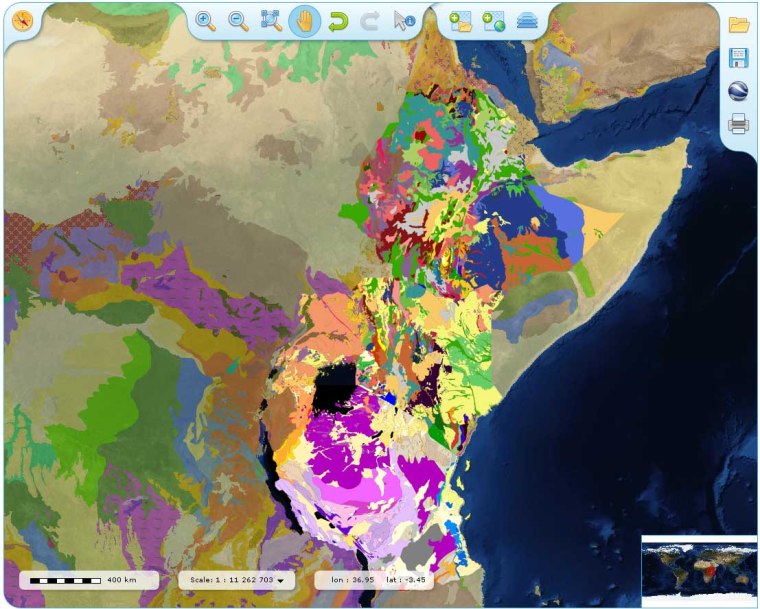
Small-scale extract from the OneGeology portal with 1:2 million maps for Ethiopia, Kenya, Tanzania and Uganda, and at 1:10 million covering surrounding areas (credit:OneGeology portal)


Fracking leaks

Cameron speaking in 2010.
David Cameron speaks (credit: Wikipedia)

The start of 2013 saw a massive puff from the British government for development of shale gas, Premier David Cameron crying ‘Britain must be at the heart of the shale gas revolution’. Fearful of the rapidly growing shift from Britain’s natural-gas self reliance to dependence on the Gulf, Russia and Norway the Conservative-Liberal  Democrat coalition gave the green light for ‘frack drilling’ to restart. This followed a pause following seismicity in the Blackpool area that attended Cuadrilla’s exploratory drilling into the gas-rich Carboniferous Bowland Shale thereabouts. There is also a nice sweetener for the new industry in the form of tax breaks.

English: Boris Johnson holding a model red dou...
Boris Johnson holds a model London red bus (Photo credit: Wikipedia)

London Mayor Boris Johnson, a possible contender for Tory leadership, seems pleased. And perhaps he should be, as the Lib-Con coalition will be tested because the junior partners depend electorally, to some extent, on ‘green’ credentials. The Lib-Dem Energy Minister, Ed Davey, seemingly favours an automatic halt to drilling should there be seismicity greater than 0.5 on the Richter scale; an energy level less than experienced every day in London from its Underground trains. Political commentators have forecast that green issues may exacerbate tensions within the coalition in the second half of its scheduled 5-year term, especially as the electorate seems set to reduce the Liberal Democrat partners to irrelevance in future elections.

Natural gas’s biggest ‘green’ plus is that being a hydrocarbon its burning releases considerably less CO2 than does its coal energy equivalent, the hydrogen content becoming water vapour. Yet the dominant gas is methane, which has a far larger greenhouse effect than the CO2 released by its burning. To avoid that presenting increased atmospheric warming, extracting natural gas needs to avoid leakage. Unfortunately for those bawling lustily about the economic potential of fracking source rocks such as the Bowland Shale, recent aerial surveys over US gas fields will come as a major shock. At the annual meeting of the American Geophysical Union in early December 2012 methane emissions from two large gas fields in the western US were released (Tollefson, J. 2013. Methane leaks erode green credentials of natural gas. Nature, v. 493, p. 12). They amount to 9% of total production, which would more than offset the climatic ‘benefit’ of using natural gas as a coal alternative.

A shift from coal to natural gas-fuelled power generation would slow down climatic warming, if leakage is kept below the modest level of 3.2% of production. So if the latest measurements are an unavoidable norm for gas fields then natural gas burning in fact increases global warming. Even more telling is that, until the shale ‘fracking revolution’, gas was produced by drilling into permeable reservoir rocks capped by a seal rock – usually a shale. The gas would not have leaked except from the well itself. Fracking, by design, increases the permeability of what would otherwise be a seal rock – hydrocarbon-rich shale – over a large area.

English: Schematic cross-section of the subsur...
Schematic cross-section illustrating types of natural gas deposits (credit: Wikipedia)

Aerial analyses to check emissions over oil and gas fields, let alone over shale-gas operations, are not widespread. However, the technology is not new. Where emissions are strictly enforced in populated areas, as over oil terminals and refineries, overflights to sample the air have been routine for several decades. Little mention is made of such precautionary measures in the promotion of fracking.

Another point is that as well as often being far from habitations, US shale-gas operations are generally into simple stratigraphy and structure. The Lower Carboniferous Bowland Shale now being touted as fuel for Britain’s escape from a descent into economic depression, with its estimated 200 trillion cubic feet of as potential, is intensely faulted and broadly folded, having experienced the Variscan orogeny at the end of the Palaeozoic Era. The complexity and pervasiveness of this brittle deformation is amply shown by geological maps of former coalfields that incorporate subsurface information from mine workings. The Bowland Shale lies below the Upper Carboniferous Coal Measures, many of the likely targets for fracking have never been subject to intensive underground mining simply because the Coal Measures were eroded away tens of million years ago. Consequently the degree to which many fracking targets may be riven by surface-breaking faults and fracture zones is not and possibly never will be known in the detail needed to assess widespread methane leakage.

Sometime in early 2013, the British Geological Survey is set to release estimates of the Bowland Shale gas reserves, in which its detailed mapping archives will have played the major role. That report will bear detailed scrutiny as regards the degree to which it also assesses potential leakage.

Publishing: is it worth the effort?

A measure of the esteem in which a peer-reviewed paper is held is supposedly the number of times to which it is referred in other papers. Of course, the older a paper is the more chance that such citations will have built up; but the annual rate of citation is likely to fizzle out over time. Papers that create a frisson of initial excitement and command enduring citation are few and far between: they probably launched a new line of inquiry.

It is instructive to try to nail Alfred Wegener’s influence in tectonics using the Web of Science, which ought to have been pretty high. Superficially, he had none and is remembered through that arm of Thomson Reuters for six papers: four on atmospheric physics – his speciality; one on lunar craters and a sixth on the patterns of cracking seen on rotten wood. These give him a mere 20 citations. Wegener’s posthumous problem was that Die Entstehung der Kontinente first appeared in the fourth issue of Geologische Rundshau in 1912, and seemingly the Web of Science doesn’t have that journal in its archives of a century ago. Later, extended editions appeared in book format which were not peer reviewed (most geoscientists would not touch his ideas with a barge pole until long after his death in 1930), and are therefore outside the academic pale. The key to a plausible mechanism for continental drift – symmetrical magnetic striping above ocean basins – was first described by Fred Vine and Drummond Matthews in an issue of Nature in 1963. In 50 years their work, ranking with discovering the structure of DNA, has accumulated 709 citations; i.e. 38.5 citations per year on average, which is not much for fuelling a revolution.

Photograph of Alfred Wegener, the scientist
Alfred Wegener, the unsung hero of continental drift(credit: Wikipedia)

Of course, citation is not the same as the frequency at which a paper is read. It is no secret that a not inconsiderable number of papers that appear in published reference lists haven’t been read by the authors who cite them. They are there by proxy, and you will probably find them in the bibliography of later papers that those same authors have cited. There is perhaps a certain kudos in such proxy citations, for it may be that the cited paper has achieved the equivalent of canonical status in the field.

Citation frequency is something of a lottery: language of publication; discipline (since 1953 Crick and Watson achieved three times Vine and Matthews’s average citations); date of publication (E. Komatsu of the University of Texas at Austin has already had 1939 citations for his February 2011 paper ‘Seven-Year Wilkinson Microwave Anisotropy Probe Observations: Cosmological Interpretations’ published in a supplement to the Astrophysical Journal; nine times the rate of Crick and Watson, but the paper is about the origin of everything)

Interestingly, the December 2012 issue of Geology presents stats on the most cited papers that it has published since 2000 (Cowie, P.A. 2012. Highly cited Geology papers (2000-2010) – What were they and who wrote them? Geology, v.  40, p. 1147-1148). Geology is among the highest ranking journals in the geoscience field, and had an impact factor of 4.8 over the last 5 years. A journal’s impact factor is the number of times all articles published in a 2-year period were cited in all indexed journals in the year following them, divided by the total number of articles published in the two years by the assessed journal. So, papers published in Geology between2007 and 2011 were cited on average 4.8 times in the year following publication. This journal is a useful source of citation statistics as it covers the full range of geoscience and all papers are limited to 4 printed pages, thereby forcing authors to be concise and clear in their writing and illustration. Consequently it is popular, which, incidentally, may explain its high impact factor.

Of the 33 papers cited most between 2000 and 2010, 14 are on topics relating to Tibet and China. There are 3 on oceanography; 3 on paleontology and extinctions; 6 on palaeoclimatology; 10 on tectonics and 10 on magmatism (3 of which were about rare adakites formed by partial melting of subducted oceanic crust). I haven’t read all of the papers, and the stats on topics may tell us very little, but I would bet that papers about geology in high-population emerging countries – China, India and Brazil – are met gleefully by rapidly growing communities of eager young geoscientists. It may even be worth a flutter on adakites as the ‘next big thing’ in petrogenesis. Mind you, it looks like I am not likely to be the best punter for hot papers, as out of the 33 ‘top-3’ papers since 2000, only 6 made it into Earth Pages, and of those only one between 2004-2010.

The digest goes on to show that year-by-year as many as 10 % of papers in Geology are not cited at all, up to 70% are cited between 1 and 5 times per year, while less than 10% get 10 or more citations in a year. Oddly, the author suggests that a dip in citations of Geology papers in recent years may reflect the launch of Nature Geoscience in 2008. Yet glossy as that new addition to the Nature stable might be, it has become something of a desert for papers on geology. Then there is evidence for both ‘vintage’ and ‘just-about-drinkable’ years  in Geology citations: the ‘top ten’ papers in 2001, 2005, 2006, 2008 and 2010 ranged from 10-15 citations for the tenth to 20-25 for the ‘hottest’ paper, while in 2000, 2002, 2003, 2004, 2007 and 2009 the most cited papers stood well above the rest at 32 to 55 citations per year. But that may just reflect the uneven pace at which well-received and provocative work emerges.

So, it begins to seem, from Geology at least, that for most geoscience authors publishing isn’t going to raise much hope as far as jobs or promotions are concerned. Yet if results are not published funding agencies may become fractious about your next grant application, and of course, university science departments puff themselves with annual publication rates (though rarely citation records, which as far as geosciences goes could be a wise move). But it is a matter of academic duty to publish for the record; even if a paper fills just one tiny niche the cumulative effect of publically available knowledge does eventually result in breaks through – one never knows… It could be a salutary lesson should publishers release data on hits for on-line PDFs of papers, as that would give some indication of how many readers individual papers have, but as for a ‘like this’ button or a means of star rating I think we have to venture into the deeper recesses of academic conservatism one small step at a time.

A glimpse of the deep Moon

Charting the variation in gravitational potential across a planet provides a measure of the distribution of mass beneath its surface. That depends on both the planet’s actual shape and on internal variations in rock density. The Earth’s gravity has been mapped with varying degrees of precision, depending on sample spacing, by surface measurements using gravimeters. Doing gravity surveys from space cannot be so direct, however. One ingenious approach for the gravitational field over the oceans is to measure the mean height of the ocean surface using radar beams from a satellite. Since this is affected by variations in the gravitational field, partly due to bathymetry and partly because of varying density beneath the ocean floor, removing the calculable bathymetric effect leaves a gravitational signal from the underling lithosphere and deeper mantle. The first satellite to illuminate the Earth with radar microwaves, Seasat, gradually built up such a gravitational map of the deep Earth over a period of 105 days in 1978, which was followed up by other satellites such as the ERS series and Topex-Poseidon.

GRAIL lunar probes
The GRAIL satellites in lunar orbit (credit: Wikipedia)

It is not so easy to map gravity precisely above a solid planetary surface, but through the GRACE experiment this can be done by measuring very precisely the distance between a pair of satellites that follow the same orbit. As the gravitational field changes so too does the separation between the tandem of satellites; an increase in gravity pulls the satellites closer together and vive versa. GRACE has provided some fascinating data, such as estimates of the withdrawal of groundwater from large sedimentary basins and shrinkage of ice caps. However, GRACE is limited in its resolution of gravitational anomalies by the fact that Earth has an atmosphere above which such tandems must be parked in orbit to avoid burning up. The higher the orbit, the more degraded is the resolution. This effect is much less for Mars and non-existent for the Moon.

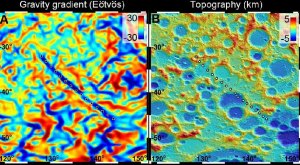
Gravity field of the moon as measured by NASA's GRAIL mission. The far side of the moon is at the centre, whereas the nearside (as viewed from Earth) is at either side. (credit: NASA/ARC/MIT)
Gravity field of the moon as measured by NASA’s GRAIL mission. The far side of the moon is at the centre, whereas the nearside (as viewed from Earth) is at either side. (credit: NASA/ARC/MIT)

A sister experiment to GRACE has been orbiting the Moon since September 2011: the Gravity Recovery and Interior Laboratory (GRAIL). First the tandem orbited at 55 km, then 22 and for a brief period 11 km, before running out of thruster fuel on 17 December 2012 and crashing into the lunar surface. Results from the highest orbit resolve lunar gravity to 13 km cells, recently reported on-line in three papers (Zuber, M.T. and 16 others 2012. Gravity field of the Moon from the Gravity Recovery and Interior Laboratory (GRAIL) Mission. Science, doi 10.1126/science.1231507; Wieczorek, M.A. and 15 others 2012. The crust of the Moon as seen by GRAIL. Science, doi 10.1126/science.1231530; Andrews-Hanna, J.C. and 18 others 2012. Ancient igneous intrusions and early expansion of the Moon revealed by GRAIL gravity gradiometry. Science, doi 10.1126/science.1231753). From crater gravitational signatures due to variations in surface topography it seems that the early bombardment of the lunar surface far exceeded previous assumptions. Impact effects dominate the GRAIL data at this resolution, but 2% of the information relates to structures hidden at depth.

500 km linear anomaly in the Moon's far-side  gravitational field. (credit: NASA/JPL-Caltech/CSM)
500 km linear anomaly in the Moon’s far-side gravitational field. (credit: NASA/JPL-Caltech/CSM)

There are linear gravity anomalies extending over hundreds of kilometres, which may be huge igneous intrusions in the form of dykes; perhaps reflections of early influences of early extensional tectonics in the Moons lithosphere. Estimates point to this having been due to an up to 5 km increase in the lunar radius, probably as a result of thermal changes. The dominant feature of the lunar surface is not the near-side flat basaltic maria, visually prominent as they are, but the far more rugged lunar highlands which stand far higher because of the lower density of their constituent feldspar-rich anorthosites. GRAIL permitted a bulk estimate of the density of highland crust that turned out to be substantially lower, at 2550 kg m-3 – compared with 2600-2700 for granite and 2800-3000 for basalt – than originally estimated from samples returned by the Apollo mission. This forces a reassessment of the thickness of highland crust from 50-60 km to between 34 and 43 km, with a near-surface layer that has a porosity of around 12%, probably resulting from its awful battering. A thinner highland crust than previously assumed presents a bulk geochemical picture that need not be more enriched in ‘refractory’  elements, such as aluminium and calcium, than is the Earth.

Such unanticipated results from the low-resolution mode of the GRAIL experiment have its science team almost salivating at prospects from the sharper ‘pictures’ that will arise from the lower altitude orbits.

The Ediacaran fossils: a big surprise

English: Photograph showing the 'golden spike'...
Edicara sandstones in the Flinders Ranges of  South Australia (credit: Wikipedia).

The first macroscopic life forms were the enigmatic bag-like and quilted fossils in sedimentary rocks dating back to 635 Ma in Australia, eastern Canada and NW Europe. They are grouped as the Ediacaran Fauna named after the Ediacara Hills in South Australia where they are most common and diverse. Generally they are not body fossils but impressions of soft-bodied organisms, often in sandstones rather than muds. Some are believed to be animals that absorbed nutrients through their skin, whereas others are subjects of speculation. One thing seems clear; these first metazoans arose because of some kind of trigger provided by the global glacial conditions that preceded their appearance. It has always been assumed that, whatever they were, Ediacaran organisms lived on the sea floor, probably in shallow water. New sedimentological evidence found in the type locality by Gregory Retallack of the University of Oregon seems set to force a complete rethink about these hugely important life forms (Retallack, G.J 2012. Ediacaran life on land. Nature (online), doi:10.1038/nature11777). So momentous are his conclusions that they form the subject of a Nature editorial in the 13 December 2012 issue.

Retallack, a specialist on ancient soils of the Precambrian, examined reddish facies of the Ediacara Member of the Rawnsley Quartzite of South Australia, whose previous interpretation have a somewhat odd background. Originally regarded as non-marine, before their fossils were discovered, when traces of jellyfish-like organisms turned up this view was reversed to marine, the red coloration being ascribed to deep Cretaceous weathering. A range of features, such as clasts of red facies in grey Ediacaran rocks, the presence of feldspar in the red facies – unlikely to have survived deep weathering – bedding surfaces with textures very like those formed by subaerial biofilms, and desiccation cracks, suggest to Retallack that the red facies represents palaeosols in the sedimentary sequence. Moreover, some features indicate a land surface prone to freezing from time to time. The key observation is that this facies contains Ediacaran trace fossils representing many of the forms previously regarded as marine animals of some kind, including Spriggina, Dickinsonia and Charnia  on which most palaeontologists would bet good money that they were animals, albeit enigmatic ones.

English: Cropped and digitally remastered vers...
Specimen of Edicaran Dickinsonia (credit: Wikipedia)

If Retallack’s sedimentological observations are confirmed then organisms found in the palaeosols cannot have been animals but perhaps akin to lichens or colonial microbes, and survived freezing conditions. As they occur in other facies more likely to be subaqueous, then they were ‘at home’ in a variety of ecosystems. As the Nature editorial reminds us, from the near-certainty that early macroscopic life was marine there is a chance that views will have to revert to a terrestrial emergence first suggested in the 1950s by Jane Grey. Uncomfortable times lie ahead for the palaeontological world.

Grand Canyon now the Grand Old Canyon?

Grand Canyon in Winter
Grand Canyon in Winter (credit: Wikipedia)

Among the best known and certainly the most visited topographic feature on the planet, the Grand Canyon resulted from erosion by the Colorado River keeping pace with uplift of the south-central United States. It is the archetype for what is known as antecedent drainage. Since that uplift is still going on, albeit slowly, the Grand Canyon has been assumed to be a relative young landform. By dating the first appearance of debris from the eastern end of the canyon in sediments at its western limit geomorphologists estimated that incision began around 6 Ma ago. Yet a range of other observations present puzzling contradictions. One means of settling the issue is to somehow to date the uplift radiometrically.

A long-used technique is to determine ‘cooling ages’ of crustal rocks exposed by uplift and erosion, exploiting the way in which rock temperature determines whether or not products of radioactive decay cab be preserved intact. One method uses the tracks of defects produced by electrons or helium nuclei from radioactive decay as they pass through various minerals that incorporate high amounts of elements such as uranium. Above a certain temperature the fission tracks anneal and disappear quickly, while below it they accumulate over time. Quantifying that build-up allows the date of cooling below the threshold temperature to be estimated. Similarly, gases produced by radioactive decay of some radioactive isotopes, such as argon from the decay of 40K or helium from uranium and thorium isotopes, can only stay in their host mineral if it remains cooler than a narrow range of temperatures. As rock rises towards the Earth’s surface, it starts out hot at depth but cools by conduction as it get closer to the surface. For the 1.8 km of uplift of the Grand Canyon and the relatively cool nature of the underlying crust, neither the fission-track nor the  40Ar/39Ar cooling-age methods give meaningful results. However, minerals lose helium at temperatures above about 70°C, so a method based on helium accumulation from uranium and thorium isotope decay is a possible means of assessing uplift timing. But there have been plenty of snags to overcome to make this approach reliable. In the case of the Grand Canyon analytical quality and careful sample collection has given a credible result (Flowers, R.M. & Farley, K.A. 2012. Apatite 4He/3He and (U-Th)He evidence for an ancient Grand Canyon. Science , doi 10.1126/science.1229390)

Flowers and Farley from the University of Colorado at Boulder and the California Institute of Technology, Pasadena, respectively, produced a result that completely overturns previous conceptions. The western end of the Canyon had been incised to within a few hundred metres of modern depths by 70 Ma ago; more than ten times earlier than previously thought. The eastern end has a more complex history that reveals cooling events in the Neogene as well as an end-Cretaceous initiation of uplift and erosion. Their data are consistent with early incision of the Grand Canyon by a Cretaceous river flowing eastward from the Western Cordillera, with a reversal of flow in the late-Tertiary as uplift of the Colorado Plateau began and western mountains subsided. Whether or not this fits with Cretaceous and later geological history of the SW US, is beyond my ken, but you can bet there will be a storm of comment from US geomorphologists once the paper appears in the print issue of Science.

Toba ash and calibrating the Pleistocene record

Landsat image of Lake Toba, the largest volcan...
Landsat image of the Lake Toba caldera, Sumatra (credit: Wikipedia)

The largest volcanic catastrophe during the evolution of humans formed the huge caldera at Lake Toba near the Equator in Sumatra about 70 thousand years ago. Explosive action erupted 2800 cubic kilometres of magma, of which 800 km3 was deposited as thick ash across most of South Asia and the northern Indian Ocean. Sulfates derived from the gas emissions by Toba form clear ‘spikes’ in ice cores from both Greenland and Antarctica. Its effects were global through the mixing of sulfate aerosols in the stratosphere of both hemispheres, encouraged by its position close to the Equator. By reflecting incoming solar energy the aerosols resulted in a century-long 10°C fall in temperature over the Greenland ice cap. Such global cooling almost certainly affected anatomically modern humans, but it is possible that in South Asia Toba had an even more devastating effect.

Jwalapuram
The Toba ash at the Jwalapuram excavations in South India(Photo credit: Sanjay P. K. via Flickr)

At several sites in the Indian state of Tamil Nadu and in Malaysia Toba ash has buried artifacts that arguably may have been made by the earliest modern emigrants from Africa. Immediately above the ash are yet more tools that suggest humans did survive the eruption. Palaeoanthropologists have argued that the stress of Toba’s environmental effects on all hominins living at the time may have resulted in population crashes from which only the fittest individuals emerged. Major evolutionary changes have been ascribed to ‘bottlenecks’ of that kind to result in changes in human behaviour detectable from the archaeological record, such as the creation of completely new kinds of tools, art and language.  However, recent finds in Africa suggest that many such shifts are much older than Toba.

Perhaps Toba’s greatest contribution to palaeoanthropology is that it is an easily recognised event in the geological record, but compared with its sulfate spike in the Greenland ice core at ~71 ka the existing radiometric dates have uncertainties of several thousand years. Using the latest 40Ar/39Ar dating methods on fresh crystals of sanidine (volcanic K-feldspar) from new excavations in Malaysia these uncertainties have been reduced significantly (Storey, M. et al. 2012. Astronomically calibrated 40Ar/39Ar age for the Toba supereruption and global synchronization of late Quaternary records. Proceedings of the National Academy of Sciences, v. 109, p. 19684-18688 ). The sulfate peak and the ash can now be attributed to an age of 73.88 ± 0.32 ka; better than a golden spike in Late Pleistocene stratigraphy. The ice-cores have a check on chronology just beyond the limit of counting annual layering, as do ocean sediment cores for a time older than 14C can ever achieve. Toba now links too with events recorded by the precise U-Th series dating of cave deposits

Probing the Earth’s mantle using noise

sesmic tomography
Artistic impression of a global seismic tomogram – beneath Mercator projection – dividing the mantle into ‘warm’ and ‘cool’ regions (Credit: Cornell University Geology Department – http://www.geo.cornell.edu/geology/classes/Geo101/graphics/s12fsl.jpg)

It goes without saying that it is difficult to sample the mantle. The only direct samples are inclusions found in igneous rocks that formed by partial melting at depth so that the magma incorporated fragments of mantle rock as it rose, or where tectonics has shoved once very deep blocks to the surface. Even if such samples were not contaminated in some way, they are isolated from any context. For 20 years geophysicists have been analysing seismograms from many stations across the globe for every digitally recordable earthquake to use in a form of depth sounding. This seismic tomography assesses variations in the speed of body (P and S) waves according to the path that they travelled through the Earth.

Unusually high speeds at a particular depth suggests more rigid rock and thus cooler temperatures whereas hotter materials slow down body waves. The result is images of deep structure in vertical 2-D slices, but the quality of such sections depends, ironically, on plate tectonics. Earthquakes, by definition mainly occur at plate boundaries, which are lines at the surface. Such a one-dimensional source for seismic tomograms inevitably leaves the bulk of the mantle as a blur. But there are more ways of killing a cat than drowning it in melted butter. All kinds of processes unconnected with tectonics, such as ocean waves hitting the shore and interfering with one another across the ocean basins, plus changes in atmospheric pressure especially associated with storms, also create waves similar in kind to seismic ones that pass through the solid Earth.

Such aseismic energy produces the background noise seen on any seismogram. Even though this noise is way below the energy and amplitude associated with earthquakes, it is continuous and all pervading: the cumulative energy. Given highly sensitive modern detectors and sophisticated processing much the same kind of depth sounding is possible using micro-seismic noise, but for the entire planet and at high resolution. Rather than imaging speed variations this approach can pick up reflections from physical boundaries in the solid Earth. Surface micro-seismic waves exactly the same as Rayleigh and Love waves from earthquakes have already been used to analyse the Mohorovičić discontinuity between crust and upper mantle as well as features in the continental crust; indeed the potential of noise was recognized in the 1960s. But the deep mantle and core are the principle targets, being far out of reach of experimental seismic surveys using artificial energy input. It seems they are now accessible using body-wave noise (Poli, P. et al. 2012. Body-wave imaging of Earth’s mantle discontinuities from ambient seismic noise. Science, v. 338, p. 1063-1065).

Poli and colleagues from the University of Grenoble, France and Finland used a temporary network of 42 seismometers laid out in Arctic Finland to pick up noise, and sophisticated signal processing to separate surface waves from body waves. Their experiment resolved two major mantle discontinuities at ~410 and 660 km depth that define a transition zone between the upper and lower mantle, where the dominant mineral of the upper mantle – olivine – changes its molecular state to a more closely packed configuration akin to that of the mineral perovskite that is thought to characterize the lower mantle. Moreover, they were able to demonstrate that the 2-step shift to perovskite occupies depth changes of about 10-15 km.

Applying the method elsewhere doesn’t need a flurry of new closely-spaced seismic networks. Data are already available from arrays that aimed at conventional seismic tomography, such as USArray that deploys  400 portable stations in area-by-area steps across the United States (http://earth-pages.co.uk/2009/11/01/the-march-of-the-seismometers/)

It is early days, but micro-seismic noise seems very like the dreams of planetary probing foreseen by several science fiction writers, such as Larry Niven who envisaged ‘deep radar’ being deployed for exploration by his piratical hero Louis Wu. Trouble is, radar of that kind would need a stupendous power source and would probably fry any living beings unwise enough to use it. Noise may be a free lunch to the well-equipped geophysicist of the future.

  • Prieto, G.A. 2012. Imaging the deep Earth. Science (Perspectives), v. 338, p. 1037-1038.

Breakthrough in human tools: the scene shifts to Africa

A means of assessing the cognitive abilities of hominins is through the objects that they created, whether tools or artefacts with apparent symbolic significance. The latter include pigments, coloured shells, beads, artwork or even deliberately parallel and crossing lines gouged on otherwise innocuous rock. Undoubtedly valuable to their creators, possibly treasured and passed on until lost or broken – most are fragile – symbolic artefacts are rare. So although they shout ‘thoughtful’, their age tells us little about when such a capacity first arose. Many archaeologists and palaeoanthropologists assert that creating and/or manipulating symbols may signify a link with being able to speak. Tools are a lot easier to find, probably as discards and lost items, and a well-described and understood sequence of forms and sometimes uses has been established, which extends as far back as perhaps 3 Ma – before the genus Homo appeared.

In terms of their meaning in terms of the consciousness of their makers and users, there are possibly four major recognisable steps. Chimpanzees and some birds can learn to pick up natural objects, such as stones and twigs, and use them: some bands of chimps even retain the knowledge. A step beyond that is preparing a natural object for use, as with breaking a pebble to create a cutting edge: something not exclusively human because it is possible that pre-human hominins created the earliest such Oldowan tools. Being able to visualise hidden potential inside something natural is altogether more advanced, and is represented by the iconic bi-face or Acheulean ‘hand-axe’. Its earliest makers, H. ergaster and erectus, literally brought such objects to light by skilfully knapping away the outer parts of substantial lumps of suitable rock. The knowledge endured for more than a million years but was eventually added to and superseded by a range of more delicate and specific stone tools, but more sophisticated tools represented the same ‘liberation’ of a simple idea held in rock. The fourth general cognitive leap was to add several resources together as composite tools, and arguably we have not long emerged from that phase with the creation of composite tools that help us design and make other tools: a machine-tool culture.

English: Backed edge bladelet Español: Hojita ...
Example of a microlith (credit: Wikipedia)

It is that penultimate step-up in consciousness that has been engaging archaeologists since they first realised that some small, sharp chips of stone were not waste but deliberately crafted for combination with wood or bone. Such ‘microliths’ have been found in intact arrows and sickles of the Meso- and Neolithic, but their range steadily goes back in time with more research. Unmistakeable microliths have now been discovered at the South African coastal site at Pinnacle Point, in an occupation layer that is 71 ka old (Brown, K.S. and 8 others 2012. An early and enduring advanced technology originating 71, 000 years ago in South Africa. Nature, v. 491, p. 590-593).

The Pinnacle Point technology was indeed sophisticated, microlith manufacture requiring fire treatment as well as choice of rock and careful shaping and sharpening. As well as extending the microlith culture back so far the team of South African, US, Australian and Greek archaeologists compared them with 28 later African tool kits. The designs have barely changed from 71 ka to those of the last few hundred years. Kyle Brown and colleagues show that the industrial method endured, thereby laying to rest the somewhat reactionary notion that the methods were lost again and again in Africa after separate inventions and were only taken up decisively by the supposed ‘advanced’ anatomically modern humans who colonised Europe…

It is difficult to see how the Pinnacle Point microliths could have been useful, unless hafted in arrows or throwing sticks – maybe even saws and sickles? Crucially, they predate larger blade-tools that could have been hafted to form spears. The focus must now shift to the Zambian scene where possible microliths are reported at two 250 ka sites. If confirmed, they would link the decisive fourth cognitive step towards humanity with the very origin of fully modern humans, rather than a much later, non-African dawning of ‘smarts’ along with language, advanced art and much else in the chilly caves of southern Europe.

Of all human-colonised continents Africa lags far behind the rest as regards spread and density of archaeological digs. Only the ‘famous’ sites attract resources for investigation. Imagine what might emerge once there are more local people with research skills, equipment and transport; and, dare I say it, more independence of action and the attendant confidence in their ability.

A glimpse of the Hadean

There is something deeply unsatisfying, even untidy, about a geoscientific history from which the first half billion years is more or less a blank. Every likely stone has been turned and every isotope hurled as a curve-ball through a mass spectrometer in the quest for either direct evidence of Hadean events or an acrid whiff that lingers in later matter. All, that is, except for one…

Formed in a proposed supernova that likely helped trigger formation of the Sun and Solar System, 150Gd quickly decayed to produce 146Sm, which itself had a half-life of about 68 Ma. That is too short for any significant trace of that radioactive rare-earth element to remain in terrestrial rocks, but its daughter isotope 142Nd bears witness to its former existence. Checking the proportion of 142Nd against the heavier 144Nd is a means of assessing isotopic fractionation according to atomic mass between a solid source of a magma, and between residual magma and solids that crystallised from it.

A popular and well-supported view of the Hadean is that shortly after accretion of the Earth a stupendous impact left a deep ‘ocean’ of magma and flung off mass that produced the Moon. Solidification of that ocean, which would have involved denser minerals sinking and lighter ones rising to higher levels, has been suggested to have resulted in differentiation of the mantle into two portions, one enriched, the other depleted; an event on which the entire later geochemical history of our planet has depended. Should either part of the mantle melt again, the igneous rocks that would result should carry a neodymium isotope signature of one or the other. Little sign of either emerges from studies of igneous rocks younger than 2.5 Ga, but older rocks from Greenland that go back to 3.8 Ga demonstrate that almost all of them melted from the Hadean depleted mantle. Without rocks carrying 142Nd/144Nd ratios signifying the other side of the more ancient mantle division, an enriched source, the grand idea was flawed. But this one-sidedness appears now to have been balanced by other Archaean igneous rocks (Rizo, H. et al. 2012. The elusive Hadean enriched reservoir revealed by 142Nd deficits in Isua Archaean rocks. Nature, v. 491, p. 96-100).

3.8 billion year-old Amitsoq gneisses, West Greenland (Image credit: Stephen Moorbath, via Royal Society)

The analysed rocks are interesting for another reason, for they are 3.4 Ga old vertical sheets of basalt or dykes that cut through the more ancient west Greenland crust. They are the first evidence of a brittle crust that cracked under tension to be followed by mantle-derived magma. Some members of the Ameralik dyke swarm show just the isotopic signature predicted for the enriched member of the postulated fundamental mantle division. However, for some yet to be recognised reason, few post-Archaean rocks show any sign of widespread mantle heterogeneity. Such matters could be addressed with any confidence only after mass spectrometry allowed precise discrimination between isotopes of a whole variety of both common and rare elements. That was not so long ago, so a rich trove of future revelations can be anticipated.

Batter your planet

K/T extinction event theory. An artist's depic...
Artist’s depiction of the asteroid impact 65 million years ago that caused the K-T mass extinction. (Photo credit: Wikipedia)

Just in time for the festive season I have been sent the URL for an on-line impact simulator written by a team from Imperial College London and the University of Arizona (Collins, G.S. et al. 2005. Earth Impact Effects Program: A Web-based computer program for calculating the regional environmental consequences of a meteoroid impact on Earth. Meteoritics and Planetary Science, v. 40, p. 817–840), with a web presence designed at Purdue University, Indiana. ImpactEarth (http://www.purdue.edu/impactearth/) has been around for two years and has a scientifically pleasing level of precision, thanks to the authors, Gareth Collins, Jay Melosh and Robert Marcus.

The fact that the target shown by the accompanying animation and other graphics seems to be the Washington-New York megalopolis may be a cause for some concern for US readers, especially the Department of Homeland Security, National Security Agency and CIA. They can rest easy, however, as this seems to be a matter of artistic license: the choice of parameters allows for ocean strikes and targets of sedimentary or crystalline rocks. Others are impactor diameter and density, impact angle and speed, plus distance from ground zero. An element of whimsy allows the casual user to choose inbound humpback whales, school buses and the Empire State Building as well as more astronomically likely scenarios.

There are a number of missing parameters such as direction relative to Earth’s rotation, latitude and the likely affect of an ice-cap strike, and no mention in the results of the electromagnetic burst from atmospheric compression on entry – the Diesel effect. However, the thermal effects on bystanders, buildings and vegetation at the ‘viewpoint’ personalise the experience to some extent. It is the detail about crater dimensions and evolution, lithospheric melting and what might happen to the Earth’s axial tilt and day length that the wealth of computations produce surprises. It is not easy to destroy our planet: using a body with a density of 3000 kg m-3 and the diameter of Asia causes no significant melting or changes in axial tilt at speeds less than 12 km s-1, but does change the length of the day by up to 113 hours. This is because the power of impacts and therefore the work done by them is proportional to the square of the speed. Mind you, nothing is left standing as the seismic effect has a Richter Magnitude of more than 15! Yet, curiously, no atmospheric or thermal radiation effects are noted.

Have fun.

Hominin round-up

Our tenacious companions.

Male human head louse, Pediculus humanus capit...
Male human head louse, Pediculus humanus capitis (credit: Wikipedia)

Until recently humans and lice were inseparable and the same goes for all primates, and nearly all mammals. However, unlike fleas, which happily will suck any blood that is going provided it is easily tapped, lice are tailored to their hosts. Should a baboon louse, for instance, get into your short and curlies it will almost certainly die. In any case, again unlike fleas, the louse cannot leap: they spread through intimate contact. The human head louse spreads especially well among nursery- and infant-school children, as any parent knows, because lessons often involve them literally getting their heads together. Less well known is that Pediculus humanus eschew soiled or greasy hair and it is the well-scrubbed kids who suffer and spread ‘beasts on the head’. Conversely, the clothes louse that carries typhus and other infections is deterred by regular laundry and ironing. And then there is the  Continue reading “Hominin round-up”

Short fuse on clathrate bomb?

Structure of a gas hydrate (methane clathrate)...
Gas hydrate (methane clathrate) block embedded in seabed sediment (Photo credit: Wikipedia)

The biggest tsunami to affect inhabitants of Britain, mentioned in the earlier post Landslides and multiple dangers, emanated from the Storegga Slide in the northern North Sea west of Norway. That submarine debris flow was probably launched by gas hydrates beneath the sea bed breaking down to release methane thereby destabilising soft sediments on the continental slope. Similar slides were implicated in breaking Europe-America communications in the 20th century, such as the Grand Banks Slide of 1929 that severed submarine cables up to 600 km from the source of the slide. Even now, much Internet traffic is carried across oceans along optic-fibre cables, breakages disrupting and slowing services. A more mysterious facet of clathrate breakdown is its possible implication in unexplained and sudden losses of ships. When gas escapes to the surface, the net density of seawater decreases, the more so as the proportion of bubbles increases. Ship design and cargo loading rests on an assumed water density range from fresh to salt water and for different temperatures at high and low latitudes.

Gulf stream map
Gulf stream map (credit: Wikipedia)

The Atlantic seaboard of the USA hosts some of the best-studied accumulations of clathrates in the top 100-300 m of seabed sediments. Since their discovery these ‘cage complexes’ of mainly methane and carbon dioxide trapped within molecules of water ice have been studied in detail. Importantly, the temperatures at which they form and the range over which they remain stable depend on pressure and therefore depth below the sea surface. At atmospheric pressure solid methane hydrate is unstable at any likely temperature and requires -20°C to form at a pressure equivalent to 200 m water depth. Yet is stable at temperatures up to 10°C 500 m down and 20°C at a depth of 2 km. Modern sea water cools to around 0°C at depths greater than 1.5 km, so gas hydrates can form virtually anywhere that there is a source of methane or CO2 in seafloor sediment. In the sediments temperature increases sharply with depth beneath the seabed due to geothermal heat flow thereby limiting the clathrate stability zone to the top few hundred metres.

Two factors may lead to clathrate instability: falling sea level and sea-floor pressure or rising sea-floor temperature. Many gas-hydrate deposits, especially on the continental shelf and continental edge are likely to be close to their stability limits, hence the worries about destabilisation should global warming penetrate through the water column. The western North Atlantic is an area of especial concern because the Gulf Stream flows northward from the Caribbean to pass close to the US seaboard off the Carolinas: that massive flow of tropical warm water has been increasing during the last 5 thousand years so that its thermal effects are shifting westwards.

Geophysicists Benjamin Phrampus and Matthew Hornbach of the Southern Methodist University in Dallas, Texas have used thermal modelling to predict that gas-hydrate instability is imminent across 10 thousand square kilometres of the Caroline Rise (Phrampus, B.J. & Hornbach, M.J. 2012. Recent changes to the Gulf Stream causing widespread gas hydrate destabilization. Nature, v. 490, p. 527-530). As a test they analysed two seismic reflection profiles across the Carolina Rise, seeking anomalies known as bottom-simulating reflectors that signify free gas in the sediments. These are expected at the base of the gas-hydrate zone and their presence helps assess sediment temperature. At depths less than 1 km the base of the gas-hydrates modelled from the present temperature profile through the overlying seawater lies significantly above the base’s signature on seismic lines. The deeper levels probably formed under cooler conditions than now – probably eight degrees cooler – and may be unstable. If that is correct, the Caroline Rise area seems set to release around 2.5 Gt of methane to add to atmospheric greenhouse warming. The Storegga Slide also lies close to the northern track of the Gulf-Stream – North Atlantic Drift…

Una parodia della giustizia?

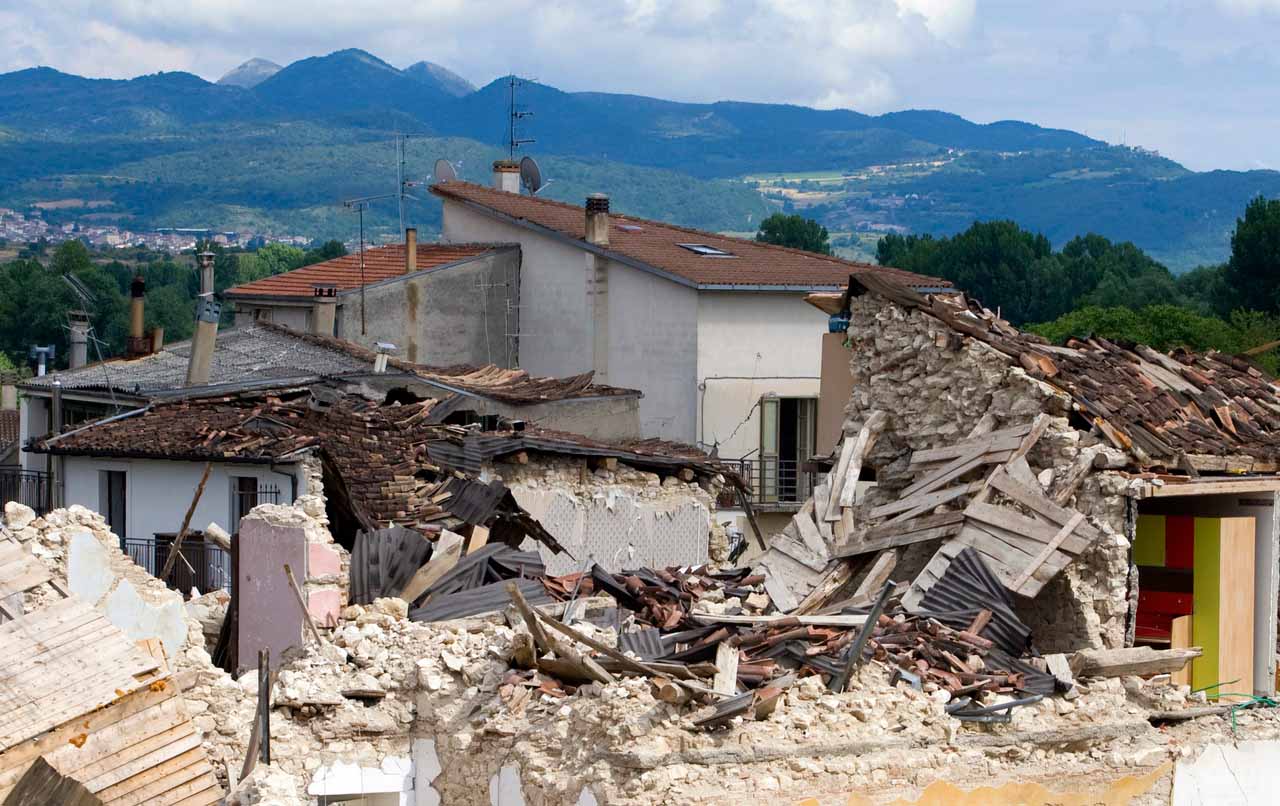
Damage caused by the L’ Aquila earthquake of 6 April 2009. (credit: Reuters)

Lying above a destructive plate margin, albeit a small one, Italy is prone to earthquakes. Seismometers detect a great many of low magnitude that no one notices and that do no obvious damage to buildings. From 2006 to autumn 2008 the Abruzzo region on the eastern flank of the Appenine mountains of central Italy experienced a background of one low-magnitude tremor every day (Papadopoulos, G.A. et al. 2010. Strong foreshock signal preceding the L’Aquila (Italy) earthquake (Mw 6.3) of 6 April 2009. Natural Hazards and Earth System Sciences, v. 10, p. 19-24). In the following 6 months the rate more than doubled but the epicentres continued to be almost randomly situated. Things changed dramatically in the 10 days following 27 March 2009: the pace increased to twenty times the normal ‘background’ and epicentres clustered directly beneath the regional capital L’ Aquila (population 73 thousand) close to a known fault line. At 3.32 am on 6 April 2009 the Paganica fault failed less than 10 km below L’ Aquila, directing most of the Magnitude 6.3 energy at the town. This was the deadliest earthquake in Italy for three decades; 308 people died 1500 were injured and 40 thousand found themselves homeless. Silvio Berlusconi, not a man to flinch from controversy, commented on German TV about the homeless, ‘Of course, their current lodgings are a bit temporary. But they should see it like a weekend of camping’.

English: Silvio Berlusconi in a meeting with J...
Former Italian President Silvio Berlusconi (credit: Wikipedia)

L’ Aquila has a dismal history of seismic damage, having been devastated before: 7 times since the 14th century. Having grown on a foundation of lake-bed sediments, notorious for amplifying ground movements, the city was clearly in a high-risk status in much the same manner as Mexico City. Shaken several times before and built with no regard to seismicity, much of L’ Aquila’s centuries-old building stock was incapable of resisting the event of 6 April 2009: up to 11 thousand building were damaged, some collapsing completely.

Not only was the earthquake preceded by an increasing pace of foreshocks, but many local people reported strange ‘earth lights’ during the months beforehand (Fidani, C. The earthquake lights (EQL) of the 6 April 2009 Aquila earthquake, in Central Italy.Natural Hazards and Earth System Sciences, v. 10, p. 967-978). In fact, so many sightings were made that plans have been outlined for a CCTV monitoring network in rural areas.

So, this disaster was not short of signs that all was not well in Abruzzo, in a seismic sense: historical precedent; poor urban siting; foreshocks and oddities that have come to be associated with impending energy release. But was this litany sufficient to predict the place, date, and magnitude of what was coming? Plate tectonics, local structural geology and worldwide seismicity allow geophysicists to assess risk from earthquakes in the same way as hydrologists can outline flood-prone areas: literally on flood plains. Yet there are few if any records of a devastating earthquake having been predicted anywhere with sufficient accuracy to allow evacuation and mitigation of death and injury. That is despite the fact that teams of seismologists in the western US, Japan, Italy and several other well-off countries continually monitor seismic events even with a power many orders of magnitude less than those which kill or injure. Such bodies are faced with a dreadful choice in the face of evidence like that summarised above: warn tens of thousands to evacuate, organise such an exodus in a few days and prepare accommodation for them, or advise that similar seismic escalations rarely lead to massive damage with an estimate of the probability of risk. Both choices are guesswork for there are no rigorous equations that spell ‘doom’ or ‘all clear’ from such data. Earthquakes are not rainstorms or hurricanes, as 250 thousand dead people on the shores of the Indian Ocean bear grim witness.

Despite broad knowledge of the deep uncertainty associated with earthquakes and volcanic eruptions – no longer privy to specialist scientists these days, even in the least developed parts of the world – the Italian authorities saw fit to prosecute six earth scientists and a public official for multiple manslaughter.  Because they provided “inaccurate, incomplete and contradictory” information about what might have been the aftermath of tremors felt ahead of 6 April 2009 earthquake, a regional court sentenced all of them to six years in prison – two years more than even the prosecution demanded – and they are to pay the equivalent of £6.7 million in compensation. This was not a jury verdict, but the decision of a single judge, Marco Billi. No scientist, even one poring over data from the Large Hadron Collider in search of the Higgs boson, would every claim that what they report is perfectly accurate, complete and incontrovertible. The L’Aquila Seven never said they were certain that no earthquake would ensue, and the city’s people were well aware of what risk they faced in much the same way that Neapolitans living on the slopes of Vesuvius know that one day they may be incinerated.

This is a travesty of justice so bizarre that one must look to the famous adage of Roman Law: qui bono? Certainly not the victims and their mourners, and definitely not science because any sensible Italian geophysicist will in future simply play dumb. There is already a huge world wide outcry, not just from outraged scientists.

Added 25 October 2012: The 12 October issue of Science carried a lengthy summary of proceedings early in the trial (Cartlidge, E. 2012. Aftershocks in the courtroom. Science, v. 338, p. 185-188). Read Nature‘s editorial on the L’ Aquila verdict here and further comment.

New twist on lunar origin

English: Giant impact - artist impression. Čes...
Artistic impression of the moon-forming giant impact. (credit: Wikipedia)

Although a few would-be space faring countries have ambitions, a post-Apollo crewed mission to the Moon is unlikely for quite a while. Yet moon-struck curiosity goes on: currently there is a surge in re-examining the lunar samples brought back more than 40 years ago. The Lunar Sample Laboratory Facility in Houston holds about a third of a ton of rock and regolith. I suppose part of the reason why lunar rocks are being re-analysed – in fact some for the first time – is because new or improved methods are available, but frustration among  a growing community of planetary geochemists having little more than meteorites to peer at probably plays a role as well. Since Hartman and Davis first suggested it, the giant impact theory for the Moon’s origin has dominated geochemical ideas. Most tangible is that of a magma ocean, floated plagioclase crystals from its fractional crystallisation probably having formed the glaring white lunar highlands composed of anorthosite. More subtle are ideas about what happened to the Mars-sized planet that did the damage to Earth and flung vaporised rock into orbit to accrete into the new Moon, and the effects of the stupendous energy on the geochemistry of all three bodies. Directed at all that is new research on isotopes of zinc (Paniello, R.C. et al. 2012. Zinc isotope evidence for the origin of the Moon. Nature, v. 490, p. 376-379).

The focus on zinc is because it is easily vaporised compared with more refractory materials, such as calcium an titanium, and as well as being ‘volatile’ it has five naturally occurring isotopes with relative atomic masses of 64 (the most abundant), 66, 67, 68 and 70. In general, isotopes of an element behave in slightly different ways during geological and cosmological processes, which changes their proportions in the products; a process known as ‘mass-fractionation’. Paniello and colleagues from Washington University, Missouri and the Scripps Institution of Oceanography, California USA found that Moon rocks are enriched in the heavier isotopes of zinc yet depleted in total zinc compared with terrestrial rocks and meteorites supposed to have come from Mars. Unlike those two planets the Moon’s zinc deviates from its abundance relative to other elements recorded by chondritic meteorites. This zinc depletion tallies with volatile loss from incandescent vapour blurted from the colliding planets. But it doesn’t help with the detailed predictions from the giant-impact model. A variety of scenarios suggest that the Moon should be made from remnants of the inbound impactor’s mantle, yet studies of other elements’ isotopes indicate that the Moon is rather Earth-like. But not those of zinc, so it looks like they have to be explained by a complete rethink of the whole hypothesis (Elliott, T. 2012. Galvanized lunacy. Nature, v. 490, p. 346-7).

The shuffling poles

The mechanical disconnection of the lithosphere from the Earth’s deep mantle by a more ductile zone in the upper mantle – the asthenosphere – suggests that the lithosphere might move independently. If that were the case then points on the surface would shift relative to the axis of rotation and the magnetic poles, irrespective of plate tectonics.  So it makes sense to speak of absolute and relative motions of tectonic plates. The second relates to plates’ motions relative to each other and to the ancient position of the magnetic poles, assumed to be reasonably close to that of the past pole of rotation, yet measurable from the direction of palaeomagnetism retained in rocks on this or that tectonic plate. Plotting palaeomagnetic pole positions through time for each tectonic plate gives the impression that the poles have wandered. Such apparent polar wandering has long been a key element in judging ancient plate motions.  Absolute plate motion judges the direction and speed of plates relative to supposedly fixed mantle plumes beneath volcanic hot spots, the classic case being Hawaii, over which the Pacific Plate has moved to leave a chain of extinct volcanoes that become progressively older to the west. But it turns out that between about 80 to 50 Ma there are some gross misfits using the hot-spot frame of reference. An example is the 60° bend of the Hawaiian chain to become the Emperor seamount chain that some have ascribed to hot spots shifting (see http://earth-pages.co.uk/2009/05/01/the-great-bend-of-the-pacific-ocean-floor/).

English: Age of ocean floor, with fracture zon...
Age of Pacific Ocean floor, showing the Hawaii-Emperor seamount chain in black. (credit: Wikipedia)

Ideas have shifted dramatically since it became clear that hot spots can shift, and there has been an attempt to estimate their actual motions (Doubrovine, P.V. et al. 2012. Absolute plate motions in a reference frame defined by moving hot spots in the Pacific, Atlantic, and Indian oceans. Journal of Geophysics Research: Solid Earth, v. 117, B09101, doi:10.1029/2011JB009072). It is early days for the revised view of absolute motion of the lithosphere and estimates go back only 120 Ma. However, one outcome has been a realistic examination of whether the positions of the poles have shifted through time; a possibility that is hidden in apparent polar wander paths. Since the mid-Cretaceous it seems that a slow and hesitant, but significant polar shuffle has taken place, varying between 0.1 and 1.0° Ma-1, starting in one direction and then the movement retraced its steps to achieve the current proximity of magnetic poles to the poles of rotation.

Landslides and multiple dangers

English: A rock landslide in Guerrero, Mexico....
A landslide in Guerrero, Mexico in August, 1989. (credit: Wikipedia)

Just as modern humans were establishing a permanent foothold in Britain and engaging in the transition to settled farming and livestock husbandry disaster struck some of the most attractive Mesolithic real estate. Around 8 000 years ago the east coast of Scotland, from the Shetland Isles to the Firth of Forth, was struck by a tsunami as big as that affecting the north eastern island of Honshu in the Japan archipelago in 2011. It washed over low lying islands of Shetland and Orkney and roiled up the great inlets or firths of eastern mainland Scotland to leave thick sand deposits containing carcases of whales and other large sea mammals. At that time, Britain was joined to the rest of Europe by marshy lowlands linking East Anglia and the Netherlands dubbed ‘Doggerland’ at the southern end of a huge gulf that became the North Sea. Final sea level rise removed that initial gateway to Britain, so we cannot judge what damage the tsunami wrought, but tools and animal bones dredged from the area show that it was full of game and people. A disaster, but not one linked to seismicity. The driving force has been recognised in a series of submarine scars off the west coast of Norway that witness massive slides of sediment on the sea bed area known as Storegga. Similar scars around the Hawaiian Islands and those making up the Azores and Canaries in the mid Atlantic bear witness to many large slippage events, on the sea bed and from the islands themselves. Recognising signs of past tsunami damage in coastal areas worldwide reveals plenty of cases triggered by landslides rather than earthquakes.

The March 2011 Sendai tsunami and those which ravaged lands around the Indian Ocean in late 2004 formed because of vertical movements on major faults that dropped or shoved up the oceanic crust itself. Yet any sudden change in the shape of the sea floor will displace all the ocean water above, the difference from seismic tsunamis lies in the energy source: instead of tectonic plate forces, gravitational potential energy is released by slumps and slides. That may happen because of erosion producing unstable steep slopes, build up of sedimentary piles, large outpourings of lavas or slopes being destabilised by minor earthquakes or release of gases from the sediments themselves. The Mesolithic submarine slide at Storegga may have been set in motion by massive release of methane from gas-hydrate deposits, and such is the extent of scarring of the sea floor there that it must have happened before and may do so again.

1755 copper engraving showing Lisbon in flames...
Copper engraving showing the 1755 Lisbon tsunami overwhelming ships in the harbor. (credit: Wikipedia)

Realisation of the potential for tsunamis to be triggered by submarine and coastal and slides has spurred bathymetric studies in a number of likely areas, including the Gorringe Bank that lies on the Atlantic floor just west of the Iberian Peninsula. It is tectonic in origin but has a thick veneer of sediment brought by Iberian river systems. On its northern flank is a 35 km long scar of a slip that moved 80 km3 of sediment (Lo Iacono, C. And 11 others 2012. Large, deepwater slope failures: implications for landslide generated tsunamis.  Geology, v. 40, p. 931-934). The Spanish-British-Italian group estimate that the slip would have generated a 15 m tsunami most likely to have affected the Iberian coast south of Lisbon. Conditions for slides of si,ilar magnitude still exist on the Gorringe Bank. One unstable system ripe for collapse is present far out in the Atlantic on the south-east coast of the island of Picos in the Azores (Hildenbrand, A. et al. 2012. Large-sale active slump on the southeast flan of Picos Island, Azores. Geology, v. 40, p. 939-942). This is in a coastal area where repeated volcanism has piled up lavas on the flanks of the island’s main volcanic edifice. Failure has already started, with a number of prominent arcuate scars having developed. The Picos slide moves very slowly sideways but vertical displacements ar estimated at up to a centimetre a year. The volume of the slowly moving mass is an order of magnitude less that the fossil slide on the Gorringe Bank. Yet should it fail entirely, the slopes involved, the absence of water’s slowing effect and the height of the mass might ensure comparable energy is delivered to the Atlantic Ocean, though the likely trajectory of tsunamis would be parallel to the coast of Africa rather than directly towards it.

Landslides of all kinds, though hazardous, have long been thought to be less of a risk to life globally than the more spectacular seismic and volcanic hazards, but there are few data to support that view. In an attempt to assess the annual risk properly, David Petley of Durham University, UK ‘mined’ world-wide landslide records for the seven years since 2004 (Petley, D. 2012. Global patterns of loss of life from landslides. Geology, v. 40, p. 927-930). There were more than 2600 recorded slope-failures that killed people and caused a total of more than 32 thousand fatalities: ten time more than previous vague estimates. This is a minimum because many landslides occur in very remote areas, especially in the mountainous regions of China and the Himalaya. The number of fatalities accompanying each event shows distinct signs, on a country-by-country basis, of a relationship with population density. Several international agencies are emerging that aim at means of measuring disaster risk, one being the Integrated Global Observing Strategy for Geohazards (IGOS).

Early animals and Snowball Earth

"SNOWBALL EARTH" - 640 million years ago
The Earth 640 million years ago during the Marinoan ‘Snowball’ event (credit: Cornell University via Flickr)

Palaeobiologists generally believe that without a significant boost to oxygen levels in the oceans macroscopic eukaryotes, animals in particular, could not have evolved. Although the first signs of a rise in atmospheric oxygen enter the stratigraphic record some 2.4 billion years ago and eukaryote microfossils appeared at around 2 Ga, traces of bulky creatures suddenly show up much later at ~610 Ma with possible fossil bilaterian embryos preserved in 630 Ma old sediments. An intriguing feature of this Ediacaran fauna is that it appeared shortly after one of the Neoproterozoic global glaciations, the Marinoan ‘Snowball’ event: a coincidence or was there some connection? It has looked very like happenstance because few if any signs of a tangible post-Marinoan rise in environmental oxygen have been detected. Perhaps the sluggish two billion-year accumulation of free oxygen simply passed the threshold needed for metazoan metabolism. But there are other, proxy means of assessing the oxidation-reduction balance, one of which depends on trace metals whose chemistry hinges on their variable valency. The balance between soluble iron-2 and iron-3 that readily forms insoluble compounds is a model, although iron itself is so common in sediments that its concentration is not much of a guide. Molybdenum, vanadium and uranium, being quite rare, are more likely to chart subtle changes in the redox conditions under which marine sediments were deposited.

English: Cropped and digitally remastered vers...
Dickinsonia; a typical Ediacaran animal. Scale in cm (credit: Wikipedia)

Swapan Sahoo of the University of Nevada and colleagues from the USA, China and Canada detected a marked increase in the variability of Mo, V and U content of the basal black shales of the Doushantuo Formation of southern China, which contain the possible eukaryote embryos (Sahoo, S.K and 8 others 2012. Ocean oxygenation in the wake of the Marinoan glaciation. Nature, v. 489, p. 546-549). These rocks occur just above the last member of the Marinoan glacial to post-glacial sedimentary package and are around 632 Ma old. Since the black shales accumulated at depths well below those affected by surface waves that might have permitted local changes in the oxygen content of sea water the geochemistry of their formative environment ought not to have changed if global chemical conditions had been stable: the observed fluctuations may represent secular changes in global redox conditions. The earlier variability settles down to low levels towards the top of the analysed sequence, suggesting stabilised global chemistry.

What this might indicate is quite simple to work out. When the overall chemistry of the oceans is reducing Mo, V and U are more likely to enter sulfides in sediments, thereby forcing down their dissolved concentration in sea water. With a steady supply of those elements, probably by solution from basalt lavas at ocean ridges, sedimentary concentrations should stabilise at high levels in balance with low concentrations in solution. If seawater becomes more oxidising it holds more Mo, V and U in solution and sediment levels decline. So the high concentrations in sediments mark periods of global reducing conditions, whereas low values signal a more oxidising marine environment. Sahoo et al.’s observations suggest that marine geochemistry became unstable immediately after the Marinoan glaciation but settled to a fundamentally more oxidising state than it had been in earlier times, perhaps by tenfold increase in atmospheric oxygen content. So what might have caused this and the attendant potential for animals to get larger in the aftermath of the Snowball Earth event? One possibility is that the long period of glaciers’ grinding down continental crust added nutrients to the oceans. Once warmed and lit by the sun they hosted huge blooms of single-celled phytoplankton whose photosynthesis became an oxygen factory and whose burial in pervasive reducing conditions on the sea bed formed a permanent repository of organic carbon. The outcome an at-first hesitant oxygenation of the planet and then a permanent fixture opening a window of opportunity for the Ediacarans and ultimately life as we know it.

Carbon capture and storage: dissolving it

Amassador Jacobson, centre, visits the carbon ...
A Canadian carbon capture and storage project in Saskatchewan (credit: US Mission to Canada via Flickr)

Tucking away vast amounts of atmospheric carbon dioxide (carbon capture and storage or CCS), or at least that emitted by fossil-fuel power stations, is a widely suggested and well supported approach to slowing down global warming. It has two main downsides: if successful it helps maintain the dominance of fossil fuels and vast amounts of buried greenhouse gas might simply leak out some time. Ideally, the storage part of CCS would involve CO2 being taken up by an inert solid. Carbonates may be stable enough but arranging the chemical reactions to make them seem difficult, the most widely considered being by encouraging weathering of ultramafic rocks to form magnesium carbonates as a by-product: huge areas would have be coated with finely-ground peridotite. A less satisfactory approach would to dissolve the gas in water held at great depths in sedimentary aquifers, but if that water doesn’t move and doesn’t get warmed it might do the trick.

Unsurprisingly, a lot of funds are available to research CCS  and ideas are pouring forth, a recent, sober assessment focussing on the solubility option (Steele-MacInnis, M. et al. 2012. Volumetrics of CO2 storage in deep saline formations. Environmental Science and Technology (August 2012 online) DOI: 10.1021/es301598t). The team from Virginia Tech and the US Department of Energy conclude that solution in brines trapped in deep aquifers may help, although solution is an equilibrium between gas and dissolved CO2, so that a gas layer in the aquifer is always likely to be present, even at high pressures. The only way of avoiding that is if the dissolved gas reacted with carbonate in the aquifer so that calcium and hydrogen-carbonate (HCO3) ions entered solution. That ‘enhanced’ solution is not so easy since, although it mimics the calcite-weathering effect by acid rain that naturally takes CO2 from the atmosphere, calcite dissolves very sluggishly. But solution adds to the density of already dense brine so that it is less likely to leak upwards into more shallow aquifers. Their preferred technology is to liquefy the gas under pressure and pump that to deep aquifers where eventually the supercritical CO2 liquid will dissolve. The problem is this: while experiment and theory suggest the approach will work, nobody knows how long CO2 solution in brine will take. There needs to be a sizeable pilot study…

Birth of a plate boundary rocks the planet

English: Historical seismicity across the Sund...
Historical seismicity across the Sunda trench(credit: Wikipedia)

Few people will fail to remember the Indian Ocean tsunamis of 26 December 2004 because of their quarter-million death toll. The earthquake responsible for them resulted from thrusting movements on the subduction zone where part of the India-Australia plate descends beneath Sumatra. There have been some equally large but far less devastating events and many lesser earthquakes in the same region since. Some have been on the massive Wadati-Benioff zone but many, including two with magnitudes >8 in April 2012, have occurred well off the known plate boundary. Oddly, those two had strike-slip motions and were the largest such events since seismic records have been kept. Such motions where masses of lithosphere move past one another laterally can be devastating on land, yet offshore ones rarely cause tsunamis, for a simple reason: they neither lift nor drop parts of the ocean floor. So, to the world at large, both events went unreported.

To geophysicists, however, they were revealing oddities, for there is no bathymetric sign of an active sea-floor strike-slip fault. But there is a series of linear gravity anomalies running roughly N-S thought to represent transform faults that were thought to have shut down about 45 Ma ago (Delescluse, M. et al. 2012. April 2012 intra-oceanic seismicity off Sumatra boosted by the Banda-Aceh megathrust. Nature (on-line 27 September issue) doi:10.1038/nature11520). Examining the post-December 2004 seismic record of the area the authors noted a flurry of lesser events, mostly in the vicinity of the long dead fracture zones. Their analysis leads them to suggest not only that the Banda-Aceh earthquake and others along the Sumatran subduction zone reactivated the old strike-slip faults but that differences in the motion of the India-Australia plate continually stress the lithosphere. Indian continental crust is resisting subduction beneath the Himalaya thereby slowing plate movement in its wake. Ocean lithosphere north of Australia slides more easily down the subduction zone, so its northward motion is substantially faster, creating a torque in the region affected by the strike-slip motions. Ultimately, it is thought, this will split the plate into separate Indian and Australian plates.

Another surprising outcome of this complex seismic linkage in the far-east of the Indian Ocean is that the April strike-slip earthquake set the Earth ringing. For six days afterwards there was a five-fold increase in events of magnitudes greater than 5.5 more than 1500 km away, including some of around magnitude 7.0 (Polliitz, F.F. et al. 2012. The 11 April 2012 east Indian Ocean earthquake triggered large aftershocks worldwide. Nature (on-line 27 September issue) doi:10.1038/nature11504). Although distant minor shocks often follow large earthquakes, this is the first time that a swarm of magnitude 5.5 and greater has been noticed.

Erosion by jostling

Inca wall of dry stone in Sacsayhuamán fortres...
Inca dry stone wall in Sacsayhuamán fortress, Cusco, Peru (credit: Håkan Svensson via Wikipedia)

These days it is a rare thing for an entirely novel surface process to be discovered; two centuries of geomorphological and sedimentological studies seem to have exhausted all the basic possibilities with only a few bits and pieces to be filled in.

Go to the foot of any steep slope topped by hard rock in an arid or semi-arid area and you are sure to find a boulder field formed by a variety of mass-wasting processes, such as rockfalls. As often as not such boulders are rounded, the usual explanation being that the rounding has resulted either from chemical weathering in the up-slope colluvium or exfoliation (‘onion-skin’ formation) through physical weathering in situ. Boulders are simply too big to have been moved other than by toppling or glacial transport at high latitudes, so rounding by abrasion seems unlikely. Aeolian sandblasting tends to favour just one side of boulders and ‘scallops’ their surface.

The driest place on Earth, Chile’s Atacama Desert, has plenty of boulder fields next to areas of high relief, and sure enough they are beautifully rounded, even though it has barely rained there for around 10 million years. Jay Quade of the University of Arizona, USA, with US, Australian and Israeli colleagues noticed that many of the boulders are surrounded by moat-like depressions and their sides, but not their tops, are nicely smoothed. These features suggested that some process had caused the boulders to move around and to rub one another, but whatever that was it had not caused even quite tall boulders to topple over (Quade, J. et al. 2012. Seismicity and the strange rubbing boulders of the Atacama Desert, northern Chile. Geology, 40, 851-854). An explanation was clearly something to puzzle over, until, that is, two of the authors returned to the area to make further observations. They were caught on the exposure by a magnitude 5.2 earthquake – a not uncommon experience in the foothills of the Andes – when the ton-sized boulders began to sway, rotate and jostle together with a great deal of noise. Here was the novel mechanism of erosion and ‘granulation’: seismic rubbing.

By dating the age of the exposed surfaces using cosmic-ray generated isotopes of beryllium and aluminium, the authors have been able to  estimate that over the past 1.3 Ma the boulders have experienced between 40 to 70 thousand hours of rubbing. Indeed, it is quite likely that the whole boulder field, the upslope mass wasting and the sediment in which the boulders are embedded are products of seismicity. Oddly, just such jostling and rubbing of boulders and cobbles is characteristic of Inca architecture in the Andes, whose stonework used no cement but has minimal  gaps between the blocks. Who is to deny that the Incas learned their unique building method from observing seismic rubbing.