Even at my age, if I rummage through pockets of various bits of outdoor clothing there’s a good chance I’ll find a handy length of string that I have scavenged at some time. It’s a just-in-case thing, which I learned from my father and grandad. One can hardly imagine a hunter-gatherer not having string or lengths of sinew for that very reason. Cordage has many other uses than merely securing something: bags, mats, nets, snares, fabric, baskets, huts made of sticks and fronds, and even watercraft. Yet archaeological evidence for twine is exceedingly rare. The oldest known string – made of bark fibres – was found wrapped around a stone tool at a 52 to 41 ka Neanderthal site in the Rhône valley 120 km north-west of Marseille. Rope is somewhat more difficult to make as it requires twisting together several lengths of simpler cordage. Once that skill is cracked a rope maker is on the verge of engineering!
The reassembled rope-making tool from Hohle Fels Cave (Credit: Conard & Rots, Fig 2)
In 2015 archaeologists unearthed several pieces of worked mammoth ivory from the Hohle Fels Cave in SW Germany. They were dated to between 40 to 35 ka and associated with Aurignacian stone tools made by modern humans. Fifteen pieces could be fitted together to yield a 20 cm long ‘baton’. First believed to be some kind of ritual object, the fact that 4 circular holes had been bored through the ‘baton’ suggested it must have had some practical use, perhaps for straightening wooden shafts. Then it became clear that each hole was surrounded by spirals of carefully carved, V-shaped notches. Nicholas Conard and Veerle Rots of the University of Tubingen realised that the object may have been used for making rope using a technique known from the Egyptian pharaonic period into medieval times (Conard, N.J. & Rots, V. 2024. Rope making in the Aurignacian of Central Europe more than 35,000 years ago. Science Advances, v. 10, article adh5217; DOI: 10.1126/sciadv.adh5217).
Frame from a movie showing how the tool may have been used to make ropes. The three ‘feeders’ twist foliage clockwise whereas the fourth pulls and imparts an anticlockwise twist to the three stands. (Credit: Conard & Rots, Supplementary material, Fig S15)
After a little practice, four people were able to make sturdy rope using a replica of the tool. Three twisted together fibrous materials, such as the stems and leaves of bulrushes (Typha), and pushed the rough cordage through the intact holes. A fourth person pulled the cordage through and counter-twisted the three strands into rope about 1.5 cm thick – thicker rope would also have required a tool with more holes and more operators. The spiral grooves maintained the initial clockwise rotation of each strand of cordage, so that when all three were twisted together in an anticlockwise sense the counter rotation held the rope together firmly. Remarkably, the small team were able to produce 5 m of rope in 10 minutes. Other common kinds of fibrous plant material, such as linden and willow were used successfully. Incidentally, the tool squeezed edible starch from the foliage of bulrushes. But it seems that this particular rope-making took only performed well for coarse materials. Making rope from finer firbres, such as animal sinew, nettle, flax and hemp would probably have required another design with smaller holes.
Good illustrations of self publicity and soaring ambition are the private space programmes of oligarchs Elon Musk (SpaceX), Jeff Bezos (Blue Origin) and Richard Branson (Virgin Galactic). For a cool US$65 million a ‘civilian’ can get a trip to the International Space Station on SpaceX; a one-hour suborbital flight on Blue Origin will cost US$300,000, with luck having Bezos as a companion; a reservation on Virgin Galactic for a 1 hour trip to the ‘edge of space’ (~100 km up) now costs US$624,000. It’s a tourist trip for the very, very rich only … but even the long-dead can go … or bits of them. On 8 September 2023 aboard Virgin Galactic flight Tim Nash, a South African billionaire had in his pocket a sturdy tube containing a thumb bone of Homo nalediand the collarbone of Australopithecus sediba. Nash reportedly said afterwards, “I am humbled and honoured to represent South Africa and all of humankind as I carry these precious representations of our collective ancestors”.
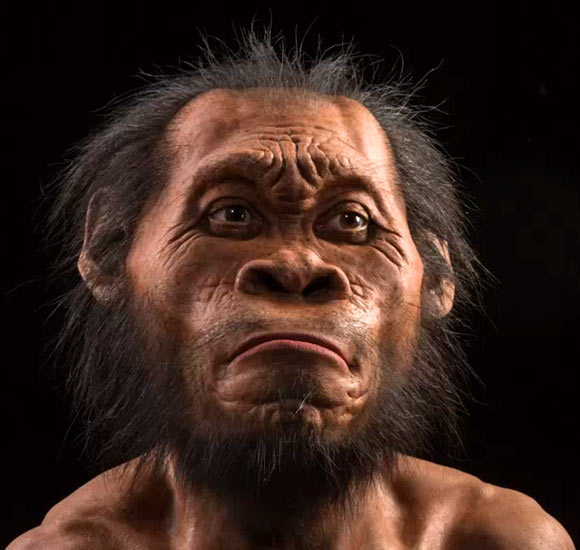
Reconstructed head of a somewhat annoyed Homo naledi. Credit: John Gurche, Mark Thiessen, National Geographic.
Nash was entrusted with these unique fossils by Lee Berger, Professor in Palaeoanthropology at Witwatersrand University, South Africa and a National Geographic Explorer-in-Residence. Berger recovered fossils of both species from limestone caves in the UNESCO World Heritage Site grandly named the Cradle of Humankind near Johannesburg. He is no stranger to controversy, and this venture cooked up with Nash seems to aim at promotion of South African achievements rather than having any scientific purpose. It has backfired spectacularly (see: McKie, R. 2023. ‘Callous, reckless, unethical’: scientists in row over rare fossils flown into space. The Observer, 22 October 2023). Comments from the anthropological world, six national and international bodies and perhaps the leading hominin specialist Professor Chris Stringer of the Natural History Museum in London include the words and phrases “callous”, “unethical”, “extraordinarily poorly thought-out”, “a publicity stunt”, “reckless” and “utterly irresponsible”. The caper breaks the South African, indeed international, scientific rule that fossils can only be allowed to travel for scientific purposes, applied consistently by similarly hominin-rich African countries such as Ethiopia, Kenya and Tanzania.
But, Hey, that’s how you get on in the world … isn’t it?
White Sands National Park in New Mexico, USA is notorious for being adjacent to the site at which the first nuclear weapon was tested (code name Trinity) on 16 July 1945. Four weeks later two such bombs killed between 129,000 and 226,000 people at Hiroshima (6 August 1945) and Nagasaki (9 August 1945). The area is one of spectacular geology, the white sand being made of gypsum (CaSO4) grains precipitated from lake water supplied by rivers that had dissolved the mineral from Permian evaporites in the surrounding mountains. Subsequent wind erosion created a large, white dune field: the main attraction. Though a national park that has been proposed for UNESCO World Heritage Centre, the park itself is surrounded by military installations including the nuclear test site.
Gypsum sand dunes in White Sands National Park USA. (Credit: Wikipedia)
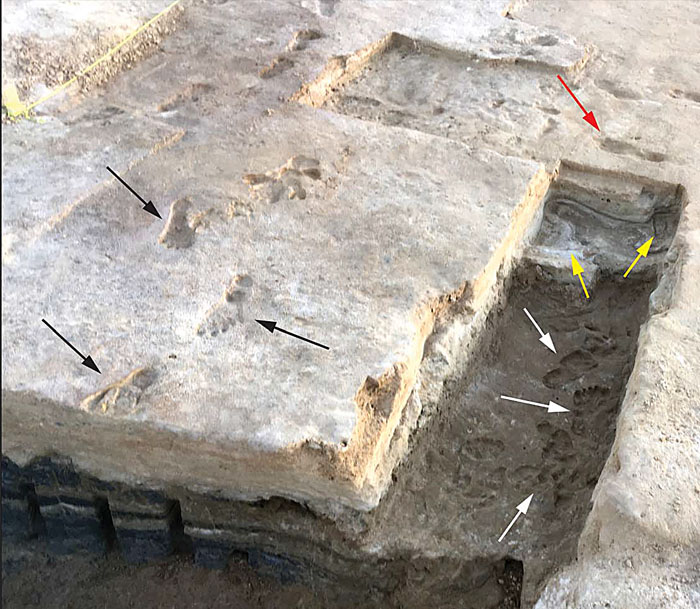
As in most evaporite basins, the White Sands’ gypsum sediments built up layer-by-layer through deposition of clays during successive inundations followed by evaporation of CaSO4 rich water. Animals crossing the basin were likely to leave trackways, which subsequent sedimentary cycles could preserve in stratigraphic order. Examples had been found in the early 20th century, revealing the former presence of the late-Pleistocene megafauna: Columbian mammoths, ground sloths, ancient camels, dire wolves, lions, and sabre-toothed cats. One set of dire wolf prints found in the 2010s contained seeds that yielded a radiocarbon age of 18 ka. More recently, 61 human footprint tracks turned up in layers that also displayed signs of megafauna crossing the lake flats, in one case showing convincing signs of hunters having followed a giant ground sloth (Bennett, M.R. 2021 and 13 others 2021. Evidence of humans in North America during the Last Glacial Maximum. Science, v. 373, p. 1528-1531; doi: 10.1126/science.abg7586). Interestingly, many of the human tracks seem to have been made by teenagers and children with only a few made by adults. Dating of seeds in the sediment layers – and in some footprints – yielded 23 to 21 ka radiocarbon ages. This evidence suggested human occupation of New Mexico long before those who left Clovis-style artifacts around 13 ka and others who preceded them. However, the seeds that were dated are those of an aquatic grass (Ruppia cirrhosa), which may have absorbed older carbon from groundwater permeating the evaporite sediments. Being robust, the seeds could also have been transported by wind back and forth from plants that lived before the animals and humans left their marks in the saline flats. Such is the importance of the White Sands fossil trackways that a team of US and British geologists, some of whom authored Bennett et al. 2021, have sought to refute doubts of their antiquity (Pigati, J.S. and 10 others 2023. Independent age estimates resolve the controversy of ancient human footprints at White Sands. Science, v. 382, p. 73-75; DOI: 10.1126/science.adh5007).
Human footprints (arrowed) preserved on three sediment surfaces of the White Sands clay-gypsum sequences; i.e. at three times in their depositional sequence. (Credit: from Pigati et al.; Fig 1)
The researchers cut trenches into the layered clay-gypsum to reveal human footprints on three successive surfaces at the site where Ruppia seeds had provided very old, but disputed ages. They supplemented the earlier evidence by 14C dating of pollen grains blown into the prints from terrestrial plants and optically stimulated luminescence ages (time of last exposure to sunlight) of detrital quartz grains in the evaporites. The pollen dating gave ages from 23.4 to 22.6 ka, the minimum quartz OSL age being 21.5 ka. Similar ages from three different methods are pretty convincing evidence that humans were active in New Mexico during the Last Glacial Maximum (LGM), and that absorption of older carbon from groundwater had not affected the Ruppia seeds.
The Asia to America migration, which led these hunters to what the abundant megafauna trackways suggest were rich pickings around the White Sands palaeo-lake, must have been earlier still. High-latitude North America was almost certainly a vast, frigid desert for thousands of years leading up to the LGM. Another implication of the remarkable finds in the gypsum beds is that migration most probably involved a coastal or even a maritime route along the Eastern Pacific shore to reach more habitable lower latitudes.
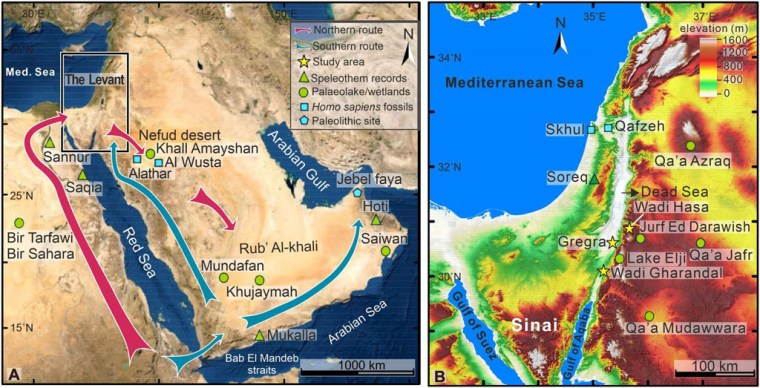
Without seafaring skills and sturdy boats, ancient humans had only two options to leave Africa for Eurasia: by crossing the Straits of Bab el Mandab at the southern end of the Red Sea and from the Nile delta to the Levant at its northern end. Both would have been difficult. The first route demanded extremely low sea level drawn down by continental ice accumulation to narrow the sea crossing, the earliest in the last glacial cycle being around 70 ka ago. The northern route, with no sea crossing, was potentially achievable throughout the history of the genus Homo. But that way is beset to the north and east by deserts with large tracts that today lack natural water sources. To leave Africa by that route seems the most obvious, being reached along the well-watered Nile valley or the Red Sea coast with its abundant marine resources. Yet moving eastwards to Arabia and further would have required climatic windows of opportunity to ensure well-watered corridors: it would be impossible today without an infrastructure of wells; and edible resources are extremely sparse. Remains of anatomically modern humans (AMH) as old as 200 ka and others in the period between 130 to 85 ka have been found around the eastern shores of the Mediterranean. Either of the two routes could have led them there during periods of increased humidity, perhaps in a series of migratory pulses. In the case of an exodus across the Straits of Bab el Mandab, people could have moved northwards along the Red Sea coast of modern Yemen and Arabia to the Levant. However, the record is patchy, and there is no direct fossil evidence to suggest they went further, into southern Asia or Europe in these earlier times. Each early venture may also have ended in extinction. The first presence of AMH in Asia and Europe, seems to have been tens of thousand years later: about 75 ka and 45 ka, respectively, so far as we know.
Left: Satellite image of the Arabia and the Levant, showing the possible northern (red) and southern migration routes (blue) and sites that yielded various palaeoclimatic signs of formerly wet areas, Homo sapiens fossils and stone tools (see key). Right colour-coded map of topographic elevation for the study area in the Levant with sites that reveal palaeoclimatic and anthropological information. (Credit: Abbas et al., Fig 1)
Research in the Arabian Peninsula has early recorded human presence from discarded stone artefacts at widely scattered sites, as far east as the UAE and Oman, but whether these were carried by AMH or other human groups is uncertain. Yet geological research suggests that even in the presently forbidding Empty Quarter of Saudi Arabia there were from time to time abundant springs, river networks and even lakes: occasionally climate changes made much of Arabia habitable. Researchers from the University of Southampton (UK) and Shantou University (China), together with colleagues in Jordan, Australia and the Czech Republic have documented further evidence for ‘green’ episodes on the Jordan Plateau – part of the currently hyperarid Arabian interior (Abbas, M. and 10 others 2023. Human dispersals out of Africa via the Levant. Science Advances, v.9, article eadi6838; DOI: 10.1126/sciadv.adi6838).
Three sites in Jordan reveal wetland sediments incised by now dry channels or wadis, one of which yielded stone tools Luminescence dating of wetland sediment grains shows the times when they were last exposed to sunlight: some between 86 to 65 ka, others between 57 to 43 ka. Together with data from the rest of Arabia the sites help roughly to define routes that would have permitted human migration, though not the actual directions that early AMH might have travelled or their destinations – if any. They may just have wandered around surviving on the resources that they found during short periods of amenable local climate, and vegetation much as do desert dwellers today. Actually to exit Arabia to southern Asia would require migration around what is now the Persian Gulf, where relevant data are lacking and likely to remain so while poor security for research prevails. To get to Europe would require a much more intricate journey through large mountainous tracts to reach the shores of the Black Sea.
The genetic diversity of living humans, particularly among short, repetitive segments of DNA, is surprisingly low. As they are passed from generation to generation they have a high chance of mutation, which would be expected to create substantial differences between geographically separated populations. In the late 1990s and early 2000s some researchers attributed the absence of such gross differences to the human gene pool having been reduced to a small size in the past, thereby reducing earlier genetic variation as a result of increased interbreeding among survivors. They were able to assess roughly when such a population ‘bottleneck’ took place and the level to which the global population fell. Genetic analysis of living human populations seemed to suggest that around 74 ka ago the global human population fell to as little as 10 thousand individuals. A potential culprit was the catastrophic eruption of the Toba supervolcano in Sumatra around that time, which belched out 800 km3 of ash now found as far afield as the Greenland and Antarctic ice caps. Global surface temperature may have fallen by 10°C for several years to decades. Subsequent research has cast doubt on such a severe decline in numbers of living hummans; for instance archaeologists working in SE India found much the same numbers of stone tools above the Toba ash deposit as below it (see: Toba ash and calibrating the Pleistocene record: December 2012). Other, less catastrophic explanations for the low genetic diversity of modern humans have also been proposed. Nevertheless, environmental changes that placed huge stresses on our ancestors may repeatedly have led to such population bottlenecks, and indeed throughout the entire history of biological evolution.
An improved method of ‘back-tracking’ genetic relatedness among living populations, known as fast infinitesimal time coalescence or ‘FitCoal’, tracks genomes of individuals back to a last common ancestor. In simple language, it expresses relatedness along lineages to find branching points and, using an assumed mutation rate, estimates how long ago such coalescences probably occurred. The more lineages the further back in time FitCoal can reach and the greater the precision of the analysis. Moreover it can suggest the likely numbers of individuals, whose history is preserved in the genetics of modern people, who contributed to the gene pool at different branching points. Our genetics today are not restricted to our species for it is certain that traces of Neanderthal and Denisovan ancestry are present in populations outside of Africa. African genetics also host ‘ghosts’ of so-far unknown distant ancestors. So, the FitCoal approach may well be capable of teasing out events in human evolution beyond a million years ago, if sufficient data are fed into the algorithms. A team of geneticists based in China, Italy and the US has recently applied FitCoal to genomic sequences of 3154 individual alive today (Hu, W.and 8 others 2023. Genomic inference of a severe human bottleneck during the Early to Middle Pleistocene transition. Science, v. 381, p. 979-984; DOI I: 10.1126/science.abq7487). Their findings are startling and likely to launch controversy among their peers.
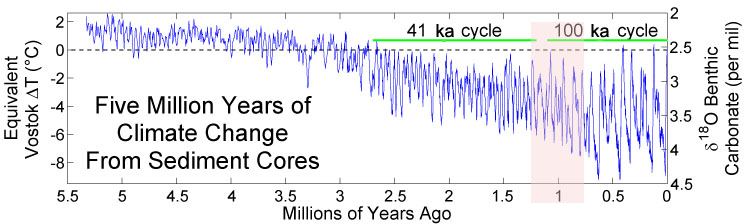
Their analyses suggest that between 930 and 813 ka ago human ancestors passed through a population bottleneck that involved only about 1300 breeding individuals. Moreover they remained at the very brink of extinction for a little under 120 thousand years. Interestingly, the genetic data are from people living on all continents, with no major differences between the analyses for geographically broad groups of people in Africa and Eurasia. Archaeological evidence, albeit sparse, suggests that ancient humans were widely spread across those two continental masses before the bottleneck event. The date range coincides with late stages of the Mid-Pleistocene climatic transition (1250 to 750 ka) during which glacial-interglacial cycles changed from 41 thousand-year periods to those that have an average duration of around 100 ka. The transition also brought with it roughly a doubling in the mean annual temperature range from the warmest parts of interglacials to the frigid glacial maxima: the world became a colder and drier place during the glacial parts of the cycles.
Genomes for Neanderthals and Denisovans suggest that they emerged as separate species between 500 and 700 ka ago. Their common ancestor, possibly Homo heidelbergensis, H. antecessoror other candidates (palaeoanthropologists habitually differ) may well have constituted the widespread population whose numbers shrank dramatically during the bottleneck. Perhaps several variants emerged because of it to become Denisovans, Neanderthals and, several hundred thousand years later, of anatomically modern humans. Yet it would require actual DNA from one or other candidate for the issue of last common ancestor for the three genetically known ‘late’ hominins to be resolved. But Hu et al. have shown a possible means of accelerated hominin evolution from which they may have emerged, at the very brink of extinction.
Oxygen-isotope record and global temperature changes over the last 5 million years, green lines showing the times dominated by 41 and 100 ka climatic cycles. The mid-Pleistocene climatic transition is shown in pink (Credit: Robert A Rohde)
There is a need for caution, however. H. erectus first appeared in the African fossil record about 1.8 Ma ago and subsequently spread across Eurasia to become the most ‘durable’ of all hominin species. Physiologically they seem not to have evolved much over at least a million years, nor even culturally – their biface Acheulean tools lasted as long as they did. They were present in Asia for even longer, and apparently did not dwindle during the mid-Pleistocene transition to the near catastrophic levels as did the ancestral species for living humans. The tiny global population suggested by Hu et al. for the latter also hints that their geographic distribution had to be very limited; otherwise widely separated small bands would surely have perished over the 120 ka of the bottleneck event. Yet, during the critical period from 930 to 813 ka even Britain was visited by a small band of archaic humans who left footprints in river sediments now exposed at Happisburgh in Norfolk. Hu et al. cite the scarcity of archaeological evidence from that period – perhaps unwisely – in support of their bottleneck hypothesis. There are plenty of other gaps in the comparatively tenuous fossil and archaeological records of hominins as a whole.
The discovery of genetic evidence for this population bottleneck is clearly exciting, as is the implication that it may have been the trigger for evolution of later human species and the stem event for modern humans. Hopefully Hu et al’s work will spur yet more genetic research along similar lines, but there is an even more pressing need for field research aimed at new human fossils from new archaeological sites.
See also: Ashton, N. & Stringer, C. 2023. Did our ancestors nearly die out? Science (Perspectives), v. 381, p. 947-948; DOI: 10.1126.science.adj9484.
The US city of Los Angeles, originally known as El Pueblo de Nuestra Señora la Reina de los Ángeles (The Town of Our Lady the Queen of the Angels), was founded in 1781 by 44 Spanish settlers. It remained a small cattle-centred town after the annexation of California from Mexico by the USA in 1847. Once it was reached by the transcontinental Southern Pacific railroad in 1876 it had the potential for growth. But it took the discovery of oil within its limits in 1892 for its population to increase rapidly. The Los Angeles City Oil Field became the top producer in California with 200 separate oil companies crammed cheek by jowl by 1901. Now only one remains, producing just 3.5 barrels per day. That crude oil was there for the taking was pretty obvious as bitumen seeps had long been exploited by native people and the original Spanish colonists. The oilfield was developed near one such seep: the Rancho La Brea tar pits.
Rancho La Brea tar pit and derricks of the Los Angeles City Oil Field in 1901
By 1901 perfectly preserved bones of a huge variety of animals – 231 vertebrate species – as well as plants and invertebrates began to be collected from the continually roiling pond of bitumen. Thousands of specimens have been collected since then, both predators and prey of all sizes. Famous for mastodons and sabre-toothed cats, La Brea is a repository of almost the entire western Californian fauna through much of the Late Pleistocene: before about 100 ka the area lay beneath the Pacific Ocean. Tar pits are traps for unwary animals of any kind, especially as shallow water often hides the danger. Carnivores seeking easy, abundant food end up trapped too.
Because of the anaerobic nature of bitumen, bacterial decay is suppressed. Many of the bones still contain undegraded collagen: the most abundant protein in mammals, which can be dated using the radiocarbon method. So, despite the lack of stratigraphy in the tar pits, it is possible to track the history of the ecosystem by painstaking dating of individual fossils (OKeefe, F.R and 18 others 2023. Pre–Younger Dryas megafaunal extirpation at Rancho La Brea linked to fire-driven state shift. Science, v. 381, article eabo3594; DOI: 10.1126/science.abo3594). Robin OKeefe and colleagues dated 169 specimens of eight large mammal species most commonly found in the bitumen: sabre-toothed cat (Smilodon fatalis); dire wolf (Aenocyon dirus); coyote (Canis latrans); American lion (Panthera atrox); ancient bison (Bison antiquus); western horse (Equus occidentalis); Harlan’s ground sloth (Paramylodonharlani); and yesterday’s camel (Camelopshesternus).
The authors focussed on precisely dated specimens spanning the 15.6 to 10.0 ka time range. This would allow the disappearance times of individual species to be compared with stages in the rapid change in the Californian climate during post glacial maximum warming, those during the Younger Dryas abrupt cooling (12.9 to 11.7 ka) and the earliest Holocene warming that succeeded it. The first to go extinct were the camels and giant sloths about 13.6 ka ago. At 13.2 ka the other mammals declined very rapidly, the two remaining herbivores vanishing more quickly than the four predators. By 12.9 ka the only surviving species of the chosen eight was the coyote. So seven members of the Pleistocene mammalian megafauna became extinct before the onset of the Younger Dryas cold millennium.
Part of the team examined pollen from a core through sediments deposited in a lake 100 km south of La Brea. They found that flora, and probably climate, had not changed at the time of camel and sloth extinctions around 13.6 ka. However a 300 year period between 13.2 and 12.9 ka witnessed a collapse in deciduous tree species while conifers, grasses and drought-tolerant shrubs increased. A woodland ecosystem had been replaced by semi-arid chaparral. Another feature of the lake-bed sediments was that charcoal fragments increased explosively during that 300-year episode that ended both the woodland ecosystem and the megafauna that exploited it: undoubtedly three centuries of regular wildfires. What remained was the chaparral ecosystem based on drought-tolerant, fire-adapted plants.
Were the megafauna collapse and a change in ecology results of a climatic harbinger for the Younger Dryas cool millennium, or some other cause? Interestingly, tangible evidence for the Clovis hunting culture of North America, which has long been implicated in the faunal ‘extirpation’, does not appear until 12.9 ka, and in California neither does any implicating other human groups. Yet evidence is accumulating for much earlier entry of humans into North America. Occupation sites are very rare on land, but human presence here and there implies such earlier migration, probably along the west coast that avoided the frigid interior further north than California. The question posed by OKeefe et al. is, ‘Were the fires ignited by humans over a 300 year period just before the Younger Dryas’? It remains to be confirmed … First human arrivals coinciding with evidence for wildfires in Australia, New Zealand and a few other areas do suggest that it is a possibility. There needs to be a motive, such as producing lush clearings in forest to attract game, or removing cover to make hunting easier. In this case, the fires immediately preceded a global climatic downturn with terrestrial drying, so they may have had natural causes: the potentially incendiary chaparral flora had been increasing steadily beforehand and decreased rapidly after the evidence for wildfires
See also: Price, M. 2023. Death by fire. Science, v. 381, p. 724-727; DOI: 10.1126/science.adk3291
Since 2001 Tom Higham, now Professor of Scientific Archaeology at the University of Vienna, helped develop new ways of refining radiocarbon dating at Oxford University’s Research Lab for Archaeology and the History of Art. Specifically his lab learned how to remove contamination of ancient samples by recent carbon and to reduce the detection limit of their accelerator mass spectrometer for the 14C atoms that remained from when they were in living organisms. The Oxford Radiocarbon Accelerator Unit pushed sample dates to the absolute limit of the method: around 50 thousand years. Being among the very best, the ORAU had a path beaten to its doors by archaeologists from across the world keen to get the most believable dates for their samples. Equally, Higham engaged in the field work itself and in the interpretation of other data from sites, such as ancient DNA. An outcome of Higham’s energetic efforts over two decades is his book The World Before Us: How Science is Revealing a New Story of Our Human Origins (paperback edition 2022, Penguin Books,ISBN-10: 0241989051). One reviewer commented ‘The who, what, where, when and how of human evolution’.
The World Before Us is not only comprehensive and eminently clear for the lay-reader, but it is more exciting than any science book that I have read. For the moment, it is the latest ‘word’ on early, anatomically modern humans and on the closely related Neanderthals and Denisovans. Its core is about how these three key groups ‘rubbed along’ once they met in the Late Pleistocene. As an amateur interested in palaeoanthropology, I have tried to keep pace with all the developments in the field since 2001 through Earth-logs, but Higham shows just how much I have missed that is important to the human story. If you have followed my many posts on human evolution and migrations with interest, read his book for a great deal more and a coherent story of how things stand.
Finding human fossils in SE Asia is rare because its tropical climate generally results in decomposition of bones. Up to now the oldest known anatomically modern human (AMH) found beyond the Middle East is from Australia and has been dated to 65 ka. Other, less convincing candidates for the earliest appearance of AMH in Asia are scattered teeth found in Chinese caves that yielded dates of up to 139 ka: their assignment to AMH and the reliability of their dating are disputed. Now a large team of scientists from the USA, Germany, Australia, South Africa, France, Denmark and Laos have unearthed convincing but fragmented AMH bones among a jumble of diverse animal fossils in sediment flooring Tam Pà Ling cave in northern Laos (Friedline, S.E. and 30 others 2023. Early presence of Homo sapiens in Southeast Asia by 86–68 kyr at Tam Pà Ling, Northern Laos. Nature Communications, v. 14, article 3193; DOI: 10.1038/s41467-023-38715-y). Several dating techniques reveal ages of the AMH samples that range from 46 to 77 ka, and potentially as far back as 86 ka. It is conceivable that the oldest are from the population that subsequently reached Australia. Far to the west of Laos in Greece, Israel and Arabia an earlier AMH presence goes back as far as 90 to 210 ka. Moreover, palaeoclimatic studies suggest many opportunities for eastward migration since 290 ka ago that AMH emigrants may have exploited. Once beyond regions around Arabia and the Gulf, which were periodically hyperarid, the journey to the rest of Asia was probably continuously habitable throughout the last two glacial-interglacial cycles.
Entrance to Tam Pà Ling cave in northern Laos (credit: Demeter et al.; Fig S1)
Another aspect of the AMH record in southern and SE Asia is that the individuals represented seem to have been anatomically very varied (Demeter, F. et al. 2023. Early Modern Humans and Morphological Variation in Southeast Asia: Fossil Evidence from Tam Pa Ling, Laos. PLOS ONE, v. 10, article e0121193. DOI:10.1371/journal.pone.0121193). This may suggest that migration was by significantly different groups at different times. Oddly, the earliest known examples have more ‘modern’ characteristics than younger ones that appear somewhat ‘archaic’. The age of the fossils conflicts with the 60 ka age reconstructed from genetic evidence for the main diffusion across Eurasia and Australasia. One possibility is that there were several pre-60 ka migrations, descendents of these early populations having been replaced or assimilated by a later, larger numbers of AMH migrants. At 74 ka the Sumatran Toba supervolcano erupted about 2,800 km3 of ash to blanket a vast area and cause global cooling that could have more than decimated migrating AMH groups. Alternatively the 60 ka ‘genetics’ date is not correct, as suggested by the minimum date of 65 ka for the earliest Australians. Such a conflict of evidence will surely spur further excavation: as one researcher observed about Laos, ‘There are thousands of caves to explore’.
Reconstruction of a Paranthropus head (Credit: Jerry Humphrey, Pinterest)
Paranthropoids had large, broad teeth and pronounced cheekbones plus a bone crest on the top of their skulls that were the attachments for powerful jaw muscles, much as in modern gorillas. Unlike gorillas they were definitely bipedal and were more similar to australopithecines. They have been called ‘robust’ australopithecines but they were not significantly taller or heavier. The first to be unearthed at Olduvai, Tanzania in 1959 (Paranthropus boisei) was dubbed ‘Nutcracker Man’ by its finder, and many have implied that paranthropoids’ teeth and powerful jaws were signs of a vegetarian diet that needed a lot of chewing. Yet their teeth do not show the microscopic pitting associated with living primates that eat hard plant parts and nuts, or the heavy wear that results from eating grasses. They probably ate soft plants, such as semi-aquatic succulents or tubers, but meat-eating that causes little dental wear cannot be ruled out. Some specimens are associated with long bones of other animals whose ends are worn, suggesting that they may have used them as tools for digging. Plant remains found at paranthropoid sites suggests that they inhabited woodland, together with coexisting australopithecines. They were around in the form of three successive species from 2.9 to 1.2 Ma, outlasting australopithecines. The later paranthropoids coexisted with Homo habilis and H. erectus: they were clearly just as successfully adapted to their surroundings as were early humans.
In early 2023 evidence was published that associated Oldowan stone tools with remains of Paranthropus, together with deliberately defleshed and cut bones (see also): though association is not proof of a direct link. Interestingly, the hand of a P. robustus found in the Swartkrans cave system in South Africa is consistent with a human-like precision grip, i.e. it had an opposable thumb. Swarkrans also yielded the earliest evidence for the deliberate use of fire about 1.5 Ma ago, associated with remains of both P. robustus and H. erectus. All this suggests that a case could be made for paranthropoids’ being human ancestors – supporting evidence has just been published (Braga, J. et al. 2023. Hominin fossils from Kromdraai and Drimolen inform Paranthropus robustus craniofacial ontogeny. Science Advances, v. 9, article eade7165; DOI: 10.1126/sciadv.ade7165).
Fossil-bearing breccias beneath the floor of the Kromdraai cave in the Cradle of HumankindWorld Heritage Site 45 km NW of Johannesburg, South Africa yielded the first near-complete P. robustus skull in 1938, another being found in cave breccias at the nearby Drimolen quarry. These deposits also contained remains of four infants assigned to the species, whose teeth and cranial parts were at different stages of juvenile development (ontogeny). José Braga of the University of Toulouse, France and co-workers from South Africa and the USA compared this growth sequence with those teased out from immature specimens of Australopithecus africanus and early Homo.Their tentative conclusion is that Paranthropus robustus is more closely related to early humans than to australopithecines of the same stratigraphic age.
Skull of a probable adult female P. robustus (left) with that of H. habilis (centre) and A. africanus (right). Credits: all from Wikipedia pages
So, it now seems possible that paranthropoids are not ‘robust’ australopithecines in an acceptable, taxonomic sense. Their closer resemblance in early development to early humans, together with their association with early stone tools used for defleshing prey animals, together with evidence for possible their use of fire, further strengthens their candidacy for an ancestral link to humans. The best preserved skulls of Homo habilis and a female P. robustus (males of that species show the distinctive saggital crest) do show close similarities, that of a roughly contemporary A. africanus having distinctly wider cheeks than both. All three species were in life probably of much the same weight and stature (30 to 40 kg and 110 to 130 cm) but H. habilis had a significantly larger brain volume (500 to 900 cm3) than the other two (each ~450 cm3). However, this isn’t proof that the genus Homo evolved from a paranthropoid ancestor. That would require genetic evidence, unlikely to be extracted from specimens because DNA seems to degrade more quickly under the conditions of the tropics than at high latitudes. Debate on ultimate human origins will probably be endless. Perhaps it would make more sense simply to accept that early humans weren’t the only ‘smart kids on the palaeoanthropological block’, one of which left no issue after 1.2 Ma ago.
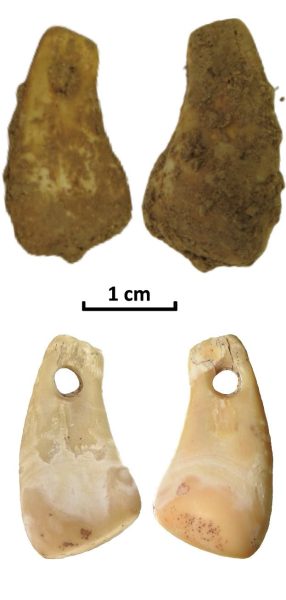
The Denisova cave in southern Siberia is now famous for the evidence that it has provided for Neanderthals and Denisovans and their interbreeding based on DNA recovered from their bones, even a tiny finger bone of the latter. Indeed we would not know of the former existence of Denisovans without such a clue. Scientists at the Max Planck Institute for Evolutionary Anthropology in Leipzig, responsible for both breakthroughs, also pioneered the extraction of hominin DNA from soil in the cave. Now they have refined the intricate extraction of genetic material to such an extent that detailed hominin DNA sequences can be analysed from ornaments worn by ancient people, in much the same manner as applied in forensic studies of crime scenes (Essel, E. and 22 others 2023. Ancient human DNA recovered from a Palaeolithic pendant. Nature, early release 3 May 2023; DOI: 10.1038/s41586-023-06035-2).
Elk-tooth pendant found at Denisova cave, before cleaning and DNA extraction (top) and after the ‘washing’ procedure (bottom). Credit: Essel et al., Fig 1.
Russian archaeologists who continue to work at Denisova cave found a pierced pendant made from the tooth of a Siberian elk or wapiti during the 2019 field season. It was sent to Leipzig, where the palaeogenetics team had been trying to extract the DNA of whoever had worn personal artefacts found in French and Bulgarian caves. Their efforts had been unsuccessful, but such an object from Denisova clearly spurred them on. When someone wears next to the skin objects made of porous materials their sweat and the DNA that it carries seeps into the pores. If the materials decay very slowly, as do bone and especially teeth, genetic material can, in principle be extracted. But crushing up important ancient objects is not an option: for such rarities the extraction has to be non-destructive. It can only be done by ‘washing’ it in reagents that do not themselves break down DNA. Elena Essel and her many colleagues experimented with many ‘brews’ of reagents and repeated immersion at steadily rising temperature (up to 90°C). This releases genetic material in a stepwise fashion, allowing separation of contaminants in the host sediment from that which had penetrated into the tooth’s pores from whoever made the pendant and the wearer, and the animal from which it came
Analysis of the recovered material yielded elk mtDNA, which was compared with that from four other ancient elks of known ages. This suggested that the elk had lived between 19 and 25 ka ago, thereby indirectly dating the time when the pendant was made and worn. A surprisingly large amount human DNA showed that the wearer was a female who was genetically allied with ancient anatomically modern humans who lived further east in Siberia at about that time.
Obviously this astonishing result opens up a wide vista for archaeology, though not from Palaeolithic burials, which are extremely rare. But artefacts of various kinds are much more common that actual human remains. Because the technique is non-destructive museums may be more willing to make objects in their collections available for analysis. Maybe the approach will be restricted to porous bone or tooth ornaments worn for long periods by individuals. Yet stone tools that were handled continually could be a more important target, depending on the rock from which they were made and its porosity.
When and how humans first migrated into the Americas are issues that have exercised anthropologists for the last two decades, often sparking off acrimonious debate. In the 20th century both seemed to well established: hunters using the celebrated Clovis fluted spear blades arrived first, no earlier than 13 ka ago. The Beringia land bridge across what is now the Bering Strait was exposed by falling sea level as early as 30 thousand years ago in the lead-up to the last glacial maximum (LGM) to link eastern Siberia and Alaska. However, ice sheets expanding to the south-west of the main area of glaciation on the Canadian Shield barred passage through Interior Alaska and NW Canada. Only around 13 ka had a N-S ice-free corridor opened through the mountains during glacial retreat. Nevertheless, humans had entered Alaska at least ten thousand years earlier, during the LGM, to occupy caves in its western extremity: Alaska was habitable but they were stuck there.
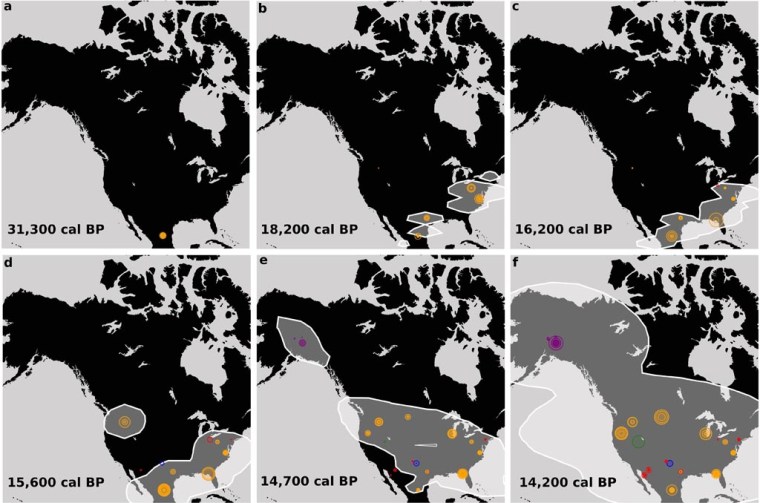
In the early 21st century, it became clear that the ‘Clovis First’ hypothesis was mistaken. Sediments in Texas that contained Clovis blades were found to be underlain by those of an older culture, reliably dated to about 15.5 ka. Furthermore, analysis of the DNA of all groups of native Americans (north and south) indicated a last common ancestor in Siberia more than 30 ka ago: they descended from that ancestor outside of Asia. More recently excavated sites in Mexico and Chile point to human populations having reached there as early at 33 ka (see: Earliest Americans, and plenty of them; July 2020), and there is a host of pre-Clovis sites in North and Central America dating back to 18.2 ka. Such ancient groups could not have walked from the Beringia land bridge because the present topographic grain in the Western Cordillera would have been blocked by ice since about 25 thousand years ago. The only viable possibility was that they followed the Alaskan coast to move southwards, either in boats or over sea ice.
Dated pre-Clovis sites in Mexico and North America and possible expanding distribution of people from 31.3 to 14.2 ka (Credit; Becerra-Valdivia and Higham; Extended Data Fig. 4)
A new focus on when such journeys would have been feasible was published in February 2023 (Praetorius, S.K et al. 2023. Ice and ocean constraints on early human migrations into North America along the Pacific coast.Proceedings of the National Academy of Science, v. 120, article e2208738120; DOI: 10.1073/pnas.2208738120). One advantage of moving along the coast is that, though it would be pretty cold, the warming effect of the Pacific Ocean would make it more bearable than travelling inland, where winter temperatures even today regularly reach -50°C. More important, there would be no shortage of food; fish, marine mammals and shellfish abound at the ice margin or onshore, at any season. But a coastal route may not have been possible at all times during the period either side of the LGM. Large glaciers still reach the ocean from Alaska and there is little more perilous than crossing the huge crevasse fields that they present. Boating would have been highly dangerous because of continual calving of icebergs from extensive ice shelves. Moreover, the Alaska Coastal Current flows northwards and would likely have sped up during episodes of glacial melting as the current is affected by fresh water influx. Yet there may sometimes have been episodes of open water at the ice front frozen to relatively flat sea ice in winter. That would making boat- or foot travel relatively safe. Sea ice would also make glacier-free islands accessible for encampments over the harsh winters or even for hundreds of years, with plenty of marine food resources.
Summer Praetorius of the US Geological Survey and colleagues from Woods Hole Oceanographic Institution, Oregon State University, and the Universities of California (Santa Cruz) and Oregon have attempted to model conditions since 32.5 ka ago in coastal waters off Northwest America. They used simulations of the behaviour of the Alaska Coastal Current during varying climate conditions before and during the LGM, while glaciers were in retreat that followed and during the Holocene. Their modelling is based on the effects of changing sea level and water salinity on general circulation in the Northern Pacific. The relative abundance of sea ice can be tracked using variation in an alkenone produced by phytoplankton that wax and wane according to sea-surface temperature and sea-ice cover. The other input is the well-documented changing extent of continental glaciation in Alaska and the Yukon Territory. Based on their model they estimate that the most favourable environmental conditions for coastal migration occurred just before the LGM (24.5 to 22 ka) and between 16.4 and 14.8 ka during the initial stages of warming and extensive melting of ice sheets. The Alaskan Coastal Current probably doubled in intensity during the LGM making the use of boats highly dangerous
By 35 ka ocean-going boats are known to have been used by people in northern Japan. Traversing sea-ice was the way in which Inuit people occupied all the Arctic coastal areas of North America and Greenland during the last five thousand years, and is the form of travel favoured by the authors. It is not yet possible to prove and date such coastal journeys because campsites or settlements along the coast would now be inundated by 100 m of post-glacial sea-level rise. Yet such migration was necessary to establish settlements at lower latitudes in North America and Mexico in the period when overland routes from Beringia were blocked by ice sheets. By 32.5 ka falling sea level probably made it possible to cross the Bering Strait for the first time and for the next 7.5 ka an ice-free corridor made it possible for the rest of North America and points further south to be reached on-foot from Alaska. That window of opportunity might have allowed humans to have reached Mexico and South America, where the earliest dates of occupation have been found. But many of the early sites across North America date to the period (25 to 13 ka) when overland access was blocked. Of course, those sites might have been established by expansion from the very earliest migrants who crossed the Beringia land bridge and took advantage of overland passage before 25 ka. But if later migrants from Asia could follow the coastal route, then it seems likely that they did. Later Inuit spread along the shores of the Arctic Ocean since 5000 years ago probably with a material culture little different from that of the earlier migrants from Siberia.
Up to now the earliest stone tools are objects dated to about 3.3 Ma (Late Pliocene) found in the Turkana basin of Kenya in 2015. They are sharp-edged pieces of rock that seem to have been made simply by striking two lumps of rock together (see: Stone tools go even further back; May 2015). These Lomekwian artefacts are similar to the basic tools made today by some chimpanzees in parts of Africa. Their age matches that for the earliest known animal bones that show signs of having meat cut from them, which were unearthed in Dikika, Ethiopia (see: Another big surprise; September 2010) which, like the Lomekwian tools, are not accompanied by tools or hominin remains. The earliest tools associated with members of the genus Homo are significantly more sophisticated. They were found in close association with H. habilis at what seems to have been a well-used butchering site, dated at 2.0 Ma, in Tanzania’s Olduvai Gorge, hence their designation as the Oldowan ‘industry’. The Oldowan ‘tool kit’ includes choppers and blades deliberately shaped to be wielded by hand and made by striking large cobbles with distinctive hammer stones. Earlier tools with this level of deliberate crafting come from the 2.6 Ma Ledi-Geraru site in the Afar Depression of NE Ethiopia but with no sign of their makers.
Oldowan tools used for pounding and cutting from Nyayanga, Kenya (Credit: Thomas Plummer, James Oliver and Emma Finestone/Homa Peninsula Paleoanthropology Project/SWNS)
The presence of Oldowan tools has now been pushed further back, by about 400 ka, thanks to excavations in Late Pliocene sediments at Nyayanga on the shore of Lake Victoria in western Kenya by Thomas Plummer of Queens College in New York State, USA, and his numerous collaborators from the US, Germany, the UK, China, Italy, Australia, Kenya, South Africa and Poland (Plummer, T.W. and 31 others 2023. Expanded geographic distribution and dietary strategies of the earliest Oldowan hominins and Paranthropus. Science, v. 379, p. 561-566; DOI: 10.1126/science.abo7452). Their work also expands the range of Oldowan culture by about 1300 km. The Nyayanga site yielded over 300 artefacts that closely resemble the previously known range of Oldowan tool shapes. Their makers struck flakes from suitable corestones – made of rhyolite, quartz and quartzite – and trimmed them by more intricate means. They seem to have been used to cut up mainly hippo and buffalo, bones of which bear clear cut marks, but had other uses. Analysis of the wear on tool surfaces not only show signs of butchery, but also processing of plant tissue by pounding; the latter resulted in pitting and polishing of tools that seem to have been used many times. Stable-isotope analysis of the bones and animal teeth suggests that in the Pliocene Nyayanga was a grassy and partly wooded savannah close to a substantial water body needed by hippos.
Reconstruction of a Paranthropus head (Credit: Jerry Humphrey, Pinterest)
The ‘great surprise’ is that the only hominin remains associated with the site are two damaged molar teeth. They are so large that their most likely source was a species of Paranthropus.Paranthropoids have long been considered to be a gorilla-like, ‘robust’ branch of australopithecines. Their large cranial crests anchoring jaw muscles and enormous teeth were reckoned to indicate a diet of tough vegetation – the discoverer of the first specimen of P. boisei dubbed it ‘Nutcracker Man’ – although the wear on individual teeth suggests otherwise. But there is no reason to suppose that they could not eat meat. They survived australopithecines by more than a million years to cohabit the East African savannahs with H. ergaster until about 1 Ma ago.
Lead author Thomas Plummer wonders if paranthropoids would have needed tools because they had the largest jaws and teeth of any hominin. But had his team found close association with smaller H.habilis teeth would he have held a similarly negative view? There is evidence from younger sites in South Africa that paranthropoids used a wide diversity of bone tools and may even have been among the earliest fire users. So why the negativity about stone tools? To paraphrase Ali G, ‘Is it because they is ugly?’
In the 1980s miners in the Neumark-Nord area of Saxony-Anhalt, central Germany uncovered an extensive assemblage of animal bones and stone tools in opencast ‘brown coal’ (lignite) workings. Archaeologists working over a ten-year period recovered bones from an estimated 70 straight-tusked elephants (Palaeoloxodon antiquus), as well as many other large herbivores, while huge bucket-wheel excavators advanced through the deposit. Most of the elephants were adult males, some preserved as entire skeletons others as disarticulated bones. Weighing as much 15 tonnes – equivalent to ten medium SUVs – and standing up to 4 m high at the shoulder, they were twice as large as the biggest modern African elephants and had far longer legs. Being so tall they could browse vegetation up to 8 metres above the ground surface using an 80 cm tongue as well as a long trunk and their huge tusks.
The lignite deposits formed in marshes and shallow lakes that occupied low-lying depressions left in the wake of retreating glaciers during the last (Eemian) interglacial (130 to 115 ka ago). The warming encouraged temperate forest to extend much further north than it does today. The fauna too would have changed substantially once the ice sheets began to retreat. For instance, mammoths that grazed low tundra vegetation during the preceding ice age disappeared from Central Europe to be replaced by straight-tusked elephants migrating from much further south that had plenty of trees, shrubs and grasses to feed on, as did other herbivores. So the central European plains teemed with big game. The marshes and lakes had little outflow and became depleted in oxygen so that dead vegetation built up to form extensive peat deposits: just the conditions for organic preservation.
Artistic impression of Neanderthal elephant butchery site (Credit: Tom Bjorklund, Science)
The Neumark-Nord sites yielded literally tonnes of fossils, including 3400 elephant bones. But these were not simply the remains of animals that had become bogged down and died of exhaustion. Sabine Gaudzinski-Windheuser and Lutz Kindlerof the Johannes Gutenberg University of Mainz, Germany and Katherine MacDonald and Wil Roebroeks of Leiden University, Netherlands have examined every bone for signs of post-mortem modification by humans (Gaudzinski-WindHeuser, S. et al. 2023. Hunting and processing of straight-tusked elephants 125.000 years ago: Implications for Neanderthal behaviour. Science Advances, v. 9, article add8186; DOI: https://doi.org/10.1126/sciadv.add8186). Some bones are so large as to require a forklift to shift or turn them in the laboratory. Most of the bones bear deliberate cut marks made by stone blades: far more than signs of gnawing by carnivores. Neanderthals had got to them before scavengers. The density of cuts and gouges suggests that almost every scrap of meat and fat had systematically been harvested from the corpses, even the fat-rich feet and brains. The sheer number of cuts needed to skin and deflesh the elephants strongly suggests that their meat was fresh: rotten meat could simply have been pulled from the skin and bone quite easily. Little was left for scavengers to gnaw.
Each elephant would have yielded enough meat and fat for an estimated 2500 portions, each with a calorific value of around 4000 kcal. To fully butcher each beast and then to dry and/or smoke the produce can be estimated – by comparison with such work on a modern African elephant – would take around 1500 person hours. To achieve that would require 3 to 5 days of very heavy labour by 25 people. Some means of preservation would have been needed, unless hundreds of people had scoffed the lot at one or two sittings. The authors consider the bounty to imply that a considerably larger collective of Neanderthals than the previously estimated ~25 per band probably benefitted from a single elephant, whether it was eaten on the spot or preserved in some way and either carried off or cached. But 70 elephants …?
The geographic context suggests a pile of corpses built up in lignite close to or on a lake shore had accumulated over a lengthy period. Using likely sedimentation rates backed by counting of annual tree rings from stumps in the lignite the authors estimate that the pile formed over about 300 years at a rate of one kill every 5 to 6 years. But this site is one of several found in the Neumark-Nord area, albeit not quite so large, and there are probably more, either remaining buried or destroyed by the brutal lignite mining technique. Taking on a herd of animals would be far more risky than hunting individuals. This is where the sex of the elephant remains gives an idea of the hunters’ strategy. Those that could be sexed – about 23 – were all adult males that were estimated to be from 20 to 50 or more years old. By analogy with African elephants, adult male are generally solitary, only joining herds of females and offspring when one or more is at oestrus. Male straight-tusked elephants were more than twice the mass of adult females and when keeping themselves to themselves would have been a safer and more profitable target than females and juveniles in a herd. Solitary males would have been easy to approach, being confidant that their size would deter direct predation by the largest carnivores, such as lions. In a peaty swamp, simply driving an individual into deep mud would bog it down to be dispatched by spear thrusts. The earliest known thrusting spears have been unearthed in similar lignite beds 200 km away.
This study adds to growing understanding of Neanderthal culture. It suggests that they were not just opportunistic and wandering foragers but regularly combined resources to focus on a specific, very high-value prey. Maybe that was restricted to the special peat-swamp environment of what is now central Germany, but it speaks of an ability to plan and orchestrate spectacular communal events. And they performed such feats again and again. They were the masters of Europe through three of four glacial-interglacial cycles.
Championed as the earliest commonly found human species and, apart from anatomically modern humans (AMH), the most widespread through Africa and Eurasia. It also endured longer (~1.75 Ma) than any other hominin species, appearing first in East Africa around 2 Ma ago, the youngest widely accepted fossil – found in China – being around 250 ka old. The ‘erects’ arguably cooked their food and discovered the use of fire 1.7 to 2 Ma ago. The first fossils discovered in Java by Eugene Dubois are now known to be associated with the oldest-known art (430 to 540 ka) The biggest issue surrounding H. erectus has been its great diversity, succinctly indicated by a braincase capacity ranging from 550 to 1250 cm3: from slightly greater than the best endowed living apes to within the range of AMH. Even the shape of their skulls defies the constraints placed on those of other hominin species. For instance, some have sagittal crests to anchor powerful jaw muscles, whereas others do not. What they all have in common are jutting brow ridges and the absence of chins along with all more recently evolved human species, except for AMH.
This diversity is summed up in 9 subspecies having been attributed to H. erectus, the majority by Chinese palaeoanthropologists. Chinese fossils from over a dozen sites account for most of the anatomical variability, which perhaps even includes Denisovans, though their existence stems only through the DNA extracted from a few tiny bone fragments. So far none of the many ‘erect’ bones from China have been submitted to genetic analysis, so that connection remains to be tested. Several finds of diminutive humans from the Indonesian and Philippine archipelagos have been suggested to have evolved from H. erectus in isolation. All in all, the differences among the remains of H. erectus are greater than those used to separate later human species, i.e. archaic AMH, Neanderthals, Denisovans, H. antecessor etc. So it seems strange that H. erectus has not been split into several species instead of being lumped together, in the manner of the recently proposed Homo bodoensis. Another fossil cranium has turned up in central China’s Hubei province, to great excitement even though it has not yet been fully excavated (Lewis, D. 2022. Ancient skull uncovered in China could be million-year-old Homo erectus. Nature News 29 November 2022; DOI: 10.1038/d41586-022-04142-00; see also a video). Chances are that it too will be different from other examples. It also presents a good excuse to consider H. erectus.
Cranium of a Chinese Homo erectus, somewhat distorted by burial, from a site close to the latest find. (Credit: Hubei Museum, Wuhan, China)
The complications began in Africa with H. ergaster, the originator of the bifacial or Acheulean multi-purpose stone tool at around 1.6 Ma (see: Flirting with hand axes; May 2009), the inventor of cooking and discoverer of the controlled use of fire. ‘Action Men’ were obviously smarter than any preceding hominin, possibly because of an increase of cooked protein and plant resources that are more easily digested than in the raw state and so more available for brain growth. The dispute over nomenclature arose from a close cranial similarity of H. ergaster to the H. erectus discovered in Java in the 19th century: H. erectus ergaster is now its widely accepted name. In 1991-5 the earliest recorded hominins outside Africa were found at Dmanisi, Georgia, in sediments dated at around 1.8 Ma (see: First out of Africa; November 2003) Among a large number of bones were five well-preserved skulls, with brain volumes less than 800 cm3 (see: An iconic early human skull; October 2013). These earliest known migrants from Africa were first thought to resemble the oldest humans (H.habilis) because of their short stature, but now are classified as H. erectus georgicus. They encapsulate the issue of anatomical variability among supposed H. erectus fossils, each being very different in appearance, one even showing ape-like features. Another had lost all teeth from the left side of the face, yet had survived long after their loss, presumably because others had cared for the individual.
The great variety of cranial forms of the Asian specimens of H. erectus may reflect a number of factors. The simplest is that continuous presence of a population there for as long as 1.5 Ma inevitably would have resulted in at least as much evolution as stemmed from the erects left behind in Africa, up to and including the emergence of AMH in North Africa about 300 ka ago. If contact with the African human population was lost after 1.8 Ma, the course of human evolution in Africa and Asia would clearly have been different. But that leaves out the possibility of several waves of migrants into Asia that carried novel physiological traits evolved in Africa to mix with those of earlier Asian populations. From about 1 Ma ago a succession of migrations from Africa populated Europe – H. antecessor, H. heidelbergensis, and Neanderthals and then AMH. So a similar succession of migrants could just as well have gone east instead of west on leaving Africa. Asia is so vast that migration may have led different groups to widely separated locations, partially cut-off by mountain ranges and deserts so that it became very difficult for them to maintain genetic contact. Geographic isolation of small groups could lead to accelerated evolution, similar to that which may have led to the tiny H. floresiensisandH. luzonensisdiscovered on Indonesian and Philippine islands.
Another aspect of the Asian continent is its unsurpassed range of altitude, latitude and climate zones. Its ecologically diversity offers a multitude of food resources, and both climate and elevation differences pose a range of potential stresses to which humans would have had to adapt. The major climate cycles of the Pleistocene would have driven migration across latitudes within the continent, thereby mixing groups with different physical tolerances and diets to which they had adapted. Equally, westward migration was possible using the Indo-Gangetic plains and the shore of the Arabian Sea: yet more opportunities for mixing between established Asians and newly arrived African emigrants.
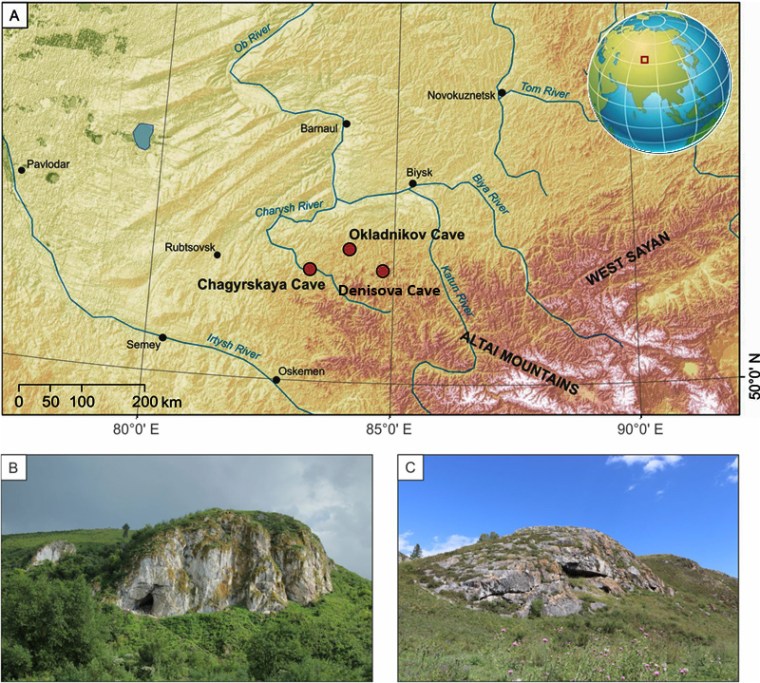
Caves used by the Neanderthals of southern Siberia: A – location map; B – Chagyrskaya Cave; C – Okladnikov Cave. (Credit: adapted from Skov et al.; Extended Data Fig. 1)
The early focus on Neanderthals was on remains found in Western Europe from the 19th century onwards. That has shifted in recent years to southern Siberia in the foothills of the Altai mountains, despite the fossils’ fragmentary nature: a few teeth and bits of mandible. The Denisova Cave became famous not just because it contained the easternmost evidence of Neanderthal occupation but through the genetic analysis of a tiny finger-tip bone. It proved not to be from a Neanderthal but a distinctly different hominin species, dubbed Denisovan (see: Other rich hominin pickings; May 2010). What Denisovans looked like remains unknown but genetic traces of them are rife among living humans of the western Pacific islands and Australia, whose ancestors interbred with Denisovans, presumably in East Asia. Modern people indigenous to Europe and the Middle East have Neanderthal genes in their genomes. Other bone fragments from Denisova Cave also yielded Neanderthal genomes, and the cave sediments yielded traces of both groups (see: Detecting the presence of hominins in ancient soil samples; April 2017). Then in 2018 DNA extracted from a limb bone from the cave clearly showed that it was from a female teenager who had had a Neanderthal mother and a Denisovan father (see: Neanderthal Mum meets Denisovan Dad; August 2018). These astonishing and unexpected finds spurred further excavations and genetic analysis in other caves within 100 km of Denisova Cave. This was largely led by current and former co-workers of Svanti Pääbo, of the Max Planck Institute for Evolutionary Anthropology, Leipzig, Germany: Pääbo was awarded the 2022 Nobel Prize in Physiology or Medicine for his coordination of research and discoveries concerning ancient human genomes. Their enormous field and laboratory efforts have paid astonishingly valuable dividends (Skov, L. and 34 others 2022. Genetic insights into the social organization of Neanderthals. Nature v. 610, p. 519–525; DOI: 10.1038/s41586-022-05283-y).
To the previously analysed 18 Neanderthal genomes from 14 archaeological sites across Eurasia (including Denisova Cave) Skov et al. have added 13 more from just two sites in Siberia (the Chagyrskaya and Okladnikov caves). Each site overlooks valleys along which game still migrates, so they may have been seasonal hunting camps rather than permanent dwellings: they are littered with bison and horse bones. Tools in the two 59-51 ka old human occupation levels are different from those at the older (130 to 91 Ka) Denisova Cave about 100 km to the east. As at the much older site, human fossils include several teeth and fragments of bones from jaws, hands, limbs and vertebrae. The detailed genomes recovered from 17 finds shows them to be from 14 individuals (12 from Chagyrskaya, 2 from Okladnikov).
Chagyrskaya yielded evidence for 5 females (3 adults and 2 children) and 7 males (3 children and 4 adults). One female estimated to have lost a premolar tooth when a teenager was the daughter of a Chagyrskaya adult male. He, in turn, was brother or father to another male, so the girl seems to have had an uncle as well. Another male and female proved to be second-degree relations (includes uncles, aunts, nephews, nieces, grandparents, grandchildren, half-siblings, and double cousins). The two people from Okladnikov were an adult female and an unrelated male child. The boy was not related to the Chagyrskaya group, but the woman was, her former presence at that cave lingering in its cave-sediment DNA. None of the newly discovered individuals were closely related to six of the seven much older Denisova Cave Neanderthals, but the Okladnikov boy had similar mtDNA to one individual from Denisova.
Further information about the Chagyrskaya group came from comparison of DNA in Y-chromosomes and mitochondria. The father of the teenage girl had two types of mtDNA – the unusual characteristic of heteroplasmy – that he shared with two other males. This suggests that three of the males shared the same maternal lineage – not necessarily a mother – and also indicates that they lived at roughly the same time. The mtDNA recovered from all Chagyrskaya individuals was much more varied than was their Y-chromosome DNA (passed only down male lineage). One way of explaining that would be females from different Neanderthal communities having migrated into the Chagyrskaya group and mated with its males, who largely remained in the group: a ‘tradition’ known as patrilocality, which is practised in traditional Hindu communities, for instance.
So, what has emerged is clear evidence for a closely related community of Neanderthals at Chagyrskaya, although it cannot be shown that all were present there at the same time, apart from the five who show first- or second-degree relatedness or mitochondrial heteroplasmy. Those represented only by individual teeth didn’t necessarily die there: adult teeth can be lost through trauma and deciduous teeth fall out naturally. There was also some individual physical connection between the two caves: The Okladnikov woman’s DNA being in the sediment at Chagyrskaya. Looking for DNA similarities more widely, it appears that all individuals at Chagyrskaya may have had some ancestral connection with Croatian Neanderthals, as did the previously mentioned mother of the Denisovan-Neanderthal hybrid girl. Four of the Chagyrskaya individuals can also be linked genetically to Neanderthals from Spain, more so than to much closer individuals found in the Caucasus Mountains. So, by around 59-51 ka the results of a wave of eastward migration of Neanderthals had reached southern Siberia. Yet the apparent matrilineal relatedness of the Okladnikov boy to the much older Neanderthals of Denisova Cave suggests that the earlier group continued to exist.
The new results are just as fascinating as the 2021 discovery that ancient DNA from Neolithic tomb burials in the Cotswolds of SW England suggests that the individual skeletons represent five continuous generations of one extended family. The difference is that they were farmers tied to the locality, whereas the Siberian Neanderthals were probably hunter gatherers with a very wide geographic range. Laurits Skov and his colleagues have analysed less than one-quarter of the Neanderthal remains already discovered in Chagyrskaya and Okladnikov caves and only a third of the cave deposits have been excavated. Extracting and analysing ancient DNA is now far quicker, more detailed and cheaper than it was in 2010 when news of the first Neanderthal genome broke. So more Neanderthal surprises may yet come from Siberia. Progress on the genetics of their anatomically-modern contemporaries in NE Asia has not been so swift.
Two years ago material excavated from the Bacho Kiro cave in Bulgaria revealed that anatomically modern humans (AMH) had lived there between 44 and 47 ka ago: the earliest known migrants into Europe. Bacho Kiro contains evidence of occupancy by both Neanderthals and AMH. This discovery expanded the time over which Europe was co-occupied by ourselves and Neanderthals. The latter probably faded from the scene as an anatomically distinct group around 41 to 39 ka, although some evidence suggests that they lingered in Spain until ~37 ka and perhaps as late as 34 to 31 ka in the northern Ural mountains at the modern boundary of Europe and Asia. For most of Europe both groups were therefore capable of meeting over a period of seven to eight thousand years.
Aside from interbreeding, which they certainly did, palaeoanthropologists have long pondered on a range of tools that define an early Upper Palaeolithic culture known as the Châtelperronian, which also spans the same lengthy episode. But there have been sharp disagreements about whether it was a shared culture and, if so, which group inspired it. Evidence from the Grotte du Renne in eastern France suggests that the Neanderthals did abandon their earlier Mousterian culture to use the Châtelperronian approach early in the period of dual occupancy of Europe.
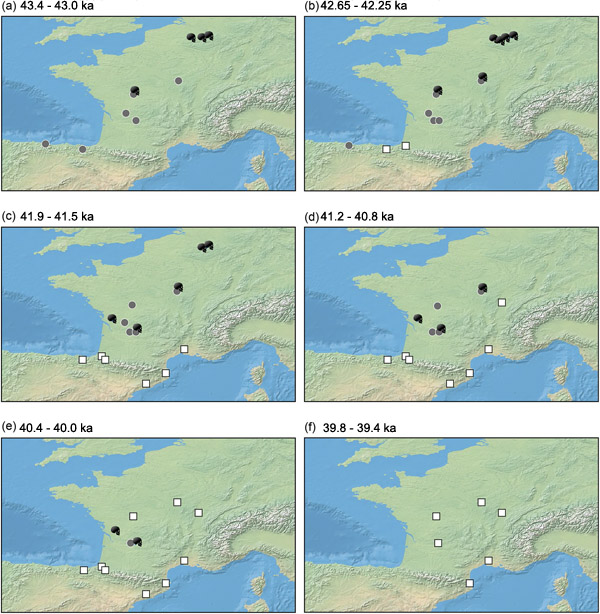
Dated appearances in France and NE Spain of Neanderthal fossils (black skulls), Châtelperronian artefacts (grey circles) and proto-Aurignacian artefacts (white squares) in different time ‘slots’ between 43.4 and 39.4 ka. (Credit: Djakovic et al., Fig. 3)
Igor Djakovic of Leiden University in the Netherlands , Alastair Key of Cambridge University, UK, and Marie Soressi, also of Leiden University have undertaken a statistical analysis of the geochronological and stratigraphic context of artefacts at Neanderthal and AMH sites in France and NW Spain during the co-occupancy period (Djakovic, I., Key, A. & Soressi, M. 2022. Optimal linear estimation models predict 1400–2900 years of overlap between Homo sapiens and Neandertals prior to their disappearance from France and northern Spain. Scientific Reports, v. 12, article 15000; DOI: 10.1038/s41598-022-19162-z). Their study is partly an attempt to shed light on the ‘authorship’ of the novel technology. The results suggest that the Châtelperronian (Ch) started around 45 ka and had disappeared by ~40.5 ka, along with the Neanderthals themselves. Early AMH artefacts are known as proto-Aurignacian (PA) and bear some resemblance to those of Châtelperronian provenance. The issue revolves around 3 conceivable scenarios: 1. the earliest AMH migrants brought the PA culture with them that Neanderthals attempted to copy, leading to their Ch tools; 2. Neanderthals independently invented the Ch methodology, which AMH adopted to produce PA artefacts; 3. both cultures arose independently.
Djakovic and colleagues have found that the data suggest that the proto-Aurignacian first appeared in the area at around 42.5 ka. Maps of dated human remains and artefacts for six 400-year time ranges from 43.4 to 39.4 ka show only Neanderthal remains and Châtelperronian artefacts from the earliest range (a in the figure). Two sites with proto-Aurignacian artefacts appears in NW Spain during the next ‘slot’ (b) then grow in numbers (c to e) relative to those of Châtelperronian provenance, which are not present after 40 ka (f) and neither are Neanderthal remains. These data suggest that local Neanderthals may have made the technological breakthrough before the appearance of the AMH proto-Aurignacian culture, which supports scenario 2 but not 1. They also suggest that the sudden appearance of Ch in France and Spain and the abandonment of earlier Neanderthal artefacts known as Mousterian could indicate that the Ch culture may have been introduced by Neanderthals migrating into the area, perhaps from further east where they may have been influenced by the earliest known European AMH in Bulgaria: i.e. tentative support for 1 or 2.
However, well documented as Djakovic et al.’s study is, it considers only 17 sites across only a fraction of Europe and a mere 28 individual artefacts each from Neanderthal and AMH associations (56 altogether). More sites and data are bound to emerge. But the study definitely opens exciting new possibilities for cultural ‘cross fertilisation’ as well as the proven physical exchange of genetic material: the two seem very likely to go hand-in-hand. Seven thousand years (~350 generations) of mutual dependence on the resources of southern Europe surely signifies too that the initially distinct groups did not engage in perpetual conflict or ecological competition, as with small numbers of both one or the other would have been extinguished within a few generations.
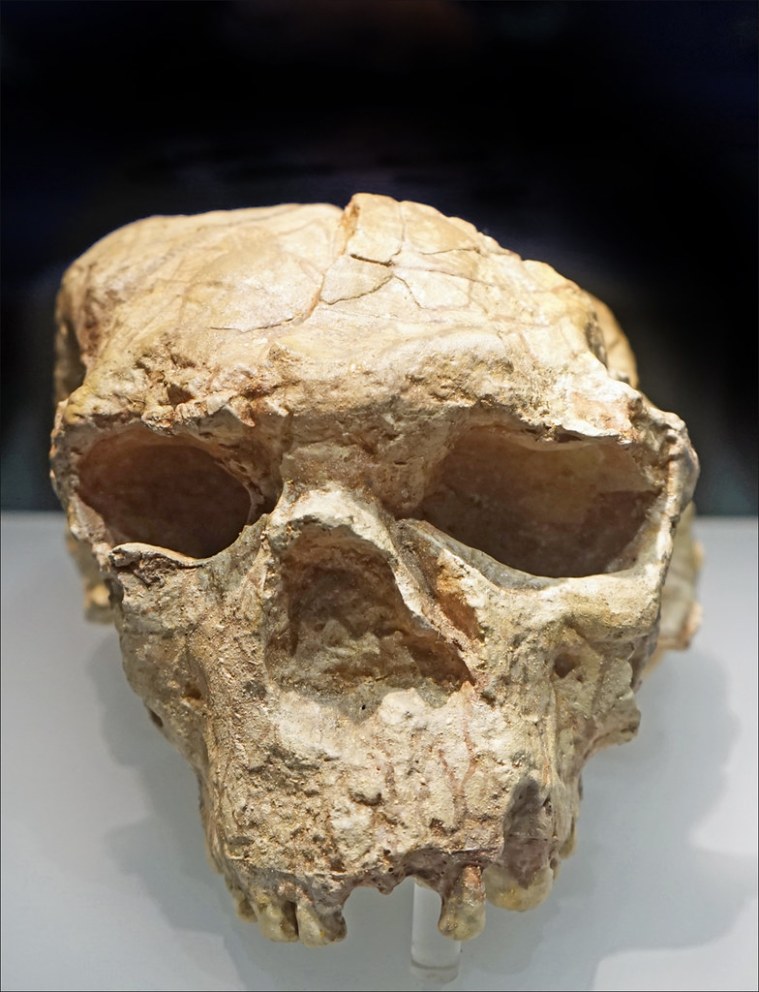
Two decades ago the world of palaeoanthropologists was in turmoil with the publication of an account of a new find in Chad (see: Bonanza time for Bonzo; July 2002). A fossil cranium, dubbed Sahelanthropus tchadensis (nicknamed Toumaï or ‘hope of life’ in the Goran language), appeared like a cross between a chimpanzee and an australopithecine. The turmoil erupted partly because of its age: Upper Miocene, around 7 Ma old. Such an antiquity was difficult to reconcile with the then accepted ~5 Ma estimate for the evolutionary split between humans and chimpanzees, based on applying a ‘molecular clock’ approach to the difference between their mtDNA. The other point of contention was the size of Sahelanthropus’s canine teeth: far too large for australopithecines and humans, but more appropriate for a gorilla or chimp.
Cast of the reconstructed skull of Sahelanthropus tchadensis. (Credit: Didier Descouens, University of Toulouse)
In the absence of pelvic- and foot bones, or signs of the foramen magnum where the spinal cord enters the skull – crucial in distinguishing habitual bipedalism or being an obligate quadruped – encouraged the finders of a 6.1 to 5.7 Ma-old Kenyan hominin Orrorin tugenensis to insist that its skeletal remains – several teeth, fragments of a lower jaw, a thigh bone, an upper arm and of a finger and thumb but no cranial bones – were of ‘the earliest human ancestor’. In Orrorin’s favour were smaller canine teeth than those of later australopithecines. At the time of the dispute, centred mainly on absence of crucial evidence, doyen of hominin fossils Bernard Wood of George Washington University and an advocate of ‘untidy’ evolution, suggested that both early species may well have been evolutionary ‘dead ends’ (see: A considered view; October 2002). And there the ‘muddle’ has rested for 20 years.
In 2002 not only a cranium of Sahelanthropus had been unearthed. Three lower jaw bones and a collection of teeth suggested that as many as 5 individuals had been fossilised. A partial leg bone (femur) and three from forearms (ulna) cannot definitely be ascribed to Sahelanthropus but, in the absence of evidence of any other putative hominin species, they may well be. It has taken two decades for these remains to be analysed to a standard acceptable to peer review (Daver, G. et al. 2022. Postcranial evidence of late Miocene hominin bipedalism in Chad. Nature v. 608, published online; DOI: 10.1038/s41586-022-04901-z). The authors present convoluted anatomical evidence that Toumaï’s femur, which had been gnawed by a porcupine and lacks joints at both ends, suggesting that it was indeed suited to upright walking. Yet the arm bones hint that it may have been equally comfortable in tree canopies. Yet it does look very like an ape rather than a hominin.
Much the same conclusion has been applied to Australopithecus afarensis, indeed its celebrated representative ‘Lucy’ met her end through falling out of a large tree ~3.2 Ma ago (see: Lucy: the australopithecine who fell to Earth?; September 2016). So, dual habitats may have been adopted by hominins long after they emerged. Yet Au afarensis was capable of trudging through mud as witnessed by the famous footprints at Laetoli in Tanzania. Only around 3 Ma has reasonably convincing evidence for upright walking similar to ours been discovered in Au africanus. The full package of signs from pelvis and foot for habitual bipedalism dates to 2 Ma ago in Au sediba. Even this latest known australopithecine seems to have had a gait oddly different from that of members of the genus Homo.
So, in many respects the benefits of full freeing of the hands to develop manipulation of objects, as first suggested by Freidrich Engels, may have had to await the appearance of early humans. Earlier hominins almost certainly did make tools of a kind, but the revolutionary breakthrough associated with humanity was more than 5 million years in the making.
The Sterkfontein cave 40 km northwest of Johannesburg in South Africa first sprang to the attention of scientists in 1936, with the discovery there of an adult hominin skull. This showed clear affinities with the discovery 400 km to the SW in 1924 of the fossil skull of a juvenile primate, which Raymond Dart claimed to be ancestral to modern humans, naming it Australopithecus africanus. Sterkfontein has since yielded more than 500 hominin fossils, many of which are Au. africanus.
Limestone cave deposits are difficult to date precisely, unlike sediments that are interbedded with volcanic rocks, the most amenable material being that deposited by water flowing through the cave to form flowstone or speleothem. Using the U-Pb method of radiometric dating yielded an age of between 2.1 to 2.6 Ma for flowstone that cements the breccia in which the Au. africanus fossils occur. Clearly, the flowstone formed after burial so that was a minimum age for them, awaiting the use of a different chronological tool to suggest when burial of the bones took place
The face of an Australopithecus africanus: ‘Mrs Ples’. (Credit University of Zurich)
An almost complete skeleton of another australopithecine found in another part of the Sterkfontein cave system was dated in 2015 by a different approach. This used the decay of 10Be and 26Al isotopes that high-energy cosmic rays produce in quartz grains while they are exposed at the surface. Burial of irradiated sedimentary grains protects them from such bombardment, and the two isotopes then steadily decay at a known rate. Quartz grains associated with this specimen (fondly known as ‘Little Foot’) turned out to be far older than the flowstone U-Pb age, with a cosmogenic burial age of about 3.7 Ma. Its much greater antiquity prompted scientists to regard ‘Little Foot’ as a different species – Au. prometheus – despite being similar to Au. africanus.
Since that success, much the same team from South Africa, the US and France has been working on sedimentary grains buried with the abundant Au. africanus specimens from Sterkfontein (Granger D.E. et al. 2022. Cosmogenic nuclide dating of Australopithecus at Sterkfontein, South Africa. Proceedings of the National Academy of Sciences, v. 119, article e2123516119; DOI: 10.1073/pnas.2123516119). Their newly published efforts show that “Little Foot’s” burial took place between 3.41 and 3.49 Ma, more than a million years earlier than suggested by the flowstone U-Pb dating and just ~200 ka younger than the ‘Little Foot’ skeleton. More surprising is that Au. africanus lived during the same period (3.4 to 3.7 Ma) as did Au. afarensis – the species to which ‘Lucy’ belonged – 3500 km to the north in Ethiopia.
So it is no longer justifiable to suggest that the first known human species (Homo habilis ~2.3 to 1.65 M) is either a more ‘advanced’ australopithecine or a direct descendant from that genus, for the new dating opens a million-year gap in the history of human evolution. That age range does contain stone tools but no plausible candidates for an australopithecine-human evolutionary connection. One of the most recently suggested link is Au. sediba (see: Another candidate for earliest, direct human ancestor, October 2011; and Australopithecus sediba: is she or is she not a human ancestor? April 2013). The snag with that candidate is that the well-established age (2.0 Ma) of known specimens falls in the middle of the range for H. habilis. The two may have been cohabiters of Africa but are very different.
The million years that separated Au. africanus together with afarensis from H. habilis is the period when the defining character of humans, tool making, evolved. So the hunt is on for hominins associated with stone tools in that huge stratigraphic gap. One of the drawbacks with famous sites, such as the ‘Cradle of Humankind’ that includes Sterkfontein, is that they almost become clichés so that scientists return to them again and again, while the key that they seek may well lie elsewhere.
We know that when anatomically modern humans (AMH) arrived in Asia they shared the landscape with ‘archaic’ humans that had a much longer pedigree. In 2010 an individual’s little-finger bone dated to around 30 to 49 ka old was found in the Denisova Cave in central Siberia (at 50°N). It yielded a full genome that was distinctly different from those of AMH and Neanderthals (see: Other rich hominin pickings; May 2010). Four other fossils found subsequently in the Denisova Cave contained similar DNA. Checking the DNA of living humans and fossil Neanderthal remains revealed that the newly discovered human group had interbred with both. In the case of AMH, segments of Denisovan DNA are found in the genomes of indigenous people living in East and South Asia, Australia, the Pacific Islands and the Americas, at levels of 0.2%, rising to 6% in Melanesian people of Papua-New Guinea. But such introgressions have not been found in Europeans (but see below), suggesting that the Denisovans were restricted to Asia.
There have been suggestions that at least some of the ‘archaic’ human remains found widely and abundantly in China may have been Denisovans; although they might equally be of Homo erectus. But none of the Chinese fossils have been subjected to gene sequencing – those found in caves outside tropical and sub-tropical climates might retain DNA just as well as Neanderthal and even older remains in temperate Europe. Yet a partial lower jaw discovered in a cave on the Tibetan Plateau (at 35°N) did yield proteins that had close affinities to those recovered from Siberian Denisovans. Now similar analyses have been performed on an abnormally large molar found in a cave in Northern Laos, showing that it too is most likely to be from a young (as suggested by its being little worn), possibly female (it lacks male-specific peptides), Denisovan. The locality lies at about 20°N, far to the south of the other two Denisovan sites (Demeter, F. et al. A Middle Pleistocene Denisovan molar from the Annamite Chain of northern Laos. Nature Communications, v. 13, article 2557; DOI: 10.1038/s41467-022-29923-z). Sparse as the evidence is, Denisovans were able to tolerate climate differences across 30 degrees of latitude.
A probable Denisovan molar from 164 to 131 ka old cave sediments in northern Laos. (credit: Demeter, et al.; Fig. 2)
The Wikipedia entry for Denisovans is a mine of additional information. For instance, detailed analysis of the roughly 5% of their genome that indigenous people of New Guinea carry suggests that the two groups may have interbred there as late as 30 ka. Since Both New Guinea and Australia were until 8 thousand years ago part of the Sahul landmass when sea level was low during the last ice age, these inferences add tropical occupancy to the Denisovan range. Does this suggest that Papuans and indigenous Australians migrated with Denisovans, or had the latter crossed the sea from Timor earlier and independently, after moving from Asia by ‘hopping’ from island to island through eastern Indonesia? There is a possibility that Denisovans could even have survived in Sahul until as late as 14.5 ka. Even more odd, modern Icelandic people are unique among Europeans in having detectable traces of Denisovan DNA. However, rather than having been directly shared between Denisovans and ancestral Scandinavians – a possibility – it may have been carried by Neanderthal-Denisovan hybrids migrating westwards from Siberia with whom the Icelanders’ ancestors interbred. There are other interesting points in the Wikipedia entry. One is that the consistently lower Denisovan ancestry in living East Asians compared with people of Oceania, may indicate two separate waves of eastward migration by AMH. The latter may have arrived first, had greater contact with Denisovans and then moved on across seaways to remain isolated from the later migrants.
Finally, something that puzzles me as a non-geneticist. If both Denisovans and Neanderthals died out as genetically distinct groups tens of millennia ago how could the genetic traces of interbreeding with AMH have been retained at such high levels until the present; i.e. through thousands of generations? Each of us carries a 50% deal of genes from our parents. Then with each subsequent generation the proportion is diluted, so that we inherit 25% from grandparents, 12.5 % from great-grandparents and so on. Yet Papuans still have 5 to 6 percent of Denisovan DNA: much the same holds for Europeans’ Neanderthal heritage. Does such a high level of retention of this ancestry suggest that a large proportion of the earliest migrating AMH individuals stemmed from generation to generation interbreeding on a massive scale? Did the ‘newcomers’ and ‘locals’ band eventually together almost completely to merge genetically, or am I missing something … ? Probably
The cave of Grotte Mandrin in the Rhône Valley, France. (Credit: Slimak et al Fig 1c)
Since 1999 a cave (Grotte Mandrin) on the west flank of the lower Rhône valley in sothern France has been revealing archaeological remains from 3 metres of sediment that can be divided into 12 distinct layers (Slimak, L. and 22 others 2022. Modern human incursion into Neanderthal territories 54,000 years ago at Mandrin, France. Science Advances, v. 8, article eabj9496; DOI: 10.1126/sciadv.abj9496). Tens of thousands of objects have been recovered, mostly from a layer just below midway in the sequence, which is dominated by small (<1 cm), ‘standardised’ stone points that are also found at other sites in the local area. This veritable industry – dubbed the ‘Neronian’ from the nearby Grotte de Néron – seems to have been focussed hereabouts. Older artefacts in layers F and G are considered to be Mousterian, that is generally ascribed to late Neanderthals. Horse, bison and deer bones suggest that these were the main source of animal protein for the cave’s occupants. The site also contained a few objects that show simple decoration. The way in which the Neronian points were produced resembles the working of similar artefacts in Lebanon by anatomically modern humans (AMH) about 45 ka ago; so it is possible that the technology had spread westward with the earliest AMH migrants into Europe. Yet precise radiocarbon and optically stimulated luminescence dating of the Grotte Mandrin site suggests that the sediment accumulated between 84 to 44 thousand years ago. The Mousterian/Neanderthal objects occur in layers F and G between 79 and 57 ka, whereas the Neronian layer E spans 56.8 to 51.7.
Grotte Mandrin has yielded very few hominin remains, except for 9 teeth in layers C to G. Those from C, D, F and G showed clear Neanderthal dental features. However, shape analysis of one damaged, deciduous (infant) molar from Layer E suggests that it matches Upper Pleistocene AMH dental morphology. That seems to place Grotte Mandrin as by far the oldest AMH occupation site in Europe, up 11 thousand years earlier than the 45 to 43 ka AMH site at Bacho Kiro in Bulgaria. To some extent that tallies with the tiny tooth’s association with a prolific, standardised and delicate industry new to the area: probably points for small projectiles. Neanderthals re-occupied the site in Layers D to B, yet in the upper part of layer B, from 44.1 to 41.5, there is a return of Neronian-like points, probably made by AMH.
A curious detail from layer E (not reported in this paper) is the occurrence of soot trapped in thin, annually deposited layers of carbonate on the cave walls. Fragments of the sooty speleothem continually fell onto the cave floor to be incorporated into the sediments. The base of layer E that contains Neronian, possibly AMH artefacts and the top of layer F that shows preceding Neanderthal occupation, contain such sooty speleothem fragments. Precise dating of them is claimed to suggest a very short period of transition between the two kinds of occupants: perhaps only a few years. Neanderthals and AMH may not have met in the cave, but may well have been co-occupants of the surrounding area at the same time.
A great deal of effort over more than two decades has gone into this publication, and several of its findings have caused quite a stir. Because permanent AMH occupation of the Levant began at least 55 ka ago, there is no reason to suppose that AMH migrating along the northern shores of the Mediterranean could not have arrived a little earlier in what is now southern France. What has been emphasised in the broad media is the exchange of a Neanderthal to an AMH population in the Grotte Mandrin, as if it was done in a friendly, indeed neighbourly spirit (!). That hinges on the ultra-precise dating of the sooty speleothem fragments to reveal just a few years between the Neanderthals doing a ‘flit’ and the AMH starting a ‘squat’ in the vacant premises to set up a cottage industry. The time of the replacement before present is, in fact, very close to the limit at which radiocarbon dating is feasible, almost all 14C formed at that time having decayed away since then. There can be no doubt that layer E did mark a major change in sophistication of stone technology, but was it really an AMH development? The only definite evidence is the single deciduous molar, and that is damaged to such an extent that an independent dental paleoanthropologist who has specialised in distinguishing AMH from Neanderthal dentition isn’t convinced. But,surely, DNA from the tooth would resolve the issue. The paper notes that trial extraction and sequencing of 6 horse teeth from layer E failed to yield results, which suggests degradation of genetic teril. So the team did not commit the tooth to sequencing, which would have further damaged it. Finally, four separate groups occupying what certainly looks like a nice little cave over the course of about 40 thousand years is hardly a surprise. Many caves throughout Europe and southern Africa show evidence of multiple occupancy. After all, before 11 ka all humans and their forebears were of necessity foragers and migrants; just think of how many times your neighbours have changed since you moved in …
People assigned to a variety of human species: Homo sapiens – H. neanderthalensis (Swanscombe, 400 ka and several later times ) H heidelbergensis (Boxgrove, ca 500 ka, )H. antecessor (Happisburgh, ca 950 ka) – have left signs of their presence in Britain. Human occupancy has largely depended on climate. Around 9 times since the first known human presence here, much of Britain was repeatedly buried by glacial ice to become a frigid desert for tens of thousands of years. Between 180 and 60 ka only a couple of flint artefacts found in road excavations in Kent hint at Neanderthal visitors. For most of the Late Pleistocene the archipelago seems to have been devoid of humans. Arguably, Europe’s first known anatomically modern humans occupied several caves in Devon, Derbyshire and South Wales as early as around 43 ka, while climate was cooling, only to abandon Britain during the Last Glacial Maximum (24 to 18 ka ago). As climate warmed again thereafter, sporadic occupation by Late Palaeolithic hunter-gatherers occurred up to the sudden onset of the frigid Younger Dryas (12.9 ka). Once warming returned quickly 11,700 years ago, sea level was low enough for game and hunter gatherers to migrate to Britain; this time for permanent occupancy. Bones of the earliest known of these Mesolithic people have yielded DNA and a surprise: they were dark skinned and so far as we can tell remained so until the beginning of Neolithic farming in Britain around 6100 years ago. The DNA of most living Britons with pale skins retains up to 10% of inheritance from these original hunter gatherers. Much the same is known from elsewhere in NW Europe. In the early Holocene it was possible to walk across what is now the southern North Sea thanks to Doggerland. Following a tsunami at around 8.2 ka this rich area of wetland vanished, so that all later migration demanded sea journeys.
Mesolithic people remained in occupation of the British Isles for another two millennia. A wealth of evidence, summarised nicely in Ray, K. & Thomas, J. 2018, Neolithic Britain, Oxford University Press, suggests that there was a lengthy period of overlap between Mesolithic and Neolithic occupation around 4100 BCE. The main difference between the two groups was that Neolithic communities subsisted on domesticated grains and animals, while those of the Mesolithic consumed wild resources. Cultural clues in archaeological finds, however, suggest a lot in common, such as the erection of various kinds of monuments. Posts of tree trunks, sometimes arranged in lines, were raised in the Mesolithic and lines of probably ritual pits were dug. Both ‘traditions’ continued into the Neolithic and evolved to stone monuments, to which were added burials of different kinds. It is worth noting that Stonehenge was developed on a site that held much earlier, large totem-pole like posts, with a nearby spring that had hosted regular gatherings of Mesolithic people. Signs of Mesolithic occupation in Britain extend just as widely as do those of Neolithic practices. A study of DNA from 7 Mesolithic skeletons and 67 of early Neolithic age (Brace, S. and 20 others 2019. Population Replacement in Early Neolithic Britain. Nature Ecology & Evolution, v. 3, p. 765-771; DOI: 10.1038/s41559-019-0871-9) revealed that early Neolithic people did not wipe out the genetic make-up (either by complete displacement or annihilation) of their predecessors. About 20 to 30% of Neolithic DNA was inherited from them; as would be expected from assimilation of a probably much smaller number of hunter-gatherers into a larger population of immigrants who brought farming and herding from Asian Turkey (Anatolia). Such ‘hybrid’ genetics was widespread in Europe and they are referred to as the Early European Farmers (EEF). As Ray and Thomas suggest, aspects of Mesolithic culture may have been adopted by the newcomers across the British Isles from Orkney to Wiltshire.
Around 2400 BCE the earliest Neolithic ceremonial site at Brodgar on Orkney was destroyed to the accompaniment of an enormous feast that consumed several hundred cattle. At about the same time several men, whose tooth geochemistry indicated an origin in the European Alps, were buried on Salisbury Plain together with the earliest metal artefacts known from Britain (copper knives), the accoutrements of archery and distinctive, bell-shaped pottery beakers. Stonehenge was ‘remodelled’ shortly afterwards, with the addition of its giant trilithons, four of which were later adorned with carvings of metal axes and daggers. The Early Bronze (or Chalcolithic) Age had arrived! A 2018 study of ancient DNA from Bronze Age burials in Europe suggested a far more drastic swamping of Neolithic genetic heritage by the ‘Beaker people’ (Olalde, I. and a great many others 2018. The Beaker phenomenon and the genomic transformation of northwest Europe. Nature, v. 555, p. 190-196; DOI: 10.1038/nature25738). The skeletons from Britain analysed by Olalde et al. apparently suggested that, within a few hundred years, up to 90% of the Neolithic gene pool had been removed from the British population. Who were these people who used metals and the distinctive Bell Beakers, where did they come from and what did they do?
The closest match to the British and western European Bronze Age DNA was that associated with the Yamnaya people from the steppes of SE Ukraine and Southern Russia who had developed a culture centred on herding. They had also adopted the wheel from people of the Mesopotamian plains and had domesticated the horse for riding and pulling carts: ideal for their semi-nomadic lifestyle and for moving en masse. After 3000 BCE they spread into Europe, as widely recorded by their distinctive beakers and the presence of their DNA in the genomes of later Europeans. Their burials – in ‘kurgans’ – resembled the round barrows that appeared on Salisbury Plain and elsewhere during the Bronze Age. The DNA replacement data from 2018 were limited and held few clues to how it happened. One possibility for such a dramatic change could be a violent takeover that drove down the population of British Neolithic people. To address the broader influence of migration in more detail and over a loner time span, a team led by the Universities of York and Vienna, and Harvard Medical School (Patterson, N. and a great many others 2021. Large-scale migration into Britain during the Middle to Late Bronze Age. Nature, early online release; DOI: 10.1038/s41586-021-04287-4) used ancient DNA from 793 individuals excavated in Britain (416 individuals) and continental Europe (377) from Bronze- to Iron Age sites (2300 to ~100 BCE).
The proportion of Early European Farmers DNA in British individuals from the Bronze Age (2400 BCE) to the Iron Age (750 BCE to 43 CE). Note the ‘fuzzy’ nature of the data, and that the decline in EEF in British individuals was not as great as earlier analyses had shown. Remarkably, the ‘Amesbury Archer’, who brought the first metals to Britain, had a higher proportion of EEF ancestry than the Early Bronze-Age average. (Credit: Patterson et al. Fig. 3)
The new data from Britain suggest that the migrants, who crossed the Channel later in the Bronze Age, were of mixed ethnicity, but most carried EEF genes. The influence of earlier migrants from the Yamnaya heartlands is present, but so too are relics of Mesolithic ancestry. Interestingly, the British data show a much larger increase in the genes associated with lactase persistence, which marks the ability of adults to digest milk, than was apparent in the wider European population (50% compared with about 7% in Eastern Europeans of the time). Whatever the impact of the first influx of metal-using people – it may have been culturally decisive in Britain – by the end of the Bronze Age the EEF ‘signature’ had increased in peoples’ genomes. Rather than some kind of invasion, the influx was more likely to have been a sustained movement of people to Britain over several hundred years By the Iron Age, almost half the ancestry of Britain, particularly in England and Wales, was once again predominantly of EEF origin (around 40% of the mixture), but culture had become completely different. There are even suggestions that the influx brought with it the beginnings of Celtic languages. Yet the data leave a great deal of further analysis to be undertaken.
In 2015 the remains of about 15 hominins, new to science, were found in a near-inaccessible South African cave (See: The ‘star’ hominin of South Africa; September 2015), that number having risen to more than 24 at the time of writing. The ‘star’ status of Homo naledi (named after the cave’s name Naledi meaning star in the local Sotho language) arose partly from an extraordinary barrage of promotion by the organisers of the expedition that unearthed them (probably to boost fundraising). But it was indeed one of the most extraordinary discoveries in palaeoanthropology. The remains were recovered by a team of women archaeologists who small and lithe enough to wriggle through a maze of extremely narrow cave passages. The bones in the remote chamber were complete, with no sign of physical trauma, except gnawing by snails and beetles. Few hominin fossils were found in the more accessible parts of the cave. One likely explanation was that a living H. naledi group had deliberately carried the bodies through the cave system for burial – at less than 1.5 m tall with a slender build they could have done this far more easily than the modern excavators. A plausible alternative is that a group of H. naledi scrambled deep into the cave on being panicked by large predators, and suffocated as CO2 built-up to toxic levels.
Map of the Rising Star cave system in Gautong Province South Africa. The yellow dot marks the chamber where Homo naledi fossils were first found; the red one is the site of a new discovery. (Credit: Elliott et al 2021, PaleoAnthropology. Issue 1.64, Fig. 1)
Initially, the bones were estimated to be 2 Ma old. The fossils are so well-preserved that most aspects of their functional anatomy are known in great detail, such as the articulation of their hands and feet. Although not a single tool was found in the cave deposit, to get into the far reaches of the labyrinthine cave system they must have lit the way with firebrands. The anatomy of H. naledi is far more advanced than that of contemporary H. habilis. The discoverers speculated that the group may have been a species that gave direct rise to the later H. ergaster and erectus, and ultimately us. Alternatively, the individuals’ diminutive size suggested parallels with much later H. floresiensis and H. luzonensis from the other side of the world. Much of this hype was later blunted by more reliable geochronology indicating an age of between 236 ka and 335 ka: i.e. about the time when anatomically modern humans were already roaming Africa. A more plausible conclusion, therefore, is that H. naledi was one of at least 6 hominin groups that co-occupied the late-Pleistocene world: i.e. similar to H. floresiensis.
Now the partial skull and half a dozen teeth of an immature H. naledi has been recovered from another remote chamber in the cave system (Brophy, J.K. et al. 2021. Immature Hominin Craniodental Remains From a New Locality in the Rising Star Cave System, South Africa. PaleoAnthropology. Issue 1.64; DOI: 10.48738/2021.iss1.64). Fossils of young humans are rare, their bones being thinner and much more fragile than those of adults, so the skull had to be reconstructed from 28 fragments. Unlike the older individuals from the main chamber, there are no other bones associated with the skull. Oddly, the supposedly young H. naledi’s brain volume (between 480 to 610 cm3) is between 90 to 95 % that of adults. A possible explanation for this degree of similarity is that these beings reached maturity far more quickly than do anatomically modern humans. The evidence for youth is based on close dental similarity with those of other ‘immature’ specimens from the main bone deposit, and most importantly that two of the teeth are demed to be deciduous (‘milk’) teeth. Yet the ‘milk’ teeth show severely chipped enamel as do the permanent teeth of more mature specimens, to the extent of being unique in the fossil record of hominins. Clearly, their diet was sand-rich.
Shortly after publication in the journal PaleoAnthropology during early November 2021 the world’s media leapt on the two papers rorting these new finds. Yet it is hard to judge why it was deemed by science journalists to have truly popular appeal. It actually adds very little to the H. naledi story, apart from specialised anatomical description. Despite the skull being bereft of the rest of the individual’s body, the authors ‘…regard it as likely that some hominin agency was involved in the deposition of the cranial material’. Perhaps the ‘star’ status was rekindled because the press release from the University of the Witwatersrand used the word ‘child’ again and again – a sure fire way of getting wide attention. The published papers properly refers to it as an ‘immature hominin individual’, which it undoubtedly is. The same sort of attention came the way of Raymond Dart from a small skull of Australopithecus africanus found in 1924 by workers in a limestone quarry – he called it ‘the Taung Child’. Of course, H. naledi is one of the best-preserved hominins known. But how does its current newsworthiness rank above H. floresiensis? Now, that was a surprise, but the hype about that tiny human has died down. And when H. naledi was originally deemed to be 2 Ma old, it too was astonishing. But since its true, quite young age was determined, it too is no longer such a big deal.
Interestingly, South African scientists self-proclaimed the name ‘Cradle of Humankind’ for the area in Gautung Province close to Johannesburg, which is rich in limestone caves and has a long history of fossil hominin discoveries since Raymond Dart’s Taung Child. But the earliest anatomically modern human remains are from Jebel Irhoud in Morocco, and the oldest known hominin fossils are from Chad, and most advances in early hominin evolution have stemmed from Ethiopia, Kenya and Tanzania. The fossiliferous part of Gautung Province rightly has World Heritage status, but not under that name. Instead it is called more accurately ‘Fossil Hominid Sites of South Africa”
Earth-logs has previously covered quite a few hypotheses involving catastrophic astronomical events of the past, often returning to them as new data and ideas emerge. They range from giant impacts, exemplified in the mass extinction at the K-Pg boundary to smaller-scale events that may have coincided with important changes in climate, such as the sudden onset of the Younger Dryas, and a few that have been suggested as agencies affecting local human populations such as the demise of Sodom by a cosmogenic air-burst. Some of the papers that spurred the Earth-pages posts have been widely regarded in the geoscience community. Yet there have been others that many have doubted, and even condemned. For instance, data used by the consortium that suggested an extraterrestrial event triggered the frigid millennium of the Younger Dryas (YD) have been seriously and widely questioned. A sizeable number of the team that were under close scrutiny in 2008 joined others in 2019 to back the YD air-burst hypothesis again, using similarly ‘persuasive’ data from Chile. Members of the original consortium of academics also contributed to the widely disputed notion of a cosmic air-burst having destroyed a Bronze Age urban centre in Jordan that may, or may not, have been the site of the Biblical Sodom. Again, they cited almost the ‘full monty’ of data for high-energy astronomical events, but again no crater or substantial melt glass, apart from tiny spherules. Now another paper on much the same theme, but none of whose authors contributed to those based on possibly ‘dodgy’ data, has appeared in Geology (Schultz, P.H. et al. 2021. Widespread glasses generated by cometary fireballs during the Late Pleistocene in the Atacama Desert, Chile. Geology, published online November 2, 2021; doi: 10.1130/G49426.1).
Peter Schultz of Brown University, USA and colleagues from the US and Chile make no dramatic claims for death and destruction or climate destabilisation, and simply report a fascinating discovery. In 2012 one of the authors, Nicolas Blanco of the Universidad Santo Tomás in Santiago, Chile, found slabs made of glassy material up to half a metre across. They occurred in several 1 to 3 km2 patches over a wide area of the Atacama Desert. Resting on Pleistocene glacio-fluvial sediments, they had been exposed by wind erosion of active sand dunes. The glass is dark green to brown and had been folded while still molten. For the glass slabs to be volcanic bombs presupposes a nearby volcano, but although Chile does have volcanoes none of the active vents are close enough to have flung such large lumps of lava into the glass-strewn area. The glassy material also contains traces of vegetation, and varies a great deal in colour (brown to green). Its bulk chemical composition suggests melting of a wide variety of surface materials: quite unlike volcanic glasses.
Chilean glass occurrence: panorama of large glass fragments in the Atacama Desert; a specimen of the glass; thin section of glass showing bubbles and dusty particles (Credit: Schultz et al. 2021; Figs 1B, 2D and 2C)
Microscopic examination of thin sections of the glasses also reveals nothing resembling lava, except for gas bubbles. The slabs are full of exotic fragments, some of which closely resemble mineral assemblages found in meteorites, including nickel-rich sulfides embedded in ultramafic material. Others are calcium-, aluminium- and titanium-rich inclusions, such as corundum (Al2O3) and perovskite (CaTiO3), thought to have originated as very-high temperature condensates from the pre-solar nebula: like the celebrated ‘white inclusions’ in the Allende meteorite. Some minute grains resemble dust particles recovered by the NASA Stardust mission to Comet 81P/Wild-2 which returned samples to Earth in 2006. Zircon grains in the glasses, presumed to be locally derived, have been decomposed to zirconium oxide (baddeleyite), suggesting melting temperatures greater than 1670°C: far above the highest temperature found in lavas (~1200°C). Interestingly, the green-yellow silica glass strewn over the Sahara Desert around the southern Egypt-Libya border also contains baddeleyite and cometary dusts, together with anomalously high platinum-group elements and nanodiamonds that are not reported from the Chilean glass. Much prized by the elite of pharaonic Egypt and earlier makers of stone tools, the Saharan glass is ascribed to shock heating of the desert surface by a cometary nucleus that exploded over the Sahara. Unsurprisingly, Schultz et al. come to the same conclusion.
Any object entering the Earth’s atmosphere does so at speeds in excess of our planet’s escape velocity (11.2 km s-1). Not only does that result in heating by friction with the air, but much of the kinetic energy of hypersonic entry goes into compressing air through shock waves, especially with objects larger than a few tens of metres. Such adiabatic compression can produce temperatures >>10 thousand °C. Hence the ‘fireballs’ associated with large meteorites. With very large air-bursts the flash of radiant energy would be sufficient to completely melt surface materials in microseconds, though rugged topography could protect areas shadowed from the air-burst by mountains, perhaps explaining the patchy nature of the glass occurrences. (Note: the aforementioned papers on the YD and Sodom ‘air-bursts’ do not mention large glass fragments, whereas some surface melting would be expected). Some of the Chilean glass contains carbonised remnants of vegetation. Radiocarbon dating of four samples show that the glass formed at some time between 16.3 to 12.1 ka. Yes, that does include the age of the start of the YD (12.9 ka) and human migrants had established themselves in northern Chile and coastal Peru after 14.2 ka. Yet the authors, perhaps wisely, do no more than mention the coincidence, as well as that with the disappearance of South American Pleistocene megafaunas – more severe than on any other continent. With a very distinctive product, probably spanning a far larger area of South America, and attractive to humans as an ornament or a resource for sharp tools, expect follow-up articles in the future.
Palaeoanthropologists are in a bit of a muddle about the early humans of the Middle Pleistocene (~780 to 130 ka), namely Homo heidelbergensis and H. rhodesiensis. The first was defined in 1907 based on a massive lower jaw or mandible (but no cranium) found near Heidelberg in Germany. Fourteen years later a massively browed cranium (but no mandible) turned up near Kabwe in what is now Zambia (then Northern Rhodesia). That specimen became, in true colonialist fashion, H. rhodesiensis. Since then scientists have unearthed more such highly ‘robust’, ‘archaic’ remains in Africa, Asia and especially Europe: including at least 28 individuals in the Sima de los Huesos (‘pit of bones’), part of the World Heritage Site in the Atapuerca mountains of northern Spain. Do these widespread fossils really represent just two species or do specimens just happen to fit within two broadly similar morphological types? These days, most scientists experience discomfort with a reference to the legacy of Cecil Rhodes, so several sacks full of bones were metaphorically lumped into H. heidelbergensis. So widely dispersed are their sources and their ages covering such a wide span of time that the specimens might be expected contain a diverse range of genetic signatures. Yet only a single specimen from northern Spain, dated around 400 ka, has yielded DNA. The Sierra de Atapuerca provided an even more archaic European dated between 1.2 to 0.8 Ma (Early Pleistocene), from which dental proteins have been extracted. Comparative proteomics have encouraged H. antecessor to be considered as a possible common ancestor for anatomically modern humans (AMH), Neanderthals and Denisovans … and H. heidelbergensis.
A new, simplified model for the evolution of the genus Homo over the last 2 million years (Credit: Roksandic et al Fig 1)
A group of palaeoanthropologists has proposed a way to clear such muddy waters (Roksandic, M. & Radović, P. et al. 2021. Resolving the “muddle in the middle”: The case for Homo bodoensis sp. nov.. Evolutionary Anthropology, v. 30, early-release article 21929; DOI: 10.1002/evan.21929). Their device is to abolish the two previous species and lump together many human remains from the Middle Pleistocene of Africa into a new species named after the Bodo site in the Awash Valley of Ethiopia. It was there that a human cranium bearing characteristics similar to all the African specimens was found in 1976. Originally it was allocated to H. heidelbergensis, but now the composite group of archaic Middle Pleistocene Africans is proposed to be assigned to H. bodoensis. This composite species is also reckoned by the authors to be the ancestor of all surviving, anatomically modern humans. European examples of H. heidelbergensis are to be slotted into an early population of Neanderthals. Since the Denisovans of Asia are only known by DNA from tiny skeletal fragments, the taxonomic rearrangement logically should assign Asian archaic humans to early members of that mysterious but well-defined group. But a spanner in the works is that the sole example of H. heidelbergensis DNA (mitochondrial) – from northern Spain – more closely resembles Denisovans than it that of Neanderthals (see: Mitochondrial DNA from 400 thousand year old humans; Earth-logs December 2013).
There is also a bit of a problem with H. antecessor. There aren’t many specimens, and they are all from Atapuerca. Yet they are a plausible candidate, according to the proteomic analyses, for the most recent common ancestor (MRCA) of all subsequent humans (whatever taxonomists care to call them). But they do not fit in the taxonomic model suggested by Roksandic et al., who reject them as MRCA, on grounds that they are European. They consign them to an anomalous ‘spur’ that petred out in Spain while the real action was in Africa. So what happens if a cranium that bears close similarity to both H antecessor and H. bodoensis pops out of African Early Pleistocene sediments (older than about 700 ka)? There is at least one candidate from ~1 Ma sediments in Eritrea (Abbate, E. and 16 others 1998. A one-million-year-old Homo cranium from the Danakil (Afar) Depression of Eritrea. Nature, v. 393, p. 458-460; DOI: 10.1038/30954), which is said to display ‘a mixture of characters typical of H. erectus and H. sapiens’. And there are others of that antiquity from Ethiopia.
Since the time of Charles Darwin there have been taxonomists who were (and are) either habitual ‘lumpers’ or ‘splitters’. There are more with a propensity for splitting because a new species carries the name of its initiator into posterity! So I expect the paper by Roksandic et al. to raise a cloud of academic dust. Yet taxonomic lumping has its stand-out species in the field of human evolution – H. erectus. A great many ‘archaic-looking’ human remains from the period after ~1.9 Ma until as recently as 200 ka have been dubbed ‘Erects’, giving the group an unsurpassed survival span of over a million years. A few early examples from Africa have been ‘split’ away to give H. ergaster, on taxonomic grounds that some palaeoanthropologists do not fully accept. Yet there are signs of later diversity that ‘splitters’ have, so far, not dared to slice-off from the mainstream consensus. So common are these ‘Erect’ fossils in China, that it is almost state policy that it was they who gave rise to living Han Chinese people! The lumpers are likely to hold sway in the absence of ancient DNA sequencing, which may never be possible outside temperate climates or for ages greater than that of the Spanish H. antecessor. With the knowledge that several anatomically very distinct hominin groups occupied the Earth together at several times in the last 300 ka – think H. floresiensis and H. naledi – it seems likely that the proposed pan-African H. bodoensis may not reflect past reality and the hypothesis needs considerably more testing
It was Mary Leakey’s jaw-dropping discovery in the 1970s of the footprints of two adult Australopithecus afarensis and an accompanying juvenile in 3.6 Ma-old volcanic ash at Laetoli, Tanzania that provided the oldest palpable evidence of a bipedal hominin species. Just seeing a high-resolution image of this now legendary trackway made me determined to call my book on Earth and human evolution Stepping Stones: the Making of our Homeworld. Human footprints have figured several times in Earth-logs articles. A jumble of footprints in 1.0 to 0.78 Ma old Pleistocene interglacial sediments at Happisbugh on England’s Norfolk coast marks the presence there of Homo antecessor: the earliest known, northern Europeans. In The first volcanologists (March 2003) I noted the discovery of evidence that Neanderthal children played in 350 ka volcanic ash on the Roccamonfina volcano in Italy. The emotion generated by seeing such relics has never left me. Two similarly important proofs of human presence emerged in September 2021.
Footprints thought to have been made by children and teenagers between 23 and 21 thousand years ago in lake shore muds at White Sands, New Mexico. (Credit Bennett et al. 2021)
Since 2011 a variety of evidence has accumulated that the Americas began to be populated by anatomically modern humans before what had long been assumed to be the ‘first arrivals’: the Clovis people who made finely-worked stone spear points first found in 13 ka-old sediments in New Mexico. To the pre-Clovis artefacts that suggested earlier immigrations have been added indisputable signs of human presence even earlier than anticipated. They were uncovered in lake sediments beneath the gypsum sand dunes of White Sands National Park in New Mexico. The site is not far from where Robert Oppenheimer exclaimed to himself ‘Now I am become Death, the destroyer of worlds’ after he witnessed his creation, the first detonation of a nuclear weapon on 9 July 1945. These lake sediments have yielded thousands of human and animal footprints over the years, but the latest have been dated at between 23 to 21 ka (Bennett, M.R. and 13 others 2021. Evidence of humans in North America during the Last Glacial Maximum. Science, v. 373, p. 1528-1531; DOI: 10.1126/science.abg7586). As with the Happisburgh and Roccamonfina human trackways, size analysis suggests that they were made mainly by children and teenagers! Other animal trackways show that the lake edge was teeming with game at the height of the last Ice Age: abundant food for hunter-gatherers generally results in lots of free time. So maybe these early American people were having fun too. When ice sheets were at their maximum extent sea level had fallen, leaving the Bering Strait dry. The broad Beringia land-bridge made the Americas accessible from Eurasia. Whatever objections have previously been raised as regards human penetration south from Alaska during the Last Glacial Maximum, the White Sands find sweeps them away; people overcame whatever obstacles there were.
Travertine outcrop covered with hand- and footprints at Quesang on the Tibetan Plateau (Credit: Zhang et al., Fig. 1c)
Much older footprints and handprints, preserved in a biogenic carbonate (travertine) deposit from the Tibetan Plateau – more than 4,000 metres above sea level – are reported in an article soon to be published by Elsevier (Zhang, D.D. and 17 others 2021. Earliest parietal art: hominin hand and foot traces from the middle Pleistocene of Tibet, Science Bulletinv 66 online; DOI: 10.1016/j.scib.2021.09.001). Travertine forms when calcium carbonate is precipitated from lime-rich spring water onto films of algae or bacteria. At first it is soft and spongy, hardening as more carbonate is precipitated and solidifying when dried out to form a porous rock. People made a jumble of prints when they pressed their hands and feet into the originally spongy biofilm. Three-dimensional images of the slab provide the basis for interpreting how the prints were made. There are 5 handprints and 5 footprints. From comparing their sizes with modern humans’ feet and hands, it seems that the handprints were made by a single 12-year-old, and the footprints by a child of about 7. Although the travertine layer would have been steep and slippery none of the prints show signs of falling or sliding. They seem to have been deliberately placed close to one another, with suggestions that at least one thumb was wiggled. The authors argue that the prints are a form of art similar to the hand stencils commonly seen on Palaeolithic cave walls. It could be that a couple of kids took delight in leaving signs that they had been there, ‘messing around’: but still an art form. What is especially exciting is their age, between 169 and 226 ka. The children are unlikely to have been anatomically modern humans, who first reached Tibet only a little before 21 ka. One alternative is that they were Denisovans (see: Denisovan on top of the world, May 2019.