The early signs of counting and arithmetic?

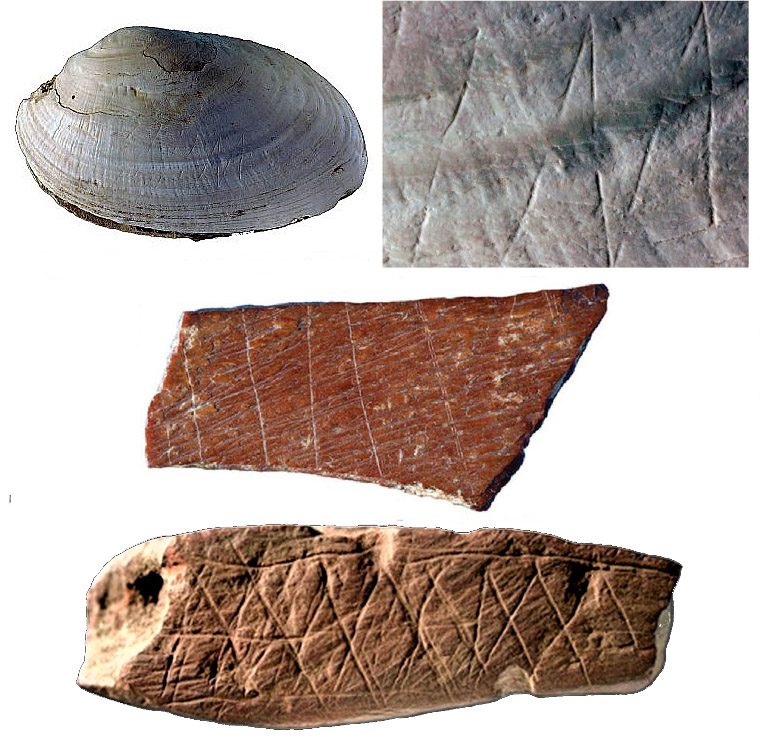
Three earlier articles in Earth-logs originally focussed on what I supposed to be ‘ancient abstract art’.  One highlighted a clam shell that bears carefully etched V-shapes found at the type locality for Asian Homo erectus at Trinil on the Solo River, Java, dated between 430 and 540 ka. Another is about parallel lines etched on a piece of defleshed bone from China dated at 78 to 123 ka, which may be a Denisovan artefact. The most complex is a piece of ochre found in the coastal Blombos Cave 300 km east of Cape Town, South Africa in association with tools ascribed to early modern humans who lived there about 73 ka ago. Fascinating as they seemed at the time, they may hold much greater significance about early-human cognitive powers than about mere decoration. That is thanks to recent evaluation of other simple artefacts made of lines and notches by anthropologists, cognitive scientists and psychologists. Their work is summarised in a recent Nature Feature by Colin Barras (Barras, C. 2021. How did Neanderthals and other ancient humans learn to count? Nature, v. 594, p. 22-25; DOI: 10.1038/d41586-021-01429-6). The European Research Council recently allocated a €10 million grant to foster research into ‘when, why and how number systems appeared and spread’.

Examples of ancient ‘abstract’ art. Top – V-shaped features inscribed on 430-540 ka freshwater clam from Java; Middle – parallel lines etched through red ochre to show white bone, from a possible Denisovan site in China; Bottom – complex inscription on a tablet of iron-rich silcrete from South Africa

Straight lines and patterns made from them are definitely deliberate, whatever their antiquity. In recent times, such devices have been used by artists to render mental images, moods and thoughts as simplified abstractions: hence ‘abstract’ art, such as that of Piet Mondrian and Kazimir Malevich. The term also applies to the dribbles and drabbles of Jackson Pollock and many more styles. But these works are a very recent evolutionary development out of earlier schools of art. So deliberate geometric shapes and arrangements of lines that are many millennia old cannot simply be termed ‘abstract art’. It is certainly not easy to see how they evolved into the magnificence of Palaeolithic figurative cave art that started at least 40 thousand years ago; Yet they are not ‘doodles’. Being so deliberate suggests that they represented something to their makers. The question is, ‘What?’

The research summarised by Barras is mainly that of Francisco d’Errico of The University of Bordeaux, France and colleagues from Canada and Italy (d’Errico, F. et al. 2018. From number sense to number symbols. An archaeological perspective. Philosophical Transactions of the Royal Society B, v. 373, article 2160518; DOI: 10.1098/rstb.2016.0518). They focused their work on two remarkable artefacts. The oldest (72 to 60 ka), from a cave near Angoulême in France, is a fragment of a hyena’s thigh bone that carries nine notches. It is associated with stone tools almost certainly made by Neandethals. The other, from the Border Cave rock shelter in KwaZulu-Natal in South Africa, is a 44 to 42 ka old baboon’s shin bone, which carries a row of 29 prominent notches, and a number of less distinct, roughly parallel scratches. The rock shelter contains remains of anatomically modern humans and a very diverse set of other artefacts that closely resemble some used by modern San people.

Top: notched hyena femur bone fragment associated with Neanderthal tools from SW France. Bottom: notched baboon shin bone from Border Cave, South Africa. Scale bars(Credit: F. d’Errica and L. Backwell)

Microscopic examination of the notches made by a Neanderthal suggest that all 9 notches were cut at the same time, using the same stone blade. Those on the Border Cave shin bone suggest that they were made using four distinctly different tools on four separate occasions. Are both objects analogous to tally sticks; i.e. to count or keep a record of things as an extension to memory? There are other known examples, such as a 30 ka-old  wolf’s radial bone from the Czech Republic having notches in groups of five, suggesting a record of counting on fingers. Yet very similar devices, made in recent times by the original people of Australia, were not used for keeping count, but to help travellers commit a verbal message to memory enabling them to recount it later.

Do read Barras’s summary and the original paper by d’Errico et al. to get an expanded notion of the arguments being debated. They emerge from the truly novel idea that just because the makers of such objects lived tens or even hundreds of thousands of years ago that doesn’t make them intellectually lacking. Imagining in the manner of Victorian scientists that ancient beings such as Neanderthals and H. erectus must have been pretty dim is akin to the prejudice of European colonialists that people of colour or with non-European cultures were somehow inferior, even non-human. To me it is admirable that the European Research Council has generously funded further research in this field at a time when research funding in the UK, especially for the disciplines involved, has been decimated by those who demanded an exit from the EU.

The older Trinil and Blombos patterns appear yet more sophisticated. The pattern on the latter looks very like the kind of thing that someone in a prison cell might draw to keep track of time. It also incorporates the zig-zag element engraved on the Trinil clam shell. Remember that the word ‘Exchequer’ is derived from a tax audit during the reign of Henry I of England that was conducted on a counting board whose surface had a checked pattern

CSI and detecting the presence of ancient humans

Enter a room, even for a few minutes, and dead skin cells will follow you like an invisible cloud to settle on exposed surfaces. Live there and a greyish white, fluffy dust builds up in every room. Even the most obsessive cleaning will not remove it, especially under a bed or on the bathroom floor. Consider a cave as a home, but one without vacuum cleaners, any kind of sanitation, paper tissues, panty liners, nappies or wet wipes. For pre-modern human dwellings can be added snot, fecal matter, sweat, urine, menstrual blood and semen among all the other detritus of living. A modern crime-scene investigator would be overwhelmed by the sheer abundance of DNA from the host of people who had once dwelt there. CSI works today as much because most homes are pretty clean and most people are fastidious about personal hygene as because of the rapidly shrinking lower limit of DNA detection of the tools at its disposal. Except, that is, when someone from outside the home commits a criminal offence: burglary, GBH, rape, murder. We have all eagerly watched ‘police operas’ and in the absence of other evidence the forensic team generally gets its perpetrator, unless they did the deed wearing a hazmat suit, mask, bootees and latex gloves.

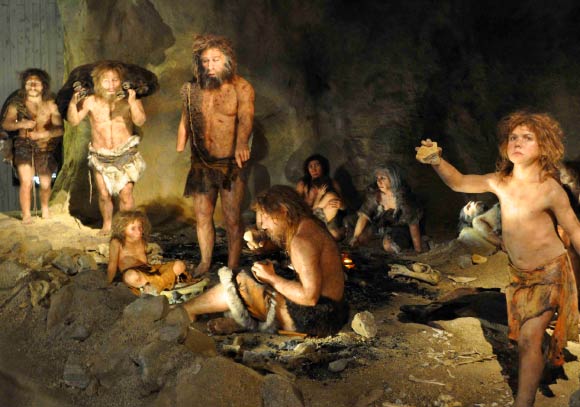
Artistic impression of Neanderthal extended-family life in a cave (credit: Tyler B. Tretsven)

Since 2015 analysis of environmental DNA from soils has begun to revolutionise the analysis of ancient ecosystems, including the living spaces of ancient humans (see: Detecting the presence of hominins in ancient soil samples, April 2017). It is no longer necessary to find tools or skeletal remains of humans to detect their former presence and work out their ancestry. DNA sequencing of soil samples, formerly discarded from archaeological sites, can now detect former human presence in a particular layer, as well as that of other animals. In many cases the ‘signal’ pervades the layer rather than occurring in a particular spot, as expected from shed skin cells and bodily fluids. The first results were promising but only revealed mitochondrial DNA. Now the technique has extended to nuclear DNA: the genome (Vernot, B. and 33 others 2021. Unearthing Neanderthal population history using nuclear and mitochondrial DNA from cave sediments. Science, v. 372, article eabf1667; DOI: 10.1126/science.abf1667). Benjamin Vernot and colleagues from 7 countries collected and analysed cave soils from three promising sites with tangible signs of ancient human occupation. Two of them were in Siberia and had previously yielded Neanderthal and Denisovan genomes from bones. The other is part of the Atapuerca cave complex of NW Spain that had not. The Russian caves yielded DNA from more than 60 samples, 30 being nuclear DNA consistent with that from actual Neanderthal and Denisovan bones found in the caves. Galería de las Estatuas cave in Spain presented a soil profile spanning about 40 thousand years from 112 to 70 ka.

Teasing-out nuclear DNA from soil is complicated, from both technical and theoretical standpoints. So being able to match genomes from soil and bone samples in the Russian caves validated the methodology. The Spanish samples could then be treated with confidence. Galería de las Estatuas revealed the presence of Neanderthals throughout its 40 ka soil profile, but also a surprise. The older DNA was sufficiently distinct from that from later levels to suggest that two different populations had used the cave as a home, the original occupants being replaced by another genetically different group around 100 to 115 ka ago. The earlier affinity was with the ancestors of sequenced Neanderthal remains from Belgium, the later with those from Croatia. That time is at the end of the last (Eemian) interglacial episode, so one possibility is a population change driven by climatic deterioration. This success is sure to encourage other re-examinations of caves all over the place. That is, if there is the analyical capacity to perform such painstaking work in greater volume and at greater pace. Like many other palaeo-genomic studies, this one has relied heavily on the analytical facilities pioneered and developed by Svante Paäbo at the Max Planck Institute for Evolutionary Anthropology in Leipzig, Germany. Covid has forced genetics to the front page for a year and more. And it has led to many advances in anlytical techniques, particularly in their speed. It would nice to think that a dreadful experience may end-up with positive benefits for understanding the full history of humanity.

Relationships between modern humans and Neanderthals

Before 40 thousand years (ka) ago Europe was co-occupied by Neanderthals and anatomically modern humans (AMH) for between five to seven thousand years; about 350 generations – as long as the time since farming began in Neolithic Britain to the present day. Populations of both groups were probably low given their dependence on hunting and foraging during a period significantly colder than it is now. Crude estimates suggest between 3,000 to 12,000 individuals in each group; equivalent to the attendance at a single English Football League 2 match on a Covid-free winter Saturday afternoon. Moving around Europe south of say 55°N, their potential range would have been around 5 million square kilometres, which very roughly suggests that population density would be one person for every 200 km2. That they would have moved around in bands of, say, 10 to 25 might seem to suggest that encounters were very infrequent. Yet a hybrid Neanderthal-Denisovan female found in Siberia yielded DNA that suggested a family connection with Croatia, 5,000 km away (see: Neanderthal Mum meets Denisovan Dad, August 2018); early humans moved far and wide.

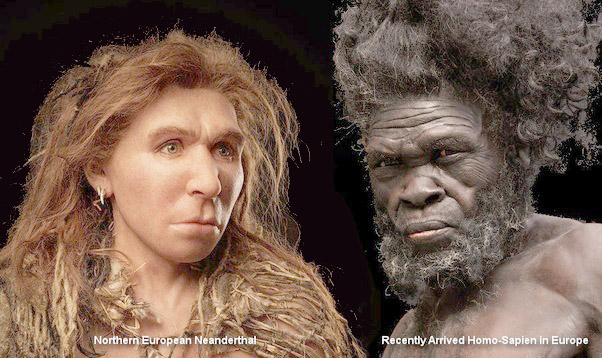
The likely appearances of Neanderthals and anatomically modern humans when they first met between 50 and 40 thousand years ago. (Credit: Jason Ford, New York University)

A sparsely populated land can be wandered through with little fear other than those of predators, sparse resources or harsh climate and lack of shelter. But it still seems incredible for there to have been regular meetings with other bands. But that view leaves out knowledge of good places to camp, hunt and forage that assure shelter, water, game and so forth, and how to get to them – a central part of hunter-gatherers’ livelihoods. There would have been a limited number of such refuges, considerably increasing chances of meeting. Whatever the physiognomic differences between AMH and Neaderthals, and they weren’t very striking, meeting up of bands of both human groups at a comfortable campsite would be cause for relief, celebration, exchanges of knowledge and perhaps individuals of one group to partner members of the other.

As well as that from Neanderthals, ancient DNA from very early European AMH remains has increasingly been teased out. The latest comes from three individuals from Bacho Kiro Cave in Bulgaria dated to between 45.9 to 42.6 ka; among the earliest known, fully modern Europeans. One had a Neanderthal ancestor less than six generations removed (perhaps even a great-great grandparent 60 years beforehand). Because of the slight elapsed time, the liaison was probably in Europe, rather than in the Middle East as previously suggested for insertion of Neanderthal genes into European ancestry. The genetic roots of the other two families stemmed back seven to ten generations – roughly 100 to 150 years (Hajdinjak, M. and 31 others 2021. Initial Upper Palaeolithic humans in Europe had recent Neanderthal ancestryNature, v. 592, p. 253–257; DOI: 10.1038/s41586-021-03335-3). The interpretation of these close relationships stems from the high proportion of Neanderthal DNA (3 to 4 %) in the three genomes. The segments are unusually lengthy, which is a major clue to the short time since the original coupling; inherited segments tend to shorten in successive generations. The groups to which these AMH individuals belonged did not contribute to later Eurasian populations, but link to living East Asians and Native Americans. They seem to have vanished from Europe long before modern times. The same day saw publication of a fourth instance of high Neanderthal genetic content (~3 %) in an early European’s genome, extracted from a ~45 ka female AMH from Zlatý kůň (Golden Horse) Cave in Czechia (Prüfer, K. and 11 others 2021. A genome sequence from a modern human skull over 45,000 years old from Zlatý kůň in Czechia. Nature Ecology & Evolution  DOI: 10.1038/s41559-021-01443-x). In her case, too, the Neanderthal DNA segments are unusually lengthy, but indicate 70 to 80 generations (~2,000 to 3,000 years) had elapsed. Her DNA also suggests that she was dark-skinned and had brown hair and brown eyes. Overall her genetics, too, do not have counterparts in later European AMH. The population to which she belonged may have migrated westwards from the Middle East, where one of her ancestors had mated with a Neanderthal, perhaps as long as 50 ka ago. But that does not rule out her group having been in Europe at that time. A later modern human, dated at 42 to 37 ka, is a young man from the Petştera cu Oase cave in Romania, whose forbears mixed with Neanderthals. His genome contains 6.4% of Neanderthal DNA, suggesting that his Neanderthal ancestor lived a mere 4 to 6 generations earlier, most likely in Europe, and was perhaps one of the last of that group.

The data suggest that once modern humans came into contact with their predecessors in the Middle East and Europe, mixture with Neanderthals was ‘the rule rather than the exception’. Yet their lack of direct relationship to later Europeans implies that AMH colonisation of Europe occurred in successive waves of people, not all of whom survived. As Palaeolithic specialist Chris Stringer of the Natural History Museum in London cautions, of these multiple waves of incomers ‘Some groups mixed with Neanderthals, and some didn’t. Some are related to later humans and some are not’. Even five thousand years after ‘first contact’, relations of modern humans with Neanderthals remained ‘cordial’, to say the least, including with the last few before their extinction.

See also: Gibbons, A. 2021. More than 45,000 years ago, modern humans ventured into Neanderthal territory. Here’s what happened next. Science, v. 372, News article; DOI: 10.1126/science.abi8830. Callaway, E. 2021. Oldest DNA from a Homo sapiens reveals surprisingly recent Neanderthal ancestry. Nature, v. 592, News article; DOI: 10.1038/d41586-021-00916-0. Genomes of the earliest Europeans (Science Daily, 7 April 2021). Bower, B. 2021 Europe’s oldest known humans mated with Neandertals surprisingly often (ScienceNews, 7 April 2021)

Snippet: Early human collection of useless objects

The Ga-Mohana rock shelter in North Cape Province, South Africa (Credit: Jayne Wilkins, University of the Witwatersrand)

We all, especially as kids, have collected visually interesting objects for no particular reason other than they ‘caught our eye’: at the beach; from ploughed fields; river gravel, or at the side of a path. They end up in sheds, attics and mantel shelves. In an online News and Views article at the Nature website Pamela Willoughby discusses the significance of a paper on an archaeological site in the southern Kalahari Desert, North Cape Province South Africa (Willoughby, P.R. 2021. Early humans far from the South African coast collected unusual objects. Nature, v. 323, online News and Views; DOI: 10.1038/d41586-021-00795-5). Jayne Wilkins and co-workers from South Africa, Australia, Canada, Austria and the UK have investigated a rock shelter, with floor deposits going back over 100 thousand years. The researchers have, in a sense, continued the long human habit of seeking objets trouvée by using trowels and sieves to excavate the shelter’s floor sediments. They found a collection of cleavage fragments of white calcite and abundant shards of ostrich shell. Ga-Mohana Hill is still a place that locals consider to have spiritual significance. The authors consider the original collectors to have had no other motive than aesthetic pleasure and perhaps ritual, and that this signifies perhaps the earliest truly modern human behaviour. Yet, in 1925 a cave on the other side of South Africa, in Limpopo Province, yielded a striking example of a possible ‘collector’s piece’ from much earlier times. It is associated with remains of australopithecines and has been dated to around 3 Ma ago (see: Earliest sign of a sense of aesthetics, November 2020).

Source: Wilkins, J. et al.2021. Innovative Homo sapiens behaviours 105,000 years ago in a wetter Kalahari. Nature, v. 323 DOI: 10.1038/s41586-021-03419-0

Magnetic reversal and demise of the Neanderthals?

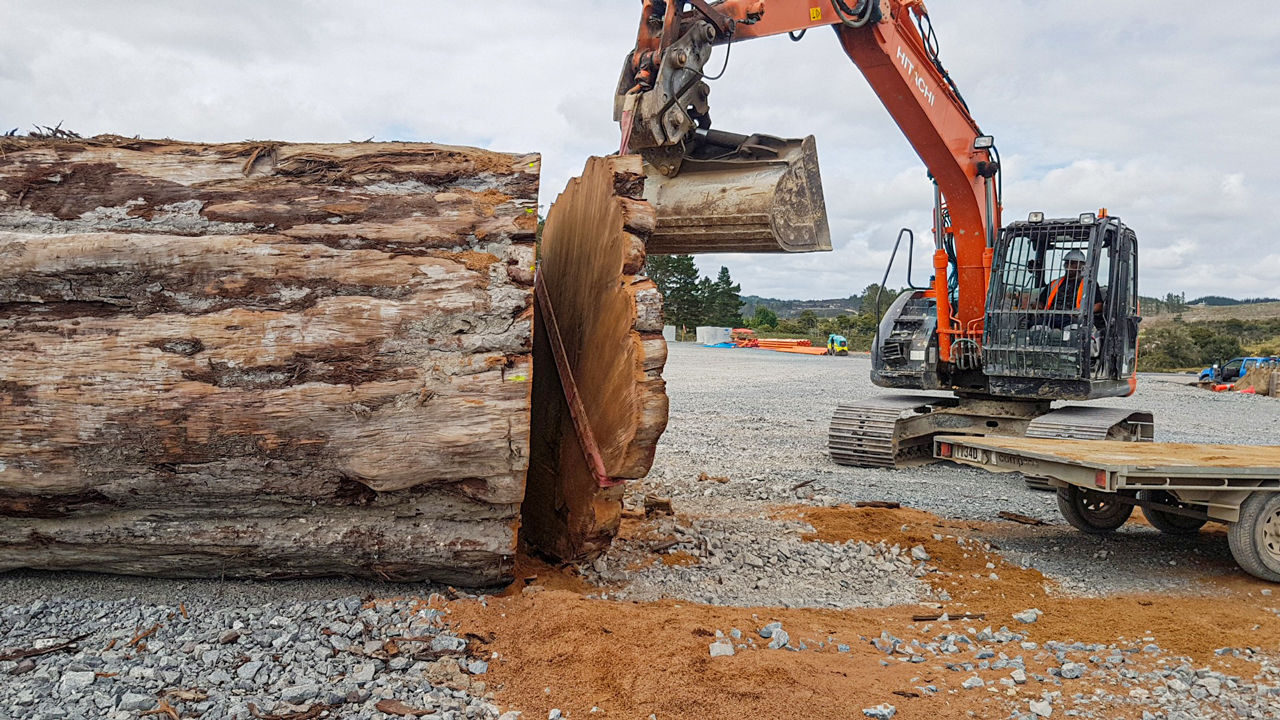
A rumour emerged last week that the Neanderthals met their end as one consequence of an extraterrestrial, possibly even extragalactic influence. Curiously, it stems from a recent discovery in New Zealand, where of course Neanderthals never set foot and nor did anatomically modern humans, the ancestors of Maori people, until a mere 800 years ago. It started with an ancient log from a kauri tree (Agathis australis), a species that Maoris revere. Found in excavations of boggy ground, the log weighed about 60 tons, so it was a valuable commodity, especially as it is illegal to fell living kauri trees. The wood is unaffected by burial and insect attack, has a regular grain and colour throughout, so is ideal for monumental Maori sculpture. Such swamp kauri also preserves their own life history in annual growth rings, and the log in question has 1700 of them. Using growth rings to chart climate variation gives the most detailed records of the recent past, provided the wood can be dated. Matching growth ring records from several trees of different ages is key to charting local climate with annual precision over several millennia.

An ancient kauri tree log recovered by swampland excavations in New Zealand. (Credit: Jonathan Palmer, in Voosen 2021)

Radiocarbon dating indicates that this particular kauri tree was growing around 42 thousand years ago. That is close to the upper limit for using 14C concentration in organic matter to determine age because the isotope has a short half-life (5730 years). In this case samples of the log would contain only about 0.7 % of its original complement of radioactive carbon. Cosmic rays generate 14C when they hit nitrogen atoms in the atmosphere and it enters COand thus the carbon cycle. Carbon dioxide taken up by photosynthesis to contribute carbon to plants contains only about one part per trillion of 14C. Consequently wood as ancient as that in the kauri log contains almost vanishingly small amounts, yet it can still be measured using mass spectrometry to yield an accurate radiometric age.

The particularly interesting thing about the 42 ka date is that it coincides with the timing of the last reversal of the Earth’s magnetic field, known as the Laschamps event. The kauri tree bears detailed witness through its growth rings to the environmental effects of a decrease in that field to almost zero as the poles flipped. The bulk of cosmic rays are normally deflected away from the Earth by the geomagnetic field, but during a reversal a great many more pass through the atmosphere, the most energetic reaching the surface and the biosphere. The kauri growth rings record fluctuations in the generation of 14C by their passage and thereby the geomagnetic field strength, which was only 6% of normal levels from 42.3 to 41.6 ka (Cooper, A. and 32 others  2021. A global environmental crisis 42,000 years ago. Science, v. 371, p. 811-818; DOI: 10.1126/science.abb8677). This coincided with an unrelated succession of periods of low solar activity and a reduced solar ‘wind’, which also provides some cosmic-rayprotection when activity is at normal levels; a ‘double whammy’. One consequence would have been destruction of stratospheric ozone by cosmic rays and thus increased ultraviolet exposure at ground level.

Combined with the highly precise growth-ring dating, the climatic changes over the 1700 year lifetime of the kauri tree can be linked to other records of environmental change. These include glacial ice- and lake-bed cores together with stalactite layers. Apparently, the Laschamps geomagnetic reversal coincided with abrupt shifts in wind belts and precipitation, perhaps triggering major droughts in the southern continents. Highly plausible, but some of the other speculations are less certain. For instance, some time around 42 ka, but far from well-established, Australia’s marsupial megafauna experienced major extinctions, the Neanderthals disappear from the fossil record and modern humans started decorating caves in Europe (20 ka after they did in Indonesia). In fact, speculation becomes somewhat silly, with suggestions that early Europeans went to live in caves because of increased exposure to UV (they knew, did they, while Neanderthals didn’t?), their painting and, by implication, their entire culture shifting through the shock and awe of mighty displays of the aurora borealis. Just because the number 42 is (or was), according to the late Douglas Adams’s Hitchhiker’s Guide to the Galaxy, ‘the answer to life, the universe and everything’, the authors tag the episode as the ‘Adams Event’. In their summary for The Conversation they include an animation with a quintessential Stephen Fry narrative, which Earth-logs readers can judge for themselves. Perhaps ‘Lockdown Trauma’ has a lot more to answer for, other than upsurges in Zoom conferences, knitting and gourmet experimentation …

See also: Voosen, P. 2021. Kauri trees mark magnetic flip 42,000 years ago. Science, v. 371, p. 766; DOI: 10.1126/science.371.6531.766

And here’s another snippet: Neanderthal link to our brain

Elizabeth Pennisi reports on a ‘Petri-dish’ experiment that substitutes a Neanderthal gene for a modern human one in a culture of human brain tissue. It gives some idea of how our very close relative may have thought differently from us. Pennisi, E. 2021. Neanderthal-inspired ‘minibrains’ hint at what makes modern humans specialScience, online news item; DOI:10.1126/science.abh0331

The ancestry of our opposable thumbs

Since the appearance of smart phones and the explosion of social media our thumbs have found a new niche; typing while holding a mobile. At a desktop keyboard, most of us don’t use thumbs very much, unless we have mastered fast touch typing, but for a huge variety of manual tasks thumbs are essential. The first makers of sophisticated stone tools must have been able to grip between fingers and thumb to manipulate the materials from which they were made and to perform the various stages in creating a razor sharp edge. To do that, as most of us are aware, the tip of the thumb must be capable of touching the tips of all four fingers; an opposable thumb is essential for the ‘precision grip’. Being able to tell when opposable thumbs evolve depends, of course, on finding hand-bone fossils. Being made of many bones disarticulated hands are a lot more fragile than long bones or those of the skull. Complete fossil hands are rare, as are feet, but a number have been found more or less complete. Whichever hominin had evolved opposable thumbs, their potential would have given them a considerable advantage over those that hadn’t.

The main muscles that control the movements of modern human fingers and thumb (Credit: Wikipedia)

Simply comparing the shapes of fossilised bones of fingers and thumbs with those of modern humans and other living primates has, so far, not proved capable of resolving with certainty which hominin groups either did or did not have opposable thumbs. The key lies in the muscles that operate them. It has become commonplace to reconstruct faces and even whole bodies from fairly complete skeletal remains by modelling musculature from the positioning and shape of the points of attachment of muscles to bone. But that become increasingly difficult for the small-scale and intricate attachments in hands. The critical muscle for opposable thumbs is known as the Opponens pollicis (the Latin for thumb is Digitus pollex); a small triangular muscle that operates in conjunction with three others (with pollicis in their Latin names).

Fotios Karakostis and six colleagues from German, Swiss and Greek universities have devised software that can model muscles in 3-D (F.A. Karakostis et al. 2021. Biomechanics of the human thumb and the evolution of dexterityCurrent Biology, v.31,  online; DOI: 10.1016/j.cub.2020.12.041). Based on the anatomy of human and chimpanzee hand muscles and the positions of their attachment to individual bones, they have been able to establish a series of parameters that clearly distinguish the morphological and probably functional characteristics of the thumbs of these living primates. Complete sets of thumb bones from four Neanderthal skeletons show that they were significantly, but only slightly, different from anatomically modern humans. Those from three species of Australopithecus (africanus, sediba and afarensis) lie between ours and chimps’, with significantly closer affinity to chimpanzees. It seems that australopithecines of whatever age were not equipped with opposable thumbs and were possible tool producers and users with the very limited capabilities of modern chimps; holding, pounding and poking. A single set of hominin thumb bones from about two million years ago that were found in the famous Swartkrans Cave in South Africa show just as close affinity in thumb opposability to humans as do Neanderthals. So at 2 Ma there was a hominin species sufficiently dextrous to make and use sophisticated tools. The problem is, the bones are not directly associated with others and have been ascribed by different authors either to H. habilis or Paranthropus robustus. Interestingly, this paranthropoid has also been suggested (controversially) to have been the first known hominin to use fire, and it also used digging sticks. No one has ever suggested that the genus Homo descended from a paranthropoid ancestor or vice versa; these massively jawed beings did coexist with early humans in East Africa for over a million years. The other hominin who left hands in the geological record was Homo naledi; a controversial species because it was found in a barely accessible cave chamber, and took a while to date. This context gave rise to the notions that it was the direct ancestor of humans and that it buried its dead in a special place. However, it turned out to be relative recent, at about 280 ka (see: Homo naledi: an anti-climax; May 2017). Homo naledi does seem to have had opposable thumbs, but there is no associated evidence to suggest either tool making or use.

Fascinating as the methodology outlined by Karakostis et al. is, their findings do not take early human capabilities very much further than what is already known. Tools were made and used as far back as 3.3 Ma ago, and we know that H. habilis was doing this by about 2.6 Ma; i.e. long before the first evidence for opposable thumbs, and who had them first is uncertain. What is clear is that sophisticated tools, such as the bifacial Acheulian artifacts whose manufacture demands great dexterity, only appeared after the potential for nimble dexterity (about 1.8 Ma). The same goes for the first migration out of Africa, at about the same time, which demanded resourcefulness that may have sprung from the ability to manipulate natural materials effectively and carefully

See also: Handwerk B. 2012. How dexterous thumbs may have helped shape evolution two million years ago. (Smithsonian Magazine, 28 January 2021); Bower, B. 2021. Humanlike thumb dexterity may date back as far as 2 million years ago. (Science News, 28 January 2021)

How like the Neanderthals are we?

An actor made-up to resemble a Neanderthal man in a business suit traveling on the London Underground. (Source: screen-grab from BBC2 Neanderthals – Meet Your Ancestors)

In the most basic, genetic sense, we were sufficiently alike for us to have interbred with them regularly and possibly wherever the two human groups met. As a result the genomes of all modern humans contain snips derived from Neanderthals (see: Everyone now has their Inner Neanderthal; February 2020). East Asian people also carry some Denisovan genes as do the original people of Australasia and the first Americans. Those very facts suggest that members of each group did not find individuals from others especially repellent as potential sexual partners! But that covers only a tiny part of what constitutes culture. There is archaeological evidence that Neanderthals and modern humans made similar tools. Both had the skills to make bi-faced ‘hand axes’ before they even met around 45 to 40 ka ago.  A cave (La Grotte des Fées) near Châtelperron to the west of the French Alps that was occupied by Neanderthals until about 40 ka yielded a selection of stone tools, including blades, known as the Châtelperronian culture, which indicates a major breakthrough in technology by their makers. It is sufficiently similar to the stone industry of anatomically modern humans (AMH) who, around that time, first migrated into Europe from the east (Aurignacian) to pose a conundrum: Did the Neanderthals copy Aurignacian techniques when they met AMH, or vice versa? Making blades by splitting large flint cores is achieved by striking the cores with just a couple of blows with a softer tool. At the very least Neanderthals had the intellectual capacity to learn this very difficult skill, but they may have invented it (see: Disputes in the cavern; June 2012). Then there is growing evidence for artistic abilities among Neanderthals, and even Homo erectus gets a look-in (see: Sophisticated Neanderthal art now established; February 2018).

Reconstructed burial of a Neanderthal individual at La Chappelle-aux-Saints (Credit: Musée de La Chapelle-aux-Saints, Corrèze, France)

For a long time, a pervasive aspect of AMH culture has been ritual. Indeed much early art may be have been bound up with ritualistic social practices, as it has been in historic times. A persuasive hint at Neanderthal ritual lies in the peculiar structures – dated at 177 ka – found far from the light of day in the Bruniquel Cave in south-western France (see: Breaking news: Cave structures made by Neanderthals; May 2016). They comprise circles fashioned from broken-off stalactites, and fires seem to have been lit in them. The most enduring rituals among anatomically modern humans have been those surrounding death: we bury our dead, thereby preserving them, in a variety of ways and ‘send them off’ with grave goods or even by burning them and putting the ashes in a pot. A Neanderthal skeleton (dated at 50 ka) found in a cave at La Chappelle-aux-Saints appears to have been buried and made safe from scavengers and erosion. There are even older Neanderthal graves (90 to 100 ka) at Quafzeh in Palestine and Shanidar in Iraq, where numerous individuals, including a mother and child, had been interred. Some are associated with possible grave goods, such as pieces of red ochre (hematite) pigment, animal body parts and even pollen that suggests flowers had been scattered on the remains. The possibility of deliberate offerings or tributes and even the notion of burial have met with scepticism among some palaeoanthropologists. One reason for the scientific caution is that many of the finds were excavated long before the rigour of modern archaeological protocols

Recently a multidisciplinary team involving scientists from France, Belgium, Italy, Germany, Spain and Denmark exhaustively analysed the context and remains of a Neanderthal child found in the La Ferrassie cave (Dordogne region of France) in the early 1970s  (Balzeau, A. and 13 others 2020. Pluridisciplinary evidence for burial for the La Ferrassie 8 Neandertal childScientific Reports, v. 10, article 21230; DOI: 10.1038/s41598-020-77611-z). Estimated to have been about 2 years old, the child is anatomically complete. Bones of other animals found in the same deposit were less-well preserved than those of the child, adding weight to the hypothesis that a body, rather than bones, had been buried soon after death. Luminescence dating of the sediments enveloping the skeleton is considerably older than the radiocarbon age of one of the child’s bones. That is difficult to explain other than by deliberate burial. It is almost certain that a pit had been dug and the child placed in it, to be covered in sediment. The skeleton was oriented E-W, with the head towards the east. Remarkably, other Neanderthal remains at the La Ferrassie site also have heads to the east of the rest of their bones, suggesting perhaps a common practice of orientation relative to sunrise and sunset.

It is slowly dawning on palaeoanthropologists that Neanderthal culture and cognitive capacity were not greatly different from those of anatomically modern humans. That similar beings to ourselves disappeared from the archaeological record within a few thousand years of the first appearance of AMH in Europe has long been attributed to what can be summarised as the Neanderthals being ‘second best’ in many ways. That may not have been the case. Since the last glaciation something similar has happened twice in Europe, which analysis of ancient DNA has documented in far more detail than the disappearance of the Neanderthals. Mesolithic hunter-gatherers were followed by early Neolithic farmers with genetic affinities to living people in Northern Anatolia in Turkey – the region where growing crops began. The DNA record from human remains with Neolithic ages shows no sign of genomes with a clear Mesolithic signature, yet some of the genetic features of these hunter-gatherers still remain in the genomes of modern Europeans. Similarly, ancient DNA recovered from Bronze Age human bones suggests almost complete replacement of the Neolithic inhabitants by people who introduced metallurgy, a horse-centred culture and a new kind of ceramic – the Bell Beaker. This genetic group is known as the Yamnaya, whose origins lie in the steppe of modern Ukraine and European Russia. In this Neolithic-Bronze Age population transition the earlier genomes disappear from the ancient DNA record. Yet Europeans still carry traces of that earlier genetic heritage. The explanation now accepted by both geneticists and archaeologists is that both events involved assimilation and merging through interbreeding. That seems just as applicable to the ‘disappearance’ of the Neanderthals

See also: Neanderthals buried their dead: New evidence (Science Daily, 9 December 2020)

Doggerland and the Storegga tsunami

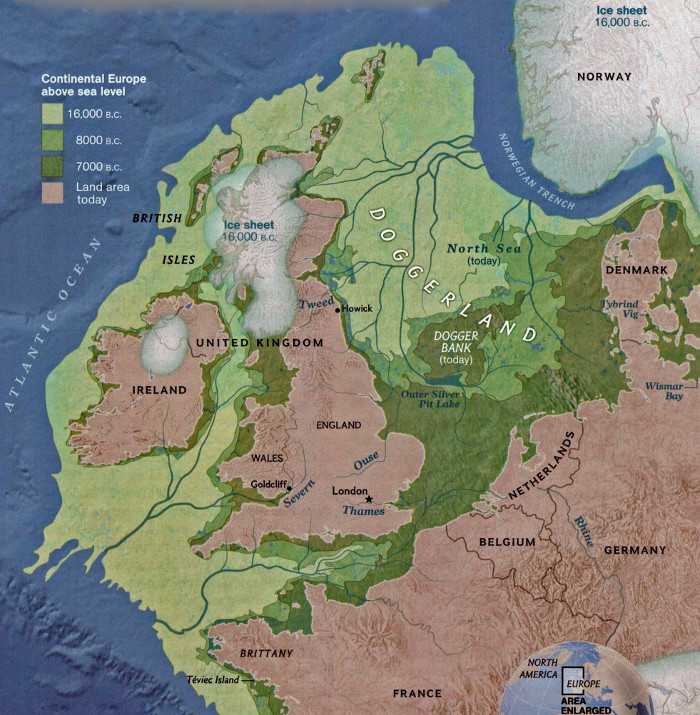
Britain is only an island when sea level stands high; i.e. during interglacial conditions. Since the last ice age global sea level have risen by about 130 m as the great northern ice sheets slowly melted. That Britain could oscillate between being part of Europe and a large archipelago as a result of major climatic cycles dates back only to between 450 and 240 ka ago. Previously it was a permanent part of what is now Europe, as befits its geological identity, joined to it by a low ridge buttressed by Chalk across the Dover Strait/Pas de Calais. All that remains of that are the white cliffs on either side. The drainage of what became the Thames, Seine and Rhine passed to the Atlantic in a much larger rive system that flowed down the axis of the Channel. Each time an ice age ended the ridge acted as a dam for glacial meltwater to form a large lake in what is now the southern North Sea. While continuous glaciers across the northern North Sea persisted the lake remained, but erosion during interglacials steadily wore down the ridge. About 450 ka ago it was low enough for this pro-glacial lake to spill across it in a catastrophic flood that began the separation. Several repeats occurred until the ridge was finally breached (See: When Britain first left Europe; September 2007). Yet sufficient remained that the link reappeared when sea level fell. What remains at present is a system of shallows and sandbanks, the largest of which is the Dogger Bank roughly halfway between Newcastle and Denmark. Consequently the swamps and river systems that immediately followed the last ice age have become known collectively as Doggerland.

The shrinkage of Doggerland since 16,000 BCE (Credit: Europe’s Lost Frontiers Project, University of Bradford)

Dredging of the southern North Sea for sand and gravel frequently brings both the bones of land mammals and the tools of Stone Age hunters to light – one fossil was a skull fragment of a Neanderthal. At the end of the Younger Dryas (~11.7 ka) Doggerland was populated and became a route for Mesolithic hunter-gatherers to cross from Europe to Britain and become transient and then permanent inhabitants. Melting of the northern ice sheets was slow and so was the pace of sea-level rise. A continuous passage across Dogger Land  remained even as it shrank. Only when the sea surface reached about 20 m below its current level was the land corridor breached bay what is now the Dover Strait, although low islands, including the Dogger Bank, littered the growing seaway. A new study examines the fate of Doggerland and its people during its final stage (Walker, J. et al. 2020. A great wave: the Storegga tsunami and the end of Doggerland? Antiquity, v. 94, p. 1409-1425; DOI: 10.15184/aqy.2020.49).

James Walker and colleagues at the University of Bradford, UK, and co-workers from the universities of Tartu, Estonia, Wales Trinity Saint David and St Andrews, UK, focus on one devastating event during Doggerland’s slow shrinkage and inundation. This took place around 8.2 ka ago, during the collapse of a section of the Norwegian continental edge. Known as the Storegga Slides (storegga means great edge in Norse), three submarine debris flows shifted 3500 km3 of sediment to blanket 80 thousand km2 of the Norwegian Sea floor, reaching more than half way to Iceland.  Tsunami deposits related to these events occur along the coast western Norway, on the Shetlands and the shoreline of eastern Scotland. They lie between 3 and 20 m above modern sea level, but allowing for the lower sea level at the time the ‘run-up’ probably reached as high as 35 m: more than the maximum of both the 26 December 2004 Indian Ocean tsunami and that in NW Japan on 11 March 2011. Two Mesolithic archaeological sites definitely lie beneath the tsunami deposit, one close to the source of the slid, another near Inverness, Scotland. At the time part of the Dogger Bank still lay above the sea, as did a wide coastal plain and offshore islands along England’s east coast. This catastrophic event was a little later than a sudden cooling event in the Northern Hemisphere. Any Mesolithic people living on what was left of Doggerland would not have survived. But quite possibly they may already have left as the climate cooled substantially

A seabed drilling programme financed by the EU targeted what lies beneath more recent sediments on the Dogger Bank and off the embayment known as The Wash of Eastern England. Some of the cores contain tsunamis deposits, one having been analysed in detail in a separate paper (Gaffney, V. and 24 others 2020. Multi-Proxy Characterisation of the Storegga Tsunami and Its Impact on the Early Holocene Landscapes of the Southern North Sea. Geosciences, v. 10, online; DOI: 10.3390/geosciences10070270). The tsunami washed across an estuarine mudflat into an area of meadowland with oak and hazel woodland, which may have absorbed much of its energy. Environmental DNA analysis suggests that this relic of Doggerland was roamed by bear, wild boar and ruminants. The authors also found evidence that the tsunamis had been guided by pre-existing topography, such as the river channel of what is now the River Great Ouse. Yet they found no evidence of human occupation. Together with other researchers, the University of Bradford’s Lost Frontiers Project have produced sufficient detail about Doggerland to contemplate looking for Mesolithic sites in the excavations for offshore wind farms.

See also: Addley, E. 2020.  Study finds indications of life on Doggerland after devastating tsunamis. (The Guardian, 1 December 2020); Europe’s Lost Frontiers website

Earliest sign of a sense of aesthetics

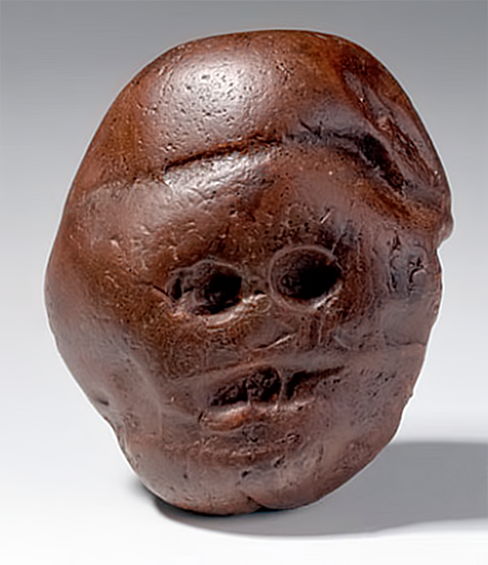
Maybe because of the Covid-19 pandemic, there has been a dearth of interesting new developments in the geosciences over that last few months: the ‘bread and butter’ of Earth-logs. So instead of allowing a gap in articles to develop, and as a sign that I haven’t succumbed, this piece concerns one of the most intriguing discoveries in palaeoanthropology. In 1925 Wilfred Eitzman, a school teacher, investigated a cave in the Makapansgat Valley in Limpopo Province, South Africa that had been exposed by quarry workers.  His most striking discovery was a polished pebble made of very fine-grained, iron-rich silica, probably from a Precambrian banded iron formation. Being round and deeply pitted, it had clearly been subject to prolonged rolling and sand blasting in running water and wind. Eerily, whichever way it was viewed it bore a striking resemblance to a primate face: eyes, mouth, nose and, viewed from the rear, a disturbing, toothless grin. We have all picked up odd-looking pebbles on beaches or a river bank: I recently found a sandstone demon-cat (it even has pointy ears) when digging a new vegetable patch.

The Makapansgat Pebble. Inverted it still resembles a face and its obverse side does too.

What is different about the Makapansgat Pebble is that Eitzman found it in a cave-floor layer full of bones, including those of australopithecines. The cave is located in dolomitic limestone outcrops high in the local drainage system, so it’s unlikely that the pebble was washed into it. The nearest occurrence of banded iron formation is about 20 kilometres away, so something must have carried the pebble for a day or more to the cave. The local area has since yielded a superb palaeontological record of early hominin evolution, stimulated by  Eitzman’s finds. He gave the fossils and the pebble to Raymond Dart, the pioneer of South African palaeoanthropology. Dart named the hominin fossils Australopithecus prometheus because associated bones of other animals were covered in black stains that Dart eagerly regarded as signs of burning and thus cooking. When it became clear that the stains were of manganese oxide the name was changed to Au. africanus, the fossils eventually being dated to around 3 million years ago.

Dart was notorious for his showmanship, and the fossils and the Makapansgat Pebble ‘did the rounds’ and continue to do so. In 2016 the pebble was displayed with a golden rhino, a collection of apartheid-era badges and much more in the British Museum’s South Africa: the art of a nation exhibition. Well, is the pebble art? As it shows no evidence of deliberate working it can not be considered art, but could be termed an objet trouvé. That is, an ‘object found by chance and held to have aesthetic value to an artist’. The pebble’s original finder 3 million years ago must have found the 0.25 kg pebble sufficiently interesting to have carried it back to the cave, presumably because of its clear resemblance to a hominin head: in fact a multiple-faced head. Was it carried by a cave-dwelling australopithecine or an early member of genus Homo who left no other trace at Makapansgat? At an even earlier time a so-far undiscovered hominin did indeed make simple stone tools to dismember joints of meat on the shores of Lake Turkana in Kenya. It is impossible to know who for sure carried the pebble, nor to know why. Yet all living primates are curious creatures, so it is far from impossible that any member of the hominins in our line of descent would have collected portable curiosities.

More Denisovan connections

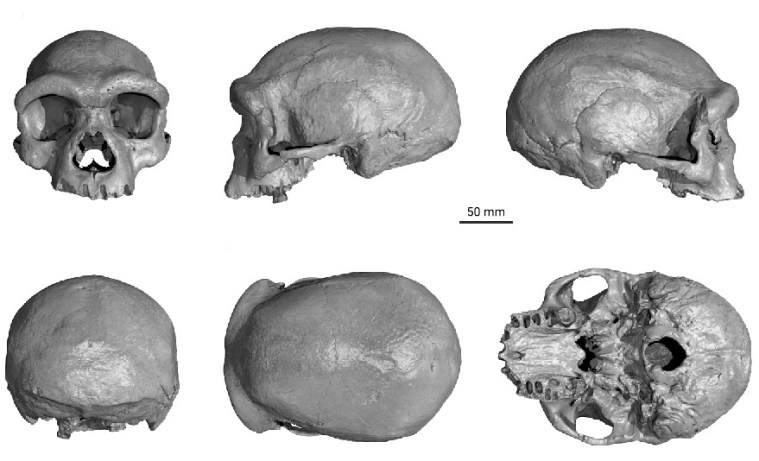
In 2006 mining operations in NE Mongolia uncovered a human skull cap with prominent brow ridges. After having been dubbed Mongolanthropus because of its primitive appearance and then suggested to be either a Neanderthal of Homo erectus. Radiocarbon dating in 2019 then showed the woman to be around 34,500 years old and the accompanying sequencing of its mtDNA assigned her to a widespread Eurasian haplotype of modern humans. Powdered bone samples ended up in Svante Paabo’s renowned ancient-DNA lab at the Max Planck Institute for Evolutionary Anthropology in Leipzig and yielded a full genome (Massilani, D. and 14 others 2020. Denisovan ancestry and population history of early East Asians. Science, v. 370, p. 579-583; DOI: 10.1126/science.abc1166). From this flowed some interesting genetic history.

Skull cap of a female modern human from Salkhit in Outer Mongolia, which superficially resembles those of Homo erectus from Java (Credit: Massilani et al. Fig 1a; © Institute of Archaeology, Mongolian Academy of Sciences)

First was a close overall resemblance to living East Asians and Native Americans, similar to that of an older individual from near Beijing, China. This confirmed the antiquity of the East Eurasian population’s split from that of the west, yet contained evidence of some interbreeding with West Eurasians to the extent of sharing 25% of DNA and with Neanderthals. The two specimens also contained evidence of Denisovan ancestry in their genomes, but fragments that are more akin to those in living people in East Asia than to those of Papuans and Aboriginal Australians: these were definitely cosmopolitan people! The simplest explanation is two distinct minglings with Denisovans: that involving ancestors of Papuans and Australian being the perhaps earlier, en route to their arrival at least 60 thousand years on what became an island continent in the run-up to the last glacial maximum. Be that as it may, two separate Denisovan populations interbred with modern human bands. Further genetic connections with ancient Northern Siberian humans suggests complex movement across the continent, probably inevitable because these hunter-gatherers would have followed prey animals on their seasonal migrations, which would have been longer than today because of climatic cooling. The same can be surmised for Denisovans which would have increased the chances of contact

See also: Denisovan DNA in the genome of early East Asians (Science Daily, 29 October 2020)

In May 2019 (Denisovan on top of the world) I wrote about a human lower jaw that a Buddhist monk had found in a cave at a height of 3.3 km on the Tibetan plateau. Analysis of protein traces in the teeth it retained suggested that it was Denisovan. Like the earlier small remnants from Siberia, dating this putative Denisovan precisely proved to be impossible. The jawbone was at least 160 ka old from the age of speleothem carbonate encrusting it. Excavation of the sediment layers from Baishiya Cave has enabled a large team of Chinese, Australian, US and Swedish scientists to try out the ‘environmental DNA’ approach pioneered by the Max Planck Institute for Evolutionary Anthropology (see: Detecting the presence of hominins in ancient soil samples, April 2017). The cave confirmed occupation by Denisovans from mtDNA found in layers dated using radiocarbon and optically stimulated luminescence methods. Denisovan mtDNA turned up in four layers dated at ~100, ~60 and possibly as young as 45 ka, as well at that from a variety of other mammals (Zhang, D. and 26 others. Denisovan DNA in Late Pleistocene sediments from Baishiya Karst Cave on the Tibetan Plateau. Science, v. 370, p. 584-587; DOI: 10.1126/science.abb6320).  Denisovans were clearly able to live at high elevations for at least 100 thousand years: long enough to evolve the metabolic processes essential to sustain living in low-oxygen conditions, which it has been suggested was passed on to ancestral modern Tibetans.

Environmental change and early-human innovation

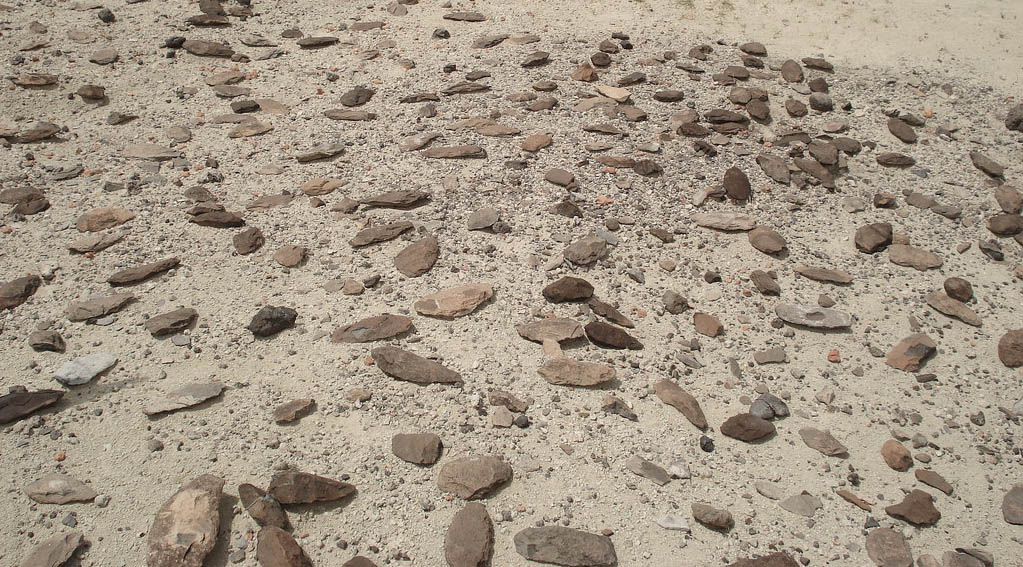
Acheulean biface tools strewn on a bedding surface in the Olorgesailie Basin, Kenya (credit: mmercedes_78 Flickr)

The Olorgesailie Basin in Southern Kenya is possibly the world’s richest source for evidence of ancient stone-tool manufacture. For early humans, it certainly was rich in the necessary resources from which to craft tools. Lying in East Africa’s active rift system, its stratigraphy contains abundant beds of hydrothermal silica (chert), deposited by hot springs, and flows of fine grained lavas. Its sediments spanning the last 1.2 million years show that the Basin hosted lakes and extensive river systems for the earlier part of this period: it was rich in food resources too. The tools, together with bones from dismembered prey, bear witness to long-term human occupation, but hominin remains themselves have yet to be discovered. The time span suggests early occupation by Homo erectus, who probably manufactured Acheulean biface stone tools in large quantities that litter the surface at some archaeological sites.

There is a break in the stratigraphic sequence from about 500 to 320 thousand years ago caused by erosion during a period of tectonic uplift. Younger sediments reveal a striking change in archaeology. The earlier large cutting tools give way to a more diverse ‘toolkit’ of smaller tools produced by more sophisticated techniques than those used to make the Acheulean ‘hand axes’. In African archaeological parlance, the <320 ka-old tools mark the onset of the Middle Stone Age (NB not equivalent to the much younger Mesolithic of Europe). The sedimentary gap also marks what seems to have been very different human behaviour. The stone resources used in the 1.2 to 0.5 Ma sequence were local: no more than 5 km from the tool-yielding sites. After the gap a much more varied range of lithologies was used, from as far afield as 95 km. Not only that, but rock unsuitable for tools appears: soft pigments such as hematite.

The foregoing was known from three major papers that appeared in March 2018 (see: Human evolution and revolution in Africa, March 2018 – specifically the section Hominin cultural revolution 320,000 years ago). Now, many members of the teams who produced that published evidence report detailed analysis of samples from a deep drill core through the stratigraphy in a similar, nearby basin (Potts, R. and 21 others 2020. Increased ecological resource variability during a critical transition in hominin evolutionScience Advances, v. 6, article eabc8975; DOI:10.1126/sciadv.abc8975). As well as calibrating the timing of stratigraphic changes using 40Ar/39Ar dating from 22 volcanic layers, the team analysed sedimentary structures, body- and trace fossils, variations in sediment geochemistry, palaeobotany and carbon isotopes, to suggest variations in environmental conditions and ecology throughout the section in greater detail than previously achieved anywhere in Africa.

They conclude that as well as a change in topography resulting from the 500-320 ka period of tectonic uplift and erosion, the climate of this part of East Africa became more unstable. Combined, these two factors transformed the ecosystems of the Olorgesailie Basin. Between 1.2 to 0.5 Ma the Acheulean tool makers inhabited dominantly grassy plains with substantial, permanent lakes – a stable period of 700 thousand years, well suited to large herbivores and thus to these early humans. Tectonic and climatic change disrupted a ‘land of plenty’; the herbivores left to be replaced by smaller prey animals; vegetation shifted back and forth from grassland to woodland with the unstable climate; lakes became smaller and ephemeral. The problem in linking environmental change to changed human practices in this case, however, is the 180 thousand-year gap in the geological record. Lead author Richard Potts, director of the Human Origins Program at the Smithsonian’s National Museum of Natural History, and his team suggest that the change contributed to the ecological flexibility of the probable Homo sapiens who left the fancier, more diverse tools during the later phase. Yet 1.6 million years beforehand early H. erectus had sufficient flexibility to cross 30 to 40 degrees of latitude and end up on the shores of the Black Sea in Georgia! The likely late-stage H. erectus of Olorgesailie may have moved out around 500 ka ago and sometime later early H. sapiens moved in with new technology developed elsewhere. We know that the earliest known anatomically modern humans lived in Morocco at around 315 ka (see: Origin of anatomically modern humans, June 2017): but we don’t know what tools they had or where they went next. There are all sorts of possibilities that cannot be addressed by even the most intricate analysis of secondary evidence. The important issue seems, I think, to centre on the transition from erects to sapiens, in anatomical, cognitive and behavioural contexts, via some intermediary such as H. antecessor, to which this study can contribute very little. That needs complete stratigraphic records: ironically, the other basin from which the core was drilled is apparently more complete, especially for the 500 to 320 ka ‘gap’. That seems likely to offer more potential. Yet, such big questions also demand a much broader brush: perhaps on a continental scale. It’s to early to tell …

See also: Turbulent era sparked leap in human behavior, adaptability 320,000 years ago (Science Daily,21 October 2020)

Supernova at the start of the Pleistocene

This brief note takes up a thread begun in Can a supernova affect the Earth System? (August 2020). In February 2020 the brightness of Betelgeuse – the prominent red star at the top-left of the constellation Orion – dropped in a dramatic fashion. This led to media speculation that it was about to ‘go supernova’, but with the rise of COVID-19 beginning then, that seemed the least of our worries. In fact, astronomers already knew that the red star had dimmed many times before, on a roughly 6.4-year time scale. Betelgeuse is a variable star and by March 2020 it brightened once again: shock-horror over; back to the latter-day plague.

When stars more than ten-times the mass of the Sun run out of fuel for the nuclear fusion energy that keeps them ‘inflated’ they collapse. The vast amount of gravitational potential energy released by the collapse triggers a supernova and is sufficient to form all manner of exotic heavy isotopes by nucleosynthesis. Such an event radiates highly energetic and damaging gamma radiation, and flings off dust charged with a soup of exotic isotopes at very high speeds. The energy released could sum to the entire amount of light that our Sun has shone since it formed 4.6 billion years ago. If close enough, the dual ‘blast’ could have severe effects on Earth, and has been suggested to have caused the mass extinction at the end of the Ordovician Period.

Betelgeuse is about 700 light years away, massive enough to become a future supernova and its rapid consumption of nuclear fuel – it is only about 10 million years old – suggests it will do so within the next hundred thousand years. Nobody knows how close such an event needs to be to wreak havoc on the Earth system, so it is as well to check if there is evidence for such linked perturbations in the geological record. The isotope 60Fe occurs in manganese-rich crusts and nodules on the floor of the Pacific Ocean and also in some rocks from the Moon. It is radioactive with a half-life of about 2.6 million years, so it soon decays away and cannot have been a part of Earth’s original geochemistry or that of the Moon. Its presence may suggest accretion of debris from supernovas in the geologically recent past: possibly 20 in the last 10 Ma but with apparently no obvious extinctions. Yet that isotope of iron may also be produced by less-spectacular stellar processes, so may not be a useful guide.

There is, however, another short-lived radioactive isotope, of manganese (53Mn), which can only form under supernova conditions. It has been found in ocean-floor manganese-rich crusts by a German-Argentinian team of physicists  (Korschinek, G. et al. 2020. Supernova-produced 53Mn on Earth. Physical Review Letters, v. 125, article 031101; DOI: 10.1103/PhysRevLett.125.031101). They dated the crusts using another short-lived cosmogenic isotope produced when cosmic rays transform the atomic nuclei of oxygen and nitrogen to 10Be that ended up in the manganese-rich crusts along with any supernova-produced  53Mn and 60Fe. These were detected in parts of four crusts widely separated on the Pacific Ocean floor. The relative proportions of the two isotopes matched that predicted for nucleosynthesis in supernovas, so the team considers their joint presence to be a ‘smoking gun’ for such an event.

The 10Be in the supernova-affected parts of the crusts yielded an age of 2.58 ± 0.43 million years, which marks the start of the Pleistocene Epoch, the onset of glacial cycles in the Northern Hemisphere and the time of the earliest known members of the genus Homo. A remarkable coincidence? Possibly. Yet cosmic rays, many of which come from supernova relics, have been cited as a significant source of nucleation sites for cloud condensation. Clouds increase the planet’s reflectivity and thus act to to cool it. This has been a contentious issue in the debate about modern climate change, some refuting their significance on the basis of a lack of correlation between cloud-cover data and changes in the flux of cosmic rays over the last century. Yet, over the five millennia of recorded history there have been no records of supernovas with a magnitude that would suggest they were able to bathe the night sky in light akin to that of daytime. That may be the signature of one capable of affecting the Earth system. Thousands that warrant being dubbed a ‘very large new star’are recorded, but none that ‘turned night into day’. The hypothesis seems to have ‘legs’, but so too do others, such as the slow influence on oceanic circulation of the formation of the Isthmus of Panama and other parochial mechanisms of changing the transfer of energy around our planet

See also: Stellar explosion in Earth’s proximity, eons ago. (Science Daily; 30 September 2020.)

Severe COVID-19 associated with Neanderthal inheritance?

News broke in 2010 about evidence from modern and ancient DNA samples that showed some anatomically modern humans who left Africa before 40 thousand years ago to have interbred with the Neanderthal occupants of Eurasia (see: Yes, it seems that they did …; May 2010). In 2011 it turned out that the same had happened when AMH migrants in Asia met with Denisovans (see: Snippets on human evolution; November 2011). The resulting human hybrids went on to spread their new genes as they populated East Asia, Australasia and the Americas. Genomes of thousands of living people from these continents all show varying proportions – but generally less than about 5% – of genetic contributions from one or the other and in some cases both. Some of the modern humans who remained in Africa also had a similar opportunity. A few Neanderthals did set foot in Africa sharing their genes with its original inhabitants, but those venturing far from their normal range had already interbred with early ‘out-of-Africa’ AMH migrants about 150 to 100 thousand years ago, as had  AMH returning from Eurasia around 20 ka ago. Five widespread groups of modern Africans (but not all) carry up to 0.3% of the Neanderthal genome. Moreover, the ancestors of some living Africans had also exchanged genes with as-yet unknown archaic humans (see also: Everyone now has their Inner Neanderthal; February 2020).

Personally, I reacted to the news with a sense of pride. Neanderthals were tough, survivors of several hundred thousand years of climatic extremes hunting fearsome prey, and they probably had an intellect as advanced as that of the AMH with whom they mingled. My little bit of Neanderthal has conferred several advantages including resistance to Eurasian pathogens, but also has its downside, such as a tendency to depression and excessive blood clotting. But an unedited paper released in advance of publication by the journal Nature suggests that my pride turns out to include an unwelcome element of hubris.

Early in the COVID-19 pandemic, genetic research on over 3000 individuals, whose symptoms were severe enough for them to be hospitalised – a high proportion of whom sadly died – revealed that there was more to their being prone to severe symptoms than age, co-morbidities, gender and ethnicity. A short segment (around 50,000 base pairs long) on the DNA of their chromosome-3 is significantly associated with severe COVID-19 outcomes. Svante Pääbo, the leader of the team than reconstructed the Neanderthal and Denisovan genomes and discovered their presence in living people, and his co-author, Hugo Zeberg, have linked this segment to a stretch in the Neanderthal genome (Zeberg, H. & Pääbo, S. 2020. The major genetic risk factor for severe COVID-19 is inherited from Neanderthals. Nature, accelerated preview; DOI: 10.1038/s41586-020-2818-3). One gene included in the segment plays a role in the human immune response and another is linked to the way the coronavirus invades human cells, but how they influence health outcomes in COVID-19 victims is yet to be established. Sixteen percent of Europeans and 30% of South Asians carry the segment. If infected, they are at higher risk of severe outcomes than the rest of the population. That the relatively small segment still persists 40 ka after Neanderthals became extinct suggests that it has not always conferred high risk: probably because it once conferred significant advantages, perhaps by protecting against other, now extinct pathogens. A fitness benefit is passed on through natural selection

The pandemic has yet to run its course and genetic research, such as that by Zeberg and Pääbo, takes second place to that aiming at lessening the effects of the disease and developing vaccines that, hopefully, will wipe it out. The country-by-country statistics of COVID-19 morbidity and mortality are shaky, but an interesting feature may be emerging. Although there have been many cases in Africa, where health services are under developed, it seems that deaths as a proportion of infections are significantly lower there than in the more advanced countries. Hopefully that will continue, perhaps as a result of lower Neanderthal inheritance.

See also: Sample, I. 2020. Neanderthal genes increase risk of serious Covid-19, study claims. (The Guardian, 30 September 2020)

Did early humans learn to cook in Olduvai Gorge?

Olduvai Gorge in northern Tanzania was for many years the stamping ground of the famous Leakey family and many other anthropologists because of it richness in the skeletal remains and the tools of the earliest members of our genus Homo. The first of these, H. habilis, appears in the Olduvai stratigraphic sequence at around 2 Ma: older examples are now known from localities in Kenya and South Africa taking the species back to about 2.4 Ma. ‘Handy Man’ got the Latinised nickname from its association with abundant stone tools, albeit of a very primitive kind. Oldowan tools are of the ‘let’s bash a couple of pebbles together to get a cutting edge’ kind, dating back to 3.4 Ma (but without evidence of who made them then) and as easily-made disposable tools they linger in the archaeological record until the Neolithic and even modern times. Homo habilis had a brain size little larger than that of australopithecines and some authorities deem them to be such.

Olduvai also yielded the earliest of a more ‘brainy’ species H. ergaster (‘Action Man’), which coexisted with habilis for a few hundred thousand years from around 2 Ma. Initially they also left Oldowan tools. Then, around 1.7 Ma at Olduvai, ergaster began making another stone artefact, the symmetrical bifacial ‘axe’ – probably a multipurpose tool and possibly an object of ritual significance, according to some researchers. Whichever, to make one required visualising the finished item within a shapeless lump of hard rock, and making them required great dexterity: and still does for stone knappers. The biface or ‘Acheulean’ tool originates with one of humanity’s greatest cognitive leaps and lay at the centre of the human toolkit for well over a million years. After being made first in Olduvai by African H. ergaster biface artefacts then spread throughout the continent with H. erectus (probably a direct descendent) and beyond its shores with succeeding humans, up to and including the earliest H. sapiens. How did what seems to be a ‘golden spike’ in human culture first take material form in Olduvai? The possibility of an answer stems from pure serendipity and the development of new research tools.

A flint bifacial stone artefact from the Palaeolithic of Norfolk, UK, which incorporates a bivalve fossil

That the Olduvai Gorge has drawn in several generations of researchers lies in its geology. As well as the sediments deposited by rivers and in ephemeral lakes that characterised a broadly speaking savannah environment, from 2 to 1 Ma there were at least 31 major volcanic eruptions that deposited lavas and a wide range of volcanic ash beds. These have enabled precise dating to calibrate in minute detail the evolution of a highly productive environment and the flora and fauna that it supported during the early Pleistocene. A recently developed technique involves identification of a variety of fatty acids or lipids – natural oils, waxes and steroids – using gas chromatography. Lipids are the remaining ‘biomarkers’ of plants and microorganisms that once lived in an ecosystem. Ainara Sistiaga of the Massachusetts Institute of Technology and the University of Copenhagen, with colleagues from Denmark, Spain, the US and Tanzania, set out to document ecological variation at Olduvai over a million-year interval using this approach. Among the microbial biomarkers they stumbled on something of possibly great importance (Sistiaga, A. and 10 others 2020. Microbial biomarkers reveal a hydrothermally active landscape at Olduvai Gorge at the dawn of the Acheulean, 1.7 Ma. Proceedings of the National Academy of Sciences, v. 117, published online; DOI: 10.1073/pnas.2004532117).

The palaeo-landscape of Olduvai, as revealed by lipid analysis, was highly diverse and rich in grasses, palms shrubs, aquatic flora and edible plants, watered by spring-fed rivers. It supported a diverse fauna including large herbivores (supported by fecal biomarkers): ideal for hominin subsistence. Sistiaga et al. focus in their paper on samples from the 1.7 Ma sedimentary and volcanic sequence (the Lower Augitic Sandstones – augite is an igneous pyroxene) that contains remains of H. ergaster, the oldest bifacial artefacts, and dismembered carcases of hominin prey animals. The surprise that emerged from the volcanoclastic sandstones included lipids produced by a range of bacterial species that only thrive in modern hot springs, such as those at Yellowstone and on the North Island of New Zealand. At three sample sites biomarkers for one particular hyperthermophile were found (Thermocrinis ruber), which can only live in water between 80 to 95°C. This and the other heat-loving bacteria also require water chemistry that, if cool, is drinkable.

Artist’s impression of Homo ergaster cooking an antelope in a 1.7 Ma hot spring at Olduvai Gorge, Tanzania (credit: Tom Björklund, MIT)

The implication is obvious: the ancient Olduvai hot springs were capable of thoroughly cooking meat and vegetables. The importance for humans is that cooking both tenderises meat and tough tubers and roots and breaks down carbohydrates and proteins to make them more easily and efficiently digestible. The brain capacity of H. ergaster was significantly greater than that of H. habilis, and at the average 800 cm3 about 2/3 that of anatomically modern humans. An increase in the input of easily digested protein, fats and carbohydrates may have fuelled that growth and, in turn, the cognitive capacity of H. ergaster. Not only the Western Rift Valley of Tanzania but the whole of the East African Rift System is liberally dotted with hydrothermal vents and also with hominin-rich sites.

See also: Chu, J. 2020. Did our early ancestors boil their food in hot springs? (MIT News, 15 September 2020)

Isotopic clues to diet of early hominins

‘We are what we eat’ is certainly a truism, but it is neither a trope nor a cliché. The phrase is especially appropriate when scientists examine isotopes of a variety of elements in bones or teeth. For instance the relative proportions of two stable isotopes of the metal strontium – 87Sr and 86Sr – differ from place to place in soil because 87Sr is the daughter isotope of radioactive 87Rb. The older the rock from which a soil has formed the more of the radioactive rubidium isotope will have decayed. Not only does this increase the 87Sr/ 86Sr ratio in the rock and the soil derived from it, but vegetation inherits it too. So it gets into an animal’s diet and ultimately its teeth. A human who has migrated will carry the ratio of the geology of her early home geology in her adult teeth – fully developed by about 13 years-old – to wherever she dies. Likewise, the different oxygen isotopes in rainwater, which result from climate variation, end up in teeth thanks to what a person ate before adulthood. The two ‘signatures’ together allowed archaeologists to backtrack the famous ‘Amesbury Archer’, who may have brought Bronze Age culture to Britain, back to the Alps of Central Europe. Just what a human diet comprised can be roughly assessed from the carbon and nitrogen isotopes in collagen that fossil bone sometimes preserves: the proportion of seafood relative to the meat of land herbivores and the amount of terrestrial grains, nuts and fruits. The trouble is, collagen degrades with the age of human remains and another approach is needed to assess the diets of our distant forebears.

Calcium isotope data from early hominins and some modern primates. Increasingly negative values of δ44/42Ca signify lower values of the ratio compared with a standard. (Credit: Martin et al. 2020; Fig. 1)

It turns out that calcium isotopes in teeth, which do not degrade over extremely long time spans, offer clues to diet. In particular the dental 44Ca/42Ca ratio decreases as its hosts rise in the food chain; effectively as the meat content in their diet increases. This approach has been applied to the hominin and non-human primate fauna of the Turkana Basin in Kenya (Martin, J.E. et al. 2020. Calcium isotopic ecology of Turkana Basin hominins. Nature Communications, v. 11, article 3587; DOI: 10.1038/s41467-020-17427-7). The shores of a large lake in the vicinity of modern Lake Turkana were occupied from 3.5 to about 2 Ma ago by early Homo, australopithecines, paranthropoids and baboons. Using dental Ca isotopes fails to distinguish Australopithecus anamensis and Kenyanthropus platyops, whereas carbon isotopes suggest that the first had a purely C3 plant diet – fruiting plants that thrive under cool, wet conditions, as beneath woodland canopies – whereas Kenyanthropus foraged on both these and the C4 plants – many grasses and sedges – that favour open, well-lit grassland. The 44Ca/42Ca ratios in Homo teeth span a wide range of values that point to omnivory and even a high dietary meat content: a similar isotopic pattern to those of fossil baboons and geladas. Paranthropus boisei is definitely the odd-one-out, among both ancient and modern primates, and even among paranthropoids as a whole. It most likely had a specialised diet. Its teeth show wear patterns that suggest soft plant material, which seems to rule out grasses which are abrasive. Perhaps it fed on succulent semi-aquatic plants of the lake shore. When Mary Leakey first discovered P. boisei in 1959, she and husband Louis considered that its huge molars with thick enamel indicated that it ate hard vegetable matter, hence its original nickname ‘Nutcracker Man’. It also had hands capable of precise manipulation, indeed the association of the first specimen with Oldowan-type stone tools led to speculation that it had made them. Some specimens are associated with long bones with worn ends, suggesting that they may have used them for digging.

Earliest Americans, and plenty of them

Who the first Americans were is barely known outside of the tools that they left in the archaeological record. For most of the late 20th century US researchers claimed that the first people to migrate into the Americas produced stone tools of the Clovis culture that first appear just before the Younger Dryas cold period, around 13.2 to 12.9 thousand years (ka) ago. The hallmark of Clovis culture is the finely-worked stone spear point, and its association with butchered large mammals: the Clovis people were apparently big-game hunters  Despite other, albeit less convincing, signs of earlier human habitation, this notion ossified for a seemingly irrefutable reason. To reach the Americas from NE Asia on foot, these people would have had to cross the Bering Straits via the Beringia land bridge exposed as sea level fell during the Last Glacial Maximum (LGM). That would have taken them to Alaska, but an exit to the south remained blocked by the huge Laurentian ice sheet until around 13 ka. Once an ice-free route had opened, the Clovis people migrated quickly to reach the site from which they take their name in New Mexico. But other archaeological sites discovered in the last couple of decades, extending as far south as Chile, have yielded ages that clearly predate the Clovis culture (see: Clovis First hypothesis dumped, May 2008). Beneath a Clovis-bearing layer at a site in Texas excavators unearthed thousands of totally different tools reliably dated to as far back as 15.5 ka (see: Clovis first hypothesis refuted, May 2011). This opened the realistic possibility that the earliest migrants had not necessarily walked from Asia, but may have followed a marine route along the Pacific coast and spread eastwards as opportunities presented themselves.

Now Mesoamerica has convincingly verified migration more than twice as long ago as that which littered North America with Clovis tools. It emerged from the Chiquihuite Cave 2.7 km high in the Astillero Mountains of northern Mexico. Almost 2000 stone artefacts were found throughout a 3 m thick layer of sediment beneath the cave floor that spans 27 to 13  ka, (Ardelean, C.F. and 27 others 2020. Evidence of human occupation in Mexico around the Last Glacial Maximum. Nature, v. 584 p. 87–92; DOI: 10.1038/s41586-020-2509-0). The technology revealed by the tools is more primitive than that of the Clovis culture. Artefacts occur throughout the layer, which extends back in time from the Younger Dryas, through the preceding period of warming and the LGM itself. Although colder than the present equitable climate of the high mountain valleys of Northern Mexico environmental data obtained from the layer show that it was viable for occupation through the LGM. Of the 42 highly precise and accurate radiocarbon dates those from some of the stratigraphically deepest part of the layer exceed 33 ka, which the authors suggest may establish the initial human occupation of the cave. Incidentally, although the paper was published online in July 2020 it was submitted to Nature in October 2018. That is a very long time in the editorial and review process. There is no indication as to why there was such a delay: maybe an indication of some continuing defence of the Clovis First hypothesis among the reviewers …

Dated pre-Clovis sites in Mexico and North America and possible expanding distribution of people from 31.3 to 14.2 ka (Credit; Becerra-Valdivia and Higham; Extended Data Fig. 4)

The radiocarbon dating in the paper was carried out at the state-of-the-art accelerator mass spectrometer unit at the University of Oxford, UK, by two of the co-authors (Lorena Becerra-Valdivia and Thomas Higham). They too published a Nature paper in late July 2020, which discusses their new dating of 42 archaeological sites in North America and Siberia (Becerra-Valdivia, L. & Higham, T. 2020. The timing and effect of the earliest human arrivals in North America. Nature, v. 584, p. 93-97; DOI: 10.1038/s41586-020-2491-6). In Mesoamerica and North America (the Clovis heartland) their results suggest that, as in Chiquihuite Cave, ‘people were present in different settings before, during and immediately following the LGM’, their ranges increasing over time. These people would likely not have followed the same route suggested for the later Clovis people, i.e. across Beringia and then parallel to the topographic grain in the Western Cordillera, ice-cap melting permitting. An interesting suggestion by Becerra-Valdivia and Higham is that post-LGM expansion in numbers and range of these early American contributed to the famous extinction of the North American Pleistocene megafauna. Dating the extinctions of different genera suggests that disappearance of the megafauna may not have been a single event during the Younger Dryas, but seems to have been during at least two other episodes peaking at about 40 and 24 ka. Both the ecological devastation supposedly associated with the Clovis people and the impact theory for its cause depend on a single event.

See also:  Gruhn, R. 2020. Evidence grows for early peopling of the Americas. Nature, v. 584, p. 47-48; DOI: 10.1038/d41586-020-02137-3; Rincon, P. 2020. Earliest evidence for humans in the Americas (BBC News, 22 July 2020); Keys, D. 2020. Humans reached the Americas 11,000 years earlier than previously thought, archaeologists discover (Independent, 22 July 2020)

A protein clue to H. antecessor’s role in human evolution

Homo_antecessor child
Forensic reconstruction of the remains of a Homo antecessor child from Gran Dolina Cave in northern Spain (credit Élisabeth Daynès, Museo de la Evolución, Burgos, Spain)

The older a fossil, no matter how well preserved it is, the less chance it has to contain enough undegraded DNA for it to be extracted and sequenced using the most advanced techniques. At present the oldest fossil DNA not to have passed its ‘sell-by’date is that of a 560 to 780 thousand year-old horse’s legbone found in Canadian permafrost. For human remains the oldest mtDNA is that of a ~430 ka individual from the Sima de los Huesos in northern Spain (see: Mitochondrial DNA from 400 thousand year old humans; Earth-logs December 2013). But there is another route to establishing genetic relatedness from the amino-acid sequences of proteins recovered from ancient individuals (see: Ancient proteins: keys to early human evolution?). Fossil teeth have proved to be good repositories of ancient protein and are the most commonly found hominin fossils.

A key species for unravelling the origins of the three most recent human groups (ourselves, Neanderthals and Denisovans) is thought to be Homo antecessor who inhabited the Gran Dolina Cave in the Atapuerca Mountains in northern Spain between about 1.2 Ma and 800 ka ago (see: Human evolution: bush or basketwork? Earth-logs, January 2014). Palaeoanthropologists excavated 170 skeletal fragments from six individuals in the most productive layer at Gran Dolina. Incomplete facial bones suggest a ‘modern-like’ face, although the remains as a whole are insufficient to reconstruct the oldest Europeans with sufficient detail to place them in anatomical relation to the younger groups. But there are several teeth. One of them, a permanent molar, has yielded informative proteins (Welker, F. and 26 others 2020. The dental proteome of Homo antecessor. Nature, v. 580, p. 235-238; DOI: 10.1038/s41586-020-2153-8) and has been dated to between 772 to 949 ka.

Amino acids in the dental proteins, sequenced using mass spectrometry, were compared with those of other hominins. Because protein sequences are coded by an animal’s genome they are a ‘proxy’ for DNA. The outcome is that the Gran Dolina proteins are roughly equally related to Denisovans, Neanderthals and ourselves, suggesting that, although the younger three groups are closely related, H. antecessor is an ‘outlier’. Being significantly older, it is likely to be the common ancestor of all three. Another species with close anatomical affinities is H. heidelbergensis (700 to 300 ka) found in Africa as well as in Europe. Its mtDNA (see: Mitochondrial DNA from 400 thousand year old humans; Earth-logs December 2013) matches that of Denisovans better than it does Neanderthals, yet without protein and full-genome analysis all that can be concluded is that it may be an intermediary between H. antecessor and the well known interbreeding triad of more recent times.

We are getting closer to a documented web of interrelationships between humans in general whose time span from 2 Ma ago is now well established. The remaining genetic link to be documented is that to H. erectus, the longest lived and most travelled of all ancient humans. Frido Welker and co-workers also had a shot at the proteomics of one of the first humans known to have migrated from Africa, using an isolated, presumably H. erectus, molar found at the 1.77 Ma site at Dmanisi in the Caucasus foothills of Georgia. Although inconclusive in placing that precociously intrepid group firmly in the human story, the fact that dental proteins were discovered is cause for optimism.

See also: Campbell, M. 2020. Protein analysis of 800,000-year-old human fossil clarifies dispute over ancestors (Technology Networks, 1 April 2020)

More time for modern humans to have mingled with Neanderthals

When anatomically modern humans (AMH) became established in Europe the days of the Neanderthals were numbered. Yet, genomic evidence is mounting for many instances of interbreeding between the two groups (see Human evolution links). The longer they were in contact the chances of meeting and having sex were likewise increased. So, for how long were the two groups able to make contact? Neanderthals declined and eventually disappeared between 41 and 39 ka, except for a possible refuge for a tiny number in southern Spain until 37 ka and maybe in the northern Urals where there are disputed Mousterian stone tools as young as 34 to 31 ka. Undoubtedly, the appearance of AMH somehow contributed to the demise of our close relatives, but there are many possible reasons why. Until recently, the earliest European entry of AMH had been placed at around 41 ka, based on dating of H. sapiens remains in Romania (but note: a single 210 ka possible AMH skull from Greece). This is now exceeded by data from a Bulgarian cave.

Bacho Kiro cave in Bulgaria (credit: Getty images)

The Bacho Kiro site was first excavated in the 1970s, and revealed stone tools that represent the earliest Upper Palaeolithic culture, known as the Bachokirian. Mitochondrial DNA from excavated bone fragments is clearly of AMH origin (Hublin, J.-J. and 31 others 2020. Initial Upper Palaeolithic Homo sapiens from Bacho Kiro Cave, Bulgaria. Nature, v. 581, online; DOI: 10.1038/s41586-020-2259-z). Dating the Bacho Kiro cave sediments has been difficult, but new analytical and statistical approaches using the radiocarbon (14C) method have yielded ages between 46 to 44 ka and perhaps as far back at 47ka (Fewlass, H. and 20 others 2020. A 14C chronology for the Middle to Upper Palaeolithic transition at Bacho Kiro Cave, Bulgaria. Nature Ecology and Evolution, v. 4, online; DOI: 10.1038/s41559-020-1136-3). This is the earliest unequivocal, direct evidence of our species in Europe and its association with the initial Upper Palaeolithic culture. Among the finds are perforated animal teeth and ivory beads that probably formed pendants, which resemble those found elsewhere in association with late Neanderthals: the Chatelperronian culture that seems to have been shared between AMH and Neanderthals.

The new data add up to 6 thousand years to the period of AMH-Neanderthal co-occupation of Europe, or about 400 generations. Plenty of time to ‘get to know one another’, and perhaps to assimilate genetically

See also: Rincon, P. 2020. Longer overlap for modern humans and Neanderthals. (BBC News 11 May 2020); Metcalfe, T. 2020. A tooth offers evidence modern humans reached Europe earlier than previously thought. (NBC News 11 May 2020)

Human evolution links

Time and energy permit me to summarise only one or two research developments each week. Yet there is a continual flow of other publications in fields which interest me, and hopefully most readers of Earth-logs. I come across them during my weekly search for suitable inspiration, so have decided occasionally to provide links to informative summaries in other blogs.

Last week, Science Daily reported on a paper in the journal Genetics that evaluates new genetic evidence that interbreeding between anatomically modern humans (AMH) occurred more often than previously suggested, when the two groups were in contact in Eurasia (New research adds to growing evidence that our ancestors interbred with Neanderthals at multiple times in history. Science Daily 1 April 2020). Other Neanderthals also left signs that around 40 ka ago they wove cordage from woody cellulose (in Scientific Reports): they were clearly as technologically adept as contemporary AMH (40,000 year old evidence that Neanderthal’s wove string. Science Daily 9 April 2020).

The early-April issue of Science also published dating of a key site in South Africa to show that around 2 Ma ago the earliest known Homo erectus co-inhabited the surrounding area with Australopithecus naledi and the earliest known Paranthropus. One of the highlights is that this rules out A. naledi as a direct human ancestor, as previously claimed by some. (When three species of human ancestor walked the Earth. Science Daily 2 April 2020).

In its last March issue Science carried a paper suggesting that Neanderthals in Portugal were avid consumers of seafood (Neanderthals ate mussels, fish, and seals too. Science Daily 26 March 2020).

Further back in the Eurasian human story

About 800 to 950 thousand years (ka) ago the earliest human colonisers of northern Europe, both adults and children, left footprints and stone tools in sedimentary strata laid down by a river system that then drained central England and Wales. The fossil flora and fauna at the Happisburgh (pronounced ‘Haze-burra’) site in Norfolk suggest a climate that was somewhat warmer in summers than at present, with winter temperatures about 3°C lower than now: similar to the climate in today’s southern Norway. At that time the European landmass extended unbroken to the western UK, so any hunter-gatherers could easily follow migrating herds and take advantage of seasonal vegetation resources. These people don’t have a name because they left no body fossils. A group known from their fossils as Homo antecessor had occupied Spain, southern France and Italy in slightly earlier times (back to 1200 ka). Since the discovery of their unique mix of modern and primitive traits, they have been regarded as possible intermediaries between H. erectus and H. heidelbergensis – once supposed to be the predecessor of Neanderthals and possibly anatomically modern humans (AMH). Since the emergence about 10 years ago of ancient genomics as the prime tool in examining human ancestry the picture has been shown to be considerably more complex. Not only had AMH interbred with Neanderthals and Denisovans, those two groups were demonstrably interfertile too, and a complex web of such relationships had been pieced together by 2016. But there has been a new development.

700 ka Homo erectus from Java: a possible Eurasian ‘super-archaic’ human (credit: Gibbons 2020)

Population geneticists at the University of Utah, USA, have devised sophisticated means of making more of the detailed ATCG nucleotide sequences in ancient human DNA, despite there being very few full genomes of Neanderthals and Denisovans (Rogers, A.R. et al. 2020. Neanderthal-Denisovan ancestors interbred with a distantly related hominin. Science Advances, v. 6, article eaay5483; DOI: 10.1126/sciadv.aay5483). In Earth-logs you may already have come across the idea of the ancestral ‘ghosts’ that are represented by unusual sections of genomes from living West African people. Those sections seem likely to have resulted from interbreeding with an unknown archaic population – i.e. neither Neanderthal nor Denisovan. It now seems that both Neanderthal and Denisovan genomes also show traces of such introgression with ‘ghost’ populations during much earlier times. The ancestors of both these groups separated from the lineage that led to AMH perhaps 750 ka ago. Rogers et al. refer to the earliest as ‘neandersovans’ and consider that they split into the two groups after they entered Eurasia, at some time before 600 ka – perhaps around 740 ka. This division may well have occurred as a result of a population of ‘neandersovans’ having spread over the vastness of Eurasia and growing genetic isolation. The reanalysis of both sets of genomes show evidence of a ‘neandersovan’ population crash before the split. Thereafter, the early Neanderthal population may have risen to around 16 thousand then slowly declined to ~3400 individuals.

A ‘state-of-play’ view of human interbreeding in Eurasia since 2 Ma ago (credit: Gibbons 2020)

However, the ‘neandersovans’ did not enter a new continent devoid of hominins, for as long ago as 1.9 Ma archaic H. erectus had arrived from Africa.  Both Neanderthal and Denisovan genomes record the presence of sections of ‘super-archaic’ DNA, which reflect early  interbreeding with earlier Eurasian populations. Indeed, Denisovans seem to have repeated their ancestors’ sexual exploits, once they became a genetically distinct group.  From the ‘ghost’ DNA fragments Rogers et al. conclude that the ‘super-archaics’ separated from other humans about two million years ago. They were descended from the first ‘Out-of-Africa’ wave of humans, represented by the fossils humans from Dmanisi in Georgia (see First out of Africa, November 2003 and An iconic early human skull,  October 2013 in Earth-logs Human evolution and migrations). A measure of the potential of novel means of analysing available ancient human DNA is the authors’ ability even to estimate the approximate population size of the interbreeding ‘super-archaic’ group at 20 to 50 thousand. Long thought to be impossible, it now seems possible to penetrate back to the very earliest human genetics, and the more DNA that can be teased out of other Neanderthal and Denisovan fossils the more we will know of our origins.

See also: Gibbons, A. 2020. Strange bedfellows for human ancestors. Science, v. 367, p. 838–839; doi:10.1126/science.367.6480.838

Everyone now has their Inner Neanderthal

For 20 years, we have known the full human genome. For 10 years the full content of Neanderthal DNA has been available, courtesy of Svante Paabo’s team at the Max Planck Institute for Evolutionary Anthropology in Leipzig, Germany. The two were compared and suddenly every living person with a Eurasian ancestry learned that they had significant and functional bits of Neanderthal in their make-up: some beneficial, some not so good (see: Yes, it seems that they did… in Human evolution and migrations, May 2010). Then the Denisovan connection emerged for East Asians and original populations of Australasia. Africans seemed not to share such a privilege. But now it seems that they do, but as a result of a somewhat tortuous route (Lu Chen et al. 2020. Identifying and interpreting apparent Neanderthal ancestry in African individuals. Cell v. 180, p. 1–11; DOI: 10.1016/j.cell.2020.01.012).

Reconstruction of Neanderthal male

Lu and colleagues used a new approach to discover that 2500 people from five widespread subpopulations living in Africa carry in their DNA several million base-pairs of Neanderthal origin (about 0.3% of their genomes). This happened in two steps. The most recent resulted when ancient anatomically modern humans (AMH), who carried Neanderthal DNA as a result of repeated interbreeding, migrated back to Africa from Europe about 20 thousand years ago. But the modern Africans’ DNA also suggests that their ancestral Neanderthals had also interbred with a much earlier group of Africans who had left their home continent between 150 to 100 thousand years ago. The Neanderthals already carried sections of that earlier AMH genome. The relationship between modern humans and Neanderthals seems to have been a great deal more complex that previously thought.

The authors conclude, …  our data show that out-of-Africa and in-to-Africa dispersals must be accounted for when interpreting archaic hominin ancestry in contemporary human populations. It is notable that Neanderthal sequences have been identified in every contemporary modern human genome analyzed to date. Thus, the legacy of gene flow with Neanderthals likely exists in all modern humans, highlighting our shared history’. Palaeo-geneticists have also shown that a similarly complex social relationship may have characterised Neanderthals and Denisovans, where their ranges overlapped (see Neanderthal Mum meets Denisovan Dad in Human evolution and migrations, August 2018). It would come as no surprise to learn, eventually, that wherever different human groups crossed paths in the more distant past they engaged in similar practices, that is, they behaved humanly. Things have changed a bit in recorded history, when only a single human group has existed; perhaps a consequence of the emergence of what today passes for ‘economy’.

Watch Chris Stringer discussing his views on Neanderthal-AMH interactions

See also: Price, M. 2020. Africans, too, carry Neanderthal genetic legacy. Science, v. 367, p. 497; DOI: 10.1126/science.367.6477.497

Note added 14 February 2020

Several studies of DNA from living Africans have suggested introgression (interbreeding) of an even earlier archaic population into ancient AMH in Africa. Because this cannot be related to any known fossils, such as Homo erectus, such a population is known in palaeogenetic circles as a ‘ghost’. A new paper (Durvasula, A. & Sankararaman, S. 2020. Recovering signals of ghost archaic introgression in
African populationsScience Advances, v. 6, article eaax5097; DOI: 10.1126/sciadv.aax5097) suggests that two living groups from West Africa (Yoruba and Mende) derive 2 to 19% of their genetic ancestry from such a ‘ghost’ population. It seems that this archaic group diverged from the descent path of AMH before the split of Neanderthals and AMH. But when the Neanderthal-AMH event took place is uncertain, estimates ranging from 185 to 800 ka. This time uncertainty further obscures the genetic ‘trail’. Curiously, as far as I know non-Africans whose AMH ancestors were of African origin, show no sign of this particular ‘ghost’ among their forebears. That perhaps suggests that few if any West Africans engaged in ‘out-of-Africa’ migrations …

The last known Homo erectus

There are a lot of assumptions made about Homo erectus and, indeed, there is much confusion surrounding the species (see: various items in Human evolution and migrations logs for 2001, 2002, 2003 and several other years). For a start, the name derives from Eugene Dubois’s 1891 discovery of several hominin cranial fragments in sediments deposited by the Solo River in Java. Dubois was the first to recognise in ‘Java Man’ the human-ape ‘missing link’ about which Charles Darwin speculated in his The Descent of Man, and Selection in Relation to Sex (1871). Dubois named the beings Pithecanthropus (now Homo) erectus. Once the “multiregional” versus “out-of-Africa” debate about the origin of anatomically modern humans (AMH) emerged after a variety of H. erectus-like fossils had also turned up in Africa and Europe, as well as in East and SE Asia, ‘Java Man’ was adopted by the multiregionalists as ‘evidence’ for separate evolution of AMH in Asia. Such a view remains adhered to by a tenacious number of Chinese palaeoanthropologists, but by virtually no-one else.

Reconstruction of the Nariokotome Boy from the skeleton found in the Turkana Basin of Kenya (credit: Atelier Daynes/Science Photo Library)

The earliest of the African ‘erects’ were distinguished as H. ergaster, represented by the 1.6 Ma old, almost intact skeleton of Nariokotome Boy from the Turkana area of Kenya. In Africa the specific names ergaster and erectus often seem to be used as synonyms, whereas similar-looking fossils from Asia are almost always referred to as ‘Asian ­H. erectus’. Matters became even more confusing when the earliest human migrants from Africa to Eurasia were discovered at Dmanisi in Georgia (see; Human evolution and migrations logs for 2002, 2003, 2007, 2013). Anatomically they deviate substantially from both H. ergaster and Asian erectus – and from each other! – and at 1.8 Ma they are very old indeed. Perhaps as a palliative in the academic rows that broke out following their discovery, for the moment they are called Homo erectus georgicus; a sub-species. But, then, how can Asian H. erectus be regarded as their descendants. Yet anatomically erectus-like fossils are known in East and SE Asia from 1.5 Ma onwards.

There is another mystery. Homo ergaster/erectus in Africa made distinctive tools, typified by the bifacial Acheulian hand axe. Their tool kit remained substantially the same for more than a million years, and was inherited by all the descendants of H. erectus in Africa and Europe: by H. antecessor, heidelbergensis, Neanderthals and early AMH. Yet in Asia, such a technology has not been discovered at sites older than around 250 thousand years. Either no earlier human migrants into Asia made and carried such artefacts or stone tools were largely abandoned by early Asian humans in favour of those more easily made from woods, for instance bamboo.

In 1996 the youngest Solo River sediments that had yielded H. erectus remains in the 1930s were dated using electron-spin resonance and uranium-series methods. The results suggested occupation by ‘erects’ between 53 and 27 ka, triggering yet more astonishment, because fully modern humans had by then also arrived in Indonesia. Could anatomically modern humans have co-existed with a species whose origin went back to almost two million years beforehand? It has taken another two decades for this perplexing issue to be clarified – to some extent. The previous dates were checked using more precise versions of the original geochronological methods covering a wider range of sediment strata (Rizal, Y. et al. 2019. Last appearance of Homo erectus at Ngandong, Java, 117,000–108,000 years ago. Nature, published online; DOI:10.1038/s41586-019-1863-2). No AMH presence in Asia is known before about 80 ka, so can the astonishment be set aside? Possibly, but what is known for sure from modern and ancient DNA comparisons is that early modern human migrants interbred with a more ancient Asian group, the Denisovans. At present that group is only known from a site in Siberia and another in Tibet through a finger bone and a few molar teeth that yielded DNA significantly different from both living humans and ancient Neanderthals. So we have no tangible evidence of what the Denisovans looked like, unlike Asian H. erectus of whom there are many substantial fossils. Yet DNA has not been extracted from any of them. That is hardly surprising for the Indonesian specimens because hot and humid conditions cause DNA to break down quickly and completely. There is a much better chance of extracting genomes from the youngest H. erectus fossils from higher latitudes in China. Once that is achieved, we will know whether they are indeed erects or can be matched genetically with Denisovans.

See also:  Price, M. 2019. Ancient human species made ‘last stand’ 100,000 years ago on Indonesian island (Science)

Chewing gum and the genetics of an ancient human

The sequencing of DNA has advanced to such a degree of precision and accuracy that minute traces of tissue, hair, saliva, sweat, semen and other bodily solids and fluids found at crime scenes are able to point to whomever was present. That is, provided that those persons’ DNA is known either from samples taken from suspects or resides in police records. In the case of individuals unknown to the authorities, archived DNA sequences from members of almost all ethnic groups can be used to ‘profile’ those present at a crime. Likely skin and hair pigmentation, and even eye colour, emerge from segments that contain the genes responsible.

One of the oddest demonstrations of the efficacy of DNA sequencing from minute samples used a wad of chewed birch resin. Such gums are still chewed widely for a number of reasons: to stave off thirst or hunger; to benefit from antiseptic compounds in the resin and to soften a useful gluing material – resin derived by heating birch bark is a particularly good natural adhesive . Today we are most familiar with chicle resin from Central America, the base for most commercial chewing gum, but a whole range of such mastics are chewed on every inhabited continent, birch gum still being used by Native North Americans: it happens to be quite sweet. The chewed wad in this case was from a Neolithic site at Syltholm on the Baltic coast of southern Denmark (Jensen, T.Z.T. and 21 others 2019. A 5700 year-old human genome and oral microbiome from chewed birch pitch. Nature Communications v. 10, Article 5520; DOI: 10.1038/s41467-019-13549-9). The sample contained enough ancient human DNA to reconstruct a full genome, and also yielded fragments from a recent meal – duck with hazelnuts – and from several oral bacteria and viruses, including a herpes variety that is a cause of glandular fever. The sample also shows that the carrier did not have the gene associated with lactase persistence that allows adults to digest milk.

An artist’s impression of the gum chewing young woman from southern Denmark (credit: Tom Bjorklund)

The chewer was female and had both dark skin and hair, together with blue eyes; similar to a Mesolithic male found in a cave in Cheddar Gorge in SW England whose petrous ear bone yielded DNA. By no means all fossil human bones still carry enough DNA for full sequencing, and are in any case rare. Chewed resin is much more commonly found and its potential awaits wider exploitation, particularly as much older wads have been found. Specifically, the Danish woman’s DNA reveals that she did not carry any ancestry from European Neolithic farmers whose DNA is well known from numerous burials. It was previously thought that farmers migrating westward from Anatolia in modern Turkey either replaced or absorbed the earlier Europeans. By 5700 years ago farming communities were widespread in western Europe, having arrived almost two thousand years earlier. The blue-eyed, dark Danish woman was probably a member of a surviving group of earlier hunter gatherers who followed the retreat of glacial conditions at the end of the Younger Dryas ice re-advance about 11,500 years ago. The Syltholm site seems to have been occupied for hundreds of generations. Clearly, the community had not evolved pale skin since its arrival, as suggested by a once popular theory that dark skin at high latitudes is unable to produce sufficient vitamin-D for good health. That notion has been superseded by knowledge that diets rich in meat, nuts and fungi provide sufficient vitamin-D. Pale skins may have evolved more recently as people came to rely on a diet dominated by cereals that are a poor source of vitamin-D.

Why did anatomically modern humans replace Neanderthals?

Extinction of the Neanderthals has long been attributed to pressure on resources following the first influx into Europe by AMH bands and perhaps different uses of the available resources by the two groups. One often quoted piece of evidence comes from the outermost layer in the teeth of deer. Most ruminants continually replace tooth enamel to make up for wear, winter additions being darker than those during summer. Incidentally, the resulting layering gives away their age, as in, ‘Never look a gift horse in the mouth’! Deer teeth associated with Neanderthal sites show that they were killed throughout the year. Those around AMH camps are either summer or winter kills. The implication is that AMH were highly mobile, whereas Neanderthals had fixed hunting ranges whose resources would have been depleted by passing AMH bands. That is as may be, but another possibility has received more convincing support.

Neanderthal populations across their range from Gibraltar to western Siberia were extremely low and band sizes seem to have been small, even before AMH made their appearance. This may have been critical in their demise, based on considerations that arise from attempts to conserve threatened species today (Vaesen, K. et al. 2019. Inbreeding, Allee effects and stochasticity might be sufficient to account for Neanderthal extinction. PLoS One, v. 14, article e0225117; DOI: 10.1371/journal.pone.0225117). The smaller and more isolated groups are, the more likely they are to resort to inbreeding in the absence of close-by potential mates. There is evidence from Neanderthal DNA that such endogamy was practised. Long-term interbreeding between genetic relatives among living human groups is known to result in decreased fitness as deleterious traits accumulate. On top of that, very low population density makes finding mates, closely related or not, difficult (the Allee effect). A result of that is akin to the modern tendency of young people born in remote areas to leave, so that local population falls and becomes more elderly. The remaining elders face difficulties in assembling hunting and foraging parties; i.e. keeping the community going. Many Neanderthal skeletons show signs of extremely hard, repetitive physical effort and senescence; e.g. loss of teeth and evidence of having to be cared for by others. Both factors in small communities are exacerbated by fluctuating birth and death rates and changed gender ratios more than are those with larger numbers; i.e. random events have a far greater overall effect (stochasticity). Krist Vaesen and colleagues from the Netherlands use two modern demographic techniques that encapsulate these tendencies to model Neanderthal populations over  10,000 years.

By themselves, none of the likely factors should have driven Neanderthals into extinction. But in combination they may well have done so, even if modern humans hadn’t arrived around 40 ka. Completely external events, such as epidemics or sudden climate change, would have made little difference. Indeed the very isolation of Neanderthal bands over their vast geographic range would have shielded them from infection, and they had been able to survive almost half a million years of repeated climate crises. If their numbers were always small that begs the question of how they survived for so long. The authors suggest that they ran out of luck, in the sense that, finally, their precariousness came up against a rare blend of environmental fluctuations that ‘stacked the odds’ against them. It is possible that interactions, involving neither competition nor hostility, with small numbers of AMH migrants may have tipped the balance. A possibility not mentioned in the paper, perhaps because it is speculation rather than modelling, is social fusion of the two groups and interbreeding. Perhaps the Neanderthals disappeared because of hybridisation through choice of new kinds of mate. Some closely-related modern species are under threat for that very reason. Although individual living non-African humans carry little more than 3% of Neanderthal genetic material it has been estimated that a very large proportion of the Neanderthal genome is distributed mainly in the population of Eurasia. For that to have happened suggests that interbreeding was habitual and perhaps a popular option

See also: Sample, I. 2019. Bad luck may have caused Neanderthals’ extinction – study. (Guardian 27 November 2019)