The end-Triassic mass extinction and ocean acidification

Triassic reef limestones in the Dolomites of northern Italy. Credit: © Matteo Volpone

Four out of six mass extinctions that ravaged life on Earth during the last 300 Ma coincided with large igneous events marked by basaltic flood volcanism. But not all such bursts of igneous activity match significant mass extinctions. Moreover, some rapid rises in the rate of extinction are not clearly linked to peaks in igneous activity. Another issue in this context is that ‘kill mechanisms’ are generally speculative rather than based on hard data. Large igneous events inevitably emit very large amounts of gases and dust-sized particulates into the atmosphere. Carbon dioxide, being a greenhouse gas, tends to heat up the global climate, but also dissolves in seawater to lower its pH. Both global warming and more acidic oceans are possible ‘kill mechanisms’. Volcanic emission of sulfur dioxide results in acid rain and thus a decrease in the pH of seawater. But if it is blasted into the stratosphere it combines with oxygen and water vapour to form minute droplets of sulfuric acid. These form long-lived haze, which reflects solar energy beck into space. Such an increased albedo therefore tends to cool the planet and create a so-called ‘volcanic winter’. Dust that reaches the stratosphere reduces penetration of visible light to the surface, again resulting in cooling. But since photosynthetic organisms rely on blue and red light to power their conversion of CO­2­ and water vapour to carbohydrates and oxygen, these primary producers at the base of the marine and terrestrial food webs decline. That presents a fourth kill mechanism that may trigger mass extinction on land and in the oceans: starvation.

Palaeontologists have steadily built up a powerful case for occasional mass extinctions since fossils first appear in the stratigraphic record of the Phanerozoic Eon. Their data are simply the numbers of species, genera and families of organisms preserved as fossils in packages of sedimentary strata that represent roughly equal ‘parcels’ of time (~10 Ma). Mass extinctions are now unchallengeable parts of life’s history and evolution. Yet, assigning specific kill mechanisms involved in the damage that they create remains very difficult. There are hypotheses for the cause of each mass extinction, but a dearth of data that can test why they happened. The only global die-off near hard scientific resolution is that at the end of the Cretaceous. The K-Pg (formerly K-T) event has been extensively covered in Earth-logs since 2000. It involved a mixture of global ecological stress from the Deccan large igneous event spread over a few million years of the Late Cretaceous, with the near-instantaneous catastrophe induced by the Chicxulub impact, with a few remaining dots and ticks needed on ‘i’s and ‘t’s. Other possibilities have been raised: gamma-ray bursts from distant supernovae; belches of methane from the sea floor; emissions of hydrogen sulfide gas from seawater itself during ocean anoxia events; sea-level changes etc.

The mass extinction that ended the Triassic (~201 Ma) coincides with evidence for intense volcanism in South and North America, Africa and southern Europe, then at the core of the Pangaea supercontinent. Flood basalts and large igneous intrusions – the Central Atlantic Magmatic Province (CAMP) – began the final break-up of Pangaea. The end-Triassic extinction deleted 34% of marine genera. Marine sediments aged around 201 Ma reveal a massive shift in sulfur and carbon isotopes in the ocean that has been interpreted as a sign of acute anoxia in the world’s oceans, which may have resulted in massive burial of oxygen-starved marine animal life. However, there is no sign of Triassic, carbon-rich deep-water sediments that characterise ocean anoxia events in later times. But it is possible that bacteria that use the reduction of sulfate (SO42-) to sulfide (S2-) ions as an energy source for them to decay dead organisms, could have produced the sulfur isotope ‘excursion’. That would also have produced massive amounts of highly toxic hydrogen sulfide gas, which would have overwhelmed terrestrial animal life at continental margins. The solution ofH2S in water would also have acidified the world’s oceans.

Molly Trudgill of the University of St Andrews, Scotland and colleagues from the UK, France, the Netherlands, the US, Norway, Sweden and Ireland set out to test the hypothesis of end-Triassic oceanic acidification (Trudgill, M. and 24 others 2025. Pulses of ocean acidification at the Triassic–Jurassic boundary. Nature Communications, v. 16, article 6471; DOI: 10.1038/s41467-025-61344-6). The team used Triassic fossil oysters from before the extinction time interval. Boron-isotope data from the shells are a means of estimating variations in the pH of seawater. Before the extinction event the average pH in Triassic seawater was about the same as today, at 8.2 or slightly alkaline. By 201 Ma the pH had shifted towards acidic conditions by at least 0.3: the biggest detected in the Phanerozoic record. One of the most dramatic changes in Triassic marine fauna was the disappearance of reef limestones made by the recently evolved modern corals on a vast scale in the earlier Triassic; a so-called ‘reef gap’ in the geological record. That suggests a possible analogue to the waning of today’s coral reefs that is thought to be a result of increased dissolution of CO2 in seawater and acidification, related to global greenhouse warming. Using the fossil oysters, Trudgill et al. also sought a carbon-isotope ‘fingerprint’ for the source of elevated CO2, finding that it mainly derived from the mantle, and was probably emitted by CAMP volcanism. So their discussion centres mainly on end-Triassic ocean acidification as an analogy for current climate change driven by CO2 largely emitted by anthropogenic burning of fossil fuels. Nowhere in their paper do they mention any role for acidification by hydrogen sulfide emitted by massive anoxia on the Triassic ocean floor, which hit the scientific headlines in 2020 (see earlier link).

Global natural hydrogen resources: a CO2 free future??

The idea of a ‘Hydrogen Economy’ has been around for at least six decades, its main attraction being that when hydrogen is burned it combines with oxygen to form H2O. It might seem to be the ultimate ‘green’ energy source, but it is currently being touted by governments and petroleum companies in what is widely regarded as ‘green washing’. The technology favoured by that axis uses steam reforming of the methane that dominates natural petroleum gas, through the reaction:

CH4 + H2O  → CO + 3H2

It’s actually not much different from producing coke gas from coal, which began in the 19th century and is now largely abadoned. Because carbon monoxide (CO) reacts with atmospheric oxygen to form CO2 this process is by no means ‘green’ and is properly referred to as ‘grey’ hydrogen. Only if the CO is stored permanently underground could steam reforming not add to greenhouse warming. That puts the approach in the same category as ‘carbon capture and storage’, with all the possible difficulties inherent in that technology, which has yet to be demonstrated on a large scale. Such hydrogen is classified as a ‘blue’. Colour coding hydrogen is described nicely by the British National Grid. They give another six varieties. Green and yellow hydrogen are produced by electrolysing water using wind or solar power respectively. The pink variety uses nuclear power in the same fashion. Black or brown hydrogen is that produced by coking coal or stewing-up brown coal (lignite) which amazingly are contemplated in Australia and Germany. There is even a turquoise variety can be produced if methane is somehow turned into hydrogen and solid carbon using renewables. There is another category (white) which is hydrogen produced by a variety of natural, geochemical processes.

Distribution of ophiolites around the Eastern Mediterranean and Black Seas. Many orogenic belts are endowed to a similar extent. (Credit: Gültekin Topuz, Istanbul Technical University)

Earth-logs discussed white hydrogen in March 2023 when news emerged of gas that was 98% hydrogen leaking from a water borehole in Mali. The local people harnessed this surprising resource to generate electricity for their village. It also emerges in springs from ultramafic rocks, having formed through weathering of the mineral olivine:

3Fe2SiO4 + 2H2O → 2 Fe3O4 + 3SiO­2 +3H2

Much the same reaction occurs beneath the ocean floor where hydrothermal fluids alter basalts and in geothermal springs that emerge from onshore basalt lavas. Such ‘white’ hydrogen emissions are widespread. So an unknown, but possibly huge amount of hydrogen is leaking into the atmosphere continuously. Because of its tiny nucleus – just a single proton – atmospheric hydrogen quickly escapes to outer space: what a waste! Equally as interesting is that inducing the breakdown of ultramafic rock to yield hydrogen, by pumping water and carbon dioxide into them, may also be a means of leak-free carbon sequestration. This produces the complex mineral serpentine and magnesium carbonate. The reaction gives off heat and so is self sustaining until pumping is stopped.

It has been estimated that by 2050 the annual global demand for hydrogen will reach 530 million t.  Just how big is the potential resource to meet such a demand? Natural weathering and hydrothermal processes have always functioned. Some of the hydrogen produced by them may have built-up in reservoirs like the one in Mali, some is escaping. Neither the magnitude of annual natural generation of hydrogen nor the amount trapped in porous sedimentary rocks are known in any detail. A recent survey of how much may be trapped gives a range from 103 to 1010 million metric tons (Ellis, G.S. & Gelman, S.E. 2024. Model predictions of global geologic hydrogen resources. Science Advances, v. 10, article eado0955; DOI: 10.1126/sciadv.ado0955), most probably 5.6 trillion t. If only a tenth of that is recoverable, replacing fossil-fuel energy with that from white hydrogen to achieve net-zero CO2 emissions would be sustainable for about 400 years. That magnitude of trapped hydrogen reserves well exceeds all proven reserves of natural gas.

This estimate assumes using only hydrogen that has been naturally produced and stored beneath the Earth’s surface. Basalts and ultramafic rocks exposed at the land surface as ophiolites – ancient oceanic crust thrust onto continental crust – are abundant on every continent. Inducing hydrogen-producing chemical reactions in them by pumping water and CO2 into them is little different from the technology being used in fracking. This potential resource is effectively limitless. Combined with renewable energy technology, a hydrogen economy has no conceivable need for fossil fuels, except as organic-chemistry feedstock. Such a scenario for stabilising climate is almost certainly feasible. It could use the capital, technology and skills currently deployed by the petroleum industry that is currently driving society and the Earth in the opposite direction. It is capable of drilling 10 km below the continental surface or the ocean floor, and even into the Earth’s mantle that is made of . . . ultramafic rock.

Best wishes for the festive season to all Earth-logs followers and visitors

A major breakthrough in carbon capture and storage?

Carbon capture and storage is in the news most weeks and is increasingly on the agenda for some governments. But plans to implement the CCS approach to reducing and stopping global warming increasingly draws scorn from scientists and environmental campaigners. There is a simple reason for their suspicion. State engagement, in the UK and other rich countries, involves major petroleum companies that developed the oil and gas fields responsible for unsustainably massive injection of CO2 into the atmosphere. Because they have ‘trousered’ stupendous profits they are a tempting source for the financial costs of pumping CO2 into porous sedimentary rocks that once contained hydrocarbon reserves. Not only that, they have conducted such sequestration over decades to drive out whatever petroleum fluids remaining in previously tapped sedimentary strata. For that second reason, many oil companies are eager and willing to comply with governmental plans, thereby seeming to be environmentally ‘friendly’. It also tallies with their ambitions to continue making profits from fossil-fuel extraction. But isn’t that simply a means of replacing the sequestered greenhouse gas with more of it generated by burning the recovered oil and natural gas; i.e. ‘kicking the can down the road’? Being a gas – technically a ‘free phase’ – buried CO2 also risks leaking back to the atmosphere through fractures in the reservoir rock. Indeed, some potential sites for its sequestration have been deliberately made more gas-permeable by ‘fracking’ as a means of increasing the yield of petroleum-rich rock. Finally, a litre of injected gas can drive out pretty much the same volume of oil. So this approach to CCS may yield a greater potential for greenhouse warming than would the sequestered carbon dioxide itself.

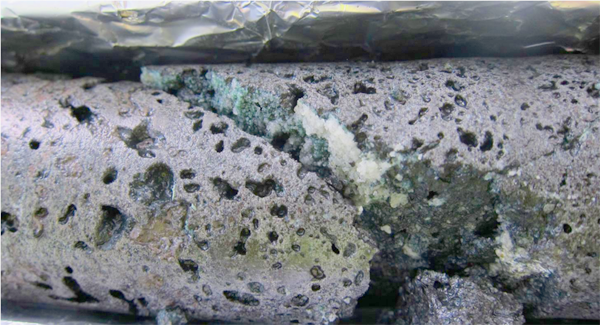
Image of calcite (white) and chlorite (cyan) formed in porous basalt due to CO2-charged water-rock interaction at the CarbFix site in Iceland. (Credit: Sandra Ósk Snæbjörnsdóttir)

Another, less widely publicised approach is to geochemically bind CO2 into solid carbonates, such as calcite (CaCO­3), dolomite (CaMgCO3), or magnesite (MgCO3). Once formed such crystalline solids are unlikely to break down to their component parts at the surface, under water or buried. One way of doing this is by the chemical weathering of rocks that contain calcium- and magnesium-rich minerals, such as feldspar (CaAl2Si2O8), olivine ([Fe,Mg]2SiO4) and pyroxene ([Fe,Mg]CaSi2O6) . Mafic and ultramafic rocks, such as basalt and peridotite are commonly composed of such minerals. One approach involves pumping the gas into a Icelandic borehole that passes through basalt and letting natural reactions do the trick. They give off heat and proceed quickly, very like those involved in the setting of concrete. In two experimental field trials 95% of injected CO2 was absorbed within 18 months. Believe it or not, ants can do the trick with crushed basalt and so too can plant roots. There have been recent experiments aimed at finding accelerants for such subsurface weathering (Wang, J. et al. 2024. CO2 capture, geological storage, and mineralization using biobased biodegradable chelating agents and seawater. Science Advances, v. 10, article eadq0515; DOI: 10.1126/sciadv.adq0515). In some respects the approach is akin to fracking. The aim is to connect isolated natural pores to allow fluids to permeate rock more easily, and to release metal ions to combine with injected CO2.

Chelating agents are biomolecules that are able to dissolve metal ions; some are used to remove toxic metals, such as lead, mercury and cadmium, from the bodies of people suffering from their effects. Naturally occurring ones extract metal ions from minerals and rocks and are agents of chemical weathering; probably used by the aforesaid ants and root systems. Wang and colleagues, based at Tohoku University in Japan, chose a chelating agent GLDA (tetrasodium glutamate diacetate –  C9H9NNa4O8) derived from plants, which is non-toxic, cheap and biodegradable. They injected CO2 and seawater containing dissolved GDLA into basaltic rock samples. The GDLA increases the rock’s porosity and permeability by breaking down its minerals so that Ca and Mg ions entered solution and were thereby able to combine with the gas to form carbonate minerals. Within five days porosity was increased by 16% and the rocks permeability increased by 26 times. Using electron microscopy the authors were able to show fine particles of carbonate growing in the connected pores. In fact these carbonate aggregates become coated with silica released by the induced mineral-weathering reactions. Calculations based on the previously mentioned field experiment in Iceland suggest that up to 20 billion tonnes of CO2 could be stored in 1.3 km3 of basalt treated in this way: about 1/25000 of the active rift system in Iceland (3.3 x 10⁴ km2 covered by 1 km of basalt lava). In 2023 fossil fuel use emitted an estimated 36.6 bllion tons of CO2 into the atmosphere.

So, why do such means of efficiently reducing the greenhouse effect not receive wide publicity by governments or the Intergovernmental Panel on Climate Change? Answers on a yellow PostIt™ please . . .

Climate changes and the mass extinction at Permian-Triassic boundary

The greatest mass extinction in Earth’s history at around 252 Ma ago snuffed out 81% of marine animal species, 70% of vertebrates and many invertebrates that lived on land. It is not known how many land plants were removed, but the complete absence of coals from the first 10 Ma of the Early Triassic suggests that luxuriant forests that characterised low-lying humid area in the Permian disappeared. A clear sign of the sudden dearth of plant life is that Early Triassic river sediments were no longer deposited by meandering rivers but by braided channels. Meanders of large river channels typify land surfaces with abundant vegetation whose root systems bind alluvium. Where vegetation cover is sparse, there is little to constrain river flow and alluvial erosion, and wide braided river courses develop (see: End-Permian devastation of land plants; September 2000. You can follow 21st century developments regarding the P-Tr extinction using the Palaeobiology index).

The most likely culprit was the Siberian Trap flood basalts effusion whose lavas emitted huge amounts of CO2 and even more through underground burning of older coal deposits (see: Coal and the end-Permian mass extinction; March 2011) which triggered severe global warming. That, however, is a broad-brush approach to what was undoubtedly a very complex event. Of about 20 volcanism-driven global warming events during the Phanerozoic only a few coincide with mass extinctions. Of those none comes close the devastation of ‘The Great Dying’, which begs the question, ‘Were there other factors at play 252 Ma ago?’ That there must have been is highlighted by the terrestrial extinctions having begun significantly earlier than did those in marine ecosystems, and they preceded direct evidence for climatic warming. Also temperature records – obtained from shifts in oxygen isotopes held in fossils – for that episode are widely spaced in time and tell palaeoclimatologists next to nothing about the details of the variation of air- and sea-surface temperature (SST) variations.

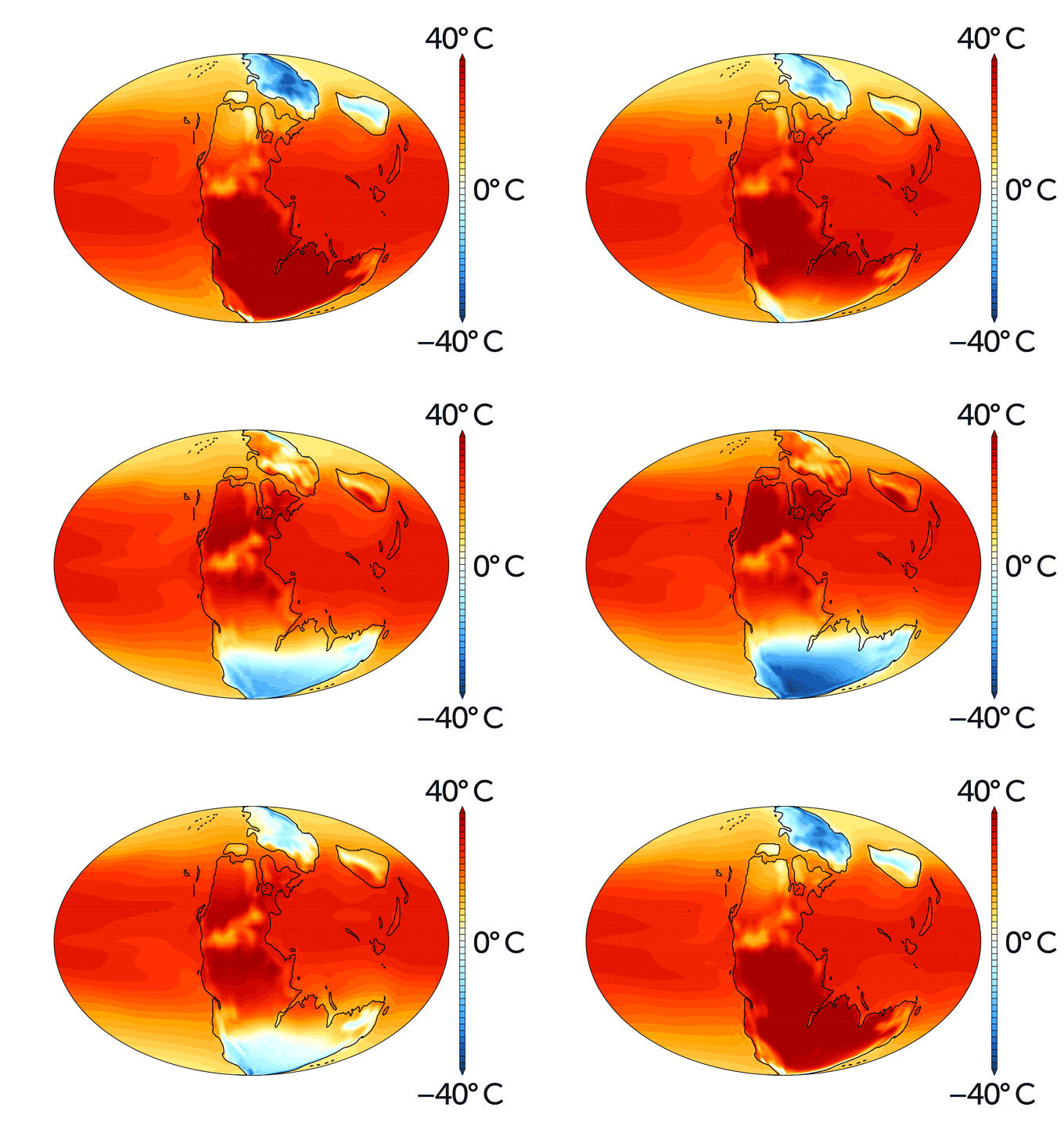
Modelled sea-surface temperatures in the tropics in the early stages of Siberian Trap eruptions with atmospheric CO¬2 at 857 ppm – twice today’s level. (Credit: Sun et al., Fig. 1A)

Earth at the end of the Permian was very different from its current wide dispersal of continents and multiple oceans and seas. Then it was dominated by Pangaea, a single supercontinent that stretched almost from pole to pole, and a surrounding vast ocean known as Panthalassa. Geoscientists from China, Germany, Britain and Austria used this simple palaeogeography and the available Early Triassic greenhouse-gas and  palaeo-temperature data as input to a climate prediction model (HadCM3BL) (Yadong Sun and 7 others 2024. Mega El Niño instigated the end-Permian mass extinction. Science 385, p. 1189–1195; DOI: 10.1126/science.ado2030  – contact yadong.sun@cug.edu.cn for PDF).. The computer model was developed by the Hadley Centre of the UK Met Office to assess possible global outcomes of modern anthropogenic global warming. It assesses heat transport by atmospheric flow and ocean currents and their interactions. The researchers ran it for various levels of atmospheric CO2 concentrations over the estimate 100 ka duration of the P-Tr mass extinction.

The pole-to-pole continental configuration of Pangaea lends itself to equatorial El Niño and El Niña type climatic events that occur today along the Pacific coast of the Americas, known as the El Niño-Southern Oscillation. In the first, warm surface water builds-up in the eastern tropical Pacific Ocean. It then then drifts westwards to allow cold surface water to flow northwards along the Pacific shore of South America to result in El Niña. Today, this climatic ‘teleconnection’ not only affects the Americas but also winds, temperature and precipitation across the whole planet. The simpler topography at the end of the Permian seems likely to have made such global cycles even more dominant.

Sun et al’s simulations used stepwise increases in the atmospheric concentration of CO2 from an estimated  412 parts per million (ppm) before the eruption of the Siberian Traps (similar to those today) to a maximum of 4000 ppm during the late-stage magmatism that set buried coals ablaze. As levels reached 857 ppm SSTs peaked at 2 °C above the mean level during El Niño events and the cycles doubled in length. Further increase in emissions led to greater anomalies that lasted longer, rising to 4°C above the mean at 4000 ppm. The El Niña cooler parts of the cycle steadily became equally anomalous and long lasting. This amplification of the 252 Ma equivalent of the El Niño-Southern Oscillation would have added to the environmental stress of an ever increasing global mean surface temperature.  The severity is clear from an animation of mean surface temperature change during a Triassic ENSO event.

Animation of monthly average surface temperatures across the Earth during an ENSO event at the height of the P-Tr mass extinction. (Credit: Alex Farnsworth, University of Bristol, UK)

The results from the modelling suggest increasing weather chaos across the Triassic Earth, with the interior of Pangaea locked in permanent drought. Its high latitude parts would undergo extreme heating and then cooling from 40°C to -40°C during the El Niño- El Niña cycles. The authors suggest that conditions on the continents became inimical for terrestrial life, which would be unable to survive even if they migrated long distances. That can explain why terrestrial extinctions at the P-Tr boundary preceded those in the global ocean. The marine biota probably succumbed to anoxia (See: Chemical conditions for the end-Permian mass extinction; November 2008)

There is a timely warning here. The El Niño-Southern Oscillation is becoming stronger, although each El Niño is a mere 2 years long at most, compared with up to 8 years at the height of the P-Tr extinction event. But it lay behind the record 2023-2024 summer temperatures in both northern and southern hemispheres, the North American heatwave of June 2024 being 15°C higher than normal. Many areas are now experiencing unprecedentedly severe annual wildfires. There also finds a parallel with conditions on the fringes of Early Triassic Pangaea. During the early part of the warming charcoal is common in the relics of the coastal swamps of tropical Pangaea, suggesting extensive and repeated wildfires. Then charcoal suddenly vanishes from the sedimentary record: all that could burn had burnt to leave the supercontinent deforested.

See also: Voosen, P. 2024. Strong El Niños primed Earth for mass extinction. Science 385, p. 1151; DOI: 10.1126/science.z04mx5b; Buehler, J. 2024. Mega El Niños kicked off the world’s worst mass extinction. ScienceNews, 12 September 2024.

Milankovich precession and the Palaeocene-Eocene Thermal Maximum

About 56 Ma ago there occurred some of the most dramatic biological changes since the mass extinction at the Cretaceous-Palaeogene boundary. They included rapid expansion and diversification of mammals and land plants, and a plunge in the number of deep-water foraminifera. Global cooling from the Cretaceous hothouse was rudely reversed by sudden global warming of about 5 to 10°C. Some climatologists have ascribed bugbear status to the Palaeocene-Eocene Thermal Maximum (PETM) as a possible scenario for future anthropogenic global warming. The widely accepted cause is a massive blurt into the Palaeocene atmosphere of greenhouse gases, but what caused it is enthusiastically debated. The climate shift is associated with a sudden decrease in the proportion of 13C in marine sediments: a negative spike in δ13C. Because photosynthesis favours the lighter 12C, organic matter has a low δ13C, so a great deal of buried organic carbon may have escaped from the ocean floor, most likely in the form of methane gas. However, massive burning of living terrestrial biomass would produce the same carbon-isotope signal, but absence of evidence for mass conflagration supports methane release. Methane is temporarily held in marine sediments in the form of gas hydrate (clathrate), an ice-like solid that forms at low temperatures on the deep seafloor. Warming of deep sea water or a decrease in pressure, if sea level falls, destabilise clathrates thereby releasing methane gas: the ‘clathrate gun hypothesis’. The main issue is what mechanism may have pulled the trigger for a monstrous methane release.

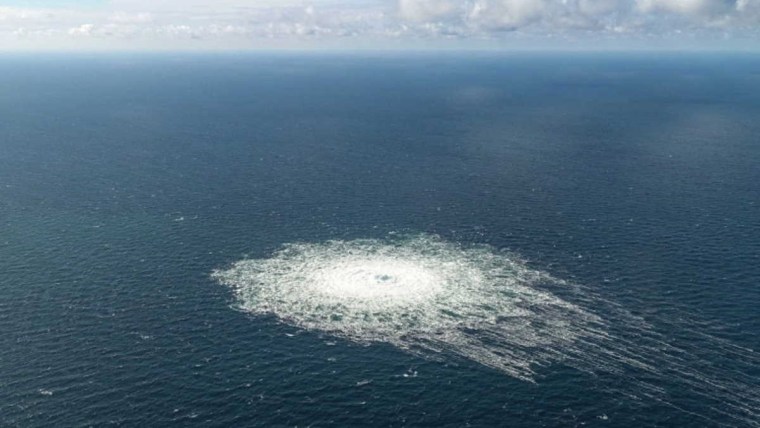
Massive leak of natural gas – mainly methane – off Sweden in the Baltic Sea, from the probably sabotaged Nord Stream pipeline. (Source: Swedish coastguard agency)

Many have favoured a major igneous event. Between 55.0 and 55.8 Ma basaltic magmatism– continuing today in Iceland – formed the North Atlantic Igneous Province. It involved large-scale intrusion of sills as well as outpourings of flood basalts and coincided with the initial rifting of Greenland from northern Europe (see: Smoking gun for end-Palaeocene warming: an igneous connection; July/August 2004). The occurrence of impact ejecta in end-Palaeocene sediments off the east coast of the US has spawned an extraterrestrial hypothesis for the warming, which could account for the negative spike in δ13C as the product of a burning terrestrial biosphere (see: Impact linked to the Palaeocene-Eocene boundary event; October 2016). Less headline-grabbing is the possibility that the event was part and parcel of the Milankovich effect: an inevitability in the complex interplay between the three astronomical components that affect Earth’s orbital and rotational behaviour: eccentricity, axial tilt and precession. A group of geoscientists from China and the US, led by Mingsong Li of Peking University, have investigated in minute detail the ups and downs of δ13C around 56 Ma in drill cores recovered from a sequence of Palaeocene and Eocene continental-shelf sediments in Maryland, USA (Li, M., Bralower, T.J. et al. 2022. Astrochronology of the Paleocene-Eocene Thermal Maximum on the Atlantic Coastal Plain. Nature Communications, v. 13, Article 5618; DOI: 10.1038/s41467-022-33390-x).

The study involved sampling sediment for carbon- and oxygen-isotope analysis at depth intervals between 3 and 10 cm over a 35 m section through the lower Eocene and uppermost Palaeocene. Calcium abundances in the core were logged at a resolution of 5 mm using an X-ray fluorescence instrument. The results link to variations in CaCO3 in the sediments across the PETM event. Another dataset involves semi-continuous measurements of magnetic susceptibility (MS) along the core. These measurements are able to indicate variations in delivery to the ocean of dissolved calcium and detrital magnetic minerals as climate and continental weathering vary through time. They are widely known to be good recorders of Milankovich cycles. After processing, the Ca and MS data sets show cyclical fluctuations relative to depth within the cores. ‘Tuning’ their frequencies to the familiar time series of Milankovich astronomical climate forcing reveals a close match to what would be expected if the climate fluctuations were paced by the 26 ka axial precession signal. My post of 17 June 2022 about the influence of precession over ‘iceberg armadas’ during the Pleistocene might be useful to re-read in this context. This correlation enabled the researchers to convert depth in the cores to time, so that the timing of fluctuations in carbon- and oxygen-isotope data that the PETM had created could be considered against various hypotheses for its cause. The ‘excursions’ of both began at the same time and reached the maxima of their changes from Palaeocene values over about 6,000 years. The authors consider that is far too long to countenance the release of methane as a result of asteroidal impact, or by massive burning of terrestrial vegetation. The other option that the beginning of the North Atlantic Igneous Province had been the trigger may also be ruled out on two grounds: the magmatism began earlier, and it continued for far longer. The onset of the PETM coincides with an extreme in precession-related climatic forcing. So Li et al. consider that a quirk in the Milankovich Effect could have played a role in triggering massive methane release. This might also explain features of the global calcium record in seafloor sediments as results of a brief period of ocean acidification during the PETM. Such an event would play havoc with carbonate-secreting organisms, such as foraminifera, by lowering the dissolved carbonate ion content on which they depend for their shells: hence their suffering considerable extinction. Of course, the other elements of astronomical forcing – eccentricity and axial tilt – would also have been operating on global climate at the time.  The long-term 100 and 405 ka eccentricity cycles may have played a role in amplifying warming, which may have resulted in increased burial of organic carbon and thus the amount of methane buried beneath the seabed.

Climate change reducing Earth’s albedo

According to a new study (Goode, P. R.et al. 2021. Earth’s albedo 1998–2017 as measured from earthshine. Geophysical Research Letters, v. 48, article e2021GL094888; DOI: 10.1029/2021GL094888) the ability of the Earth to reflect solar radiation back into space has been decreasing significantly over the last two decades. The conclusion has arisen from measurements of the brightness of the lunar surface. A new Moon is barely visible, apart from a thin sliver illuminated by the Sun. Its overall faint brightness is due to sunlight reflected from the Earth’s surface that faces the Moon: so-called ‘earthshine’. New Moons occurs when it is above the lit side of the Earth, so they appear during daylight hours. Earthshine depends on the ability of the Earth’s surface and cloud cover to reflect solar radiation, or its albedo. Albedo was high during the last ice age because of continental ice sheets and it can also occur when there is an unusually large percentage of cloud cover or a lot of dust and aerosols in the atmosphere, perhaps after a large volcanic eruption. High albedo leads to global cooling. Decreased albedo allows the atmosphere to heat up, and conspires with the greenhouse effect to produce global warming.

Philip Goode and his colleagues measured earthshine on the Moon between 1998 and 2017 to precisely determine daily, monthly, seasonal, yearly and decadal changes in terrestrial albedo. The Earth reflects roughly 30% of the solar energy that falls on it, although it varies with Earth’s rotation, depending on the proportion of land to ocean that is sunlit. Over the two decades earthshine decreased gradually by ~0.5 W m-2, indicating a 0.5% decrease in Earth’s albedo and a corresponding increase in the amount of solar energy received at the land and ocean surfaces. To put this in perspective the estimated warming from anthropogenic greenhouse emissions over the same period increased by just a little more (0.6 W m-2). Albedo decrease is reinforcing the greenhouse effect.

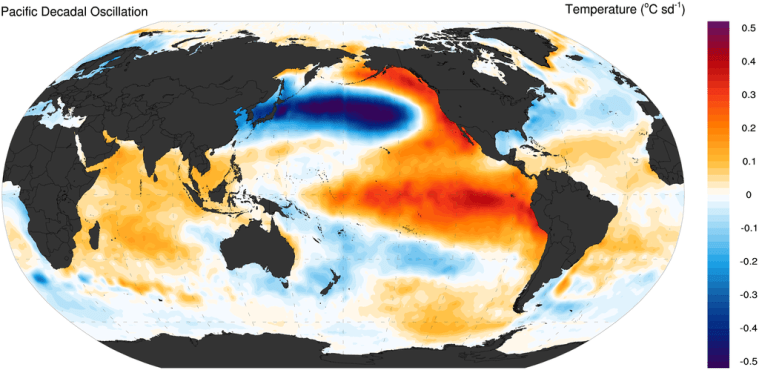
Sea-surface temperature anomalies over the Pacific Ocean during a ‘positive’ phase of the Pacific Decadal Oscillation – reversal to a ‘negative’ phase cools the eastern Pacific and warms the west (Credit: Wikipedia)

Although it might seem that increased seasonal melting of polar sea ice would have the main effect on albedo, this is not borne out by the earthshine data. What is strongly implicated is a decrease over the Eastern Pacific Ocean of highly reflective low-altitude clouds. That might seem counterintuitive, since warming of the sea surface increases evaporation, but the reduced low-cloud cover has been measured from satellites. Many scientists and most climate-change deniers have thought that an increase in cloud cover at low latitudes and thus albedo would moderate surface warming. The opposite seems to be happening. The key may lie in one of the Earth’s largest climate phenomena, the Pacific Decadal Oscillation (PDO). This has a major effect on global climate through long-distance connections (teleconnections) to other climatic processes. The satellite data hint at the changes in albedo of the Western Hemisphere having been related to a long-term reversal in the PDO. The Earth’s climate system increasingly reveals its enormous complexity.

See also: Earth is dimming due to climate change, Science Daily, 30 September 2021.

Apocalypse Soon: Will current global warming trigger a mass extinction?

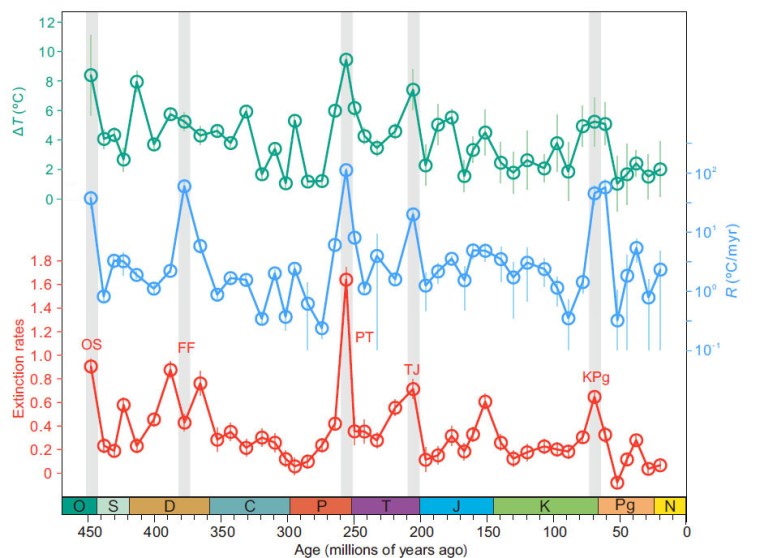
Since the start of 2020 I doubt there has been much field research. But such a vast amount of data has been amassed over the years that there must be opportunities to keep the academic pot boiling. One way is to look for new correlations between different kinds of data. For instance matching the decades-old time series of extinctions with those of other parameters that have changed over geological time. At a time of growing concern about anthropogenic climate change a group based at the State Key Laboratory of Biogeology and Environmental Geology, at China University of Geosciences, Wuhan have checked the extinction rates of marine fossils over the last 450 Ma against variations in sea-surface temperature (Song, H. et al 2021. Thresholds of temperature change for mass extinctions. Nature Communications, v. 12, Article number 4694; DOI: 0.1038/s41467-021-25019-2).

Extinction data are usually presented in time ‘bins’ based on the number of disappearances of fossil genera in one or a number of geological Stages – the finest divisions of the stratigraphic column. The growing data set for sea-surface temperatures derived using oxygen isotopes from marine fossil shells is more continuous, being derived from many different layers of suitable sedimentary rock within a Stage. Clearly, the two kinds of data have to be expressed in a similar way to check for correlations. Haijun Song and co-workers converted both the extinction and temperature time series to 45 time ‘bins’, each around 10 Ma long. They express the binned climatic data in two ways: as the largest temperature change (°C) and the highest rate of temperature change (°C Ma-1) within each bin. That is, they expressed to some extent the greater continuity of seawater temperature data as well as matching them to those for extinctions.

Changes since the end of the Ordovician: red = extinction rate in time bins; green = the greatest magnitude of change in temperature in each bin; blue- the greatest rate of temperature change in each bin. Grey bars show mass extinctions (Credit: Song et al., Fig 1)

There are good correlations between the climatic and extinction data, particularly for mass extinctions. Bearing in mind that mass extinctions take place far more rapidly than can be expressed with 10 Ma time bins, the authors were concerned that bias could creep into the binned extinction data. They were able to discount this by examining both data sets in finer detail at the times of the ‘Big 5’ extinctions. Earlier research had identified warming episodes around the times of each mass extinction, often implicating greenhouse-gas emissions from Large Igneous Provinces. Yet there are other factors that may have influenced the 7 ‘lesser’ mass extinctions in the fossil record. The authors are sufficiently confident in the correlations they have revealed to suggest thresholds that seem to have launched major mass extinctions: greater than 5.2 °C and 10 °C Ma-1 for magnitudes and rates of sea-surface temperature change, respectively.

In the context of the modern climate, the data analysis predicts that a rise of 5.2 °C above the preindustrial mean global temperature spells extinctions of ‘Big Five’ magnitude. The rate of temperature increase since 1880 – 0.08 ° per decade – is hugely faster than that expressed by the data that span the last 450 Ma. This is more alarming than the stark Sixth Report of the Intergovernmental Panel on Climate Change IPCC released on 9 August 2021.

Climate change has shifted Earth’s poles

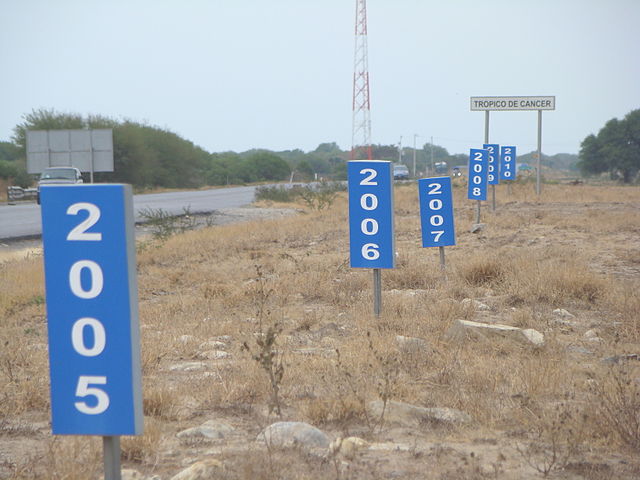
The shifting position of the Tropic of Cancer in Mexico due to nutation from 2005 to 2010 (Credit: Roberto González, Wikimedia Commons)

First suggested by Isaac Newton and confirmed from observations by Seth Chandler in 1891, the Earth’s axis of rotation and thus its geographic poles wander in much the same manner as does the axis of a gyroscope, through a process known as nutation. The best-known movement of the poles – Chandler wobble – results in a change of about 9 metres in the poles’ positions every 433 days, which describes a rough circle around the mean position of each pole. Every 18.6 years the orbital behaviour of the Moon results in a substantially larger shift, illustrated by a shift in the position of the circles of latitude, as above. Essentially, nutation results from the combined effects of gravitational forces imposed by other bodies. The axial precession cycle of 26 thousand years that is part of the Milankovich effect on long-term climate forcing is a result of nutation. But the Earth’s own gravitational field changes too, as mass within and upon it shifts from place to place. So mantle convection and plate tectonics inevitably change Earth’s mode of rotation, as do changes in the Earth’s molten iron core.

The most sensitive instrument devoted to measuring changes in Earth’s gravity is the tandem of two satellites known as the Gravity Recovery and Climate Experiment or GRACE. Among much else, GRACE has revealed the rate of withdrawal of groundwater from aquifers in Northern India and areas of mass deficit over the Canadian Shield that resulted from melting of its vast ice sheet since 18 ka ago (see: Ice age mass deficit over Canada deduced from gravity data, July 2007). Further GRACE data have now confirmed that more recent melting of polar glaciers due to global warming underlie an unusual reversal and acceleration of polar wandering since the 1990s (Deng, S. et al. 2021. Polar drift in the 1990s explained by terrestrial water storage changes. Geophysical Research Letters, v. 48, online article e2020GL092114; DOI: 10.1029/2020GL092114). In 1995 polar drift changed from southwards to eastwards, and increased by 17 times from its mean speed from 1981 to 1995. That tallies with an increase in the flow of glacial meltwater from polar regions and also with changes in the mass balance of surface and subsurface water at lower latitudes, especially in India, the USA and China where groundwater pumping for irrigation is on a massive scale.

Clearly, human activity is not only changing climate, but also our planet’s astronomical behaviour. That connection, in itself, is enough to set alarm bells ringing, even though the axial shift’s main tangible effect is to change the length of the day by a few milliseconds. Polar wandering has been documented for the last 176 years. Conceivably, data on shifts in past direction and speed may allow climatic changes throughout the industrial revolution to be assessed independently of meteorological data and on a whole-planet basis.

Ses also: Climate has shifted the axis of the Earth (EurekaAlert, 22 April 2021)

Global warming: an important revision

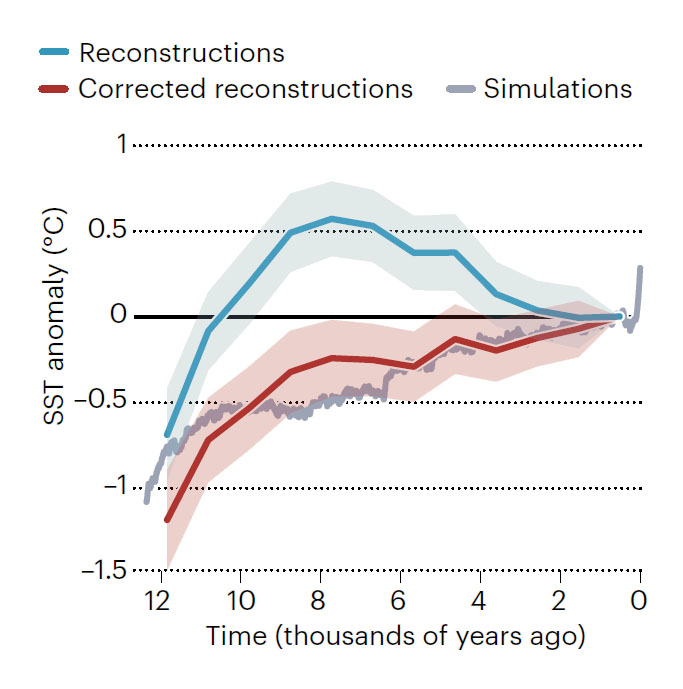
Part of the turmoil surrounding the issue of anthropogenic global warming hinges on whether or not observed changes in annual mean global temperature since the Industrial Revolution may be due to natural climatic cycles similar to those that operated previously during the Holocene Epoch. Actual measurements of temperatures of the air, sea surface and so on date only as far back at the early 18th century when thermometers were invented. Getting an idea of natural climate change through the 11.65 thousand years since the end of the last period of extensive glaciation depends on a variety of indirect measurements or proxies for temperature. For sea-surface temperature (SST) the proxy of choice is based on the way that surface-dwelling organisms, specifically planktic foraminifera, extract magnesium and calcium from sea water to construct their tests (shells). The warmer the sea surface the more magnesium is incorporated as a trace element into the calcium carbonate that forms their tests. The Mg/Ca ratio in planktic foram tests recovered from sea-floor sediment layers changes in a reliably precise fashion with warming and cooling. Following the Younger Dryas frigid millennium this proxy suggests that the average sea-surface temperature at mid-latitudes in the North Atlantic rose to a maximum of 0.5°C above the present value between 10 to 6 thousand years ago. After this Holocene Climate Optimum the sea surface seems to have cooled until very recently. Much the same pattern has been recorded in sediment cores from many parts of the world. Another approach is based on the varying amount of solar heating modelled by the Milankovich theory of astronomical climatic forcing and a variety of other forcing factors, such as albedo changes and the greenhouse effect. The two sets of data, one measured the other based on well-accepted simulations, do not agree; the modelling suggests a steady rise in SST throughout the Holocene and no climatic optimum. This conundrum either casts doubt on computer modelling of climate forcing, otherwise reliable on the broader time scale, or on some unsuspected aspect of the Mg/Ca palaeothermometer. The second could involve some kind of bias.

Plots of global mean sea-surface temperature estimates during the Holocene: blue – based on the Mg/Ca ratios in the tests of planktic foraminifera; red – the Mg/Ca data corrected for seasonal bias (the pale blue and pink areas encompass the full range of mid-latitude marine records); grey – modelling based on all potential forcing factors, including anthropogenic greenhouse emissions. (credit: Jennifer Hertzberg, 2021; Fig 1)

Samatha Bova of Rutgers University, USA, and colleagues from the US and China have examined the possibility of seasonal bias in estimates of SSTs from West Pacific ocean floor sediment cores off New Guinea  (Bova, S. et al. 2021. Seasonal origin of the thermal maxima at the Holocene and the last interglacialNature, v. 589, p. 548–553; DOI: 10.1038/s41586-020-03155-x). First they examined the Mg/Ca proxy record from the last, Eemian interglacial episode (128-115 ka), on the grounds that astronomical modelling indicated much stronger seasonal contrasts in solar warming during that period, whereas other forcing factors were comparatively weak. By calculating the varying sensitivity of the older Mg/Ca record to seasonal factors they were able to devise a method of correcting such records for seasonal bias and apply it to the Holocene data from northeast New Guinea. The corrected Holocene SST record lacks the previously suspected climate optimum and its peak at ~8000 years ago. Instead, it reveals a continuous warming trend throughout the Holocene. The early part is far cooler than previously indicated by uncorrected SST thermometry. That may have resulted from the increased reflection of solar radiation – albedo forcing – from a larger area of remnant ice sheets on high-latitude parts of continents than was present during the warmer early-Eemian interglacial. Final melting of the great ice sheets of the Northern Hemisphere took until about 6500 years ago, when albedo effects would be roughly the same as at present. Thereafter, rising levels of atmospheric greenhouse gases warmed the planet towards modern levels.

Bova et al’s findings fundamentally change the context for modelling future climate change, and also for the interpretation of all previous interglacials, palaeotemperature records from which remain uncorrected. It seems likely that none of them had an early warm episode. As regards the future; climate modelling will have to change its parameters. For climate-change sceptics; two of their favourite arguments have been questioned. There are no longer signs of major, natural  ups and downs in the early Holocene that might suggest that current warming is simply repeating such fluctuations. The other aspect of the Holocene climate conundrum, that greenhouse gases increased naturally since 6000 years ago while global mean SSTs declined, has been removed from the sceptics’ arguments

See also: Hertzberg, J. 2021. Palaeoclimate puzzle explained by seasonal variation. Nature, v. 589, p. 521-522; DOI: 10.1038/d41586-021-00115-x. Kiefer, P. 2021. Earth used to be cooler than we thought, which changes our math on global warming, Popular Science, 28 January 2021

Thawing permafrost, release of carbon and the role of iron

Projected shrinkage of permanently frozen ground i around the Arctic Ocean over the next 60 years

Global warming is clearly happening. The crucial question is ‘How bad can it get?’ Most pundits focus on the capacity of the globalised economy to cut carbon emissions – mainly CO2 from fossil fuel burning and methane emissions by commercial livestock herds. Can they be reduced in time to reverse the increase in global mean surface temperature that has already taken place and those that lie ahead? Every now and then there is mention of the importance of natural means of drawing down greenhouse gases: plant more trees; preserve and encourage wetlands and their accumulation of peat and so on. For several months of the Northern Hemisphere summer the planet’s largest bogs actively sequester carbon in the form of dead vegetation. For the rest of the year they are frozen stiff. Muskeg and tundra form a band across the alluvial plains of great rivers that drain North America and Eurasia towards the Arctic Ocean. The seasonal bogs lie above sediments deposited in earlier river basins and swamps that have remained permanently frozen since the last glacial period. Such permafrost begins at just a few metres below the surface at high latitudes down to as much as a kilometre, becoming deeper, thinner and more patchy until it disappears south of about 60°N except in mountainous areas. Permafrost is melting relentlessly, sometimes with spectacular results broadly known as thermokarst that involves surface collapse, mudslides and erosion by summer meltwater.

Thawing permafrost in Siberia and associated collapse structures

Permafrost is a good preserver of organic material, as shown by the almost perfect remains of mammoths and other animals that have been found where rivers have eroded their frozen banks. The latest spectacular find is a mummified wolf pup unearthed by a gold prospector from 57 ka-old permafrost in the Yukon, Canada. She was probably buried when a wolf den collapsed. Thawing exposes buried carbonaceous material to processes that release CO, as does the drying-out of peat in more temperate climes. It has long been known that the vast reserves of carbon preserved in frozen ground and in gas hydrate in sea-floor sediments present an immense danger of accelerated greenhouse conditions should permafrost thaw quickly and deep seawater heats up; the first is certainly starting to happen in boreal North America and Eurasia. Research into Arctic soils had suggested that there is a potential mitigating factor. Iron-3 oxides and hydroxides, the colorants of soils that overlie permafrost, have chemical properties that allow them to trap carbon, in much the same way that they trap arsenic by adsorption on the surface of their molecular structure (see: Screening for arsenic contamination, September 2008).

But, as in the case of arsenic, mineralogical trapping of carbon and its protection from oxidation to CO2 can be thwarted by bacterial action (Patzner, M.S. and 10 others 2020. Iron mineral dissolution releases iron and associated organic carbon during permafrost thaw. Nature Communications, v. 11, article 6329; DOI: 10.1038/s41467-020-20102-6). Monique Patzner of the University of Tuebingen, Germany, and her colleagues from Germany, Denmark, the UK and the US have studied peaty soils overlying permafrost in Sweden that occurs north of the Arctic Circle. Their mineralogical and biological findings came from cores driven through the different layers above deep permafrost. In the layer immediately above permanently frozen ground the binding of carbon to iron-3 minerals certainly does occur. However, at higher levels that show evidence of longer periods of thawing there is an increase of reduced iron-2 dissolved in the soil water along with more dissolved organic carbon – i.e. carbon prone to oxidation to carbon dioxide. Also, biogenic methane – a more powerful greenhouse gas – increases in the more waterlogged upper sediments. Among the active bacteria are varieties whose metabolism involves the reduction of insoluble iron in ferric oxyhdroxide minerals to the soluble ferrous form (iron-2). As in the case of arsenic contamination of groundwater, the adsorbed contents of iron oxyhydroxides are being released as a result of powerful reducing conditions.

Applying their results to the entire permafrost inventory at high northern latitudes, the team predicts a worrying scenario. Initial thawing can indeed lock-in up to tens of billion tonnes of carbon once preserved in permafrost, yet this amounts to only a fifth of the carbon present in the surface-to-permafrost layer of thawing, at best. In itself, the trapped carbon is equivalent to between 2 to 5 times the annual anthropogenic release of carbon by burning fossil fuels. Nevertheless, it is destined by reductive dissolution of its host minerals to be emitted eventually, if thawing continues. This adds to the even vaster potential releases of greenhouse gases in the form of biogenic methane from waterlogged ground. However, there is some evidence to the contrary. During the deglaciation between 15 to 8 thousand years ago – except for the thousand years of the Younger Dryas cold episode – land-surface temperatures rose far more rapidly than happening at present. A study of carbon isotopes in air trapped as bubbles in Antarctic ice suggests that methane emissions from organic carbon exposed to bacterial action by thawing permafrost were much lower than claimed by Patzner et al. for present-day, slower thawing (see: Old carbon reservoirs unlikely to cause massive greenhouse gas release, study finds. Science Daily, 20 February 2020) – as were those released by breakdown of submarine gas hydrates.