
The first anatomically modern humans (AMH) known to have left their remains outside of Africa lived about 200 ka ago in Greece and the Middle East. They were followed by several short-lived migrations that got as far as Europe, leaving very few fossils or artefacts. Over that time Neanderthals were continually present. Migration probably depended on windows of opportunity controlled by pressures from climatic changes in Africa and sea level being low enough to leave their heartland: perhaps as many as 8 or 9 before 70 ka, when continuous migration out of Africa began. The first long-enduring AMH presence in Europe began around 47 ka ago.
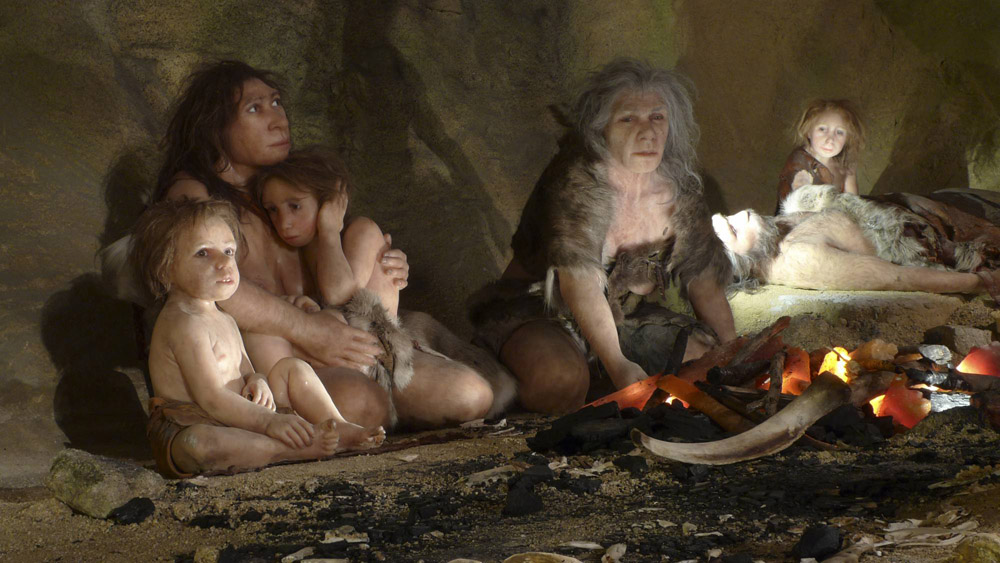
For about 7 thousand years thereafter – about 350 generations – AMH and Neanderthals co-occupied Europe. Evidence is growing that the two groups shared technology. After 40 ka there are no tangible signs of Neanderthals other than segments of their DNA that constitute a proportion of the genomes of modern non-African people. They and AMH must have interbred at some time in the last 200 ka until Neanderthals disappeared. In the same week in late 2024 two papers that shed much light on that issue were published in the leading scientific journals, Nature and Science, picked up by the world’s news media. Both stem from research led by researchers at the Max Planck Institute for Evolutionary Anthropology in Leipzig, Germany. They focus on new DNA results from the genomes of ancient and living Homo sapiens. One centred on 59 AMH fossils dated between 45 and 2.2 ka and 275 living humans (Iasi, L. M. N. and 6 others 2024. Neanderthal ancestry through time: Insights from genomes of ancient and present-day humans Science, v. 386, p. 1239-1246: DOI: 10.1126/science.adq3010. PDF available by request to leonardo_iasi@eva.mpg.de). The other concerns genomes recovered from seven AMH individuals from the oldest sites in Germany and Czechia. (Sümer, A. P. and 44 others 2024. Earliest modern human genomes constrain timing of Neanderthal admixture. Nature, online article; DOI: 10.1038/s41586-024-08420-x. PDF available by request to arev_suemer@eva.mpg.de ).
Leonardo Iasi and colleagues from the US and UK examined Neanderthal DNA segments found in more than 300 AMH genomes, both ancient and in living people, by many other researchers. Their critical focus was on lengths of such segments. Repeated genetic recombination in the descendants of those individuals who had both AMH and Neanderthal parents results in shortening of the lengths of their inherited Neanderthal DNA segments. That provides insights into the timing and duration of interbreeding. The approach used by Iasi et al. used sophisticated statistics to enrich their analysis of Neanderthal-human gene flow. They were able to show that the vast majority of Neanderthal inheritance stems from a single period of such gene flow into the common ancestors of all living people who originated outside Africa. This genetic interchange seems to have lasted for about 7 thousand years after 50 ka. This tallies quite closely with the period when fossil and cultural evidence supports AMH and Neanderthals having co-occupied Europe.

The other study, led by Arev Sümer, has an author list of 44 researchers from Germany, the US, Spain, Australia, Israel, the UK, France, Sweden, Denmark and Czechia. The authors took on a difficult task: extracting full genomes from seven of the oldest AMH fossils found in Europe, six from a cave Ranis in Germany and one from about 230 km away at Zlatý kůň in Czechia. Human bones, dated between 42.2 and 49.5 ka, from the Ranis site had earlier provided mitochondrial DNA that proved them to be AMH. A complete female skull excavated from Czechia site, dated at 45 ka had previously yielded a high quality AMH genome. Interestingly that carried variants associated with dark skin and hair, which perhaps reflect African origins. Neanderthals probably had pale skins and may have passed on to the incomers genes associated with more efficient production of vitamin D in the lower light levels of high latitudes and maybe immunity to some diseases. Both sites contain a distinct range of artefacts known as the Lincombian-Ranisian-Jerzmanowician technocomplex. This culture was once regarded as having been made by Neanderthals, but is now linked by the mtDNA results to early AMH. Such artefacts occur across central and north-western Europe. The bones from both sites are clearly important in addressing the issue of Neanderthal-AMH cultural and familial relationships.
The new, distinct genetic data from the Ranis and Zlatý kůň individuals reveals a mother and her child at Ranis. The female found at Zlatý kůň had a fifth- to sixth-degree genetic relationship with Ranis individuals: she may have been their half first cousin once removed. This suggests a wider range of communications than most people in medieval Europe would have had. The data from both sites suggests that the small Ranis-Zlatý kůň population – estimated at around 200 individuals – diverged late from the main body of AMH who began to populate Asia and Australasia at least 65 ka ago. Their complement of Neanderthal genetic segments seems to have originated during their seven thousand-year presence in Europe. Though they survived through 350 generations it seems that their genetic line was not passed on within and outside of Europe. They died out, perhaps during a sudden cold episode during the climatic decline towards the Last Glacial Maximum. We know that because their particular share of the Neanderthal genome does not crop up in the wider data set used by Iasi et al., neither in Europe and West Asia nor in East Asia. That they survived for so long may well have been due to their genetic inheritance from Neanderthals that made them more resilient to what, for them, was initially an alien environment. It is not over-imaginative to suggest that both populations may have collaborated over this period. But neither survived beyond about 40 ka..
Widely publicised as they have been, the two papers leave much more unanswered than they reveal. Both the AMH-Neanderthal relationship and the general migration out of Africa are shown to be more complex than previously thought by palaeoanthropologists. For a start, the descendants today of migrants who headed east carry more Neanderthal DNA that do living Europeans, and it is different. Where did they interbreed? Possibly in western Asia, but that may never be resolved because warmer conditions tend to degrade genetic material beyond the levels that can be recovered from ancient bones. Also, some living people in the east carry both Neanderthal and Denisovan DNA segments. Research Centres like the Max Planck Institute for Evolutionary Anthropology will clearly offer secure employment for some time yet!




 Earth-logs