Life’s origins: a new variant on Darwin’s “warm little pond”

In 1871 Charles Darwin wrote to his friend Joseph Hooker, a botanist:

“It is often said that all the conditions for the first production of a living organism are now present, which could ever have been present. But if (& oh what a big if) we could conceive in some warm little pond with all sorts of ammonia & phosphoric salts, light, heat, electricity &c present, that a protein compound was chemically formed, ready to undergo still more complex changes, at the present day such matter wd be instantly devoured, or absorbed, which would not have been the case before living creatures were formed.”

There have been several attempts over the last 150 years, starting with Miller and Urey in 1952, to create physical analogues for this famous insight (See:  The origin of life on Earth: new developments). What such a physico-chemical environment on the early Earth could have been like has also been a fertile topic for discussion: literally warm pools at the surface; hot springs; seawater around deep-ocean hydrothermal vents; even droplets in clouds in the early atmosphere. Attention has recently moved to Darwin’s original surface pools through examination of modern ones. The most important content would be dissolved phosphorus compounds, because that element helps form the ‘backbone’ of the helix structure of RNA and DNA. But almost all natural waters today have concentrations of phosphorus that are far too low for such linkages to form by chemical processes, and also to produce lipids that form cell membranes and the ATP (adenosine triphosphate) so essential in all living metabolism. Phosphorus availability has been too low for most of geological time simply because living organisms are so efficient at removing what they need in order to thrive.

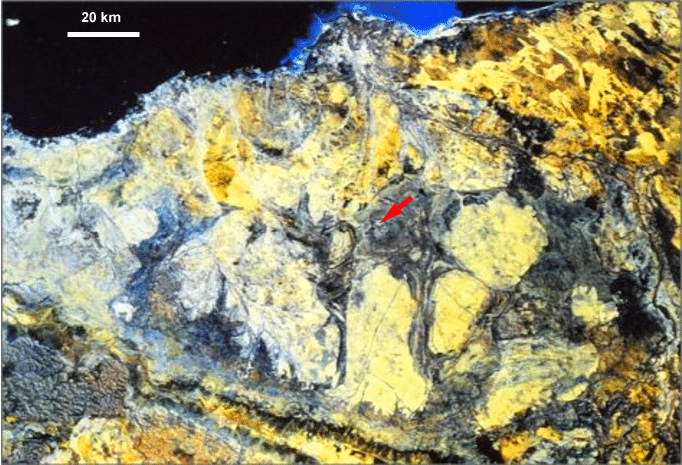
Mono Lake in semi-arid eastern California – a ‘soda lake’- is so concentrated by evaporation that pillars of carbonate grow above its surface

For the first life to form, phosphorus would somehow have had to be concentrated in watery solution as phosphate ions – [PO ₄]³⁻. The element’s source, like that of all others in the surface environment, is in magmas and the volcanic rocks that they form. Perhaps early chemical weathering or reactions between lavas and hydrothermal fluids could have released phosphate ions to solution from a trace mineral present in all lavas: the complex phosphate apatite (Ca10(PO4)6(OH,F,Cl)2). But that would still require extreme concentration for it to be easily available to the life-forming process. In January 2024 scientists at the University of Washington in Seattle, USA (Haas, S. et al. 2024. Biogeochemical explanations for the world’s most phosphate-rich lake, an origin-of-life analog. Nature Communications, v. 5, article 28; DOI: 10.1038/s43247-023-01192-8) showed that the highest known concentrations of dissolved phosphorus occur in the so called “soda lakes” that are found in a variety of modern environments, from volcanically active continental rifts to swampy land. They contain dissolved sodium carbonate (washing soda) at very high concentrations so that they are extremely alkaline and often highly salty. Usually, they are shallow and have no outlet so that dry weather and high winds evaporate the water. Interestingly, the streams that flow into them are quite fresh, so soda lakes form where evaporation exceeds annual resupply of rainwater.

The high evaporation increases the dissolved content of many ions in such lakes to levels high enough for them for them to combine and precipitate calcium, sodium and magnesium as carbonates. In some, but not all soda lakes, such evaporative concentration also increases their levels of dissolved phosphate ions higher than in any other bodies of water. That is odd, since it might seem that phosphate ions should combine with dissolved calcium to form solid calcium phosphate making the water less P-rich.  Haas et al. found that lakes which precipitate calcium and magnesium together in the form of dolomite (Ca,Mg)CO3 have high dissolved phosphate. Removal of Ca and other metal ions through bonding to carbonate (CO3) deprives dissolved phosphate ions in solution of metal ions with which they can bond. But why has dissolved phosphate not been taken up by organisms growing in the lakes: after all, it is an essential nutrient. The researchers found that some soda lakes that contain algal mats have much lower dissolved phosphate – it has been removed by the algae. But such lakes are not as salty as those rich in dissolved phosphate. They in turn contain far less algae whose metabolism is suppressed by high levels of dissolved NaCl (salt). Hass et al.’s hypothesis has now been supported by more research on soda lakes.

In an early, lifeless world phosphate concentrations in alkaline, salty lakes would be controlled by purely inorganic reactions. This strongly suggests that ‘warm little soda lakes’ enriched in dissolved sodium carbonate by evaporation, and which precipitated dolomite could have enabled phosphorus compounds to accumulate to levels needed for life to start. They might have been present on any watery world in the cosmos that sustained volcanism.

See also: Service, R.F. 2025. Early life’s phosphorus problem solved? Science, v. 387, p. 917; DOI: 10.1126/science.z78227f; Soda Lakes: The Missing Link in the Origin of Life? SciTechDaily, 26 January 2024. .

A fully revised edition of Steve Drury’s book Stepping Stones: The Making of Our Home World can now be downloaded as a free eBook

Modelling climate change since the Devonian

A consortium of geoscientists from Australia, Britain and France, led by Andrew Merdith of the University of Adelaide examines the likely climate cooling mechanisms that may have set off the two great ‘icehouse’ intervals in the last 541 Ma (Merdith, A.S. et al. 2025. Phanerozoic icehouse climates as the result of multiple solid-Earth cooling mechanisms. Science Advances, v. 11, article eadm9798: DOI: 10.1126/sciadv.adm9798). They consider the first to be the global cooling that began in the latter part of the Devonian culminating in the Carboniferous-Permian icehouse. The second is the Cenozoic global cooling to form the permanent Antarctic ice cap around 34 Ma and culminated in cyclical ice ages on the northern continents after 2.4 Ma during the Pleistocene. They dismiss the 40 Ma long, late Ordovician to early Silurian glaciation that left its imprint on North Africa and South America –  then combined in the Gondwana supercontinent. The data about two of the parameters used in their model – the degree of early colonisation of the continents by plants and their influence on terrestrial weathering are uncertain in that protracted event.  Yet the Hirnantian glaciation reached 20°S at its maximum extent in the Late Ordovician around 444 Ma to cover about a third of Gondwana: it was larger than the present Antarctic ice cap. For that reason, their study spans only Devonian and later times.

Fluctuation in evidence for the extent of glacial conditions since the Devonian: the ‘ice line’ is grey. The count of glacial proxy occurrences in each 10° of latitude through time is shown in the colour key. Credit: Merdith et al., Fig 2A.

Merdith et al. rely on four climatic proxies. The first of these comprises indicators of cold climates, such as glacial dropstones, tillites and evidence in sedimentary rocks of crystals of hydrated calcium carbonate (ikaite – CaCO3.6H2O) that bizarrely forms only at around 0°C . From such occurrences it is possible to define an ‘ice line’ linking different latitudes through geological time. Then there are estimates of global average surface temperature; low-latitude sea surface temperature; and estimates of atmospheric CO2. The ‘ice-line’ data records an additional, long period of glaciation in the Jurassic and early Cretaceous, but evidence does not extend to latitudes lower than 60°. It is regarded by Merdith et al. as an episode of ‘cooling’ rather than an ‘icehouse’. Their model assesses sources and sinks of COsince the Devonian Period.

The main natural source of the principal greenhouse gas CO2 is degassing through volcanism expelled from the mantle and breakdown of carbonate rock in subducted lithosphere. Natural sequestration of carbon involves weathering of exposed rock that releases dissolved CO2 and ions of calcium and magnesium.   A recently compiled set of plate reconstructions that chart the waxing and waning of tectonics since the Devonian Period allows them to model the tectonically driven release of carbon over time, with time scales on the order of tens to hundreds of Ma. The familiar Milanković forcing cycles on the order of tens to hundreds of ka are thus of no significance in Merdith et al.’s  broader conception of icehouse episodes  Their modelling shows high degassing during the Cretaceous, modern levels during the late Palaeozoic and early Mesozoic, and low emissions during the Devonian. The model also suggests that cooling stemmed from variations in the positions and configuration of continents over time.  Another crucial factor is the tempo of exposure of rocks that are most prone to weathering. The most important are rocks of the ocean lithosphere incorporated into the continents to form ophiolite masses. The release of soluble products of weathering into ocean basins through time acts as a fluctuating means of ‘fertilising’ so that more carbon can be sequestered in deep sediments in the form of organisms’ unoxidised tissue and hard parts made of calcium carbonates and phosphates. Less silicate weathering results in a boost to atmospheric CO2.

Only two long, true icehouse episodes emerge from the empirical proxy data, expressed by the ‘ice-line’ plots. Restricting the modelling to single global processes that might be expected to influence degassing or carbon sequestration produces no good fits to the climatic proxy data. Running the model with all the drivers “off” produces more or less continuous icehouse conditions since the Devonian. The model’s climate-related outputs thus imply that many complex processes working together in syncopation may have driven the gross climate vagaries over the last 400 Ma or so. A planet of Earth’s size without such complexity would throughout that period have had a high-CO2 warm climate. According to Andrew Merdith its fluctuation from greenhouse to icehouse conditions in the late Palaeozoic and the Cenozoic were probably due to “coincidental combination of very low rates of global volcanism, and highly dispersed continents with big mountains, which allow for lots of global rainfall and therefore amplify reactions that remove carbon from the atmosphere”.

Geological history is, almost by definition, somewhat rambling. So, despite despite the large investment in seeking a computed explanation of data drawn from the record, the outcome reflects that in a less than coherent account. To state that many complex processes working at once may have driven climate vagaries over the last 400 Ma or so, is hardly a major advance: palaeoclimatologists have said more or less the same for a couple of decades or more, but have mainly proposed single driving mechanisms. One aspect of Merdith et al.’s  results seems to be of particular interest. ‘Icehouse’ conditions seem to be rare events interspersed with broader ice-free periods. We evolved within the mammal-dominated ecosystems on the continents during the latest of these anomalous climatic episodes. And we and those ecosystems now rely on a cool world. As the supervisor of the project commented, ‘Over its long history, the Earth likes it hot, but our human society does not’.

Readers may like to venture into how some philosophers of science deal with a far bigger question; ‘Is intelligent life a rare, chance event throughout the universe?’ That is, might we be alone in the cosmos? In the same issue of Science Advances is a paper centred on just such questions (Mills, D.B. et al. 2025. A reassessment of the “hard-steps” model for the evolution of intelligent life. Science Advances, v. 11, article eads5698; DOI: 10.1126/sciadv.ads5698). It stems from cosmologist Brandon Carter’s ‘Anthropic Principle’ first developed at Nicolas Copernicus’s 500th birthday celebrations in 1973. This has since been much debated by scientists and philosophers – a gross understatement as it knocks the spots off the Drake Equation. To take the edge off what seems to be a daunting task, Mills et al. consider a corollary of the Anthropic Principle, the ‘hard steps model’. That, in a nutshell, postulates that the origin of humanity and its ability to ponder on observations of the universe required a successful evolutionary passage through a number of hard steps. It predicts that such intelligence is ‘exceedingly rare’ in the universe. Icehouse conditions are respectable candidates for evolutionary ‘hard steps’, and in the history of Earth there have been five of them.

A fully revised edition of Steve Drury’s book Stepping Stones: The Making of Our Home World can now be downloaded as a free eBook

A cure for the Great British Pothole Plague?

Anyone who read the manifestos of the mainstream political parties in the UK – there may not be many who did – would have been amused to see that all promised to resolve the plague of potholes in the countries roads, both major and minor. For decades road users have been alarmed when hitting a pothole and in some cases had damage inflicted on their vehicles, and in the case of those on two wheels, on themselves. The RAC (Royal Automobile Club) has estimated that there are, on average, six potholes per mile on Britain’s roads: the greatest density in Europe. The AA (Automobile Association) estimated that almost £0.6 billion was spent in 2024 repairing pothole-damaged vehicles. This is not a new phenomenon. Before the advent of turnpike trusts in the late 18th century, which maintained roads travelled by Britain’s mail coach services, it was not uncommon to encounter potholes up to two metres deep. Legend has it that on one such route through northern Nottinghamshire two coach horses fell into a pothole and drowned. Scottish engineer, John Loudon McAdam invented a solution around 1820: crushed stone laid on the road surface in slightly convex layers, the topmost being bonded with stone dust. This ‘macadam’ surface created cambered highways that drained rainwater to the sides and downwards. Modern roads are still based on that principle, with the addition of tar or bitumen to the top layer to produce a hard, impermeable surface, which also prevents aggregate and dust being sucked from the surface by fast moving vehicles.

A spore of the club moss Lycopodium

So, why the potholes? Several reasons: increased traffic; heavier vehicles; less maintenance; patching rather than resurfacing. Most important: the materials and the weather. Dry, hot weather softens the bitumen and drives out volatile hydrocarbons making the bitumen less plastic. The pounding of tyres in cooler weather fractures the now stiffened bitumen, mainly at microscopic scales. Wetting of the tarmac seeps water into the microfractures. The formation of ice films jacks opens the microfractures and produces more in the cold stiff bitumen, eventually to separate the particles of aggregate in the asphalt. The wearing course begins to crumble so that aggregate grains escape and scatter. Thus weakened, the top layer breaks up into larger fragments and a pit forms to join up with others so that a pothole forms and grows. Wheels of traffic bounce when they cross a pothole, the shock of which causes the centre of degradation to shift and create more cavities. Simply filling the existing potholes merely serves to create new ones: a vicious cycle that can only be broken by complete resurfacing: the traffic cones come out!.

All this has been known for well over a century by civil engineers. Around the start of the 21st century – maybe slightly earlier – it dawned on engineers that the critical problem was degradation of bitumen. A petroleum derivative, occurring naturally as surface seeps in some oilfields, bitumen is chemically complex: a combination of asphaltenes and maltenes (resins and oils). Deterioration of bitumen through evaporation, oxidation and exposure to ultraviolet radiation decreases the maltene content and stiffens the binding agent in asphalt. So the earliest attempts at reducing pothole formation centred on rejuvenation by periodically adding substitutes for maltenes to road surfaces. Diesel (gas-oil) works, but is obviously hazardous. More suitable are vegetable oils such as waste cooking oils or those produced by pyrolysis of cotton, straw, wood waste and even animal manure. The problem is getting the rejuvenators into existing asphalt surfaces: clearly, simply spraying them on the surface seems a recipe for disaster! A solution that dawned on engineers around 2005 was to make bitumen that is ‘self-healing’.

Schematic of the production of microcapsules from club moss spores to contain sunflower oil to be used in self-healing asphalt (Credit: Alpizar-Reyes, E. et al. 2022)

Simply mixing rejuvenators into bitumen during asphalt manufacture will not do the trick, for the result would be a weakened binding agent at the outset. For the last 15 years researchers have sought means of adding rejuvenators in  porous capsules, to release them as microfractures begin to form: on demand, as it were. There have been dozens of publications about experiments that found ‘sticking points’. However, in early 2025 what seems to be a viable breakthrough splashed in the British press. It was made by an interdisciplinary team of scientists from King’s College London and Swansea University, in collaboration with scientists in Chile. They chemically treated spores of Lycopodium club mosses to perforate their cell walls and clear out their contents to be replaced by sunflower oil, an effective bitumen rejuvenator. Experiments showed that such microcapsules released the oil to heal cracks in aged  bitumen samples in around an hour. Mixed into bitumen to be added to asphalt they would remain ‘dormant’ until a microfracture formed in their vicinity released it, thereby making the asphalt binder self healing.

Will such an advance finally resolve the pothole plague? It may take a while …

See: Alpizar-Reyes, E. et al. 2022. Biobased spore microcapsules for asphalt self-healing. ACS Applied Materials & Interfaces, v. 14, p. 31296-31311; DOI: 10.1021/acsami.2c07301

A fully revised edition of Steve Drury’s book Stepping Stones: The Making of Our Home World can now be downloaded as a free eBook

Early hominin dispersal in Eurasia

Evidence from Dmanisi in Georgia that Homo erectus may have been the first advanced hominin to leave Africa about 1.8 Ma ago was a big surprise (see: First out of Africa? November 2003). Remains of five individuals included one skull of an aged person who face was so deformed that he or she must have been cared for by others for many years. So, a second surprise from Dmanisi was that human empathy arose far earlier than most people believed. Since 2002 there has been only a single further find of hominin bones of such antiquity, at Longgudong in central China. For the period between 1.0 and 2.0 Ma eight other sites in Eurasia have yielded hominin remains. If finds of stone tools and evidence of deliberate butchery – cut marks on prey animals’ bones – are accepted as tell-tale signs, the Eurasian hominin record is considerably larger, and longer,. There are 11 Eurasian sites that have yielded such evidence – but no hominin remains – that are older than Longgudong: in Russia, China, the Middle East, North Africa and northern India. The oldest, at Masol in northern India is 2.6 Ma old. In January 2025 the earliest European evidence for hominin activity was reported from Grăunceanu in Romania (Curran, S.C. and 15 others 2025. Hominin presence in Eurasia by at least 1.95 million years ago. Nature Communications, v. 16, article 836; DOI: 10.1038/s41467-025-56154-9) in the form of animal bones showing clear signs of butchery, as well as stone tools, but no hominin fossils.

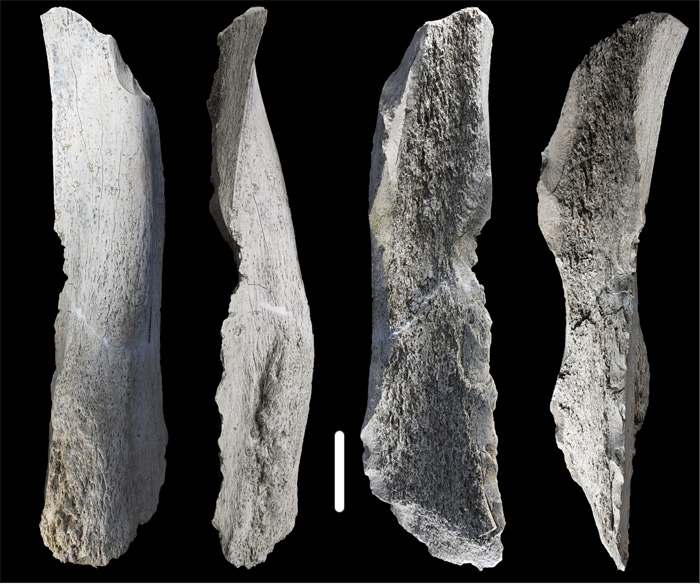
Animal bones showing cut marks from the 1.95 Ma old Grăunceanu site in Romania. (Credit: Curran et al. 2025, Figs 2A and C)

There were stone-tool makers who butchered prey in Africa as early as 3.4 Ma ago (see: Stone tools go even further back; May 2015), but without direct evidence of which hominin was involved. Several possible candidates have been suggested: Australopithecus; Kenyanthropus; Paranthropus. The earliest known African remains of H. erectus have been dated at around 2.0 Ma. So, all that can be said with some certainty about the pre-2 Ma migrants to Eurasia, until fossils of that antiquity are found, is that they were hominins of some kind: maybe advanced australopithecines, paranthropoids or early humans. Those from Longgudong and Dmanisi probably are early Homo erectus, and 2 others (1.7 and 1.6 Ma) from China have been designated similarly. Younger, pre-1.0 Ma Eurasian hominins from Israel, Indonesia, Spain and Turkey are currently un-named at the species level, but are allegedly members of the genus Homo.

So, what can be teased from the early Eurasian hominin finds? Some certainly travelled thousands of kilometres from their assumed origins in Africa, but none penetrated further north than about 50°N. Perhaps they could not cope with winters at higher latitudes, especially during ice ages. To reach as far as eastern and western Eurasia suggests that dispersal following exit from Africa would have taken many generations. There is no reason to suppose continual travel; rather the reverse, staying put in areas with abundant resources while they remained available, and then moving on when they became scarce. Climate cycles, first paced at around 40 ka (early Pleistocene) then at around 100 ka (mid Pleistocene and later), would have been the main drivers for hominin population movements, as it would have been for game and vegetation.

After about 3 Ma the 40 ka climate cyclicity evolved to greater differences in global temperature between glacial and interglacial episodes, and even more so after the mid Pleistocene transition to 100 ka cycles (see Wikipedia entry for the mid-Pleistocene Transition). Thus, it seems likely that chances of survival of dispersed bands of hominins decreased over hundreds of millennia. Could populations have survived in particularly favourable areas; i.e. those at low latitudes? If so did both culture and the hominins themselves evolve? Alternatively, was migration in a series of pulses out of Africa and then dispersal in all directions, most ending in regional extinction? Almost certainly, pressures to leave Africa would have been driven by climate, for instance by increased aridity as global temperatures waned and sea-level falls made travel to Eurasia easier. There may also have been secondary, shorter migrations within Eurasia, again driven by environmental changes. Without more data from newly discovered sites we can go little further. Within the 35 known, pre-1 Ma hominin sites there are two clusters: southern and central China, and the Levant, Turkey and Georgia. Could they yield more developments? A 2016 article in Scientific American about Chinese H. erectus finds makes particularly interesting reading in this regard.

Neanderthals and the elusive Denisovans began to establish permanent Eurasian ranges, after roughly 600 ka ago. Both groups survived until after first contact with waves of anatomically modern humans in the last 100 ka, with whom some interbred before vanishing from the record. However, evidence from the DNA of both groups suggests an interesting possibility. Before the two groups split genetically, their common ancestors (H. heidelbergensis or H. antecessor?) apparently interbred with genetically more ancient Eurasian hominins (see Wikipedia entry for Neanderthal evolution). This intriguing hint suggests that more may be discovered when substantial remains of Denisovans – i.e. more than a few teeth and small bones – are discovered and yield more DNA. My guess is such a future development will stem from analysis of early hominin remains in China, currently regarded as H. erectus. See China discovers landmark human evolution fossils. Xinhua News Agency 9 December 2024)

A fully revised edition of Steve Drury’s book Stepping Stones: The Making of Our Home World can now be downloaded as a free eBook

The origin of life on Earth: new developments

Debates around the origin of Earth’s life and what the first organism was like resemble the mythical search for the Holy Grail. Chivalric romanticists of the late 12th and early 13th centuries were pretty clear about the Grail – some kind of receptacle connected either with the Last Supper or Christ’s crucifixion – but never found it. Two big quests that engage modern science centre on how the chemical building blocks of the earliest cells arose and the last universal common ancestor (LUCA) of all living things. Like the Grail’s location, neither is likely to be fully resolved because they can only be sought in a very roundabout way: both verge on the imaginary. The fossil record is limited to organisms that left skeletal remains, traces of their former presence, and a few degraded organic molecules. The further back in geological time the more sedimentary rock has either been removed by erosion or fundamentally changed at high temperatures and pressures. Both great conundrums can only be addressed by trying to reconstruct processes and organisms that occurred or existed more than 4 billion years ago.

Artistic impression of the early Earth dominated by oceans (Credit: Sci-news.com)

In the 1950s Harold Urey of the University of Chicago and his student Stanley Miller mixed water, methane, ammonia and hydrogen sulfide in lab glassware, heated it up and passed electrical discharges through it. They believed the simple set-up crudely mimicked Hadean conditions at the Earth surface. They were successful in generating more complex organic chemicals than their starting materials, though the early atmosphere and oceans are now considered to have been chemically quite different. Such a ‘Frankenstein’ approach has been repeated since with more success (see Earth-logs April 2024), creating 10 of the 20 amino acids plus the peptide bonds that link them up to make all known proteins, and even amphiphiles, the likely founders of cell walls. The latest attempt has been made by Spanish scientists at the Andalusian Earth Sciences Institute, the Universities of Valladolid and Cadiz, and the International Physics Centre in San Sebastian (Jenewein, C. et al 2024. Concomitant formation of protocells and prebiotic compounds under a plausible early Earth atmosphere. Proceedings of the National Academy of Sciences, v. 122, article 413816122; DOI: 10.1073/pnas.241381612).

Biomorphs formed by polymerisation of HCN (Credit: Jenewein, C. et al 2024, Figure 2)

Jenewein and colleagues claim to have created cell-like structures, or ‘biomorphs’ at nanometre- and micrometre scale – spheres and polyp-like bodies – from a more plausible atmosphere of CO2 , H2O, and N2. These ‘protocells’ seem to have formed from minutely thin (150 to 3000 nanometres) polymer films built from hydrogen cyanide that grew  on the surface of the reaction chamber as electric discharges and UV light generated HCN and more complex ‘prebiotic’ chemicals. Apparently, these films were catalysed by SiO2 (silica) molecules from the glass reactor. Note:  In the Hadean breakdown of olivine to serpentinite as sea water reacted with ultramafic lavas would have released abundant silica. Serpentinisation also generates hydrogen. Intimate release of gas formed bubbles to create the spherical and polyp-like ‘protocells’. The authors imagine the Hadean global ocean permanently teeming with such microscopic receptacles. Such a veritable ‘primordial soup’ would be able to isolate other small molecules, such as amino acids, oligopeptides, nucleobases, and fatty acids, to generate more complex organic molecules in micro-reactors en route  to the kind of complex, self-sustaining systems we know as life.

So, is it possible to make a reasonable stab at what that first kind of life may have been? It was without doubt single celled. To reproduce it must have carried a genetic code enshrined in DNA, which is unique not only to all species, but to individuals. The key to tracking down LUCA is that it represents the point at which the evolutionary trees of the fundamental domains of modern life life – eukarya (including animals, plants and fungi), bacteria, and archaea – converge to a single evolutionary stem. There is little point in using fossils to resolve this issue because only multicelled life leaves tangible traces, and the first of those was found in 2,100 Ma old sediments in Gabon (see: The earliest multicelled life; July 2010). The key is using AI to compare the genetic sequences of the hugely diverse modern biosphere. Modern molecular phylogenetics and computing power can discern from their similarities and differences the relative order in which various species and broader groups split from others. It can also trace the origins of specific genes that provides clues about earlier genetic associations. Given a rate of mutation the modern differences provide estimates of when each branching occurred. The most recent genetic delving has been achieved by a consortium based at various institutions in Britain, the Netherlands, Hungary and Japan  (Moody, E.R.R. and 18 others 2024. The nature of the last universal common ancestor and its impact on the early Earth system. Nature Ecology & Evolution, v.8, pages 1654–1666; DOI: 10.1038/s41559-024-02461-1).

Moody et al have pushed back the estimated age of LUCA to halfway through the Hadean, between 4.09 to 4.33 billion years (Ga), well beyond the geologically known age of the earliest traces of life (3.5 Ga). That age for LUCA in itself is quite astonishing: it could have been only a couple of hundred million years after the Moon-forming interplanetary collision. Moreover, they have estimated that Darwin’s Ur-organism had a genome of around 2 million base pairs that encoded about 2600 proteins: roughly comparable to living species of bacteria and archaea, and thus probably quite advanced in evolutionary terms. The gene types probably carried by LUCA suggest that it may have been an anaerobic acetogen; i.e. an organism whose metabolism generated acetate (CH3COO) ions. Acetogens may produce their own food as autotrophs, or metabolise other organisms (heterotrophs). If LUCA was a heterotroph, then it must have subsisted in an ecosystem together with autotrophs which it consumed, possibly by fermentation. To function it also required hydrogen that can be supplied by the breakdown of ultramafic rocks to serpentinites, which tallies with the likely ocean-world with ultramafic igneous crust of the Hadean (see the earlier paragraphs about protocells). If an autotroph, LUCA would have had an abundance of CO2 and H2 to sustain it, and may have provided food for heterotrophs in the early ecosystem. The most remarkable possibility discerned by Moody et al is that LUCA may have had a kind of immune system to stave off viral infection.

The carbon cycle on the Hadean Earth (Credit: Moody et al. 2024; Figure 3e)

The Hadean environment was vastly different to that of modern times: a waterworld seething with volcanism; no continents; a target for errant asteroids and comets; more rapidly spinning with a 12 hour day; a much closer Moon and thus far bigger tides. The genetic template for the biosphere of the following four billion years was laid down then. LUCA and its companions may well have been unique to the Earth, as are their descendants. It is hard to believe that other worlds with the potential for life, even those in the solar system, could have followed a similar biogeochemical course. They may have life, but probably not as we know it  . . .

See also: Ball, P. 2025. Luca is the progenitor of all life on Earth. But its genesis has implications far beyond our planet. The Observer, 19 January 2025.

A fully revised edition of Steve Drury’s book Stepping Stones: The Making of Our Home World can now be downloaded as a free eBook

Was Venus once habitable?

The surface of Venus from the USSR Venera 14 lander

It is often said that Earth has a twin: Venus, the second planet from the Sun. That isn’t true, despite the fact that both have similar size and density. Venus, in fact, is even more inhospitable that either Mars or the Moon, having surface temperatures (~465°C) that are high enough to melt lead or, more graphically, those in a pizza oven. The only vehicles successfully to have landed on Venus (the Russian Venera series) survived for a mere 2 hours, but some did did send back data and images. That near incandescence is masked by the Venusian atmosphere that comprises 96.5% carbon dioxide, 3.5% nitrogen and 0.05 % sulfur dioxide, with mere traces of other gases including extremely low amounts of water vapour (0.002%) and virtually no oxygen. The dense atmosphere imposes a pressure at Venus’s surface tht is 92 times that on Earth: so dense that CO2 and N2 are, strictly speaking, not gases but supercritical fluids at the surface. At present Venus is definitely inimical to any known type of life. It is the victim of an extreme, runaway greenhouse effect.

As it stands, Venus’s geology is also very different from that of the Earth. Because its upper atmosphere contains clouds of highly reflective sulfuric acid aerosols only radar is capable of penetrating to the surface and returning to have been monitored by a couple of orbital vehicles: Magellan (NASA 1990 to 1994) and Venus Express (European Space Agency 2006 to 2014). The latter also carried means of mapping Venus’s surface gravitational field. The radar imagery shows that 80% of the Venusian surface comprises somewhat wrinkled plains that suggests a purely volcanic origin. Indeed more that 85,000 volcanoes have been mapped, 167 of which are over 100 km across. Much of the surface appears to have been broken into polygonal blocks or ‘campuses’ (campus is Latin for field) that give the impression of ‘crazy paving’. A peculiar kind of local-scale tectonics has operated there, but nothing like the plate tectonics on Earth in either shape or scale.

Polygonal blocks or ‘campuses’ on the lowland surface of Venus. Note the zones of ridges that roughly parallel ‘campus’ margins. Credit: Paul K. Byrne, North Carolina State University and Sean C. Solomon, Lamont-Doherty Earth Observatory

Many of the rocky bodies of the solar system are pocked by impact craters – the Earth has few, simply because erosion and sedimentary burial on the continents, and subduction of ocean floors have removed them from view. The Venusian surface has so few that it can, in its entirety, be surmised to have formed by magmatic ‘repaving’ since about 500 Ma ago at least. Earlier geological process can only be guessed at, or modelled in some way. A recent paper postulates that ‘there are several lines of evidence that suggest that Venus once did have a mobile lithosphere perhaps not dissimilar to Earth …’ (Weller, M.B. & Kiefer, W.S. 2025. The punctuated evolution of the Venusian atmosphere from a transition in mantle convective style and volcanic outgassing. Science Advances, v. 11, article eadn986; DOI: 10.1126/sciadv.adn986). One large, but subtle feature may have formed by convergence similar to that of collision tectonics. There are also gravitational features that hint at active subduction at depth, although the surface no longer shows connected features such as trenches and island arcs. Local extension has been inferred from other data.

Weller and Kiefer suspect that Venus in the past may have shifted between a form of mobile plate tectonics and stagnant ‘lid’ tectonics, the vast volcanic plains having formed by processes akin to flood volcanism on a planetary scale. Venus’s similar density to that of Earth suggests that it is made of similar rocky material surrounding a metallic core. However, that planet has a far weaker magnetic field suggesting that the core is unable to convect and behave like a dynamo to generate a magnetic field. That may explain why the atmosphere of Venus is almost completely dry. With no magnetic field to deflect it the solar wind of charged particles directly impacts the upper atmosphere, in contrast to the Earth where only a very small proportion descends at the poles. Together with the action of UV solar radiation that splits water vapour into its constituent hydrogen and oxygen ions, the solar wind adds energy to them so that they escape to space. This atmospheric ‘erosion’ has steadily stripped the atmosphere of Venus – and thus its solid surface – of all but a minute trace of water, leaving behind higher mass molecules, particularly carbon dioxide, emitted by its volcanism. Of course, this process has vastly amplified the greenhouse effect that makes Venus so hot. Early on the planet may have had oceans and even primitive life, which on Earth extract CO2 by precipitating carbonates and by photosynthesis, respectively. But they no longer exist.

The high surface temperature on Venus has made its internal geothermal gradient very different from Earth’s; i.e. increasing from 465°C with depth, instead of from about 15°C on Earth. As a result, everywhere beneath the surface of Venus its mantle has been more able to melt and generate magma. Earlier in its history it may have behaved more like Earth, but eventually flipped to continual magmatic ‘repaving’. To investigate how this evolution may have occurred Weller and Kiefer created 3-D spherical models of geological activity, beginning with Earth-like tectonics – a reasonable starting point because of the probable Earth-like geochemistry of Venus. My simplified impression of what they found is that the periodic blurting of magma well-known from Earth history to have created flood-basalt events without disturbing plate tectonics proceeded on Venus with progressively greater violence. Such events here emitted massive amounts of CO2 into the atmosphere over short (~1 Ma) time scales and resulted in climate change, but Earth’s surface processes have always returned to ‘normal’. Flood-basalt episodes here have had a rough periodicity of around 35 Ma. Weller and Kiefer’s modelling seems to suggest that such events on Venus may have been larger. Repetition of such events, which emitted CO­2 that surface processes could not erase before the next event, would progressively ramp up surface temperatures and the geothermal gradient.  Eventually climatic heating would drive water from the surface into the atmosphere, to be lost forever through interaction with the solar wind. Without rainfall made acid by dissolved CO2, rock weathering that tempers the greenhouse effect on Earth would cease on Venus. The increased geothermal gradient would change any earlier rigid, Earth-like lithosphere to more ductile material, thereby shutting down the formation of plates, the essence of tectonics on Earth. It may have been something along those lines that made Venus inimical to life, and some may fear that anthropogenic global warming here might similarly doom the Earth to become an incandescent and sterile crucible orbiting the Sun. But as Mark Twain observed in 1897 after reading The New York Herald’s account that he was ill and possibly dying in London, ‘The report of my death was an exaggeration’. It would suit my narrative better had he said ‘… was premature’!

The Earth has a very large Moon because of a stupendous collision with a Mars-sized planet shortly after it accreted. That fundamentally reset Earth’s bulk geochemistry: a sort of Year Zero event. It endowed both bodies with magma oceans from which several tectonic scenarios developed on Earth from Eon to Eon. There is no evidence that Venus had such a catastrophic beginning. By at least 3.7 billion years ago Earth had a strong magnetic field. Protected by that thereafter from the solar wind, it has never lost its huge endowment of water; solid, liquid or gaseous. It seems that it did go through a stagnant lid style of tectonics early on, that transitioned to plate tectonics around the end of the Hadean Eon (~4.0 Ga), with a few hiccups during the Archaean Eon. And it did develop life as an integral part of the rock cycle. Venus, fascinating as it is, shows no sign of either, and that’s hardly surprising. Those factors and its being much closer to the Sun may have condemned it from the outset.

A fully revised edition of Steve Drury’s book Stepping Stones: The Making of Our Home World can now be downloaded as a free eBook
Global natural hydrogen resources: a CO2 free future??

The idea of a ‘Hydrogen Economy’ has been around for at least six decades, its main attraction being that when hydrogen is burned it combines with oxygen to form H2O. It might seem to be the ultimate ‘green’ energy source, but it is currently being touted by governments and petroleum companies in what is widely regarded as ‘green washing’. The technology favoured by that axis uses steam reforming of the methane that dominates natural petroleum gas, through the reaction:

CH4 + H2O  → CO + 3H2

It’s actually not much different from producing coke gas from coal, which began in the 19th century and is now largely abadoned. Because carbon monoxide (CO) reacts with atmospheric oxygen to form CO2 this process is by no means ‘green’ and is properly referred to as ‘grey’ hydrogen. Only if the CO is stored permanently underground could steam reforming not add to greenhouse warming. That puts the approach in the same category as ‘carbon capture and storage’, with all the possible difficulties inherent in that technology, which has yet to be demonstrated on a large scale. Such hydrogen is classified as a ‘blue’. Colour coding hydrogen is described nicely by the British National Grid. They give another six varieties. Green and yellow hydrogen are produced by electrolysing water using wind or solar power respectively. The pink variety uses nuclear power in the same fashion. Black or brown hydrogen is that produced by coking coal or stewing-up brown coal (lignite) which amazingly are contemplated in Australia and Germany. There is even a turquoise variety can be produced if methane is somehow turned into hydrogen and solid carbon using renewables. There is another category (white) which is hydrogen produced by a variety of natural, geochemical processes.

Distribution of ophiolites around the Eastern Mediterranean and Black Seas. Many orogenic belts are endowed to a similar extent. (Credit: Gültekin Topuz, Istanbul Technical University)

Earth-logs discussed white hydrogen in March 2023 when news emerged of gas that was 98% hydrogen leaking from a water borehole in Mali. The local people harnessed this surprising resource to generate electricity for their village. It also emerges in springs from ultramafic rocks, having formed through weathering of the mineral olivine:

3Fe2SiO4 + 2H2O → 2 Fe3O4 + 3SiO­2 +3H2

Much the same reaction occurs beneath the ocean floor where hydrothermal fluids alter basalts and in geothermal springs that emerge from onshore basalt lavas. Such ‘white’ hydrogen emissions are widespread. So an unknown, but possibly huge amount of hydrogen is leaking into the atmosphere continuously. Because of its tiny nucleus – just a single proton – atmospheric hydrogen quickly escapes to outer space: what a waste! Equally as interesting is that inducing the breakdown of ultramafic rock to yield hydrogen, by pumping water and carbon dioxide into them, may also be a means of leak-free carbon sequestration. This produces the complex mineral serpentine and magnesium carbonate. The reaction gives off heat and so is self sustaining until pumping is stopped.

It has been estimated that by 2050 the annual global demand for hydrogen will reach 530 million t.  Just how big is the potential resource to meet such a demand? Natural weathering and hydrothermal processes have always functioned. Some of the hydrogen produced by them may have built-up in reservoirs like the one in Mali, some is escaping. Neither the magnitude of annual natural generation of hydrogen nor the amount trapped in porous sedimentary rocks are known in any detail. A recent survey of how much may be trapped gives a range from 103 to 1010 million metric tons (Ellis, G.S. & Gelman, S.E. 2024. Model predictions of global geologic hydrogen resources. Science Advances, v. 10, article eado0955; DOI: 10.1126/sciadv.ado0955), most probably 5.6 trillion t. If only a tenth of that is recoverable, replacing fossil-fuel energy with that from white hydrogen to achieve net-zero CO2 emissions would be sustainable for about 400 years. That magnitude of trapped hydrogen reserves well exceeds all proven reserves of natural gas.

This estimate assumes using only hydrogen that has been naturally produced and stored beneath the Earth’s surface. Basalts and ultramafic rocks exposed at the land surface as ophiolites – ancient oceanic crust thrust onto continental crust – are abundant on every continent. Inducing hydrogen-producing chemical reactions in them by pumping water and CO2 into them is little different from the technology being used in fracking. This potential resource is effectively limitless. Combined with renewable energy technology, a hydrogen economy has no conceivable need for fossil fuels, except as organic-chemistry feedstock. Such a scenario for stabilising climate is almost certainly feasible. It could use the capital, technology and skills currently deployed by the petroleum industry that is currently driving society and the Earth in the opposite direction. It is capable of drilling 10 km below the continental surface or the ocean floor, and even into the Earth’s mantle that is made of . . . ultramafic rock.

Best wishes for the festive season to all Earth-logs followers and visitors

The earliest known human-Neanderthal relations

The first anatomically modern humans (AMH) known to have left their remains outside of Africa lived about 200 ka ago in Greece and the Middle East. They were followed by several short-lived migrations that got as far as Europe, leaving very few fossils or artefacts. Over that time Neanderthals were continually present. Migration probably depended on windows of opportunity controlled by pressures from climatic changes in Africa and sea level being low enough to leave their heartland: perhaps as many as 8 or 9 before 70 ka, when continuous migration out of Africa began. The first long-enduring AMH presence in Europe began around 47 ka ago.

For about 7 thousand years thereafter – about 350 generations – AMH and Neanderthals co-occupied Europe. Evidence is growing that the two groups shared technology. After 40 ka there are no tangible signs of Neanderthals other than segments of their DNA that constitute a proportion of the genomes of modern non-African people. They and AMH must have interbred at some time in the last 200 ka until Neanderthals disappeared. In the same week in late 2024 two papers that shed much light on that issue were published in the leading scientific journals, Nature and Science, picked up by the world’s news media. Both stem from research led by researchers at the Max Planck Institute for Evolutionary Anthropology in Leipzig, Germany. They focus on new DNA results from the genomes of ancient and living Homo sapiens. One centred on 59 AMH fossils dated between 45 and 2.2 ka and 275 living humans (Iasi, L. M. N. and 6 others 2024. Neanderthal ancestry through time: Insights from genomes of ancient and present-day humans Science, v. 386, p. 1239-1246: DOI: 10.1126/science.adq3010. PDF available by request to leonardo_iasi@eva.mpg.de). The other concerns genomes recovered from seven AMH individuals from the oldest sites in Germany and Czechia. (Sümer, A. P. and 44 others 2024. Earliest modern human genomes constrain timing of Neanderthal admixture. Nature, online article; DOI: 10.1038/s41586-024-08420-x. PDF available by request to arev_suemer@eva.mpg.de ).

Leonardo Iasi and colleagues from the US and UK examined Neanderthal DNA segments found in more than 300 AMH  genomes, both ancient and in living people, by many other researchers. Their critical focus was on lengths of such segments. Repeated genetic recombination in the descendants of those individuals who had both AMH and Neanderthal parents results in shortening of the lengths of their inherited Neanderthal DNA segments. That provides insights into the timing and duration of interbreeding. The approach used by Iasi ­et al­. used sophisticated statistics to enrich their analysis of Neanderthal-human gene flow. They were able to show that the vast majority of Neanderthal inheritance stems from a single period of such gene flow into the common ancestors of all living people who originated outside Africa. This genetic interchange seems to have lasted for about 7 thousand years after 50 ka. This tallies quite closely with the period when fossil and cultural evidence supports AMH and Neanderthals having co-occupied Europe.

Reconstruction of the woman whose skull was found at Zlatý kůň, Czechia. Credit: Tom Björklund / Max Planck Institute for Evolutionary Anthropology.

The other study, led by Arev Sümer,  has an author list of 44 researchers from Germany, the US,  Spain, Australia, Israel, the UK, France, Sweden, Denmark and Czechia. The authors took on a difficult task: extracting full genomes from seven of the oldest AMH fossils found in Europe, six from a cave Ranis in Germany and one from about 230 km away at Zlatý kůň in Czechia. Human bones, dated between 42.2 and 49.5 ka, from the Ranis site had earlier provided mitochondrial DNA that proved them to be AMH. A complete female skull excavated from Czechia site, dated at 45 ka had previously yielded a high quality AMH genome. Interestingly that carried variants associated with dark skin and hair, which perhaps reflect African origins. Neanderthals probably had pale skins and may have passed on to the incomers genes associated with more efficient production of vitamin D in the lower light levels of high latitudes and maybe immunity to some diseases. Both sites contain a distinct range of artefacts known as the Lincombian-Ranisian-Jerzmanowician technocomplex. This culture was once regarded as having been made by Neanderthals, but is now linked by the mtDNA results to early AMH. Such artefacts occur across central and north-western Europe. The bones from both sites are clearly important in addressing the issue of Neanderthal-AMH cultural and familial relationships.

The new, distinct genetic data from the Ranis and Zlatý kůň individuals reveals a mother and her child at Ranis. The female found at Zlatý kůň had a fifth- to sixth-degree genetic relationship with Ranis individuals: she may have been their half first cousin once removed. This suggests a wider range of communications than most people in medieval Europe would have had. The data from both sites suggests that the small Ranis-Zlatý kůň population – estimated at around 200 individuals – diverged late from the main body of AMH who began to populate Asia and Australasia at least 65 ka ago. Their complement of Neanderthal genetic segments seems to have originated during their seven thousand-year presence in Europe. Though they survived through 350 generations it seems that their genetic line was not passed on within and outside of Europe. They died out, perhaps during a sudden cold episode during the climatic decline towards the Last Glacial Maximum. We know that because their particular share of the Neanderthal genome does not crop up in the wider data set used by Iasi et al., neither in Europe and West Asia nor in East Asia. That they survived for so long may well have been due to their genetic inheritance from Neanderthals that made them more resilient to what, for them, was initially an alien environment. It is not over-imaginative to suggest that both populations may have collaborated over this period. But neither survived beyond about 40 ka..

Widely publicised as they have been, the two papers leave much more unanswered than they reveal. Both the AMH-Neanderthal relationship and the general migration out of Africa are shown to be more complex than previously thought by palaeoanthropologists. For a start, the descendants today of migrants who headed east carry more Neanderthal DNA that do living Europeans, and it is different. Where did they interbreed? Possibly in western Asia, but that may never be resolved because warmer conditions tend to degrade genetic material beyond the levels that can be recovered from ancient bones. Also, some living people in the east carry both Neanderthal and Denisovan DNA segments. Research Centres like the Max Planck Institute for Evolutionary Anthropology will clearly offer secure employment for some time yet!

How changes in the Earth System have affected human evolution, migration and culture

Refugees from the Middle East migrating through Slovenia in 2015. Credit: Britannica

During the Pliocene (5.3 to 2.7 Ma) there evolved a network of various hominins, with their remains scattered across both the northern and southern parts of that continent. The earliest, though somewhat disputed hominin fossil Sahelanthropus tchadensis hails from northern Chad and lived  around 7 Ma ago, during the late Miocene, as did a similarly disputed creature from Kenya Orrorin tugenensis (~5.8 Ma). The two were geographically separated by 1500 km, what is now the Sahara desert and the East African Rift System.  The suggestion from mtDNA evidence that humans and chimpanzees had a common ancestor, the uncertainty about when it lived (between 13 to 5 Ma) and what it may have looked like, let alone where it lived, makes the notion debateable. There is even a possibility that the common ancestor of humans and the other anthropoid apes may have been European. Its descendants could well have crossed to North Africa when the Mediterranean Sea had been evaporated away to form the thick salt deposits that now lie beneath it: what could be termed the ‘Into Africa’ hypothesis. The better known Pliocene hominins were also widely distributed in the east and south of the African continent. Wandering around was clearly a hominin predilection from their outset. The same can be said about humans in the general sense (genus Homo) during the Early Pleistocene when some of them left Africa for Eurasia. Artifacts dated at 2.1 Ma have been found on the Loess Plateau of western China, and Georgia hosts the earliest human remains known from Eurasia. Since them H. antecessor, heidelbergensis, Neanderthals and Denisovans roamed Eurasia. Then, after about 130 ka, anatomically modern humans progressively populated all continents, except Antarctica, to their geographic extremities and from sea level to 4 km above it.

There is a popular view that curiosity and exploration are endemic and perhaps unique to the human line: ‘It’s in our genes’. But even plants migrate, as do all animal species. So it is best to be wary of a kind of hominin exceptionalism or superior motive force. Before settled agriculture, simply diffusion of populations in search of sustenance could have achieved the enormous migrations undertaken by all hominins: biological resources move and hunter gatherers follow them. The first migration of Homo erectus from Africa to northern China by way of Georgia seems to taken 200 ka at most and covered about ten thousand kilometres: on average a speed of only 50 m per year! That achievement and many others before and later were interwoven with the evolution of brain size, cognitive ability, means of communication and culture. But what were the ultimate drivers? Two recent papers in the journal Nature Communications make empirically-based cases for natural forces driving the movement of people and changes in demography.

The first considers hominin dispersal in the Palaearctic biogeographic realm: the largest of eight originally proposed by Alfred Russel Wallace in the late 19th century that encompasses the whole of Eurasia and North Africa (Zan, J. et al. 2024. Mid-Pleistocene aridity and landscape shifts promoted Palearctic hominin dispersals. Nature Communications, v. 15, article 10279; DOI: 10.1038/s41467-024-54767-0). The Palearctic comprises a wide range of ecosystems: arid to wet, tropical to arctic. After 2 Ma ago, hominins moved to all its parts several times. The approach followed by Zan et al. is to assess the 3.6 Ma record of the thick deposits of dust carried by the perpetual westerly winds that cross Central Asia. This gave rise to the huge (635,000 km2) Loess Plateau. At least 17 separate soil layers in the loess have yielded artefacts during the last 2.1 Ma. The authors radiocarbon dated the successive layers of loess in Tajikistan (286 samples) and the Tarim Basin (244 samples) as precisely as possible, achieving time resolutions of 5 to 10 ka and 10 to 20 ka respectively. To judge variations in climate in these area they also measured the carbon isotopic proportions in organic materials preserved within the layers. Another climate-linked metric that Zan et al. is a time series showing the development of river terraces across Eurasia derived from the earlier work of many geomorphologists. The results from those studies are linked to variations through time in the numbers of archaeological sites across Eurasia that have yielded hominin fossils, stone tools and signs of tool manufacture, many of which have been dated accurately.

The authors use sophisticated statistics to find correlations between times of climatic change and the signs of hominin occupation. Episodes of desertification in Palaearctic Eurasia clearly hindered hominins’ spreading across the continent either from west to east of vice versa. But there were distinct, periodic windows of climatic opportunity for that to happen that coincide with interglacial episodes, whose frequency changed at the Mid Pleistocene Transition (MPT) from about 41 ka to roughly every 100 ka. That was suggested in 2021 to have arisen from an increased roughness of the rock surface over which the great ice sheets of the Northern Hemisphere moved. This suppressed the pace of ice movement so that the 41 ka changes in the tilt of the Earth’s rotational axis could no longer drive climate change during the later Pleistocene, despite the fact that the same astronomical influence continued. The succeeding ~100 ka pulsation may or may not have been paced by the very much weaker influence of Earth changing orbital eccentricity. Whichever, after the MPT climate changes became much more extreme, making human dispersal in the Palearctic realm more problematic. Rather than hominin’s evolution driving them to a ‘Manifest Destiny’ of dominating the world vastly larger and wider inorganic forces corralled and released them so that, eventually, they did.

Much the same conclusion, it seems to me, emerges from a second study that covers the period since ~ 9 ka ago when anatomically modern humans transitioned from a globally dominant hunter-gatherer culture to one of ‘managing’ and dominating ecosystems, physical resources and ultimately the planet itself. (Wirtz, K.W et al. 2024. Multicentennial cycles in continental demography synchronous with solar activity and climate stability. Nature Communications, v. 15, article 10248; DOI: 10.1038/s41467-024-54474-w). Like Zan et al., Kai Wirtz and colleagues from Germany, Ukraine and Ireland base their findings on a vast accumulated number (~180,000) of radiocarbon dates from Holocene archaeological sites from all inhabited continents. The greatest number (>90,000) are from Europe. The authors applied statistical methods to judge human population variations since 11.7 ka in each continental area. Known sites are probably significantly outweighed by signs of human presence that remain hidden, and the diligence of surveys varies from country to country and continent to continent: Britain, the Netherlands and Southern Scandinavia are by far the best surveyed. Given those caveats, clearly this approach gives only a blurred estimate of population dynamics during the Holocene. Nonetheless the data are very interesting.

The changes in population growth rates show distinct cyclicity during the Holocene, which Wirtz et al. suggest are signs of booms and busts in population on all six continents. Matching these records against a large number of climatic time series reveals a correlation. Their chosen metric is variation in solar irradiance: the power per unit area received from the Sun. That has been directly monitored only over a couple of centuries. But ice cores and tree rings contain proxies for solar irradiance in the proportions of the radioactive isotopes 10Be and 14C contained in them respectively. Both are produced by the solar wind of high-energy charged particles (electrons, protons and helium nuclei or alpha particles) penetrating the upper atmosphere. The two isotopes have half-lives long enough for them to remain undecayed and thus detectable for tens of thousand years. Both ice cores and tree rings have decadal to annual time resolutions. Wirtz et al. find that their crude estimates of booms and busts in human populations during the Holocene seem closely to match variations in solar activity measured in this way. Climate stability favours successful subsistence and thus growth in populations. Variable climatic conditions seem to induce subsistence failures and increase mortality, probably through malnutrition.

A nice dialectic clearly emerges from these studies. ‘Boom and bust’ as regards populations in millennial and centennial to decadal terms stem from climate variations. Such cyclical change thus repeatedly hones natural selection among the survivors, both genetically and culturally, increasing their general fitness to their surroundings. Karl Marx and Friedrich Engels would have devoured these data avidly had they emerged in the 19th century. I’m sure they would have suggested from the evidence that something could go badly wrong – negation of negation, if readers care to explore that dialectical law further . . . And indeed that is happening. Humans made ecologically very fit indeed in surviving natural pressures are now stoking up a major climatic hiccup, or rather the culture and institutions that humans have evolved are doing that.

Hominin footprints in Kenya confirm two species occupied the same ecosystem the same time

For the last forty thousand years anatomically modern humans have been the only primates living on Planet Earth with a sophisticated culture; i.e. using tools, fire, language, art etcetera. Since Homo sapiens emerged some 300 ka ago, they joined at least two other groups of humans – Neanderthals and Denisovans – and not only shared Eurasia with them, but interbred as well. In fact no hominin group has been truly alone since Pliocene times, which began 5.3 Ma ago. Sometimes up to half a dozen species occupied the habitable areas of Africa. Yet we can never be sure whether or not they bumped into one another. Dates for fossils are generally imprecise; give or take a few thousand years. The evidence is merely that sedimentary strata of roughly the same age in various places have yielded fossils of several hominins, but that co-occupation has never been proved in a single stratum in the same place: until now.

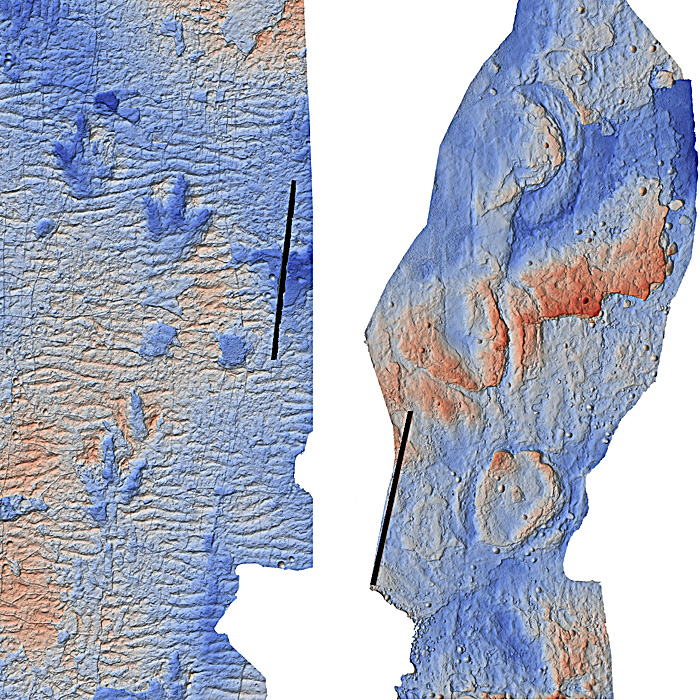
Footprints from Koobi Fora: left – right foot of H. erectus; right – left foot of Paranthropus boisei. Credit: Kevin Hatala. Chatham University

The Koobi Fora area near modern Lake Turkana has been an important, go-to site, courtesy of the Leakey palaeoanthropology dynasty (Louis and Mary, their son and daughter-in-law Richard and Meave, and granddaughter Louise). They discovered five hominin species there dating from 4.2 to 1.4 Ma. So there was a chance that this rich area might prove that two of the species were close neighbours in both space and time. In 2021 Kenyan members of the Turkana Basin Institute based in Nairobi spotted a trackway of human footprints on a bedding surface of sediments that had been deposited about 1.5 Ma ago. Reminiscent of the famous, 2 million years older Laetoli trackway of Australopithecus afarensis in Tanzania, that at Koobi Fora is scientifically just as exciting  for it shows footprints of two hominin species Homo erectus and Paranthropus boisei who had walked through wet mud a few centimetres below the surface of Lake Turkana’s ancient predecessor (Hatala, K.G. and 13 others, 2024. Footprint evidence for locomotive diversity and shared habitats among early Pleistocene hominins. Science, v. 386, p. 1004-1010; DOI: 10.1126/science.ado5275). The trackway is littered with the footprints of large birds and contains evidence of zebra.

One set of prints attributed to H. erectus suggest the heels struck the surface first, then the feet rolled forwards before pushing off with the soles: little different from our own, unshod footprints in mud. They are attributed to H. erectus. The others also show a bipedal gait, but different locomotion. The feet that made them were significantly flatter than ours and had a big toe angled away from the smaller toes. They are so different that no close human relative could have made them. The local fossil record includes paranthropoids (Paranthropus boisei), whose fossil foot bones suggest an individual of that speciesmade those prints. It also turns out that a similar, dual walkers’ pattern was found 40 km away in lake sediments of roughly the same age. The two species cohabited the same terrain for a substantial period of time. As regards the Koobi Fora trackway, it seems the two hominins plodded through the mud only a few hours apart at most: they were neighbours.

Artists’ reconstructions of: left – H. erectus; right – Paranthropus boisei. Credits: Yale University, Roman Yevseyev respectively

From their respective anatomies they were very different. Homo erectus was, apart from having massive brow ridges, similar to us. Paranthropus boisei had huge jaws and facial muscles attached to a bony skull crest. So how did they get along? The first was probably omnivorous and actively hunted or scavenged meaty prey: a bifacial axe-wielding hunter-gatherer. Paranthropoids seem to have sought and eaten only vegetable victuals, and some sites preserve bone digging sticks. They were not in competition for foodstuffs and there was no reason for mutual intolerance. Yet they were physically so different that intimate social relations were pretty unlikely. Also their brain sizes were very different, that of P. Boisei’s being far smaller than that of H. erectus , which may not have encouraged intellectual discourse. Both persist in the fossil record for a million years or more. Modern humans, Neanderthals and Denisovans, as we know, sometimes got along swimmingly, possibly because they were cognitively very similar and not so different physically.

Since many hominin fossils are associated with riverine and lake-side environments, it is surprising that more trackways than those of Laetoli and Koobi Fora have been found. Perhaps that is because palaeoanthropologists are generally bent on finding bones and tools! Yet trackways show in a very graphic way how animals behave and interrelate with their environment, for example dinosaurs. Now anthropologists have learned how to spot footprint trace fossils that will change, and enrich the human story.

See also: Ashworth, J. Fossil footprints of different ancient humans found together for the first time. Natural History Museum News 28 November 2024; Marshall, M. Ancient footprints show how early human species lived side by side. New Scientist, 28 November 2024