At the start of the Cambrian Period animal life began to diversify from that of the Ediacaran world. For the first time sediments on the seafloor were explored for sustenance, leading to a variety of burrows that disrupted fine depositional layers. The basal Cambrian sandstones found in Britain and elsewhere are pervasively bioturbated: good evidence for the start of a ‘Worm world’ that marks the Precambrian-Phanerozoic boundary. That is probably a misnomer for the shallow seabed of that time, as fossils of burrowers with a variety of hard parts turn up in the oldest Cambrian sequences. Also appearing for the first time are tooth-like microfossils that took on such a range of bizarre shapes that they have long been used for correlating sedimentary strata in the absence of larger creatures. Some of these conodonts have been attributed to early vertebrates akin to modern lampreys and hag fish, but others may have been the grasping mouth-spines of a group of predatory worms which also survive to the present: chaetognaths. Apart from these oral spines chaetognaths lack hard parts, so anatomical details of ancient ones are only found in sites of exquisite preservation or lagerstätten. In such rare, tranquil places soft tissues such as muscles may be preserved by phosphatisation during decay.
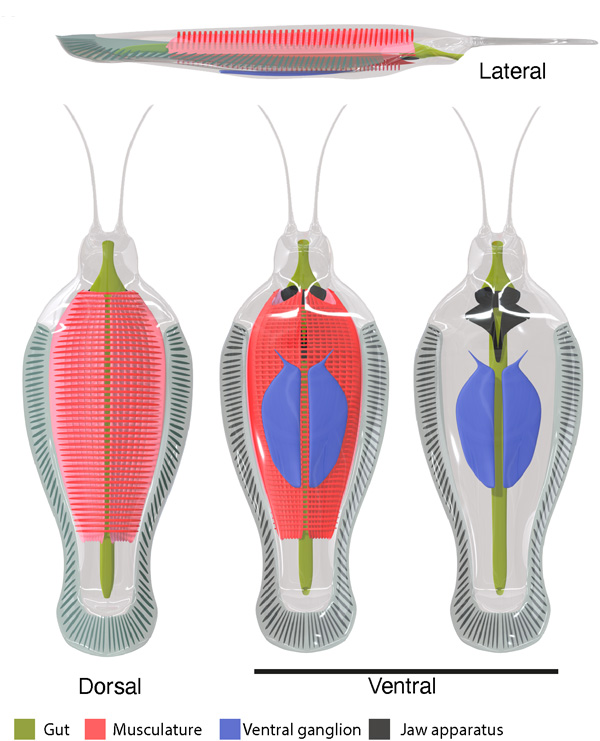
Reconstruction of Timorebestia koprii showing its musculature, nerve system and mouthparts, It probably propelled itself by fluttering its outer and rear flaps, much like a modern flatfish. Credit: Park et al., Fig 4
One of the earliest Phanerozoic lagerstätten (Sirius Passet) occurs in northern Greenland. It is curiously named after the Sirius Dog Sled Patrol, an elite pair of naval troops with a sledge and 12 dogs that enforces Danish sovereignty over the Greenlandic shore of the Arctic Ocean. The Sirius Passet fauna includes a monstrous chaetognath over 30 cm long (Park, T.-Y. S. and 12 others 2024. A giant stem-group chaetognath. Science Advances, v. 10 article eadi6678; DOI: 10.1126/sciadv.adi6678). It is called Timorebestia koprii (Timorebestia is Latin for ‘terror beast’) and was related to the living, but tiny, arrow worms that prey on zooplankton in modern oceans. This description and moniker may seem to be somewhat hyperbolic, but Timorobestia outranks in size any Early Cambrian predatory arthropods. It was probably high in the Early Cambrian trophic pyramid, but was soon relegated by the later Cambrian rise of trilobites and then of cephalopods and eventually jawed vertebrate fishes in the Silurian. One specimen contained shells of a swimming arthropod whose protective spines did not deter the ‘terrible’ chaetognath from swimming them down.
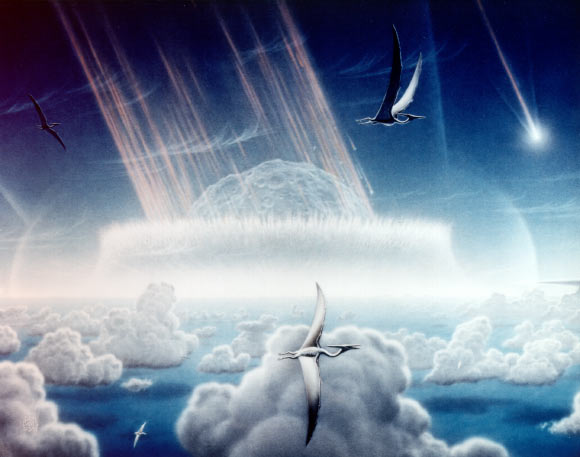
The Cretaceous-Palaeogene mass extinction is no longer an event that polarises geologists’ views between a slow volcanic driver (The Deccan large igneous province) and a near instantaneous asteroid impact (Chicxulub). There is now a broad consensus that both processes were involved in weakening the Late Cretaceous biosphere and snuffing out much of it around 66 Ma ago. Yet is still no closure as regards the details. From a palaeontologist’s standpoint the die-off varied dramatically between major groups of animals. For instance, the non-avian dinosaurs disappeared completely while those that evolved to modern birds did not. Crocodiles came through it largely unscathed unlike aquatic dinosaurs. In the seas those animals that lived in the water column, such as ammonites, were far more affected than were denizens of the seafloor. But much the same final devastation was visited on every continent and ocean. However, lesser and more restricted extinctions occurred before the Chicxulub impact.
Scientists from Norway, Canada, the US, Italy, the UK and Sweden have now thrown light on the possibility that climate change during the last half-million years of the Cretaceous may have been eroding biodiversity and disrupting ecosystems (Callegaro, S. et al. 2023. Recurring volcanic winters during the latest Cretaceous: Sulfur and fluorine budgets of Deccan Traps lavas. Science Advances, v. 9, article eadg8284; DOI: 10.1126/sciadv.adg8284). Almost inevitably, they turned to the record of Deccan volcanism that overlapped the K-Pg event, specifically the likely composition of the gases that the magmas may have belched into the atmosphere. Instead of choosing the usual suspect carbon dioxide and its greenhouse effect, their focus was on sulfur and fluorine dissolved in pyroxene grains from 15 basalts erupted in the 10 Formations of the Deccan flood-basalt sequence. From these analyses they were able to estimate the amounts of the two elements in the magma erupted in each of these 10 phases.
Exposed section through a small part of the Deccan Traps in the Western Ghats of Maharashtra, India. (Credit: Gerta Keller, Princeton University)
The accompanying image of a famous section through the Deccan Traps SE of Mumbai clearly shows that 15 sampled flows could reveal only a fraction of the magmas’ variability: there are 12 flows in the foreground alone. The mountain beyond shows that the pale-coloured sequence is underlain by many more flows, and the full Deccan sequence is about 3.5 km thick. Clearly, flood-basalt volcanism is in no way continuous, but builds up from repeated lava flows that can be as much as 50 m thick. Each of them is capped by a red, clay-rich soil or bole – from the Greek word bolos (βόλος) meaning ‘clod of earth’. Weathering of basalt would have taken a few centuries to form each bole. Individual Deccan flows extend over enormous areas: one can be traced for 1500 km. At the end of volcanism the pile extended over roughly 1.5 million km2 to reach a volume of half a million km3.
Fluorine is a particularly toxic gas with horrific effects on organisms that ingest it. In the form of hydrofluoric acid (HF) – routinely used to dissolve rock – it penetrates tissue very rapidly to react with calcium in the blood to form calcium fluoride. This causes very severe pain, bone damage and other symptoms of skeletal fluorosis. The 1783-4 eruption of the Laki volcanic fissure in Iceland emitted an estimated 8,000 t of HF gas that wiped out more than half the domestic animals as a result of their eating contaminated grass. The famine that followed the eruption killed 20 to 25% of Iceland’s people: exhumed human skeletons buried in the aftermath show the distinctive signs of endemic skeletal fluorosis. This small flood-basalt event had global repercussions, as the Wikipedia entry for Laki documents. Volcanic sulfur emissions in the form of SO2 gas react with water vapour to form sulphuric acid aerosols in a reflective haze. If this takes place in the stratosphere as a result of powerful eruptions, as was the case with the 1991 Pinatubo eruption in the Philippines, the high-altitude haze lingers and spreads. This results in reduced solar warming: a so-called ‘volcanic winter’. In the Pinatubo aftermath global temperatures fell by about 0.5°C during 1991-3. Unsurprisingly, volcanic sulfur emissions also result in acid rainfall. Moreover, inhaling the sulphur-rich haze at low altitudes causes victims to choke as their respiratory tissues swell: an estimated 23,000 people in Britain died in this way when the 1783-4 Laki eruption haze spread southwards Sara Calegaro and colleagues found that the fluorine and sulfur contents of Deccan magmas fluctuated significantly during the eruptive phases. They suggest that fluorine emissions were far above those from Laki, perhaps leading to regional fluorine toxicity around the site of the Deccan flood volcanism but not extinctions. Global cooling due to sulphuric acid aerosols in the stratosphere is suggested to have happened repeatedly, albeit briefly, as eruption waxed and waned during each phase. Magmas rich in volatiles would have been more likely to erupt explosively to inject SO2 to stratospheric altitudes (above 10 to 20 km). The authors do not attempt to model when such cooling episodes may have occurred: data from only 15 levels in the Deccan Traps do not have the time-resolution to achieve that. They do, however, show that this large igneous province definitely had the potential to generate ‘volcanic winters’ and toxic episodes. Time and time again ecosystems globally and regionally would have experienced severe stress, the most important perhaps being disruption of the terrestrial and marine food chains.
The US city of Los Angeles, originally known as El Pueblo de Nuestra Señora la Reina de los Ángeles (The Town of Our Lady the Queen of the Angels), was founded in 1781 by 44 Spanish settlers. It remained a small cattle-centred town after the annexation of California from Mexico by the USA in 1847. Once it was reached by the transcontinental Southern Pacific railroad in 1876 it had the potential for growth. But it took the discovery of oil within its limits in 1892 for its population to increase rapidly. The Los Angeles City Oil Field became the top producer in California with 200 separate oil companies crammed cheek by jowl by 1901. Now only one remains, producing just 3.5 barrels per day. That crude oil was there for the taking was pretty obvious as bitumen seeps had long been exploited by native people and the original Spanish colonists. The oilfield was developed near one such seep: the Rancho La Brea tar pits.
Rancho La Brea tar pit and derricks of the Los Angeles City Oil Field in 1901
By 1901 perfectly preserved bones of a huge variety of animals – 231 vertebrate species – as well as plants and invertebrates began to be collected from the continually roiling pond of bitumen. Thousands of specimens have been collected since then, both predators and prey of all sizes. Famous for mastodons and sabre-toothed cats, La Brea is a repository of almost the entire western Californian fauna through much of the Late Pleistocene: before about 100 ka the area lay beneath the Pacific Ocean. Tar pits are traps for unwary animals of any kind, especially as shallow water often hides the danger. Carnivores seeking easy, abundant food end up trapped too.
Because of the anaerobic nature of bitumen, bacterial decay is suppressed. Many of the bones still contain undegraded collagen: the most abundant protein in mammals, which can be dated using the radiocarbon method. So, despite the lack of stratigraphy in the tar pits, it is possible to track the history of the ecosystem by painstaking dating of individual fossils (OKeefe, F.R and 18 others 2023. Pre–Younger Dryas megafaunal extirpation at Rancho La Brea linked to fire-driven state shift. Science, v. 381, article eabo3594; DOI: 10.1126/science.abo3594). Robin OKeefe and colleagues dated 169 specimens of eight large mammal species most commonly found in the bitumen: sabre-toothed cat (Smilodon fatalis); dire wolf (Aenocyon dirus); coyote (Canis latrans); American lion (Panthera atrox); ancient bison (Bison antiquus); western horse (Equus occidentalis); Harlan’s ground sloth (Paramylodonharlani); and yesterday’s camel (Camelopshesternus).
The authors focussed on precisely dated specimens spanning the 15.6 to 10.0 ka time range. This would allow the disappearance times of individual species to be compared with stages in the rapid change in the Californian climate during post glacial maximum warming, those during the Younger Dryas abrupt cooling (12.9 to 11.7 ka) and the earliest Holocene warming that succeeded it. The first to go extinct were the camels and giant sloths about 13.6 ka ago. At 13.2 ka the other mammals declined very rapidly, the two remaining herbivores vanishing more quickly than the four predators. By 12.9 ka the only surviving species of the chosen eight was the coyote. So seven members of the Pleistocene mammalian megafauna became extinct before the onset of the Younger Dryas cold millennium.
Part of the team examined pollen from a core through sediments deposited in a lake 100 km south of La Brea. They found that flora, and probably climate, had not changed at the time of camel and sloth extinctions around 13.6 ka. However a 300 year period between 13.2 and 12.9 ka witnessed a collapse in deciduous tree species while conifers, grasses and drought-tolerant shrubs increased. A woodland ecosystem had been replaced by semi-arid chaparral. Another feature of the lake-bed sediments was that charcoal fragments increased explosively during that 300-year episode that ended both the woodland ecosystem and the megafauna that exploited it: undoubtedly three centuries of regular wildfires. What remained was the chaparral ecosystem based on drought-tolerant, fire-adapted plants.
Were the megafauna collapse and a change in ecology results of a climatic harbinger for the Younger Dryas cool millennium, or some other cause? Interestingly, tangible evidence for the Clovis hunting culture of North America, which has long been implicated in the faunal ‘extirpation’, does not appear until 12.9 ka, and in California neither does any implicating other human groups. Yet evidence is accumulating for much earlier entry of humans into North America. Occupation sites are very rare on land, but human presence here and there implies such earlier migration, probably along the west coast that avoided the frigid interior further north than California. The question posed by OKeefe et al. is, ‘Were the fires ignited by humans over a 300 year period just before the Younger Dryas’? It remains to be confirmed … First human arrivals coinciding with evidence for wildfires in Australia, New Zealand and a few other areas do suggest that it is a possibility. There needs to be a motive, such as producing lush clearings in forest to attract game, or removing cover to make hunting easier. In this case, the fires immediately preceded a global climatic downturn with terrestrial drying, so they may have had natural causes: the potentially incendiary chaparral flora had been increasing steadily beforehand and decreased rapidly after the evidence for wildfires
See also: Price, M. 2023. Death by fire. Science, v. 381, p. 724-727; DOI: 10.1126/science.adk3291
Along with algae, jellyfish, oak trees, sharks and nearly every organism that can be seen with the naked eye, we are eukaryotes. The cells of every member of the Eukarya, one of the three great domains of life, all contain a nucleus – the main location of genetic material – and a variety of other small bodies known as organelles, such as the mitochondria of animals and the chloroplasts of plant cells. The vast bulk of organisms that we can’t see unaided are prokaryotes, divided into the domains of Bacteria and Archaea. Their genetic material floats around in their cells’ fluid. The DNA of eukaryotes shares some stretches with prokaryotes, but no prokaryotes contain any eukaryote genetic material. This suggests that the Eukarya arose after the Bacteria and Archaea, and also that they are a product of evolution from prokaryotes, probably by several combining in symbiotic relationships inside a shared cell membrane. Earth-logs has followed developments surrounding this major issue since 2002, as reflected in some of the posts linked to what follows.
While prokaryotes can live in every conceivable environment at the Earth’s surface and even in a few kilometres of crust beneath, the vast majority of eukaryotes depend on free oxygen for their metabolism. Logically, the earliest of the Eukarya could only have emerged when oxygen began to appear in the oceans following the Great Oxidation Event around 2.4 billion years ago. That is more than a billion years after the first prokaryotes had left their geological signature in the form of curiously bulbous, layered carbonate structures (stromatolites), probably formed by bacterial mats. The oldest occur in the Archaean rocks of Western Australia as far back as 3.5 Ga, and disputed examples have been found in the 3.7 Ga Isua sediments of West Greenland. The oldest of them are thought to have been produced through the anoxygenic photosynthesis of purple bacteria (See: Molecular ‘fossils’ and the emergence of photosynthesis; September 2000), suggested by organic molecules found in kerogen from early Archaean sediments. Later stromatolites (<3.0 Ga) have provided similar evidence for oxygen-producing cyanobacteria.
Acritarchs are microfossils of single-celled organisms made of kerogen that have been found in sediments up to 1.8 billion years old. Features protruding from their cell walls distinguish them from prokaryote cells, which are more or less ‘smooth’: acritarchs have been considered as possible early eukaryotes. Yet the oldest undisputed eukaryote microfossils – red and green algae – are much younger (about 1.0 Ga). A means of estimating an age for the crown group from which every later eukaryote organism evolved – last eukaryotic common ancestor (LECA) – is to use an assumed rate of mutation in DNA to deduce the time when differences in genetics between living eukaryotes began to diverge: i.e. a ‘molecular clock’. This gives a time around 2 Ga ago, but the method is fraught with uncertainties, not the least being the high possibility of mutation rates changing through time. So, when the Eukarya arose is blurred within the so-called ‘boring billion’ of the early Proterozoic Eon. A way of resolving this uncertainty to some extent is to look for ‘biomarker’ chemicals in the geological record that provide a ‘signature’ for eukaryotes.
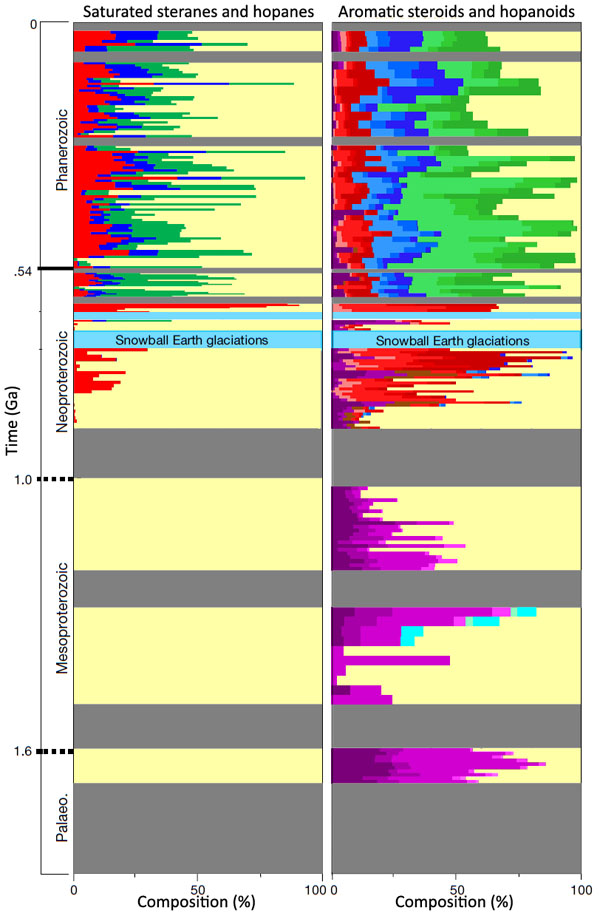
A new study has been undertaken by a group of Australian, German and French scientists to analyse sediments ranging in age from 635 to 1640 Ma from Australia, China, Asia, Africa, North and South America (Brocks, J.J and 9 others 2023. Lost world of complex life and the late rise of the eukaryotic crown. Nature, v. 618, p. 767–773; DOI: 10.1038/s41586-023-06170-w; contact for PDF). Their chosen biomarkers are sterols (steroids) that regulate eukaryote cell membranes. Some prokaryotes also synthesise steroids but all of them produce hopanepolyols (hopanoids), which eukaryotes do not. The key measures for the presence/absence of eukaryote remains in ancient sea-floor sediments is thus the relative proportions of preserved steroids and hopanoids, together with those for the breakdown products of both – steranes and hopanesthat are, crudely speaking, carbon ‘skeletons’ of the original chemicals.
Proportions of biomarkers in sediments from present to 1.64 Ga. Cholesteroids – reds; ergosteroids – blues; stigmasteroids – greens; protosteroids magentas, hopanoids – yellows; unsampled – grey. Snowball glaciations are shown in pale blue. (Credit: Simplified from Figure 3 in Brocks et al.)
Interpretation of the results by Jochen Brocks and colleagues is complicated, and what follows is a summary based partly on an accompanying Nature News & Views article(Kenig, F. 2023. The long infancy of sterol biosynthesis. Nature, v. 618, p. 678-680; DOI: 10.1038/d41586-023-01816-1). The conclusions of Brocks et al. are surprising. First, the break-down products of steroids (saturated steranes) that can be attributed to crown eukaryotes (left on the figure above) are only present in sediments going back to about 200 Ma before the first Snowball Earth event (~900 Ma). Before that only hopanes formed by hopanoid degradation are present: a suggestion that LECA only appeared around that time – the authors suggest sometime between 1 and 1.2 Ga. That is far later than the time when eukaryotes could have emerged: i.e. once there was available oxygen after the Great Oxidation Event (~2.4 to 2.2 Ga). So what was going on before this? The authors broke new ground in analysis of biomarkers by being able to detect signs of the presence of actual hopanoids and steroids of several different kinds. Steroids were present as far back as 1.6 Ga in the oldest sediments that were analysed.
Steroids of crown eukaryotes are represented by cholesteroids, ergosteroids and stigmasteroids. All three are present throughout the Phanerozoic Eon and into the time of the Ediacaran Fauna that began 630 Ma ago. In that time span they generally outweigh hopanoids, thus reflecting the dominance of eukaryotes over prokaryotes. Back to about 900 Ma, only cholesteroids are present, together with archaic forms that are not found in living Eukarya, termed protosteroids. Before that, only protosteroids are found. Moreover, these archaic steroids are not present in sediments that follow the Snowball Earth episodes (the Cryogenian Period).
Thus, it is possible that crown group eukaryotes – and their descendants, including us – evolved from and completely replaced an earlier primitive form (acritarchs?) at around the time of the greatest climatic changes that the Earth had experienced in the previous billion years or more. Moreover, the Cryogenian and Ediacaran Periods seem to show a rapid emergence of stigmasteroid- and ergosteroid production relative to cholesteroid: perhaps a result of explosive evolution of the Eukarya at that time. The organisms that produced protosteroids were present in variable amounts throughout the Mesoproteroic. Clearly there need to be similar analyses of sediments going back to the Great Oxygenation Event and the preceding Archaean to see if the protosteroid producers arose along with increasing levels of molecular oxygen. The ‘boring billion’ (2.0 to 1.0 Ga) may well be more interesting than previously thought.
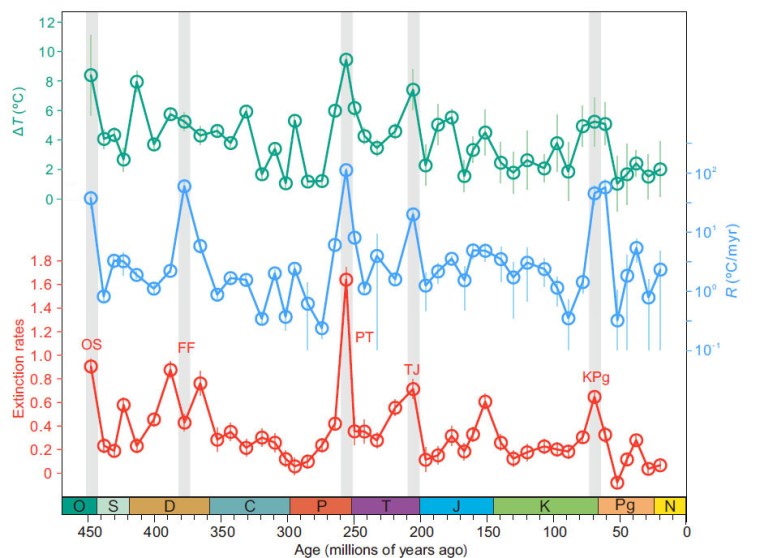
Enormous events occurred between 460 and 435 Ma around the mid-point of the Palaeozoic Era and spanning the Ordovician-Silurian (O-S) boundary. At around 443 Ma the second-most severe mass extinction in Earth’s history occurred, which eliminated 50 to 60% of all marine genera and almost 85% of species: not much less than the Great Dying at the end of the Permian Period. The event was accompanied by one of the greatest biological diversifications known to palaeontology, which largely replaced the global biota initiated by the Cambrian Explosion. Centred on the Saharan region of northern Africa, Late Ordovician glacial deposits also occur in western South America and North America. At that time all the current southern continents and India were assembled in the Gondwana supercontinent, with continental masses that became North America, the Baltic region, Siberia and South China not far off: all the components that eventually collided to form Pangaea from the Late Silurian to the Carboniferous.
The mass extinction has troubled geologists for quite a while. There are few signs of major volcanism having been involved, although some geochemists have suggested that very high mercury concentrations in some Late Ordovician marine sediments bear witness to large, albeit invisible, igneous events. No large impact crater is known from those times, although there is a curious superabundance of extraterrestrial debris, including high helium-3, chromium and iridium concentrations, preserved in earlier Ordovician sedimentary rocks, around the Baltic Sea. Another suggestion, poorly supported by evidence, is destruction of the atmospheric ozone layer by a gamma-ray burst from some distant but stupendous supernova. A better supported idea is that the oceans around the time of the event lacked oxygen. Such anoxia can encourage solution of toxic metals and hydrogen sulfide gas. Unlike other mass extinctions, this one was long-drawn out with several pulses.
The glacial epoch also seems implicated somehow in the mass die-off, being the only one known to coincide with a mass extinction. It included spells of frigidity that exceeded those of the last Pleistocene glacial maximum, with the main ice cap having a volume of from 50 to 250 million cubic kilometres. The greatest of these, around 445 Ma, involved a 5°C fall in global sea-surface temperatures and a large negative spike in δ13C in carbon-rich sediments, both of which lasted for about a million years. The complex events around that time coincided with the highest ever extinction and speciation rates, the number of marine species being halved in a short space of time: a possible explanation for the δ13 C anomaly. Yet estimates of atmospheric CO2 concentration in the Late Ordovician suggests it was perhaps 8–16 times higher than today; Earth should have been a warm planet then. One probable contributor to extreme glacial conditions has been suggested to be that the South Pole at that time was well within Gondwana and thus isolated from the warming effect of the ocean. So, severe glaciation and a paradoxical combination of mass extinction with considerable biological diversification present quite an enigma.
A group of scientists based in Beijing, China set out to check the palaeogeographic position of South China between 460 and 435 Ma and evaluate those in O-S sediments at locations on 6 present continents (Jing, X., Yang, Z., Mitchell, R.N. et al. 2022. Ordovician–Silurian true polar wander as a mechanism for severe glaciation and mass extinction. Nature Communications, v. 13, article 7941; DOI: 10.1038/s41467-022-35609-3). Their key tool is determining the position of the magnetic poles present at various times in the past from core samples drilled at different levels in these sedimentary sequences. The team aimed to test a hypothesis that in O-S times not only the entire lithosphere but the entire mantle moved relative to the Earth’s axis of rotation, the ‘slippage’ probably being at the Core-mantle boundary [thanks to Steve Rozario for pointing this out]. Such a ‘true polar wander’ spanning 20° over a mere 2 Ma has been detected during the Cretaceous, another case of a 90° shift over 15 Ma may have occurred at the time when Snowball Earth conditions first appeared in the Neoproterozoic around the time when the Rodinia supercontinent broke up and a similar event was proposed in 1994 for C-O times albeit based on sparse and roughly dated palaeomagnetic pole positions.
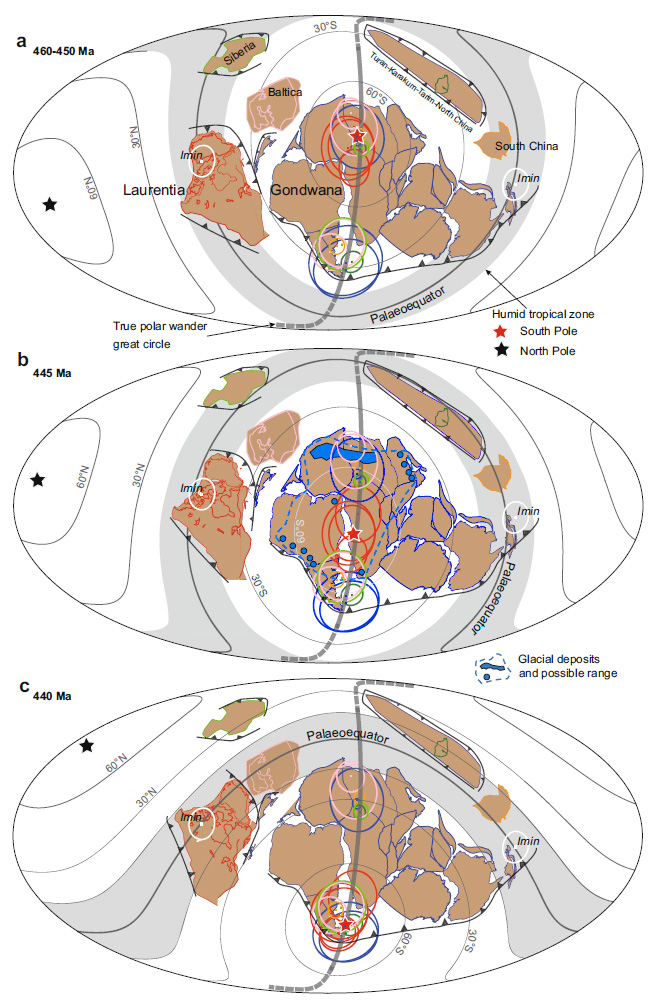
Xianqing Jing and colleagues report a wholesale 50° rotation of the lithosphere between 450 and 440 Ma that would have involved speeds of about 55 cm per year. It involved the Gondwana supercontinent and other continental masses still isolated from it moving synchronously in the same direction, as shown in the figure. From 460 to 450 Ma the geographic South Pole lay at the centre of the present Sahara. At 445 Ma its position had shifted to central Gondwana during the glacial period. By 440 Gondwana had moved further northwards so that the South Pole then lay at Gondwana’s southernmost extremity.
Palaeogeographic reconstructions charting true polar wander and the synchronised movement of all continental masses between 460 and 440 Ma. Note the changes in the trajectories of lines of latitude on the Mollweide projections. The grey band either side of the palaeo-Equator marks intense chemical weathering in the humid tropics. Credit Jing et al. Fig 5.
As well as a possible key to the brief but extreme glacial episode this astonishing journey by a vast area of lithosphere may help account for the mass extinction with rapid speciation and diversification associated with the O-S boundary. While the South Pole was traversing Gondwana as the supercontinent shifted the ‘satellite’ continental masses remained in or close to the humid tropics, exposed to silicate weathering and erosion. That is a means for extracting CO2 from the atmosphere and launching global cooling, eventually to result in glaciation over a huge tract of Gondwana around 445 Ma. Gondwana then moved rapidly into more clement climatic zones and was deglaciated a few million years later. The rapid movement of the most faunally diverse continental-shelf seas through different climate zones would have condemned earlier species to extinction simultaneous adaptation to changed conditions could have encouraged the appearance of new species and ecosystems. This does not require the catastrophic mechanisms largely established for the other mass extinction events. It seems that during the stupendous, en masse slippage of the Earth’s lithosphere plate tectonic processes still continued, yet it must have had a dynamic effect throughout the underlying mantle.
Yet the fascinating story does have a weak point. What if the position of the magnetic poles shifted during O-S times from their assumed rough coincidence with the geographic poles? In other words, did the self-exciting dynamo in the liquid outer core undergo a large and lengthy wobble? How the outer core’s circulation behaves depends on its depth to the solid core, yet the inner core seems only to have begun solidifying just before the onset of the Cambrian, about 100 Ma before the O-S events. It grew rapidly during the Palaeozoic, so the thickness of the outer core was continuously increasing. Fluid dynamic suggests that the form of its circulation may also have undergone changes, thereby affecting the shape and position of the geomagnetic field: perhaps even shifting its poles away from the geographic poles …
The closest land to the North Pole is Peary Land in northern Greenland. Today, much of it is a polar desert and is bare of ice, so field geology is possible during the Arctic summer. It is one of the last parts of the northern hemisphere to have been mapped in detail. The bedrock ranges in age from the Mesoproterozoic to Upper Cretaceous, although the sequence is incomplete because of tectonic events and erosion during the Phanerozoic Eon. Its complex history has made Peary Land a draw for both structural geologists and stratigraphers. Apart from glacial tills the youngest rocks are estuarine sediments deposited in the early Pleistocene, between two glacial tills. They define one of the earliest known interglacials, roughly between 1.9 and 2.1 Ma, which lasted for an estimated 20 ka. Late Pliocene (3.4 Ma) sediments from around the Arctic Ocean have yielded rich fossil fauna and flora that suggest much warmer conditions – 10°C higher than those at present – before repeated glaciation began in the Northern Hemisphere. The sediments in Peary Land are fossiliferous, plant remains indicating a cover of coniferous trees, but animal fossils are restricted to small invertebrates: the tangible palaeontology offers slim pickings as regards assessing environmental conditions and the ecosystem.
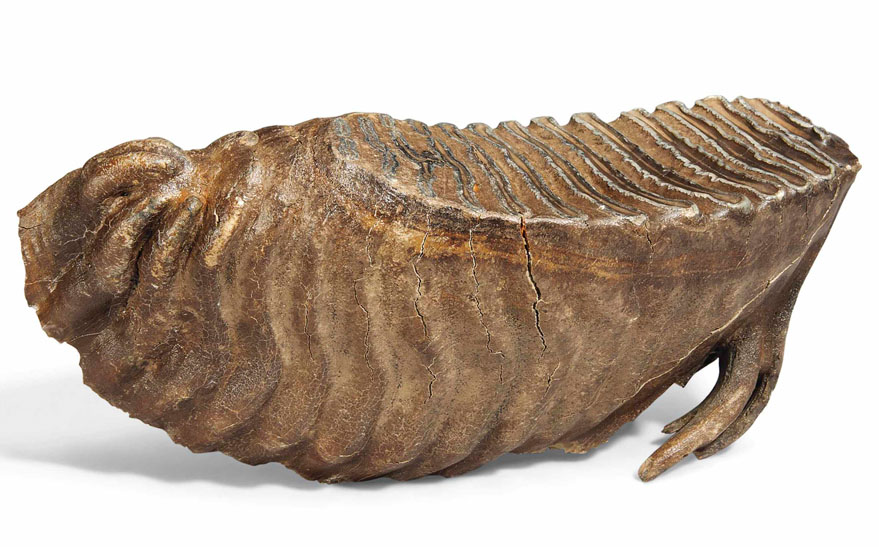
One means of exploring faunal and floral diversity is through sampling and analysing DNA buried in sediments and soils rather than in fossils – plants shed pollen while animals spread their DNA via dung and urine. This approach has met with extraordinary success in revealing megafaunas that may have been decimated by humans newly arrived in the Americas. Even more remarkable was the ability of environmental DNA from cave sediments to reveal the former presence of individual humans who once lived in the caves and thus assess their numbers and relatedness. Such penetrating genetic ‘fingerprinting’ only became possible when new techniques to extract fragments of DNA from sediments and splice them to reconstruct genomes had been developed. But to apply them to material some two million years old would be a big ask; The oldest known DNA sequence had been recovered in 2021 from the molar of a 1.1 Ma old mammoth preserved in permafrost – a near-ideal source. A large multinational team under the supervision of Eske Willerslev (currently of Cambridge University, UK) took on the challenge, despite two million years of burial being likely to have degraded genetic material to minuscule fragments absorbed on the surface of minerals (Kjær, K.H. and 38 others 2022. A 2-million-year-old ecosystem in Greenland uncovered by environmental DNA. Nature, v 612, p. 283–291; DOI: 10.1038/s41586-022-05453-y). But it transpired that quartz grains have a good chance of ‘collecting’ bits of DNA and readily yielding them to the extraction media. The results are extraordinary.
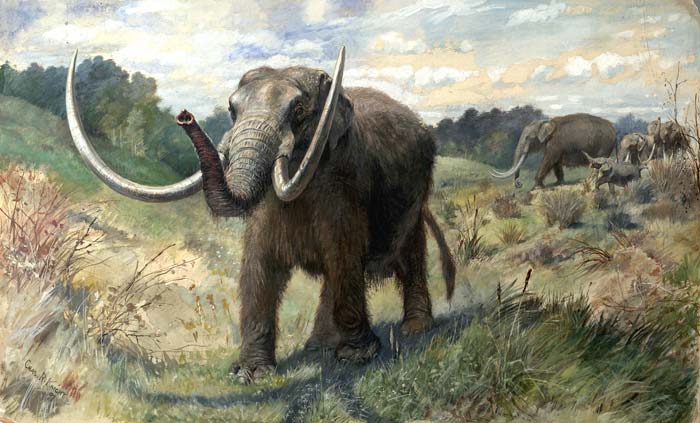
Reconstruction of an American mastodon herd by American painter of large extinct fauna Charles R. Knight
The DNA extraction turned-up signs of 70 vascular plants, including poplar, spruce and yew now typically found at much lower latitudes, alongside sedges, shrubs and birch-tree species that still grow in Greenland. The climate was substantially warmer than it is now. The fauna included elephants – probably mastodons (Mammut) but not mammoths (Mammuthus) and caribou, as well as rabbits, geese and various species of rodents. There were even signs of ants and fleas. The overall assemblage of plants has no analogue in modern vegetation, perhaps because of the absence of anthropogenic influences, such as fires, the smaller extent of glaciations, their shorter duration and less established permafrost during the early Pleistocene. The last factor could have allowed a quicker and wider spread of coniferous-deciduous woodland, found today in NE Canada. In turn this spread of vegetation would have drawn in herds of large herbivores, later mastodons being known to have been wide-ranging forest dwellers. Willerslev suggests that the study has a potential bearing on how ecosystems may respond to climate change.
Among the strange early animals of the latest Precambrian, known as the Ediacaran fauna, is the slug-like Kimberella. Unlike most of its cohort, which are impressions in sediment or trace fossils, Kimberella is a body fossil in which can be seen signs of a front and back, i.e. mouth and anus (See also: A lowly worm from the Ediacaran?). In that respect they are the same as us: bilaterians both. Indeed, Kimberella may be one of the oldest of our broad kind that we will ever be able to see. Rare examples have fans of grooves radiating from their ‘front’. It may have grated its food, a bit like a slug does, but drew it in to its mouth. Some enthusiasts have likened the little beasty to a JCB digger, able to rotate and rake stuff into its mouth. In that case, Kimberella would have moved ‘backwards’ while feeding. If it can be likened to any modern animals, it may be a simple mollusc.
A Kimberella fossil, about 10 centimetres long, and a speculative reconstruction showing its feeding apparatus.
Other Ediacaran animals show no such mouth-gut-anus symmetry. Some have tops and bases, but most show no symmetry at all, being flaccid bag-like creatures. Palaeontologists provisionally suggest that they are primitive sponges, ctenophores, placozoans and cnidarians. Such animals excrete through pores on their surfaces and draw food in either through a simple mouth or their skins. The early bilaterians probably ‘grazed’ on bacterial or algal mats, but until now that has been conjectural. Ilya Bobrovskiy of the Australian National University and colleagues from Russia and Australia have managed to extract and analyse biomarker chemicals contained in well-preserved specimens of three Ediacaran animals from strata on the White Sea coast of Russia (Bobrovskiy, I. et al. 2022. Guts, gut contents, and feeding strategies of Ediacaran animals. Current Biology, v. 32, ; DOI: 10.1016/j.cub.2022.10.051). Biomarkers are molecules, such as fatty acids, phospholipids, triglycerides, hopanes and steranes, that definitively indicate metabolic processes of once living organisms, sometimes referred to as ‘molecular fossils’. Their varying proportions relative to one another are key to recognising the presence of different groups of organisms.
Specifically, hopane molecules are the best indicators of the former metabolism of bacteria whereas steranes (based on linked chains of carbon atoms bonded in rings) are typical products of degradation of sterols in eukaryotes. One sterane group involving 27 carbon atoms (C27 steranes) are typically formed when and animal dies and decays. C28 and C29 steranes likely form when algae decay, as when they are digested in the gut of a herbivore. Specimens of one of the Ediacaran animals analysed by the team – Dickinsonia – contained far more C27 steranes than C28 and C29, a sign of biomarkers associated with its decay. It probably absorbed food, weirdly, through its skin. Kimberella and a worm-like animal – Calyptrina – had sterane proportions which suggested that they digested algae or bacteria in a gut, as befits bilaterians. Simple as they may appear, these are among the earliest ancestors of modern animals, including us: of course!
In September 2022 Earth-logs highlighted how greening of the continents affected the composition of the continental crust. It now seems that was not the only profound change that the first land plants wrought on the Earth system. Beginning in the Silurian, the spread of vegetation swept across the continents during the Devonian Period. From a height of less than 30 cm among the earliest species by the Late Devonian the stature of plants went through a large increase with extensive forests of primitive tree-sized conifers, cycads, horsetails and sporiferous lycopods up to 10 m tall. Their rapid evolution and spread was not hampered by any herbivores. It was during the Devonian that tetrapod amphibians emerged from the seas, probably feeding on burgeoning terrestrial invertebrates. The Late Devonian was marked by five distinct episodes of extinction, two of which comprise the Devonian mass extinction: one of the ‘Big Five’. This affected both marine and terrestrial organisms. Neither flood volcanism nor extraterrestrial impact can be linked to the extinction episodes. Rather they marked a long drawn-out period of repeated environmental stress.
Phytoplankton bloom off the east coast of Scotland ‘fertilised’ by effluents carried by the Tay and Forth estuaries.
One possibility is that a side effect of the greening of the land was the release of massive amounts of nutrients to the seas that would have resulted in large-scale blooms of phytoplankton whose death and decay depleted oxygen levels in the water column. That is a process seen today where large amounts of commercial fertilisers end up in water bodies to result in their eutrophication. Matthew Smart and others from Indiana University-Purdue University, USA and the University of Southampton, UK, geochemically analysed Devonian lake deposits from Greenland and Scotland to test this hypothesis (Smart, M.S. et al. 2022. Enhanced terrestrial nutrient release during the Devonian emergence and expansion of forests: Evidence from lacustrine phosphorus and geochemical records. Geological Society of America Bulletin, v. 134, early release article; DOI: 10.1130/B36384.1).
Smart et al. show that in the Middle and Late Devonian the lacustrine strata show cycles in their abundance of phosphorus (P an important plant nutrient) that parallel evidence for wet and dry cycles in the lacustrine basins. The cycles show that the same phosphorus abundance patterns occurred at roughly the same times at five separate sites. This may suggest a climatic control forced by changes in Earth’s orbital behaviour, similar to the Milankovich Effect on the Pleistocene climate and at other times in Phanerozoic history. The wet and dry intervals show up in the changing ratio between strontium and copper abundances (Sr/Cu): high values signify wet conditions, low suggesting dry. The wet periods show high ratios of rubidium to strontium (Rb/Sr) that suggest enhanced weathering, while dry periods show the reverse – decreased weathering.
When conditions were dry and weathering low, P built up in the lake sediments, whereas during wet conditions P decreases; i.e. it was exported from the lakes, presumably to the oceans. The authors interpret the changes in relation to the fate of plants under the different conditions. Dry periods would result in widespread death of plants and their rotting, which would release their P content to the shallowing, more stagnant lakes. When conditions were wetter root growth would have increased weathering and more rainfall would flush P from the now deeper and more active lake basins. The ultimate repository of the sediments and freshwater, the oceans, would therefore be subject to boom and bust (wet and dry) as regards nutrition and phytoplankton blooms. Dead phytoplankton, in turn, would use up dissolved oxygen during their decay. That would lead to oceanic anoxia, which also occurred in pulses during the Devonian, that may have contributed to animal extinction.
Every organism that you can easily see is a eukaryote, the vast majority of which depend on the availability of oxygen molecules. The range of genetic variation in a wide variety of eukaryotes suggests, using a molecular ‘clock’, that the first of them arose between 2000 to 1000 Ma ago. It possibly originated as a symbiotic assemblage of earlier prokaryote cells ‘bagged-up’ within a single cell wall: Lynn Margulis’s hypothesis of endosymbiosis. It had to have happened after the Great Oxygenation Event (GOE 2.4 to 2.2 Ga), before which free oxygen was present in the seas and atmosphere only at vanishingly small concentrations. Various single-celled fossil possibilities have been suggested to be the oldest members of the Eukarya but are not especially prepossessing, except for one bizarre assemblage in Gabon. The first inescapable sign that eukaryotes were around is the appearance of distinctive organic biomarkers in sediments about 720 Ma old. The Neoproterozoic is famous for its Snowball Earth episodes and the associated multiplicity of large though primitive animals during the Ediacaran Period (see: The rise of the eukaryotes; December 2017).
The records of carbon- and sulfur isotopes in Neo- and Mesoproterozoic sedimentary rocks are more or less flat lines after a mighty hiccup in the carbon and sulfur cycles that followed the GOE and the earliest recorded major glaciation of the Earth. The time between 2.0 and 1.0 Ga has been dubbed ‘the Boring Billion’. At about 900 Ma, both records run riot. Sulfur isotopes in sediments reveal the variations of sulfides and sulfates on the seafloor, which signify reducing and oxidising conditions respectively. The δ13C record charts the burial of organic carbon and its release from marine sediments related to reducing and oxidising conditions in deep water. There were four major ‘excursions’ of δ13C during the Neoproterozoic, which became increasingly extreme. From constant anoxic, reducing conditions throughout the Boring Billion the Late Neoproterozoic ocean-floor experienced repeated cycles of low and high oxygenation reflected in sulfide and sulfate precipitation and by fluctuations in trace elements whose precipitation depends on redox conditions. By the end of the Cambrian, when marine animals were burgeoning, deep-water oxic-anoxic cycles had been smoothed out, though throughout the Phanerozoic eon anoxic events crop up from time to time.
Atmospheric levels of free oxygen relative to that today (scale is logarithmic) computed using combined carbon- and sulfur isotope records from marine sediments since 1500 Ma ago. The black line is the mean of 5,000 model runs, the grey area represents ±1 standard deviations. The pale blue area represents previous ‘guesstimates’. Vertical yellow bars are the three Snowball Earth events of the Late Neoproterozoic (Sturtian, Marinoan and Gaskiers). (Credit: Krause et al., Fig 1a)
The Late Neoproterozoic redox cycles suggest that oxygen levels in the oceans may have fluctuated too. But there are few reliable proxies for free oxygen. Until recently, individual proxies could only suggest broad, stepwise changes in the availability of oxygen: around 0.1% of modern abundance after the GOE until about 800 Ma; a steady rise to about 10% during the Late Neoproterozoic; a sharp rise to an average of roughly 80% at during the Silurian attributed to increased photosynthesis by land plants. But over the last few decades geochemists have devised a new approach based on variations on carbon and sulfur isotope data from which powerful software modelling can make plausible inferences about varying oxygen levels. Results from the latest version have just been published (Krause, A.J. et al. 2022. Extreme variability in atmospheric oxygen levels in the late Precambrian. Science Advances, v. 8, article 8191; DOI: 10.1126/sciadv.abm8191).
Alexander Krause of Leeds University, UK, and colleagues from University College London, the University of Exeter, UK and the Univerisité Claude Bernard, Lyon, France show that atmospheric oxygen oscillated between ~1 and 50 % of modern levels during the critical 740 to 540 Ma period for the origin and initial diversification of animals. Each major glaciation was associated with a rapid decline, whereas oxygen levels rebounded during the largely ice-free episodes. By the end of the Cambrian Period (485 Ma), by which time the majority of animal phyla had emerged, there appear to have been six such extreme cycles.
Entirely dependent on oxygen for their metabolism, the early animals faced periodic life-threatening stresses. In terms of oxygen availability the fluctuations are almost two orders of magnitude greater than those that animal life faced through most of the Phanerozoic. Able to thrive and diversify during the peaks, most animals of those times faced annihilation as O2 levels plummeted. These would have been periods when natural selection was at its most ruthless in the history of metazoan life on Earth. Its survival repeatedly faced termination, later mass extinctions being only partial threats. Each of those Phanerozoic events was followed by massive diversification and re-occupation of abandoned and new ecological niches. So too those Neoproterozoic organism that survived each massive environmental threat may have undergone adaptive radiation involving extreme changes in their form and function. The Ediacaran fauna was one that teemed on the sea floor, but with oxygen able to seep into the subsurface other faunas may have been evolving there exploiting dead organic matter. The only signs of that wholly new ecosystem are the burrows that first appear in the earliest Cambrian rocks. Evolution there would have ben rife but only expressed by those phyla that left it during the Cambrian Explosion.
There is a clear, empirical link between redox shifts and very large-scale glacial and deglaciation events. Seeking a cause for the dramatic cycles of climate, oxygen and life is not easy. The main drivers of the greenhouse effect CO2 and methane had to have been involved, i.e. the global carbon cycle. But what triggered the instability after the ‘Boring Billion’? The modelled oxygen record first shows a sudden rise to above 10% of modern levels at about 900 Ma, with a short-lived tenfold decline at 800 Ma. Could the onset have had something to do with a hidden major development in the biosphere: extinction of prokaryote methane generators; explosion of reef-building and oxygen-generating stromatolites? How about a tectonic driver, such as the break-up of the Rodinia supercontinent? Then there are large extraterrestrial events … Maybe the details provided by Krause et al. will spur others to imaginative solutions. See also: How fluctuating oxygen levels may have accelerated animal evolution. Science Daily, 14 October 2022
Most people are familiar with the term ‘blood diamonds’, meaning diamonds clandestinely exported from areas infested by the lethal activities of military and paramilitary forces. Indeed such conflicts are often fuelled by the large profits to be made from trading diamonds. One such source was in Sierra Leone during the civil war of 1991-2002. Others include Liberia, Côte d’ Ivoire, Angola and the Democratic Republic of Congo. Like illicit money, gemstones can be ‘laundered’ and find their way into conventional trade. To some extent the blood diamond trade has been slowed down by a programme of certification of packaged uncut diamond ‘rough’ by bona fide producers, and banning the sale of uncertified rough. The Kimberley Programme has been criticised because certificates can be issued in corrupt ways, so that blood diamonds probably still make their way to the international diamond markets: certification may hold no fears for those who force people to ine at gun point. However, because diamonds often show geochemical signatures and minute inclusions of other minerals that are unique to individual pipe-like intrusions of kimberlite that carry deep-mantle material to the surface. So, it is technically possible – but costly – to check for suspect rough. Such controls do not apply to other gemstones. A major source of very-high value gems is Myanmar (formerly Burma), whose widely condemned military dictatorship may be engaged in their unethical trade, including smuggling to neighbouring Thailand and China to avoid scrutiny.
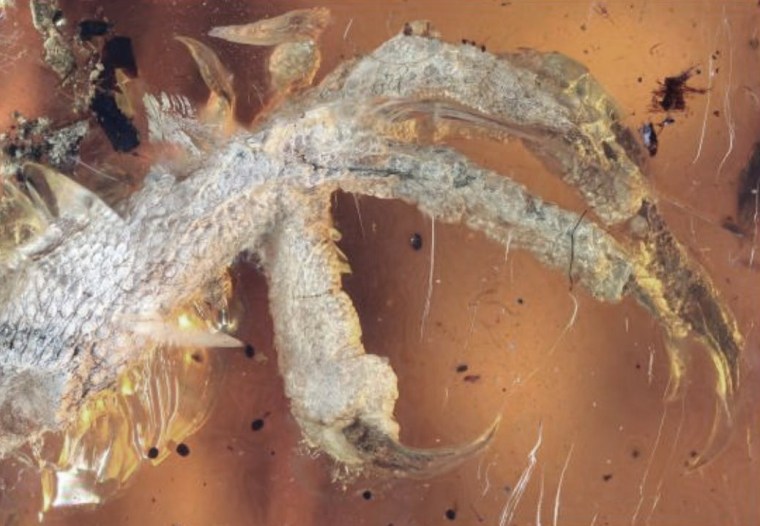
Foot of bird chick preserved in Cretaceous amber from Kachin, Myanmar. Credit: Pinterest, Xing Lida, China University of Geosciences)
Myanmar is well endowed with sedimentary deposits that contain amber, the solidified resin from a variety of now extinct trees. Oddly, completely clear amber has low intrinsic value: it is semi-precious, albeit attractive. But it often contains inclusions of vegetation fragments, insects, feathers and small vertebrates, of interest to palaeontologists. Myanmar amber is especially interesting as it is dated to the Middle Cretaceous (~130 Ma), older than that found around the Baltic Sea (Eocene ~44 Ma), which was the main source for European jewellery since the 12th century, and that from Canada (Upper Cretaceous ~80 Ma). Myanmar amber has been used decoratively and medicinally in China since the 3rd century CE, and in Europe since prehistoric times. It is attractive but quite common, so historically amber never commanded high prices but was widely used as a trade item. Since the publicity attending the supposed extraction of dinosaur DNA from the bodies of reptile parasites to resurrect dinosaurs in Steven Spielberg’s 1993 film Jurassic Park, public and scientific interest in amber has boomed. It is primarily the exquisite preservation of encased organisms that piques the interest of palaeontologists. Papers that rely on the Myanmar amber have grown in number over the last ten years, despite the country being infamous for military repression of tribal and religious groups in its rural areas.
One of the most conflict-riven areas is the northern state of Kachin where the most interesting amber to palaeontologists is collected by the Kachin people of the Hukawng Valley. Government forces have been in conflict with the Kachin Independence Army since the 1960s, most particularly for control of the amber industry. A recent paper has focussed on the ethical issue of publications based on fossil-bearing amber from the area (Dunne, E.M. et al. 2022. Ethics, law, and politics in palaeontological research: The case of Myanmar amber. Communications Biology, v. 5, article no. 1023; DOI: 10.1038/s42003-022-03847-2).
In 2010 the military began forcibly to take over mines in Kachin. Between 2014 and 2021 the annual number of publication underwent a tenfold growth from between 10 to 15 to over 150, despite the fact that in 2015 the government in Yangon prohibited removal of fossils from the country. But the export laws exempt gemstones, so the growing demand for fossiliferous amber is clearly reflected in its supply to foreign scientists. Rare specimens that include vertebrate remains command prices up to US$100,000. The Myanmar amber trade is now estimated at around US$ 1 billion per annum. The Myanmar military took over all the mines in 2017, and is clearly the main supplier to palaeontologists.
In the seven-year period, only 3 papers out of 872 included contributors from Myanmar, which also suggests an element of ‘parachute science’: unsurprisingly Myanmar-based scientists also find it difficult to visit the Kachin area. Before 2014 most of the 69 publications involved scientists in the US; since then, the top spot has been occupied by Chinese scientists who have amassed 417. It seems clear that there is a web of contacts linking together the source of Myanmar amber, its market and science. In 2020 the Society of Vertebrate Paleontology called for a moratorium on publishing data from Kachin sources. But since then there is little sign that palaeontologists have taken any notice.
Worldwide, billions of people depend on groundwater for their water needs from wells, deep boreholes and natural springs. Even surface water in rivers and lakes is directly connected to that moving sluggishly below the surface. In fact the surface water level marks where the water table coincides with the land surface. From season to season the water table rises and falls and so too do river and lake levels, depending on fluctuations in rainfall, snow melt, evaporation and extraction. Where it is present, vegetation plays a role in the hydrological cycle, through transpiration from roots through stems and leaves, from which it is exhaled by minute pores or stomata; effectively plants are able to pump water through their tissues to a height of up to a hundred metres. Groundwater, like that at the surface, moves under gravity roughly parallel to the slope of the land surface from the place where precipitation infiltrates soil and rock. But the deeper it is the slower the flow and the less it is in direct contact with surface processes to be replenished by infiltration. Wells and boreholes rarely penetrate deeper than a few hundred metres, so that the vast bulk of groundwater is never used. Indeed most deep groundwater would not be drinkable or suitable for irrigation since over millennia or longer it dissolves material from the rock that contains it to become saline. In some deep sedimentary aquifers it may actually be composed of seawater trapped at the time of sedimentation.
Damp conditions in the Mponeng gold mine near Johannesburg, South Africa, the world’s deepest at 3.8 km below the surface with planned expansion to 4.3 km (Credit: AngloGold Ashanti)
The pore spaces in sandstones and fractures in limestones, the most common aquifers, are not the only conduits for groundwater. Crystalline igneous and metamorphic rocks are generally full of minute fractures resulting from their tectonic history. The deepest mines in crystalline basement, such as the gold mines of the Johannesburg area in South Africa, penetrate almost 4 km below the surface, yet are by no means dry and have to be pumped to stave off flooding. The water is a brine containing sodium and calcium chloride with high concentrations of dissolved, reduced gases such as hydrogen, methane and ethane (C2H6). Studies of the proportions of oxygen isotopes in the water reveal that the water in the fractures is very different from that in modern rainwater: this fluid is completely isolated from the modern hydrological cycle and is very old indeed. Just how old has now been determined (Warr, O. et al. 2022. 86Kr excess and other noble gases identify a billion-year-old radiogenically-enriched groundwater system. Nature Communications v. 13, Article number 3768; DOI: 10.1038/s41467-022-31412-2).
Brine extracted from a borehole in the floor of the Moab Khotsong gold/uranium mine also contains the noble gases helium, neon, argon, krypton and xenon. Noble gases are present in today’s atmosphere, so conceivably they may have originally entered the brine in rain water that seeped along fractures. However, when their isotopes are measured their proportions are very different from those in air. There are excesses of 4He, 21Ne, 22Ne, 40Ar, 86Kr and several isotopes of Xe. These isotopes are emitted during the radioactive decay of uranium, thorium and 40K, the main heat producing isotopes in the crust and mantle. Oliver Warr of the University of Toronto Canada and geochemists from Oxford University UK, Princeton University and the New Mexico Institute of Mining and Technology US, and the Sorbonne France show that originally atmospheric noble gases have been enriched in these radiogenic isotopes. Their present isotopic proportions therefore give clues to the time when air dissolved in groundwater was trapped in the host rock more than a billion years ago. A complicating factor is that the host rocks themselves are dated at about three times that age. They suggest that the fractures systems were initiated by the Vredfort asteroid impact at 2.0 Ga to form aquifers, but they became isolated from hydrological circulation around 1.2 Ga and now now contain the world’s oldest groundwater.
One of the implications of the study is that such trapped water may be present at depth in the crust of Mars, despite its current aridity. Another is that, because the fluid contains hydrogen, sulfate ions and hydrocarbon gases, it can potentially support organisms that use them to power their metabolism and reproduce. In 2008 microbes were found living in similar ancient groundwater 2.4 km below the surface in the Kidd Creek Mine, Canada, at a level of around 5 thousand cells per millilitre (50 times less than in surface water). They are powered by reduction of sulfate ions to sulfide. In 2008 another peculiar discovery in the deep biosphere emerged from the Mponeng gold mine near Johannesburg, South African (the world’s deepest) in the form of a living sulfate reducing bacteriumDesulforudis audaxviator. DNA analysis of the ancient water revealed that it was the sole inhabitant, a biological mystery confirmed by later deep-biosphere studies in Death Valley, USA, and Siberia.
The snuffing out of up to 90 percent of all terrestrial and marine species at the end of the Permian (252 Ma) was the outcome of lethal climatic warming. It probably stemmed from a stupendous episode of flood basalt volcanism and intrusions in what is now Siberia that burned vast amounts of peat or coal in the basin that the flows filled (see: Coal and the end-Permian mass extinction; March 2011). The carbon dioxide so released created planetary hyperthermia and toxic acid rain. For at least five million years Earth was an almost sterile world, a notable absence being dense vegetation on the land surface – the Early Triassic is devoid of coal, whereas there is plenty of Late Permian age. Much the same slow recovery of life is found in meagre collections of land and marine animal fossils of that age. Yet, other mass extinctions were followed by recovery and species diversification at a much faster pace.
One conceivable explanation could be the near absence of vegetation whose photosynthesis and burial would otherwise draw down CO2 and the same goes for its marine equivalent phytoplankton. But there is a powerful inorganic means of carbon sequestration: silicate weathering. The chemistry depends on carbon dioxide dissolved in water. For simple silicates it can be expressed as:
2CO2 + H2O + CaSiO3 → Ca2+ + 2HCO3– + SiO2.
The higher the ambient temperature, the faster such reactions proceed. Most silicates are more complex and many common ones, such as feldspars, include aluminium, so that another product of weathering is insoluble, fine-grained clay minerals. So various soluble metal ions (Ca, Mg, K, Na etc), dissolved bicarbonate ions, silica in various guises and clays eventually end up in the sea. Once there, it is possible for them to recombine, as for instance calcium and bicarbonate ions:
Ca2+ + 2HCO3-→ CaCO3 + CO2 + H2O
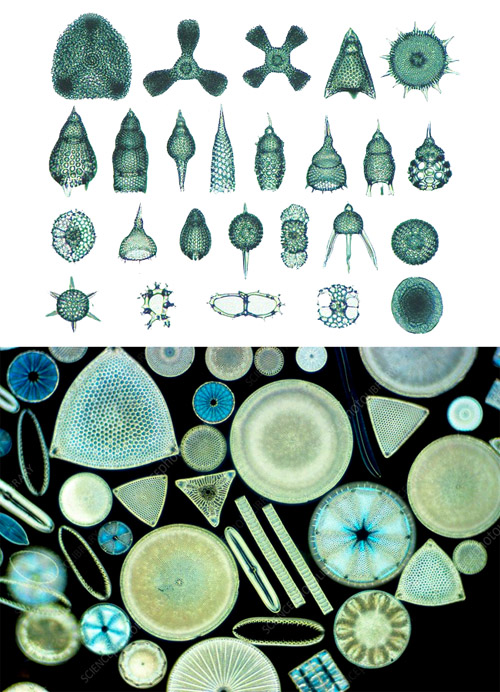
Despite some CO2 gas being released, this reaction results in a net sequestration of carbon in calcium carbonate. Incidentally, the same kind of chemical reaction occurs in the soils produced by weathering. The carbonate may cement soils to form a hard crust of caliche or ‘calcrete’. Chemical weathering enhanced by a hot climate, it might seem, should reduce the greenhouse effect quickly: a feedback mechanism that normally stabilises climate. But that did not happen after the P-Tr extinction event, thereby stressing all remaining life forms. A group of scientists at the University of Waikato in New Zealand have developed a possible explanation for this potentially fatal hazard for life on Earth (Isson, T.T. et al. 2022. Marine siliceous ecosystem decline led to sustained anomalous Early Triassic warmth. Nature Communications, v. 13, article 3509; DOI: 10.1038/s41467-022-31128-3). It focuses on the silica (SiO2) released by chemical weathering, which enters the ocean in the form of a colloid: Si(OH)4, a form of silicic acid known as ‘reactive silica’. Under ‘normal’ conditions, this is removed by organisms, such as diatoms and radiolaria, and is constantly recycled on a time scale of about 400 years, some contributing to deep-ocean oozes in the form of chert. But, like all other marine organisms, they too were victims of the P-Tr mass extinction.
Examples of marine radiolaria (top)
Reactive silica colloids in seawater also participate in inorganic chemical reactions, combining with dissolved metal ions to form complex hydrated aluminosilicates, i.e. more clay minerals. The reactions change the alkalinity of seawater. As a result dissolved HCO3–ions transform to CO2 gas and water. Despite the complexity of the chemistry that interweaves the carbon and silicon cycles, there is a simple conclusion. If the abundance of silica-secreting marine organisms falls drastically while continental weathering continues to deliver silica, clay-mineral formation on the ocean floor results in release of CO2 that reverses the effect of enhanced weathering and thus maintains hyperthermal conditions. The other outcome is that less chert and flint granules form Terry Isson and colleagues examined the varying proportion of chert in cores through Lower Triassic marine sediments. A ‘chert gap’characterises the 4 to 6 Ma following the P-Tr boundary event. This can be explained in part by extinction of silica-secreting organisms and by inorganic reactions converting the reactive silica that enhanced weathering delivered to the oceans to clay minerals. This supports the idea that the inorganic part of the silica cycle maintained greenhouse conditions in the absence of organic ‘competition’ for reactive silica. Many other biogeochemical cycles link biological and chemical processes that combine to affect climate: involving phosphorus, nitrogen and iron, to name but three.
Among the oldest known rocks are metamorphosed pillow basalts on Nuvvuagittuk Island in Quebec on the east side of Hudson Bay, Canada. They contain red and orange, iron-rich sediments probably formed by hydrothermal activity associated with sea water passing through hot basalts. The ironstones are made of silica in the form of jasper (SiO2) and carbonates that are coloured by hematite (Fe2O3). This rock sequence is cut by silica-rich intrusive igneous rocks dated between 3750 and 3775 Ma: a minimum, Eoarchaean age for the sequence. This is roughly the same as the age of the famous Isua supracrustal rocks of West Greenland, but dating of the basalts using the samarium–neodymium method suggested that they formed in the Hadean about 4300 Ma ago, which would make them by far the oldest known rocks. However, that date clashes with a zircon U-Pb age of 3780 Ma for associated metasedimentary mica schists: a still ‘live’ controversy. The ironstones have been suggested to contain signs of life, in the form of minute tubes and filaments similar to those formed in modern hydrothermal vents by iron-oxidising bacteria (see: Earliest hydrothermal vent and evidence for life, March 2017). If that can be proven this would push back the age of the earliest known life by at least 300 Ma and maybe far more if the Hadean Sm-Nd age is confirmed
The Nuvvuagittuk material has recently been re-examined by its original discoverers using a variety of advanced microscope techniques (Papineau, D. et al 2022. Metabolically diverse primordial microbial communities in Earth’s oldest seafloor-hydrothermal jasper. Science Advances, v. 8, article 2296; DOI: 10.1126/sciadv.abm2296.). The most revealing of these involve two very-high resolution imaging systems: X-ray micro-tomography and electron microscopy armed with a focused ion beam that repeatedly shaves away 200 nm of rock from a sample. Both build up highly detailed 3-D images of any minute structures within a sample. The techniques revealed details of twisted filaments, tubes, knob-like and branching structures up to a centimetre long. While the first three could possibly have some inorganic origin, a ‘comb-like’ branch, likened to a moth’s antenna, has never been known to have formed by chemical reactions alone.
An image of hematite tubes from microfossils discovered in hydrothermal vent precipitates in the Nuvvuagittuk ironstones, reconstructed from X-ray and ion-beam micro-tomography (credit: Matthew Dodd, UCL)
All the structures are formed from hematite within a silica or carbonate (mainly calcite CaCO3 and ankerite Ca(Fe,Mg,Mn)(CO3)2) matrix. Some of the hematite (dominated by Fe3+) contains significant amounts of reduced Fe2+. The structures also contain tiny grains of graphite (C), phosphate (apatite Ca5(PO4)3(F,Cl,OH)) and various metal (Mn, Co, Cu, Zn, Ni, Cd) sulfides. The presence of graphite obviously suggests – but does not prove – a biological origin. However, all Phanerozoic jaspers formed from hydrothermal fluids contain undisputed organic material and appear little different from these ancient examples. Filaments, tubes and comb-like structures are displayed by various iron-oxidising bacteria found living in modern sea-floor hydrothermal vent systems. The sulfur isotopes in metal sulfides suggest their formation in an environment with vanishingly low oxygen content. Carbon isotopes in graphite are more enriched in light 12C relative to 13C than those in associated carbonates, a feature produced by living organic processes today. Patterns in plots of rare-earth elements (REE) from the Nuvvuagittuk jaspers are similar to those from modern examples and suggest high-temperature interactions between sea water and basaltic igneous rocks.
It is clear from the paper just how comprehensively the team of authors have considered and tested various biotic and abiotic options for the origin of the features found in the Nuvvuagittuk jasper samples. They conclude that they probably do represent an ancient microbial ecosystem associated with sea-floor hydrothermal vents; a now widely supported scenario for the origin of life on Earth. But what metabolic processes did the Nuvvuagittuk microbes use? Their intimate association with Fe3+ oxides that contain some reduced Fe2+ suggests that they exploited chemical ‘energy’ from oxidation reactions that acted on Fe2+ dissolved in hydrothermal fluids. This would have been impossible by inorganic means because of the very low oxygen content of seawater shown by the sulfur isotopes in associated sulfide minerals. Iron oxidation and precipitation of iron oxide by organic processes must have involved dissociation of water to yield the necessary oxygen and loss of electrons from available Fe2+, a process used by modern deep-water bacteria that depends on the presence of nitrates. That can power the metabolism of inorganic carbon dissolved in water as, for instance, bicarbonate ions and water to yield cell-building carbohydrates: a form of autotrophy. There may have been other metabolic routes, such as reducing dissolved sulfate ions to sulfur, as suggested by the association of metal sulfides. If the sea floor was shallow enough to be lit CO2 and water may have been converted to carbohydrates by a form of photosynthesis that does not release oxygen, analogous to modern purple bacteria.
There may have been considerable biodiversity in the Nuvvuagittuk ecosystem. So despite its vast age – it may have been active only 300 Ma after the Earth formed, if the oldest date is verified – it has to be remembered that a great many earlier evolutionary steps, both inorganic and organic, must have been accomplished to have allowed these organisms to exist. The materials do not signify the origin of life, but life that was chemically extremely sophisticated: far more so than anything attempted so far in laboratories to figure out the tricks performed by natural inorganic systems. DNA and RNA alone are quite a challenge!
Geologists of my generation leaned that the earliest signs of abundant and diverse animal life were displayed by an extraordinary assemblage of fossils in a mudstone exposure high on a ridge in the Rocky Mountains of British Columbia. The Burgess Shale lagerstätte, or ‘site of exceptional preservation’, was discovered by Charles Walcott in 1909. It contained exquisite remains, some showing signs of soft tissue, of a great range of animals, many having never before been seen. Though dated at 509 Ma (Middle Cambrian) it was regarded for much of the 20th century as the sign of a sudden burgeoning from which all subsequent life had evolved: the Cambrian Explosion. Walcott only scratched the surface of its riches, its true wonders only being excavated and analysed later by Harry Whittington and his protégé Simon Conway Morris of Cambridge University. Their results were summarised and promoted in one of the great books on palaeontology and evolutionary biology, Wonderful Life (1989) by Steven Jay Gould.
Harbingers of animal profusion first appear around 635 Ma in the Late Neoproterozoic as the Ediacaran Fauna, with the oldest precursors turning up around a billion years ago in the Torridonian Sandstone Formation of northern Scotland. The evolutionary links between them and the Cambrian Explosion are yet to be documented, as creatures of the Ediacaran remain elusive in the earliest Phanerozoic rocks. As regards the conditions that promoted the explosion of animal faunas, the Burgess Shale is a blank canvas, for its riches were not preserved in situ, but had drifted onto deep, stagnant ocean floor to be preserved in oxygen-poor muds that enabled their intricate preservation. The animals could not have lived and evolved without abundant oxygen: what that environment was is not recorded by Walcott’s famous stratigraphic site.
Artistic impression of the Chengjian Biota
China, it has emerged, offers a major clue from around 40 lagerstätten in Chengjian County, Yunnan. They are not only older (518 Ma) than the Burgess Shale but contain 27 percent more faunal diversity: 17 phylums and more than 250 species. Since the discovery of the Chengjian Biota in the first decade of the 21st century palaeontologists have, understandably, been preoccupied by describing its riches in hundreds of scientific papers. The nature of the ecosystem has remained as obscure as that of the Burgess Shale, largely due to the exposed host rocks (laminated siltstones and mudstones) having been weathered. They are superficially similar to the Burgess Shale. In March 2022, 10 scientists working at laboratories in China, Canada, Switzerland and the UK published the results of their painstaking sedimentological investigation of a core dilled through through the entire fossiliferous sequence (Salih, F. and 9 others 2022. The Chengjiang Biota inhabited a deltaic environment. Nature Communications, v. 13, article 1569; DOI: 10.1038/s41467-022-29246-z).
Reconstruction of the near-shore deltaic environment in which the Chengjian Biota lived and evolved. Several rock types and the
sedimentary processes that probably formed them shown in ‘cores’ (Credit: Salih et al. Figure 3)
The unweathered core displays a variety of tiny sedimentary structures. These include cross laminations formed by migrating ripples, occasional fine sandstones that include signs of burrowing, graded bedding formed by minor turbidity currents, hummocks formed by back and forth water flow, ripples formed by flow in a single direction and small channels. Unlike the Burgess Shale, the fine-grained Chengjian sediments seem to have been deposited in environments that were far from stagnant and deep. They most closely resemble the offshore parts of the delta of a predominantly muddy river, subject to occasional floods and storms and characterised by large and rapid accumulation of mud and silt by dense sediment-loaded river water flowing down a gently sloping seabed into clearer seawater. That the sediment supply was full of nutrients and oxygen is reflected by small organisms living in burrows. The high-quality preservation of fossils in some layers can be attributed to sudden influxes of freshwater into their marine habitat during storms, so that they were killed in place. Such a near-shore environment, full of nutrients and oxygen but subjected to repeated geochemical and physical stresses, can explain adaptive radiation and evolution at a fast pace. Clearly, that is by no means a full explanation of the Cambrian Explosion, but offers sufficient insight for research to proceed fruitfully.
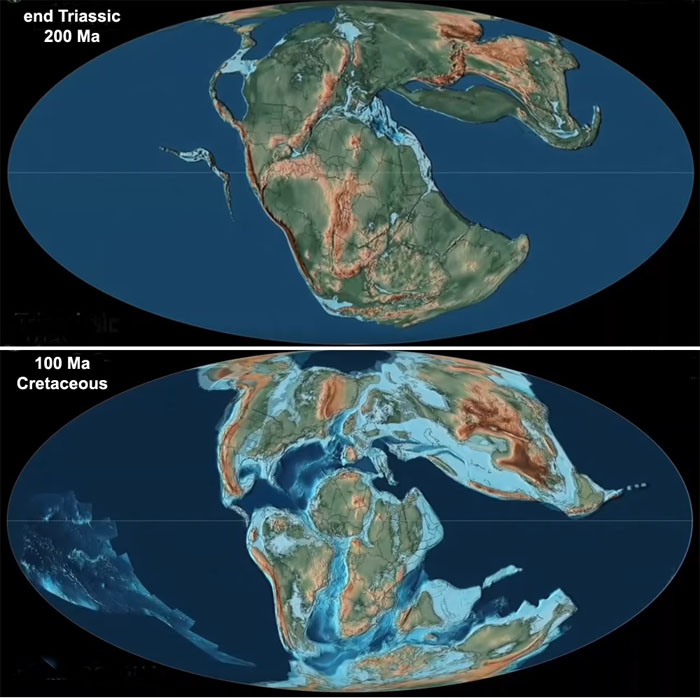
One of the ‘Big Five’ mass extinctions occurred at the end of the Triassic Period (~201 Ma), whose magnitude matches that of the more famous end-Cretaceous (K-Pg) event. It roughly coincided with the beginning of break-up of the Pangaea supercontinent that was accompanied by a major episode of volcanism preserved in the Central Atlantic Magmatic Province (CAMP). Eastern North America, West Africa and northern South America reveal scattered patches of CAMP flood basalts, swarms of dykes and large intrusive sills. Like all mass extinctions, that at the Triassic-Jurassic boundary left a huge selection of vacant or depleted ecological niches ready for evolution to fill by later adaptive radiation of surviving organisms. Because it coincided with continental break-up and drift, unlike other such events, evolution proceeded in different ways on the various wandering land masses and in newly formed seas (see an excellent animation of the formation and break-up of Pangaea – move the slider to 3 minutes for the start of break-up). The Jurassic was a period of explosive evolution among all groups of organisms. The most notable changes were among marine cephalopods, to give rise to a bewildering variety of ammonite species, and on land with the appearance and subsequent diversification of dinosaurs.
Pangaea at the end of the Triassic (top) and in Middle Cretaceous times (Credit: screen shots from animation by Christopher Scotese)
Many scientists have ascribed the origin of these events to the CAMP magmatic activity and the release of huge amounts of methane to trigger rapid global warming. In October 2021 one group focused on a special role for the high percentages of magma that never reached the surface and formed huge intrusions that spread laterally in thick sedimentary sequences to ‘crack’ hydrocarbons to their simplest form, CH4 or methane. A sedimentary origin of the methane, rather than its escape from the mantle, is indicated by the carbon-isotope ‘signature’ of sediments deposited shortly after the Tr-J event. The lighter isotope 12C rose significantly relative to 13C, suggesting an organic source – photosynthesis selectively takes up the lighter isotope.
By examining the element mercury (Hg) in deep ocean sediments from a Tr-J sedimentary section now exposed in Japan, scientists from China, the US and Norway have added detail to the methane-release hypothesis (Shen, J et al. 2022. Mercury evidence for combustion of organic-rich sediments during the end-Triassic crisis. Nature Communications, v. 13, article 1307; DOI:10.1038/s41467-022-28891-8). The relative proportions of Hg isotopes strongly suggest that the mercury had been released, as was the methane, from organic-rich sediments rather than from the CAMP magmas (i.e. ultimately from the mantle) through gasification and then burning at the surface.
The hypothesis is enlivened by a separate study (Fox C.P. et al. 2022. Flame out! End-Triassic mass extinction polycyclic aromatic hydrocarbons reflect more than just fire. Earth and Planetary Science Letters, v. 584, article 117418; DOI: 10.1016/j.epsl.2022.117418) that sees magmatic heating as being not so important. Calum Fox and colleagues at Curtin University, Western Australia analysed sediments from a Triassic-Jurassic sedimentary sequence near the Severn Bridge in SW England, focusing on polycyclic hydrocarbons in them. Their results show little sign of the kinds of organic chemical remnants of modern wildfires. Instead they suggest a greater contribution from soil erosion by acid rain that increased input of plant debris to a late Triassic marine basin
This post’s title seems beyond belief for an event that occurred 66 million years ago: how can geologists possibly say that with any conviction? The claim is based on fossil fishes found in the Late Cretaceous Hell Creek Formation of North Dakota (see: A bad day at the end of the Cretaceous. April, 2019), described in a paper published on 1 April 2019. The horizon that displays all the classic evidence for an impact origin for the K-Pg extinction is a freshwater sediment laid down by a surge into a river system: the upstream result of the mega-tsunami driven by the Chicxulub impact in the Gulf of Mexico. Amongst much else it contains intact marine ammonites – the last of their kind – and freshwater paddlefish and sturgeon. The fishes are preserved exquisitely, with no sign of scavenging. Parts of their gills are clogged with microscopic spherules made of impact glass. They are pretty good ‘smoking guns’ for an impact, and are accompanied by dinosaur remains – an egg with an embryo, hatchlings and even a piece of skin.
A group of scientists from the Netherlands, Sweden, Belgium and the UK examined thin sections of the fishes’ bones (During, M.A.D. et al. 2022. The Mesozoic terminated in boreal spring. Nature online publication, 23 February 2022; DOI: 10.1038/s41586-022-04446-1). These revealed growth layers that show lines of arrested growth (LAGs) separated by thicker layers. Such LAGs in modern paddlefish and sturgeon bones may indicate conditions of low food availability in winter, most growth being during warmer times of year. Each bone that was examined has only a thin outer zone of accelerated growth following its last LAG. So it seems that each specimen died in the Northern Hemisphere spring. This was confirmed by variations within the cyclic zonation of the relative proportions of carbon isotopes 13C and 12C, expressed as δ13C. In the LAGs δ13C is lower than in the thicker zones, which is consistent with decreased prey availability in winter, but see below.
Thin sections of fish bones from the K-Pg boundary layer in the Hell Creek Formation, showing lines of arrested growth marked by red arrowheads. The outermost (top) LAGs are succeeded by only a thin zone of accelerated growth during their last weeks of the fishes’ lives (credit: During et al., Fig. 2)
The paper by During et al. follows one with very similar content from the same deposit that was published about 12 weeks earlier (DePalma, R.A., et al. 2021. Seasonal calibration of the end-cretaceous Chicxulub impact event. Nature Science Reports, v. 11, 23704; DOI: 10.1038/s41598-021-03232-9). Yet During et al. do not refer to it, despite acknowledging DePalma’s guidance in the field and his granting access to his team’s specimens: maybe due to poor communications … or maybe not. DePalma et al. note thatmodern sturgeons are able to spend winters in the sea, which may also explain the low δ13C in the LAGs, as well as decreased prey availability does. They also examined damage by leaf-mining insects in fossil leaves at the site, which supports the springtime extinction hypothesis. Another study in DePalma et al. is the size range of newly hatched fish of three different Families that are founds as fossils in the K-Pg deposit. By comparing them with the growth histories of closely-related modern hatchlings they conclude that perhaps late spring to early summer is implied. Whatever, both papers go on to discuss the implications of their basic conclusions. Spring is a particularly sensitive time for the life cycles of many organisms; i.e. annual reproduction and newborns’ early growth. But some groups of egg-laying animals, such as perhaps dinosaurs, require longer incubation periods than do others, e.g. birds, and may be more vulnerable to rapid environmental change. That may explain the demise of the dinosaurs while their close avian relatives, or at least some of them, survived. Yet the season in the Southern Hemisphere when the Chicxulub impact occurred would have been autumn. That may go some way towards explaining evidence that ecological recovery from mass extinction in the southern continents seems to have been faster. Almost certainly, the impact would have induced a double climatic whammy: warming in its immediate aftermath followed by global cooling plus a shutdown of photosynthesis as dust clouds enveloped the planet. Then there is the issue of contamination by potentially toxic compounds raised by Chicxulub. The K-Pg boundary seems likely to run and run as a geoscientific story more than four decades since it was first proposed.
Earth-logs has previously covered quite a few hypotheses involving catastrophic astronomical events of the past, often returning to them as new data and ideas emerge. They range from giant impacts, exemplified in the mass extinction at the K-Pg boundary to smaller-scale events that may have coincided with important changes in climate, such as the sudden onset of the Younger Dryas, and a few that have been suggested as agencies affecting local human populations such as the demise of Sodom by a cosmogenic air-burst. Some of the papers that spurred the Earth-pages posts have been widely regarded in the geoscience community. Yet there have been others that many have doubted, and even condemned. For instance, data used by the consortium that suggested an extraterrestrial event triggered the frigid millennium of the Younger Dryas (YD) have been seriously and widely questioned. A sizeable number of the team that were under close scrutiny in 2008 joined others in 2019 to back the YD air-burst hypothesis again, using similarly ‘persuasive’ data from Chile. Members of the original consortium of academics also contributed to the widely disputed notion of a cosmic air-burst having destroyed a Bronze Age urban centre in Jordan that may, or may not, have been the site of the Biblical Sodom. Again, they cited almost the ‘full monty’ of data for high-energy astronomical events, but again no crater or substantial melt glass, apart from tiny spherules. Now another paper on much the same theme, but none of whose authors contributed to those based on possibly ‘dodgy’ data, has appeared in Geology (Schultz, P.H. et al. 2021. Widespread glasses generated by cometary fireballs during the Late Pleistocene in the Atacama Desert, Chile. Geology, published online November 2, 2021; doi: 10.1130/G49426.1).
Peter Schultz of Brown University, USA and colleagues from the US and Chile make no dramatic claims for death and destruction or climate destabilisation, and simply report a fascinating discovery. In 2012 one of the authors, Nicolas Blanco of the Universidad Santo Tomás in Santiago, Chile, found slabs made of glassy material up to half a metre across. They occurred in several 1 to 3 km2 patches over a wide area of the Atacama Desert. Resting on Pleistocene glacio-fluvial sediments, they had been exposed by wind erosion of active sand dunes. The glass is dark green to brown and had been folded while still molten. For the glass slabs to be volcanic bombs presupposes a nearby volcano, but although Chile does have volcanoes none of the active vents are close enough to have flung such large lumps of lava into the glass-strewn area. The glassy material also contains traces of vegetation, and varies a great deal in colour (brown to green). Its bulk chemical composition suggests melting of a wide variety of surface materials: quite unlike volcanic glasses.
Chilean glass occurrence: panorama of large glass fragments in the Atacama Desert; a specimen of the glass; thin section of glass showing bubbles and dusty particles (Credit: Schultz et al. 2021; Figs 1B, 2D and 2C)
Microscopic examination of thin sections of the glasses also reveals nothing resembling lava, except for gas bubbles. The slabs are full of exotic fragments, some of which closely resemble mineral assemblages found in meteorites, including nickel-rich sulfides embedded in ultramafic material. Others are calcium-, aluminium- and titanium-rich inclusions, such as corundum (Al2O3) and perovskite (CaTiO3), thought to have originated as very-high temperature condensates from the pre-solar nebula: like the celebrated ‘white inclusions’ in the Allende meteorite. Some minute grains resemble dust particles recovered by the NASA Stardust mission to Comet 81P/Wild-2 which returned samples to Earth in 2006. Zircon grains in the glasses, presumed to be locally derived, have been decomposed to zirconium oxide (baddeleyite), suggesting melting temperatures greater than 1670°C: far above the highest temperature found in lavas (~1200°C). Interestingly, the green-yellow silica glass strewn over the Sahara Desert around the southern Egypt-Libya border also contains baddeleyite and cometary dusts, together with anomalously high platinum-group elements and nanodiamonds that are not reported from the Chilean glass. Much prized by the elite of pharaonic Egypt and earlier makers of stone tools, the Saharan glass is ascribed to shock heating of the desert surface by a cometary nucleus that exploded over the Sahara. Unsurprisingly, Schultz et al. come to the same conclusion.
Any object entering the Earth’s atmosphere does so at speeds in excess of our planet’s escape velocity (11.2 km s-1). Not only does that result in heating by friction with the air, but much of the kinetic energy of hypersonic entry goes into compressing air through shock waves, especially with objects larger than a few tens of metres. Such adiabatic compression can produce temperatures >>10 thousand °C. Hence the ‘fireballs’ associated with large meteorites. With very large air-bursts the flash of radiant energy would be sufficient to completely melt surface materials in microseconds, though rugged topography could protect areas shadowed from the air-burst by mountains, perhaps explaining the patchy nature of the glass occurrences. (Note: the aforementioned papers on the YD and Sodom ‘air-bursts’ do not mention large glass fragments, whereas some surface melting would be expected). Some of the Chilean glass contains carbonised remnants of vegetation. Radiocarbon dating of four samples show that the glass formed at some time between 16.3 to 12.1 ka. Yes, that does include the age of the start of the YD (12.9 ka) and human migrants had established themselves in northern Chile and coastal Peru after 14.2 ka. Yet the authors, perhaps wisely, do no more than mention the coincidence, as well as that with the disappearance of South American Pleistocene megafaunas – more severe than on any other continent. With a very distinctive product, probably spanning a far larger area of South America, and attractive to humans as an ornament or a resource for sharp tools, expect follow-up articles in the future.
Since the start of 2020 I doubt there has been much field research. But such a vast amount of data has been amassed over the years that there must be opportunities to keep the academic pot boiling. One way is to look for new correlations between different kinds of data. For instance matching the decades-old time series of extinctions with those of other parameters that have changed over geological time. At a time of growing concern about anthropogenic climate change a group based at the State Key Laboratory of Biogeology and Environmental Geology, at China University of Geosciences, Wuhan have checked the extinction rates of marine fossils over the last 450 Ma against variations in sea-surface temperature (Song, H. et al 2021. Thresholds of temperature change for mass extinctions. Nature Communications, v. 12, Article number 4694; DOI: 0.1038/s41467-021-25019-2).
Extinction data are usually presented in time ‘bins’ based on the number of disappearances of fossil genera in one or a number of geological Stages – the finest divisions of the stratigraphic column. The growing data set for sea-surface temperatures derived using oxygen isotopes from marine fossil shells is more continuous, being derived from many different layers of suitable sedimentary rock within a Stage. Clearly, the two kinds of data have to be expressed in a similar way to check for correlations. Haijun Song and co-workers converted both the extinction and temperature time series to 45 time ‘bins’, each around 10 Ma long. They express the binned climatic data in two ways: as the largest temperature change (°C) and the highest rate of temperature change (°C Ma-1) within each bin. That is, they expressed to some extent the greater continuity of seawater temperature data as well as matching them to those for extinctions.
Changes since the end of the Ordovician: red = extinction rate in time bins; green = the greatest magnitude of change in temperature in each bin; blue- the greatest rate of temperature change in each bin. Grey bars show mass extinctions (Credit: Song et al., Fig 1)
There are good correlations between the climatic and extinction data, particularly for mass extinctions. Bearing in mind that mass extinctions take place far more rapidly than can be expressed with 10 Ma time bins, the authors were concerned that bias could creep into the binned extinction data. They were able to discount this by examining both data sets in finer detail at the times of the ‘Big 5’ extinctions. Earlier research had identified warming episodes around the times of each mass extinction, often implicating greenhouse-gas emissions from Large Igneous Provinces. Yet there are other factors that may have influenced the 7 ‘lesser’ mass extinctions in the fossil record. The authors are sufficiently confident in the correlations they have revealed to suggest thresholds that seem to have launched major mass extinctions: greater than 5.2 °C and 10 °C Ma-1 for magnitudes and rates of sea-surface temperature change, respectively.
In the context of the modern climate, the data analysis predicts that a rise of 5.2 °C above the preindustrial mean global temperature spells extinctions of ‘Big Five’ magnitude. The rate of temperature increase since 1880 – 0.08 ° per decade – is hugely faster than that expressed by the data that span the last 450 Ma. This is more alarming than the stark Sixth Report of the Intergovernmental Panel on Climate Change IPCC released on 9 August 2021.
Earth-pages asked this question in August 2020 because it had been suggested that at least one mass extinction – the protracted faunal decline during the Late Devonian – may provide evidence that supernovas can have deadly influence. The authors of the paper that I discussed proposed mass spectrometric analysis of isotopes, such as 146Sm, 235U and 244Pu in sediments deposited in an extinction event to test the hypothesis. In the 14 May issue of Science a multinational group of geochemists and physicists, led by Anton Wallner of the Australian National University, report detection of alien isotopes in roughly 10 million-year-old sediments sampled from the Pacific Ocean floor (Wallner, A and 12 others 2021. 60Fe and 244Pu deposited on Earth constrain the r-process yields of recent nearby supernovae. Science, v. 372, p. 742-745; DOI: 10.1126/science.aax3972).
Many of the chemical elements whose atomic masses are greater than 56 form by a thermonuclear fusion process known as rapid neutron capture – termed the ‘r-process’ by physicists. This requires such high energy that the likely heavy-element ‘nurseries must be events such as supernovas and/or mergers of neutron stars. The iron and plutonium isotopes detected at very low concentrations are radioactive, with half-lives of 2.6 Ma for 60Fe and 80.6 Ma for 244Pu. That makes it impossible for them to be terrestrial in origin because, over the lifetime of the Earth, they would decayed away completely. They must be from recent, alien sources either in our galaxy or one of the nearby galaxies. In fact two ‘doses’ were involved. The authors make no comment on any relationship with marine or continental extinctions at that time in the Miocene Epoch
Beinn Alligin and Loch Torridon, Northwest Highlands of Scotland. The hills are formed by Torridonian terrestrial sediments (credit: Stefan Krause, Wikimedia Commons)
Palaeobiologists interested in the origin of animals have generally focussed on sedimentary rocks from southern China: specifically those of the 635 to 550 Ma Doushantuo Formation. Phosphorus-rich nodules in those marine sediments have yielded tiny spheroids whose structure suggests that they are fossil embryos of some unspecified eukaryote. The Doushantuo Formation lies on top of rocks associated with the Marinoan episode of global glaciation during the Neoproterozoic; a feature which suggested that the evolutionary leap from single- to multi-celled eukaryotes was associated with environmental changes associated with Snowball Earth events. In a forthcoming issue of Current Biology that view will be challenged and the origin of multicellular life pushed back to around 1 billion years ago (Strother, P.K. et al. 2021. A possible billion-year-old holozoan with differentiated multicellularity. Current Biology, v. 31, p. 1-8; DOI: 10.1016/j.cub.2021.03.051). Spherical fossils of that age have been teased out of phosphatic nodules deposited in lacustrine sediments from the lower part of the Mesoproterozoic Torridonian Group of the Northwest Highlands of Scotland.
The internal structure of the fossils has been preserved in exquisite detail. Not only are cells packed together in their interiors, but some reveal an outer layer of larger sausage-shaped cells. So, cell differentiation had taken place in the original organisms, whereas such features are not visible in the Doushantuo ‘embryos’. A few of the central cells show dark, organic spots that may be remains of theirnucleii. Whatever these multicellular spheres may have developed into, the morphology of the Torridonian fossils is consistent with a transition from single-celled holozoans to the dominant metazoans of the Phanerozoic; i.e. the stem of later animals. The younger, Chinese fossils that are reputed to be embryos cannot be distinguished from multicellular algae (see: Excitement over early animals dampened, January 2012)
Photomicrograph of Bicellum brazieiri: scale bar = 10μm; arrows point to dark spots that may be cell nuclei (credit: Charles Wellman, Sheffield University)
Interestingly, the Torridonian Group is exclusively terrestrial in origin, being dominated by sediments deposited in the alluvial plains of huge braided streams that eventually buried a rugged landscape eroded from Archaean high-grade metamorphic rocks. Thus the environment would have been continually in contact with the atmosphere and thus oxygen that is vital for eukaryote life forms. The age of the fossils also rings a bell: a molecular clock based on the genomics of all groups of animals alive today hints at around 900-1000 Ma for the emergence of the basic body plan. Because its host rocks are about that age, could Bicellum brazier be the Common Ancestor of all modern animals? That would be a nice tribute to the second author, Martin Brazier (deceased) of Oxford University, who sought signs of the most ancient life for much of his career.
The only positive outcome of the thawing of permafrost is that it exposes remains of ancient animals in a virtually intact state, most famously those of the woolly mammoth (Mammuthus primigenius). But not so well-preserved that anyone could be induced to feast on its thawed-out meat. Tales of select groups being served mammoth at banquets are almost certainly apocryphal, but several have tasted one, and found that the meat smelled rotten and tasted awful. Mammoth bones, being so large, are regularly found and most museums in the Northern Hemisphere display their enormous teeth. DNA from three species of these extinct elephants has been sequenced – North American and European woolly mammoths and the North American Columbian mammoth that thrived on the more temperate central plains. But they lived about 12 to 100 thousand years ago. Now genetic data are available from three molar teeth found in permafrost in the Chukochya river basin in northern Siberia. (van der Valk, T. and 21 others 2021. Million-year-old DNA sheds light on the genomic history of mammoths. Nature v.591, p. 265–269; DOI: 10.1038/s41586-021-03224-9).
Wooly mammoth tooth offered for sale at Christie’s in 2015, which fetched £2750 (Credit: Christie’s on-line archives)
The mammoth molars have been dated at 0.68, 1.0 and 1.2 Ma (conservative estimates), far older than a horse dated between 560 and 780 ka that yielded DNA several years back. The sheer mass of the teeth and the fact that they had been preserved in frozen soil shielded genetic material from complete breakdown, but it was nonetheless heavily degraded to fragments no more than 50 base pairs long. This presented a major challenge to the team of palaeogeneticists’ reconstruction of the three mammoths’ genomes. Comparing the genomes with those of far younger woolly mammoths and their closest living relatives, Indian elephants, reveals that the ancient beasts were cold-adapted and probably had woolly coats. Two of the genomes suggest direct ancestry to both later woolly mammoths, whereas the third – the oldest – can be linked to the enormous Columbian mammoth (M. columbi) that lived on mid-American grasslands during the Late Pleistocene. Duringglacial maxima when sea levels were ~100 m lower than at presentSiberian faunas could easily have migrated into and colonised the Americas, using the Beringia land bridge across the Bering Strait. An early migration by the oldest Siberian mammoth could have given rise to the Columbian mammoth, later crossings to the American woollies. In fact it seems that genetic strands from the two younger Siberian mammoths also entered the DNA of M. columbi at some stage in its evolution.
Interesting as these revelations are about Arctic ice-age megafaunas, finding human remains that predate a few 10’s of kain permafrost is unlikely. Modern humans and Neanderthals are known to have migrated through Arctic Siberia, and perhaps Denisovans did too. Some individuals may have been unfortunate enough to have fallen into boggy ground that froze to form permafrost. However, there is no evidence for older human species having moved north of about 40°N since the first Africans entered 1.8 Ma ago. In any case, without the protection of massive bones, human DNA would probably have degraded more quickly than did that of these old mammoths.
Artist’s impression of an asteroid slamming into the shallow sea off the present Yucatán Peninsula about 65 Ma ago (Credit: Donald E. Davis of NASA)
Aimed at resolving the impact versus volcanism debate about the causes of the K-Pg mass extinction, the International Ocean Discovery Program (IODP) and International Continental Scientific Drilling Program (ICDP) began drilling into the focus of the Chicxulub impact structure off the Yucatán Peninsula, Mexico in 2016. The project recovered 830 m of rock core, of which about 140 cm contained the boundary between tsunami deposits and the post-impact marine limestones of Danian Age (basal Palaeogene); as close as one can get to the moment when the asteroid hit the sea floor. That an impact close to the start of the Danian had taken place was first discovered from abnormally high concentrations of the platinum-group metal iridium (Ir), shocked mineral grains and glass spherules, among other anomalous materials, in 350 marine and terrestrial sections across the globe. If the Chicxulub crater contained similar features to these ‘smoking guns’ then the link might seem to be done and dusted. A report on the crucial few centimetres from the Chicxulub drill core shows this to be the case (Goderis, S. and 32 others 2021. Globally distributed iridium layer preserved within the Chicxulub impact structure. Science Advances, v. 9, article eabe3647; DOI: 10.1126/sciadv.abe3647).
Yet the boundary layer at Chicxulub could not have been emplaced at the instant of impact. The gigantic power involved would have flung debris outwards, including seawater as well as the rocks that were once at considerable depth below the seabed. Much in the manner of a stone falling into a pond molten crust would have rebounded from the initial strike to form an axial peak and a ringed basin. Likewise huge tsunamis would have rolled away from the impact, then to return and fill the new basin, perhaps several times. Some of the ejected debris would have reached low orbit in the form of pulverised rock and asteroid to remain there for a while before completely falling back to Earth. The core includes about 130 m of once partly molten debris (suevite) above more-or-less intact granitic basement. Only the top 3.5 m show signs of having been deposited in water; fine-grained, well-sorted and laminated suevite containing clasts of once molten material and even late-Cretaceous foraminifera tests, formed probably by the refilling of the impact basin during the backflow of tusunamis. A mere 3 cm of silt and clay just below marine limestones has yielded the characteristic high Ir and nickel concentrations. This Ir-rich layer also contains the earliest Palaeocene foraminifera.
Grains in the Ir-rich layer were the last to settle, the main question being ‘How long after the impact took place did that happen?’ Being very fine they are estimated to have fallen-out from suspension and circulation in the atmosphere over a period of up to a few decades. Coarser material below them would have taken no longer than a few weeks to years. Yet these estimates are based mainly on Stokes’ law governing particles of different sizes falling through a viscous fluid. Taking an empirical view based on actual rates of clay sedimentation in the ocean (~5 mm per thousand years) the Ir-rich layer may have been deposited over 6000 years. That is hardly the ‘instant of the impact’. But the timing does say something interesting about the return of life to the seas; in geological terms it was swift, if the forams are anything to go by. Since the tsunamis swept onto and drained the surrounding land masses a great deal of nutrient would have ended up in the sea awaiting organisms at the bottom of the food chain. Biomarker chemicals and trace fossils in the Ir-rich layer suggest thriving bacterial communities, with forams, crustacea and larval fish.
The authors conclude ‘The clear association of the Ir anomaly within the Chicxulub impact structure and the recorded biotic response confirms the direct relationship between the impact event and the K-Pg mass extinction’. Whether that is accepted by those geoscientists with their eyes on the Deccan Trap hypothesis is not so certain …
A rumour emerged last week that the Neanderthals met their end as one consequence of an extraterrestrial, possibly even extragalactic influence. Curiously, it stems from a recent discovery in New Zealand, where of course Neanderthals never set foot and nor did anatomically modern humans, the ancestors of Maori people, until a mere 800 years ago. It started with an ancient log from a kauri tree (Agathis australis), a species that Maoris revere. Found in excavations of boggy ground, the log weighed about 60 tons, so it was a valuable commodity, especially as it is illegal to fell living kauri trees. The wood is unaffected by burial and insect attack, has a regular grain and colour throughout, so is ideal for monumental Maori sculpture. Such swamp kauri also preserves their own life history in annual growth rings, and the log in question has 1700 of them. Using growth rings to chart climate variation gives the most detailed records of the recent past, provided the wood can be dated. Matching growth ring records from several trees of different ages is key to charting local climate with annual precision over several millennia.
An ancient kauri tree log recovered by swampland excavations in New Zealand. (Credit: Jonathan Palmer, in Voosen 2021)
Radiocarbon dating indicates that this particular kauri tree was growing around 42 thousand years ago. That is close to the upper limit for using 14C concentration in organic matter to determine age because the isotope has a short half-life (5730 years). In this case samples of the log would contain only about 0.7 % of its original complement of radioactive carbon. Cosmic rays generate 14C when they hit nitrogen atoms in the atmosphere and it enters CO2 and thus the carbon cycle. Carbon dioxide taken up by photosynthesis to contribute carbon to plants contains only about one part per trillion of 14C. Consequently wood as ancient as that in the kauri log contains almost vanishingly small amounts, yet it can still be measured using mass spectrometry to yield an accurate radiometric age.
The particularly interesting thing about the 42 ka date is that it coincides with the timing of the last reversal of the Earth’s magnetic field, known as the Laschamps event. The kauri tree bears detailed witness through its growth rings to the environmental effects of a decrease in that field to almost zero as the poles flipped. The bulk of cosmic rays are normally deflected away from the Earth by the geomagnetic field, but during a reversal a great many more pass through the atmosphere, the most energetic reaching the surface and the biosphere. The kauri growth rings record fluctuations in the generation of 14C by their passage and thereby the geomagnetic field strength, which was only 6% of normal levels from 42.3 to 41.6 ka (Cooper, A. and 32 others 2021. A global environmental crisis 42,000 years ago. Science, v. 371, p. 811-818; DOI: 10.1126/science.abb8677). This coincided with an unrelated succession of periods of low solar activity and a reduced solar ‘wind’, which also provides some cosmic-rayprotection when activity is at normal levels; a ‘double whammy’. One consequence would have been destruction of stratospheric ozone by cosmic rays and thus increased ultraviolet exposure at ground level.
Combined with the highly precise growth-ring dating, the climatic changes over the 1700 year lifetime of the kauri tree can be linked to other records of environmental change. These include glacial ice- and lake-bed cores together with stalactite layers. Apparently, the Laschamps geomagnetic reversal coincided with abrupt shifts in wind belts and precipitation, perhaps triggering major droughts in the southern continents. Highly plausible, but some of the other speculations are less certain. For instance, some time around 42 ka, but far from well-established, Australia’s marsupial megafauna experienced major extinctions, the Neanderthals disappear from the fossil record and modern humans started decorating caves in Europe (20 ka after they did in Indonesia). In fact, speculation becomes somewhat silly, with suggestions that early Europeans went to live in caves because of increased exposure to UV (they knew, did they, while Neanderthals didn’t?), their painting and, by implication, their entire culture shifting through the shock and awe of mighty displays of the aurora borealis. Just because the number 42 is (or was), according to the late Douglas Adams’s Hitchhiker’s Guide to the Galaxy, ‘the answer to life, the universe and everything’, the authors tag the episode as the ‘Adams Event’. In their summary for The Conversation they include an animation with a quintessential Stephen Fry narrative, which Earth-logs readers can judge for themselves. Perhaps ‘Lockdown Trauma’ has a lot more to answer for, other than upsurges in Zoom conferences, knitting and gourmet experimentation …
Elizabeth Pennisi comments on three comparative studies of the genetics of modern fish and terrestrial tetrapods in the latest online issue of Science News. Apparently some fish genes were, perhaps fortuitously, ‘multipurpose’. They may have been exploited during the Devonian colonisation of land to help evolution of limbs, lungs and aspects of the nervous system to adapt shallow-water fishes to climb out onto dry land. (Pennisi, E. 2021. Fish had the genes to adapt to life on land—while they were still swimming the seas. Science, News 10 February 2021; DOI: 10.1126/science.abg9265).
Ultimately, the source of free oxygen in the Earth System is photosynthesis, but that is the result of a chemical balance in the biosphere and hydrosphere that operates at the surface and just beneath it in sediments. Burial of dead organic carbon in sedimentary rocks allows free oxygen to accumulate whereas weathering and oxidation of that carbon, largely to CO2, tends to counteract oxygen build-up. The balance is reflected in the current proportion of 21% oxygen in the atmosphere. Yet in the past oxygen levels have been much higher. During the Carboniferous and Permian periods it rose dramatically to an all-time high of 35% in the late Permian (about 250 Ma ago). This is famously reflected in fossils of giant dragonflies and other insects from the later part of the Palaeozoic Era. Insects breathe passively by tiny tubes (trachea) through whose walls oxygen diffuses, unlike active-breathing quadrupeds that drive air into lung alveoli to dissolve O2 directly in blood. Insect size is thus limited by the oxygen content of air; to grow wing spans of up to 2 metres a modern dragon fly’s body would consist only of trachea with no room for gut; it would starve.
Woman holding a reconstructed Late Carboniferous dragonfly (Namurotypus sippeli)
During the early Mesozoic oxygen fell rapidly to around 15% during the Triassic then rose through the Jurassic and Cretaceous Periods to about 30%, only to fall again to present levels during the Cenozoic Era. Incidentally, the mass extinction at the end of the Cretaceous (the K-Pg boundary event) was marked in the marine sedimentary record by unusually high amounts of charcoal. That is evidence for the Chixculub impact being accompanied by global wild fires that a high-oxygen atmosphere would have encouraged. The high oxygen levels of the Cretaceous marked the emergence of modern flowering plants – the angiosperms. Six British geoscientists have analysed the possible influence on the Earth System of this new and eventually dominant component of the terrestrial biosphere. (Belcher, C.M. et al. The rise of angiosperms strengthened fire feedbacks and improved the regulation of atmospheric oxygen. Nature Communications, v. 12, article 503; DOI 10.1038/s41467-020-20772-2)
The episodic occurrence of charcoal in sedimentary rocks bears witness to wildfires having affected terrestrial ecosystems since the decisive colonisation of the land by plants at the start of the Devonian 420 Ma ago. Fire and vegetation have since gone hand in hand, and the evolution of land plants has partly been through adaptations to burning. For instance the cones of some conifer species open only during wildfires to shed seeds following burning. Some angiosperm seeds, such as those of eucalyptus, germinate only after being subject to fire . The nature of wildfires varies according to particular ecosystems: needle-like foliage burns differently from angiosperm leaves; grassland fires differ from those in forests and so on. Massive fires on the Earth’s surface are not inevitable, however. Evidence for wildfires is absent during those times when the atmosphere’s oxygen content has dipped below an estimated 16%. The current oxygen level encourages fires in dry forest during drought, as those of Victoria in Australia and California in the US during 2020 amply demonstrated. It is possible that with oxygen above 25% dry forest would not regenerate without burning in the next dry season. Wet forest, as in Brazil and Indonesia, can burn under present conditions but only if set alight deliberately. Evidence of a global firestorm after the K-Pg extinction implies that tropical rain forest burns easily when oxygen is above 30%. So, how come the dominant flora of Earth’s huge tropical forests – the flowering angiosperms – evolved and hung on when conditions were ripe for them to burn on a massive scale?
Early angiosperms had small leaves suggesting small stature and growth in stands of open woodland [perhaps shrubberies] that favoured the fire protection of wetlands. ‘Weedy’ plants regenerate and reach maturity more quickly than do those species that are destined to produce tall trees. With endemic wildfires, tree-sized plants – e.g. the gymnosperms of the Mesozoic – cannot attain maturity by growing above the height of flames. Diminutive early angiosperms in a forest understory would probably outcompete their more ancient companions. Yet to become the mighty trees of later rain forests angiosperms must somehow have regulated atmospheric oxygen so that it declined well below the level where wet forest is ravaged by natural wild fires. The oldest evidence for angiosperm rain forest dates to 59 Ma, when perhaps more primitive tropical trees had been almost wiped-out by wildfires. Did angiosperms also encourage wildfires, that consumed oxygen on a massive scale, as well as evolving to resist their affects on plant growth? Claire Belcher et al. suggest that they did, through series of evolutionary steps. Key to their stabilising oxygen levels at around 21%, the authors allege, was angiosperms’ suppression of weathering of phosphorus from rocks and/or transfer of that major nutrient from the land to the oceans. On land nitrogen is the most important nutrient for biomass, whereas phosphorus is the limiting factor in the ocean. Its reduction by angiosperm dominance on land thereby reduces carbon burial in ocean sediments. In a very roundabout way, therefore, angiosperms control the key factor in allowing atmospheric build-up of oxygen; by encouraging mass burning and suppressing carbon burial. Today, about 84 percent of wildfires are started by anthropogenic activities. As yet we have little, if any, idea of how such disruption of the natural flora-fire system is going to affect future ecosystems. The ‘Pyrocene’ may be an outcome of the ‘Anthropocene’ …