Tectonic history and the Drake Equation

In 1961 ten scientists interested in a search for extra-terrestrial intelligence met at Green Bank, West Virginia, USA, none of whom were geologists or palaeontologists. The participants called themselves “The Order of the Dolphin”, inspired by the thorny challenge of discovering how small cetaceans communicated: still something of a mystery. To set the ball rolling, Frank Drake an American astrophysicist and astrobiologist, proposed an algorithm aimed at forecasting the number of planets elsewhere in our galaxy on which ‘active, communicative civilisations’ (ACCs) might live. The Drake Equation is formulated as:

ACCs = R* · fp · ne · fl · fi · fc · L

where R* = number of new stars formed per year, fp = the fraction of stars with planetary systems, ne = the average number of planets that could support life (habitable planets) per planetary system, fl = the fraction of habitable  planets that develop primitive life, fi = the fraction of planets with life that evolve intelligent life and civilizations, fc = the fraction of civilizations that become ACCs, L = the length of time that ACCs broadcast radio into space. A team of then renowned scientists from several disciplines discussed what numbers to attach to these parameters. Their ‘educated guesses’ were: R* – one star per year; fp – one fifth to one half of all stars will have planets; ne – 1 to 5 planets per planetary system will be habitable; of which 100% will develop life (fl) and 100% (fi) will eventually develop intelligent life and civilisations; of those civilisations 10 to 20 % (fc) will eventually develop radio communications; which will survive for between a thousand years and 100 Ma (L). Acknowledging the great uncertainties in all the parameters, Drake inferred that between 103 and 108 ACCs exist today in the Milky Way, which is ~100 light years across and contains 1 to 4 x 10¹¹ stars).

Today the values attached to the parameters and the outcomes seem absurdly optimistic to most people, simply because, despite 4 decades of searching by SETI there have been no signs of intelligible radio broadcasts from anywhere other than Earth and space probes launched from here. This is humorously referred to as the Fermi Paradox. There are however many scientists who still believe that we are not alone in the galaxy, and several have suggested reasons why nothing has yet been heard from ACCs. Robert Stern of the University of Texas (Dallas), USA and Taras Gerya of ETH-Zurich, Switzerland have sought clues from the history of life on Earth and that of the inorganic systems from which it arose and in which it has evolved that bear on the lack of any corrigible signals in the 63 years since the Drake Equation (Stern, R.J & Gerya, T.V. 2024. The importance of continents, oceans and plate tectonics for the evolution of complex life: implications for finding extraterrestrial civilizations. Nature (Scientific Reports), v. 14, article 8552; DOI: 10.1038/s41598-024-54700-x – definitely worth reading). Of course, Stern and Gerya too are fascinated by the scientific question as to whether or not there are ‘active, communicative civilisations’ elsewhere in the cosmos. Their starting point is that the Drake Equation is either missing some salient parameters, or that those it includes are assigned grossly optimistic magnitudes.

Life seems to have been present on Earth 3.8 Ga ago but multicelled animals probably arose only in the Late Neoproterozoic since 1.0 Ga ago. So here it has taken a billion years for their evolution to achieve terrestrial ACC-hood. Stern and Gerya address what processes favour life and its rapid evolution. Primarily, life depends on abundant liquid water: i.e. on a planet within the ‘Goldilocks Zone’ around a star. The authors assume a high supply of bioactive compounds – organic carbon, ammonium, ferrous iron and phosphate to watery environments. Phosphorus is critical to their scenario building. It is most readily supplied by weathering of exposed continental crust, but demands continual exposure of fresh rock by erosion and river transport to maintain a steady supply to the oceans. Along with favourable climatic conditions, that can only be achieved by an oxidising environment that followed the Great Oxidation Event (2.4 to 2.1 Ga) and continual topographic rejuvenation by plate tectonics.

A variety of Earth-logs posts have discussed various kinds of evidence for the likely onset of plate tectonics, largely focussing on the Hadean and Archaean. Stern and Gerya prefer the Proterozoic Eon that preserves more strands of relevant evidence, from which sea-floor spreading, subduction and repeated collision orogenies can confidently be inferred. All three occur overwhelmingly in Neoproterozoic and Phanerozoic times. Geologists often refer to the whole of the Mesoproterozoic and back to about 2.0 Ga in the Palaeoproterozoic as the ‘Boring Billion’ during which carbon isotope data suggest very little change in the status of living processes: they were present but nothing dramatic happened after the Great Oxidation Event. ‘Hard-rock’ geology also reveals far less passive extensional events that indicate continental break-up and drift than occur after 1.0 Ga and to the present. It also includes a unique form of magmatism that formed rocks dominated by sodium-rich feldspar (anorthosites) and granites that crystallised from water-poor magmas. They are thought to represent build-ups of heat in the mantle unrelieved by plate-tectonic circulation. Before the ‘Boring Billion’ such evidence as there is does point to some kind of plate motions, if not in the modern style.

How different styles of tectonics influence living processes differently: a single stagnant ‘lid’ versus plate tectonics. (Credit: Stern and Gerya, Fig 2)

Stern and Gerya conclude that the ‘Boring Billion’ was dominated by relative stagnation in the form of lid tectonics.  They compare the influence of stagnant ‘lid’ tectonics on life and evolution with that of plate tectonics in terms of: bioactive element supply; oxygenation; climate control; habitat formation; environmental pressure (see figure). In each case single lid tectonics is likely to retard life and evolution, whereas plate tectonics stimulates them as it has done from the time of Snowball Earth and throughout the Phanerozoic. Only one out of 8 planets that orbit the sun displays plate tectonics and has both oceans and continents. Could habitable planets be a great deal rarer than Drake and his pals assumed? [look at exoplanets in Wikipedia] Whatever, Stern and Gerya suggest that the seemingly thwarted enthusiasm surrounding the Drake Equation needs to be tempered by the addition of two new terms: the fraction of habitable exoplanets with significant continents and oceans (foc)and the fraction of them that have experienced plate tectonics for at least half a billion years (fpt). They estimate foc to be on the order of 0.0002 to 0.01, and suggest a value for fpt of less than 0.17. Multiplied together yields value between less than 0.00003 and 0.002. Their incorporation in the Drake Equation drastically reduces the potential number of ACCs to between <0.006 and <100,000, i.e. to effectively none in the Milky Way galaxy rising to a still substantial number

There are several other reasons to reject such ‘ball-parking’ cum ‘back-of-the-envelope’ musings. For me the killer is that biological evolution can never be predicted in advance. What happened on our home world is that the origin and evolution of life have been bound up with the unique inorganic evolution of the Solar System and the Earth itself over more than 4.5 billion years. That ranges in magnitude from the early collision with another, Mars-sized world that reset the proto-Earth’s geochemistry and created a large moon whose gravity has cycled the oceans through tides and changed the length of the day continually for almost the whole of geological history. At least once, at the end of the Cretaceous Period, a moderately sized asteroid in unstable orbit almost wiped out life at an advanced stage in its evolution. During the last quarter billion years internally generated geological forcing mechanisms have repeatedly and seriously stressed the biosphere in roughly 36 Ma cycles (Boulila, S. et al. 2023. Earth’s interior dynamics drive marine fossil diversity cycles of tens of millions of years. Proceedings of the National Academy of Sciences, v. 120 article e2221149120; DOI: 10.1073/pnas.2221149120). Two outcomes were near catastrophic mass extinctions, at the ends of the Permian and Triassic Periods, from which life struggled to continue. As well as extinctions, such ‘own goals’ reset global ecosystems repeatedly to trigger evolutionary diversification based on the body plans of surviving organisms.

Such unique events have been going on for four billion years, including whatever triggered the Snowball Earth episodes that accompanied the Great Oxygenation Event around 2.4 Ga and returned to coincide with the rise of multicelled animals during the Cryogenian and Ediacaran Periods of the Late Neoproterozoic. For most of the Phanerozoic a background fibrillation of gravitational fields in the Solar System has occasionally resulted in profound cycling between climatic extremes and their attendant stresses on ecosystems and their occupants. The last of these coincided with the evolution of humanity: the only creator of an active, communicative civilisation of which we know anything. But it took four billion years of a host of diverse vagaries, both physical and biological to make such a highly unlikely event possible. That known history puts the Drake Equation firmly in its place as the creature of a bunch of self-publicising and regarding, ambitious academics who in 1961 basically knew ‘sweet FA’. I could go on … but the wealth of information in Stern and  Gerya’s work is surely fodder for a more pessimistic view of other civilisations in the cosmos.

Someone – I forget who – provided another, very practical reason underlying the lack of messages from afar. It is not a good idea to become known to all and sundry in the galaxy, for fear that others might come to exploit, enslave and/or harvest. Earth is still in a kind of  imperialist phase from which lessons could be drawn!

Snowball Earth and the rise of multi-celled life

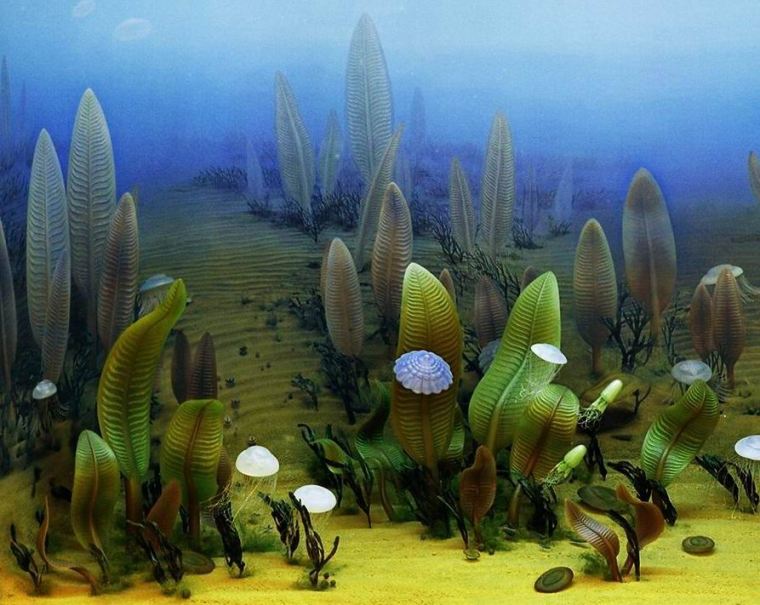
You can follow my ‘reportage’ on the long running story of the Snowball Earth events during the Neoproterozoic Cryogenian Period (850 to 635 Ma) since 2000 through the index to annual Palaeoclimatology logs (15 posts). Once these dramatic events were over sedimentary rocks deposited around the world during the Ediacaran Period (635 to 541 Ma) record the sudden appearance of large-bodied fossils: the first multicellular animals. This explosion from slimy biofilms and colonies of single-celled prokaryotes and eukaryotes laid the basis for the myriad ecological niches that have characterised Planet Earth ever since. The change saw specialised eukaryote cells (see: The rise of the eukaryotes; December 2017), whose precursors had originated in single-celled forms, begin to cooperate inthe development of complex tissues, organs, and organ systems to form bodies rather than just cell walls. The pulsating evolution, diversification and repeated extinction that followed during the last one tenth of geological time shaped a planet that is unique in the Solar System and possibly in the galaxy, if not the entire universe. The simple biosphere that preceded it, on the other hand, may have emerged on innumerable rocky planets blessed with liquid water to survive little changed for billions of years, as have Earths’ prokaryotes, the Archaea and Bacteria.  

Artist’s impression of the Ediacaran Fauna (credit: Science)

The Ediacaran biological revolution followed repeated changes in the geochemistry of the oceans, which carbon isotope data from the Cryogenian and Ediacaran suggest to have ‘gone haywire’. This turmoil involved dramatic changes in the cycling of sulfur and phosphorus that help ‘fertilise’ the marine food chain and in the production of oxygen by photosynthesis that is essential for metazoan animals.  The episodes when the Earth was iced over reduced the availability of nutrients through decreased rates of ocean-floor burial of dead organisms. Such Snowball events would also have reduced penetration of sunlight in the oceans. Less photosynthesis would not only have reduced oxygen production but also the amounts of autotrophic organisms. Furthermore, decreased water temperature would have increased its viscosity thereby slowing the spread of nutrients. The food chain for heterotrophs was decimated. Each Snowball event ended with warming, ice-free conditions so that the marine biosphere could burgeon

A great deal of data and numerous theories have accumulated since the Snowball concept was first mooted, but there has been little progress in understanding the rise of multi-celled life. Four geoscientists from the Massachusetts Institute of Technology, the Santa Fe Institute and the University of Colorado (Boulder), USA have developed an interesting hypothesis for how this enormous evolutionary step may have developed (Crockett, W.W. et al. 2024. Physical constraints during Snowball Earth drive the evolution of multicellularity. Proceedings of the Royal Society B: Biological Sciences, v. 291; DOI: 10.1098/rspb.2023.2767). The concatenation of huge events during the Cryogenian and Ediacaran presented continually changing patterns of selective pressures on simple organisms that preceded that time period. Crockett et al. review them in the light of fundamental biology to suggest how multicellular animals emerged as the Ediacara Fauna. Intuitively, such harsh conditions suggest at worst mass, even complete, extinction, at best a general reduction in size of all organism to cope with scarce resources. That the size of eukaryotes should have grown hugely goes against the grain of most biologists’ outlook.

The authors consider the crucial factor to be fundamental differences between prokaryotes and early eukaryotes. Prokaryote cells are very small, and whether autotrophs of heterotrophs they absorb nutrients through their walls by diffusion. Single-celled eukaryotes are far larger than prokaryotes and typically have a flagellum or ‘tail’ so that they can move independently and more easily gather resources. Crockett et al. used computer modelling to simulate the type of life form that could grow and thrive under Snowball conditions. They found that prokaryotes could only grow smaller, being ‘stunted’ by scarce resources. On the other hand eukaryotes would be better equipped to gather resources, the more so if they adopted a simple multicellular form – a hollow, self-propelled sphere about the size of a pea, which the authors dub a choanoblastula. Although no such form is known today, it does resemble the green Volvox algae, and plausibly could have evolved further to the simple forms of the Ediacaran fauna. The next task is either to find a fossil of such an organism, or to grow one.

A new explanation for the Neoproterozoic Snowball Earth episodes

The Cryogenian Period that lasted from 860 to 635 million years ago is aptly named, for it encompassed two maybe three episodes of glaciation. Each left a mark on every modern continent and extended from the poles to the Equator. In some way, this series of long, frigid catastrophes seems to have been instrumental in a decisive change in Earth’s biology that emerged as fossils during the following Ediacaran Period (635 to 541 Ma). That saw the sudden appearance of multicelled organisms whose macrofossil remains – enigmatic bag-like, quilted and ribbed animals – are found in sedimentary rocks in Australia, eastern Canada and NW Europe. Their type locality is in the Ediacara Hills of South Australia, and there can be little doubt that they were the ultimate ancestors of all succeeding animal phyla. Indeed one of them Helminthoidichnites, a stubby worm-like animal, is a candidate for the first bilaterian animal and thus our own ultimate ancestor. Using the index for Palaeobiology or the Search Earth-logs pane you can discover more about them in 12 posts from 2006 to 2023. The issue here concerns the question: Why did Snowball Earth conditions develop? Again, refresh your knowledge of them, if you wish, using the index for Palaeoclimatology or Search Earth-logs. From 2000 onwards you will find 18 posts: the most for any specific topic covered by Earth-logs. The most recent are Kicking-off planetary Snowball conditions (August 2020) and Signs of Milankovich Effect during Snowball Earth episodes (July 2021): see also: Chapter 17 in Stepping Stones.

One reason why Snowball Earths are so enigmatic is that CO2 concentrations in the Neoproterozoic atmospheric were far higher than they are at present. In fact since the Hadean Earth has largely been prevented from being perpetually frozen over by a powerful atmospheric greenhouse effect. Four Ga ago solar heating was about 70 % less intense than today, because of the ‘Faint Young Sun’ paradox. There was a long episode of glaciation (from 2.5 to 2.2 Ga) at the start of the Palaeoproterozoic Era during which the Great Oxygenation Event (GOE) occurred once photosynthesis by oxygenic bacteria became far more common than those that produced methane. This resulted in wholesale oxidation to carbon dioxide of atmospheric methane whose loss drove down the early greenhouse effect – perhaps a narrow escape from the fate of Venus. There followed the ‘boring billion years’ of the Mesoproterozoic during which tectonic processes seem to have been less active. in that geologically tedious episode important proxies (carbon and sulfur isotopes) that relate to the surface part of the Earth System ‘flat-lined’.  The plethora of research centred on the Cryogenian glacial events seems to have stemmed from the by-then greater complexity of the Precambrian Earth System.

Since the GOE the main drivers of Earth’s climate have been the emission of CO2 and SO2 by volcanism, the sedimentary burial of carbonates and organic carbon in the deep oceans, and weathering. Volcanism in the context of climate is a two-edged sword: CO2 emission results in greenhouse warming, and SO2 that enters the stratosphere helps reflect solar radiation away leading to cooling. Silicate minerals in rocks are attacked by hydrogen ions (H+) produced by the solution of CO2 in rain water to form a weak acid (H2CO3: carbonic acid). A very simple example of such chemical weathering is the breakdown of calcium silicate:

CaSiO3  +  2CO2  + 3H2O  =  Ca2+  +  2HCO3  +  H4SiO4  

The reaction results in calcium and bicarbonate ions being dissolved in water, eventually to enter the oceans where they are recombined in the shells of planktonic organisms as calcium carbonate. On death, their shells sink and end up in ocean-floor sediments along with unoxidised organic carbon compounds. The net result of this part of the carbon cycle is reduction in atmospheric CO2 and a decreased greenhouse effect: increased silicate weathering cools down the climate. Overall, internal processes – particularly volcanism – and surface processes – weathering and carbonate burial – interact. During the ‘boring billion’ they seem to have been in balance. The two processes lie at the core of attempts to model global climate behaviour in the past, along with what is known about developments in plate tectonics – continental break-up, seafloor spreading and orogenies – and large igneous events resulting from mantle plumes. A group of geoscientists from the Universities of Sydney and Adelaide, Australia have evaluated the tectonic factors that may have contributed to the first and longest Snowball Earth of the Neoproterozoic: the Sturtian glaciation (717 to 661 Ma) (Dutkiewicz, A. et al. 2024. Duration of Sturtian “Snowball Earth” glaciation linked to exceptionally low mid-ocean ridge outgassing. Geology, v. 52, online early publication; DOI: 10.1130/G51669.1).

Palaeogeographic reconstructions (Robinson projection) during the early part of the Sturtian global glaciation: LEFT based on geological data from Neoproterozoic terrains on modern continents; RIGHT based on palaeomagnetic pole positions from those terrains. Acronyms refer to each terrains, e.g. Am is Amazonia, WAC is the West African Craton. Orange lines are ocean ridges, those with teeth are subduction zone. (Credit: Dutkiewicz et al., parts of Fig. 1)

Shortly before the Sturtian began there was a major flood volcanism event, forming the Franklin large igneous province, remains of which are in Arctic Canada. The Franklin LIP is a subject of interest for triggering the Sturtian, by way of a ‘volcanic winter’ effect from SO2 emissions or as a sink for CO through its weathering. But both can be ruled out as no subsequent LIP is associated with global cooling and the later, equally intense Marinoan global glaciation (655 to 632 Ma) was bereft of a preceding LIP. Moreover, a world of growing frigidity probably could not sustain the degree of chemical weathering to launch a massive depletion in atmospheric CO2. In search of an alternative, Adriana Dutkiewicz and colleagues turned to the plate movements of the early Neoproterozoic. Since 2020 there have been two notable developments in modelling global tectonics of that time, which was dominated by the evolution of the Rodinia supercontinent. One is based largely on geological data from the surviving remnants of Rodinia (download animation), the other uses palaeomagnetic pole positions to fix their relative positions: the results are very different (download animation).

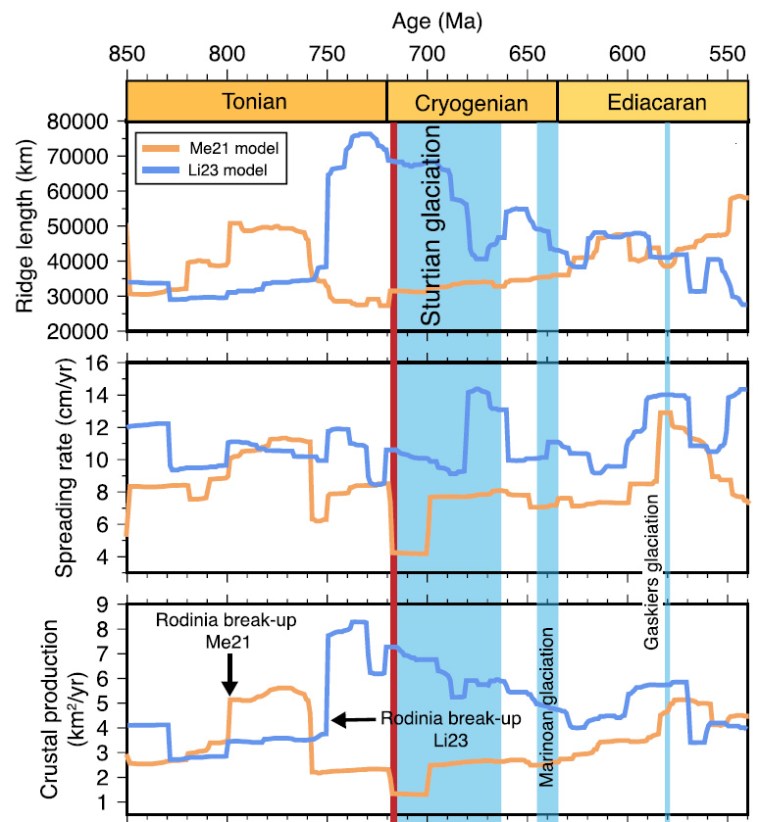
Variations in ocean ridge lengths, spreading rates and oceanic crust production during the Neoproterozoic estimated from the geological (orange) and palaeomagnetic (blue) models. Credit: Dutkiewicz et al., parts of Fig. 2)

The geology-based model has Rodinia beginning to break up around 800 Ma ago with a lengthening of global constructive plate margins during disassembly. The resulting continental drift involved an increase in the rate of oceanic crust formation from 3.5 to 5.0 km2 yr-1. Around 760 Ma new crust production more than halved and continued at a much slowed rate throughout the Cryogenian and the early part of the Ediacaran Period.  The palaeomagnetic model delays breakup of the Rodinia supercontinent until 750 Ma, and instead of the rate of crust production declining through the Cryogenian it more than doubles and remains higher than in the geological model until the late Ediacaran. The production of new oceanic crust is likely to govern the rate at which CO2 is out-gassed from the mantle to the atmosphere. The geology-based model suggests that from 750 to 580 Ma annual CO2 additions could have been significantly below what occurred during the Pleistocene ice ages since 2.5 Ma ago. Taking into account the lower solar heat emission, such a drop is a plausible explanation for the recurrent Snowball Earths of the Neoproterozoic. On the other hand, the model based on palaeomagnetic data suggests significant warming during the Cryogenian contrary to a mass of geological evidence for the opposite.

A prolonged decrease in tectonic activity thus seems to be a plausible trigger for global glaciation. Moreover, reconstruction of Precambrian global tectonics using available palaeomagnetic data seems to be flawed, perhaps fatally. One may ask, given the trends in tectonic data: How did the Earth repeatedly emerge from Snowball episodes? The authors suggest that the slowing or shut-down of silicate weathering during glaciations allowed atmospheric CO2 to gradually build up as a result of on-land volcanism associated with subduction zones that are a quintessential part of any tectonic scenario.

This kind of explanation for recovery of a planet and its biosphere locked in glaciation is in fact not new. From the outset of the Snowball Earth hypothesis much the same escape mechanisms were speculated and endlessly discussed. Adriana Dutkiewicz and colleagues have fleshed out such ideas quite nicely, stressing a central role for tectonics. But the glaring disparities between the two models show that geoscientists remain ‘not quite there’. For one thing, carbon isotope data from the Cryogenian and Ediacaran Periods went haywire: living processes almost certainly played a major role in the Neoproterozoic climatic dialectic.

Geochemical evidence for the origin of eukaryotes

Along with algae, jellyfish, oak trees, sharks and nearly every organism that can be seen with the naked eye, we are eukaryotes. The cells of every member of the Eukarya, one of the three great domains of life, all contain a nucleus – the main location of genetic material – and a variety of other small bodies known as organelles, such as the mitochondria of animals and the chloroplasts of plant cells. The vast bulk of organisms that we can’t see unaided are prokaryotes, divided into the domains of Bacteria and Archaea. Their genetic material floats around in their cells’ fluid. The DNA of eukaryotes shares some stretches with prokaryotes, but no prokaryotes contain any eukaryote genetic material. This suggests that the Eukarya arose after the Bacteria and Archaea, and also that they are a product of evolution from prokaryotes, probably by several combining in symbiotic relationships inside a shared cell membrane. Earth-logs has followed developments surrounding this major issue since 2002, as reflected in some of the posts linked to what follows. 

While prokaryotes can live in every conceivable environment at the Earth’s surface and even in a few kilometres of crust beneath, the vast majority of eukaryotes depend on free oxygen for their metabolism. Logically, the earliest of the Eukarya could only have emerged when oxygen began to appear in the oceans following the Great Oxidation Event around 2.4 billion years ago. That is more than a billion years after the first prokaryotes had left their geological signature in the form of curiously bulbous, layered carbonate structures (stromatolites), probably formed by bacterial mats. The oldest occur in the Archaean rocks of Western Australia as far back as 3.5 Ga, and disputed examples have been found in the 3.7 Ga Isua sediments of West Greenland. The oldest of them are thought to have been produced through the anoxygenic photosynthesis of purple bacteria (See: Molecular ‘fossils’ and the emergence of photosynthesis; September 2000), suggested by organic molecules found in kerogen from early Archaean sediments. Later stromatolites (<3.0 Ga) have provided similar evidence for oxygen-producing cyanobacteria.

Acritarchs are microfossils of single-celled organisms made of kerogen that have been found in sediments up to 1.8 billion years old. Features protruding from their cell walls distinguish them from prokaryote cells, which are more or less ‘smooth’: acritarchs have been considered as possible early eukaryotes. Yet the oldest undisputed eukaryote microfossils – red and green algae – are much younger (about 1.0 Ga). A means of estimating an age for the crown group from which every later eukaryote organism evolved – last eukaryotic common ancestor (LECA) – is to use an assumed rate of mutation in DNA to deduce the time when differences in genetics between living eukaryotes began to diverge: i.e. a ‘molecular clock’. This gives a time around 2 Ga ago, but the method is fraught with uncertainties, not the least being the high possibility of mutation rates changing through time. So, when the Eukarya arose is blurred within the so-called ‘boring billion’ of the early Proterozoic Eon. A way of resolving this uncertainty to some extent is to look for ‘biomarker’ chemicals in the geological record that provide a ‘signature’ for eukaryotes.

A new study has been undertaken by a group of Australian, German and French scientists to analyse sediments ranging in age from 635 to 1640 Ma from Australia, China, Asia, Africa, North and South America (Brocks, J.J and 9 others 2023. Lost world of complex life and the late rise of the eukaryotic crown. Nature, v. 618, p. 767–773; DOI: 10.1038/s41586-023-06170-w; contact for PDF). Their chosen biomarkers are sterols (steroids) that regulate eukaryote cell membranes. Some prokaryotes also synthesise steroids but all of them produce hopanepolyols (hopanoids), which eukaryotes do not. The key measures for the presence/absence of eukaryote remains in ancient sea-floor sediments is thus the relative proportions of preserved steroids and hopanoids, together with those for the breakdown products of both – steranes and hopanesthat are, crudely speaking, carbon ‘skeletons’ of the original chemicals.

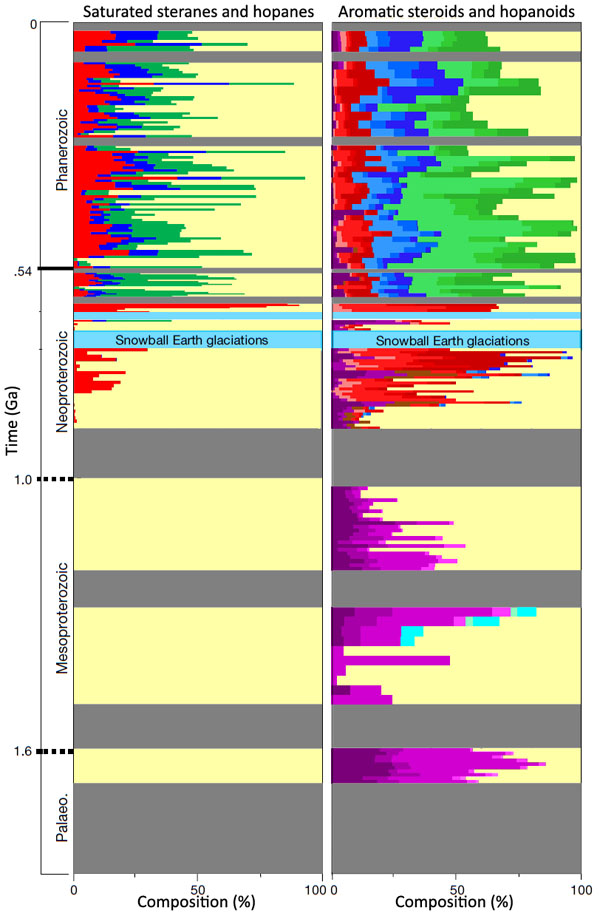
Proportions of biomarkers in sediments from present to 1.64 Ga. Cholesteroids – reds; ergosteroids – blues; stigmasteroids – greens; protosteroids magentas, hopanoids – yellows; unsampled – grey. Snowball glaciations are shown in pale blue. (Credit: Simplified from Figure 3 in Brocks et al.)

Interpretation of the results by Jochen Brocks and colleagues is complicated, and what follows is a summary based partly on an accompanying Nature News & Views article(Kenig, F. 2023. The long infancy of sterol biosynthesis. Nature, v. 618, p. 678-680; DOI: 10.1038/d41586-023-01816-1). The conclusions of Brocks et al. are surprising. First, the break-down products of steroids (saturated steranes) that can be attributed to crown eukaryotes (left on the figure above) are only present in sediments going back to about 200 Ma before the first Snowball Earth event (~900 Ma). Before that only hopanes formed by hopanoid degradation are present: a suggestion that LECA only appeared around that time – the authors suggest sometime between 1 and 1.2 Ga. That is far later than the time when eukaryotes could have emerged: i.e. once there was available oxygen after the Great Oxidation Event (~2.4 to 2.2 Ga). So what was going on before this? The authors broke new ground in analysis of biomarkers by being able to detect signs of the presence of actual hopanoids and steroids of several different kinds. Steroids were present as far back as 1.6 Ga in the oldest sediments that were analysed.

Steroids of crown eukaryotes are represented by cholesteroids, ergosteroids and stigmasteroids. All three are present throughout the Phanerozoic Eon and into the time of the Ediacaran Fauna that began 630 Ma ago. In that time span they generally outweigh hopanoids, thus reflecting the dominance of eukaryotes over prokaryotes. Back to about 900 Ma, only cholesteroids are present, together with archaic forms that are not found in living Eukarya, termed protosteroids.  Before that, only protosteroids are found. Moreover, these archaic steroids are not present in sediments that follow the Snowball Earth episodes (the Cryogenian Period).

Thus, it is possible that crown group eukaryotes – and their descendants, including us – evolved from and completely replaced an earlier primitive form (acritarchs?) at around the time of the greatest climatic changes that the Earth had experienced in the previous billion years or more. Moreover, the Cryogenian and Ediacaran Periods seem to show a rapid emergence of stigmasteroid- and ergosteroid production relative to cholesteroid: perhaps a result of explosive evolution of the Eukarya at that time. The organisms that produced protosteroids were present in variable amounts throughout the Mesoproteroic. Clearly there need to be similar analyses of sediments going back to the Great Oxygenation Event and the preceding Archaean to see if the protosteroid producers arose along with increasing levels of molecular oxygen. The ‘boring billion’ (2.0 to 1.0 Ga) may well be more interesting than previously thought.

Origin of animals at a time of chaotic oxygen levels

Every organism that you can easily see is a eukaryote, the vast majority of which depend on the availability of oxygen molecules. The range of genetic variation in a wide variety of eukaryotes suggests, using a molecular ‘clock’, that the first of them arose between 2000 to 1000 Ma ago. It possibly originated as a symbiotic assemblage of earlier prokaryote cells ‘bagged-up’ within a single cell wall: Lynn Margulis’s hypothesis of endosymbiosis. It had to have happened after the Great Oxygenation Event (GOE 2.4 to 2.2 Ga), before which free oxygen was present in the seas and atmosphere only at vanishingly small concentrations. Various single-celled fossil possibilities have been suggested to be the oldest members of the Eukarya but are not especially prepossessing, except for one bizarre assemblage in Gabon. The first inescapable sign that eukaryotes were around is the appearance of distinctive organic biomarkers in sediments about 720 Ma old. The Neoproterozoic is famous for its Snowball Earth episodes and the associated multiplicity of large though primitive animals during the Ediacaran Period (see: The rise of the eukaryotes; December 2017).

The records of carbon- and sulfur isotopes in Neo- and Mesoproterozoic sedimentary rocks are more or less flat lines after a mighty hiccup in the carbon and sulfur cycles that followed the GOE and the earliest recorded major glaciation of the Earth. The time between 2.0 and 1.0 Ga has been dubbed ‘the Boring Billion’. At about 900 Ma, both records run riot. Sulfur isotopes in sediments reveal the variations of sulfides and sulfates on the seafloor, which signify reducing and oxidising conditions respectively.  The δ13C record charts the burial of organic carbon and its release from marine sediments related to reducing and oxidising conditions in deep water. There were four major ‘excursions’ of δ13C during the Neoproterozoic, which became increasingly extreme. From constant anoxic, reducing conditions throughout the Boring Billion the Late Neoproterozoic ocean-floor experienced repeated cycles of low and high oxygenation reflected in sulfide and sulfate precipitation and by fluctuations in trace elements whose precipitation depends on redox conditions. By the end of the Cambrian, when marine animals were burgeoning, deep-water oxic-anoxic cycles had been smoothed out, though throughout the Phanerozoic eon anoxic events crop up from time to time.

Atmospheric levels of free oxygen relative to that today (scale is logarithmic) computed using combined carbon- and sulfur isotope records from marine sediments since 1500 Ma ago. The black line is the mean of 5,000 model runs, the grey area represents ±1 standard deviations. The pale blue area represents previous ‘guesstimates’. Vertical yellow bars are the three Snowball Earth events of the Late Neoproterozoic (Sturtian, Marinoan and Gaskiers). (Credit: Krause et al., Fig 1a)

The Late Neoproterozoic redox cycles suggest that oxygen levels in the oceans may have fluctuated too. But there are few reliable proxies for free oxygen. Until recently, individual proxies could only suggest broad, stepwise changes in the availability of oxygen: around 0.1% of modern abundance after the GOE until about 800 Ma; a steady rise to about 10% during the Late Neoproterozoic; a sharp rise to an average of roughly 80% at during the Silurian attributed to increased photosynthesis by land plants. But over the last few decades geochemists have devised a new approach based on variations on carbon and sulfur isotope data from which powerful software modelling can make plausible inferences about varying oxygen levels. Results from the latest version have just been published (Krause, A.J. et al. 2022. Extreme variability in atmospheric oxygen levels in the late Precambrian. Science Advances, v. 8, article 8191; DOI: 10.1126/sciadv.abm8191).

Alexander Krause of Leeds University, UK, and colleagues from University College London, the University of Exeter, UK and the Univerisité Claude Bernard, Lyon, France show that atmospheric oxygen oscillated between ~1 and 50 % of modern levels during the critical 740 to 540 Ma period for the origin and initial diversification of animals. Each major glaciation was associated with a rapid decline, whereas oxygen levels rebounded during the largely ice-free episodes. By the end of the Cambrian Period (485 Ma), by which time the majority of animal phyla had emerged, there appear to have been six such extreme cycles.

Entirely dependent on oxygen for their metabolism, the early animals faced periodic life-threatening stresses. In terms of oxygen availability the fluctuations are almost two orders of magnitude greater than those that animal life faced through most of the Phanerozoic. Able to thrive and diversify during the peaks, most animals of those times faced annihilation as O2 levels plummeted. These would have been periods when natural selection was at its most ruthless in the history of metazoan life on Earth. Its survival repeatedly faced termination, later mass extinctions being only partial threats. Each of those Phanerozoic events was followed by massive diversification and re-occupation of abandoned and new ecological niches. So too those Neoproterozoic organism that survived each massive environmental threat may have undergone adaptive radiation involving extreme changes in their form and function. The Ediacaran fauna was one that teemed on the sea floor, but with oxygen able to seep into the subsurface other faunas may have been evolving there exploiting dead organic matter. The only signs of that wholly new ecosystem are the burrows that first appear in the earliest Cambrian rocks. Evolution there would have ben rife but only expressed by those phyla that left it during the Cambrian Explosion.

There is a clear, empirical link between redox shifts and very large-scale glacial and deglaciation events. Seeking a cause for the dramatic cycles of climate, oxygen and life is not easy. The main drivers of the greenhouse effect COand methane had to have been involved, i.e. the global carbon cycle. But what triggered the instability after the ‘Boring Billion’? The modelled oxygen record first shows a sudden rise to above 10% of modern levels at about 900 Ma, with a short-lived tenfold decline at 800 Ma. Could the onset have had something to do with a hidden major development in the biosphere: extinction of prokaryote methane generators; explosion of reef-building and oxygen-generating stromatolites? How about a tectonic driver, such as the break-up of the Rodinia supercontinent? Then there are large extraterrestrial events … Maybe the details provided by Krause et al. will spur others to imaginative solutions. See also: How fluctuating oxygen levels may have accelerated animal evolution. Science Daily, 14 October 2022

Signs of Milankovich Effect during Snowball Earth episodes

The idea that the Earth was like a giant snowball during the Neoproterozoic Era arose from the discovery of rocks of that age that could only have formed as a result of glaciation. However, unlike the Pleistocene ice ages, evidence for these much older glacial conditions occurs on all continents. In some locations remanent magnetism in sedimentary rocks of that age is almost horizontal; i.e. they had been deposited at low magnetic latitudes, equivalent to the tropics of the present day. Frigid as it then was, the Earth still received solar heating and magmatic activity would have been slowly adding CO2 to the atmosphere so that less heat escaped – a greenhouse effect must have been functioning. Moreover, an iced-over world would not have been supporting much photosynthetic life to draw down the greenhouse gas into solid carbohydrates and carbonates to be buried on the ocean floor. As far as we know the Solar System’s geometry during the Neoproterozoic was much as it is today. So changes in the gravitational fields induced by the orbiting Giant Planets would have been affecting the shape (eccentricity) of Earth’s orbit, the tilt (obliquity) of its rotational axis and the precession (wobble) of its rotation as they do at present through the Milankovich effect. These astronomical forcings vary the amount of solar energy reaching the Earth’s surface. It has been suggested that a Snowball Earth’s climate system would have been just as sensitive to astronomical forcing as it has been during the last 2 million years or more. Proof of that hypothesis has recently been achieved, at least for one of the Snowball events (Mitchell, R.N. and 8 others 2021. Orbital forcing of ice sheets during snowball Earth. Nature Communications, v. 12, article 4187; DOI: 10.1038/s41467-021-24439-4).

Another of the enigmas of the Neoproterozoic is that after and absence of more than a billion years banded iron formations (see: Banded iron formations (BIFs) reviewed, December 2017) began to form again. BIFs are part of the suite of sedimentary rocks that characterise Snowball Earth events, often alternating with glaciogenic sediments. Throughout each cold cycle – the Sturtian (717 to 663 Ma) and Marinoan (650 to 632 Ma) glacial periods – conditions of sediment deposition varied a great deal from place to place and over time. Some sort of cyclicity is hinted at, but the pace of alternations has proved impossible to check, partly because the dominant rocks (glacial conglomerates or diamictites) show little stratification and others that are bedded (various non-glacial sandstones) vary from place to place and give no sign of rates of deposition, having been deposited under high-energy conditions. BIFs, on the other hand are made up of enormous numbers of parallel layers on scales from millimetres to centimetres. Bundles of bands can be traced over large areas, and they may represent repeated cycles of deposition.

Typical banded iron formation

How BIFs formed is crucial. They were precipitated from water rich in dissolved iron in its reduced Fe2+ (ferrous) form, which originated from sea-floor hydrothermal vents. Precipitation occurred when the amount of oxygen in the water increased the chance of electrons being removed from iron ions to transform them from ferrous to ferric (Fe3+). Their combination with oxygen yields insoluble iron oxides. Cyclical changes in the availability of oxygen and the balance between reducing and oxidising conditions result in the banding. In fact several rhythms of alternation are witnessed by repeated packages at deci-, centi- and millimetre scales within each BIF deposit. Overall the packages suggest a constant rate of deposition: a ‘must-have’ for precise time-analysis of the cycles. BIFs contain both weakly magnetic hematite (Fe2O3) and strongly magnetic magnetite (Fe3O4), their ratio depending on varying geochemical conditions during deposition. Ross Mitchell of Curtin University, Western Australia and his Chinese, Australian and Dutch colleagues measured magnetic susceptibility at closely spaced intervals (1 and 0.25 m) in two section of BIFs from the Sturtian glaciation in the Flinders Ranges of South Australia. Visually both sections show clear signs of two high-frequency and three lower frequency kinds of cycles, expressed in thickness.

The tricky step was converting the magneto-stratigraphic data to a time series. High-precision zircon U-Pb dating of volcanic rocks in the sequence suggested a mean BIF deposition rate of 3.7 to 4.4 cm per thousand years. This allowed the thickness of individual bands and packages to be expressed in years, the prerequisite for time-series analysis of the BIF magneto-stratigraphic sequence. This involves a mathematical process known as the Fast-Fourier Transform, which expresses the actual data as a spectral curve. Peaks in the curve represent specific frequencies expressed as cycles per metre. The rate of deposition of the BIF allows each peak to be assigned a frequency in years, which can then be compared with the hypothetical spectrum associated with the Milankovich effect. One of the BIF sequences yielded peaks corresponding to 23, 97 and 106 ka. These match the effects of variation in precession (23 ka) and ‘short’ orbital eccentricity (97 and 106 ka) found in Cenozoic sea-floor sediments and ice cores. The other showed peaks at 405, 754 and 1.2 Ma corresponding to ‘long’ orbital eccentricity and long-term features of both obliquity and precession. Quite a result! But how does this bear on Snowball Earth events? Cyclical changes in solar heating would have affected the extent of ice sheets and sea ice at all latitudes, forcing episodes of expansion and contraction and thus changes in sediment supply to the sea floor. That helps explain the many observed variations in sedimentation other than that of BIFs. Rather than supporting a ‘hard’ Snowball model of total marine ice cover for millions of years, it suggests that such an extreme was relieved by period of extensive open water, much as affected the modern Arctic Ocean for the last 2 million years or so. There could have been global equivalents of ice ages and interglacials during the Sturtian and Marinoan. ‘Hard’ conditions would have shut down much of the oceans’ biological productivity, periodically to have been reprieved by more open conditions: a mechanism that would have promoted both extinctions and evolutionary radiations. Snowball events may have driven the takeover of prokaryote (bacteria) dominance by that of the multicelled eukaryotes that is signalled by the Ediacaran faunas that swiftly followed glacial epochs and the explosion of multicelled life during the Cambrian. As eukaryotes, we may well owe our existence to Snowball.

Kicking-off planetary Snowball conditions

Untitled-1
Artist’s impression of the glacial maximum of a Snowball Earth event (Source: NASA)

Twice in the Cryogenian Period of the Neoproterozoic, glacial- and sea ice extended from both poles to the Equator, giving ‘Snowball Earth’ conditions. Notable glacial climates in the Phanerozoic – Ordovician, Carboniferous-Permian and Pleistocene – were long-lived but restricted to areas around the poles, so do not qualify as Snowball Earth conditions. It is possible, but less certain, that Snowball Earth conditions also prevailed during the Palaeoproterozoic at around 2.4 to 2.1 billion years ago. This earlier episode roughly coincided with the ‘Great Oxidation Event’, and one explanation for it is that the rise of atmospheric oxygen removed methane, a more powerful greenhouse gas than carbon dioxide, by oxidizing it to CO2 and water. That may well have been a consequence of the evolution of the cyanobacteria, their photosynthesis releasing oxygen to the atmosphere. The Neoproterozoic ‘big freezes’ are associated with rapid changes in the biosphere, most importantly with the rise of metazoan life in the form of the Ediacaran fauna, the precursor to the explosion in animal diversity during the Cambrian. Indeed all major global coolings, restricted as well as global, find echoes in the course of biological evolution. Another interwoven factor is the rock cycle, particularly volcanism and the varying pace of chemical weathering. The first releases CO2 from the mantle, the second helps draw it down from the atmosphere when weak carbonic acid in rainwater rots silicate minerals (see: Can rock weathering halt global warming, July 2020). All such interplays between major and sometimes minor ‘actors’ in the Earth system influence climate and, in turn, climate inevitably affects all the rest. With such complexity it is hardly surprising that there is a plethora of theories about past climate shifts.

As well as a link with fluctuations in the greenhouse effect, climate is influenced by changes in the amount of solar heating, for which there are yet more options to consider. For instance, the increase in Earth’s albedo (reflectivity) that results from ice cover, may lead through a feedback effect to runaway cooling, particularly once ice extends beyond the poorly illuminated poles. Volcanic dust and sulfate aerosols in the stratosphere also increase albedo and the tendency to cooling, as would interplanetary dust. More complexity to befuddle would-be modellers of ancient climates. Yet it is safe to say that, within the maelstrom of contributory factors, the freeze-overs of Snowball conditions must have resulted from our planet passing through some kind of threshold in the Earth System. Two theoretical scientists from the Department of Earth, Atmospheric, and Planetary Sciences at the Massachusetts Institute of Technology have attempted to cut through the log-jam by modelling the dynamics of the interplay between the ice-albedo feedback and the carbon-silicate cycle of weathering (Arnscheidt, C.W. & Rothman, D.H. 2020. Routes to global glaciation. Proceedings of the Royal Society A, v. 476, article 0303 online; DOI: 10.1098/rspa.2020.0303). Their mathematical approach involves two relatively simple, if long-winded, equations based on parameters that express solar heating, albedo, surface temperature and pressure, and the rate of volcanic outgassing of CO2; a simplification that sets biological processes to one side.

Unlike previous models, theirs can simulate varying rates, particularly of changes in solar energy input. The key conclusion of the paper is that if solar heating decreases faster than a threshold rate the more a planet’s surface water is likely to freeze from pole to pole. The authors suggest that a Snowball Earth event would result from a 2% fall in received solar radiation over about ten thousand years: pretty quick in a geological sense. Such a trigger might stem from a volcanic ‘winter’ scenario, an increase in clouds seeded by spores of primitive marine algae or other factors. The real ‘tipping point’ would probably be the high albedo of ice. There is a warning in this for the present, when a variety of means of decreasing solar input have been proposed as a ‘solution’ to global warming.

Because the Earth orbits the Sun in the ‘Goldilocks Zone’ and is volcanically active even global glaciation would be temporary, albeit of the order of millions of years. The cold would have shut down weathering so that volcanic CO2 could slowly build up in the atmosphere: the greenhouse effect would rescue the planet. Further from the Sun, a planet would not have that escape route, regardless of its atmospheric concentration of greenhouse gases: a neat lead-in to another recent paper about the ancient climate of Mars (Grau Galofre, A. et al. 2020. Valley formation on early Mars by subglacial and fluvial erosion. Nature Geoscience, early online article; DOI: 10.1038/s41561-020-0618-x)

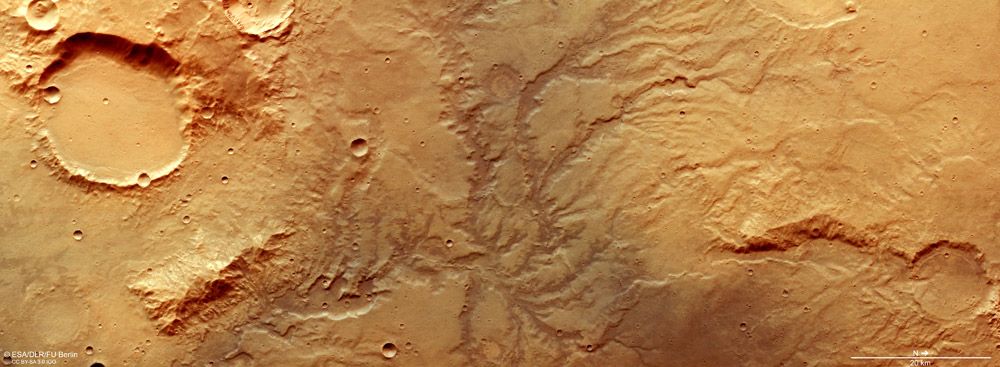
A Martian channel system: note later cratering (credit: European Space Agency)

There is a lot of evidence from both high-resolution orbital images of the Martian surface and surface ‘rovers’ that surface water was abundant over a long period in Mars’s early history. The most convincing are networks of channels, mainly in the southern hemisphere highlands. They are not the vast channelled scablands, such as those associated with Valles Marineris, which probably resulted from stupendous outburst floods connected to catastrophic melting of subsurface ice by some means. There are hundreds of channel networks, that resemble counterparts on Earth. Since rainfall and melting of ice and snow have carved most terrestrial channel networks, traditionally those on Mars have been attributed to similar processes during an early warm and wet phase. The warm-early Mars hypothesis extends even to interpreting the smooth low-lying plains of its northern hemisphere – about a third of Mars’s surface area – as the site of an ocean in those ancient times. Of course, a big question is, ‘Where did all that water go?’ Another relates to the fact that the early Sun emitted considerably less radiation 4.5 billion years ago than it does now: a warm-wet early Mars is counterintuitive.

Anna Grau Galofre of the University of British Columbia and co-authors found that many of the networks on Mars clearly differ in morphology from one another, even in small areas of its surface. Drainage networks on Earth conform to far fewer morphological types. By comparing the variability on Mars with channel-network shapes on Earth, the authors found a close match for many with those that formed beneath the ice sheet that covered high latitudes of North America during the last glaciation. Some match drainage patterns typical of surface-water erosion, but both types are present in low Martian latitudes: a suggestion of ‘Snowball Mars’ conditions? The authors reached their conclusions by analysing six mathematical measures that describe channel morphology for over ten thousand individual valley systems. Previous analyses of individual systems discovered on high-resolution images have qualitative comparisons with terrestrial geomorphology

See also: Chu, J. 2020. “Snowball Earths” May Have Been Triggered by a Plunge in Incoming Sunlight – “Be Wary of Speed” (SciTech Daily 29 July 2020); Early Mars was covered in ice sheets, not flowing rivers, researchers say (Science Daily, 3 August 2020)

How marine animal life survived (just) Snowball Earth events

diamict3
A Cryogenian glacial diamictite containing boulders of many different provenances from the Garvellach Islands off the west coast of Scotland. (Credit: Steve Drury)

Glacial conditions during the latter part of the Neoproterozoic Era extended to tropical latitudes, probably as far as the Equator, thereby giving rise to the concept of Snowball Earth events. They left evidence in the form of sedimentary strata known as diamictites, whose large range of particle size from clay to boulders has a range of environmental explanations, the most widely assumed being glacial conditions. Many of those from the Cryogenian Period are littered with dropstones that puncture bedding, which suggest that they were deposited from floating ice similar to that forming present-day Antarctic ice shelves or extensions of onshore glaciers. Oceans on which vast shelves of glacial ice floated would have posed major threats to marine life by cutting off photosynthesis and reducing the oxygen content of seawater. That marine life was severely set back is signalled by a series of perturbations in the carbon-isotope composition of seawater. Its relative proportion of 13C to 12C (δ13C) fell sharply during the two main Snowball events and at other times between 850 to 550 Ma. The Cryogenian was a time of repeated major stress to Precambrian life, which may well have speeded up evolution, sediments of the succeeding Ediacaran Period famously containing the first large, abundant and diverse eukaryote fossils.

For eukaryotes to survive each prolonged cryogenic stress required that oxygen was indeed present in the oceans. But evidence for oxygenated marine habitats during Snowball Earth events has been elusive since these global phenomena were discovered. Geoscientists from Australia, Canada, China and the US have applied novel geochemical approaches to occasional iron-rich strata within Cryogenian diamictite sequences from Namibia, Australia and the south-western US in an attempt to resolve the paradox (Lechte, M.A. and 8 others 2019. Subglacial meltwater supported aerobic marine habitats during Snowball Earth. Proceedings of the National Academy of Sciences, 2019; 201909165 DOI: 10.1073/pnas.1909165116). Iron isotopes in iron-rich minerals, specifically the proportion of 56Fe relative to that of 54Fe (δ56Fe), help to assess the redox conditions when they formed. This is backed up by cerium geochemistry and the manganese to iron ratio in ironstones.

In the geological settings that the researchers chose to study there are sedimentological features that reveal where ice shelves were in direct contact with the sea bed, i.e. where  they were ‘grounded’. Grounding is signified by a much greater proportion of large fragments in diamictites, many of which are striated through being dragged over underlying rock. Far beyond the grounding line diamictites tend to be mainly fine grained with only a few dropstones. The redox indicators show clear changes from the grounding lines through nearby environments to those of deep water beneath the ice. Each of them shows evidence of greater oxidation of seawater at the grounding line and a falling off further into deep water. The explanation given by the authors is fresh meltwater flowing through sub-glacial channels at the base of the grounded ice fed by melting at the glacier surface, as occurs today during summer on the Greenland ice cap and close to the edge of Antarctica. Since cold water is able to dissolve gas efficiently the sub-glacial channels were also transporting atmospheric oxygen to enrich the near shore sub-glacial environment of the sea bed. In iron-rich water this may have sustained bacterial chemo-autotrophic life to set up a fringing food chain that, together with oxygen, sustained eukaryotic heterotrophs. In such a case, photosynthesis would have been impossible, yet unnecessary. Moreover, bacteria that use the oxidation of dissolved iron as an energy source would have caused Fe-3 oxides to precipitate, thereby forming the ironstones on which the study centred. Interestingly, the hypothesis resembles the recently discovered ecosystems beneath Antarctic ice shelves.

Small and probably unconnected ecosystems of this kind would have been conducive to accelerated evolution among isolated eukaryote communities. That is a prerequisite for the sudden appearance of the rich Ediacaran faunas that colonised sea floors globally once the Cryogenian ended. Perhaps these ironstone-bearing diamictite occurrences where the biological action seems to have taken place might, one day, reveal evidence of the precursors to the largely bag-like Ediacaran animals

Geochemical background to the Ediacaran explosion

The first clear and abundant signs of multicelled organisms appear in the geological record during the 635 to 541 Ma Ediacaran Period of the Neoproterozoic, named from the Ediacara Hills of South Australia where they were first discovered in the late 19th century. But it wasn’t until 1956, when schoolchildren fossicking in Charnwood Forest north of Leicester in Britain found similar body impressions in rocks that were clearly Precambrian age that it was realised the organism predated the Cambrian Explosion of life. Subsequently they have turned-up on all continents that preserve rocks of that age (see: Larging the Ediacaran, March 2011). The oldest of them, in the form of small discs, date back to about 610 Ma, while suspected embryos of multicelled eukaryotes are as old as the very start of the Edicaran (see; Precambrian bonanza for palaeoembryologists, August 2006).

Artist’s impression of the Ediacaran Fauna (credit: Science)

The Ediacaran fauna appeared soon after the Marinoan Snowball Earth glaciogenic sediments that lies at the top of the preceding Cryogenian Period (650-635 Ma), which began with far longer Sturtian glaciation (715-680 Ma). A lesser climatic event – the 580 Ma old Gaskiers glaciation – just preceded the full blooming of the Ediacaran fauna. Geologists have to go back 400 million years to find an earlier glacial epoch at the outset of the Palaeoproterozoic. Each of those Snowball Earth events was broadly associated with increased availability of molecular oxygen in seawater and the atmosphere. Of course, eukaryote life depends on oxygen. So, is there a connection between prolonged, severe climatic events and leaps in the history of life? It does look that way, but begs the question of how Snowball Earth events were themselves triggered. Continue reading “Geochemical background to the Ediacaran explosion”

Snowball Earth: A result of global tectonic change?

The Snowball Earth hypothesis first arose when Antarctic explorer Douglas Mawson (1882-1958)speculated towards the end of his career on an episode of global glaciations, based on his recognition in South Australia of thick Neoproterozoic glacial sediments. Further discoveries on every continent, together with precise dating and palaeomagnetic indications of the latitude at which they were laid down, have steadily concretised Mawson’s musings. It is now generally accepted that frigid conditions enveloped the globe at least twice – the Sturtian (~715 to 660 Ma) and Marinoan (650 to 635 Ma) glacial episodes – and perhaps more often during the Neoproterozoic Era. Such an astonishing idea has spurred intensive studies of geochemistry associated with the events, which showed rapid variations in carbon isotopes in ancient seawater, linked to the terrestrial carbon cycle that involves both life- and Earth processes. Strontium isotopes suggest that the Neoproterozoic launched erratic variation of continental erosion and weathering and related carbon sequestration that underpinned major climate changes in the succeeding Phanerozoic Eon. Increased marine phosphorus deposition and a change in sulfur isotopes indicate substantial change in the role of oxygen in seawater. The preceding part of the Proterozoic Eon is relatively featureless in most respects and is known to some geoscientists as the ‘Boring Billion’.

Untitled-1
Artist’s impression of the glacial maximum of a Snowball Earth event (Source: NASA)

Noted tectonician Robert Stern and his colleague Nathan Miller, both of the University of Texas, USA, have produced a well- argued and -documented case (and probably cause for controversy) that suggests a fundamental change in the way the Precambrian Earth worked at the outset of the Neoproterozoic (Stern, R.J. & Miller, N.R. 2018. Did the transition to plate tectonics cause Neoproterozoic Snowball Earth. Terra Nova, v. 30, p. 87-94). To the geochemical and climatic changes they have added evidence from a host of upheavals in tectonics. Ophiolites and high-pressure, low-temperature metamorphic rocks, including those produced deep in the mantle, are direct indicators of plate tectonics and subduction. Both make their first, uncontested appearance in the Neoproterozoic. Stern and Miller ask the obvious question; Was this the start of plate tectonics? Most geologists would put this back to at least the end of the Archaean Eon (2,500 Ma) and some much earlier, hence the likelihood of some dispute with their views.

They consider the quiescent billion years (1,800 to 800 Ma) before all this upheaval to be evidence of a period of stagnant ‘lid tectonics’, despite the Rodinia supercontinent having been assembled in the latter part of the ‘Boring Billion’, although little convincing evidence has emerged to suggest it was an entity formed by plate tectonics driven by subduction. But how could the onset of subduction-driven tectonics have triggered Snowball Earth? An early explanation was that the Earth’s spin axis was much more tilted in the Neoproterozoic than it is at present (~23°). High obliquity could lead to extreme variability of seasons, particularly in the tropics. A major shift in axial tilt requires a redistribution of mass within a planetary body, leading to true polar wander, as opposed to the apparent polar wander that results from continental drift. There is evidence for such an episode around the time of Rodinia break-up at 800 Ma that others have suggested stemmed from the formation of a mantle superplume beneath the supercontinent.

Considering seventeen possible geodynamic, oceanographic and biotic causes that have been plausibly suggested for global glaciation Stern and Miller link all but one to a Neoproterozoic transition from lid- to plate tectonics. Readers may wish to examine the authors’ reasoning to make up their own minds –  their paper is available for free download as a PDF from the publishers.

A fully revised edition of Steve Drury’s book Stepping Stones: The Making of Our Home World can now be downloaded as a free eBook