A possible Chinese ancestor for Denisovans, Neanderthals and modern humans

Assigning human fossils older than around 250 ka to different groups of the genus Homo depends entirely on their physical features. That is because ancient DNA has yet to be found and analysed from specimens older than that. The phylogeny of older human remains is also generally restricted to the bones that make up their heads; 21 that are fixed together in the skull and face, plus the moveable lower jaw or mandible. Far more teeth than crania have been discovered and considerable weight is given to differences in human dentition. Teeth are not bones, but they are much more durable, having no fibrous structure and vary a great deal. The main problem for palaeoanthropologists is that living humans are very diverse in their cranial characteristics, and so it is reasonable to infer that all ancient human groups were characterised by such polymorphism, and may have overlapped in their physical appearance. A measure of this is that assigning fossils to anatomically modern humans, i.e. Homo sapiens, relies to a large extent on whether or not their lower mandible juts out to define a chin. All earlier hominins and indeed all other living apes might be regarded as ‘chinless wonders’! This pejorative term suggests dim-wittedness to most people, and anthropologists have had to inure themselves to such crude cultural conjecture.

The extraction, sequencing and comparison of ancient DNA from human fossils since 2010 has revealed that three distinct human species coexisted and interbred in Eurasia. Several well preserved examples of ancient Neanderthals and anatomically modern humans (AMH) have had their DNA sequenced, but a Denisovan genome has only emerged from a few bone fragments from the Denisova Cave in western Siberia. Whereas Neanderthals have well-known robust physical characters, until 2025 palaeoanthropologists had little idea of what Denisovans may have looked like. Then proteins and, most importantly, mitochondrial DNA (mtDNA) were extracted from a very robust skull found around 1931 in Harbin, China, dated at 146 ka. Analysis of the mtDNA and proteins, from dental plaque and bone respectively, reveal that the Harbin skull is likely to be that of a Denisovan. Previously it had been referred to as Homo longi, or ‘Dragon Man’, along with several other very robust Chinese skulls of a variety of ages.

The distorted Yunxian cranium (right) and its reconstruction (middle) [Credit: Guanghui Zhao] compared with the Harbin Denisovan cranium (left) [Hebei Geo University]

The sparse genetic data have been used to suggest the times when the three different coexisting groups diverged. DNA in Y chromosomes from Denisovans and Neanderthals suggest that the two lineages split from a common ancestor around 700 ka ago, whereas Neanderthals and modern humans diverged genetically at about 370 ka. Yet the presence of sections of DNA from both archaic groups in living humans and the discovery that a female Neanderthal from Denisova cave had a Neanderthal mother and a Denisovan father reveals that all three were interfertile when they met and interacted. Such admixture events clearly have implications for earlier humans. There are signs of at least 6 coexisting groups as far back as the Middle Pleistocene (781 to 126 ka), referred to by some as the ‘muddle in the middle’ because such an association has increasingly mystified palaeoanthropologists. A million-year-old, cranium found near Yunxian in Hubei Province, China, distorted by the pressure of sediments in which it was buried, has been digitally reconstructed.

This reconstruction encouraged a team of Chinese scientists, together with Chris Stringer of the UK Museum of Natural History, to undertake a complex statistical study of the Yunxian cranium. Their method compares it with anatomical data for all members of the genus Homo from Eurasia and Africa, i.e. as far back as the 2.4 Ma old H. habilis (Xiabo Feng and 12 others 2025. The phylogenetic position of the Yunxian cranium elucidates the origin of Homo longi and the Denisovans. Science, v. 389, p. 1320-1324; DOI: 10.1126/science.ado9202). The study has produced a plausible framework that suggests that the five large-brained humans known from 800 ka ago – Homo erectus (Asian), H. heidelbergensis, H. longi (Denisovans), H. sapiens, and H. neanderthalensis – began diverging from one another more than a million years ago. The authors regard the Yuxian specimen as an early participant in that evolutionary process. The fact that at least some remained interfertile long after the divergence began suggests that it was part of the earlier human evolutionary process. It is also possible that the repeated morphological divergence may stem from genetic drift. That process involves small populations with limited genetic diversity that are separated from other groups, perhaps by near-extinction in a population bottleneck or as a result of the founder effect when a small group splits from a larger population during migration. The global population of early humans was inevitably very low, and migrations would dilute and fragment each group’s gene pool.

The earliest evidence for migration of humans out of Africa emerged from the discovery of five 1.8 Ma old crania of H. erectus at Dmanisi to the east of the Black Sea in Georgia. similar archaic crania have been found in eastern Eurasia, especially China, at various localities with Early- to Middle Pleistocene dates. The earliest European large-brained humans – 1.2 to 0.8 Ma old H. antecessor from northern Spain – must have migrated a huge distance from either Africa or from eastern Eurasia and may have been a product of the divergence-convergence evolutionary framework suggested by Xiabo Feng and colleagues. Such a framework implies that even earlier members of what became the longi, heidelbergensis, neanderthalensis, and sapiens lineages may await either recognition or discovery elsewhere. But the whole issue raises questions about the widely held view that Homo sapiens first appeared 300 ka ago in North Africa and then populated the rest of that continent. Was that specimen a migrant from Eurasia or from elsewhere in Africa? The model suggested by Xiabo Feng and colleagues is already attracting controversy, but that is nothing new among palaeoanthropologists. Yet it is based on cutting edge phylogeny derived from physical characteristics of hominin fossils: the traditional approach by all palaeobiologists. Such disputes cannot be resolved without ancient DNA or protein assemblages. But neither is a completely hopeless task, for Siberian mammoth teeth have yielded DNA as old as 1.2 Ma and the record is held by genetic material recovered from sediments in Greenland that are up to 2.1 Ma old. The chances of pushing ancient human DNA studies back to the ‘muddle’ in the Middle Pleistocene depend on finding human fossils at high latitudes in sediments of past glacial maxima or very old permafrost, for DNA degrades more rapidly as environmental temperature rises.

See also: Natural History Museum press release. Analysis of reconstructed ancient skull pushes back our origins by 400,000 years to more than one million years ago. 25 September 2025; Bower, B. 2025. An ancient Chinese skull might change how we see our human roots. ScienceNews, 25 September 2025; Ghosh, P. 2025. Million-year-old skull rewrites human evolution, scientists claim. The Guardian, 25 September 2025

Middle Palaeolithic Neanderthals and Denisovans of East Asia

During the Middle Palaeolithic (250 to 30 ka) anatomically modern humans (AMH) and Neanderthals were engaged in new technological developments in Europe and Africa as well as in migration and social interaction. This is reflected in the tools that they left at occupation sites and the fact that most living non-Africans carry Neanderthal DNA. One of the major cultural developments was a novel means of manufacturing stone implements. It developed from the Levallois technique that involved knapping sharp-edged flakes of hard rock from larger blocks or cores. A type of tool first found at a Neanderthal site near La Quina in France is a thick flake of stone with a broad, sharp edge that shows evidence of having been resharpened many times. Most other flake tools seem to have been ‘one-offs’ that were discarded after brief usage. The Quina version was not only durable but seems to have been multipurpose. Analysis of wear patterns on the sharpened edges suggest that they were deployed in carving wood and bone, removing fat and hair from animal hides, and butchery. Such scrapers have been found over a wide area of Europe, the Middle East and NE Asia mostly at Neanderthal sites, including the famous Denisova Cave of southern Siberia that yielded the first Denisovan DNA as well as that of Neanderthals.

Making a typical Quina scraper and related tools. The toolmaker would flake pieces of stone off the core and then carefully shape the Quina scraper. (Image credit: Pei-Yuan Xiao)

Until now, the early humans of East Asia were thought not to have proceeded beyond more rudimentary tools during the Middle Palaeolithic: in fact that archaeological designation hasn’t been applied there. Recent excavations at Longtan Cave in south-west China have forced a complete revision of that view (Ruan, Q.-J., et al. 2025. Quina lithic technology indicates diverse Late Pleistocene human dynamics in East Asia. Proceedings of the National Academy of Sciences, v. 122, article e2418029122; DOI: 10.1073/pnas.2418029122). The Longtan site has yielded more than fifty scrapers and the cores from which they had been struck that clearly suggest the Quina technology had been used there. They occur in cave sediments dated at between 60 and 50 ka. As yet, no human remains have been found in the same level at Longtan, although deeper levels dated at 412 ka have yielded hominin crania, mandibular fragments, and teeth, that have been suggested to be Homo erectus.

Quina type tools in East Asia may previously have been overlooked at other hominin sites in China: re-examination of archived tool collections may show they are in fact widespread. The technology could have been brought in by migrating Neanderthals, or maybe it was invented independently by local East Asian hominins. Because most living people in China carry Denisovan DNA in the genomes so perhaps that group developed the technique before interbreeding with AMH immigrants from the west. Indeed there is no reason to discard the notion that  early AMH may have imported the Quina style. A lot of work lies ahead to understand this currently unique culture at Longtan Cave. However, interpretation of another discovery published shortly after that from Longtan has spectacularly ‘stolen the thunder’ of the Qina tools, and it was made in Taiwan …

Right (top) and downward (lower) views of the partial Penghu mandible. Credit: Yousuke Kaifu University of Tokyo, Japan and Chun-Hsiang Chang Tunghai University, Taichung, from Tsutaya et al. Fig. 1 (inset)Taiwan.

About 10 years ago, Taiwanese fishers trawling in the Penghu Channel between Taiwan and China were regularly finding bones in their nets. Between 70 to 10 ka and 190 to 130 ka ago much lower sea level due to continental ice cap formation exposed the Penghu seabed. Animals and humans were thus able to move between the East Asian mainland and what is now Taiwan. The bones brought to the surface included those of elephants, water buffaloes and tigers, but one was clearly a human lower jawbone (mandible). Its shape and large molar teeth are very different from modern human mandibles and molars. A multinational team from Japan, Denmark, Taiwan and Ireland has extracted proteins from the mandible to check its genetic affinities (Tsutaya, T. and 14 others 2025. A male Denisovan mandible from Pleistocene Taiwan. Science, v. 388, p. 176-180; DOI: 10.1126/science.ads3888). Where DNA has not been preserved in bones proteomics is a useful tool, especially if results are matched with other bones that have yielded both DNA and protein sequences. In the case of the Penghu mandible, proteins from its teeth matched those of Denisovans from the Denisova Cave in Siberia which famously yielded the genome of this elusive human group. They also matched proteins from a rib found in Tibet associated with Denisovan mitochondrial DNA in cave sediments that enclosed the bones.

The three sites (Denisova, Baishiya Cave in Tibet and Penghu Channel) that have produced plausible Denisovan specimens span a large range of latitudes and altitudes. This suggests that Denisovans were capable of successful subsistence across much of East Asia. The Penghu mandible and teeth are similar to several hominin specimens from elsewhere in China that hitherto have been attributed to H. erectus. Apart from the Denisovan type locality, most of the sites have yet to be accurately dated. Having been immersed in sea water for thousands of years isotopes used in dating have been contaminated in the Panghu specimen. It can only be guessed to have lived when the seabed from which it was recovered was dry land; i.e. between 70 to 10 ka and 190 to 130 ka. China was undoubtedly occupied by Homo erectus during the early Pleistocene, but much younger fossils have been attributed to that species by Chinese palaeoanthropologists. Could it be that they are in fact Denisovans? Maybe such people independently developed the Quina knapping technique

See also: Marwick, B. 2025.  Unknown human species in East Asia used sophisticated tools at the same time Neanderthals did in Europe. Live Science, 31 March 2025; Ashworth. J. 2025. Denisovan jawbone helps to reveal appearance of ancient human species. Natural History Museum News 11 April 2025.

A fully revised edition of Steve Drury’s book Stepping Stones: The Making of Our Home World can now be downloaded as a free eBook

The earliest known human-Neanderthal relations

The first anatomically modern humans (AMH) known to have left their remains outside of Africa lived about 200 ka ago in Greece and the Middle East. They were followed by several short-lived migrations that got as far as Europe, leaving very few fossils or artefacts. Over that time Neanderthals were continually present. Migration probably depended on windows of opportunity controlled by pressures from climatic changes in Africa and sea level being low enough to leave their heartland: perhaps as many as 8 or 9 before 70 ka, when continuous migration out of Africa began. The first long-enduring AMH presence in Europe began around 47 ka ago.

For about 7 thousand years thereafter – about 350 generations – AMH and Neanderthals co-occupied Europe. Evidence is growing that the two groups shared technology. After 40 ka there are no tangible signs of Neanderthals other than segments of their DNA that constitute a proportion of the genomes of modern non-African people. They and AMH must have interbred at some time in the last 200 ka until Neanderthals disappeared. In the same week in late 2024 two papers that shed much light on that issue were published in the leading scientific journals, Nature and Science, picked up by the world’s news media. Both stem from research led by researchers at the Max Planck Institute for Evolutionary Anthropology in Leipzig, Germany. They focus on new DNA results from the genomes of ancient and living Homo sapiens. One centred on 59 AMH fossils dated between 45 and 2.2 ka and 275 living humans (Iasi, L. M. N. and 6 others 2024. Neanderthal ancestry through time: Insights from genomes of ancient and present-day humans Science, v. 386, p. 1239-1246: DOI: 10.1126/science.adq3010. PDF available by request to leonardo_iasi@eva.mpg.de). The other concerns genomes recovered from seven AMH individuals from the oldest sites in Germany and Czechia. (Sümer, A. P. and 44 others 2024. Earliest modern human genomes constrain timing of Neanderthal admixture. Nature, online article; DOI: 10.1038/s41586-024-08420-x. PDF available by request to arev_suemer@eva.mpg.de ).

Leonardo Iasi and colleagues from the US and UK examined Neanderthal DNA segments found in more than 300 AMH  genomes, both ancient and in living people, by many other researchers. Their critical focus was on lengths of such segments. Repeated genetic recombination in the descendants of those individuals who had both AMH and Neanderthal parents results in shortening of the lengths of their inherited Neanderthal DNA segments. That provides insights into the timing and duration of interbreeding. The approach used by Iasi ­et al­. used sophisticated statistics to enrich their analysis of Neanderthal-human gene flow. They were able to show that the vast majority of Neanderthal inheritance stems from a single period of such gene flow into the common ancestors of all living people who originated outside Africa. This genetic interchange seems to have lasted for about 7 thousand years after 50 ka. This tallies quite closely with the period when fossil and cultural evidence supports AMH and Neanderthals having co-occupied Europe.

Reconstruction of the woman whose skull was found at Zlatý kůň, Czechia. Credit: Tom Björklund / Max Planck Institute for Evolutionary Anthropology.

The other study, led by Arev Sümer,  has an author list of 44 researchers from Germany, the US,  Spain, Australia, Israel, the UK, France, Sweden, Denmark and Czechia. The authors took on a difficult task: extracting full genomes from seven of the oldest AMH fossils found in Europe, six from a cave Ranis in Germany and one from about 230 km away at Zlatý kůň in Czechia. Human bones, dated between 42.2 and 49.5 ka, from the Ranis site had earlier provided mitochondrial DNA that proved them to be AMH. A complete female skull excavated from Czechia site, dated at 45 ka had previously yielded a high quality AMH genome. Interestingly that carried variants associated with dark skin and hair, which perhaps reflect African origins. Neanderthals probably had pale skins and may have passed on to the incomers genes associated with more efficient production of vitamin D in the lower light levels of high latitudes and maybe immunity to some diseases. Both sites contain a distinct range of artefacts known as the Lincombian-Ranisian-Jerzmanowician technocomplex. This culture was once regarded as having been made by Neanderthals, but is now linked by the mtDNA results to early AMH. Such artefacts occur across central and north-western Europe. The bones from both sites are clearly important in addressing the issue of Neanderthal-AMH cultural and familial relationships.

The new, distinct genetic data from the Ranis and Zlatý kůň individuals reveals a mother and her child at Ranis. The female found at Zlatý kůň had a fifth- to sixth-degree genetic relationship with Ranis individuals: she may have been their half first cousin once removed. This suggests a wider range of communications than most people in medieval Europe would have had. The data from both sites suggests that the small Ranis-Zlatý kůň population – estimated at around 200 individuals – diverged late from the main body of AMH who began to populate Asia and Australasia at least 65 ka ago. Their complement of Neanderthal genetic segments seems to have originated during their seven thousand-year presence in Europe. Though they survived through 350 generations it seems that their genetic line was not passed on within and outside of Europe. They died out, perhaps during a sudden cold episode during the climatic decline towards the Last Glacial Maximum. We know that because their particular share of the Neanderthal genome does not crop up in the wider data set used by Iasi et al., neither in Europe and West Asia nor in East Asia. That they survived for so long may well have been due to their genetic inheritance from Neanderthals that made them more resilient to what, for them, was initially an alien environment. It is not over-imaginative to suggest that both populations may have collaborated over this period. But neither survived beyond about 40 ka..

Widely publicised as they have been, the two papers leave much more unanswered than they reveal. Both the AMH-Neanderthal relationship and the general migration out of Africa are shown to be more complex than previously thought by palaeoanthropologists. For a start, the descendants today of migrants who headed east carry more Neanderthal DNA that do living Europeans, and it is different. Where did they interbreed? Possibly in western Asia, but that may never be resolved because warmer conditions tend to degrade genetic material beyond the levels that can be recovered from ancient bones. Also, some living people in the east carry both Neanderthal and Denisovan DNA segments. Research Centres like the Max Planck Institute for Evolutionary Anthropology will clearly offer secure employment for some time yet!

Neanderthals and the earliest ‘plastic’ handles

February 2024 was a notable month for discoveries about ancient technology: first that of an ancient tool probably used in rope making and now signs of the use of a composite ‘plastic’ material in stone-tool hafts. Both are from Neanderthal sites in France, the first dated around 52 to 41 ka and the second in the Le Moustier rock shelters of the Dordogne – the type locality for the Mousterian culture associated with Neanderthals (Schmidt, P. et al. 2024. Ochre-based compound adhesives at the Mousterian type-site document complex cognition and high investment. Science Advances, v. 10, article ead10822; DOI: 10.1126/sciadv.adl0822), dated at around 56 to 40 ka. The second discovery resulted from the first detailed analysis of unstudied artifacts unearthed from Le Moustier in 1907 by Swiss archaeologist Otto Hauser that had been tucked away in a Berlin Museum.

Patrick Schmidt of the University of Tubingen in Germany and colleagues  from Germany, the US and Kazakhstan identified stone artifacts that show traces of red and yellow colorants. At first sight it could be suggested that they are decorations of some kind. However, they coat only parts of the stone flakes and are sharply distinct from the fresh rock surface and the sharpest edges. Another feature discovered during chemical analysis is that the colour is due to iron hydroxides (goethite) but this ochre is mixed with natural bitumen: the coating is a composite of an adhesive and filler not far different from what can be purchased in any hardware store.

LEFT: Stone flake from the Le Moustier site in France, partly coated with a reddish iron-rich colorant. RIGHT: Experimental stone flakes with 55:44 mix of goethite and bitumen (top) and pure bitumen (bottom) being handled. (Credit: Schmidt et al. Figs 1A, 3).

The authors tested the properties of the mixtures against those of bitumen alone – an adhesive known to have been used along with various tree resins to haft blades to spears in earlier times. In particular they examined the results of ‘cooking’ the substances. Whether unheated or ‘cooked’ a mixture of ochre and bitumen is up to three times stronger than pure bitumen. A further advantage is that the mixed ingredients are not sticky when cooked and cooled, whereas bitumen remains sticky, as the illustration clearly shows. Anyone who has handled a stone blade realises how sharp they are, and not just around the cutting edges. So Schmidt and colleagues tried to use the composite material as a protective handle when stone flake tools were gripped for cutting or carving. The composite handles worked well on scrapers and blades, even in the softer, ‘uncooked’ form

Similar composite adhesives are known from older sites in Africa associated with anatomically modern humans, but not for this particular, very practical use. It is perhaps possible that the use of bitumen mixed with ochre was brought into Europe by AMH migrants and adopted by Neanderthals who came into contact with them. Yet the limestones of the Dordogne valley yield both bitumen in liquid and solid forms, and ochers are easily found because of their striking colours. Long exposure of petroleum seeps drives off lighter petroleum compounds to leave solid residues that can be melted easily to tarry consistency. So there is every reason to believe that Neanderthals developed this technology unaided. As Schmidt has commented, “Compound adhesives are considered to be among the first expressions of the modern cognitive processes that are still active today”.

An evolutionary bottleneck and the emergence of Neanderthals, Denisovans and modern humans

The genetic diversity of living humans, particularly among short, repetitive segments of DNA, is surprisingly low. As they are passed from generation to generation they have a high chance of mutation, which would be expected to create substantial differences between geographically separated populations. In the late 1990s and early 2000s some researchers attributed the absence of such gross differences to the human gene pool having been reduced to a small size in the past, thereby reducing earlier genetic variation as a result of increased interbreeding among survivors. They were able to assess roughly when such a population ‘bottleneck’ took place and the level to which the global population fell. Genetic analysis of living human populations seemed to suggest that around 74 ka ago the global human population fell to as little as 10 thousand individuals. A potential culprit was the catastrophic eruption of the Toba supervolcano in Sumatra around that time, which belched out 800 km3 of ash now found as far afield as the Greenland and Antarctic ice caps. Global surface temperature may have fallen by 10°C for several years to decades. Subsequent research has cast doubt on such a severe decline in numbers of living hummans; for instance archaeologists working in SE India found much the same numbers of stone tools above the Toba ash deposit as below it (see: Toba ash and calibrating the Pleistocene record: December 2012). Other, less catastrophic explanations for the low genetic diversity of modern humans have also been proposed. Nevertheless, environmental changes that placed huge stresses on our ancestors may repeatedly have led to such population bottlenecks, and indeed throughout the entire history of biological evolution.

An improved method of ‘back-tracking’ genetic relatedness among living populations, known as fast infinitesimal time coalescence or ‘FitCoal’, tracks genomes of individuals back to a last common ancestor. In simple language, it expresses relatedness along lineages to find branching points and, using an assumed mutation rate, estimates how long ago such coalescences probably occurred. The more lineages the further back in time FitCoal can reach and the greater the precision of the analysis. Moreover it can suggest the likely numbers of individuals, whose history is preserved in the genetics of modern people, who contributed to the gene pool at different branching points. Our genetics today are not restricted to our species for it is certain that traces of Neanderthal and Denisovan ancestry are present in populations outside of Africa. African genetics also host ‘ghosts’ of so-far unknown distant ancestors. So, the FitCoal approach may well be capable of teasing out events in human evolution beyond a million years ago, if sufficient data are fed into the algorithms. A team of geneticists based in China, Italy and the US has recently applied FitCoal to genomic sequences of 3154 individual alive today (Hu, W.and 8 others 2023. Genomic inference of a severe human bottleneck during the Early to Middle Pleistocene transition. Science, v. 381, p. 979-984; DOI I: 10.1126/science.abq7487). Their findings are startling and likely to launch controversy among their peers.

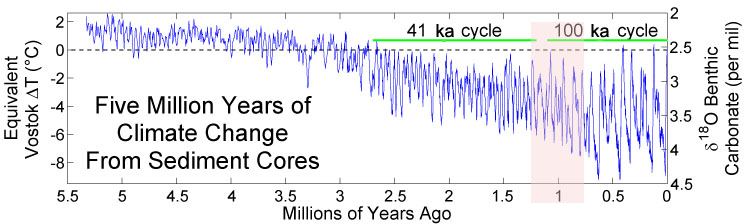
Their analyses suggest that between 930 and 813 ka ago human ancestors passed through a population bottleneck that involved only about 1300 breeding individuals. Moreover they remained at the very brink of extinction for a little under 120 thousand years. Interestingly, the genetic data are from people living on all continents, with no major differences between the analyses for geographically broad groups of people in Africa and Eurasia. Archaeological evidence, albeit sparse, suggests that ancient humans were widely spread across those two continental masses before the bottleneck event. The date range coincides with late stages of the Mid-Pleistocene climatic transition (1250 to 750 ka) during which glacial-interglacial cycles changed from 41 thousand-year periods to those that have an average duration of around 100 ka. The transition also brought with it roughly a doubling in the mean annual temperature range from the warmest parts of interglacials to the frigid glacial maxima: the world became a colder and drier place during the glacial parts of the cycles.

Genomes for Neanderthals and Denisovans suggest that they emerged as separate species between 500 and 700 ka ago. Their common ancestor, possibly Homo heidelbergensis, H. antecessor or other candidates (palaeoanthropologists habitually differ) may well have constituted the widespread population whose numbers shrank dramatically during the bottleneck. Perhaps several variants emerged because of it to become Denisovans, Neanderthals and, several hundred thousand years later, of anatomically modern humans. Yet it would require actual DNA from one or other candidate for the issue of last common ancestor for the three genetically known ‘late’ hominins to be resolved. But Hu et al. have shown a possible means of accelerated hominin evolution from which they may have emerged, at the very brink of extinction.

Oxygen-isotope record and global temperature changes over the last 5 million years, green lines showing the times dominated by 41 and 100 ka climatic cycles. The mid-Pleistocene climatic transition is shown in pink (Credit: Robert A Rohde)

There is a need for caution, however. H. erectus first appeared in the African fossil record about 1.8 Ma ago and subsequently spread across Eurasia to become the most ‘durable’ of all hominin species. Physiologically they seem not to have evolved much over at least a million years, nor even culturally – their biface Acheulean tools lasted as long as they did. They were present in Asia for even longer, and apparently did not dwindle during the mid-Pleistocene transition to the near catastrophic levels as did the ancestral species for living humans. The tiny global population suggested by Hu et al. for the latter also hints that their geographic distribution had to be very limited; otherwise widely separated small bands would surely have perished over the 120 ka of the bottleneck event. Yet, during the critical period from 930 to 813 ka even Britain was visited by a small band of archaic humans who left footprints in river sediments now exposed at Happisburgh in Norfolk. Hu et al. cite the scarcity of archaeological evidence from that period – perhaps unwisely – in support of their bottleneck hypothesis. There are plenty of other gaps in the comparatively tenuous fossil and archaeological records of hominins as a whole.

The discovery of genetic evidence for this population bottleneck is clearly exciting, as is the implication that it may have been the trigger for evolution of later human species and the stem event for modern humans. Hopefully Hu et al’s work will spur yet more genetic research along similar lines, but there is an even more pressing need for field research aimed at new human fossils from new archaeological sites.

See also: Ashton, N. & Stringer, C. 2023. Did our ancestors nearly die out? Science (Perspectives), v. 381, p. 947-948; DOI: 10.1126.science.adj9484.

Ikarashi, A. 2023. Human ancestors nearly went extinct 900,000 years ago. Nature, v. 621; DOI: 10.1038/d41586-023-02712-4

Di Vicenzo, F & Manzi, G. 2023. An evolutionary bottleneck and the emergence of Neanderthals, Denisovans and modern humans. Homo heidelbergensis as the Middle Pleistocene common ancestor of Denisovans, Neanderthals and modern humans. Journal of Mediterranean Earth Sciences, v, 15, p. 161-173; DOI: 10.13133/2280-6148/18074

A book on archaeology, radiocarbon dating, ancient DNA, and how modern humans evolved

Since 2001 Tom Higham, now Professor of Scientific Archaeology at the University of Vienna, helped develop new ways of refining radiocarbon dating at Oxford University’s Research Lab for Archaeology and the History of Art. Specifically his lab learned how to remove contamination of ancient samples by recent carbon and to reduce the detection limit of their accelerator mass spectrometer for the 14C atoms that remained from when they were in living organisms. The Oxford Radiocarbon Accelerator Unit pushed sample dates to the absolute limit of the method: around 50 thousand years. Being among the very best, the ORAU had a path beaten to its doors by archaeologists from across the world keen to get the most believable dates for their samples. Equally, Higham engaged in the field work itself and in the interpretation of other data from sites, such as ancient DNA. An outcome of Higham’s energetic efforts over two decades is his book The World Before Us: How Science is Revealing a New Story of Our Human Origins (paperback edition 2022, Penguin Books,ISBN-10: ‎0241989051). One reviewer commented ‘The who, what, where, when and how of human evolution’.

The World Before Us is not only comprehensive and eminently clear for the lay-reader, but it is more exciting than any science book that I have read. For the moment, it is the latest ‘word’ on early, anatomically modern humans and on the closely related Neanderthals and Denisovans. Its core is about how these three key groups ‘rubbed along’ once they met  in the Late Pleistocene. As an amateur interested in palaeoanthropology, I have tried to keep pace with all the developments in the field since 2001 through Earth-logs, but Higham shows just how much I have missed that is important to the human story. If you have followed my many posts on human evolution and migrations with interest, read his book for a great deal more and a coherent story of how things stand.

Neanderthal elephant hunters

In the 1980s miners in the Neumark-Nord area of Saxony-Anhalt, central Germany uncovered an extensive assemblage of animal bones and stone tools in opencast ‘brown coal’ (lignite) workings. Archaeologists working over a ten-year period recovered bones from an estimated 70 straight-tusked elephants (Palaeoloxodon antiquus), as well as many other large herbivores, while huge bucket-wheel excavators advanced through the deposit. Most of the elephants were adult males, some preserved as entire skeletons others as disarticulated bones. Weighing as much 15 tonnes – equivalent to ten medium SUVs – and standing up to 4 m high at the shoulder, they were twice as large as the biggest modern African elephants and had far longer legs. Being so tall they could browse vegetation up to 8 metres above the ground surface using an 80 cm tongue as well as a long trunk and their huge tusks.

The lignite deposits formed in marshes and shallow lakes that occupied low-lying depressions left in the wake of retreating glaciers during the last (Eemian) interglacial (130 to 115 ka ago). The warming encouraged temperate forest to extend much further north than it does today. The fauna too would have changed substantially once the ice sheets began to retreat. For instance, mammoths that grazed low tundra vegetation during the preceding ice age disappeared from Central Europe to be replaced by straight-tusked elephants migrating from much further south that had plenty of trees, shrubs and grasses to feed on, as did other herbivores. So the central European plains teemed with big game. The marshes and lakes had little outflow and became depleted in oxygen so that dead vegetation built up to form extensive peat deposits: just the conditions for organic preservation.

Artistic impression of Neanderthal elephant butchery site (Credit: Tom Bjorklund, Science)

The Neumark-Nord sites yielded literally tonnes of fossils, including 3400 elephant bones. But these were not simply the remains of animals that had become bogged down and died of exhaustion. Sabine Gaudzinski-Windheuser and Lutz Kindler of the Johannes Gutenberg University of Mainz, Germany and Katherine MacDonald and Wil Roebroeks of Leiden University, Netherlands have examined every bone for signs of post-mortem modification by humans (Gaudzinski-WindHeuser, S. et al. 2023. Hunting and processing of straight-tusked elephants 125.000 years ago: Implications for Neanderthal behaviour. Science Advances, v. 9, article add8186; DOI: https://doi.org/10.1126/sciadv.add8186). Some bones are so large as to require a forklift to shift or turn them in the laboratory. Most of the bones bear deliberate cut marks made by stone blades: far more than signs of gnawing by carnivores. Neanderthals had got to them before scavengers. The density of cuts and gouges suggests that almost every scrap of meat and fat had systematically been harvested from the corpses, even the fat-rich feet and brains. The sheer number of cuts needed to skin and deflesh the elephants strongly suggests that their meat was fresh: rotten meat could simply have been pulled from the skin and bone quite easily. Little was left for scavengers to gnaw.

Each elephant would have yielded enough meat and fat for an estimated 2500 portions, each with a calorific value of around 4000 kcal. To fully butcher each beast and then to dry and/or smoke the produce can be estimated – by comparison with such work on a modern African elephant – would take around 1500 person hours. To achieve that would require 3 to 5 days of very heavy labour by 25 people. Some means of preservation would have been needed, unless hundreds of people had scoffed the lot at one or two sittings. The authors consider the bounty to imply  that a considerably larger collective of Neanderthals than the previously estimated ~25 per band probably benefitted from a single elephant, whether it was eaten on the spot or preserved in some way and either carried off or cached. But 70 elephants …?

The geographic context suggests a pile of corpses built up in lignite close to or on a lake shore had accumulated over a lengthy period. Using likely sedimentation rates backed by counting of annual tree rings from stumps in the lignite the authors estimate that the pile formed over about 300 years at a rate of one kill every 5 to 6 years. But this site is one of several found in the Neumark-Nord area, albeit not quite so large, and there are probably more, either remaining buried or destroyed by the brutal lignite mining technique. Taking on a herd of animals would be far more risky than hunting individuals. This is where the sex of the elephant remains gives an idea of the hunters’ strategy. Those that could be sexed – about 23  – were all adult males that were estimated to be from 20 to 50 or more years old. By analogy with African elephants, adult male are generally solitary, only joining herds of females and offspring when one or more is at oestrus. Male straight-tusked elephants were more than twice the mass of adult females and when keeping themselves to themselves would have been a safer and more profitable target than females and juveniles in a herd. Solitary males would have been easy to approach, being confidant  that their size would deter direct predation by the largest carnivores, such as lions. In a peaty swamp, simply driving an individual into deep mud would bog it down to be dispatched by spear thrusts. The earliest known thrusting spears have been unearthed in similar lignite beds 200 km away.

This study adds to growing understanding of Neanderthal culture. It suggests that they were not just opportunistic and wandering foragers but regularly combined resources to focus on a specific, very high-value prey. Maybe that was restricted to the special peat-swamp environment of what is now central Germany, but it speaks of an ability to plan and orchestrate spectacular communal events. And they performed such feats again and again. They were the masters of Europe through three of four glacial-interglacial cycles.

Family links among the Neanderthals of Siberia

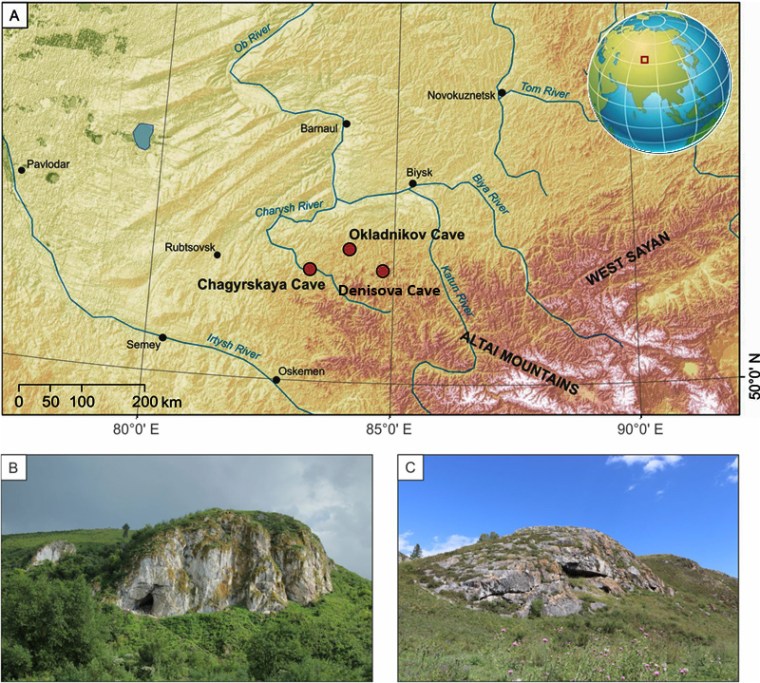
Caves used by the Neanderthals of southern Siberia: A – location map; B – Chagyrskaya Cave; C – Okladnikov Cave. (Credit: adapted from Skov et al.; Extended Data Fig. 1)

The early focus on Neanderthals was on remains found in Western Europe from the 19th century onwards. That has shifted in recent years to southern Siberia in the foothills of the Altai mountains, despite the fossils’ fragmentary nature: a few teeth and bits of mandible. The Denisova Cave became famous not just because it contained the easternmost evidence of Neanderthal occupation but through the genetic analysis of a tiny finger-tip bone. It proved not to be from a Neanderthal but a distinctly different hominin species, dubbed Denisovan (see: Other rich hominin pickings; May 2010). What Denisovans looked like remains unknown but genetic traces of them are rife among living humans of the western Pacific islands and Australia, whose ancestors interbred with Denisovans, presumably in East Asia. Modern people indigenous to Europe and the Middle East have Neanderthal genes in their genomes. Other bone fragments from Denisova Cave also yielded Neanderthal genomes, and the cave sediments yielded traces of both groups (see: Detecting the presence of hominins in ancient soil samples; April 2017). Then in 2018 DNA extracted from a limb bone from the cave clearly showed that it was from a female teenager who had had a Neanderthal mother and a Denisovan father (see: Neanderthal Mum meets Denisovan Dad; August 2018). These astonishing and unexpected finds spurred further excavations and genetic analysis in other caves within 100 km of Denisova Cave. This was largely led by current and former co-workers of Svanti Pääbo, of the Max Planck Institute for Evolutionary Anthropology, Leipzig, Germany: Pääbo was awarded the 2022 Nobel Prize in Physiology or Medicine for his coordination of research and discoveries concerning ancient human genomes. Their enormous field and laboratory efforts have paid astonishingly valuable dividends (Skov, L. and 34 others 2022. Genetic insights into the social organization of Neanderthals. Nature v. 610, p. 519–525; DOI: 10.1038/s41586-022-05283-y).

To the previously analysed 18 Neanderthal genomes from 14 archaeological sites across Eurasia (including Denisova Cave) Skov et al. have added 13 more from just two sites in Siberia (the Chagyrskaya and Okladnikov caves). Each site overlooks valleys along which game still migrates, so they may have been seasonal hunting camps rather than permanent dwellings: they are littered with bison and horse bones. Tools in the two 59-51 ka old human occupation levels are different from those at the older (130 to 91 Ka) Denisova Cave about 100 km to the east. As at the much older site, human fossils include several teeth and fragments of bones from jaws, hands, limbs and vertebrae. The detailed genomes recovered from 17 finds shows them to be from 14 individuals (12 from Chagyrskaya, 2 from Okladnikov).

Chagyrskaya yielded evidence for 5 females (3 adults and 2 children) and 7 males (3 children and 4 adults). One female estimated to have lost a premolar tooth when a teenager was the daughter of a Chagyrskaya adult male. He, in turn, was brother or father to another male, so the girl seems to have had an uncle as well. Another male and female proved to be second-degree relations (includes uncles, aunts, nephews, nieces, grandparents, grandchildren, half-siblings, and double cousins). The two people from Okladnikov were an adult female and an unrelated male child. The boy was not related to the Chagyrskaya group, but the woman was, her former presence at that cave lingering in its cave-sediment DNA. None of the newly discovered individuals were closely related to six of the seven much older Denisova Cave Neanderthals, but the Okladnikov boy had similar mtDNA to one individual from Denisova.

Further information about the Chagyrskaya group came from comparison of DNA in Y-chromosomes and mitochondria. The father of the teenage girl had two types of mtDNA – the unusual characteristic of heteroplasmy – that he shared with two other males. This suggests that three of the males shared the same maternal lineage – not necessarily a mother – and also indicates that they lived at roughly the same time. The mtDNA recovered from all Chagyrskaya individuals was much more varied than was their Y-chromosome DNA (passed only down male lineage). One way of explaining that would be females from different Neanderthal communities having migrated into the Chagyrskaya group and mated with its males, who largely remained in the group: a ‘tradition’ known as patrilocality, which is practised in traditional Hindu communities, for instance.

So, what has emerged is clear evidence for a closely related community of Neanderthals at Chagyrskaya, although it cannot be shown that all were present there at the same time, apart from the five who show first- or second-degree relatedness or mitochondrial heteroplasmy. Those represented only by individual teeth didn’t necessarily die there: adult teeth can be lost through trauma and deciduous teeth fall out naturally. There was also some individual physical connection between the two caves: The Okladnikov woman’s DNA being in the sediment at Chagyrskaya. Looking for DNA similarities more widely, it appears that all individuals at Chagyrskaya may have had some ancestral connection with Croatian Neanderthals, as did the previously mentioned mother of the Denisovan-Neanderthal hybrid girl. Four of the Chagyrskaya individuals can also be linked genetically to Neanderthals from Spain, more so than to much closer individuals found in the Caucasus Mountains. So, by around 59-51 ka the results of a wave of eastward migration of Neanderthals had reached southern Siberia. Yet the apparent matrilineal relatedness of the Okladnikov boy to the much older Neanderthals of Denisova Cave suggests that the earlier group continued to exist.

The new results are just as fascinating as the 2021 discovery that ancient DNA from Neolithic tomb burials in the Cotswolds of SW England suggests that the individual skeletons represent five continuous generations of one extended family. The difference is that they were farmers tied to the locality, whereas the Siberian Neanderthals were probably hunter gatherers with a very wide geographic range.  Laurits Skov and his colleagues have analysed less than one-quarter of the Neanderthal remains already discovered in Chagyrskaya and Okladnikov caves and only a third of the cave deposits have been excavated. Extracting and analysing ancient DNA is now far quicker, more detailed and cheaper than it was in 2010 when news of the first Neanderthal genome broke. So more Neanderthal surprises may yet come from Siberia. Progress on the genetics of their anatomically-modern contemporaries in NE Asia has not been so swift.

See also:  Callaway, E. 2022. First known Neanderthal family discovered in Siberian cave.  Nature online 19 October 2022.

Seven thousand years of cultural sharing in Europe between Neanderthals and modern humans

Two years ago material excavated from the Bacho Kiro cave in Bulgaria revealed that anatomically modern humans (AMH) had lived there between 44 and 47 ka ago: the earliest known migrants into Europe. Bacho Kiro contains evidence of occupancy by both Neanderthals and AMH. This discovery expanded the time over which Europe was co-occupied by ourselves and Neanderthals. The latter probably faded from the scene as an anatomically distinct group around 41 to 39 ka, although some evidence suggests that they lingered in Spain until ~37 ka and perhaps as late as 34 to 31 ka in the northern Ural mountains at the modern boundary of Europe and Asia. For most of Europe both groups were therefore capable of meeting over a period of seven to eight thousand years.

Aside from interbreeding, which they certainly did, palaeoanthropologists have long pondered on a range of tools that define an early Upper Palaeolithic culture known as the Châtelperronian, which also spans the same lengthy episode. But there have been sharp disagreements about whether it was a shared culture and, if so, which group inspired it. Evidence from the Grotte du Renne in eastern France suggests that the Neanderthals did abandon their earlier Mousterian culture to use the Châtelperronian approach early in the period of dual occupancy of Europe.

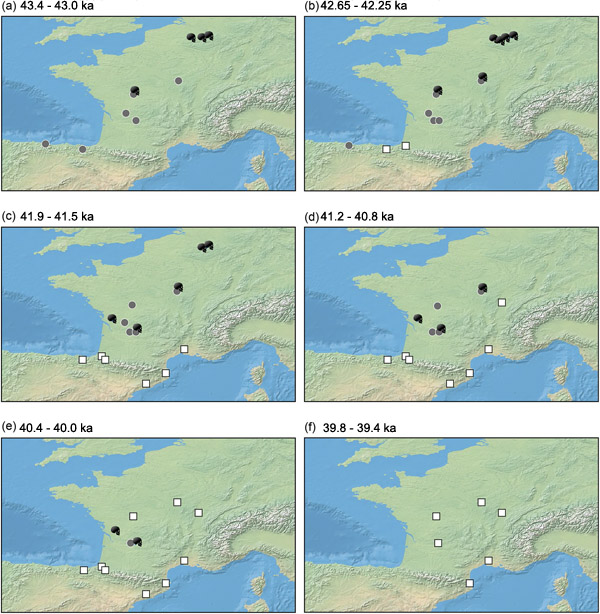
Dated appearances in France and NE Spain of Neanderthal fossils (black skulls), Châtelperronian artefacts (grey circles) and proto-Aurignacian artefacts (white squares) in different time ‘slots’ between 43.4 and 39.4 ka. (Credit: Djakovic et al., Fig. 3)

Igor Djakovic of Leiden University in the Netherlands , Alastair Key of Cambridge University, UK, and Marie Soressi, also of Leiden University have undertaken a statistical analysis of the geochronological and stratigraphic context of artefacts at Neanderthal and AMH sites in France and NW Spain during the co-occupancy period (Djakovic, I., Key, A. & Soressi, M. 2022. Optimal linear estimation models predict 1400–2900 years of overlap between Homo sapiens and Neandertals prior to their disappearance from France and northern Spain. Scientific Reports, v. 12, article  15000; DOI: 10.1038/s41598-022-19162-z). Their study is partly an attempt to shed light on the ‘authorship’ of the novel technology. The results suggest that the Châtelperronian (Ch) started around 45 ka and had disappeared by ~40.5 ka, along with the Neanderthals themselves. Early AMH artefacts are known as proto-Aurignacian (PA) and bear some resemblance to those of Châtelperronian provenance. The issue revolves around 3 conceivable scenarios: 1. the earliest AMH migrants brought the PA culture with them that Neanderthals attempted to copy, leading to their Ch tools; 2. Neanderthals independently invented the Ch methodology, which AMH adopted to produce PA artefacts; 3. both cultures arose independently.

Djakovic and colleagues have found that the data suggest that the proto-Aurignacian first appeared in the area at around 42.5 ka. Maps of dated human remains and artefacts for six 400-year time ranges from 43.4 to 39.4 ka show only Neanderthal remains and Châtelperronian artefacts from the earliest range (a in the figure). Two sites with proto-Aurignacian artefacts appears in NW Spain during the next ‘slot’ (b) then grow in numbers (c to e) relative to those of Châtelperronian provenance, which are not present after 40 ka (f) and neither are Neanderthal remains. These data suggest that local Neanderthals may have made the technological breakthrough before the appearance of the AMH proto-Aurignacian culture, which supports scenario 2 but not 1. They also suggest that the sudden appearance of Ch in France and Spain and the abandonment of earlier Neanderthal artefacts known as Mousterian could indicate that the Ch culture may have been introduced by Neanderthals migrating into the area, perhaps from further east where they may have been influenced by the earliest known European AMH in Bulgaria: i.e. tentative support for 1 or 2.

However, well documented as Djakovic et al.’s study is, it considers only 17 sites across only a fraction of Europe and a mere 28 individual artefacts each from Neanderthal and AMH associations (56 altogether). More sites and data are bound to emerge. But the study definitely opens exciting new possibilities for cultural ‘cross fertilisation’ as well as the proven physical exchange of genetic material: the two seem very likely to go hand-in-hand. Seven thousand years (~350 generations) of mutual dependence on the resources of southern Europe surely signifies too that the initially distinct groups did not engage in perpetual conflict or ecological competition, as with small numbers of both one or the other would have been extinguished within a few generations.

 See also: Devlin, H. 2022. Neanderthals and modern humans may have copied each other’s tools. The Guardian, 13 October 2022; Davis, N. 2020. Humans and Neanderthals ‘co-existed in Europe for far longer than thought’. The Guardian, 11 May 2020.

Did earliest modern humans in Europe share a cave with Neanderthals?

The cave of Grotte Mandrin in the Rhône Valley, France. (Credit: Slimak et al Fig 1c)

Since 1999 a cave (Grotte Mandrin) on the west flank of the lower Rhône valley in sothern France has been revealing archaeological remains from 3 metres of sediment that can be divided into 12 distinct layers (Slimak, L. and 22 others 2022. Modern human incursion into Neanderthal territories 54,000 years ago at Mandrin, France. Science Advances, v. 8, article eabj9496; DOI: 10.1126/sciadv.abj9496). Tens of thousands of objects have been recovered, mostly from a layer just below midway in the sequence, which is dominated by small (<1 cm), ‘standardised’ stone points that are also found at other sites in the local area. This veritable industry – dubbed the ‘Neronian’ from the nearby Grotte de Néron – seems to have been focussed hereabouts. Older artefacts in layers F and G are considered to be Mousterian, that is generally ascribed to late Neanderthals. Horse, bison and deer bones suggest that these were the main source of animal protein for the cave’s occupants. The site also contained a few objects that show simple decoration. The way in which the Neronian points were produced resembles the working of similar artefacts in Lebanon by anatomically modern humans (AMH) about 45 ka ago; so it is possible that the technology had spread westward with the earliest AMH migrants into Europe. Yet precise radiocarbon and optically stimulated luminescence dating of the Grotte Mandrin site suggests that the sediment accumulated between 84 to 44 thousand years ago. The Mousterian/Neanderthal objects occur in layers F and G between 79 and 57 ka, whereas the Neronian layer E spans 56.8 to 51.7.

Grotte Mandrin has yielded very few hominin remains, except for 9 teeth in layers C to G. Those from C, D, F and G showed clear Neanderthal dental features. However, shape analysis of one damaged, deciduous (infant) molar from Layer E suggests that it matches Upper Pleistocene AMH dental morphology. That seems to place Grotte Mandrin as by far the oldest AMH occupation site in Europe, up 11 thousand years earlier than the 45 to 43 ka AMH site at Bacho Kiro in Bulgaria. To some extent that tallies with the tiny tooth’s association with a prolific, standardised and delicate industry new to the area: probably points for small projectiles. Neanderthals re-occupied the site in Layers D to B, yet in the upper part of layer B, from 44.1 to 41.5, there is a return of Neronian-like points, probably made by AMH.

A curious detail from layer E (not reported in this paper) is the occurrence of soot trapped in thin, annually deposited layers of carbonate on the cave walls. Fragments of the sooty speleothem continually fell onto the cave floor to be incorporated into the sediments. The base of layer E that contains Neronian, possibly AMH artefacts and the top of layer F that shows preceding Neanderthal occupation, contain such sooty speleothem fragments. Precise dating of them is claimed to suggest a very short period of transition between the two kinds of occupants: perhaps only a few years. Neanderthals and AMH may not have met in the cave, but may well have been co-occupants of the surrounding area at the same time.

A great deal of effort over more than two decades has gone into this publication, and several of its findings have caused quite a stir. Because permanent AMH occupation of the Levant began at least 55 ka ago, there is no reason to suppose that AMH migrating along the northern shores of the Mediterranean could not have arrived a little earlier in what is now southern France. What has been emphasised in the broad media is the exchange of a Neanderthal to an AMH population in the Grotte Mandrin, as if it was done in a friendly, indeed neighbourly spirit (!). That hinges on the ultra-precise dating of the sooty speleothem fragments to reveal just a few years between the Neanderthals doing a ‘flit’ and the AMH starting a ‘squat’ in the vacant premises to set up a cottage industry. The time of the replacement before present is, in fact, very close to the limit at which radiocarbon dating is feasible, almost all 14C formed at that time having decayed away since then. There can be no doubt that layer E did mark a major change in sophistication of stone technology, but was it really an AMH development? The only definite evidence is the single deciduous molar, and that is damaged to such an extent that an independent dental paleoanthropologist who has specialised in distinguishing AMH from Neanderthal dentition isn’t convinced. But,surely, DNA from the tooth would resolve the issue. The paper notes that trial extraction and sequencing of 6 horse teeth from layer E failed to yield results, which suggests degradation of genetic teril. So the team did not commit the tooth to sequencing, which would have further damaged it. Finally, four separate groups occupying what certainly looks like a nice little cave over the course of about 40 thousand years is hardly a surprise. Many caves throughout Europe and southern Africa show evidence of multiple occupancy. After all, before 11 ka all humans and their forebears were of necessity foragers and migrants; just think of how many times your neighbours have changed since you moved in …

See also: Price, M. 2022. Did Neanderthals and modern humans take turns living in a French cave? Science, v, 375, p. 598-599; DOI: 10.1126/science.ada1114