The great Tohoku earthquake (moment magnitude 9.0) of 11 March 2011 beneath the Pacific Ocean off the largest Japanese island of Honshu resulted in the devastating tsunami that tore many kilometres inland along its northern coast line and affected the entire Pacific Basin (see NOAA animation of the tsunami’s propagation) .
Railway locomotive thrown aside by the 11 March 2011 Tsunami in Japan. (credit: Wikipedia)
This article can now be read in full at Earth-logs in the Geohazardsarchive for 2017
The division of the lunar surface into two petrological domains – ancient anorthositic highlands and younger basaltic maria – spurred the idea, as long ago as the early 1970s, that the early Moon had a deep ocean of magma at the surface, whose cooling caused fractional crystallization. Low density plagioclase feldspar, dominated by high-calcium anorthite and bytownite, floated to the surface to form the lunar anorthosites leaving a more mafic mantle from which the mare basalts formed by partial melting. The key evidence in support of this hypothesis lies in the rare-earth elements of the two terrains. Because plagioclase feldspar has a much stronger affinity to incorporate the element europium (Eu) than the other REEs, the lunar anorthosites are enriched in Eu compared with its related elements. If the highland anorthosites did form by fractional crystallisation the remaining magma that formed the lunar mantle would be depleted in Eu yet enriched in the remaining REE. Although there are no samples of the Moon’s mantle there are plenty of the mare basalts that formed when it partially melted, probably as a result of huge impacts around 3.8 billion years ago. They should have inherited dominant features of mantle geochemistry, and indeed they do show characteristic depletion of Eu.
Lunar Highland anorthosite, collected by the crew of Apollo 16. (credit: Wikipedia)
The giant-impact hypothesis for the Earth-Moon system presupposes that such a cataclysm would have left much of the outer Earth in much the same molten condition and destined to fractionate in the same manner. There are geochemical hints from terrestrial rocks that do support such an idea. An important target for exploration of Mars has been to check if a magma ocean also existed early in its history. Of the various missions in recent years only two have the capacity to shed useful light on the issue: the US Mars Reconnaissance Orbiter and Mars Odyssey. Both orbiters carry more sophisticated remote sensing instruments than any circling the Earth. The first has the hyperspectral Compact Reconnaissance Imaging Spectrometer for Mars (CRISM) that senses visible to short-wave infrared (VNIR) radiation, the other deploys the Thermal Emission Imaging System (THEMIS) that captures different parts of the longer wavelength thermal infrared (TIR) spectrum emitted by surface materials. Both allow spectra of surface materials to be reconstructed and compared with the features of known minerals from the Earth and Moon.
Feldspars are highly reflective for the most part of the VNIR range but show a shallow, broad absorption feature centred on a wavelength of 1.26 micrometres. Such spectra have been detected using CRISM from parts of the Martian surface in the highlands of its southern hemisphere (Carter, J. & Poulet, F. 2013. Ancient plutonic processes on Mars inferred from the detection of possible anorthositic terrains. Nature Geoscience, v. 6, p. 1008-1012). The authors, from Chile and France, acknowledge that the plagioclase-rich rocks occur only in small patches, unlike the vast tracts on the Moon, and also that on Earth anorthosites are known to have formed by a variety of processes from far smaller magma systems than a veritable ocean of molten rock. Feldspars also show spectral features in the TIR, though not so distinctive, both plagioclase and alkali feldspars being very similar. Moreover, THEMIS deploys sensor for only 10 thermal wavebands, compared with 544 on CRISM. A team of US remote sensers (Wray, J.J. and 8 others 2013. Prolonged magmatic activity on Mars inferred from the detection of felsic rocks. Nature Geoscience, v. 6, p. 1013-1017) used both CRISM and THEMIS data. While noting resemblances to lunar anorthosites, they adopt a more cautious approach to the spectra and prefer the broad, ‘sack’ term ‘felsic rocks’. It seemed possible from their work that feldspar-rich magmas may have formed by partial melting of common andesitic crust noted from the Martian surface: high spatial resolution images of the occurrences bear some resemblance to outcrops of granitic rocks in arid environments on Earth. That is, there may be highly evolved rocks akin to terrestrial continental crust.
The interesting spectral observations on Mars can only be validated by actual rock samples. While rovers still operating on the Martian surface are well able to produce geochemical data that would petrologically characterise most rocks that they encounter, none of them is in a terrain suitable for resolving this particular issue. Yet, coincidentally, a meteorite found in West Africa shows hallmarks of having been blasted from the surface of Mars and sheds useful light on various hypotheses about the Martian crust http://earth-pages.co.uk/2013/11/21/a-glimpse-of-early-martian-crust/. It is a breccia that may represent the soil or regolith that accumulated from early impacts that shattered and melted surface materials, and it is extremely old: zircons yielded an age of 4428 Ma. The clasts set in a fine matrix consist of a variety of igneous rocks, none of which are anorthosites. Some are coarse grained, plutonic rocks containing both alkali feldspars and plagioclase, which match terrestrial monzonites; broadly speaking members of the granite family. Having formed from the ejecta of large impacts, such regolith materials represent the breadth of compositions across the planet and extending deep into its crust. This one suggests that anorthosites may have been rare on early Mars.
There are paradoxes with groundwater: while over-use of coastal aquifers may draw in seawater to become undrinkable, on reef islands with no surface water adequate supplies may be had from fresh groundwater ‘floating’ on deeper, denser salt water. Seemingly even more odd, there are places several kilometres off some coastlines where freshwater rises in large volumes to the surface from springs on the sea floor.
Despite this and the fact that onshore aquifers extend far out to sea on continental shelves, hydrogeologists have paid scant attention to the potential water supplies that they might offer. Indeed, around the Persian Gulf where many submarine fresh springs are known petrodollars have poured into desalination rather than cheaper drilling and pipelines to the aquifers feeding the springs.
Reviewing the known potential of offshore groundwater, which occurs seawards of most continental shores, Vincent Post of Flinders University, Australia and colleagues from Holland, the US and Britain, consider that the global potential might be as high as half a million cubic kilometres (Post, V.E.A. et al. 2013. Offshore fresh groundwater reserves as a global phenomenon. Nature , v. 504, p. 71-78), around one tenth that of shallow (<750 m deep) groundwater onshore . It should be noted that the maximum safe level of salts dissolved in drinking water is about 1 gram per litre, and double that for irrigation water. The best prospects are where aquifers are trapped beneath impermeable sedimentary layers that prevent downward contamination by salt water.
The key to explaining such huge reserves is dating the water. In those places where that has been done the water is older than the Holocene (i.e. > 11 ka), which suggests infiltration when sea level was as much as 130 m lower than in interglacial periods, due to storage of evaporated seawater in major ice sheets. That would have exposed vast areas of what is now the sea floor to recharge. Modelling downward diffusion of seawater as sea level rose suggests that interglacials have too short to fully flush fresh water from the now submarine aquifers. Nevertheless, recharge is not continual, so that exploiting the resource is akin to ‘mining’ water. Yet the potential may prove essential in some coastal regions, and the authors caution against contamination by human activities offshore, such as exploration drilling for petroleum and carbon dioxide sequestration.
The review points out that submarine hydrogeology is one of the last great challenges in analysis of sedimentary basins.
The Sima de los Huesos (‘pit of bones’) site in the cave complex of Atapuerca in northern Spain has yielded one of the greatest assemblages of hominin bones. Well-preserved remains of at least 28 individuals date to the Middle Pleistocene (>300 ka). Anatomically the individuals have many Neanderthal-like features but also show affinities with earlier Homo heidelbergensis, who is widely considered to be the common ancestor for anatomically modern humans and Neanderthals, and perhaps also for the mysterious Denisovans. Most palaeoanthropologists have previously considered this Atapuerca group to be early Neanderthals, divergent from African lineages because they migrated to and became isolated in Europe.
Human cranium from the Sima de los Huesos, Atapuerca mountains (Spain). (credit: Wikipedia)
The riches of the Sima de los Huesos ossuary made it inevitable that attempts would be made to extract DNA that survived in the bones, especially as bear bones from the area had shown that mtDNA can survive more than 4300 ka. There has been an air of expectancy in hominin-evolution circles, and indeed among the wider public, since rumours emerged that the famous Max Planck Institute for Evolutionary Anthropology in Leipzig, Germany had initiated genetic sequencing under the direction of Svante Pääbo: perhaps another ‘scoop’ to add to their reconstructing the first Neanderthal and Denisovan genomes. The news came out in the 5 December 2013 issue of Nature, albeit published on-line (Meyer, M. and 10 others 2013. A mitochondrial genome sequence of a hominin from Sima de los Huesos, Nature, v. 504; doi:10.1038/nature12788) with a discussion by Ewan Callaway (Callaway, E. 2013. Hominin DNA baffles experts Nature, v. 504, p. 16-17).
The bafflement is because the mtDNA from a femur of a 400 ka individual does not match existing Neanderthal data as well as it does that of the Denisovan from Siberia by such a degree that the individual is an early Denisovan not a Neanderthal. Northern Spain being thousands of kilometres further west than the Denisova cave heightens the surprise. Indeed, it may be on a lineage from an earlier hominin that did not give rise to Neanderthals. The full Neanderthal and Denisovan genomes suggest that they shared a common ancestor up to 700 ka ago. So the Sima de los Huesos individual presents several possibilities. It could be a member of an original population of migrants from Africa that occupied wide tracts of Eurasia, eventually to give rise to both Neanderthals and Denisovans. That genetic split may have arisen by the female line carrying it not surviving into populations that became Neanderthals – mtDNA is only present in the eggs of mothers. Mind you, that begs the question of who the Neanderthal females were. Another view is that the Sima de los Huesos individual may be descended from even earlier H. antecessor, whose 800 ka remains occur in a nearby cave. Pääbo’s team have even suggested that Denisovans interbred with a mysterious group: perhaps relics of the earlier H. antecessor colonists.
Established ideas of how humans emerged, based on bones alone and very few individuals to boot, are set to totter and collapse like a house of cards. Interbreeding has been cited three times from DNA data: modern human-Neanderthal; modern human-Denisovan and Denisovan with an unknown population. Will opinion converge on what seems to be obvious, that one repeatedly errant species, albeit with distinct variants, has been involved from far back in the human evolutionary journey? There seems only one avenue to follow for an answer, which is to look for well preserved H. heidelbergensis. H. antecessor and H. erectus remains and apply ever improving techniques of genetic retrieval. Yet there is a chance that stretches of ancient DNA can be teased out of younger fossils.
Land plants begin to appear in the fossil record as early as the late Ordovician (~450 Ma), show signs of diversification during the Silurian and by the end of the Devonian Period most of the basic features of plants are apparent. During the Carboniferous Period terrestrial biomass became so high as to cause a fall in atmospheric carbon dioxide, triggering the longest period of glaciation of the Phanerozoic, and such a boost to oxygen in the air (to over 30%) that insects, huge by modern standards, were able to thrive and the risk of conflagration was perhaps at its highest in Earth’s history. Yet surprisingly, the first signs of massive forest fires appear in the Devonian when vegetation was nowhere near so widespread and luxuriant as it became in the Carboniferous (Kaiho, K. et al. 2013. A forest fire and soil erosion event during the Late Devonian mass extinction. Palaeogeography, Palaeoclimatology, Palaeoecology, v. 392, p. 272-280). Moreover, Devonian oxygen levels were well below those of the present atmosphere and CO2 was more than 10 times even the post-industrial concentration (387 parts per million in 2013). Such atmospheric chemistry would probably have suppressed burning.
Kunio Kaiho of Tohoku University in Japan and colleagues from Japan, the US and Belgium analysed organic molecules in Belgian marine sediments from the time of the late-Devonian mass extinction (around the Frasnian-Famennian boundary at 372 Ma). A range of compounds produced by hydrocarbon combustion show marked ‘spikes’ at the F-F boundary. The thin bed that marks the extinction boundary also shows sudden increase then decrease in δ13C and total organic carbon, indicative of increase burial of organic material and a likely increase in atmospheric oxygen levels. Another biomarker that is a proxy for soil erosion follows the other biogeochemical markers, perhaps signifying less of a binding effect on soil by plant colonisation: a likely consequence of large widlfires. Unlike the biomarkers, magnetic susceptibility of the boundary sediments is lower than in earlier and later sediments. This is ascribed to a decreased supply of detrital sediment to the Belgian marine Devonian basin, probably as a result of markedly decreased rainfall around the time of the late-Devonian mass extinction. But the magnetic data from 3 metres either side of the boundary also reveal the influence of the 20, 40, 100 and 405 ka Milankovich cycles.
Dunkleosteus, a giant (10 m long) placoderm fish from the Devonian, which became extinct in the late Devonian along with all other placoderms (credit: Wikipedia)
This set of environmentally-related data encourages the authors to suggest a novel, if not entirely plausible, mechanism for mass extinction related to astronomically modulated dry-moist climate changes that repeatedly killed off vegetation so that dry woody matter could accumulate en masse during the Frasnian while atmospheric oxygen levels were too low for combustion. A mass burial of organic carbon at the end of that Age then boosted oxygen levels above the burning threshold to create widespread conflagration once the wood pile was set ablaze. Makes a change from continental flood basalts and extraterrestrial impacts… Yet it was about this time that vertebrates took it upon themselves to avail themselves of the new ecological niche provided by vegetation to haul themselves onto land.
The global glaciations of the Neoproterozoic that reached low latitudes – the so-called ‘Snowball Earth’ events have dominated accounts of ancient glaciations since the start of the 21st century. Yet they are not the oldest examples of large-scale effects of continental ice sheets. Distinctive tillites or diamictites that contain large clasts of diverse, exotic rocks occur in sedimentary sequences of Archaean and Palaeoproterozoic age.
Diamictite from the Palaeoproterozoic Gowganda Formation in Ontario Canada (credit: Canadian Sedimentology Research Group)
Whatever controversies still linger about when they arrived in the Americas, there can be little doubt that humans crossed what are now the Bering Straits from NE Asia using the landmass of Beringia exposed by sea-level fall during the last ice age. Of course, there have been controversies too about who they were; probably of East Asian origin but the waters muddied by the celebrated case of 9300 year-old Kennewick Man whose skull bears close resemblance to those of modern Europeans but also to those of the Ainu of northern Japan. Genetic studies of Y-chromosome DNA suggested that all early Americans stemmed from 4 separate colonising populations who may have entered via Beringia by different routes (coastal and across the interior of North America) and at different times. Now, perhaps unsurprisingly, a new kind of data seems set to stir things up immeasurably.
Famous Lacotans of the Dakotas (credit: Wikipedia)
After the triumphs of reconstruction of the Neanderthal and Denisovan genomes and the corollary that both interbred with anatomically modern humans, it was only a matter of time before the palaeogenetics of humans would be pushed back in time. The oldest remains to yield DNA are those of a boy from near Lake Baikal in Siberia excavated by Soviet archaeologists along with a rich trove of cultural remains, including female effigies. Such figurines are rare in Siberia, most being known from western Eurasia. Radiocarbon dating of the bones gave an age of around 24 ka, just before the last glacial maximum. The genetic information, specifically mtDNA and Y-chromosome DNA are potentially revolutionary (Raghavaan and 30 others 2013. Upper Palaeolithic Siberian genome reveals dual ancestry of Native Americans. Nature online doi:10.1038/nature12736).
The mtDNA (passed down the female line) places the individual in haplogroup U, but with little relation to living members with that ‘signature’. Modern haplogroup U is mainly confined to people now living in North Africa, the Middle East, south and central Asia, Europe and western Siberia up to the area where the skeleton was found but rare further to the northeast. The male-specific Y-chromosome DNA is related to haplogroup R widely spread today among men living in western Eurasia, south Asian and in the vicinity of the find. When the data were subject to statistical tests routinely used in distinguishing existing p[populations and lineages within them (principal component analysis) a surprise emerged. The boy plots separately from all living populations but halfway between modern Europeans and the genetic trend of native Americans: i.e. descendants from the population to which he belonged could have evolved towards both extant groups but certainly not to East Asians. Plotted on a map, the degree of shared genetic history of the ice-age south Siberian boy to modern humans shows links westward to Europeans and eastwards to northeastern Siberians and hence to native Americans. Up to 38% of native American ancestry may have originated by gene flow from the population to which the boy belonged, similarly for Europeans as a whole.
The research helps explain traces of European genetic ‘signatures’ in native Americans rather than the commonly held view that this resulted from post-Columbian admixture with European invaders. It also links with the European-looking skulls of a number of early Americans which do not resemble those of East Asians once thought to be their forebears.
That planetary scientists are eager for chemical information about the rocks of planet Mars is probably unnecessary information, a vast amount of money having been spend to get three spindly vehicles equipped with miniaturized petrographic instruments onto the Martian surface. Meteoriticists might say, ‘Well, we already have some Mars rock in our lab, and we can collect some more from deserts or ablated blue ice in Antarctica’. Four classes of meteorites are alleged to have been flung from Mars by impacts: the allegation is supported by the materials having oxygen isotope proportions that are different from those in rocks from the Earth or Moon.
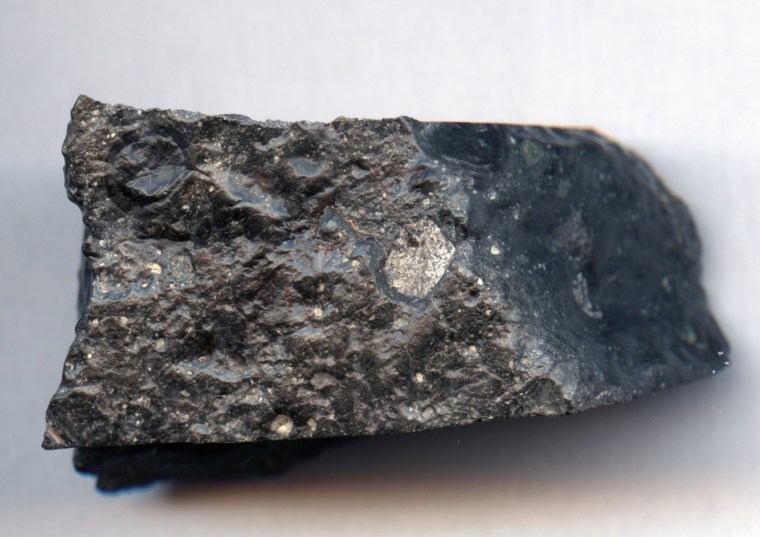
Another class of meteorite has joined the Martian family, and it it’s a doozy. Found in the northwestern Sahara Desert the rock is a breccia containing a variety of rocks in the form of clasts (Humayun, M. and 10 others 2013. Origin and age of the earliest Martian crust from meteorite NWA7533. Nature online doi:10.1038/nature12764). In fact four other meteorites looking much the same were found near NWA7533. The bulk of the material is impact melt rock, now devitrified. Some of the clasts are also melt fragments and spherules, while others are fine-grained basalts, broken crystals and, most exciting, coarser igneous rocks rich in alkali and plagioclase feldspar. Their rare-earth element contents, like those of the Earth’s average continental crust, show evidence of fractional crystallization, particularly the removal of plagioclase to produce a marked depletion in the element europium. Slowly cooled and evolved monzonites of this kind are candidates for Martian crustal material. Overall, the texture of the breccia meteorites closely resembles the material that coats the lunar surface – regolith – but it has been lithified rather than remaining a dust.
Meteorite NWA7533 showing a variety of clasts, including light-coloured monzonite (credit: Humayun et al. 2013; doi:10.1038/nature12764)
Highly evolved igneous rocks, broadly speaking those of granitic composition, are the most likely to contain the mineral zircon, and the monzonite clasts yielded five that the US-Australian-French team subjected to U-Pb dating. The results are astonishing. These zircons formed around 4425 Ma ago, in the first hundred million years of the planet’s evolution, at the same time – within statistical error – as did the earliest materials from Earth and the Moon. Other putative Martian meteorites have yielded evidence from their neodymium isotopes that the earliest event there was the formation of a magma ocean, much as postulated for the Earth-Moon system. The latter is widely regarded as having resulted from a mega impact of the proto-Earth with an object roughly the size of Mars. The Martian monzonites may well be products of fractionation from that magma, subsequently excavated and shattered by a series of later, lesser impacts. If it did come from Mars, NWA7533 probably represents part of the early, heavily cratered highlands of the southern hemisphere of that planet.
Full-color global map showing the regions of Mars imaged by the Hubble telescope (credit: Wikipedia)
It will be a long time before rocks can be lifted from the actual surface of Mars and transported back to Earth, and meteorites with a Martian provenance are so rare, that one can foresee a lot of very frustrated planetary petrogeneticists in the near term and a great deal of field work on desert and ice-cap surfaces looking for similar lumps of far-flung regolith.
The desert surface of the remote Sahara of SW Egypt and adjacent Libya is strewn with silica-rich glass over an area of up to 6500 km2. Pale yellow in colour and translucent, the glass clearly attracted Pleistocene hunter gatherers who manufactured edged tools from it. Pieces cut en cabouchon are also found in pharaonic jewellery, including an item found in the tomb of Tutankhamun. Evidence for its formation at very high temperature is the melting temperature of pure silica around 2000°C and the presence of baddeleyite, a breakdown product of zircon. The glass fragments are undoubtedly the product of shock heating of desert sand or the local Nubian Sandstone of Cretaceous age by some kind of extraterrestrial impact. Fission-track dating suggests the glass formed around 29 Ma ago. A possible source is a 30 km wide crater on the Gilf Kebir Plateau made famous by Michael Ondaatje’s novel The English Patient that was centered on Pleistocene rock art discovered at the Cave of Swimmers in the Nubian Sandstone.
Scarab cut from Libyan Desert Glass in a pendant from the tomb of Tutanhkamun (credit: Wikipedia)
Neither the crater nor the glass strewn field yields meteoritic material despite several expeditions but the platinum-group metal content of the glass indicates an impact origin. Some specimens include enigmatic, graphite-rich banding. However, recently a South African-French team studied a strange, irregular 30 g fragment picked up in 1996 by an Egyptian postgraduate student collecting samples from the strewn field. He discovered that the dark fragment contained diamond by using X-ray diffraction. The dominant element in the fragment is carbon with less than 5% silicates and the new study used a battery of geochemical tests that confirmed the presence of abundant tiny diamonds (Kramers, J.D. and 13 others 2013. Unique chemistry of a diamond bearing pebble from the Libyan Desert Glass strewn field, SW Egypt: Evidence for a shocked comet fragment. Earth and Planetary Science Letters, v. 382, p. 21-31).
Conceivably, the diamonds could have formed by shock metamorphism of a coal seam or other carbonaceous sediments at the site of an impact – the K-T boundary layer formed by the huge Chicxulub impact contains nano-diamonds. However none of the chemical characteristics, including noble gas isotopic proportions and those of carbon, match terrestrial organic matter. Nor do they match carbonaceous chondrite meteorites that could have been another potential source, in its case an impactor of that composition. Instead, much evidence suggests the fragment is chemically akin to interplanetary dust and dust from the coma of comet 81P/Wild2 captured by NASDA’s Stardust mission in 2004. A plausible explanation, therefore, for the glass strewn field is an airburst explosion of a comet nucleus above the Sahara, the particle being a shocked fragment of the comet itself.
Recently there have been worrying accounts about pathogens, for instance the viruses that cause foot and mouth disease in livestock, flu in humans and other animals and the sheep disease bluetongue carried by tiny midges, being transported for thousands of kilometres in dust storms. They raise the question of whether or not in the past organisms small enough to be carried by winds in aerosol suspension might have helped colonise regions distant from where they evolved.
The 600 square kilometre caldera lake of Taupo on New Zealand’s North Island. (Photo credit: Wikipedia)
Studies of volcanic ash thought to have been transported at high latitudes in the Southern Hemisphere from a 25 thousand-year old major volcanic eruption on the North Island of New Zealand add volcanic activity to violent meteorological phenomena as a possible means of transport (Van Eaton, A.R. et al. 2013. High-flying diatoms: Widespread dispersal of microorganisms in an explosive volcanic eruption. Geology, v. 41, p. 1187-1190). Ash from as far as 850 km from the volcano turns out to incorporate abundant remains of diatoms – species of algae that secrete distinctively intricate skeletons made from silica. The volcano, Taupo, erupted from beneath a lake bed, explaining the diatoms’ origin from lake muds and the water column itself. Even details of the organisms’ soft parts and pigmentation are preserved in the ash, suggesting that at least some of them might have been transported alive. Astonishingly, the New Zealand authors’ counts of organic material in the ash suggest that as much as 0.6 km3 of diatom remains were dispersed during the eruption.
Assorted species of diatoms on a microscope slide (credit: Wikipedia)
Violent sub-aqueous eruptions can entrain liquid water as spray as well as water vapour and glassy magma shards, carrying the mixture into the stratosphere, far above wind belts in the lower atmosphere. At such altitudes transport can spread fine aerosols through an entire hemisphere because they remain in suspension for long periods.
Different species of diatom live in subtly different environments, so that their relative proportions and presence or absence in ash provide a ‘fingerprint’ for the volcano responsible. So the discovery by the team from the Victoria University of Wellington (a ‘first’) presents a new tool for identifying the source of ash layers in the volcanic record that came from other volcanoes associated with caldera lakes – common for those capable of launching huge volumes of material aloft, such as Toba that erupted in Sumatra at around 74 ka and may have influenced the first modern human migrants from Africa. But could minute organisms survive both the volcanic heat and blast and a traverse through the dry stratosphere to result in colonisation? If that were possible it would have significant implications for the spread of early life forms during the far more volcanically active Hadean and Archaean Eons of Earth’s history.
Commenting on the article, Jennifer Pike of Cardiff University, UK (Pike, J. 2013. Of volcanoes and diatoms. Geology, v. 41, p. 1199-2000) surmises that diatoms might survive drying out in the stratosphere, provided they were in the form of spores encased in silica. Such spores were not found in the Taupo ash, but who is to say that they will not be discovered in other ancient volcanic ash layers? Spores are extremely durable and other micro-organisms than diatoms produce them and have done in the past.