Eleven years on from his announcement in March 2003 of a giant member of the Family Sciuridae (squirrels) found in a lateritic lagerstätte in the Western Ghats of Karnataka State in India (see http://geocities.yahoo.com/pusiffli/squirrels.html – note: this site may no longer be extant) Professor Pandit U. Siffli of the emeritus faculty at the Sringeri Institute of Palaeontology has sent me further news of his investigations. The clay-filled pocket within the mottled zone has proved astonishingly fruitful now that Pandit Unmer has more free time following his retirement. He and his recently graduated colleague, Dr G.B. Harm, have unearthed several more exquisite specimens of Titanosciurus sringeriensis – long-standing readers will recall that the body cavity of the child-sized type specimen of T. sringeriensis contained bones of primitive hamsters, that no doubt the squirrel had consumed, confirming Siffli’s speculation that the creature was the only known member of the Sciuridae that was an obligate carnivore. This view stemmed originally from its formidable dentition.
Laterite (credit: Paul J. Morris)
Confirmation of this astounding revelation comes from two new lines of evidence discovered by Harm – the principle excavator since Siffli became encumbered by what he has described to me as his ‘blessed game leg’. In his letter he says, ‘young Grivas Bodili has informed me in a mood of solemn gaiety that there are burrows in the lagerstätte which contain complete skeletons of hamsters in a cowering posture. There are also abundant coprolites associated with one of the more corpulent specimens of T. sringeriensis that are a rich source of tiny hamster bones and one example of a partly digested avian flight feather’. The pair now have a paper in press (Harm, G.B. & Siffli, P.U. in press 2014. A large predatory sciurid from the Kudremukh laterites, Karnataka, India: evidence from a well-preserved rodent warren. Earth and Sanitary Appliance Letters, doi:11.3319/esal55164).
It seems likely that the early squirrels and hamsters borrowed into the laterite soon after intense tropical weathering has ceased due to climatic cooling associated with the onset of glaciation in Antarctica, probably in late-Eocene times. At that stage the upper laterite must have been soft enough for early mammals to dig into it. Subsequently the palaeosol became indurated as a result of regional desiccation, allowing exquisite preservation. Exact dating by the Ar-Ar method may soon be possible, given samples containing potassium-rich authigenic minerals. The search is now surely on for similar subterranean lagerstätten in the lateritic veneers covering vast tracts of the southern continents, whose formation probably came to a close at roughly the same time as did those of South India.
Artist’s impression of T. sringeriensis (credit: network54.com)
Prof Siffli tells me he would welcome communications from other sciurid and laterite researchers at pusiffli@gmail.com
The discovery around 50 years ago that in orbiting the centre of the Milky Way galaxy the solar system regularly wobbles to either side of its path. If the galaxy’s physical properties varied in a direction at right angles to the plane of the Milky Way then the Sun and its planets would experience that variation in a regular and predictable way (see Galactic controls http://earth-pages.co.uk/2011/12/15/galactic-controls/). Such oscillations might therefore show up as periodic changes in the geological record. There are loads of such cycles some not so regular, such as the accretion and disaggregation of supercontinents, and some involved in climatic change that have almost the predictability of a metronome.
One of these periodicities has thrilled geoscientists ever since it first began to emerge from improved dating of events in the geological record and more extensive knowledge of what it contained. Massive floods of basaltic magma blurt from the mantle every so often; more specifically approximately every 35 Ma. Intriguingly, there is a rough tally between the timing of such large igneous provinces and pulses in biological extinction. The wobbles in the solar system’s galactic passage are – wait for it – about every 35 Ma. A supposed link between LIPs, extinctions and galactic motions simply will not go away as a topic for speculation. Add to that some evidence that terrestrial impact cratering might have a 35 Ma period and you have ‘a story that will run and run’. The apparent periodicity of impacts, besides encouraging links with life and death and magmas, now seems to have spurred links with the dark side of cosmology.
Artist’s conception of the spiral structure of the Milky Way with two major stellar arms and a central bar (credit: Wikipedia)
It does indeed seem that the galactic magnetic field and dust concentrations vary across the plane of the Milky Way, but their affects during solar peregrinations have been raised long before now (Steiner, J. 1967. The sequence of geological events and the dynamics of the Milky Way Galaxy. Journal of the Geological Society of Australia, v. 14, p. 99–132.). The latest novelty concerns the possibility that galaxies might somehow collect the fabled but as yet undiscovered ‘dark matter’ in a flat disc within the galactic plane. Well, matter, ‘dark’ or not, should have mass, and mass must have a gravitational effect (thanks of course to the Higgs boson), even if it is hidden. Instead of some Nemesis or Death Star, as once was proposed to nudge comets from the outer reaches of the solar system, a gigantic dish of dark matter through which the Sun might pass on a regular basis might serve more plausibly (Randall, L. & Reece, MM. 2014. Dark matter as a trigger for periodic comet impacts. Physical Review Letters. arXiv:1403.0576 [astro-ph.GA]). Interestingly, Comments on the paper at the arXiv site read “Accepted by Physical Review Letters. 4 figures, no dinosaurs”
Solar System, in Perspective (credit: NASA Goddard SFC)
A large number of water-oriented tropes have been applied to Earth for ‘artistic effect’, ranging from Waterworld to the Blue Planet, but from a geoscientific perspective H2O in its many forms – liquid, solid, gas, supercritical fluid and chemically bound – has as much influence over the way the world works as do its internal heat production and transfer. Leaving aside surface processes, the presence of water has dramatic effects on the temperature at which rocks – felsic, mafic and ultramafic – begin to melt and deform and on the rates of important chemical reactions bound up with internal processes.
For a long while many geologists believed that the oceans were the product of water being transferred from the mantle by degassing through volcanoes so that the deep Earth has steadily been desiccated. But now it has become clear that such is the rate at which subduction can shift water back to the mantle that the entire volume of modern ocean water may have been cycled back and forth more than 3 times in Earth history (see Subduction and the water cycle). Besides, it is conceivable that accretion of cometary material up to about 3.8 Ga may have delivered the bulk of it.
An important aspect of the deep part of the water cycle concerns just how far into the mantle subduction can transport this most dominant volatile component of our planet. Ultra high-pressure experimental petrology has reached the stage when conditions at depths more than halfway to the core-mantle boundary (pressures up to 50 GPa) can be sustained using diamond anvils surrounding chemical mixtures that approximate mantle ultramafic materials. Previously, it was thought that serpentinite, the hydrous mineral most likely to be subducted, broke down into magnesium-rich, anhydrous silicates at around 1250 km down. This would prevent the deepest mantle from gaining any subducted water and retaining any that it had since the Earth formed. A team of Japanese geochemists has discovered a hint that hydrous silicates can, through a series of phase changes, achieve stability under the conditions of the deepest mantle (Nishi, M. 2014. Stability of hydrous silicate at high pressures and water transport to the deep lower mantle. Nature Geoscience, v. 7, p. 224-227). Their experiments yielded a yet unnamed mineral (phase H or MgSiH2O4) from approximate mantle composition that could remain stable in subducted slabs down to the core-mantle boundary. This development may help explain why the lowermost mantle is able to participate in plume activity through reduction in viscosity at those depths.
A parallel discovery concerns conditions at the base of the upper mantle; the 410 to 660 km mantle seismic transition zone. It comes from close study of a rare class of Brazilian diamonds that have been swiftly transported to the Earth’s surface from such depths, probably in kimberlite magma pipes, though their actual source rock has yet to be discovered. These ultra-deep diamonds prove to contain inclusions of mantle materials from the transition zone (Pearson, D.G. and 11 others 2014. Hydrous mantle transition zone indicated by ringwoodite included within diamond. Nature, v. 507, p. 221-224). Australian geochemist Ted Ringwood pioneered the idea in the 1950s and 60s that the mantle transition zone might be due to the main mantle mineral olivine ((Mg,Fe)2SiO4) being transformed to structures commensurate with extremely high pressures, including one akin to that of spinel. Such a mineral was first observed in stony meteorites that had undergone shock metamorphism, and was dubbed ringwoodite in honour of its eponymous predictor. Yet ringwoodite had never been found in terrestrial rocks, until it turned up in the Brazilian diamonds thanks to Pearson and colleagues.
Partial cross-section of the Earth showing the location of ringwoodite in the mantle Credit: Kathy Mather
Earlier experimental work to synthesise ultra-deep minerals discovered that ringwoodite may contain up to 2% water (actually OH groups) in its molecular lattice: an astonishing thing for material formed under such extreme conditions. The ringwoodite inclusions in diamond show infrared spectra that closely resemble its hydrous form. From this it may be inferred that the 401-660 km transition zone contains a vast amount of water; roughly the same as in all the oceans combined, though the find is yet to be confirmed in a wider selection of diamonds. One of the puzzles about diamondiferous kimberlites is that the magma must have been rich in water and carbon dioxide. That can now be explained by volatile-rich materials at the depths where diamonds form, But that does not necessarily implicate the whole transition zone: there may be pockets ripe for kimberlitic magma formation in a more widely water-poor mantle.
Related articles
Keppler, H. 2014. Earth’s deep water reservoir. Nature , v. 507, p. 174-175
Warming surface currents of the North Atlantic (credit: Wikipedia)
A stupendous amount of heat is shifted by ocean-surface currents, so they have a major influence over regional climates. But they are just part of ocean circulation systems, the other being the movement of water in the deep ocean basins. One driver of this world-encompassing system is water density; a function of its temperature and salinity. Cold saline water forming at the surface tends to sink, the volume that does being replaced by surface flow towards the site of sinking: effectively, cold downwellings ‘drag’ major surface currents along. This is especially striking in the North Atlantic where sinking cold brines are focused in narrow zones between Canada and Greenland and between Greenland and Iceland. From there the cold water flows southwards towards the South Atlantic at depths between 1 and 5 km. The northward compensating surface flow, largely from tropical seas of the Caribbean, is the Gulf Stream/North Atlantic Current whose warming influence on climate of western and north-western Europe extends into the Arctic Ocean.
Circulation in the Atlantic Ocean. the orange and red water masses are those of the Gulf stream and North Atlantic Deep Water (credit: Science, Figure 1 in Galaasen et al. 2014)
Since the discovery of this top-to-bottom ‘conveyor system’ of ocean circulation oceanographers and climatologists have suspected that sudden climate shifts around the North Atlantic, such as the millennial Dansgaard-Oeschger events recorded in the Greenland ice cores, may have been forced by circulation changes. The return to almost full glacial conditions during the Younger Dryas, while global climate was warming towards the interglacial conditions of the Holocene and present day, has been attributed to huge volumes of meltwater from the North American ice sheet entering the North Atlantic. By reducing surface salinity and density the deluge slowed or shut down the ‘conveyor’ for over a thousand years, thereby drastically cooling regional climate. Such drastic and potentially devastating events for humans in the region seem not to have occurred during the 11.5 thousand years since the end of the Younger Dryas. Yet their suspected cause, increased freshwater influx into the North Atlantic, continues with melting of the Greenland ice cap and reduction of the permanent sea-ice cover of the Arctic Ocean, particularly accelerated by global warming.
The Holocene interglacial has not yet come to completion, so checking what could happen in the North Atlantic region depends on studying previous interglacials, especially the previous one – the Eemian – from 130 to 114 ka. Unfortunately the high-resolution climate records from Greenland ice cores do not extend that far back. On top of that, more lengthy sea-floor sediment cores rarely have the time resolution to show detailed records, unless, that is, sediment accumulated quickly on the deep sea bed. One place that seems to have happened is just south of Greenland. Cores from there have been re-examined with an eye to charting the change in deep water temperature from unusually thick sediment sequences spanning the Eemian interglacial (Galaasen, E.V. and 7 others 2014. Rapid reductions in North Atlantic Deep Water during the peak of the last interglacial period. Science, v. 343, 1129-1132).
The approach taken by the consortium of scientiosts from Norway, the US, France and Britain was to analyse the carbon-isotope composition of the shells of foraminifers that lived in the very cold water of the ocean floor during the Eemian. The ratio of 13C to 12C, expressed as δ13C, fluctuates according to the isotopic composition of the water in which the forams lived. What show up in the 130-114 ka period are several major but short-lived falls in δ13C from the general level of what would then have been North Atlantic Deep Water (NADW). It seems that five times during the Eemian the flow of NADW slowed and perhaps stopped for periods of the order of a few hundred years. If so, then the warming influence of the Gulf Stream and North Atlantic Current would inevitably have waned through the same intervals. Confirmation of that comes from records of surface dwelling forams. This revelation should come as a warning: if purely natural shifts in currents and climate were able to perturb what had been assumed previously to be stable conditions during the last interglacial, what might anthropogenic warming do in the next century?
To set against five brief episodes of mass extinction – some would count the present as being the beginning of a sixth – is one short period when animals with hard parts appeared for the first time roughly simultaneously across the Earth. Not only was the Cambrian Explosion sudden and pervasive but almost all phyla, the basic morphological divisions of multicellular life, adopted inner or outer skeletons that could survive as fossils. Such an all-pervading evolutionary step has never been repeated, although there have been many bursts in living diversity. Apart from the origin of life and the emergence of its sexual model, the eukaryotes, nothing could be more important in palaeobiology than the events across the Cambrian-Precambrian boundary.
One of the evolutionary experiments during the Cambrian, Opabinia regalis, from the Burgess Shale. (credit: Wikipedia)
This eminent event has been marked by most of the latest issue of the journal Gondwana Research (volume 25, Issue 3 for April 2014)in a 20-paper series called Beyond the Cambrian Explosion: from galaxy to genome (summarized by Isozaki, Y., Degan, S.., aruyama,, S.. & Santosh, M. 2014. Beyond the Cambrian Explosion: from galaxy to genome.Gondwana Research, v. 25, p. 881-883). Of course, these phenomenal events have been at issue since the 19th century when the division of geological time began to be based on the appearance and vanishing of well preserved and easily distinguished fossils in the stratigraphic column. On this basis roughly the last ninth of the Earth’s history was split on palaeontological grounds into the 3 Eras, 11 Periods, and a great many of the briefer Epochs and Ages that constitute the Phanerozoic. Time that preceded the Cambrian explosion was for a long while somewhat murky mainly because of a lack of means of subdivision and the greater structural and metamorphic damage that had been done to the rocks that had accumulated over 4 billion years since the planet accreted. Detail emerged slowly by increasingly concerted study of the Precambrian, helped since the 1930s by the ability to assign numerical ages to rocks. Signs of life in sediments that had originally been termed the Azoic (Greek for ‘without life’) gradually turned up as far back as 3.5 Ga, but much attention focused on the 400 Ma immediately preceding the start of the Cambrian period once abundant trace fossils had been found in the Ediacaran Hills of South Australia that had been preceded by repeated worldwide glacial epochs. The Ediacaran and Cryogenian Periods (635-541 and 850-635 Ma respectively) of the Neoproterozoic figure prominently in 9 of the papers to investigate or review the ‘back story’ from which the crucial event in the history of life emerged. Six have a mainly Cambrian focus on newly discovered fossils, especially from a sedimentary sequence in southern China that preserves delicate fossils in great detail: the Chengjian Lagerstätte. Others cover geochemical evidence for changes in marine conditions from the Cryogenian to Cambrian and reviews of theories for what triggered the great faunal change.
Since the hard parts that allow fossils to linger are based on calcium-rich compounds, mainly carbonates and phosphates that bind the organic materials in bones and shells, it is important to check for some change in the Ca content of ocean water over the time covered by the discourse. In fact there are signs from Ca-isotopes in carbonates that this did change. A team of Japanese and Chinese geochemists drilled through an almost unbroken sequence of Ediacaran to Lower Cambrian sediments near the Three Gorges Dam across the Yangtse River and analysed for 44Ca and 42Ca (Sawaki, Y. et al. 2014. The anomalous Ca cycle in the Ediacaran ocean: Evidence from Ca isotopes preserved in carbonates in the Three Gorges area, South China.Gondwana Research, v. 25, p. 1070-1089) calibrated to time by U-Pb dating of volcanic ash layers in the sequence (Okada, Y. et al. 2014. New chronological constraints for Cryogenian to Cambrian rocks in the Three Gorges, Weng’an and Chengjiang areas, South China. Gondwana Research, v. 25, p. 1027-1044). They found that there were significant changes in the ratio between the two isotopes. The isotopic ratio underwent a rapid decrease, an equally abrupt increase then a decrease around the start of the Cambrian, which coincided with a major upward ‘spike’ and then a broad increase in the 87Sr/86Sr isotope ratio in the Lower Cambrian. The authors ascribe this to an increasing Ca ion concentration in sea water through the Ediacaran and a major perturbation just before the Cambrian Explosion, which happens to coincide with Sr-isotope evidence for a major influx of isotopically old material derived from erosion of the continental crust. As discussed in Origin of the arms race (May 2012) perhaps the appearance of animals’ hard parts did indeed result from initial secretions of calcium compounds outside cells to protect them from excess calcium’s toxic effects and were then commandeered for protective armour or offensive tools of predation.
Artists impression of a Snowball Earth event 640 Ma ago (credit: guano via Flickr)
Is there is a link between the Cambrian Explosion and the preceding Snowball Earth episodes of the Cryogenian with their associated roller coaster excursions in carbon isotopes? Xingliang Zhang and colleagues at Northwest University in Xian, China (Zhang, X. et al. 2014. Triggers for the Cambrian explosion: Hypotheses and problems. Gondwana Research, v. 25, p. 896-909) propose that fluctuating Cryogenian environmental conditions conspiring with massive nutrient influxes to the oceans and boosts in oxygenation of sea water through the Ediacaran set the scene for early Cambrian biological events. The nutrient boost may have been through increased transfer o f water from mantle to the surface linked to the start of subduction of wet lithosphere and expulsion of fluids from it as a result of the geotherm cooling through a threshold around 600 Ma (Maruyama, S. et al. 2014. Initiation of leaking Earth: An ultimate trigger of the Cambrian explosion.Gondwana Research, v. 25, p. 910-944). Alternatively the nutrient flux may have arisen by increased erosion as a result of plume-driven uplift (Santosh, M. et al. 2014. The Cambrian Explosion: Plume-driven birth of the second ecosystem on Earth. Gondwana Research, v. 25, p. 945-965).
A bolder approach, reflected in the title of the Special Issue, seeks an interstellar trigger (Kataoka, R. et al. 2014. The Nebula Winter: The united view of the snowball Earth, mass extinctions, and explosive evolution in the late Neoproterozoic and Cambrian periods. Gondwana Research, v. 25, p. 1153-1163). This looks to encounters between the Solar System and dust clouds or supernova remnants as it orbited the galactic centre: a view that surfaces occasionally in several other contexts. Such chance events may have been climatically and biologically catastrophic: a sort of nebular winter, far more pervasive than the once postulated nuclear winter of a 3rd World War. That is perhaps going a little too far beyond the constraints of evidence, for there should be isotopic and other geochemical signs that such an event took place. It also raises yet the issue that life on Earth is and always has been unique in the galaxy and perhaps the known universe due to a concatenation of diverse chance events, without structure in time or order, which pushed living processes to outcomes whose probabilities of repetition are infinitesimally small.
Perhaps the most evocative traces of our ancestors are their footprints preserved in once soft muds or silts, none more so than the 3.6 Ma old hominin trackway at Laetoli in Tanzania, discovered by Mary Leakey and colleagues in 1978. Such records of living beings’ activities are by no means vanishingly rare. In 2003 footprints of Neanderthal children emerged in volcanic ash that had formed on the slopes of an Italian volcano. The fact that the tracks zig-zagged and included handprints seemed to suggest that the children were playing on a tempting slope of soft sediment, much as they do today (see The first volcanologists? and Walking with the ancestors). The muddy sediments of the Severn and Mersey estuaries in England yield younger footprints of anatomically modern humans of all sizes every time tidal flows rip up the sedimentary layers. Now similar examples have been unearthed from 1.0 to 0.78 Ma old Pleistocene interglacial sediments at a coastal site in Norfolk, England, in which stone tools had been found in 2010 .
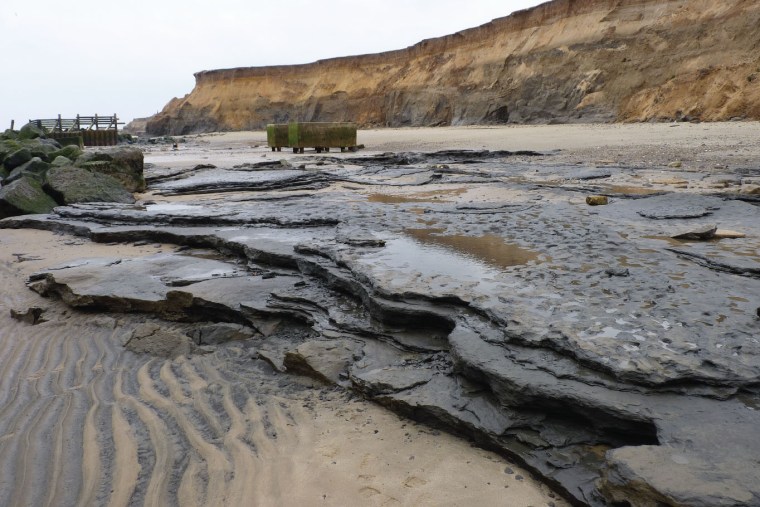
Coastal exposure of Pleistocene laminated sediments at Happisburgh; the top surface exposes the hominin trackway (credit: Ashton et al. 2014 PLOS1)
A team funded by the Pathways to Ancient Britain Project, involving scientists from a consortium of British museums and universities, rapidly conserved a 12 m2 surface of laminated sediments fortuitously exposed on the foreshore at Happisburgh (pronounced ‘Haze-burra’) by winter storms. It was covered in footprints (Ashton, N. and 11 others 2014. Hominin Footprints from Early Pleistocene Deposits at Happisburgh, UK. PLoS ONE v. 9: e88329. doi:10.1371/journal.pone.0088329). Analysis of the prints suggested a band of individuals who had tramped southwards across mudflats at the edge of an estuary. They were possibly members of an early human species, known as Homo antecessor, skeletal remains of whom are known from northern Spain. The Happisburgh individuals were of mixed size, probably including adults and juveniles: three footprint sets suggested 1.6 to 1.73 m stature; nine less than 1.4 m.
View from above of the well-trodden trackway at Happisburgh, with an enlarged example of one of the foot prints (credit: Ashton et al. 2014 PLoS1)
From pollen samples, East Anglia during the interglacial had a cool climate with pine, spruce, birch and alder tree cover with patches of heath and grassland. That it had attracted early humans to travel so far north from the Mediterranean climate where skeletal remains are found, suggests that food resources were at least adequate. It is hard to imagine the band having been seasonal visitors from warmer climes further south. They must have been hardy, and from the stone tools we know they were well equipped and capable of killing sizeable prey animals, bones of which marked by clear cut marks being good evidence for their hunting skills.
Note: Earth-Pages will be closing as of early July, but will continue in another form atEarth-logs
For many geoscientists and lay people the water cycle is considered to be part of the Earth’s surface system. That is, the cycle of evapotranspiration, precipitation and infiltration involving atmosphere, oceans, cryosphere, terrestrial hydrology and groundwater. Yet it links to the mantle through subduction of hydrated oceanic lithosphere and volcanism. The rate at which water vapour re-enters the surface part of the water cycle through volcanoes is reasonably well understood, but the same cannot be said about ‘recharge’ of the mantle through subduction.
The water cycle as visualised by the US Geological Survey (credit: Wikipedia)
Subducted oceanic crust is old, cold and wet: fundamentals of plate theory. The slab-pull that largely drives plate tectonics results from phase transitions in oceanic crust that are part and parcel of low-temperature – high-pressure metamorphism. They involve the growth of the anhydrous minerals garnet and high-pressure pyroxene that constitute eclogite, the dense form taken by basalt that causes the density of subducted lithosphere to exceed that of mantle peridotite and so to sink. This transformation drives water out of subducted lithosphere into the mantle wedge overlying a subduction zone, where it encourages partial melting to produce volatile-rich andesitic basalt magma – the primary magma of island- and continental-arc igneous activity. Thus, most water that does reenter the mantle probably resides in the ultramafic lithospheric mantle in the form of hydrated olivine, i.e. the mineral serpentine, and that is hard to judge.
Water probably gets into the mantle lithosphere when the lithosphere bends to begin its descent. That is believed to involve faults – cold lithosphere is brittle – down which water can diffuse to hydrate ultramafic rocks. So the amount of water probably depends on the number of such bend-related faults. A way of assessing the degree of such faulting and thus the proportion of serpentinite is analysis of seismic records from subduction zones. This has been done from earthquake records from the West Pacific subduction zone descending beneath northern Japan (Garth, T. & Rietbrock, A. 2014. Order of magnitude increase in subducted H2O due to hydrated normal faults within the Wadati-Bennioff zone. Geology, on-line publication doi:10.1130/G34730.1). The results suggest that between 17 to 31% of the subducted mantle there has been serpentinised.
In a million years each kilometre along the length of this subduction zone would therefore transfer between 170 to 318 billion tonnes of water into the mantle; an estimate more than ten times previous estimates. The authors observe that at such a rate a subduction zone equivalent to the existing, 3400 km long Kuril and Izu-Bonin arcs that affect Japan would have transferred sufficient water to fill the present world oceans 3.5 times over the history of the Earth. Had the entire rate of modern subduction along a length of 55 thousand kilometres been maintained over 4.5 billion years, the world’s oceans would have been recycled through the mantle once every 80 million years. To put that in perspective, since the Cretaceous Chalk of southern England began to be deposited, the entire mass of ocean water has been renewed. Moreover, subduction has probably slowed considerably through time, so the transfer of water would have been at a greater pace in the more distant past.
Remote sensing, including mapping of topographic elevation, and the recent exploits of three surface vehicles – the Spirit, Opportunity and Curiosity Rovers – have provided lots of data for a host of geological interpreters. Producing a time frame for Martian geological and geomorphological events has, understandably, been limited mainly to the use of stratigraphic principles. Various rock units and surface features can be placed in relative time order through simple stratigraphic principles, such as what sits on top of what and which features cut through pre-existing rock units or are masked by them. The most important guide up to now has been interpretation of the relations between impact craters and both rock units and other geomorphological features. The Inner Planets are assumed to have recorded the same variation through time of the frequency and energies of bombardment, and that has been calibrated to some extent by radiometric dating of impact-related rocks returned from the Moon by the crewed Apollo missions. Some detail of relative timings also emerge from some craters cutting earlier ones. The only other source of Martian ages has been from rare meteorites (there are only 114 of them) whose stable isotope compositions are different from those of terrestrial rocks and more common meteorites. By a process of elimination it is surmised that they were flung from Mars as a result of large impacts in the past to land eventually on Earth. The oldest of them date back to 4.5 Ga, much the same as the estimated age of the earliest crystallisation of magmas on Earth.
Colorised relief map of the western hemisphere of Mars, showing Valles Marineris at centre and the four largest volcanoes on the planet (credit: Wikipedia)
But all Martian stratigraphy is still pretty vague by comparison with that here, with only 4 time divisions based on reference to the lunar crater chronology and 3 based on evidence from detailed orbital spectroscopy and Rover data about the alteration of minerals on the Martian surface. Apart from meteorite dates there is very little knowledge of the earliest events, other than Mars must have had a solid, probably crystalline crust made of mainly anhydrous igneous minerals. This was the ‘target’ on which much of the impact record was impressed: by analogy with the Moon it probably spanned the period of the Late Heavy Bombardment from about 4.1 to 3.7 Ga, equivalent to the Eoarchaean on Earth. That period takes its name – Noachian – from Noachis Terra (‘land of Noah’), an intensely cratered, topographically high region of Mars’s southern hemisphere, whose name was given to this large area of high albedo by classical astronomers. Perhaps coincidentally, the Noachian provides the clearest evidence for the former presence of huge amounts of water on the surface of Mars and its erosional power that formed the gigantic Valles Marineris canyon system. The rocky surface that the craters punctured is imaginatively referred to as the pre-Noachian. A major episode of volcanic activity that formed Olympus Mons and other lava domes is named the Hesperian (another legacy of early astronomical nomenclature). It is vaguely ascribed to the period between 3.7 and 3.0 Ga, and followed by three billion years during which erosion and deposition under hyper-arid conditions formed smooth surfaces with very few craters and rare evidence for the influence of surface water and ice. It is named, inappropriately as it turns out, the Amazonian.
Remote sensing has provided evidence of episodes of mineral alteration. Clay minerals have been mapped on the pre-Noachian surface, suggesting that aqueous weathering occurred during the earliest times. Sulfates occur in exposed rocks of early Hesperian age, suggesting abundant atmospheric SO2 during this period of massive volcanicity. The last 3.5 billion years saw only the development of the surface iron oxides whose dominance led to Mars being nickname the ‘Red Planet’.
A ‘selfie’ of Curiosity Rover drilling in Gale Crater (credit: Euclid vanderKroew)
A recent paper (Farley, K.A. and 33 others plus the entire Mars Science Laboratory 2014. In Situ Radiometric and Exposure Age Dating of the Martian Surface. Science, v. 343, online publication DOI: 10.1126/science.1247166) suggests that radiometric ages can be measured ‘in the field’, as it were, by instruments carried by the Curiosity rover. How is that done? Curiosity carries a miniature mass spectrometer and other analytical devices. Drilling a rock surface produces a powder which is then heated to almost 900°C for half an hour to drive off all the gases present in the sample. The mass spectrometer can measure isotopes of noble gases, notably 40Ar, 36Ar, 21Ne and 3He. Together with potassium measured by an instrument akin to and XRF, the 40Ar yields a K-Ar age for the rock. A sample drilled from a fine-grained sedimentary in Gale Crater gave an age of 4.2 Ga, most likely that of the detrital feldspars derived from the ancient rocks that form the crater’s wall, rather than an age of sedimentation. The values for 36Ar, 21Ne and 3He provide a means for establishing how long the rock has been exposed at the surface: all three isotopes can be generated by cosmic-ray bombardment. The sample from Gale Crater gave an age of about 78 Ma that probably dates the eventual exposure of the rock by protracted wind erosion.
By themselves, these ages do not tell geologists a great deal about the history of Mars, but if Curiosity makes it through the higher levels of the sediments that once filled Gale Crater – and there is enough power to repeat the mass spectrometry at other levels – it could provide a benchmark for Noachian events. The exposure age, interesting in its own right, also suggests that sediments in the crater have not been exposed to cosmic-ray bombardment for long enough to have destroyed any organic materials that the science community longs for.
A rough-and-ready way of assessing the rate at which silicic magmatic activity has varied through time is to separate out grains of zircon that have accumulated in sedimentary rocks of different ages. Zircon is readily datable using the U-Pb method, if you have access to mass spectrometry. While some of the zircons will date from much older continental crust that was exposed while the sediments originated, sometimes there are grains that formed only a few million years before the sediments accumulated. Those are likely to have crystallized from silica-rich volcanic rocks above subduction zones where ocean-floor has been driven beneath continental crust; i.e. at continental volcanic arcs. Such young zircons therefore help assess the tectonic conditions close to sedimentary basins. The potential of detrital zircon geochronology was first suggested to me by Dr M.V.N. Murthy of the Geological Survey of India in 1978, long before anyone could aspire to mass zircon dating. M.V.N. had by then amassed kilograms of zircon grains from every imaginable source in India, and may have been the first geologist to realise their potential. It has become a lot quicker and cheaper in the last two decades, thanks to methods of dating single zircon grains both precisely and accurately and M.V.N.’s prescient suggestion has been borne out globally.
A detrital zircon grain about 0.25 mm long. (Photo credit: Wikipedia)
Results for the late Precambrian to early Palaeozoic have recently been compiled (McKenzie, N.R. et al. 2014. Plate tectonic influences on Neoproterozoic-early Paleozoic climate and animal evolution. Geology, online publication doi:10.1130/G34962.1). One of the striking correlations is between the abundance of ‘young’ zircons relative to Cambrian sedimentary deposition and the pace of diversification of animal faunas during the Cambrian. During the Cambrian Period there may have been far more continental-margin arc volcanism than in the preceding late Neoproterozoic or later in the early Palaeozoic. That would match with evidence for the Cambrian atmosphere having reached the greatest CO2 concentration of Phanerozoic times and the fact that the Gondwana supercontinent (comprising the present southern continents plus India) was assembled at that time by collision of several Precambrian continental masses. Global temperatures must have been rising.
Earth at abround the start of the Cambrian showing the cratons that collided to form Gondwana (Photo credit: Wikipedia)
The rapid emergence of all the major animal groups by the middle Cambrian – the Cambrian Explosion – took place during and despite climatic warming. Environmental stress, perhaps increased calcium and bicarbonate ions in sea water as a result of acid conditions, may have forced animals to develop means of getting both ions out of their cells to form carbonate skeletons: the Cambrian Explosion really marks the first appearance of shelly faunas and a good chance of fossilisation. Yet at the peak of volcanically-induced warming faunal diversity, especially of reef-building animals, fell-off dramatically to create what some palaeobiologsts have termed the Cambrian ‘dead interval’. Marine life really took-off in a big way during the Ordovician while temperatures were falling globally; so much so that the close of the Ordovician was marked by the first major glaciation focused on Gondwana. The zircon record indicates that continental-arc volcanism also declined during the Ordovician, and maybe the Cambrian silicic volcanics were chemically weathered during that Period to remove carbon-dioxide from the atmosphere, along with renewed reef building to bury carbonate fossils.
Although the frigid conditions at the last glacial maximum, around 19 to 20 thousand years ago, gradually relinquished their grip through slow global warming, this amelioration came to sudden stop around 12 800 years before the present. Northern hemisphere ice-core and other climate records show that there was a return to glacial conditions over a period of a few decades at most, to launch what is known as the Younger Dryas stadial that lasted over a thousand years until about 11 500 years ago, with the onset of the warm, climatically more stable Holocene that launched the transformation of the human way of life. The start of the Younger Dryas had dramatic effects throughout the northern hemisphere, the cold conditions emerging suddenly from an immense oceanographic change; a weakening or the halt of the North Atlantic thermohaline circulation in which cold, very salty surface waters at the fringe of the Arctic Ocean sink to drag warmer water to high latitudes. In short, the Gulf Stream slowed or stopped its warming influence at high northern latitudes. Current thoughts centre on a freshening of surface sea water following the collapse of the North American ice sheet to gush meltwater and icebergs into the North Atlantic to buoy-up surface waters.
Major climate shifts in Europe since 18 ka (credit: Wikipedia)
Most of the data about this climatic shock can only be dated accurately to within a few centuries: it is clear that the initial cooling was very rapid, on the scale of a few years, as was the warming that closed the Younger Dryas and marked the start of the Holocene, but the ‘when’ is known only to within a few hundred years. To resolve the start and stop ages needs records that include several indicators: clear signs of the beginning and end of the episode, an accurate means of dating them and confirmation from other sites, which presupposes a cast-iron means of correlating the records over large distances. The most reliable markers for correlation are volcanic ashes that can be dated radiometrically and which drift on the wind to be deposited over very large areas. If sedimentary sequences that accumulated continuously preserve such ashes, contain clear signs of climatic change and clearly record the passage of time in great detail, there is a chance of resolving climatic events very accurately; but they are no common. A British-German team have located and analysed two such promising sites (Land, C.S. et al. 2013. Volcanic ash reveals time transgressive abrupt climate change during the Younger Dryas. Geology, v. 41, p. 1251-1254). One of them is from the bed of a lake that formed by a single volcanic eruption (Meerfelder Maar) in the Eifel region of western Germany. Quiet sediment accumulation has occurred there continuously to form very narrow, alternating dark and light layers, the variegation being due to sedimentation under ice in winter and open water in summer respectively. Twelve thousand of these annual varves provide a means of dating potentially with a precision of ± 1 year, but calibration to absolute time is necessary. The maar sediments contain three ash layers, two of which are from small local eruptions; the older having an age of 12 900 years before 2000 AD, the other being 11 000 years old, showing that the entire Younger Dryas is spanned by the Meerfelder Maar sediments. The third was dated by varve counting, showing the eruption had taken place 12 140 years ago. That age coincides closely with that of major eruption in Iceland.
A typical volcanic maar in Eifel Region of Germany (credit: Wikipedia)
One prominent climatic feature of the Younger Dryas of Europe is a shift around halfway through: it started with the fiercest cold and then ameliorated. This change shows up in the Meerfelder Maar record as a reduction in mean varve thickness and an increase in the titanium content of the clays, the latter taking place in about a year (12 250 years ago) some 100 years before the Icelandic ash was deposited. The same kind of change occurs in records from lakes as far north as the Arctic Circle. One of the core records from Kråkenes in Northern Norway also contains the tell-tale Icelandic ash (as do ice cores from Greenland), but in its case it occurs 20 years before the abrupt climate shift. This clearly shows that major climate changes at the end of the last ice age occur at different times from place to place. The authors ascribe the 120 year difference between the two records to the times when prevailing, warm westerly winds began to affect central and northern Europe, linked to a gradual northward migration of the polar front. The data from both lakes also suggest that the Younger Dryas ended about 20 years earlier in Norway than in Germany, although Lane et al. do not comment..
Hitherto, correlation between climate records has been based on an assumption that major climate changes were at the same time, so that climate proxies such those discussed here have been ‘wiggle-matched’. Quite probably a lot of subtleties have thereby been missed.







 Earth-logs