Around 20 thousand years ago, the Earth began to emerge from the grip of the Last Glacial Maximum (LGM). Huge ice sheets had locked up so much water that sea level was then about 125 m lower than it is today. At 12,870 years ago the warming and sea-level rise were reversed for 1,170 years in the Northern Hemisphere: an episode of near-full glacial conditions known as the Younger Dryas (YD). The adjectives ‘sudden’ or ‘abrupt’ grossly understate the pace of initial cooling – 3°, 6° and 15° C in North America, Europe and Greenland, respectively. Isotopic evidence from Greenland ice cores suggest that the cooling took place over three years or less. Such a degree of precision stems from the continuous annual layering in the Greenland ice cap. As far as humans were concerned, this would have been catastrophic for hunter gatherers following game northwards in Eurasia and North America as conditions ameliorated during the seven thousand years since the LGM. The archaeological record, or rather the lack of one, for what are now temperate zones suggests humans either retreated south or were blotted out.
There is no counterpart for the YD in the end stages of early glacial episodes. Some authors have suggested that it was the outcome of an appropriately catastrophic geological event, such as a large meteorite strike, as proposed in 2007 (See: Whizz-bang view of Younger Dryas; July 2007). This hypothesis gained traction in 2013, at least for its authors, with the discovery of anomalously high concentrations of the noble metal platinum (Pt) and other platinum Group metals, such as iridium (Ir) at or around the start of the YD in the GISP2 ice core. New research on this anomaly (Green, C.E. et al 2025. A possible volcanic origin for the Greenland ice core Pt anomaly near the Bølling-Allerød/Younger Dryas boundary. PLOS One, v. 20, article e0331811; DOI: 10.1371/journal.pone.0331811) offers a different scenario. Charlotte Green of Royal Holloway, University of London and colleagues from universities in the UK, Germany and Austria examine the timing of this Pt spike and its detailed geochemistry.
The ‘killer’ observation is that the anomaly occurs in ice that formed 45 years after the onset of the Younger Dryas and has a spread of about 14 years. Whatever kind of event released the platinum, it definitely did not somehow trigger the onset of the YD. Moreover, the anomaly was significantly deficient in iridium compared with a wide range of meteorites and terrestrial igneous rocks. It also differed markedly in other elements, such as lutetium and hafnium, and in all three elements in melt rocks and ejecta sediments associated with five proven impact structures. The closest match is to volcanic gas condensates from a recent eruption of a submarine volcano near Tonga
Both the GISP2 and NGRIP cores through the Greenland ice also record a large, 12-year long spike in sulfate of volcanic origin spread across the very start of the YD. That roughly matches the age of an explosive eruption, which formed the circular Laacher See in the Eifel volcanic field in Germany. That eruption is thought to have blasted 6.3 km3 of highly alkaline magma into the atmosphere: about the magnitude of the 1991 Pinatubo eruption, but insufficient to yield the size and duration of the sulfate spike that coincides with the start of the YD. The sulfate anomaly suggests a far larger, currently unknown eruption at 12,870 years ago. The Pt and Ir data from the Laacher See event rule it out as a source for the younger Pt anomaly in the GISP2 ice core. One possibility is a nearby Icelandic subglacial fissure eruption at that time.
So, as regards what started the Younger Dryas, there is support for a very large, but so-far unknown volcanic event, and an as yet unresolved, perturbation in the Atlantic Meridional Overturning Circulation (AMOC) resulting from drainage of a huge glacial lake in northern North America (see: The Younger Dryas and the Flood; June 2006), but no support whatever for an impact event. Climatology of the distant past is always likely to be difficult to pin down. That is because, as now, it involves linkages between a large number of variables: not only physical ones, but issues of biogeochemistry, the inner Earth, the rest of the solar system and even cosmology. That is, it is as complex as human affairs and their history. Common sense, linear thinking and the like, simply will not do.
The emergence of the eukaryotes – of which we are a late-entry member – has been debated for quite a while. In 2023 Earth-logs reportedthat a study of ‘biomarker’ organic chemicals in Proterozoic sediments suggests that eukaryotes cannot be traced back further than about 900 Ma ago using such an approach. At about the same time another biomarker study showed signs of a eukaryote presence at around 1050 Ma. Both outcomes seriously contradicted a ‘molecular-clock’ approach based on the DNA of modern members of the Eukarya and estimates of the rate of genetic mutation. That method sought to deduce the time in the past when the last eukaryotic common ancestor (LECA) appeared. It pointed to about 2 Ga ago, i.e. a few hundred million years after the Great Oxygenation Event got underway. Since eukaryote metabolism depends on oxygen, the molecular-clock result seems reasonable. The biomarker evidence does not. But were the Palaeo- and Mesoproterozoic Eras truly ‘boring’? A recent paper by Dietmar Müller and colleagues from the Universities of Sydney and Adelaide, Australia definitely shows that geologically they were far from that (Müller, R.D. et al. 2025. Mid-Proterozoic expansion of passive margins and reduction in volcanic outgassing supported marine oxygenation and eukaryogenesis. Earth and Planetary Science Letters, v. 672; DOI: 10.1016/j.epsl.2025.119683).
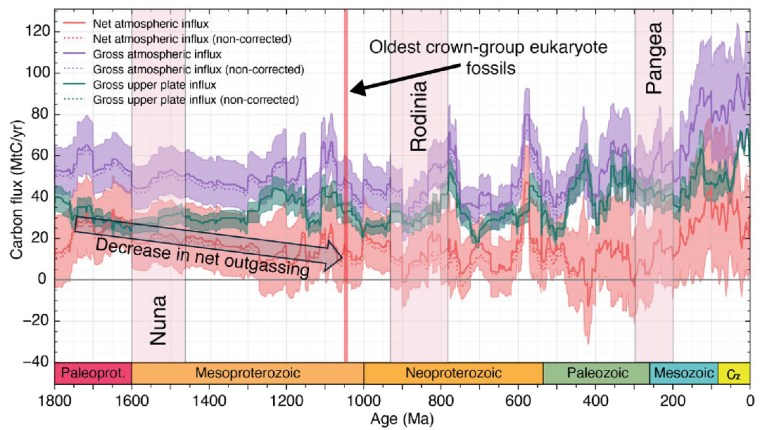
Carbon influx (million tons per year) into tectonic plates and into the ocean-atmosphere system from 1800 Ma to present. The colour bands represent: total carbon influx into the atmosphere (mauve); sequestered in tectonic plates (green); net atmospheric influx i.e. total minus carbon sequestered into plates (orange). The widths of the bands show the uncertainties of the calculated masses shown as darker coloured lines.
From 1800 to 800 Ma two supercontinents– Nuna-Columbia and Rodinia – aggregated nearly all existing continental masses, and then broke apart. Continents had collided and then split asunder to drift. So plate tectonics was very active and encompassed the entire planet, as Müller et al’s palaeogeographic animation reveals dramatically. Tectonics behaved in much the same fashion through the succeeding Neoproterozoic and Phanerozoic to build-up then fragment the more familiar supercontinent of Pangaea. Such dynamic events emit magma to form new oceanic lithosphere at oceanic rift systems and arc volcanoes above subduction zones, interspersed with plume-related large igneous provinces and they wax and wane. Inevitably, such partial melting delivered carbon dioxide to the atmosphere. Reaction on land and in the rubbly flanks of spreading ridges between new lithosphere and dissolved CO2 drew down and sequestered some of that gas in the form of solid carbonate minerals. Continental collisions raised the land surface and the pace of weathering, which also acted as a carbon sink. But they also involved metamorphism that released carbon dioxide from limestones involved in the crustal transformation. This protracted and changing tectonic evolution is completely bound up through the rock cycle with geochemical change in the carbon cycle.
From the latest knowledge of the tectonic and other factors behind the accretion and break-up of Nuna and Rodinia, Müller et al. were able to model the changes in the carbon cycle during the ‘boring billion’ and their effects on climate and the chemistry of the oceans. For instance, about 1.46 Ga ago, the total length of continental margins doubled while Nuna broke apart. That would have hugely increased the area of shallow shelf seas where living processes would have been concentrated, including the photosynthetic emission of oxygen. In an evolutionary sense this increased, diversified and separated the ecological niches in which evolution could prosper. It also increased the sequestration of greenhouse gas through reactions on the flanks of a multiplicity of oceanic rift systems, thereby cooling the planet. Translating this into a geochemical model of the changing carbon cycle (see figure) suggests that the rate of carbon addition to the atmosphere (outgassing) halved during the Mesoproterozoic. The carbon cycle and probable global cooling bound up with Nuna’s breakup ended with the start of Rodinia’s aggregation about 1000 Ma ago and the time that biomarkers first indicate the presence of eukaryotes.
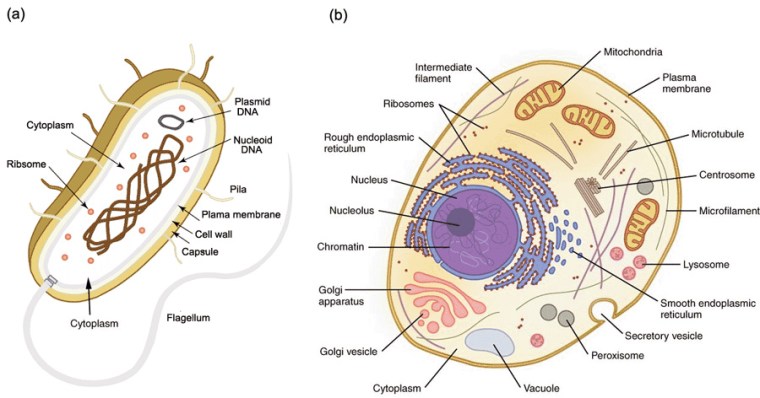
Simplified structures of (a) a prokaryote cell; (b) a simple eukaryote animal cell. Plants also contain organelles called chloroplasts
So, did tectonics play a major role in the rise of the Eukarya? Well, of course it did, as much as it was subsequently the changing background to the appearance of the Ediacaran animals and the evolutionary carnival of the Phanerozoic. But did it affect the billion-year delay of ‘eukaryogenesis’ during prolonged availability of the oxygen that such a biological revolution demanded? Possibly not. Lyn Margulis’s hypothesis of the origin of the basic eukaryote cell by a process of ‘endosymbiosis’ is still the best candidate 50 years on. She suggested that such cells were built from various forms of bacteria and archaea successively being engulfed within a cell wall to function together through symbiosis. Compared with prokaryote cells those of the eukaryotes are enormously complex. At each stage the symbionts had to be or become compatible to survive. It is highly unlikely that all components entered the relationship together. Each possible kind of cell assembly was also subject to evolutionary pressures. This clearly was a slow evolutionary process, probably only surviving from stage to stage because of the global presence of a little oxygen. But the eukaryote cell may also have been forced to restart again and again until a stable form emerged.
Four out of six mass extinctions that ravaged life on Earth during the last 300 Ma coincided with large igneous events marked by basaltic flood volcanism. But not all such bursts of igneous activity match significant mass extinctions. Moreover, some rapid rises in the rate of extinction are not clearly linked to peaks in igneous activity. Another issue in this context is that ‘kill mechanisms’ are generally speculative rather than based on hard data. Large igneous events inevitably emit very large amounts of gases and dust-sized particulates into the atmosphere. Carbon dioxide, being a greenhouse gas, tends to heat up the global climate, but also dissolves in seawater to lower its pH. Both global warming and more acidic oceans are possible ‘kill mechanisms’. Volcanic emission of sulfur dioxide results in acid rain and thus a decrease in the pH of seawater. But if it is blasted into the stratosphere it combines with oxygen and water vapour to form minute droplets of sulfuric acid. These form long-lived haze, which reflects solar energy beck into space. Such an increased albedo therefore tends to cool the planet and create a so-called ‘volcanic winter’. Dust that reaches the stratosphere reduces penetration of visible light to the surface, again resulting in cooling. But since photosynthetic organisms rely on blue and red light to power their conversion of CO2 and water vapour to carbohydrates and oxygen, these primary producers at the base of the marine and terrestrial food webs decline. That presents a fourth kill mechanism that may trigger mass extinction on land and in the oceans: starvation.
Palaeontologists have steadily built up a powerful case for occasional mass extinctions since fossils first appear in the stratigraphic record of the Phanerozoic Eon. Their data are simply the numbers of species, genera and families of organisms preserved as fossils in packages of sedimentary strata that represent roughly equal ‘parcels’ of time (~10 Ma). Mass extinctions are now unchallengeable parts of life’s history and evolution. Yet, assigning specific kill mechanisms involved in the damage that they create remains very difficult. There are hypotheses for the cause of each mass extinction, but a dearth of data that can test why they happened. The only global die-off near hard scientific resolution is that at the end of the Cretaceous. The K-Pg (formerly K-T) event has been extensively covered in Earth-logs since 2000. It involved a mixture of global ecological stress from the Deccan large igneous event spread over a few million years of the Late Cretaceous, with the near-instantaneous catastrophe induced by the Chicxulub impact, with a few remaining dots and ticks needed on ‘i’s and ‘t’s. Other possibilities have been raised: gamma-ray bursts from distant supernovae; belches of methane from the sea floor; emissions of hydrogen sulfide gas from seawater itself during ocean anoxia events; sea-level changes etc.
The mass extinction that ended the Triassic (~201 Ma) coincides with evidence for intense volcanism in South and North America, Africa and southern Europe, then at the core of the Pangaea supercontinent. Flood basalts and large igneous intrusions – the Central Atlantic Magmatic Province (CAMP) – began the final break-up of Pangaea. The end-Triassic extinction deleted 34% of marine genera. Marine sediments aged around 201 Ma reveal a massive shift in sulfur and carbon isotopes in the ocean that has been interpreted as a sign of acute anoxia in the world’s oceans, which may have resulted in massive burial of oxygen-starved marine animal life. However, there is no sign of Triassic, carbon-rich deep-water sediments that characterise ocean anoxia events in later times. But it is possible that bacteria that use the reduction of sulfate (SO42-) to sulfide (S2-) ions as an energy source for them to decay dead organisms, could have produced the sulfur isotope ‘excursion’. That would also have produced massive amounts of highly toxic hydrogen sulfide gas, which would have overwhelmed terrestrial animal life at continental margins. The solution ofH2S in water would also have acidified the world’s oceans.
Molly Trudgill of the University of St Andrews, Scotland and colleagues from the UK, France, the Netherlands, the US, Norway, Sweden and Ireland set out to test the hypothesis of end-Triassic oceanic acidification (Trudgill, M. and 24 others 2025. Pulses of ocean acidification at the Triassic–Jurassic boundary. Nature Communications, v. 16, article 6471; DOI: 10.1038/s41467-025-61344-6). The team used Triassic fossil oysters from before the extinction time interval. Boron-isotope data from the shells are a means of estimating variations in the pH of seawater. Before the extinction event the average pH in Triassic seawater was about the same as today, at 8.2 or slightly alkaline. By 201 Ma the pH had shifted towards acidic conditions by at least 0.3: the biggest detected in the Phanerozoic record. One of the most dramatic changes in Triassic marine fauna was the disappearance of reef limestones made by the recently evolved modern corals on a vast scale in the earlier Triassic; a so-called ‘reef gap’ in the geological record. That suggests a possible analogue to the waning of today’s coral reefs that is thought to be a result of increased dissolution of CO2 in seawater and acidification, related to global greenhouse warming. Using the fossil oysters, Trudgill et al. also sought a carbon-isotope ‘fingerprint’ for the source of elevated CO2, finding that it mainly derived from the mantle, and was probably emitted by CAMP volcanism. So their discussion centres mainly on end-Triassic ocean acidification as an analogy for current climate change driven by CO2 largely emitted by anthropogenic burning of fossil fuels. Nowhere in their paper do they mention any role for acidification by hydrogen sulfide emitted by massive anoxia on the Triassic ocean floor, which hit the scientific headlines in 2020 (see earlier link).
For decades, research into the composition of the Earth’s early atmosphere depended on indirect means. An example is the preservation of water-worn grains of sulphides and uranium oxides in coarse terrestrial sediments older than about 2,200 Ma. Their survival on the continental surface suggested that the atmosphere before then had vanishingly low O2. Such grains would have otherwise been broken down by oxidation reactions. Younger sediments simply do not contain such detrital grains. This suggested the appearance of an oxidising atmosphere around 2.2 Ga ago: the Great Oxygenation Event. The greenhouse gases – carbon dioxide and methane – are also difficult to estimate directly, especially in the Precambrian. Once plants colonised the land surface, their photosynthesis depended on inhaling and exhaling air through stomata on the surface of leaves (see:Ancient CO2 estimates worry climatologists; January 2017). The number of stomata per unit area of a leaf surface is expected to increase with lowering of atmospheric CO2 and vice versa, which has been observed in plants grown in different air compositions. By comparing stomatal density in fossilised leaves of modern plants back to 800 ka allows the change to be calibrated against the record of CO2 inside air bubbles trapped in ice-cores. This proxy method has given a guide to CO2 variations through the Cenozoic, Mesozoic and upper Palaeozoic Eras. However, the reliability of extinct plant leaves as proxies is suspect.
A fluid inclusion (about 0.2 mm) trapped in a crystal of halite (NaCl). Credit: alchetron.com
Is it possible to find air trapped by other means than in glacial ice? It may be. Tiny pockets of liquid and gas – fluid inclusions – are often found in minerals that crystallised at the Earth’s surface. The most common are crystals of salt (NaCl) and carbonates from ancient lake deposits. A 2019 study revealed that Late Triassic carbonates from Colorado, USA record an increase of atmospheric oxygen levels from 15 to 19% about 215 Ma ago over a period of just 3 million years as dinosaurs first spread into North America, then at equatorial latitudes in the Pangaea supercontinent. This sudden increase in the availability of oxygen may also be linked to the trend towards larger and larger dinosaurs worldwide. Going further back in time trace-metal chemistry of 1,400 Ma old marine sediments from China indicates oxygenated water that suggests an atmospheric oxygen level greater than 4% of that at present. Small as that might seem, it would have been sufficient to sustain animal respiration about half a billion years before the first evidence for the earliest animals. Further work on ancient salt and carbonate deposits confirms much higher oxygen levels than geochemists have expected previously.
A consortium of geoscientists from Australia, Britain and France, led by Andrew Merdith of the University of Adelaide examines the likely climate cooling mechanisms that may have set off the two great ‘icehouse’ intervals in the last 541 Ma (Merdith, A.S. et al. 2025. Phanerozoic icehouse climates as the result of multiple solid-Earth cooling mechanisms. Science Advances, v. 11, article eadm9798: DOI: 10.1126/sciadv.adm9798). They consider the first to be the global cooling that began in the latter part of the Devonian culminating in the Carboniferous-Permian icehouse. The second is the Cenozoic global cooling to form the permanent Antarctic ice cap around 34 Ma and culminated in cyclical ice ages on the northern continents after 2.4 Ma during the Pleistocene. They dismiss the 40 Ma long, late Ordovician to early Silurian glaciation that left its imprint on North Africa and South America – then combined in the Gondwana supercontinent. The data about two of the parameters used in their model – the degree of early colonisation of the continents by plants and their influence on terrestrial weathering are uncertain in that protracted event. Yet the Hirnantian glaciation reached 20°S at its maximum extent in the Late Ordovician around 444 Ma to cover about a third of Gondwana: it was larger than the present Antarctic ice cap. For that reason, their study spans only Devonian and later times.
Fluctuation in evidence for the extent of glacial conditions since the Devonian: the ‘ice line’ is grey. The count of glacial proxy occurrences in each 10° of latitude through time is shown in the colour key. Credit: Merdith et al., Fig 2A.
Merdith et al. rely on four climatic proxies. The first of these comprises indicators of cold climates, such as glacial dropstones, tillites and evidence in sedimentary rocks of crystals of hydrated calcium carbonate (ikaite – CaCO3.6H2O) that bizarrely forms only at around 0°C . From such occurrences it is possible to define an ‘ice line’ linking different latitudes through geological time. Then there are estimates of global average surface temperature; low-latitude sea surface temperature; and estimates of atmospheric CO2. The ‘ice-line’ data records an additional, long period of glaciation in the Jurassic and early Cretaceous, but evidence does not extend to latitudes lower than 60°. It is regarded by Merdith et al. as an episode of ‘cooling’ rather than an ‘icehouse’. Their model assesses sources and sinks of CO2 since the Devonian Period.
The main natural source of the principal greenhouse gas CO2 is degassing through volcanism expelled from the mantle and breakdown of carbonate rock in subducted lithosphere. Natural sequestration of carbon involves weathering of exposed rock that releases dissolved CO2 and ions of calcium and magnesium. A recently compiled set of plate reconstructions that chart the waxing and waning of tectonics since the Devonian Period allows them to model the tectonically driven release of carbon over time, with time scales on the order of tens to hundreds of Ma. The familiar Milanković forcing cycles on the order of tens to hundreds of ka are thus of no significance in Merdith et al.’s broader conception of icehouse episodes Their modelling shows high degassing during the Cretaceous, modern levels during the late Palaeozoic and early Mesozoic, and low emissions during the Devonian. The model also suggests that cooling stemmed from variations in the positions and configuration of continents over time. Another crucial factor is the tempo of exposure of rocks that are most prone to weathering. The most important are rocks of the ocean lithosphere incorporated into the continents to form ophiolite masses. The release of soluble products of weathering into ocean basins through time acts as a fluctuating means of ‘fertilising’ so that more carbon can be sequestered in deep sediments in the form of organisms’ unoxidised tissue and hard parts made of calcium carbonates and phosphates. Less silicate weathering results in a boost to atmospheric CO2.
Only two long, true icehouse episodes emerge from the empirical proxy data, expressed by the ‘ice-line’ plots. Restricting the modelling to single global processes that might be expected to influence degassing or carbon sequestration produces no good fits to the climatic proxy data. Running the model with all the drivers “off” produces more or less continuous icehouse conditions since the Devonian. The model’s climate-related outputs thus imply that many complex processes working together in syncopation may have driven the gross climate vagaries over the last 400 Ma or so. A planet of Earth’s size without such complexity would throughout that period have had a high-CO2 warm climate. According to Andrew Merdith its fluctuation from greenhouse to icehouse conditions in the late Palaeozoic and the Cenozoic were probably due to “coincidental combination of very low rates of global volcanism, and highly dispersed continents with big mountains, which allow for lots of global rainfall and therefore amplify reactions that remove carbon from the atmosphere”.
Geological history is, almost by definition, somewhat rambling. So, despite despite the large investment in seeking a computed explanation of data drawn from the record, the outcome reflects that in a less than coherent account. To state that many complex processes working at once may have driven climate vagaries over the last 400 Ma or so, is hardly a major advance: palaeoclimatologists have said more or less the same for a couple of decades or more, but have mainly proposed single driving mechanisms. One aspect of Merdith et al.’s results seems to be of particular interest. ‘Icehouse’ conditions seem to be rare events interspersed with broader ice-free periods. We evolved within the mammal-dominated ecosystems on the continents during the latest of these anomalous climatic episodes. And we and those ecosystems now rely on a cool world. As the supervisor of the project commented, ‘Over its long history, the Earth likes it hot, but our human society does not’.
Readers may like to venture into how some philosophers of science deal with a far bigger question; ‘Is intelligent life a rare, chance event throughout the universe?’ That is, might we be alone in the cosmos? In the same issue of Science Advances is a paper centred on just such questions (Mills, D.B. et al. 2025. A reassessment of the “hard-steps” model for the evolution of intelligent life. Science Advances, v. 11, article eads5698; DOI: 10.1126/sciadv.ads5698). It stems from cosmologist Brandon Carter’s ‘Anthropic Principle’ first developed at Nicolas Copernicus’s 500th birthday celebrations in 1973. This has since been much debated by scientists and philosophers – a gross understatement as it knocks the spots off the Drake Equation. To take the edge off what seems to be a daunting task, Mills et al. consider a corollary of the Anthropic Principle, the ‘hard steps model’. That, in a nutshell, postulates that the origin of humanity and its ability to ponder on observations of the universe required a successful evolutionary passage through a number of hard steps. It predicts that such intelligence is ‘exceedingly rare’ in the universe. Icehouse conditions are respectable candidates for evolutionary ‘hard steps’, and in the history of Earth there have been five of them.
A fully revised edition of Steve Drury’s book Stepping Stones: The Making of Our Home World can now be downloaded as a free eBook
Refugees from the Middle East migrating through Slovenia in 2015. Credit: Britannica
During the Pliocene (5.3 to 2.7 Ma) there evolved a network of various hominins, with their remains scattered across both the northern and southern parts of that continent. The earliest, though somewhat disputed hominin fossil Sahelanthropus tchadensis hails from northern Chad and lived around 7 Ma ago, during the late Miocene, as did a similarly disputed creature from Kenya Orrorin tugenensis (~5.8 Ma). The two were geographically separated by 1500 km, what is now the Sahara desert and the East African Rift System. The suggestion from mtDNA evidence that humans and chimpanzees had a common ancestor, the uncertainty about when it lived (between 13 to 5 Ma) and what it may have looked like, let alone where it lived, makes the notion debateable. There is even a possibility that the common ancestor of humans and the other anthropoid apes may have been European. Its descendants could well have crossed to North Africa when the Mediterranean Sea had been evaporated away to form the thick salt deposits that now lie beneath it: what could be termed the ‘Into Africa’ hypothesis. The better known Pliocene hominins were also widely distributed in the east and south of the African continent. Wandering around was clearly a hominin predilection from their outset. The same can be said about humans in the general sense (genus Homo) during the Early Pleistocene when some of them left Africa for Eurasia. Artifacts dated at 2.1 Ma have been found on the Loess Plateau of western China, and Georgia hosts the earliest human remains known from Eurasia. Since them H. antecessor, heidelbergensis, Neanderthals and Denisovans roamed Eurasia. Then, after about 130 ka, anatomically modern humans progressively populated all continents, except Antarctica, to their geographic extremities and from sea level to 4 km above it.
There is a popular view that curiosity and exploration are endemic and perhaps unique to the human line: ‘It’s in our genes’. But even plants migrate, as do all animal species. So it is best to be wary of a kind of hominin exceptionalism or superior motive force. Before settled agriculture, simply diffusion of populations in search of sustenance could have achieved the enormous migrations undertaken by all hominins: biological resources move and hunter gatherers follow them. The first migration of Homo erectus from Africa to northern China by way of Georgia seems to taken 200 ka at most and covered about ten thousand kilometres: on average a speed of only 50 m per year! That achievement and many others before and later were interwoven with the evolution of brain size, cognitive ability, means of communication and culture. But what were the ultimate drivers? Two recent papers in the journal Nature Communications make empirically-based cases for natural forces driving the movement of people and changes in demography.
The first considers hominin dispersal in the Palaearctic biogeographic realm: the largest of eight originally proposed by Alfred Russel Wallace in the late 19th century that encompasses the whole of Eurasia and North Africa (Zan, J. et al. 2024. Mid-Pleistocene aridity and landscape shifts promoted Palearctic hominin dispersals. Nature Communications, v. 15, article 10279; DOI: 10.1038/s41467-024-54767-0). The Palearctic comprises a wide range of ecosystems: arid to wet, tropical to arctic. After 2 Ma ago, hominins moved to all its parts several times. The approach followed by Zan et al. is to assess the 3.6 Ma record of the thick deposits of dust carried by the perpetual westerly winds that cross Central Asia. This gave rise to the huge (635,000 km2) Loess Plateau. At least 17 separate soil layers in the loess have yielded artefacts during the last 2.1 Ma. The authors radiocarbon dated the successive layers of loess in Tajikistan (286 samples) and the Tarim Basin (244 samples) as precisely as possible, achieving time resolutions of 5 to 10 ka and 10 to 20 ka respectively. To judge variations in climate in these area they also measured the carbon isotopic proportions in organic materials preserved within the layers. Another climate-linked metric that Zan et al. is a time series showing the development of river terraces across Eurasia derived from the earlier work of many geomorphologists. The results from those studies are linked to variations through time in the numbers of archaeological sites across Eurasia that have yielded hominin fossils, stone tools and signs of tool manufacture, many of which have been dated accurately.
The authors use sophisticated statistics to find correlations between times of climatic change and the signs of hominin occupation. Episodes of desertification in Palaearctic Eurasia clearly hindered hominins’ spreading across the continent either from west to east of vice versa. But there were distinct, periodic windows of climatic opportunity for that to happen that coincide with interglacial episodes, whose frequency changed at the Mid Pleistocene Transition (MPT) from about 41 ka to roughly every 100 ka. That was suggested in 2021 to have arisen from an increased roughness of the rock surface over which the great ice sheets of the Northern Hemisphere moved. This suppressed the pace of ice movement so that the 41 ka changes in the tilt of the Earth’s rotational axis could no longer drive climate change during the later Pleistocene, despite the fact that the same astronomical influence continued. The succeeding ~100 ka pulsation may or may not have been paced by the very much weaker influence of Earth changing orbital eccentricity. Whichever, after the MPT climate changes became much more extreme, making human dispersal in the Palearctic realm more problematic. Rather than hominin’s evolution driving them to a ‘Manifest Destiny’ of dominating the world vastly larger and wider inorganic forces corralled and released them so that, eventually, they did.
Much the same conclusion, it seems to me, emerges from a second study that covers the period since ~ 9 ka ago when anatomically modern humans transitioned from a globally dominant hunter-gatherer culture to one of ‘managing’ and dominating ecosystems, physical resources and ultimately the planet itself. (Wirtz, K.W et al. 2024. Multicentennial cycles in continental demography synchronous with solar activity and climate stability. Nature Communications, v. 15, article 10248; DOI: 10.1038/s41467-024-54474-w). Like Zan et al., Kai Wirtz and colleagues from Germany, Ukraine and Ireland base their findings on a vast accumulated number (~180,000) of radiocarbon dates from Holocene archaeological sites from all inhabited continents. The greatest number (>90,000) are from Europe. The authors applied statistical methods to judge human population variations since 11.7 ka in each continental area. Known sites are probably significantly outweighed by signs of human presence that remain hidden, and the diligence of surveys varies from country to country and continent to continent: Britain, the Netherlands and Southern Scandinavia are by far the best surveyed. Given those caveats, clearly this approach gives only a blurred estimate of population dynamics during the Holocene. Nonetheless the data are very interesting.
The changes in population growth rates show distinct cyclicity during the Holocene, which Wirtz et al. suggest are signs of booms and busts in population on all six continents. Matching these records against a large number of climatic time series reveals a correlation. Their chosen metric is variation in solar irradiance: the power per unit area received from the Sun. That has been directly monitored only over a couple of centuries. But ice cores and tree rings contain proxies for solar irradiance in the proportions of the radioactive isotopes 10Be and 14C contained in them respectively. Both are produced by the solar wind of high-energy charged particles (electrons, protons and helium nuclei or alpha particles) penetrating the upper atmosphere. The two isotopes have half-lives long enough for them to remain undecayed and thus detectable for tens of thousand years. Both ice cores and tree rings have decadal to annual time resolutions. Wirtz et al. find that their crude estimates of booms and busts in human populations during the Holocene seem closely to match variations in solar activity measured in this way. Climate stability favours successful subsistence and thus growth in populations. Variable climatic conditions seem to induce subsistence failures and increase mortality, probably through malnutrition.
A nice dialectic clearly emerges from these studies. ‘Boom and bust’ as regards populations in millennial and centennial to decadal terms stem from climate variations. Such cyclical change thus repeatedly hones natural selection among the survivors, both genetically and culturally, increasing their general fitness to their surroundings. Karl Marx and Friedrich Engels would have devoured these data avidly had they emerged in the 19th century. I’m sure they would have suggested from the evidence that something could go badly wrong – negation of negation, if readers care to explore that dialectical law further . . . And indeed that is happening. Humans made ecologically very fit indeed in surviving natural pressures are now stoking up a major climatic hiccup, or rather the culture and institutions that humans have evolved are doing that.
Meltwater channels and lake on the surface of the Greenland ice sheet
In August 2024 Earth-Logs reported on the fragile nature of thermohaline circulation of ocean water. The post focussed on the Atlantic Meridional Overturning Circulation (AMOC), whose fickle nature seems to have resulted in a succession of climatic blips during the last glacial-interglacial cycle since 100 ka ago. They took the form of warming-cooling cycles known as Dansgaard-Oeschger events, when the poleward movement of warm surface water in the North Atlantic Ocean was disrupted. An operating AMOC normally drags northwards warm water from lower latitudes, which is more saline as a result of evaporation from the ocean surface there. Though it gradually cools in its journey it remains warmer and less dense than the surrounding surface water through which it passes: it effectively ‘floats’. But as the north-bound, more saline stream steadily loses energy its density increases. Eventually the density equals and then exceeds that of high-latitude surface water, at around 60° to 70°N, and sinks. Under these conditions the AMOC is self-sustaining and serves to warm the surrounding land masses by influencing climate. This is especially the case for the branch of the AMOC known as the Gulf Stream that today swings eastwards to ameliorate the climate of NW Europe and Scandinavia as far as Norway’s North Cape and into the eastern Arctic Ocean.
The suspected driving forces for the Dansgaard-Oeschger events are sudden massive increases in the supply of freshwater into the Atlantic at high northern latitudes, which dilute surface waters and lower their density. So it becomes more difficult for surface water to become denser on being cooled so that it can sink to the ocean floor. The AMOC may weaken and shut down as a result and so too its warming effect at high latitudes. It also has a major effect on atmospheric circulation and moisture content: a truly complicated climatic phenomenon. Indeed, like the Pacific El Niño-Southern Oscillation (ENSO), major changes in AMOC may have global climatic implications. QIyun Ma of the Alfred Wegner Institute in Bremerhaven, Germany and colleagues from Germany, China and Romania have modelled how the various possible locations of fresh water input may affect AMOC (Ma, Q. et al. 2024. Revisiting climate impacts of an AMOC slowdown: dependence on freshwater locations in the North Atlantic. Science Advances, v. 10, article eadr3243; DOI: 10.1126/sciadv.adr3243). They refer to such sudden inputs as ‘hosing’!
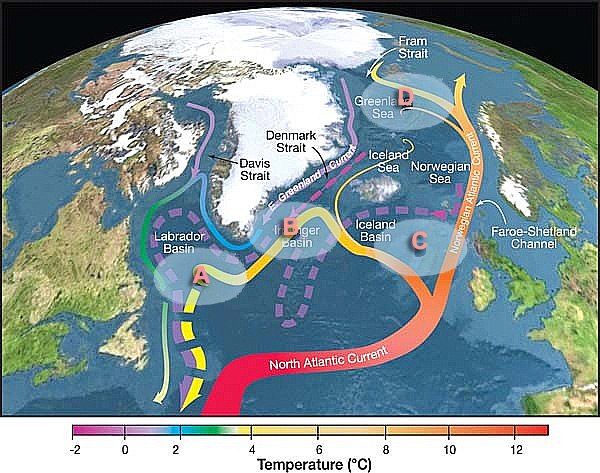
Location of the 4 regions in the northern North Atlantic used by Ma et al. in their modelling of AMOC: A Labrador Sea; B Irminger Basin; C NE Atlantic; D Nordic Seas. Colour chart refers to current temperature. Solid line – surface currents, dashed line – deep currents
First, the likely consequences under current climatic conditions of such ‘hosings’ and AMOC collapses are: a rapid expansion of the Arctic Ocean sea ice; delayed onset of summer ice-free conditions; southward shift of the Intertropical Convergence Zone (ITCZ) – a roughly equatorial band of low pressure where the NE and SE trade winds converge, and the rough location of the sometimes windless Doldrums. There have been several attempts to model the general climatic effects of an AMOC slowdown. Ma et al. take matters a step further by using the Alfred Wegener Institute Climate Model (AWI-CM3) to address what may happen following ‘hosing’ in four regions of the North Atlantic: the Labrador Sea (between Labrador and West Greenland); the Irminger Basin (SE of East Greenland, SW of Iceland); the Nordic Seas (north of Iceland; and the Greenland-Iceland-Norwegian seas) and the NE Atlantic (between Iceland, Britain and western Norway).
Prolonged freshwater flow into the Irminger Basin has the most pronounced effect on AMOC weakening, largely due to a U-bend in the AMOC where the surface current changes from northward to south-westward flow parallel to the East Greenland Current. The latter carries meltwater from the Greenland ice sheet whose low density keeps it near the surface. In turn, this strengthens NE and SW winds over the Labrador Sea and Nordic Seas respectively, which slow this part of the AMOC. In turn that complex system slows the entire AMOC further south. Since 2010 an average 270 billion tonnes of ice has melted in Greenland each year. This results in an annual 0.74 mm rise in global sea level, so the melted glacial ice is not being replenished. When sea ice forms it does not take up salt and is just as fresh as glacial ice. Annual melting of sea ice therefore temporarily adds fresh water to surface waters of the Arctic Ocean, but the extent of winter sea ice is rapidly shrinking. So, it too adds to freshening and lowering the density of the ocean-surface layer. The whole polar ocean ‘drains’ southwards by surface currents, mainly along the east coast of Greenland potentially to mix with branches of the AMOC. At present they sink with cooled more saline water to move at depth. To melting can be added calving of Greenlandic glaciers to form icebergs that surface currents transport southwards. A single glacier (Zachariae Isstrom) in NE Greenland lost 160 billion tonnes of ice between 1999 and 2022. Satellite monitoring of the Greenland glaciers suggests that a trillion tonnes have been lost through iceberg formation during the first quarter of the 21st century. Accompanying the Dansgaard-Oeschger events of the last 100 ka were iceberg ‘armadas’ (Heinrich events) that deposited gravel in ocean-floor sediments as far south as Portugal.
The modelling done by Ma et al. also addresses possible wider implications of their ‘hosing’ experiments to the global climate. The authors caution that this aspect is an ‘exploration’ rather than prediction. Globally increased duration of ‘cold extremes’ and dry spells, and the intensity of precipitation may ensue from downturns and potential collapse of AMOC. Europe seems to be most at risk. Ma et al. plea for expanded observational and modelling studies focused on the Irminger Basin because it may play a critical role in understanding the mechanisms and future strength of the AMOC.
It hardly needs saying that volcanoes present a major hazard to people living in close proximity. The inhabitants of the Roman cities of Herculaneum and Pompeii in the shadow of Vesuvius were snuffed out by an incandescent pyroclastic during the 79 CE eruption of the volcano. Since December 2023 long-lasting eruptions from the Sundhnúksgígar crater row on the Reykjanes Penisula of Iceland have driven the inhabitants of nearby Grindavík from their homes, but no injuries or fatalities have been reported. Far worse was the 1815 eruption of Tambora on Sumbawa, Indonesia, when at least 71,000 people perished. But that event had much wider consequences, which lasted into 1817 at least. As well as an ash cloud the huge plume from Tambora injected 28 million tons of sulfur dioxide into the stratosphere. In the form of sulfuric acid aerosols, this reflected so much solar energy back into space that the Northern Hemisphere cooled by 1° C, making 1816 ‘the year without a summer’. Crop failures in Europe and North America doubled grain prices, leading to widespread social unrest and economic depression. That year also saw unusual weather in India culminate in a cholera outbreak, which spread to unleash the 1817 global pandemic. Tambora is implicated in a global death toll in the tens of millions. Thanks to the record of sulfur in Greenland ice cores it has proved possible to link past volcanic action to historic famines and epidemics, such as the Plague of Justinian in 541 CE. If they emit large amounts of sulfur gases volcanic eruptions can result in sudden global climatic downturns.
The ash plume towering above Pinatubo volcano in the Philippines on 12 June 1991, which rose to 40 km (Credit: Karin Jackson U.S. Air Force)
With this in mind Markus Stoffel, Christophe Corona and Scott St. George of the University of Geneva, Switzerland, CNRS, Grenoble France and global insurance brokers WTW, London, respectively, have published a Comment in Nature warning of this kind of global hazard (Stoffel, M., Corona, C. & St. George, S. 2024. The next massive volcano eruption will cause climate chaos — we are unprepared. Nature v. 635, p. 286-289; DOI: 10.1038/d41586-024-03680-z). The crux of their argument is that there has been nothing approaching the scale of Tambora for the last two centuries. The 1991 eruption of Pinatubo fed the stratosphere with just over a quarter of Tambora’s complement of SO2, and decreased global temperatures by around 0.6°C during 1991-2. Should one so-calledDecade Volcanoes – those located in densely populated areas, such as Vesuvius – erupt within the next five years actuaries at Lloyd’s of London estimate economic impacts of US$ 3 trillion in the first year and US$1.5 trillion over the following years. But that is based on just the local risk of ash falls, lava and pyroclastic flows, mud slides and lateral collapse, not global climatic effects. So, a Tambora-sized or larger event is not countenanced by the world’s most famous insurance underwriter: probably because its economic impact is incalculable. Yet the chances of such a repeat certainly are conceivable. A 60 ka record of sulfate in the Greenland ice cores allows the probability of eruptions on the scale of Tambora to be estimated. The data suggest that there is a one-in-six chance that one will occur somewhere during the 21st century, but not necessarily at a site judged by volcanologists to be precarious . Nobody expected the eruption from the Pacific Ocean floor of the Hunga Tonga-Hunga Ha’apai volcano on January 15, 2022: the largest in the last 30 years.
The authors insist that climate-changing eruptions now need to be viewed in the context of anthropogenic global warming. Superficially, it might seem that a few volcanic winters and years without a summer could be a welcome, albeit short-term, solution. However, Stoffel, Corona and St. George suggest that the interaction of a volcano-induced global cooling with climatic processes would probably be very complex. Global warming heats the lower atmosphere and cools the stratosphere. Such steady changes will affect the height to which explosive volcanic plumes may reach. Atmospheric circulation patterns are changing dramatically as the weather of 2024 seems to show. The same may be said for ocean currents that are changing as sea-surface temperatures increase. Superimposing volcano-induced cooling of the sea surface adds an element of chaos to what is already worrying. What if a volcanic winter coincided with an el Niño event? The Intergovernmental Panel on Climate Change that projects climate changes is ‘flying blind’ as regards volcanic cooling. Another issue is that our knowledge of the effects in 1815 of Tambora concerned a very different world from ours: a global population then that was eight times smaller than now; very different patterns of agriculture and habitation; a world with industrial production on a tiny proportion of the continental surface. Stoffel, Corona and St. George urge the IPCC to shed light on this major blind spot. Climate modellers need to explore the truly worst-case scenarios since a massive volcanic eruption is bound to happen one day. Unlike global warming from greenhouse-gas emission, there is absolutely nothing that can be done to avert another Tambora.
The greatest mass extinction in Earth’s history at around 252 Ma ago snuffed out 81% of marine animal species, 70% of vertebrates and many invertebrates that lived on land. It is not known how many land plants were removed, but the complete absence of coals from the first 10 Ma of the Early Triassic suggests that luxuriant forests that characterised low-lying humid area in the Permian disappeared. A clear sign of the sudden dearth of plant life is that Early Triassic river sediments were no longer deposited by meandering rivers but by braided channels. Meanders of large river channels typify land surfaces with abundant vegetation whose root systems bind alluvium. Where vegetation cover is sparse, there is little to constrain river flow and alluvial erosion, and wide braided river courses develop (see: End-Permian devastation of land plants; September 2000. You can follow 21st century developments regarding the P-Tr extinction using the Palaeobiology index).
The most likely culprit was the Siberian Trap flood basalts effusion whose lavas emitted huge amounts of CO2 and even more through underground burning of older coal deposits (see:Coal and the end-Permian mass extinction; March 2011) which triggered severe global warming. That, however, is a broad-brush approach to what was undoubtedly a very complex event. Of about 20 volcanism-driven global warming events during the Phanerozoic only a few coincide with mass extinctions. Of those none comes close the devastation of ‘The Great Dying’, which begs the question, ‘Were there other factors at play 252 Ma ago?’ That there must have been is highlighted by the terrestrial extinctions having begun significantly earlier than did those in marine ecosystems, and they preceded direct evidence for climatic warming. Also temperature records – obtained from shifts in oxygen isotopes held in fossils – for that episode are widely spaced in time and tell palaeoclimatologists next to nothing about the details of the variation of air- and sea-surface temperature (SST) variations.
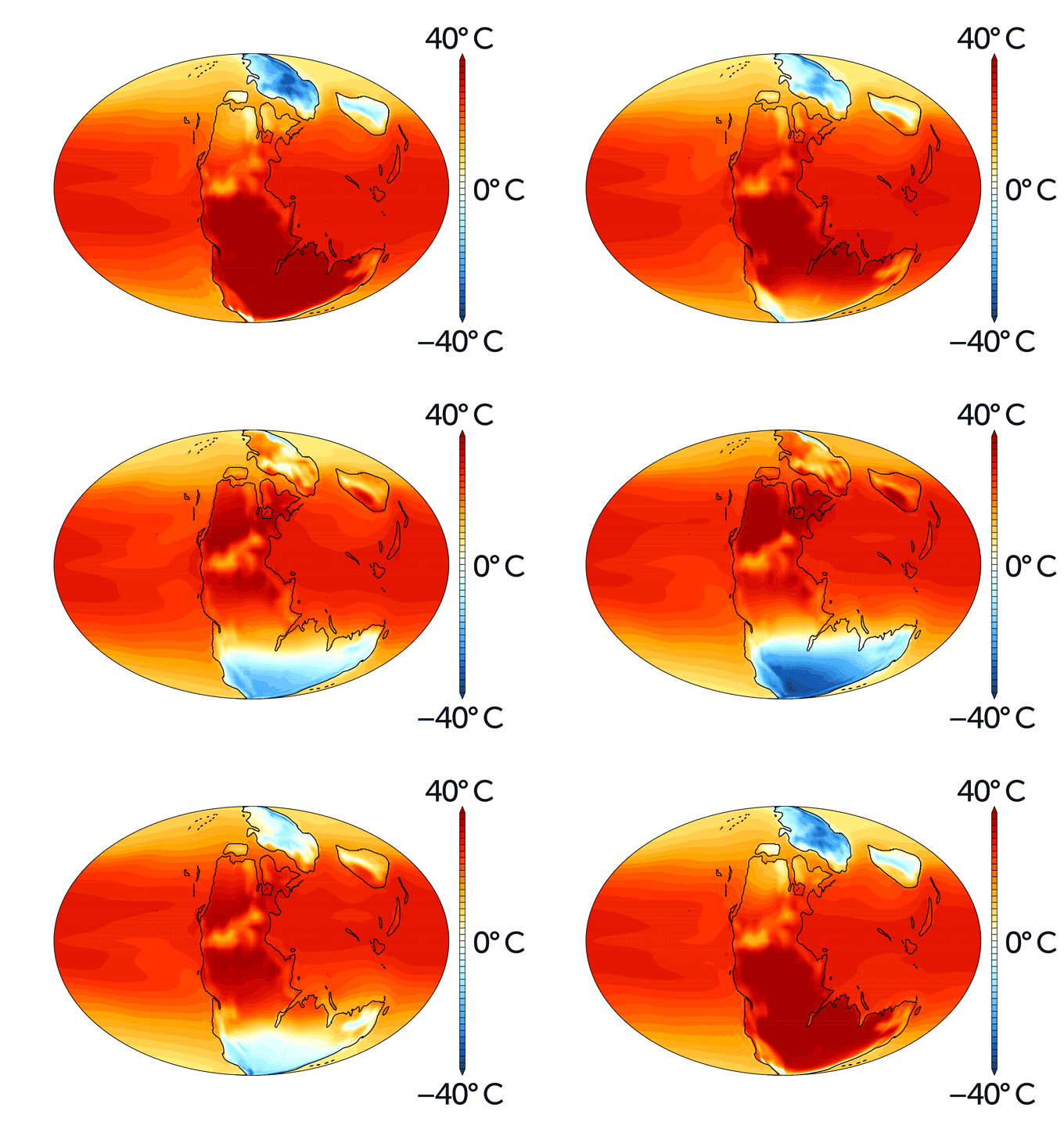
Modelled sea-surface temperatures in the tropics in the early stages of Siberian Trap eruptions with atmospheric CO¬2 at 857 ppm – twice today’s level. (Credit: Sun et al., Fig. 1A)
Earth at the end of the Permian was very different from its current wide dispersal of continents and multiple oceans and seas. Then it was dominated by Pangaea, a single supercontinent that stretched almost from pole to pole, and a surrounding vast ocean known as Panthalassa. Geoscientists from China, Germany, Britain and Austria used this simple palaeogeography and the available Early Triassic greenhouse-gas and palaeo-temperature data as input to a climate prediction model (HadCM3BL) (Yadong Sun and 7 others 2024. Mega El Niño instigated the end-Permian mass extinction. Science 385, p. 1189–1195; DOI: 10.1126/science.ado2030 – contact yadong.sun@cug.edu.cn for PDF).. The computer model was developed by the Hadley Centre of the UK Met Office to assess possible global outcomes of modern anthropogenic global warming. It assesses heat transport by atmospheric flow and ocean currents and their interactions. The researchers ran it for various levels of atmospheric CO2 concentrations over the estimate 100 ka duration of the P-Tr mass extinction.
The pole-to-pole continental configuration of Pangaea lends itself to equatorial El Niño and El Niña type climatic events that occur today along the Pacific coast of the Americas, known as the El Niño-Southern Oscillation. In the first, warm surface water builds-up in the eastern tropical Pacific Ocean. It then then drifts westwards to allow cold surface water to flow northwards along the Pacific shore of South America to result in El Niña. Today, this climatic ‘teleconnection’ not only affects the Americas but also winds, temperature and precipitation across the whole planet. The simpler topography at the end of the Permian seems likely to have made such global cycles even more dominant.
Sun et al’s simulations used stepwise increases in the atmospheric concentration of CO2 from an estimated 412 parts per million (ppm) before the eruption of the Siberian Traps (similar to those today) to a maximum of 4000 ppm during the late-stage magmatism that set buried coals ablaze. As levels reached 857 ppm SSTs peaked at 2 °C above the mean level during El Niño events and the cycles doubled in length. Further increase in emissions led to greater anomalies that lasted longer, rising to 4°C above the mean at 4000 ppm. The El Niña cooler parts of the cycle steadily became equally anomalous and long lasting. This amplification of the 252 Ma equivalent of the El Niño-Southern Oscillation would have added to the environmental stress of an ever increasing global mean surface temperature. The severity is clear from an animation of mean surface temperature change during a Triassic ENSO event.
Animation of monthly average surface temperatures across the Earth during an ENSO event at the height of the P-Tr mass extinction. (Credit: Alex Farnsworth, University of Bristol, UK)
The results from the modelling suggest increasing weather chaos across the Triassic Earth, with the interior of Pangaea locked in permanent drought. Its high latitude parts would undergo extreme heating and then cooling from 40°C to -40°C during the El Niño- El Niña cycles. The authors suggest that conditions on the continents became inimical for terrestrial life, which would be unable to survive even if they migrated long distances. That can explain why terrestrial extinctions at the P-Tr boundary preceded those in the global ocean. The marine biota probably succumbed to anoxia (See: Chemical conditions for the end-Permian mass extinction; November 2008)
There is a timely warning here. The El Niño-Southern Oscillation is becoming stronger, although each El Niño is a mere 2 years long at most, compared with up to 8 years at the height of the P-Tr extinction event. But it lay behind the record 2023-2024 summer temperatures in both northern and southern hemispheres, the North American heatwave of June 2024 being 15°C higher than normal. Many areas are now experiencing unprecedentedly severe annual wildfires. There also finds a parallel with conditions on the fringes of Early Triassic Pangaea. During the early part of the warming charcoal is common in the relics of the coastal swamps of tropical Pangaea, suggesting extensive and repeated wildfires. Then charcoal suddenly vanishes from the sedimentary record: all that could burn had burnt to leave the supercontinent deforested.
That the Earth has undergone sudden large changes is demonstrated by all manner of geoscientific records. It seems that many of these catastrophic events occurred whenever steady changes reach thresholds that trigger new behaviours in the interlinked atmosphere, hydrosphere, atmosphere, biosphere and lithosphere that constitute the Earth system. The driving forces for change, both steady and chaotic, may be extra-terrestrial, such as the Milankovich cycles and asteroid impacts, due to Earth processes themselves or a mixture of the two. Our home world is and always has been supremely complicated; the more obviously so as knowledge advances. Abrupt transitions in components of the Earth system occur when a critical forcing threshold is passed, creating a ‘tipping point’. Examples in the geologically short term are ice-sheet instability, the drying of the Sahara, collapse of tropical rain forest in the Amazon Basin, but perhaps the most important is the poleward transfer of heat in the North Atlantic Ocean. That is technically known as the Atlantic Meridional Overturning Circulation with the ominous acronym AMOC.
As things stand today, warm Atlantic surface water, made more saline and dense by evaporation in the tropics is transferred northwards by the Gulf Stream. Its cooling at high latitudes further increases the density of this water, so at low temperatures it sinks to flow southwards at depth. This thermohaline circulation continually pulls surface water northwards to create the AMOC, thereby making north-western European winters a lot warmer than they would be otherwise. Data from Greenland ice cores show that during the climatic downturn to the last glacial maximum, the cooling trend was repeatedly interrupted by sudden warming-cooling episodes, known as Dansgaard-Oeschger events, one aspect of which was the launching of “armadas” of icebergs to latitudes as far south as Portugal (known as Heinrich events), which left their mark as occasional gravel layers in the otherwise muddy sediments on the deep Atlantic floor (see: Review of thermohaline circulation; February 2002).
These episodes involved temperature changes over the Greenland icecap of as much as 15°C. They began with warming on this scale within a matter of decades followed by slow cooling to minimal temperatures, before the next turn-over. Various lines of evidence suggest that these events were accompanied by shutdowns of AMOC and hence the Gulf Stream, as shown by variations in the foraminifera species in sea-floor sediments. The culprit was vast amounts of fresh water pouring into the Arctic and northernmost Atlantic Oceans, decreasing the salinity and density of the surface ocean water. In these cases that may have been connected to repeated collapse of circumpolar ice sheets to launch Heinrich’s iceberg armadas. A similar scenario has been proposed for the millennium-long Younger Dryas cold spell that interrupted the onset of interglacial conditions. In that case the freshening of high-latitude surface water was probably a result of floods released when glacial barriers holding back vast lakes on the Canadian Shield burst.
At present the Greenland icecap is melting rapidly. Rising sea level may undermine the ice sheet’s coastal edges causing it to surge seawards and launch an iceberg armada. This may be critical for AMOC and the continuance of the Gulf Stream, as predicted by modelling: counter-intuitive to the fears of global warming, at least for NW Europe. In August 2024 scientists from Germany and the UK published what amounts to a major caution about attempts to model future catastrophes of this kind (Ben-Yami, M. et al 2024, Uncertainties too large to predict tipping times of major Earth system components from historical data, Science Advances, v. 10, article eadl4841; DOI 10.1126/sciadv.adl4841). They focus on records of the AMOC system, for which an earlier modelling study predicted that a collapse could occur between 2025 and 2095: of more concern than global warming beyond the 1.5° C currently predicted by greenhouse-gas climate models .
Maya Ben-Yami and colleagues point out that the assumptions about mechanisms in Earth-system modelling and possible social actions to mitigate sudden change are simplistic. Moreover, models used for forecasting rely on historical data sets that are sparse and incomplete and depend on proxies for actual variables, such as sea-surface and air temperatures. The further back in geological time, the more limited the data are. The authors assess in detail data sets and modelling algorithms that bear on AMOC. Rather than a chance of AMOC collapse in the 21st century, as suggested by others, Ben Yami et al. reckon that any such event lies between 2055 and 8065 CE, which begs the question, “Is such forecasting worth the effort?”, however appealing it might seem to the academics engaged in climatology. The celebrated British Met Office and other meteorological institutions, use enormous amounts of data, the fastest computers and among the most powerful algorithms on the planet to simulate weather conditions in the very near future. They openly admit a limit on accurate forecasting of no more than 7 day ahead. ‘Weather’ can be regarded as short-term climate change.
It is impossible to stop scientists being curious and playing sophisticated computer games with whatever data they have to hand. Yet, while it is wise to take climate predictions with a pinch of salt because of their gross limitations, the lessons of the geological past do demand attention. AMOC has shut down in the past – the last being during the Younger Dryas – and it will do so again. Greenhouse global warming probably increases the risk of such planetary hiccups, as may other recent anthropogenic changes in the Earth system. The most productive course of action is to reduce and, where possible, reverse those changes. In my honest opinion, our best bet is swiftly to rid ourselves of an economic system that in the couple of centuries since the ‘Industrial Revolution’ has wrought these unnatural distortions.








 Earth-logs