Tectonic history and the Drake Equation

In 1961 ten scientists interested in a search for extra-terrestrial intelligence met at Green Bank, West Virginia, USA, none of whom were geologists or palaeontologists. The participants called themselves “The Order of the Dolphin”, inspired by the thorny challenge of discovering how small cetaceans communicated: still something of a mystery. To set the ball rolling, Frank Drake an American astrophysicist and astrobiologist, proposed an algorithm aimed at forecasting the number of planets elsewhere in our galaxy on which ‘active, communicative civilisations’ (ACCs) might live. The Drake Equation is formulated as:

ACCs = R* · fp · ne · fl · fi · fc · L

where R* = number of new stars formed per year, fp = the fraction of stars with planetary systems, ne = the average number of planets that could support life (habitable planets) per planetary system, fl = the fraction of habitable  planets that develop primitive life, fi = the fraction of planets with life that evolve intelligent life and civilizations, fc = the fraction of civilizations that become ACCs, L = the length of time that ACCs broadcast radio into space. A team of then renowned scientists from several disciplines discussed what numbers to attach to these parameters. Their ‘educated guesses’ were: R* – one star per year; fp – one fifth to one half of all stars will have planets; ne – 1 to 5 planets per planetary system will be habitable; of which 100% will develop life (fl) and 100% (fi) will eventually develop intelligent life and civilisations; of those civilisations 10 to 20 % (fc) will eventually develop radio communications; which will survive for between a thousand years and 100 Ma (L). Acknowledging the great uncertainties in all the parameters, Drake inferred that between 103 and 108 ACCs exist today in the Milky Way, which is ~100 light years across and contains 1 to 4 x 10¹¹ stars).

Today the values attached to the parameters and the outcomes seem absurdly optimistic to most people, simply because, despite 4 decades of searching by SETI there have been no signs of intelligible radio broadcasts from anywhere other than Earth and space probes launched from here. This is humorously referred to as the Fermi Paradox. There are however many scientists who still believe that we are not alone in the galaxy, and several have suggested reasons why nothing has yet been heard from ACCs. Robert Stern of the University of Texas (Dallas), USA and Taras Gerya of ETH-Zurich, Switzerland have sought clues from the history of life on Earth and that of the inorganic systems from which it arose and in which it has evolved that bear on the lack of any corrigible signals in the 63 years since the Drake Equation (Stern, R.J & Gerya, T.V. 2024. The importance of continents, oceans and plate tectonics for the evolution of complex life: implications for finding extraterrestrial civilizations. Nature (Scientific Reports), v. 14, article 8552; DOI: 10.1038/s41598-024-54700-x – definitely worth reading). Of course, Stern and Gerya too are fascinated by the scientific question as to whether or not there are ‘active, communicative civilisations’ elsewhere in the cosmos. Their starting point is that the Drake Equation is either missing some salient parameters, or that those it includes are assigned grossly optimistic magnitudes.

Life seems to have been present on Earth 3.8 Ga ago but multicelled animals probably arose only in the Late Neoproterozoic since 1.0 Ga ago. So here it has taken a billion years for their evolution to achieve terrestrial ACC-hood. Stern and Gerya address what processes favour life and its rapid evolution. Primarily, life depends on abundant liquid water: i.e. on a planet within the ‘Goldilocks Zone’ around a star. The authors assume a high supply of bioactive compounds – organic carbon, ammonium, ferrous iron and phosphate to watery environments. Phosphorus is critical to their scenario building. It is most readily supplied by weathering of exposed continental crust, but demands continual exposure of fresh rock by erosion and river transport to maintain a steady supply to the oceans. Along with favourable climatic conditions, that can only be achieved by an oxidising environment that followed the Great Oxidation Event (2.4 to 2.1 Ga) and continual topographic rejuvenation by plate tectonics.

A variety of Earth-logs posts have discussed various kinds of evidence for the likely onset of plate tectonics, largely focussing on the Hadean and Archaean. Stern and Gerya prefer the Proterozoic Eon that preserves more strands of relevant evidence, from which sea-floor spreading, subduction and repeated collision orogenies can confidently be inferred. All three occur overwhelmingly in Neoproterozoic and Phanerozoic times. Geologists often refer to the whole of the Mesoproterozoic and back to about 2.0 Ga in the Palaeoproterozoic as the ‘Boring Billion’ during which carbon isotope data suggest very little change in the status of living processes: they were present but nothing dramatic happened after the Great Oxidation Event. ‘Hard-rock’ geology also reveals far less passive extensional events that indicate continental break-up and drift than occur after 1.0 Ga and to the present. It also includes a unique form of magmatism that formed rocks dominated by sodium-rich feldspar (anorthosites) and granites that crystallised from water-poor magmas. They are thought to represent build-ups of heat in the mantle unrelieved by plate-tectonic circulation. Before the ‘Boring Billion’ such evidence as there is does point to some kind of plate motions, if not in the modern style.

How different styles of tectonics influence living processes differently: a single stagnant ‘lid’ versus plate tectonics. (Credit: Stern and Gerya, Fig 2)

Stern and Gerya conclude that the ‘Boring Billion’ was dominated by relative stagnation in the form of lid tectonics.  They compare the influence of stagnant ‘lid’ tectonics on life and evolution with that of plate tectonics in terms of: bioactive element supply; oxygenation; climate control; habitat formation; environmental pressure (see figure). In each case single lid tectonics is likely to retard life and evolution, whereas plate tectonics stimulates them as it has done from the time of Snowball Earth and throughout the Phanerozoic. Only one out of 8 planets that orbit the sun displays plate tectonics and has both oceans and continents. Could habitable planets be a great deal rarer than Drake and his pals assumed? [look at exoplanets in Wikipedia] Whatever, Stern and Gerya suggest that the seemingly thwarted enthusiasm surrounding the Drake Equation needs to be tempered by the addition of two new terms: the fraction of habitable exoplanets with significant continents and oceans (foc)and the fraction of them that have experienced plate tectonics for at least half a billion years (fpt). They estimate foc to be on the order of 0.0002 to 0.01, and suggest a value for fpt of less than 0.17. Multiplied together yields value between less than 0.00003 and 0.002. Their incorporation in the Drake Equation drastically reduces the potential number of ACCs to between <0.006 and <100,000, i.e. to effectively none in the Milky Way galaxy rising to a still substantial number

There are several other reasons to reject such ‘ball-parking’ cum ‘back-of-the-envelope’ musings. For me the killer is that biological evolution can never be predicted in advance. What happened on our home world is that the origin and evolution of life have been bound up with the unique inorganic evolution of the Solar System and the Earth itself over more than 4.5 billion years. That ranges in magnitude from the early collision with another, Mars-sized world that reset the proto-Earth’s geochemistry and created a large moon whose gravity has cycled the oceans through tides and changed the length of the day continually for almost the whole of geological history. At least once, at the end of the Cretaceous Period, a moderately sized asteroid in unstable orbit almost wiped out life at an advanced stage in its evolution. During the last quarter billion years internally generated geological forcing mechanisms have repeatedly and seriously stressed the biosphere in roughly 36 Ma cycles (Boulila, S. et al. 2023. Earth’s interior dynamics drive marine fossil diversity cycles of tens of millions of years. Proceedings of the National Academy of Sciences, v. 120 article e2221149120; DOI: 10.1073/pnas.2221149120). Two outcomes were near catastrophic mass extinctions, at the ends of the Permian and Triassic Periods, from which life struggled to continue. As well as extinctions, such ‘own goals’ reset global ecosystems repeatedly to trigger evolutionary diversification based on the body plans of surviving organisms.

Such unique events have been going on for four billion years, including whatever triggered the Snowball Earth episodes that accompanied the Great Oxygenation Event around 2.4 Ga and returned to coincide with the rise of multicelled animals during the Cryogenian and Ediacaran Periods of the Late Neoproterozoic. For most of the Phanerozoic a background fibrillation of gravitational fields in the Solar System has occasionally resulted in profound cycling between climatic extremes and their attendant stresses on ecosystems and their occupants. The last of these coincided with the evolution of humanity: the only creator of an active, communicative civilisation of which we know anything. But it took four billion years of a host of diverse vagaries, both physical and biological to make such a highly unlikely event possible. That known history puts the Drake Equation firmly in its place as the creature of a bunch of self-publicising and regarding, ambitious academics who in 1961 basically knew ‘sweet FA’. I could go on … but the wealth of information in Stern and  Gerya’s work is surely fodder for a more pessimistic view of other civilisations in the cosmos.

Someone – I forget who – provided another, very practical reason underlying the lack of messages from afar. It is not a good idea to become known to all and sundry in the galaxy, for fear that others might come to exploit, enslave and/or harvest. Earth is still in a kind of  imperialist phase from which lessons could be drawn!

Snowball Earth and the rise of multi-celled life

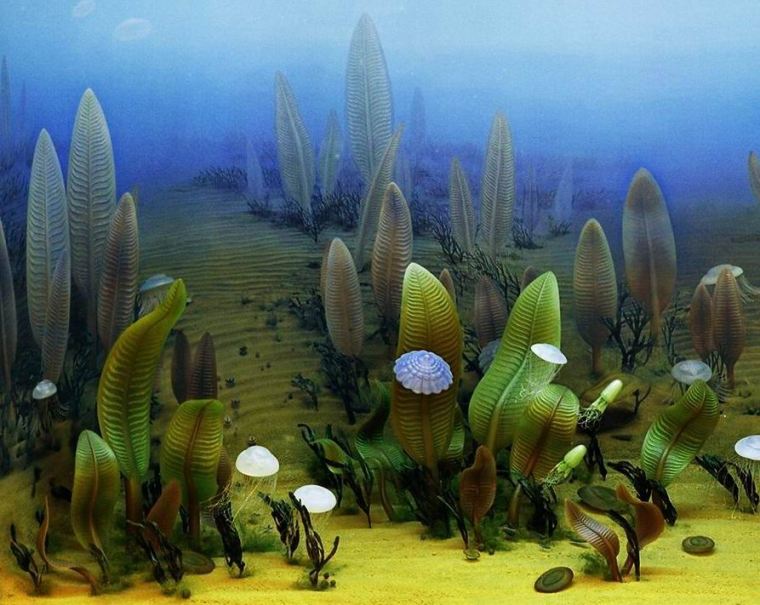
You can follow my ‘reportage’ on the long running story of the Snowball Earth events during the Neoproterozoic Cryogenian Period (850 to 635 Ma) since 2000 through the index to annual Palaeoclimatology logs (15 posts). Once these dramatic events were over sedimentary rocks deposited around the world during the Ediacaran Period (635 to 541 Ma) record the sudden appearance of large-bodied fossils: the first multicellular animals. This explosion from slimy biofilms and colonies of single-celled prokaryotes and eukaryotes laid the basis for the myriad ecological niches that have characterised Planet Earth ever since. The change saw specialised eukaryote cells (see: The rise of the eukaryotes; December 2017), whose precursors had originated in single-celled forms, begin to cooperate inthe development of complex tissues, organs, and organ systems to form bodies rather than just cell walls. The pulsating evolution, diversification and repeated extinction that followed during the last one tenth of geological time shaped a planet that is unique in the Solar System and possibly in the galaxy, if not the entire universe. The simple biosphere that preceded it, on the other hand, may have emerged on innumerable rocky planets blessed with liquid water to survive little changed for billions of years, as have Earths’ prokaryotes, the Archaea and Bacteria.  

Artist’s impression of the Ediacaran Fauna (credit: Science)

The Ediacaran biological revolution followed repeated changes in the geochemistry of the oceans, which carbon isotope data from the Cryogenian and Ediacaran suggest to have ‘gone haywire’. This turmoil involved dramatic changes in the cycling of sulfur and phosphorus that help ‘fertilise’ the marine food chain and in the production of oxygen by photosynthesis that is essential for metazoan animals.  The episodes when the Earth was iced over reduced the availability of nutrients through decreased rates of ocean-floor burial of dead organisms. Such Snowball events would also have reduced penetration of sunlight in the oceans. Less photosynthesis would not only have reduced oxygen production but also the amounts of autotrophic organisms. Furthermore, decreased water temperature would have increased its viscosity thereby slowing the spread of nutrients. The food chain for heterotrophs was decimated. Each Snowball event ended with warming, ice-free conditions so that the marine biosphere could burgeon

A great deal of data and numerous theories have accumulated since the Snowball concept was first mooted, but there has been little progress in understanding the rise of multi-celled life. Four geoscientists from the Massachusetts Institute of Technology, the Santa Fe Institute and the University of Colorado (Boulder), USA have developed an interesting hypothesis for how this enormous evolutionary step may have developed (Crockett, W.W. et al. 2024. Physical constraints during Snowball Earth drive the evolution of multicellularity. Proceedings of the Royal Society B: Biological Sciences, v. 291; DOI: 10.1098/rspb.2023.2767). The concatenation of huge events during the Cryogenian and Ediacaran presented continually changing patterns of selective pressures on simple organisms that preceded that time period. Crockett et al. review them in the light of fundamental biology to suggest how multicellular animals emerged as the Ediacara Fauna. Intuitively, such harsh conditions suggest at worst mass, even complete, extinction, at best a general reduction in size of all organism to cope with scarce resources. That the size of eukaryotes should have grown hugely goes against the grain of most biologists’ outlook.

The authors consider the crucial factor to be fundamental differences between prokaryotes and early eukaryotes. Prokaryote cells are very small, and whether autotrophs of heterotrophs they absorb nutrients through their walls by diffusion. Single-celled eukaryotes are far larger than prokaryotes and typically have a flagellum or ‘tail’ so that they can move independently and more easily gather resources. Crockett et al. used computer modelling to simulate the type of life form that could grow and thrive under Snowball conditions. They found that prokaryotes could only grow smaller, being ‘stunted’ by scarce resources. On the other hand eukaryotes would be better equipped to gather resources, the more so if they adopted a simple multicellular form – a hollow, self-propelled sphere about the size of a pea, which the authors dub a choanoblastula. Although no such form is known today, it does resemble the green Volvox algae, and plausibly could have evolved further to the simple forms of the Ediacaran fauna. The next task is either to find a fossil of such an organism, or to grow one.

Was the earliest human ancestor a European?

Charles Darwin famously suggested that humans evolved from apes, and since great apes (chimpanzees, bonobos and gorillas) live in Africa he reckoned it was probably there that the human ‘line’ began. Indeed, the mitochondrial DNA of chimpanzees (Pan troglodytes) is the closest to that of living humans. Palaeoanthropology in Africa has established evolutionary steps during the Pleistocene (2.0 to 0.3 Ma) by early members of the genus Homo: H. habilis, H. ergaster, H. erectus; H. heidelbergensis and the earliest H. sapiens. Members of the last three migrated to Eurasia, beginning around 1.8 Ma with the individuals found at Dmanisi in Georgia. The earliest African hominins emerged through the Late Miocene (7.0 to 5.3 Ma): Sahelanthropus tchadensi, Orrorin tugenensis and Ardipthecus kadabba. Through the Pliocene (5.3 to 2.9 Ma) and earliest Pleistocene two very distinct hominin groups appeared: the ‘gracile’ australopithecines (Ardipithecus ramidus; Australopithecus anamensis; Au. afarensis; Au. africanus; Au. sediba) and the ‘robust’ paranthropoids (Paranthropus aethiopicus; P. robustus and P. boisei). The last of the paranthropoids cohabited East Africa with early homo species until around 1.4 Ma. Most of these species have been covered in Earth-logs and an excellent time line of most hominin and early human fossils is hosted by Wikipedia.

All apes, including ourselves, and fossil examples are members of the Family Hominidae (hominids) which refers to the entire world. A Subfamily (Homininae) refers to African apes, with two Tribes. One, the Gorillini, refers to the two living species of gorilla. The other is the Hominini (hominins) that includes chimpanzees, living humans and all fossils believed to be on the evolutionary line to Homo. The Tribe Hominini is defined to have descended from the common ancestor of modern humans and chimps, and evolved only in Africa. As the definition of hominins stands, it excludes other possibilities! The Miocene of Africa before 7.2 Ma ‘goes cold’ as regards the evolution of hominins.  There are, however fossils of other African apes in earlier Miocene strata (8 to 18 Ma) that have been assigned to the Family Hominidae, i.e. hominids, of which more later.

Much has been made of using a ‘molecular clock’ to hint at the length of time since the mtDNA of living humans and chimps began to diverge from their last common ancestor. That is a crude measure at it depends entirely on assuming a fixed rate at which genetic mutation in primates take place. Many factors render it highly uncertain, until ancient DNA is recovered from times before about 400 ka, if ever. The approach suggests a range from 7 to 10 Ma, yet the evolutionary history of chimps based on fossils is practically invisible: the earliest fossil of a member of genus Pan is from the Middle Pleistocene (1.2 to 0.8 Ma) of Kenya. Indeed, we have little if any clue about what such a common ancestor looked like or did. So the course of human evolution relies entirely on the fossil sequence of earlier African hominins and comparing their physical appearances. Each species in the African time line displays two distinctive features. All were bipedal and had small canine teeth.  Modern chimps habitually use knuckle walking except when having to cross waterways. As with virtually all other primates, fossil or living, male chimps have large, threatening canines. In the absence of ancient DNA from fossils older than 0.4 Ma these two features present a practical if crude way of assessing to when and where the hominin time line leads.

In 2002 a Polish geologist on holiday at the beach at Trachilos on Crete discovered a trackway on a bedding plane in shallow-marine Miocene sediments. It had been left by what seems to have been a bipedal hominin. Subsequent research was able to date the footprints to about 6.05 Ma. Though younger than Sahelanthropus, the discovery potentially challenges the exclusivity of hominins to Africa. Unsurprisingly, publication of this tentative interpretation drew negative responses from some quarters. But the discovery helped resurrect the notion that Africa may have been colonised in the Miocene by hominins that had evolved in Europe. That had been hinted at by the 1872 excavation of Oreopithecus bambolii from an Upper Miocene (~7.6 Ma) lignite mine in Tuscany, Italy – a year after publication of Darwin’s The Descent of Man.

Lignites in Tuscany and Sardinia have since yielded many more specimens, so the species is well documented. Oreopithecus could walk on two legs, its hands were capable of a precision grip and it had relatively small canines. Its Wikipedia entry cautiously refers to it as ‘hominid’ – i.e. lumped with all apes to comply with current taxonomic theory (above). In 2019 another fascinating find was made in a clay pit in Bavaria, Germany. Danuvius guggenmosi lived 11.6 Ma ago and fossilised remains of its leg- and arm bones suggested that it could walk on two legs: it too may have been on the hominin line. But no remains of Danuvius’s skull or teeth have been found. There is now an embarrassment of riches as regards Miocene fossil apes from Europe and the Eastern Mediterranean (Sevim-Erol, A. and 8 others 2023. A new ape from Türkiye and the radiation of late Miocene hominines. Nature Communications Biology, v. 6, article  842.; DOI: 10.1038/s42003-023-05210-5). A number of them closely resemble the earliest fossil hominins of Africa, but most predate the hominin record there by several million years.

Phylogenetic links between fossils assigned to Hominidae found in Africa and north of the Mediterranean Sea. (Credit: Sevim-Erol et al. 2023, Fig 5)

Ayla Sevim-Erol of Ankara University, Turkiye and colleagues from Turkiye, Canada and the Netherlands describe a newly identified Miocene genus, Anadoluvius, which they place in the Subfamily Homininae dated to around 8.7 Ma. Fragments of crania and partial male and female mandibles from Anatolia show that its canines were small and comparable with those of younger African hominins, such as Ardipithecus and Australopithecus. But limb bones are yet to be found. Around the size of a large male chimpanzee, Anadoluvius lived in an ecosystem remarkably like the grasslands and dry forests of modern East Africa, with early species of giraffes, wart hogs, rhinos, diverse antelopes, zebras, elephants, porcupines, hyenas and lion-like carnivores. Sevim-Erol et al. have attempted to trace back hominin evolution further than is possible with African fossils. They compare various skeletal features of different fossils and living genera to assess varying degrees of similarity between each genus, applied to 23 genera. These comprised 7 hominids from the African Miocene, 2 early African hominins (Ardipithecus and Orrorin) and 10 Miocene hominids from Europe and the Eastern Mediterranean. They also assessed similarities with 4 living genera, Homo, orang utan (Pongo), gorilla and chimp (Pan).

The resulting phylogeny shows close morphological links within a cluster (green ‘pools’ on diagram) of non-African hominids with the African hominins, gorillas, humans and chimps. There are less-close relations between that cluster and the earlier Miocene hominids of Africa (blue ‘pool’) and the possible phylogeny of orang utans (orange ‘pool’). Sevim-Erol et al. note that African hominins are clearly more similar and perhaps more closely related to the fossils of Europe and the Eastern Mediterranean than they are to Miocene African hominids. This suggests that evolution among the non-African hominids ceased around the end of the Miocene Epoch north of the Mediterranean Sea. But it may have continued in Africa. Somehow, therefore, it became possible late in Miocene times for hominids to migrate from Europe to Africa. Yet the earlier, phylogenetically isolated African hominids seem to have ‘crashed’ at roughly the same time. Such a complex scenario cannot be supported by phylogenetic studies alone: it needs some kind of ecological impetus.

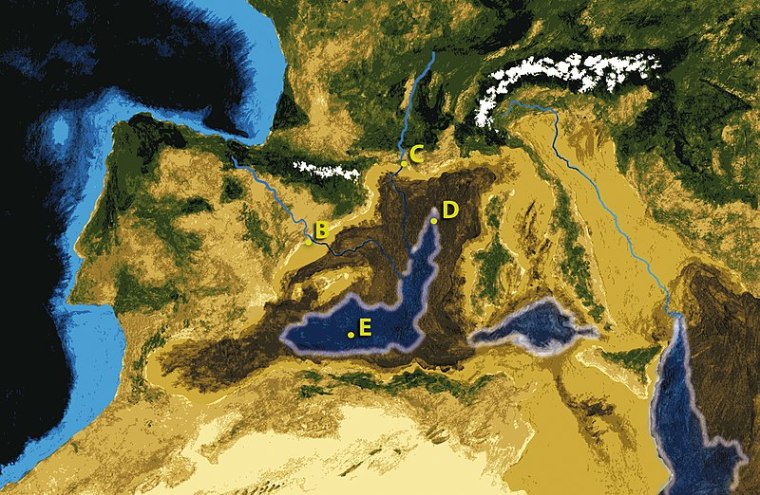
The Mediterranean Basin at the end of the Miocene Epoch when the only water was in the deepest parts of the basin. (Credit: Wikipedia, Creative Commons)

Following a ‘mild’ tectonic collision between the African continent and the Iberian Peninsula during the late Miocene connection between the Atlantic Ocean and the Mediterranean Sea was blocked from 6.0 to 5.3 Ma. Except for its deepest parts, seawater in the Mediterranean evaporated away to leave thick salt deposits. Rivers, such as the Rhône, Danube, Dneiper and Nile, shed sediments into the exposed basin. For 700 ka the basin was a fertile, sub-sea level plain, connecting Europe and North Africa over and E-W distance of 3860 km. There was little to stop the faunas of Eurasia and Africa migrating and intermingling, at a critical period in the evolution of the Family Hominidae. One genus presented with the opportunity was quite possibly the last common ancestor of all the hominins and chimps. The migratory window vanished at the end of the Miocene when what became the Strait of Gibraltar opened at 5.3 to allow Atlantic water. This resulted in the stupendous Zanclean flood with a flow rate about 1,000 times that of the present-day Amazon River. An animation of these events is worth watching

Earthquakes and flooding in the Ganges Basin

Floods pose a huge threat to the large populations of West Bengal, India and the state of Bangladesh, particularly in the highly fertile fluvio-deltaic plains of the Ganges and Brahmaputra. The two river systems drain 2 million km2 of the Eastern Himalaya of annual monsoon rains and snow melt, the first flowing west to east and the latter from east to west at the apex of the low-lying Bengal Basin. The 400 million people subsisting in the 105 thousand km2 onshore basin make it the world’s most populous delta plain with one of the highest population densities, averaging 1,100 per square kilometre in 2019. The risk of catastrophic flooding is generally ascribed to unusually high monsoonal precipitation and snow melt, combined with storm surges from the Bay of Bengal that funnels tropical cyclones. But either can bring inundation. Another factor has recently been proposed as an addition to flood hazard: earthquakes near the basin (Chamberlain, E.L and 12 others 2024. Cascading hazards of a major Bengal basin earthquake and abrupt avulsion of the Ganges River. Nature Communications, v. 15, online article 4975; DOI: 10.1038/s41467-024-47786-4). It seems they can completely and suddenly change the flow networks in such a complex system of major channels.

Using remotely sensed data Elizabeth Chamberlain, currently at Wageningen University in the Netherlands, and colleagues from Bangladesh, the US, Germany and Austria have detected an immense abandoned channel in the Ganges River. They reckon that it resulted from a sudden change in the river’s course. Such avulsions in the sluggish lower parts of a river system are generally caused by the flow becoming elevated above the flood plain by levees. When they burst free the channel may be abandoned. This one is 1.0 to 1.7 km wide and may have been the main Ganges channel at the time of avulsion. The main channel now flows about 45 km north of the abandoned relic. The event must have been sudden and irreversible as the relic channel contains a much thinner layer of fine mud deposited by stagnant water than in other abandoned channels that became ox-bow lakes. That implies rapid uplift and complete drainage from the channel. Throughout the Bengal Basin the immense high-water discharge and heavy sediment load seems generally to have infilled most abandoned channels, so this one is an anomaly.

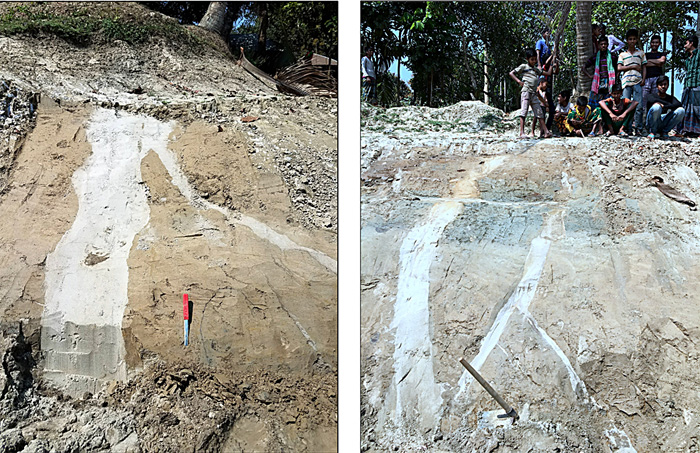
Sand dykes along fractures in river alluvium of the Bengal Basin. (Credit: Chamberlain et al. Figs 3c and 3d)

Fieldwork near the old channel reveals fracturing of earlier riverbed sediments some of which are filled by intrusions of sand in the form of dykes up to 40 cm wide. Sand dykes are produced by liquefaction of sandy alluvium by seismic waves to slurry that can be injected into fractures pulled apart by seismic movements. The channel is now about 3 m below the level of the floodplain, suggesting subsidence since the avulsion event. Optically stimulated luminescence dating of sediment grains from the uppermost channel sands yielded ages averaging around 2.5 ka, marking the time when the sudden event took place. The authors consider that it marked a major reorganisation of the Ganges River system, involving catastrophic flooding. The nearest seismically active area is about 180 to 300 km to the east and northeast. Seismic modelling suggests that for liquefaction and fracturing to have affected the area of the abandoned channel the earthquake must have been of magnitude 7.5–8.0, possibly in the subduction zone that roughly follows the Bangladesh-Myanmar border. It may have had similar, yet to be demonstrated, effects throughout the eastern Bengal Basin.

There are no historic records of more recent massive earthquake-induced flooding of the Bengal Basin. However, global warming and growing human intervention in the Ganges-Brahmaputra river systems, such as large-scale dredging and industrialisation could make such events more likely. Other basins close to seismically active fault systems, such as the Yangtze and Yellow River basins of China, also face such risks.

Many thanks to  Piso Mojado for giving me the tip about this paper

Apology

Dear Followers

You will have noticed a 5-week break in my posting news items, for which I need to apologise and to explain.

Despite weekly searching all the leading journals that publish geoscientific papers, none have appeared that meet my criteria for commenting. That is, nothing has emerged that makes a significant breakthrough in any of the the Categories that Earth-logs covers. In fact, since Covid I have noticed a drop in the number of publications that do. Maybe there was a downturn in research during the pandemic, or perhaps some other reason such as a decline in the discipline, of journal policy changes.

There’s not much I can do other than wait patiently, and post when something turns up – you will be among the first to know about it, as ever!

In the meantime, maybe one or more of you have come across something interesting that I missed, or have a question about topics covered earlier. Either way, don’t hesitate to get in touch with me, either with a comment or using the Contact Author link in the Menu bar.

With regards

Steve Drury

The onset of weathering in the late Archaean and stabilisation of the continents

Distribution of exposed Archaean cratons. The blue Proterozoic areas may, in part be underlain by cratons. (Credit: Groves, D.I. & Santosh, M. DOI:10.1016/j.gr.2020.06.008)

About 50% of continental crust is of Archaean age (2.5 to 4.0 Ga) in huge blocks above lithosphere more than 150 km thick. Younger continental lithosphere is significantly thinner – as low as 40 km. Since the end of the Archaean Eon these blocks have remained tectonically stable and only show signs of extensional, brittle fracture that have been exploited by basaltic dyke swarms. Such crystalline monstrosities have remained rigid for 2.5 billion years. They are termed cratons from the Greek word κράτο (kratos) for ‘might’ or ‘strength’. Numbers of cratons have been pushed together by later tectonics to form continental ‘cores’, separated from one another by highly deformed ‘mobile belts’ formed by younger collisional orogenies. Africa and South America have 4 cratons each, Eurasia 6 or 7, the other continents all have one

Considering how much cratons have been stressed by later tectonic forces, their implacable rigidity might seem surprising. This rigidity is thought to be due to cratons’ unusually low amounts of the main heat-producing elements (HPE) potassium, uranium and thorium, the decay of whose radioactive isotopes produces surface heat flow. Cratons have the lowest surface heat flow on the planet, so in bulk they must have low HPE content. This stems from the nature of cratons’ deepest parts: almost anhydrous, once igneous rocks of intermediate average composition known as granulites. They formed by metamorphism of earlier crustal rocks at depths of up to 70km, which drove out most of their original HPEs and water. The upper cratonic crust has much the same complement of HPEs as that of more recent continental crust. This bulk depletion of cratons has maintained unusually low temperatures in their deep continental crust. That has been immune from partial melting and thus ductile deformation since it formed.

Three billion year-old TTG gneiss in the Outer Hebrides, Scotland. (Credit: British Geological Survey)

Jesse Reimink and Andrew Smye of Pennsylvania State University, USA have considered the geochemistry and history of the world’s cratons to address the long-standing issue of their stability and longevity (Reimink, J.R. & Smye, A.J. 2024. Subaerial weathering drove stabilization of continents. Nature, v. 629, online article; DOI: 10.1038/s41586-024-07307-1). Their main focus is on how the Archaean lower crust lost most of it HPEs, and where they went. During much of the Archaean continental crust formed by partial melting of hydrated basaltic rocks at shallow depths. That generated sodium-rich silicic magmas from which the dominant grey tonalite-trondhjemite-granodiorite (TTG) gneisses of Archaean crust formed by extreme ductile deformation. Though TTGs originally contained sufficient heat-producing capacity to make them ductile during the early Archaean there is little evidence that they underwent extensive partial melting themselves. But they did after 3.0 Ga to produce swarms of granite plutons in the upper Archaean crust.

Complementing the late-Archaean granite ‘swarm’ are deep-crustal granulites with low HPE contents, which mainly formed around the same time. The granulites contain highly metamorphosed sedimentary rocks, which seem to have been sliced into the Archaean crust during its ductile deformation phase. Some of them have compositions that suggest that they are derived from clay-rich shales, their proportion reaching about 30% of all granulite-facies metasediments. Clay minerals are the products of chemical weathering of silicon- and aluminium-rich igneous rocks exposed to the atmosphere. When they form, they host K, U and Th. Also, their composition and high initial water contents are conducive to partial melting under high-temperature conditions, to become a source of granitic magmas. Crustal weathering is key to Reimink and Smye’s hypothesis for the development of cratons in the late Archaean.

There is growing evidence that high Archaean heat flow through oceanic lithosphere – the mantle contained more undecayed HPE isotopes than now – reduced its density. As a result Archaean oceanic basins were considerably shallower than they became in later times. Because of the lower volume of the basins during the Archaean, seawater extended across much of the continental surface. For most of the Archaean Eon Earth was a ‘waterworld’, with little subaerial weathering of its TTG upper crust. As the volume of exposed continental crust increased so did surface weathering to form clay minerals that selectively absorbed HPEs. Over time shales became tectonically incorporated deep into the thickening Archaean continental crust to form a zone with increased heat producing capacity and a higher water content. Once deep enough and heated by their own content of HPE they began partially melting to yield voluminous granitic magmas to which they contributed their load of HPEs. Being lower in density than the bulk of TTG crust the granite melts would have risen to reach the upper crust. They also took in HPEs from the deep TTG crust itself. According to Reimink and Smye this would have concentrated continental heat production in the upper crust, leaving the deeper crust drier, less able to melt and assume ductile properties, and thus to create the cratons.

The authors believe that such a redistribution of heat production in the ancient continental crust did not need any major change in global tectonics. All it required was decreasing oceanic heat flow to create deeper and more voluminous ocean basins, allowing more continental surface to emerge above sea level and dynamic burial of sedimentary products of subaerial weathering. They conclude: “The geological record can then be cast in terms of a pre-emergence (TTG-dominated) and post-emergence (granite-dominated) planet.” That seems very neat … but it seems unlikely that samples can be drilled from the depths where the ‘action’ took place. Geologists depend on exposures of Archaean middle to deep crust brought to the surface by fortuitous later tectonics.

The chaotic early Solar System: when giant planets went berserk

Readers of Earth-logs will be familiar with the way gravitational interactions between the planets that orbit the Sun control cyclical shifts in each other’s rotational and orbital behaviours. The best known are the three Milankovich cycles. The eccentricity of Earth’s orbit (deviation from a circular path) changes according to the varying gravitational pulls exerted by Jupiter and Saturn as they orbit the Sun, and is dominated by 100 ka cyclicity. The tilt (obliquity) of Earth’s rotational axis changes in 41 ka cycles.  The direction in which the axis points relative to the Sun varies with its precession which has a period of about 25.7 ka. Together they control the amount of solar heating that our planet receives, best shown by the current variation in glacial-interglacial cycles. But the phenomena predicted by Milutin Milankovich show up in palaeoclimatic changes back to at least the late Precambrian. Climate changes resulting from the gravitational effect of Mars have recently been detected with a 2.4 Ma period. But that steady carousel of planetary motions hasn’t always characterised the Solar System.

Cartoon showing planet formation in the early, unstable Solar System (Credit: Mark Garlick, Science Source)

Observations of other stars that reveal the presence of their own planetary systems show that some have giant planets in much closer orbits than those that circuit the Sun. Others occur at distances that extend as far as the orbital diameters as those in the Solar System: so perhaps giant planets can migrate. A possibility began to be discussed in the late 1990s that Jupiter, Saturn, Uranus and Neptune – and a fifth now-vanished giant planet – were at the outset in neat, evenly-spaced and much closer orbits. But they were forced outwards later into more eccentric and generally askew orbits. In 2005, planetary astronomers gathered in Nice, France to ponder the possibilities. The outcome was the ‘Nice’ Model that suggested that a gravitational instability had once emerged, which set the Solar System in chaotic motion. It may even have flung gigantic masses, such as postulated fifth giant planets, into interstellar space. This upheaval may have been due to a rapid change in the overall distribution of mass in the Solar System, possibly involving gas and dust that had not yet accreted into other planets or their planetesimal precursors. Chaotic antics of monstrous bodies and shifts in their combined gravitational fields can barely be imagined: it was nothing like the staid and ever present Milankovich Effect. Geologists have reconstructed one gargantuan event that reset the chemistry of the early Earth when it collided with another body about the size of Mars. That  also flung off matter that became the Moon. Evidence from lunar and terrestrial zircon grains (see: Moon-forming impact dated; March 2009) suggests the collision occurred before 4.46 billion years ago (when parts of both eventually crystallised from magma oceans), Solar System having begun to form at around 4.57 Ga. Could formation of the Moon record the early planetary chaos? Others have suggested instead that the great upheaval was the Late Heavy Bombardment, between 4.1 and 3.8 Ga, which heavily cratered much of the lunar surface and those of moons orbiting the giant planets.

Another approach has been followed by Chrysa Avdellidou of the University of Leicester, UK and colleagues from France and the US (Avdellidoli, C. et al. 2024. Dating the Solar System’s giant planet orbital instability using enstatite meteorites. Science, v. 384, p. 348-352; DOI: 10.1126/science.adg8092) after discovery of a new family of asteroids: named after its largest member Athor. The composition of their surfaces, from telescopic spectra, closely matches that of EL enstatite chondrite meteorites. Dating these meteorites should show when their parent asteroids – presumably the Athors – formed.  Using argon and xenon isotopes Mario Trieloff  and colleagues from the University of Heidelberg, Germany in showed that the materials in EL enstatite chondrite meteorites were assembled a mere 2 Ma after the Solar System formed (Trieloff, M. et al. 2022. Evolution of the parent body of enstatite (EL) chondrites. Icarus, v. 373, article 114762; DOI: 10.1016/j.icarus.2021.114762). Be that as it may, that the evidence came from small meteorites shows that the parent body, estimated as having had a 240 to 420 km diameter, was shattered at some later time. Moreover, at that very early date such bodies would have contained a ready heat source in the form of a short-lived isotope of aluminium (26Al) which decays to stable 26Mg, with a half-life of 0.717 Ma. 26Al is thought to have been produced by a supernova that has been suggested to have triggered the formation of the Solar System. Excessive 26Mg is found in many meteorites, evidence for metamorphism formed by such radiogenic heat. They also record the history of their cooling.

Avdellidoli et al. estimate that the 240 to 420 km Athor parental planetesimal had slowly cooled for at least 60 Ma after it formed. When it was shattered, the small fragments would have cooled instantaneously to the temperature of interplanetary space – a few degrees above absolute zero (-273.2 °C). From this they deduce the age of the chaotic restructuring of the early Solar System to be at least 60 Ma after its formation. Other authors use similar reasoning from other chondritic meteorite classes to suggest it may have happened even earlier at 11 Ma. But there are other views for a considerably later migration of the giant planets and the havoc that they wrought. The only widely agreed date, in what seems to be an outbreak of wrangling among astronomers, is for the Moon-forming collision: 110 Ma after formation of the Solar System. For me, at least, that’s good-enough evidence for when system-wide chaos prevailed. The Late Heavy Bombardment between 4.1 and 3.8 Ga seems to require a different mechanism as it affected large bodies that still exist. It may have resulted from whatever formed the asteroid belt, for it was bodies within the range of sizes of the asteroids that did the damage, in both the Inner and Outer Solar System.

See also: The instability at the beginning of the solar system. MSUToday, 27 April 2022: Voosen, P. 2024. Giant planets ran amok soon after the Solar System’s birth. Science, v. 384 news article eadp8889; DOI: 10.1126/science.adp8889

The peptide bond that holds life together may have an interstellar origin

In the 1950s Harold Urey of the University of Chicago and his student Stanley Miller used basic lab glassware containing 200 ml of water and a mix of the gases methane (CH4), ammonia (NH3) and hydrogen sulfide (H2S) to model conditions on the early Earth. Heating this crude analogue for ocean and atmosphere and continuous electrical discharge through it did, in a Frankensteinian manner, generate amino acids. Repeats of the Miller-Urey experiment have yielded 10 of the 20 amino acids from which the vast array of life’s proteins have been built. Experiments along similar lines have also produced the possible precursors of cell walls – amphiphiles. In fact, all kinds of ‘building blocks’ for life’s chemistry turn up in analyses of carbonaceous chondrite meteorites and in light spectra from interstellar gas clouds. The ‘embarrassment of riches’ of life’s precursors from what was until the 20th century regarded as the ‘void’ of outer space lacks one thing that could make it a candidate for life’s origin, or at least for precursors of proteins and the genetic code DNA and RNA. Both kinds of keystone chemicals depend on a single kind of connector in organic chemistry.

Reaction between two molecules of the amino acid glycene that links them by a peptide bond to form a dipeptide. (Credit: Wikimedia Commons)

Molecules of amino acids have acidic properties (COOH – carboxyl) at one end and their other end is basic (NH2 – amine). Two can react by their acid and basic ‘ends’ neutralising. A hydroxyl (OH) from carboxyl and a proton (H+) from amine produce water. This gives the chance for an end-to-end linkage between the nitrogen and carbon atoms of two amino acids – the peptide bond. The end-product is a dipeptide molecule, which also has carboxyl at one end and amine at the other. This enables further linkages through peptide bonds to build chains or polymers based on amino acids – proteins. Only 20 amino acids contribute to terrestrial life forms, but linked in chains they can form potentially an unimaginable diversity of proteins. Formation of even a small protein that links together 100 amino acids taken from that small number illustrates the awesome potential of the peptide bond. The number of possible permutations and combinations to build such a protein is 20100 – more than the estimated number of atoms in the observable universe! Protein-based life has almost infinite options: no wonder that ecosystems on Earth are so diverse, despite using a mere 20 building blocks. Simple amino acids can be chemically synthesised from C, H, O and N. About 500 occur naturally, including 92 found in a single carbonaceous chondrite meteorite. They vastly increase the numbers of conceivable proteins and other chain-molecules analogous to RNA and DNA: a point seemingly lost on exobiologists and science fiction writers!

Serge Kranokutski of the Max Planck Institute for Astronomy at the Friedrich Schiller University in Jena, German and colleagues from Germany, the Netherlands and France have assessed the likelihood of peptides forming in interstellar space in two publications (Kranokutski S.A. and 4 others 2022. A pathway to peptides in space through the condensation of atomic carbon. Nature Astronomy, v, 6, p. 381–386; DOI: 10.1038/s41550-021-01577-9. Kranokutski, S.A. et al. 2024. Formation of extraterrestrial peptides and their derivatives. Science Advances, v. 10, article eadj7179; DOI: 10.1126/sciadv.adj7179). In the first paper the authors show experimentally that condensation of carbon atoms on cold cosmic dust particles can combine with carbon monoxide (CO) and ammonia (NH3) form amino acids. In turn, they can polymerise to produce peptides of different lengths. The second demonstrates that water molecules, produced by peptide formation, do not prevent such reactions from happening. In other words, proteins can form inorganically anywhere in the cosmos. Delivery of these products, through comets or meteorites, to planets forming in the habitable ‘Goldilocks’ zone around stars may have been ‘an important element in the origins of life’ – anywhere in the universe. Chances are that, compared with the biochemistry of Earth, such life would be alien in an absolute sense. There are effectively infinite options for the proteins and genetic molecules that may be the basis of life elsewhere, quite possibly on Mars or the moons of Jupiter and Saturn: should it or its chemical fossils be detectable.

The first Europeans at the Ukraine-Hungary border

Until this year, the earliest date recorded for the presence of humans in Europe came from the Sierra de Atapuerca in the Province of Burgos, northern Spain. The Sima del Elefante cave yielded a fossil mandible of a human dubbed Homo antecessor from which an age between 1.2 to 1.1 Ma was estimated from a combination of palaeomagnetism, cosmogenic nuclides and stratigraphy. Stone tools from the Vallonet Cave in southern France are around the same age. There is a time gap of about 200 ka before the next sign of human ventures into Europe, probably coinciding with an extreme ice age. They reappear in the form of stone tools and even footprints that they left between 1.0 to 0.78 Ma in ancient river sediments beneath the crumbling sea cliffs of Happisburgh in Norfolk, England. Although no human fossils were preserved, they too have been assigned to H. antecessor.

Topographic map of Europe (click to see full resolution in a new window). The Carpathian Mountains form an arc surrounding the Pannonian Basin (Hungarian Plains) just below centr. Korolevo and other Homo erectus and H. antecessor sites are marked by red spots (Credit: Wikipedia Commons)

In 1974 Soviet archaeologists discovered a site bearing stone tools by the River Tisza at Korolevo in the Carpathian Mountains close to the borders between Ukraine, Romania and Hungary. Korolevo lies at the northeastern edge of the Pannonian Basin that dominates modern Hungary. Whoever left the tools was on the westward route to a huge, fertile area whose game might support them and their descendants. The route along the Tisza leads to the River Danube and then to its headwaters far to the west. Going eastwards leads to the plains north of the Black Sea and eventually via Georgia to the Levant. On that route lies Dmanisi in Georgia, famous for the site where remains of the first hominins (H. erectus, dated at ~1.8 Ma) to leave Africa were found (see: Consider Homo erectus for what early humans achived). The tools from Korolevo are primitive, but have remained undated since 1974. 50 years on, Roman Garba of the Czech Academy of Sciences with colleagues from Czechia, Ukraine, Germany, Australia, South Africa and Denmark have finally resolved their antiquity (Garba, R. and 12 others 2024. East-to-west human dispersal into Europe 1.4 million years ago. Nature v. 627, p. 805–810; DOI: 10.1038/s41586-024-07151-3). Without fossils it is not possible to decide if the tool makers were H. erectus or H. antecessor.

The method used to date the site is based on radioactive 10Be and 26Al formed from oxygen and silicon in quartz grains by cosmic ray bombardment while the grains are at the surface. Since the half life of 26Al (0.7 Ma) is less than that of 10Be (1.4 Ma), after burial the 26Al/10Be ratio decreases and is a guide to the age of the sediment layer that contains the quartz grains. In this case the ag is quite precise (1.42 ± 0.28 Ma). The decreasing age of H. erectus or H. antecessor sites from the 1.8 Ma of Dmanisi in Georgia in the east, through 1.4 Ma (Korolevo) to 1.2 in Spain and France could mark the slow westward migration of the earliest Europeans. It is tempting to suggest possible routes as Garba et al. have. But such sparse and widely separated sites can yield very little certainty. Indeed, it is equally likely that each known site marks the destination of separate migrations at different times that ended in population collapse. The authors make an interesting point regarding the Korolevo population. They were there at a time when three successive interglacials were significantly warmer than the majority during the Early Pleistocene. Also glacial cycles then had ~41 ka time spans before the transition to 100 ka about 1 Ma ago. Unfortunately, no information about the ecosystem that the migrants exploited is available

See also: Prostak, S. 2024. 1.4-Million-Year-Old Stone Tools Found in Ukraine Document Earliest Hominin Occupation of Europe. Sci News, 7 March 2024. (includes map showing possible routes of early human dispersal)

Ocean-floor sediments reveal the influence of Mars on long-term climate cycles

In 1976 three scientists from Columbia and Brown (USA) and Cambridge (UK) Universities published a paper that revolutionised the study of ancient climates (Hays J.D., Imbrie J. and Shackleton N.J. 1976. Variations in the Earth’s Orbit: Pacemaker of the Ice Ages. Science, v. 194, p. 1121-1132;  DOI: 10.1126/science.194.4270.1121). Using variations in oxygen isotopes from foraminifera through two cores of sediments beneath the floor of the southern Indian Ocean they verified Milutin Milankovich’s hypothesis of astronomical controls over Earth’s climate. This centred on changes in Earth’s orbital parameters induced by gravitational effects from the motions of other planets: its orbit’s eccentricity, and the tilt and precession of its rotational axis. Analysis of the frequency of isotopic variations in the resulting time series yielded Milankovich’s predictions of ~100, 41 and 21 ka periodicities respectively. The time spanned by the cores was that of the last 500 ka of the Pleistocene and thus the last 5 glacial-interglacial cycles. Subsequently, the same astronomical climate forcing  has been detected  for various climate-induced changes in the earlier sedimentary record, including the glacial cycles of the Carboniferous and Neoproterozoic, Jurassic climate changes due to oceanic methane emissions and many other types of cyclicity during the Phanerozoic.

One hemisphere of Mars captured by ESA’s Mars Express. Credit: ESA / DLR / FU Berlin /

As well as time series based on isotopic and other geochemical changes in marine cores, other variables such as thickness of turbidite beds or cyclical repetitions of short rock sequences such as the ‘cyclothems’ of Carboniferous age (repetitions of a  limestone, sandstone, soil, coal sequence) have also been subject to frequency analysis. Sedimentary features that have not been tried are gaps or hiatuses in stratigraphic sequences where strata are missing from a deep-sea sequence. These signify erosion of sediment due to vigorous bottom currents in sequences otherwise dominated by continuous deposition under low-energy conditions. Three geoscientists from the University of Sydney, Australia and the Sorbonne University, France, have subjected records of gaps in Cenozoic sedimentation from 293 deep-sea drill cores to time-series analysis to discover what such ‘big data’ might reveal as regards climate fluctuations on the order of millions of years (Dutkiewicz, A., Boulila, S. & Müller, R.D. 2024. Deep-sea hiatus record reveals orbital pacing by 2.4 Myr eccentricity grand cycles. Nature Communications, v. 15, article 1998; DOI: 10.1038/s41467-024-46171-5).

In theory gravitational interrelationships between all the orbiting planets should have an effect on the orbital parameters of each other, and thus the amount of received solar radiation and changes in global climate. As well as the Milankovich effect, longer astronomical ‘grand cycles’ may therefore have been reflected somehow in Earth’s climatic history (Laskar, J. et al. 2004. A long-term numerical solution for the insolation quantities of the Earth. Astronomy & Astrophysics, v. 428, p. 261-285; DOI: 10.1051/0004-6361:20041335). Based on Laskar et al.’s calculations Adriana Dutkiewicz and colleagues sought evidence for two predicted ‘grand cycles’ that result from orbital interactions between Earth and Mars. These are a 2.4 Ma period in the eccentricity of Earth’s orbit and one of 1.2 Ma in the tilt of its axis.

The authors were able to detect cyclicity in the hiatus time series that is close to the 2.4 Ma Mars-induced waxing and waning of solar heating. Warming would increase mixing of ocean water through cyclones and hurricanes. That would then induce more energetic deep ocean currents and more erosion on the deep ocean floor: more gaps in sedimentation. Cooler conditions would ‘calm’ deep ocean currents so that deposition would outweigh evidence of erosion. The 1.2 Ma axial tilt cyclicity is not apparent in the data. Interestingly, the ~2.4 Ma cyclicity underwent a significant deviation at the Palaeocene-Eocene Boundary’ (56Ma), seemingly predicted by Laskar et al’s  astronomical solutions as a chaotic orbital transition between 56 and 53 Ma. Dutkiewicz et al. also chart the relations between the sedimentary-hiatus time series and major tectonic, oceanographic, and climatic changes during the Cenozoic Era, and found that terrestrial processes did disrupt the Mars-related orbital eccentricity cycles.

The findings suggest that long-term astronomical climate forcing needs to be borne in mind for better understanding the future response of the ocean to global warming. Also, if Mars had such an influence so must have Venus, which is more massive and closer. That remains to be investigated, and also the effects of the giant planets. In the very distant past there behaviour may have resulted in unimaginable astronomical changes. According to the bizarrely named Nice Model a back and forth shuffling of the Giant Planets was probably responsible for the Late Heavy Bombardment 4.1 to 3.8 billion years (Ga) ago. Such errant behaviour may even have triggered the flinging of some of the Sun’s original planetary complement out of the solar system and changed the outward order of the existing eight. Fortunately, the present planetary set-up seems to be stable …

See also: Dutkiewicz, A., & Müller, R. D. 2022. Deep-sea hiatuses track the vigor of Cenozoic ocean bottom currents. Geology, v. 50, p. 710–715; DOI: 10.1130/G49810.1; Mars drives deep-ocean circulation in Earth’s oceans, study suggests. Sci News, 13 March 2024.