Conditions that may have underpinned the ‘Cambrian Explosion’

Geologists of my generation leaned that the earliest signs of abundant and diverse animal life were displayed by an extraordinary assemblage of fossils in a mudstone exposure high on a ridge in the Rocky Mountains of British Columbia. The Burgess Shale lagerstätte, or ‘site of exceptional preservation’, was discovered by Charles Walcott in 1909. It contained exquisite remains, some showing signs of soft tissue, of a great range of animals, many having never before been seen. Though dated at 509 Ma (Middle Cambrian) it was regarded for much of the 20th century as the sign of a sudden burgeoning from which all subsequent life had evolved: the Cambrian Explosion. Walcott only scratched the surface of its riches, its true wonders only being excavated and analysed later by Harry Whittington and his protégé Simon Conway Morris of Cambridge University. Their results were summarised and promoted in one of the great books on palaeontology and evolutionary biology, Wonderful Life (1989) by Steven Jay Gould.

Harbingers of animal profusion first appear around 635 Ma in the Late Neoproterozoic as the Ediacaran Fauna, with the oldest precursors turning up around a billion years ago in the Torridonian Sandstone Formation of northern Scotland. The evolutionary links between them and the Cambrian Explosion are yet to be documented, as creatures of the Ediacaran remain elusive in the earliest Phanerozoic rocks. As regards the conditions that promoted the explosion of animal faunas, the Burgess Shale is a blank canvas, for its riches were not preserved in situ, but had drifted onto deep, stagnant ocean floor to be preserved in oxygen-poor muds that enabled their intricate preservation. The animals could not have lived and evolved without abundant oxygen: what that environment was is not recorded by Walcott’s famous stratigraphic site.

Artistic impression of the Chengjian Biota

China, it has emerged, offers a major clue from around 40 lagerstätten in Chengjian County, Yunnan. They are not only older (518 Ma) than the Burgess Shale but contain 27 percent more faunal diversity: 17 phylums and more than 250 species. Since the discovery of the Chengjian Biota in the first decade of the 21st century palaeontologists have, understandably, been preoccupied by describing its riches in hundreds of scientific papers. The nature of the ecosystem has remained as obscure as that of the Burgess Shale, largely due to the exposed host rocks (laminated siltstones and mudstones) having been weathered. They are superficially similar to the Burgess Shale. In March 2022, 10 scientists working at laboratories in China, Canada, Switzerland and the UK published the results of their painstaking sedimentological investigation of a core dilled through through the entire fossiliferous sequence (Salih, F. and 9 others 2022. The Chengjiang Biota inhabited a deltaic environment. Nature Communications, v. 13, article 1569; DOI: 10.1038/s41467-022-29246-z).

Reconstruction of the near-shore deltaic environment in which the Chengjian Biota lived and evolved. Several rock types and the sedimentary processes that probably formed them shown in ‘cores’ (Credit: Salih et al. Figure 3)

The unweathered core displays a variety of tiny sedimentary structures. These include cross laminations formed by migrating ripples, occasional fine sandstones that include signs of burrowing, graded bedding formed by minor turbidity currents, hummocks formed by back and forth water flow, ripples formed by flow in a single direction and small channels. Unlike the Burgess Shale, the fine-grained Chengjian sediments seem to have been deposited in environments that were far from stagnant and deep. They most closely resemble the offshore parts of the delta of a predominantly muddy river, subject to occasional floods and storms and characterised by large and rapid accumulation of mud and silt by dense sediment-loaded river water flowing down a gently sloping seabed into clearer seawater. That the sediment supply was full of nutrients and oxygen is reflected by small organisms living in burrows. The high-quality preservation of fossils in some layers can be attributed to sudden influxes of freshwater into their marine habitat during storms, so that they were killed in place. Such a near-shore environment, full of nutrients and oxygen but subjected to repeated geochemical and physical stresses, can explain adaptive radiation and evolution at a fast pace. Clearly, that is by no means a full explanation of the Cambrian Explosion, but offers sufficient insight for research to proceed fruitfully.

See also: Modern Animal Life Could Have Origins in a Shallow, Nutrient-Rich Delta, SciTechDaily, 23 March 2022.

Lower-mantle blobs may reveal relics of event going back to the Hadean

The World-Wide Standardised Seismograph Network (WWSSN) records the arrivals of waves generated by earthquakes that have passed through the Earth’s interior. There are two types of these body waves: S- or shear waves that move matter at right angles to their direction of movement; compressional or P-waves that are a little like sound waves as materials are compressed and expanded along the direction of movement. Like sound, P-waves can travel through solids, liquids and gases. Since liquids and gases are non-rigid they cannot sustain shearing, so S-waves only travel through the solid Earth’s mantle but not its liquid outer core. However, their speed is partly controlled by rock rigidity, which depends on the temperature of the mantle; the hotter the lower the mantle’s rigidity.

Analysis of the S-wave arrival times throughout the WWSSN from many individual earthquakes enables seismologists to make 3-D maps of how S-wave speeds vary throughout the mantle and, by proxy, the variation of mantle rigidity with depth. This is known as seismic tomography, which since the late 1990s has revolutionised our understanding of mantle plumes and subduction zones, and also the overall structure of the deep mantle. In particular, seismic tomography has revealed two huge, blob-like masses above the core-mantle boundary that show anomalously low S-wave speeds, one beneath the Pacific Ocean and another at about the antipode beneath Africa: by far the largest structures in the deep mantle. They are known as ‘large low-shear-wave-velocity provinces’ (LLSVPs) and until recently they have remained the enigmatic focus of much speculation around two broad hypotheses: ‘graveyards’ for plates subducted throughout Earth history; or remnants of the magma ocean thought to have formed when another protoplanet impacted with the early Earth to create the Moon about 4.4 billion years ago.

Three-dimensional rendition of seismic tomography results beneath Africa. Mantle with anomalously low S-wave speeds is show in red, orange and yellow. The faint grey overlay represents the extent of surface continental crust today – Horn of Africa at right and Cape Town at the lower margin – the blue areas near the top are oceanic crust on the floor od the Mediterranean Sea. (Image credit: Mingming Li/ASU)

Qian Yuan and Mingming Li of Arizone State University, USA have tried to improve understanding of the shapes of the two massive blobs (Yuan, Q. & Li, M. 2022. Instability of the African large low-shear-wave-velocity province due to its low intrinsic density. Nature Geoscience, v. 15  DOI: 10.1038/s41561-022-00908-3) using advanced geodynamic modelling of the seismic tomography. Their work reveasl that the Pacific LLSVP extends between 500 to 800 km above the core-mantle boundary. Yet that beneath Africa reaches almost 1000 km higher, at 1300 to 1500 km. Both of them are less rigid and therefore hotter than the surrounding mantle. In order to be stable they must be considerably denser than the rest of the mantle surrounding them. But, because it reaches much higher above the core, the African LLSVP is probably less dense than the Pacific one. A lower density suggests two things: the African blob may be less stable; the two blobs may have different compositions and origins.

Both the Pacific Ocean floor and the African continent are littered with volcanic rocks that formed above mantle plumes. The volcanic geochemistry above the two LLSVPs differs. African samples show signs of a source enriched by material from upper continental crust, whereas those from the Pacific do not. Yuan and Li suggest that the enrichment supports the ‘plate graveyard’ hypothesis for the African blob and a different history beneath the Pacific. The 3-D tomography beneath Africa (see above) shows great complexity, perhaps reflecting the less stable nature of the LLSVP. Interestingly, 80 % of the pipe-like African kimberlite intrusions that have brought diamonds up from mantle depths over that last 320 Ma formed above the blob.

But why are there just two such huge blobs of anomalous material that lie on opposite sides of the Earth rather than a continuous anomaly or lots of smaller ones? The subduction graveyard hypothesis is compatible with the last two distributions. In a 2021 conference presentation the authors suggest from computer simulations that the two blobs may have originated at the time of the Moon’s formation after a planetary collision (Yuan, Q. et al. 2021. Giant impact origin for the large low shear velocity provinces. Abstracts for the 52nd Lunar and Planetary Science Conference: Lunar and Planetary Institute, Houston). Specifically, they suggest that the LLSVPs originated from the mantle of the other planet (Theia) after its near complete destruction and melting, which sank without mixing through the magma ocean formed by the stupendous collision. Yet, so far, no geochemists have been bold enough to suggest that there are volcanic rocks of any age that reveal truly exotic compositions inherited from deep mantle material with such an origin. If Theia’s mantle was dense enough to settle through that of the Earth when both were molten, it would be sufficiently anomalous in its chemistry for signs to show up in any melts derived from it. There again, because of a high density it may never have risen in plumes to source any magma that reached the Earth’s surface …

Note added later: Simon Hamner’s Comment about alternative views on seismic tomography has prompted me to draw attention to something I wrote 19 years ago

Signs of massive hydrocarbon burning at the end of the Triassic

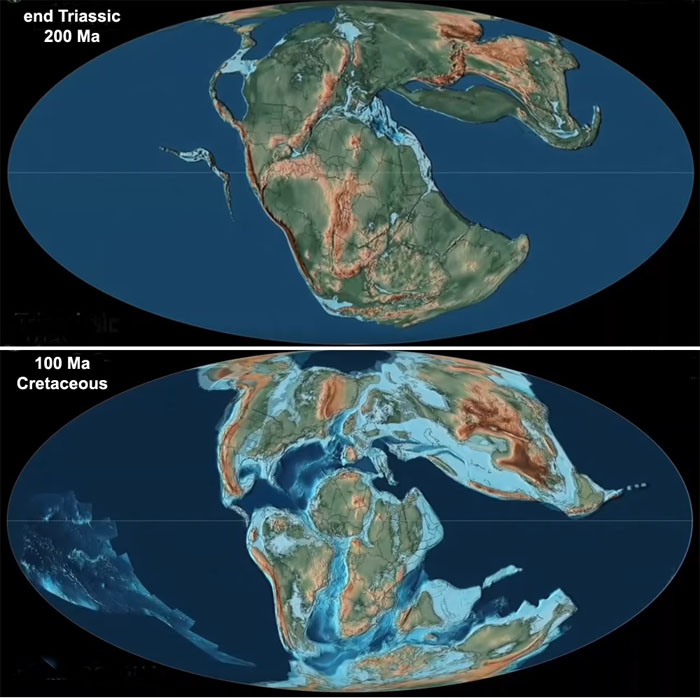
One of the ‘Big Five’ mass extinctions occurred at the end of the Triassic Period (~201 Ma), whose magnitude matches that of the more famous end-Cretaceous (K-Pg) event. It roughly coincided with the beginning of break-up of the Pangaea supercontinent that was accompanied by a major episode of volcanism preserved in the Central Atlantic Magmatic Province (CAMP). Eastern North America, West Africa and northern South America reveal scattered patches of CAMP flood basalts, swarms of dykes and large intrusive sills. Like all mass extinctions, that at the Triassic-Jurassic boundary left a huge selection of vacant or depleted ecological niches ready for evolution to fill by later adaptive radiation of surviving organisms. Because it coincided with continental break-up and drift, unlike other such events, evolution proceeded in different ways on the various wandering land masses and in newly formed seas (see  an excellent animation of the formation and break-up of Pangaea – move the slider to 3 minutes for the start of break-up). The Jurassic was a period of explosive evolution among all groups of organisms. The most notable changes were among marine cephalopods, to give rise to a bewildering variety of ammonite species, and on land with the appearance and subsequent diversification of dinosaurs.

Pangaea at the end of the Triassic (top) and in Middle Cretaceous times (Credit: screen shots from animation by Christopher Scotese)

Many scientists have ascribed the origin of these events to the CAMP magmatic activity and the release of huge amounts of methane to trigger rapid global warming. In October 2021 one group focused on a special role for the high percentages of magma that never reached the surface and formed huge intrusions that spread laterally in thick sedimentary sequences to ‘crack’ hydrocarbons to their simplest form, CH4 or methane. A sedimentary origin of the methane, rather than its escape from the mantle, is indicated by the carbon-isotope ‘signature’ of sediments deposited shortly after the Tr-J event. The lighter isotope 12C rose significantly relative to 13C, suggesting an organic source – photosynthesis selectively takes up the lighter isotope.

By examining the element mercury (Hg) in deep ocean sediments from a Tr-J sedimentary section now exposed in Japan, scientists from China, the US and Norway have added detail to the methane-release hypothesis (Shen, J et al. 2022. Mercury evidence for combustion of organic-rich sediments during the end-Triassic crisis. Nature Communications, v. 13, article 1307; DOI:10.1038/s41467-022-28891-8). The relative proportions of Hg isotopes strongly suggest that the mercury had been released, as was the methane, from organic-rich sediments rather than from the CAMP magmas (i.e. ultimately from the mantle) through gasification and then burning at the surface.

The hypothesis is enlivened by a separate study (Fox C.P. et al. 2022. Flame out! End-Triassic mass extinction polycyclic aromatic hydrocarbons reflect more than just fire. Earth and Planetary Science Letters, v. 584, article 117418; DOI: 10.1016/j.epsl.2022.117418) that sees magmatic heating as being not so important. Calum Fox and colleagues at Curtin University, Western Australia analysed sediments from a Triassic-Jurassic sedimentary sequence near the Severn Bridge in SW England, focusing on polycyclic hydrocarbons in them. Their results show little sign of the kinds of organic chemical remnants of modern wildfires. Instead they suggest a greater contribution from soil erosion by acid rain that increased input of plant debris to a late Triassic marine basin

See also: How a major volcanic eruption paved the way for the rise of the dinosaurs Eureka Alert 23 March 2022;  Soil erosion and wildfire: another nail in coffin for Triassic era. Science Daily, 21 March 2022

‘Smoking gun’ for Younger Dryas trigger refuted

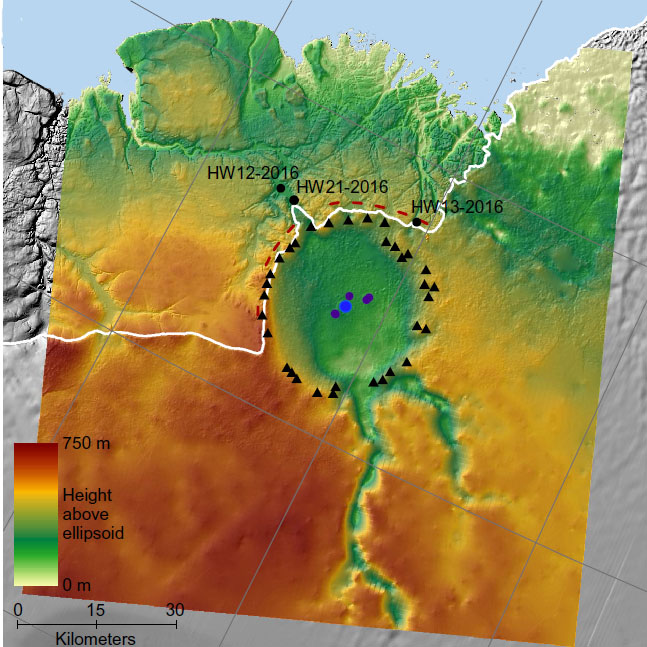
In 2018 airborne ice-penetrating radar over the far northwest of the Greenland revealed an impact crater as large as the extent of Washington DC, USA beneath the Hiawatha Glacier. The ice surrounding it was estimated to be younger than 100 ka. This seemed to offer a measure of support for the controversial hypothesis that an impact may have triggered the start of the millennium-long Younger Dryas episode of frigidity (12.9 to 11.7 ka). This notion had been proposed by a group of scientists who claimed to have found mineralogical and geochemical signs of an asteroid impact at a variety of archaeological sites of roughly this age in North America, Chile and Syria. A new study of the Hiawatha crater by a multinational team, including the original discoverers of the impact structure, has focussed on sediments deposited beyond the edge of the Greenland ice cap by meltwater streams flowing along its base. (Kenny, G.G. et al. 2022. A Late Paleocene age for Greenland’s Hiawatha impact structure. Science Advances, v.8, article eabm2434; DOI: 10.1126/science.eabm2434).

Colour-coded subglacial topography from airborne radar sounding over the Hiawatha Glacier of NW Greenland (Credit: Kjaer et al. 2018; Fig. 1D)

Where meltwater emerges from the Hiawatha Glacier downstream of the crater there are glaciofluvial sands and gravels that began to build up after 2010 when rapid summer melting began, probably due to global warming. As luck would have it, the team found quartz grains that contained distinctive planar features that are characteristic of impact shock. They also found pebbles of glassy impact melts that contain clasts of bedrock, further grains of shocked quartz and tiny needles of plagioclase feldspar that crystallised from the melt. Also present were small grains of the mineral zircon (ZrSiO4), both as pristine crystals in the bedrock clasts and porous, grainy-textured grains showing signs of deformation in the feldspathic melt rock. So, two materials that can be radiometrically dated are available: feldspars suitable for the 40Ar/39Ar method and zircons for uranium-lead (U-Pb) dating. The feldspars proved to be about 58 million years old; i.e. of Late Palaeocene age. The pristine zircon grains from bedrock clasts yielded Palaeoproterozoic U-Pb ages (~1915 Ma), which is the general age of the Precambrian metamorphic basement that underpins northern Greenland. The deformed zircon samples have a very precise U-Pb age of 57.99±0.54 Ma. There seems little doubt that the impact structure beneath the Hiawatha Glacier formed towards the beginning of the Cenozoic Era.

During the Palaeocene, Northern Greenland was experiencing warm conditions and sediments of that age show that it was covered with dense forest. The group that since 2007 has been advocating the influence of an impact over the rapid onset of the Younger Dryas acknowledges that the Hiawatha crater cannot support their view. But they have an alternative: an airburst of an incoming projectile. Although scientists know such phenomena do occur, as one did over the Tunguska area in Siberia on the morning of 30 June 1908. Research on the Tunguska Event has discovered  geochemical traces that may implicate an extraterrestrial object, but coincidentally the area affected is underlain by the giant SIberian Traps large igneous province that arguably might account for geochemical anomalies. Airbursts need to have been observed to have irrefutable recognition. Two posts from October 2021 – A Bronze Age catastrophe: the destruction of Sodom and Gomorrah? and Wide criticism of Sodom airburst hypothesis emerges – suggest that some scientists question the data used repeatedly to infer extraterrestrial events by the team that first suggested an impact origin for the Younger Dryas.

See also: Voosen, P, 2022. Controversial impact crater under Greenland’s ice is surprisingly ancient. Science, v. 375, article adb1944;DOI: 10.1126/science.adb1944

New book on geology and landscape of the Britsh Lake District

I don’t often review books on Earth-logs, but one that is pending publication may interest readers (Ian Francis, Stuart Holmes and Bruce Yardley 2022. The Lake District: Landscape and Geology. Marlborough: The Crowbrook Press; ISBN: 078 0 7198 4011 1). Ian Francis urged me to create Earth Pages, the predecessor to Earth-logs. One good turn deserves another, but this is a very good book. Unlike nearly all area-specific geoscientific books it is not primarily a guidebook. Instead it uses the internationally famous Lake District as a means of teaching how to fathom what a landscape represents. In this case, one with a history going back half a billion years, involving closure of an ocean, destruction of a mountain chain and sediment deposition in a ‘shallow, inland sea’. The last couple of million years or so of cycles of glaciation and river erosion have sculpted its present form. Finally, it became the home range of human hunter gatherers, once the ice had melted away around 10 thousand years ago. Britain’s first stone-age tillers and herders colonised its lower elevations, followed by miners and metal smelters, Roman, Viking and Anglo Saxon invaders and settlers. Its beauty and complexity have inspired poets and artists, and they in turn have drawn in more visitors per km2 than perhaps any other National Park on Earth, and far more per annum than its indigenous population.

Cover of The Lake District: Landscape and Geology

Ian, Stuart and Bruce lace their book with some of the best landscape images of the Lake District that I have come across, which invite you to read the text. The Lake District is pitched at a level that anyone can understand, with a minimum of jargon and a pleasant style. Basic geological concepts are covered in separate ‘boxes’, where the main thread requires them and for those who want a little more science. Geology being an observational science, there is some emphasis on indicators of natural processes, such as elliptical drumlins whose sculpting by flowing ice aligns their long axes, and exotic boulders made of rocks only present miles away whose presence suggests the source of the ice that had moved them. Solid rock outcrops in the Lakes are products of many Earth processes, both internal and at the former surface. There are granitic rocks that intruded through once volcanic and sedimentary rocks. Their internal features tell the rocktypes apart, such as the layering of sediments, often cleaved and folded by deformation. and the lack of structure in granite that cuts the layering, yet imparts new minerals to the older marine rocks as a result of igneous heating to very high temperatures.

Most of the geological concepts raised in the main text are amplified by narratives of seven field trips; provided the reader physically walks through them. And why shouldn’t they? Each of them involves only a few kilometres of gentle walking from parking spaces on metalled roads.  They cover all the solid geology, from the regionally oldest rocks, the Early-Ordovician, deep-water Skiddaw Slates; upwards in geological time through the varied products of later Ordovician volcanism and marine sediments; the thick Silurian mudstones and silts; and the youngest and structurally simplest shallow-marine Carboniferous limestone. The sediments all contain fossils and the volcanics are full of evidence of the environment onto which they poured – an oceanic island arc. A simple story is unveiled by all, such as following a track on the flanks of Blencathra, a hill in the Northern Fells. From slates with cleavage formed by compressive forces acting on muds; to a point where new minerals have grown in them through later heating; then to where heat was so intense that the slates came to resemble igneous rocks; and finally outcrops of a granite whose much later intrusion as magma explains the simple sequence. All the trips are like that: not too much to take in, but enough to hammer home the various rudiments of geology.

Britain was where the modern Earth sciences were largely forged. But that was in the absence of complete exposure of all the solid rock that underpins it. What lies between outcrops is the modern natural world and a diversity of ecosystems to which The Lake District also draws attention. Even professional geologists get bored to tears by trudging unendingly over nothing but rock. They enjoy flowers, trees, birds, streams and tarns with fish as a relief. Some of the text also taught me about oddities created by Cumbrian farmers: bields, which are shelters for shepherds and sheep; washfolds where sheep used to be gathered and cleaned prior to shearing, and lots more about the unique upland farming culture of Cumbria. I hope the book proves physically durable, for it will surely find its way into secondary-school and first-year undergraduate field trips. It is also ideal for any family aiming at a fortnight’s holiday in the Lakes, but wondering what to do. The book will get well-thumbed and wet – the one drawback of the Lake District is its annual rainfall, averaging 3.3 metres! Go in April, May or early June to escape the worst of it and that of tourists, and to see its ecology at its best. I’m giving my complimentary copy to my grandchildren, because I get annoyed when they complain of boredom!

End-Cretaceous mass extinction occurred in northern spring

This post’s title seems beyond belief for an event that occurred 66 million years ago: how can geologists possibly say that with any conviction? The claim is based on fossil fishes found in the Late Cretaceous Hell Creek Formation of North Dakota (see: A bad day at the end of the Cretaceous. April, 2019), described in a paper published on 1 April 2019. The horizon that displays all the classic evidence for an impact origin for the K-Pg extinction is a freshwater sediment laid down by a surge into a river system: the upstream result of the mega-tsunami driven by the Chicxulub impact in the Gulf of Mexico. Amongst much else it contains intact marine ammonites – the last of their kind – and freshwater paddlefish and sturgeon. The fishes are preserved exquisitely, with no sign of scavenging. Parts of their gills are clogged with microscopic spherules made of impact glass. They are pretty good ‘smoking guns’ for an impact, and are accompanied by dinosaur remains – an egg with an embryo, hatchlings and even a piece of skin.

A group of scientists from the Netherlands, Sweden, Belgium and the UK examined thin sections of the fishes’ bones (During, M.A.D. et al. 2022. The Mesozoic terminated in boreal springNature online publication, 23 February 2022; DOI: 10.1038/s41586-022-04446-1). These revealed growth layers that show lines of arrested growth (LAGs) separated by thicker layers. Such LAGs in modern paddlefish and sturgeon bones may indicate conditions of low food availability in winter, most growth being during warmer times of year. Each bone that was examined has only a thin outer zone of accelerated growth following its last LAG. So it seems that each specimen died in the Northern Hemisphere spring. This was confirmed by variations within the cyclic zonation of the relative proportions of carbon isotopes 13C and 12C, expressed as δ13C. In the LAGs δ13C is lower than in the thicker zones, which is consistent with decreased prey availability in winter, but see below.

Thin sections of fish bones from the K-Pg boundary layer in the Hell Creek Formation, showing lines of arrested growth marked by red arrowheads. The outermost (top) LAGs are succeeded by only a thin zone of accelerated growth during their last weeks of the fishes’ lives (credit: During et al., Fig. 2)

The paper by During et al. follows one with very similar content from the same deposit that was published about 12 weeks earlier (DePalma, R.A., et al. 2021. Seasonal calibration of the end-cretaceous Chicxulub impact event. Nature Science Reports, v. 11, 23704; DOI: 10.1038/s41598-021-03232-9). Yet During et al. do not refer to it, despite acknowledging DePalma’s guidance in the field and his granting access to his team’s specimens: maybe due to poor communications … or maybe not. DePalma et al. note thatmodern sturgeons are able to spend winters in the sea, which may also explain the low δ13C in the LAGs, as well as decreased prey availability does. They also examined damage by leaf-mining insects in fossil leaves at the site, which supports the springtime extinction hypothesis. Another study in DePalma et al. is the size range of newly hatched fish of three different Families that are founds as fossils in the K-Pg deposit. By comparing them with the growth histories of closely-related modern hatchlings they conclude that perhaps late spring to early summer is implied. Whatever, both papers go on to discuss the implications of their basic conclusions. Spring is a particularly sensitive time for the life cycles of many organisms; i.e. annual reproduction and newborns’ early growth. But some groups of egg-laying animals, such as perhaps dinosaurs, require longer incubation periods than do others, e.g. birds, and may be more vulnerable to rapid environmental change. That may explain the demise of the dinosaurs while their close avian relatives, or at least some of them, survived.  Yet the season in the Southern Hemisphere when the Chicxulub impact occurred would have been autumn. That may go some way towards explaining evidence that ecological recovery from mass extinction in the southern continents seems to have been faster. Almost certainly, the impact would have induced a double climatic whammy: warming in its immediate aftermath followed by global cooling plus a shutdown of photosynthesis as dust clouds enveloped the planet. Then there is the issue of contamination by potentially toxic compounds raised by Chicxulub. The K-Pg boundary seems likely to run and run as a geoscientific story more than four decades since it was first proposed.

See also: Sample, I. 2022. Springtime asteroid ramped up extinction rates, say scientists. The Guardian, 23 September 2022.

Did earliest modern humans in Europe share a cave with Neanderthals?

The cave of Grotte Mandrin in the Rhône Valley, France. (Credit: Slimak et al Fig 1c)

Since 1999 a cave (Grotte Mandrin) on the west flank of the lower Rhône valley in sothern France has been revealing archaeological remains from 3 metres of sediment that can be divided into 12 distinct layers (Slimak, L. and 22 others 2022. Modern human incursion into Neanderthal territories 54,000 years ago at Mandrin, France. Science Advances, v. 8, article eabj9496; DOI: 10.1126/sciadv.abj9496). Tens of thousands of objects have been recovered, mostly from a layer just below midway in the sequence, which is dominated by small (<1 cm), ‘standardised’ stone points that are also found at other sites in the local area. This veritable industry – dubbed the ‘Neronian’ from the nearby Grotte de Néron – seems to have been focussed hereabouts. Older artefacts in layers F and G are considered to be Mousterian, that is generally ascribed to late Neanderthals. Horse, bison and deer bones suggest that these were the main source of animal protein for the cave’s occupants. The site also contained a few objects that show simple decoration. The way in which the Neronian points were produced resembles the working of similar artefacts in Lebanon by anatomically modern humans (AMH) about 45 ka ago; so it is possible that the technology had spread westward with the earliest AMH migrants into Europe. Yet precise radiocarbon and optically stimulated luminescence dating of the Grotte Mandrin site suggests that the sediment accumulated between 84 to 44 thousand years ago. The Mousterian/Neanderthal objects occur in layers F and G between 79 and 57 ka, whereas the Neronian layer E spans 56.8 to 51.7.

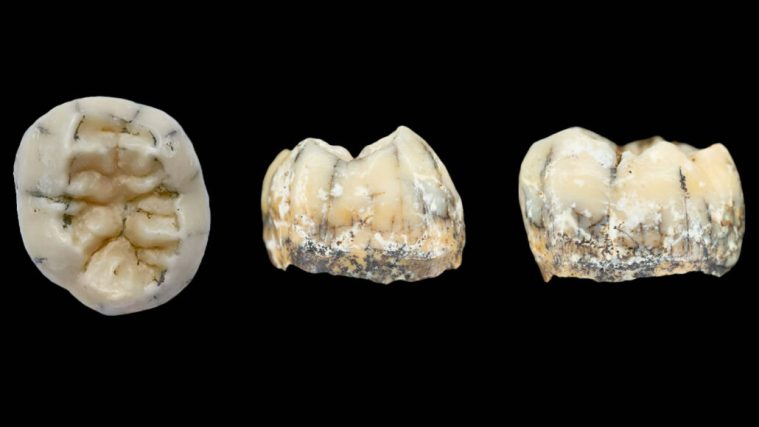
Grotte Mandrin has yielded very few hominin remains, except for 9 teeth in layers C to G. Those from C, D, F and G showed clear Neanderthal dental features. However, shape analysis of one damaged, deciduous (infant) molar from Layer E suggests that it matches Upper Pleistocene AMH dental morphology. That seems to place Grotte Mandrin as by far the oldest AMH occupation site in Europe, up 11 thousand years earlier than the 45 to 43 ka AMH site at Bacho Kiro in Bulgaria. To some extent that tallies with the tiny tooth’s association with a prolific, standardised and delicate industry new to the area: probably points for small projectiles. Neanderthals re-occupied the site in Layers D to B, yet in the upper part of layer B, from 44.1 to 41.5, there is a return of Neronian-like points, probably made by AMH.

A curious detail from layer E (not reported in this paper) is the occurrence of soot trapped in thin, annually deposited layers of carbonate on the cave walls. Fragments of the sooty speleothem continually fell onto the cave floor to be incorporated into the sediments. The base of layer E that contains Neronian, possibly AMH artefacts and the top of layer F that shows preceding Neanderthal occupation, contain such sooty speleothem fragments. Precise dating of them is claimed to suggest a very short period of transition between the two kinds of occupants: perhaps only a few years. Neanderthals and AMH may not have met in the cave, but may well have been co-occupants of the surrounding area at the same time.

A great deal of effort over more than two decades has gone into this publication, and several of its findings have caused quite a stir. Because permanent AMH occupation of the Levant began at least 55 ka ago, there is no reason to suppose that AMH migrating along the northern shores of the Mediterranean could not have arrived a little earlier in what is now southern France. What has been emphasised in the broad media is the exchange of a Neanderthal to an AMH population in the Grotte Mandrin, as if it was done in a friendly, indeed neighbourly spirit (!). That hinges on the ultra-precise dating of the sooty speleothem fragments to reveal just a few years between the Neanderthals doing a ‘flit’ and the AMH starting a ‘squat’ in the vacant premises to set up a cottage industry. The time of the replacement before present is, in fact, very close to the limit at which radiocarbon dating is feasible, almost all 14C formed at that time having decayed away since then. There can be no doubt that layer E did mark a major change in sophistication of stone technology, but was it really an AMH development? The only definite evidence is the single deciduous molar, and that is damaged to such an extent that an independent dental paleoanthropologist who has specialised in distinguishing AMH from Neanderthal dentition isn’t convinced. But,surely, DNA from the tooth would resolve the issue. The paper notes that trial extraction and sequencing of 6 horse teeth from layer E failed to yield results, which suggests degradation of genetic teril. So the team did not commit the tooth to sequencing, which would have further damaged it. Finally, four separate groups occupying what certainly looks like a nice little cave over the course of about 40 thousand years is hardly a surprise. Many caves throughout Europe and southern Africa show evidence of multiple occupancy. After all, before 11 ka all humans and their forebears were of necessity foragers and migrants; just think of how many times your neighbours have changed since you moved in …

See also: Price, M. 2022. Did Neanderthals and modern humans take turns living in a French cave? Science, v, 375, p. 598-599; DOI: 10.1126/science.ada1114

Neocolonial/economic bias of the fossil record and evolution

Charles Darwin’s ideas on the evolution of species through natural selection became imprinted by his participation in the second survey expedition of HMS Beagle (1831-1836), commanded by Captain Robert Fitzroy. The voyage aimed at comprehensive surveys along its circumnavigation, Darwin having been engaged to provide geological expertise. At that time he would have been best described as a ‘natural historian’ and his only qualification was that he had an ordinary degree (BA) from Cambridge  and had read widely in natural science: had it not been for joining the Beagle he may have become a country parson.

The voyage was a maritime venture typical of British and other European imperialism and colonisation during the early 19th century – a survey not only of geodesy, geography and natural science but also of the economic potential of the places that it visited. European science benefitted immensely from such voyages and overland expeditions. Today, research in the natural sciences is still dominated by academics from the better-off nations. Significantly, the charting of the ocean floor during the 20th and 21st centuries has been conducted almost exclusively by those nations with a global reach: plate tectonics is a science for the very wealthy. It is only in the last 60 years that geological mapping of the bulk of the continental surface has been relinquished by former colonial powers to local surveys. In the majority of cases the geological surveys of these now independent countries are grossly underfunded and they still largely depend on maps produced more than half a century ago by their former rulers.

In the 19th century global palaeontology, botany and zoology, which lie at the roots of evolutionary studies, shipped specimens to the museums and universities of the colonising powers. Their scientists today still retain a near monopoly of access to those old collections. Now it is economic power that enables continued collection by researchers mainly from the former colonising countries and their institutions. There are a few exceptions, such as the rapid rise of Chinese natural science in a mere three to four decades, which has become a major ‘player’ in early and Mesozoic evolution. Gradually, hominin palaeontology has drawn in local scientists from countries well-endowed with productive sites, such as Kenya, Tanzania and Ethiopia, yet funding remains largely external. Nussaïbah Raja at Friedrich-Alexander University in Erlagen, Germany and colleagues from Britain, South Africa, Brazil and India  (Raja, N.B. et al. 2021. Colonial history and global economics distort our understanding of deep-time biodiversity. Nature Ecology & Evolution, v. 6, p. 1-10 ; DOI: 10.1038/s41559-021-01608-8) have used the vast Paleobiology Database (PBDB) to assess which countries are the main influence over global fossil collection.

Proportion of publications on national fossil data with a local lead author, for regions of the world. (Credit: Raja et al., Extended Data Fig 9)

Their findings are unsurprising. The 29 thousand papers referenced by PBDB that give fossil-occurrence data from the last 30 years involved 97% of authors who were resident in high- and upper-middle-income countries: more than a third from the US and the rest of the top ten from, in order, Germany, Britain, France, Canada, Russia, China, Australia, Italy and Spain: and 92% of the publications were published in English. Interestingly, it appears that old colonial ties still exert an influence on palaeontology research in former colonies: a quarter of that conducted in Morocco, Tunisia and Algeria was done by scientists based in France; 10% of work in South Africa and Egypt was authored by UK-based researchers; and 17% of Namibian palaeontology was conducted by scientists from Germany.  When it comes to first authors of papers about fossils, local scientists get increasingly short shrift as the overall wealth of their homelands decreases. The authors of the PBDB study devised an index of what they call ‘parachute science’, based on the proportion of a country’s fossil data that was contributed by foreign teams that lacked any local co-authors.

The ‘Parachute Index’ for the ten countries most exploited by external palaeontological researchers. (Credit: Raja et al., Fig 3b)

This lack of engagement with and assistance for local scientists ‘hinders local scientists and domestic scientific development, by favouring foreign input and exacerbating power imbalances between those from foreign countries and those located ‘on the ground’. Furthermore, this can also lead to mistrust by local scientists towards foreign researchers, affecting future collaborations’. Scientific ‘colonialism’ is still pervasive for much of the world, and is a major force in imposing opinions on evolution in particular. Raja and colleagues rightly call for external economic and ‘intellectual’ power over research to be replaced by ‘equitable, ethical and sustainable collaboration’. Without that, scientific expertise will advance at a very slow pace in less well-endowed regions, with the same-old, same-old beneficiaries getting the benefits.

See also: Callaway, E. 2022. How rich countries skew the fossil record.Nature News 13 January 2022. Adame, F. 2021. Meaningful collaborations can end ‘helicopter research’. Nature Careers, 29 June 2021.

Holocene migrations of people into Britain

People assigned to a variety of human species: Homo sapiens H. neanderthalensis (Swanscombe, 400 ka and several later times ) H heidelbergensis (Boxgrove, ca 500 ka, )H. antecessor (Happisburgh, ca 950 ka) – have left signs of their presence in Britain. Human occupancy has largely depended on climate. Around 9 times since the first known human presence here, much of Britain was repeatedly buried by glacial ice to become a frigid desert for tens of thousands of years. Between 180 and 60 ka only a couple of flint artefacts found in road excavations in Kent hint at Neanderthal visitors. For most of the Late Pleistocene the archipelago seems to have been devoid of humans. Arguably, Europe’s first known anatomically modern humans occupied several caves in Devon, Derbyshire and South Wales as early as around 43 ka, while climate was cooling, only to abandon Britain during the Last Glacial Maximum (24 to 18 ka ago). As climate warmed again thereafter, sporadic occupation by Late Palaeolithic hunter-gatherers occurred up to the sudden onset of the frigid Younger Dryas (12.9 ka). Once warming returned quickly 11,700 years ago, sea level was low enough for game and hunter gatherers to migrate to Britain; this time for permanent occupancy. Bones of the earliest known of these Mesolithic people have yielded DNA and a surprise: they were dark skinned and so far as we can tell remained so until the beginning of Neolithic farming in Britain around 6100 years ago. The DNA of most living Britons with pale skins retains up to 10% of inheritance from these original hunter gatherers.  Much the same is known from elsewhere in NW Europe. In the early Holocene it was possible to walk across what is now the southern North Sea thanks to Doggerland. Following a tsunami at around 8.2 ka this rich area of wetland vanished, so that all later migration demanded sea journeys.  

Mesolithic people remained in occupation of the British Isles for another two millennia. A wealth of evidence, summarised nicely in Ray, K. & Thomas, J. 2018, Neolithic Britain, Oxford University Press, suggests that there was a lengthy period of overlap between Mesolithic and Neolithic occupation around 4100 BCE. The main difference between the two groups was that Neolithic communities subsisted on domesticated grains and animals, while those of the Mesolithic consumed wild resources. Cultural clues in archaeological finds, however, suggest a lot in common, such as the erection of various kinds of monuments. Posts of tree trunks, sometimes arranged in lines, were raised in the Mesolithic and lines of probably ritual pits were dug. Both ‘traditions’ continued into the Neolithic and evolved to stone monuments, to which were added burials of different kinds. It is worth noting that Stonehenge was developed on a site that held much earlier, large totem-pole like posts, with a nearby spring that had hosted regular gatherings of Mesolithic people. Signs of Mesolithic occupation in Britain extend just as widely as do those of Neolithic practices. A study of DNA from 7 Mesolithic skeletons and 67 of early Neolithic age (Brace, S. and 20 others 2019. Population Replacement in Early Neolithic Britain. Nature Ecology & Evolution, v. 3, p. 765-771; DOI: 10.1038/s41559-019-0871-9) revealed that early Neolithic people did not wipe out the genetic make-up (either by complete displacement or annihilation) of their predecessors. About 20 to 30% of Neolithic DNA was inherited from them; as would be expected from assimilation of a probably much smaller number of hunter-gatherers into a larger population  of  immigrants who brought farming and herding from Asian Turkey (Anatolia). Such ‘hybrid’ genetics was widespread in Europe and they are referred to as the Early European Farmers (EEF). As Ray and Thomas suggest, aspects of Mesolithic culture may have been adopted by the newcomers across the British Isles from Orkney to Wiltshire.

Around 2400 BCE the earliest Neolithic ceremonial site at Brodgar on Orkney was destroyed to the accompaniment of an enormous feast that consumed several hundred cattle. At about the same time several men, whose tooth geochemistry indicated an origin in the European Alps, were buried on Salisbury Plain together with the earliest metal artefacts known from Britain (copper knives), the accoutrements of archery and distinctive, bell-shaped pottery beakers. Stonehenge was ‘remodelled’ shortly afterwards, with the addition of its giant trilithons, four of which were later adorned with carvings of metal axes and daggers. The Early Bronze (or Chalcolithic) Age had arrived! A 2018 study of ancient DNA from Bronze Age burials in Europe suggested a far more drastic swamping of Neolithic genetic heritage by the ‘Beaker people’ (Olalde, I. and a great many others 2018. The Beaker phenomenon and the genomic transformation of northwest Europe. Nature, v. 555, p. 190-196; DOI: 10.1038/nature25738). The skeletons from Britain analysed by Olalde et al. apparently suggested that, within a few hundred years, up to 90% of the Neolithic gene pool had been removed from the British population. Who were these people who used metals and the distinctive Bell Beakers, where did they come from and what did they do?

The closest match to the British and western European Bronze Age DNA was that associated with the Yamnaya people from the steppes of SE Ukraine and Southern Russia who had developed a culture centred on herding. They had also adopted the wheel from people of the Mesopotamian plains and had domesticated the horse for riding and pulling carts: ideal for their semi-nomadic lifestyle and for moving en masse. After 3000 BCE they spread into Europe, as widely recorded by their distinctive beakers and the presence of their DNA in the genomes of later Europeans. Their burials – in ‘kurgans’ – resembled the round barrows that appeared on Salisbury Plain and elsewhere during the Bronze Age. The DNA replacement data from 2018 were limited and held few clues to how it happened. One possibility for such a dramatic change could be a violent takeover that drove down the population of British Neolithic people. To address the broader influence of migration in more detail and over a loner time span, a team led by the Universities of York and Vienna, and Harvard Medical School (Patterson, N. and a great many others 2021. Large-scale migration into Britain during the Middle to Late Bronze Age. Nature, early online release; DOI: 10.1038/s41586-021-04287-4) used ancient DNA from 793 individuals excavated in Britain (416 individuals) and continental Europe (377) from Bronze- to Iron Age sites (2300 to ~100 BCE).

The proportion of Early European Farmers DNA in British individuals from the Bronze Age (2400 BCE) to the Iron Age (750 BCE to 43 CE). Note the ‘fuzzy’ nature of the data, and that the decline in EEF in British individuals was not as great as earlier analyses had shown. Remarkably, the ‘Amesbury Archer’, who brought the first metals to Britain, had a higher proportion of EEF ancestry than the Early Bronze-Age average. (Credit: Patterson et al. Fig. 3)

The new data from Britain suggest that the migrants, who crossed the Channel later in the Bronze Age, were of mixed ethnicity, but most carried EEF genes. The influence of earlier migrants from the Yamnaya heartlands is present, but so too are relics of Mesolithic ancestry. Interestingly, the British data show a much larger increase in the genes associated with lactase persistence, which marks the ability of adults to digest milk, than was apparent in the wider European population (50% compared with about 7% in Eastern Europeans of the time). Whatever the impact of the first influx of metal-using people – it may have been culturally decisive in Britain – by the end of the Bronze Age the EEF ‘signature’ had increased in peoples’ genomes. Rather than some kind of invasion, the influx was more likely to have been a sustained movement of people to Britain over several hundred years By the Iron Age, almost half the ancestry of Britain, particularly in England and Wales, was once again predominantly of EEF origin (around 40% of the mixture), but culture had become completely different. There are even suggestions that the influx brought with it the beginnings of Celtic languages. Yet the data leave a great deal of further analysis to be undertaken.

See also: Drury, S.A. 2019. Genetics and the peopling of Britain: We are all hybrids, People and Nature; Ancient DNA Analysis Reveals Large Scale Migrations Into Bronze Age Britain, SciTechDaily, 28 December 2021.

Some Homo naledi news

In 2015 the remains of about 15 hominins, new to science, were found in a near-inaccessible South African cave (See: The ‘star’ hominin of South Africa;  September 2015), that number having risen to more than 24 at the time of writing. The ‘star’ status of Homo naledi (named after the cave’s name Naledi meaning star in the local Sotho language) arose partly from an extraordinary barrage of promotion by the organisers of the expedition that unearthed them (probably to boost fundraising). But it was indeed one of the most extraordinary discoveries in palaeoanthropology. The remains were recovered by a team of women archaeologists who small and lithe enough to wriggle through a maze of extremely narrow cave passages. The bones in the remote chamber were complete, with no sign of physical trauma, except gnawing by snails and beetles. Few hominin fossils were found in the more accessible parts of the cave. One likely explanation was that a living H. naledi group had deliberately carried the bodies through the cave system for burial – at less than 1.5 m tall with a slender build they could have done this far more easily than the modern excavators. A plausible alternative is that a group of H. naledi scrambled deep into the cave on being panicked by large predators, and suffocated as CO2 built-up to toxic levels.

Map of the Rising Star cave system in Gautong Province South Africa. The yellow dot marks the chamber where Homo naledi fossils were first found; the red one is the site of a new discovery. (Credit: Elliott et al 2021, PaleoAnthropology. Issue 1.64, Fig. 1)

Initially, the bones were estimated to be 2 Ma old. The fossils are so well-preserved that most aspects of their functional anatomy are known in great detail, such as the articulation of their hands and feet. Although not a single tool was found in the cave deposit, to get into the far reaches of the labyrinthine cave system they must have lit the way with firebrands. The anatomy of H. naledi is far more advanced than that of contemporary H. habilis. The discoverers speculated that the group may have been a species that gave direct rise to the later H. ergaster and erectus, and ultimately us. Alternatively, the individuals’ diminutive size suggested parallels with much later H. floresiensis and H. luzonensis from the other side of the world. Much of this hype was later blunted by more reliable geochronology indicating an age of between 236 ka and 335 ka: i.e. about the time when anatomically modern humans were already roaming Africa. A more plausible conclusion, therefore, is that H. naledi was one of at least 6 hominin groups that co-occupied the late-Pleistocene world: i.e. similar to H. floresiensis.

Now the partial skull and half a dozen teeth of an immature H. naledi has been recovered from another remote chamber in the cave system (Brophy, J.K. et al. 2021. Immature Hominin Craniodental Remains From a New Locality in the Rising Star Cave System, South Africa. PaleoAnthropology. Issue 1.64; DOI: 10.48738/2021.iss1.64). Fossils of young humans are rare, their bones being thinner and much more fragile than those of adults, so the skull had to be reconstructed from 28 fragments. Unlike the older individuals from the main chamber, there are no other bones associated with the skull. Oddly, the supposedly young H. naledi’s brain volume (between 480 to 610 cm3) is between 90 to 95 % that of adults. A possible explanation for this degree of similarity is that these beings reached maturity far more quickly than do anatomically modern humans. The evidence for youth is based on close dental similarity with those of other ‘immature’ specimens from the main bone deposit, and most importantly that two of the teeth are demed to be deciduous (‘milk’) teeth. Yet the ‘milk’ teeth show severely chipped enamel as do the permanent teeth of more mature specimens, to the extent of being unique in the fossil record of hominins. Clearly, their diet was sand-rich.

Shortly after publication in the journal PaleoAnthropology during early November 2021 the world’s media leapt on the two papers rorting these new finds. Yet it is hard to judge why it was deemed by science journalists to have truly popular appeal. It actually adds very little to the H. naledi story, apart from specialised anatomical description. Despite the skull being bereft of the rest of the individual’s body, the authors ‘…regard it as likely that some hominin agency was involved in the deposition of the cra­nial material’.  Perhaps the ‘star’ status was rekindled because the press release from the University of the Witwatersrand used the word ‘child’ again and again – a sure fire way of getting wide attention. The published papers properly refers to it as an ‘immature hominin individual’, which it undoubtedly is.  The same sort of attention came the way of Raymond Dart from a small skull of Australopithecus africanus found in 1924 by workers in a limestone quarry – he called it ‘the Taung Child’. Of course, H. naledi is one of the best-preserved hominins known. But how does its current newsworthiness rank above H. floresiensis? Now, that was a surprise, but the hype about that tiny human has died down. And when H. naledi was originally deemed to be 2 Ma old, it too was astonishing. But since its true, quite young age was determined, it too is no longer such a big deal.

Interestingly, South African scientists self-proclaimed the name ‘Cradle of Humankind’ for the area in Gautung Province close to Johannesburg, which is rich in limestone caves and has a long history of fossil hominin discoveries since Raymond Dart’s Taung Child. But the earliest anatomically modern human remains are from Jebel Irhoud in Morocco, and the oldest known hominin fossils are from Chad, and most advances in early hominin evolution have stemmed from Ethiopia, Kenya and Tanzania.   The fossiliferous part of Gautung Province rightly has World Heritage status, but not under that name. Instead it is called more accurately ‘Fossil Hominid Sites of South Africa”

See also: Partial skull of a child of Homo naledi: Insight into stages of life of remarkable species. Science Daily, November 2021.