Modelling climate change since the Devonian

A consortium of geoscientists from Australia, Britain and France, led by Andrew Merdith of the University of Adelaide examines the likely climate cooling mechanisms that may have set off the two great ‘icehouse’ intervals in the last 541 Ma (Merdith, A.S. et al. 2025. Phanerozoic icehouse climates as the result of multiple solid-Earth cooling mechanisms. Science Advances, v. 11, article eadm9798: DOI: 10.1126/sciadv.adm9798). They consider the first to be the global cooling that began in the latter part of the Devonian culminating in the Carboniferous-Permian icehouse. The second is the Cenozoic global cooling to form the permanent Antarctic ice cap around 34 Ma and culminated in cyclical ice ages on the northern continents after 2.4 Ma during the Pleistocene. They dismiss the 40 Ma long, late Ordovician to early Silurian glaciation that left its imprint on North Africa and South America –  then combined in the Gondwana supercontinent. The data about two of the parameters used in their model – the degree of early colonisation of the continents by plants and their influence on terrestrial weathering are uncertain in that protracted event.  Yet the Hirnantian glaciation reached 20°S at its maximum extent in the Late Ordovician around 444 Ma to cover about a third of Gondwana: it was larger than the present Antarctic ice cap. For that reason, their study spans only Devonian and later times.

Fluctuation in evidence for the extent of glacial conditions since the Devonian: the ‘ice line’ is grey. The count of glacial proxy occurrences in each 10° of latitude through time is shown in the colour key. Credit: Merdith et al., Fig 2A.

Merdith et al. rely on four climatic proxies. The first of these comprises indicators of cold climates, such as glacial dropstones, tillites and evidence in sedimentary rocks of crystals of hydrated calcium carbonate (ikaite – CaCO3.6H2O) that bizarrely forms only at around 0°C . From such occurrences it is possible to define an ‘ice line’ linking different latitudes through geological time. Then there are estimates of global average surface temperature; low-latitude sea surface temperature; and estimates of atmospheric CO2. The ‘ice-line’ data records an additional, long period of glaciation in the Jurassic and early Cretaceous, but evidence does not extend to latitudes lower than 60°. It is regarded by Merdith et al. as an episode of ‘cooling’ rather than an ‘icehouse’. Their model assesses sources and sinks of COsince the Devonian Period.

The main natural source of the principal greenhouse gas CO2 is degassing through volcanism expelled from the mantle and breakdown of carbonate rock in subducted lithosphere. Natural sequestration of carbon involves weathering of exposed rock that releases dissolved CO2 and ions of calcium and magnesium.   A recently compiled set of plate reconstructions that chart the waxing and waning of tectonics since the Devonian Period allows them to model the tectonically driven release of carbon over time, with time scales on the order of tens to hundreds of Ma. The familiar Milanković forcing cycles on the order of tens to hundreds of ka are thus of no significance in Merdith et al.’s  broader conception of icehouse episodes  Their modelling shows high degassing during the Cretaceous, modern levels during the late Palaeozoic and early Mesozoic, and low emissions during the Devonian. The model also suggests that cooling stemmed from variations in the positions and configuration of continents over time.  Another crucial factor is the tempo of exposure of rocks that are most prone to weathering. The most important are rocks of the ocean lithosphere incorporated into the continents to form ophiolite masses. The release of soluble products of weathering into ocean basins through time acts as a fluctuating means of ‘fertilising’ so that more carbon can be sequestered in deep sediments in the form of organisms’ unoxidised tissue and hard parts made of calcium carbonates and phosphates. Less silicate weathering results in a boost to atmospheric CO2.

Only two long, true icehouse episodes emerge from the empirical proxy data, expressed by the ‘ice-line’ plots. Restricting the modelling to single global processes that might be expected to influence degassing or carbon sequestration produces no good fits to the climatic proxy data. Running the model with all the drivers “off” produces more or less continuous icehouse conditions since the Devonian. The model’s climate-related outputs thus imply that many complex processes working together in syncopation may have driven the gross climate vagaries over the last 400 Ma or so. A planet of Earth’s size without such complexity would throughout that period have had a high-CO2 warm climate. According to Andrew Merdith its fluctuation from greenhouse to icehouse conditions in the late Palaeozoic and the Cenozoic were probably due to “coincidental combination of very low rates of global volcanism, and highly dispersed continents with big mountains, which allow for lots of global rainfall and therefore amplify reactions that remove carbon from the atmosphere”.

Geological history is, almost by definition, somewhat rambling. So, despite despite the large investment in seeking a computed explanation of data drawn from the record, the outcome reflects that in a less than coherent account. To state that many complex processes working at once may have driven climate vagaries over the last 400 Ma or so, is hardly a major advance: palaeoclimatologists have said more or less the same for a couple of decades or more, but have mainly proposed single driving mechanisms. One aspect of Merdith et al.’s  results seems to be of particular interest. ‘Icehouse’ conditions seem to be rare events interspersed with broader ice-free periods. We evolved within the mammal-dominated ecosystems on the continents during the latest of these anomalous climatic episodes. And we and those ecosystems now rely on a cool world. As the supervisor of the project commented, ‘Over its long history, the Earth likes it hot, but our human society does not’.

Readers may like to venture into how some philosophers of science deal with a far bigger question; ‘Is intelligent life a rare, chance event throughout the universe?’ That is, might we be alone in the cosmos? In the same issue of Science Advances is a paper centred on just such questions (Mills, D.B. et al. 2025. A reassessment of the “hard-steps” model for the evolution of intelligent life. Science Advances, v. 11, article eads5698; DOI: 10.1126/sciadv.ads5698). It stems from cosmologist Brandon Carter’s ‘Anthropic Principle’ first developed at Nicolas Copernicus’s 500th birthday celebrations in 1973. This has since been much debated by scientists and philosophers – a gross understatement as it knocks the spots off the Drake Equation. To take the edge off what seems to be a daunting task, Mills et al. consider a corollary of the Anthropic Principle, the ‘hard steps model’. That, in a nutshell, postulates that the origin of humanity and its ability to ponder on observations of the universe required a successful evolutionary passage through a number of hard steps. It predicts that such intelligence is ‘exceedingly rare’ in the universe. Icehouse conditions are respectable candidates for evolutionary ‘hard steps’, and in the history of Earth there have been five of them.

A fully revised edition of Steve Drury’s book Stepping Stones: The Making of Our Home World can now be downloaded as a free eBook

Global natural hydrogen resources: a CO2 free future??

The idea of a ‘Hydrogen Economy’ has been around for at least six decades, its main attraction being that when hydrogen is burned it combines with oxygen to form H2O. It might seem to be the ultimate ‘green’ energy source, but it is currently being touted by governments and petroleum companies in what is widely regarded as ‘green washing’. The technology favoured by that axis uses steam reforming of the methane that dominates natural petroleum gas, through the reaction:

CH4 + H2O  → CO + 3H2

It’s actually not much different from producing coke gas from coal, which began in the 19th century and is now largely abadoned. Because carbon monoxide (CO) reacts with atmospheric oxygen to form CO2 this process is by no means ‘green’ and is properly referred to as ‘grey’ hydrogen. Only if the CO is stored permanently underground could steam reforming not add to greenhouse warming. That puts the approach in the same category as ‘carbon capture and storage’, with all the possible difficulties inherent in that technology, which has yet to be demonstrated on a large scale. Such hydrogen is classified as a ‘blue’. Colour coding hydrogen is described nicely by the British National Grid. They give another six varieties. Green and yellow hydrogen are produced by electrolysing water using wind or solar power respectively. The pink variety uses nuclear power in the same fashion. Black or brown hydrogen is that produced by coking coal or stewing-up brown coal (lignite) which amazingly are contemplated in Australia and Germany. There is even a turquoise variety can be produced if methane is somehow turned into hydrogen and solid carbon using renewables. There is another category (white) which is hydrogen produced by a variety of natural, geochemical processes.

Distribution of ophiolites around the Eastern Mediterranean and Black Seas. Many orogenic belts are endowed to a similar extent. (Credit: Gültekin Topuz, Istanbul Technical University)

Earth-logs discussed white hydrogen in March 2023 when news emerged of gas that was 98% hydrogen leaking from a water borehole in Mali. The local people harnessed this surprising resource to generate electricity for their village. It also emerges in springs from ultramafic rocks, having formed through weathering of the mineral olivine:

3Fe2SiO4 + 2H2O → 2 Fe3O4 + 3SiO­2 +3H2

Much the same reaction occurs beneath the ocean floor where hydrothermal fluids alter basalts and in geothermal springs that emerge from onshore basalt lavas. Such ‘white’ hydrogen emissions are widespread. So an unknown, but possibly huge amount of hydrogen is leaking into the atmosphere continuously. Because of its tiny nucleus – just a single proton – atmospheric hydrogen quickly escapes to outer space: what a waste! Equally as interesting is that inducing the breakdown of ultramafic rock to yield hydrogen, by pumping water and carbon dioxide into them, may also be a means of leak-free carbon sequestration. This produces the complex mineral serpentine and magnesium carbonate. The reaction gives off heat and so is self sustaining until pumping is stopped.

It has been estimated that by 2050 the annual global demand for hydrogen will reach 530 million t.  Just how big is the potential resource to meet such a demand? Natural weathering and hydrothermal processes have always functioned. Some of the hydrogen produced by them may have built-up in reservoirs like the one in Mali, some is escaping. Neither the magnitude of annual natural generation of hydrogen nor the amount trapped in porous sedimentary rocks are known in any detail. A recent survey of how much may be trapped gives a range from 103 to 1010 million metric tons (Ellis, G.S. & Gelman, S.E. 2024. Model predictions of global geologic hydrogen resources. Science Advances, v. 10, article eado0955; DOI: 10.1126/sciadv.ado0955), most probably 5.6 trillion t. If only a tenth of that is recoverable, replacing fossil-fuel energy with that from white hydrogen to achieve net-zero CO2 emissions would be sustainable for about 400 years. That magnitude of trapped hydrogen reserves well exceeds all proven reserves of natural gas.

This estimate assumes using only hydrogen that has been naturally produced and stored beneath the Earth’s surface. Basalts and ultramafic rocks exposed at the land surface as ophiolites – ancient oceanic crust thrust onto continental crust – are abundant on every continent. Inducing hydrogen-producing chemical reactions in them by pumping water and CO2 into them is little different from the technology being used in fracking. This potential resource is effectively limitless. Combined with renewable energy technology, a hydrogen economy has no conceivable need for fossil fuels, except as organic-chemistry feedstock. Such a scenario for stabilising climate is almost certainly feasible. It could use the capital, technology and skills currently deployed by the petroleum industry that is currently driving society and the Earth in the opposite direction. It is capable of drilling 10 km below the continental surface or the ocean floor, and even into the Earth’s mantle that is made of . . . ultramafic rock.

Best wishes for the festive season to all Earth-logs followers and visitors

A major breakthrough in carbon capture and storage?

Carbon capture and storage is in the news most weeks and is increasingly on the agenda for some governments. But plans to implement the CCS approach to reducing and stopping global warming increasingly draws scorn from scientists and environmental campaigners. There is a simple reason for their suspicion. State engagement, in the UK and other rich countries, involves major petroleum companies that developed the oil and gas fields responsible for unsustainably massive injection of CO2 into the atmosphere. Because they have ‘trousered’ stupendous profits they are a tempting source for the financial costs of pumping CO2 into porous sedimentary rocks that once contained hydrocarbon reserves. Not only that, they have conducted such sequestration over decades to drive out whatever petroleum fluids remaining in previously tapped sedimentary strata. For that second reason, many oil companies are eager and willing to comply with governmental plans, thereby seeming to be environmentally ‘friendly’. It also tallies with their ambitions to continue making profits from fossil-fuel extraction. But isn’t that simply a means of replacing the sequestered greenhouse gas with more of it generated by burning the recovered oil and natural gas; i.e. ‘kicking the can down the road’? Being a gas – technically a ‘free phase’ – buried CO2 also risks leaking back to the atmosphere through fractures in the reservoir rock. Indeed, some potential sites for its sequestration have been deliberately made more gas-permeable by ‘fracking’ as a means of increasing the yield of petroleum-rich rock. Finally, a litre of injected gas can drive out pretty much the same volume of oil. So this approach to CCS may yield a greater potential for greenhouse warming than would the sequestered carbon dioxide itself.

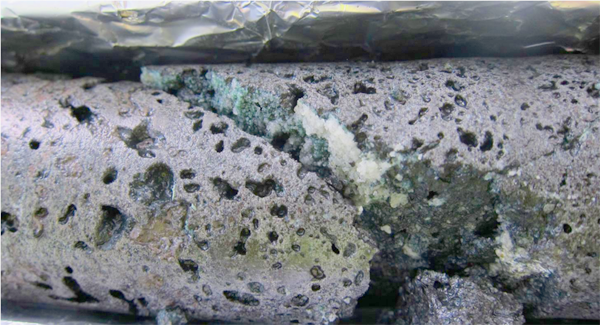
Image of calcite (white) and chlorite (cyan) formed in porous basalt due to CO2-charged water-rock interaction at the CarbFix site in Iceland. (Credit: Sandra Ósk Snæbjörnsdóttir)

Another, less widely publicised approach is to geochemically bind CO2 into solid carbonates, such as calcite (CaCO­3), dolomite (CaMgCO3), or magnesite (MgCO3). Once formed such crystalline solids are unlikely to break down to their component parts at the surface, under water or buried. One way of doing this is by the chemical weathering of rocks that contain calcium- and magnesium-rich minerals, such as feldspar (CaAl2Si2O8), olivine ([Fe,Mg]2SiO4) and pyroxene ([Fe,Mg]CaSi2O6) . Mafic and ultramafic rocks, such as basalt and peridotite are commonly composed of such minerals. One approach involves pumping the gas into a Icelandic borehole that passes through basalt and letting natural reactions do the trick. They give off heat and proceed quickly, very like those involved in the setting of concrete. In two experimental field trials 95% of injected CO2 was absorbed within 18 months. Believe it or not, ants can do the trick with crushed basalt and so too can plant roots. There have been recent experiments aimed at finding accelerants for such subsurface weathering (Wang, J. et al. 2024. CO2 capture, geological storage, and mineralization using biobased biodegradable chelating agents and seawater. Science Advances, v. 10, article eadq0515; DOI: 10.1126/sciadv.adq0515). In some respects the approach is akin to fracking. The aim is to connect isolated natural pores to allow fluids to permeate rock more easily, and to release metal ions to combine with injected CO2.

Chelating agents are biomolecules that are able to dissolve metal ions; some are used to remove toxic metals, such as lead, mercury and cadmium, from the bodies of people suffering from their effects. Naturally occurring ones extract metal ions from minerals and rocks and are agents of chemical weathering; probably used by the aforesaid ants and root systems. Wang and colleagues, based at Tohoku University in Japan, chose a chelating agent GLDA (tetrasodium glutamate diacetate –  C9H9NNa4O8) derived from plants, which is non-toxic, cheap and biodegradable. They injected CO2 and seawater containing dissolved GDLA into basaltic rock samples. The GDLA increases the rock’s porosity and permeability by breaking down its minerals so that Ca and Mg ions entered solution and were thereby able to combine with the gas to form carbonate minerals. Within five days porosity was increased by 16% and the rocks permeability increased by 26 times. Using electron microscopy the authors were able to show fine particles of carbonate growing in the connected pores. In fact these carbonate aggregates become coated with silica released by the induced mineral-weathering reactions. Calculations based on the previously mentioned field experiment in Iceland suggest that up to 20 billion tonnes of CO2 could be stored in 1.3 km3 of basalt treated in this way: about 1/25000 of the active rift system in Iceland (3.3 x 10⁴ km2 covered by 1 km of basalt lava). In 2023 fossil fuel use emitted an estimated 36.6 bllion tons of CO2 into the atmosphere.

So, why do such means of efficiently reducing the greenhouse effect not receive wide publicity by governments or the Intergovernmental Panel on Climate Change? Answers on a yellow PostIt™ please . . .

Early land plants and oceanic extinctions

In September 2022 Earth-logs highlighted how greening of the continents affected the composition of the continental crust. It now seems that was not the only profound change that the first land plants wrought on the Earth system. Beginning in the Silurian, the spread of vegetation swept across the continents during the Devonian Period. From a height of less than 30 cm among the earliest species by the Late Devonian the stature of plants went through a large increase with extensive forests of primitive tree-sized conifers, cycads, horsetails and sporiferous lycopods up to 10 m tall. Their rapid evolution and spread was not hampered by any herbivores. It was during the Devonian that tetrapod amphibians emerged from the seas, probably feeding on burgeoning terrestrial invertebrates. The Late Devonian was marked by five distinct episodes of extinction, two of which comprise the Devonian mass extinction: one of the ‘Big Five’. This affected both marine and terrestrial organisms. Neither flood volcanism nor extraterrestrial impact can be linked to the extinction episodes. Rather they marked a long drawn-out period of repeated environmental stress.

Phytoplankton bloom off the east coast of Scotland ‘fertilised’ by effluents carried by the Tay and Forth estuaries.

One possibility is that a side effect of the greening of the land was the release of massive amounts of nutrients to the seas that would have resulted in large-scale blooms of phytoplankton whose death and decay depleted oxygen levels in the water column. That is a process seen today where large amounts of commercial fertilisers end up in water bodies to result in their eutrophication. Matthew Smart and others from Indiana University-Purdue University, USA and the University of Southampton, UK, geochemically analysed Devonian lake deposits from Greenland and Scotland to test this hypothesis (Smart, M.S. et al. 2022. Enhanced terrestrial nutrient release during the Devonian emergence and expansion of forests: Evidence from lacustrine phosphorus and geochemical records. Geological Society of America Bulletin, v. 134, early release article;  DOI: 10.1130/B36384.1).

Smart et al. show that in the Middle and Late Devonian the lacustrine strata show cycles in their abundance of phosphorus (P an important plant nutrient) that parallel evidence for wet and dry cycles in the lacustrine basins. The cycles show that the same phosphorus abundance patterns occurred at roughly the same times at five separate sites. This may suggest a climatic control forced by changes in Earth’s orbital behaviour, similar to the Milankovich Effect on the Pleistocene climate and at other times in Phanerozoic history. The wet and dry intervals show up in the changing ratio between strontium and copper abundances (Sr/Cu): high values signify wet conditions, low suggesting dry. The wet periods show high ratios of rubidium to strontium (Rb/Sr) that suggest enhanced weathering, while dry periods show the reverse – decreased weathering.

When conditions were dry and weathering low, P built up in the lake sediments, whereas during wet conditions P decreases; i.e. it was exported from the lakes, presumably to the oceans. The authors interpret the changes in relation to the fate of plants under the different conditions. Dry periods would result in widespread death of plants and their rotting, which would release their P content to the shallowing, more stagnant lakes. When conditions were wetter root growth would have increased weathering and more rainfall would flush P from the now deeper and more active lake basins. The ultimate repository of the sediments and freshwater, the oceans, would therefore be subject to boom and bust (wet and dry) as regards nutrition and phytoplankton blooms. Dead phytoplankton, in turn, would use up dissolved oxygen during their decay. That would lead to oceanic anoxia, which also occurred in pulses during the Devonian, that may have contributed to animal extinction.

See also: Linking mass extinctions to the expansion and radiation of land plants, EurekaAlert 10 November 2022; Mass Extinctions May Have Been Driven by the Evolution of Tree Roots, SciTechDaily, 14 November 2022.

The Earth System in action: land plants affected composition of continental crust

The essence of the Earth System is that all processes upon, above and beneath the surface interact in a bewildering set of connections. Matter and energy in all their forms are continually being exchanged, deployed and moved through complex cycles: involving rocks and sediments; water in its various forms; gases in the atmosphere; magmas; moving tectonic plates and much else besides. The central and massively dominant role of plate tectonics connects surface processes with those of our planet’s interior: the lithosphere, mantle and, arguably, the core. Interactions between the Earth System’s components impose changes in the dynamics and chemical processes through which it operates. Living processes have been a part of this for at least 3.5 billion years ago, in part through their role in the carbon cycle and thus the Earth’s climatic evolution. During the Silurian Period life became a pervasive component of the continental surface, first in the form of plants, to be followed by animals during the Devonian Period. Those novel changes have remained in place since about 430 Ma ago, plants being the dominant base of continental ecosystems and food chains.

Schematic diagram showing changes in river systems and their alluvium before and after the development of land plants. (Credit: Based on Spencer et al. 2022, Fig 4)

Land plants exude a variety of chemicals from their roots that break down rock to yield nutrient elements. So they play a dominant role in the formation of soil and are an important means of rock weathering and the production of clay minerals from igneous and metamorphic minerals. Plant root systems bind near-surface sediments thus increasing their resistance to erosion by wind and water, and to mass movement under gravity. This binding and plant canopies efficiently reduce dust transport, slow water flow on slopes and decrease the sediment load of flowing water. Plants and their roots also stabilise channels systems. There is much evidence that before the Devonian most rivers comprised continually migrating braided channels in which mainly coarse sands and gravels were rapidly deposited while silts and muds in suspension were shifted to the sea. Thereafter flow became dominated by larger and fewer channels meandering across wide tracts on which fine sediment could accumulate as alluvium on flood plains when channels broke their banks. Land plants more efficiently extract CO2 from the atmosphere through photosynthesis and the new regime of floodplains could store dead plant debris in the muds and also in thick peat deposits. As a result, greenhouse warming had dwindled by the Carboniferous, encouraging global cooling and glaciation. 

Judging the wider influence of the ‘greening of the land’ on other parts of the Earth system, particularly those that depend on internal  magmatic processes, relies on detecting geochemical changes in minerals formed as direct outcomes of plate tectonics. Christopher Spencer of Queen’s University in Kingston, Canada and co-workers at the Universities of Southampton, Cambridge and Aberdeen in the UK, and the China University of Geosciences in Wuhan set out to find and assess such a geochemical signal (Spencer, C., Davies, N., Gernon, T. et al. 2022. Composition of continental crust altered by the emergence of land plants. Nature Geoscience, v. 15 online publication; DOI: 10.1038/s41561-022-00995-2). Achieving that required analyses of a common mineral formed when magmas crystallise: one that can be precisely dated, contains diverse trace elements and whose chemistry remains little changed by later geological events. Readers of Earth-logs might have guessed that would be zircon (ZrSiO). Being chemically unreactive and hard, small zircon grains resist weathering and the abrasion of transport to become common minor minerals in sediments. Thousands of detrital zircon grains teased out from sediments have been dated and analysed in the last few decades. They span almost the entirety of geological history. Spencer et al. compiled a database of over 5,000 zircon analyses from igneous rocks formed at subduction zones over the last 720 Ma, from 183 publications by a variety of laboratories.

The approach considered two measures: the varying percentages of mudrocks in continental sedimentary sequences since 600 Ma ago; aspects of the hafnium- (Hf) and oxygen-isotope proportions measured in the zircons using mass spectrometry and their changes over the same time. Before ~430 Ma the proportion of mudrocks in continental sedimentary sequences is consistently much lower than it is in post post-Silurian, suggesting a link with the rise of continental plant cover (see second paragraph). The deviation of the 176Hf/177Hf ratio in an igneous mineral from that of chondritic meteorites (the mineral’s εHf value) is a guide to the source of the magma, negative values indicating a crustal source, whereas positive values suggest a mantle origin. The relative proportions of two oxygen isotopes 18O and 16O  in zircons, expressed as δ18O, indicates the proportion of products of weathering, such as clay minerals, involved in magma production – 18O selectively moves from groundwater to clay minerals when they form, increasing their δ18O.

While the two geochemical parameters express very different geological processes, the authors noticed that before ~430 Ma the two showed low correlation between their values in zircons. Yet, surprisingly, the parameters showed a considerable and consistent increase in their correlation in younger zircons, directly paralleling the ‘step change’ in the proportions of mudstones after the Silurian. Complex as their arguments are, based on several statistical tests, Spencer et al. conclude that the geologically sudden change in zircon geochemistry ultimately stems from land plants’ stabilisation of river systems. As a result more clay minerals formed by protracted weathering, increasing the δ18O in soils when they were eroded and transported. When the resulting marine mudrocks were subducted they transferred their oxygen-isotope proportions to magmas when they were partially melted.

That bolsters the case for dramatic geological consequences of the ‘greening of the land’. But did its effect on arc magmatism fundamentally change the bulk composition of post-Silurian additions to the continental crust? To be convinced of that I would like to see if other geochemical parameters in subduction-related magmas changed after 430 Ma. Many other elements and isotopes in broadly granitic rocks have been monitored since the emergence of high-precision rock-analysing technologies around 50 years ago. There has been no mention, to my knowledge, that the late-Silurian involved a magmatic game-changer to match that which occurred in the Archaean, also revealed by hafnium and oxygen isotopes in much more ancient zircons.   

See also: https://www.sci.news/othersciences/geoscience/land-plants-continental-crust-composition-11151.htmlhttps://www.eurekalert.org/news-releases/963296

Climate out of control after the Permian-Triassic mass extinction

The snuffing out of up to 90 percent of all terrestrial and marine species at the end of the Permian (252 Ma) was the outcome of lethal climatic warming. It probably stemmed from a stupendous episode of flood basalt volcanism and intrusions in what is now Siberia that burned vast amounts of peat or coal in the basin that the flows filled (see: Coal and the end-Permian mass extinction; March 2011). The carbon dioxide so released created planetary hyperthermia and toxic acid rain. For at least five million years Earth was an almost sterile world, a notable absence being dense vegetation on the land surface – the Early Triassic is devoid of coal, whereas there is plenty of Late Permian age. Much the same slow recovery of life is found in meagre collections of land and marine animal fossils of that age. Yet, other mass extinctions were followed by recovery and species diversification at a much faster pace.

One conceivable explanation could be the near absence of vegetation whose photosynthesis and burial would otherwise draw down CO2 and the same goes for its marine equivalent phytoplankton. But there is a powerful inorganic means of carbon sequestration: silicate weathering. The chemistry depends on carbon dioxide dissolved in water. For simple silicates it can be expressed as:

2CO2 + H2O + CaSiO3 → Ca2+ + 2HCO3 + SiO2.

The higher the ambient temperature, the faster such reactions proceed. Most silicates are more complex and many common ones, such as feldspars, include aluminium, so that another product of weathering is insoluble, fine-grained clay minerals. So various soluble metal ions (Ca, Mg, K, Na etc), dissolved bicarbonate ions, silica in various guises and clays eventually end up in the sea. Once there, it is possible for them to recombine, as for instance calcium and bicarbonate ions:

Ca2+ + 2HCO3→ CaCO3 + CO2 + H2O

Despite some CO2 gas being released, this reaction results in a net sequestration of carbon in calcium carbonate. Incidentally, the same kind of chemical reaction occurs in the soils produced by weathering. The carbonate may cement soils to form a hard crust of caliche or ‘calcrete’. Chemical weathering enhanced by a hot climate, it might seem, should reduce the greenhouse effect quickly: a feedback mechanism that normally stabilises climate. But that did not happen after the P-Tr extinction event, thereby stressing all remaining life forms. A group of scientists at the University of Waikato in New Zealand have developed a possible explanation for this potentially fatal hazard for life on Earth (Isson, T.T. et al. 2022. Marine siliceous ecosystem decline led to sustained anomalous Early Triassic warmth. Nature Communications, v. 13, article 3509; DOI: 10.1038/s41467-022-31128-3). It focuses on the silica (SiO2) released by chemical weathering, which enters the ocean in the form of a colloid: Si(OH)4, a form of silicic acid known as ‘reactive silica’. Under ‘normal’ conditions, this is removed by organisms, such as diatoms and radiolaria, and is constantly recycled on a time scale of about 400 years, some contributing to deep-ocean oozes in the form of chert. But, like all other marine organisms, they too were victims of the P-Tr mass extinction.

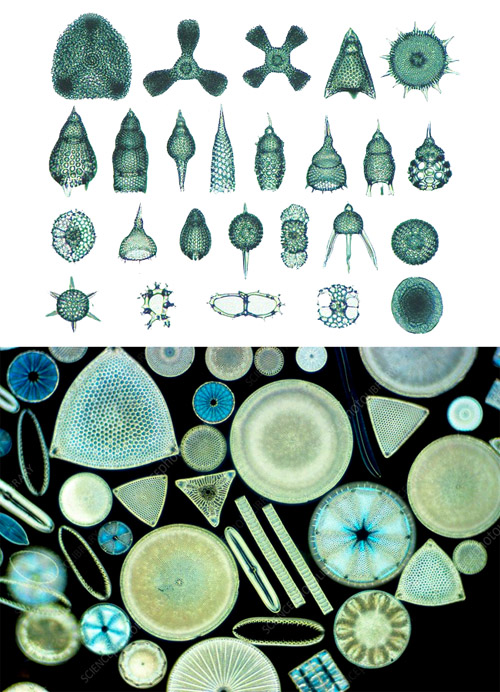
Examples of marine radiolaria (top)

Reactive silica colloids in seawater also participate in inorganic chemical reactions, combining with dissolved metal ions to form complex hydrated aluminosilicates, i.e. more clay minerals. The reactions change the alkalinity of seawater. As a result dissolved HCO3ions transform to CO2 gas and water. Despite the complexity of the chemistry that interweaves the carbon and silicon cycles, there is a simple conclusion. If the abundance of silica-secreting marine organisms falls drastically while continental weathering continues to deliver silica, clay-mineral formation on the ocean floor results in release of CO2 that reverses the effect of enhanced weathering and thus maintains hyperthermal conditions. The other outcome is that less chert and flint granules form Terry Isson and colleagues examined the varying proportion of chert in cores through Lower Triassic marine sediments. A ‘chert gap’characterises the 4 to 6 Ma following the P-Tr boundary event. This can be explained in part by extinction of silica-secreting organisms and by inorganic reactions converting the reactive silica that enhanced weathering delivered to the oceans to clay minerals. This supports the idea that the inorganic part of the silica cycle maintained greenhouse conditions in the absence of organic ‘competition’ for reactive silica. Many other biogeochemical cycles link biological and chemical processes that combine to affect climate: involving phosphorus, nitrogen and iron, to name but three.

‘Mud, mud, glorious mud’

Earth is a water world, which is one reason why we are here. But when it comes to sedimentary rocks, mud is Number 1. Earth’s oceans and seas hide vast amounts of mud that have accumulated on their floors since Pangaea began to split apart about 200 Ma ago during the Early Jurassic. Half the sedimentary record on the continents since 4 billion years ago is made of mudstones. They are the ultimate products of the weathering of crystalline igneous rocks, whose main minerals – feldspars, pyroxenes, amphiboles, olivines and micas, with the exception of quartz – are all prone to breakdown by the action of the weakly acidic properties of rainwater and the CO2 dissolved in it. Aside from more resistant quartz grains, the main solid products of weathering are clay minerals (hydrated aluminosilicates) and iron oxides and hydroxides. Except for silicon, aluminium and ferric iron, most metals end up in solution and ultimately the oceans.  As well as being a natural product of weathering, mud is today generated by several large industries, and humans have been dabbling in natural muds since the invention of pottery some 25 thousand years ago.  On 21 August 2020 the journal Science devoted 18 pages to a Special Issue on mud, with seven reviews (Malakoff, D. 2020. Mud. Science, v. 369, p. 894-895; DOI: 10.1126/science.369.6506.894).

Mud carnival in Brazil (Credit: africanews.com)

The rate at which mud accumulates as sediment depends on the rate at which erosion takes place, as well as on weathering. Once arable farming had spread widely, deforestation and tilling the soil sparked an increase in soil erosion and therefore in the transportation and deposition of muddy sediment. The spurt becomes noticeable in the sedimentary record of river deltas, such as that of the Nile, about 5000 years ago. But human influences have also had negative effects, particularly through dams. Harnessing stream flow to power mills and forges generally required dams and leats. During medieval times water power exploded in Europe and has since spread exponentially through every continent except Antarctica, with a similar growth in the capacity of reservoirs. As well as damming drainage these efforts also capture mud and other sediments. A study of drainage basins in north-east USA, along which mill dams quickly spread following European colonisation in the 17th century, revealed their major effects on valley geomorphology and hydrology (see: Watermills and meanders; March 2008). Up to 5 metres of sediment build-up changed stream flow to an extent that this now almost vanished industry has stoked-up the chances of major flooding downstream and a host of other environmental changes. The authors of the study are acknowledged in one Mud article (Voosen, P. 2020. A muddy legacy. Science, v. 369, p. 898-901; DOI: 10.1126/science.369.6506.898) because they have since demonstrated that the effects in Pennsylania are reversible if the ‘legacy’ sediment is removed. The same cannot be expected for truly vast reservoirs once they eventually fill with muds to become useless. While big dams continue to function, alluvium downstream is being starved of fresh mud that over millennia made it highly and continuously productive for arable farming, as in the case of Egypt, the lower Colorado River delta and the lower Yangtze flood plain below China’s Three Gorges Dam.

Mud poses extreme risk when set in motion. Unlike sand, clay deposits saturated with water are thixotropic – when static they appear solid and stable but as soon as they begin to move en masse they behave as a viscous fluid. Once mudflows slow they solidify again, burying and trapping whatever and whomever they have carried off. This is a major threat from the storage of industrially created muds in tailings ponds, exemplified by a disaster at a Brazilian mine in 2019, first at the site itself and then as the mud entered a river system and eventually reached the sea. Warren Cornwall explains how these failures happen and may be prevented (Cornwall, W. 2020. A dam big problem.  Science, v. 369, p. 906-909; DOI: 10.1126/science.369.6506.906). Another article in the Mud special issue considers waste from aluminium plants (Service, R.F. 2020. Red alert. Science, v. 369, p. 910-911; DOI: 10.1126/science.369.6506.910). The main ore for aluminium is bauxite, which is the product of extreme chemical weathering in the tropics. The metal is smelted from aluminium hydroxides formed when silica is leached out of clay minerals, but this has to be separated from clay minerals and iron oxides that form a high proportion of commercial bauxites, and which are disposed of in tailings dams. The retaining dam of such a waste pond in Hungary gave way in 2010, the thixotropic red clay burying a town downstream to kill 10 people. This mud was highly alkaline and inflicted severe burns on 150 survivors. Service also points out a more positive aspect of clay-rich mud: it can absorb CO2 bubbled through it to form various, non-toxic carbonates and help draw down the greenhouse gas.

Muddy sediments are chemically complex, partly because their very low permeability hinders oxygenated water from entering them: they maintain highly reducing conditions. Because of this, oxidising bacteria are excluded, so that much of the organic matter deposited in the muds remains as carbonaceous particles. They store carbon extracted from the atmosphere by surface plankton whose remains sink to the ocean floor. Consequently, many mudrocks are potential source rocks for petroleum. Although they do not support oxygen-demanding animals, they are colonised by bacteria of many different kinds. Some – methanogens – break down organic molecules to produce methane. The metabolism of others depends on sulfate ions in the trapped water, which they reduce to sulfide ions and thus hydrogen sulfide gas: most muds stink. Some of the H2S reacts with metal ions, to precipitate sulfide minerals, the most common being pyrite (FeS2). In fact a significant proportion of the world’s copper, zinc and lead resources reside in sulfide-rich mudstones: essential to the economies of Zambia and the Democratic Republic of Congo. But there are some strange features of mud-loving bacteria that are only just emerging. The latest is the discovery of bacteria that build chains up to 5 cm long that conduct electricity (Pennisi, E. 2020. The mud is electric. Science, v. 369, p. 902-905; DOI: 10.1126/science.369.6506.902). The bacterial ‘nanowires’ sprout from minute pyrite grains, and transfer electrons released by oxidation of organic compounds, effectively to catalyse sulfide-producing reduction reactions. NB Oxygen is not necessary for oxidation as its chemistry involves the loss of electrons, while reduction involves a gain of electrons, expressed by the acronym OILRIG (oxidation is loss, reduction is gain). It seems such electrical bacteria are part of a hitherto unsuspected chemical ecosystem that helps hold the mud together as well as participating in a host of geochemical cycles. They may spur an entirely new field of nano-technology, extending, bizarrely, to an ability to generate electricity from moisture in the air.

If you wish to read these reviews in full, you might try using their DOIs at Sci Hub.

Ants and carbon sequestration

Aside from a swift but highly unlikely abandonment of fossil fuels, reduction of greenhouse warming depends to a large extent, possibly entirely, on somehow removing CO2 from the atmosphere. Currently the most researched approach is simply pumping emissions into underground storage in gas permeable rock, but an important target is incorporating anthropogenic carbon in carbonate minerals through chemical interaction with potentially reactive rocks. In a sense this is a quest to exploit equilibria involving carbon compounds that dominate natural chemical weathering and to sequester CO2 in solid, stable minerals.

The two most likely minerals to participate readily in weathering that involves CO2 dissolved in water are plagioclase feldspar, a calcium-rich aluminosilicate and olivine, a magnesium silicate. Both are abundant in mafic and ultramafic rocks, such as basalt and peridotite, which themselves are among the most common rocks exposed at the Earth’s surface. The two minerals, being anhydrous, are especially prone to weathering reactions involving acid waters that contain hydrogen ions, and in the presence of CO2 they yield stable carbonates of calcium and magnesium respectively. Despite lots of exposed basalts and ultramafic rocks, clearly such natural sequestration is incapable of absorbing emissions as fast as they are produced.

One means of speeding up weathering is to grind up plagioclase- and olivine-bearing rocks and spread the resulting gravel over large areas; as particles become smaller their surface area exposed to weathering increases. Yet it doesn’t take much pondering to realise that a great deal of energy would be needed to produce sufficient Ca- and Mg-rich gravel to take up the approximately 10 billion tonnes of CO2 being released each year by burning fossil fuels: though quick by geological standards the reaction rates involved are painfully slow in the sense of what the climatic future threatens to do. So is there any way in which these reactions might be speeded up?

Two biological agencies are known to accelerate chemical weathering, or are suspected to do so: plant roots and animals that live in soil. Ronald Dorn of Arizona State University set out to investigate the extent to which such agencies do sequester carbon dioxide, under the semi-arid conditions that prevail in Arizona and Texas (Dorn, R.I. 2014. Ants as a powerful biotic agent of olivine and plagioclase dissolution. Geology, v. 42, p. 771-774). His was such a simple experiment that it is a wonder it had not been conducted long ago; but it actually took more than half his working life. Spaced over a range of topographic elevations, Dorn used an augur at each site to drill five half-metre holes into the root mats of native trees, established ant and termite colonies and bare soil surfaces free of vegetation or animal colonies, filling each with sand-sized crushed basalt.

Empire of the Ants (film)
Film poster for Empire of the Ants (starring Joan Collins) (credit: Wikipedia)

Every five years thereafter he extracted the basalt sand from one of the holes at each site and each soil environment. To assess how much dissolution had occurred he checked for changes in porosity, and heated the samples to temperatures where carbonates break down to discover how much carbonate had been deposited. That way he was able to assess the cumulative changes over a 25 year period relative to the bare-ground control sites. The results are startling: root mats achieved 11 to 49 times more dissolution than the control; termites somewhat less, at 10 to 19 times; while ants achieved 53 to 177 times more dissolution. While it was certain that the samples had been continuously exposed to root mats throughout, the degree of exposure to termites and ants is unknown, so the animal enhancements of dissolution are probably minima.

Microscopic examination of mineral grains exposed to ant activity shows clear signs of surface pitting and other kinds of decay. Chemically, the samples showed that exposure to ants consistently increased levels of carbonate in the crushed basalt sand compared with controls, with levels rising by 2 to 4% by mass, with some variation according to ant species. Clearly, there is some scope for a role for ants in carbon sequestration and storage; after all, there are estimated to be around 1013 to 1016 individual ants living in the world’s soils. In the humid tropics the total mass of ants may be up to 4 times greater than all mammals, reptiles and amphibians combined. There is more to learn, but probably a mix of acid secretions and bioturbation by ants and termites is involved in their dramatic effect on weathering. One interesting speculation is that ants may even have played a role in global cooling through the Cenozoic, having evolved around 100 Ma ago.