Tectonic history and the Drake Equation

In 1961 ten scientists interested in a search for extra-terrestrial intelligence met at Green Bank, West Virginia, USA, none of whom were geologists or palaeontologists. The participants called themselves “The Order of the Dolphin”, inspired by the thorny challenge of discovering how small cetaceans communicated: still something of a mystery. To set the ball rolling, Frank Drake an American astrophysicist and astrobiologist, proposed an algorithm aimed at forecasting the number of planets elsewhere in our galaxy on which ‘active, communicative civilisations’ (ACCs) might live. The Drake Equation is formulated as:

ACCs = R* · fp · ne · fl · fi · fc · L

where R* = number of new stars formed per year, fp = the fraction of stars with planetary systems, ne = the average number of planets that could support life (habitable planets) per planetary system, fl = the fraction of habitable  planets that develop primitive life, fi = the fraction of planets with life that evolve intelligent life and civilizations, fc = the fraction of civilizations that become ACCs, L = the length of time that ACCs broadcast radio into space. A team of then renowned scientists from several disciplines discussed what numbers to attach to these parameters. Their ‘educated guesses’ were: R* – one star per year; fp – one fifth to one half of all stars will have planets; ne – 1 to 5 planets per planetary system will be habitable; of which 100% will develop life (fl) and 100% (fi) will eventually develop intelligent life and civilisations; of those civilisations 10 to 20 % (fc) will eventually develop radio communications; which will survive for between a thousand years and 100 Ma (L). Acknowledging the great uncertainties in all the parameters, Drake inferred that between 103 and 108 ACCs exist today in the Milky Way, which is ~100 light years across and contains 1 to 4 x 10¹¹ stars).

Today the values attached to the parameters and the outcomes seem absurdly optimistic to most people, simply because, despite 4 decades of searching by SETI there have been no signs of intelligible radio broadcasts from anywhere other than Earth and space probes launched from here. This is humorously referred to as the Fermi Paradox. There are however many scientists who still believe that we are not alone in the galaxy, and several have suggested reasons why nothing has yet been heard from ACCs. Robert Stern of the University of Texas (Dallas), USA and Taras Gerya of ETH-Zurich, Switzerland have sought clues from the history of life on Earth and that of the inorganic systems from which it arose and in which it has evolved that bear on the lack of any corrigible signals in the 63 years since the Drake Equation (Stern, R.J & Gerya, T.V. 2024. The importance of continents, oceans and plate tectonics for the evolution of complex life: implications for finding extraterrestrial civilizations. Nature (Scientific Reports), v. 14, article 8552; DOI: 10.1038/s41598-024-54700-x – definitely worth reading). Of course, Stern and Gerya too are fascinated by the scientific question as to whether or not there are ‘active, communicative civilisations’ elsewhere in the cosmos. Their starting point is that the Drake Equation is either missing some salient parameters, or that those it includes are assigned grossly optimistic magnitudes.

Life seems to have been present on Earth 3.8 Ga ago but multicelled animals probably arose only in the Late Neoproterozoic since 1.0 Ga ago. So here it has taken a billion years for their evolution to achieve terrestrial ACC-hood. Stern and Gerya address what processes favour life and its rapid evolution. Primarily, life depends on abundant liquid water: i.e. on a planet within the ‘Goldilocks Zone’ around a star. The authors assume a high supply of bioactive compounds – organic carbon, ammonium, ferrous iron and phosphate to watery environments. Phosphorus is critical to their scenario building. It is most readily supplied by weathering of exposed continental crust, but demands continual exposure of fresh rock by erosion and river transport to maintain a steady supply to the oceans. Along with favourable climatic conditions, that can only be achieved by an oxidising environment that followed the Great Oxidation Event (2.4 to 2.1 Ga) and continual topographic rejuvenation by plate tectonics.

A variety of Earth-logs posts have discussed various kinds of evidence for the likely onset of plate tectonics, largely focussing on the Hadean and Archaean. Stern and Gerya prefer the Proterozoic Eon that preserves more strands of relevant evidence, from which sea-floor spreading, subduction and repeated collision orogenies can confidently be inferred. All three occur overwhelmingly in Neoproterozoic and Phanerozoic times. Geologists often refer to the whole of the Mesoproterozoic and back to about 2.0 Ga in the Palaeoproterozoic as the ‘Boring Billion’ during which carbon isotope data suggest very little change in the status of living processes: they were present but nothing dramatic happened after the Great Oxidation Event. ‘Hard-rock’ geology also reveals far less passive extensional events that indicate continental break-up and drift than occur after 1.0 Ga and to the present. It also includes a unique form of magmatism that formed rocks dominated by sodium-rich feldspar (anorthosites) and granites that crystallised from water-poor magmas. They are thought to represent build-ups of heat in the mantle unrelieved by plate-tectonic circulation. Before the ‘Boring Billion’ such evidence as there is does point to some kind of plate motions, if not in the modern style.

How different styles of tectonics influence living processes differently: a single stagnant ‘lid’ versus plate tectonics. (Credit: Stern and Gerya, Fig 2)

Stern and Gerya conclude that the ‘Boring Billion’ was dominated by relative stagnation in the form of lid tectonics.  They compare the influence of stagnant ‘lid’ tectonics on life and evolution with that of plate tectonics in terms of: bioactive element supply; oxygenation; climate control; habitat formation; environmental pressure (see figure). In each case single lid tectonics is likely to retard life and evolution, whereas plate tectonics stimulates them as it has done from the time of Snowball Earth and throughout the Phanerozoic. Only one out of 8 planets that orbit the sun displays plate tectonics and has both oceans and continents. Could habitable planets be a great deal rarer than Drake and his pals assumed? [look at exoplanets in Wikipedia] Whatever, Stern and Gerya suggest that the seemingly thwarted enthusiasm surrounding the Drake Equation needs to be tempered by the addition of two new terms: the fraction of habitable exoplanets with significant continents and oceans (foc)and the fraction of them that have experienced plate tectonics for at least half a billion years (fpt). They estimate foc to be on the order of 0.0002 to 0.01, and suggest a value for fpt of less than 0.17. Multiplied together yields value between less than 0.00003 and 0.002. Their incorporation in the Drake Equation drastically reduces the potential number of ACCs to between <0.006 and <100,000, i.e. to effectively none in the Milky Way galaxy rising to a still substantial number

There are several other reasons to reject such ‘ball-parking’ cum ‘back-of-the-envelope’ musings. For me the killer is that biological evolution can never be predicted in advance. What happened on our home world is that the origin and evolution of life have been bound up with the unique inorganic evolution of the Solar System and the Earth itself over more than 4.5 billion years. That ranges in magnitude from the early collision with another, Mars-sized world that reset the proto-Earth’s geochemistry and created a large moon whose gravity has cycled the oceans through tides and changed the length of the day continually for almost the whole of geological history. At least once, at the end of the Cretaceous Period, a moderately sized asteroid in unstable orbit almost wiped out life at an advanced stage in its evolution. During the last quarter billion years internally generated geological forcing mechanisms have repeatedly and seriously stressed the biosphere in roughly 36 Ma cycles (Boulila, S. et al. 2023. Earth’s interior dynamics drive marine fossil diversity cycles of tens of millions of years. Proceedings of the National Academy of Sciences, v. 120 article e2221149120; DOI: 10.1073/pnas.2221149120). Two outcomes were near catastrophic mass extinctions, at the ends of the Permian and Triassic Periods, from which life struggled to continue. As well as extinctions, such ‘own goals’ reset global ecosystems repeatedly to trigger evolutionary diversification based on the body plans of surviving organisms.

Such unique events have been going on for four billion years, including whatever triggered the Snowball Earth episodes that accompanied the Great Oxygenation Event around 2.4 Ga and returned to coincide with the rise of multicelled animals during the Cryogenian and Ediacaran Periods of the Late Neoproterozoic. For most of the Phanerozoic a background fibrillation of gravitational fields in the Solar System has occasionally resulted in profound cycling between climatic extremes and their attendant stresses on ecosystems and their occupants. The last of these coincided with the evolution of humanity: the only creator of an active, communicative civilisation of which we know anything. But it took four billion years of a host of diverse vagaries, both physical and biological to make such a highly unlikely event possible. That known history puts the Drake Equation firmly in its place as the creature of a bunch of self-publicising and regarding, ambitious academics who in 1961 basically knew ‘sweet FA’. I could go on … but the wealth of information in Stern and  Gerya’s work is surely fodder for a more pessimistic view of other civilisations in the cosmos.

Someone – I forget who – provided another, very practical reason underlying the lack of messages from afar. It is not a good idea to become known to all and sundry in the galaxy, for fear that others might come to exploit, enslave and/or harvest. Earth is still in a kind of  imperialist phase from which lessons could be drawn!

Snowball Earth and the rise of multi-celled life

You can follow my ‘reportage’ on the long running story of the Snowball Earth events during the Neoproterozoic Cryogenian Period (850 to 635 Ma) since 2000 through the index to annual Palaeoclimatology logs (15 posts). Once these dramatic events were over sedimentary rocks deposited around the world during the Ediacaran Period (635 to 541 Ma) record the sudden appearance of large-bodied fossils: the first multicellular animals. This explosion from slimy biofilms and colonies of single-celled prokaryotes and eukaryotes laid the basis for the myriad ecological niches that have characterised Planet Earth ever since. The change saw specialised eukaryote cells (see: The rise of the eukaryotes; December 2017), whose precursors had originated in single-celled forms, begin to cooperate inthe development of complex tissues, organs, and organ systems to form bodies rather than just cell walls. The pulsating evolution, diversification and repeated extinction that followed during the last one tenth of geological time shaped a planet that is unique in the Solar System and possibly in the galaxy, if not the entire universe. The simple biosphere that preceded it, on the other hand, may have emerged on innumerable rocky planets blessed with liquid water to survive little changed for billions of years, as have Earths’ prokaryotes, the Archaea and Bacteria.  

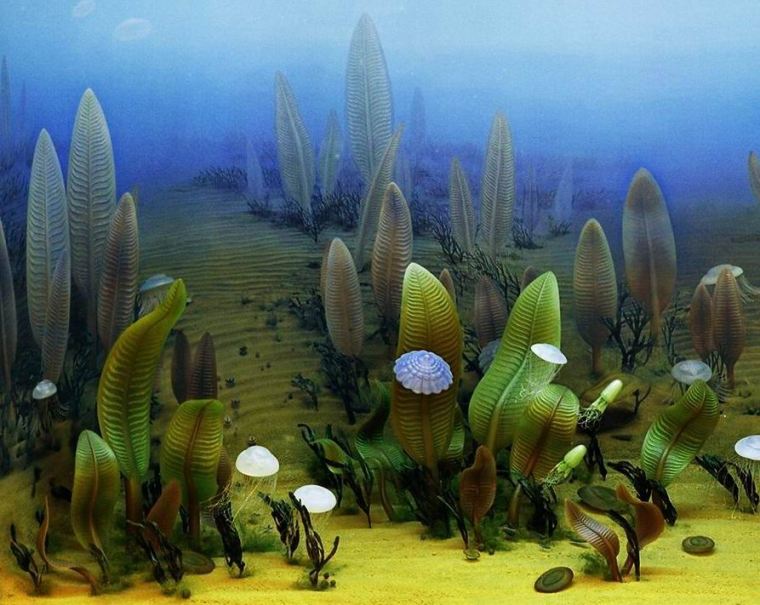
Artist’s impression of the Ediacaran Fauna (credit: Science)

The Ediacaran biological revolution followed repeated changes in the geochemistry of the oceans, which carbon isotope data from the Cryogenian and Ediacaran suggest to have ‘gone haywire’. This turmoil involved dramatic changes in the cycling of sulfur and phosphorus that help ‘fertilise’ the marine food chain and in the production of oxygen by photosynthesis that is essential for metazoan animals.  The episodes when the Earth was iced over reduced the availability of nutrients through decreased rates of ocean-floor burial of dead organisms. Such Snowball events would also have reduced penetration of sunlight in the oceans. Less photosynthesis would not only have reduced oxygen production but also the amounts of autotrophic organisms. Furthermore, decreased water temperature would have increased its viscosity thereby slowing the spread of nutrients. The food chain for heterotrophs was decimated. Each Snowball event ended with warming, ice-free conditions so that the marine biosphere could burgeon

A great deal of data and numerous theories have accumulated since the Snowball concept was first mooted, but there has been little progress in understanding the rise of multi-celled life. Four geoscientists from the Massachusetts Institute of Technology, the Santa Fe Institute and the University of Colorado (Boulder), USA have developed an interesting hypothesis for how this enormous evolutionary step may have developed (Crockett, W.W. et al. 2024. Physical constraints during Snowball Earth drive the evolution of multicellularity. Proceedings of the Royal Society B: Biological Sciences, v. 291; DOI: 10.1098/rspb.2023.2767). The concatenation of huge events during the Cryogenian and Ediacaran presented continually changing patterns of selective pressures on simple organisms that preceded that time period. Crockett et al. review them in the light of fundamental biology to suggest how multicellular animals emerged as the Ediacara Fauna. Intuitively, such harsh conditions suggest at worst mass, even complete, extinction, at best a general reduction in size of all organism to cope with scarce resources. That the size of eukaryotes should have grown hugely goes against the grain of most biologists’ outlook.

The authors consider the crucial factor to be fundamental differences between prokaryotes and early eukaryotes. Prokaryote cells are very small, and whether autotrophs of heterotrophs they absorb nutrients through their walls by diffusion. Single-celled eukaryotes are far larger than prokaryotes and typically have a flagellum or ‘tail’ so that they can move independently and more easily gather resources. Crockett et al. used computer modelling to simulate the type of life form that could grow and thrive under Snowball conditions. They found that prokaryotes could only grow smaller, being ‘stunted’ by scarce resources. On the other hand eukaryotes would be better equipped to gather resources, the more so if they adopted a simple multicellular form – a hollow, self-propelled sphere about the size of a pea, which the authors dub a choanoblastula. Although no such form is known today, it does resemble the green Volvox algae, and plausibly could have evolved further to the simple forms of the Ediacaran fauna. The next task is either to find a fossil of such an organism, or to grow one.

Was the earliest human ancestor a European?

Charles Darwin famously suggested that humans evolved from apes, and since great apes (chimpanzees, bonobos and gorillas) live in Africa he reckoned it was probably there that the human ‘line’ began. Indeed, the mitochondrial DNA of chimpanzees (Pan troglodytes) is the closest to that of living humans. Palaeoanthropology in Africa has established evolutionary steps during the Pleistocene (2.0 to 0.3 Ma) by early members of the genus Homo: H. habilis, H. ergaster, H. erectus; H. heidelbergensis and the earliest H. sapiens. Members of the last three migrated to Eurasia, beginning around 1.8 Ma with the individuals found at Dmanisi in Georgia. The earliest African hominins emerged through the Late Miocene (7.0 to 5.3 Ma): Sahelanthropus tchadensi, Orrorin tugenensis and Ardipthecus kadabba. Through the Pliocene (5.3 to 2.9 Ma) and earliest Pleistocene two very distinct hominin groups appeared: the ‘gracile’ australopithecines (Ardipithecus ramidus; Australopithecus anamensis; Au. afarensis; Au. africanus; Au. sediba) and the ‘robust’ paranthropoids (Paranthropus aethiopicus; P. robustus and P. boisei). The last of the paranthropoids cohabited East Africa with early homo species until around 1.4 Ma. Most of these species have been covered in Earth-logs and an excellent time line of most hominin and early human fossils is hosted by Wikipedia.

All apes, including ourselves, and fossil examples are members of the Family Hominidae (hominids) which refers to the entire world. A Subfamily (Homininae) refers to African apes, with two Tribes. One, the Gorillini, refers to the two living species of gorilla. The other is the Hominini (hominins) that includes chimpanzees, living humans and all fossils believed to be on the evolutionary line to Homo. The Tribe Hominini is defined to have descended from the common ancestor of modern humans and chimps, and evolved only in Africa. As the definition of hominins stands, it excludes other possibilities! The Miocene of Africa before 7.2 Ma ‘goes cold’ as regards the evolution of hominins.  There are, however fossils of other African apes in earlier Miocene strata (8 to 18 Ma) that have been assigned to the Family Hominidae, i.e. hominids, of which more later.

Much has been made of using a ‘molecular clock’ to hint at the length of time since the mtDNA of living humans and chimps began to diverge from their last common ancestor. That is a crude measure at it depends entirely on assuming a fixed rate at which genetic mutation in primates take place. Many factors render it highly uncertain, until ancient DNA is recovered from times before about 400 ka, if ever. The approach suggests a range from 7 to 10 Ma, yet the evolutionary history of chimps based on fossils is practically invisible: the earliest fossil of a member of genus Pan is from the Middle Pleistocene (1.2 to 0.8 Ma) of Kenya. Indeed, we have little if any clue about what such a common ancestor looked like or did. So the course of human evolution relies entirely on the fossil sequence of earlier African hominins and comparing their physical appearances. Each species in the African time line displays two distinctive features. All were bipedal and had small canine teeth.  Modern chimps habitually use knuckle walking except when having to cross waterways. As with virtually all other primates, fossil or living, male chimps have large, threatening canines. In the absence of ancient DNA from fossils older than 0.4 Ma these two features present a practical if crude way of assessing to when and where the hominin time line leads.

In 2002 a Polish geologist on holiday at the beach at Trachilos on Crete discovered a trackway on a bedding plane in shallow-marine Miocene sediments. It had been left by what seems to have been a bipedal hominin. Subsequent research was able to date the footprints to about 6.05 Ma. Though younger than Sahelanthropus, the discovery potentially challenges the exclusivity of hominins to Africa. Unsurprisingly, publication of this tentative interpretation drew negative responses from some quarters. But the discovery helped resurrect the notion that Africa may have been colonised in the Miocene by hominins that had evolved in Europe. That had been hinted at by the 1872 excavation of Oreopithecus bambolii from an Upper Miocene (~7.6 Ma) lignite mine in Tuscany, Italy – a year after publication of Darwin’s The Descent of Man.

Lignites in Tuscany and Sardinia have since yielded many more specimens, so the species is well documented. Oreopithecus could walk on two legs, its hands were capable of a precision grip and it had relatively small canines. Its Wikipedia entry cautiously refers to it as ‘hominid’ – i.e. lumped with all apes to comply with current taxonomic theory (above). In 2019 another fascinating find was made in a clay pit in Bavaria, Germany. Danuvius guggenmosi lived 11.6 Ma ago and fossilised remains of its leg- and arm bones suggested that it could walk on two legs: it too may have been on the hominin line. But no remains of Danuvius’s skull or teeth have been found. There is now an embarrassment of riches as regards Miocene fossil apes from Europe and the Eastern Mediterranean (Sevim-Erol, A. and 8 others 2023. A new ape from Türkiye and the radiation of late Miocene hominines. Nature Communications Biology, v. 6, article  842.; DOI: 10.1038/s42003-023-05210-5). A number of them closely resemble the earliest fossil hominins of Africa, but most predate the hominin record there by several million years.

Phylogenetic links between fossils assigned to Hominidae found in Africa and north of the Mediterranean Sea. (Credit: Sevim-Erol et al. 2023, Fig 5)

Ayla Sevim-Erol of Ankara University, Turkiye and colleagues from Turkiye, Canada and the Netherlands describe a newly identified Miocene genus, Anadoluvius, which they place in the Subfamily Homininae dated to around 8.7 Ma. Fragments of crania and partial male and female mandibles from Anatolia show that its canines were small and comparable with those of younger African hominins, such as Ardipithecus and Australopithecus. But limb bones are yet to be found. Around the size of a large male chimpanzee, Anadoluvius lived in an ecosystem remarkably like the grasslands and dry forests of modern East Africa, with early species of giraffes, wart hogs, rhinos, diverse antelopes, zebras, elephants, porcupines, hyenas and lion-like carnivores. Sevim-Erol et al. have attempted to trace back hominin evolution further than is possible with African fossils. They compare various skeletal features of different fossils and living genera to assess varying degrees of similarity between each genus, applied to 23 genera. These comprised 7 hominids from the African Miocene, 2 early African hominins (Ardipithecus and Orrorin) and 10 Miocene hominids from Europe and the Eastern Mediterranean. They also assessed similarities with 4 living genera, Homo, orang utan (Pongo), gorilla and chimp (Pan).

The resulting phylogeny shows close morphological links within a cluster (green ‘pools’ on diagram) of non-African hominids with the African hominins, gorillas, humans and chimps. There are less-close relations between that cluster and the earlier Miocene hominids of Africa (blue ‘pool’) and the possible phylogeny of orang utans (orange ‘pool’). Sevim-Erol et al. note that African hominins are clearly more similar and perhaps more closely related to the fossils of Europe and the Eastern Mediterranean than they are to Miocene African hominids. This suggests that evolution among the non-African hominids ceased around the end of the Miocene Epoch north of the Mediterranean Sea. But it may have continued in Africa. Somehow, therefore, it became possible late in Miocene times for hominids to migrate from Europe to Africa. Yet the earlier, phylogenetically isolated African hominids seem to have ‘crashed’ at roughly the same time. Such a complex scenario cannot be supported by phylogenetic studies alone: it needs some kind of ecological impetus.

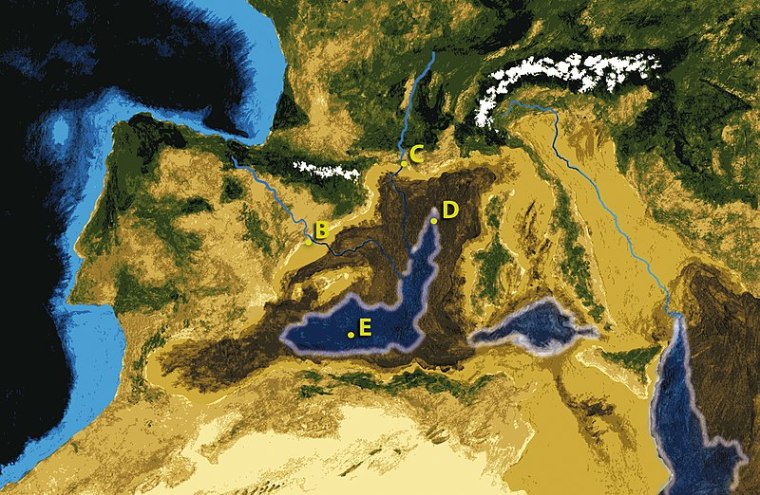
The Mediterranean Basin at the end of the Miocene Epoch when the only water was in the deepest parts of the basin. (Credit: Wikipedia, Creative Commons)

Following a ‘mild’ tectonic collision between the African continent and the Iberian Peninsula during the late Miocene connection between the Atlantic Ocean and the Mediterranean Sea was blocked from 6.0 to 5.3 Ma. Except for its deepest parts, seawater in the Mediterranean evaporated away to leave thick salt deposits. Rivers, such as the Rhône, Danube, Dneiper and Nile, shed sediments into the exposed basin. For 700 ka the basin was a fertile, sub-sea level plain, connecting Europe and North Africa over and E-W distance of 3860 km. There was little to stop the faunas of Eurasia and Africa migrating and intermingling, at a critical period in the evolution of the Family Hominidae. One genus presented with the opportunity was quite possibly the last common ancestor of all the hominins and chimps. The migratory window vanished at the end of the Miocene when what became the Strait of Gibraltar opened at 5.3 to allow Atlantic water. This resulted in the stupendous Zanclean flood with a flow rate about 1,000 times that of the present-day Amazon River. An animation of these events is worth watching

How did African humans survive the 74 ka Toba volcanic supereruption?

The largest volcanic eruption during the 2.5 million year evolution of the genius Homo, about 74 thousand years (ka) ago, formed a huge caldera in Sumatra, now filled by Lake Toba. A series of explosions lasting just 9 to 14 days was forceful enough to blast between 2,800 to 6,000 km3 of rocky debris from the crust. An estimated 800 km3 was in the form of fine volcanic ash that blanketed South Asia to a depth of 15 cm. Thin ash layers containing shards of glass from Toba occur in marine sediments beneath the Indian Ocean, the Arabian and South China Seas. Some occur as far off as sediments on the floor of Lake Malawi in southern Africa. A ‘spike’ of sulfates is present at around 74 ka in a Greenland ice core too. Stratospheric fine dust and sulfate aerosols from Toba probably caused global cooling of up to 3.5 °C over a modelled 5 years following the eruption. To make matters worse, this severe ‘volcanic winter’ occurred during a climatic transition from warm to cold caused by changes in ocean circulation and falling atmospheric CO2 concentration, known as a Dansgaard-Oeschger event.

There had been short-lived migrations of modern humans out of Africa into the Levant since about 185 ka. However, studies of the mitochondrial DNA (mtDNA) of living humans in Eurasia and Australasia suggest that permanent migration began about 60 ka ago. Another outcome of the mtDNA analysis is that the genetic diversity of living humans is surprisingly low. This suggests that human genetic diversity may have been sharply reduced globally roughly around the time of the  Toba eruption. This implies a population bottleneck with the number of humans alive at the time to the order of a few tens of thousands (see also: Toba ash and calibrating the Pleistocene record; December 2012). Could such a major genetic ‘pruning’ have happened in Africa? Over six field seasons, a large team of geoscientists and archaeologists drawn from the USA, Ethiopia, China, France and South Africa have excavated a rich Palaeolithic site in the valley of the Shinfa River, a tributary of the Blue Nile in western Ethiopia. Microscopic studies of the sediments enclosing the site yielded glass shards whose chemistry closely matches those in Toba ash, thereby providing an extremely precise date for the human occupation of the site: during the Toba eruption itself (Kappelman, Y. and 63 others 2024. Adaptive foraging behaviours in the Horn of Africa during Toba supereruption. Nature, v. 627; DOI: 10.1038/s41586-024-07208-3).

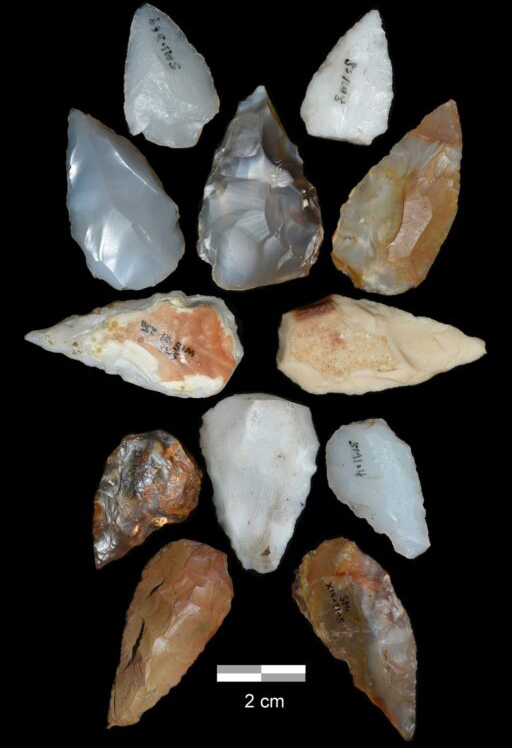
Selection of possible arrowheads from the Shinfa River site (Credit: Kappelman et al.; Blue Nile Survey Project)

The artifacts and bones of what these modern humans ate suggest a remarkable scenario for how they lived. Stone tools are finely worked from local basalt lava, quartz and flint-like chalcedony found in cavities in lava flows. Many of them are small, sharp triangular points, some of which show features consistent with their use as projectile tips that fractured on impact; they may be arrowheads, indeed the earliest known. Bones found at the site are key pointers to their diet. They are from a wide variety of animal, roughly similar to those living in the area at present: from monkeys to giraffe, guinea fowl to ostrich, and even frogs. There are remains of many fish and freshwater molluscs. Although there are no traces of plant foods, clearly those people who loved through the distant effects of Toba were well fed. Although a period of global cooling may have increased aridity at tropical latitudes in Africa, the campers were able to devise efficient strategies to obtain victuals. During wet seasons they lived off terrestrial prey animals, and during the driest times ate fish from pools in the river valley. These are hardly conditions likely to devastate their numbers, and the people seem to have been technologically flexible. Similar observations were made at the Pinnacle Point site in far-off South Africa in 2018, where Toba ash is also present. Both sites refute any retardation of human cultural progress 74 ka ago. Rather the opposite: people may have been spurred to innovation, and the new strategies may have allowed them to migrate more efficiently, perhaps along seasonal drainages. In this case that would have led them or their descendants to the Nile and a direct route to Eurasia; along ‘blue highway’ corridors as Kappelman et al. suggest.

Yet the population bottleneck implied by mtDNA analyses is only vaguely dated: it may have been well before or well after Toba. Moreover, there is a 10 ka gap between Toba and the earliest accurately dated migrants who left Africa – the first Australians at about 65 ka. However, note that there is inconclusive evidence that modern humans may have occupied Sumatra by the time of the eruption.  Much closer to the site of the eruption in southeast India, stone artifacts have been found below and above the 74 ka datum marked by the thick Toba Ash. Whether these were discarded by anatomically modern humans or earlier migrants such as Homo erectus remains unresolved. Either way, at that site there is no evidence for any mass die-off, even though conditions must have been pretty dreadful while the ash fell. But that probably only lasted for little more than a month. If the migrants did suffer very high losses to decrease the genetic diversity of the survivors, it seems just as likely to have been due to attrition on an extremely lengthy trek, with little likelihood of tangible evidence surviving. Alternatively, the out-of-Africa migrants may have been small in number and not fully representative of the genetic richness of the Africans who stayed put: a few tens of thousand migrants may not have been very diverse from the outset.

Consider Homo erectus …

Championed as the earliest commonly found human species and, apart from anatomically modern humans (AMH), the most widespread through Africa and Eurasia. It also endured longer (~1.75 Ma) than any other hominin species, appearing first in East Africa around 2 Ma ago, the youngest widely accepted fossil – found in China – being around 250 ka old. The ‘erects’ arguably cooked their food and discovered the use of fire 1.7 to 2 Ma ago. The first fossils discovered in Java by Eugene Dubois are now known to be associated with the oldest-known art (430 to 540 ka) The biggest issue surrounding H. erectus has been its great diversity, succinctly indicated by a braincase capacity ranging from 550 to 1250 cm3: from slightly greater than the best endowed living apes to within the range of AMH. Even the shape of their skulls defies the constraints placed on those of other hominin species. For instance, some have sagittal crests to anchor powerful jaw muscles, whereas others do not. What they all have in common are jutting brow ridges and the absence of chins along with all more recently evolved human species, except for AMH.

This diversity is summed up in 9 subspecies having been attributed to H. erectus, the majority by Chinese palaeoanthropologists. Chinese fossils from over a dozen sites account for most of the anatomical variability, which perhaps even includes Denisovans, though their existence stems only through the DNA extracted from a few tiny bone fragments. So far none of the many ‘erect’ bones from China have been submitted to genetic analysis, so that connection remains to be tested. Several finds of diminutive humans from the Indonesian and Philippine archipelagos have been suggested to have evolved from H. erectus in isolation. All in all, the differences among the remains of H. erectus are greater than those used to separate later human species, i.e. archaic AMH, Neanderthals, Denisovans, H. antecessor etc. So it seems strange that H. erectus has not been split into several species instead of being lumped together, in the manner of the recently proposed Homo bodoensis. Another fossil cranium has turned up in central China’s Hubei province, to great excitement even though it has not yet been fully excavated (Lewis, D. 2022. Ancient skull uncovered in China could be million-year-old Homo erectus. Nature News 29 November 2022; DOI: 10.1038/d41586-022-04142-00; see also a video). Chances are that it too will be different from other examples. It also presents a good excuse to consider H. erectus.

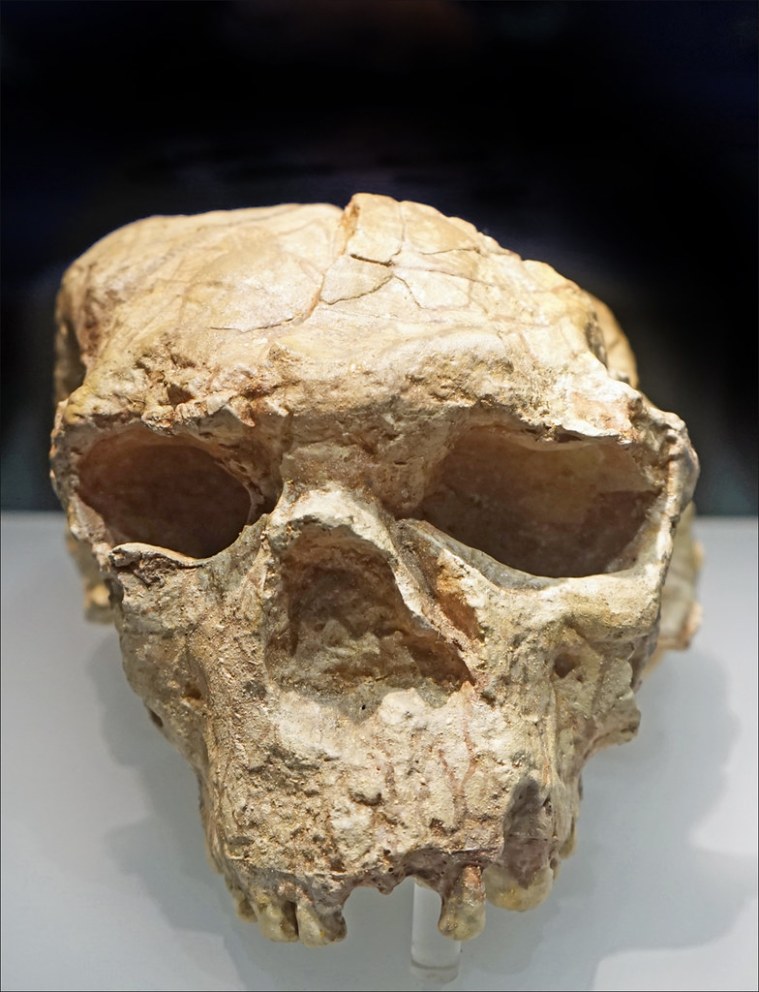
Cranium of a Chinese Homo erectus, somewhat distorted by burial, from a site close to the latest find. (Credit: Hubei Museum, Wuhan, China)

The complications began in Africa with H. ergaster, the originator of the bifacial or Acheulean multi-purpose stone tool at around 1.6 Ma (see: Flirting with hand axes; May 2009), the inventor of cooking and discoverer of the controlled use of fire. ‘Action Men’ were obviously smarter than any preceding hominin, possibly because of an increase of cooked protein and plant resources that are more easily digested than in the raw state and so more available for brain growth. The dispute over nomenclature arose from a close cranial similarity of H. ergaster to the H. erectus discovered in Java in the 19th century: H. erectus ergaster is now its widely accepted name. In 1991-5 the earliest recorded hominins outside Africa were found at Dmanisi, Georgia, in sediments dated at around 1.8 Ma (see: First out of Africa; November 2003) Among a large number of bones were five well-preserved skulls, with brain volumes less than 800 cm3 (see: An iconic early human skull; October 2013). These earliest known migrants from Africa were first thought to resemble the oldest humans (H.habilis) because of their short stature, but now are classified as H. erectus georgicus. They encapsulate the issue of anatomical variability among supposed H. erectus fossils, each being very different in appearance, one even showing ape-like features. Another had lost all teeth from the left side of the face, yet had survived long after their loss, presumably because others had cared for the individual.

The great variety of cranial forms of the Asian specimens of H. erectus may reflect a number of factors. The simplest is that continuous presence of a population there for as long as 1.5 Ma inevitably would have resulted in at least as much evolution as stemmed from the erects left behind in Africa, up to and including the emergence of AMH in North Africa about 300 ka ago. If contact with the African human population was lost after 1.8 Ma, the course of human evolution in Africa and Asia would clearly have been different. But that leaves out the possibility of several waves of migrants into Asia that carried novel physiological traits evolved in Africa to mix with those of earlier Asian populations. From about 1 Ma ago a succession of migrations from Africa populated Europe – H. antecessor, H. heidelbergensis, and Neanderthals and then AMH. So a similar succession of migrants could just as well have gone east instead of west on leaving Africa. Asia is so vast that migration may have led different groups to widely separated locations, partially cut-off by mountain ranges and deserts so that it became very difficult for them to maintain genetic contact. Geographic isolation of small groups could lead to accelerated evolution, similar to that which may have led to the tiny H. floresiensis and H. luzonensisdiscovered on Indonesian and Philippine islands.

 Another aspect of the Asian continent is its unsurpassed range of altitude, latitude and climate zones. Its ecologically diversity offers a multitude of food resources, and both climate and elevation differences pose a range of potential stresses to which humans would have had to adapt. The major climate cycles of the Pleistocene would have driven migration across latitudes within the continent, thereby mixing groups with different physical tolerances and diets to which they had adapted. Equally, westward migration was possible using the Indo-Gangetic plains and the shore of the Arabian Sea: yet more opportunities for mixing between established Asians and newly arrived African emigrants.

An iconic early human skull

The earliest known human fossils outside of Africa were found at a site near Dmanisi in Georgia, between 1991 and 2005, following the discovery there in 1984 of primitive stone tools together with early Pleistocene animal bones. The Dmanisi finds occur with those of sabre-toothed cats and giant cheetahs, and so are probably not interments or in some kind of dwelling but were probably dragged into an underground carnivore den.

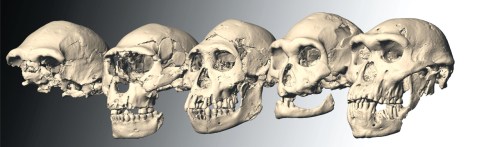
The five Dmanisi skulls of Homo erectus georgicus (credits; M.S. Ponce de Leon & P.E. Zollkofer, University of Zurich)

Initially the remains were assigned to a new species – Homo georgicus – but are now believed to be a subspecies of H. erectus. The finds are anatomically rich, with fossils of at least 5 individuals, both male and female, including 5 well-preserved skulls.  Analysing them has been a long process. Details of the best preserved, indeed the most complete early Homo skull ever found, have taken 8 years since its discovery in 2005 to reach publication (Lordkipanidze, D.  et al. 2013. A complete skull from Dmanisi, Georgia, and the evolutionary biology of early Homo. Science, v. 342, p. 326-331, DOI: 10.1126/science.1238484).

To the surprise of palaeoanthropologists, this specimen of Homo erectus georgicus has some ape-like features, including a protruding upper jaw in a relatively large face that most resembles the oldest African H. habilis, from Ethiopia, dated at 2.3 Ma. With a braincase of 546 cm3, the skull is on the small side of H. habilis and in the range of late australopithecines. Yet, like the much younger Homo floresiensis – dubbed ‘the Hobbit’ – the association with tools, of the most basic Oldowan type,  places it a cut above non-human hominins. The rest of the skeletal fossils show individuals with modern human proportions, albeit somewhat diminutive.

Surprises multiplied when comparative studies of all 5 skulls were complete. They are so different that, if found in widely separated specimens, would be placed in different species by most anatomists. Ruling out the chance association of several human species far from their Africa origins – few would suggest that up to 5 species left Africa at the same time and stuck together – a suggested explanation is that they represent a population of a human lineage in the process of evolving to a new species. The strength of this hypothesis contradicts the other recent view that several human species may have cohabited environments at different times. It also seems to throw into question the adoption of the name H. erectus for later human populations in both Africa and Eurasia: unless, as the authors tentatively suggest, there was genetic continuity and connectivity over large distances between both evolving populations