A possible Chinese ancestor for Denisovans, Neanderthals and modern humans

Assigning human fossils older than around 250 ka to different groups of the genus Homo depends entirely on their physical features. That is because ancient DNA has yet to be found and analysed from specimens older than that. The phylogeny of older human remains is also generally restricted to the bones that make up their heads; 21 that are fixed together in the skull and face, plus the moveable lower jaw or mandible. Far more teeth than crania have been discovered and considerable weight is given to differences in human dentition. Teeth are not bones, but they are much more durable, having no fibrous structure and vary a great deal. The main problem for palaeoanthropologists is that living humans are very diverse in their cranial characteristics, and so it is reasonable to infer that all ancient human groups were characterised by such polymorphism, and may have overlapped in their physical appearance. A measure of this is that assigning fossils to anatomically modern humans, i.e. Homo sapiens, relies to a large extent on whether or not their lower mandible juts out to define a chin. All earlier hominins and indeed all other living apes might be regarded as ‘chinless wonders’! This pejorative term suggests dim-wittedness to most people, and anthropologists have had to inure themselves to such crude cultural conjecture.

The extraction, sequencing and comparison of ancient DNA from human fossils since 2010 has revealed that three distinct human species coexisted and interbred in Eurasia. Several well preserved examples of ancient Neanderthals and anatomically modern humans (AMH) have had their DNA sequenced, but a Denisovan genome has only emerged from a few bone fragments from the Denisova Cave in western Siberia. Whereas Neanderthals have well-known robust physical characters, until 2025 palaeoanthropologists had little idea of what Denisovans may have looked like. Then proteins and, most importantly, mitochondrial DNA (mtDNA) were extracted from a very robust skull found around 1931 in Harbin, China, dated at 146 ka. Analysis of the mtDNA and proteins, from dental plaque and bone respectively, reveal that the Harbin skull is likely to be that of a Denisovan. Previously it had been referred to as Homo longi, or ‘Dragon Man’, along with several other very robust Chinese skulls of a variety of ages.

The distorted Yunxian cranium (right) and its reconstruction (middle) [Credit: Guanghui Zhao] compared with the Harbin Denisovan cranium (left) [Hebei Geo University]

The sparse genetic data have been used to suggest the times when the three different coexisting groups diverged. DNA in Y chromosomes from Denisovans and Neanderthals suggest that the two lineages split from a common ancestor around 700 ka ago, whereas Neanderthals and modern humans diverged genetically at about 370 ka. Yet the presence of sections of DNA from both archaic groups in living humans and the discovery that a female Neanderthal from Denisova cave had a Neanderthal mother and a Denisovan father reveals that all three were interfertile when they met and interacted. Such admixture events clearly have implications for earlier humans. There are signs of at least 6 coexisting groups as far back as the Middle Pleistocene (781 to 126 ka), referred to by some as the ‘muddle in the middle’ because such an association has increasingly mystified palaeoanthropologists. A million-year-old, cranium found near Yunxian in Hubei Province, China, distorted by the pressure of sediments in which it was buried, has been digitally reconstructed.

This reconstruction encouraged a team of Chinese scientists, together with Chris Stringer of the UK Museum of Natural History, to undertake a complex statistical study of the Yunxian cranium. Their method compares it with anatomical data for all members of the genus Homo from Eurasia and Africa, i.e. as far back as the 2.4 Ma old H. habilis (Xiabo Feng and 12 others 2025. The phylogenetic position of the Yunxian cranium elucidates the origin of Homo longi and the Denisovans. Science, v. 389, p. 1320-1324; DOI: 10.1126/science.ado9202). The study has produced a plausible framework that suggests that the five large-brained humans known from 800 ka ago – Homo erectus (Asian), H. heidelbergensis, H. longi (Denisovans), H. sapiens, and H. neanderthalensis – began diverging from one another more than a million years ago. The authors regard the Yuxian specimen as an early participant in that evolutionary process. The fact that at least some remained interfertile long after the divergence began suggests that it was part of the earlier human evolutionary process. It is also possible that the repeated morphological divergence may stem from genetic drift. That process involves small populations with limited genetic diversity that are separated from other groups, perhaps by near-extinction in a population bottleneck or as a result of the founder effect when a small group splits from a larger population during migration. The global population of early humans was inevitably very low, and migrations would dilute and fragment each group’s gene pool.

The earliest evidence for migration of humans out of Africa emerged from the discovery of five 1.8 Ma old crania of H. erectus at Dmanisi to the east of the Black Sea in Georgia. similar archaic crania have been found in eastern Eurasia, especially China, at various localities with Early- to Middle Pleistocene dates. The earliest European large-brained humans – 1.2 to 0.8 Ma old H. antecessor from northern Spain – must have migrated a huge distance from either Africa or from eastern Eurasia and may have been a product of the divergence-convergence evolutionary framework suggested by Xiabo Feng and colleagues. Such a framework implies that even earlier members of what became the longi, heidelbergensis, neanderthalensis, and sapiens lineages may await either recognition or discovery elsewhere. But the whole issue raises questions about the widely held view that Homo sapiens first appeared 300 ka ago in North Africa and then populated the rest of that continent. Was that specimen a migrant from Eurasia or from elsewhere in Africa? The model suggested by Xiabo Feng and colleagues is already attracting controversy, but that is nothing new among palaeoanthropologists. Yet it is based on cutting edge phylogeny derived from physical characteristics of hominin fossils: the traditional approach by all palaeobiologists. Such disputes cannot be resolved without ancient DNA or protein assemblages. But neither is a completely hopeless task, for Siberian mammoth teeth have yielded DNA as old as 1.2 Ma and the record is held by genetic material recovered from sediments in Greenland that are up to 2.1 Ma old. The chances of pushing ancient human DNA studies back to the ‘muddle’ in the Middle Pleistocene depend on finding human fossils at high latitudes in sediments of past glacial maxima or very old permafrost, for DNA degrades more rapidly as environmental temperature rises.

See also: Natural History Museum press release. Analysis of reconstructed ancient skull pushes back our origins by 400,000 years to more than one million years ago. 25 September 2025; Bower, B. 2025. An ancient Chinese skull might change how we see our human roots. ScienceNews, 25 September 2025; Ghosh, P. 2025. Million-year-old skull rewrites human evolution, scientists claim. The Guardian, 25 September 2025

Evolution of pigmentation in anatomically modern humans of Europe: a new paradigm?

The colours of human skin, eyes and hair in living people across the world are determined by variants of genes (alleles) found at the same place on a chromosome. Since chromosomes are inherited from both mother and father, an individual may have the same two alleles (homozygous), or one of each (heterozygous). A dominant allele is always expressed, even if a single copy is present. A recessive allele is only expressed if the individual inherits two copies of it. Most characteristics of individuals result from the interaction of multiple genes, rather than a single gene. A commonly cited example is the coloration of eyes. If we had a single gene for eye colour – that of the iris – that had alleles just for blue (recessive or ‘b’) and one for brown (dominant or ‘B) pigmentation, brown-eyed individuals would have one or two ‘B’ alleles (bB or BB), whereas those with blue eyes would have to have two ‘blue’ alleles (bb). But inheritance is more complicated than that: there are people with green, hazel or grey eyes and even left- and right eyes of different colour. Such examples suggest that there are more than two genes affecting human eye colour, and each must have evolved as a result of mutations. Much the same goes for hair and skin coloration.

A group of scientists from the University of Ferrara in Italy have analysed highly detailed ancient DNA in anatomically modern human remains from Russia (Palaeolithic), Sweden (Mesolithic) and Croatia (Neolithic) to tease out the complexities of pigmentation inheritance. Then they applied a statistical approach learned from that study to predict the likely skin-, eye- and hair pigmentation in 348 less detailed genomes of ancient individuals whose remains date back to 45 Ma ( Silvia Perretti et al, 2025. Inference of human pigmentation from ancient DNA by genotype likelihood. Proceedings of the National Academy of Science, v. 122, article e2502158122; DOI: 10.1073/pnas.2502158122).

An artist’s impression of a Mesolithic woman from southern Denmark (credit: Tom Bjorklund)

All the hunter-gatherer Palaeolithic individuals (12 samples between 45 and 13 ka old) bar one, showed clear signs of dark pigmentation in skin, eyes and hair – the outlier from Russia was probably lighter. Those from the Mesolithic (14 to 4 ka) showed that 11 out of 35 had a light eye colour (Northern Europe, France, and Serbia), but most retained the dark skin and hair expected in descendants of migrants from Africa. Only one 12 ka hunter-gatherer from Sweden had inferred blue eyes, blonde hair, and light skin.  The retention of dark pigmentation by European hunter-gatherers who migrated there from Africa has been noted before, using DNA from Mesolithic human remains and in one case from birch resin chewed by a Mesolithic woman. This called into question the hypothesis that high levels of melatonin in skin, which protects indigenous people in Africa from cancers, would result in their producing insufficient vitamin D for good health. That notion supposed that out-of-Africa migrants would quickly evolve paler skin coloration at higher latitudes. It is now known that diets rich in meat, nuts and fungi – staple for hunter-gatherers – provide sufficient vitamin-D for health at high latitudes. A more recent hypothesis is that pale skins may have evolved only after the widespread Neolithic adoption of farming when people came to rely on a diet dominated by cereals that are a poor source of vitamin-D.

However, 132 Neolithic farmers (10 to 4 ka ago) individuals studied by Perretti et al. showed increased diversity in pigmentation, with more frequent light skin tones, yet dark individuals persisted, particularly in southern and eastern Europe. Hair and eye colour showed considerable variability, the earliest sign of red hair showing up in Turkey. Even Copper- and Bronze Age samples ( 113 from 7 to 3 ka) and those from Iron Age Europeans (25 from 3 to 1.7 ka ago) still indicate common retention of dark skin, eyes and hair, although the proportion of lighter pigmentation increased in some regions of Europe. Other analyses of ancient DNA have shown that the Palaeo- and Mesolithic populations of Europe were quickly outnumbered by influx of early farmers, probably from the Anatolian region of modern Turkey, during the Neolithic. The farming lifestyle seems likely to have allowed the numbers of those who practised it to rise beyond the natural environment’s ‘carrying capacity’ for hunter-gatherers. The former inhabitants of Europe may simply have been genetically absorbed within the growing population of farmers. Much the same absorption of earlier groups seems to have happened with the westward migration from the Ukrainian and Russia steppes of the Yamnaya people and culture, culminating in the start of the European Bronze Age that reached western Europe around 2.1 ka, The Yamnaya introduced metal culture, horse-drawn wheeled vehicles and possibly Indo-European language.

So the novel probabilistic approach to ancient DNA by Perretti et al. also casts doubt on the diet-based evolution of light pigmentation at high latitudes. Instead, pulses of large population movements and thus changes in European population genetics probably account for the persistence of abundant evidence for dark pigmentation throughout Europe until historic times. The ‘lightening’ of Europeans’ physiognomy seems to have been vastly more complex than previously believed. Early Europe seems to have been almost bewilderingly diverse, which make a complete mockery of modern chauvinism and racism. The present European genetic ‘melting pot’ is surprisingly similar to that of Europe’s ancient past.

A book on archaeology, radiocarbon dating, ancient DNA, and how modern humans evolved

Since 2001 Tom Higham, now Professor of Scientific Archaeology at the University of Vienna, helped develop new ways of refining radiocarbon dating at Oxford University’s Research Lab for Archaeology and the History of Art. Specifically his lab learned how to remove contamination of ancient samples by recent carbon and to reduce the detection limit of their accelerator mass spectrometer for the 14C atoms that remained from when they were in living organisms. The Oxford Radiocarbon Accelerator Unit pushed sample dates to the absolute limit of the method: around 50 thousand years. Being among the very best, the ORAU had a path beaten to its doors by archaeologists from across the world keen to get the most believable dates for their samples. Equally, Higham engaged in the field work itself and in the interpretation of other data from sites, such as ancient DNA. An outcome of Higham’s energetic efforts over two decades is his book The World Before Us: How Science is Revealing a New Story of Our Human Origins (paperback edition 2022, Penguin Books,ISBN-10: ‎0241989051). One reviewer commented ‘The who, what, where, when and how of human evolution’.

The World Before Us is not only comprehensive and eminently clear for the lay-reader, but it is more exciting than any science book that I have read. For the moment, it is the latest ‘word’ on early, anatomically modern humans and on the closely related Neanderthals and Denisovans. Its core is about how these three key groups ‘rubbed along’ once they met  in the Late Pleistocene. As an amateur interested in palaeoanthropology, I have tried to keep pace with all the developments in the field since 2001 through Earth-logs, but Higham shows just how much I have missed that is important to the human story. If you have followed my many posts on human evolution and migrations with interest, read his book for a great deal more and a coherent story of how things stand.

Family links among the Neanderthals of Siberia

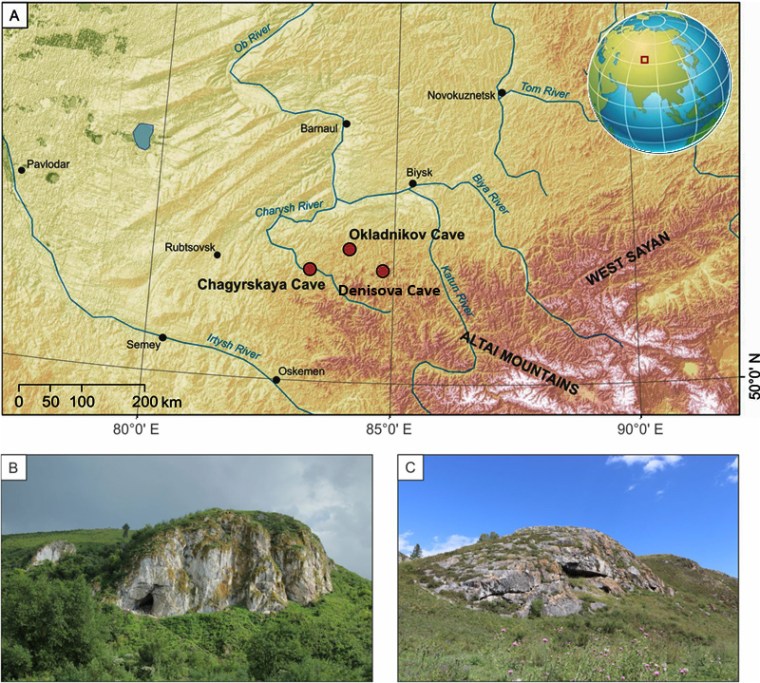
Caves used by the Neanderthals of southern Siberia: A – location map; B – Chagyrskaya Cave; C – Okladnikov Cave. (Credit: adapted from Skov et al.; Extended Data Fig. 1)

The early focus on Neanderthals was on remains found in Western Europe from the 19th century onwards. That has shifted in recent years to southern Siberia in the foothills of the Altai mountains, despite the fossils’ fragmentary nature: a few teeth and bits of mandible. The Denisova Cave became famous not just because it contained the easternmost evidence of Neanderthal occupation but through the genetic analysis of a tiny finger-tip bone. It proved not to be from a Neanderthal but a distinctly different hominin species, dubbed Denisovan (see: Other rich hominin pickings; May 2010). What Denisovans looked like remains unknown but genetic traces of them are rife among living humans of the western Pacific islands and Australia, whose ancestors interbred with Denisovans, presumably in East Asia. Modern people indigenous to Europe and the Middle East have Neanderthal genes in their genomes. Other bone fragments from Denisova Cave also yielded Neanderthal genomes, and the cave sediments yielded traces of both groups (see: Detecting the presence of hominins in ancient soil samples; April 2017). Then in 2018 DNA extracted from a limb bone from the cave clearly showed that it was from a female teenager who had had a Neanderthal mother and a Denisovan father (see: Neanderthal Mum meets Denisovan Dad; August 2018). These astonishing and unexpected finds spurred further excavations and genetic analysis in other caves within 100 km of Denisova Cave. This was largely led by current and former co-workers of Svanti Pääbo, of the Max Planck Institute for Evolutionary Anthropology, Leipzig, Germany: Pääbo was awarded the 2022 Nobel Prize in Physiology or Medicine for his coordination of research and discoveries concerning ancient human genomes. Their enormous field and laboratory efforts have paid astonishingly valuable dividends (Skov, L. and 34 others 2022. Genetic insights into the social organization of Neanderthals. Nature v. 610, p. 519–525; DOI: 10.1038/s41586-022-05283-y).

To the previously analysed 18 Neanderthal genomes from 14 archaeological sites across Eurasia (including Denisova Cave) Skov et al. have added 13 more from just two sites in Siberia (the Chagyrskaya and Okladnikov caves). Each site overlooks valleys along which game still migrates, so they may have been seasonal hunting camps rather than permanent dwellings: they are littered with bison and horse bones. Tools in the two 59-51 ka old human occupation levels are different from those at the older (130 to 91 Ka) Denisova Cave about 100 km to the east. As at the much older site, human fossils include several teeth and fragments of bones from jaws, hands, limbs and vertebrae. The detailed genomes recovered from 17 finds shows them to be from 14 individuals (12 from Chagyrskaya, 2 from Okladnikov).

Chagyrskaya yielded evidence for 5 females (3 adults and 2 children) and 7 males (3 children and 4 adults). One female estimated to have lost a premolar tooth when a teenager was the daughter of a Chagyrskaya adult male. He, in turn, was brother or father to another male, so the girl seems to have had an uncle as well. Another male and female proved to be second-degree relations (includes uncles, aunts, nephews, nieces, grandparents, grandchildren, half-siblings, and double cousins). The two people from Okladnikov were an adult female and an unrelated male child. The boy was not related to the Chagyrskaya group, but the woman was, her former presence at that cave lingering in its cave-sediment DNA. None of the newly discovered individuals were closely related to six of the seven much older Denisova Cave Neanderthals, but the Okladnikov boy had similar mtDNA to one individual from Denisova.

Further information about the Chagyrskaya group came from comparison of DNA in Y-chromosomes and mitochondria. The father of the teenage girl had two types of mtDNA – the unusual characteristic of heteroplasmy – that he shared with two other males. This suggests that three of the males shared the same maternal lineage – not necessarily a mother – and also indicates that they lived at roughly the same time. The mtDNA recovered from all Chagyrskaya individuals was much more varied than was their Y-chromosome DNA (passed only down male lineage). One way of explaining that would be females from different Neanderthal communities having migrated into the Chagyrskaya group and mated with its males, who largely remained in the group: a ‘tradition’ known as patrilocality, which is practised in traditional Hindu communities, for instance.

So, what has emerged is clear evidence for a closely related community of Neanderthals at Chagyrskaya, although it cannot be shown that all were present there at the same time, apart from the five who show first- or second-degree relatedness or mitochondrial heteroplasmy. Those represented only by individual teeth didn’t necessarily die there: adult teeth can be lost through trauma and deciduous teeth fall out naturally. There was also some individual physical connection between the two caves: The Okladnikov woman’s DNA being in the sediment at Chagyrskaya. Looking for DNA similarities more widely, it appears that all individuals at Chagyrskaya may have had some ancestral connection with Croatian Neanderthals, as did the previously mentioned mother of the Denisovan-Neanderthal hybrid girl. Four of the Chagyrskaya individuals can also be linked genetically to Neanderthals from Spain, more so than to much closer individuals found in the Caucasus Mountains. So, by around 59-51 ka the results of a wave of eastward migration of Neanderthals had reached southern Siberia. Yet the apparent matrilineal relatedness of the Okladnikov boy to the much older Neanderthals of Denisova Cave suggests that the earlier group continued to exist.

The new results are just as fascinating as the 2021 discovery that ancient DNA from Neolithic tomb burials in the Cotswolds of SW England suggests that the individual skeletons represent five continuous generations of one extended family. The difference is that they were farmers tied to the locality, whereas the Siberian Neanderthals were probably hunter gatherers with a very wide geographic range.  Laurits Skov and his colleagues have analysed less than one-quarter of the Neanderthal remains already discovered in Chagyrskaya and Okladnikov caves and only a third of the cave deposits have been excavated. Extracting and analysing ancient DNA is now far quicker, more detailed and cheaper than it was in 2010 when news of the first Neanderthal genome broke. So more Neanderthal surprises may yet come from Siberia. Progress on the genetics of their anatomically-modern contemporaries in NE Asia has not been so swift.

See also:  Callaway, E. 2022. First known Neanderthal family discovered in Siberian cave.  Nature online 19 October 2022.

Genetic material from a baby dinosaur

A clutch of Massospondylus carinatus eggs from the Jurassic of South Africa (credit: Brett Eloff)

Recently, a lot of publicity focussed on stunning CT scans of embryos preserved in fossilised eggs of a Jurassic sauropodomorph dinosaur, which were obtained using very high energy X-rays generated by a synchrotron in France (Chapelle, K.E.J. et al. 2020. Conserved in-ovo cranial ossification sequences of extant saurians allow estimation of embryonic dinosaur developmental stages. Nature Scientific Reports, v. 10, article 4224; doi: 10.1038/s41598-020-60292-z). The images suggest that the embryos’ skulls developed in much the same way as do those of living reptiles. Within a week there emerged an even more compelling dinosaurian scoop: a fossil nestling of a duck-billed dinosaur (hadrosaur) from the Upper Cretaceous of Montana is reported to have yielded evidence for a broad spectrum of cellular materials (Bailleul, A.M. et al. 2020. Evidence of proteins, chromosomes and chemical markers of DNA in exceptionally preserved dinosaur cartilage. National Science Review, v. 7, advance publication NWZ206; DOI: 10.1093/nsr/nwz206).

Alida Bailleul, who works at the Chinese Academy of Sciences in Beijing, and fellow molecular palaeontologists from Canada, the US and Sweden, examined material from the nestling’s skull that was suspected to contain traces of cartilage. Their methods involved microscopic studies of thin sections together with staining and fluorochemical analysis of cellular material extracted by dissolving away bone tissue in acid. The same methodologies were also applied to similar material from modern emu chicks as a means of validating the results from the fossil. Staining used the same chemical that previously had revealed blood proteins in a specimen of Tyrannosaurus rex (see: Blood of the dinosaurs  in Palaeobiology, January 2011). The fluorescence approach dosed the dinosaur cartilage with antibodies against bird collagen, and revealed an immune reaction (green fluorescence) in both fossil material and that from the baby emus.

The researchers also isolated cartilage cells (chondrocytes) from the dinosaur preparations. Two stains (PI and DAPI, for short) that show up DNA were applied, giving positive responses. The PI (propidium iodide) stain is useful as it does not respond to DNA in living material, bit only to that in dead cells, thereby helping to rule out contamination with modern material. Apparently, the double-staining experiments support the presence of double-stranded material that involves at least six base pairs (of ACTG amino acids). This does not prove the existence of dinosaur DNA, but does demonstrate that the hadrosaur’s cell nuclei are preserved.

Does that suggest that the hunt is on for a dinosaur genome, with all its connotations? OK, a complete genome has been extracted from a frozen Siberian mammoth a few tens of thousand years old, which encourages ‘re-wilding’ aficionados, but that animal preserved intact cells of many kinds. A 70 Ma old dinosaur fossil, however exquisitely preserved, is mostly ‘rock’, in that preservation is through mineralisation of bone and tissue, and even cells … Moreover, it is possible that what the team found may even be material from post-mortem bacterial colonisation of any age younger than 70 Ma.

See also: De Lazaro, E. 2020. Scientists Use X-rays to Peer inside Fossilized Dinosaur Eggs Sci News, 10 April 2020; Black, R. 2020. Possible dinosaur DNA has been found. Scientific American, 17 April 2020

Further back in the Eurasian human story

About 800 to 950 thousand years (ka) ago the earliest human colonisers of northern Europe, both adults and children, left footprints and stone tools in sedimentary strata laid down by a river system that then drained central England and Wales. The fossil flora and fauna at the Happisburgh (pronounced ‘Haze-burra’) site in Norfolk suggest a climate that was somewhat warmer in summers than at present, with winter temperatures about 3°C lower than now: similar to the climate in today’s southern Norway. At that time the European landmass extended unbroken to the western UK, so any hunter-gatherers could easily follow migrating herds and take advantage of seasonal vegetation resources. These people don’t have a name because they left no body fossils. A group known from their fossils as Homo antecessor had occupied Spain, southern France and Italy in slightly earlier times (back to 1200 ka). Since the discovery of their unique mix of modern and primitive traits, they have been regarded as possible intermediaries between H. erectus and H. heidelbergensis – once supposed to be the predecessor of Neanderthals and possibly anatomically modern humans (AMH). Since the emergence about 10 years ago of ancient genomics as the prime tool in examining human ancestry the picture has been shown to be considerably more complex. Not only had AMH interbred with Neanderthals and Denisovans, those two groups were demonstrably interfertile too, and a complex web of such relationships had been pieced together by 2016. But there has been a new development.

700 ka Homo erectus from Java: a possible Eurasian ‘super-archaic’ human (credit: Gibbons 2020)

Population geneticists at the University of Utah, USA, have devised sophisticated means of making more of the detailed ATCG nucleotide sequences in ancient human DNA, despite there being very few full genomes of Neanderthals and Denisovans (Rogers, A.R. et al. 2020. Neanderthal-Denisovan ancestors interbred with a distantly related hominin. Science Advances, v. 6, article eaay5483; DOI: 10.1126/sciadv.aay5483). In Earth-logs you may already have come across the idea of the ancestral ‘ghosts’ that are represented by unusual sections of genomes from living West African people. Those sections seem likely to have resulted from interbreeding with an unknown archaic population – i.e. neither Neanderthal nor Denisovan. It now seems that both Neanderthal and Denisovan genomes also show traces of such introgression with ‘ghost’ populations during much earlier times. The ancestors of both these groups separated from the lineage that led to AMH perhaps 750 ka ago. Rogers et al. refer to the earliest as ‘neandersovans’ and consider that they split into the two groups after they entered Eurasia, at some time before 600 ka – perhaps around 740 ka. This division may well have occurred as a result of a population of ‘neandersovans’ having spread over the vastness of Eurasia and growing genetic isolation. The reanalysis of both sets of genomes show evidence of a ‘neandersovan’ population crash before the split. Thereafter, the early Neanderthal population may have risen to around 16 thousand then slowly declined to ~3400 individuals.

A ‘state-of-play’ view of human interbreeding in Eurasia since 2 Ma ago (credit: Gibbons 2020)

However, the ‘neandersovans’ did not enter a new continent devoid of hominins, for as long ago as 1.9 Ma archaic H. erectus had arrived from Africa.  Both Neanderthal and Denisovan genomes record the presence of sections of ‘super-archaic’ DNA, which reflect early  interbreeding with earlier Eurasian populations. Indeed, Denisovans seem to have repeated their ancestors’ sexual exploits, once they became a genetically distinct group.  From the ‘ghost’ DNA fragments Rogers et al. conclude that the ‘super-archaics’ separated from other humans about two million years ago. They were descended from the first ‘Out-of-Africa’ wave of humans, represented by the fossils humans from Dmanisi in Georgia (see First out of Africa, November 2003 and An iconic early human skull,  October 2013 in Earth-logs Human evolution and migrations). A measure of the potential of novel means of analysing available ancient human DNA is the authors’ ability even to estimate the approximate population size of the interbreeding ‘super-archaic’ group at 20 to 50 thousand. Long thought to be impossible, it now seems possible to penetrate back to the very earliest human genetics, and the more DNA that can be teased out of other Neanderthal and Denisovan fossils the more we will know of our origins.

See also: Gibbons, A. 2020. Strange bedfellows for human ancestors. Science, v. 367, p. 838–839; doi:10.1126/science.367.6480.838

Neanderthal Mum meets Denisovan Dad

Two bone fragments from the Denisova Cave – the former abode of an 18th century Russian hermit called Denis – in the Altai region of Siberia yielded ancient  DNA. One matches that from previously analysed Neanderthal remains and the other a genome that could only be ascribed to a hitherto unknown ancient-human population, now known as the Denisovans. Since their discovery further analysis of both modern and ancient DNA has shown that modern humans living outside of Africa contain a few percent of DNA from both ancient-human groups. Soon after leaving Africa some of their ancestors interbred with both; indeed a 40 ka-old modern-human jaw from Romania revealed genetic evidence that the individual had a Neanderthal great-great grandparent. Their descendants spread far and wide to populate Eurasia, Australasia and the Americas. Using the ancient DNA to peer back in time suggests that Neanderthals and Denisovans diverged from a common ancestor between 470 and 380 ka, itself having split from modern-human ancestry between 770 to 550 ka. Denisovan DNA also contains evidence that its ancestry included segments that could only have come from a totally unknown hominin species. Interestingly, DNA from the Neanderthal bone fragment found at Denisova contains fragments from an anatomically modern-human.

Tourists at the entrance to Denisova Cave, Rus...
Tourists at the entrance to Denisova Cave, Russia (credit: Wikipedia)

With such riches from tiny fragments of human bones unearthed from the Denisova Cave, it is no surprise that the team led by Svante Pääbo at the Max Planck Institute for Evolutionary Anthropology in Leipzig, Germany, has subsequently analysed others that showed signs of human proteins. The latest ‘takes the biscuit’. A fragment of limb bone from someone who was at least 13 years old yielded DNA commensurate with their having been the child of a Neanderthal mother and a Denisovan father (Slon, V. and 18 others 2018. The genome of the offspring of a Neanderthal mother and a Denisovan father. Nature, v. 560, published on-line; doi: 10.1038/s41586-018-0455-x). Their child was a girl, who has been nicknamed ‘Denny’ by the team, though ‘Denise’ might seem more appropriate. The only clues to what her father, or any Denisovan, might have looked like stem from a few teeth and a skull fragment from the cave that have yielded Denisovan DNA. The teeth are much larger and the skull fragment is thicker than those of Neanderthals, suggesting that Denisovans were distinctly bigger and more robust than even the sturdy Neanderthals.

The father came from a population related to a later Denisovan found in the cave – the first to be sequenced. This suggests long-term occupancy of the area by Denisovans. But his genome also carries traces of Neanderthal ancestry. Surprisingly, the mother is more closely related to Croatian Neanderthals, rather than to an earlier Neanderthal found in the cave. Neanderthals were clearly capable of migrating between Europe and eastern Eurasia; more than 5000 km in this case. Even though very few archaic humans have been genetically sequenced it is beginning to look as if genetic mixing between diverse hominin groups in the last half million years was common, when they actually met. A custom of marrying outside a closely related group (exogamy) has been popular throughout recorded history; indeed it makes sound genetic sense. With the tiny human population density during the Late Pleistocene, it may then have been cause for mutual celebration.  As documented in Chapters 2 and 3 of David Reich’s Who We Are and How We Got Here (Oxford University Press, 2018) human origins since about 470 ka until the present chart a history of episodic migrations and genetic mixing that certainly makes nonsense of earlier ideas of ‘racial purity’ and casts doubt even on the term ‘species’ as regards members of the genus Homo.

If we are ever to discover who the Denisovans were and what they looked like, the evidence is likely to come from East Asia at latitudes where climate favours preservation of DNA. Advanced sequencing equipment and techniques are now operational in China, where suspected Denisovan remains have been found

See also: Warren, M. 2018. First ancient-human hybrid. Nature, v. 560, p. 417-418; doi: 10.1038/d41586-018-06004-0); Sample, I. 2018. Offspring of Neanderthal and Denisovan identified for first time. The Guardian (22 August 2918).

A revised and updated edition of Steve Drury’s book Stepping Stones: The Making of Our Home World can now be downloaded as a free eBook

Denisovan(?) remains in the garden

On the edge of the small town of Lingjing near Xuchang City in Henan Province, China, local people have long practiced intensive vegetable gardening because the local soil is naturally irrigated by the water table beneath the flood plain deposits of the Yinghe River. In the mid 1960s, around a small spring, they began to find dozens of small stone tools together with animal bones. Only in 2005, after the spring had stopped flowing, did systematic excavation begin (Li, Z.-Y. et al. 2017. Late Pleistocene archaic human crania from Xuchang, China. Science, v. 355, p. 969-972; doi: 10.1126/science.aal2482) About 3.5 m below the surface tools and bone fragments, including one with a carved representation of a bird, occurred just above the base of the modern soil profile. Radiocarbon dating of charcoal from the layer clustered around 13 500 years ago, just before the start of the Younger Dryas cooling episode; probably products of modern humans, although no human remains were found in the layer. Continued excavation penetrated sediments free of fossils and tools down to a depth of 8 m, when stone tools and bone fragments began to turn up again through the lowest 2 m of sediment. Optically stimulated luminescence (OSL) dating of mineral grains, which shows the last time that sediments were exposed to sunlight, produced much older dates between 78 to 123 ka. The thousands of stone flakes and cores, and cut marks on the animal bones found through the fossil-rich layer suggests that this was a site long used for tool making and food preparation, that had begun in the last interglacial period. Among the bones were fragments of the crania of as many as five individual humans.

Who were they? Their age range is tens of thousands of years before anatomically modern humans began to migrate into east Asia, so they are likely to have been an earlier human group. Homo erectus is known to have inhabited China since as early as 1.6 Ma ago and may be a possibility. The other possible group are the Denisovans, known only from their DNA in a small finger bone from a cave in eastern Siberia. Fragments of Denisovan DNA are famously present in that of many living indigenous people from eastern Asia, Melanesia and the Americas, but hardly at all in west Asians and Europeans. They also interbred with Neanderthals and may share a common ancestor with us and them, who lived about 700 ka ago.

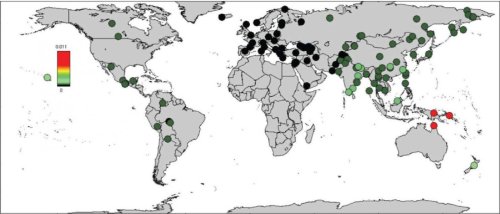
Map showing the proportion of the genome inferred to be Denisovan in ancestry in diverse non-Africans. The color scale is not linear to allow saturation of the high Denisova proportions in Oceania (bright red) and better visualization of the peak of Denisova proportion in South Asia. (Credit: Sankararaman et al./Current Biology 2016;  http://dx.doi.org/10.1016/j.cub.2016.03.037)
Map showing the proportion of the genome inferred to be Denisovan in ancestry in non-Africans. The color scale ranges from black – 0, through greens – present to red – highest . (Credit: Sankararaman et al./Current Biology 2016; http://dx.doi.org/10.1016/j.cub.2016.03.037)

Unfortunately the human bones are completely fragmented and lack any teeth, jaw bones or elements of the face. However, the Chinese-US team used sophisticated computer refitting of CT-scanned fragments to reconstruct two of the crania, revealing one individual with prominent brow ridges and a flat-topped skull extended towards the back, similar to that of Neanderthals but with a much larger brain than H. erectus. The semi-circular canals associated with the ears, but used in balancing, are well preserved and also resemble those of Neanderthals. Yet east Asia has yielded not a single Neanderthal fossil. Could these be the elusive Denisovans? Even if more diagnostic bones turn up, especially teeth, such is the state of late hominin taxonomy that only DNA will provide definitive results: the Denisovans are defined entirely by DNA. The authors, perhaps wisely, do not speculate, but others may not be able to resist the temptation.

For more information on recent human evolution see here.

Gibbons, A. 2017. Close relative of Neandertals unearthed in China. Science, v. 355, p. 899; doi: 10.1126/science.355.6328.899