Rio de Janeiro, a threatened city? Image by Alcindo Correa Filho via Flickr
Earthquake prediction has not had a good record, but it seems that vastly larger tectonic processes are now becoming the subject of risk analysis (Nikolaeva, K. et al. 2011. Numerical analysis of subduction initiation risk along the Atlantic American passive margins. Geology, v. 39, p. 463-466). The Swiss, Russian and Portuguese authors focus on the old (Jurassic ~170 Ma) and presumably cold oceanic lithosphere on the western flank of the Atlantic, against both the North and South American continents. Increased density with ageing imparts a potential downwards force, but that has to overcome resistance to plate failure at passive margins. The dominance of upper continental lithosphere by rheologically weak quartz tends to make it more likely to fail than more or less quartz-free oceanic lithosphere. So, if subduction at a passive continental margin is to take place, then where and when it begins depends on the nature of the abutting continental lithosphere. That on the Atlantic’s western flank varies a lot, ranging from 75-150 km thick. Consequently the temperature at the Moho, the junction between continental lithosphere and weaker asthenosphere, varies too. The loading by marginal sedimentation also plays a role, as do continent-wide forces associated with far-distant mountain ranges, such as the Western Cordillera and Andes, and the forces from opposed sea-floor spreading from the Juan de Fuca and East Pacific systems that affect the whole of western South America, most of Central America and the far NW of North America.
Analysing all pertinent forces acting along 9 lines of section through both North and South America, the authors’ focus fell on the relatively thin continental lithosphere of the Atlantic margin of South America. It is at its thinnest along the southernmost part of the margin adjacent to Brazil, where the Moho temperature reaches as high as 735°C: the weakest link in the American continental lithosphere, where there is seismicity and also indications of igneous activity. The modelling suggests that incipient deformation may begin off southern Brazil within 4 Ma to form a zone of overthrusting, eventually evolving towards failure of the ocean-continent interface and the start of proper subduction in the succeeding 20 Ma. Other stretches of the eastern Americas are deemed safe from subduction for considerably longer by virtue of their greater thickness, lower Moho temperatures and thus higher strength. It is an interesting situation because, insofar as I understand plate tectonics, extensional or compressional failure needed to generate plate boundaries must also propagate from the weak spots that first fail; plate boundaries are lines not points. If that does not happen, then the very strength of the overwhelming longer continent-ocean interface will surely prevent subduction at a single, albeit weak link.
Media coverage of the disasters following the magnitude 9.0 earthquake of 11 March 2011 that devastated the north-eastern coast of Honshu, Japan around the city of Sendai is now (early May) fitful and dominated by the aftermath of the tsunamis’ effect on the Fukushima Daiichi nuclear power station. For those who escaped the tsunamis the experience is irredeemably seared on their memory. Unlike the great waves that killed 10 times more people around the Indian Ocean on 26 December 2004, it will also be unforgettable for those of us far from the event who witnessed the lengthy, high-definition footage captured during the black-water torrents that swept all before them far inland. But that is no longer ‘news’…
Only 6 to 7 weeks later lessons are being learned that probably should have been anticipated long before. Japan has the world’s best disaster preparedness systems. They are centred on civil engineering that was proven to resist great earthquakes by that of 11 March; the terrifying tremors resulted in far fewer casualties than would have been the case anywhere else under such conditions. The tragedy lay with the magnitude of the tsunamis – as high as 30 m in some areas – that reached the coast within an hour of the seismic event. As well as the devastation and loss of life along the coast and up fertile low-lying valleys, waves of this size swept over defences of the coastal Fukushima Daiichi nuclear power plant cutting off emergency power supplies: the world’s largest tsunami barriers proved inadequate to the task and near-meltdown ensued.
Despite the densest network of seismometers anywhere and in-place earthquake early-warning and risk-assessment systems, the events were not forecast and the only warning was that of the earthquake itself which alerted a well-versed population to the imminence of tsunamis to follow. Public education and preparedness proved to be the major life saver, except of course for those tragically killed or lost without trace. So what went wrong?
The risk assessment and warning systems produced results that bore little relation to the actual seismic shaking; the warning was for the immediate vicinity of Sendai city to experience the highest intensities (5-6), most of the rest of Honshu, including Tokyo, having expected intensities in the 2-4 range. For Fukushima Daiichi a maximum magnitude of 7.2 in its vicinity was predicted to have less than 10% chance of occurring over the next 50 years. In reality seismometers across the whole eastern part of the Honshu north of Tokyo recorded intensities between 5-7, demonstrated graphically by numerous CCT recordings in shops and offices. The emerging opinion is that the theory and historic data used for risk and warning systems are flawed or inadequate. For instance the earthquake ripped along 400 km of the Japan Trench subduction zone rather than being a point source – a lesson also from the Sumatra earthquake of 26 December 2004, when ocean-floor thrusting extended 1200 km northwards to the Andaman Islands. Great earthquakes are far too infrequent for sufficient modern-style seismic data to have been collected for previous cases in the 20th century, but it seems clear since 2004 that: (1) stresses accumulate to unexpectedly high values where opposed plates are coupled or stuck together; (2) the ‘point-source’ model for earthquakes, which the use of seismic focuses and epicentres pinpointed by the world-wide seismic network encourages, is far from reality, the more so for the biggest stress accumulations; (3) existing approaches will fail for events with magnitudes greater than 8.0.
NOAA's Prediction of 11 March tsunami wave heights across Pacific Ocean. Image by cogito ergo imago via Flickr
Part of the problem is the sparse record of great earthquakes and the likelihood that, if they do have cyclicity, it may be of the order of hundreds to thousands of years. Historical sources record a large earthquake and tsunamis affecting Sendai district in 869 CE (Common Era), confirmed recently by geologists having located a typical tsunami deposit extending 3-4 km up the Sendai Plain, compared with more than 5 km in March 2011. The survey team claimed at the time that their discovery might indicate far higher risk now in the area than modelled ‘officially’. Sadly, evaluating the prediction was incomplete when disaster did strike. Geoscientists can map faults, infer the length of their activity and work out the mechanisms whereby they fail, but apart from historical data – often sketchy – pinpointing and quantifying past events is beyond us, Looking at more widespread secondary effects, tsunami deposits in particular that often contain dateable organic debris, seems a fruitful way forward for coastal areas likely to bear the brunt of both shaking and huge inundations and the powerful ebbing of their flood waters. That is a topic in its infancy, but likely now to burgeon.
Ominously, because great earthquakes are so rare along any plate boundary, for seven greater than magnitude 8 to occur worldwide in a matter of 6 years (Sumatra, 2004, 9.1, 2005, 8.8, and three with magnitude >7 in 2010; Kuril Islands, 2006, 8.3, 2007, 8.1; Sichuan, 2008, 8.0; Chile, 2010, 8.8; Japan, 2011, 9.0) raises the questions, do they occur in time clusters, and if so, why? Although the numbers are small enough to strain statistics, comparing the last six years with the previous century or so of seismometer recordings shows that great earthquakes have never occurred so frequently. Is there a domino effect so that, say, energy from the Sumatran earthquake of late 2004 has somehow been transmitted throughout the interconnected subduction-zone system to destabilise other highly stressed areas? It is widely acknowledged that in one subduction system there is evidence of clustering, and this may extend to the two great earthquakes (2006 and 2007) in the Kuril Islands on the same boundary as the Sendai event, and two off Sumatra (2004 and 2005) with three more with magnitude >7 in 2010 on what previously had been regarded as a relatively quiescent subduction zone. Analysing all recorded seismic events greater than magnitude 5 to improve the statistics suggests that clustering does not extend to global scales, yet great earthquakes buck other trends shown by lesser ones. Their motions both vertical and lateral could conceivably cause widespread destabilisation, yet worryingly the only test of the idea is the occurrence of yet more in the next few years.
Sources: Normile, D. et al. 2011. Devastating earthquake defied expectations. Science, v. 331, p. 1375-1376; Brahic, C. et al. 2011. Megaquake aftermath. New Scientist, v. 209 (19 March 2011), p. 6-8; Cyranoski, D. Japan faces up to failure of its earthquake preparations. Nature, v. 471, p. 556-557; Normile, D. 2011. Scientific consensus on great quake came too late. Science, v. 332, p. 22-23.
See also: Geller, R.J. 2011. Shake-up time for Japanese seismology. Nature, v. 472, p. 407-409; Kerr, R.A. 2011. New Work reinforces megaquake’s harsh lessons in geoscience. Science, v. 332, p. 911
For decades palaeoanthropologists studying the Americas were dominated by a single idea; that nobody entered the continents before those people who used the elegant fluted spear blades first found near Clovis, New Mexico in the 1930s. These were eventually dated at a maximum age of around 13 ka before the present. One reason for accepting the Clovis people as the first Americans, apart from the lack of conclusive evidence for any earlier occupation, was the fact that glaciers blocked the route from the Bering land bridge of the last Ice age until about 13 ka. But migration may have been possible as far back as 30 ka along the Pacific coast after people crossed the Beringia flatlands exposed by fallen sea-level . There have been suggestions of pre-Clovis sites, but none have carried the weight of evidence to shift the majority from their position. This now has to change because of very high-quality evidence from a site in Texas (Waters, M.R.and 12 others 2011. The Buttermilk Creek complex and the origins of Clovis at the Debra L. Friedkin site, Texas. Science, v. 331, p. 1599-1603). The site in question is in sediments that lie beneath those containing Clovis style tools. In fact it has yielded more than 15 thousand items that are well made, but bear little comparison with the iconic Clovis tools. Almost 50 optically stimulated luminescence (OSL, based on time of burial after exposure to sunlight) dates show a clear increase in age with depth in the excavations, some reaching back as far as 33 ka. The authors favour a conservative approach and restrict their estimated ages to those artefacts found in a well defined stratigraphic horizon, which span the range 13.2 to 15.5 ka. The Clovis-first case seems to be closed, but a new phase in North America aimed at pushing back the time of first human colonising will undoubtedly begin now.
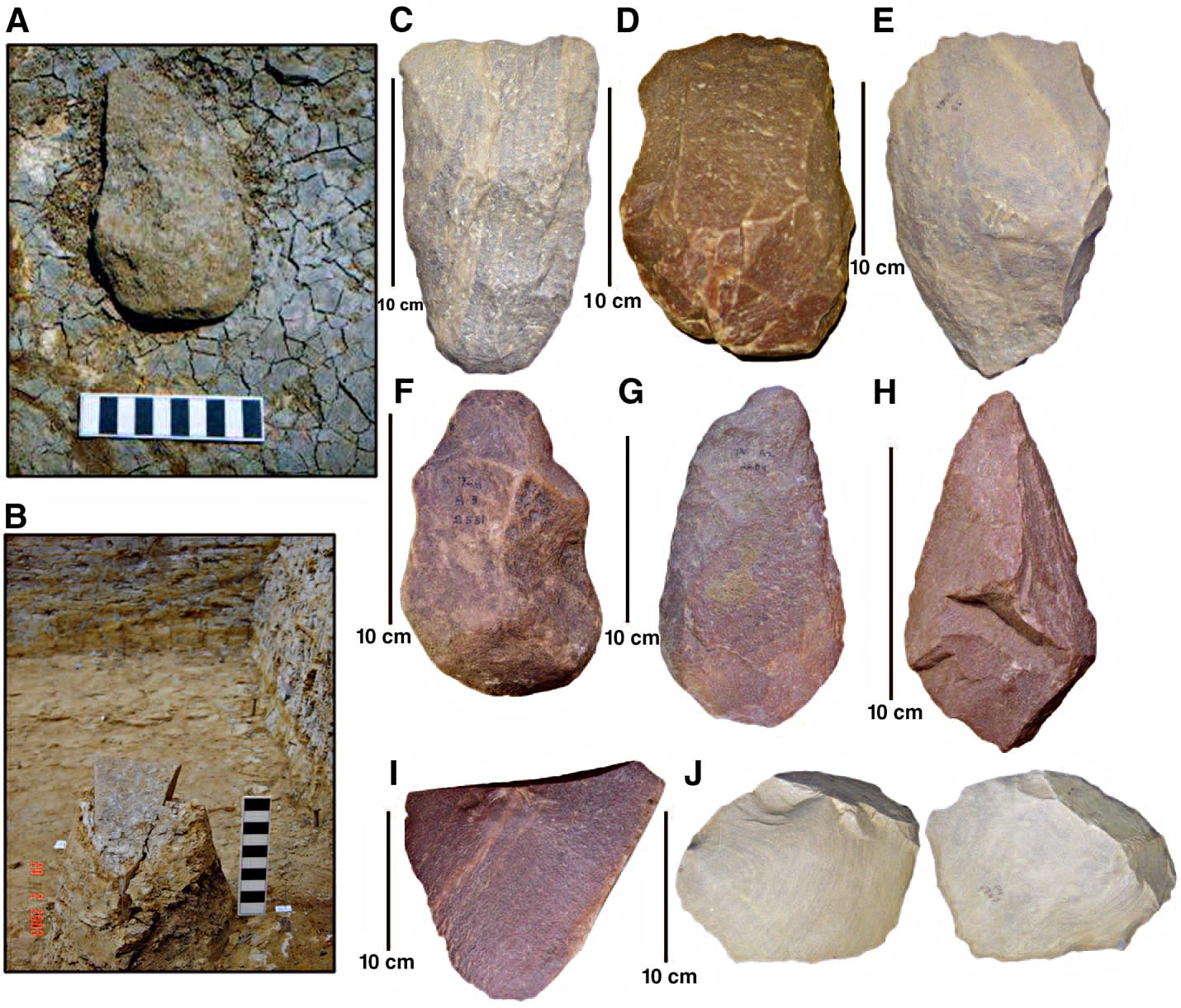
Assorted tools, including biface ‘hand axes, from Attirampakkam. Figure 2 Pappu et al 2011, with kind permission of the authors.
One of the most familiar icons of archaeology, the biface or Acheulean ‘hand axe’ was invented in Africa, presumably by H. ergaster, about 1.6 Ma ago and apart from in the Middle East, where it first occurs around 1.4 Ma, elsewhere it seemed to have been a late arrival in the artefact record. Human colonisation of Asia began as early as 1.8 Ma ago, so in its absence those early arrivals have been assumed not to have brought the Acheulean technology but used less elegant tools similar to the earliest Oldowan edged pebbles. Although parts of Asia were occupied by H. erectus until as recently as ~20 ka, they are believed not to have managed the biface breakthrough. It has been widely accepted that abundant biface tools in India date from about 500 ka ago, presumed to have been brought by H. heidelbergensis migrants.An object lesson in the way that new techniques rather than new archaeological sites can dramatically change such long-held notions has emerged from excavations at Attirampakkam about 30 km NW of Chennai (Madras) in South India (Pappu, S. et al. 2011. Early Pleistocene presence of Acheulian hominins in South India. Science, v. 331, p. 1596-1599). This was the site where Palaeolithic tools were first unearthed in the sub-continent by Robert Bruce Foote in 1863. The Indo-French research team used the cosmogenic isotope- and magnetostratigraphic dating methods to estimate when the tools were buried and discovered a much earlier age than expected, between 1.0 to 1.5 Ma. That throws into question the assumption of younger ages in general for the Acheulean technology in India, but more important, suggests that there was an eastward wave of migration from Africa shortly after the invention of biface tools. A wave of re-evaluation of the somewhat confusing Asian record of early humans seems on the cards.
See also: Dennell, R. 2011. Earlier Acheulian arrival in South Asia. Science, v. 331, p. 1532-1533
Altyn Tagh range at top - click for detail. Image via Wikipedia
The transport of sediment by wind action is generally visualised as sand dunes of all kind of shapes. Yet shifting sand particles arm strong wind in the manner of a sand blaster so that it can act as an agent of erosion to form peculiar landforms known as yardangs, which often parallel the prevailing wind as linear ridges. Yardangs very rarely form from crystalline rocks, but poorly cemented sedimentary rocks are particularly prone to wind erosion. In a few areas that are very arid it is the dominant sculpting process. One such area is the Qaidam Basin (<50 mm of rain per year) at the northern edge of the Tibetan Plateau. The basin is flanked to the north by the Altyn Tagh mountains, and major passes in that range funnel powerful winds across the basin floor. The yardangs of Qaidam are enormous, reaching up to 50 m high and show clearly on satellite images and often camouflage the trend of bedding in the sedimentary rocks from which they are carved. Formerly thought to be a basin in which sediment was accumulating and being actively folded by tectonic forces related to the India-Asia collision zone, recent work reveals several very surprising aspects of local wind action (Kapp, P. et al. 2011. Wind erosion in the Qaidam basin, central Asia: implications for tectonics, palaeoclimate, and the source of the Loess Plateau. GSA Today, v. 21 (April/May 2011) p. 4-10). Since the Late Pliocene the rate of wind erosion has reached as much as 1 mm per year, so that it is a source of sediment not a repository, to the extent that at least a third of the basin is occupied by exposed folded sediments that wind erosion has exhumed. Yet this is not an area noted for large dust storms.
Yardangs in Quaidam. Image by Joe Zhou via Flickr
The folded sediments are early Pleistocene lacustrine silts and fine sands, which sand blasting has easily sculpted, but many of the yardangs are encrusted with a crust of salt. Indeed several generations of such crusts mark wind-eroded surfaces of different relative ages. It seems that the erosion has occurred in episodes, most likely during cold-dry glacial and stadial periods when the northern jet stream probably shifted south from its present local position around 48°N to the latitude of Qaidam (around 40°N) when the Altyn Tagh’s funnelling effect would have been maximised by prevailing north westerly winds that parallels the yardangs. Such episodes can be shown to have eroded hundreds to thousands of metres of the slowly deforming sediments since about 2.8 Ma. It was at that time that folding began in earnest, and quite possibly the unloading effect of the wind erosion may have assisted the deformation. Where did such vast volumes of sediment end up? Downwind to the south east are the famous loess deposits in the headwaters of the Huang He (Yellow River), whose transport of eroded loess accounts for the great fertility of much of China’s soils and thereby its great carrying capacity for human population. Interestingly, the loess deposits show intricate alternations that match the ups and downs of climate through the late Pleistocene. The link with the Qaidam yardang fields seems convincing
In 2008 a team of geophysicists from Cambridge University, UK published an astonishingly detailed picture of about 500 km2 of a land surface complete with drainage systems (Figure 3 in Rudge, J.F. et al. 2008. A plume model of transient diachronous uplift at the Earth’s surface. Earth and Planetary Science Letters, v. 267, p. 146-160). The surprise was not its Palaeogene age (~55 Ma), but that it is buried beneath the Atlantic continental shelf about 200 km west of the Shetland Isles and had been revealed by detailed, 3-D seismic reflection surveys during oil exploration. Technically it is buried landscape unconformity that resulted from uplift (by almost 500 m) and erosion (for ~1.3 Ma) that interrupted Palaeocene to Eocene marine sedimentation and was suddenly buried to preserve the details of river channels: uplift rapidly gave way to subsidence and conditions returned to marine about 0.6 Ma later. The timing and the location of such a transient crustal bulge, during the early part of opening of the North Atlantic, suggests that it stemmed from a thermal source, probably the Iceland hot spot straddled by the mid-Atlantic Ridge. The model favoured by the authors is radially horizontal spreading of a pulse of especially hot mantle outwards from the plume beneath the Iceland hot spot; a ‘plume head’. Volumetric expansion of the lithosphere causes the uplift, and movement away from the plume of the hot mantle results in an annular, outward moving ripple. Cooling once the thermal source has passed produces subsidence.
The idea clearly has ‘legs’ for a whole number of reasons, not the least being the sheer number of long-lived hot spots above mantle plumes that affect the ocean basins and parts of the continents, Africa and North America especially. Now it has been publicised more widely than in a specialised journal (Williams, C. 2011. Pulsating planet. New Scientist, v. 209 (12 March 2011), p. 41-43). One of the original authors is reported to have suggested that the ~55 Ma thermal ripple beneath the nascent North Atlantic may have destabilised gas hydrates in the sediments causing methane to belch out in its wake. That is a possible mechanism for the Palaeocene-Eocene thermal maximum and its huge associated carbon isotope ‘spike’ likely stemming from boosted atmospheric methane.
The Grand Canyon from the South Rim. Image via Wikipedia
Probably the most famous extant bulge is the one through which the Colorado River has carved the USA’s 1.8 km deep Grand Canyon: the Colorado Plateau. Long believed to have formed above hot, low-density lithosphere too, this uplift is the subject of completely new ideas that also have stemmed in part from seismic data, though not produced by artificial reflectance methods. Geophysicists in the US have developed a system that uses hundreds of transportable seismometers that are being ‘marched’ from west to east as an array that uses seismographs from natural earthquakes world-wide to perform seismic tomography –3-D mapping of varying seismic velocities and thereby rigidity and density in the mantle – with improved resolution because of the close spacing of the recording stations. Publications from the Earthscope USarray are beginning to appear from the western USA, one of which concerns the Colorado Plateau (Levander, A.et al, 2011. Continuing Colorado plateau uplift by delamination-stylee convective lithospheric downwelling. Nature, v. 472, p. 461-465). The western part of the plateau is associated with a high-velocity anomaly that extends to around 90m km beneath, which the authors ascribe to a large blob of rigid mantle that has detached from the lithosphere and is slowly sinking. This ‘drip’ is an example of delamination where mantle that becomes detached from the lithosphere causes it to thin and reduces its overall density. The overlying crust rises in response. There is a thermal effect, as warmer, less rigid asthenosphere convects upwards to fill the gap left by the drip, but it is an effect rather than a cause of the uplift.
See also: Zandt, G. & Reiners, P. 2011. Lithosphere today… Nature, v. 472, p. 420-421.
Eclogite from Norway. Image by kevinzim via Flickr
Because the average density of the rocks making up the continental crust is about 2.7 t m-3 while that of the mantle is greater than 3.0 t m-3 it might seem as though continents cannot be subducted. Indeed, that was one of the first principles of plate tectonics, which would account for continental crust dating back to 4000 Ma, whereas there is no oceanic crust older than about 150 Ma. In the southern foothills of the Alps in Piemonte, Italy is a site which refutes the hypothesis in a stunning fashion. The minor ski resort of Monte Mucrone is backed by cliffs in what to all appearances is a common-or-garden granite: it even seems to contain phenocrysts of plagioclase feldspar. Microscopic examination of the megacrysts reveals them to be made up of a complex intergrowth between jadeite, a high-pressure sodic pyroxene, and quartz. This is exactly what should form if albite, the sodium-rich kind of plagioclase feldspar, if it descended to depths over 70 km below the surface, i.e. to mantle depths.
Monte Mucrone proves that continental materials can be subducted, but also reveals that these granites popped back up again when the forces of subduction were relieved at the end of the Alpine orogeny. Other examples have since turned up, but few so spectacular as continental rocks from Switzerland (Herwartz, D. et al. 2011. Tracing two orogenic cycles in one eclogite sample by Lu-Hf garnet chronometry. Nature Geoscience, v. 4, p. 178-183). The Adula nappe of the Swiss Lepontine Alps consists of granitoid gneisses and metasediments of continental affinities, associated with mafic and ultramafic metamorphic rocks. The mafic rocks include eclogites typical of high-pressure, low-temperature metamorphism characteristic of subduction. Their minerals record formation temperatures around 680°C at a depth of more than more than 80 km. Eclogites are beautiful green and red rocks containing high-pressure omphacite pyroxene and pyrope garnet. Garnets generally contain abundant rare-earth elements especially those with the highest atomic numbers. One of these is lutetium (Lu) that has a radioactive isotope 176Lu with a half-life of 3.78×10¹⁰ years to yield a daughter isotope of hafnium 176Hf; garnets can be dated using this method. Garnets are frequently zoned, and the Adula eclogites clearly show several generations of zonation. Zoning can form as metamorphic conditions change, so in itself is not unusual, but dating different generations is. The German team from the Universities of Bonn, Cologne and Münster found that the garnets defined two distinct isochrons, one of Variscan age of just over 330 Ma, the other Alpine around 38 Ma. Clearly the pre-Variscan crust (probably once part of the African continent) had been subducted twice but had wrested itself clear of the mantle’s clutches on both occasions, each time remaining more or less intact. One idea that stems from this coincidence is that the Variscan mountain belt that formed at the earlier subduction zone subsequently split at its high P – low T core, so that the eclogites lay at a new continental margin and could suffer the same extreme compression when new subduction began there.
It also turns out that the region in which Monte Mucrone lies, the Sesia zone of the Western Alps, also records a double whammy of continental subduction, but a repetition that occurred during the early events of the Alpine orogeny (Rubatto, D. et al. 2011. Yo-yo subduction recorded by accessory minerals in the Italian Western Alps. Nature Geoscience, v. 4, p. 338-342). The team of Australian, Swiss and Italian geologists focused on the P-T record preserved in zoned garnets, allanites and zircons and evidence for two generation of white micas in eclogites and blueschists. Backed by U-Pb dating of zircon and allanite zones, the authots uncovered two episodes of deep subduction separated by period of rapid exhumation over the period between 79 to 65 Ma ago. The double subduction took place while the African plate converged obliquely with Eurasia; a strike-slip configuration that probably resulted in large-scale switches from compression to extension.
See also: Bruekner, H.K. 2011. Double-dunk tectonics. Nature Geoscience, v. 4, p. 136-138
Harvey was an imaginary, 2 m tall rabbit which befriended Elwood P. Dowd in Mary Chase’s 1944 comedy of errors named after the said rabbit, filmed in 1950 and starring James Stewart as the affable though deranged Dowd. Though not so tall, a giant fossil rabbit (relative to modern rabbits) weighing it at 12 kg has emerged from the prolific Late Neogene cave deposits of Minorca (Quintana, J. Et al. 2011. Nuralagus rex, gen. et sp. nov., an endemic insular giant rabbit from the Neogene of Minorca (Balearic Islands, Spain). Journal of Vertebrate Paleontology, v. 31, p. 231-240). At about 3 times heavier than Barrington my lagomorphophagic (rabbit-eating to the uninitiated) cat, this would have been, to him, a beast best avoided, as the name N. rex might suggest. So unexpected was a gigantic rabbit that, interestingly, it was first mistaken for a fossil tortoise, albeit one lacking a carapace.
Island faunas have long been recognized as havens for peculiar trends in evolutionary successions, either towards dwarfism as in the case of the tiny elephants on which H. floresiensis preyed until quite recently on the Indonesian island of Flores or gigantism as in this remarkable case. As the authors infer, on account of the creature’s ‘…(short manus and pes with splayed phalanges, short and stiff vertebral column with reduced extension/flexion capabilities), and the relatively small size of sense-related areas of the skull (tympanic bullae, orbits, braincase, and choanae)…’ this was a rabbit which sadly could not hop. This un-rabbit-like locomotion may well have been a result of it not having needed to hop, being so large as to challenge seriously the largest Neogene predators on the island – lizards – and thereby saving energy. For much the same evolutionary logic, neither did N. rex have long ears, having less need to detect a stealthy nemesis.
The demise of Late Neogene megafaunas in general has often been ascribed to human intervention. Though N. rex became extinct at around 3 Ma and avoided human predation, later giants did not fare so well. A case in point is the celebrated wooly mammoth, the last of the steppe mammoths, that first appeared in the fossil record of Siberia around 750 ka ago (Nicholls H. 2011. Last days of the mammoth. New Scientist, v. 209 (26 March 2011), p. 54-57). DNA evidence from hairs preserved in permafrost suggests that ancestors of the steppe mammoth line diverged with that of Asian elephants from African elephant ancestors around 5 Ma. Interestingly, ancestral steppe mammoths – without shaggy coats but having the archetypical curved tusks – roamed Africa until 3 Ma when they disappear to reappear in Europe and Asia, yet without adaptation to cold until the onset of northern glaciations around 2.5 Ma. At that point the true steppe mammoths evolved increased tooth enamel needed for a diet of mainly silica-rich grasses to resist wear. The family spread to North America when sea-level fell to expose the sea floor of the Bering Straits. The woolly mammoth is the star partly because specimens periodically turn up almost perfectly preserved in permafrost. This has allowed almost half of a full DNA sequence to be restored. Preserved haemoglobin from a woolly mammoth shares with that from modern musk oxen an ability to release oxygen at temperatures well below zero so that they could function even if their extremities became chilled.
Reconstructed woolly mammoth at the Royal BC Museum, Victoria, British Columbia (Image via Wikipedia)
Astonishingly, all elephants urinate so copiously that they soak their range lands in DNA, though it only lingers in ultra cold climes. This bizarre fact encouraged a large team of palaeobiologists to comb frozen soils in an alluvium section in Arctic Alaska for mammoth DNA (Haile, J and 17 others, 2009. Ancient DNA reveals late survival of mammoth and horse in interior Alaska. Proceedings of the National Academy of Sciences of the USA, v. 106, p. 22352–22357). Mammoth DNA turned up in soils as young as 10.5 ka. Moreover mammoth overlapped with human occupation for several millennia, casting doubt on theories that mammoth extinction resulted either from human predation or the introduction of epidemic disease that might have felled mammoths quickly: they declined gradually. Yet the empirical fact that steppe mammoths in general and the woolly mammoth in particular survived through at least 8 major glacial-interglacial transitions only to become extinct at the start of the current Holocene interglacial period at the same time as humans recolonised the frigid desert of Arctic latitudes, where woolly mammoths could survive except at the last glacial maximum surely points to some influence that arose from human activity.
The Geologic Time Spiral: A Path to the Past. Designed by Joseph Graham, William Newman, and John Stacy. Get it from http://pubs.usgs.gov/gip/2008/58/
The Système International d’Unités (SI) is the agreed arbiter that defines the units in which phenomena are measured. There are 7 SI base units (length, mass, time, electric current, temperature, intensity of radiation and amount of substance) from which others are derived as they become necessary. Geoscientists have striven to comply, though not always happily. For instance the doubly-derived SI unit for pressure, the pascal (Pa) is a newton (derived unit of force) per square metre (N m-2), and in base units 1 kg m-1 s-2. The pascal replaced the long employed arbitrary unit, the kilobar (1 kb = 1000 x surface atmospheric or barometric pressure) one of which represents about 3.5 km depth in the earth. The reluctance to shift units is probably innate conservatism, for 1 kb = 100 MPa: simples!
Another problem has arisen as regards the SI base unit for time – the second. This is unwieldy for geological time, the Earth having formed approximately 1.435 x 10¹⁷ seconds ago. It’s not so handy for history either, about 3 x 10¹⁰ seconds having elapsed since William of Normandy won the Battle of Hastings.
The year is what we remember, but even that in a historical sense has its problems, for instance the BC/AD division where some scholars even dare to suggest that Christ was born in 4 BC. The more politically correct Common Era (CE) and Before the Common Era (BCE) of course don’t fool anyone. Interestingly, Wikipedia (en.wikipedia.org/wiki/Year) indicates, there are over ten current versions of a ‘year’ depending on context (for instance, astronomers favour the Julian year). Historical and thus geological time has the unnerving habit of continually getting longer, and it is a major problem to measure historical time precisely, either from increasingly vague records as one delves back in historical documents or because of the inherent imprecision in measuring radioactive isotopes and their daughter products that underpins archaeological and geological time. Archaeologists have a very hard time of it, for their workhorse is radiocarbon dating that depends on the production of radioactive 14C in the atmosphere by cosmic ray’s interaction with nitrogen. The rate of 14C production varies over time with the cosmic ray flux from extra-solar sources, and even worse, a very large amount was produced by testing nuclear weapons in the atmosphere in the mid 20th century. Abandoning the BC/AD division that lurks still with historians and archaeologists, geoscientists speak of time ‘before present’ (bp), which doesn’t matter a damn for geological Periods, Eras and Eons which are immensely long whatever the unit. But it does for the Holocene, mainly calibrated by radiocarbon methods: bomb-test production of 14C , which will linger about 50 thousand years before near-complete decay, has forced the ‘present’ to be set at 1950 AD!
So the year is here to stay, even though it is arbitrary and changes all the time, along with kilo, mega and giga prefixes for thousands, millions and billions of years. Yet teeth are now being ground over what the unit’s symbol should be (Biever, C. 2011. Push to define year sparks time war. New Scientist, v. 210 (30 April 2011), p. 10). A task group of geoscientists and chemists set up by the International Union of Pure and Applied Chemistry, IUPAC, and the International Union of Geological Sciences, IUGS in 2006 have now defined the year – why chemists, you might wonder; they measure the radioactive decay constants of isotopes used in radiometric dating. The link to the SI system through the base unit of one atomic-standard second is to be standardised by the solar year; the time in seconds between one solstice and the next at the equator for year 2000: i.e. 3.1556925445 × 10⁷ s (Holden, N.E. et al. 2011. IUPAC-IUGS common definition and convention on the use of the year as a derived unit of time (IUPAC Recommendations 2011). Pure and Applied Chemistry, v. 83, p. 1159-1162). It is to be called the annus (a), applied in ka, Ma or Ga to two usages of time, the time difference between ‘now’ and an event in the past, and the time difference between two events in the past. This dual usage of the same symbol is the source of the gnashing. Whereas Ma, for instance, was quite acceptably used for the measured age of a rock relative to the present, there are at least three schools of thought for other uses of time. Some have been quite happy to use Ma for measured age, a fixed time datum in the past such as the Precambrian-Cambrian boundary, and a time duration such as that of a geological Period or some major event such as an orogeny (that has been used in Earth Pages News since its outset). Others would distinguish between the first and the other two, as for instance Ma for the first and Myr for the other two. But there are variants, the symbol mya having been used for ‘million years ago’, and the international science journal Nature currently uses Myr for the first but now takes the safe path of using ‘million years’ for the other two. Nicholas Christie-Blick of Columbia University in New York is reported as having opined that the rationalisation to one-symbol-fits-all is a huge step backwards, and he is not alone; Science editorial staff will continue to demand of their authors a distinction between age and time span, since a switch would ‘confuse its readers’, long accustomed to that usage.
Also it is so easy to write, ‘the rock has an Ar-Ar age of 25 Ma’, ‘it took 25 Ma for this trilobite to disappear from the geological record’, and ‘about 25 Ma ago, there is a gap in the fossil record of primates’. I personally welcome the simplification, especially as it will encourage authors to write more nicely.
Most people are quite content with an annual holiday abroad, yet a number of geoscientists yearn for something more adventurous. The Croatian geophysicist Andrija Mohorovičić was among the first to study estimates of speeds at which seismic waves travelled through the Earth, discovering in 1909 that below a depth of about 30 km below the continental surface they moved faster than in the uppermost layer. He had discovered the boundary between the continental crust and the underlying mantle, a discontinuity that bears his name though often shortened to the ‘Moho’. Having been traced beneath most of the Earth’s surface, a group of American scientists discussed over a drink or three at a ‘wine breakfast’ in 1957 a project to drill through the Moho to find out what the mantle was made of. The brainchild of Harry Hess, one of the first to suggest plate tectonics as a driving mechanism for continental drift, was dubbed Project Mohole. With US government support, a drilling barge designed for offshore oil drilling and a system of thrusters and pre-GPS locational instrumentation to keep the barge on station the Mohole was spudded in 1961 on the seabed near Guadalupe Island off Baha California in Mexico; about the time that John F. Kennedy declared his belief that the USA could land a man on the Moon by the end of the 1960s. There was something of a thrill factor about Project Mohole, and its first attempts were reported in Life Magazine by John Steinbeck, author of The Grapes of Wrath and amateur oceanographer. It turned out that sending a drill bit to the mantle was more difficult than a manned lunar landing. Only a few metres of basaltic crust was recovered and Congress cancelled Mohole funding in 1966. Nevertheless, the project was the forerunner of the highly successful Ocean Drilling Program and its predecessors, probably the most prolific international collaboration of any kind.
The drilling barge CUSS1 used for the original Mohole Project. Image via Wikipedia
Since the 1960s research into the mantle has been continued with great success by looking at upthrust masses such as those in the Alps and in ophiolite complexes, nodules in alkaline basalts and kimberlites that form below 100 km into the mantle, samples dredged from oceanic fracture zones, and indirectly from the geochemistry of basalts that are derived by partial melting of mantle materials. Yet, there is still an air of frustration about some igneous petrologists and geophysicists; they want to touch the real thing! Now, at last, they may have their chance, for improved drilling and positioning technology developed by ODP and the petroleum industry make a hole through the Moho feasible. Indeed one is planned once drill-bits and lubricants suitable for the anticipated temperatures and pressures have been finalised. Three sites are under consideration: near the original Mohole; in the Cocos Plate off Costa Rica and the Pacific Plate near Hawaii, each combining the coolest crust, thinnest sediment cover and shallowest possible water – i.e. just off a mid-ocean ridge or hot-spot. The Costa Rica site (ODP site 1256) has the thinnest crust due to rapid sea-floor spreading by the East Pacific Rise there and is the most likely to be drilled. It already has a core the penetrates to 1.5 km in oceanic crust and a current project aimed at sampling the cumulate gabbro layer of the lower oceanic crust. That will still be 3.5 km above the local Moho.
There is an obvious question; will an ocean-floor site, however favourable, and a hole drilled through it help resolve fundamental issues regarding the mantle? Well, probably for oceanic lithospheric mantle, but that has had basaltic magma removed from it to form the crust above. Also mid-ocean ridge basalts have geochemical features that suggest that their source mantle had been a melt source previously, compared with the source mantle materials for alkaline and some other types of basalt that seem to have been less depleted in certain elements. The most important question posed by the mantle in general concerns how it originally formed during the Earth’s earliest history, accretion of debris from the solar nebula, the moon-forming event and extraction of the metallic core. A Mohole can contribute little to those issues.
Source: Teagle, D.A.H. & Ildefonse B. 2011. Journey to the mantle of the Earth. Nature, v. 471, p. 437-439.
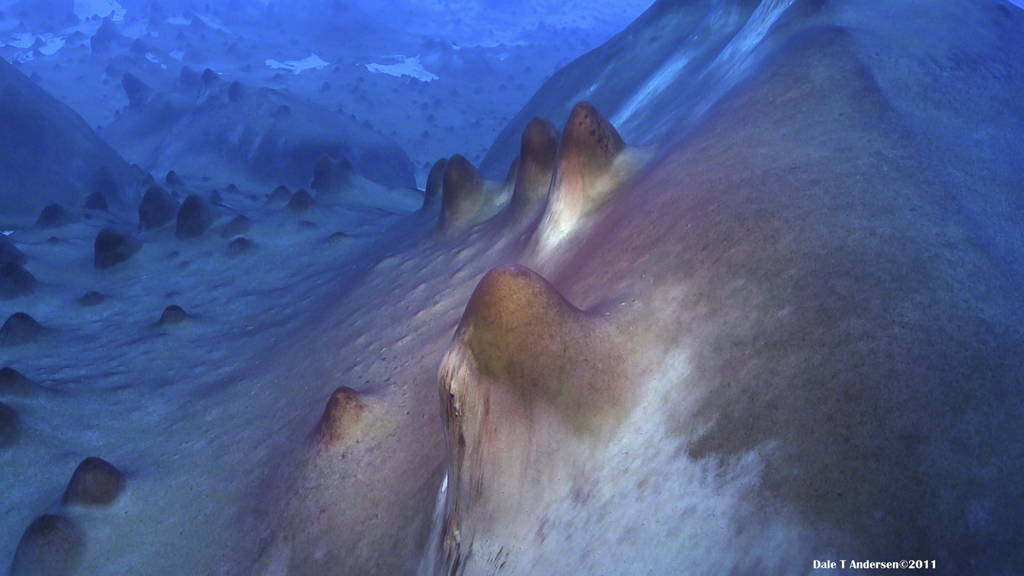
The full ‘Snowball Earth’ model for episodes in the Neoproterozoic that left glaciogenic sediments at near-equatorial palaeolatitudes implies that the oceans were frozen over globally. An objection to that is the likelihood that all photosynthetic activity would have been shut down leading to near catastrophe for all life forms of the time except those based on chemoautotrophic metabolism, as around hydrothermal vents. Antarctica has around 140 lakes that have been frozen over for at least hundreds of thousands if not millions of years, the best known being Lake Vostok, deep within the continent, that Russian scientists are on the verge of tapping after drilling through more than 3 km of glacial ice. Who knows what they might find? Far less extreme, but also having perennial ice cover, is Lake Untersee close to the coast in East Antarctica. Its summer ice cover is 3 m thick and it is presumed to have remained icebound through previous interglacials, although it is fed by meltwater from a nearby glacier in summer. It is not filled with fresh water, however, having a pH up to 12.1, around that of household bleach. It also has very high oxygen content, in fact supersaturated at 50% more than the solubility expected at 0°C. Lake Untersee would be expected to have little life, being an extremely hostile environment. Nonetheless, it does boast a biome and sufficient light gets through the ice cover to support microbial mats of photosynthesising blue-green bacteria (Andersen, D.T. et al. 2011. Discovery of large conical stromatolites in Lake Untersee, Antarctica. Geobiology, v. 9, p. 280–293). As well as perhaps helping elevate the oxygen levels in the lake water, these organisms have secreted stromatolite-like cones, pinnacles and mounds, but not ones made of carbonate. Although the water contains plenty of calcium ions, there is insufficient carbon as CO3 or HCO3 ions for calcite to be precipitated. The carbon-poor nature of the water seems to confirm its long-term isolation from the atmosphere. Instead, the stromatolites are made of laminated clay, maybe derived by exceedingly slow breakdown of feldspars that would also yield calcium and hydroxyl ions to explain the waters peculiar chemistry. The different shapes of stromatolites are linked to different cyanobacterial communities, which may help explain morphological variations among fossil stromatolites.
Stromatolites in Lake Untersee, East Antarctica. Image Dale Andersen,
Carl Sagan Center for the Study of Life in the Universe
The lead author is from the SETI Institute in California, and presumably visited Lake Untersee in the cause of exobiology, as reported in other commentaries on the paper. However, the peculiarities of the lake and its life seem to be just that, with little relevance to frigid sedimentation in the distant past apart from a possible explanation for varying shapes of fossil stromatolites. Nor is the lake sterilised by virtue of perennial ice cover. Being fed by glacial melting it has received rock flour that has broken down to clays, and that implies meltwater carries other materials from the ice cap. Even Antarctica is not isolated from wind-blown dust, so cyanobacteria may have been introduced by sturdy, wind-borne spores being incorporated in the ice cap, eventually to end up in Lake Untersee. It seems that the lead author actually dived in the lake, which puts the fears of contamination by careful drilling into Lake Vostok into perspective. How such an environment links to notions of life elsewhere in the universe is hard to see. The truly fascinating thing about home-grown cyanobacteria is that early variants may well have cuddled up with other simple cells for mutual wellbeing to become the chloroplasts of eucaryan photosynthesising autotrophs, on which most metazoan life on Earth now depends.
A widely accepted view of the departure from Africa of anatomically modern humans to colonise the rest of the habitable world is that it involved them crossing the Straits of Bab el Mandab in the southern Red Sea and following coastlines around Arabia and thence to the rest of Eurasia. That crossing would have become possible when sea level had fallen by more than 80m to expose much of the shelf between southern Eritrea and Yemen; a level that was reached during a glacial stadial from 60 to 70 ka as climate cooled erratically to reach the last glacial maximum. That hypothesis focused archaeologists on the narrow coastal fringe of Arabia in the search for remnants of human occupation. Indeed there have been discoveries of Palaeolithic stone tools in caves and rock shelters in southern and central Oman, and lately in the United Arab Emirates close to the Straits of Hormuz at the outlet of the Persian Gulf (Armitage, S.J. et al. 2011. The southern route ‘out of Africa’: evidence for an early expansion of modern humans into Arabia. Science, v. 331, p. 453-456). The trouble is that optically stimulated luminescence (OSL) dating of the UAE site (Jebel Faya) yielded ages of around 125, 95 and 40 ka for the tool-bearing layers; during the last (Eemian) interglacial, the early cooling in the succeeding glacial epoch and just before the last glacial maximum, respectively. For the two oldest ages sea level would have been high and the Bab el Mandab as wide as it is nowadays.
Armitage et al. focus on the stone tool kits at the site, finding them substantially different from any known Palaeolithic artifacts. The oldest tools are about the same age as those found at sites in the Levant (occupations at ~120 and 80 ka), but unlike them. The best match is with coeval tools from E and NE Africa. Accepting that view could point to a much earlier migration from Africa than currently accepted: probably during the previous glacial maximum (130-140 ka) as proposed by Armitage et al. when crossing the Red Sea would have been even easier because sea level had by then fallen 120 m. Alternatively, the anatomically modern human sites of the Levant may represent ‘waypoints’ along a northerly exodus. That has some geographic support as the narrow Nile flood plain would have provided continuous subsistence for gatherer hunters moving along it throughout even the most arid times. Yet before the hyperarid, and probably impassable desert would have separated the Levant from the Tigris Euphrates plains en route eastwards. Yet there is no evidence, other than their morphology, that the Jebel Faya tools were made by modern humans; skeletal remains are yet to be found and the tools could have been made by more archaic humans from a much earlier diaspora. Until tangible evidence of their association with anatomically modern humans emerges from Jebel Faya or other old Arabian sites, Neanderthals or, quite conceivably, H. erectus remain candidates. Perhaps, however, Jebel Faya presents a sign of a soon-to-come shift in ideas about human migration.
Morocco at the opposite side of the African continent also hosts a potentially revolutionizing discovery at the Grotte des Contrabandiers on the Atlantic coast (Balter, M. 2011. Was North Africa the launch pad for modern human migrations? Science, v. 331, p. 20-23). The cave revealed 108 ka remains of an 8 year-old child. Like other human fossils in Morocco and across North Africa, the child has much larger teeth than other contemporary Africans; a trait shared with some of the earliest anatomically modern human fossils outside the continent, including those found in the Levant. Merely following the Mediterranean coast would have brought migrants of this group into the Levant. Indeed there are old sites all along the Maghreb shore and in the Saharan interior that yield tool kits similar to those of the Grotte des Contrabandiers, which interestingly include triangular blades that may have been arrowheads or spear points. This surprisingly advanced culture, which also contains shell ornaments, has yielded ages up to 145ka. More archaic human remains on the Atlantic coast date to 160 ka suggest that modern-human occupation of North Africa may have been almost as prolonged as that of Ethiopia.
So, there are now two candidate groups of modern humans for populating the rest of the world: those of NE Africa (Nile to Levant and/or via Bab el Mandab to Yemen) and those of North Africa. Using records of past sea level and climate there is scope for hypothesizing multiple migrations. Since early migrants entered unknown territories they did not set out purposively to colonise them. But provided there were navigable and survivable routes simple diffusion could take people far and wide in radiometrically brief periods (order of 1-5 ka) as they followed similarly migrating prey species. As regards sea-level, it was low enough for the Bab el Mandab crossing (and that of the Straits of Hormuz) to be feasible during several stadials of the 240-130 ka glacial, and seashore resources would have sustained migrants hugging the coast during the aridity that accompanies low global mean surface temperatures. The desert stretching from northern Syria to Aqaba on the Red Sea, is passable now during periods of high rainfall, as it would have been during the Eemian interglacial. Yet there is every reason to believe it would have become far more arid in colder global climates; a major barrier to migration.
That humans reached India before crossing the Bab el Mandab was probably not feasible because of high sea level has been suggested from stone tools that occur below a 74 ka volcanic ash layer in Andhra Pradesh, India. The tools lie above sediments with a 77 ka date, and have Middle Palaeolithic characteristics, although that alone does not necessarily signify that they were made by modern humans. If they were then that suggests a route from the Levant eastwards. The search is on for anatomically human remains in Arabia and also in India, although whether they have been preserved in the acid tropical soils of southern India is less likely than in more arid regions.
See also: Petraglia, M.D. 2011. Trailblazers across Arabia. Nature, v. 470, p. 50-51
Anyone who has followed British TV series featuring the survival specialist Ray Mears will be well aware of the wealth of wild foods available from plants even in cold climes: Mears is famous for persuading his camera crews to try what he eats when ‘out bush’. Surviving gatherer-hunters, such as the native people of Australia, have encyclopaedic knowledge of what is edible and how to find plant victuals, and we can surmise that such skills date back to the earliest hominins. Neanderthals have been widely regarded as being exclusive meat eaters – the Innuit of Greenland can subsist on a meat- and fish-only diet, showing that it is a perfectly wholesome strategy – but new evidence reveals that they also ate a wide variety of vegetables, and cooked them. Neanderthals suffered from plaque (calculus) and that dental biofilm preserves traces of their diet (Henry, A. G. et al. 2010. Microfossils in calculus demonstrate consumption of plants and cooked foods in Neanderthal diets (Shanidar III, Iraq; Spy I and II, Belgium), Proceedings of the National Academy of Sciences, doi/10.1073/pnas.1016868108). Teeth from the famous Neanderthal sites of Shanidar in Iraq and Spy in Belgium had substantial plaque deposits. The authors found a wide variety of starch grains and silica-bearing hard parts that are characteristic of a wide range of plants (phytoliths) embedded in the plaques. Food plants included grasses, such as wild barley and sorghum; starchy roots, such as water lily; date palm, and a wide variety of starch grains and phytoliths that proved difficult to link to specific plants. Clearly, Neanderthals were not exclusively hunters of large and small game. The exclusively hunting hypothesis arose from analysis of fossilized fecal matter preserved with Neanderthal remains in occupation sites dating to the onset of frigid conditions in Europe, and in any case only shows what their producer’s last few meals contained. We can expect a closer look at teeth of other hominins from now on, as mineralized plaque is almost as indestructible as teeth themselves.
Neanderthals definitely did hunt, and evidence is that they were able regularly to bring down enormous beasts such as elephants and rhinoceroses. The question is, did they have to chase their prey animals so that they weakened through heat exhaustion before the kill, as in the case of the San hunters of SW Africa? To do that they would have had to be endurance runners. Comparing their ankle bones with those of modern humans suggests they were not very athletic in this way. (Raichlen, S.A. et al. 2011. Calcaneus length determines running economy: Implications for endurance running performance in modern humans and Neandertals. Journal of Human Evolution, v. 60, p. 299-308). Running well and keeping it up over long distances depends to a large extent on the efficiency of the Achilles tendon, the largest in the whole body: it literally puts a ‘spring in the step’ and couples muscle power to the role of feet in running. The calcaneus bone in the ankle provides leverage from the elastic storage of power in the Achilles, so its length is a guide to running efficiency. Neanderthals had a longer calcaneus than modern humans and probably had to spend considerably more muscular energy in keeping up with prey; they would have tired more quickly. The authors put this down to an evolutionary adaptation in cold climes to the lesser chance of prey animals succumbing to heat exhaustion. That would also perhaps explain evidence from other parts of Neanderthal skeletons for severe injuries, probably caused during hunting. They probably used ambush techniques and close-quarters stabbing with spears; a very risky strategy with unexhausted big game.
Interestingly, close on the heels of the Neanderthal Achilles tendon work a newly discovered foot bone of Australopithecus afarensis (Ward, C.V. et al. 2011. Complete fourth metatarsal and arches in the foot of Australopithecus afarensis. Science, v. 331, p. 750-753) shows that, like us, it had arches whereas modern apes do not. This seems to settle a lengthy debate about how australopithecines walked – they are long acknowledged to have been at least part bipedal. The 4th metatarsal is crucial: in apes its shape gives the flexibility needed to negotiate and grip branches, whilst in Homo sp. it endows the foot with the rigidity and stability to balance, absorb shock and use the toes efficiently in walking. This is pretty fundamental stuff en route to ‘proper’ humans, yet skull morphology dominates discussion of hominin anatomical relationships: the earliest tools (~3.4 Ma; see Another big surprise in EPN of September 2010) are a million years older than the earliest human, H. habilis. But they overlap in age with and occur in the same area as Australopithecus afarensis. So, should these beings actually be renamed H. afarensis?
Tantalising glimpses suggesting that Neanderthals were not brutes, such as possible shell jewellery, use of pigments and scattering of flowers at burials, has been accumulating for years. The latest has been unearthed from a cave in the north of Italy, in association with Levallois tools that are distinctive of Neanderthals (Peresani, M. et al. 2011. Late Neandertals and the intentional removal of feathers as evidenced from bird bone taphonomy at Fumane Cave 44 ky B.P., Italy. Proceedings of the National Academy of Sciences, doi:10.1073/pnas.1016212108). Wing bones of vultures, eagles, owls, crows and various other birds show grooves and scratches suggesting that the long flight feathers had been carefully removed: there isn’t much meat on a wing. Since fletched arrows are believed not to have been invented until much later times, it seems pretty certain that the feathers were aimed at personal adornment, or even clothing. The evidence is very convincing and so helps confirm earlier suspicions of feather-use from wing bones found at a variety of Neanderthal sites. Some hollow bird bones are also suspected of having been used as whistles. Given the recent genetic evidence of their sexual interaction with anatomically modern humans, gradual build-up of signs of a rich cultural life make the Neanderthals significantly more attractive than the famous view of geneticist Steve Jones in 1994 that ‘If you met an unwashed Cro Magnon dressed in a business suit on the Underground, you would probably change seats. If you met a similarly garbed Neanderthal, you would undoubtedly change trains’.
A distinctive Ediacaran fossil. Image via Wikipedia
The biota dominated by large, indistinct and generally flabby creatures named together with the eponymous Period (635-542 Ma) from their type occurrence in late Neoproterozoic sediments of the Ediacara Hills of South Australia is made up of imprints of a strange bunch of organisms – bags; discs; donut-shapes and the enigmatic quilted organisms that likely subsisted by osmotically drawing nutrients from ocean water through their skins – together with others that have forms suggestive of extant groups – cnidarians; bilaterian embryos; mollusc-like and segmented forms. The Avalon fauna of Newfoundland, discovered after those of Charnwood Forest, UK and the Ediacara Hills, added other life forms, including the fractal-like rangeomorphs from earlier (~579 Ma) times in the Ediacaran. Recently, the oldest known (630-551 Ma) members of the Ediacaran biota were presented (Yuan, X. et al. 2011. An early Ediacaran assemblage of macroscopic and morphologically differentiated eukaryotes. Nature, v. 470 , p. 390-393). Unlike the better known organisms that were preserved against all odds in quite coarse sand- and siltstones, the host rocks in South China are a more familiar lagerstätten of black shales in which fossils take the form of carbonaceous films. These preserve considerable detail and are unlike the later Ediacaran organisms. Many resemble marine algae (seaweeds), some very like kelp, in their living positions and probably represent quite sunlit seabed habitats(the authors also suggest that some rare forms may be bilaterian worms and cnidarians). Dating of this Lantian assemblage stems from several ash beds and correlation of C-isotope anomalies with other Ediacaran sections.
From their age, the Lantian fossils are of organisms that evolved shortly after the Marinoan (635 Ma) ‘Snowball Earth’ episode, whereas the faunas of Newfoundland and Australia followed the less prominent Gaskiers glacial epoch (582 Ma). So they represent another evolutionary surge presaged by global ice cover and massive stress for all terrestrial life. If the Lantian organisms were algae, then photosynthesising eukaryotes may have been the first large multicelled organisms. All eukaryotes – autotrophs and heterotrophs – are obliged to live in oxygenated conditions, so at least shallow water after the Marinoan glacial event must have been such, although preservation of the Lantian fossils does indicate anoxic conditions during burial. The association of evolutionary bursts with two ‘Snowball Earth’ periods ought to point palaeobiologists to the sedimentary sequences that followed the earliest such event, the Sturtian (~720 Ma), which shows similar violent swings in C-isotopes that indicate surges and declines in burial of organic matter. So far only sponge-like fossils have been found from the Cryogenian Period of the Neoproterozoic that encompasses the Sturtian and Marinoan glacial episodes (Maloof, C. & 8 others 2010. Possible animal-body fossils in pre-Marinoan limestones from South Australia. Nature Geoscience, v. 3, p. 653-659).
The uncoiled ammonite Baculites used in the study. Image via Wikipedia
Emerging in the Upper Palaeozoic and rapidly diversifying through the Mesozoic, thereby surviving over a period of 340 Ma, ammonites proved to be a stratigrapher’s dream organism as well as being the most widely collected fossils. As well as their rapid evolution of form, they were able to spread widely though the oceans in larval form, through the jet propulsion they shared with other cephalopods and because they floated when dead and drifted with currents. Much of ammonite taxonomy has centred for almost two centuries on their external for: ribs, keels, knobbles, intricacy of the sutures separating each body chamber and the previous one and whether or not their growing shell coils hid earlier parts or developed into an open spiral. These characteristics enables such a wealth of easily recognised genera and species that as zone fossils ammonites have been used to finely divide Mesozoic sediments; Jurassic ammonites locally divide the Jurassic (199 – 145 Ma) into time slices each of which represent a few hundred thousand years.
What is least familiar to non-specialists is the feeding apparatus of ammonites and what they actually ate. Thanks to the use of high energy X-ray images it turns out that, unlike squid, octopuses and the similar looking modern Nautilus, some Cretaceous ammonites would not have been able to rip apart large prey (Kruta, I et al. 2011. The role of ammonites in the Mesozoic marine food web revealed by jaw preservation. Science, v. 331, p. 70-72). Instead of a large beak-like process the ammonites studied sported a rasp-like radula, similar to that used on lettuce by the slug. The radula is armed with tiny but quite fearsome looking barbs, suitable for grating but not gnawing. The analysed ammonites may probably have eaten plankton. Indeed, one specimen turned out to have fragments of its last meal lodged in its radula; an isopod and a small gastropod. That diet tallies with the likely habitat of some ammonites; they were probably able to change their buoyancy by manipulating the gas and water content of their abandoned earlier body chambers to move up and down in the upper ocean. However, such was the stratigraphic duration, global spread and diversification of the ammonites, further studies of this kind would be needed to verify general plankton feeding. However, such a diet may well explain the conundrum of the total extinction of ammonites at the end of the Cretaceous while the superficially similar nautiloids survived and live today. The Cretaceous-Palaeocene (K-P formerly K-T) mass extinction devastated plankton, while larger marine organisms lived on to serve as nautiloids prey.
Twin Creeks gold mine, Nevada, USA; Carlin-style mineralisation. Image via Wikipedia
With the price of gold having climbed to above $1400 oz-1 while social revolutions develop in North Africa and the Middle East, articles on how gold deposits form will get a wider readership than they would have during its doldrum years in the late 20th century – the price has increased 7-fold since 2000. The bulk of gold nowadays can be mined profitably from ores in which it cannot be seen, except using a microscope, at grades well below 1 g t-1 (1 part per million) thanks to cheap heap-leaching with sodium cyanide of lightly milled ore. The epitome of low-grade gold is that produced at huge open-pit mines in Nevada from sedimentary host rocks. The gold is far too fine grained to have been deposited as placers, and also occurs dissolved in pyrite (Fe2S), so most experts regard it as having been introduced by hydrothermal fluids. Yet that covers two possibilities: by deep penetration of groundwater or from magmatic waters, and it is hard to decide which, again because the mineralisation is too fine grained to allow conclusive studies of fluid inclusions and stable isotopes. Also, such evidence as there is suggests low temperature fluids (~200° C) with low salinity; ambiguous data.
By using a synergy of ore-mineral chemistry, experimental data and ages of magmatism and mineralisation, Nevadan geologists have developed a convincing model for these ‘Carlin-type’ deposits (Muntean, J.L. et al. 2011. Magmatic-hydrothermal origin of Nevada’s Carlin-type gold deposits. Nature Geoscience, v. 4, p. 122-127). First, the mineralisation is of Eocene age and was introduced in Lower Palaeozoic sediments. The Eocene in the western USA saw the end of a period of compressional tectonics related to subduction since the Jurassic, fluids from which gave rise to partial melting of the overlying mantle wedge. This was succeeded by extensional tectonics and further intrusive magmatism dated between 40 to 36 Ma. This provided thermal energy and passageways for fluid migration. The second line of evidence is that hydrogen- and oxygen isotopes from fluid inclusions in hydrothermal gangue minerals show evidence that both mantle-derived and meteoric water mixed in the ore-forming fluids, and sulfur isotopes are similarly evidence of dual origin. Thirdly, the authors reasonably postulate from experimental data that basaltic back-arc magmas of Jurassic to Eocene age may have repeatedly added metals, including gold, to the mantle wedge that underpinned Nevada during subduction over a 175 Ma period. Thus later extension-related magmatism sourced in the wedge would itself have become metal enriched from this ‘fertile’ source. Moreover, conditions would have been ripe for highly oxidised conditions in the magmas and high concentrations of water in their fractionated descendants. Under such conditions gold and other metals favour entry into hydrothermal fluids. Given the extensional tectonic conditions such fluids could rise efficiently. Initially highly saline and very hot, rapid rise of the fluids would eventually result in them cooling adiabatically and separating into a dense salty liquid or brine and remaining vapour. That would force down the chlorine content in the vapour, favour some metals (Fe, Ag, Pb, Zn and Mn) ending up in the brine, while others (Au, Cu, As and Sb together with S) would remain in the vapour phase together with dissolved CO2 in large amounts, making the vapour acidic. Able to pass into the fractured Palaeozoic cover, the fluids widened fractures in the carbonate sediments and facilitated their own precipitation of minerals, the foremost being gold-bearing pyrite. Nevada is probably unique, but my goodness it is a big gold province; >6000 t of gold in tham thar hills.
Damage in Christchurch, New Zealand. Image by Shazster via Flickr
Every time seismic disaster strikes, as it did in Christchurch New Zealand on 22 February 2011 to kill at least 160 people and destroying a third of the city’s buildings, people long for some means to be forewarned of pending earthquakes early enough to escape collapsing buildings. Many approaches have been suggested over the years, such as changing water levels in wells, increased emission of radon and even the behaviour of animals in advance of major events. Ideally, seismic early warning tools should be generally applicable, easily implemented and possible to telemeter immediately to local and national authorities. Probably the best place to seek such a method is in the field of seismology itself, and one candidate recently emerged (Bouchon, M. et al. 2011. Extended nucleation of the 1999 Mw 7.6 Izmit earthquake. Science, v. 331, p. 877-880). This examines foreshocks of the tragic events at around midnight 16 August 2009 in NW Turkey that ripped along 150 km of the North Anatolian Fault to kill around 17 000 people. The seismological records of the Izmit earthquake are not good quality, but Michel Bouchon and his French and Turkish colleagues, experts on the event, were able mine the ‘blurred’ data using new techniques. What they found was a sequence of 18 small earthquakes up to 45 minutes before the main one, each of which showed remarkably similar seismogram traces. From them they were able to show that most of the foreshocks arose from the same place on the fault and involved the same kind of deformation; by slippage in a patch or nucleus only about a few hundred metres wide at 15 km depth on the main fault. At each successive foreshock the rate of slip can be shown to have speeded up, and in the final 2 minutes before the main earthquake the localised acceleration was at its fastest. Also the low-frequency ‘rumble’ associated with each shock steadily got more powerful. These features define a similar shape for each seismogram record in the foreshock sequence.
Radar interferogram showing the movement along the North Anatolian Fault during the 16 August 2009 Izmit earthquake. Each sequence of colours (lower left) represents 28 mm of movement Image via Wikipedia
The Izmit data tally well with a theoretical scenario for the initiation of movement along a fault. As tectonic stress builds up it begins to be dissipated by slow creep that can focus on a small part of the fault. Since this weakens that patch, subsequent creep is likely to favour the same place which becomes a nucleus for later events. If the stress loading is large enough to presage an eventual rip along a greater section of the fault such a major event will probably propagate sideways from the nucleus weakened by creep. Given sensitive seismometers suitably placed along threatening faults zones linked by telemetry to a central unit, as might seem sensible anyway, automated analysis of foreshock records with the signature of spatially restricted creep that begin to show an accelerating sequence might give the 5 to 10 minutes of warning that are the minimum to reduce fatalities in major earthquakes. However, analysis of better data from some other earthquakes does not reveal the same features, but it is early days and similar patterns may emerge from yet others: fault systems behave in a range of ways depending on their tectonic settings. The other issue is the cost of installations and facilities and their maintenance over long periods – how could somewhere like Haiti find the resources. And sadly, some earthquakes, like that beneath Christchurch occur on faults that show no sign at the surface.
Fly ash from coal-fired power station. Image via Wikipedia
It is hardly contested these days that the massive Siberian Traps – the largest known continental flood basalt province – had something to do with the mass extinction at the Permian/Triassic boundary. Yet what actually produced sufficient, planet-wide environmental stress to slaughter up to 90% of all previously living species has not been pinned down. It was probably a combination of direct and indirect outcomes of the volcanic outpourings and several mechanisms have been suggested, such as: acid rain produced by SO2 emissions from the magma; global warming as a result of volcanic CO2 having accumulated in the atmosphere; a marked fall in the oxygen content of the atmosphere (see New twist for end-Permian extinctions in the May 2005 issue of EPN); increased phosphate fertilization of the oceans leading to anoxia and release of hydrogen sulfide gas.
Interestingly, the part of Siberia where the basalt floods took place is rich in coal measures and carbon-rich shales. Their thermal metamorphism by an overlying pile of lavas could conceivably have added huge amounts of CO2 and methane to the atmosphere, creating strong greenhouse conditions: gas release from combustion and baking would have been almost instantaneous as each major flow came into contact with carbonaceous sediments. Yet direct evidence of widespread carbon combustion at the P/Tr boundary has not yet been demonstrated, although there are abundant gas-release structures in Siberia of around that age (Svenson, H. et al. 2009. Siberian gas venting and the end-Permian environmental crisis. Earth and Planetary Science Letters, v. 277, p. 490-500).
From a study of a near-continuous section of deep water marine sediments, whose ages range from Late Carboniferous to Cretaceous, something surprising has emerged. Silica-rich shales that span the P/Tr boundary show a major shift in d13C that matches the C-isotopic signature of the boundary elsewhere, and two lesser anomalies before the boundary event. At each C-isotope anomaly the shales also contain fly ash (Grasby, S.E. et al. 2011. Catastrophic dispersion of coal fly ash into oceans during the latest Permian extinction. Nature Geoscience, v. 4, p. 104-107), which forms today only in the rapid high-temperature combustion of coal in thermal power stations. It does not form from natural fires in underground and exposed coal seams that are caused by spontaneous combustion, usually ignited by rapid oxidation of pyrite in coal. The ash particles are smaller than 50 µm, and like similar sized, but denser, volcanic ash could easily be carried large distances. The Canadian team suggests that the fly ash formed when Siberian Trap basalts burned coals and organic-rich sediments, explosive release or explosive phases of the volcanism injecting them high in the atmosphere. Coal fly ash is not identifiable by normal microscopy, and its absence from the geological record may reflect that fact. Using organic petrography routinely on rocks from occurrences of the P/Tr and other boundary sequences should settle the matter.
One of the main controls over Earth’s climate is the way that water in the North Atlantic convects. At present it is behaving like a liquid conveyor belt that links the tropics and well to the north of the Arctic Circle. Warm salty water that reaches boreal latitudes cools and also becomes saltier as sea ice freezes out fresh water. It therefore gets denser and sinks to the ocean floor in the Denmark Strait between Iceland and Greenland, and between Iceland and the Faeroe Isles. This downwelling drags surface water polewards from the tropics to replenish the system, thereby creating the Gulf Stream and North Atlantic Drift that warms coastal north-western Europe as far as the northern tip of Scandinavia. It was not always this way; evidence has accumulated to indicate that the North Atlantic ‘conveyor’ shut down periodically during the run-up to the last glacial period and in the climatic hiccup of the Younger Dryas (12.6-11.5 ka). The best supported hypothesis as to why it may do that is through massive influx of freshwater to lower the density of surface water in the northernmost North Atlantic. The progressive summer retreat of sea-ice in the Arctic Ocean and the likelihood of ice-free summers there in the near future raises fears that such a shut-down may occur once again, because of freshening of surface water by ice meltwater, with devastating climatic results for Europe at least. The circulation also transports carbon dioxide dissolved in cold descending surface water to abyssal depths helping buffer its atmospheric concentration: a shut-down would allow greenhouse gas emitted by society to build up in the air.
One means of investigating the mechanisms that underlie ‘on’ and ‘off’ switching in ocean convection is to use sea-floor sediment data from the18 ka long period since the last glacial maximum (Thornalley. D.J.R. et al. 2011. The deglacial evolution of North Atlantic convection. Science, v. 331, p. 202-205). The British-US consortium used oxygen isotope data from the planktonic (near-surface) foraminifera Neogloboquadrina pachyderma preserved in sea-floor sediment cores from south of Iceland, close to where surface water descends today, to assess sea-surface temperature variations. Because of the continual exchange of CO2 between surface water and the atmosphere, the ocean surface contains the same radioactive 14C content in carbon as does the atmosphere, at whose top the isotope is produced. When water descends this connection is cut and the proportion of 14C in it decays so that it is theoretically possible to work out the time at which deep water began to descend – its ‘ventilation age’. In practice this is done by measuring the ‘age’ of carbon preserved in planktonic and benthonic (deep- and bottom-water) foram shells, the planktonic age being the actual age used to assess the age difference between deep and surface waters. In the case of a complete shut-down of the convection the ventilation age should be high and constant; exactly the case during the last glacial maximum (19-22 ka) and most of Heinrich Stadial 1 (16.5-19 ka). When the ‘conveyor’ is functioning the ventilation age should be low, in fact from about 16-11.5 ka the ventilation age fluctuates to show 3 major and 2 lesser low to high episodes during the Bølling-Allerød and Younger Dryas, suggesting that indeed there was repeated turning-on and turning-off of the conveyor, probably triggered by pulses of fresh water into the northern North Atlantic from glacial melting. The resolution of these data is of the order of 350 years, so there may be finer detail of great interest as regards future climate.
See also: Sarnthein, M. Northern meltwater pulses, CO2, and changes in Atlantic convection. Science, v. 331, p. 156-158.
First five confirmed planets discovered by Kepler mission Image via Wikipedia
There is little doubt that it can be done, but what is so compelling about the search for worlds that orbit other stars?
By the end of the 21st century’s first decade 500 such exoplanets had been discovered, ranging from super gas giants almost 10 thousand times the mass of the Earth to a few that are comparable in size to our home world. At present the records of size and orbital radius are biased by the relative ease
of detecting large bodies over that of Earth-sized objects. Another bias is the greater chance of observing the change in luminosity of a star as one of its planets passes between us and the star – a transit – if the planet’s orbital period is short, being close to the star. The majority of known exoplanets are less than about 8 times the Earth’s orbital radius (1 astronomical unit or AU) away from their star, although some truly huge bodies have been spotted that are up to a thousand times more remote from a star than ours is.
Kepler spacecraft. Image via Wikipedia
The rate of discovery is set to burgeon now that data from NASA’s Kepler exoplanet-finding mission, launched in 2009, is producing data (Reich, E.S. 2011. Beyond the stars. Nature, v. 470, p. 24-26). The 0.95 m Kepler space telescope gazes continually at a patch of sky containing 150 thousand Milky Way stars, many of which are like the Sun. It uses the transit method, and because it is fixed on only one star field it can potentially pick up the variation of stars’ luminosity due to transiting planets that are about the size of the Earth and larger. The computations are, unsurprisingly, massive and any dips in the light curves for pixels that represent individual stars have to be confirmed by other methods or by Kepler detecting repeats of the fluctuation. One drawback is that the transit method only provides the radius of a planet and its orbital period. Mass is needed to work out an exoplanet’s density and that requires another method using the red-shift of a star due to the gravitational effect of a planet causing it to wobble; a technique fraught with difficulties and best applied to dwarf red stars. The density is important for discriminating silicate-rich exoplanets from gas-liquid bodies. The main aim of planet finders is to find those around the same size and mass as the Earth that orbit a star at a distance where they would be warm enough for liquid water to exist but not so warm that it existed only as a vapour: in the so-called ‘Goldilocks zone’.
There was an initial flurry of excitement in the press in 2010 when a scientist on the Kepler programme was misinterpreted while giving a conference presentation that resulted in headlines that hundreds of distant Earths had already been discovered in the experiment’s first year. So far Kepler has only 15 confirmed planets to its credit that range from 800 times to twice the Earth’s radius all with orbits less than that of the Earth around the Sun. Nonetheless, a couple orbit within their star’s Goldilocks zone. So there is a way to go before real excitement is justified, but Kepler data will undoubtedly be used to seek funds for other planet-dedicated programmes that can fill in the gaps and perhaps confirm the existence of distant worlds that bear some resemblance to ours. Out of Kepler’s 1235 candidate detections since launch, 68 would be Earth-sized if confirmed (Shiga, D. 2011. What’s an alien solar system like? New Scientist, v. 209 (26 February 2011 issue) p. 6-7). For such remote detection to suggest an exoplanet on which life has evolved demands that atmospheric composition can be deduced from spectra of electromagnetic radiation from the body itself: a far more difficult undertaking that finding and weighing. Free atmospheric oxygen, so far unique to the Earth, is an obvious target. However, its absence would not rule out life that did not use photosynthesis to split water molecules in making living matter, and there are plenty of life forms here that do that.
There are two main hypotheses about the origin of Earth’s oceans: that they are filled with water that was locked in the meteoritic matter that initially accreted to form the Earth, or ocean water was delivered by massive comet bombardment in the first half billion years of the Earth’s history. It hasn’t yet been possible to decide whether one of these, or both were involved, but the Moon might give a clue, even though until very recently it was regarded as being bone dry (see Moon rocks turn out to be wetter and stranger in May 2010 issue of EPN). The ratio between deuterium and hydrogen (D/H) gives a clue to the origin of water, in which both hydrogen isotopes occur (Greenwood, J.P. et al. 2011. Hydrogen isotope ratios in lunar rocks indicate delivery of cometary water to the Moon. Nature Geoscience, v. 4, p. 79-82). Using an ion microprobe to analyse the water in apatite, its dominant host in lunar rock samples, the authors were able to report two things. First, there is water in magmatic rocks of all ages found on the Moon: the earliest anorthosites of the lunar highlands and the younger basalts that fill the dark maria. Secondly, the water has D/H ratios significantly outside the terrestrial range. In detail, apatites with the greatest enrichment of deuterium relative to hydrogen are found in the maria basalts which fill enormous basins thought to have formed around 4 Ga ago as a result of cometary impacts. The D/H ratios are lower in apatites from the lunar highland anorthosites, which probably formed through flotation of low density calcium-rich feldspar as the Moon’s initially molten mantle crystallized not long after its formation through the impact of a small planet with the Earth. The highland D/H values are not wildly dissimilar from those found on Earth, yet those found in the mare basalts match the admittedly less well-constrained levels determined from comets hale-Bopp, Hyakutake and Halley. Because the Earth’s mass would ensure that it would corral 15 times more incoming extraterrestrial matter than would the Moon, the argument goes that if the Moon captured cometary water then Earth did so in trumps. The difference is that the Earths greater gravitational pull and thick atmosphere allowed it to retain gaseous and liquid water, while the Moon’s lower escape velocity let them leak away so that only mineralogically bound water could be retained.
Reconstruction of a middle-aged Neanderthal man. Image via Wikipedia
EPN might seem to include a disproportionate number of items on hominin evolution, including several on genetic evidence. An outcome of the Earth System’s 4.5 billion-year evolution increasingly depending on physical resources, we lie at the focus of our own curiosity studying the past primarily for ourselves. That is why the discovery from the partial genome of Neanderthal remains that all humans outside those who live in Africa carry in our DNA the ‘fruits’ of intimate relations with Neanderthals is surely the most explosive development of the 21st century so far (see Yes, it seems that they did…in May 2010 issue of EPN). It is deepened by the publication in late 2010 (Reich, D and 27 others 2010. Genetic history of an archaic hominin group from Denisova Cave in Siberia. Nature, v. 468, p. 1053-1060) of genetic findings from remains of a third distinct hominin group that inhabited central Siberia 30 to 50 ka ago (see Other rich hominin pickings in the May 2010 issue of EPN). [Thanks go to Dr Bill Deller, legal historian, for alerting me to this.] The DNA from a tooth and a finger bone show that the individual female was genetically neither a fully modern human nor a Neanderthal in a statistical sense, but parts of the sequence, as with the Neanderthal genome, pop up in the genomes of living people. The ‘Denisovan’ signature – the authors do not assign the female to a new species – contributes 4 to 6 % of the genomes of present-day inhabitants of Papua-New Guinea and other Melanesian people of the Pacific north of Australia, but appears in no others. Since Melanesians carry some Neanderthal genetic material the new finding can be interpreted as the result of similar interfertile mating between the ‘Denisovans’ and a limited group of early fully human travellers who crossed central Asia and eventually moved through Indonesia to cross the West Pacific to Papua-New Guinea and Melanesia about 45 ka ago. For up to a twentieth of the genetic outcome of such liaisons to survive to the present suggests no idle dalliance, but proportionately common relationships.
Reconstruction of Homo heidelbergensis, perhaps similar to a Denisovan. Image via Wikipedia
Denisovans shared a common ancestor with Neanderthals and ourselves, but seem to have followed a separate evolutionary path. Analysis of their DNA suggests that they diverged from Neanderthals around 640 ka and from modern Africans around 800 ka. Although these ‘molecular clock’ dates show considerable uncertainty, they extend back to a period when fossil evidence suggests the presence in Europe and Africa of Homo heidelbergensis and H. erectus respectively. The molar tooth has a morphology similar to African H. erectus and to even earlier hominins, but distinct from the teeth of Neanderthals and fully modern humans. Could the ‘Denisovans’ represent a distinct wave of emigrants from Africa? Some hominin fossils from China are dissimilar to Neanderthals and Asian H. erectus and efforts will certainly be made to establish their genetic make-up. For the moment, these findings deny any simple linear explanation for the ‘Out-of-Africa’ movement of people. Equally important, and the reason why the researchers refuse to assign the ‘Denisovans’ to a new species, is that interfertility is generally accepted as the sign of mating between members of the same species. To some extent this harks back to the ideas of the ecologist Jonathan Kingdon (Kingdon, J. 1993, Self-made Man and His Undoing. Simon & Schuster: London) that humans are a line that did not speciate over the last couple of million years, but show morphological differences that arose within the growing protection from selection pressures conferred by the use and development of tools. Kingdon’s parsimonious approach to human evolution found little favour with palaeoanthropologists, perhaps because of the kudos associated with finding and naming new species.
See also: Callaway, E. 2010. Fossil genome reveals ancestral link. Nature, v. 468, p. 1012; Bustamante, C.D. & Henn, B.M. 2010. Shadows of early migrations. Nature, v. 468, p. 1044-1045.
Perhaps it is a generational thing, stemming from popular science fiction and scientists’ speculation in the 1970s and 80s, that has encouraged the growth of exo-, xeno- and astrobiology as subdisciplines. There is a certain sadness in that all practitioners can do at present is examine the organic diversity offered by our home world and speculate about alien life forms based on that terrestrial evidence. The Earth offers plenty of scope for studying the biologically odd and awesome, especially among prokaryotes, as there are extremophiles of all kinds: the hot, the cold and the deep biospheres. But all are based on the nucleic acids shared by all life on Earth; traces of familiar amino acids occur far and wide in the cosmos, but none whatsoever of anything more complicated that could source self-replication and evolution. So it was in a mood of solemn gaiety that EPN greeted the hint of truly alien life forms among us by NASA press officers in November. It turned out to presage a paper concerning bacteria peculiar to Mono Lake in California (Wolfe-Simon, F. And 11 others 2010. A bacterium that can grow by using arsenic instead of phosphorus. Science Express, DOI:10.1126/science.1197258). The paper hinted at arsenic being used to substitute for phosphorus in the structure of nucleic acids in the bacterium when it lived in low-phosphate environments. The paper’s substance was culturing the bacterium in vitro in increasingly P-deficient water that also contained arsenic. If replicable the notion of arsenic-DNA would seem to be pretty startling, but the paper faced a storm of adverse comment.
Biomineralised columns at Mono Lake, California. Image via Wikipedia
A crucial feature of the DNA molecule is the bond between the sugar of one nucleotide and the phosphate group of another. As any geochemist knows, it is possible for elements to substitute for one another if they have similar atomic properties. Arsenic, being adjacent to phosphorus in the same group of the periodic table, is a potential substitute – arsenate for phosphate, although the former is far less stable than phosphate. Wolfe-Simon’s team is not claiming the peculiar bacterium as a candidate for alien life forms, but that is the spin widely being put on their work. All they suggest is that some bacteria can survive high-As low-P conditions and may be found in chemically highly toxic environments elsewhere. Since the cosmic abundance of arsenic is about three orders of magnitude less than that of phosphorus it is unlikely that alien genetic material somehow uses arsenic in its architecture. Besides, why should DNA be the sole basis for self-replication, the essence of truly living beings?
Added 14 January 2011: Science gave Felisa Wolfe-Simon the opportunity to reply to critics (Pennisi, E. 2010. Discoverer asks for time, patience over arsenic bacteria controversy. Science, v. 330, p. 1734-1735). Personally, I sympathise with the beleaguered team: on the launch of Stepping Stones in 1999 I was pestered continuously by journalists from both low- and highbrow newspapers. In that case I had made a joke that perhaps the human coughing reflex had stemmed from ancestral reptiles that survived the Permian-Triassic mass extinction and the emissions of the Siberian Traps: the journalists actually believed it
See also: Pennisi, E. 2010. What Poison? Bacterium uses arsenic to build DNA and other molecules. Science, v. 330, p. 1302.
Of the fossil fuels coal has long been assumed to be the most plentiful, even the most pessimistic forecasters having acknowledged a global lifetime of centuries for known reserves. The determination of the emerging giant economies of China and India and of the USA to fuel themselves through coal-burning seems inevitable if highly risky for the climate. But that depends on coal remaining the cheapest fuel, largely because of the sheer abundance of supplies. A recent commentary on coal (Heinberg, R. & Fridley, D. 2010. The end of cheap coal. Nature, v. 268, p. 367-369) suggests that there is a growing tendency for reserve estimates to decrease as geologists factor in practical restrictions – place, depth, seam thickness and quality – on feasibility under current mining conditions, instead of just looking at known masses of coal. Astonishingly, the end-19th century estimate of five thousand years of US coal supplies dropped to about 400 years by 1974 and is currently judged to be 240 years. China and India look likely to have less than 60 years-worth left. On top of that, the widely publicized turn to carbon capture and storage (CCS)for ‘clean-coal’ future supplies will inevitably drive-up prices of coal-fired energy. The two main factors in this remarkable transformation of ‘King Coal’ are fundamental economic forces in capitalism and the increasing refusal of miners to accept dangerous working conditions. The second is especially the case for China, where most coal is deep-mined; in the late 1990s it saw a drive to close down unsafe mines that caused production to fall, although it has greatly accelerated this century – further driving down coal’s lifetime there. It seems from this analysis that any realistic hope for a CCS-based coal economy, especially in China and India, depends on declining safety and environmental standards in their largely underground mines, which in turn depends on the highly unlikely willingness of their workforces to accept worse conditions.
Some scientists have enormous publication records, a notorious case being one who claimed personal discovery of the HIV virus. During the 1980s, this person managed to figure as an author in up to 90 papers a year, despite mainly travelling back and forth to conferences. If the same name appears again and again in publications – it makes little difference where it figures in the list of authors – it is that name that is remembered as an “authority”. In some cases such an accolade is deserved, in others it is engineered by a variety of devices: the same data can be used over and over (most blatantly if those data are ‘engineered in the first place); a place in an authors’ list can result from being a ‘guest’, in the manner of a faded star, ‘down on their luck’, who pops up with a one-line cameo in a film (I rule out Alfred Hithcock’s appearance as a bystander in every film that he made); by nicking the ideas and words of others; through the device of self plagiarism. The last is an especially cunning ploy, as it also saves time crafting text. The italicized sentence above is an example self-plagiarised from the March 2002 issue of EPN (Credit where credit is due?), but as a blogger I can do that with a clear conscience; Earth Pages News is highly unlikely to get me into the ‘Professoriat’, especially my inability to resist occasional items such as this! Having provided the original source reference, I am safe from universal condemnation.
Potentially the game is up for plagiarists and pot-boilers in peer-reviewed journals through scanning software (e.g. Turnitin) that checks text against web-available journals. Self-plagiarism may well be an oxymoron, but it serves as CV fodder as well as creating academic redundancy. It hit the news (Reich, E.S. 2010. Self-plagiarism case prompts calls for agencies to tighten rules. Nature, v. 468, p. 745) because of a case in Canada where an author’s peer-reviewed portfolio was found to contain 20 instances. No academic censure ensued, but three of his papers were retracted. Using the Déjà Vu facility to check biomedical literature has resulted in 79 thousand cases of duplicated wording in abstracts and titles alone, and the eventual retraction of almost 100 articles. Seemingly, journal editors are allowing repeated use of text in the ‘methods’ sections of papers, so a geochemist minor co-author, who gets a ride for a small contribution based on use of a particular piece of equipment might be safe in that regard, there being safety in numbers. Yet as the use of anti-plagiarism software spreads into the wider on-line literature its original targets, undergraduate and graduate students, may decide that the biter ought to be bit and turn the cyber searchlight on their ‘betters’…
Dunkleosteus (10 m long) of the Late Devonian. Image by Travis S. via Flickr
Probably the greatest ecological truism is that without oxygen there would be no life forms on Earth above the level of a restricted number of prokaryotes. Since around 2.4 Ga, when free atmospheric oxygen first appeared, levels have risen to the present 21% – it was probably as high as ~30% in the Carboniferous and Cretaceous Periods. Charting the rise has been difficult and the history of oxygen is written with a very broad brush. If there had been sudden increases in the availability of oxygen in the atmosphere and oceans there ought to have been a bursts of evolutionary radiation and diversity, but often oxygen-related causality for events such as the Cambrian Explosion have been speculative, as have cases for the inverse, declines due to downturns in oxygen levels (see Oxygen depletion before P-T extinction in the November 2003 issue of EPN). Recently a proxy for the redox chemistry of the global ocean, and therefore for relative changes in atmospheric oxygen, has been developed. It is based on the abundance and isotopic composition of the element molybdenum (Mo) in sedimentary rocks: higher 98Mo relative to 95Mo (the d98Mo value) signifies higher oxygen levels. Its recent use in relation to evolutionary radiations (Dahl, T.W. et al. 2010. Devonian rise in atmospheric oxygen correlated to the radiations of terrestrial plants and large predatory fish. Proceedings of the National Academy of the US, v. 107, p. 17911-17915) has produced interesting results. The US-Swedish-Danish-British team analysed the Mo in euxinic (reduced) marine black shales, which concentrate the element from seawater, in the Proterozoic and Phanerozoic Eons. Increases in δ98Mo occur at the time of the Cambrian Explosion, as expected, and also during the Devonian. The latter correlates with increasing diversification of large fishes and among early terrestrial plants, and may have been the greatest leap in the bioavailability of oxygen in Earth’s history, stemming from the ‘greening’ of the land. So far Mo-isotope data have not been obtained from Carboniferous, Permian or Cretaceous back shales, but the ratio of Mo to organic carbon content in black shales of those ages – a less constrained proxy – does confirm what has been suspected: highs (greater than present levels) in the Carboniferous and Cretaceous and lows during the Permian and Triassic. However, any hopes that the approach can be calibrated to actual oxygen levels seem likely to be optimistic as the controls over dissolved molybdenum supply to the oceans and its transfer to sediments are extremely complex.
Added 14 January 2011. Some of the team feature in a related article (Gill, B.C. et al. 2011. Geochemical evidence for widespread euxinia in the Later Cambrian ocean. Nature, v. 469, p. 80-83) that ticks all the geochemical boxes for the evolutionary effects of depleted oxygen; i.e. extinctions. They use new measurements of sulfur isotopes in conjunction with published carbon-isotope and other geochemical data from a wide range of Late Cambrian sediment types and environments in six well-known sections of that age. Spikes in the relative abundance of 34S match those in 13C along with a decrease in Mo in one section (see above), suggesting temporary increases in carbon and sulfide burial during periods of oxygen deficiency in the Late Cambrian ocean. Massive sequestration of organic carbon may have led to the extremely cold Late Cambrian climate, as described in A chilly Late Cambrian (this issue). Combined with changes in redox conditions associated with ocean anoxia this would have especially stressed animals, even on continental shelves had oxygen depleted water risen from the depths where sulfur and carbon burial were going on.
See also: Shields-Zhou, G. 2011. Toxic Cambrian oceans. Nature, v. 469, p. 42-43.