Evidence for Earth’s magnetic field 3.7 billion years ago

If ever there was one geological locality that  ‘kept giving’ it would have to be the Isua supracrustal belt in West Greenland. Since 1971 it has been known to be the repository of the oldest known metasedimentary rocks, dated at around 3.7 Ga. Repeatedly, geochemists have sought evidence for life of that antiquity, but the Isua metasediments have yielded only ambiguous chemical signs. A more convincing hint emerged from iron-rich silica layers (jasper) in similarly aged metabasalts on Nuvvuagittuk Island in Quebec on the east side of Hudson Bay, Canada, which may be products of Eoarchaean sea-floor hydrothermal vents. X-ray micro-tomography and electron microscopy of the jaspers revealed twisted filaments, tubes, knob-like and branching structures up to a centimetre long that contain minute grains of carbon, phosphates and metal sufides, but the structures are made from hematite (Fe2O3­) so an inorganic formation is just as likely as the earliest biology. Isua’s most intriguing contribution to the search for the earliest life has been what look like stromatolites in a marble layer (see: Signs of life in some of the oldest rocks; September 2016). Such structures formed in later times on shallow sea floors through the secretion of biofilms by photosynthesising blue-green bacteria.

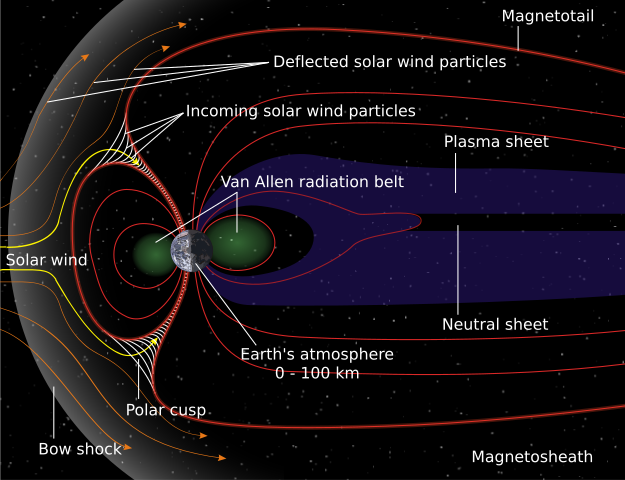
Structure of the Earth’s magnetosphere that deflects charged particles which form the solar wind. (Credit: Wikipedia Commons)

For life to form and survive depends on its complex molecules being protected from high-energy charged particles in the solar wind. In turn that depends on a strong geomagnetic field deflecting the solar wind as it does today, except for a small proportion that descend towards the poles and form aurora during solar mass ejections. In  visits to Isua in 2018 and 2019, geophysicists from the Massachusetts Institute of Technology, USA and Oxford University, UK drilled over 300 rock cores from metasedimentary ironstones (Nichols, C.I.O. and 9 others 2024. Possible Eoarchean records of the geomagnetic field preserved in the Isua Supracrustal Belt, southern West Greenland. Journal of Geophysics Research (Solid Earth), v. 129, article e2023JB027706; DOI: 10.1029/2023JB027706 Magnetisation preserved in the samples (remanent magnetism) suggest that it was formed by a geomagnetic field strength of at least 15 microtesla, similar to that which prevails today. The minerals magnetite (Fe3O4) and apatite (a complex phosphate) in the ironstones have been dated using U-Pb geochronometry and record a metamorphic event only slightly younger that the age of the Isua belt (3.69 and 3.63 Ga respectively). There is no sign of any younger heating above the temperatures that would reset the ironstones’ magnetisation. The Isua remanent magnetisation is at least 200 Ma older than that found in igneous rocks from north-eastern South Africa dated at between 3.2 to 3.45 Ga. So even in the Eoarchaean it seems likely that life, had it formed, would have avoided the hazard of exposure to the high energy solar wind. In all likelihood, however, in a shallow marine environment it would have had to protect itself somehow from intense ultraviolet radiation. That is now vastly reduced by stratospheric ozone (O3) which could only form once the atmosphere had appreciable oxygen (O2) content, i.e. after the Great Oxygenation Event beginning about 2.4 Ga ago. Undoubted stromatolites as old as 3.5 Ga suggest that early photosynthesising bacteria clearly had cracked the problem of UV protection somehow.

A companion crater for Chicxulub on the continental shelf of West Africa

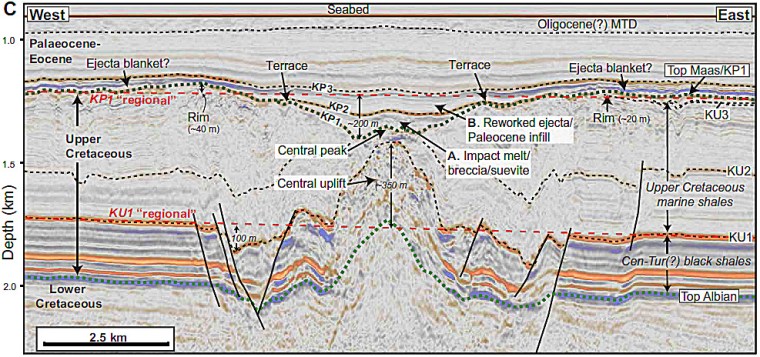
Fig Interpreted 2D seismic section across the Nadir crater and central uplift beneath the Guinea Terrace. (Credit: Nicholson, et al. 2022. Fig 2c)

In 2022 four geoscientists from Heriot-Watt University in Edinburgh, Scotland and the Universities of Arizona and Texas (Austin), USA were geologically interpreting seismic-reflection data beneath the seafloor off Guinea and Guinea-Bissau, West Africa. Individual sedimentary strata that cover the upper continental crust show up as many reflectors. They are calibrated to rock cores from exploratory well that had revealed up to 8 km of sedimentary cover deposited continuously since the Upper Jurassic. The team’s objective was to collect information on tectonic structures that had formed when South America separated from Africa during the Cretaceous. The geophysical data were from commercial reconnaissance surveys aimed at locating petroleum fields beneath part of the West African continental shelf known as the Guinea Terrace. One of the seismic sections revealed a ~9 km wide basin-like depression at the level of the Cretaceous-Palaeogene boundary, which is underlain by a prominent upward bulge in reflectors corresponding to the mid-Cretaceous, plus a large number of nearby faults (Nicholson, U., and 3 others 2022. The Nadir Crater offshore West Africa: a candidate Cretaceous-Paleogene impact structure. Science Advances, v. 8, article eabn3096; DOI: 10.1126/sciadv.abn3096). Elsewhere on the Guinea Terrace the strata were featureless by comparison.

The Nadir crater showed many of the signs to be expected from an asteroid impact. That it drew attention stemmed partly from being of roughly the same age as the much larger 66 Ma Chicxulub impact off the Yucatan Peninsula of Mexico: the likely culprit for the K-Pg mass-extinction event. Perhaps both impactors stemmed from the break-up of a large, near-Earth asteroid because of gravitational forces resulting from a previous close encounter with either the Earth or another planet. The crater lies at the centre of a 23 km wide zone of faults that only affect Cretaceous and older strata; i.e. they formed just before the K-Pg event. The seismic data also show signs of widespread liquefaction of nearby Cretaceous sedimentary strata and that the crater had been filled by sediments shortly after it formed. Yet the data were too fuzzy for an astronomical catastrophe to be absolutely certain: similar structures can form from the rise of bodies of rock salt, which is less dense than sediments and will dissolve on reaching the seabed.  The owners of the seismic data donated a much larger collection from a grid of survey lines. Processing of such seismic grids turns the collection of individual two-dimensional sections into a 3D regional data set showing the complete shape of subsurface structures. Seismic data of this kind enables more detailed structural and lithological interpretation of both cross section and plan views. They enable sedimentary layers to be ‘peeled’ back to examine the crater at all depths, in much the same manner as CT  and MRI scans reveal the inner anatomy of the human body.

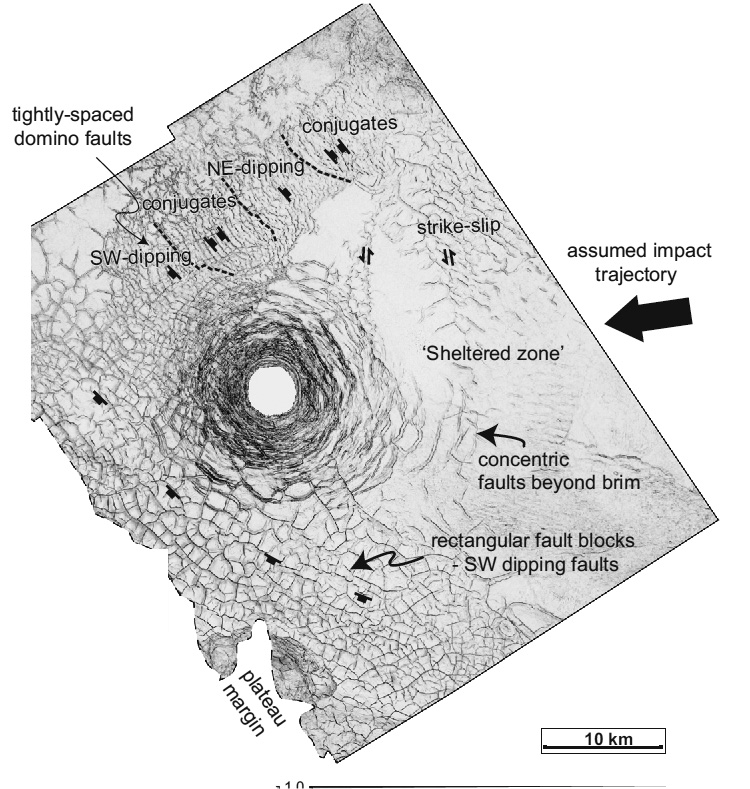
Map of faults around the Nadir crater at a level in the 3D seismic data that was about 200 m below the sea bed at the time of the impact. (Credit: Nicholson, et al. 2024, Fig 6)

Uisdean Nicholson and a larger team have now published their findings from the 3D seismic data that show the structure in unique detail (Nicholson, U., and 6 others 2024. 3D anatomy of the Cretaceous–Paleogene age Nadir Crater. Communications Earth & Environment v. 5, article number 547; DOI: 10.1038/s43247-024-01700-4). Nadir crater was affected by spiral-shaped thrust faults that suggest it was formed by an oblique impact from the northeast by an object around 450 m across, probably travelling at 20 km s-1 at 20 to 40° to the surface. Seconds after excavation uplift of deeper sediments was a response to removal of the load on the crust. The energy was sufficient to vaporise both sediment and impactor within a few seconds, the to drive drive seawater outwards in a tsunami about half a kilometre high, which in about 30 seconds exposed the incandescent crater floor. In the succeeding minutes hours and days liquefied sea water sloshed in and out of the crater, repeated tsunami resurgence forming gullies on its flanks and transporting sediment mixed with glass (suevite) flowed to refill the crater.

Time line for the Nadir impact, derived from detail shown by 3D seismic data. (Credit: Nicholson, et al. 2024, Fig 7)

There is no means of assigning any of the K-Pg extinctions to the Nadir crater, just that it happened at roughly the same time as Chicxulub. But it is the first impact crater to reveal the processes involved through complete coverage by high-resolution 3D seismic data. The majority of the roughly 200 craters are on the continental surface, and were thus ravaged to some extent by later erosion. Yet of the influx of hypervelocity objects through time at least 70% must have struck the oceans, but only 15 to 20 are known. That may reflect the fact that much deeper water could have buffered even giant impacts from affecting the oceanic crust beneath the abyssal plains, whose average depth is about 4 km. Only a small proportion of the continental shelves deemed to contain petroleum reserves have been explored seismically.  Chicxulub itself has been drilled, but only two seismic reflection sections have crossed its centre since its discovery, although earlier 3D data from petroleum exploration cover its outermost northern parts. More detail is available for Nadir and its lower energy did not smash its structural results, unlike Chicxulub. So, despite Nadir’s smaller size, fortuitously it gives more clues to how such marine craters formed. It looks to be an irresistible target for drilling.

Snowball Earth and the rise of multi-celled life

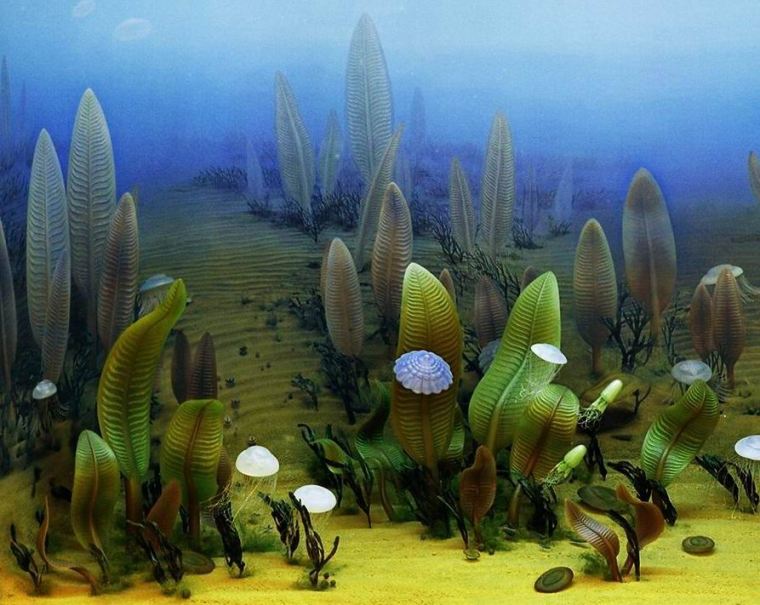
You can follow my ‘reportage’ on the long running story of the Snowball Earth events during the Neoproterozoic Cryogenian Period (850 to 635 Ma) since 2000 through the index to annual Palaeoclimatology logs (15 posts). Once these dramatic events were over sedimentary rocks deposited around the world during the Ediacaran Period (635 to 541 Ma) record the sudden appearance of large-bodied fossils: the first multicellular animals. This explosion from slimy biofilms and colonies of single-celled prokaryotes and eukaryotes laid the basis for the myriad ecological niches that have characterised Planet Earth ever since. The change saw specialised eukaryote cells (see: The rise of the eukaryotes; December 2017), whose precursors had originated in single-celled forms, begin to cooperate inthe development of complex tissues, organs, and organ systems to form bodies rather than just cell walls. The pulsating evolution, diversification and repeated extinction that followed during the last one tenth of geological time shaped a planet that is unique in the Solar System and possibly in the galaxy, if not the entire universe. The simple biosphere that preceded it, on the other hand, may have emerged on innumerable rocky planets blessed with liquid water to survive little changed for billions of years, as have Earths’ prokaryotes, the Archaea and Bacteria.  

Artist’s impression of the Ediacaran Fauna (credit: Science)

The Ediacaran biological revolution followed repeated changes in the geochemistry of the oceans, which carbon isotope data from the Cryogenian and Ediacaran suggest to have ‘gone haywire’. This turmoil involved dramatic changes in the cycling of sulfur and phosphorus that help ‘fertilise’ the marine food chain and in the production of oxygen by photosynthesis that is essential for metazoan animals.  The episodes when the Earth was iced over reduced the availability of nutrients through decreased rates of ocean-floor burial of dead organisms. Such Snowball events would also have reduced penetration of sunlight in the oceans. Less photosynthesis would not only have reduced oxygen production but also the amounts of autotrophic organisms. Furthermore, decreased water temperature would have increased its viscosity thereby slowing the spread of nutrients. The food chain for heterotrophs was decimated. Each Snowball event ended with warming, ice-free conditions so that the marine biosphere could burgeon

A great deal of data and numerous theories have accumulated since the Snowball concept was first mooted, but there has been little progress in understanding the rise of multi-celled life. Four geoscientists from the Massachusetts Institute of Technology, the Santa Fe Institute and the University of Colorado (Boulder), USA have developed an interesting hypothesis for how this enormous evolutionary step may have developed (Crockett, W.W. et al. 2024. Physical constraints during Snowball Earth drive the evolution of multicellularity. Proceedings of the Royal Society B: Biological Sciences, v. 291; DOI: 10.1098/rspb.2023.2767). The concatenation of huge events during the Cryogenian and Ediacaran presented continually changing patterns of selective pressures on simple organisms that preceded that time period. Crockett et al. review them in the light of fundamental biology to suggest how multicellular animals emerged as the Ediacara Fauna. Intuitively, such harsh conditions suggest at worst mass, even complete, extinction, at best a general reduction in size of all organism to cope with scarce resources. That the size of eukaryotes should have grown hugely goes against the grain of most biologists’ outlook.

The authors consider the crucial factor to be fundamental differences between prokaryotes and early eukaryotes. Prokaryote cells are very small, and whether autotrophs of heterotrophs they absorb nutrients through their walls by diffusion. Single-celled eukaryotes are far larger than prokaryotes and typically have a flagellum or ‘tail’ so that they can move independently and more easily gather resources. Crockett et al. used computer modelling to simulate the type of life form that could grow and thrive under Snowball conditions. They found that prokaryotes could only grow smaller, being ‘stunted’ by scarce resources. On the other hand eukaryotes would be better equipped to gather resources, the more so if they adopted a simple multicellular form – a hollow, self-propelled sphere about the size of a pea, which the authors dub a choanoblastula. Although no such form is known today, it does resemble the green Volvox algae, and plausibly could have evolved further to the simple forms of the Ediacaran fauna. The next task is either to find a fossil of such an organism, or to grow one.

The chaotic early Solar System: when giant planets went berserk

Readers of Earth-logs will be familiar with the way gravitational interactions between the planets that orbit the Sun control cyclical shifts in each other’s rotational and orbital behaviours. The best known are the three Milankovich cycles. The eccentricity of Earth’s orbit (deviation from a circular path) changes according to the varying gravitational pulls exerted by Jupiter and Saturn as they orbit the Sun, and is dominated by 100 ka cyclicity. The tilt (obliquity) of Earth’s rotational axis changes in 41 ka cycles.  The direction in which the axis points relative to the Sun varies with its precession which has a period of about 25.7 ka. Together they control the amount of solar heating that our planet receives, best shown by the current variation in glacial-interglacial cycles. But the phenomena predicted by Milutin Milankovich show up in palaeoclimatic changes back to at least the late Precambrian. Climate changes resulting from the gravitational effect of Mars have recently been detected with a 2.4 Ma period. But that steady carousel of planetary motions hasn’t always characterised the Solar System.

Cartoon showing planet formation in the early, unstable Solar System (Credit: Mark Garlick, Science Source)

Observations of other stars that reveal the presence of their own planetary systems show that some have giant planets in much closer orbits than those that circuit the Sun. Others occur at distances that extend as far as the orbital diameters as those in the Solar System: so perhaps giant planets can migrate. A possibility began to be discussed in the late 1990s that Jupiter, Saturn, Uranus and Neptune – and a fifth now-vanished giant planet – were at the outset in neat, evenly-spaced and much closer orbits. But they were forced outwards later into more eccentric and generally askew orbits. In 2005, planetary astronomers gathered in Nice, France to ponder the possibilities. The outcome was the ‘Nice’ Model that suggested that a gravitational instability had once emerged, which set the Solar System in chaotic motion. It may even have flung gigantic masses, such as postulated fifth giant planets, into interstellar space. This upheaval may have been due to a rapid change in the overall distribution of mass in the Solar System, possibly involving gas and dust that had not yet accreted into other planets or their planetesimal precursors. Chaotic antics of monstrous bodies and shifts in their combined gravitational fields can barely be imagined: it was nothing like the staid and ever present Milankovich Effect. Geologists have reconstructed one gargantuan event that reset the chemistry of the early Earth when it collided with another body about the size of Mars. That  also flung off matter that became the Moon. Evidence from lunar and terrestrial zircon grains (see: Moon-forming impact dated; March 2009) suggests the collision occurred before 4.46 billion years ago (when parts of both eventually crystallised from magma oceans), Solar System having begun to form at around 4.57 Ga. Could formation of the Moon record the early planetary chaos? Others have suggested instead that the great upheaval was the Late Heavy Bombardment, between 4.1 and 3.8 Ga, which heavily cratered much of the lunar surface and those of moons orbiting the giant planets.

Another approach has been followed by Chrysa Avdellidou of the University of Leicester, UK and colleagues from France and the US (Avdellidoli, C. et al. 2024. Dating the Solar System’s giant planet orbital instability using enstatite meteorites. Science, v. 384, p. 348-352; DOI: 10.1126/science.adg8092) after discovery of a new family of asteroids: named after its largest member Athor. The composition of their surfaces, from telescopic spectra, closely matches that of EL enstatite chondrite meteorites. Dating these meteorites should show when their parent asteroids – presumably the Athors – formed.  Using argon and xenon isotopes Mario Trieloff  and colleagues from the University of Heidelberg, Germany in showed that the materials in EL enstatite chondrite meteorites were assembled a mere 2 Ma after the Solar System formed (Trieloff, M. et al. 2022. Evolution of the parent body of enstatite (EL) chondrites. Icarus, v. 373, article 114762; DOI: 10.1016/j.icarus.2021.114762). Be that as it may, that the evidence came from small meteorites shows that the parent body, estimated as having had a 240 to 420 km diameter, was shattered at some later time. Moreover, at that very early date such bodies would have contained a ready heat source in the form of a short-lived isotope of aluminium (26Al) which decays to stable 26Mg, with a half-life of 0.717 Ma. 26Al is thought to have been produced by a supernova that has been suggested to have triggered the formation of the Solar System. Excessive 26Mg is found in many meteorites, evidence for metamorphism formed by such radiogenic heat. They also record the history of their cooling.

Avdellidoli et al. estimate that the 240 to 420 km Athor parental planetesimal had slowly cooled for at least 60 Ma after it formed. When it was shattered, the small fragments would have cooled instantaneously to the temperature of interplanetary space – a few degrees above absolute zero (-273.2 °C). From this they deduce the age of the chaotic restructuring of the early Solar System to be at least 60 Ma after its formation. Other authors use similar reasoning from other chondritic meteorite classes to suggest it may have happened even earlier at 11 Ma. But there are other views for a considerably later migration of the giant planets and the havoc that they wrought. The only widely agreed date, in what seems to be an outbreak of wrangling among astronomers, is for the Moon-forming collision: 110 Ma after formation of the Solar System. For me, at least, that’s good-enough evidence for when system-wide chaos prevailed. The Late Heavy Bombardment between 4.1 and 3.8 Ga seems to require a different mechanism as it affected large bodies that still exist. It may have resulted from whatever formed the asteroid belt, for it was bodies within the range of sizes of the asteroids that did the damage, in both the Inner and Outer Solar System.

See also: The instability at the beginning of the solar system. MSUToday, 27 April 2022: Voosen, P. 2024. Giant planets ran amok soon after the Solar System’s birth. Science, v. 384 news article eadp8889; DOI: 10.1126/science.adp8889

The peptide bond that holds life together may have an interstellar origin

In the 1950s Harold Urey of the University of Chicago and his student Stanley Miller used basic lab glassware containing 200 ml of water and a mix of the gases methane (CH4), ammonia (NH3) and hydrogen sulfide (H2S) to model conditions on the early Earth. Heating this crude analogue for ocean and atmosphere and continuous electrical discharge through it did, in a Frankensteinian manner, generate amino acids. Repeats of the Miller-Urey experiment have yielded 10 of the 20 amino acids from which the vast array of life’s proteins have been built. Experiments along similar lines have also produced the possible precursors of cell walls – amphiphiles. In fact, all kinds of ‘building blocks’ for life’s chemistry turn up in analyses of carbonaceous chondrite meteorites and in light spectra from interstellar gas clouds. The ‘embarrassment of riches’ of life’s precursors from what was until the 20th century regarded as the ‘void’ of outer space lacks one thing that could make it a candidate for life’s origin, or at least for precursors of proteins and the genetic code DNA and RNA. Both kinds of keystone chemicals depend on a single kind of connector in organic chemistry.

Reaction between two molecules of the amino acid glycene that links them by a peptide bond to form a dipeptide. (Credit: Wikimedia Commons)

Molecules of amino acids have acidic properties (COOH – carboxyl) at one end and their other end is basic (NH2 – amine). Two can react by their acid and basic ‘ends’ neutralising. A hydroxyl (OH) from carboxyl and a proton (H+) from amine produce water. This gives the chance for an end-to-end linkage between the nitrogen and carbon atoms of two amino acids – the peptide bond. The end-product is a dipeptide molecule, which also has carboxyl at one end and amine at the other. This enables further linkages through peptide bonds to build chains or polymers based on amino acids – proteins. Only 20 amino acids contribute to terrestrial life forms, but linked in chains they can form potentially an unimaginable diversity of proteins. Formation of even a small protein that links together 100 amino acids taken from that small number illustrates the awesome potential of the peptide bond. The number of possible permutations and combinations to build such a protein is 20100 – more than the estimated number of atoms in the observable universe! Protein-based life has almost infinite options: no wonder that ecosystems on Earth are so diverse, despite using a mere 20 building blocks. Simple amino acids can be chemically synthesised from C, H, O and N. About 500 occur naturally, including 92 found in a single carbonaceous chondrite meteorite. They vastly increase the numbers of conceivable proteins and other chain-molecules analogous to RNA and DNA: a point seemingly lost on exobiologists and science fiction writers!

Serge Kranokutski of the Max Planck Institute for Astronomy at the Friedrich Schiller University in Jena, German and colleagues from Germany, the Netherlands and France have assessed the likelihood of peptides forming in interstellar space in two publications (Kranokutski S.A. and 4 others 2022. A pathway to peptides in space through the condensation of atomic carbon. Nature Astronomy, v, 6, p. 381–386; DOI: 10.1038/s41550-021-01577-9. Kranokutski, S.A. et al. 2024. Formation of extraterrestrial peptides and their derivatives. Science Advances, v. 10, article eadj7179; DOI: 10.1126/sciadv.adj7179). In the first paper the authors show experimentally that condensation of carbon atoms on cold cosmic dust particles can combine with carbon monoxide (CO) and ammonia (NH3) form amino acids. In turn, they can polymerise to produce peptides of different lengths. The second demonstrates that water molecules, produced by peptide formation, do not prevent such reactions from happening. In other words, proteins can form inorganically anywhere in the cosmos. Delivery of these products, through comets or meteorites, to planets forming in the habitable ‘Goldilocks’ zone around stars may have been ‘an important element in the origins of life’ – anywhere in the universe. Chances are that, compared with the biochemistry of Earth, such life would be alien in an absolute sense. There are effectively infinite options for the proteins and genetic molecules that may be the basis of life elsewhere, quite possibly on Mars or the moons of Jupiter and Saturn: should it or its chemical fossils be detectable.

Ocean-floor sediments reveal the influence of Mars on long-term climate cycles

In 1976 three scientists from Columbia and Brown (USA) and Cambridge (UK) Universities published a paper that revolutionised the study of ancient climates (Hays J.D., Imbrie J. and Shackleton N.J. 1976. Variations in the Earth’s Orbit: Pacemaker of the Ice Ages. Science, v. 194, p. 1121-1132;  DOI: 10.1126/science.194.4270.1121). Using variations in oxygen isotopes from foraminifera through two cores of sediments beneath the floor of the southern Indian Ocean they verified Milutin Milankovich’s hypothesis of astronomical controls over Earth’s climate. This centred on changes in Earth’s orbital parameters induced by gravitational effects from the motions of other planets: its orbit’s eccentricity, and the tilt and precession of its rotational axis. Analysis of the frequency of isotopic variations in the resulting time series yielded Milankovich’s predictions of ~100, 41 and 21 ka periodicities respectively. The time spanned by the cores was that of the last 500 ka of the Pleistocene and thus the last 5 glacial-interglacial cycles. Subsequently, the same astronomical climate forcing  has been detected  for various climate-induced changes in the earlier sedimentary record, including the glacial cycles of the Carboniferous and Neoproterozoic, Jurassic climate changes due to oceanic methane emissions and many other types of cyclicity during the Phanerozoic.

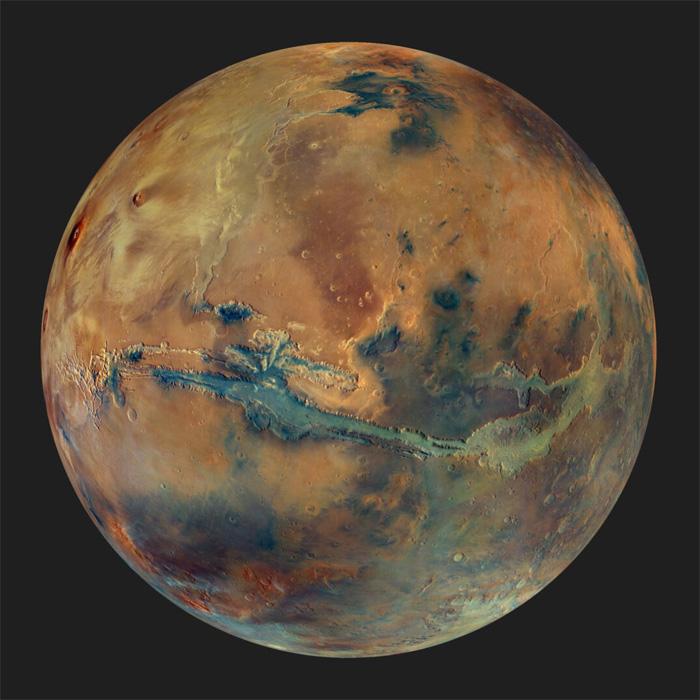
One hemisphere of Mars captured by ESA’s Mars Express. Credit: ESA / DLR / FU Berlin /

As well as time series based on isotopic and other geochemical changes in marine cores, other variables such as thickness of turbidite beds or cyclical repetitions of short rock sequences such as the ‘cyclothems’ of Carboniferous age (repetitions of a  limestone, sandstone, soil, coal sequence) have also been subject to frequency analysis. Sedimentary features that have not been tried are gaps or hiatuses in stratigraphic sequences where strata are missing from a deep-sea sequence. These signify erosion of sediment due to vigorous bottom currents in sequences otherwise dominated by continuous deposition under low-energy conditions. Three geoscientists from the University of Sydney, Australia and the Sorbonne University, France, have subjected records of gaps in Cenozoic sedimentation from 293 deep-sea drill cores to time-series analysis to discover what such ‘big data’ might reveal as regards climate fluctuations on the order of millions of years (Dutkiewicz, A., Boulila, S. & Müller, R.D. 2024. Deep-sea hiatus record reveals orbital pacing by 2.4 Myr eccentricity grand cycles. Nature Communications, v. 15, article 1998; DOI: 10.1038/s41467-024-46171-5).

In theory gravitational interrelationships between all the orbiting planets should have an effect on the orbital parameters of each other, and thus the amount of received solar radiation and changes in global climate. As well as the Milankovich effect, longer astronomical ‘grand cycles’ may therefore have been reflected somehow in Earth’s climatic history (Laskar, J. et al. 2004. A long-term numerical solution for the insolation quantities of the Earth. Astronomy & Astrophysics, v. 428, p. 261-285; DOI: 10.1051/0004-6361:20041335). Based on Laskar et al.’s calculations Adriana Dutkiewicz and colleagues sought evidence for two predicted ‘grand cycles’ that result from orbital interactions between Earth and Mars. These are a 2.4 Ma period in the eccentricity of Earth’s orbit and one of 1.2 Ma in the tilt of its axis.

The authors were able to detect cyclicity in the hiatus time series that is close to the 2.4 Ma Mars-induced waxing and waning of solar heating. Warming would increase mixing of ocean water through cyclones and hurricanes. That would then induce more energetic deep ocean currents and more erosion on the deep ocean floor: more gaps in sedimentation. Cooler conditions would ‘calm’ deep ocean currents so that deposition would outweigh evidence of erosion. The 1.2 Ma axial tilt cyclicity is not apparent in the data. Interestingly, the ~2.4 Ma cyclicity underwent a significant deviation at the Palaeocene-Eocene Boundary’ (56Ma), seemingly predicted by Laskar et al’s  astronomical solutions as a chaotic orbital transition between 56 and 53 Ma. Dutkiewicz et al. also chart the relations between the sedimentary-hiatus time series and major tectonic, oceanographic, and climatic changes during the Cenozoic Era, and found that terrestrial processes did disrupt the Mars-related orbital eccentricity cycles.

The findings suggest that long-term astronomical climate forcing needs to be borne in mind for better understanding the future response of the ocean to global warming. Also, if Mars had such an influence so must have Venus, which is more massive and closer. That remains to be investigated, and also the effects of the giant planets. In the very distant past there behaviour may have resulted in unimaginable astronomical changes. According to the bizarrely named Nice Model a back and forth shuffling of the Giant Planets was probably responsible for the Late Heavy Bombardment 4.1 to 3.8 billion years (Ga) ago. Such errant behaviour may even have triggered the flinging of some of the Sun’s original planetary complement out of the solar system and changed the outward order of the existing eight. Fortunately, the present planetary set-up seems to be stable …

See also: Dutkiewicz, A., & Müller, R. D. 2022. Deep-sea hiatuses track the vigor of Cenozoic ocean bottom currents. Geology, v. 50, p. 710–715; DOI: 10.1130/G49810.1; Mars drives deep-ocean circulation in Earth’s oceans, study suggests. Sci News, 13 March 2024.

An astronomical background to flood basalt events and mass extinctions?

Michael Rampino and Ken Caldeira of New York University and the Carnegie Institute have for at least three decades been at the forefront of studies into mass extinctions and their possible causes, including flood-basalt volcanism, extraterrestrial impacts and climate change. As early as 1993 the duo reported an ubiquitous 26-million year cycle in plate tectonic and volcanic activity. In Rampino’s 2017 book Cataclysms: A New Geology for the Twenty-First Century the notion of a process similar to Milutin Milankovich’s prediction of Earth’s orbital characteristics underpinning climate cyclicity figured in his thinking (see Shock and Er … wait a minute, Earth-logs, October 2017). Rampino postulated then that this longer-term geological cyclicity could be linked to gravitational changes during the Solar System’s progress around the Milky Way galaxy. He was by no means the first to turn to galactic forces, Johann Steiner having made a similar suggestion in 1966. The notion stems from the Solar System’s wobbling path as it orbits the centre of the Milky Way galaxy about every 250 Ma, which may result in its passage through a vast layered variation in several physical properties aligned at right angles to galactic orbital motions. This grand astronomical theory is ‘a story that will run and run’; and it has. It is possible that the galaxy has corralled dark matter in a disc within the galactic plane, which Rampino and Caldeira latched onto that notion a year after it appeared in Physical Review Letters in 2014.

As I commented in my brief review of Rampino’s book: “As for Rampino’s galactic hypothesis, the statistics are decidedly dodgy, but chasing down more forensics is definitely on the cards.” Indeed they have been chased in a recent review by the pair and their colleague Sedelia Rodriguez (Rampino, M.R., Caldeira, K. & Rodriguez, S. 2023. Cycles of ∼32.5 My and ∼26.2 My in correlated episodes of continental flood basalts (CFBs), hyper-thermal climate pulses, anoxic oceans, and mass extinctions over the last 260 My: Connections between geological and astronomical cycles. Earth-Science Reviews, v. 246 ; DOI: 10.1016/j.earscirev.2023.104548; reprint available on request from Rampino). They base their amplified case on much more than radiometric dates of continental flood basalt (CFB) events matched against the stratigraphic record of biotic diversity. Among the proxies are published measurements of mercury and osmium isotope anomalies in oceanic sediments that are best explained by sudden increases in basaltic magma eruption; signs of deep ocean anoxia; new dating of marine and non-marine extinctions in the fossil record, and episodes of sudden extreme climatic heating.

Statistical analysis of the ages of anoxic events and marine extinctions has yielded cycles of 32.5 and 26.2 Ma, those for CFBs having a 32.8 Ma periodicity. A note of caution, however: their data only cover the last 266 Ma – about one orbit of the solar system around the galactic centre. The authors attribute their interpretation of the cycles “to the Earth’s tectonic-volcanic rhythms, but the similarities with known Milankovitch Earth orbital periods and their amplitude modulations, and with known Galactic cycles, suggest that, contrary to conventional wisdom, the geological events and cycles may be paced by astronomical factors”.

Whether or not a detailed record of appropriate proxies can be extended back beyond the Late Permian, remains to be seen. The main fly-in-the-ointment is the tendency of CFB provinces to form high ground so that they are readily eroded away. Pre-Mesozoic signs of their former presence lie in basaltic dyke swarms that cut through older  crystalline continental crust. The marine sedimentary record is somewhat better preserved. A search for distinctive anomalies in osmium isotopes and mercury concentrations, which are useful proxies for global productivity of basaltic magmas, will be costly. Moreover, dating will depend to a large degree on the traditional palaeontology of strata, which in Palaeozoic rocks is more difficult to calibrate precisely by absolute radiometric dating.

Relics of the Moon-forming impact?

Close to the core-mantle boundary (CMB) there are two extensive zones up to 10 km thick in the lower mantle. They have seismic-wave speeds that are much lower than expected at such depths: hence their being termed large low-velocity provinces (LLVPs). Seismic velocities being inversely proportional to the density of the material through which such waves travel, these zones have anomalously high density. The LLVPs have remained enigmatic since they were first discovered. Some have suggested that they are relics of dense subducted banded iron formations (see also: Curiously low-velocity material at the core-mantle boundary; March 2005) or simply piles of subducted slabs with an eclogite component that have gradually accumulated through Earth’s long history of  plate tectonics. An alternative is that LLVPs may be connected to geochemical evidence for a heterogeneous lower mantle and perhaps are relics of Earth’s earliest history.

An artist’s impression of the collision between Theia and the proto-Earth. (Credit: Hernán Cañellas, Nature)

The Moon-forming event about 4,500 Ma ago (for more information search the Planetary Science annual logs index) that probably involved a collision between the proto-Earth and another, Mars-sized planet – dubbed ‘Theia’ – is an alternative explanation for LLVPs. Maybe they are chunks of that planet that became embedded in the early Earth’s mantle. Many geochemical approaches to such an obvious origin are inconclusive, however. The latest attempt to model the processes involved in such a planetary truck crash using computer simulation does suggest that LLVPs may indeed be relics of Theia material that sank through the molten mass that became Earth’s mantle after the collision (Yuan, Q. et al. 2023. Moon-forming impactor as a source of Earth’s basal mantle anomalies. Nature v. 623, p. 95–99; DOI: 10.1038/s41586-023-06589-1).

Qian Yuan of the California Institute of Technology, and colleagues from China, USA and the UK based their approach on geochemical anomalies in plume related ocean-island basalts. These included distinctly non-terrestrial isotopic proportions of the noble gases neon and xenon, similar to those in lunar basalts., which in turn are more iron-rich than most basalts and thus 2-3% denser. The initial assumption in their modelling was that during the collision fragments of Theia peppered the magma ocean that became Earth upper mantle. These were thoroughly mixed in this molten zone as it convected before solidifying. But melts derived from some of the fragments could have penetrated the solid mantle below 1400 km depth as blobs, to retain their chemically anomalous integrity. Being dense, the blobs could slowly sink to accumulate at the CMB to form the two LLVPs. An animation of the processes revealed by Yuan et al.’s modelling can be viewed here.

See also: Oza, A. 2023. Strange blobs in Earth’s mantle are relics of a massive collision. Nature v. 623; DOI: 10.1038/s41586-023-06589-1

Hydrogen and how the Earth formed

A third piece with hydrogen as its focus in a couple of months? Well, from a galactic perspective there’s a lot of it about. Modern cosmology suggests that only 4.6% of the energy in the universe consists of elemental atoms made of protons, neutrons and electrons, dwarfed by dark energy and dark matter that are something of mystery. But of the more familiar energy equivalent, tangible matter (as in E=mc2), 74% of the universe is hydrogen, 24% is helium and the other 92 elements amount to just 2%. That tiny proportion of heavier elements was created by nucleosynthesis within stars from the two products of the Big Bang (H and He). Nuclear fusion reactions formed those with atomic numbers (protons in their nuclei) up to that of iron (26), whereas the heavier elements were created through neutron- and proton capture when the largest stars destroyed themselves cataclysmically as supernovae. Yet the planet whose surface we inhabit contains only minute amounts of helium and elemental hydrogen. Of course water at and beneath the surface, in the form of atmospheric vapour and locked within minerals retains some of the cosmically available hydrogen. But current estimates suggest that hydrogen accounts for a mere 0.03% of Earth’s mass. Despite the fact that some forms of radioactive decay generate alpha particles that become helium it forms a vanishingly small proportion of terrestrial mass.

The solar system formed around 4.6 billion years ago by a complex gravitational accretion of the gas and dust of an interstellar cloud: mainly H and He. Its dynamic collapse resulted in gravitational potential energy being transformed into heat: in the case of the Sun, sufficient to set off self-sustaining nuclear fusion. As a body grows in this way so does its gravity and thus the speed needed for matter to escape from its pull (escape velocity). As temperature increases so does the speed at which atoms of each element vibrate; the lower the atomic mass the faster the vibration and the greater the chance of escape. So the ‘blend’ of elements that an astronomical body retains during its early evolution depends on its gravity and its surface temperature. The Sun is so massive that very little has escaped its pull, despite a surface temperature of about 5 to 6 thousand degrees Celsius. Its composition is thus close to the cosmic average. Those of the giant planets Jupiter, Saturn, Uranus and Neptune are not far short because of their large gravities and low surface temperatures. Even today, the smaller Inner Planets are unable to cling on to elemental hydrogen and helium and nearly all that is left of the matter from which they formed is the 2% of heavier cosmic elements locked into solids, liquids and gases.

Processes in the early solar system were far more complicated than they are today. In the mainly gaseous disc, from which the solar system evolved, gravity dragged matter towards its centre. That eventually ignited nuclear fusion of hydrogen to form our star. More remote from its gravitational pull vortices aggregated dust into bodies known as planetesimals that in turn accreted to larger protoplanets. Solar gravity dragged gas from the inner solar system leaving rocky protoplanets, whereas gas was able to be attracted to the surface of what became the gas giants where their gravity outweighed that of the far-off Sun. This was complicated by a sort of Milankovich Effect on steroids in which protoplanets continuously changed their orbits and underwent collisions. The best known of these was between the protoEarth and a Mars-sized body that formed the Earth-Moon system, both bodies having deep magma oceans as a result of the huge energy focussed on them by the collision. What may have happened to the protoplanet that became Earth before the Moon-forming collision has been addressed by three geoscientists at the University of California Los Angeles and the Carnegie Institution for Science Washington DC, USA (Young, E.D. et al. 2023. Earth shaped by primordial H2 atmospheres. Nature, v. 616, p. 306–311; DOI: 10.1038/s41586-023-05823-0 [PDF request to: eyoung@epss.ucla.edu]).

A thick hydrogen-rich atmosphere’s interacting chemically with a protoplanet (left). A possible later stage (right) where iron oxide in the magma ocean of the Early Hadean after Moon formation oxidises a hydrogen atmosphere to form surface water (Credit: Sean Raymond 2023, Fig 1)

The focus of the work of Edward Young, Anat Shahar and Hilke Schlichting is directed at the possibility that the Earth-forming protoplanets originally retained thick hydrogen atmospheres. They use thermodynamic modelling of the equilibrium between hydrogen and silicate magma oceans that had resulted from the energy of their accretion. The authors’ main assumption is that insufficient time had elapsed during accretion for the protoplanets to cool and crystallise: a distinct possibility because loss of accretionary heat by thermal radiation would have been ‘blanketed’ by actively accreting dust and gas in orbit around the growing protoplanets. Effectively, the equilibrium would have been chemical in nature: reactions between highly reducing hydrogen and oxidised silicate melts or even vaporised rock evaporated from the very hot surface. The authors suggest that protoplanets bigger than Mars (0.2 to 0.3 times that of Earth) could retain a hydrogen-rich atmosphere long enough for the chemical reactions to come to a balance, despite high temperatures. There would have been no shortage of hydrogen at this early stage in solar system evolution: perhaps as much as 0.2% percent the mass of the Earth surrounding a protoplanet about half its present size.

Two outcomes may have emerged. Reaction between hydrogen and anhydrous silicates could produce H2O in amounts up to three times that currently in the Earth’s oceans, some locked in the magma ocean, some in the dense atmosphere. A by-product would have been iron oxide, giving the current mantle its oxidising properties known from the geochemistry of basaltic magmas.  Hydrogen might also have dissolved in molten iron alloys, thereby contributing to the nascent core. That second outcome would help explain why the modern core is less dense than expected for iron-nickel alloy, both solid and liquid. In fact densities calculated by geophysicists from the speeds of seismic waves that have travelled through the core are 5 to 10% percent lower than expected for the alloy. So the core must contain substantial amounts of elements with low atomic numbers.

Several other possibilities have been suggested to account for Earth’s abundance of water. Two popular ideas are comets arriving in the ‘settled’ times of the Hadean or by original accretion of hydrous chondrite meteorites, whose hydrogen isotope proportions match those of ocean water. Hydrogen as the light element needed in the core is but one possibility along with oxygen, sulfur and other ‘light’ elements. Also, the oxidising potential of the modern mantle may have resulted from several billion years of wet lithosphere being subducted. To paraphrase Sean Raymond (below), ‘other hypotheses are available’!

See also: Raymond, S.N. 2023. Earth’s molten youth had long-lasting consequences. Nature (News & Views), v. 616, p. 251-252; DOI: 10.1038/d41586-023-00979-1 [PDF request to: rayray.sean@gmail.com]

The Moon may have water resources in its soil

Apart from signs of water ice in permanently shadowed areas of some polar craters, the Moon’s surface has generally been considered to be very dry. Rocks returned by the various Apollo missions contain minute traces of water by comparison with similar rocks on Earth. They consist only of anhydrous minerals such as feldspars, pyroxenes and olivines. But much of the lunar surface is coated by regolith: a jumble of rock fragments and dust ejected from a vast number of impact craters over billions of years. It is estimated to be between 3 and 12 m deep. Much of the finer grained regolith is made up of silicate-glass spherules created by the most powerful impacts.

The lunar regolith at Tranquillity Base bearing an astronaut’s bootprint (Credit: Buzz Aldrin, NASA Apollo 11, Photo ID AS11-40-5877)

The scientific and economic (i.e. mining) impetus for the establishment of long term human habitation on the lunar surface hangs on the possibility of extracting water from the Moon itself. It is needed for human consumption and as a source through electrolysis of both oxygen and hydrogen for breathing and also for rocket fuel. The stupendous cost, in both monetary and energy terms, of shifting mass from Earth to the Moon clearly demands self-sufficiency in water for a lunar base occupied for more than a few weeks.

Remote sensing that focussed on the ability of water molecules and hydroxyl (OH) ions to absorb solar radiation with a wavelength of 2.8 to 3.0 micrometres was deployed by the Indian lunar orbiter Chandrayaan-1 that collected data for several months in 2008-9. The results suggested that OH and H2O were detectable over a large proportion of the lunar surface at concentrations estimated at between 10 parts per million (ppm) up to about 0.1%. Where did these hydroxyl ions and water molecules come from and what had locked them up? There are several possibilities for their origin: volcanic activity that tapped the Moon’s mantle (magma could not have formed had some water not been present at great depths); impacts of icy bodies such as comets; even the solar wind that carries protons, i.e. hydrogen atoms stripped of their electrons. Conceivably, protons could react with oxygen in silicate material at the surface to produce both OH and H2O to be locked within solid particles. To assess the possibilities a group of researchers at Chinese and British institutions have examined in detail the 1.7 kg of lunar-surface materials collected and returned to Earth by the 2020 Chinese Chang’e 5 lunar sample return mission (He, H. and 27 others 2023. A solar wind-derived water reservoir on the Moon hosted by impact glass beads. Nature Geoscience, online article; DOI: 10.1038/s41561-023-01159-6)

He et al. focussed on glass spherules formed by impact melting of lunar basalts, whose bulk composition they retain. The glass ‘beads’ contain up to 0.2 % water, mainly concentrated in their outermost parts. This alone suggests that the water and hydroxyl ions were formed by spherules being bathed in the solar wind rather than being of volcanic or cometary origin and trapped in the glass. An abnormally low proportion of deuterium (2H) relative to the more abundant 1H isotope of hydrogen in the spherules is consistent with that hypothesis. Indeed, the high temperatures involved in impact melting would be expected to have driven out any ‘indigenous’ water in the source rocks. The water and OH ions seem to have built up over time, diffusing into the glass from their surfaces rather than gradually escaping from within.

An awful lot of regolith coats the lunar surface, as many of the images taken by the Apollo astronauts amply show. So how much water might be available from the lunar regolith? The Chinese-British team reckon between 3.0 × 10⁸ to 3.0 × 10¹¹ metric tons. But how much can feasibly be extracted at a lunar base camp? The data suggest that a cubic metre (~2 t) of regolith could yield enough to fill 4 shot glasses (~0.13 litres). Using a solar furnace and a condenser – the one in full sunlight the other in the shade – is not, as they say, ‘rocket science’. But for a minimum 3 litres per day intake of fluids per person, a team of 4 astronauts would need to shift and process roughly 100 m3 of regolith every day. Over a year, this would produce a substantial pit. But that assumes all the regolith contains some water, yet the data are derived from the surface alone …See also:Glass beads on moon’s surface may hold billions of tonnes of water, scientists say. The Guardian, 27 March 2023.