Tectonics of the early Earth

Tectonics on any rocky planet is an expression of the way heat is transferred from its deep interior to the surface to be lost by radiation to outer space. Radiative heat loss is vastly more efficient than either conduction or convection since the power emitted by a body is proportion to the fourth power of its absolute temperature. Unless it is superheated from outside by its star, a planet cannot stay molten at its surface for long because cooling by radiation releases all of the heat that makes its way to the surface.  Any football supporter who has rushed to get a microwaved pie at half time will have learned this quickly: a cool crust can hide a damagingly hot centre.

Thermal power is delivered to a planet’s surface by convection deep down and conduction nearer the surface because rocks, both solid and molten, are almost opaque to radiation. The vigour of the outward flow of heat might seem to be related mainly to the amount of internal heat but it is also governed by limits imposed by temperature on the form of convection. Of the Inner Planets only Earth shows surface signs of deep convection in the form of plate tectonics driven mainly by the pull exerted by steep subduction of cool, dense slabs of old oceanic lithosphere. Only Jupiter’s moon Io shows comparable surface signs of inner dynamics, but in the form of immense volcanoes rather than lateral movements of slabs. Io has about 40 times the surface heat flow of Earth, thanks largely to huge tidal forces imposed by Jupiter. So it seems that a different mode of convection is needed to shift the tidal heat production; similar in many ways to Earth’s relatively puny and isolated hot spots and mantle plumes.

Most of the yellow and orange hues of Io are d...
An analogy for the early Earth, Jupiter’s moon Io is speckled with large active volcanoes; signs of vigorous internal heat transport but not of plate tectonics. Its colour is dominated by various forms of sulfur rather than mafic igneous rocks. (credit: Wikipedia)

Shortly after Earth’s accretion it would have contained far more heat than now: gravitational energy of accretion itself; greater tidal heating from a close Moon and up to five times more from internal radioactive decay. The time at which plate tectonics can be deduced from evidence in ancient rocks has been disputed since the 1970s, but now an approach inspired by Io’s behaviour approaches the issue from the opposite direction: what might have been the mode of Earth’s heat transport shortly after accretion (Moore, W.B. & Webb, A.A.G. 2013. Heat-pipe Earth. Nature, v.  501, p. 501-505). The two American geophysicists modelled Rayleigh-Bénard convection – multicelled convection akin to that of the ‘heat pipes’ inside Io – for a range of possible thermal conditions in the Hadean. The modelled planet, dominated by volcanic centres turned out to have some surprising properties.

The sheer efficiency of heat-pipe dominated heat transfer and radiative heat lost results in development of a thick cold lithosphere between the pipes, that advects surface material downwards. Decreasing the heat sources results in a ‘flip’ to convection very like plate tectonics. In itself, this notion of sudden shift from Rayleigh-Bénard convection to plate tectonics is not new – several Archaean specialists, including me, debated this in the late 1970s – but the convincing modelling is. The authors also assemble a plausible list of evidence for it from the Archaean geological record: the presence in pre- 3.2 Ga greenstone belts of abundant ultramafic lavas marking high fractions of mantle melting; the dome-trough structure of granite-greenstone terrains; granitic magmas formed by melting of wet mafic rocks at around 45 km depth, extending back to second-hand evidence from Hadean zircons preserved in much younger rocks. They dwell on the oldest sizeable terranes in West Greenland (the Itsaq gneiss complex), South Africa and Western Australia (Barberton and the Pilbara) as a plausible and tangible products of ‘heat-pipe’ tectonics. They suggest that the transition to plate-tectonic dominance was around 3.2 Ga, yet ‘heat pipes’ remain to the present in the form of plumes so nicely defined in the preceding item Mantle structures beneath the central Pacific.

Mantle structures beneath the central Pacific

Since it first figured in Earth Pages 13 years ago seismic tomography has advanced steadily as regards the detail that can be shown and the level of confidence in its accuracy: in the early days some geoscientists considered the results to be verging on the imaginary. There were indeed deficiencies, one being that a mantle plume which everyone believed to be present beneath Hawaii didn’t show up on the first tomographic section through the central Pacific. Plumes are one of the forms likely to be taken by mantle heat convection, and many now believe that some of them emerge from great depths in the mantle, perhaps at its interface with the outer core.

The improvements in imaging deep structure stem mainly from increasingly sophisticated software and faster computers, the data being fed in being historic seismograph records from around the globe. The approach seeks out deviations in the speed of seismic waves from the mean at different depths beneath the Earth’s surface. Decreases suggest lower strength and therefore hotter rocks while abnormally high speeds signify strong, cool parts of the mantle. The hotter mantle rock is the lower its density and the more likely it is to be rising, and vice versa.

Using state-of-the-art tomography to probe beneath the central Pacific is a natural strategy as the region contains a greater concentration of hot-spot related volcanic island chains than anywhere else and that is the focus of a US-French group of collaborators (French, S. et al. 2013. Waveform tomography reveals channeled flow at the base of the oceanic lithosphere. Science, v. 342, 227-230;  doi 10.1126/science.1241514). The authors first note the appearance on 2-D global maps for a depth of 250 km of elongate zones of low shear-strength mantle that approximately parallel the known directions of local absolute plate movement. The most clear of these occur beneath the Pacific hemisphere, strongly suggesting some kind of channelling of hot material by convection away from the East Pacific Rise.

Seismic tomograhic model of the mantle beneath the central Pacific. Yellow to red colours represent increasing low shear strength. (credit: Global Seismology Group / Berkeley Seismological Laboratory
Seismic tomographic model of the mantle beneath the central Pacific. Yellow to red colours represent increasingly low shear strength. (credit: Global Seismology Group / Berkeley Seismological Laboratory)

Visually it is the three-dimensional models of the Pacific hot-spot ‘swarm’ that grab attention. These show the low velocity zone of the asthenosphere at depths of around 50 to 100 km, as predicted but with odd convolutions. Down to 1000 km is a zone of complexity with limb-like lobes of warm, low-strength mantle concentrated beneath the main island chains. That beneath the Hawaiian hot spot definitely has a plume-like shape but one curiously bent at depth, turning to the NW as it emerges from even deeper mantle then taking a knee-like bend to the east . Those beneath the hot spots of the west Pacific are more irregular but almost vertical. Just what kind of process the peculiarities represent in detail is not known, but it is almost certainly a reflection of complex forms taken by convection in a highly viscous medium.

Pushing back DNA sequencing: a Spanish cave bear

At the time, only 3 years ago, publication of the first full Neanderthal genome  seemed miraculous. Yet the apparent magic proved repeatable, including for an obscure but distinct group of extinct humans – the  Denisovans – known only from their DNA in a single pinkie bone. These advances astonished the world by showing that anatomically modern humans were capable of interbreeding with both groups; and did so that many people now living outside of Africa carry the genetic evidence. But the samples analysed for DNA were little more than 40 thousand years old. Older fossils of extinct animals have given up their genetic features, such as the wooly mammoth and a horse about 700 ka old, but only from samples frozen into permafrost at high northern latitudes.

The degradation of DNA over time seemed destined to limit palaeo-genetics, even when slowed down by natural freezing. The degradation breaks down any surviving genetic material into shorter and shorter fragments of the DNA molecule, ultimately to its atoms being recombined in new molecules of totally unrelated compounds through the chemical processes of fossilisation. Reassembling the fragments correctly becomes increasingly difficult the smaller they are. Few outside of a highly skilled specialists were optimistic of breaking the 100 ka barrier, even using frozen fossils. Unsurprisingly, having had such dramatic successes, the specialists continue to ride their luck and their ingenuity.

Excavations at the site of Gran Dolina, in Ata...
Excavations at Gran Dolina, in Atapuerca, Spain. (Photo credit: Wikipedia)

The cave complex of the Atapuerca Mountains  in northern Spain, whose sediments range in age from almost a million years ago to recent times, contain rich accumulations of human remains, including the pre-Neanderthal Homo heidelbergensis and H. antecessor dating back to more than 800 ka. If ever there was a magnet for archaeo-geneticists Atapuerca is definitely one. Moreover, physical anthropologists seem never to stop disputing their interpretations. Jesse Dabney of the now famous Max Planck Institute for Evolutionary Anthropology in Leipzig, Germany, and co-workers from Britain, New Zealand, Spain and Australia are now beginning to report results. The first are from a cave bear (probably Ursos deningeri) known to be older than 300 ka (Dabney, J. and 10 others 2013. Complete mitochondrial genome sequence of a Middle Pleistocene cave bear reconstructed from ultrashort DNA fragments in one of its foreleg bones. Proceedings of the National Academy of Sciences, v. 110, doi/10.1073/pnas.1314445110). The bear’s mitochondrial DNA was pieced together from fragments as small as 50 base pairs, and shows its ancestry to bears (U. spelaeus) from the later Pleistocene that became extinct at about 28 ka.

reconstruction of a European cave bear (Ursus ...
Reconstruction of a European cave bear (Ursus spelaeus) (credit: Wikipedia)

It may be only a matter of time before human DNA emerges from the rich Atapuerca fossil hoard; indeed the authors strongly hint that they are working on that now.

The East African Orogen: Neoproterozoic tectonics on display

Over a period of about 300 Ma the fragmentation of a supercontinent, Rodinia, drove a round of sea-floor spreading and continental drift that culminated in reassembly of the older continental pieces and entirely new crust in a new supercontinent, Gondwana. The largest source of evidence for this remarkable tectonic turnaround is a belt stretching N-S for over 3000 km from southern Israel through East Africa to Mozambique. At its widest the belt exposes Neoproterozoic  rocks and structures for some 1700 km E-W from west of the Nile in northern Sudan almost to Riyadh in Saudi Arabia.  This Arabian-Nubian Shield tapers southwards to thin out completely in northern Tanzania between far older cratons and in a state of high-grade metamorphism.

This East African Orogen has long been considered the best exposed bowels of former mountain building that there are: results of continent-continent collision and the bulldozing together of many oceanic arcs and remnants of oceanic lithosphere that once separated the cratons. This was much more complex than a case of head-on tectonics, the northward-swelling Arabian-Nubian Shield showing all the signs of being like a gigantic ‘pip’ squeezed out northwards from two cratonic jaws during the last stages of what is often called the Pan African Orogeny. Interestingly, the line of the orogen is roughly followed by East Africa’s other giant feature, the Rift Valley; actually two of them following Pan African terranes. A continental scale anisotropy has been reactivated and subject to extensional tectonics, and maybe in future a new round of sea-floor spreading as has begun in the Red Sea, some half a billion years after it formed.

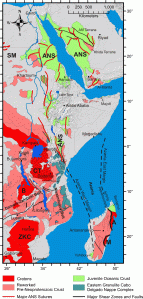
Simplified geological map of the East African Orogen courtesy of the authors of Fritz et al 2013

Now there is an opportunity for anyone to download and read a digest of East African orogenic processes compiled by researchers from several countries along the belt and their colleagues from North America, Europe and Australia who have been privileged to work in this vast area (Fritz, H and 13 others 2013. Orogen styles in the East African orogen: A review of the Neoproterozoic to Cambrian tectonic evolution. Journal of African Earth Sciences, v. 86, p. 65-106 Click on the link, scroll to the Open Access article to download the 12 Mb PDF version). The authors present superb simplified geological maps of each major part of the orogen, a vast array of references and well-written accounts of its sector-by-sector tectonic and metamorphic evolution, variations in style and broad tectonic setting.

Explosive erosion in the Himalaya

As the Yalung-Tsangpo River on the northern flank of the Himalaya approaches  a bend the rotates its flow by almost 180 degrees to become the Brahmaputra it enters one of the world’s largest canyons. Over the 200 km length of the Tsangpo Gorge the river descends two kilometres between peaks that tower 7 km above sea level. Since the area is rising tectonically and as a result of the unloading that attends erosion, for the Tsangpo to have maintained its eastward flow it has been suggested that an average erosion rate of 3 to 5 km per million years was maintained continuously over the last 3 to 5 Ma. However, new information from the sediments downstream of the gorge suggests that much of the gorge’s depth was cut during a series of sudden episodes (Lang, K.A. et al. 2013. Erosion of the Tsangpo Gorge by megafloods, Eastern Himalaya. Geology, v. 41, p. 1003-1006).

English: Map of the Yarlung Tsangpo River wate...
The Yarlung Tsangpo River watershed which drains the north slope of the Himalayas. (credit: Wikipedia)

It has become clear from a series of mountainside terraces that during the Pleistocene glaciers and debris from them often blocked the narrow valleys through which the river flowed along the northern flank of the Himalaya. Each blockage would have impounded enormous lakes upstream of the Tsangpo Gorge, containing up to 800 km3 of water. Failure of the natural dams would have unleashed equally spectacular floods. The researchers from the University of Washington in Seattle examined the valley downstream of the gorge, to find unconsolidated sediments as much as 150 m above the present channel. They have similar grain size distributions to flood deposits laid down some 30 m above the channel by a flood unleashed in 2000 by the failure of a temporary dam caused by a landslide. The difference is that the higher level deposits are densely vegetated and have well-developed soils: they are almost certainly relics of far larger floods in the distant past from the lakes betrayed by the terraces above the Tsangpo Gorge.

By measuring the age of zircons found in the megaflood deposits using the U/Pb methods the team  have been able to show that the sediments were derived mainly from 500 Ma crystalline basement in the Tsangpo Gorge itself rather than from the younger terranes in Tibet. There are four such deposits at separate elevations above the modern river below the gorge. Like the 2000 AD flood deposit, each terrace is capped by landslide debris suggesting that flooding and associated erosion destabilised the steep slopes so characteristic of the region. Because the valleys are so narrow (<200 m at the bottom), each flood would have been extremely deep, flows being of the order of a million cubic metres per second. The huge power would have been capable of moving blocks up to 18 m across with 1 m boulders being carried in suspension. It has been estimated that each of the floods would have been capable of removing material that would otherwise have taken up to 4000 years to erode at present rates of flow.

Electricity from ‘black smokers’

English: Black smoker at a mid-ocean ridge hyd...
Hydrothermal vent at the mid-Atlantic Ridge (credit: Wikipedia)

Occasionally, journals not usually associated with mainstream geosciences publish something startling, but easily missed. Nature of 12 September 2013 alerted me to just such an oddity. It seems that the chemistry of sea-floor hydrothermal vents potentially can generate electrical power (Yamamoto, M. et al. 2013. Generation of electricity and illumination by an environmental fuel cell in deep-sea hydrothermal vents. Angewandte Chemie, online DOI: 10.1002/ange.201302704).

The team from the Japan Agency for Marine-Earth Science and Technology, the Riken Centre for Sustainable Resource Science and the University of Tokyo used a submersible ROV to suspend a fuel cell based on a platinum cathode and iridium anode in hydrothermal vents that emerge from the Okinawa Trough off southern Japan at a depth of over 1 km. It recorded a tiny, but significant power generation of a few milliwatts.

The fluids issuing from the vents are at over 300°C while seawater is around 4°C, creating a very high thermal gradient. More importantly, the fluid-seawater interface is also a boundary between geochemically very different conditions. The fluids are highly acidic (pH 4.8) compared with the slight alkalinity of seawater, and contain high concentrations of hydrogen and hydrogen sulfide but undetectable oxygen (sea water is slightly oxygenated).

The fuel cell was designed so that iridium in the anode speeds up the oxidation of H2S at the geochemical interface which yields the electrons necessary in electrical currents. The experiment neatly signified its success by lighting up three light-emitting diodes.

Does this herald entirely new means of renewable power generation? Perhaps, if the fuel cell is scaled-up enormously. Yet, the very basis of oxidation and reduction is expressed by the mnemonic OILRIG (Oxidation Is Loss Reduction Is Gain – of electrons) and any potential redox reaction in nature has potential, even plants can be electricity producers. In fact all fuel cells exploit oxidation reactions of one kind or another.

Estimating arsenic risks in China

Two weeks after Earth pages featured arsenic in groundwater below the Mekong Delta another important paper has emerged about modelling risk of arsenic contamination throughout the People’s Republic of China (Rodriguez-Lado, L. et al. 2013. Groundwater arsenic contamination throughout China. Science, v. 341, p. 866-868). Scientists based in the Swiss Federal Institute of Aquatic Science and technology and the China Medical University follow up the results of geochemical testing of groundwater from almost 450 thousand wells in 12% of China’s counties; part of a nationwide aim to test millions of wells. That is a programme likely to last for decades, and their work seeks to develop a predictive model that might better focus such an enormous effort and help in other large regions where well sampling is not so advanced.

As well as the well-known release of arsenic-containing ions through the dissolution of iron oxy-hydroxides in aquifers that exhibit reducing conditions, aridity that causes surface evaporation can create alkaline conditions in groundwater that also desorbs arsenic from similar minerals. The early results from China suggested 16 environmental  factors available in digital map form, mainly geological, topographic and hydrogeochemical, that possibly encourage contamination; a clear indication of the sheer complexity of the problem.  Using GIS techniques these possible proxies were narrowed down to 8 that show significant correlation with arsenic levels above the WHO suggested maximum tolerable concentration of 10 micrograms per litre (10 parts per billion by volume). Geology (Holocene sediments are most likely sources), the texture of soils and their salinity, the potential wetness of soils predicted from topography and the density of surface streams carrying arsenic correlate positively with high well-water contamination, whereas slope, distance from streams and gravity (a measure of depth of sedimentary basins) show a negative correlation. These parameters form the basis for the predictive model and more than 2500 new arsenic measurements were used to validate the results of the analysis.

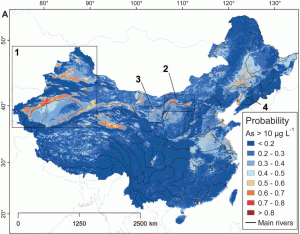
Estimated probability of arsenic in Chinese groundwater above the WHO acceptable maximum concentration (Credit:Rodriguez-Lado, et al. 2013)

The results graphically highlight possible high risk areas, mainly in the northern Chinese provinces that are partly confirmed by the validation. Using estimated variations in population density across the country the team discovered that as many as 19.6 million people may be affected by consumption of arsenic contaminated water. In fact if groundwater is used for irrigation, arsenic may also be ingested with locally grown food. It seems that the vast majority of Chinese people live outside the areas of risk, so that mitigating risk is likely to be more manageable that it is in Bangladesh and West Bengal.

As well as being an important input to environmental health management in the PRC the approach is appropriate for other large areas where direct water monitoring is less organised, such as Mongolia, Kazakhstan and Kyrgyzstan in central Asia, and in the arid regions of South America.

The Grand Greenland Canyon

One of the properties of radar is that it can pass through hundreds of metres of ice to be scattered by the bedrock beneath and return to the surface with sufficient remaining power to allow measurement of ice depth from the time between transmission of a pulse and that when the scattered energy returns to the antenna. Liquid water simply absorbs the radar energy preventing any return from the subsurface. As far as rocks and soils are concerned, any water in them and the structure of minerals from which they are composed limit penetration and energy return to at most only a few metres. While radar images that result from scattering by the Earth’s solid surface are highly informative about landforms and variations in the surface’s small-scale texture, outside of seismic reflection profiling, only ice-penetrating radar (IPR) approaches the ‘holy grail’ of mapping what lies beneath the surface in 3-D. Unlike seismic surveys it can be achieved from aircraft and is far cheaper to conduct.

English: Topographic map of Greenland bedrock,...
Greenland’s topography without the ice sheet. (Photo credit: Wikipedia)

It was IPR that revealed the scattering of large lakes at the base of the Antarctic ice cap, but a survey of Greenland has revealed something even more astonishing: major drainage systems. These include a vast canyon that meanders beneath the thickest part of the ice towards the island’s north coast (Bamber, J.L. et al. 2013. Palaeofluvial mega-canyon beneath the central Greenland ice sheet. Science, v. 341, p. 997-999). At 750 km long and a maximum depth of 800 m it is comparable with active canyon systems along the Colorado and Nile rivers in the western US and Ethiopia respectively. A less-well publicised feature is ancient leaf-shaped system of buried valleys further south that emerges in a great embayment on West Greenland’s coast near Uummannaq, which may be the catchment of another former river system. In fact much of the data that revealed what appears to be pre-glacial topography dates back to the 1970s, though most was acquired since 2000. The coverage by flight lines varies a great deal, and as more flights are conducted, yet more detail will emerge.

The British, Canadian and Italian discoverers consider that glacial meltwater sinking to the base of the ice cap continues to follow the canyon, perhaps lubricating ice movement. The flatter topography beneath the Antarctic ice cap is not so easy to drain, which probably accounts for the many sub-glacial lakes there whereas none of any significance have been detected in Greenland. The earliest time when Greenland became ice-bound was about 5 Ma ago, so that is the minimum age for the river erosion that carved the canyon

New approach to the Milankovitch mystery

Melting pond on the ice sheet
Melting pond on the Greenland ice sheet (credit: Photo by Leif Taurer)

Milutin Milankovitch’s astronomical theory to account for glacial – interglacial cycles is based on 3 gravitational influences on the Earth that change the way it spins and orbits the Sun. Each is cyclic but with different periods: the angle of axial tilt every 41 ka; precession of its rotation axis on a 23 ka pacing; the change in shape of the orbit around the Sun over 100 ka. Each subtly affects the amount of solar energy, their influences combining to produce a seemingly complex, but predictable variation through time of solar heating for any point on the Earth’s surface. Milankovitch’s work was triumphantly confirmed when analysis of oxygen-isotope time series from sea-floor sediments revealed precisely these periods in the record of continental ice cover. Specifically, astronomical pacing of midsummer insolation at 65°N matches the real climatic pattern through time.

Yet the periods between glacial maxima have not stayed constant over the last 2 Ma or so (Figure showing Phanerozoic climate changes). About 0.8 to 1 Ma ago a sequence with roughly 41 ka spacing was replaced by another about every 100 ka, i.e. both overall climate periods matched one of the astronomical forcings. What is a puzzle is that the current periodicity seems to follow the very weakest influence in energy terms; that from orbital eccentricity. The energy shifts from changes in orbit shape are, in fact, far too weak to drive the accumulation and eventual melting of ice sheets on land. Climatologists have suggested a variety of processes that might be paced by eccentricity but which act to amplify is climatic ‘signal’. None have been especially convincing.

In an attempt to resolve the mystery Ayako Abe-Ouchi of the University of Tokyo and Japanese, US and Swiss colleagues linked a climate model driven by Milankovitch insolation and variations in CO2 recorded in an Antarctic ice core with a model of how land-ice forms and interacts with the underlying lithosphere (Abe-Ouchi, A. et  al. 2013. Insolation-driven 100,000-year glacial cycles and hysteresis of ice-sheet volume. Nature, v. 500, p. 190-193).

CLIMAP map of ice sheets, sea temperature chan...
Map of ice sheets, sea temperature changes, and changes in the outline of coastal regions during the last glacial maximum. (credit: Wikipedia)

Their key discovery is that the ice-sheets that repeatedly formed on the Canadian Shield and extended further south than Chicago had such a huge mass that they changed the shape of the land surface beneath them so much it had an effect on climate as a whole. The reason for this is that glacial loading forces the lithosphere down by displacing the more ductile asthenosphere sideways. But when melting begins rebound of the rock surface lags a long time behind the shrinking ice volume – well displayed today in Britain and Scandinavia by continued rise of the land to form raised beaches. In the case of the North American ice sheet, what had become an enormous ice bulge at glacial maxima developed into a huge basin up to 1 km deep as the ice began to melt. Simply by virtue of its low elevation this sub-continental basin would have warmed up more and more rapidly as the ice-surface fell because of this ‘isostatic’ lag.

Another feature to emerge from the model was the interaction between the 100 ka eccentricity ‘signal’ and that of precession at 23 ka. For long periods that kept summer temperature low enough for snow to pile up and become glacial ice, but on a roughly 100 ka time scale both acted together to increase summer temperatures at high northern latitudes. Melting that instantaneously removed some ice load each summer brought into play the sluggish isostatic  response that helped even more warming the following year. As well as convincingly accounting for the 100 ka mystery, the model explains the far more rapid deglaciations in that mode than in the preceding 41 ka cycles, which were almost symmetrical compared with the more recent slow accumulation of continental ice sheets over ~90 ka followed by almost complete melting in a mere 10 ka.

If true, the model seems to imply that before 800 ka the positions, thicknesses and extents of continental ice sheets were different from those in later times. Or perhaps it reflects a steady increase in the overall volume of ice being produced over northern North America, or that glacial erosion thinned the crust until changing isostatic influences could ‘trip’ sufficient additional warming.

Yet another risk of arsenic exposure

The most widely feared risk of poisoning through natural causes, which grossly disfigures and kills through a range of cancers, is from chronic exposure to arsenic in drinking water. Tragically, the risk is highest from what has traditionally been considered safest source, groundwater. That was the gruesome lesson of a massive transfer in Bangladesh from drinking surface water containing organic pathogens to reliance on well waters. The greatest mass poisoning in history was eventually traced to shallow aquifers in the Ganges-Brahmaputra plains that were rich in organic matter. Their reducing chemistry broke down iron hydroxide coatings on sedimentary grains. Since these minerals are among the most accommodating adsorbers of ions from the environment, including a variety of arsenic-bearing ions, their dissolution releases potential poisons from otherwise safe storage. In Bangladesh and neighbouring West Bengal in India it was found that deeper aquifers have oxidising chemistry and so the iron minerals not only hold ionic pollutants fast by adsorption but help to extract them from groundwater. Deep wells together with various kinds of treatment of shallow groundwater, some using the very iron minerals whose breakdown caused the pollution, are helping to mitigate the perilous situation for people of South Asia.

Skin lesions from arsenic poisoning in Bangladesh
Skin lesions (keratoses) from arsenic poisoning in Bangladesh (Photo credit: waterdotorg)

Much the same kind of arsenic pollution has subsequently been revealed in groundwaters of lowland Vietnam and Cambodia. Yet the turn there to deep groundwater has revealed a new twist. That too is yielding increasingly high arsenic concentrations, but for a different reason (Erband, L.E. et al. 2013. Release of arsenic to deep groundwater in the Mekong Delta, Vietnam, linked to pumping-induced land subsidence. Proceedings of the National Academy of Science, doi/10.1073/pnas.1300503110). Scientists from Stanford University, California analysed waters from around 900 wells in the Lower Mekong Delta and found several tracts with arsenic contents well above levels deemed safe by the WHO. Some, as could be anticipated from South Asian studies, were from shallow wells along the present course of the Mekong. However, in the delta area to the southwest of Ho Chi Minh City (formerly Saigon) is a large cluster from wells 150 to 450 m deep, totally unlike the situation in other areas of thick Pliocene to Recent river sedimentation.

Comparing the distribution of affected wells with precise estimates of the subsidence rates of the land surface from orbital interferometric radar surveys shows a close correlation of arsenic contamination with rates of subsidence. This suggests that groundwater pumping from deep aquifers is causing compaction at depth, in much the same way as in the environs of Venice. But is this somehow drawing in arsenic polluted water from higher levels? It seems not. So the pollution seems most likely to be an effect of pumping itself. The authors suggest that most of the subsidence is due to compaction of clay-rich sediments rather than the sandy aquifers, well known by engineers to resist compression. They explain the increasing arsenic concentrations by the introduction into the aquifers of water expelled from the clays, either containing arsenic ions in solution or carrying organic compounds that create the reducing conditions to break down iron hydroxide grain coatings and release ions adsorbed on their surfaces.

This presents another grim prospect for South Asian people forced to make the choice between drinking polluted surface water and enteric disease and increasingly exploited deep groundwaters that seem to be safe as well as in very high volumes. Let’s hope that arsenic monitoring can be maintained in the Ganges-Brahmaputra plains in the long term.