Seismic tomography provides no evidence that slabs of oceanic lithosphere descend intact through the whole mantle to the core-mantle boundary. It might once have happened when they were capped by abundant high-density rocks, such as Precambrian banded-iron formations. A great many actively descending slabs have been shown to cease sinking, slide sideways and accumulate at depths around 660 and 1000 km. Until recently these discontinuities were been generally ascribed to transitions in the structure of the dominant mafic mineral olivine (Mg2SiO4) in mantle peridotite induced by increasing pressure and temperature. The resulting increases in mantle density supposedly form barriers to further slab descent. Pressure-induced mineral transitions in the slabs themselves that increase their density, such as pyroxene to garnet, may somehow be inhibited thereby leading to stagnation in slab descent. That may be true for the 660 km discontinuity, but for stagnation at 1000 km deep no such density-changing mineral transitions have shown up in high-P high-T mineralogical experiments. Some other process must therefore be responsible for slab descent to that depth. Recent work by geoscientists at several universities in China gives insights into what may be going on (Li, J., Li, K., Li, J. et al 2026. Dual slab stagnation depths controlled by grain-size-induced sporadic low-viscosity zones at around 1000 km depth. Nature Communications DOI: 10.1038/s41467-026-69987-9).
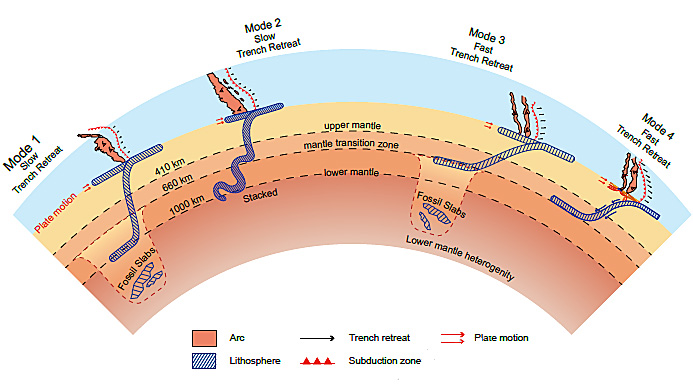
Four different modes of subduction at island arcs. Credit: Li et al. Fig 6
Jing Li and colleagues have focussed on the possibility that changes in the bulk viscosity of the mantle may play an important role. Their approach is twofold: experimental mineral physics and geodynamic modelling. Results suggest that recrystallization in the mantle when deeply penetrating slabs pass through it may patchily reduce the mantle’s grain size and thus its viscosity; the more so with larger volumes of subducted slab material. In turn, the resulting physical heterogeneity probably disrupts the steady downward passage of the slabs; fine-grained, less viscous zones ‘lubricating’ slab penetration, unchanged zones hindering it. The authors link such hypothetical micro-structural processes to modes of subduction that are currently active. They consider four modes of active subduction beneath island arcs with either a slow or a fast rate of trench retreat (see Figure). A slowly retreating trench system combined with low-viscosity patches at depth (Mode 1) results in penetration below 660 km and slab stagnation at 1000 km. Slow trench retreat with a homogenous lower mantle (Mode 2) gives rise to penetration and buckling of the descending slab between 660 and 1000 km. Fast trench retreat with a deeper low-viscosity zone (Mode 3), or with a homogeneous lower mantle (Mode 4) both result in slab stagnation at 660 km.
The models developed by Jing Li et al convincingly simulate various results of seismic tomography beneath island arcs. Interestingly, they suggest that the eventual assimilation of older slab materials into the deeper mantle (‘fossil’ slabs) may play a major role in mineral comminution and reduced mantle strength. That may leave behind low viscosity zones that later subduction may exploit. In fact, there are signs of possible fossil slabs in seismic tomograms more than 1000 km below the present Pacific Ocean floor in the form of zones of high P-wave velocity.
This work shows that plate tectonics is far from ‘done-and-dusted’, the mantle being far from uniform in its properties. Li et al’s results potentially open up new insights into whole-mantle convection, in which older tectonic events influence plate motions that are currently operating and the triggering of plumes rising from the deepest mantle. It also hints that such complex physical mixing of subducted material into the mantle may have resulted in the geochemical heterogeneities that increasingly emerge from analysis of magmas with ultimate origins in the mantle.
The emergence of the eukaryotes – of which we are a late-entry member – has been debated for quite a while. In 2023 Earth-logs reportedthat a study of ‘biomarker’ organic chemicals in Proterozoic sediments suggests that eukaryotes cannot be traced back further than about 900 Ma ago using such an approach. At about the same time another biomarker study showed signs of a eukaryote presence at around 1050 Ma. Both outcomes seriously contradicted a ‘molecular-clock’ approach based on the DNA of modern members of the Eukarya and estimates of the rate of genetic mutation. That method sought to deduce the time in the past when the last eukaryotic common ancestor (LECA) appeared. It pointed to about 2 Ga ago, i.e. a few hundred million years after the Great Oxygenation Event got underway. Since eukaryote metabolism depends on oxygen, the molecular-clock result seems reasonable. The biomarker evidence does not. But were the Palaeo- and Mesoproterozoic Eras truly ‘boring’? A recent paper by Dietmar Müller and colleagues from the Universities of Sydney and Adelaide, Australia definitely shows that geologically they were far from that (Müller, R.D. et al. 2025. Mid-Proterozoic expansion of passive margins and reduction in volcanic outgassing supported marine oxygenation and eukaryogenesis. Earth and Planetary Science Letters, v. 672; DOI: 10.1016/j.epsl.2025.119683).
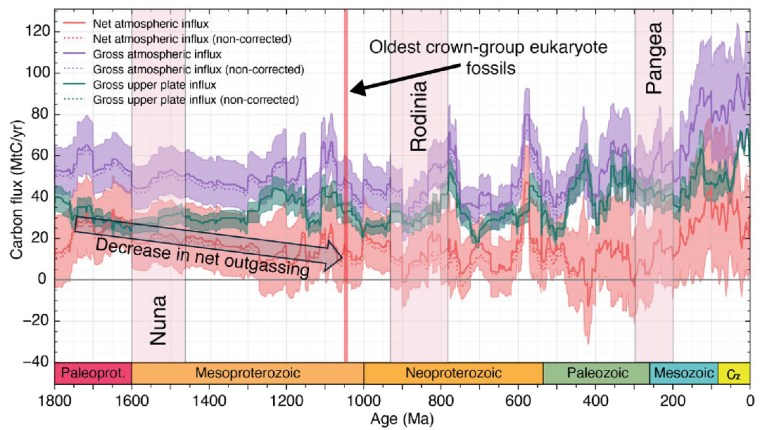
Carbon influx (million tons per year) into tectonic plates and into the ocean-atmosphere system from 1800 Ma to present. The colour bands represent: total carbon influx into the atmosphere (mauve); sequestered in tectonic plates (green); net atmospheric influx i.e. total minus carbon sequestered into plates (orange). The widths of the bands show the uncertainties of the calculated masses shown as darker coloured lines.
From 1800 to 800 Ma two supercontinents– Nuna-Columbia and Rodinia – aggregated nearly all existing continental masses, and then broke apart. Continents had collided and then split asunder to drift. So plate tectonics was very active and encompassed the entire planet, as Müller et al’s palaeogeographic animation reveals dramatically. Tectonics behaved in much the same fashion through the succeeding Neoproterozoic and Phanerozoic to build-up then fragment the more familiar supercontinent of Pangaea. Such dynamic events emit magma to form new oceanic lithosphere at oceanic rift systems and arc volcanoes above subduction zones, interspersed with plume-related large igneous provinces and they wax and wane. Inevitably, such partial melting delivered carbon dioxide to the atmosphere. Reaction on land and in the rubbly flanks of spreading ridges between new lithosphere and dissolved CO2 drew down and sequestered some of that gas in the form of solid carbonate minerals. Continental collisions raised the land surface and the pace of weathering, which also acted as a carbon sink. But they also involved metamorphism that released carbon dioxide from limestones involved in the crustal transformation. This protracted and changing tectonic evolution is completely bound up through the rock cycle with geochemical change in the carbon cycle.
From the latest knowledge of the tectonic and other factors behind the accretion and break-up of Nuna and Rodinia, Müller et al. were able to model the changes in the carbon cycle during the ‘boring billion’ and their effects on climate and the chemistry of the oceans. For instance, about 1.46 Ga ago, the total length of continental margins doubled while Nuna broke apart. That would have hugely increased the area of shallow shelf seas where living processes would have been concentrated, including the photosynthetic emission of oxygen. In an evolutionary sense this increased, diversified and separated the ecological niches in which evolution could prosper. It also increased the sequestration of greenhouse gas through reactions on the flanks of a multiplicity of oceanic rift systems, thereby cooling the planet. Translating this into a geochemical model of the changing carbon cycle (see figure) suggests that the rate of carbon addition to the atmosphere (outgassing) halved during the Mesoproterozoic. The carbon cycle and probable global cooling bound up with Nuna’s breakup ended with the start of Rodinia’s aggregation about 1000 Ma ago and the time that biomarkers first indicate the presence of eukaryotes.
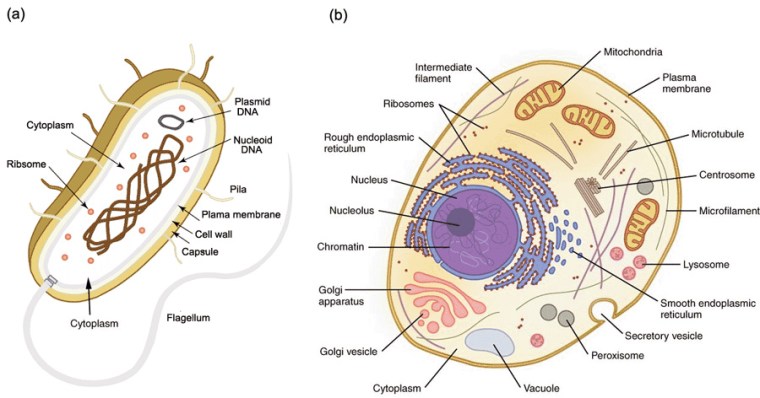
Simplified structures of (a) a prokaryote cell; (b) a simple eukaryote animal cell. Plants also contain organelles called chloroplasts
So, did tectonics play a major role in the rise of the Eukarya? Well, of course it did, as much as it was subsequently the changing background to the appearance of the Ediacaran animals and the evolutionary carnival of the Phanerozoic. But did it affect the billion-year delay of ‘eukaryogenesis’ during prolonged availability of the oxygen that such a biological revolution demanded? Possibly not. Lyn Margulis’s hypothesis of the origin of the basic eukaryote cell by a process of ‘endosymbiosis’ is still the best candidate 50 years on. She suggested that such cells were built from various forms of bacteria and archaea successively being engulfed within a cell wall to function together through symbiosis. Compared with prokaryote cells those of the eukaryotes are enormously complex. At each stage the symbionts had to be or become compatible to survive. It is highly unlikely that all components entered the relationship together. Each possible kind of cell assembly was also subject to evolutionary pressures. This clearly was a slow evolutionary process, probably only surviving from stage to stage because of the global presence of a little oxygen. But the eukaryote cell may also have been forced to restart again and again until a stable form emerged.
A symposium hosted by the Royal Society in 1965 aimed at resurrecting Alfred Wegener’s hypothesis of continental drift. During the half century since Wegener made his proposal in 1915, it had been studiously ignored by most geologists. The majority had bumbled along with the fixist ideology of their Victorian predecessors. The symposium launched what can only be regarded as a revolution in the Earth Sciences. In the three years following the symposium, the basic elements of plate tectonics had emerged from a flurry of papers, mainly centred on geophysical evidence. Geology itself became part of this cause célèbre through young scientists eager to make a name for themselves. The geological history of Britain, together with that of the eastern North America, became beneficiaries only four years after the Royal Society meeting (Dewey, J. 1969. Evolution of the Appalachian/Caledonian Orogen. Nature222, 124–129; DOI: 10.1038/222124a0).
In Britain John Dewey, like a few other geologists, saw plate theory as key to understanding the many peculiarities revealed by geological structure, igneous activity and stratigraphy of the early Palaeozoic. These included very different Cambrian and Ordovician fossil assemblages in Scotland and Wales, now only a few hundred kilometres apart. The Cambro-Ordovician of NW Scotland was bounded to the SE by a belt of highly deformed and metamorphosed Proterozoic to Ordovician sediments and volcanics forming the Scottish Highlands. That was terminated to the SE by a gigantic fault zone containing slivers of possible oceanic lithosphere. The contorted and ‘shuffled’ Ordovician and Silurian sediments of the Southern Uplands of Scotland. The oldest strata seemed to have ocean-floor affinities, being deposited on another sliver of ophiolites. A few tens of km south of that there was a very different Lower Palaeozoic stratigraphy in the Lake District of northern England. It included volcanic rocks with affinities to those of modern island arcs. A gap covered by only mildly deformed later Palaeozoic shelf and terrestrial sediments, dotted by inliers of Proterozoic sediments and volcanics separated the Lake District from yet another Lower Palaeozoic assembly of arc volcanics and marine sediments in Wales. Intervening in Anglesey was another Proterozoic block of deformed sediments that also included ophiolites.
Dewey’s tectonic assessment from this geological hodge-podge, which had made Britain irresistible to geologists through the 19th and early 20th centuries, was that it had resulted from blocks of crust (terranes), once separated by thousands of kilometres, being driven into each other. Britain was thus formed by the evolution and eventual destruction of an early Palaeozoic ocean, Iapetus: a product of plate tectonics. Scotland had a fundamentally different history from England and Wales; the unification of several terranes having taken over 150 Ma of diverse tectonic processes. Dewey concluded that the line of final convergence lay at a now dead, major subduction zone – the Iapetus Suture – roughly beneath the Solway Firth. During the 56 years since Dewey’s seminal paper on the Caledonian-Appalachian Orogeny details and modifications have been added at a rate of around one to two publications per year. The latest seeks to date when and where the accretion of 6 or 7 terranes was finally completed (Waldron, J.W.F. et al. 2025. Is Britain divided by an Acadian suture?Geology, v. 53, p. 847–852; DOI: 10.1130/G53431.1).
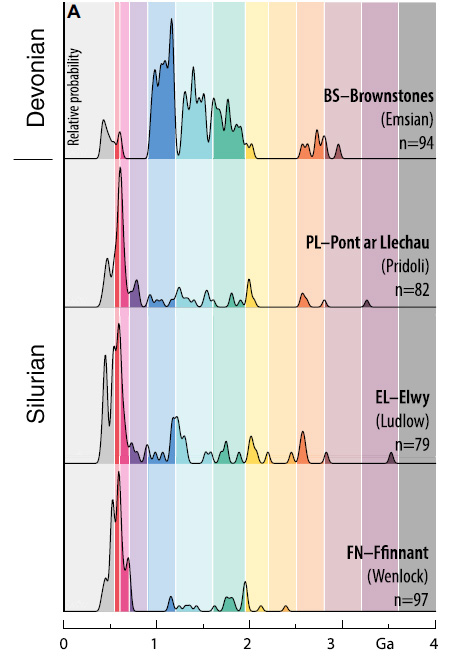
Kernel density plots – smoothed versions of histograms – of detrital zircon ages in Silurian and Devonian sandstones from Wales. The bracketed words are stratigraphic epochs. Credit: Waldron et al. 2025, Fig 3A
John Waldron and colleagues from the University of Alberta and Acadia University in Canada and the British Geological Survey addressed this issue by extracting zircons from four late Silurian and early Devonian sandstones in North and South Wales. These sediments had been deposited between 433 and 393 Ma ago at the southernmost edge of the British Caledonide terrane assemblage towards the end of terrane assembly. The team dated roughly 250 zircons from each sandstone using the 207Pb/206Pb and 206Pb/238U methods. Each produced a range of ages, presumed to be those of igneous rocks from whose magma the zircon grains had crystallised. These data are expressed as plots of probable frequency against age. Each pattern of ages is assumed to be a ‘fingerprint’ for the continental crust from which the zircons were eroded and transported to their resting place in their host sediment. In this case, the researchers were hoping to see signs of continental crust from the other side of the Caledonian orogen; i.e. from the Precambrian basement of the Laurentia continent.
The three late-Silurian sediments showed distinct zircon-age peaks around 600 Ma and a spread of smaller peaks extending to 2.2 Ga. This tallied with a sediment source in Africa, from which the southernmost Caledonian terrane was said to have split and moved northwards. The Devonian sediment lacked signs of such an African ‘heritage’ but had a prominent age peak at about 1.0 Ga, absent from the Welsh Silurian sediments. Not only is this a sign of different sediment provenance but closely follows the known age of a widespread magmatic pulse in the Laurentian continent. So, sediment transport from the opposite side of the Iapetus Ocean across the entire Caledonian orogenic belt was only possible after the end of the Silurian Period at around 410 Ma. There must have been an intervening barrier to sediment movement from Laurentia before that, such as deep ocean water further north. Previous studies from more northern Caledonian terranes show that Laurentian zircons arrived in the Southern Uplands of Scotland and the English Lake District around 432 Ma in the mid-Silurian. Waldron et al. suggest, on these grounds that the suture marking the final closure of the Iapetus Ocean lies between the English Lake District and Anglesey, rather than beneath the Solway. They hint that the late-Silurian to early Devonian granite magmatism that permeated the northern parts of the Caledonian-Appalachian orogen formed above northward subduction of the last relics of Iapetus, which presaged widespread crustal thickening known as the Acadian orogeny in North America.
Readers interested in this episode of Earth history should download Waldron et al.’s paper for its excellent graphics, which cannot be reproduced adequately here.
About 70 Ma ago the magnetic striping of the Indian Ocean floor suggests that the Indian subcontinent was then moving towards the huge, almost stationary Eurasian continent at about 8 cm per year. Over the next 5 Ma this convergence rate underwent a tectonically startling acceleration to reach 18 cm yr-1 by around the time of the Cretaceous-Palaeogene boundary (65 Ma): more than doubling the approach rate. Thereafter it slowed, eventually to a few centimetres per year once collision and building of the Himalayan mountain belt were more or less complete about 30 Ma ago. This cannot easily be explained by a speeding up of the sea-floor spreading rate at an Indian Ocean ridge to the south, 18 cm yr-1 being as fast as tectonic forces can manage at present. At that time ocean floor to the north of India was being subducted beneath Eurasia, and basaltic volcanism was flooding what is now the Deccan Plateau on western India. A couple of suggestions have been made: two northward subduction zones may have developed or the mantle plume feeding the Deccan flood basalts may have driven the tectonic acceleration. A third possibility is that the subduction was somehow lubricated. That approach has recently been considered by geoscientists from China and Singapore (Zhou, H. et al. 2024. India–Eurasia convergence speed-up by passive-margin sediment subduction. Nature, v. 635, p. 114-120; DOI: 10.1038/s41586-024-08069-6).
Hao Zhou and colleagues studied the isotopic and trace-element geochemistry of volcanic and plutonic igneous complexes to the north of the Himalaya. They were emplaced in arc environments in three stages: from 98 to 89; 65 to 60; and 57 to 50 Ma. In this tectonic setting fluids rise from the subducted slab to induce the mantle part of the overriding lithosphere to partially melt. That yields magmas which penetrate the crust above. The first and last magmatic events produced similar isotopic and trace-element ‘signatures’, which suggest fluids rose from subducted ocean lithosphere. But those in the latest Cretaceous to earliest Palaeocene are markedly different. Instead of showing signs of their magmas being entirely mantle derived like the earlier and later groups, the 65 to 60 Ma rocks exhibit clear evidence of partial melting having incorporated materials that had originated in older continental crust. The authors suggest that this crustal contamination stemmed from sediments that had been deposited at the northern margin of the Indian subcontinent during the Mesozoic. These sediments had formed by weathering of the ancient rocks that underpin India, transport of the debris by rivers and deposition on the seafloor as water-saturated sands, silts and clays. Once those sediments were subducted beneath what is now Tibet they would yield fluids with a geochemical ‘fingerprint’ inherited from old continental crust. Moreover, far more fluids than subducted oceanic crust could ever release would rise into the overriding lithosphere than.
The fluids rising from a subducted wedge of sediments may have reduced friction between the overriding Eurasian lithosphere and the subducted slab derived from the Indian tectonic plate. That scenario would not only have lubricated subduction, but allowed compressive forces in the overriding lithosphere to relax. Both would have allowed convergence of the two plates to move significantly faster as the sediments were progressively consumed. Once completed, convergence would have slowed without such ‘lubrication’.Earlier continent-continent collision zones, such as those that united Pangaea and older supercontinents may well have involved such tectonic surges. And the same kind of process may eventually speed up the reassembly of the latest distribution of continents.
Watch an animation of the India-Eurasia convergence (just over 3 minutes long)compiled by Christopher Scotese of Northwestern University in Evanston, Illinois, USA, which is a component of his Paleomap Project. It starts by following India from its current position to its origin in the break-up of Gondwanaland ~100 Ma ago. The last half reverses the motions to show India’s slow collision with Eurasia.
In 1961 ten scientists interested in a search for extra-terrestrial intelligence met at Green Bank, West Virginia, USA, none of whom were geologists or palaeontologists. The participants called themselves “The Order of the Dolphin”, inspired by the thorny challenge of discovering how small cetaceans communicated: still something of a mystery. To set the ball rolling, Frank Drake an American astrophysicist and astrobiologist, proposed an algorithm aimed at forecasting the number of planets elsewhere in our galaxy on which ‘active, communicative civilisations’ (ACCs) might live. The Drake Equation is formulated as:
ACCs = R* · fp · ne · fl · fi · fc · L
where R* = number of new stars formed per year, fp = the fraction of stars with planetary systems, ne = the average number of planets that could support life (habitable planets) per planetary system, fl = the fraction of habitable planets that develop primitive life, fi = the fraction of planets with life that evolve intelligent life and civilizations, fc = the fraction of civilizations that become ACCs,L = the length of time that ACCs broadcast radio into space. A team of then renowned scientists from several disciplines discussed what numbers to attach to these parameters. Their ‘educated guesses’ were: R* – one star per year; fp – one fifth to one half of all stars will have planets; ne – 1 to 5 planets per planetary system will be habitable; of which 100% will develop life (fl) and 100% (fi) will eventually develop intelligent life and civilisations; of those civilisations 10 to 20 % (fc) will eventually develop radio communications; which will survive for between a thousand years and 100 Ma (L). Acknowledging the great uncertainties in all the parameters, Drake inferred that between 103 and 108 ACCs exist today in the Milky Way, which is ~100 light years across and contains 1 to 4 x 10¹¹ stars).
Today the values attached to the parameters and the outcomes seem absurdly optimistic to most people, simply because, despite 4 decades of searching by SETI there have been no signs of intelligible radio broadcasts from anywhere other than Earth and space probes launched from here. This is humorously referred to as the Fermi Paradox. There are however many scientists who still believe that we are not alone in the galaxy, and several have suggested reasons why nothing has yet been heard from ACCs. Robert Stern of the University of Texas (Dallas), USA and Taras Gerya of ETH-Zurich, Switzerland have sought clues from the history of life on Earth and that of the inorganic systems from which it arose and in which it has evolved that bear on the lack of any corrigible signals in the 63 years since the Drake Equation (Stern, R.J & Gerya, T.V. 2024. The importance of continents, oceans and plate tectonics for the evolution of complex life: implications for finding extraterrestrial civilizations. Nature (Scientific Reports), v. 14, article 8552; DOI: 10.1038/s41598-024-54700-x – definitely worth reading). Of course, Stern and Gerya too are fascinated by the scientific question as to whether or not there are ‘active, communicative civilisations’ elsewhere in the cosmos. Their starting point is that the Drake Equation is either missing some salient parameters, or that those it includes are assigned grossly optimistic magnitudes.
Life seems to have been present on Earth 3.8 Ga ago but multicelled animals probably arose only in the Late Neoproterozoic since 1.0 Ga ago. So here it has taken a billion years for their evolution to achieve terrestrial ACC-hood. Stern and Gerya address what processes favour life and its rapid evolution. Primarily, life depends on abundant liquid water: i.e. on a planet within the ‘Goldilocks Zone’ around a star. The authors assume a high supply of bioactive compounds – organic carbon, ammonium, ferrous iron and phosphate to watery environments. Phosphorus is critical to their scenario building. It is most readily supplied by weathering of exposed continental crust, but demands continual exposure of fresh rock by erosion and river transport to maintain a steady supply to the oceans. Along with favourable climatic conditions, that can only be achieved by an oxidising environment that followed the Great Oxidation Event (2.4 to 2.1 Ga) and continual topographic rejuvenation by plate tectonics.
A variety of Earth-logs posts have discussed various kinds of evidence for the likely onset of plate tectonics, largely focussing on the Hadean and Archaean. Stern and Gerya prefer the Proterozoic Eon that preserves more strands of relevant evidence, from which sea-floor spreading, subduction and repeated collision orogenies can confidently be inferred. All three occur overwhelmingly in Neoproterozoic and Phanerozoic times. Geologists often refer to the whole of the Mesoproterozoic and back to about 2.0 Ga in the Palaeoproterozoic as the ‘Boring Billion’ during which carbon isotope data suggest very little change in the status of living processes: they were present but nothing dramatic happened after the Great Oxidation Event. ‘Hard-rock’ geology also reveals far less passive extensional events that indicate continental break-up and drift than occur after 1.0 Ga and to the present. It also includes a unique form of magmatism that formed rocks dominated by sodium-rich feldspar (anorthosites) and granites that crystallised from water-poor magmas. They are thought to represent build-ups of heat in the mantle unrelieved by plate-tectonic circulation. Before the ‘Boring Billion’ such evidence as there is does point to some kind of plate motions, if not in the modern style.
How different styles of tectonics influence living processes differently: a single stagnant ‘lid’ versus plate tectonics. (Credit: Stern and Gerya, Fig 2)
Stern and Gerya conclude that the ‘Boring Billion’ was dominated by relative stagnation in the form of lid tectonics. They compare the influence of stagnant ‘lid’ tectonics on life and evolution with that of plate tectonics in terms of: bioactive element supply; oxygenation; climate control; habitat formation; environmental pressure (see figure). In each case single lid tectonics is likely to retard life and evolution, whereas plate tectonics stimulates them as it has done from the time of Snowball Earth and throughout the Phanerozoic. Only one out of 8 planets that orbit the sun displays plate tectonics and has both oceans and continents. Could habitable planets be a great deal rarer than Drake and his pals assumed? [look at exoplanets in Wikipedia] Whatever, Stern and Gerya suggest that the seemingly thwarted enthusiasm surrounding the Drake Equation needs to be tempered by the addition of two new terms: the fraction of habitable exoplanets with significant continents and oceans (foc)and the fraction of them that have experienced plate tectonics for at least half a billion years (fpt). They estimate foc to be on the order of 0.0002 to 0.01, and suggest a value for fpt of less than 0.17. Multiplied together yields value between less than 0.00003 and 0.002. Their incorporation in the Drake Equation drastically reduces the potential number of ACCs to between <0.006 and <100,000, i.e. to effectively none in the Milky Way galaxy rising to a still substantial number
There are several other reasons to reject such ‘ball-parking’ cum ‘back-of-the-envelope’ musings. For me the killer is that biological evolution can never be predicted in advance. What happened on our home world is that the origin and evolution of life have been bound up with the unique inorganic evolution of the Solar System and the Earth itself over more than 4.5 billion years. That ranges in magnitude from the early collision with another, Mars-sized world that reset the proto-Earth’s geochemistry and created a large moon whose gravity has cycled the oceans through tides and changed the length of the day continually for almost the whole of geological history. At least once, at the end of the Cretaceous Period, a moderately sized asteroid in unstable orbit almost wiped out life at an advanced stage in its evolution. During the last quarter billion years internally generated geological forcing mechanisms have repeatedly and seriously stressed the biosphere in roughly 36 Ma cycles (Boulila, S. et al. 2023. Earth’s interior dynamics drive marine fossil diversity cycles of tens of millions of years. Proceedings of the National Academy of Sciences, v. 120 article e2221149120; DOI: 10.1073/pnas.2221149120). Two outcomes were near catastrophic mass extinctions, at the ends of the Permian and Triassic Periods, from which life struggled to continue. As well as extinctions, such ‘own goals’ reset global ecosystems repeatedly to trigger evolutionary diversification based on the body plans of surviving organisms.
Such unique events have been going on for four billion years, including whatever triggered the Snowball Earth episodes that accompanied the Great Oxygenation Event around 2.4 Ga and returned to coincide with the rise of multicelled animals during the Cryogenian and Ediacaran Periods of the Late Neoproterozoic. For most of the Phanerozoic a background fibrillation of gravitational fields in the Solar System has occasionally resulted in profound cycling between climatic extremes and their attendant stresses on ecosystems and their occupants. The last of these coincided with the evolution of humanity: the only creator of an active, communicative civilisation of which we know anything. But it took four billion years of a host of diverse vagaries, both physical and biological to make such a highly unlikely event possible. That known history puts the Drake Equation firmly in its place as the creature of a bunch of self-publicising and regarding, ambitious academics who in 1961 basically knew ‘sweet FA’. I could go on … but the wealth of information in Stern and Gerya’s work is surely fodder for a more pessimistic view of other civilisations in the cosmos.
Someone – I forget who – provided another, very practical reason underlying the lack of messages from afar. It is not a good idea to become known to all and sundry in the galaxy, for fear that others might come to exploit, enslave and/or harvest. Earth is still in a kind of imperialist phase from which lessons could be drawn!
Tangible signs of past subduction take the form of rocks whose mineralogy shows that they have been metamorphosed under conditions of high pressure and low temperature, and then returned to the surface somehow. Ocean-crust basaltic rocks become blueschist and eclogite. The latter is denser than mantle peridotite so that oceanic lithosphere can sink and be recycled. That provides the slab-pull force, which is the major driver of plate tectonics. Unfortunately, neither blueschists nor eclogites are found in metamorphic complexes older than about 800 Ma. This absence of direct proof of subduction and thus modern style plate tectonics has resulted in lively discussion and research seeking indirect evidence for when it did begin, the progress of which since 2000 you can follow through the index for annual logs about tectonics. An interesting new approach emerged in 2017 that sought a general theory for the evolution of silicate planets, which involves the concept of ‘lid tectonics’. A planet in a stagnant-lid phase has a lithosphere that is weak as a result of high temperatures: indeed so weak and warm that subduction was impossible. Stagnant-lid tectonics does not recycle crustal material back to its source in the mantle and it simply builds up the lithosphere. Once planetary heat production wanes below a threshold level that permits a rigid lithosphere, parts of the lid can be driven into the mantle. The beginnings of this mobile-lid phase and thus plate tectonics of some kind involves surface materials in mantle convection: the may be recycled.
Cartoon of possible Hadean stagnant lid tectonics, dominated by mantle plumes. (Credit: Bédard, J.H. 2018, Fig 3B, DOI: 10.1016/j.gsf.2017.01.005)
A group of geochemists from China, Canada and Australia have sought evidence for recycled crustal rocks from silicon and oxygen isotopes in the oldest large Archaean terrane, the 4.0 Ga old Acasta Gneiss Complex in northern Canada (Zhang, Q. and 10 others 2023. No evidence of supracrustal recycling in Si-O isotopes of Earth’s oldest rocks 4 Ga ago. Science Advances, v.9, article eadf0693; DOI: 10.1126/sciadv.adf0693). Silicon has three stable isotopes 28Si, 29Si, and 30Si. As happens with a number of elements, various geochemical processes are able to selectively change the relative proportions of such isotopes: a process known as isotope fractionation. As regards silicon isotopes used to chart lithosphere recycling, the basic steps are as follows: Organisms that now remove silicon from solution in seawater to form their hard parts and accumulate in death as fine sediments like flint had not evolved in the Archaean. Because of that reasonable supposition it has been suggested that seawater during the Archaean contained far more dissolved silicon than it does now. Such a rich source of Si would have entered Archaean oceanic crust and ocean-floor sediments to precipitate silica ‘cement’. The heaviest isotope 30Si would have left solution more easily than the lighter two. Should such silicified lithosphere have descended to depths in the mantle where it could partially melt the anomalously high 30Si would be transferred to the resulting magmas.
Proportions of 30Si in zircons, quartz and whole rock for Acasta gneisses (coloured), other Archaean areas (grey) and Jack Hills zircons (open circles. Vertical lines are error bars. (Credit: simplified from Zhang et al. Fig 1)
Stable-isotope analyses by Zhang et al. revealed that zircon and quartz grains and bulk rock samples from the Acasta gneisses, with undisturbed U-Pb ages, contain 30Si in about the same proportions relative to silicon’s other stable isotopes as do samples of the mantle. So it seems that the dominant trondhjemite-tonalite-granodiorite (TTG) rocks that make up the oldest Acasta gneisses were formed by partial melting of a source that did not contain rocks from the ocean crust. Yet the Acasta Gneiss Complex also contains younger granitic rocks (3.75 to 3.50 Ga) and they are significantly more enriched in 30Si, as expected from a deep source that contained formerly oceanic rocks. A similar ‘heavy’ silicon-isotope signature is also found in samples from other Archaean terranes that are less than 3.8 Ga old. Thus a major shift from stagnant-lid tectonics to the mobile-lid form may have occurred at the end of the Hadean. But apart from the Acasta Gneiss Complex only one other, much smaller Hadean terrane has been discovered, the 4.2 Ga Nuvvuagittuq Greenstone Belt. It occupies a mere 20 km2 on the eastern shore of Hudson Bay in Canada, and appears to be a sample of Hadean oceanic crust. It does include TTG gneisses, but they are about 3.8 Ga old and contain isotopically heavy silicon. So it seems unlikely that testing this hypothesis with silicon-isotope data from other Hadean gneissic terranes will be possible for quite a while, if at all.
How the Earth has been shaped has depended to a large extent on a very simple variable among rocks: their density. Contrasts in density between vast rock masses are expressed when gravity attempts to maintain a balance of forces. The abrupt difference in elevation of the solid surface at the boundaries of oceans and continents – the Earth’s hypsometry – stems from the contrasted densities of continental and oceanic crust: the one dominated by granitic rocks (~2.8 t m-3) the other by those of basaltic composition (~ 3.0 t m-3). Astronomers have estimated that Earth’s overall density is about 5.5 t m-3 – it is the densest planet in the Solar System. The underlying mantle makes up 68% of Earth’s mass, with a density that increases with depth from 3.3 to 5.4 t m-3 in a stepwise fashion, at a number of discontinuities, because mantle minerals undergo changes induced by pressure. The remaining one third of Earth’s mass resides in the iron-nickel core at densities between 9.5 to 14.5 t m-3. Such density layering is by no means completely stable. Locally increased temperatures in mantle rocks reduce their density sufficiently for masses to rise convectively to be replaced by cooler ones, albeit slowly. By far the most important form of convection affecting the lithosphere involves the resorption of oceanic lithosphere plates at destructive margins, which results in subduction. This is thought to be due to old, cold oceanic basalts undergoing metamorphism as pressure increases during subduction. They are transformed at depth to a mineral assemblage (eclogite) that is denser (3.4 to 3.5 t m-3) than the enveloping upper mantle. That density contrast is sufficient for gravity to pull slabs of oceanic lithosphere downwards. This slab-pull force is transmitted through oceanic lithosphere that remains at the surface to become the dominant driver of modern plate tectonics. As a result, extension of the surface oceanic lithosphere at constructive margins draws mantle upwards to partially melt at reduced pressure, thus adding new basaltic crust at mid-ocean rift systems to maintain a form of mantle convection. Seismic tomography shows that active subducted slabs become ductile about 660 km beneath the surface and below that no earthquakes are detected. Quite possibly, the density of the reconstituted lithospheric slab becomes less than that of the mantle below the 660 km discontinuity. So the subducted slab continues by moving sideways and buckling in response to the ‘push’ from its rigid upper parts above. But it has been suggested that some subducted slabs do finally sink to the core-mantle boundary, but that is somewhat conjectural.
Typical banded iron formation
There are sedimentary rocks whose density at the surface exceeds that of the upper mantle: banded iron formations (BIFs) that contain up to 60% iron oxides (mainly Fe2O3) and have an average density at the surface of around 3.5 t m-3. BIFs formed mainly in the late Archaean and early Proterozoic Eons (3.2 to 1.0 Ga) and none are known from the last 400 Ma. They formed when soluble iron-2 (Fe2+) – being added to ocean water by submarine hydrothermal activity –was precipitated as Fe3+ in the form of iron oxide (Fe2O3) where oxygen was present in ocean water. With little doubt this happened only in shallow marine basins where cyanobacteria that appeared about 3.5 Ga ago had sufficient sunlight to photosynthesise. Until about 2.4 Ga the atmosphere and thus the bulk of ocean water contained very little oxygen so the oceans were pervaded by soluble iron so that BIFs were able to form wherever such biological activity was going on. Conceivably (but not proven), that BIF-forming biochemical reaction may even have operated far from land in ocean surface water, slowly to deposit Fe2O3 on the deep ocean floor. After 2.4 Ga oxygen began to build in the atmosphere after the Great Oxidation Event had begon. That time was also when the greatest production of BIFs took place. Strangely, the amount of BIF in the geological record fell during the next 600 Ma to rise again to a very high peak at 1.8 Ga. Since there must have been sufficient soluble iron and an increasing amount of available oxygen for BIFs to form throughout that ‘lean’ period the drop in BIF formation is paradoxical. After 1.0 Ga BIFs more or less disappear. By then so much oxygen was present in the atmosphere and from top to bottom in ocean water that soluble iron was mostly precipitated at its hydrothermal source on the ocean floor. Incidentally, modern ocean surface water far from land contains so little dissolved iron that little microbiological activity goes on there: iron is an essential nutrient so the surface waters of remote oceans are effectively ‘wet deserts’.
Plots of probability of LIPs and BIFs forming at the Earth’s surface during Precambrian times, based on actual occurrences (Credit: Keller, et al., modified Fig 1A)
Spurred by the fact that if a sea-floor slab dominated by BIFs was subducted it wouldn’t need eclogite formation to sink into the mantle, Duncan Keller of Rice University in Texas and other US and Canadian colleagues have published a ‘thought experiment’ using time-series data on LIPs and BIFs compiled by other geoscientists (Keller, D.S. et al. 2023. Links between large igneous province volcanism and subducted iron formations. Nature Geoscience, v. 16, article; DOI: 10.1038/s41561-023-01188-1.). Their approach involves comparing the occurrences of 54 BIFs through time with signs of activity in the mantle during the Palaeo- and Mesoproterozoic Eras, as marked by large igneous provinces (LIPs) during that time span. To do this they calculated the degree of correlation in time between BIFs and LIPs. The authors chose a minimum area for LIPs of 400 thousand km2 – giving a total of 66 well-dated examples. Because the bulk of Precambrian flood-basalt provinces, such as occurred during the Phanerozoic, have been eroded away, most of their examples are huge, well-dated dyke swarms that almost certainly fed such plateau basalts. Rather than a direct time-correlation, what emerged was a match-up that covered 74% of the LIPs with BIFs that had formed about 241 Ma earlier. They also found a less precise correlation between LIPs associated with 241 Ma older BIFs and protracted periods of stable geomagnetic field, known as ‘superchrons’. These are thought by geophysicists to be influenced by heat flow through the core-mantle boundary (CMB).
The high bulk density of BIFs at the surface would be likely to remain about 15 % greater than that of peridotite as pressure increased with depth in the mantle. Such slabs could therefore penetrate the 660 mantle discontinuity. Their subduction would probably result in their eventually ‘piling up’ in the vicinity of the CMB. The high iron content of BIFs may also have changed the way that the core loses heat, thereby triggering mantle plumes. Certainly, there is a complex zone of ultra-low seismic velocities (ULVZ) that signifies hot, ductile material extending above the CMB. Because BIFs’ high iron-content makes them thermally highly conductive compared with basalts and other sediments, they may be responsible. Clearly, Keller et al’s hypothesis is likely to be controversial and they hope that other geoscientists will test it with new or re-analysed geophysical data. But the possibility of BIFs falling to the base of the mantle spectacularly extends the influence of surface biological processes to the entire planet. And, indeed, it may have shaped the later part of its tectonic history having changed the composition of the deep mantle. The interconnectedness of the Earth system also demands that the consequences – plumes and large igneous provinces – would have fed back to the Precambrian biosphere. See also: Iron-rich rocks unlock new insights into Earth’s planetary history, Science Daily, 2 June 2023
Modern plate tectonics is largely driven by slab-pull: a consequence of high-pressure, low-temperature metamorphism of the oceanic crust far from its origin at an oceanic ridge. As it ages, basaltic crust cools, become increasingly hydrated by hydrothermal circulation of seawater through it and its density increases. That is why the abyssal plains of the ocean floor are so deep relative to the shallower oceanic ridges where it formed. Due to the decrease in the Earth’s internal heat production by decay of radioactive isotopes, once oceanic lithosphere breaks and begins to descend high-P low-T metamorphism transforms the basaltic crust to a denser form: eclogite, in which the dense, anhydrous minerals garnet and sodium-rich pyroxene (omphacite) form. Depending on local heat flow, the entire oceanic slab may then exceed the density of the upper mantle to drag the plate downwards under gravity. Metamorphic reactions of any P-T regime creates minerals less capable of holding water and drive H2O-rich fluids upwards into the overriding lithosphere, thus inducing it to partially melt. Magmas produced by this create volcanism at the surface, either at oceanic island arcs or near to continental margins, depending on the initial position of the plate subduction.
A direct proof of active subduction in the geological record is the presence of eclogite and related blueschists. Such rocks are unknown before 2100 Ma ago (mid-Palaeoproterozoic of the Democratic Republic of Congo) but there are geochemical means of ‘sensing’ plate tectonic control over arc magmatism (See:So, when did plate tectonics start up? February 2016). The relative proportions of rare-earth elements in ancient magmatic rocks that make up the bulk of continental crust once seemed to suggest that plate tectonics started at the end of the Archaean Eon (~2500 Ma). That method, however, was quite crude and has been superseded by looking in great detail at the geochemistry of the Earth’s most durable mineral: zircon (ZrSiO4), which began more than two decades ago. Minute grains of that mineral most famously have pushed back the geological record into what was long believed to be half a billion years with no suggestion of a history: the Hadean. Zircon grains extracted from a variety of ancient sediments have yielded U-Pb ages of their crystallisation from igneous magma that extend back 4.4 billion years (Ga) (see:Pushing back the “vestige of a beginning”;January 2001).
Though simple in their basic chemical formula, zircons sponge-up a large range of other trace elements from their parent magma. So, in a sense, each tiny grain is a capsule of their geochemical environment at the time they crystallised. In 2020 Australian geochemists presented the trace-element geochemistry of 32 zircons extracted from a 3.3 Ga old sedimentary conglomerate in the Jack Hills of Western Australia, which lie within an ancient continental nucleus or craton. They concluded that those zircons mainly reveal that they formed in andesitic magmas, little different from the volcanic rocks that are erupted today above subduction zones. From those data it might seem that some form of plate tectonics has been present since shortly after the Earth’s formation. Oxygen-isotope data from zircons are useful in checking whether zircons had formed in magmas derived directly from partial melting of mantle rocks or by recycling of crustal magmatic rocks through subduction. Such a study in 2012 (see: Charting the growth of continental crust; March 2012) that used a very much larger number of detrital zircon grains from Australia, Eurasia, North America, and South America seemed, in retrospect, to contradict a subduction-since-the-start view of Earth dynamics and crust formation. Instead it suggested that recycling of crust, and thus plate-tectonic subduction, first showed itself in zircon geochemistry at about 3 Ga ago.
Detailed chemical and isotopic analysis of zircons using a variety of instruments has steadily become faster and cheaper. Actually finding the grains is much easier than doing interesting things with them. It is a matter of crushing the host rock to ‘liberate’ the grains. Sedimentary hosts that have not been strongly metamorphosed are much more tractable than igneous rocks. Being denser than quartz, the dominant sedimentary mineral, zircon can be separated from it along with other dense, trace minerals, and from them in turn by various methods based on magnetic and electrical properties. Zircons can then be picked out manually because of their distinctive colours and shapes. A tedious process, but there are now several thousand fully analysed zircons aged between 3.0 to 4.4 Ga, from eleven cratons that underpin Australia, North America, India, Greenland and southern Africa. The latest come from a sandstone bed laid down about 3.31 Ga ago in the Barberton area of South Africa (Drabon, N. et al. 2022. Destabilization of Long‐Lived Hadean Protocrust and the Onset of Pervasive Hydrous Melting at 3.8 Ga. AGU Advances, v. 3, article e2021AV000520; DOI: 10.1029/2021AV000520). The authors measured lutetium (Lu), hafnium (Hf) and oxygen isotopes, and concentrations of a suite of trace element in 329 zircons from Barberton dated between 3.3 to 4.15 Ga.
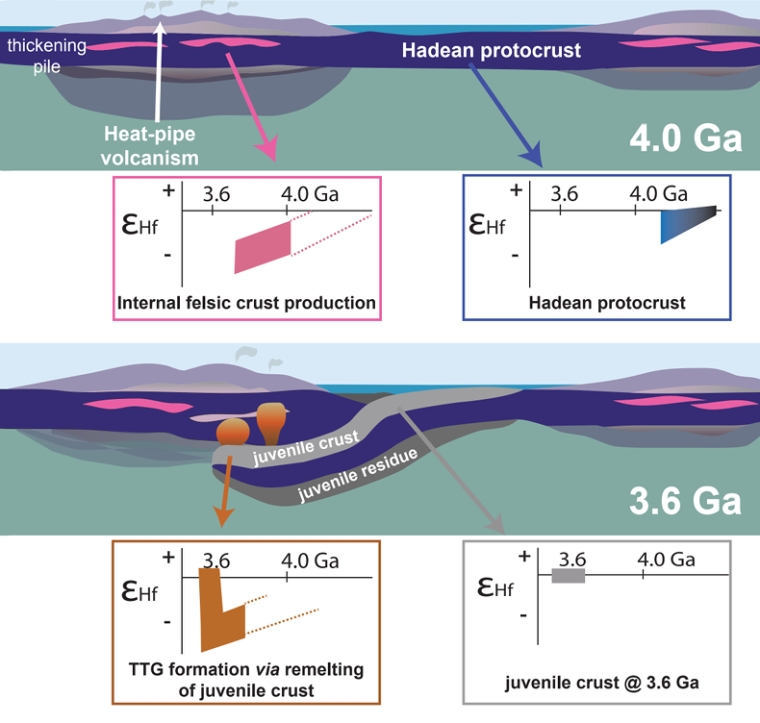
A schematic model of transition from Hadean-Eoarchaean lid tectonics to a type of plate tectonics that subsequently evolved to its current form, based on hafnium isotope data in ancient zircons (credit: Bauer et al. 2020; Fig 3)
The Hf isotopes show two main groups relative to the values for chondritic meteorites (assumed to reflect the composition of the bulk Earth). Zircons dated between 3.8 and 4.15 Ga all show values below that expected for the whole Earth. Those between 3.3 and 3.8 Ga show a broader range of values that extend above chondritic levels. The transition in data at around 3.8 Ga is also present in age plots of uranium relative to niobium and scandium relative to ytterbium, and to a lesser extent in the oxygen isotope data. On the basis of these data, something fundamentally changed in the way the Earth worked at around 3.8 Ga. Nadja Drabon and colleagues ascribe the chemical features of Hadean and Eoarchaean zircons to an early protocrust formed by melting of chemically undepleted mantle. This gradually built up and remained more or less stable for more than 600 Ma, without being substantially remelted through recycling back to mantle depths. After 3.8 billion years ago, geochemical signatures of the zircons start showing similarities to those of zircons derived from modern subduction zones. Hf isotopes and trace-element geochemistry in 3.6 to 3.8 Ga-old detrital zircons from other cratons are consistent with a 200 Ma transition from ‘lid’ tectonics (see:Lid tectonics on Earth; December 2017) to the familiar tectonics of rigid plates whose basalt-capped lithosphere ultimately returns to the mantle to be involved in formation of new magmas from which continental crust stems. Parts of plates bolstered by this new, low density crust largely remain at the surface.
While Drabon et al. do provide new data from South Africa’s Kaapvaal craton, their conclusions are similar to earlier work by other geochemists based on data from other area (e.g. Bauer, A.M. et al. 2020. Hafnium isotopes in zircons document the gradual onset of mobile-lid tectonics. Geochemical Perspectives Letters, v. 14; DOI: 10.7185/geochemlet.2015), which the accompanying figure illustrates.
Nowadays, plate tectonics is thought mainly to be driven by the sinking of old, relatively cold and dense oceanic lithosphere at subduction zones: slab-pull force dominates the current behaviour of the outermost Earth. At the eastern edge of Eurasia subduction beneath Japan has yet to consume Pacific Ocean lithosphere younger than 180 Ma (Middle Jurassic). The Pacific Plate extends eastwards from there for over 7000 km to its source at the East Pacific Rise. That spreading axis has disappeared quite recently beneath the North American Plate between Baha California and northern California. It has been subducted. Since, to a first approximation, sea-floor spreading is at the same pace either side of mid-ocean constructive plate margins, subduction at the western edge of the North America has consumed at least 7000 km of old ocean lithosphere. Slab-pull force there has been sustained for probably more than 250 Ma. As a result several former island arcs have been plastered onto the leading edge of the North American Plate to create the geological complexity of its western states. If at any time the weight of the subducting slab had caused it leading edge literally to snap and fall independently wouldn’t that have decreased slab-pull force or shut it off, and spreading at the East Pacific Rise, altogether? No, says the vast expanse of the West Pacific plate
That dichotomy once encouraged scientists of the plate-tectonic era to assume that a subducted slab remains as strong as rigid plates at the surface. They believed that subduction merely bends a plate so that it can slide into the mantle. The use of seismic waves (seismic tomography) to peer into the mantle has revealed a far more complex situation. Beneath North America traces of subducted slabs are highly deformed and must have lost their rigidity, yet they still maintain slab-pull force. Three geoscientists from the Swiss Federal Institute of Technology Zurich, Switzerland, and the University of Texas at Austin, USA (Gerya T. V., Becovici, D. & Becker, T.W. 2021. Dynamic slab segmentation due to brittle–ductile damage in the outer rise. Nature, v. 599, p 245-250; DOI: 10.1038/s41586-021-03937-x) used computer-generated models of how various forces and temperature conditions at small and large scales bear on the behaviour of slabs being subducted. Where a plate bends into a subduction zone its rigidity results in cracking and faulting of its no convex upper surface, while the base is compressed. Seismic anomalies in the descending slab reflect the formation of pulled-apart segments, similar to those in a bar of chocolate (for a possible example from an exhumed subduction zone see: A drop off the old block? May 2008). Thermo-mechanical modelling suggests that the slab becomes distinctly weakened through brittle damage and by reduction in grain size because of ductile deformation, yet each segment maintains a high viscosity relative to the surrounding mantle rocks. Under present conditions and those extrapolated back into the Proterozoic, where the slab is thinned between segments it remains sufficiently viscous to avoid segments detaching to sink independently of one another. Such delamination would reduce slab-pull force. Another process operates in the surrounding mantle. The occurrence of earthquakes in a subducted slab down to a depth of about 660 km – the level of a major discontinuity in the mantle where pressure induces a change in its mineralogy and density – confirms that a modern slab maintains some rigidity and deforms in a brittle fashion. But at this depth it cannot continue to descend steeply and travels horizontally along the discontinuity, pushed by the more shallow subduction. It can now become buckled as the mantle resists its lateral motion.
Left: the subduction zone beneath Japan defined by seismic tomography (yellow to red = lower seismic wave speeds – more ductile; yellow to blue = higher speeds – more rigid). Right: modelled evolution of viscosity in a similar subduction zone under modern conditions showing slab segmentation (blue to brown = increasing viscosity). (Credit: Gerya et al., Figs 4c & 1a-e)
Rather than trying to mimic the chaos beneath North America the authors compared their results with seismic tomography of the younger system of westward subduction beneath Japan. This allowed them to ‘calibrate’ their modelling against actual deep structure well-defined by seismic tomography. The tectonic jumble beneath North America probably resulted from a much longer history of eastwards subduction. The complexity there may be explained by successive foundering of deformed slabs into the deeper mantle looking a bit like a sheet of still viscous pie pastry dropped on its edge. This happened, perhaps, as island arcs that had formed in the eastern Pacific sporadically accreted to the continent as the intervening oceanic lithosphere was subducted.
There is ample evidence that modern-style subduction was widespread back as far as the Palaeoproterozoic. But in the Archaean the evidence is fitful: some hints of subduction, but plenty of contrary evidence. Gerya and co-workers suggest that higher heat production from radioactive decay mantle earlier in Earth’s history would have reduced plate strength and mantle resistance to slab penetration. Subduction may have occurred but was interrupted repeatedly by foundering/delamination of individual detached segments at much shallower depths. That implies weaker as well as intermittent slab pull, or even further back its complete absence, so that planetary recycling would then have required other mechanisms, such as ‘drip tectonics’.
The beginning of modern-style plate tectonics is still debated in the absence of definite evidence. Because Earth’s mantle generates heat through radioactive decay and still contains heat left over from planetary accretion and core formation it must always have maintained some kind of heat transfer through some kind of circulatory motion involving the mantle and lithosphere. That must always too have involved partial melting and chemical differentiation that created materials whose density was lower than that of the mantle; e.g. continental crust. Since continental materials date back to more than 4 billion years ago and some may have been generated earlier in the Hadean, only to be lrgely resorbed, a generalised circulation and chemical differentiation have been Earth’s main characteristics from the start. One view is that early circulation was a form of vertical tectonics without subduction via a sort of ‘dripping’ or delamination of particularly dense crustal materials back into the mantle. A sophisticated model of how the hotter early Earth worked in this way has been called ‘lid tectonics’, from which plate tectonics evolved as the Earth cooled and developed a thicker, more rigid lithosphere. Such an outer layer would be capable of self-generating the slab pull that largely drives lateral motions of lithospheric plates. That process occurs once a slab of oceanic lithosphere becomes cool and dense enough to be subducted (see: How does subduction start?; August 2018).
The most convincing evidence for early plate tectonics would therefore be tangible signs of both subduction and large horizontal movements of lithospheric plates: common enough in the Neoproterozoic and Phanerozoic records, but not glaringly obvious in the earlier Archaean Eon. These unequivocal hallmarks have now emerged from studies of Archaean rocks in the Precambrian basement that underpins northern China and North Korea. The North China Craton has two main Archaean components: an Eastern Block of gneisses dated between 3.8 and 3.0 Ga and a Western Block of younger (2.6 to 2.5 Ga) gneisses, metavolcanics and metasediments. They are separated by a zone of high deformation. A key area for understanding the nature of the deformed Central Orogenic Belt is the Zanhuan Complex near the city of Kingtai (Zhong, YL. et al. 2021. Alpine-style nappes thrust over ancient North China continental margin demonstrate large Archean horizontal plate motions. Nature Communications, v. 12, article6172, DOI: 10.1038/s41467-021-26474-7).
Schematic cross sections through the Zanhuan Complex of northern China, showing early and final development of the Central Orogenic Belt in the North China Block . (Credit: Zhong, YL. et al.;Figs 10b and c)
This small, complex area reveals that the older Eastern Block is unconformably overlain by Neoarchaean sediments, above which has been thrust a stacked series of nappes similar in size and form to those of the much younger Alpine orogenic belt of southern Europe. Though highly complex, the rocks involved having been folded and stretched by ductile processes, they are still recognisable as having originally been at the surface. Metavolcanics in the nappes can be assigned from their geochemistry to a late-Archaean fore-arc, through comparison with that of modern igneous rocks formed at such a setting in the Western Pacific. Thrust over the nappe complex is a jumble or mélange of highly deformed metasediments containing blocks of metabasalts and occasional ultramafic igneous rocks that geochemically resemble oceanic crust formed at a mid-ocean ridge. Some of them contain high-pressure minerals formed at depth in the mantle, indicating that they had once been subducted. The whole complex is cut by undeformed dykes of granitic composition dated at 2.5 Ga, confirming that the older rocks and the structures within them are Archaean in age. Thrust over the melange and tectonically underlying nappe complex are less-deformed volcanic rocks and granitic intrusions that closely resemble what is generally found in modern island arcs.
Orogenic belts bear witness to enormous crustal shortening caused by horizontal compressive forces. Assuming the average rate of modern subduction (2 cm yr-1) the 178 Ma history of the Zanhuan Complex implies more than 3,500 km of lateral transport. 2.5 billion years ago, higher radioactive heat production in the mantle would have made tectonic overturning considerably faster The unconformity at the base of the complex suggests that it was driven over the equivalent of a modern passive, continental margin. So the complex provides direct evidence of horizontal plate tectonics and associated subduction during the latter stages of the Archaean that ranks in scale with that of many Phanerozoic orogenic belts, such as that of the European Alps. The Zanhuan Complex is a result of arc accretion that played a major role in many later orogens. The North China craton itself is reminiscent of continent-continent collision, as required in the formation of supercontinents.







 Earth-logs