Water sources and early migration from Africa

SeaWiFS collected this view of the Arabian Pen...
The Arabian Peninsula today. Image via Wikipedia

In March 2011 EPN reported in Human migration a puzzle relating to evidence for modern human occupation of Arabia on the southern shore of the Persian Gulf during the last Eemian interglacial at 125 and 95 ka. At that time sea level would have been as it is now, discouraging any attempt to cross the Red Sea via the Straits of Bab el Mandab; a widely suggested short-cut from East Africa to the rest of the world. Around 125 ka modern humans were making a living from coastal resources in Eritrea, leaving abundant stone tools in shoreline deposits at the head of the Gulf of Zula, and in the Sodmein Cave on Egypt’s Red Sea coast. They had also reached the famous Qafzeh and Skhul caves of Mount Carmel in today’s Israel around 100 thousand years ago. A route out of Africa through the Levant has not been widely favoured and the humans of Qafzeh and Skhul have been suggested to have reached a geographic cul-de-sac with no eastward exit because of the aridity of the Arabian Peninsula. Yet once in the Levant they could have skirted the desert interior by following the east coast of the Red Sea, and ‘strandloped’, as Jonathan Kingdon has dubbed following the coastline. But continuous access to fresh water would still have been essential.

The shores of the Red Sea preserve many examples of uplifted coral reefs, indeed signs of human presence in Eritrea occur in such a terrace. Being extremely porous, reef terraces are potential aquifers and a sign that they may have sourced freshwater springs is the conversion of the intricate coral skeletons from one form of calcium carbonate to another; original aragonite changes to calcite in the presence of fresh water, a complete replacement being estimated to take a thousand years of continual contact with fresh water. This change allowed Boaz Lazar and Mordechai Stein of the Hebrew University of Jerusalem and the Geological Survey of Israel to check for the presence of freshwater coastal springs in the past (Lazar, B. & Stein, M. 2011. Freshwater on the route of hominins out of Africa revealed by U-Th in Red Sea corals. Geology, v. 39, p. 1067-1070). Their test site was a series of uplifted reefs near Aqaba on the Red Sea coast of Jordan. The authors determined variations in the 230Th/238U ratio in the reefs relative to that of 234U/238U and showed open-system addition of 230Th and 234U during the aragonite to calcite recrystallization, that results in an isotopic compositional trend charting the timing of any alteration. Thus, the original age of reef terraces can be backtracked, revealing at Aqaba successively higher terraces formed recently and at 120, 142 and  190 ka. The oldest of the terraces seems to have been flooded with fresh water at the start of the Eemian interglacial (~140 ka), and may have been a source of springs that would have served the earliest human travellers well. It remains to use Lazar and Stein’s approach at other reef terraces along the postulated northern exit route for the earliest modern human emigrants from Africa and, more important, to find traces of their passage.

Added 21 December 2011. The likely route for leaving Africa got a push towards the Bab el Mandab with publication of evidence for a greener south Arabia at several times in the late Pleistocene (Rosenberg, T.M. and 8 others 2011. Humid periods in southern Arabia: Windows of opportunity for modern human dispersal. Geology, v. 39, p. 1115-1118). On the eastern edge of the now hyper-arid Rub al Khali are a series of former lakes with thin sediments. When first discovered they yielded radiocarbon ages of fossil molluscs of around 40 to 20 and 10.5 to 6 ka. However recent dating using optically stimulated luminescence (OSL) of the dune sands between which occur lacustrine muds and silts suggest that the lakes were water-filled  for lengthy periods  before those ages – radiocarbon dating can be reset to younger ages by precipitation of carbonates on older  fossils.  The OSL results show wet periods around 80, 100 and 125 ka, suggesting that around these times the Intertropical Convergence Zone was pulled northwards so taking seasonal monsoon rains well into the Arabian Peninsula. They tie in nicely with a variety of other parameters, including the timing of lowstands of the Red Sea. This created episodes a few thousand years long that would have been conducive to humans living there and passing through en route to Asia around eastern Arabia and perhaps to the Levant up the west side of the sub-continent. Potential occupancy was shut off by long arid periods, which might have allowed only pulses of migration. Had such episodic diffusion occurred it might have left a record in human DNA that ongoing and planned population genetic research may reveal.

South Asian arsenic update

Skin lesions from arsenic poisoning in Bangladesh
The first signs of chronic arsenic poisoning: skin keratoses. Image by waterdotorg via Flickr

That groundwater in West Bengal, India was polluted with arsenic to such levels that symptoms of poisoning had become endemic was reported by Depankar Chakraborti in 1983, leading to his being branded a ‘panic monger’ by the Indian authorities. The news broke internationally in 1993 as the now infamous tragedy in neighbouring Bangladesh emerged. Means of mitigating the effects – lesions or keratoses and skin discoloration, and later increases in incidence of several forms of cancer – and ideas of how the pollution had occurred had to await proper geochemical analyses of well waters and logging of the mainly alluvial sediments from which water was being withdrawn; another 8 years went by. Reports of arsenicosis began to emerge from other areas of alluvial sediments in SE Asia, revealing by far the worst mass poisoning in history and the likelihood that the lives of millions would be blighted by what Bangladeshis dubbed ‘the Black  Rain’ from the resemblance of the characteristic skin lesions to drops of black water.

Thanks principally to the work of water engineer Peter Ravenscroft with other geochemists, the source of arsenic in groundwater was narrowed down to the effect of reducing conditions in grey, carbonaceous sandstones and peats on the mineral goethite, an iron oxy-hydroxide that forms the main colorant in oxidised sediments and whose loose structure normally encourages the mopping-up by surface adsorption of a wide spectrum of dissolved ions, including those of arsenic. Goethite readily breaks down under reducing conditions, and when that happens all the adsorbed material is released into solution. The upper parts of the alluvial and deltaic sediments in the lower reaches of the Ganges and Brahmaputra rivers contain abundant organic remains picked up when vegetation burgeoned during the Holocene, which mixed with goethite-coated sand grains derived from erosion in the Himalayan stretches of the rivers. Purely natural sedimentary and hydrogeological processes created the dreadful plight of villagers. The terrible irony was that before the 1980s there were no signs of arsenicosis, yet mortality, especially of under-fives, was very high due to water-borne pathogens in surface water supplies. Indian and Bangladeshi authorities and UN agencies waged a campaign to sink shallow wells for drinking water rather than relying on river and pond supplies. At first rural people resisted the change since they regarded water from wells as the ‘Devil’s water’, but as infant mortality began to fall, the resistance turned to rapid construction nationwide of wells, both public and private. A few years later came the ‘Black Rain’.

In the attempts to mitigate the arsenicosis plague, filters containing adsorptive materials, including goethite, were installed on pumps. However, the geochemists showed that in the deeper wells there were consistently low concentrations of arsenic in sediments that were brown-coloured due to prevailing oxidising conditions and the presence of goethite. Although arsenic was present in the sediments it was safely locked in the goethite coatings of sand grains. Steadily major public supplies were transferred to deep, high-yield wells. Alluvial and deltaic deposits are generally highly permeable, so it was feared that as the deeper wells were pumped arsenic-rich water from the reduced shallow sediments would replace the safe groundwater. Thankfully, it seems that is not likely to be a problem (Radloff, K.A. and 12 others 2011. Arsenic migration to deep groundwater in Bangladesh influenced by adsorption and water demand. Nature Geoscience, v. 4, p. 793-798). The study injected As-bearing groundwater into a deep aquifer and monitored its arsenic concentration over time, once in place. Within a day, the concentration of dissolved arsenic fell by 70% and by 5 days had fallen below recommended maximum levels for drinking water; a dramatic demonstration of the clean-up power of even minute films of goethite in sediments, for that seems the only explanation for the fall. The US-Bangladeshi team verified this by testing samples of the deeper sediments from drill cuttings. They mixed highly contaminated groundwater with the cuttings, to find that arsenic sorption over  about a week was extremely high (~40mg kg-1).

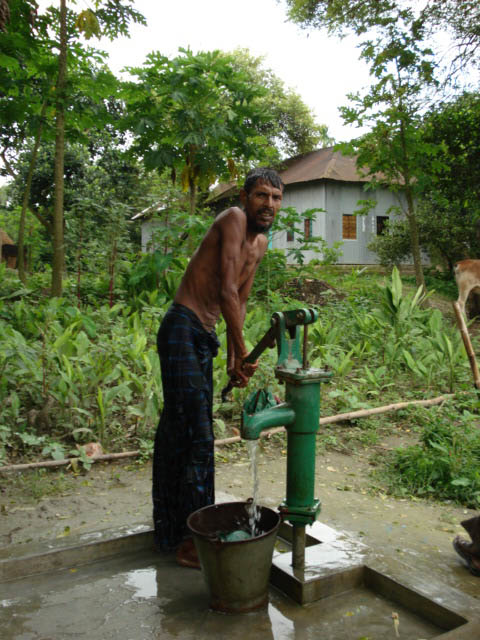
Water well in Bangladesh. From http://www.flickr.com/photos/waterdotorg/3696304044

Rather than just publishing their reassuring findings, the team input them to hydrogeological models of the Bengal Basin, varying hypothetical pumping rates to assess the changes in deep-groundwater chemistry over time due to downward migration of the highly polluted near-surface waters. Sure enough, the As-rich waters would end up in the deep aquifer eventually to overwhelm the sorptive capacity of its goethite content; arsenic would once again enter well supplies. However, if deep extraction was limited to drinking water by limiting pumping for irrigation to intermediate depths, safe limits could be sustained theoretically for a thousand years or more, except in some areas especially prone downward intrusion of polluted shallow groundwater. (Use of highly contaminated shallow groundwater for irrigation would simply transfer the problem to crops.) Clearly, monitoring is obligatory, but one hopes this important study does resolve the horrifying plight faced by so many people in catchments fed by Himalayan waters.

Fracking check list

Bergung der Opfer des Grubenunglücks
Aftermath of the 1906 mine explosion at Courrières, northern France; the largest mining disaster in Europe with 1099 fatalities. Image via Wikipedia

Britain is on the cusp of a shale-gas boom (see Britain to be comprehensively fracked? : EPN 14 October 2011) and it is as well to be prepared for some potential consequences. In extensively fracked parts of the US – the states of New York, Pennsylvania, Texas and Colorado – there are reports of water taps emitting roaring flames after dissolved methane in groundwater ignites. This is largely due to common-place household water supplies from unprocessed groundwater, which are rare in Britain. But there are other hazards (Mooney, C. 2011. The truth about fracking. Scientific American, v. 305 (Nov 2011), p. 62-67) that have enraged Americans in affected areas, which are just as likely to occur in Britain. In fact the nature of shale-gas exploitation by horizontal drilling beneath large areas poses larger threats in densely populated area, as the people of Blackpool have witnessed in the form of small earthquakes that the local shale-gas entrepreneur Cuadrilla admit as side effects of their exploratory operations .

Chris Mooney succinctly explains the processes involved in fracking shale reservoirs; basically huge volumes of water laced with a cocktail of hazardous chemicals and sand being blasted into shales at high pressure to fracture the rock hydraulically and create pathways for natural gas to leak to the wells. One risk is that this water has to be recovered and stored in surface ponds for re-use. About 75% returns to the surface and also carries whatever has been dissolved from the shales, which can be extremely hazardous. By definition a shale containing hydrocarbons creates strongly reducing conditions, which in turn can induce several elements to enter solution as well as easily dissolved salts; for instance divalent iron (Fe2+) is highly soluble, whereas more oxidised Fe3+ is not, so waters having passed through gas-rich shales will be iron-rich. But that is by no means the worst possibility; one of the most common iron minerals in sedimentary rocks is goethite (FeOOH), which adsorbs many otherwise soluble elements and compounds. In reducing conditions goethite can break down to release its adsorbed elements, among which is commonly arsenic. The blazing faucet hazard results from hydrocarbon gases leaking through imperfectly sealed well casings to enter shallow groundwater, where the gases can also create reducing conditions and release toxic elements and compounds into otherwise pure groundwater by dissolution of ubiquitous goethite, as in the infamous arsenic crisis of Bangladesh and adjoining West Bengal in India where natural reducing conditions do the damage.

What is not mentioned in the Scientific American article is the common association of hydrogen sulfide gas with petroleum, produced from abundant sulfate ions in formation water by bacteria that reduce sulfate to sulfide in the metabolism. This ‘sour gas’, as it is known in the oil industry, is a stealthy killer: at high concentrations it loses its rotten-eggs smell and in the early days of the petroleum industry killed more oil workers than did any other occupational hazard. Visit the spa towns of Harrogate in Yorkshire and Strathpeffer in northern Scotland and sample their waters for examples of what Carboniferous and Devonian gas-rich shales produce quite naturally: noxious stuff of questionable efficacy. The environmental effects of such natural seepage from gas-rich rocks tell a cautionary tale as regards fracking. The highly reducing cocktail of hydrocarbon and sulfide gases in rising, mineral-rich formation water kills the microbiotic symbionts that are essential to plant root systems for nutrient uptake die and so too do trees. The onshore Solway Basin of Carboniferous age in NW England illustrates both points, having many chalybeate springs as the sulfide- and iron-rich waters are euphemistically known and also a strange phenomenon in many of the deep valleys cut by glacial melt waters as land rose following the last glacial maximum. Once trees reach a certain height – and correspondingly deep root systems – they die, to litter the valley woodland with large dead-heads.  Also leaves on smaller trees turn to their autumnal colours earlier than on higher ground. Both seem to be due to minor gas seepages from thick sale sequences in the depths of the sedimentary basin. Indeed, both are botanical indicators to the hydrocarbon explorationist.

To recap, a common size of a fracking operation using several horizontal wells driven from a single wellhead is 4km in diameter entering gas-rich shales at up to 2 km depth. Each well can generate fractures of a hundred metres or more in the shales and surrounding rocks, as they have to for commercial production. In Britain, most of the sites underlain by shales with gas potential are low-lying agricultural- or urban land. The producing rock in the Blackpool area is the Middle Carboniferous Bowland Shale that lies beneath the Coal Measures of what was formerly the Lancashire coalfield, now a patchwork of expanding urban centres. On 23 May 1984 an explosion occurred in Abbystead, Lancashire at an installation designed to pump winter flood water between the rivers Lune and Wyre through a tunnel beneath the Lower to Middle Carboniferous Bowland Fells. The Abbystead Disaster coincided with an inaugural demonstration of the pumping station to visitors, of whom 16 were killed and 22 injured. Methane had escaped from Carboniferous shales to build up in the flood-balancing  tunnel soon after its construction. Methane build-ups were by far the worst hazard throughout the history of British coal mining, thousands dying and being maimed as a result of explosions. One of the largest death tolls in British coal-mining history was 344 miners at Hulton Colliery in Westhoughton, Lancashire in 1910 after a methane explosion; the methane may well have escaped from the underlying Bowland Shales.

Snippets on human evolution

Image copyright held by author, Chris Henshilw...
Artifacts from the Blombos Cave, South Africa, including deliberately etched block of hematite Image by Chris Henshilwood via Wikipedia

The news that most humans outside of Africa carry fragments of DNA that match with those of Neanderthals and the mysterious Denisovan archaic humans ( see Yes, it seems that they did… and Other rich hominin pickings in the May 2010 issue of EPN) has entered into popular culture; or soon will have! Similar dalliances with the ‘older folk’ seem also to have occurred among those humans who remained in Africa (Hammer, M.F. et al. 2011. Genetic evidence for archaic admixture in Africa. Proceedings of the National Academy of Sciences, v. 108, p. 15123-15128). The DNA of three groups in West Africa who maintain a hunter-gatherer lifestyles show regions that are not involved in coding for proteins that differ from the African norm. This suggests mating with an entirely separate and unknown group of hominins – probably archaic forms of humans – that produced fertile offspring, probably around 35 thousand years ago. The find spurred re-evaluation of bones with a mix of archaic and modern features that were discovered in a Nigerian cave in the 1960s (Harvati, K. et al. 2011. The Later Stone Age Calvaria from Iwo Eleru, Nigeria: Morphology and Chronology. PLoS ONE, v.  6: e24024. doi:10.1371/journal.pone.0024024). The study confirms that the skulls are outside the fully modern human range, but display a close similarity with Neanderthal and H. erectus. The big surprise is that U-Th dating suggests they are quite recent, around 16 ka. The stage seems set for nor only a burst of exploration for human remains of less antiquity than early hominins but a ‘paradigm shift’ in our view of what constitutes a human species.

See also: Gibbons, A. 2011, African data bolster new view of modern human origins. Science, v. 334, p. 167.

Another interesting link with archaic humans who had the closest of relationships with some of our ancestors is that their union may have bolstered the resistance of migrants from Africa to Eurasian pathogens (Abi-Rached, L. and 22 others 2011. The shaping of modern human immune systems by multiregional admixture with archaic humans. Science, v. 334, p. 89-94). The focus was on the human leucocyte antigen (HLA) group that is a vital part of our immune system in the form of ‘killer cells’. Part of modern Eurasian DNA that codes for the group (HLA-B*73 allele) appears in the Neanderthal and Denisovan genomes; indeed more than half the HLA alleles of modern Eurasians may have originated in this way, and have also been introduced into Africans subsequently.

Also at the front line of genomic research into human origins, DNA sequenced from a lock of hair given to an Edwardian anthropologist by a native Australian turns out to have an extreme antiquity compared with that of other Eurasian people descended from African migrants (Rasmussen, M. and 57 others. An aboriginal Australian genome reveals separate human dispersals into Asia. Science, v. 334, p. 94-98). The unique aspects of the Australian genome signify separation of a group of individuals from the main African population around 62-75 thousand years ago; significantly earlier than and different from ‘run of the mill’ migrants from whom modern Asians arose at between 25 to 38 ka. There is little doubt that native Australians are descended from the pioneers who first diffused from Africa either by crossing the Straits of Bab el Mandab or taking another route and they moved more speedily across southern Asia than other waves made possible by climate change and sea-level falls following the Eemian interglacial of 133-115 ka.

Despite the lingering Eurocentrist view that somehow fully modern human consciousness sprang into being at the time the famous French and Spanish cave art was painted, around 30 ka, increasing evidence points to an African origin for a sense of aesthetics and the ability to express it. The latest is the discovery of a 100 ka ‘paint box’ in a South African coastal cave (Henshilwood, C.S. et al. 2011. A 100,000-year-old ochre-processing workshop at Blombos Cave, South Africa. Science, v. 334, p. 219-223). The material consists of two large abalone shells containing traces of red and orange ochre, together with a hammer stone and grinder with adhering ochre, and fat-rich bones which ground-up would have produced a binder for the ochre. No art occurs in the cave and it might be supposed that the pigments were intended for face- or body adornment.

The ultra-deep carbon cycle

A scattering of "brilliant" cut diam...
Image via Wikipedia

The presence of diamonds in the strange, potassium-rich, mafic to ultramafic igneous rocks known as kimberlites clearly demonstrates that there is carbon in the mantle, but it could have come from either biogenic carbon having moved down subduction zones or the original meteoritic matter that accreted to form the Earth. Both are distinct possibilities for which evidence can only be found within diamonds themselves as inclusions. There is a steady flow of publications focussed on diamond inclusions subsidised to some extent by companies that mine them (see Plate tectonics monitored by diamonds in EPN, 2 August 2011). The latest centres on the original source rocks of kimberlites and the depths that they reached (Walter, M.J. and 8 others 2011. Deep mantle cycling of oceanic crust: evidence from diamonds and their mineral inclusions. Science, v. 334, p. 54-57). The British, Brazilian and US team analysed inclusions in diamonds from Brazil, finding assemblages that are consistent with original minerals having formed below the 660 km upper- to lower-mantle seismic boundary and then adjusting to decreasing pressure as the kimberlite’s precursor rose to melt at shallower levels. The minerals – various forms of perovskite stable at deep-mantle pressures – from which the intricate composites of several lower-pressure phases exsolved suggest the diamonds originated around 1000 km below the surface; far deeper than did more common diamonds. Moreover, their geochemistry suggests that the inclusions formed from deeply subducted basalts of former oceanic crust.

Previous work on the carbon isotopes in ‘super-deep’ diamonds seemed to rule out a biogenic origin for the carbon, suggesting that surface carbon does not survive subduction into the lower mantle. In this case, however, the diamonds are made of carbon strongly enriched in light 12C relative to 13C, with δ13C values of around -20 ‰ (per thousand), which is far lower than that found in mantle peridotite and may have been subducted organic carbon. If that proves to be the case it extends the global carbon cycle far deeper than had been imagined, even by the most enthusiastic supporters of the Gaia hypothesis.

Low-lying Tibet before India-Asia collision

The Tibetan plateau lies between the Himalayan...
The semi-arid Tibetan Plateau from spaceImage via Wikipedia

The vast Tibetan Plateau at an average elevation of 4500 m is a major influence on the climate of Asia, being central to the annual monsoons, as well as one the world’s largest continental tectonic features. When it formed is crucial in palaeoclimatic modelling as well as to geomorphologists and structural geologists. Whether or not it was present before the Indian subcontinent collided with Asia at 50 Ma has been the subject of perennial debate; it could have formed during the more or less continual accretion of terranes to southern Eurasia since the Jurassic Period. A novel approach to timing uplift of Tibet is obviously needed to resolve the controversies, and that may have been achieved (Hetzel, R. et al. 2011. Peneplain formation in southern Tibet predates the India-Asia collision and plateau uplift.  Geology, v.39, p.983-986). North of Lhasa is an area of coincident small plateaus at around 5200-5400 m into which are cut valleys a few hundred metres. It has the hallmarks of a peneplain stripped to the base level of erosion, and developed on Cretaceous granites. The German-Chinese-South African team applied a range of geochronological techniques to date the emplacement of the granites and their cooling history. U/Pb dating shows the granites to have crystallised between 120 to 110 Ma; U-Th/He dating of zircons in them indicate their cooling from 180° to 60°C between 90 and 70 Ma; apatite  U-Th/He and fission-track dating show that the granites experienced surface temperatures by around 55 Ma during a period of erosion at a rate of 200-400 m Ma-1. The clear inference is that an area >10 000 km2 became a peneplain by the end of the Palaeocene, to be unconformably overlain by Eocene continental redbeds.

By the Eocene the northern Lhasa Block had become a low-elevation plain from which a vast amount of sediment had been removed to be deposited elsewhere – Palaeocene and Eocene sediments are not common throughout the whole Tibetan Plateau. This is strong evidence that uplift of the Plateau only began after the India-Asia collision during the Eocene. Despite that and the erosion that would have taken place, much of the peneplain remains; given resistant bedrock peneplains can be very long-lived.

Seafloor mud cores and the seismic record

Chikyu
Japan's deep-sea Drilling Vessel "CHIKYU" Image via Wikipedia

The most important factors in attempting to assess risk from earthquakes are their frequency and the time-dependence of seismic magnitude. Historical records, although they go back more than a millennium, do not offer sufficient statistical rigor for which tens or hundreds of thousand years are needed. So the geological record is the only source of information and for most environments it is incomplete, because of erosion episodes, ambiguity of possible signs of earthquakes and difficulty in precise dating; indeed some sequences are extremely difficult to date at all with the resolution and consistency that analysis requires. One set of records that offer precise, continuous timing is that from ocean-floor sediment cores in which oxygen isotope variations related to the intricacies of climate change can be widely correlated with one another and with the records preserved in polar ice cores. For the past 50 ka they can be dated using radiocarbon methods on foraminifera shells The main difficulty lies in finding earthquake signatures in quite monotonous muds, but one kind of feature may prove crucial; evidence of sudden fracturing of otherwise gloopy ooze (Sakagusch, A. et al. 2011. Episodic seafloor mud brecciation due to great subduction zone earthquakes. Geology, v.39, p. 919-922).

The Japanese-US team scrutinised cores from the Integrated Ocean Drilling Program (IODP) that were drilled 5 years ago through the shallow sea floor above the subduction zone associated with the Nankai Trough to the SE of southern Japan. Young, upper sediments were targeted close to one of the long-lived faults associated with the formation of an accretionary wedge by the scraping action of subduction. Rather than examining the cores visually the team used X-ray tomography similar to that involved in CT scans, which produce precise 3-D images of internal structure. This showed up repeated examples of sediment disturbance in the form of angular pieces of clay set in a homogeneous mud matrix separated by undisturbed sections containing laminations. The repetitions are on a scale of centimetres to tens of centimetres and were dated using a combination of 14C and 210Pb dating (210Pb forms as a stage in the decay sequence of 238U and decays with a half-life of about 22 years, so is useful for recent events). The youngest mud breccia gave a 210Pb age of AD 1950±20, and probably formed during the 1944 Tonankai event, a great earthquake with Magnitude 8.2. Two other near-surface breccias gave 14C ages of 3512±34 and 10626±45 years before present. These too probably represent earlier great earthquakes as it can be shown that mud fracturing and brecciation by ground shaking needs accelerations of around 1G, induced by earthquakes with magnitudes greater than about 7.0. So, not all earthquakes in a particular segment of crust would show up in seafloor cores, most inducing turbidity flow of surface sediment, but knowing the frequency of the most damaging events, both by onshore seismicity and tsunamis, could be useful in risk analysis. In its favour, the method requires cores that penetrate only about 10 m, so hundreds could be systematically collected using simple piston coring rigs where a weighted tube is dropped onto the sea floor from a small craft.

Mercury: anything new?

Full color image of from first MESSENGER flyby
Mercury from an earlier MESSENGER fly-by. Image via Wikipedia

The Sun’s nearest planet, Mercury, seems odd in some ways; for instance, it has a proportionately larger metallic core than any other planet. That feature has led some to suggest that somehow most of any original silicate mantle was lost. One possibility is that its proximity to the Sun resulted in Mercury’s surface being ablated. Another looks to a huge collision with another body that tore off much of the mantle; similar to the event that the chemical commonality of the Earth and Moon suggests early in Earth history. Both processes should have left a distinct geochemical signature on the surface of Mercury: some kind of residue of solar ablation or evidence of fractional crystallisation of a magma ocean, such as the feldspar-rich lunar highlands that are probably formed of crystals that floated as such a planetary silicate melt cooled and evolved. The seeming strangeness of Mercury helped underpin a well-equipped un-crewed mission, going by the acronym MESSENGER, that finally settled into Mercury orbit in March 2011 after a planned ‘yo-yoing’ path since launch in August 2004 that took it back and forth between Earth, Mercury and Venus in its early stages. Early analysis of results from the now permanent orbit appeared in the 30 September 2011 issue of Science.

MESSENGER carries several remote sensing instruments: a stereo imaging device to map landforms, and topography; a laser altimeter to back the stereo imager; a visible to short-wave infrared spectrometer to map variations in surface spectra and minerals; gamma-ray spectrometry to map distributions of naturally radioactive isotopes and emissions from other elements triggered by high-energy cosmic ray bombardment; using the Sun as a source of gamma- and X-rays to cause a variety of elements to emit lower energy X-rays – a variant of X-ray fluorescence spectrometry that is a workhorse of lab geochemistry.

The earlier Mercury fly-bys and previous missions clearly showed that its surface is heavily cratered but possesses areas resurfaced by lavas that obliterate older cratering. A little like the lunar maria in age and appearance, these smooth terrains show evidence of accumulations up to a kilometre thick formed by repeated lava flows (Head, J.W. and 25 others, 2011. Flood volcanism in the northern high latitudes of Mercury revealed by MESSENGER. Science, v. 333, p. 1853-1855). As regards the age of these major volcanic features, all that can be said is that they post-date the largest impacts, such as the huge Caloris Basin, and are more sparsely peppered with younger craters. Intriguingly, floors of some of the craters show clusters of small depressions and pits surrounded by light-coloured material of some kind, suggested to be solids condensed from gases that emerged from below (Blewett, D.T. and 17 others 2011. Hollows on Mercury: MESSENGER evidence for geologically recent volatile-related activity. Science, v. 333, p. 1856-1859). While it is only possible to assign youth of these features relative to the craters in which they occur, they indicate an underlying source of volatiles; a factor weighing against previous accounts of Mercury’s evolution by either solar ablation or giant impact.

Considerably more interesting – at least to me – are the results from the geochemically oriented instruments. Calcium, magnesium, aluminium and silicon estimates by the XRF-like instrument present not the slightest evidence for a feldspar-rich component of the early crust akin to the lunar highlands; another blow for the giant-impact and magma-ocean hypotheses. Mercury’s surface seems to be similar in composition to the most ancient terrestrial lavas: Mg-rich mafic to ultramafic komatiites, compared with the more iron-rich tholeiites of the lunar maria (Nittler, L.R. and 14 others. The major-element composition of Mercury’s surface from Messenger X-ray spectrometry. Science, v. 333, p. 1847-1850). They are ten-times more enriched in sulfur than surface rocks on the Earth or Moon, though iron content seems too low to accommodate it in minerals such as pyrite (FeS2). High sulfur content could point to an origin for Mercury from accretion of highly reduced material in the solar nebula, the Earth-Moon system being broadly more oxidised. Gamma-ray spectrometry to analyse the abundances of potassium, uranium and thorium (Peplowski, P.N. and 16 others. Radioactive elements on Mercury’s surface from MESSENGER: implications for the planet’s formation and evolution. Science, v. 333, p. 1850-1852) doesn’t serve previous ideas about the planet’s history either. Potassium, which is moderately volatile, is too high relative to more refractory uranium and thorium to support any notion of solar ablation of the surface, but the U, Th and K proportions are roughly like those of the Earth’s oceanic crust. One of the plots shows K-Th relationships for supposed meteorites from Mars and the extensive gamma-ray data from Mars itself, in which few of the meteorites fall in the K-Th ‘cloud’ for the Martian surface: now there’s a thing….

It must be emphasised that the geochemical results are but a fraction of what should eventually emerge from these powerful instruments. However, these early data place Mercury in much the same envelope as the other rock worlds of the Inner Solar System (Kerr, R.A. 2011. Mercury looking less exotic, more a member of the family. Science, v. 333, p. 1812).

Britain to be comprehensively fracked?

Tower for drilling horizontally into the Marce...
Drill rig in Pennsylvania aimed at hydraulic fracturing of the hydrocarbon-rich Marcellus Shale of Devonian age. Image via Wikipedia

In ‘Fracking’ shale and US ‘peak gas’ (EPN of 1 July 2010) I drew attention to the relief being offered to dwindling US self-sufficiency in natural gas by new drilling and subsurface rock-fracturing technologies that opens access to extremely ‘tight’ carbonaceous shale and the gas it contains. The item also hinted at the down-side of shale-gas. The ‘fracking’ industry has grown at an alarming rate in the USA, now supplying more than 20% of US demand for gas. This side of the Atlantic the once vast reserves of North Sea gas fields are approaching exhaustion. This is at a time when commitments to reducing carbon emissions dramatically depend to a large extent on hydrocarbon gas supplanting coal to generate electricity, releasing much lower CO2  by burning hydrogen-rich gases such as methane (CH4) than by using coal that contains mainly carbon. Without alternative, indigenous supplies declining gas reserves in Western Europe also seem likely to enforce dependency on piped gas from Russia or shipment of liquefied petroleum gas from those major oil fields that produce it. The scene has been set in Europe in general and Britain in particular for a massive round of exploration aimed at alternative gas sources beneath dry land. Unlike the US and Canada, the British are not accustomed to on-shore drilling rigs, seismic exploration and production platforms, and nor are most Europeans. Least welcome are the potential environmental and social hazards that have been associated with the US fracking industry, which seem a greater threat in more densely populated Europe.

The offshore oil and gas of the North Sea fields formed by a process of slow geothermal heating of solid hydrocarbons or kerogen in source rocks at a variety of stratigraphic levels, escape into surrounding rocks of the gases and liquids produced by this maturation, and their eventual migration and accumulation in geological traps. By no means all products of maturation leave shale source rocks because of their very low permeability. That residue may be much more voluminous than petroleum liquids and gases in conventional reservoir rocks; hence the attraction of fracking carbonaceous shales. British on-shore geology is bulging with them, particularly Devonian and Carboniferous lacustrine mudstones, Carboniferous and Jurassic coals, and the marine black shales of the Jurassic (see http://www.bgs.ac.uk/research/energy/shaleGas.html and https://www.og.decc.gov.uk/upstream/licensing/shalegas.pdf), to the extent that areas of potential fracking cover around a third of England, Wales and southern Scotland.

News is breaking of a major shale-gas discovery beneath Blackpool, the seaside resort ‘noted for fresh air and fun, where Mr and Mrs Ramsbottom went with Young Albert their son…’ (Albert poked a stick at Wallace the lion and was eaten), said by energy firm Cuadrilla to have gas reserves of 5.7 trillion m3. The announcement followed 6 months of exploratory drilling, and drew attention to the burgeoning interest by entrepreneurs in the upcoming 14th Onshore Licensing Round for petroleum exploration in Britain. It isn’t just from major petroleum companies, but in some cases even what amount to family businesses finding sufficient venture capital to spud wells; similar in many respects to the US fracking boom that began a mere 10 years ago.

The useful geoneutrino

The Sudbury Neutrino Detector
A neutrino detector in Canada similar to KamLAND. Image via Wikipedia

While the wires were hot with news of neutrinos possibly having exceeded light speed as they were fired through the Alps by the Large Hadron Collider, steady research has been seeking answers rather than perhaps transmuting physicists’ hubris into a death wish. (Note:  it has to be said that  British theoretical physicist Jim Al-Khalili has sufficient confidence that the speeding ticket issued to the neutrinos will be rescinded that he promises to eat his underpants if it is upheld.) The more tangible work concerns antineutrinos that the Earth emits, dubbed ‘geoneutrinos’ to distinguish them from extremely exotic ones from deep space which, worryingly for some, pass from one side of the Earth to the other and through us as well.  When unstable isotopes, such as those of uranium, thorium and potassium that help heat the Earth, decay they emit antineutrinos as well as electrons, helium nuclei and gamma-rays. Notoriously elusive, neutrinos and antineutrinos can now be detected with sufficient precision to make useful observations, as well as produce results that have many theoretical physicists quivering in cellars from which they emerge, from time to time, covered with chalk dust from their desperate exertions to explain a material speed faster than ‘little c’. To geoscientists, the results of an experiment using geoneutrinos at the Japanese Kamioka Liquid-Scintillator Antineutrino Detector (KamLAND), which involved 66 individuals from 15 Japanese, US and Dutch institutions, are much more interesting: they help resolve a long-standing puzzle about the source of geothermal heat that flows from the Earth’s surface at a rate of about 44 TW (The KamLAND Collaboration 2011. Partial radiogenic heat model for Earth revealed by geoneutrino measurements. Nature Geoscience, v. 4, p. 647-651).

A model of the Earth that assumes it accreted from chondritic meteorites with well-known abundances and proportions of heat-producing U, Th and K isotopes, supported by some measurements of peridotites from the mantle, suggests that less than half the geothermal flux is radiogenic, implying that a great deal is heat originally trapped in the Earth when it formed. This view depends on several assumptions: that the Earth’s mantle is indeed chondritic below the 200 km or so from which samples have been brought by volcanism; that the core doesn’t produce any heat by radioactive decay; and that a geophysical model of a well-mixed mantle is correct. Not surprisingly, geophysical and geochemical evidence is so flimsy that many different views have had their champions: that the core contains potassium; that there is a deep, barely tapped inner-mantle layer of high heat production formed from now-rare meteoritic material, and so on. Geoneutrinos, if distinguishable from those from elsewhere in the cosmos and indeed measurable, could help home-in on one or other hypothesis. Based on a spherical balloon containing 1000 t of hydrocarbon liquids in a deep mine shaft that floats in an 18 m metal sphere filled with buoyant oil, KamLAND relies on detecting the light emitted by very rare interactions of neutrinos with protons. That is hard enough, but the site is surrounded by Japan’s 53 neutrino-emitting nuclear reactors, so a great deal of cunning operating conditions and data processing is needed to sort the ‘wheat from the chaff’; at present errors are large, but now sufficiently constrained to throw light on the great heat-flux issue. The KamLAND Collaboration reports that between 16 and 68% of heat flow is due to decay of the most productive isotopes 232Th and 238U – there is insufficient 235U and 40K in the Earth for geoneutrinos generated by their decay to be meaningfully estimated. Fuzzy as the results are, they are sufficient to support the view that Earth’s ‘primordial’ heat of formation is still a major source of geothermal energy, thus narrowing down the geochemical aspects open for disputation.

  • See also: Korenaga, J. 2011. Clairvoyant geoneutrinos. Nature Geoscience, v. 4, p. 581-582