Genus Homo pushed back nearly half a million years

Bill Deller, a friend whose Sunday is partly spent reading the Observer and Sunday Times from cover to cover, alerted me to a lengthy article by Britain’s doyen of paleoanthropologists Chris Stringer of the Natural History Museum. (Stringer, C. 2015. First human? The jawbone that makes us question where we’re from. Observer, 8 March 2015, p. 36). His piece sprang from two Reports published online in Science that describe about 1/3 of a hominin lower jaw unearthed – where else? – in the Afar Depression of Ethiopia. The discovery site of Ledi-Geraru is a mere 30 km from the most hominin-productive ground in Africa: Hadar and Dikika for Australopithecus afarensis (‘Lucy’ at 3.2 Ma and ‘Selam’ at 3.3 Ma, respectively); Gona for the earliest-known stone tools (2.6 Ma); and the previously earliest member of the genus Homo, also close to Hadar.

On some small objects mighty tales are hung, and the Ledi-Geraru jawbone and 6 teeth is one of them. It has features intermediate between Australopithecus and Homo, but more important is its age: Pliocene, around 2.8 to 2.75 Ma (Villmoare, B. And 8 others. Early Homo at 2.8 Ma from Ledi Geraru, Afar, Ethiopia. Science Express doi: 10.1126/science.aaa1343). The sediments from which Ethiopian geologist Chalachew Seyoum, studying at Arizona State University, extracted the jawbone formed in a river floodplain. Other fossils suggest open grassland rich with game, similar to that of the Serengeti in Tanzania, with tree-lined river courses. These were laid down at a time of climatic transition from humid to more arid conditions, that several authors have suggested to have provided the environmental stresses that drove evolutionary change, including that of hominins (DiMaggio, E.N. and 10 others 2015. Late Pliocene fossiliferous sedimentary record and the environmental context of early Homo from Afar, Ethiopia. Science Express doi: 10.1126/science.aaa1415).

Designating the jawbone as evidence for the earliest known member of our genus rests almost entirely on the teeth, and so is at best tentative awaiting further fossil material. The greatest complicating factor is that the earliest supposed fossils of Homo (i.e. H. habilis, H rudolfensis and others yet to be assigned a species identity) are a morphologically more mixed bunch than those younger than 2 Ma, such as H. ergaster and H. erectus. Indeed, every one of them has some significant peculiarity. That diversity even extends to the earliest humans to have left Africa, found in 1.8 Ma old sediments at Dmanisi in Georgia (Homo georgicus), where each of the 5 well-preserved skulls is unique.  The Dmanisi hominins have been likened to the type specimen of H. habilis, but such is the diversity of both that is probably a shot in the dark.

English: Cast replica of OH 7, the type specim...
Replica of OH 7, the deformed type specimen of Homo habilis. (credit: Wikipedia)

Coinciding with the new Ethiopian hominin papers a study was published in Nature the same week that describes how the type specimen of H. habilis (found, in close association with crude stone tools and cut bones, by Mary and Lewis Leakey at Olduvai Gorge, Tanzania in 1960) has been digitally restored from its somewhat deformed state when found (Spoor, F. et al. 2015. Reconstructed Homo habilis type OH 7 suggests deep-rooted species diversity in early Homo. Nature, v. 519, p. 83-86, doi:10.1038/nature14224). The restored lower jaw and teeth, and part of its cranium, deepened the mysterious diversity of the group of fossils for which it is the type specimen, but boosts its standing as regards probable brain size from one within the range of australopithecines to significantly larger –~750 ml compared with <600 ml – about half that of modern humans. The habilis diversity is largely to do with jaws and teeth: it is the estimated brain size as well as the type specimen’s association with tools and their use that elevates them all to human status. Yet, the reconstruction is said by some to raise the issue of a mosaic of early human species. The alternative is an unusual degree of shape diversity (polymorphism) among a single emerging species, which is not much favoured these days. An issue to consider is: what constitutes a species? For living organisms morphological similarity has to be set against the ability for fertile interbreeding. Small, geographically isolated populations of a single species often diverge markedly in terms of what they look like yet continue to be interfertile, the opposite being convergence in form by organisms that are completely unrelated.

Palaeontologists tend to go largely with division on grounds of form, so that when a specimen falls outside some agreed morphological statistics, it crosses a species boundary. Set against that the incontrovertible evidence that at least 3 recent human species interbred successfully to leave the mark in all non-African living humans. What if the first humans emerging from, probably, a well-defined population of australopithecines continued to interbreed with them, right up to the point when they became extinct about 2 Ma ago?

On a more concrete note, the Ledi Geraru hominin is a good candidate for the maker of the first stone tools found ‘just down the road’ at Gona!

Wet spells in Arabia and human migration

In September 2014, Earth Pages  reported how remote sensing had revealed clear signs of extensive fossil drainage systems and lakes at the heart of the Arabian Peninsula, now the hyper-arid Empty Quarter (Rub al Khali). Their association with human stone artifacts dated as far back as 211 ka, those with affinities to collections from East Africa clustering between 74-90 ka, supported the sub-continent possibly having been an early staging post for fully modern human migrants from Africa. Member of the same archaeological team based at Oxford University have now published late Pleistocene palaeoclimatic records from alluvial-fan sediments in the eastern United Arab Emirates that add detail to this hypothesis (Parton, A. ­et al. 2015. Alluvial fan records from southeast Arabia reveal multiple windows for human dispersal. Geology, advance online publication doi:10.1130/G36401.1).

The eastern part of the Empty Quarter is a vast bajada formed from coalesced alluvial fans deposited by floods rising in the Oman Mountains and flowing westwards to disappear in the great sand sea of dunes. Nowadays floods during the Arabian Sea monsoons are few and far between, and restricted to the west-facing mountain front. Yet, older alluvial fans extend far out into the Empty Quarter, some being worked for aggregate used in the frantic building boom in the UAE. In one of the quarries, about 100 km south of the Jebel Faya Upper Palaeolithic tool site , the alluvial deposit contains clear signs of cyclical deposition in the form of 13 repeated gradations from coarse to fine waterlain sediment, each capped by fossil soils and dune sands. The soils contain plant remains that suggest they formed when the area was colonized by extensive grasslands formed under humid conditions.

Dating the sequence reveals that 6 of the cycles formed over a 10 thousand-year period between 158 to 147 ka, which coincides with a peak in monsoon intensity roughly between 160 and 150 ka during the glacial period that preceded the last one. Three later cycles formed at times of monsoon maxima during the last interglacial and in the climatic decline leading to the last glacial maximum, at ~128 to 115 ka, 105 to 95 ka, 85 to 74 ka. So, contrary to the long-held notion that the Arabian Peninsula formed a hostile barrier to migration, from time to time it was a well watered area that probably had abundant game. Between times, though, it was a vast, inhospitably dry place.

English: SeaWiFS collected this view of the Ar...
Satellite view of the Arabian Peninsula. The Oman mountains sweep in a dark arc south eastwards from the Staits of Hormuz at the mouth of the Persian Gulf. The brownish grey area to the south of the arc is the bajada that borders the bright orange Empty Quarter (credit: NOAA)

The authors suggest that the climatic cyclicity was dominated by a 23 ka period. As regards the southern potential migration route out of Africa, via the Straits of Bab el Mandab, which has been highly favoured by palaeoanthropologists lately, opportunities for migration in the absence of boats would have depended on sea-level lows. They do not necessarily coincide with wet windows of opportunity for crossing the cyclically arid Arabian peninsula that would allow both survival and proceeding onwards to south and east Asia. So far as I can judge, the newly published work seems to favour a northward then eastward means of migration, independent of fluctuations in land-ice volume and sea level, whenever the driest areas received sufficient water to support vegetation and game. In fact most of NE Africa is subject to the Arabian Sea monsoons, and when they were at their least productive crossing much of Ethiopia’s Afar depression and the coastal areas of Eritrea, Sudan and Egypt would have been almost as difficult as the challenge of the Empty Quarter.

A tsunami and NW European Mesolithic settlements

About 8.2 ka ago sediments on the steep continental edge of the North and Norwegian Seas slid onto the abyssal plain of the North Atlantic. This huge mass displacement triggered a tsunami whose effects manifest themselves in sand inundations at the heads of inlets and fjords along the Norwegian and eastern Scottish coasts that reach up to 10 m above current sea level. At that time actual sea level was probably 10 m lower than at present as active melting of the last glacial ice sheets was still underway: the waves may have reached 20-30 m above the 8.2 ka sea level. So powerful were the tsunami waves in the constricted North Sea that they may have separated the British Isles from the European mainland by inundating Doggerland, the low-lying riverine plain that joined them before global sea level rose above their elevation at around the same time. Fishing vessels plying the sandbanks of the southern North Sea often trawl-up well preserved remains of land mammals and even human tools: almost certainly Doggerland was prime hunting territory during the Mesolithic, as well as an easily traversed link to the then British Peninsula. Mesolithic settlements close by tsunami deposits are known from Inverness in Scotland and Dysvikja north of Bergen in Norway and individual Mesolithic dwellings occur on the Northumberland coast. The tsunami must have had some effect on Mesolithic hunter gatherers who had migrated into a game-rich habitat. The question is: How devastating was it.

English: Maelmin - reconstruction of Mesolithi...
Reconstruction of Mesolithic hut based on evidence from two archaeological sites in Northumberland, UK. (credit: Lisa Jarvis; see http://www.maelmin.org.uk/index.html )

Hunter gatherers move seasonally with favoured game species, often returning to semi-permanent settlements for the least fruitful late-autumn to early spring season. The dominant prey animals, red deer and reindeer also tend to migrate to the hills in summer, partly to escape blood-feeding insects, returning to warmer, lower elevations for the winter. If that movement pattern dominated Mesolithic populations then the effects of the tsunami would have been most destructive in late-autumn to early spring. During warmer seasons, people may not even have noticed its effects although coastal habitations and boats may have been destroyed.

Splendid Feather Moss, Step Moss, Stair Step Moss
Stair-step moss (credit: Wikipedia)

Norwegian scientists Knut Rydgren and Stein Bondevik from Sogn og Fjordane University College, Sognda devised a clever means of working out the tsunami’s timing from mosses preserved in the sand inundations that added to near-shore marine sediments. (Rydgren, K. & Bondevik, S. 2015. Most growth patterns and timing of human exposure to a Mesolithic tsunami in the North Atlantic. Geology, v. 43, p. 111-114). Well-preserved stems of stair-step moss Hylocomium splendens still containing green chlorophyll occur, along with ripped up fragments of peat and soil, near the top of the tsunami deposit which has been uplifted by post-glacial isostatic uplift to form a bog. This moss grows shoots annually, the main growth spurt being at the end of the summer-early autumn growing season. Nineteen preserved samples preserved such new shoots that were as long as or longer than the preceding year’s shoots. This suggests that they were torn up by the tsunami while still alive towards the end of the growing season, around late-October. All around the North Sea Mesolithic people could have been returning from warm season hunting trips to sea-shore winter camps, only to have their dwellings, boats and food stores devastated, if indeed they survived such a terrifying event.

Glacial cycles and sea-floor spreading

The London Review of Books recently published a lengthy review (Godfrey-Smith, P. 2015. The Ant and the Steam Engine. London Review of Books, v. 37, 19 February 2015 issue, p. 18-20) of the latest contribution to Earth System Science by James Lovelock, the man who almost singlehandedly created that popular paradigm through his Gaia concept of a self-regulating Earth (Lovelock, J. A Rough Ride to the Future. Allen Lane: London; ISBN 978 0 241 00476 0). Coincidentally, on 5 February 2015 Science published online a startling account of the inner-outer-inner synergism of Earth processes and climate (Crowley, J.W. et al. 2015. Glacial cycles drive variations in the production of oceanic crust. Science doi:10.1126/science.1261508). In fact serendipity struck twice: the following day a similar online article appeared in a leading geophysics journal (Tolstoy, M. 2015. Mid-ocean ridge eruptions as a climate valve. Geophysical Research Letters, doi:10.1002/2014GL063015)

Both articles centred on the most common topographic features on the ocean floor, abyssal hills. These linear features trend parallel to seafloor spreading centres and the magnetic stripes, which chart the progressive additions to oceanic lithosphere at constructive margins. Abyssal hills are most common around intermediate- and fast-spreading ridges and have been widely regarded as fault-tilt blocks resulting from extensional forces where cooling of the lithosphere causes it to sag towards the abyssal plains. However, some have suggested a possible link with variations in magma production beneath ridge axes as pressure due to seawater depth varied with rising and falling sea level through repeated glacial cycles. Mantle melting beneath ridges results from depressurization of rising asthenosphere: so-called ‘adiabatic’ melting. Pressure changes equivalent to sea-level fluctuations of around 100-130 m should theoretically have an effect on magma productivity, falls resulting in additional volumes of lava erupted on the ocean floor and thus bathymetric highs.

English: A close-up showing mid-ocean ridge to...
Formation of mid-ocean ridge topography, including abyssal hills that parallel the ridge axis. (credit: Wikipedia)

A test of this hypothesis would be see how the elevation of the sea floor adjacent to spreading axes changes with the age of the underlying crust. John Crowley and colleagues from Oxford and Harvard Universities and the Korea Polar Research Institute analysed new bathymetry across the Australian-Antarctic Ridge, whereas Maya Tolstoy of Columbia University performed similar work across the Southern East Pacific Rise. In both studies frequency analysis of changes in bathymetry through time, as calibrated by local magnetic stripes, showed significant peaks at roughly 23, 41 and 100 ka in the first study and at 100 ka in the second. These correspond to the well known Milankovitch periods due to precession, changing axial tilt and orbital eccentricity: persuasive support for a glacial control over mid-ocean ridge magmatism.

Enlarged by 100% & sharpened file with IrfanView.
Periodicities of astronomical forcing and global climate over the last million years (credit: Wikipedia)

An interesting corollary of the observations may be that pulses in sea-floor eruption rates emit additional carbon dioxide, which eventually percolates through the ocean to add to its atmospheric concentration, which would result in climatic warming. The maximum effect would correspond to glacial maxima when sea level reached its lowest, the reduction in pressure stimulating the greatest magmatism. One of the puzzling features of glacial cycles over the last million years, when the 100 ka eccentricity signal dominates, is the marked asymmetry of the sea-level record; slowly declining to a glacial maximum and then a rapid rise due to warming and melting as the Earth changed to interglacial conditions. Atmospheric CO2 concentrations recorded by bubbles in polar ice cores show a close correlation with sea-level change indicated by oxygen isotope data from oceanic sediments. So it is possible that build-up of polar ice caps in a roundabout way eventually reverse cooling once they reach their greatest thickness and extents, by modulating ocean-ridge volcanism and thereby the greenhouse effect.

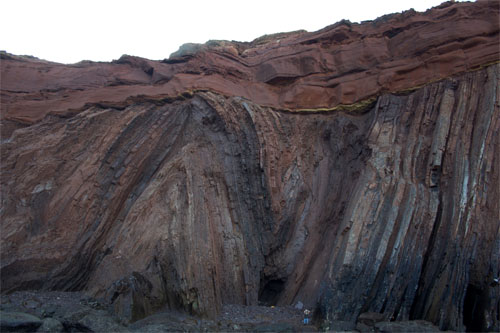
January 2015 photo of the month

Angular unconformity on the coast of Portugal at Telheiro Beach (credit: Gabriela Bruno)
Angular unconformity at Telheiro Beach, Portugal (credit: Gabriela Bruno)

This image posted at Earth Science Picture of the Day would be hard to beat as the definitive angular unconformity. It shows Upper Carboniferous  marine metagreywackes folded during the Variscan orogeny overlain by Triassic redbeds. Structurally it is uncannily similar to Hutton‘s famous unconformity at Siccar Point on the coast of SE Scotland, although the tight folding there is Caledonian in age and the unconformable redbeds are Devonian in age.

Human-Neanderthal cohabitation of the Levant

The earliest known remains of anatomically modern humans outside of Africa were found unearthed from the Skhul and Qafzeh caves in what is now northern Israel. Their context was that of deliberate burial at a time when climate was cooling from the last interglacial, between 90 to 120 ka. The Levant was also the repository for a number of well-preserved Neanderthal skeletons, most dating to between 35-65 ka, including ten individuals at Shanidar in today’s northern Iraq, some of whom were also deliberately buried including one whose grave reputedly contained evidence for a floral tribute. The 25 ka gap between the two populations has previous been regarded as evidence for lack of contact between them. However, the Tabun Cave in modern Israel has yielded tools attributed to Neanderthal Mousterian culture that may indicate their intermittent presence from 200 to 45 ka, and fossils of two individuals dated at ~122 and ~90 ka. The remains at Skhul and Qafzeh are significantly more rugged or robust than African contemporaries and have been considered possible candidates for Neanderthal-modern human hybrids. But whatever their parentage, it seems they became extinct as the climate of the Levant dried to desert conditions around 80 ka.

View of the exterior of Shanidar Cave, taken d...
Entrance to the Shanidar Cave, northern Iraq, occupied by Neanderthals between 35-65 ka (credit: Wikipedia)

A more promising overlap between modern human and Neanderthal occupation comes with the discovery by a group of Israeli, US, Canadian, German and Austrian scientists of a much younger anatomically modern human cranium from the Manot Cave, also in northern Israel (Herschkovitz, I. and 23 others 2015. Levantine cranium from Manot Cave (Israel) foreshadows the first European modern humans. Nature (online) doi:10.1038/nature14134). The cranium has a U-Th radiometric age of ~55 ka, well within the time span of Neanderthal occupation. Moreover, Manot Cave is one of a cluster of occupied sites in northern Israel, with separations of only a few tens of kilometres: undoubtedly, this individual and companions more than likely met Neanderthals. The big question, of course, is did the neighbours interbreed? If so the Levant would be the confirmed as the probable source of hybridisation to which the DNA of non-African living humans points. There may be a insuperable difficulty in taking this further: it is thought that the high temperatures of the region, despite its dryness, may have destroyed any chance of reconstructing ancient genomes. Yet one of the first Neanderthal bones to yield useful genetic material was from Croatia, which is not a great deal cooler in summer.

Convincing, indirect evidence for early toolmakers

A surprising number of animals pick up items from their surroundings and use them, mainly to get at otherwise inaccessible foodstuffs. What sets humans apart from such tool users is that we make them and for a long time part of our repertoire has been tools used to make other tools; so-called ‘machine tools’. An example is a piece of antler used to pressure-flake flint to give a stone blade a better edge, a more recent one is the increasing use of robots on assembly lines. Making a tool is impossible for a bird with only its beak and ill-adapted feet, while even a chimpanzee lacks various forms of grip needed for precisely directed force and manipulation. It was Frederick Engels who first focussed on the importance of the hand being freed to evolve the capacity for manual labour by the permanent adoption of an upright posture and gait, in his essay The Part Played by Labour in the Transition from Ape to Man written in 1876.

The earliest tools known turned up in 2.6 Ma old sediments at Gona in NE Ethiopia, while evidence for tool use is well accepted from cracked and sliced bones found in sediments dated at 2.5 Ma from Bouri in the same region. In neither case can the finds be tied to fossil remains of the makers and users, the earliest direct link emerging from famous Olduvai Gorge in western Tanzania, where crude Oldowan tools and worked bones occur with incomplete remains of a hominin, dubbed Homo habilis (‘handy man’) because of this association. Somewhat more controversial are bones that show cuts and scrape marks plus signs of having been cracked open that were found in a 3.4 Ma context at Dikika, also in Ethiopia, within the same sedimentary horizon as the young Australopithecus afarensis known as Selam (‘Hello’). The Dikika material is little different from 0.9 to 1.2 Ma younger bones at Bouri and Olduvai: the controversy seems to stem more from its much greater age and association with hominins deemed by some to have been incapable of creating tools.

English: Main division on the (right) human hand.
Bone structure of the (right) human hand. (credit: Wikipedia)

An entirely novel approach to the issue of the first tools and their makers, which with little doubt would have tickled Engels no end, is a careful anatomical and physiological examination of fossil hominin hand bones in comparison with those of chimps and living humans (Skinner, M.M. et al. Human-like hand use in Australopithecus africanus. Science, v. 347, p. 395-399). The bones being scrutinized are the five metacarpals that form the links in the palms from muscles of the forearm to finger and thumb movements and thus to various kinds of grip. In humans there are a host of ways of gripping objects from the precision of opposed thumb and finger pinching, especially that using the forefinger, to the squeezing power grip that wraps thumb and all fingers around an object and makes a fist. The best a chimp can do is grabbing a branch, to which its knuckle-walking hands are well adapted. The tips of the metacarpals are mechanically loaded according to the types of grip used repeatedly in life and that works to modify the physical density of the tips’ spongy bone tissue in patterns that vary according to habitual usage of the hand and its digits. This new approach is reputedly far more diagnostic than the actual shape of metacarpal bones, and requires high-resolution CT scanning.

Known early human and Neanderthal tool-makers show very similar patterns: in fact they suggest far more heavy loading through various kinds of grip than the metacarpals of humans from the modern period. In 1.8 to 3.0 Ma old A. africanus and Paranthropus robustus (a gorilla-like but bipedal australopithecine) from South Africa metacarpals suggest that both were habitually using a tree-climbing grip, much as chimpanzees do, but more closely resembled modern human and Neanderthal committed tool users. Both were certainly capable of using forceful precision grips to make and use tools up to 0.5 Ma earlier than the date of the earliest known tools. So far the technique has not been applied to the palm bones of earlier hominins such as A. afarensis (2.9-3.9 Ma) and Orrorin tugenensis (~6 Ma). Despite the suggestion of tool-making capability­, agreeing that it did take place in non-Homo hominins must await finds of tools, as well as signs of their use, in close association with fossil remains of their makers. The Dikika association is simply not enough. Yet, some bipedal being must have made tools before the date of the earliest ones (~2.6 Ma) discovered at Gona. Look at it this way: it is a lucky archaeologist who discovers every piece of evidence for a fundamental social change at one site. The fact that, by definition, the vast bulk of Pliocene and Pleistocene sediments that may contain the key evidence is either buried by younger material or was a victim of erosion, means that the chance of resolving the origin of the fundamental feature of human behaviour is tiny. The chance that scientists will continue looking is astronomically higher.

Reconstructing the structure of ancient vegetation canopies

One of the central measures used to describe modern ecosystems is the ratio of foliage area to that of the ground surface – the leaf area index (LAI) – which expresses the openness of vegetation canopies. A high LAI helps to retain moisture in the soil, partly by shading and cooling the surface to reduce evaporation and partly by stopping surface soil from being battered to a concrete-like consistency by heavy rain, which reduces the amount of water that can infiltrate. It is possible to estimate LAI across today’s entire land area using satellite image data but a proxy for palaeoecological LAI has remained hard to find.

English: Creative Commons attribution "ph...
Hemispherical photograph used to calculate modern canopy cover. (credit: Wikipedia; photo by S.B. Weiss)

The outer coating of leaves in well-shaded (high LAI) areas tends to have protective or pavement cells that are larger and have more complicated shapes than does that of leaves in more open canopies. The framework of leaf cells is silica-based and made up of structures known as phytoliths whose morphologies vary in much the same way as the cells that they support. So theoretically it is possible to use fossil phytoliths in terrestrial sediments to estimate LAI variations through time in local canopies, but first the approach needs a means of calibration from living ecosystems. The vegetation of Central American Costa Rica varies through the entire range of possible LAI values, which leads to varying amounts of sunlight available to the leaves of cover plants. Measuring the area and the degree of shape-complexity of phytoliths in modern soils there shows that each is positively correlated with LAI.

Lowland Paca near Las Horquetas, Costa Rica. F...
A modern herbivorous mammal (lowland paca) from dense forest in Costa Rica. (Photo credit: Wikipedia)

Putting this approach to use in the Cenozoic terrestrial sediments of Patagonia, US and Argentinean palaeoecologists aimed to examine how the evolution of the teeth of herbivorous mammals – a major feature in their speciation – linked to changes in vegetation structure (Dunn, R.E. et al. 2015. Linked canopy, climate and faunal change in the Cenozoic of Patagonia. Science, v. 347, p. 258-261). Using phytoliths they were able to show that in the Eocene the area was covered by dense, closed forest canopies that gradually became more open towards the end of the Eocene to be replaced by open forest and shrubland habitats in the Oligocene and Miocene, with a brief period of regreening. It was during the period of more open vegetation that tooth structure underwent the most change. Chances are that the vegetation shifts began in response to the onset of Antarctic glaciation at the beginning of the Oligocene Epoch and related climate change at the northern margin of the Southern Ocean. Changes in the herbivore teeth may have been in response to the increasing amount of dust adhering to leaves as canopies became more open and soil increasingly dried out.

Bicentenary of the first national geological map

It’s good to know that the geosciences have had revolutionising developments to match those of the rest of science. Forget the Battle of Waterloo in 1815, which of course was ‘the nearest-run thing you ever saw in your life’ when the Brits were saved from defeat by the timely arrival of the Prussians: This year we can celebrate one that literally put geology on the map, kicked-off the systematic exploration for every kind of physical resource, thereby putting a great deal of money in the pockets of coal, petroleum and metal moguls and making geology a career rather than a pastime. In 1815 William Smith published A Delineation of the Strata of England and Wales with part of Scotland, which despite the title was a map showing the basic geology and structure of the whole of England and Wales: the first ever map showing accurately the distribution of rocks for an entire country. The original, at 2.6 by 1.8 m, dominates the main staircase at Burlington House, the home of the Geological Society of London.

William Smith's A Delineation of the Strata of England and Wales with part of Scotland (1815)
William Smith’s A Delineation of the Strata of England and Wales with part of Scotland (1815)

Tom Sharpe has nicely summarized the key facts surrounding Smith’s masterpiece (Sharpe, T. 2015. The birth of the geological map. Science, v. 347, p. 230-232). One feature that I certainly did not know was that the colour scheme for the different stratigraphic units was based on the dominant colour of the rocks themselves, such as purples for the abundant slates of the Lower Palaeozoic, brown and red for the Old- and New Red Sandstone, greys and blacks for the Coal Measures and green for the Greensand, which until quite recently remained widely used to signify Cambrian, Ordovician and Silurian; Devonian and Permian; Upper Carboniferous and Cretaceous.

Although celebrated today, Smith’s map was panned by the gentlemen geologists of the Geol Soc, who attempted to do a better job, but failed ignominiously. William Smith was not a leisured chap of the Enlightenment, but worked for a living surveying coal mines, navigating canals and draining fens. Despite their antipathy, the Fellows of the Geological Society of London knew a good earner when they saw one and plagiarized Smith’s work and undercut his regular price for his map. As a result he ended up in a London debtors’ prison. Even on the day of his release in 1819, bailiffs seized his house and its contents. The Geol Soc eventually did honour Smith with its Wollaston Medal in 1831, its then president Adam Sedgwick dubbing him ‘the Father of English Geology’: by that time geology had become a profession…

Verneshots (huge volcanic gas blasts) ten years on

One of the most daring hypotheses of modern geosciences: is that of the ‘Verneshot’ reported by Earth Pages in 2004.  Jason Phipps Morgan and colleagues explored the possible consequences of a build-up of volatiles in plume-related magmas at the base of thick continental lithosphere beneath cratons, prior to the eruption of continental flood basalts. They suggested that pressure would eventually result in an explosive release at a lithospheric weak point, followed by collapse above the plume head that would propagate upwards, at hypersonic speeds. Modelling the forces involved, the authors of the novel idea considered that they would be sufficient to fling huge rock masses into orbit.  Verneshots might neatly explain the circumstances around mass extinctions, such as their coincidence with continental flood basalt events; large impact structures, most likely at the antipode of the event; global debris layers containing shocked rock, melt spherules; unusual element suites and compounds (including fullerenes); and enough toxic gas to cause biological devastation.

Ten years on, Verneshots are back, again in the prestigious journal Earth and Planetary Science Letters, and this time among the co-authors are Morgan père et fils (W. Jason a founder of plate tectonics, and Jason P. who launched the idea). This time the yet-to-be –accepted hypothesis comes with evidence of an extremely unusual and fortuitous kind (Vannucchi, P. et al. 2015. Direct evidence of ancient shock metamorphism at the site of the 1908 Tunguska event. Earth and Planetary Science Letters, v. 409, p. 168-174). The origin of the paper lies in an attempt to verify reports of shocked quartz in samples collected close to the centre of the 2000 km2 devastation that resulted from what is now accepted to have been a comet or asteroid air-burst explosion in June 1908 in the Tunguska region of Siberia. Apart from a disputed 300 m crater in the area, the Tunguska Event left no long-lived sign: it ‘merely’ knocked over millions of trees. However, its epicenter lay in a 10 km depression ringed by hills, that has been suggested to be a volcanic centre associated with the end-Permian Siberian Traps.

Trees knocked down and burned over hundreds of square km by the 1908Tunguska Event (credit: Leonid Alekseyevich Kulik deceased)
Trees knocked down and burned over hundreds of square km by the 1908 Tunguska Event (credit: Leonid Alekseyevich Kulik deceased)

The reported shocked quartz locality turned out to associated with an isolated occurrence of quartz-rich sand and rounded clasts of quartzite that contains sedimentary structures. The occurrence is surrounded by basalts of the Siberian Traps, yet is situated topographically above them. The quartzite is thought to be Permian terrestrial sandstone that commonly underlies much of the remaining extent of Siberian Traps.

Quartzite clasts do indeed contain shocked quartz, together with pseudotachylite glass veinlets, quartz and feldspar crystal growth on sedimentary grains and silica-rich glassy spherules. These features are not uniquely diagnostic of shock metamorphism, but are oddly absent from the surrounding Siberian Traps nearby, which suggests that whatever formed them predated the final eruptive stages of the end-Permian large igneous province. Indeed it would be unlikely that airburst of some extraterrestrial bolide in 1908 could produce the metamorphic features of the quartzites without setting ablaze the trees that it felled. A second possibility, that the Tunguska Depression is a Permo-Triassic impact crater and the quartzites being part of an associated central uplift runs into the unlikely coincidence of lying less than 5 km from the 1908 epicentre.

A third hypothesis is that the Tunguska Depression is a massive diatreme associated with a Verneshot. Another odd association lies 8 km to the south of the epicentre, a carbonatite that is one of many, along with smaller pipe-like structures all possibly linked to magmatic gas escape. The Tunguska Event, a mighty puzzle in its own right, may perhaps be eclipsed. Will silence return as it did after the original Verneshot hypothesis was published? Quite possibly, but another quirk about the Siberian Traps was reported by Earth Pages in mid-2014. In a contribution to a link between this massive end-Permian volcanic effusion and the Permian-Triassic mass extinction it was noted that in the Chinese sedimentary repository of evidence for the extinction there is an isolated spike in the abundance of nickel  that is almost certainly of volcanic origin, but only the one when repeated flood basalt events perhaps ought to have led to a series of nickel anomalies. One huge volcanic gas release as the Siberian Traps were building up?