Arsenic: an agent of evolutionary change?

The molecules that make up all living matter are almost entirely (~98 %) made from the elements Carbon, Hydrogen, Oxygen, Nitrogen and Phosphorus (CHONP) in order of their biological importance. All have low atomic numbers, respectively 6th, 1st, 8th, 7th and 15th in the Periodic Table. Of the 98 elements found in nature, about 7 occur only because they form in the decay schemes of radioactive isotopes. Only the first 83 (up to Bismuth) are likely to be around ‘for ever’; the fifteen heavier than that are made up exclusively of unstable isotopes that will eventually disappear, albeit billions of years from now. There are other oddities that mean that the 92 widely accepted  to be naturally occurring is not strictly correct. That CHONP are so biologically important stems partly from their abundances in the inorganic world and also because of the ease with which they chemically combine together. But they are not the only ones that are essential.

About 20 to 25% of the other elements are also literally vital, even though many are rare. Most of the rest are inessential except in vanishingly small amounts that do no damage, and may or may not be beneficial. However some are highly toxic. Any element can produce negative biological outcomes if above certain levels. Likewise, deficiencies can result in ill thrift and event death. For the majority of elements, biologists have established concentrations that define deficiency and toxic excess. The World Health Organisation has charted the maximum safe levels of elements in drinking water in milligrams per litre. In this regard, the lowest safe level is for thallium (Tl) and mercury (Hg) at 0.002 mg l-1.Other highly toxic elements are cadmium (Cd) (0.003 mg l-1), then arsenic (As) and lead (Pb) (0.01 mg l-1) that ‘everyone knows’ are elements to avoid like the plague. In nature lead is very rarely at levels that are unsafe because it is insoluble, but arsenic is soluble under reducing conditions and is currently responsible for a pandemic of related ailments, especially in the Gangetic plains of India and Bangladesh and similar environments worldwide.

Biological evolution has been influenced since life appeared by the availability, generally in water, of both essential and toxic elements. In 2020 Earth-logs summarised a paper about modern oxygen-free springs in Chile in which photosynthetic purple sulfur bacteria form thick microbial mats. The springs contain levels of arsenic that vary from high in winter to low in summer. This phenomenon can only be explained by some process that removes arsenic from solution in summer but not in winter. The purple-bacteria’s photosynthesis uses electrons donated by sulfur, iron-2 and hydrogen – the spring water is highly reducing so they thrive in it. In such a simple environment this suggested a reasonable explanation: the bacteria use arsenic too. In fact they contain a gene (aio) that encodes for such an eventuality. The authors suggested that purple sulfur bacteria may well have evolved before the Great Oxygenation Event (GOE). They reasoned that in an oxygen-free world arsenic, as well as Fe2+ would be readily available in water that was in a reducing state, whereas oxidising conditions after the GOE would suppress both: iron-2 would be precipitated as insoluble iron-3 oxides that in turn efficiently absorb arsenic (see: Arsenic hazard on a global scale, May 2020).

Colour photograph and CT scans of Palaeoproterozoic discoidal fossils from the Francevillian Series in Gabon. (Credit: El Albani et al. 2010; Fig. 4).

A group of geoscientists from France, the UK, Switzerland and Austria have investigated the paradox of probably high arsenic levels before the GOE and the origin and evolution of life during the Archaean  (El Khoury et al. 2025. A battle against arsenic toxicity by Earth’s earliest complex life forms. Nature Communications, v. 16, article 4388; DOI: 10.1038/s41467-025-59760-9). Note that the main, direct evidence for Archaean life are fossilized microbial mats known as stromatolites, some palaeobiologists reckoning they were formed by oxygenic photosynthesising cyanobacteria others favouring the purple sulfur bacteria (above). The purple sulfur bacteria in Chile and other living prokaryotes that tolerate and even use arsenic in their metabolism clearly evolved that potential plus necessary chemical defence mechanisms, probably when arsenic was more available in the anoxic period before the GOE. Anna El Khoury and her colleagues sought to establish whether or not eukaryotes evolved similar defences by investigating the earliest-known examples; the 2.1 Ma old Francevillian biota of Gabon that post-dates the GOE. They are found in black shales, look like tiny fried eggs and are associated with clear signs of burrowing. The shales contain steranes that are breakdown products of steroids, which are unique to eukaryotes.

The fossils have been preserved by precipitation of pyrite (Fe2S) granules under highly reducing conditions. Curiously, the cores of the pyrite granules in the fossils are rich in arsenic, yet pyrite grains in the host sediments have much lower As concentrations. The latter suggest that seawater 2.1 Ma ago held little dissolved arsenic as a result of its containing oxygen. The authors interpret the apparently biogenic pyrite’s arsenic cores as evidence of the organism having sequestered As into specialized compartments in their bodies: their ancestors must have evolved this efficient means of coping with significant arsenic stress before the GOE. It served them well in the highly reducing conditions of black shale sedimentation. Seemingly, some modern eukaryotes retain an analogue of a prokaryote As detoxification gene.

How the earliest continental crust may have formed

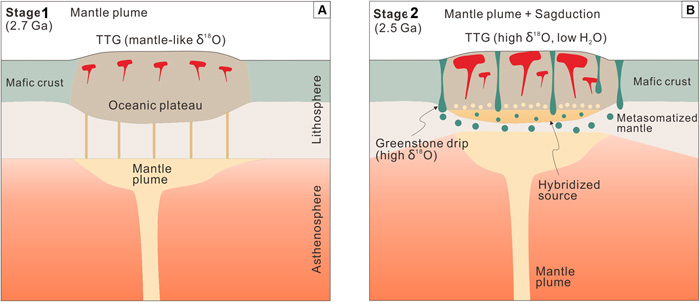
Detrital zircon grains extracted from sandstones deposited ~3 billion year (Ga) ago in Western Australia yield the ages at which these grains crystallised. The oldest formed at about 4.4 Ga; only 150 Ma after the origin of the Earth (4.55 Ga). Various lines of evidence suggest that they originally crystallized from magmas with roughly andesitic compositions, which some geochemists suggest to have formed the first continental crust (see: Zircons and early continents no longer to be sneezed at; February 2006). So far, no actual rocks of that age and composition have come to light. The oldest of these zircon grains also contain anomalously high levels of 18O, a sign that water played a role in the formation of these silicic magmas. Modern andesitic magmas – ultimately the source of most continental crust – typically form above steeply-dipping subduction zones where fluids expelled from descending oceanic crust encourage partial melting of the overriding lithospheric mantle. Higher radiogenic heat production in the Hadean and the early Archaean would probably have ensured that the increased density of later oceanic lithosphere needed for steep subduction could not have been achieved. If subduction occurred at all, it would have been at a shallow angle and unable to exert the slab-pull force that perpetuated plate tectonics in later times (see: Formation of continents without subduction, March, 2017).

Landsat image mosaic of the Palaeoarchaean granite-greenstone terrain of the Pilbara Craton, Western Australia. Granite bodies show as pale blobs, the volcanic and sedimentary greenstone belts in shades of grey.

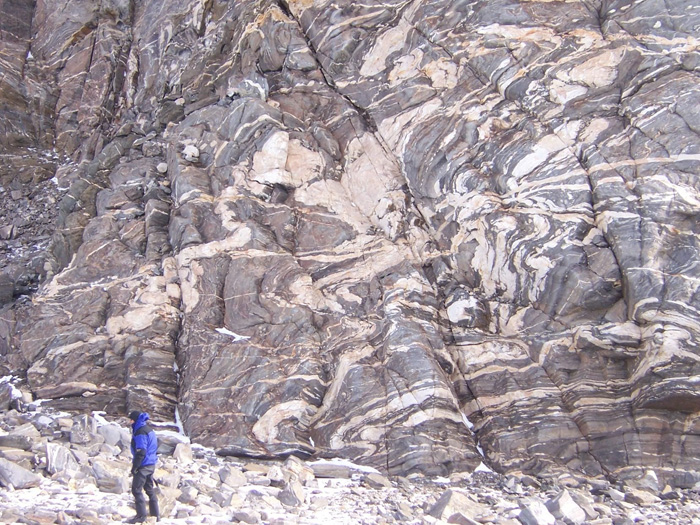
Geoscientists have been trying to resolve this paradox for quite a while. Now a group from Australia, Germany and Austria have made what seems to be an important advance (Hartnady, M. I. H and 8 others 2025. Incipient continent formation by shallow melting of an altered mafic protocrust. Nature Communications, v. 16, article 4557; DOI: 10.1038/s41467-025-59075-9). It emerged from their geochemical studies of rocks in the Pilbara Craton of Western Australia that are about a billion years younger than the aforementioned ancient zircon grains. These are high-grade Palaeoarchaean metamorphic rocks known as migmatites that lie beneath lower-grade ‘granite-greenstone’ terrains that dominate the Craton, which Proterozoic deformation has forced to the surface. Their bulk composition is that of basalt which has been converted to amphibolite by high temperature, low pressure metamorphism (680 to 730°C at a depth of about 30 km). These metabasic rocks are laced with irregular streaks and patches of pale coloured rock made up mainly of sodium-rich feldspar and quartz, some of which cut across the foliation of the amphibolites. The authors interpret these as products of partial melting during metamorphism, and they show signs of having crystallised from a water-rich magma; i.e. their parental basaltic crust had been hydrothermally altered, probably by seawater soon after it formed. The composition of the melt rocks is that of trondhjemite, one of the most common types of granite found in Archaean continental crust. Interestingly, small amounts of trondhjemite are found in modern oceanic crust and ophiolites.

A typical migmatite from Antarctica showing dark amphibolites laced with quartzofeldspathic products of partial melting. Credit: Lunar and Planetary Laboratory, University of Arizona

The authors radiometrically dated zircon and titanite (CaTiSiO₅) – otherwise known as sphene – in the trondhjemites, to give an age of 3565 Ma. The metamorphism and partial melting took place around 30 Ma before the overlying granite-greenstone assemblages formed. They regard the amphibolites as the Palaeoarchaean equivalent of basaltic oceanic crust. Under the higher heat production of the time such primary crust would probably have approached the thickness of that at modern oceanic plateaux, such as Iceland and Ontong-Java, that formed above large mantle plumes. Michael Hartnady and colleagues surmise that this intracrustal partial melting formed a nucleus on which the Pilbara granite-greenstone terrain formed as the oldest substantial component of the Australian continent. The same nucleation may have occurred during the formation of similar early Archaean terrains that form the cores of most cratons that occur in all modern continents.

Impact debris in Neoproterozoic sediments of Scotland and biological evolution?

False-colour electron microscope image of a shocked grain of zircon recovered from the Stac Fada Member. The red and pink material is a high-pressure polymorph of zircon, arranged in shock lamellae. Zircon is rendered in cyan, some of which is in granulated form. Credit: Kirkland et al. 2025, Fig 2C

Judging by its content of shards and spherules made of murky green glass, one of the lowest units in the Torridonian continental sediments of NW Scotland had long been regarded as simply red sandstone that contained volcanic debris. This Stac Fada Member was thus celebrated as the only sign of a volcanic contribution to a vast thickness (up to 2.5 km) of Neoproterozoic lake and fluviatile sediments. Current flow indicators suggested that the Torridonian was laid down by large alluvial fans derived by erosion of much older crystalline basement far to what is today the west. That is, the Archaean core of the ancient continent of Laurentia, now the other side of the North Atlantic. In 2002 more sophisticated sedimentological and geochemical analysis of the Stac Fada Member revealed a surprise: it contains anomalously elevated platinum-group elements, quartz grains that show signs of shock and otherworldly chromium isotope concentrations. The 10 m thick bed is made from ejecta, perhaps from a nearby impact crater to the WNW concluded from brittle fractures that may have been produced by the impact. Some idea of its age was suggested by Ar-Ar dating of feldspar crystals (~1200 Ma) believed to have formed authigenically in the hot debris. Being the only decent impactite known in Britain, it continues to attract attention.

A group of geoscientists from Western Australia, NASA and the UK, independent of the original discoverers, have now added new insights ( Kirkland, C.L. and 12 others 2025. A one-billion-year old Scottish meteorite impact. Geology, v. 53, early online publication; DOI: 10.1130/G53121.1). They dated shocked zircon grains using U-Pb analyses at 990 ± 22 Ma; some 200 Ma younger than the previously dated, authigenic feldspars.  Detrital feldspar grains in the Stac Fada Member yield Rb-Sr radiometric ages of 1735 and 1675, that are compatible with Palaeoproterozoic granites in the underlying Lewisian Gneiss Complex.

Photomicrograph of Bicellum brazieiri: scale bar = 10μm; arrows point to dark spots that may be cell nuclei (credit: Charles Wellman, Sheffield University)

In a separate publication (Kirkland, C.L et al 2025. 1 billion years ago, a meteorite struck Scotland and influenced life on Earth. The Conversation, 29 April 2025) three of the authors take things a little further, as their title suggests. In this Conversation piece they ponder, perhaps unwarily, on the spatial and temporal association of the indubitable impact with remarkably well-preserved spherical fossils found in Torridonian lake-bed sediments (Bicellum brasieri, reported in Earth-logs in May 2021), which are the earliest-known holozoan animal ancestors. The Torridonian phosphatic concretions in which these important fossils were found at a different locality are roughly 40 Ma younger than the Stac Fada impactite. The authors of the Conversation article appeal to the residual thermal effect of the impact as a possible driver for the appearance of these holozoan organisms. Whether a residual thermal anomaly would last long enough for them to evolve to this biological status would depend on the magnitude of the impact, of which we know nothing.  Eukaryote fossils are known from at least  650 Ma older sedimentary rocks in northern China and perhaps as far back as 2.2 Ga in a soil that formed in the Palaeoproterozoic of South Africa. Both the Torridonian organism and impactite were found in a small area of fascinating geology that has been studied continuously in minute detail since Victorian times, and visited by most living British geologists during their undergraduate days. Ideas will change as curiosity draws geologists and palaeobiologists to less-well studied sites of Proterozoic antiquity, quite possibly in northern China.

A fully revised edition of Steve Drury’s book Stepping Stones: The Making of Our Home World can now be downloaded as a free eBook

A sign of life on another planet? Should we be excited?

Judging by the coverage in the media, there is huge excitement about a possible sign of life on a very distant planet. It emerged from a Letter to The Astrophysical Journal posted by a British-US team of astronomers led by Nikku Madhusudhan that was publicised by the Cambridge University Press Office (Madhusudhan, N.et al. 2025. New Constraints on DMS and DMDS in the Atmosphere of K2-18 b from JWST MIRI. The Astrophysical Journal, v. 983, article adc1c8; DOI: 10.3847/2041-8213/adc1c8). K2-18 b is a planet a bit smaller than Neptune that orbits a red dwarf star (K2-18) about 124 light years away. The planet was discovered by NASA’s now-defunct Kepler space telescope tasked with the search for planets orbiting other stars. An infrared spectrometer on the Hubble Space Telescope revealed in 2019 that the atmosphere of K2-18 b contained water vapour, making the planet a target for further study as it may possess oceans. The more sophisticated James Webb Space Telescope IR spectrometer was trained on it a year later to reveal methane and CO2: yet more reason to investigate more deeply, for water and carbon compounds imply both habitability and the potential for life forms being there.

The latest results suggest that that the atmosphere of K2-18 b may contain simple carbon-sulfur gases: dimethyl sulfide ((CH3)2S) and dimethyl disulfide (CH3SSCH3). Bingo! for exobiologists, because on Earth both DMS and DMDS are only produced by algae and bacteria. Indeed they are responsible for the odour of the seaside. They became prominent in 1987 when biogeochemist James Lovelock fitted them into his Gaia Hypothesis. He recognised that they encourage cloud formation and thus increase Earth’s reflectivity (albedo) and also yield sulfuric acid aerosols in the stratosphere when they oxidise: that too increases albedo. DMS generates a cooling feedback loop to counter the warming feedback of greenhouse emissions. That is an idea of planetary self-regulation not much mentioned nowadays. Such gases were proposed by Carl Sagan as unique molecular indicators that could be used to search for extraterrestrial life.

The coma of Comet Churyumov-Gerasimenko yielded both dimethyl sulfide and amino acids to the mass spectrometer carried by ESA’s Rosetta. Credit: ESA.

The discovery of possible DMS and DMDS in K2-18 b’s atmosphere is, of course, currently under intense scientific scrutiny. For a start, the statistics inherent in Madhusudhan et al.’s methodology (3σ or 99.7% probability) fall short of the ‘gold standard’ for discoveries in physics (5σ or 99.99999% probability). Moreover, there’s also a chance that exotic, inorganic chemical processes could also create the gases, such as lightning in an atmosphere containing C, H and S. But this is not the first time that DMS has been discovered in an extraterrestrial body. Comets, having formed in the infancy of the Solar System much further from the Sun than any planets, are unlikely to be ‘teeming with life’. The European Space Agency’s Rosetta spacecraft chased comet 67P/Churyumov-Gerasimenko for 2 years, directly sampling dust and gas that it shed while moving closer to the Sun. A single day’s data from Rosetta’s mass spectrometer showed up DMS, and also amino acids. Both could have formed in comets or interstellar dust clouds by chemistry driven by radiation, possibly to contaminate planetary atmospheres. Almost certainly, further remote sensing of K2-18 b will end up with five-sigma precision and some will say, ‘Yes, there is life beyond Earth!’ and celebrate wildly. But that does not constitute proof, even by the ‘weight of evidence’ criterion of some judiciaries. To me such a conclusion would be unseemly romanticism. Yet such is the vastness of the material universe and the sheer abundance of the elements C H O N and P that make up most living matter that life elsewhere, indeed everywhere, (but not life as we know it) is a near certainty. The issue of intelligent lifeforms ‘out there’ is, however, somewhat less likely to be resolved . . .

Middle Palaeolithic Neanderthals and Denisovans of East Asia

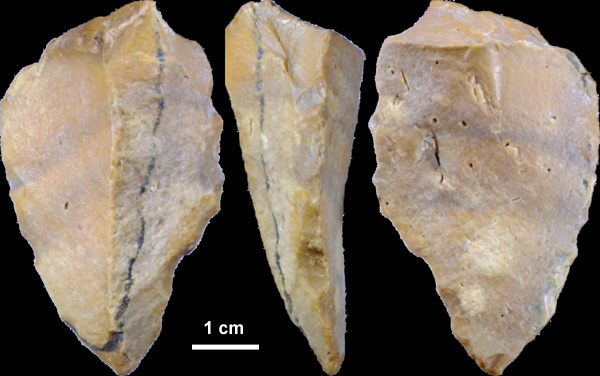
During the Middle Palaeolithic (250 to 30 ka) anatomically modern humans (AMH) and Neanderthals were engaged in new technological developments in Europe and Africa as well as in migration and social interaction. This is reflected in the tools that they left at occupation sites and the fact that most living non-Africans carry Neanderthal DNA. One of the major cultural developments was a novel means of manufacturing stone implements. It developed from the Levallois technique that involved knapping sharp-edged flakes of hard rock from larger blocks or cores. A type of tool first found at a Neanderthal site near La Quina in France is a thick flake of stone with a broad, sharp edge that shows evidence of having been resharpened many times. Most other flake tools seem to have been ‘one-offs’ that were discarded after brief usage. The Quina version was not only durable but seems to have been multipurpose. Analysis of wear patterns on the sharpened edges suggest that they were deployed in carving wood and bone, removing fat and hair from animal hides, and butchery. Such scrapers have been found over a wide area of Europe, the Middle East and NE Asia mostly at Neanderthal sites, including the famous Denisova Cave of southern Siberia that yielded the first Denisovan DNA as well as that of Neanderthals.

Making a typical Quina scraper and related tools. The toolmaker would flake pieces of stone off the core and then carefully shape the Quina scraper. (Image credit: Pei-Yuan Xiao)

Until now, the early humans of East Asia were thought not to have proceeded beyond more rudimentary tools during the Middle Palaeolithic: in fact that archaeological designation hasn’t been applied there. Recent excavations at Longtan Cave in south-west China have forced a complete revision of that view (Ruan, Q.-J., et al. 2025. Quina lithic technology indicates diverse Late Pleistocene human dynamics in East Asia. Proceedings of the National Academy of Sciences, v. 122, article e2418029122; DOI: 10.1073/pnas.2418029122). The Longtan site has yielded more than fifty scrapers and the cores from which they had been struck that clearly suggest the Quina technology had been used there. They occur in cave sediments dated at between 60 and 50 ka. As yet, no human remains have been found in the same level at Longtan, although deeper levels dated at 412 ka have yielded hominin crania, mandibular fragments, and teeth, that have been suggested to be Homo erectus.

Quina type tools in East Asia may previously have been overlooked at other hominin sites in China: re-examination of archived tool collections may show they are in fact widespread. The technology could have been brought in by migrating Neanderthals, or maybe it was invented independently by local East Asian hominins. Because most living people in China carry Denisovan DNA in the genomes so perhaps that group developed the technique before interbreeding with AMH immigrants from the west. Indeed there is no reason to discard the notion that  early AMH may have imported the Quina style. A lot of work lies ahead to understand this currently unique culture at Longtan Cave. However, interpretation of another discovery published shortly after that from Longtan has spectacularly ‘stolen the thunder’ of the Qina tools, and it was made in Taiwan …

Right (top) and downward (lower) views of the partial Penghu mandible. Credit: Yousuke Kaifu University of Tokyo, Japan and Chun-Hsiang Chang Tunghai University, Taichung, from Tsutaya et al. Fig. 1 (inset)Taiwan.

About 10 years ago, Taiwanese fishers trawling in the Penghu Channel between Taiwan and China were regularly finding bones in their nets. Between 70 to 10 ka and 190 to 130 ka ago much lower sea level due to continental ice cap formation exposed the Penghu seabed. Animals and humans were thus able to move between the East Asian mainland and what is now Taiwan. The bones brought to the surface included those of elephants, water buffaloes and tigers, but one was clearly a human lower jawbone (mandible). Its shape and large molar teeth are very different from modern human mandibles and molars. A multinational team from Japan, Denmark, Taiwan and Ireland has extracted proteins from the mandible to check its genetic affinities (Tsutaya, T. and 14 others 2025. A male Denisovan mandible from Pleistocene Taiwan. Science, v. 388, p. 176-180; DOI: 10.1126/science.ads3888). Where DNA has not been preserved in bones proteomics is a useful tool, especially if results are matched with other bones that have yielded both DNA and protein sequences. In the case of the Penghu mandible, proteins from its teeth matched those of Denisovans from the Denisova Cave in Siberia which famously yielded the genome of this elusive human group. They also matched proteins from a rib found in Tibet associated with Denisovan mitochondrial DNA in cave sediments that enclosed the bones.

The three sites (Denisova, Baishiya Cave in Tibet and Penghu Channel) that have produced plausible Denisovan specimens span a large range of latitudes and altitudes. This suggests that Denisovans were capable of successful subsistence across much of East Asia. The Penghu mandible and teeth are similar to several hominin specimens from elsewhere in China that hitherto have been attributed to H. erectus. Apart from the Denisovan type locality, most of the sites have yet to be accurately dated. Having been immersed in sea water for thousands of years isotopes used in dating have been contaminated in the Panghu specimen. It can only be guessed to have lived when the seabed from which it was recovered was dry land; i.e. between 70 to 10 ka and 190 to 130 ka. China was undoubtedly occupied by Homo erectus during the early Pleistocene, but much younger fossils have been attributed to that species by Chinese palaeoanthropologists. Could it be that they are in fact Denisovans? Maybe such people independently developed the Quina knapping technique

See also: Marwick, B. 2025.  Unknown human species in East Asia used sophisticated tools at the same time Neanderthals did in Europe. Live Science, 31 March 2025; Ashworth. J. 2025. Denisovan jawbone helps to reveal appearance of ancient human species. Natural History Museum News 11 April 2025.

A fully revised edition of Steve Drury’s book Stepping Stones: The Making of Our Home World can now be downloaded as a free eBook

More dinosaur trackways from the Jurassic of the Isle of Skye, Scotland

The Isle of Skye off the northwestern coast of Scotland is one of several areas in Britain that are world-class geological gems. Except for the Cuillin Hills that require advanced mountaineering skills it is easy to explore and has become a major destination for both beginners and expert geoscientists of all kinds. Together with the adjacent Isle of Raasay the area is covered by a superb, free geological guidebook (Bell, B. 2024. The Geology of the Isles of Skye and Raasay. Geological Society of Glasgow) together with 60 standalone excursion guides, and even an introduction to Gaelic place names and pronunciation. It is freely available from https://www.skyegeology.com/

Fig Dinosaur trackways at Prince Charles’s Point on the Isle of Skye: Left carnivorous theropods; Right herbivorous sauropods. The black scales are 1 m long. The images are enhanced fine-scale elevation models of the exposed surfaces that were derived from vertical photographs. Credit: Blakesley et al., Figs 9 and 27.

Since 2018 Skye has also become a must-visit area for vertebrate palaeontologists. Beneath Palaeocene flood basalts is a sequence of Jurassic strata, both shallow marine and terrestrial. One formation, the Great Estuarine Group of Middle Jurassic (Bathonian, 174–164 Ma) age covers the time when meat-eating theropod- and herbivorous sauropod dinosaurs began to grow to colossal sizes from diminutive forebears. While other Jurassic sequences on Skye have notable marine faunas, its Bathonian strata have yielded a major surprise: some exposed bedding surfaces are liberally  dotted with trackways of the two best known groups of dinosaur. The first to be discovered were at Rubha Nam Brathairean (Brothers’ Point) suggesting a rich diversity of species that had wandered across a wide coastal plain, also including the somewhat bizarre Stegosaurus. The latest finds are from a rocky beach at Prince Charles’s Point where the Young Pretender to the British throne, Charles Edward Stuart, landed and hid during his flight from the disastrous Battle of Culloden (16 April 1746). It was only in the last year or so that palaeontologists from the universities of Edinburgh and Liverpool, and the Staffin Museum came across yet more footprints (131 tracks) left there by numerous dinosaurs in the rippled sands of a Bathonian lagoon (Blakesley, T. et al. 2025. A new Middle Jurassic lagoon margin assemblage of theropod and sauropod dinosaur trackways from the Isle of Skye, Scotland. PLOS One, v. 20, article e0319862; DOI: 10.1371/journal.pone.0319862.

The Prince Charles’s Point site is partly covered by large basalt boulders, which perhaps account for the excellent preservation of the bedding surfaces from wave action. Two kinds of footprint are preserved (see image): those made by three-toed feet and by elephant-like feet that ‘squidged-up’ sediment surrounding than. Respectively these are suggested to represent the hind limbs of bipedal carnivorous theropods and quadrupedal herbivorous sauropods. They show that individual dinosaurs moved in multiple directions, but there is no evidence for gregarious behaviour, such as parallel trackways of several animals. They occur on two adjacent bedding surfaces so represent a very short period of time, perhaps a few days. The authors suggest that several individual animals were milling around, with more sauropods than theropods. What such behaviour represents is unclear. The water in an estuarine lagoon would likely have been fresh or brackish. They may have been drinking or perhaps there was some plants or carcases worth eating ? That might explain both kinds of dinosaurs’ milling around. The sizes of both sauropod and theropod prints average about 0.5 m. The stride lengths of the theropods suggest that they were between 5 to 7 metres long with a hip height of around 1.85 m. Their footprints resemble those reconstructed from skeletal remains of Middle Jurassic Megalosaurus, the first dinosaur to be named (by William Buckland in 1827). The sauropods had estimated hip heights of around 2 m so they may have been similar in size (around 16 m) to the Middle Jurassic Cetiosaurus, the first sauropod to be named (by Richard Owen in 1842).

A fully revised edition of Steve Drury’s book Stepping Stones: The Making of Our Home World can now be downloaded as a free eBook

What drove the Cambrian Explosion?

The origin of animals occurred sometime during the Proterozoic Eon, perhaps as early as 2.1 Ga (billion years ago) after the Great Oxygenation Event. Available oxygen is a prerequisite for animal life, and that is about as far back as palaeobiologists can push it. More familiar are the trace fossils known as the Ediacaran fauna which emerged after the environmentally highly stressful Cryogenian Period that was marked by two Snowball Earth events. Traces of these animals may have been big enough to be easily found, but they were not particularly diverse and are difficult to place in any particular modern group. Most modern animals have front- and rear ends, tops and bottoms, and input and output orifices. The earliest of these bilaterian beasts may have emerged during the Ediacaran as well, but were not very prepossessing. It was during the Cambrian Period (541 to 485 Ma) that most modern animal phyla became recognisable to palaeobiologists. That carnival of diversification is widely known as the Cambrian Explosion. Yet it was later in geological time that the full panoply of Phanerozoic diversity among taxa below the level of the phylum truly exploded, punctuated by mass extinctions and the diversification that followed each of them. So, what lay behind the initial emergence of the characteristics that form the basic templates of the phyla themselves?

Cartoon of the Cambrian Explosion in benthic faunas. Credit: Gabriela Mangano and Luis A. Buatois, 2016 The Cambrian Explosion, Fig 3.15

A multinational team of modellers and geoscientists have moved the focus from long-term shifts in climate and atmospheric chemistry to what might change from day to night in an ecosystem during the diel cycle (Hammarlund, E.U. and 13 others 2025. Benthic diel oxygen variability and stress as potential drivers for animal diversification in the Neoproterozoic-Palaeozoic Nature Communications, v. 16, article 2223; DOI:10.1038/s41467-025-57345-0). During the Neoproterozoic oxygen levels in Earth atmosphere rose to about half the amount present today. But animals arose and evolved in sea water. The most prolific source of food for them would have been in shallow water (the benthic zone), simply because sunlight in the photic zone encourages photosynthesis. As well as a thriving base for animal life’s food chain shallow water is where oxygen is produced; but only during daylight hours. At night decay of organic matter on the seabed draws down dissolved oxygen. Emma Hammarlund and colleagues wondered if day-night changes in oxygen levels might have exerted sufficient stress to force early animals to adapt and thus diversify. Their model shows that in warm, shallow water the lower oxygen levels at the start of the Phanerozoic could change dramatically in the diel cycle. Algae at the base of the food chain would swiftly oxygenate the water in daylight, but at night would consume it to produce much lower levels. Animals that were better adapted to the stress of this daily ‘feast-and-famine’ cycle in oxygen availability would outcompete others that were less resilient for the available nutrients. Environmental stress had flipped from an obstacle to evolution to a catalyst for it. The earliest appearances of organisms in the 10 modern phyla seem to coincide with global warming at low latitudes to an air temperature of about 25° C at the start of the Cambrian, perhaps when this shift began.

Another empirical coincidence lies in the sedimentary rock record. On modern continents the base of Phanerozoic sediments is widely marked by shallow-water sandstones often at an unconformity. Often white and containing abundant burrows, the sandstones are signs of abundant life, though rarely contain body fossils. They represent global sea-level rise that flooded the existing continents, so the highly productive benthic environment became about four times more widespread at the end of the Cambrian than it was during the previous Ediacaran Period. Abundant life forms were under stress more or less everywhere. Thereafter these ‘shelf seas’ halved in total area, but the basic ‘templates’ for animal life were well-established and the numbers of classes, orders, families etcetera steadily burgeoned. By the end of the Cambrian oxygen production rose so that atmospheric concentration of the gas reached 25%, higher then it is at present.

See also: Hammarlund, E. 2025. How dramatic daily swings in oxygen shaped early animal life. The Conversation, 21 March 2025.

The earliest known impact structure

Earth has been through a great many catastrophes, but the vast majority of those of which we know were slow-burning in a geological sense. They resulted in unusually high numbers of extinctions at the species- to family levels over a few million years and the true mass extinctions seem to have been dominated by build ups of greenhouse gases emitted by large igneous provinces. Even the most famous at the end of the Cretaceous Period, which did for the dinosaurs and considerably more organisms that the media hasn’t puffed, was partly connected to the eruption of the Deccan flood basalts of western India. Yet the event that did the real damage was a catastrophe that appeared in a matter of seconds: the time taken for the asteroid that gouged the Chicxulub crater to pass through the atmosphere. Its energy was huge and because it was delivered in such a short time its sheer power was unimaginable. Gradually geologists have recognised signs of an increasing number of tangible structures produced by Earth’s colliding with extraterrestrial objects, which now stands at 190 that have been confirmed.

Landsat image mosaic of the Palaeoarchaean granite-greenstone terrain of the Pilbara Craton, Western Australia. Granite bodies show as pale blobs, the volcanic and sedimentary greenstone belts in shades of grey. The site of Kirkland et al.’s study site is at the tip of the red arrow

The frequency of impact craters falls off with age, most having formed in the last ~550 million years (Ma) during the Phanerozoic Eon, only 25 being known from the Precambrian, which spanned around 88 percent of geological time. That is largely a consequence of the dynamic processes of tectonics, erosion and sedimentation that may have obliterated or hidden a larger number. Earth is unique in that respect, the surfaces of other rocky bodies in the Solar System showing vastly more. The Moon is a fine example, especially as it has been Earth’s companion since it formed 4.5 billion years ago (Ga) after the proto-Earth collided with a now vanished planet about the size of Mars. The relative ages of lunar impact structures combined with radiometric ages of the surfaces that they hit has allowed the frequency of collisions to be assessed through time. Applied to the sizes of the craters such data can show how the amount of kinetic energy inflicted on the lunar surface has changed with time. During what geologists refer to as the Hadean Eon (before 4 Ga), the moon underwent continuous bombardment that reached a crescendo between 4.1 and about 3.8 Ga. Thereafter impacts tailed off. Always having been close to the Moon, the Earth cannot have escaped the flux of objects experienced by the lunar surface. Because of Earth’s much greater gravitation pull it was probably hit by more objects per unit area. Apart from some geochemical evidence from Archaean rocks (see: Tungsten and Archaean heavy bombardment; July 2002) and several beds of 3.3 Ga old sediment in South Africa that contain what may have been glassy spherules there are no signs of actual impact structures earlier than a small crater dated at around 2.4 Ga in NE Russia.

Shatter cones in siltstone near Marble Bar in the Pilbara Province: finger for scale. Credit: Kirkland et al.; Fig 2a

Now a group of geologists from Curtin University, Perth Western Australia, and the Geological Survey of Western Australia have published their findings of indisputable signs of an impact site in the northern part of Western Australia (Kirkland, C.L. et al. 2025. A Paleoarchaean impact crater in the Pilbara Craton, Western Australia. Nature Communications, v. 16, article 2224; DOI: 10.1038/s41467-025-57558-3). In fact there is no discernible crater at the locality, but sedimentary strata show abundant evidence of a powerful impact in the form of impact-melt droplets in the form of spherules together with shatter cones. These structures form as a result of sudden increase in pressure to 2 to 30 GPa: an extreme that can only be generated in underground nuclear explosions, and thus likely to bear witness to large asteroid impacts. The shocked rocks are immediately overlain by pillow lavas dated at 3.47 Ga, making the impact the earliest known. It has been speculated that impacts during the Archaean and Hadean Eons helped create conditions for the complex organic chemistry that eventually to the first living cells. Considering that entry of hypervelocity asteroids into the early Earth’s atmosphere probably caused such compression that temperatures were raised by adiabatic heating to about ten times that of the Sun’s surface, their ‘entry flashes’ would have sterilised the surface below; the opposite of such notions. Impacts may, however, have delivered both water and simple, inorganic hydrocarbons. Together with pulverisation of rock to make ‘fertiliser’ elements (e.g. K and P) more easily dissolved, they may have had some influence. Their input of thermal energy seems to me to be of little consequence, for decay of unstable isotopes of U, Th and K in the mantle would have heated the planet quite nicely and continuously from Year Zero onwards.

A fully revised edition of Steve Drury’s book Stepping Stones: The Making of Our Home World can now be downloaded as a free eBook

Bone tools widened hominins foraging options 1.5 Ma ago

Hominins have been making and using stone tools since at least 3.4 Ma, as shown by cut marks on bones and stone artefacts themselves. I use the sack term ‘hominin’ because the likely makers and users of the oldest tools are either australopithecines or paranthropoids, there being no fossils designates to the genus Homo of late-Pliocene age. So it might seem  un-newsworthy to report that the oldest tools deliberately made from bone are now known to occur in 1.5 Ma old sediments from the famous sedimentary sequence at Olduvai Gorge in Tanzania (de la Torre, I and 8 others2025. Systematic bone tool production at 1.5 million years ago. Nature, v. 639; DOI: 10.1038/s41586-025-08652-5). To be clear, there is abundant evidence that hominins had used bones, especially sturdy long bones, for digging perhaps, much earlier in hominin history. Again, paranthropoids have been implicated in their use. The bones found at Olduvai actually show signs of manufacture into useful objects prior to their use: they show clear signs of knapping to produce points and blades. The bones are among the sturdiest known from the Pleistocene, being from elephants and hippos. Before de la Torre and colleagues found what is essentially a bone-tool factory, it was thought that systematic use of bones in such a sophisticated manner only arose between 400 to 250 ka ago among early Homo in Europe. Sadly, fossils of whoever made the tools were not found at the site. Once again, paranthropoids as well as early Homo  are known to have cohabited the area at that time.

‘Front, back and side’ views of a 1.5 Ma old tool made from an elephant humerus – its upper foreleg. The scale bar represents 5 cm. (Credit: de la Torre et al.; Fig 3a)

Bifacial Acheulean stone artefacts first appear in the rock record about 300 ka before these bone tools were made. So one idea that the authors put forward is that the same kind of stone knapping technique was transferred to the more abundant massive bones of the East African Pleistocene megafauna (in the absence or rarity of suitable blocks of stone?). But it remains unclear whether or not such tools were simply selected from very large bones smashed to get at their nutritious marrow. The first possibility implies a cultural shift, whereas the latter points simply to expedience. The authors are at pains to point out that the curious million-year gap in the record of bone tools may be ascribed either to the disappearance of bone technology or simply to archaeologists who worked elsewhere having not regarding bone fragments as the products of skills. That applies equally to earlier times, when bones were indeed used, though with not so much in the way of a ‘mental template’. As de la Torre et al. conclude ‘Future research needs to investigate whether similar bone tools were already produced in earlier times, persisted during the Acheulean and eventually evolved into Middle Pleistocene bone bifaces similar in shape, size and technology to their stone counterparts’.

Direct measurements of ancient atmospheric composition

For decades, research into the composition of the Earth’s early atmosphere depended on indirect means. An example is the preservation of water-worn grains of sulphides and uranium oxides in coarse terrestrial sediments older than about 2,200 Ma. Their survival on the continental surface suggested that the atmosphere before then had vanishingly low O2. Such grains would have otherwise been broken down by oxidation reactions. Younger sediments simply do not contain such detrital grains. This suggested the appearance of an oxidising atmosphere around 2.2 Ga ago: the Great Oxygenation Event. The greenhouse gases – carbon dioxide and methane – are also difficult to estimate directly, especially in the Precambrian. Once plants colonised the land surface, their photosynthesis depended on inhaling and exhaling air through stomata on the surface of leaves (see: Ancient CO2 estimates worry climatologists; January 2017). The number of stomata per unit area of a leaf surface is expected to increase with lowering of atmospheric CO2 and vice versa, which has been observed in plants grown in different air compositions. By comparing stomatal density in fossilised leaves of modern plants back to 800 ka allows the change to be calibrated against the record of CO­2 inside air bubbles trapped in ice-cores. This proxy method has given a guide to CO2 variations through the Cenozoic, Mesozoic and upper Palaeozoic Eras. However, the reliability of extinct plant leaves as proxies is suspect.

A fluid inclusion (about 0.2 mm) trapped in a crystal of halite (NaCl). Credit: alchetron.com

Is it possible to find air trapped by other means than in glacial ice? It may be. Tiny pockets of liquid and gas – fluid inclusions – are often found in minerals that crystallised at the Earth’s surface. The most common are crystals of salt (NaCl) and carbonates from ancient lake deposits. A 2019 study revealed that Late Triassic carbonates from Colorado, USA record an increase of atmospheric oxygen levels from 15 to 19% about 215 Ma ago over a period of just 3 million years as dinosaurs first spread into North America, then at equatorial latitudes in the Pangaea supercontinent. This sudden increase in the availability of oxygen may also be linked to the trend towards larger and larger dinosaurs worldwide.  Going further back in time trace-metal chemistry of 1,400 Ma old marine sediments from China indicates oxygenated water that suggests an atmospheric oxygen level greater than 4% of that at present. Small as that might seem, it would have been sufficient to sustain animal respiration about half a billion years before the first evidence for the earliest animals. Further work on ancient salt and carbonate deposits confirms much higher oxygen levels  than geochemists have expected previously.

Source: Voosen, P, 2025. Earth’s rocks hold whiffs of air from billions of years ago. Science, v.387, articlezhst73x; DOI: 10.1126/science.zhst73x