In an era where fears of rising sea level and loss of land are growing it is a great pleasure to announce (albeit several years late) the birth of two new islands. They emerged close to the axis of the Red Sea in Yemeni territory as new members of the volcanic Zubair Islands during episodic eruptions that began on 18 December 2011. First to form was dubbed Sholan (‘One who is Blessed’ in Arabic – a girl’s name), which ceased to be active a month later. Further submarine volcanism began on 28 September 2013, with another island, Jadid (‘New’ in Arabic – a boy’s name), breaking surface in October 2013. The double event has been described in great detail by geoscientists based at King Abdullah University of Science and Technology, Saudi Arabia (Xu, W. 2015. Birth of two volcanic islands in the southern Red Sea. Nature Communications, DOI: 10.1038/ncomms8104. After rapid growth during their initial eruptive phases both islands underwent significant marine erosion once quiescent, but seem set to remain as part of the Zubair archipelago.
‘Before and after’ images of the Zubair archipelago in the southern Red Sea. (Left from Bing maps, right (February 2014) from Google Earth)
Analysis of small earthquakes that happened during the islands’ growth together with Interferometric iradar surveys that showed coincident ground movements among the islands suggest that both eruptions took place along an active north-south fracture system, probably part of axial rifting system of the Red Sea. In more detail, magma seems to have moved upwards along N-S fissures similar to those that now show up as dykes cutting lavas on the older islands in the area. The local fracture patterns are oblique to the main Red Sea Rift that trends NNW-SSE, possibly as a result of non-linear stress trajectories in the Arabia-Africa rifting. In almost all respects the volcanism and mechanism of intrusion and effusion closely resemble that reported recently from a terrestrial setting in the nearby Afar Depression. The slow spreading Red Sea Rift rarely manifests itself by volcanism, so these events reveal a previous unsuspected zone of active melting in the mantle beneath the Zubair archipelago.
Where tectonic processes proceed quickly it is only to be expected that the land surface undergoes dramatic changes and that big features form. Exactly which processes lay behind very striking landforms may have been worked out long ago; or old ideas from the heyday of geomorphology have perhaps lingered longer than they should. Two tectonically active regions that have a long history of study are the Himalaya and Iceland: one a model of long-lived and rapid uplift driven by collisional tectonics; the other likewise, as a product of extension and rapid build-up of flood basalt flows. Major features of both have been shown to be not quite what they seem.
Substantial parts of the India-Asia collision zone contain broad patches of high, low-relief plateaus separated by deeply incised river gorges. In its eastern parts rise 3 of the largest rivers in SE Asia: the Yangtse; the Mekong and the Salween, which flow roughly parallel to the east and south-east for about 1000 km from their sources in the Tibetan Plateau. Their trajectories partly follow some enormous strike-slip fault that accommodated the relative motion of two continent-bearing plates over the last 50 million years. As well as the crustal thickening that attended the collision, vast amounts of uplifted material have been eroded from the three major gorges. Thickening and unloading have been the key to producing the largest tracts of high land on the planet. Yet between the gorges and their many tributaries in the eastern part of the collision zone are many tracts of high land with only moderate relief rather than sharp ridges. Because the Eurasian plate prior to India’s impact might reasonably be expected to have been only moderately high, if not low lying, and with a mature and muted landscape, a long-lived theory has been that these elevated plateaus are uplifted relics of this former landscape that were dissected by progressively deepening river incision. Much the same idea has been applied to similar mega features, and even coincident peaks in more completely eroded highlands.
Drainage basins of the Yangtse, Mekong and Salween rivers, with low-relief surfaces in buff and cream. Figure 1 in Yang et al. 2015 (credit: Nature)
In the India-Asian collision zone the supposedly ‘relic’ plateaus have been used to reconstruct the pre-collision land surface and the degree of bulging it has undergone since. However, the advent of accurate digital terrain elevation data has enabled the modelling of not only the large rivers but also of the tributary streams that make up major drainage. As well as the directional aspects of drainages their along-channel slopes can be analysed (Yong, R. et al. 2015. In situ low-relief landscape formation as a result of river network disruption. Nature, v. 520, p. 526-529). Rong Yang of the Swiss Federal Institute of Technology and colleagues from the same department and Ben-Gurion University of the Negev, Israel have been able to show that matters are far more complex than once believed. The tributary drainages of the Yangtse, Mekong and Salween gorges appear to have been repeatedly been disrupted by the complexities of deformation. One important factor has been drainage capture or piracy, in which drainages with greater energy erode towards the heads of their catchments until they intercept a major drainage in another sub-basin, thereby ‘stealing’ the energy of the water that it carries. The ‘pirate’ stream then erodes more powerfully in its lower reaches, whereas the basin burgled of much of its energy becomes more sluggishly evolving thereafter and increasingly left anomalous high in the regional terrain: it evolves to liken what previously it had been supposed to be – a relic of the pre-collision landscape.
Many of the rivers in Iceland occupy gorges that contain a succession of large waterfalls. Upstream of each is a wide rock terrace, and downstream the gorge is eroded into such a terrace. Much of Iceland is composed of lava flows piled one above another, as befits the only substantial land that straddles a constructive plate margin – the mid-Atlantic Ridge. Being famous also for its substantial ice caps that are relics of one far larger during the last glacial maximum, it has proved irresistible for geomorphologists to assign the gorge-fall-terrace repetition to gradual uplift due to isostatic rebound as the former ice cap melted and unloaded the underlying lithosphere. As relative sea-level fell each river gained more gravitational potential energy to cut back up its channel, which resulted in a succession of upstream migrating waterfalls and gorges below them. Individual lava flows, being highly resistant to abrasion cease to be affected once cut by a gorge; hence the terraces. But it is now possible to establish the date when each terrace first became exposed to cosmic-ray bombardment, using the amount of cosmogenic 3He that has accumulated in the basalts that form the terrace surfaces (Baynes, E.R. et al. 2015. Erosion during extreme flood events dominates Holocene canyon evolution in northeast Iceland. Proceedings of the National Academy of Science, doi:10.1073/pnas.1415443112).
Gorge incised in basalt flows, Jökulsárgljúfur National Park, Iceland (credit: Wikipedia)
The British-German team from the University of Edinburgh and Deutsches GeoForschungsZentrum, Potsdam worked on terraces of the Jökulsárgljúfur canyon, discovering that three terraces formed abruptly in the Holocene, at 9, 5 and 2 ka ago, with no evidence for any gradual erosion by abrasion. Each terrace was cut suddenly, probably aided by the highly jointed nature of the overlying lava flow that would encourage toppling of blocks given sufficient energy. The team suggests that each represents not stages in uplift, but individual megafloods, perhaps caused by catastrophic glacial melting during subglacial eruptions or failures of dams formed by moraines or ice lobes.
The London Review of Books recently published a lengthy review (Godfrey-Smith, P. 2015. The Ant and the Steam Engine. London Review of Books, v. 37, 19 February 2015 issue, p. 18-20) of the latest contribution to Earth System Science by James Lovelock, the man who almost singlehandedly created that popular paradigm through his Gaia concept of a self-regulating Earth (Lovelock, J. A Rough Ride to the Future. Allen Lane: London; ISBN 978 0 241 00476 0). Coincidentally, on 5 February 2015 Science published online a startling account of the inner-outer-inner synergism of Earth processes and climate (Crowley, J.W. et al. 2015. Glacial cycles drive variations in the production of oceanic crust. Science doi:10.1126/science.1261508). In fact serendipity struck twice: the following day a similar online article appeared in a leading geophysics journal (Tolstoy, M. 2015. Mid-ocean ridge eruptions as a climate valve. Geophysical Research Letters, doi:10.1002/2014GL063015)
Both articles centred on the most common topographic features on the ocean floor, abyssal hills. These linear features trend parallel to seafloor spreading centres and the magnetic stripes, which chart the progressive additions to oceanic lithosphere at constructive margins. Abyssal hills are most common around intermediate- and fast-spreading ridges and have been widely regarded as fault-tilt blocks resulting from extensional forces where cooling of the lithosphere causes it to sag towards the abyssal plains. However, some have suggested a possible link with variations in magma production beneath ridge axes as pressure due to seawater depth varied with rising and falling sea level through repeated glacial cycles. Mantle melting beneath ridges results from depressurization of rising asthenosphere: so-called ‘adiabatic’ melting. Pressure changes equivalent to sea-level fluctuations of around 100-130 m should theoretically have an effect on magma productivity, falls resulting in additional volumes of lava erupted on the ocean floor and thus bathymetric highs.
Formation of mid-ocean ridge topography, including abyssal hills that parallel the ridge axis. (credit: Wikipedia)
A test of this hypothesis would be see how the elevation of the sea floor adjacent to spreading axes changes with the age of the underlying crust. John Crowley and colleagues from Oxford and Harvard Universities and the Korea Polar Research Institute analysed new bathymetry across the Australian-Antarctic Ridge, whereas Maya Tolstoy of Columbia University performed similar work across the Southern East Pacific Rise. In both studies frequency analysis of changes in bathymetry through time, as calibrated by local magnetic stripes, showed significant peaks at roughly 23, 41 and 100 ka in the first study and at 100 ka in the second. These correspond to the well known Milankovitch periods due to precession, changing axial tilt and orbital eccentricity: persuasive support for a glacial control over mid-ocean ridge magmatism.
Periodicities of astronomical forcing and global climate over the last million years (credit: Wikipedia)
An interesting corollary of the observations may be that pulses in sea-floor eruption rates emit additional carbon dioxide, which eventually percolates through the ocean to add to its atmospheric concentration, which would result in climatic warming. The maximum effect would correspond to glacial maxima when sea level reached its lowest, the reduction in pressure stimulating the greatest magmatism. One of the puzzling features of glacial cycles over the last million years, when the 100 ka eccentricity signal dominates, is the marked asymmetry of the sea-level record; slowly declining to a glacial maximum and then a rapid rise due to warming and melting as the Earth changed to interglacial conditions. Atmospheric CO2 concentrations recorded by bubbles in polar ice cores show a close correlation with sea-level change indicated by oxygen isotope data from oceanic sediments. So it is possible that build-up of polar ice caps in a roundabout way eventually reverse cooling once they reach their greatest thickness and extents, by modulating ocean-ridge volcanism and thereby the greenhouse effect.
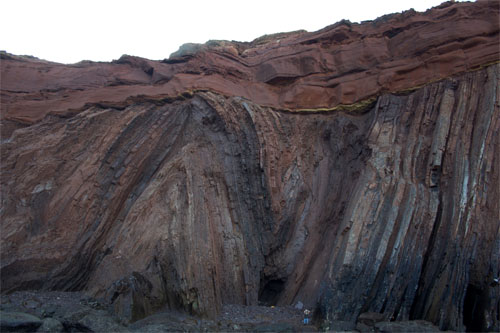
Angular unconformity at Telheiro Beach, Portugal (credit: Gabriela Bruno)
This image posted at Earth Science Picture of the Day would be hard to beat as the definitive angular unconformity. It shows Upper Carboniferous marine metagreywackes folded during the Variscan orogeny overlain by Triassic redbeds. Structurally it is uncannily similar to Hutton‘s famous unconformity at Siccar Point on the coast of SE Scotland, although the tight folding there is Caledonian in age and the unconformable redbeds are Devonian in age.
The early 21st century seems to have been plagued by very powerful earthquakes: 217 greater than Magnitude 7.0; 19 > Magnitude 8.0 and 2 >Magnitude 9.0. Although some lesser seismic events kill, those above M 7.0 have a far greater potential for fatal consequences. Over 700 thousand people have died from their effects: ~20 000 in the 2001 Gujarat earthquake (M 7.7); ~29 000 in 2003 Bam earthquake (M 6.6); ~250 000 in the 2004 Indian Ocean tsunami that stemmed from a M 9.1 earthquake off western Sumatra; ~95 000 in the 2005 Kashmir earthquake (M7.6); ~87 000 in the 2008 Sichuan earthquake (M 7.9); up to 316 000 in the 2010 Haiti earthquake (M 7.0); ~20 000 in the 2011 tsunami that hit NE Japan from the M 9.0 Tohoku earthquake. The 26 December 2004 Indian Ocean tsunamis spelled out the far-reaching risk to populated coastal areas that face oceans prone to seismicity or large coastal landslips, but also the need for warning systems: tsunamis travel far more slowly than seismic waves and , except for directly adjacent areas, there is good chance of escape given a timely alert. Yet, historically http://earthquake.usgs.gov/earthquakes/world/most_destructive.php, deadly risk is most often posed by earthquakes that occur beneath densely populated continental crust. Note that the most publicised earthquake that hit San Francisco in 1906 (at M 7.8) that lies on the world’s best-known fault, the San Andreas, caused between 700 and 3000 fatalities, a sizable proportion of which resulted from the subsequent fire. For continental earthquakes the biggest factor in deadly risk, outside of population density, is that of building standards.
A poor neighbourhood in Port au Prince, Haiti following the 2010 earthquake measuring >7 on the Richter scale. (credit: Wikipedia)
It barely needs stating that earthquakes are due to movement on faults, and these can leave distinct signs at or near to the surface, such as scarps, offsets of linear features such as roads, and broad rises or falls in the land surface. However, if they are due to faulting that does not break the surface – so-called ‘blind’ faults – very little record is left for geologists to analyse. But if it is possible to see actual breaks and shifts exposed by shallow excavations through geologically young materials, as in road cuts or trenches, then it is possible to work out an actual history of movements and their dimensions. It has also become increasingly possible to date the movements precisely using radiometric or luminescence means: a key element in establishing seismic risk is the historic frequency of events on active faults. Some of the most dangerous active faults are those at mountain fronts, such as the Himalaya and the American cordilleras, which often take the form of surface-breaking thrusts that are relative easy to analyse, although little work has been done to date. A notable study is on the West Andean Thrust that breaks cover east of Chile’s capital Santiago with a population of around 6 million (Vargas, G. Et al. 2014. Probing large intraplate earthquakes at the west flank of the Andes. Geology, v. 42, p. 1083-1086). This fault forms a prominent series of scarps in Santiago’s eastern suburbs, but for most of its length along the Andean Front it is ‘blind’. The last highly destructive on-shore earthquake in western South America was due to thrust movement that devastated the western Argentinean city of Mendoza in 1861. But the potential for large intraplate earthquakes is high along the entire west flank of the Andes.
Vargas and colleagues from France and the US excavated a 5 m deep trench through alluvium and colluvium over a distance of 25 m across one of the scarps associated with the San Ramon Thrust. They found excellent evidence of metre-sized displacement of some prominent units within the young sediments, sufficient to detect the effects of two distinct, major earthquakes, each producing horizontal shifts of up to 5 m. Individual sediment strata were dateable using radiocarbon and optically stimulated luminescence techniques. The earlier displacement occurred at around 17-19 ka and the second at about 8 ka. Various methods of estimation of the likely earthquake magnitudes of the displacements yielded values of about M 7.2 to 7.5 for both. That is quite sufficient for devastation of now nearby Santiago and, worryingly, another movement may be likely in the foreseeable future.
The “marching caterpillars” of the Basin and Range province, showing the San Andreas Fault in green (credit: University of Maryland, USA)
The Basin and Range province of the western US is one of the world’s largest products of continental extension. Being semi-arid, sedimentation has been unable to keep pace with crustal thinning thereby giving form to its name: linear mountain ridges separated by sediment-filled basins. Despite the extreme extension the Basin and Range has an average elevation of about 1400 m, although it is well below that of the Sierra Nevada range (2000+ m) that flanks it to the west. Throughout the Mesozoic, subduction towards the east beneath the North American plate produced voluminous magmas and fold-thrust belts adding to the continental crust in a manner similar to that still occurring in the South American Andes. Extension began in earnest during the Eocene (~45 Ma) and continues today. Much of the theory regarding continental extension – listric normal faults and detachments, fault-tilt blocks, core complexes etc. – stems from studies in this huge terrain. As regards the evolution of the Basin and Range, it has been widely thought that by the Late Oligocene (~25 Ma) the thickened Cordilleran crust had been reduced to a plateau no higher than the present Sierra Nevada, which subsequent extension reduced to the present Basin and Range.
The Eocene to Miocene extensional history was punctuated by huge episodes of explosive volcanism from which hot ash flowed laterally for hundreds of kilometres, relics of which are still widespread. Such ignimbrites are often very porous and were aquifers while still exposed, until buried by sediment and subsequent nuée ardent flows. Groundwater at the time of first exposure altered the volcanic glass shards from which ignimbrites are formed, so that the oxygen and hydrogen making up what was originally rainwater is now locked in the altered ash flows. The hydrogen isotopic composition of such meteoric water is known to vary with the altitude of the clouds shedding it. Water containing the heavier hydrogen isotope deuterium (D) is preferentially precipitated at low altitudes, so that high altitude rainfall is significantly depleted in it. Because of this the alteration can give clues to the former topographic elevation of the ignimbrites when they first rushed across the land surface. Applying this method to the repeated ignimbrite events in what is now the Basin and Range has given a good idea of the actual evolution of the land surface in the western US during the Palaeogene (Cassel, E.J. et al. 2014. Profile of a paleo-orogen: high topography across the present-day Basin and Range from 40-23 Ma. Geology, v. 42, p. 1007-1010).
The results present a major surprise. In the Eocene, elevation across the area was, as anticipated, a little more than the present Sierra Nevada (2000-2500 m). This fell back to roughly 2000 m, again as theory would suggest. But by the Late Oligocene (23-27 Ma) elevation expected to have declined further over the Basin and Range actually leapt to between 2500-3500 m, up to 2.1 km higher than it is today: the opposite of prediction. Effectively, despite evidence for Palaeogene extension the crust was buoyed-up probably by an upwelling of the asthenosphere and increased heat flow. The unexpected uplift occurred towards the end of subduction of oceanic lithosphere beneath western North America, the dynamics of which prevented the westward collapse of an earlier orogen. When subduction ended and the plate-margin tectonics became strike slip, as witnessed by the San Andreas Fault, the continental crust slid apart in the manner of books on a library shelf if a bookend is removed.
Related articles
Johnson, S.K. 2015. From rain to ranges. Scientific American, v. 312 (January 2015), p. 12-13.
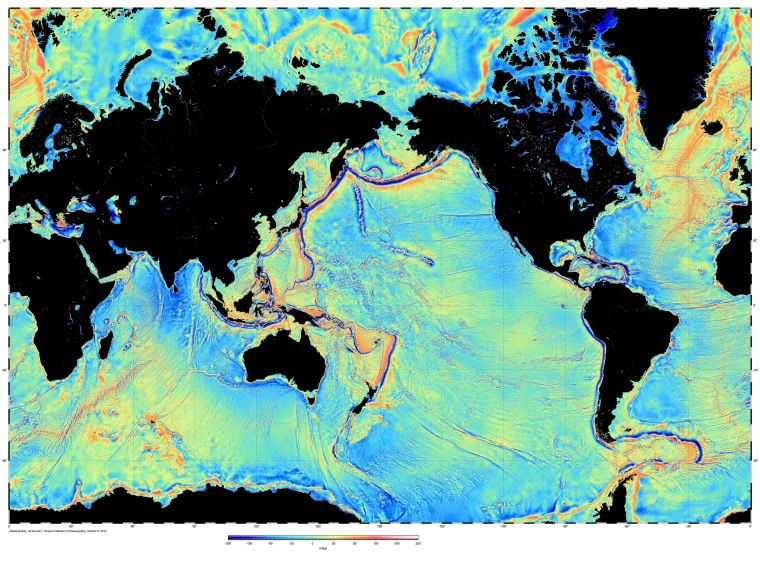
By far the least costly means of surveying the ocean floor on a global scale is the use of data remotely sensed from Earth orbit. That may sound absurd: how can it be possible to peer through thousands of metres of seawater? The answer comes from a practical application of lateral thinking. As well as being influenced by lunar and solar tidal attraction, sea level also depends on the Earth’s gravity field; that is, on the distribution of mass beneath the sea surface – how deep the water is and on varying density of rocks that lie beneath the sea floor. Water having a low density, the deeper it is the lower the overall gravitational attraction, and vice versa. Consequently, seawater is attracted towards shallower areas, standing high over, say, a seamount and low over the abyssal plains and trenches. Measuring sea-surface elevation defines the true shape that Earth would take if the entire surface was covered by water – the geoid – and is both a key to variations in gravity over the oceans and to bathymetry.
Radar altimeters can measure the average height of the sea surface to within a couple of centimetres: the roughness and tidal fluctuations are ‘ironed out’ by measurements every couple of weeks as the satellite passes on a regular orbital schedule. There is absolutely no way this systematic and highly accurate approach could be achieved by ship-borne bathymetric or gravity measurements, although such surveys help check the results from radar altimetry over widely spaced transects. Even after 40 years of accurate mapping with hundreds of ship-borne echo sounders 50% of the ocean floor is more than 10 km from such a depth measurement (80% lacks depth soundings)
This approach has been used since the first radar altimeter was placed in orbit on Seasat, launched in 1978, which revolutionised bathymetry and the details of plate tectonic features on the ocean floor. Since then, improvements in measurements of sea-surface elevation and the computer processing needed to extract the information from complex radar data have show more detail. The latest refinement stems from two satellites, NASA’s Jason-1(2001) and the European Space Agency’s Cryosat-2 (2010) (Sandwell, D.T. et al. 2014. New global marine gravity model from CryoSat-2 and Jason-1 reveals buried tectonic structure. Science, v. 346. p. 65-67; see also Hwang, C & Chang, E.T.Y. 2014. Seafloor secrets revealed. Science, v. 346. p. 32-33). If you have Google Earth you can view the marine gravity data by clicking here. The maps throw light on previously unknown tectonic features beneath the China Sea (large faults buried by sediments), the Gulf of Mexico (an extinct spreading centre) and the South Atlantic (a major propagating rift) as well as thousands of seamounts.
Global gravity over the oceans derived from Jason-1 and Cryosat-2 radar altimetry (credit: Scripps Institution of Oceanography)
There are many ways of processing the data, and so years of fruitful interpretation lie ahead of oceanographers and tectonicians, with more data likely from other suitably equipped satellites: sea-surface height studies are also essential in mapping changing surface currents, variations in water density and salinity, sea-ice thickness, eddies, superswells and changes due to processes linked to El Niño.
The lithosphere that falls into the mantle at subduction zones must end up somewhere in the deep Earth; the question is, where and what happens to it. There are hints from seismic tomography of the mantle that such slabs penetrate as deep as the boundary between the lowermost mantle and the molten outer core. The lithosphere’s two components, depleted mantle and oceanic crust, are compositionally quite different, being peridotitic and basaltic, so each is likely to be involved different petrological processes. As regards the physics, since seismic activity ceases below a depth of about 700 km neither entity behaves in a brittle fashion in the lower mantle. Such ductile materials might even pile up in the manner of intestines on the lithological equivalent of the abattoir floor; Bowels of the Earth as John Elder had it in his book of the same name.
Sketch of the lower 1000 km of the Earth’s mantle (credit: Williams, Q. 2014. Deep mantle matters. Science, v. 344, p. 800-801)
Pressure would make these recycled components mineralogically different, as indeed a relative light squeeze does in the upper mantle, where cold wet basalts become dry and denser eclogites thereby pulling more lithosphere down Wadati and Benioff’s eponymous zones to drive plate tectonics. Decades old experiments at lower-mantle pressures suggest that mantle minerals recompose from olivine with a dash of pyroxene to a mixture of more pressure-resistant iron-magnesium oxide and perovskite ((Mg,Fe)SiO3). Experiments in the early 21st century, under conditions at depths below 2600 km, revealed that perovskite transforms at the very bottom of the mantle (the D” zone) into layers of magnesium plus iron, silicon and oxygen. This is provisionally known as ‘post-perovskite’. The experiments showed that the transition releases heat. So, should oceanic lithosphere descend to the D” zone, it would receive an energy ‘kick’ and its temperature would increase. Conversely, if D”-zone materials rose to the depth of the perovskite to post-perovskite transition they would become less dense: a possible driver for deep-mantle plumes.
Now a new iron-rich phase stable in the bottom 1000 km of the mantle has emerged from experiments, seeming to result from perovskite undergoing a disproportionation reaction (Zhang, L. And 11 others 2014. Disproportionation of (Mg,Fe)SiO3 perovskite in Earth’s deep mantle. Science, v. 344, p. 877-882). In the same issue of Science other workers using laser-heated diamond anvils have revealed that, despite the huge pressures, basaltic rock may melt at temperatures considerably below the solid mantle’s ambient temperature (Andrault, D. et al. 2014. Melting of subducted basalt at the core-mantle boundary. Science, v. 344, p. 892-895). Both studies help better understand the peculiarities of the deepest mantle that emerge from seismic tomography (Williams, Q. 2014. Deep mantle matters. Science, v. 344, p. 800-801).
Huge blocks with reduced S-wave velocities that rise above the D” zone sit beneath Africa and the Pacific Ocean. There are also smaller zones at the core-mantle boundary (CMB) with shear-wave velocities up to 45% lower than expected. These ultralow-velocity zones (ULVZs) probably coincide with melting of subducted oceanic basalts, but the magma cannot escape by rising as it would soon revert to perovskite. Yet, since ultramafic compositions cannot melt under such high pressures the ULVSs indirectly show that subduction does descend to the CMB. Seismically defined horizontal layering in the D” zone thus may result from basaltic slabs whose ductility has enabled them to fold like sheets of lasagne as the reach the base of the mantle. Development of variants of the laser-heated diamond anvil set-up seem likely to offer insights into our own world’s ‘digestive’ system at a far lower cost and with vastly more relevance than the growing fad for speculating on Earth-like planets that the current ‘laws’ of physics show can never be visited and on ‘exobiology’ that cannot proceed further than the extremes of the Earth’s near-surface environment and the DNA double helix.
A large number of water-oriented tropes have been applied to Earth for ‘artistic effect’, ranging from Waterworld to the Blue Planet, but from a geoscientific perspective H2O in its many forms – liquid, solid, gas, supercritical fluid and chemically bound – has as much influence over the way the world works as do its internal heat production and transfer. Leaving aside surface processes, the presence of water has dramatic effects on the temperature at which rocks – felsic, mafic and ultramafic – begin to melt and deform and on the rates of important chemical reactions bound up with internal processes.
For a long while many geologists believed that the oceans were the product of water being transferred from the mantle by degassing through volcanoes so that the deep Earth has steadily been desiccated. But now it has become clear that such is the rate at which subduction can shift water back to the mantle that the entire volume of modern ocean water may have been cycled back and forth more than 3 times in Earth history (see Subduction and the water cycle). Besides, it is conceivable that accretion of cometary material up to about 3.8 Ga may have delivered the bulk of it.
An important aspect of the deep part of the water cycle concerns just how far into the mantle subduction can transport this most dominant volatile component of our planet. Ultra high-pressure experimental petrology has reached the stage when conditions at depths more than halfway to the core-mantle boundary (pressures up to 50 GPa) can be sustained using diamond anvils surrounding chemical mixtures that approximate mantle ultramafic materials. Previously, it was thought that serpentinite, the hydrous mineral most likely to be subducted, broke down into magnesium-rich, anhydrous silicates at around 1250 km down. This would prevent the deepest mantle from gaining any subducted water and retaining any that it had since the Earth formed. A team of Japanese geochemists has discovered a hint that hydrous silicates can, through a series of phase changes, achieve stability under the conditions of the deepest mantle (Nishi, M. 2014. Stability of hydrous silicate at high pressures and water transport to the deep lower mantle. Nature Geoscience, v. 7, p. 224-227). Their experiments yielded a yet unnamed mineral (phase H or MgSiH2O4) from approximate mantle composition that could remain stable in subducted slabs down to the core-mantle boundary. This development may help explain why the lowermost mantle is able to participate in plume activity through reduction in viscosity at those depths.
A parallel discovery concerns conditions at the base of the upper mantle; the 410 to 660 km mantle seismic transition zone. It comes from close study of a rare class of Brazilian diamonds that have been swiftly transported to the Earth’s surface from such depths, probably in kimberlite magma pipes, though their actual source rock has yet to be discovered. These ultra-deep diamonds prove to contain inclusions of mantle materials from the transition zone (Pearson, D.G. and 11 others 2014. Hydrous mantle transition zone indicated by ringwoodite included within diamond. Nature, v. 507, p. 221-224). Australian geochemist Ted Ringwood pioneered the idea in the 1950s and 60s that the mantle transition zone might be due to the main mantle mineral olivine ((Mg,Fe)2SiO4) being transformed to structures commensurate with extremely high pressures, including one akin to that of spinel. Such a mineral was first observed in stony meteorites that had undergone shock metamorphism, and was dubbed ringwoodite in honour of its eponymous predictor. Yet ringwoodite had never been found in terrestrial rocks, until it turned up in the Brazilian diamonds thanks to Pearson and colleagues.
Partial cross-section of the Earth showing the location of ringwoodite in the mantle Credit: Kathy Mather
Earlier experimental work to synthesise ultra-deep minerals discovered that ringwoodite may contain up to 2% water (actually OH groups) in its molecular lattice: an astonishing thing for material formed under such extreme conditions. The ringwoodite inclusions in diamond show infrared spectra that closely resemble its hydrous form. From this it may be inferred that the 401-660 km transition zone contains a vast amount of water; roughly the same as in all the oceans combined, though the find is yet to be confirmed in a wider selection of diamonds. One of the puzzles about diamondiferous kimberlites is that the magma must have been rich in water and carbon dioxide. That can now be explained by volatile-rich materials at the depths where diamonds form, But that does not necessarily implicate the whole transition zone: there may be pockets ripe for kimberlitic magma formation in a more widely water-poor mantle.
Related articles
Keppler, H. 2014. Earth’s deep water reservoir. Nature , v. 507, p. 174-175
Note: Earth-Pages will be closing as of early July, but will continue in another form atEarth-logs
For many geoscientists and lay people the water cycle is considered to be part of the Earth’s surface system. That is, the cycle of evapotranspiration, precipitation and infiltration involving atmosphere, oceans, cryosphere, terrestrial hydrology and groundwater. Yet it links to the mantle through subduction of hydrated oceanic lithosphere and volcanism. The rate at which water vapour re-enters the surface part of the water cycle through volcanoes is reasonably well understood, but the same cannot be said about ‘recharge’ of the mantle through subduction.
The water cycle as visualised by the US Geological Survey (credit: Wikipedia)
Subducted oceanic crust is old, cold and wet: fundamentals of plate theory. The slab-pull that largely drives plate tectonics results from phase transitions in oceanic crust that are part and parcel of low-temperature – high-pressure metamorphism. They involve the growth of the anhydrous minerals garnet and high-pressure pyroxene that constitute eclogite, the dense form taken by basalt that causes the density of subducted lithosphere to exceed that of mantle peridotite and so to sink. This transformation drives water out of subducted lithosphere into the mantle wedge overlying a subduction zone, where it encourages partial melting to produce volatile-rich andesitic basalt magma – the primary magma of island- and continental-arc igneous activity. Thus, most water that does reenter the mantle probably resides in the ultramafic lithospheric mantle in the form of hydrated olivine, i.e. the mineral serpentine, and that is hard to judge.
Water probably gets into the mantle lithosphere when the lithosphere bends to begin its descent. That is believed to involve faults – cold lithosphere is brittle – down which water can diffuse to hydrate ultramafic rocks. So the amount of water probably depends on the number of such bend-related faults. A way of assessing the degree of such faulting and thus the proportion of serpentinite is analysis of seismic records from subduction zones. This has been done from earthquake records from the West Pacific subduction zone descending beneath northern Japan (Garth, T. & Rietbrock, A. 2014. Order of magnitude increase in subducted H2O due to hydrated normal faults within the Wadati-Bennioff zone. Geology, on-line publication doi:10.1130/G34730.1). The results suggest that between 17 to 31% of the subducted mantle there has been serpentinised.
In a million years each kilometre along the length of this subduction zone would therefore transfer between 170 to 318 billion tonnes of water into the mantle; an estimate more than ten times previous estimates. The authors observe that at such a rate a subduction zone equivalent to the existing, 3400 km long Kuril and Izu-Bonin arcs that affect Japan would have transferred sufficient water to fill the present world oceans 3.5 times over the history of the Earth. Had the entire rate of modern subduction along a length of 55 thousand kilometres been maintained over 4.5 billion years, the world’s oceans would have been recycled through the mantle once every 80 million years. To put that in perspective, since the Cretaceous Chalk of southern England began to be deposited, the entire mass of ocean water has been renewed. Moreover, subduction has probably slowed considerably through time, so the transfer of water would have been at a greater pace in the more distant past.