What followed the Giant Impact (read Lord Mayor’s Show)?

The dominance of the Lunar Highlands by feldspar-rich anorthosites, which form when feldspars that crystallise from magmas float because of their lower density, gave rise to the idea that the Moon initially formed as a totally molten mass. That this probably resulted because the early Earth collided with a Mars-sized protoplanet stems from the almost identical chemical composition of the lunar and terrestrial mantles, as worked out from the composition of younger basalts derived from both, together with the vast energy needed to support a large molten planetary body condensing from a plasma cloud orbiting the Earth. Such a giant impact is also implicated in the final stages of core formation within the Earth.

Artist's depiction of the giant impact that is...
Artist’s depiction (after William K. Hartmann) of the giant impact that is hypothesized to have formed the Moon. (credit: Wikipedia)

A core formed from molten iron alloyed with nickel would have acted as a chemical attractor for all other elements that have an affinity for metallic iron: the siderophile elements, such as gold and platinum. Yet the chemistry of post-moon formation basaltic melts derived from the Earth’s mantle contain considerably more of these elements than expected, a feature that has led geochemists to wonder whether a large proportion of the mantle arrived – or was accreted – after the giant impact.

A tool that has proved useful in geochemistry on the scale of entire planets – well, just the Earth and Moon so far – is measuring the isotopic composition of tungsten, a lithophile metal that has great affinity for silicates. One isotope is 182W that forms when a radioactive isotope of hafnium (182Hf) decays. The proportion of 182W relative to other tungsten isotopes has been shown to be about the same in Lunar Highland anorthosites as it is in the Earth’s mantle. This feature is believed to reflect Moon formation and its solidification after the parent 182Hf had all decayed away: the decay has a half-life of about 9 Ma and after 60 Ma since the formation of the Solar System (and a nearby supernova that both triggered it and flung unstable isotopes such as 182Hf into what became the Solar nebula) vanishingly small amounts would remain.

Oddly, two papers on tungsten and Earth-Moon evolution, having much the same aims, using similar, newly refined methods and with similar results appeared in the same recent issue of Nature (Touboul, M. et al. 2015. Tungsten isotopic evidence for disproportional late accretion to the Earth and Moon. Nature, v. 520, p. 530-533. Kruijer, T.S. et al. 2015. Lunar tungsten isotopic evidence for the late veneer. Nature, v. 520, p. 534-537). The two of them present analyses of glasses produced by large impacts into the lunar surface and probably the mantle, which flung them all over the place, maintaining the commonality of the ventures that might be explained by there being a limited number of suitable Apollo samples. Both report an excess of 182W in the lunar materials: indeed, almost the same excess given the methodological precisions. And, both conclude that Moon and Earth were identical just after formation, with a disproportional degree of later accretion of Solar nebula material to the Earth and Moon.

So, there we have it: it does look as if Earth continued to grow after it was whacked, and there is confirmation. Both papers conclude, perhaps predictably, that the early Solar System was a violent place about which there is much yet to be learned…

St Paul and the meteorite?

Dateline: Chelyabinsk, Russia 09.20 15 February 2013. As in many parts of Russia drivers in this Oblast in the Urals Economic District use an in-car camera during rush hour, hopefully to have proof of innocence in the event of a traffic accident. On this day, such cameras recorded a massive fireball streaking low across a clear, frosty sky. Some people on foot were temporarily blinded by its light, about 4 times that sunlight, and others were thrown off their feet by a large shock wave. Travelling at about 20 km s-1 the fireball exploded, the blast shattering windows where people were gazing at the remarkable sight, about 1500 needing medical treatment. This event is the first in modern times to record the atmospheric entry of a superbolide and air blast, probably similar to what happened in the deserted area of Tunguska in Siberia on 30 June 1908.

Meteor trail and fireball seen over industrial estate in Chelyabinsk, Russia (credit: Russia Today)

Cut to the Levant in the 1st century of the Common Era: on the road to Damascus a Jewish fundamentalist with Roman citizenship, sworn to destroy the early Christian movement, is on a mission to arrest Christians and take them in chains to Jerusalem. Saul witnesses a great light in the sky and a deafening sound that he believes is the voice of Jesus, saying ‘Saul, Saul, why persecutest thou me?’(Acts 9:4). He is flung off his feet, struck blind and convinced of the error of his calling. Three days later, in Damascus ‘…there fell from his eyes as it had been scales: and he received sight forthwith, and arose, and was baptized’ (Acts 9:18), taking the name Paul.

The conversion of Saul by Michaelangelo

William Hartmann of the Planetary Science Institute at the University of Arizona, among the first planetary scientists to propose the giant impact origin for the Moon (see next item) and in his case to visualise it in a famous painting, has drawn a somewhat obvious hypothesis linking the two events (Hartmann, W.K. 2015. Chelyabinsk, Zond IV, and a possible first-century fireball of historical importance. Meteoritics and Planetary Science, v. 50, p. 368-381: doi: 10.1111/maps.12428). These days such a scary observation is easily rationalised as a natural phenomenon, but in earlier times Hartmann believes such a shock would have convinced witness of the almighty power of the supernatural ‘in terms of current cultural conceptions’. He suggests that Saul of Tarsus may, at the time, have been struggling with his conscience about his attacks on his countrymen: hence his conversion. The phrase ‘ scales fell from his eyes’ has entered common parlance for sudden changes in mental state and attitude: in fact it matches an outcome of severe photokeratitis of the eye’s epithelial coating, the dead tissue eventually becoming detached, when clear sight is restored to some sufferers.
While claiming to have no intention of undermining anyone’s spiritual beliefs, Hartmann suggests that such rare and spectacular events are capable of having emotionally changed influential figures of the past and thereby re-routing the course of history. Hartmann cites modern cases of lesser bolide-entry phenomena, such as destruction of satellites over the US and Russia, which some witnesses misreported as rockets with lighted windows; i.e. UFOs. There are plenty of medieval cases where spiritual connotations were widely attached to strange natural phenomena. I have heard accounts from people living in Asmara, capital of Eritrea, who ascribed saintly intervention to a full solar halo with sun dogs connected by cruciform arcs on a misty morning in 1991. This occurred a few days before the occupying Ethiopian forces surrendered to Eritrean nationalist forces whose struggle for self determination had lasted for the previous three decades.

Place your bets for a chance of posterity on Lunar Mission One

When I learned about the unveiling of Lunar Mission One (LM1) , a few days after the global excitement about ESA’a Rosetta mission following Philae’s 12 November 2014 landing on a far-distant comet and success with its core experiments, it did cross my mind that here was a bit of a let-down in PR terms. There’s an old saying – ‘What can follow the Lord Mayor’s Show?’ – and the thrill of Philae’s landing rivalled any of the events at the 2012 London Olympics, plus the science it and Rosetta promise is likely to be about as leading-edge as it will get for quite some time. So what does LM1 offer that might achieve a similar scoop, and indeed your prospect of virtual immortality?

Unlike NASA or ESA missions, LM1 is to be a crowd-funded private enterprise by Lunar Missions Ltd, and for that the subscribers will want something in exchange. Through Kickstarter anyone can have a punt to help raise the initial £600 thousand goal by midnight on 17 December. Apparently that sum is to fund 3 years full-time work by a professional management team to raise further mission funds from commercial partners to take the project further: it will cost at least £0.5 billion. At this stage you can pledge any sum you wish, but what you get in return depends on your generosity. Highlights are: for £3 to 15 the reward is ‘Our eternal thanks and a place in space history’; >£15 gets you a certificate and a place in an online ‘wall of thanks’; >£30 escalates to your name being included in a digital ‘time capsule’ taken to the Moon and buried, plus membership of the Lunar Missions Club; >£60 entitles you to a voucher to invest in your own digital ‘memory box’ to go in the capsule – one of ‘millions and millions’ – and a vote on key decisions; for >£300 you can ‘Meet the Team’; >£600 gets you annual meetings and a chance to ballot for the landing module’s name; for higher contributions there are invitations to the launch (>£1200), sealing of the digital archive capsule and your name engraved on the lander (>£3000); and – wait for it – you get a place in the viewing gallery at Mission Control if you can stump up more than £5000.

For those contributing £60 or more, what goes in the much vaunted digital ‘Memory Box’ is on a sliding scale, from the equivalent of a text message to a strand of your hair and the DNA in it. One catch, if you are thinking of resurrection, is that it will be at the bottom of a 5 cm diameter hole at least 20 m deep. The buried digital archive will also contain a record of all living species on Earth and the entire history of humankind to date, but a continually updated copy will also be freely available online. Wikipedia seems not to be associated for some reason, but every item in this public archive will be peer-reviewed through an editorial board to whose deliberations schools, colleges and universities can contribute. The buried, multi-Terabyte, digital capsule is said to have a life of perhaps a billion years. Currently the longest lived data storage (~1500 years) is still ink on vellum, whereas the most advanced static and optical digital media are estimated to have a maximum 100 year lifetime, subject to technical obsolescence. On the plus side, privacy is guaranteed, partly by the nature of the storage. So, for £10000 Joe and Josie Soap will figure on a kind of cenotaph but who- or whatever digs up the module will learn absolutely nothing about them and but conceivably could clone them from their anonymous strands of hair.

What are the science goals for an LM1 landing scheduled for 2024 that cannot be achieved by lunar-lander and sample-return missions currently under state-funded development by China, Russia, NASA, Japan and India before LM1 reaches the ‘Go/No Go’ stage? The landing is planned for the Moon’s South Pole, on the rim of a major crater. There, LM1 will drill a hole to between 20-100 m deep, using a maximum of 1 kW of solar power – this ‘will also be a major leap forward for safer and more efficient remote drilling on Earth’: make of that claim what you will. Such a hole is said to enable sampling of pristine lunar rock in 15 cm lengths of 2.5 cm diameter core through the debris of the impact that caused the crater. The core samples are to be chemically analysed in the lander to test the hypothesis that Earth and Moon shared their origins. Future missions may pick up the cores and return them for more detailed analysis on Earth. But consider this: the oldest rocks known from the Apollo programme are approximately 4.4 billion year-old, feldspar-rich anorthosites that are thought to have formed the lunar highlands through fractional crystallisation of an early magma ocean that immediately followed Moon formation. Any unfractionated lunar material is only likely, if at all, at far greater depths than 20 m, and none was found or even suggested among the 0.4 tonnes of samples returned by the Apollo missions, which have been repeatedly analysed using advanced instruments. Indeed, near-surface debris from a crater rim is unlikely to be any more diverse lithologically than the various kinds of lunar surface from which the Apollo samples were collected, and may be contaminated by whatever caused the cratering and by the immense, long-lived heating at the impact site itself.

filedesc Lunar Ferroan Anorthosite #60025 (Pla...
Lunar Ferroan Anorthosite #60025 (Plagioclase Feldspar). Collected by Apollo 16 from the Lunar Highlands near Descartes Crater. (credit: National Museum of Natural History in Washington, D.C.)

Compared with the prospect of advancing understanding of the origins of life and the Earth’s oceans, and the early stages of Solar System evolution from data provided by Rosetta and Philae, LM1 might seem less exciting, though the buzz being hyped is that it would be a People’s Mission. Yet those who place their punt on it and the commercial concerns that ultimately earn from it are two different sets of people. The ambitious global education wing will, of course, face competition from the growth of MOOCs in the science, technology, engineering and maths area that have a considerable head start, but it does have a noble ring to it. Whatever, if you make a pledge before midnight on 17 December this year and the ‘pump-priming’ target is not met by then, you pay nothing. If £600 thousand is raised there is no going back and only 10 years to wait. But what a challenge, you may well think… LM1 definitely has the edge over Virgin Galactica, but here on Earth there are probably a great many more vital challenges than either.

Signs of lunar tectonics

Large features on the near side of the Moon give us the illusion of the Man-in-the-Moon gazing down benevolently once a month. The lightest parts are the ancient lunar highlands made from feldspar-rich anorthosite, hence their high albedo. The dark components, originally thought to be seas or maria, are now known to be large areas of flood basalt formed about half a billion years after the Moon’s origin. Some show signs of a circular structure and have been assigned to the magmatic aftermath of truly gigantic impacts during the 4.1-3.8 Ga Late Heavy Bombardment. The largest mare feature, with a diameter of 3200 km, is Oceanus Procellarum, which has a more irregular shape, though it envelopes some smaller maria with partially circular outlines.

Full Moon view from earth In Belgium (Hamois)....
Full Moon viewed from Earth. Oceanus Procellarum is the large, irregular dark feature at left. (credit: Wikipedia)

A key line of investigation to improve knowledge of the lunar maria is the structure of the Moon’s gravitational field above them. Obviously, this can only be achieved by an orbiting experiment, and in early 2012 NASA launched one to provide detailed gravitational information: the Gravity Recovery and Interior Laboratory (GRAIL) whose early results were summarised by EPN in December 2012. GRAIL used two satellites orbiting in a tandem configuration similar to the US-German Gravity Recovery and Climate Experiment (GRACE) launched in 2002 to measure variations over time in the Earth’s gravity field. The Grail orbiters flew in a low orbit and eventually crashed into the Moon in December 2012, after producing lots of data whose processing continues.

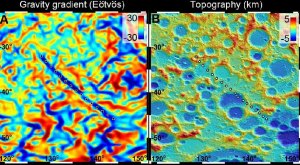
The latest finding from GRAIL concerns the gravity structure of the Procellarum region (Andrews-Hanna, J.C. and 13 others 2014. Structure and evolution of the lunar Procellarum region as revealed by GRAIL gravity data. Nature, v. 514, p. 68-71) have yielded a major surprise. Instead of a system of anomalies combining circular arcs, as might be expected from a product of major impacts, the basaltic basin has a border made up of many linear segments that define an unusually angular structure.

The topography and gravity structure of the Moon. Oceanus Procellarum is roughly at the centre. Note: the images cover both near- and far side of the Moon. (credit: Andrews-Hanna et al 2014)

The features only become apparent from the gravity data after they have been converted to the first derivative of the Bouguer anomaly (its gradient). Interpreting the features has to explain the angularity, which looks far more like an outcome of tectonics than bombardments. The features have been explained as rift structures through which basaltic magma oozed to the surface, perhaps feeding the vast outpourings of mare basalts, unusually rich in potassium (K), rare-earth elements (REE) and phosphorus (P) know as KREEP basalts. The Procellarum polygonal structure encompasses those parts of the lunar surface that are richest in the radioactive isotopes of potassium, thorium and uranium (measured from orbit by a gamma-ray spectrometer) – thorium concentration is shown in the figure.

Tectonics there may be on the Moon, but the authors are not suggesting plate tectonics but rather structures formed as a huge mass of radioactively heated lunar lithosphere cooled down at a faster rate than the rest of the outer Moon. Nor are they casting doubt on the Late Heavy Bombardment, for there is no escaping the presence of both topographic and gravity-defined circular features, just that the biggest expanse of basaltic surface on the Moon may have erupted for other reasons than a huge impact.

Newly discovered signs of Archaean giant impacts

It is barely credible that only two decades ago geoscientists who argued that extraterrestrial impacts had once had an important role in Earth history met with scorn from many of their peers; slightly mad, even bad and perhaps dangerous to know. Yet clear evidence for impacts has grown steadily, especially in the time before 2.5 billion years ago known as the Archaean (see EPN for March 2003 , April 2005, July 2012 , May 2014). Even in the 1990s, when it should have been clear from the golden years of lunar exploration that our neighbour had been battered at the outset of the Archaean, claims for terrestrial evidence of the tail-end of that cataclysmic event were eyed askance. Now, one of the pioneer researchers into the oldest terrestrial impacts, Don Lowe of Stanford University, California has, with two colleagues, reported finds of yet more impact-related spherule beds from the famous Archaean repository of the Barberton Mountains in South Africa (Lowe, D.R. et al. 2014. Recently discovered 3.42-3.23 Ga impact layers, Barberton Belt, South Africa: 3.8 Ga detrital zircons, Archaean impact history and tectonic implications. Geology, v. 42, p. 747-750).

Barberton greenstone belt, South Africa (credit: Barberton World Heritage Site)

Like four other such layers at Barberton, those newly described contain several types of spherules, degraded to microcrystalline alteration products of the original glasses. Some of them contain clear evidence of originally molten droplets having welded together on deposition. Their contrasted geochemistry reveals target rocks ranging in composition from well-sorted quartz sands to intermediate, mafic and ultramafic igneous rocks. Some beds are overlain by chaotic deposits familiar from more recent times as products of tsunamis, with signs that the spherules themselves had been picked up and transported.

Dated by their stratigraphic relations to local felsic igneous rocks, the spherule beds arrived in pulses over a period of about 240 Ma between 3.42 to 3.23 Ga. Even more interesting, the overlying tsunami beds have yielded transported zircons that extend back to 3.8 Ga spanning the Archaean history of the Kaapvaal craton of which the Barberton greenstone belt rests and indeed that of many Eoarchaean cratons; the Earth’s oldest tangible continental crust. The zircons may reflect the depth to which the impacts penetrated, possibly the base of the continental crust. It isn’t easy to judge the size of the responsible impactors from the available evidence, but Lowe and colleagues suggest that they were much larger than that which closed the Mesozoic at the Cretaceous-Palaeogene boundary; perhaps of the order of 20-70 km across. So, although the late, heavy bombardment of the Moon seems to have closed at around 3.8 Ga, from evidence yielded by the Apollo programme, until at least half a billion years later large objects continued to hit the Earth more often than expected from the lunar record. Lowe has suggested that this tail-end of major bombardment on Earth may eventually have triggered the onset of plate tectonics as we know it now.

Any excuse to return to the Moon

Humans first set foot on the Moon 45 years ago, yet by 42 years ago the last lunar astronaut left: by human standards staffed lunar exploration has been ephemeral. Yet for several reasons – romantic and political – once again getting living beings onto other worlds has become an obsession to some, in much the same manner that increasing numbers of countries seem hell-bent in increasing the redundancy of equipment in orbit; redundant because many of the satellites being launched all do much the same thing, especially in the remote sensing field. It’s all a bit like the choice between buying a Ferrari or hiring a perfectly serviceable vehicle when needed – prestige is high on the list of motivators. A new obsession is extraterrestrial mining and some very rich kids on the block are dabbling in that possibility: James Cameron of Aliens and Avatar fame (both films with space mining in the plot); a bunch of Google top dogs; billionaire entrepreneurs and oligarchs with cash to burn. Resource exploitation has also motivated Indian, Russian and Chinese interest in a return to the Moon, at least at an exploratory level.

NASA's proposed Moon colony concept from early...
NASA’s proposed Moon colony concept from early 2001 (image: NASA)

The main prospective targets have been water, as a source of hydrogen and oxygen through electrolysis to make portable rocket fuel, and helium, especially its rare isotope He-3, for use in fusion reactors. Helium is more abundant on the Moon than it is on Earth: only 300 grams of He-3 per year leaks out of the Earth’s depths. On the Moon there may be as much as 50 parts per billion in its dusty regolith cover where it remains supercooled in areas of permanent shadow. But to get a ton of it would require shifting 150 million tons of regolith. A decade ago geologists suggesting that metals might be mined on the Moon – noble metals and rare-earth elements have been mooted (the latter’s export being embargoed by Earth’s main producer China) – would have been laughing stocks, but now they get air time. Yet none of these materials occur on the Moon in the type of ore deposit found on Earth; if they did the anomalous nature of such enrichments on a body devoid of vegetation would have ensured their detection already. Even if there were lunar ore bodies, anyone with a passing familiarity with resource extraction knows just how much waste has to be shifted to make even a super-rich deposit economic on Earth, and that vast amounts of water are deployed in enriching the ‘paying’ metal to levels fit for smelting. For instance, while the rise in gold price since it was detached from a fixed link with paper money in 1971 has enabled very low concentrations to be mined, the methods involve grinding ore in water and then dissolving the gold in sodium cyanide solution, re-precipitating it on carbon made from coconut husks, redissolving and then precipitating the gold again by mixing the ‘liquor’ with zinc dust. Dry ore processing methods – based on density, magnetic and electrical properties – are hardly used in major mining operations nowadays.

The other, and perhaps most important issue with lunar or asteroid mining is that the undoubtedly high costs of whatever beneficiation process is deemed possible must be offset against income from the product; i.e. determined by market price on the home world which would have to be far higher than now. Such a rise in price would work to make currently uneconomic resources here worth mining, and anyone who believes that mining on the Moon would ever be competitive in that capitalist scenario risks being en route to the chuckle farm. Unless, of course, their motive is an exclusivist hobby par excellence and the bragging rights that accompany it – a bit like big game hunting, but the buzz coming from risking their billions rather than their lives.

But it turns out that a refocus on bringing stuff back from the Moon is not confined to floating stock on the financial markets. There are academic efforts to rationalise the Dan Dare spirit. There aren’t many scientific journals with a level of kudos to match the Philosophical Transactions of the Royal Society, the first journal in the world exclusively devoted to science and probably the longest running since it was established in 1665 at the same time as the Royal Society itself. Recently one of its thematic issues dubbed ‘‘Shock and blast: celebrating the centenary of Bertram Hopkinson’s seminal paper of 1914’  (Hopkinson, B. 1914. A method of measuring the pressure produced in the detonation of high explosives or by the impact of bullets. Philosophical Transactions of the Royal Society A v. 213, p. 437-456) a paper appeared that examines the likelihood of fossils surviving the shocks of a major impact (Burchell, M.J. et al. 2014. Survival of fossils under extreme shocks induced by hypervelocity impacts. Philosophical Transactions of the Royal Society A v. 372, 20130190 Open Access).

The authors, based at the University of Kent, UK, used a high-velocity air gun to fire quite fragile fossils of diatoms frozen in ice into water at speeds up to 5.34 km s-1. They then looked at solids left in the target to see if any recognisable sign of the fossils remained. Even at the highest energies of impact some diatomaceous material did indeed remain. Their conclusion was that meteorites derived by large impacts into planetary bodies, such as those supposedly from Mars or the Moon, could reasonably be expected to carry remnants of fossils from the bodies, had the impact been into sedimentary rock and that the bodies had supported living organisms that secreted hard parts. My first thought was that the paper was going to resurrect the aged notion of panspermia and a re-examination of the ALH84001 meteorite found in Antarctica claimed in 1996 to contain a Martian fossil (and believed by then US President Bill Clinton). Likewise it might be cited in support of the similar claim, made by panspermia buff Chandra Wickramasinghe, regarding fossils reputedly in a meteorite that fell in Sri Lanka on 29 December 2012: widely regarded as being mistaken. Yet Wickramasinghe’s team reported diatoms in the meteorite!

The Martian meteorite ALH84001 shows microscop...
The Martian meteorite ALH84001 shows microscopic features once suggested to have been created by life. (credit: Wikipedia)

However, Burchell has suggested that their results open up the possibility of meteorites on the Moon that had been blasted there from Earth might preserve terrestrial fossils. Moreover, such meteorites might preserve fossils from early stages in the evolution of life on Earth, since when both rocks and whatever they once contained have been removed by erosion or obliterated by deformation and metamorphism on our active planet. ‘Another reason we should hurry back to the Moon’ says Kieren Torres Howard of New York’s City University…

Planet Mercury and giant collisions

Full-color image of from first MESSENGER flyby
Mercury’s sun-lit side from first MESSENGER flyby (credit: Wikipedia)

Mercury is quite different from the other three Terrestrial Planets, having a significantly higher density. So it must have a considerably larger metallic core than the others – estimated to make up about 70% of Mercury’s mass – and therefore has a far thinner silicate mantle. The other large body in the Inner Solar System, our Moon, is the opposite, having the greatest proportion of silicate mantle and a small core.

The presently favoured explanation for the Moon’s anomalous mass distribution is that it resulted from a giant collision between the proto-Earth and a Mars-sized planetary body. Moreover, planetary theorists have been postulating around 20 planetary ‘embryos’ in the most of which accreted to form Venus and Earth, the final terrestrial event being the Moon-forming collision, with smaller Mars and Mercury having been derived from the two remaining such bodies. For Mercury to have such an anomalously large metallic core has invited mega-collision as a possible cause, but with such a high energy that much of its original complement of silicate mantle failed to fall back after the event. Two planetary scientists from the Universities of Arizona, USA, and Berne, Switzerland, have modelled various scenarios for such an origin of the Sun’s closest companion (Asphaug, E. & Reuffer, A. 2014. Mercury and other iron-rich planetary bodies as relics of inefficient accretion. Nature Geoscience, published online, doi: 10.1038/NGEO2189).

Their favoured mechanism is what they term ‘hit-and-run’ collisions in the early Inner Solar System. In the case of Mercury, that may have been with a larger target planet that survived intact while proto-Mercury was blasted apart to lose much of it mantle on re-accretion. To survive eventual accretion into a larger planet the left-overs had to have ended up in an orbit that avoided further collisions. Maybe Mars had the same kind of lucky escape but one that left it with a greater proportion of silicates.

One possible scenario is that proto-Mercury was indeed the body that started the clock of the Earth-Moon system through a giant impact. Yet no-one will be satisfied with a simulation and some statistics. Only detailed geochemistry of returned samples can take us any further. The supposed Martian meteorites seem not to be compatible with such a model; at least one would expect there to have been a considerable stir in planetary-science circles if they were. For Mercury, it will be a long wait for a resolution by geochemists, probably yet to be conceived.

Trapping Martian life forms

No matter how optimistic exobiologists might be, the current approaches to discovering whether or not Mars once hosted life or, the longest shot of all, still does are almost literally hit or miss. First the various teams involved try to select a target area using remotely sensed data to see if rocks or regolith have interacted with water; generally from the presence or absence of clay minerals and /or sulfates that hydrous alteration produces on Earth. Since funding is limited the sites with such ingredients are narrowed down to the ‘best’ – in the case of NASA’s Curiosity rover to Gale Crater  where a thick sequence of sediments shows occasional signs of clays and sulfates. But a potential site must also be logistically feasible with the least risk of loss to the lander. Even then, all that can be achieved in existing and planned mission is geochemical analysis of drilled and powdered samples. Curiosity’s ambition is limited to assessing whether the conditions for life were present. Isotopic analysis of any carbon content to check for mass fractionation that may have arisen from living processes is something for a future ESA mission.

Neither approach is likely to prove the existence now or in far-off times of Martian life, though scientists hope to whet the appetite of those holding the purse strings. Only return of rock samples stands any realistic chance of giving substance to the dreams of exobiologists. But what to collect? A random soil grab or drill core is highly unlikely to provide satisfaction one way or the other. Indeed only incontrovertible remains of some kind of cellular material can slake the yearning. Terrestrial materials might provide a guide to (probably) robotic collectors. Kathleen Benison and Francis Karmanocky of West Virginia University have followed this up by examining sulfates from one of the least hospitable places on Earth; the salt flats of the high Andes of Chile (Benison, K.C. & Karmanocky, F.J. 2014. Could microorganisms be preserved in Mars gypsum? Insights from terrestrial examples. Geology, v. 42, p. 615-618).

Evaporite minerals from Andean salars precipitated from extremely acidic and highly saline lake water originating from weathering of surrounding volcanoes. Oddly few researchers have sought cellular life trapped in crystals of salt or gypsum, the two most common minerals in the high-elevation salt pans. Fluid inclusions in sedimentary halite (NaCl) crystals from as far back as the Triassic are known to contain single-celled extremophile prokaryotes and eukaryotes, but gypsum is more likely to be found on Mars. Benison and Karmanocky document a variety of cellular material from Chilean gypsum that has been trapped in the solid mineral itself or in fluid inclusions. This is the most likely means of fossilisation of Martian life forms, if they ever existed. The salar gypsum contain cells that can be cultured and thereby revived since several species can remain dormant for long periods. The authors suggest that transparent cleavage fragments of Martian gypsum could be examined at up to 2000x magnification on future Mars landers. Finding convincing cells would see dancing in exobiology labs, and what if they should move…

What’s happening at the core-mantle boundary?

The lithosphere that falls into the mantle at subduction zones must end up somewhere in the deep Earth; the question is, where and what happens to it. There are hints from seismic tomography of the mantle that such slabs penetrate as deep as the boundary between the lowermost mantle and the molten outer core. The lithosphere’s two components, depleted mantle and oceanic crust, are compositionally quite different, being peridotitic and basaltic, so each is likely to be involved different petrological processes. As regards the physics, since seismic activity ceases below a depth of about 700 km neither entity behaves in a brittle fashion in the lower mantle. Such ductile materials might even pile up in the manner of intestines on the lithological equivalent of the abattoir floor; Bowels of the Earth as John Elder had it in his book of the same name.

Sketch of the lower 1000 km of the Earth’s mantle (credit: Williams, Q. 2014. Deep mantle matters. Science, v. 344, p. 800-801)

Pressure would make these recycled components mineralogically different, as indeed a relative light squeeze does in the upper mantle, where cold wet basalts become dry and denser eclogites thereby pulling more lithosphere down Wadati and Benioff’s eponymous zones to drive plate tectonics. Decades old experiments at lower-mantle pressures suggest that mantle minerals recompose from olivine with a dash of pyroxene to a mixture of more pressure-resistant iron-magnesium oxide and perovskite ((Mg,Fe)SiO3). Experiments in the early 21st century, under conditions at depths below 2600 km, revealed that perovskite transforms at the very bottom of the mantle (the D” zone) into layers of magnesium plus iron, silicon and oxygen. This is provisionally known as ‘post-perovskite’. The experiments showed that the transition releases heat. So, should oceanic lithosphere descend to the D” zone, it would receive an energy ‘kick’ and its temperature would increase. Conversely, if D”-zone materials rose to the depth of the perovskite to post-perovskite transition they would become less dense: a possible driver for deep-mantle plumes.

Now a new iron-rich phase stable in the bottom 1000 km of the mantle has emerged from experiments, seeming to result from perovskite undergoing a disproportionation reaction (Zhang, L. And 11 others 2014. Disproportionation of (Mg,Fe)SiO3 perovskite in Earth’s deep mantle. Science, v. 344, p. 877-882). In the same issue of Science other workers using laser-heated diamond anvils have revealed that, despite the huge pressures, basaltic rock may melt at temperatures considerably below the solid mantle’s ambient temperature (Andrault, D. et al. 2014. Melting of subducted basalt at the core-mantle boundary. Science, v. 344, p. 892-895). Both studies help better understand the peculiarities of the deepest mantle that emerge from seismic tomography (Williams, Q. 2014. Deep mantle matters. Science, v. 344, p. 800-801).

Huge blocks with reduced S-wave velocities that rise above the D” zone sit beneath Africa and the Pacific Ocean. There are also smaller zones at the core-mantle boundary (CMB) with shear-wave velocities up to 45% lower than expected. These ultralow-velocity zones (ULVZs) probably coincide with melting of subducted oceanic basalts, but the magma cannot escape by rising as it would soon revert to perovskite. Yet, since ultramafic compositions cannot melt under such high pressures the ULVSs indirectly show that subduction does descend to the CMB. Seismically defined horizontal layering in the D” zone thus may result from basaltic slabs whose ductility has enabled them to fold like sheets of lasagne as the reach the base of the mantle. Development of variants of the laser-heated diamond anvil set-up seem likely to offer insights into our own world’s ‘digestive’ system at a far lower cost and with vastly more relevance than the growing fad for speculating on Earth-like planets that the current ‘laws’ of physics show can never be visited and on ‘exobiology’ that cannot proceed further than the extremes of the Earth’s near-surface environment and the DNA double helix.

Year Zero: the giant-impact hypothesis

On close examination, the light-coloured Highlands of the Moon look remarkably like an old sign by a North American road through hunting country: they are pocked by impact craters of every size. More than that, a lengthy period of bombardment is signified by signs that the craters themselves are cratered to form a chaotic landscape dominated by interlocking and overlapping circular feature. In contrast the dark basaltic plains, called maria (seas), are pretty smooth albeit with some craters. They are clearly much younger than the Highlands. The discovery by Apollo astronauts that the older lunar Highlands are made almost exclusively of calcic plagioclase feldspar was a major surprise, requiring an astonishing event to explain them. Such anorthosites may form by flotation of low-density feldspar from a cooling and crystallising basaltic magma. Yet to form the bulk of the Moon’s early crust from such materials requires not simply a deep magma chamber, but literally an ocean of molten material at least 200 km deep. The anorthosites also turned out to be far older than the oldest rocks on Earth, close to 4.5 billion years. The most likely explanation seemed to be that the melting resulted from a gargantuan collision between two protoplanets, the Earth’s forebear and another now vanished. This would have melted and partially vaporised both bodies. After this discovery the Moon was widely believed to have formed from liquid and vaporised rock flung into orbit around what became the Earth.

Artist’s depiction of a collision between two planetary bodies likely to have formed the Moon (Credit: Wikipedia)

Such a catastrophic model for joint formation of the Earth and Moon shortly after planets of the Solar System had formed is hard to escape, but it carries two major puzzles. First, Earth and Moon seem to have very similar, indeed almost the same chemistry: So what happened to the colliding planet? If it had been identical in composition to the proto Earth there is no problem, but a different composition would surely have left some detectable trace in a Moon-Earth geochemical comparison. Initial models of the collision suggested that the other planet (dubbed Theia) was about the size of Mars and should have contributed 70 to 90% of the lunar mass: the Moon-Earth geochemical difference should have been substantial The second issue raised in the early days of the hypothesis was that since the Moon seemed to be almost totally dry (at least, the first rock analyses suggested that), then how come the Earth had retained so much water?

For decades, after an initial flurry of analyses, the Apollo samples remained in storage. Only in the last 10 years or so, when the need to gee-up space exploration required some prospect of astronauts one more to be sent beyond Earth orbit, have the samples been re-examined. With better analytical tools, the first puzzle was resolved: lunar rocks do contain measurable amounts of water, so the impact had not entirely driven off volatiles from the Moon. The bulk geochemical similarity was especially puzzling for the isotopes of oxygen. Meteorites of different types are significantly ear-marked by their relative proportions of different oxygen isotopes, signifying to planetary scientists that each type formed in different parts of the early Solar System; a suggestion confirmed by the difference between those in meteorites supposedly flung from Mars and terrestrial oxygen isotope proportions. A clear target for more precise re-examination of the lunar samples, plus meteorites reckoned to have come from the Moon, is therefore using vastly improved mass spectrometry to seek significant isotopic differences (Harwartz, D. et al. 2014. Identification of the giant impactor Theia in lunar rocks. Science, v. 344, p. 1146-1150). It turns out that there is a 12 ppm difference in the proportion of 17Oin lunar oxygen, sufficient to liken Theia’s geochemistry to that of enstatite chondrites. However, that difference may have arisen by the Earth, once the Moon had formed, having attracted a greater proportion of carbonaceous-chrondrite material during the later stages of planetary accretion by virtue of its much greater gravitational attraction. That would also account for the much higher volatile content of the Earth.

The new data do help to support the giant-impact hypothesis, but still leave a great deal of slack in the big questions: Did Theia form in a similar orbit around the Sun to that of Earth; was the impact head-on or glancing; how fast was the closure speed; how big was Theia and more besides? If Theia had roughly the same mass as the proto-Earth then modelling suggests that about half the mass of both Moon and Earth would be made of Theia stuff, giving the Moon and post-impact Earth much the same chemistry, irrespective of where Theia came from. Were William of Ockham’s ideas still major arbiters in science, then his Razor would suggest that we stop fretting about such details. But continuing the intellectual quest would constitute powerful support for a return to the Moon and more samples…

Impact melts and their destination

The work done by an asteroid or a comet that hits the Earth is most obviously demonstrated by the size of the crater that it creates on impact, should it have survived erosion and/or burial by sediments. Since some is done in flinging material away from the impact, the furthest point at which ejecta land is also a rough measure of the power of the hit. All this and much more derived from the kinetic energy of the object, which from Newton’s laws of motion amounts to half the product of the body’s mass and the square of its speed (mv2/2). It’s the speed that confers most energy; doubling the speed quadruples the energy. At a minimum, the speed of an object from far-off in space is that due to acceleration by the Earth’s gravitational field; the same as Earth’s escape velocity (about 11.2 km s-1). In March 1989 Earth had a close encounter with Newton’s laws writ large; an asteroid about 500 m across passed us with just half a million kilometres to spare. Moving at 20 km s-1 it carried kinetic energy of around 4 x 10¹⁹J. Had it hit, all of this immense amount would have been delivered in about a second giving a power of 4 x 10¹⁹ W. That is more than two hundred times greater than the power of solar heating of the day-side of the Earth. A small part of that power would melt quite a lot of rock.

Vredefort Dome, Free State, South Africa. Imag...
Vredefort Dome impact structure (credit: Wikipedia)

As well as the glass spherules that are one of the hallmarks of impact ejecta on Earth and more so on the Moon’s surface, some of the larger known impact craters are associated with various kinds of glassy rock produced by instantaneous melting. Some of this melt-rock occurs in thin dykes, but sometimes there is an entire layer of once molten ‘country’ rock at the impact site. The most spectacular is in the Manicougan crater in Quebec, Canada. In fact a 1 km thick impact-melt sheet dominates most of the 90 km wide structure and it is reputed to be the most homogeneous large rock mass known, being a chemical average of every rock type involved in the Triassic asteroid strike. Not all craters are so well endowed with an actual sheet of melt-rock. This has puzzled some geologists, especially those who studied the much larger (160 km) Vredfort Dome in South Africa, which formed around 2 billion years ago. As the name suggests this is now a positive circular topographic anomaly, probably due to rebound and erosional unloading, the structure extending down 20 km into the ancient continental lithosphere of the Kaapvaal craton. Vredfort has some cracking dykes of pseudotachylite but apparently no impact melt sheet. It has vanished, probably through erosion, but a relic has been found (Cupelli, C.L. et al. 2014. Discovery of mafic impact melt in the centre of the Vredfort dome: Archetype for continental residua of early Earth cratering? Geology, v. 42, p. 403-406). One reason for it having gone undiscovered until now is that it is mafic in composition, and resembles an igneous gabbro intrusion. Isotope geochemistry refutes that mundane origin. It is far younger than the rocks that were zapped, and may well have formed as huge energy penetrated to the lower crust and even the upper mantle to melt a sizeable percentage of 2.7 to 3.0 Ga old mafic and ultramafic rock.

Oddly, the same issue of Geology contains an article that also bears on the Vredfort Dome structure (Huber, M.S. et al. 2014. Impact spherules from Karelia, Russia: Possible ejecta from the 2.02 Ga Vredfort impact event. Geology, v. 42, p. 375-378). Drill core from a Palaeoproterozoic limestone revealed millimetre-sized glass droplets containing excess iridium – an element at high concentration in a variety of meteorites. The link to Vredfort is the age of the sediments, which are between 1.98 and 2.05 Ga, neatly bracketing the timing of the large South African impact. Using reasonably well-constrained palaeogeographic positions at that time for Karelia and the Kaapvaal craton suggests that the glassy ejecta, if indeed they are from Vredfort, must have been flung over 2500 km.

Enhanced by Zemanta

Impacts in the early Archaean

From the days when advocates of impacts by extraterrestrial objects as explanations of geological features were widely regarded as ‘whizz-bang artistes’ a great many hats have probably been eaten, albeit in closely guarded privacy. In 1986, when beds of glassy spherules similar to those found in lunar soil and in the K-T boundary sequence were reported from early Archaean greenstone belts in Australia and South Africa, and deduced to have formed by an impact, the authors, Donald Lowe of Stanford University, USA and colleagues, were pounced on by those who thought they could plausibly explain the very odd rocks by unremarkable, Earthly processes. Subsequent work on their geochemistry overwhelmingly supported their formation by an impact of a large carbonaceous chondrite asteroid. And at one site, the Barberton Mountain Land greenstone belt in northeastern South Africa, there was evidence for at least three such impacts formed in a 20 Ma period. In hindsight, given the lunar bombardment history that peaked between 4 and 3.8 Ga, early Archaean rocks were a great deal more likely to contain materials formed by giant impacts than less antiquated ones.

Barberton greenstone belt, South Africa (credit: Barberton World Heritage Site)

Lowe has been steadily working on his original idea since then, his enthusiasm drawing in others. The latest focus is on evidence for other likely consequences in the Archaean record of the vast power unleashed by incoming asteroids travelling at speeds around 15 km s-1 (Sleep, N.H. & Lowe, D.R. 2014. Physics of crustal fracturing and chertdike formation triggered by asteroid impact, ~3.26 Ga, Barbertongreenstone belt, South Africa. Geochemistry, Geophysics, Geosystems, v. 15, doi:10.1002/2014GC005229). The damage at Barberton not only produced spherule beds but opened fractures on the shallow sea bed into which liquefied sediments, including some spherules, were injected. These swarms of up to 10 m wide cherty dykes extend up to 100 m below what was then the sea floor strewn with impact spherules, and contain evidence of successive pulses of sediment injection.

Sleep and Lowe explain these dyke swarms as fractures caused by seismicity associated with a major impact. Their complexity suggests extreme shaking for upwards of 100 seconds; far longer than that from large, tectonic earthquakes. The fact that cracks opened to accommodate the sedimentary dykes indicates extension of the affected crust, which the authors suggest resulted from gravitational sliding of the shocked surface sediments down a gentle slope. Possibly the sediments, including the direct products of impact, the spherules, were swept into the cracks by currents associated with tsunamis induced by the impact.

Interestingly, the spherules and dykes formed upon crust largely formed of mafic to ultramafic lavas, yet volcanism following close on the heels of the impact event was of felsic composition. Did the impact trigger a shift locally from oceanic magmatism to that characteristic of island arcs; that is, did it start a new subduction zone?

Enhanced by Zemanta

Oxygen, magnetic reversals and mass extinctions

In April 2005 EPN reported evidence for a late Permian fall in atmospheric oxygen concentration to about 16% from its all-time high of 30% in the Carboniferous and earlier Permian.. This would have reduced the highest elevation on land where animals could live to about 2.7 km above sea level, compared with 4 to 5 today. Such an event would have placed a great deal of stress on terrestrial animal families. Moreover, it implies anoxic conditions in the oceans that would stress marine animals too. At the time, it seemed unlikely that declining oxygen was the main trigger for the end-Permian mass extinction as the decline would probably have been gradual; for instance by oxygen being locked into iron-3 compounds that give Permian and Triassic terrestrial sediments their unrelenting red coloration. By most accounts the greatest mass extinction of the Phanerozoic was extremely swift.

The possibility of extinctions being brought on by loss of oxygen from the air and ocean water has reappeared, though with suggestion of a very different means of achieving it (Wei, Y. and 10 others 2014. Oxygen escape from the Earth during geomagnetic reversals: Implications to mass extinction. Earth and Planetary Science Letters, v. 394, p. 94-98). The nub of the issue proposed by the Chinese-German authors is the dissociation and ionization by solar radiation of O2 molecules into O+ ions. If exposed to the solar wind, such ions could literally be ‘blown away’ into interplanetary space; an explanation for the lack of much in the way of any atmosphere on Mars today. Mars is prone to such ionic ablation because it now has a very weak magnetic field and may have been in that state for 3 billion years or more. Earth’s much larger magnetic field diverts the solar wind by acting as an electromagnetic buffer against much loss of gases, except free hydrogen and to a certain extent helium. But the geomagnetic field undergoes reversals, and while they are in progress, the field drops to very low levels exposing Earth to loss of oxygen as well as to dangerous levels of ionising radiation through unprotected exposure of the surface to the solar wind.

Artist's rendition of Earth's magnetosphere.
Artist’s rendition of Earth’s magnetosphere deflecting the solar wind. (credit: Wikipedia)

Field reversals and, presumably, short periods of very low geomagnetic field associated with them, varied in their frequency through time. For the past 80 Ma the reversal rate has been between 1 and 5 per million years. For much of the Cretaceous Period there were hardly any during a magnetic quiet episode or superchron. Earlier Mesozoic times were magnetically hectic, when reversals rose to rates as high as 7 per million years in the early Jurassic. This was preceded by another superchron that spanned the Permian and Late Carboniferous. Earlier geomagnetic data are haphazardly distributed through the stratigraphic column, so little can be said in the context of reversal-oxygen-extinction connections.

Geomagnetic polarity over the past 169 Ma, tra...
Geomagnetic polarity over the past 169 Ma (credit: Wikipedia)

Wei et al. focus on the end-Triassic mass extinction which does indeed coincide, albeit roughly, with low geochemically modelled atmospheric oxygen levels (~15%). This anoxic episode extended almost to the end of the Jurassic, although that was a period of rapid faunal diversification following the extinction event. Yet it does fall in the longest period of rapid reversals of the Mesozoic. However, this is the only clear reversal-oxygen-extinction correlation, the Cenozoic bucking the prediction. In order to present a seemingly persuasive case for their idea, the authors assign mass extinctions not to very rapid events – of the order of hundreds of thousand years at most – which is well supported by both fossils and stratigraphy, but to ‘blocks’ of time of the order of tens of million years.

My own view is that quite possibly magnetic reversals can have adverse consequences for life, but as a once widely considered causal mechanism for mass extinction they have faded from the scene; unlikely to be resurrected by this study. There are plenty of more plausible and better supported mechanisms, such as impacts and flood-basalt outpourings. Yet several large igneous provinces do coincide with the end of geomagnetic superchrons, although that correlation may well be due to the associated mantle plumes marking drastic changes around the core-mantle boundary. According to Wei et al., the supposed 6th mass extinction of the Neogene has a link to the general speeding up of geomagnetic reversals through the Cenozoic: not much has happened to either oxygen levels or biodiversity during the Neogene, and the predicted 6th mass extinction has more to do with human activity than the solar wind.

Enhanced by Zemanta

The Higgs, gravity waves and now: dark matter and the dinosaurs

The discovery around 50 years ago that in orbiting the centre of the Milky Way galaxy the solar system regularly wobbles to either side of its path. If the galaxy’s physical properties varied in a direction at right angles to the plane of the Milky Way then the Sun and its planets would experience that variation in a regular and predictable way (see Galactic controls http://earth-pages.co.uk/2011/12/15/galactic-controls/). Such oscillations might therefore show up as periodic changes in the geological record. There are loads of such cycles some not so regular, such as the accretion and disaggregation of supercontinents, and some involved in climatic change that have almost the predictability of a metronome.
One of these periodicities has thrilled geoscientists ever since it first began to emerge from improved dating of events in the geological record and more extensive knowledge of what it contained. Massive floods of basaltic magma blurt from the mantle every so often; more specifically approximately every 35 Ma. Intriguingly, there is a rough tally between the timing of such large igneous provinces and pulses in biological extinction. The wobbles in the solar system’s galactic passage are – wait for it – about every 35 Ma. A supposed link between LIPs, extinctions and galactic motions simply will not go away as a topic for speculation. Add to that some evidence that terrestrial impact cratering might have a 35 Ma period and you have ‘a story that will run and run’. The apparent periodicity of impacts, besides encouraging links with life and death and magmas, now seems to have spurred links with the dark side of cosmology.

English: Artist's conception of the spiral str...
Artist’s conception of the spiral structure of the Milky Way with two major stellar arms and a central bar (credit: Wikipedia)

It does indeed seem that the galactic magnetic field and dust concentrations vary across the plane of the Milky Way, but their affects during solar peregrinations have been raised long before now (Steiner, J. 1967. The sequence of geological events and the dynamics of the Milky Way Galaxy. Journal of the Geological Society of Australia, v. 14, p. 99–132.). The latest novelty concerns the possibility that galaxies might somehow collect the fabled but as yet undiscovered ‘dark matter’ in a flat disc within the galactic plane. Well, matter, ‘dark’ or not, should have mass, and mass must have a gravitational effect (thanks of course to the Higgs boson), even if it is hidden. Instead of some Nemesis or Death Star, as once was proposed to nudge comets from the outer reaches of the solar system, a gigantic dish of dark matter through which the Sun might pass on a regular basis might serve more plausibly (Randall, L. & Reece, MM. 2014. Dark matter as a trigger for periodic comet impacts. Physical Review Letters. arXiv:1403.0576 [astro-ph.GA]). Interestingly, Comments on the paper at the arXiv site read “Accepted by Physical Review Letters. 4 figures, no dinosaurs”

Solar System, in Perspective
Solar System, in Perspective (credit: NASA Goddard SFC)
Enhanced by Zemanta

A first for geochronology: ages from Mars

Remote sensing, including mapping of topographic elevation, and the recent exploits of three surface vehicles – the Spirit, Opportunity and Curiosity Rovers – have provided lots of data for a host of geological interpreters. Producing a time frame for Martian geological and geomorphological events has, understandably, been limited mainly to the use of stratigraphic principles. Various rock units and surface features can be placed in relative time order through simple stratigraphic principles, such as what sits on top of what and which features cut through pre-existing rock units or are masked by them. The most important guide up to now has been interpretation of the relations between impact craters and both rock units and other geomorphological features. The Inner Planets are assumed to have recorded the same variation through time of the frequency and energies of bombardment, and that has been calibrated to some extent by radiometric dating of impact-related rocks returned from the Moon by the crewed Apollo missions. Some detail of relative timings also emerge from some craters cutting earlier ones. The only other source of Martian ages has been from rare meteorites (there are only 114 of them) whose stable isotope compositions are different from those of terrestrial rocks and more common meteorites. By a process of elimination it is surmised that they were flung from Mars as a result of large impacts in the past to land eventually on Earth. The oldest of them date back to 4.5 Ga, much the same as the estimated age of the earliest crystallisation of magmas on Earth.

MOLA colorized relief map of the western hemis...
Colorised relief map of the western hemisphere of Mars, showing Valles Marineris at centre and the four largest volcanoes on the planet (credit: Wikipedia)

But all Martian stratigraphy is still pretty vague by comparison with that here, with only 4 time divisions based on reference to the lunar crater chronology and 3 based on evidence from detailed orbital spectroscopy and Rover data about the alteration of minerals on the Martian surface. Apart from meteorite dates there is very little knowledge of the earliest events, other than Mars must have had a solid, probably crystalline crust made of mainly anhydrous igneous minerals. This was the ‘target’ on which much of the impact record was impressed: by analogy with the Moon it probably spanned the period of the Late Heavy Bombardment from about 4.1 to 3.7 Ga, equivalent to the Eoarchaean on Earth. That period takes its name – Noachian – from Noachis Terra (‘land of Noah’), an intensely cratered, topographically high region of Mars’s southern hemisphere, whose name was given to this large area of high albedo by classical astronomers. Perhaps coincidentally, the Noachian provides the clearest evidence for the former presence of huge amounts of water on the surface of Mars and its erosional power that formed the gigantic Valles Marineris canyon system. The rocky surface that the craters punctured is imaginatively referred to as the pre-Noachian. A major episode of volcanic activity that formed Olympus Mons and other lava domes is named the Hesperian (another legacy of early astronomical nomenclature). It is vaguely ascribed to the period between 3.7 and 3.0 Ga, and followed by three billion years during which erosion and deposition under hyper-arid conditions formed smooth  surfaces with very few craters and rare evidence for the influence of surface water and ice. It is named, inappropriately as it turns out, the Amazonian.

Remote sensing has provided evidence of  episodes of mineral alteration. Clay minerals have been mapped on the pre-Noachian surface, suggesting that aqueous weathering occurred during the earliest times. Sulfates occur in exposed rocks of early Hesperian age, suggesting abundant atmospheric SO2 during this period of massive volcanicity. The last 3.5 billion years saw only the development of the surface iron oxides whose dominance led to Mars being nickname the ‘Red Planet’.

Curiosity Rover's Self Portrait at 'John Klein...
A ‘selfie’ of Curiosity Rover drilling in Gale Crater (credit: Euclid vanderKroew)

A recent paper (Farley, K.A. and 33 others plus the entire Mars Science Laboratory 2014. In Situ Radiometric and Exposure Age Dating of the Martian Surface. Science, v. 343, online publication DOI: 10.1126/science.1247166) suggests that radiometric ages can be measured ‘in the field’, as it were, by instruments carried by the Curiosity rover. How is that done? Curiosity carries a miniature mass spectrometer and other analytical devices. Drilling a rock surface produces a powder which is then heated to almost 900°C for half an hour to drive off all the gases present in the sample. The mass spectrometer can measure isotopes of noble gases, notably 40Ar, 36Ar, 21Ne and 3He. Together with potassium measured by an instrument akin to and XRF, the 40Ar yields a K-Ar age for the rock. A sample drilled from a fine-grained sedimentary in Gale Crater gave an age of 4.2 Ga, most likely that of the detrital feldspars derived from the ancient rocks that form the crater’s wall, rather than an age of sedimentation. The values for 36Ar, 21Ne and 3He provide a means for establishing how long the rock has been exposed at the surface: all three isotopes can be generated by cosmic-ray bombardment. The sample from Gale Crater gave an age of about 78 Ma that probably dates the eventual exposure of the rock by protracted wind erosion.

By themselves, these ages do not tell geologists a great deal about the history of Mars, but if Curiosity makes it through the higher levels of the sediments that once filled Gale Crater – and there is enough power to repeat the mass spectrometry at other levels – it could provide a benchmark for Noachian events. The exposure age, interesting in its own right, also suggests that sediments in the crater have not been exposed to cosmic-ray bombardment for long enough to have destroyed any organic materials that the science community longs for.

Enhanced by Zemanta

An early magma ocean on Mars?

The division of the lunar surface into two petrological domains – ancient anorthositic highlands and younger basaltic maria – spurred the idea, as long ago as the early 1970s, that the early Moon had a deep ocean of magma at the surface, whose cooling caused fractional crystallization. Low density plagioclase feldspar, dominated by high-calcium anorthite and bytownite, floated to the surface to form the lunar anorthosites leaving a more mafic mantle from which the mare basalts formed by partial melting. The key evidence in support of this hypothesis lies in the rare-earth elements of the two terrains. Because plagioclase feldspar has a much stronger affinity to incorporate the element europium (Eu) than the other REEs, the lunar anorthosites are enriched in Eu compared with its related elements. If the highland anorthosites did form by fractional crystallisation the remaining magma that formed the lunar mantle would be depleted in Eu yet enriched in the remaining REE. Although there are no samples of the Moon’s mantle there are plenty of the mare basalts that formed when it partially melted, probably as a result of huge impacts around 3.8 billion years ago. They should have inherited dominant features of mantle geochemistry, and indeed they do show characteristic depletion of Eu.

Lunar Highlands, near Descartes Crater. Collec...
Lunar Highland anorthosite, collected by the crew of Apollo 16. (credit: Wikipedia)

The giant-impact hypothesis for the Earth-Moon system presupposes that such a cataclysm would have left much of the outer Earth in much the same molten condition and destined to fractionate in the same manner. There are geochemical hints from terrestrial rocks that do support such an idea. An important target for exploration of Mars has been to check if a magma ocean also existed early in its history. Of the various missions in recent years only two have the capacity to shed useful light on the issue: the US Mars Reconnaissance Orbiter and Mars Odyssey. Both orbiters carry more sophisticated remote sensing instruments than any circling the Earth. The first has the hyperspectral Compact Reconnaissance Imaging Spectrometer for Mars (CRISM) that senses visible to short-wave infrared (VNIR) radiation, the other deploys  the Thermal Emission Imaging System (THEMIS) that captures different parts of the longer wavelength thermal infrared (TIR) spectrum emitted by surface materials. Both allow spectra of surface materials to be reconstructed and compared with the features of known minerals from the Earth and Moon.

Feldspars are highly reflective for the most part of  the VNIR range but show a shallow, broad absorption feature centred on a wavelength of 1.26 micrometres. Such spectra have been detected using CRISM from parts of the Martian surface in the highlands of its southern hemisphere (Carter, J. & Poulet, F. 2013. Ancient plutonic processes on Mars inferred from the detection of possible anorthositic terrains. Nature Geoscience, v. 6, p. 1008-1012). The authors, from Chile and France, acknowledge that the plagioclase-rich rocks occur only in small patches, unlike the vast tracts on the Moon, and also that on Earth anorthosites are known to have formed by a variety of processes from far smaller magma systems than a veritable ocean of molten rock. Feldspars also show spectral features in the TIR, though not so distinctive, both plagioclase and alkali feldspars being very similar. Moreover, THEMIS deploys sensor for only 10 thermal wavebands, compared with 544 on CRISM.  A team of US remote sensers (Wray, J.J. and 8 others 2013. Prolonged magmatic activity on Mars inferred from the detection of felsic rocks. Nature Geoscience, v. 6, p. 1013-1017) used both CRISM and THEMIS data. While noting resemblances to lunar anorthosites, they adopt a more cautious approach to the spectra and prefer the broad, ‘sack’ term ‘felsic rocks’. It seemed possible from their work that feldspar-rich magmas may have formed by partial melting of common andesitic crust noted from the Martian surface: high spatial resolution images of the occurrences bear some resemblance to outcrops of granitic rocks in arid environments on Earth. That is, there may be highly evolved rocks akin to terrestrial continental crust.

The interesting spectral observations on Mars can only be validated by actual rock samples. While rovers still operating on the Martian surface are well able to produce geochemical data that would petrologically characterise most rocks that they encounter, none of them is in a terrain suitable for resolving this particular issue. Yet, coincidentally, a meteorite found in West Africa shows hallmarks of having been blasted from the surface of Mars and sheds useful light on various hypotheses about the Martian crust http://earth-pages.co.uk/2013/11/21/a-glimpse-of-early-martian-crust/. It is a breccia that may represent the soil or regolith that accumulated from early impacts that shattered and melted surface materials, and it is extremely old: zircons yielded an age of 4428 Ma. The clasts set in a fine matrix consist of a variety of igneous rocks, none of which are anorthosites. Some are coarse grained, plutonic rocks containing both alkali feldspars and plagioclase, which match terrestrial monzonites; broadly speaking members of the granite family. Having formed from the ejecta of large impacts, such regolith materials represent the breadth of compositions across the planet and extending deep into its crust. This one suggests that anorthosites may have been rare on early Mars.

A glimpse of early Martian crust

That planetary scientists are eager for chemical information about the rocks of planet Mars is probably unnecessary information, a vast amount of money having been spend to get three spindly vehicles equipped with miniaturized petrographic instruments onto the Martian surface. Meteoriticists might say, ‘Well, we already have some Mars rock in our lab, and we can collect some more from deserts or ablated blue ice in Antarctica’. Four classes of meteorites are alleged to have been flung from Mars by impacts: the allegation is supported by the materials having oxygen isotope proportions that are different from those in rocks from the Earth or Moon.

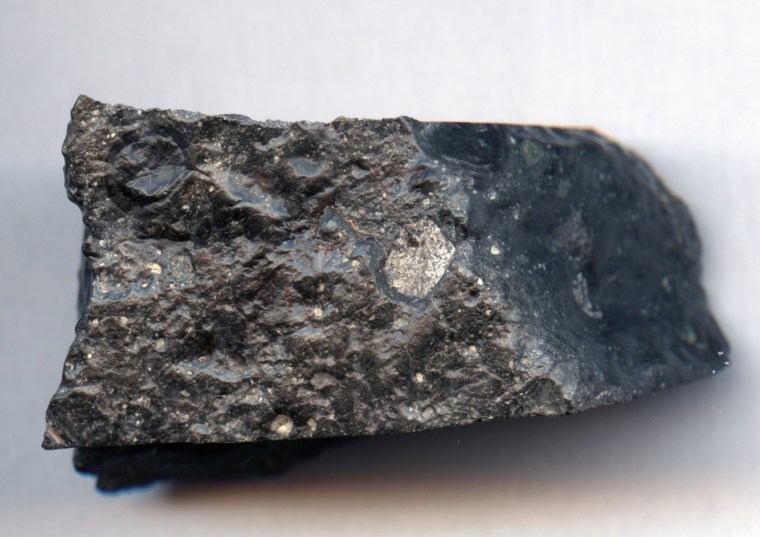
Another class of meteorite has joined the Martian family, and it it’s a doozy. Found in the northwestern Sahara Desert the rock is a breccia containing a variety of rocks in the form of clasts (Humayun, M. and 10 others 2013. Origin and age of the earliest Martian crust from meteorite NWA7533. Nature  online doi:10.1038/nature12764). In fact four other meteorites looking much the same were found near NWA7533. The bulk of the material is impact melt rock, now devitrified. Some of the clasts are also melt fragments and spherules, while others are fine-grained basalts, broken crystals and, most exciting, coarser igneous rocks rich in alkali and plagioclase feldspar. Their rare-earth element contents, like those of the Earth’s average continental crust, show evidence of fractional crystallization, particularly the removal of plagioclase to produce a marked depletion in the element europium. Slowly cooled and evolved monzonites of this kind are candidates for Martian crustal material. Overall, the texture of the breccia meteorites closely resembles the material that coats the lunar surface – regolith – but it has been lithified rather than remaining a dust.

Meteorite NWA7533 showing a variety of clasts, including light-coloured monzonite (credit: Humayun et al. 2013; doi:10.1038/nature12764)

Highly evolved igneous rocks, broadly speaking those of granitic composition, are the most likely to contain the mineral zircon, and the monzonite clasts yielded five that the US-Australian-French team subjected to U-Pb dating. The results are astonishing. These zircons formed around 4425 Ma ago, in the first hundred million years of the planet’s evolution, at the same time – within statistical error – as did the earliest materials from Earth and the Moon. Other putative Martian meteorites have yielded evidence from their neodymium isotopes that the earliest event there was the formation of a magma ocean, much as postulated for the Earth-Moon system. The latter is widely regarded as having resulted from a mega impact of the proto-Earth with an object roughly the size of Mars. The Martian monzonites may well be products of fractionation from that magma, subsequently excavated and shattered by a series of later, lesser impacts. If it did come from Mars, NWA7533 probably represents part of the early, heavily cratered highlands of the southern hemisphere of that planet.

The four hemispheric views shown above have be...
Full-color global map showing the regions of Mars imaged by the Hubble telescope (credit: Wikipedia)

It will be a long time before rocks can be lifted from the actual surface of Mars and transported back to Earth, and meteorites with a Martian provenance are so rare, that one can foresee a lot of very frustrated planetary petrogeneticists in the near term and a great deal of field work on desert and ice-cap surfaces looking for similar lumps of far-flung regolith.

Evidence for comet impact in the Sahara Desert

The desert surface of the remote Sahara of SW Egypt and adjacent Libya is strewn with silica-rich glass over an area of up to 6500 km2.  Pale yellow in colour and translucent, the glass clearly attracted Pleistocene hunter gatherers who manufactured edged tools  from it. Pieces cut en cabouchon are also found in pharaonic jewellery, including an item found in the tomb of Tutankhamun. Evidence for its formation at very high temperature is the melting temperature of pure silica around 2000°C and the presence of baddeleyite, a breakdown product of zircon. The glass fragments are undoubtedly the product of shock heating of desert sand or the local Nubian Sandstone of Cretaceous age by some kind of extraterrestrial impact. Fission-track dating suggests the glass formed around 29 Ma ago. A possible source is a 30 km wide crater on the Gilf Kebir Plateau made famous by Michael Ondaatje’s novel The English Patient that was centered on Pleistocene rock art discovered at the Cave of Swimmers in the Nubian Sandstone.

Tutanhkamun pendant with Wadjet
Scarab cut from Libyan Desert Glass in a pendant from the tomb of Tutanhkamun (credit: Wikipedia)

Neither the crater nor the glass strewn field yields meteoritic material despite several expeditions but the platinum-group metal content of the glass indicates an impact origin. Some specimens include enigmatic, graphite-rich banding. However, recently a South African-French team studied a strange, irregular 30 g fragment picked up in 1996 by an Egyptian postgraduate student collecting samples from the strewn field. He discovered that the dark fragment contained diamond by using X-ray diffraction. The dominant element in the fragment is carbon with less than 5% silicates and the new study used a battery of geochemical tests that confirmed the presence of abundant tiny diamonds (Kramers, J.D. and 13 others 2013. Unique chemistry of a diamond bearing pebble from the Libyan Desert Glass strewn field, SW Egypt: Evidence for a shocked comet fragment. Earth and Planetary Science Letters, v. 382, p. 21-31).

Conceivably, the diamonds could have formed by shock metamorphism of a coal seam or other carbonaceous sediments at the site of an impact – the K-T boundary layer formed by the huge Chicxulub impact contains nano-diamonds. However none of the chemical characteristics, including noble gas isotopic proportions and those of carbon, match terrestrial organic matter. Nor do they match carbonaceous chondrite meteorites that could have been another potential source, in its case an impactor of that composition. Instead, much evidence suggests the fragment is chemically akin to interplanetary dust and dust from the coma of comet 81P/Wild2 captured by NASDA’s Stardust mission in 2004. A plausible explanation, therefore, for the glass strewn field is an airburst explosion of a comet nucleus above the Sahara, the particle being a shocked fragment of the comet itself.

Bling from space

People have a keen eye for unusual objects and an even keener one for the aesthetic. Fossil echinoderms with their five-fold starry shape have been enduringly popular as trinkets since the Palaeolithic. Astonishingly, the gravel terrace at Swanscombe that yielded skull fragments of 400 ka Homo erectus plus many Acheulean tools also contained a flint bi-face ‘hand axe’ with a near perfect echinoid in its blunt grip. It cannot be proven, but the object seems to refute the idea that an artistic sense only arose with anatomically modern humans in the last 100 ka. Our immediate ancestors of the Neolithic sometimes took collecting to extremes in graves half full of fossil sea urchins (McNamara, K.J. 2007. Shepherds’ crowns, fairy loaves and thunderstones: the mythology of fossil echinoids in England. In: Piccardi, L. & Masse, W.B. Myth and Geology. Geological Society, London, Special Publication 273, 279–294).

Before the invention of metal smelting native gold, iron and copper appear in the archaeological record, undoubtedly because they look and indeed feel so different from the usual pebbles on the beach or just lying around. It is just that element of the odd that continues to draw people, including scientists, into a perpetually stooped posture when the walk across surfaces scattered with pebbles and boulders. The habit is especially hard to shake off for the meteoriticist whose hunting grounds are desert plains and ice caps where oddities are easy to spot, even when rare. So it is interesting when such dogged searchers encounter evidence of long-dead people having done much the same.

By 5300 years ago people had settled in small farming communities in the Nile Valley eventually to develop on the shores of lake – now represented by several smaller water bodies – what is regarded as the world’s first city near modern Faiyum. These Predynastic people buried their dead nearer to the Nile at Gerzeh, often sending them off with grave goods. The site has been continually excavated by professional archaeologists for more than a century, beginning with Sir Flinders Petrie. Two of the graves contained metallic iron beads, which presented a puzzle as iron smelting is only known from the 6th century BCE onwards. Unsurprisingly, the beads came to be regarded as artefacts wrought from an iron meteorite, though their highly altered nature and intrinsic value thwarted attempts at full analysis. Geochemists from the Open and Manchester Universities, and the Natural History Museum have now resolved the issue (Johnson, D. et al. 2013. Analysis of a prehistoric Egyptian iron bead with implications for the use and perception of meteorite iron in ancient Egypt. Meteoritics and Planetary Science, on-line, DOI: 10.1111/maps.12120). Non-destructive electron microscopy and X-ray tomography reveal, respectively, clear signs of the banded Widmanstätten structures and traces of nickel-rich iron alloy (taenite) that typify iron meteorites but are absent from smelted iron. The beads were clearly beaten and rolled into shape, but this working did not destroy the tell-tale evidence of their origin.

Optical, microprobe and CT-scan images of Predynastic iron bead from the Nile Valley (credit: Open University)

This provenance tallies with the appearance in early New Kingdom hieroglyphs of the term biA-n-pt – literally iron-from-the-sky – which was adopted for smelted iron when first made in the 26 to 27th Dynasties. But pharaonic iron was not a poor relation of gold, regarded as flesh of the gods and hence featuring in the masks of Pharaohs such as Tutankhamen, but supposedly what their bones were made from.

Mercury: sometimes a moist, organic-rich world

Full-color image of from first MESSENGER flyby
Full-colour image of Mercury from MESSENGER  (credit: NASA via Wikipedia)

Astronomers welcomed in 2013 by suggesting from Kepler spacecraft data that the Milky Way galaxy alone probably hosts at least a hundred billion extrasolar planets and that a potentially habitable world the size of Earth probably lies within 20 light years of ours (go.nature.com/pxgbbt). OK, so there are at least 10-15 planets out there for every person likely to be alive by the mid-21 century when the technology becomes available to judge whether or not any of them hold a shred of interest for a population facing worsening living conditions right here.

Mercury is closer and currently being peered at in considerable detail by NASA’s MESSENGER mission to the Sun’s closest planet. The venture seems to have justified itself – and probably JAXA/ESA’s forthcoming BepiColumbo to be launched in 2015, arriving in 2022 – by showing that the long suspected ‘cold traps’ at Mercury’s poles have indeed trapped something: ice and abundant organic debris (Neuman, G.A . and 10 others 2013. Bright and dark polar deposits on Mercury: evidence for surface volatiles. Science, v. 339, p. 296-300).

The planet is exceeding rough, having been hit by objects of all sizes yet possessing insufficient internal energy to repave itself. Its axis of rotation is at a right angles to Mercury’s orbital plane, much like that of the Moon, so its polar regions are perpetually short of solar radiation. Deeply shadows places have been measured by infrared radiometry to be as cold as 25 degrees above absolute zero. Any volatile materials that might have landed in them or condensed there from earlier atmospheres might seem likely to stay there indefinitely. Not quite so, for the most likely compound, water ice, can sublimate away (shift directly from the solid to vapour state). Nevertheless, remote sensing shows the north pole region to be somewhat mottled dark and light on shadowed poleward-facing surfaces. The properties of backscattered radar beams and detection of emitted neutrons are consistent with the bright areas being water ice (Lawrence, D.J. and 12 others 2013. Evidence for water ice near Mercury’s north pole from MESSENGER neutron spectrometer measurements. Science, v. 339, p. 292-296). First estimates give a total ice volume of around 10 to 1000 km3 compared with almost 3 million km3 in the Greenland ice cap.

It’s the dark stuff that sets Mercury apart from, say, the Martian or lunar poles, the idea being that comets or icy asteroids impacting Mercury would have delivered complex organic compounds as well as water ice. This would temporarily give otherwise airless Mercury an atmosphere of volatiles parts of which might condense in the perpetually shaded parts of the polar region. Sublimation of exposed ice would have left a residue rich in those organic compounds that eventually protected deeper ice from fading away with time.

Now, imagine how supremely excited exo-planet hunters would be if they picked up such signals from a truly far-off world.

On-line global geological maps

This item about the OneGeology map portal can now be read at Earth-logs in the Remote Sensing archive for 2013

OneGeology1
Small-scale extract from the OneGeology portal with 1:2 million maps for Ethiopia, Kenya, Tanzania and Uganda, and at 1:10 million covering surrounding areas (credit:OneGeology portal)


A glimpse of the deep Moon

Charting the variation in gravitational potential across a planet provides a measure of the distribution of mass beneath its surface. That depends on both the planet’s actual shape and on internal variations in rock density. The Earth’s gravity has been mapped with varying degrees of precision, depending on sample spacing, by surface measurements using gravimeters. Doing gravity surveys from space cannot be so direct, however. One ingenious approach for the gravitational field over the oceans is to measure the mean height of the ocean surface using radar beams from a satellite. Since this is affected by variations in the gravitational field, partly due to bathymetry and partly because of varying density beneath the ocean floor, removing the calculable bathymetric effect leaves a gravitational signal from the underling lithosphere and deeper mantle. The first satellite to illuminate the Earth with radar microwaves, Seasat, gradually built up such a gravitational map of the deep Earth over a period of 105 days in 1978, which was followed up by other satellites such as the ERS series and Topex-Poseidon.

GRAIL lunar probes
The GRAIL satellites in lunar orbit (credit: Wikipedia)

It is not so easy to map gravity precisely above a solid planetary surface, but through the GRACE experiment this can be done by measuring very precisely the distance between a pair of satellites that follow the same orbit. As the gravitational field changes so too does the separation between the tandem of satellites; an increase in gravity pulls the satellites closer together and vive versa. GRACE has provided some fascinating data, such as estimates of the withdrawal of groundwater from large sedimentary basins and shrinkage of ice caps. However, GRACE is limited in its resolution of gravitational anomalies by the fact that Earth has an atmosphere above which such tandems must be parked in orbit to avoid burning up. The higher the orbit, the more degraded is the resolution. This effect is much less for Mars and non-existent for the Moon.

Gravity field of the moon as measured by NASA's GRAIL mission. The far side of the moon is at the centre, whereas the nearside (as viewed from Earth) is at either side. (credit: NASA/ARC/MIT)
Gravity field of the moon as measured by NASA’s GRAIL mission. The far side of the moon is at the centre, whereas the nearside (as viewed from Earth) is at either side. (credit: NASA/ARC/MIT)

A sister experiment to GRACE has been orbiting the Moon since September 2011: the Gravity Recovery and Interior Laboratory (GRAIL). First the tandem orbited at 55 km, then 22 and for a brief period 11 km, before running out of thruster fuel on 17 December 2012 and crashing into the lunar surface. Results from the highest orbit resolve lunar gravity to 13 km cells, recently reported on-line in three papers (Zuber, M.T. and 16 others 2012. Gravity field of the Moon from the Gravity Recovery and Interior Laboratory (GRAIL) Mission. Science, doi 10.1126/science.1231507; Wieczorek, M.A. and 15 others 2012. The crust of the Moon as seen by GRAIL. Science, doi 10.1126/science.1231530; Andrews-Hanna, J.C. and 18 others 2012. Ancient igneous intrusions and early expansion of the Moon revealed by GRAIL gravity gradiometry. Science, doi 10.1126/science.1231753). From crater gravitational signatures due to variations in surface topography it seems that the early bombardment of the lunar surface far exceeded previous assumptions. Impact effects dominate the GRAIL data at this resolution, but 2% of the information relates to structures hidden at depth.

500 km linear anomaly in the Moon's far-side  gravitational field. (credit: NASA/JPL-Caltech/CSM)
500 km linear anomaly in the Moon’s far-side gravitational field. (credit: NASA/JPL-Caltech/CSM)

There are linear gravity anomalies extending over hundreds of kilometres, which may be huge igneous intrusions in the form of dykes; perhaps reflections of early influences of early extensional tectonics in the Moons lithosphere. Estimates point to this having been due to an up to 5 km increase in the lunar radius, probably as a result of thermal changes. The dominant feature of the lunar surface is not the near-side flat basaltic maria, visually prominent as they are, but the far more rugged lunar highlands which stand far higher because of the lower density of their constituent feldspar-rich anorthosites. GRAIL permitted a bulk estimate of the density of highland crust that turned out to be substantially lower, at 2550 kg m-3 – compared with 2600-2700 for granite and 2800-3000 for basalt – than originally estimated from samples returned by the Apollo mission. This forces a reassessment of the thickness of highland crust from 50-60 km to between 34 and 43 km, with a near-surface layer that has a porosity of around 12%, probably resulting from its awful battering. A thinner highland crust than previously assumed presents a bulk geochemical picture that need not be more enriched in ‘refractory’  elements, such as aluminium and calcium, than is the Earth.

Such unanticipated results from the low-resolution mode of the GRAIL experiment have its science team almost salivating at prospects from the sharper ‘pictures’ that will arise from the lower altitude orbits.

New twist on lunar origin

English: Giant impact - artist impression. Čes...
Artistic impression of the moon-forming giant impact. (credit: Wikipedia)

Although a few would-be space faring countries have ambitions, a post-Apollo crewed mission to the Moon is unlikely for quite a while. Yet moon-struck curiosity goes on: currently there is a surge in re-examining the lunar samples brought back more than 40 years ago. The Lunar Sample Laboratory Facility in Houston holds about a third of a ton of rock and regolith. I suppose part of the reason why lunar rocks are being re-analysed – in fact some for the first time – is because new or improved methods are available, but frustration among  a growing community of planetary geochemists having little more than meteorites to peer at probably plays a role as well. Since Hartman and Davis first suggested it, the giant impact theory for the Moon’s origin has dominated geochemical ideas. Most tangible is that of a magma ocean, floated plagioclase crystals from its fractional crystallisation probably having formed the glaring white lunar highlands composed of anorthosite. More subtle are ideas about what happened to the Mars-sized planet that did the damage to Earth and flung vaporised rock into orbit to accrete into the new Moon, and the effects of the stupendous energy on the geochemistry of all three bodies. Directed at all that is new research on isotopes of zinc (Paniello, R.C. et al. 2012. Zinc isotope evidence for the origin of the Moon. Nature, v. 490, p. 376-379).

The focus on zinc is because it is easily vaporised compared with more refractory materials, such as calcium an titanium, and as well as being ‘volatile’ it has five naturally occurring isotopes with relative atomic masses of 64 (the most abundant), 66, 67, 68 and 70. In general, isotopes of an element behave in slightly different ways during geological and cosmological processes, which changes their proportions in the products; a process known as ‘mass-fractionation’. Paniello and colleagues from Washington University, Missouri and the Scripps Institution of Oceanography, California USA found that Moon rocks are enriched in the heavier isotopes of zinc yet depleted in total zinc compared with terrestrial rocks and meteorites supposed to have come from Mars. Unlike those two planets the Moon’s zinc deviates from its abundance relative to other elements recorded by chondritic meteorites. This zinc depletion tallies with volatile loss from incandescent vapour blurted from the colliding planets. But it doesn’t help with the detailed predictions from the giant-impact model. A variety of scenarios suggest that the Moon should be made from remnants of the inbound impactor’s mantle, yet studies of other elements’ isotopes indicate that the Moon is rather Earth-like. But not those of zinc, so it looks like they have to be explained by a complete rethink of the whole hypothesis (Elliott, T. 2012. Galvanized lunacy. Nature, v. 490, p. 346-7).

Are Martian clays magmatic in origin?

593496main pia14840 full Curiosity Touching Do...
Artist’s Concept of Curiosity’s touchdown(credit: Wikipedia)

The remote detection of spectral features in the infrared that suggest abundant clay minerals on the surface of Mars is the basis for a widely-held view that Mars may once have had moist climatic conditions that encouraged life to form (see The Martian ‘sexy beast’ in September 2012  EPN). The presence of clays, along with suggestive landforms, has also been used to speculate that Mars once harboured long-lived lakes and perhaps even a huge ocean on its northern hemisphere, between 3.7 to 4.1 Ga. It was the clays that pitched the recently arrived Curiosity (aka Mars Exploration)Rover at the Gale crater and its central Aeolis Mons. The latter, also known as Mount Sharp, preserves about 5 km of layered rocks, the lowest of which are clay-rich and hypothesised to be sediments laid down in a lake that filled the crater. Provided Curiosity operates according to plan, we will know soon enough whether or not the layered rocks of Mount Sharp are indeed sediments, but a soon-to-be-published article suggests another explanation than weathering for the production of abundant clay minerals on Mars (Meunier, A. et al. 2012. Magmatic precipitation as a possible origin of Noachian clays on Mars. Nature Geoscience, published online 9 September 2012; DOI: 10.1038/NGEO1572).

Focusing the 100-millimeter Mastcam [detail]
Layered rocks on the flanks of Mount Sharp in Gale crater from Curiosity’s Mastcam (NASA Goddard via Flickr)
The French-US team provides evidence from terrestrial lavas that abundant iron- and magnesium-rich clays, known as smectites, may form at a late stage during crystallization of magma. If magma contains water – and most magmas do – as more and more anhydrous silicates crystallise during cooling water builds up in the remaining liquid. Once silicate crystallisation is complete there remains a watery fluid capable of reacting with some of the silicates to form clay minerals; a process often referred to as pneumatolysis. How much clay is formed depends on the initial water content of the magma. Pneumatolysisoperates on hot lava, whereas weathering occurs at ambient temperature provided the climate is able to support liquid water at the surface. Mars is currently far too cold for that, and ideas of a wet surface environment earlier in the planet’s history demand an explanation for a much warmer climate. Clay minerals do not appear to be present in Mars’s younger rocks, so Meunier and colleagues suggest that as the planet’s mantle evolved early water-rich magmas were gradually replaced by ones with less water: interior Mars was gradually de-gassed and its magmas lost the ability to alter minerals that crystallised from them.

Now, clay minerals are extremely resistant to change except through high-temperature metamorphism. Once formed they can be blown around – Mars has probably always been a very windy place – to end up in aeolian sediments that are plentiful on Mars.  Also, if occasionally water flowed on the surface perhaps by subsurface water venting suddenly, fine-grained pneumatolytic clays would easily be picked up, concentrated as flow speed lessened and deposited in waterlain sedimentary layers.  A dilemma that faces the Curiosity science team is what significance to assign to clays in sediment layers, when they no longer provide unequivocal evidence of weathering.  But will the resistant layers on Mount Sharp turn out to be pneumatolytically altered lava flows?
Note added 28 September 2012: The first scientific triumph of the Curiosity Rover is imagery of sediments in what had been suggested to be an alluvial fan washed into Gale crater. They show gravels with rounded pebbles.

Whence Earth’s water?

English: Carbonaceous chondrite Meteorite. The...
Carbonaceous chondrite meteorite. (credit: Mila Zinkova via Wikipedia)
English: Image of comet C/1996 B2 (Hyakutake),...
Comet Hyakutake. (credit: E. Kolmhofer & H. Raab via Wikipedia)

Because they can be so big, consist mainly of water ice and there are probably a great many lurking in the outer reaches of the solar system impacting comets have long been thought to have delivered the water that makes the Earth so dynamic and, so far as we know, the only place in near-space that hosts complex life. Remote sensing studies of the isotopic composition of water in one comet (Hartley 2) caused great excitement in 2011 by showing that its ratio of deuterium to hydrogen was very similar to that of Earthly ocean water. Other D:H ratios have recently been published from a suite of meteorites gleaned from the surface of Antarctic ice (Alexander, C.M.O’D. et al. 2012. The provenances of asteroids, and their contributions to the volatile inventories of the terrestrial planets. Science, v. 337, p. 721-723). These meteorites are carbonaceous chondrites thought to be the source of much of the solid material in planets of the Inner Solar System. To cut short a long and closely argued argument, it seems that the CI-type chondrites’ water is isotopically quite different from that in analysed comets, knocking another popular hypothesis on the head; that comets and carbonaceous chondrites formed in the same part of the Solar System.

Since hydrocarbons in comets – known from interplanetary dust particles – contain hydrogen with a far richer complement of its heavy isotope deuterium than does cometary water ice, the crashing of entire comets onto planets such as the Earth would not produce the observed terrestrial D:H ratio even though their water ice alone does match it. The US, British and Canadian meteoriticists conclude what seems to be a unifying explanation whereby CI chondritic solids and volatiles alone would have been able to form the Inner Planets and their various complements of water by initial accretion. Comets as a second-stage source, in this account, are relegated to mere curiosities of the Solar System with little role to play other than occasional big impacts that may, or may not, have influenced evolution by the power that they delivered not through their chemistry.