Using lasers to map landslide risk

As radar stands for radio detection and ranging, so lidar signifies light detection and ranging. In one respect the two are related: they are both active means of remote sensing and illuminate the surface, rather than passively monitoring solar radiation reflected from the surface or thermal radiation emitted by it. The theory and practice of imaging radar that beams microwaves at a surface and analyses the returning radiation are fiendishly complex. For a start microwave beams are directed at an angle towards the surface. Lidar is far simpler being based on an aircraft -mounted laser that sends pulses vertically downwards and records the time taken for them to be reflected from the surface back to the aircraft. The method measures the distance from aircraft to the ground surface and thus its topographic elevation. Lidar transmits about 100 thousand pulses per, so the resulting digital elevation model has remarkably good spatial resolution (down to 25 cm) and can measure surface elevation to the nearest centimetre. The technique is becoming popular: the whole of England and much of the nations of Scotland, Wales and Northern Ireland now have lidar coverage with 1 metre resolution.

The first thing the laser pulses encounter is the vegetation canopy, from which some are reflected back to the instrument. Others penetrate gaps in the canopy, to be reflected by the ground surface, so they take slightly longer to return. If the penetrating pulses are digitally separated from those reflected by vegetation, they directly map the elevation of the solid ground surface or the terrain. These data produce a  digital terrain model (DTM) whereas the more quickly returning pulses map the height and structure of the ground cover, if there is any. Both products are useful, the first to map topographic and geological features, the details of which are hidden to conventional remote sensing, the second to assess vegetation. The great advantage of a DTM is that image processing software can simulate illumination and shading of the terrain from different directions and angles to improve interpretation. Aerial photography has but a single direction and angle of solar illumination, depending on the time of day, the season and the area’s latitude. Stereoscopic viewing of overlapping photographic images does yield topographic elevation, and photogrammetric analysis produces a digital elevation model, but its usefulness is often compromised  by ground cover in vegetated terrain and by shadows. Also its vertical resolution is rarely better than 1 m. Another factor that limits terrain analysis using aerial photographs and digital images from satellites is the ‘patchwork-quilt’ appearance of farmed land that results from sharp boundaries between fields that contain different crops, bare ploughed soil and grassland. Together with spatial variation of natural vegetation, both ‘camouflage’ physical features of the landscape.

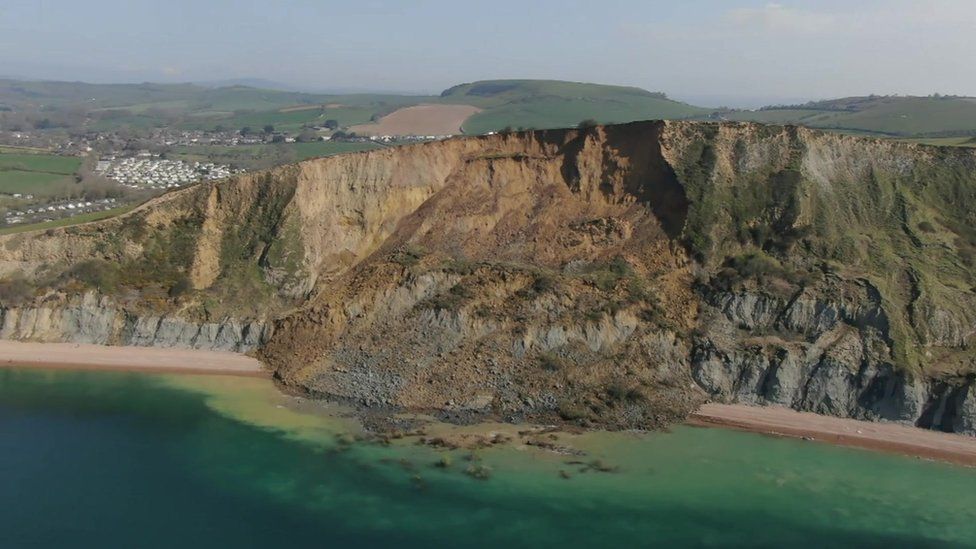
A cliff collapse in July 2023 at Seatown, Dorset England

In the field, areas of what is known as ‘mass wasting’, such as landslides, landslips, rockfalls, debris flows and solifluction, show topographic features that are characteristic of the processes involved.  They can be mapped by careful geological surveys. But are overlooked, being masked by vegetation cover such as woodland or because slower downslope movement of soil has smoothed out their original landforms. Potentially devastating mass wasting is encouraged by increased moisture content of soils and rocks that lie beneath steep slopes. Moisture provides lubrication that gravitational forces can exploit to result in sudden disruption of slopes and the movement of huge masses of Earth materials. Large areas of upland Britain show evidence of having experienced such mass wasting in the past. Some continue to move, such as that in the Derbyshire Peak District on the slopes of Mam Tor, as do cases on rugged parts of Britain’s coast where underlying rocks are weak and coastal erosion is intense (see image above).

It is thought that many of the mass-wasting features in Britain were initiated at the start of the Holocene. Prior to that, during the Younger Dryas cooling event, near-surface Earth materials were gripped solid by permafrost. Sudden warming at about 11.7 ka ago melted deeply frozen ground to create ideal conditions for mass wasting. In the last eleven thousand years the surface has come to a more or less stable gravitational balance. Yet heavy, sustained rainfall may reactivate some of the structures or trigger new ones. The likelihood of increased annual rainfall as the climate warms will undoubtedly increase the risk of more and larger instances of mass wasting. Indeed such an acceleration is happening now.

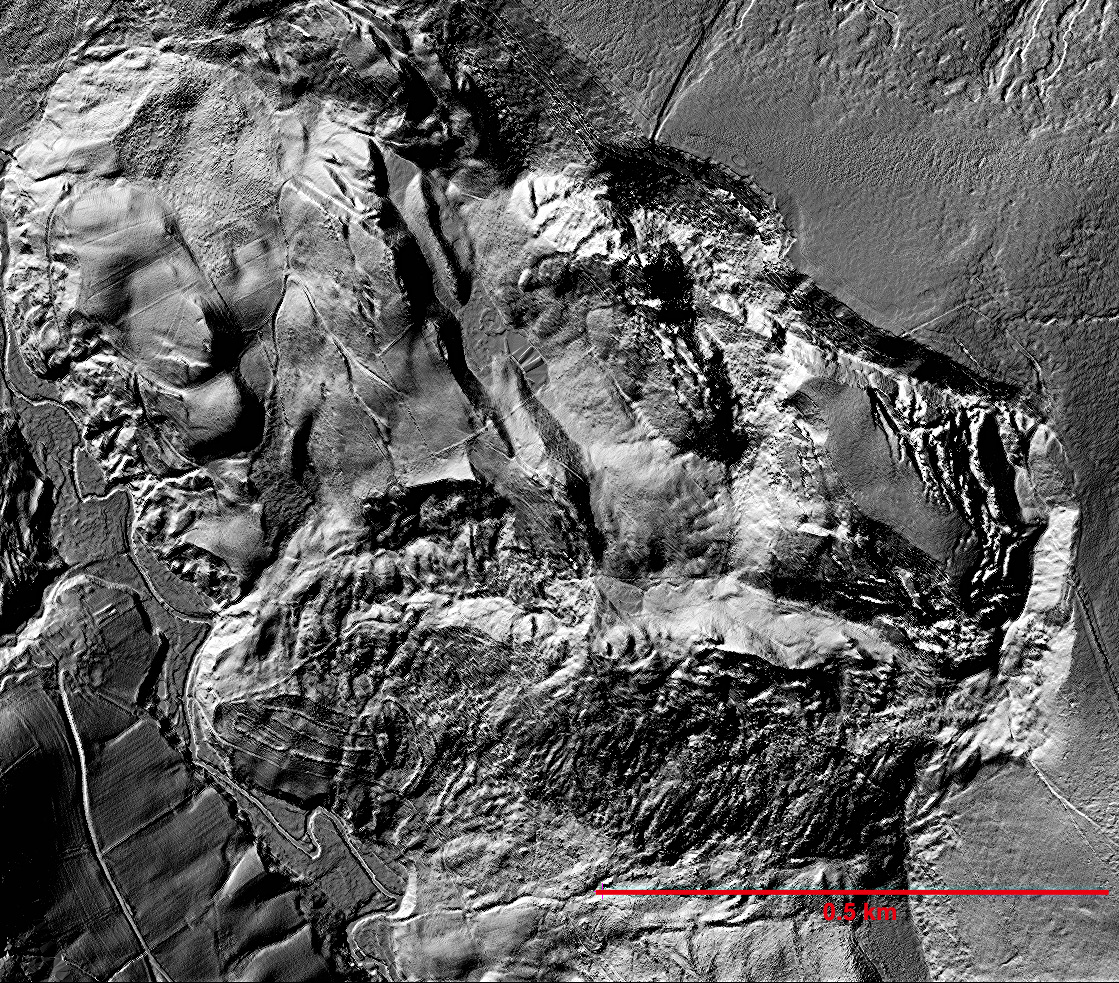
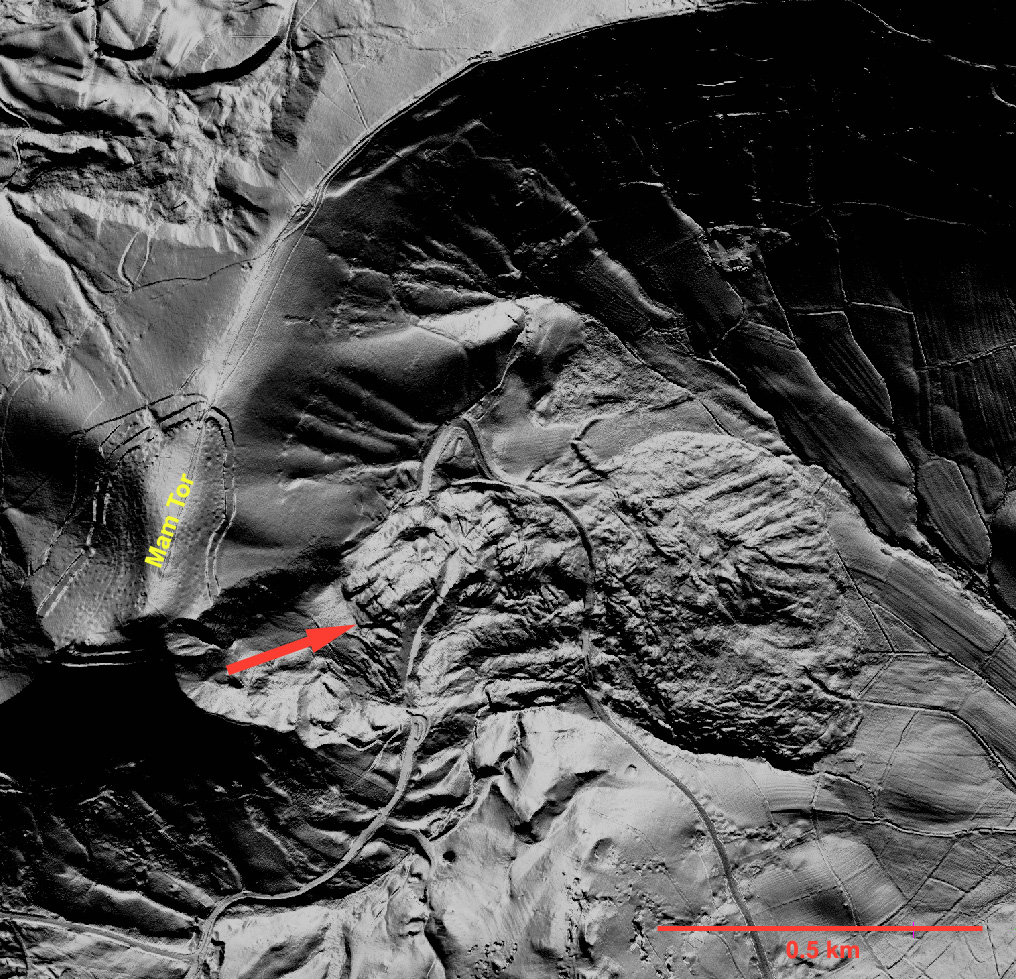
The most risky places are those with a history of landslides etc. So detailed mapping of such risk-prone ground is clearly needed. The UK has a large number of sites where mass wasting has been recorded, and below are lidar images of three of the most spectacular. Undoubtedly, there are other areas where no recent movements have been recorded, but which may ‘go off’ under changed climatic conditions. One of the best documented risky areas is in the English West Midlands within the new city of Telford. It follows the flanks of the River Severn as it passes through the Ironbridge Gorge that was cut by subglacial meltwater after the last glacial maximum. This area is also recognised as having been the birthplace of the Industrial Revolution. In 1714 Abraham Darby pioneered the use of coke in iron smelting and mass production of cast iron at Coalbrookdale a few kilometres to the east. The Severn also powered numerous forges and other heavy industries in the 18th and 19th centuries.  Industrial activity and townships in the Gorge have been plagued by large-scale mass wasting throughout subsequent history and no doubt long before. An excellent illustrated guide to the area has been produced by the Shropshire Geological Society (Rayner, C. et al. 2007. A Geological Trail through the landslides of Ironbridge Gorge, Proceedings of the Shropshire Geological Society, v. 12, p. 39-52; ISSN 1750-8568)

Lidar DTM illuminated from the west for the Severn Gorge near Ironbridge, Telford, Shropshire, UK. Lips of four major landslides shown by ‘No Entry’ signs. Initiated at the beginning of the Holocene, they continue to be active to this day, the southernmost slide having obliterated a tile factory and workers’ dwellings at Jackfield in 1952
Lidar DTM illuminated from the NW for the Alport Valley in the Peak District of North Derbyshire, UK. This includes the largest landslide complex in England, known as Alport Castles from the huge displaced sandstone blocks in the area of mass wasting.
An active landslide near Castleton, Derbyshire, UK. Note the defences of an Iron Age hillfort on Mam Tor that have been cut as the head of the landslide retreated westwards, as have medieval field walls. The relics of a major road that has been repeatedly disrupted and then destroyed following decades of maintenance can also be seen in the debris flow: it was abandoned in the 1970s.

Water in unexpected places. 1: Atmosphere

As a liquid, solid or in gaseous form water is everywhere in the human environment: even in the driest deserts it rains at some time and they may become tangibly humid. Water vapour moves most quickly in the atmosphere because of continual circulation. But 99% of all the Earth’s gaseous water resides in the lowest part, the troposphere. In that layer temperature decreases upwards to around -70°C, reflected by the lapse rate, so that water vapour condenses out as liquid or ice at low altitudes in the tangible form of clouds. So as altitude increases the air becomes increasingly cold and dry until it reaches what is termed the tropopause, the boundary between the troposphere and the stratosphere. This lies at altitudes between 6 km at the poles and 18 km in the tropics. Higher still, counter intuitively, the stratospheric air temperature rises. This is due to the production of ozone (O3) as oxygen (O2) interacts with UV radiation. Ozone absorbs UV thereby heating the thin stratospheric air. The tropopause is therefore an efficient ‘cold trap’ for water vapour, thereby preventing Earth from losing its surface water. Any that does pass through rises to the outer stratosphere where solar radiation dissociates it into oxygen and hydrogen, the latter escaping to space. So for most of the time the stratosphere is effectively free of water.

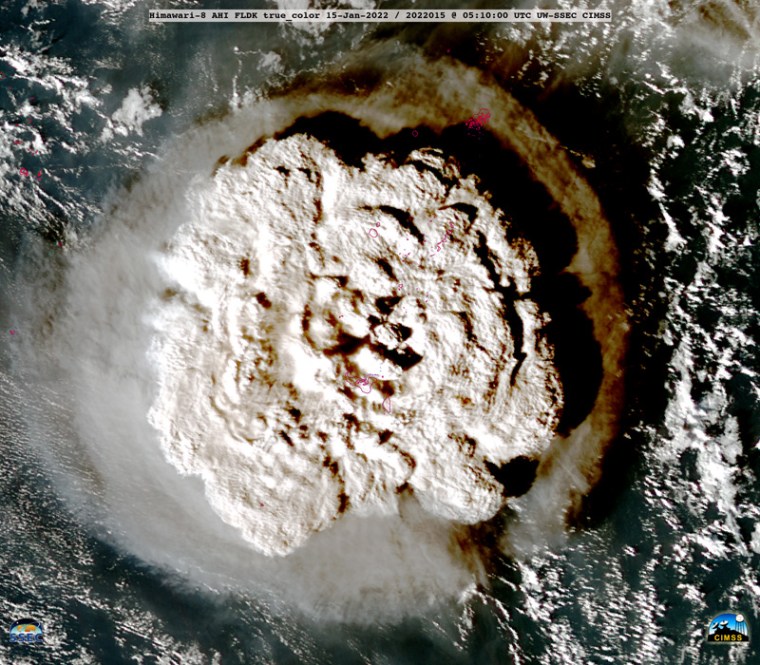
57 km high eruption plume and surrounding shock wave of Hunga Tonga-Hunga Ha’apai volcano one hour after explosion began on 15 January 2022: from the Himawari-8 satellite. The image is about 350 km across. Islands in red, the main island of Tonga being slightly to the south of the centre.

On 14 to 15 January 2022 the formerly shallow submarine Hunga Tonga-Hunga Ha’apai volcano in the Tonga archipelago of the South Pacific underwent an enormous explosive eruption (see an animation of the event captured by the Japanese weather satellite Himawari-8). The explosion was the largest in the atmosphere ever recorded by modern instruments, dwarfing even nuclear bomb tests, and the most powerful witnessed since that of Krakatoa in 1883. But, as regards global media coverage, it was a one-trick pony, trending for only a few days. It did launch tsunami waves that spanned the whole of the Pacific Ocean, but resulted in only 6 fatalities and 19 people injured. However, Hunga Tonga-Hunga Ha’apai managed to punch through the tropopause and in doing so, it changed the chemistry and dynamics of the stratosphere during the following year. A group of researchers from Harvard University and the University of Maryland used data from NASA’s Aura satellite to investigate changes in stratigraphic chemistry after the eruption (Wilmouth, D.M. et al. 2023. Impact of the Hunga Tonga volcanic eruption on stratospheric composition. Proceedings of the National Academy of Sciences, v. 120, article e23019941; DOI: 10.1073/pnas.2301994120). The Microwave Limb Sounder (MLS) carried by Aura measures thermal radiation emitted in the microwave region from the edge of the atmosphere, as revealed by Earth’s limb – seen at the horizon from a satellite. Microwave spectra from 0.12 to 2.5 mm in wavelength enable the concentrations of a variety of gases present in the atmosphere to be estimated along with temperature and pressure over a range of altitudes.

The team used MLS data for the months of February, April, September and December following the eruption to investigate its effects on the stratosphere n from 30°N to the South Pole. These data were compared with the averages over the previous 17 years. What emerged was a highly anomalous increase in the amount of water vapour between 0 and 30°S (the latitude band that includes the volcano) beginning in February 2022 and persisting until December 2023, the last dates of measurements. By April the peak showed up and persisted north of the Equator and at mid latitudes of the Southern Hemisphere and by December over Antarctica. It may well be present still. The estimated mass of water vapour that the eruption jetted into the stratosphere was of the order of 145 million tons along with about 0.4 million tons of SO2, the excess water helping accelerate the formation of highly reflective sulfate aerosols. Associated chemical changes were decreases in ozone (~ -14%) and HCl (~ -22%) and increases in ClO (>100%) and HNO3 (43%). Hunga Tonga-Hunga Ha’apai therefore changed the stratosphere’s chemistry and a variety of chemical reactions. As regards the resulting physical changes, extra water vapour together with additional sulfate aerosols should have had a cooling effect, leading to changes in its circulation with associated decrease in ozone in the Southern Hemisphere and increased ozone in the tropics. Up to now, the research has not attempted to match the chemical changes with climatic variations. The smaller 15 June 1991 eruption of Mount Pinatubo on the Philippine island of Luzon predated the possibility of detailed analysis of its chemical effects on the stratosphere. Nevertheless the material that is injected above the tropopause resulted in a global ‘volcanic winter’, and a ‘summer that wasn’t’ in the following year. The amount of sunlight reaching the surface fell by up to 10%, giving a 0.4 decrease in global mean temperature. Yet there seem to have been no media stories about such climate disruption in the aftermath of Hunga Tonga-Hunga Ha’apai. That is possibly because the most likely effect is a pulse of global warming in the midst of general alarm about greenhouse emissions, the climatically disruptive effect of the 2023 El Niño and record Northern Hemisphere temperature highs in the summer of 2023. Volcanic effects may be hidden in the welter of worrying data about anthropogenic global climate change.   David Wilmouth and colleagues hope to follow through with data from 2023 and beyond to track the movement of the anomalies, which are expected to persist for several more years. Their research is the first of its kind, so quite what its significance will be is hard to judge.

Aftershocks of ancient earthquakes

Any major earthquake is likely to be followed by aftershocks. Survivors of seismic devastation live in dread of them for weeks, even months. In reality the fault responsible for the initial event continues to move for longer than that. Commonly, aftershock activity dies down in magnitude and frequency over time, sometimes after a few weeks and in other cases much later to reach ‘normal background seismicity’ for the associated tectonic setting. Near a major plate boundary, such as the San Andreas Fault system in coastal California or the mid-Atlantic Ridge in Iceland, there is a continual risk of damaging seismic events, but the area around each major event becomes less risky a few tens of years afterwards. For instance, the Loma Prieta area on the San Andreas became quiescent sixteen years after the October 1989 Magnitude 6.9 earthquake that wrought havoc in San Francisco – and interrupted a Major League baseball match in the city. The December 1954, Magnitude 7.3 Dixie Valley earthquake in the active extensional zone of Nevada had a longer period of instability: 48 years. There is no fixed period for the aftermath, seismicity ‘stops when it stops’.

Earthquakes of greater than Magnitude 2.5 in eastern North America (see key to magnitudes at lower right). Those shown in blue date from 1568 to 1979, those in red between 1980 and 2016. (Credit: Chen & Liu, Fig 1)

Sometimes devastating earthquakes take place in what seem to be the least likely places: in tectonically ‘stable’ continental plate interiors. A Magnitude 7.9 earthquake in Sichuan Province, central China on 12 May 2008 left 86 thousand dead or missing, 374 thousand injured and 4.2 million homeless. It occurred in a region whose ancient fault systems had had little if any historic activity. One of the best studied records of seismic events in the middle of a continent is in the Mississippi River valley at the Missouri-Kentucky border, USA, near the town of New Madrid. This experienced three major earthquakes in 1811 and 1812 at Magnitudes estimated from 7.0 to 7.4. Seismicity there has continued ever since. Others that occurred long ago in the ‘stable’  North American continental crust were in South Carolina (1886) and southern Quebec, Canada (1663). They and the subsequent, lesser earthquakes that define clusters up to 250 km around them have been studied using spatial statistics (Chen, Y. & Liu, M. 2023. Long-Lived Aftershocks in the New Madrid seismic Zone and the Rest of Stable North America. Journal of Geophysics Research: Solid Earth, v. 128; DOI: 10.1029/2023JB026482). Yuxuan Chen and Mian Lui of Wuhan University, China and the University of Missouri, USA considered the dates of historic events, their estimated magnitudes and their proximity to other events in each cluster. The closer two events are the greater the chance that the later one is an aftershock of the first, although the relationship may also indicate a long-lived deformation process responsible for both. The authors suggest that this ‘nearest-neighbour’ approach may reveal that up to 65% of earthquakes in the New Madrid zone between 1980 and 2016 are aftershocks of the 1811-1812 major earthquake cluster, and a significant number of modern events in South Carolina could similarly relate to the 1886 Charleston earthquake. On the other hand, small modern earthquakes in Quebec are more likely to be part of the regional seismic background than to have any relationship to the large 17th century event.

Earthquakes are manifestations of deep-seated processes, most usually the build-up and release of strain in the lithosphere. If such processes persist they can result in long-lived earthquake swarms. So both delayed aftershocks and a high background of seismicity can contribute to the mapped clusters of historic events: a blend of relics of the past and modern deformation. They are yet to be detected in earthquake records associated with tectonic plate boundaries. A long history of movements within continents suggests that it is possible that long-delayed aftershocks may masquerade as foreshocks that presage greater events that are pending. Chen and Liu’s nearest-neighbour approach may therefore distinguish false alarms from real risk of major seismic motions.

See also: Some of today’s earthquakes may be aftershocks from quakes in the 1800s. Eureka|Alert, 13 November 2023

Relics of the Moon-forming impact?

Close to the core-mantle boundary (CMB) there are two extensive zones up to 10 km thick in the lower mantle. They have seismic-wave speeds that are much lower than expected at such depths: hence their being termed large low-velocity provinces (LLVPs). Seismic velocities being inversely proportional to the density of the material through which such waves travel, these zones have anomalously high density. The LLVPs have remained enigmatic since they were first discovered. Some have suggested that they are relics of dense subducted banded iron formations (see also: Curiously low-velocity material at the core-mantle boundary; March 2005) or simply piles of subducted slabs with an eclogite component that have gradually accumulated through Earth’s long history of  plate tectonics. An alternative is that LLVPs may be connected to geochemical evidence for a heterogeneous lower mantle and perhaps are relics of Earth’s earliest history.

An artist’s impression of the collision between Theia and the proto-Earth. (Credit: Hernán Cañellas, Nature)

The Moon-forming event about 4,500 Ma ago (for more information search the Planetary Science annual logs index) that probably involved a collision between the proto-Earth and another, Mars-sized planet – dubbed ‘Theia’ – is an alternative explanation for LLVPs. Maybe they are chunks of that planet that became embedded in the early Earth’s mantle. Many geochemical approaches to such an obvious origin are inconclusive, however. The latest attempt to model the processes involved in such a planetary truck crash using computer simulation does suggest that LLVPs may indeed be relics of Theia material that sank through the molten mass that became Earth’s mantle after the collision (Yuan, Q. et al. 2023. Moon-forming impactor as a source of Earth’s basal mantle anomalies. Nature v. 623, p. 95–99; DOI: 10.1038/s41586-023-06589-1).

Qian Yuan of the California Institute of Technology, and colleagues from China, USA and the UK based their approach on geochemical anomalies in plume related ocean-island basalts. These included distinctly non-terrestrial isotopic proportions of the noble gases neon and xenon, similar to those in lunar basalts., which in turn are more iron-rich than most basalts and thus 2-3% denser. The initial assumption in their modelling was that during the collision fragments of Theia peppered the magma ocean that became Earth upper mantle. These were thoroughly mixed in this molten zone as it convected before solidifying. But melts derived from some of the fragments could have penetrated the solid mantle below 1400 km depth as blobs, to retain their chemically anomalous integrity. Being dense, the blobs could slowly sink to accumulate at the CMB to form the two LLVPs. An animation of the processes revealed by Yuan et al.’s modelling can be viewed here.

See also: Oza, A. 2023. Strange blobs in Earth’s mantle are relics of a massive collision. Nature v. 623; DOI: 10.1038/s41586-023-06589-1

Extreme scientific showing-off: Hominin fossils in space

Good illustrations of self publicity and soaring ambition are the private space programmes of oligarchs Elon Musk (SpaceX), Jeff Bezos (Blue Origin) and Richard Branson (Virgin Galactic). For a cool US$65 million a ‘civilian’ can get a trip to the International Space Station on SpaceX; a one-hour suborbital flight on Blue Origin will cost US$300,000, with luck having Bezos as a companion; a reservation on Virgin Galactic for a 1 hour trip to the ‘edge of space’ (~100 km up) now costs US$624,000. It’s a tourist trip for the very, very rich only … but even the long-dead can go … or bits of them. On 8 September 2023 aboard Virgin Galactic flight Tim Nash, a South African billionaire had in his pocket a sturdy tube containing a thumb bone of Homo naledi and the collarbone of Australopithecus sediba. Nash reportedly said afterwards, “I am humbled and honoured to represent South Africa and all of humankind as I carry these precious representations of our collective ancestors”.

Reconstructed head of a somewhat annoyed Homo naledi. Credit: John Gurche, Mark Thiessen, National Geographic.

Nash was entrusted with these unique fossils by Lee Berger, Professor in Palaeoanthropology at Witwatersrand University, South Africa and a National Geographic Explorer-in-Residence. Berger recovered fossils of both species from limestone caves in the UNESCO World Heritage Site grandly named the Cradle of Humankind near Johannesburg. He is no stranger to controversy, and this venture cooked up with Nash seems to aim at promotion of South African achievements rather than having any scientific purpose. It has backfired spectacularly (see: McKie, R. 2023. ‘Callous, reckless, unethical’: scientists in row over rare fossils flown into space. The Observer, 22 October 2023). Comments from the anthropological world, six national and international bodies and perhaps the leading hominin specialist Professor Chris Stringer of the Natural History Museum in London include the words and phrases “callous”, “unethical”, “extraordinarily poorly thought-out”, “a publicity stunt”, “reckless” and “utterly irresponsible”. The caper breaks the South African, indeed international, scientific rule that fossils can only be allowed to travel for scientific purposes, applied consistently by similarly hominin-rich African countries such as Ethiopia, Kenya and Tanzania.

But, Hey, that’s how you get on in the world … isn’t it?

Plate tectonics loses another of its pioneers: W. Jason Morgan

The theory of plate tectonics had a long gestation. Continental drift, one of its central tenets, was first proposed by the meteorologist Alfred Wegener in 1912. Apart from a few enthusiasts of such a dynamic aspect of geology, such as Alex du Toit and Arthur Holmes, the majority of geoscientists remained with the non-revolutionary fixist ideology of their Victorian predecessors. Wegener’s stumbling block was his proposed driving mechanism – polflucht (flight from the poles) – which assumed that supercontinents had formed in polar regions to be subject to centrifugal force resulting from Earth’s rotation. This broke them apart to be driven towards the Equator. Such a mechanism being easily invalidated, most contemporary geologists preferred to ‘throw Wegener’s  baby out with the bathwater’. Yet every piece of his evidence that continents had moved around and most of his ideas about the nature of their movements were steadily verified and amplified over the next six decades, which attracted more curious and flexible scientists. What is now the central paradigm of the Earth Sciences had to wait for a set of major discoveries in the 1950s and ‘60s enabled by emerging technologies, such as the magnetometers used by Fred Vine and Drummond Matthews to discover sea-floor magnetic striping and thus sea-floor spreading. Their breakthrough presented a plausible mechanism for continental drift and launched a near frenzy of collaborative research among a global milieu of young geoscientists, one of whom being W. Jason Morgan.

W. Jason Morgan outside the Department of Earth Sciences, Princeton University. (Credit: Denise Applewhite, Princeton University)

His initial interest was in the great fracture zones on the floors of the Atlantic and Pacific Oceans. He grasped that each of them was very nearly a great circle. This was a central key to unifying seafloor spreading and continental drift – to move across a spherical surface every point on the seafloor had to follow such a path. Morgan recognised that the fracture zones could only result from rigid plates having to fracture to accommodate that motion. Using spherical geometry he was able to link together ridges, trenches and these huge transform faults with poles of rotation and triple junctions to predict plate motions in a quantitative manner. That insight provided a key to active earthquakes, mountain belts and volcanoes. His scientific unification was a result of genius: in just a few weeks Morgan established the fundamentals of what became known as plate tectonics.

W. Jason Morgan was one of the revolutionaries who made geology dynamic and launched its resurrection from the boring province of damp field workers in anoraks tramping across tracts of extremely puzzling rocks and structures, noses to the ground. He died at the age of 87 on 31 July 2023.

You can read an obituary by his former research student Richard Hey and his son Jason Phipps Morgan together with a fuller account of his career on Wikipedia.

North America occupied by modern humans during the Last Glacial Maximum

White Sands National Park in New Mexico, USA is notorious for being adjacent to the site at which the first nuclear weapon was tested (code name Trinity) on 16 July 1945. Four weeks later two such bombs killed between 129,000 and 226,000 people at Hiroshima (6 August 1945) and Nagasaki (9 August 1945). The area is one of spectacular geology, the white sand being made of gypsum (CaSO4) grains precipitated from lake water supplied by rivers that had dissolved the mineral from Permian evaporites in the surrounding mountains. Subsequent wind erosion created a large, white dune field: the main attraction. Though a national park that has been proposed for UNESCO World Heritage Centre, the park itself is surrounded by military installations including the nuclear test site.

Gypsum sand dunes in White Sands National Park USA. (Credit: Wikipedia)

As in most evaporite basins, the White Sands’ gypsum sediments built up layer-by-layer through deposition of clays during successive inundations followed by evaporation of CaSO4 rich water. Animals crossing the basin were likely to leave trackways, which subsequent sedimentary cycles could preserve in stratigraphic order. Examples had been found in the early 20th century, revealing the former presence of the late-Pleistocene megafauna: Columbian mammoths, ground sloths, ancient camels, dire wolves, lions, and sabre-toothed cats. One set of dire wolf prints found in the 2010s contained seeds that yielded a radiocarbon age of 18 ka. More recently, 61 human footprint tracks turned up in layers that also displayed signs of megafauna crossing the lake flats, in one case showing convincing signs of hunters having followed a giant ground sloth (Bennett, M.R. 2021 and 13 others 2021. Evidence of humans in North America during the Last Glacial Maximum. Science, v. 373, p. 1528-1531; doi: 10.1126/science.abg7586). Interestingly, many of the human tracks seem to have been made by teenagers and children with only a few made by adults. Dating of seeds in the sediment layers – and in some footprints – yielded 23 to 21 ka radiocarbon ages. This evidence suggested human occupation of New Mexico long before those who left Clovis-style artifacts around 13 ka and others who preceded them. However, the seeds that were dated are those of an aquatic grass (Ruppia cirrhosa), which may have absorbed older carbon from groundwater permeating the evaporite sediments. Being robust, the seeds could also have been transported by wind back and forth from plants that lived before the animals and humans left their marks in the saline flats. Such is the importance of the White Sands fossil trackways that a team of US and British geologists, some of whom authored Bennett et al. 2021, have sought to refute doubts of their antiquity (Pigati, J.S. and 10 others 2023. Independent age estimates resolve the controversy of ancient human footprints at White Sands. Science, v. 382, p. 73-75; DOI: 10.1126/science.adh5007).

Human footprints (arrowed) preserved on three sediment surfaces of the White Sands clay-gypsum sequences; i.e. at three times in their depositional sequence. (Credit: from Pigati et al.; Fig 1)

The researchers cut trenches into the layered clay-gypsum to reveal human footprints on three successive surfaces at the site where Ruppia seeds had provided very old, but disputed ages. They supplemented the earlier evidence by 14C dating of pollen grains blown into the prints from terrestrial plants and optically stimulated luminescence ages (time of last exposure to sunlight) of detrital quartz grains in the evaporites. The pollen dating gave ages from 23.4 to 22.6 ka, the minimum quartz OSL age being 21.5 ka. Similar ages from three different methods are pretty convincing evidence that humans were active in New Mexico during the Last Glacial Maximum (LGM), and that absorption of older carbon from groundwater had not affected the Ruppia seeds.

The Asia to America migration, which led these hunters to what the abundant megafauna trackways suggest were rich pickings around the White Sands palaeo-lake, must have been earlier still. High-latitude North America was almost certainly a vast, frigid desert for thousands of years leading up to the LGM. Another implication of the remarkable finds in the gypsum beds is that migration most probably involved a coastal or even a maritime route along the Eastern Pacific shore to reach more habitable lower latitudes.

See also: Earliest Americans, and plenty of them. Earth-logs, 27July 2020; Prillaman, M. 2023. Human footprints in New Mexico really may be surprisingly ancient, new dating shows. Science News, 5 October 2023.

Repeated climate and ecological stress during the run-up to the K-Pg extinction

The Cretaceous-Palaeogene mass extinction is no longer an event that polarises geologists’ views between a slow volcanic driver (The Deccan large igneous province) and a near instantaneous asteroid impact (Chicxulub). There is now a broad consensus that both processes were involved in weakening the Late Cretaceous biosphere and snuffing out much of it around 66 Ma ago. Yet is still no closure as regards the details. From a palaeontologist’s standpoint the die-off varied dramatically between major groups of animals. For instance, the non-avian dinosaurs disappeared completely while those that evolved to modern birds did not. Crocodiles came through it largely unscathed unlike aquatic dinosaurs. In the seas those animals that lived in the water column, such as ammonites, were far more affected than were denizens of the seafloor. But much the same final devastation was visited on every continent and ocean. However, lesser and more restricted extinctions occurred before the Chicxulub impact.

Scientists from Norway, Canada, the US, Italy, the UK and Sweden have now thrown light on the possibility that climate change during the last half-million years of the Cretaceous may have been eroding biodiversity and disrupting ecosystems (Callegaro, S. et al. 2023. Recurring volcanic winters during the latest Cretaceous: Sulfur and fluorine budgets of Deccan Traps lavas. Science Advances, v. 9, article eadg8284; DOI: 10.1126/sciadv.adg8284). Almost inevitably, they turned to the record of Deccan volcanism that overlapped the K-Pg event, specifically the likely composition of the gases that the magmas may have belched into the atmosphere. Instead of choosing the usual suspect carbon dioxide and its greenhouse effect, their focus was on sulfur and fluorine dissolved in pyroxene grains from 15 basalts erupted in the 10 Formations of the Deccan flood-basalt sequence. From these analyses they were able to estimate the amounts of the two elements in the magma erupted in each of these 10 phases.

Exposed section through a small part of the Deccan Traps in the Western Ghats of Maharashtra, India. (Credit: Gerta Keller, Princeton University)

The accompanying image of a famous section through the Deccan Traps SE of Mumbai clearly shows that 15 sampled flows could reveal only a fraction of the magmas’ variability: there are 12 flows in the foreground alone. The mountain beyond shows that the pale-coloured sequence is underlain by many more flows, and the full Deccan sequence is about 3.5 km thick. Clearly, flood-basalt volcanism is in no way continuous, but builds up from repeated lava flows that can be as much as 50 m thick. Each of them is capped by a red, clay-rich soil or bole – from the Greek word bolos (βόλος) meaning ‘clod of earth’. Weathering of basalt would have taken a few centuries to form each bole. Individual Deccan flows extend over enormous areas: one can be traced for 1500 km. At the end of volcanism the pile extended over roughly 1.5 million km2 to reach a volume of half a million km3.

Fluorine is a particularly toxic gas with horrific effects on organisms that ingest it. In the form of hydrofluoric acid (HF) – routinely used to dissolve rock – it penetrates tissue very rapidly to react with calcium in the blood to form calcium fluoride. This causes very severe pain, bone damage and other symptoms of skeletal fluorosis. The 1783-4 eruption of the Laki volcanic fissure in Iceland emitted an estimated 8,000 t of HF gas that wiped out more than half the domestic animals as a result of their eating contaminated grass. The famine that followed the eruption killed 20 to 25% of Iceland’s people: exhumed human skeletons buried in the aftermath show the distinctive signs of endemic skeletal fluorosis. This small flood-basalt event had global repercussions, as the Wikipedia entry for Laki documents. Volcanic sulfur emissions in the form of SO2 gas react with water vapour to form sulphuric acid aerosols in a reflective haze. If this takes place in the stratosphere as a result of powerful eruptions, as was the case with the 1991 Pinatubo eruption in the Philippines, the high-altitude haze lingers and spreads. This results in reduced solar warming: a so-called ‘volcanic winter’. In the Pinatubo aftermath global temperatures fell by about 0.5°C during 1991-3. Unsurprisingly, volcanic sulfur emissions also result in acid rainfall. Moreover, inhaling the sulphur-rich haze at low altitudes causes victims to choke as their respiratory tissues swell: an estimated 23,000 people in Britain died in this way when the 1783-4 Laki eruption haze spread southwards Sara Calegaro and colleagues found that the fluorine and sulfur contents of Deccan magmas fluctuated significantly during the eruptive phases. They suggest that fluorine emissions were far above those from Laki, perhaps leading to regional fluorine toxicity around the site of the Deccan flood volcanism but not extinctions. Global cooling due to sulphuric acid aerosols in the stratosphere is suggested to have happened repeatedly, albeit briefly, as eruption waxed and waned during each phase. Magmas rich in volatiles would have been more likely to erupt explosively to inject SO2 to stratospheric altitudes (above 10 to 20 km). The authors do not attempt to model when such cooling episodes may have occurred: data from only 15 levels in the Deccan Traps do not have the time-resolution to achieve that. They do, however, show that this large igneous province definitely had the potential to generate ‘volcanic winters’ and toxic episodes. Time and time again ecosystems globally and regionally would have experienced severe stress, the most important perhaps being disruption of the terrestrial and marine food chains.

A way for early humans to leave Africa for Eurasia via the Middle East

Without seafaring skills and sturdy boats, ancient humans had only two options to leave Africa for Eurasia: by crossing the Straits of Bab el Mandab at the southern end of the Red Sea and from the Nile delta to the Levant at its northern end. Both would have been difficult. The first route demanded extremely low sea level drawn down by continental ice accumulation to narrow the sea crossing, the earliest in the last glacial cycle being around 70 ka ago. The northern route, with no sea crossing, was potentially achievable throughout the history of the genus Homo. But that way is beset to the north and east by deserts with large tracts that today lack natural water sources. To leave Africa by that route seems the most obvious, being reached along the well-watered Nile valley or the Red Sea coast with its abundant marine resources. Yet moving eastwards to Arabia and further would have required climatic windows of opportunity to ensure well-watered corridors: it would be impossible today without an infrastructure of wells; and edible resources are extremely sparse. Remains of anatomically modern humans (AMH) as old as 200 ka and others in the period between 130 to 85 ka have been found around the eastern shores of the Mediterranean. Either of the two routes could have led them there during periods of increased humidity, perhaps in a series of migratory pulses. In the case of an exodus across the Straits of Bab el Mandab, people could have moved northwards along the Red Sea coast of modern Yemen and Arabia to the Levant. However, the record is patchy, and there is no direct fossil evidence to suggest they went further, into southern Asia or Europe in these earlier times. Each early venture may also have ended in extinction.  The first presence of AMH in Asia and Europe, seems to have been tens of thousand years later: about 75 ka and 45 ka, respectively, so far as we know.

Left: Satellite image of the Arabia and the Levant, showing the possible northern (red) and southern migration routes (blue) and sites that yielded various palaeoclimatic signs of formerly wet areas, Homo sapiens fossils and stone tools (see key). Right colour-coded map of topographic elevation for the study area in the Levant with sites that reveal palaeoclimatic and anthropological information. (Credit: Abbas et al., Fig 1)

Research in the Arabian Peninsula has early recorded human presence from discarded stone artefacts at widely scattered sites, as far east as the UAE and Oman, but whether these were carried by AMH or other human groups is uncertain. Yet geological research suggests that even in the presently forbidding Empty Quarter of Saudi Arabia there were from time to time abundant springs, river networks and even lakes: occasionally climate changes made much of Arabia habitable. Researchers from the University of Southampton (UK) and Shantou University (China), together with colleagues in Jordan, Australia and the Czech Republic have documented further evidence for ‘green’ episodes on the Jordan Plateau – part of the currently hyperarid  Arabian interior (Abbas, M. and 10 others 2023. Human dispersals out of Africa via the LevantScience Advances, v.9, article eadi6838; DOI: 10.1126/sciadv.adi6838).

Three sites in Jordan reveal wetland sediments incised by now dry channels or wadis, one of which yielded stone tools Luminescence dating of wetland sediment grains shows the times when they were last exposed to sunlight: some between 86 to 65 ka, others between 57 to 43 ka. Together with data from the rest of Arabia the sites help roughly to define routes that would have permitted human migration, though not the actual directions that early AMH might have travelled or their destinations – if any. They may just have wandered around surviving on the resources that they found during short periods of amenable local climate, and vegetation much as do desert dwellers today. Actually to exit Arabia to southern Asia would require migration around what is now the Persian Gulf, where relevant data are lacking and likely to remain so while poor security for research prevails. To get to Europe would require a much more intricate journey through large mountainous tracts to reach the shores of the Black Sea.

See also: Early human migrants followed lush corridor-route out of Africa. Science Daily. 4 October 2023

Sudden climate change: a warning from 8 millennia ago

Mesolithic hunter-gatherers in Britain must have had a very hard time around 8.2 thousand years age. The whole area around the North Atlantic experienced sudden climatic cooling of around 3.3°C together with drought that lasted about 70 years. To make things worse shortly afterwards, coasts around the North were devastated by a tsunami generated by a submarine landslide off western Norway. That event exceeded the maximum coast ‘run up’ of both the 26 December 2004 Indian Ocean tsunami and that in NW Japan on 11 March 2011. Doggerland, then in the central North Sea was devastated by a catastrophic event of a few days duration. It littered the seabed with the bones of its megafauna and even Mesolithic tools recovered by trawlers from its surviving relic the shallow Dogger Bank. It seems the tsunami arrived just as climate was warming back to ‘normal’ Holocene conditions: for many foragers, surely, a last straw.

The cooling episode has been attributed to perturbation of the Atlantic Meridional Overturning Circulation (AMOC) as a result of meltwater discharge during the deglaciation of the Laurentide Ice Sheet (see: Just when you think it’s going to turn out alright… November 2009).The event may have unfolded in a similar fashion to the trigger for the Younger Dryas and the succession of warming-cooling episodes known as Dansgaard-Oeschger events that interrupted the otherwise relentless global cooling towards the last glacial maximum (see: Review of thermohaline circulation; February 2002). The physics that set off such climatic ‘hiccups’ is that freshening of surface seawater reduces its density, so that it cannot sink to be replaced by denser saline water ‘dragged’ northwards from warmer latitudes. That currently takes the form of the Gulf Stream with its warming influence, particularly in the eastern North Atlantic and even beyond Norway’s North Cape, responsible for much warmer winters than at similar latitudes on the western side. The culprit  had long been suggested to be the drainage of a huge lake dammed by the ice sheet that covered most of eastern Canada during late stages of deglaciation. Seemingly the best candidate was Lake Agassiz trapped by the early Holocene ice front in Manitoba – the largest proglacial lake known anywhere.

Colour coded topographic elevation of North America showing the maximum extent of Lake Agassiz and four possible routes for its drainage: north-west to the Arctic Ocean via the Mackenzie River; south to the Gulf of Mexico via the Mississippi valley; east to the North Atlantic via the Great Lakes and St Laurence River; north to the North Atlantic via Hudson Bay. (Credit: ©Sheffield University)

The present landforms of central Canada show evidence for several outflow directions at different times, Including to the northwest to reach the Arctic Ocean at the onset of the Younger Dryas. Until recently there was little detailed evidence for the flow volume and timing of its drainage around 8 to 9 ka. Providing the details in the context of the short-lived event around 8.2 ka requires accurate data over a mere 200 years able to reveal a change in sea level to a precision of better than a few tens of centimetre. Any site on the shores of the North Atlantic would do, provided it satisfies these criteria. Geographers from universities in York, Leeds, Sheffield and Oxford, UK selected the small estuary of the River Ythan in NE Scotland. There, a continuous sand unit just above fine-grained intertidal tidal muds marks the knife-sharp time datum of the Storegga tsunami (Rush, G. et al. 2023. The magnitude and source of meltwater forcing of the 8.2 ka climate event constrained by relative sea-level data from eastern Scotland. Quaternary Science Advances, v. 12, article 100119; DOI: 10.1016/j.qsa.2023.100119).

Cores of the intertidal sediments from beneath the present Ythan salt marsh contain plant remains that yielded precise radiocarbon dates at several stratigraphic levels from which to derive an age-depth model for the age range of interest. The buried sediments are also rich in marine microfossils (foraminifera and diatoms) that thrive in estuaries at a variety of depths.  These enabled fluctuations in relative sea level during the build-up of the intertidal sediments to be constrained at unprecedented resolution and precision for a three thousand year period from 9.5 to 6.5 ka. The authors show that there were two episodes of rapid sea-level rise over that time: between 8.53 and 8.37 ka (~2.4 m at 13 mm yr-1) and 8.37 to 8.24 ka (~ 0.6 m at 4 mm yr-1) – these would have been global increases in sea level.

Despite its vast size, it turns out that Lake Agassiz would have been unable to result in sea-level rises of that magnitude so quickly merely through outflow. Rush et al. suggest that the huge  and rapid addition of fresh water to the North Atlantic involved flow of lake water towards Hudson Bay, beneath the ice sheet, causing it to collapse and melt, followed by completion of Lake Agassiz’s emptying in the second stage. It took a long drawn-out ‘freshening’ of the North Atlantic surface water ultimately to shut down the Atlantic Meridional Overturning Circulation, thereby depriving high latitudes of its east-side warming effect by the Gulf Stream.

Sea level has been rising since the early 20th century mainly through the melting of Greenland’s ice cap together with a substantial amount of thermal expansion while global climate has been warming. Between 1901 and 2018 the rise has amounted to 15 to 25 cm at a rate of 1 to 2 mm yr-1. The AMOC is possibly weaker now than at any time during the last millennium (Zhu, C. et al. 2023. Likely accelerated weakening of Atlantic overturning circulation emerges in optimal salinity fingerprint. Nature Communications, v. 14, article 1245; DOI: 10.1038/s41467-023-36288-4). Yet increases in freshening of the northernmost parts of the North Atlantic are now being added to by annual increases in the melting of polar sea ice, which is salt-free. The AMOC may be approaching a tipping point, because warming is accelerating over Greenland at around 1.5°C each year: faster than most of the rest of the world. In 2021 it rained for the first time ever recorded at the ice cap’s summit (3.2 km above sea level). A ‘perturbation’ of the AMOC would add chaos to the dominantly linear view of global warming taken by climatologists. That could launch frigidity and drought at mid northern latitudes as it did eight millennia ago: the opposite of what is currently feared.

See also: Unlocking Ancient Climate Secrets – Melting Ice Likely Triggered Climate Change Over 8,000 Years Ago. Scitechdaily 16 September 2023.