Was Venus once habitable?

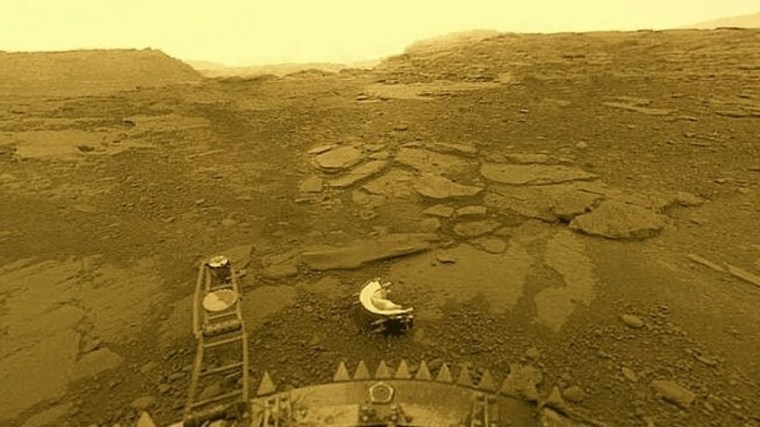
The surface of Venus from the USSR Venera 14 lander

It is often said that Earth has a twin: Venus, the second planet from the Sun. That isn’t true, despite the fact that both have similar size and density. Venus, in fact, is even more inhospitable that either Mars or the Moon, having surface temperatures (~465°C) that are high enough to melt lead or, more graphically, those in a pizza oven. The only vehicles successfully to have landed on Venus (the Russian Venera series) survived for a mere 2 hours, but some did did send back data and images. That near incandescence is masked by the Venusian atmosphere that comprises 96.5% carbon dioxide, 3.5% nitrogen and 0.05 % sulfur dioxide, with mere traces of other gases including extremely low amounts of water vapour (0.002%) and virtually no oxygen. The dense atmosphere imposes a pressure at Venus’s surface tht is 92 times that on Earth: so dense that CO2 and N2 are, strictly speaking, not gases but supercritical fluids at the surface. At present Venus is definitely inimical to any known type of life. It is the victim of an extreme, runaway greenhouse effect.

As it stands, Venus’s geology is also very different from that of the Earth. Because its upper atmosphere contains clouds of highly reflective sulfuric acid aerosols only radar is capable of penetrating to the surface and returning to have been monitored by a couple of orbital vehicles: Magellan (NASA 1990 to 1994) and Venus Express (European Space Agency 2006 to 2014). The latter also carried means of mapping Venus’s surface gravitational field. The radar imagery shows that 80% of the Venusian surface comprises somewhat wrinkled plains that suggests a purely volcanic origin. Indeed more that 85,000 volcanoes have been mapped, 167 of which are over 100 km across. Much of the surface appears to have been broken into polygonal blocks or ‘campuses’ (campus is Latin for field) that give the impression of ‘crazy paving’. A peculiar kind of local-scale tectonics has operated there, but nothing like the plate tectonics on Earth in either shape or scale.

Polygonal blocks or ‘campuses’ on the lowland surface of Venus. Note the zones of ridges that roughly parallel ‘campus’ margins. Credit: Paul K. Byrne, North Carolina State University and Sean C. Solomon, Lamont-Doherty Earth Observatory

Many of the rocky bodies of the solar system are pocked by impact craters – the Earth has few, simply because erosion and sedimentary burial on the continents, and subduction of ocean floors have removed them from view. The Venusian surface has so few that it can, in its entirety, be surmised to have formed by magmatic ‘repaving’ since about 500 Ma ago at least. Earlier geological process can only be guessed at, or modelled in some way. A recent paper postulates that ‘there are several lines of evidence that suggest that Venus once did have a mobile lithosphere perhaps not dissimilar to Earth …’ (Weller, M.B. & Kiefer, W.S. 2025. The punctuated evolution of the Venusian atmosphere from a transition in mantle convective style and volcanic outgassing. Science Advances, v. 11, article eadn986; DOI: 10.1126/sciadv.adn986). One large, but subtle feature may have formed by convergence similar to that of collision tectonics. There are also gravitational features that hint at active subduction at depth, although the surface no longer shows connected features such as trenches and island arcs. Local extension has been inferred from other data.

Weller and Kiefer suspect that Venus in the past may have shifted between a form of mobile plate tectonics and stagnant ‘lid’ tectonics, the vast volcanic plains having formed by processes akin to flood volcanism on a planetary scale. Venus’s similar density to that of Earth suggests that it is made of similar rocky material surrounding a metallic core. However, that planet has a far weaker magnetic field suggesting that the core is unable to convect and behave like a dynamo to generate a magnetic field. That may explain why the atmosphere of Venus is almost completely dry. With no magnetic field to deflect it the solar wind of charged particles directly impacts the upper atmosphere, in contrast to the Earth where only a very small proportion descends at the poles. Together with the action of UV solar radiation that splits water vapour into its constituent hydrogen and oxygen ions, the solar wind adds energy to them so that they escape to space. This atmospheric ‘erosion’ has steadily stripped the atmosphere of Venus – and thus its solid surface – of all but a minute trace of water, leaving behind higher mass molecules, particularly carbon dioxide, emitted by its volcanism. Of course, this process has vastly amplified the greenhouse effect that makes Venus so hot. Early on the planet may have had oceans and even primitive life, which on Earth extract CO2 by precipitating carbonates and by photosynthesis, respectively. But they no longer exist.

The high surface temperature on Venus has made its internal geothermal gradient very different from Earth’s; i.e. increasing from 465°C with depth, instead of from about 15°C on Earth. As a result, everywhere beneath the surface of Venus its mantle has been more able to melt and generate magma. Earlier in its history it may have behaved more like Earth, but eventually flipped to continual magmatic ‘repaving’. To investigate how this evolution may have occurred Weller and Kiefer created 3-D spherical models of geological activity, beginning with Earth-like tectonics – a reasonable starting point because of the probable Earth-like geochemistry of Venus. My simplified impression of what they found is that the periodic blurting of magma well-known from Earth history to have created flood-basalt events without disturbing plate tectonics proceeded on Venus with progressively greater violence. Such events here emitted massive amounts of CO2 into the atmosphere over short (~1 Ma) time scales and resulted in climate change, but Earth’s surface processes have always returned to ‘normal’. Flood-basalt episodes here have had a rough periodicity of around 35 Ma. Weller and Kiefer’s modelling seems to suggest that such events on Venus may have been larger. Repetition of such events, which emitted CO­2 that surface processes could not erase before the next event, would progressively ramp up surface temperatures and the geothermal gradient.  Eventually climatic heating would drive water from the surface into the atmosphere, to be lost forever through interaction with the solar wind. Without rainfall made acid by dissolved CO2, rock weathering that tempers the greenhouse effect on Earth would cease on Venus. The increased geothermal gradient would change any earlier rigid, Earth-like lithosphere to more ductile material, thereby shutting down the formation of plates, the essence of tectonics on Earth. It may have been something along those lines that made Venus inimical to life, and some may fear that anthropogenic global warming here might similarly doom the Earth to become an incandescent and sterile crucible orbiting the Sun. But as Mark Twain observed in 1897 after reading The New York Herald’s account that he was ill and possibly dying in London, ‘The report of my death was an exaggeration’. It would suit my narrative better had he said ‘… was premature’!

The Earth has a very large Moon because of a stupendous collision with a Mars-sized planet shortly after it accreted. That fundamentally reset Earth’s bulk geochemistry: a sort of Year Zero event. It endowed both bodies with magma oceans from which several tectonic scenarios developed on Earth from Eon to Eon. There is no evidence that Venus had such a catastrophic beginning. By at least 3.7 billion years ago Earth had a strong magnetic field. Protected by that thereafter from the solar wind, it has never lost its huge endowment of water; solid, liquid or gaseous. It seems that it did go through a stagnant lid style of tectonics early on, that transitioned to plate tectonics around the end of the Hadean Eon (~4.0 Ga), with a few hiccups during the Archaean Eon. And it did develop life as an integral part of the rock cycle. Venus, fascinating as it is, shows no sign of either, and that’s hardly surprising. Those factors and its being much closer to the Sun may have condemned it from the outset.

A fully revised edition of Steve Drury’s book Stepping Stones: The Making of Our Home World can now be downloaded as a free eBook

Evidence for Earth’s magnetic field 3.7 billion years ago

If ever there was one geological locality that  ‘kept giving’ it would have to be the Isua supracrustal belt in West Greenland. Since 1971 it has been known to be the repository of the oldest known metasedimentary rocks, dated at around 3.7 Ga. Repeatedly, geochemists have sought evidence for life of that antiquity, but the Isua metasediments have yielded only ambiguous chemical signs. A more convincing hint emerged from iron-rich silica layers (jasper) in similarly aged metabasalts on Nuvvuagittuk Island in Quebec on the east side of Hudson Bay, Canada, which may be products of Eoarchaean sea-floor hydrothermal vents. X-ray micro-tomography and electron microscopy of the jaspers revealed twisted filaments, tubes, knob-like and branching structures up to a centimetre long that contain minute grains of carbon, phosphates and metal sufides, but the structures are made from hematite (Fe2O3­) so an inorganic formation is just as likely as the earliest biology. Isua’s most intriguing contribution to the search for the earliest life has been what look like stromatolites in a marble layer (see: Signs of life in some of the oldest rocks; September 2016). Such structures formed in later times on shallow sea floors through the secretion of biofilms by photosynthesising blue-green bacteria.

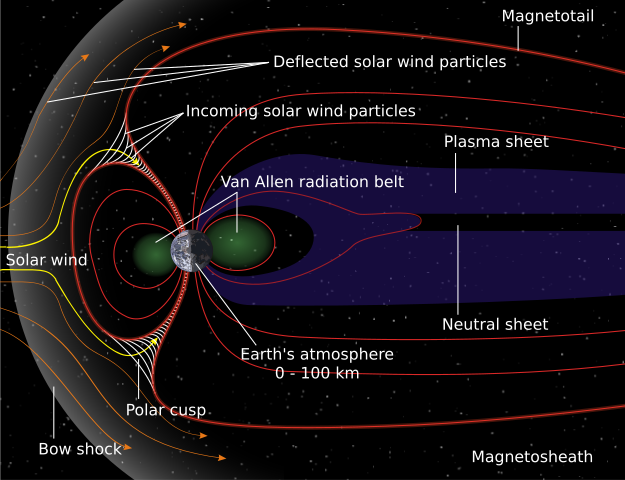
Structure of the Earth’s magnetosphere that deflects charged particles which form the solar wind. (Credit: Wikipedia Commons)

For life to form and survive depends on its complex molecules being protected from high-energy charged particles in the solar wind. In turn that depends on a strong geomagnetic field deflecting the solar wind as it does today, except for a small proportion that descend towards the poles and form aurora during solar mass ejections. In  visits to Isua in 2018 and 2019, geophysicists from the Massachusetts Institute of Technology, USA and Oxford University, UK drilled over 300 rock cores from metasedimentary ironstones (Nichols, C.I.O. and 9 others 2024. Possible Eoarchean records of the geomagnetic field preserved in the Isua Supracrustal Belt, southern West Greenland. Journal of Geophysics Research (Solid Earth), v. 129, article e2023JB027706; DOI: 10.1029/2023JB027706 Magnetisation preserved in the samples (remanent magnetism) suggest that it was formed by a geomagnetic field strength of at least 15 microtesla, similar to that which prevails today. The minerals magnetite (Fe3O4) and apatite (a complex phosphate) in the ironstones have been dated using U-Pb geochronometry and record a metamorphic event only slightly younger that the age of the Isua belt (3.69 and 3.63 Ga respectively). There is no sign of any younger heating above the temperatures that would reset the ironstones’ magnetisation. The Isua remanent magnetisation is at least 200 Ma older than that found in igneous rocks from north-eastern South Africa dated at between 3.2 to 3.45 Ga. So even in the Eoarchaean it seems likely that life, had it formed, would have avoided the hazard of exposure to the high energy solar wind. In all likelihood, however, in a shallow marine environment it would have had to protect itself somehow from intense ultraviolet radiation. That is now vastly reduced by stratospheric ozone (O3) which could only form once the atmosphere had appreciable oxygen (O2) content, i.e. after the Great Oxygenation Event beginning about 2.4 Ga ago. Undoubted stromatolites as old as 3.5 Ga suggest that early photosynthesising bacteria clearly had cracked the problem of UV protection somehow.

The Moon may have water resources in its soil

Apart from signs of water ice in permanently shadowed areas of some polar craters, the Moon’s surface has generally been considered to be very dry. Rocks returned by the various Apollo missions contain minute traces of water by comparison with similar rocks on Earth. They consist only of anhydrous minerals such as feldspars, pyroxenes and olivines. But much of the lunar surface is coated by regolith: a jumble of rock fragments and dust ejected from a vast number of impact craters over billions of years. It is estimated to be between 3 and 12 m deep. Much of the finer grained regolith is made up of silicate-glass spherules created by the most powerful impacts.

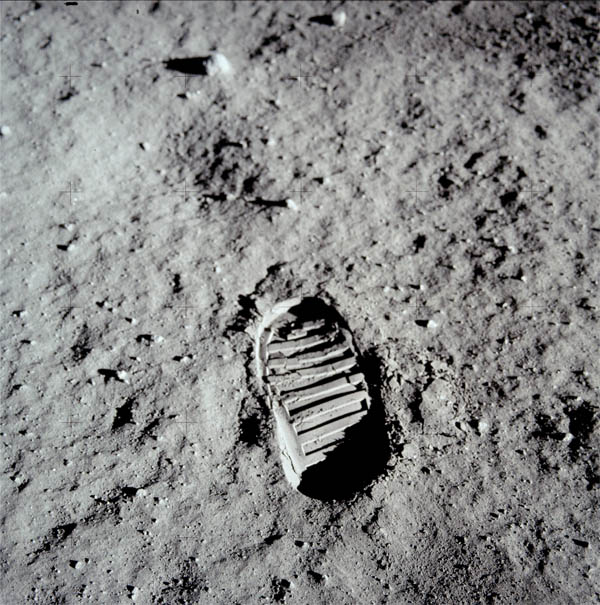
The lunar regolith at Tranquillity Base bearing an astronaut’s bootprint (Credit: Buzz Aldrin, NASA Apollo 11, Photo ID AS11-40-5877)

The scientific and economic (i.e. mining) impetus for the establishment of long term human habitation on the lunar surface hangs on the possibility of extracting water from the Moon itself. It is needed for human consumption and as a source through electrolysis of both oxygen and hydrogen for breathing and also for rocket fuel. The stupendous cost, in both monetary and energy terms, of shifting mass from Earth to the Moon clearly demands self-sufficiency in water for a lunar base occupied for more than a few weeks.

Remote sensing that focussed on the ability of water molecules and hydroxyl (OH) ions to absorb solar radiation with a wavelength of 2.8 to 3.0 micrometres was deployed by the Indian lunar orbiter Chandrayaan-1 that collected data for several months in 2008-9. The results suggested that OH and H2O were detectable over a large proportion of the lunar surface at concentrations estimated at between 10 parts per million (ppm) up to about 0.1%. Where did these hydroxyl ions and water molecules come from and what had locked them up? There are several possibilities for their origin: volcanic activity that tapped the Moon’s mantle (magma could not have formed had some water not been present at great depths); impacts of icy bodies such as comets; even the solar wind that carries protons, i.e. hydrogen atoms stripped of their electrons. Conceivably, protons could react with oxygen in silicate material at the surface to produce both OH and H2O to be locked within solid particles. To assess the possibilities a group of researchers at Chinese and British institutions have examined in detail the 1.7 kg of lunar-surface materials collected and returned to Earth by the 2020 Chinese Chang’e 5 lunar sample return mission (He, H. and 27 others 2023. A solar wind-derived water reservoir on the Moon hosted by impact glass beads. Nature Geoscience, online article; DOI: 10.1038/s41561-023-01159-6)

He et al. focussed on glass spherules formed by impact melting of lunar basalts, whose bulk composition they retain. The glass ‘beads’ contain up to 0.2 % water, mainly concentrated in their outermost parts. This alone suggests that the water and hydroxyl ions were formed by spherules being bathed in the solar wind rather than being of volcanic or cometary origin and trapped in the glass. An abnormally low proportion of deuterium (2H) relative to the more abundant 1H isotope of hydrogen in the spherules is consistent with that hypothesis. Indeed, the high temperatures involved in impact melting would be expected to have driven out any ‘indigenous’ water in the source rocks. The water and OH ions seem to have built up over time, diffusing into the glass from their surfaces rather than gradually escaping from within.

An awful lot of regolith coats the lunar surface, as many of the images taken by the Apollo astronauts amply show. So how much water might be available from the lunar regolith? The Chinese-British team reckon between 3.0 × 10⁸ to 3.0 × 10¹¹ metric tons. But how much can feasibly be extracted at a lunar base camp? The data suggest that a cubic metre (~2 t) of regolith could yield enough to fill 4 shot glasses (~0.13 litres). Using a solar furnace and a condenser – the one in full sunlight the other in the shade – is not, as they say, ‘rocket science’. But for a minimum 3 litres per day intake of fluids per person, a team of 4 astronauts would need to shift and process roughly 100 m3 of regolith every day. Over a year, this would produce a substantial pit. But that assumes all the regolith contains some water, yet the data are derived from the surface alone …See also:Glass beads on moon’s surface may hold billions of tonnes of water, scientists say. The Guardian, 27 March 2023.

Late formation of the Earth’s inner core

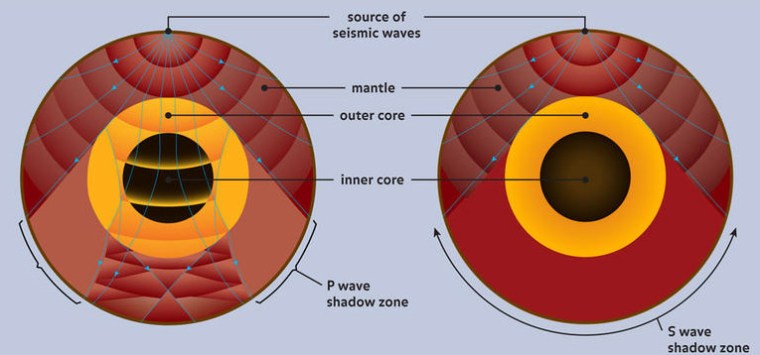
The layered structure of the Earth was discovered using the varying arrival times of seismic waves from major earthquakes, which pass through the Earth, at seismometer stations located across the planet’s surface. Analysis of these arrival times indicates the wavepaths taken through the planet, involving reflections and refractions at boundaries of materials with distinctly different physical properties. S-waves from an earthquake do not arrive in a wide ‘shadow zone’ around its antipode. Since that kind of wave depends on shearing and cannot pass through liquid the shadow reveals the presence of an outer core made of very dense liquid iron and nickel. P-waves that travel in a manner akin to sound waves also show a shadow but it is annular in form around the antipode because of refraction at the core-mantle boundary, but they do penetrate to reach the antipode. However, their arrival times there show faster speeds than expected from an entirely liquid core, and so reveal a central mass, the inner core, which is a ball of solid iron-nickel alloy about 70% of the Moon’s size.

The Earth’s internal structure as revealed by seismic waves (Credit: Smithsonian Institute)

Movements of liquid Fe-Ni in the outer core generate Earth’s magnetic field in the manner of a self-exciting dynamo. Motion in the outer core results from convection of heat from below – probably mainly heat generated by planetary accretion – coupled with the Earth’s rotation and the Coriolis Effect.  The present style of motion is in a thick molten layer trapped between the solid mantle and the inner core. Its circulation results in a magnetic field with two distinct poles close to the geographic ones. The field is crudely similar to that of a bar magnet, with lesser deviations spread around the planet. However, it is not particularly stable, as shown by periodic flips or reversals of polarity through geological time (see: How the core controls Earth’s magnetic field reversals; April 2005).

Few geoscientists doubt that the core formed early in Earth’s history from excess iron, nickel and sulfur, plus other siderophile elements such as gold, that cannot be accommodated by the dominant silicates of the mantle. This could not have been achieved other than by iron-rich melts sinking in some way because of their density. Gradual loss of original heat of accretion and declining radiogenic heat from rare isotopes (e.g. 40K) in the melt suggests an original, totally molten core that at some time began to crystallise under stupendous pressure in its lowest parts. A fully molten core would have been turbulent and therefore able to generate a magnetic field, and Archaean rocks still retain remanent magnetisation. The form that the field took can only be modelled. At times it may have been dipolar – paleomagnetic pole positions match geological evidence for early supercontinents –  and it may have undergone reversals. When the inner core formed has long remained disputed, yet thanks to advances in palaeomagnetic analysis it may now have been resolved  (Zhou, T. and 11 others 2022. Early Cambrian renewal of the geodynamo and the origin of inner core structure. Nature Communications, v. 13, article 4161; DOI:10.1038/s41467-022-31677-7).

Tinghong Zhou of the University of Rochester, USA, and colleagues from other US, Chinese and British institutions have assiduously measured the original magnetic intensities locked in tiny iron- and iron-titanium oxide needles trapped in feldspars that dominate plutonic igneous rocks, known as anorthosites, of late Precambrian age. They found that, by about 565 Ma ago during the Ediacaran Period, the Earth’s magnetic field strength had fallen to almost a sixth of its value in the early Archaean: about 15 times less than it is today. Within a mere 30 Ma it had risen to become 5 times its lowest value , as recorded by a Cambrian anorthosite, and then rose steadily through the Phanerozoic Eon to its present strength. Modelling of the rapid rebound suggests that the inner core had begun to crystallise by about 550 Ma to reach half its present radius by the end of the Ordovician Period (~450 Ma).

That event may also have been a milestone for the continuation of biological evolution on Earth. While Mars once probably had a molten core and magnetic field, it vanished 4 billion years ago, probably when its core became solid. Early Mars had an ocean in its northern hemisphere up to about 3.8 Ga, and there is plenty of evidence for erosion by water on its higher surfaces. For liquid water to have existed there for hundreds of million years demands a thick, warm atmosphere able to initiate a greenhouse effect. With low atmospheric pressure water could have existed only as ice or water vapour. Now its atmosphere is very thin and except at its poles there is no sign of surface water, even as ice (it is possible that significant amounts of water ice remain protected beneath the surface of Mars). One hypothesis is that when Mars lost its magnetic field it also lost protection from the stream of energetic particles known as the solar wind, which can strip water vapour and carbon dioxide – and thus their ability to retain atmospheric heat – from the top of the atmosphere. Earth is currently protected from the solar wind by its strong magnetic field and magnetosphere that deflects high-speed, charged particles. During the Ediacaran Period it almost lost that protection, but was spared by the self-exciting dynamo being regenerated.

See also: How did Earth avoid a Mars-like fate? Ancient rocks hold clues. Science Daily, 25 July 2022

Oxygen, magnetic reversals and mass extinctions

In April 2005 EPN reported evidence for a late Permian fall in atmospheric oxygen concentration to about 16% from its all-time high of 30% in the Carboniferous and earlier Permian.. This would have reduced the highest elevation on land where animals could live to about 2.7 km above sea level, compared with 4 to 5 today. Such an event would have placed a great deal of stress on terrestrial animal families. Moreover, it implies anoxic conditions in the oceans that would stress marine animals too. At the time, it seemed unlikely that declining oxygen was the main trigger for the end-Permian mass extinction as the decline would probably have been gradual; for instance by oxygen being locked into iron-3 compounds that give Permian and Triassic terrestrial sediments their unrelenting red coloration. By most accounts the greatest mass extinction of the Phanerozoic was extremely swift.

The possibility of extinctions being brought on by loss of oxygen from the air and ocean water has reappeared, though with suggestion of a very different means of achieving it (Wei, Y. and 10 others 2014. Oxygen escape from the Earth during geomagnetic reversals: Implications to mass extinction. Earth and Planetary Science Letters, v. 394, p. 94-98). The nub of the issue proposed by the Chinese-German authors is the dissociation and ionization by solar radiation of O2 molecules into O+ ions. If exposed to the solar wind, such ions could literally be ‘blown away’ into interplanetary space; an explanation for the lack of much in the way of any atmosphere on Mars today. Mars is prone to such ionic ablation because it now has a very weak magnetic field and may have been in that state for 3 billion years or more. Earth’s much larger magnetic field diverts the solar wind by acting as an electromagnetic buffer against much loss of gases, except free hydrogen and to a certain extent helium. But the geomagnetic field undergoes reversals, and while they are in progress, the field drops to very low levels exposing Earth to loss of oxygen as well as to dangerous levels of ionising radiation through unprotected exposure of the surface to the solar wind.

Artist's rendition of Earth's magnetosphere.
Artist’s rendition of Earth’s magnetosphere deflecting the solar wind. (credit: Wikipedia)

Field reversals and, presumably, short periods of very low geomagnetic field associated with them, varied in their frequency through time. For the past 80 Ma the reversal rate has been between 1 and 5 per million years. For much of the Cretaceous Period there were hardly any during a magnetic quiet episode or superchron. Earlier Mesozoic times were magnetically hectic, when reversals rose to rates as high as 7 per million years in the early Jurassic. This was preceded by another superchron that spanned the Permian and Late Carboniferous. Earlier geomagnetic data are haphazardly distributed through the stratigraphic column, so little can be said in the context of reversal-oxygen-extinction connections.

Geomagnetic polarity over the past 169 Ma, tra...
Geomagnetic polarity over the past 169 Ma (credit: Wikipedia)

Wei et al. focus on the end-Triassic mass extinction which does indeed coincide, albeit roughly, with low geochemically modelled atmospheric oxygen levels (~15%). This anoxic episode extended almost to the end of the Jurassic, although that was a period of rapid faunal diversification following the extinction event. Yet it does fall in the longest period of rapid reversals of the Mesozoic. However, this is the only clear reversal-oxygen-extinction correlation, the Cenozoic bucking the prediction. In order to present a seemingly persuasive case for their idea, the authors assign mass extinctions not to very rapid events – of the order of hundreds of thousand years at most – which is well supported by both fossils and stratigraphy, but to ‘blocks’ of time of the order of tens of million years.

My own view is that quite possibly magnetic reversals can have adverse consequences for life, but as a once widely considered causal mechanism for mass extinction they have faded from the scene; unlikely to be resurrected by this study. There are plenty of more plausible and better supported mechanisms, such as impacts and flood-basalt outpourings. Yet several large igneous provinces do coincide with the end of geomagnetic superchrons, although that correlation may well be due to the associated mantle plumes marking drastic changes around the core-mantle boundary. According to Wei et al., the supposed 6th mass extinction of the Neogene has a link to the general speeding up of geomagnetic reversals through the Cenozoic: not much has happened to either oxygen levels or biodiversity during the Neogene, and the predicted 6th mass extinction has more to do with human activity than the solar wind.

Enhanced by Zemanta