A possible Chinese ancestor for Denisovans, Neanderthals and modern humans

Assigning human fossils older than around 250 ka to different groups of the genus Homo depends entirely on their physical features. That is because ancient DNA has yet to be found and analysed from specimens older than that. The phylogeny of older human remains is also generally restricted to the bones that make up their heads; 21 that are fixed together in the skull and face, plus the moveable lower jaw or mandible. Far more teeth than crania have been discovered and considerable weight is given to differences in human dentition. Teeth are not bones, but they are much more durable, having no fibrous structure and vary a great deal. The main problem for palaeoanthropologists is that living humans are very diverse in their cranial characteristics, and so it is reasonable to infer that all ancient human groups were characterised by such polymorphism, and may have overlapped in their physical appearance. A measure of this is that assigning fossils to anatomically modern humans, i.e. Homo sapiens, relies to a large extent on whether or not their lower mandible juts out to define a chin. All earlier hominins and indeed all other living apes might be regarded as ‘chinless wonders’! This pejorative term suggests dim-wittedness to most people, and anthropologists have had to inure themselves to such crude cultural conjecture.

The extraction, sequencing and comparison of ancient DNA from human fossils since 2010 has revealed that three distinct human species coexisted and interbred in Eurasia. Several well preserved examples of ancient Neanderthals and anatomically modern humans (AMH) have had their DNA sequenced, but a Denisovan genome has only emerged from a few bone fragments from the Denisova Cave in western Siberia. Whereas Neanderthals have well-known robust physical characters, until 2025 palaeoanthropologists had little idea of what Denisovans may have looked like. Then proteins and, most importantly, mitochondrial DNA (mtDNA) were extracted from a very robust skull found around 1931 in Harbin, China, dated at 146 ka. Analysis of the mtDNA and proteins, from dental plaque and bone respectively, reveal that the Harbin skull is likely to be that of a Denisovan. Previously it had been referred to as Homo longi, or ‘Dragon Man’, along with several other very robust Chinese skulls of a variety of ages.

The distorted Yunxian cranium (right) and its reconstruction (middle) [Credit: Guanghui Zhao] compared with the Harbin Denisovan cranium (left) [Hebei Geo University]

The sparse genetic data have been used to suggest the times when the three different coexisting groups diverged. DNA in Y chromosomes from Denisovans and Neanderthals suggest that the two lineages split from a common ancestor around 700 ka ago, whereas Neanderthals and modern humans diverged genetically at about 370 ka. Yet the presence of sections of DNA from both archaic groups in living humans and the discovery that a female Neanderthal from Denisova cave had a Neanderthal mother and a Denisovan father reveals that all three were interfertile when they met and interacted. Such admixture events clearly have implications for earlier humans. There are signs of at least 6 coexisting groups as far back as the Middle Pleistocene (781 to 126 ka), referred to by some as the ‘muddle in the middle’ because such an association has increasingly mystified palaeoanthropologists. A million-year-old, cranium found near Yunxian in Hubei Province, China, distorted by the pressure of sediments in which it was buried, has been digitally reconstructed.

This reconstruction encouraged a team of Chinese scientists, together with Chris Stringer of the UK Museum of Natural History, to undertake a complex statistical study of the Yunxian cranium. Their method compares it with anatomical data for all members of the genus Homo from Eurasia and Africa, i.e. as far back as the 2.4 Ma old H. habilis (Xiabo Feng and 12 others 2025. The phylogenetic position of the Yunxian cranium elucidates the origin of Homo longi and the Denisovans. Science, v. 389, p. 1320-1324; DOI: 10.1126/science.ado9202). The study has produced a plausible framework that suggests that the five large-brained humans known from 800 ka ago – Homo erectus (Asian), H. heidelbergensis, H. longi (Denisovans), H. sapiens, and H. neanderthalensis – began diverging from one another more than a million years ago. The authors regard the Yuxian specimen as an early participant in that evolutionary process. The fact that at least some remained interfertile long after the divergence began suggests that it was part of the earlier human evolutionary process. It is also possible that the repeated morphological divergence may stem from genetic drift. That process involves small populations with limited genetic diversity that are separated from other groups, perhaps by near-extinction in a population bottleneck or as a result of the founder effect when a small group splits from a larger population during migration. The global population of early humans was inevitably very low, and migrations would dilute and fragment each group’s gene pool.

The earliest evidence for migration of humans out of Africa emerged from the discovery of five 1.8 Ma old crania of H. erectus at Dmanisi to the east of the Black Sea in Georgia. similar archaic crania have been found in eastern Eurasia, especially China, at various localities with Early- to Middle Pleistocene dates. The earliest European large-brained humans – 1.2 to 0.8 Ma old H. antecessor from northern Spain – must have migrated a huge distance from either Africa or from eastern Eurasia and may have been a product of the divergence-convergence evolutionary framework suggested by Xiabo Feng and colleagues. Such a framework implies that even earlier members of what became the longi, heidelbergensis, neanderthalensis, and sapiens lineages may await either recognition or discovery elsewhere. But the whole issue raises questions about the widely held view that Homo sapiens first appeared 300 ka ago in North Africa and then populated the rest of that continent. Was that specimen a migrant from Eurasia or from elsewhere in Africa? The model suggested by Xiabo Feng and colleagues is already attracting controversy, but that is nothing new among palaeoanthropologists. Yet it is based on cutting edge phylogeny derived from physical characteristics of hominin fossils: the traditional approach by all palaeobiologists. Such disputes cannot be resolved without ancient DNA or protein assemblages. But neither is a completely hopeless task, for Siberian mammoth teeth have yielded DNA as old as 1.2 Ma and the record is held by genetic material recovered from sediments in Greenland that are up to 2.1 Ma old. The chances of pushing ancient human DNA studies back to the ‘muddle’ in the Middle Pleistocene depend on finding human fossils at high latitudes in sediments of past glacial maxima or very old permafrost, for DNA degrades more rapidly as environmental temperature rises.

See also: Natural History Museum press release. Analysis of reconstructed ancient skull pushes back our origins by 400,000 years to more than one million years ago. 25 September 2025; Bower, B. 2025. An ancient Chinese skull might change how we see our human roots. ScienceNews, 25 September 2025; Ghosh, P. 2025. Million-year-old skull rewrites human evolution, scientists claim. The Guardian, 25 September 2025

How did African humans survive the 74 ka Toba volcanic supereruption?

The largest volcanic eruption during the 2.5 million year evolution of the genius Homo, about 74 thousand years (ka) ago, formed a huge caldera in Sumatra, now filled by Lake Toba. A series of explosions lasting just 9 to 14 days was forceful enough to blast between 2,800 to 6,000 km3 of rocky debris from the crust. An estimated 800 km3 was in the form of fine volcanic ash that blanketed South Asia to a depth of 15 cm. Thin ash layers containing shards of glass from Toba occur in marine sediments beneath the Indian Ocean, the Arabian and South China Seas. Some occur as far off as sediments on the floor of Lake Malawi in southern Africa. A ‘spike’ of sulfates is present at around 74 ka in a Greenland ice core too. Stratospheric fine dust and sulfate aerosols from Toba probably caused global cooling of up to 3.5 °C over a modelled 5 years following the eruption. To make matters worse, this severe ‘volcanic winter’ occurred during a climatic transition from warm to cold caused by changes in ocean circulation and falling atmospheric CO2 concentration, known as a Dansgaard-Oeschger event.

There had been short-lived migrations of modern humans out of Africa into the Levant since about 185 ka. However, studies of the mitochondrial DNA (mtDNA) of living humans in Eurasia and Australasia suggest that permanent migration began about 60 ka ago. Another outcome of the mtDNA analysis is that the genetic diversity of living humans is surprisingly low. This suggests that human genetic diversity may have been sharply reduced globally roughly around the time of the  Toba eruption. This implies a population bottleneck with the number of humans alive at the time to the order of a few tens of thousands (see also: Toba ash and calibrating the Pleistocene record; December 2012). Could such a major genetic ‘pruning’ have happened in Africa? Over six field seasons, a large team of geoscientists and archaeologists drawn from the USA, Ethiopia, China, France and South Africa have excavated a rich Palaeolithic site in the valley of the Shinfa River, a tributary of the Blue Nile in western Ethiopia. Microscopic studies of the sediments enclosing the site yielded glass shards whose chemistry closely matches those in Toba ash, thereby providing an extremely precise date for the human occupation of the site: during the Toba eruption itself (Kappelman, Y. and 63 others 2024. Adaptive foraging behaviours in the Horn of Africa during Toba supereruption. Nature, v. 627; DOI: 10.1038/s41586-024-07208-3).

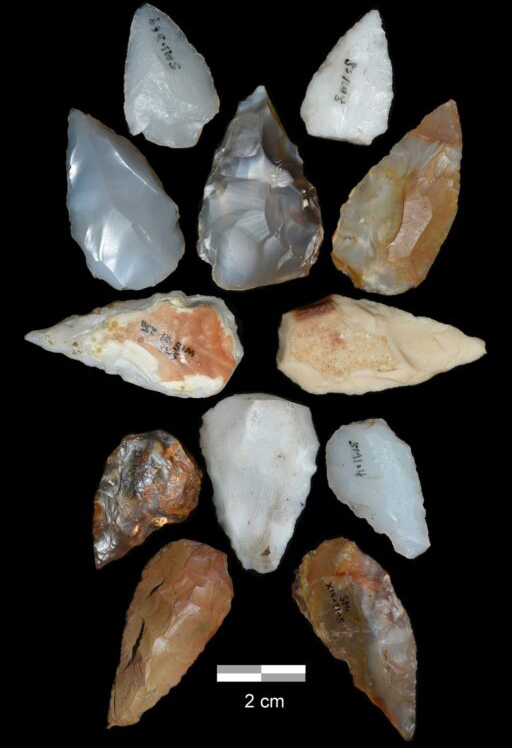
Selection of possible arrowheads from the Shinfa River site (Credit: Kappelman et al.; Blue Nile Survey Project)

The artifacts and bones of what these modern humans ate suggest a remarkable scenario for how they lived. Stone tools are finely worked from local basalt lava, quartz and flint-like chalcedony found in cavities in lava flows. Many of them are small, sharp triangular points, some of which show features consistent with their use as projectile tips that fractured on impact; they may be arrowheads, indeed the earliest known. Bones found at the site are key pointers to their diet. They are from a wide variety of animal, roughly similar to those living in the area at present: from monkeys to giraffe, guinea fowl to ostrich, and even frogs. There are remains of many fish and freshwater molluscs. Although there are no traces of plant foods, clearly those people who loved through the distant effects of Toba were well fed. Although a period of global cooling may have increased aridity at tropical latitudes in Africa, the campers were able to devise efficient strategies to obtain victuals. During wet seasons they lived off terrestrial prey animals, and during the driest times ate fish from pools in the river valley. These are hardly conditions likely to devastate their numbers, and the people seem to have been technologically flexible. Similar observations were made at the Pinnacle Point site in far-off South Africa in 2018, where Toba ash is also present. Both sites refute any retardation of human cultural progress 74 ka ago. Rather the opposite: people may have been spurred to innovation, and the new strategies may have allowed them to migrate more efficiently, perhaps along seasonal drainages. In this case that would have led them or their descendants to the Nile and a direct route to Eurasia; along ‘blue highway’ corridors as Kappelman et al. suggest.

Yet the population bottleneck implied by mtDNA analyses is only vaguely dated: it may have been well before or well after Toba. Moreover, there is a 10 ka gap between Toba and the earliest accurately dated migrants who left Africa – the first Australians at about 65 ka. However, note that there is inconclusive evidence that modern humans may have occupied Sumatra by the time of the eruption.  Much closer to the site of the eruption in southeast India, stone artifacts have been found below and above the 74 ka datum marked by the thick Toba Ash. Whether these were discarded by anatomically modern humans or earlier migrants such as Homo erectus remains unresolved. Either way, at that site there is no evidence for any mass die-off, even though conditions must have been pretty dreadful while the ash fell. But that probably only lasted for little more than a month. If the migrants did suffer very high losses to decrease the genetic diversity of the survivors, it seems just as likely to have been due to attrition on an extremely lengthy trek, with little likelihood of tangible evidence surviving. Alternatively, the out-of-Africa migrants may have been small in number and not fully representative of the genetic richness of the Africans who stayed put: a few tens of thousand migrants may not have been very diverse from the outset.

An evolutionary bottleneck and the emergence of Neanderthals, Denisovans and modern humans

The genetic diversity of living humans, particularly among short, repetitive segments of DNA, is surprisingly low. As they are passed from generation to generation they have a high chance of mutation, which would be expected to create substantial differences between geographically separated populations. In the late 1990s and early 2000s some researchers attributed the absence of such gross differences to the human gene pool having been reduced to a small size in the past, thereby reducing earlier genetic variation as a result of increased interbreeding among survivors. They were able to assess roughly when such a population ‘bottleneck’ took place and the level to which the global population fell. Genetic analysis of living human populations seemed to suggest that around 74 ka ago the global human population fell to as little as 10 thousand individuals. A potential culprit was the catastrophic eruption of the Toba supervolcano in Sumatra around that time, which belched out 800 km3 of ash now found as far afield as the Greenland and Antarctic ice caps. Global surface temperature may have fallen by 10°C for several years to decades. Subsequent research has cast doubt on such a severe decline in numbers of living hummans; for instance archaeologists working in SE India found much the same numbers of stone tools above the Toba ash deposit as below it (see: Toba ash and calibrating the Pleistocene record: December 2012). Other, less catastrophic explanations for the low genetic diversity of modern humans have also been proposed. Nevertheless, environmental changes that placed huge stresses on our ancestors may repeatedly have led to such population bottlenecks, and indeed throughout the entire history of biological evolution.

An improved method of ‘back-tracking’ genetic relatedness among living populations, known as fast infinitesimal time coalescence or ‘FitCoal’, tracks genomes of individuals back to a last common ancestor. In simple language, it expresses relatedness along lineages to find branching points and, using an assumed mutation rate, estimates how long ago such coalescences probably occurred. The more lineages the further back in time FitCoal can reach and the greater the precision of the analysis. Moreover it can suggest the likely numbers of individuals, whose history is preserved in the genetics of modern people, who contributed to the gene pool at different branching points. Our genetics today are not restricted to our species for it is certain that traces of Neanderthal and Denisovan ancestry are present in populations outside of Africa. African genetics also host ‘ghosts’ of so-far unknown distant ancestors. So, the FitCoal approach may well be capable of teasing out events in human evolution beyond a million years ago, if sufficient data are fed into the algorithms. A team of geneticists based in China, Italy and the US has recently applied FitCoal to genomic sequences of 3154 individual alive today (Hu, W.and 8 others 2023. Genomic inference of a severe human bottleneck during the Early to Middle Pleistocene transition. Science, v. 381, p. 979-984; DOI I: 10.1126/science.abq7487). Their findings are startling and likely to launch controversy among their peers.

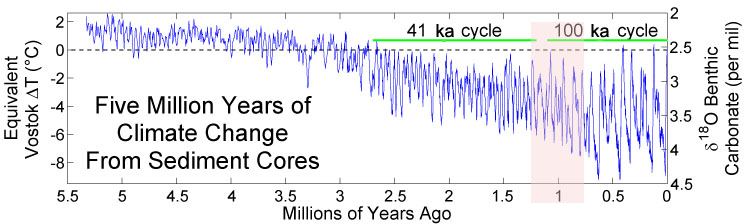
Their analyses suggest that between 930 and 813 ka ago human ancestors passed through a population bottleneck that involved only about 1300 breeding individuals. Moreover they remained at the very brink of extinction for a little under 120 thousand years. Interestingly, the genetic data are from people living on all continents, with no major differences between the analyses for geographically broad groups of people in Africa and Eurasia. Archaeological evidence, albeit sparse, suggests that ancient humans were widely spread across those two continental masses before the bottleneck event. The date range coincides with late stages of the Mid-Pleistocene climatic transition (1250 to 750 ka) during which glacial-interglacial cycles changed from 41 thousand-year periods to those that have an average duration of around 100 ka. The transition also brought with it roughly a doubling in the mean annual temperature range from the warmest parts of interglacials to the frigid glacial maxima: the world became a colder and drier place during the glacial parts of the cycles.

Genomes for Neanderthals and Denisovans suggest that they emerged as separate species between 500 and 700 ka ago. Their common ancestor, possibly Homo heidelbergensis, H. antecessor or other candidates (palaeoanthropologists habitually differ) may well have constituted the widespread population whose numbers shrank dramatically during the bottleneck. Perhaps several variants emerged because of it to become Denisovans, Neanderthals and, several hundred thousand years later, of anatomically modern humans. Yet it would require actual DNA from one or other candidate for the issue of last common ancestor for the three genetically known ‘late’ hominins to be resolved. But Hu et al. have shown a possible means of accelerated hominin evolution from which they may have emerged, at the very brink of extinction.

Oxygen-isotope record and global temperature changes over the last 5 million years, green lines showing the times dominated by 41 and 100 ka climatic cycles. The mid-Pleistocene climatic transition is shown in pink (Credit: Robert A Rohde)

There is a need for caution, however. H. erectus first appeared in the African fossil record about 1.8 Ma ago and subsequently spread across Eurasia to become the most ‘durable’ of all hominin species. Physiologically they seem not to have evolved much over at least a million years, nor even culturally – their biface Acheulean tools lasted as long as they did. They were present in Asia for even longer, and apparently did not dwindle during the mid-Pleistocene transition to the near catastrophic levels as did the ancestral species for living humans. The tiny global population suggested by Hu et al. for the latter also hints that their geographic distribution had to be very limited; otherwise widely separated small bands would surely have perished over the 120 ka of the bottleneck event. Yet, during the critical period from 930 to 813 ka even Britain was visited by a small band of archaic humans who left footprints in river sediments now exposed at Happisburgh in Norfolk. Hu et al. cite the scarcity of archaeological evidence from that period – perhaps unwisely – in support of their bottleneck hypothesis. There are plenty of other gaps in the comparatively tenuous fossil and archaeological records of hominins as a whole.

The discovery of genetic evidence for this population bottleneck is clearly exciting, as is the implication that it may have been the trigger for evolution of later human species and the stem event for modern humans. Hopefully Hu et al’s work will spur yet more genetic research along similar lines, but there is an even more pressing need for field research aimed at new human fossils from new archaeological sites.

See also: Ashton, N. & Stringer, C. 2023. Did our ancestors nearly die out? Science (Perspectives), v. 381, p. 947-948; DOI: 10.1126.science.adj9484.

Ikarashi, A. 2023. Human ancestors nearly went extinct 900,000 years ago. Nature, v. 621; DOI: 10.1038/d41586-023-02712-4

Di Vicenzo, F & Manzi, G. 2023. An evolutionary bottleneck and the emergence of Neanderthals, Denisovans and modern humans. Homo heidelbergensis as the Middle Pleistocene common ancestor of Denisovans, Neanderthals and modern humans. Journal of Mediterranean Earth Sciences, v, 15, p. 161-173; DOI: 10.13133/2280-6148/18074