North America occupied by modern humans during the Last Glacial Maximum

White Sands National Park in New Mexico, USA is notorious for being adjacent to the site at which the first nuclear weapon was tested (code name Trinity) on 16 July 1945. Four weeks later two such bombs killed between 129,000 and 226,000 people at Hiroshima (6 August 1945) and Nagasaki (9 August 1945). The area is one of spectacular geology, the white sand being made of gypsum (CaSO4) grains precipitated from lake water supplied by rivers that had dissolved the mineral from Permian evaporites in the surrounding mountains. Subsequent wind erosion created a large, white dune field: the main attraction. Though a national park that has been proposed for UNESCO World Heritage Centre, the park itself is surrounded by military installations including the nuclear test site.

Gypsum sand dunes in White Sands National Park USA. (Credit: Wikipedia)

As in most evaporite basins, the White Sands’ gypsum sediments built up layer-by-layer through deposition of clays during successive inundations followed by evaporation of CaSO4 rich water. Animals crossing the basin were likely to leave trackways, which subsequent sedimentary cycles could preserve in stratigraphic order. Examples had been found in the early 20th century, revealing the former presence of the late-Pleistocene megafauna: Columbian mammoths, ground sloths, ancient camels, dire wolves, lions, and sabre-toothed cats. One set of dire wolf prints found in the 2010s contained seeds that yielded a radiocarbon age of 18 ka. More recently, 61 human footprint tracks turned up in layers that also displayed signs of megafauna crossing the lake flats, in one case showing convincing signs of hunters having followed a giant ground sloth (Bennett, M.R. 2021 and 13 others 2021. Evidence of humans in North America during the Last Glacial Maximum. Science, v. 373, p. 1528-1531; doi: 10.1126/science.abg7586). Interestingly, many of the human tracks seem to have been made by teenagers and children with only a few made by adults. Dating of seeds in the sediment layers – and in some footprints – yielded 23 to 21 ka radiocarbon ages. This evidence suggested human occupation of New Mexico long before those who left Clovis-style artifacts around 13 ka and others who preceded them. However, the seeds that were dated are those of an aquatic grass (Ruppia cirrhosa), which may have absorbed older carbon from groundwater permeating the evaporite sediments. Being robust, the seeds could also have been transported by wind back and forth from plants that lived before the animals and humans left their marks in the saline flats. Such is the importance of the White Sands fossil trackways that a team of US and British geologists, some of whom authored Bennett et al. 2021, have sought to refute doubts of their antiquity (Pigati, J.S. and 10 others 2023. Independent age estimates resolve the controversy of ancient human footprints at White Sands. Science, v. 382, p. 73-75; DOI: 10.1126/science.adh5007).
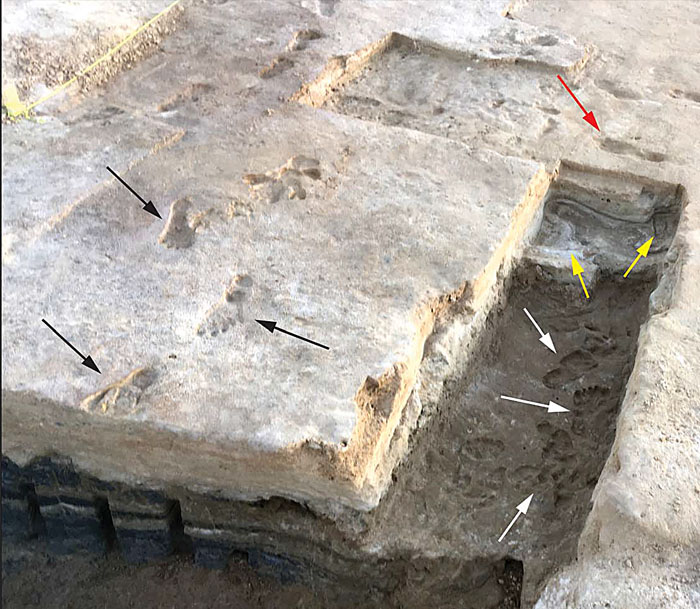
Human footprints (arrowed) preserved on three sediment surfaces of the White Sands clay-gypsum sequences; i.e. at three times in their depositional sequence. (Credit: from Pigati et al.; Fig 1)

The researchers cut trenches into the layered clay-gypsum to reveal human footprints on three successive surfaces at the site where Ruppia seeds had provided very old, but disputed ages. They supplemented the earlier evidence by 14C dating of pollen grains blown into the prints from terrestrial plants and optically stimulated luminescence ages (time of last exposure to sunlight) of detrital quartz grains in the evaporites. The pollen dating gave ages from 23.4 to 22.6 ka, the minimum quartz OSL age being 21.5 ka. Similar ages from three different methods are pretty convincing evidence that humans were active in New Mexico during the Last Glacial Maximum (LGM), and that absorption of older carbon from groundwater had not affected the Ruppia seeds.

The Asia to America migration, which led these hunters to what the abundant megafauna trackways suggest were rich pickings around the White Sands palaeo-lake, must have been earlier still. High-latitude North America was almost certainly a vast, frigid desert for thousands of years leading up to the LGM. Another implication of the remarkable finds in the gypsum beds is that migration most probably involved a coastal or even a maritime route along the Eastern Pacific shore to reach more habitable lower latitudes.

See also: Earliest Americans, and plenty of them. Earth-logs, 27July 2020; Prillaman, M. 2023. Human footprints in New Mexico really may be surprisingly ancient, new dating shows. Science News, 5 October 2023.

When and why did the North American Pleistocene megafauna collapse?

The US city of Los Angeles, originally known as El Pueblo de Nuestra Señora la Reina de los Ángeles (The Town of Our Lady the Queen of the Angels), was founded in 1781 by 44 Spanish settlers. It remained a small cattle-centred town after the annexation of California from Mexico by the USA in 1847. Once it was reached by the transcontinental Southern Pacific railroad in 1876 it had the potential for growth. But it took the discovery of oil within its limits in 1892 for its population to increase rapidly. The Los Angeles City Oil Field became the top producer in California with 200 separate oil companies crammed cheek by jowl by 1901. Now only one remains, producing just 3.5 barrels per day. That crude oil was there for the taking was pretty obvious as bitumen seeps had long been exploited by native people and the original Spanish colonists. The oilfield was developed near one such seep: the Rancho La Brea tar pits.

Rancho La Brea tar pit and derricks of the Los Angeles City Oil Field in 1901

By 1901 perfectly preserved bones of a huge variety of animals – 231 vertebrate species – as well as plants and invertebrates began to be collected from the continually roiling pond of bitumen. Thousands of specimens have been collected since then, both predators and prey of all sizes. Famous for mastodons and sabre-toothed cats, La Brea is a repository of almost the entire western Californian fauna through much of the Late Pleistocene: before about 100 ka the area lay beneath the Pacific Ocean. Tar pits are traps for unwary animals of any kind, especially as shallow water often hides the danger. Carnivores seeking easy, abundant food end up trapped too.

Because of the anaerobic nature of bitumen, bacterial decay is suppressed. Many of the bones still contain undegraded collagen: the most abundant protein in mammals, which can be dated using the radiocarbon method. So, despite the lack of stratigraphy in the tar pits, it is possible to track the history of the ecosystem by painstaking dating of individual fossils (OKeefe, F.R and 18 others 2023. Pre–Younger Dryas megafaunal extirpation at Rancho La Brea linked to fire-driven state shift. Science, v. 381, article eabo3594; DOI: 10.1126/science.abo3594). Robin OKeefe and colleagues dated 169 specimens of eight large mammal species most commonly found in the bitumen: sabre-toothed cat (Smilodon fatalis); dire wolf (Aenocyon dirus); coyote (Canis latrans); American lion (Panthera atrox); ancient bison (Bison antiquus); western horse (Equus occidentalis); Harlans ground sloth (Paramylodon harlani); and yesterdays camel (Camelops hesternus).

The authors focussed on precisely dated specimens spanning the 15.6 to 10.0 ka time range. This would allow the disappearance times of individual species to be compared with stages in the rapid change in the Californian climate during post glacial maximum warming, those during the Younger Dryas abrupt cooling (12.9 to 11.7 ka) and the earliest Holocene warming that succeeded it. The first to go extinct were the camels and giant sloths about 13.6 ka ago. At 13.2 ka the other mammals declined very rapidly, the two remaining herbivores vanishing more quickly than the four predators. By 12.9 ka the only surviving species of the chosen eight was the coyote. So seven members of the Pleistocene mammalian megafauna became extinct before the onset of the Younger Dryas cold millennium.

Part of the team examined pollen from a core through sediments deposited in a lake 100 km south of La Brea. They found that flora, and probably climate, had not changed at the time of camel and sloth extinctions around 13.6 ka. However a 300 year period between 13.2 and 12.9 ka witnessed a collapse in deciduous tree species while conifers, grasses and drought-tolerant shrubs increased. A woodland ecosystem had been replaced by semi-arid chaparral. Another feature of the lake-bed sediments was that charcoal fragments increased explosively during that 300-year episode that ended both the woodland ecosystem and the megafauna that exploited it: undoubtedly three centuries of regular wildfires. What remained was the chaparral ecosystem based on drought-tolerant, fire-adapted plants.

Were the megafauna collapse and a change in ecology results of a climatic harbinger for the Younger Dryas cool millennium, or some other cause? Interestingly, tangible evidence for the Clovis hunting culture of North America, which has long been implicated in the faunal ‘extirpation’, does not appear until 12.9 ka, and in California neither does any implicating other human groups. Yet evidence is accumulating for much earlier entry of humans into North America. Occupation sites are very rare on land, but human presence here and there implies such earlier migration, probably along the west coast that avoided the frigid interior further north than California. The question posed by OKeefe ­et al. is, ‘Were the fires ignited by humans over a 300 year period just before the Younger Dryas’? It remains to be confirmed … First human arrivals coinciding with evidence for wildfires in Australia, New Zealand and a few other areas do suggest that it is a possibility. There needs to be a motive, such as producing lush clearings in forest to attract game, or removing cover to make hunting easier. In this case, the fires immediately preceded a global climatic downturn with terrestrial drying, so they may have had natural causes: the potentially incendiary chaparral flora had been increasing steadily beforehand and decreased rapidly after the evidence for wildfires

See also: Price, M. 2023.  Death by fire. Science, v. 381, p. 724-727; DOI: 10.1126/science.adk3291

A cometary air-burst over South America 12 thousand years ago

Earth-logs has previously covered quite a few hypotheses involving catastrophic astronomical events of the past, often returning to them as new data and ideas emerge. They range from giant impacts, exemplified in the mass extinction at the K-Pg boundary to smaller-scale events that may have coincided with important changes in climate, such as the sudden onset of the Younger Dryas, and a few that have been suggested as agencies affecting local human populations such as the demise of Sodom by a cosmogenic air-burst. Some of the papers that spurred the Earth-pages posts have been widely regarded in the geoscience community. Yet there have been others that many have doubted, and even condemned. For instance, data used by the consortium that suggested an extraterrestrial event triggered the frigid millennium of the Younger Dryas (YD) have been seriously and widely questioned. A sizeable number of the team that were under close scrutiny in 2008 joined others in 2019 to back the YD air-burst hypothesis again, using similarly ‘persuasive’ data from Chile. Members of the original consortium of academics also contributed to the widely disputed notion of a cosmic air-burst having destroyed a Bronze Age urban centre in Jordan that may, or may not, have been the site of the Biblical Sodom. Again, they cited almost the ‘full monty’ of data for high-energy astronomical events, but again no crater or substantial melt glass, apart from tiny spherules. Now another paper on much the same theme, but none of whose authors contributed to those based on possibly ‘dodgy’ data, has appeared in Geology (Schultz, P.H. et al. 2021. Widespread glasses generated by cometary fireballs during the Late Pleistocene in the Atacama Desert, Chile. Geology, published online November 2, 2021; doi: 10.1130/G49426.1).

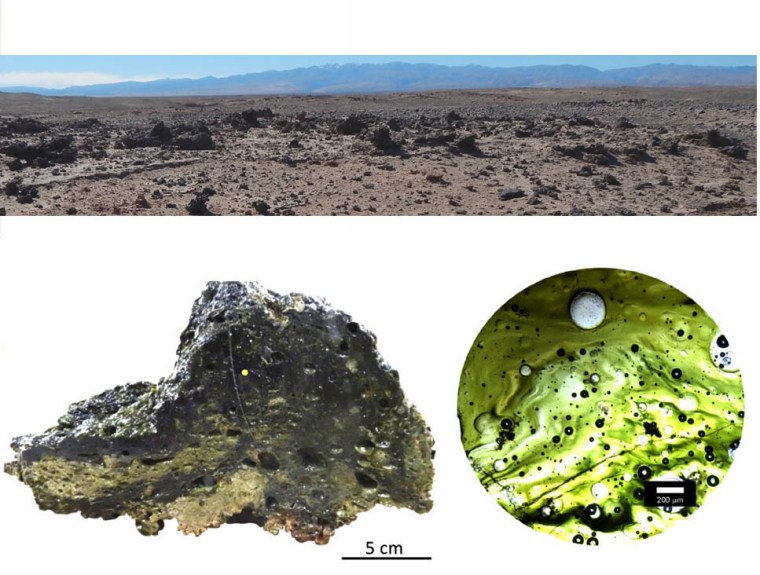
Peter Schultz of Brown University, USA and colleagues from the US and Chile make no dramatic claims for death and destruction or climate destabilisation, and simply report a fascinating discovery. In 2012 one of the authors, Nicolas Blanco of the Universidad Santo Tomás in Santiago, Chile, found slabs made of glassy material up to half a metre across. They occurred in several 1 to 3 km2 patches over a wide area of the Atacama Desert. Resting on Pleistocene glacio-fluvial sediments, they had been exposed by wind erosion of active sand dunes. The glass is dark green to brown and had been folded while still molten. For the glass slabs to be volcanic bombs presupposes a nearby volcano, but although Chile does have volcanoes none of the active vents are close enough to have flung such large lumps of lava into the glass-strewn area. The glassy material also contains traces of vegetation, and varies a great deal in colour (brown to green). Its bulk chemical composition suggests melting of a wide variety of surface materials: quite unlike volcanic glasses.

Chilean glass occurrence: panorama of large glass fragments in the Atacama Desert; a specimen of the glass; thin section of glass showing bubbles and dusty particles (Credit: Schultz et al. 2021; Figs 1B, 2D and 2C)

Microscopic examination of thin sections of the glasses also reveals nothing resembling lava, except for gas bubbles. The slabs are full of exotic fragments, some of which closely resemble mineral assemblages found in meteorites, including nickel-rich sulfides embedded in ultramafic material. Others are calcium-, aluminium- and titanium-rich inclusions, such as corundum (Al2O3) and perovskite (CaTiO3), thought to have originated as very-high temperature condensates from the pre-solar nebula: like the celebrated ‘white inclusions’ in the Allende meteorite. Some minute grains resemble dust particles recovered by the NASA Stardust mission to Comet 81P/Wild-2 which returned samples to Earth in 2006. Zircon grains in the glasses, presumed to be locally derived, have been decomposed to zirconium oxide (baddeleyite), suggesting melting temperatures greater than 1670°C: far above the highest temperature found in lavas (~1200°C). Interestingly, the green-yellow silica glass strewn over the Sahara Desert around the southern Egypt-Libya border also contains baddeleyite and cometary dusts, together with anomalously high platinum-group elements and nanodiamonds that are not reported from the Chilean glass. Much prized by the elite of pharaonic Egypt and earlier makers of stone tools, the Saharan glass is ascribed to shock heating of the desert surface by a cometary nucleus that exploded over the Sahara. Unsurprisingly, Schultz et al. come to the same conclusion.

Any object entering the Earth’s atmosphere does so at speeds in excess of our planet’s escape velocity (11.2 km s-1). Not only does that result in heating by friction with the air, but much of the kinetic energy of hypersonic entry goes into compressing air through shock waves, especially with objects larger than a few tens of metres. Such adiabatic compression can produce temperatures >>10 thousand °C. Hence the ‘fireballs’ associated with large meteorites. With very large air-bursts the flash of radiant energy would be sufficient to completely melt surface materials in microseconds, though rugged topography could protect areas shadowed from the air-burst by mountains, perhaps explaining the patchy nature of the glass occurrences.  (Note: the aforementioned papers on the YD and Sodom ‘air-bursts’ do not mention large glass fragments, whereas some surface melting would be expected). Some of the Chilean glass contains carbonised remnants of vegetation. Radiocarbon dating of four samples show that the glass formed at some time between 16.3 to 12.1 ka. Yes, that does include the age of the start of the YD (12.9 ka) and human migrants had established themselves in northern Chile and coastal Peru after 14.2 ka. Yet the authors, perhaps wisely, do no more than mention the coincidence, as well as that with the disappearance of South American Pleistocene megafaunas – more severe than on any other continent. With a very distinctive product, probably spanning a far larger area of South America, and attractive to humans as an ornament or a resource for sharp tools, expect follow-up articles in the future.

See also: http://www.sci-news.com/space/atacama-desert-comet-10247.html, Science News, 8 November 2021; Vast patches of glassy rock in Chilean desert likely created by ancient exploding comet, Eureka Alert, 2 November 2021.

Pleistocene megafaunal extinctions – were humans to blame?

Australia and the Americas had an extremely diverse fauna of large beasts (giant wombats and kangeroos in Australia; elephants, bears, big cats, camelids, ground sloths etc in the Americas) until the last glaciation and the warming period that led into the Holocene interglacial. The majority of these megafauna species vanished suddenly during that recent period. To a lesser extent something similar happened in Eurasia, but nothing significant in Africa. Because the last glacial cycle also saw migration of efficient human hunter-gatherers to every other continent except Antarctica, many ecologists, palaeontologists and anthropologists saw a direct link between human predation and the mass extinction (see Earth-Pages of April 2012. Earlier humans had indeed spread far and wide in Eurasia before, and the crude hypothesis that the last arrivals in Australasia and the Americas devoured all the meatiest prey in three continents had some traction as a result: predation in Eurasia and Africa by earlier hominids would have made surviving prey congenitally wary of bipeds with spears. In Australia and the Americas the megafauna species would have been naive and confident in their sheer bulk, numbers, speed and, in some cases, ferocity. Other possibilities emerged, such as the introduction of viruses to which faunas had no immunity or as a result of climate change, but none of the three possibilities has gained incontrovertible proof. But the most popular, human connection has had severe knocks in the last couple of years. A fourth, that the extinctions stemmed from a comet impact proved to have little traction.

English: s were driven to extinction by and hu...
Megafauna in a late-Pleistocene landscape including woolly mammoths and rhinoceroses, horses, and cave lions with a carcass. (credit: Wikipedia)

Since the amazing success of analysing the bulk DNA debris in sea water – environmental DNA or eDNA – to look at the local diversity of marine animals, the analytical and computing techniques that made it possible have been turned to ancient terrestrial materials: soils, permafrost and glacial ice. One of the first attempts revealed mammoth and pre-Columbian horse DNA surviving in Alaskan permafrost, thanks to the herds’ copious urination and dung spreading. Several articles in the 24 July 2015 issue of Science review ancient DNA advances, including eDNA from soils that chart changes in both fauna and flora over the last glacial cycle (Pennisi, E. 2015. Lost worlds found. Science, v. 349, p. 367-369). Combined with a variety of means of dating the material that yield the ancient eDNA, an interesting picture is emerging. The soil and permafrost samples potentially express ancient ecosystems in far more detail than would fossil animals or pollens, many of which are too similar to look at the species level and in any case are dominated by the most abundant plants rather than showing those critical in the food chain.

Nunavut tundra
Plants of the Arctic tundra in Nunavut, Canada (Photo credit: Wikipedia)

The first major success in palaeoecology of this kind came with a 50-author paper using eDNA ‘bar-coding’ of permafrost from 242 sites in Siberia and Alaska IWillerslev, E. and 49 others 2014. Fifty thousand years of Arctic vegetation and megafaunal diet. Nature, v. 506, p. 47-51. doi:10.1038/nature12921). Dividing the samples into 3 time spans – 50-25, 25-15 (last glacial maximum) and younger than 15 ka – the team found these major stages in the last glacial cycle mapped an ecological change from a dry tundra dominated by abundant herbaceous plants (forbs including abundant anemones and forget-me-not), to a markedly depleted Arctic steppe ecosystem then moist tundra with woody plants and grasses dominating. They also analysed the eDNA of dung and gut contents from ice-age megafauna, such as mammoths, bison and woolly rhinos, where these were found, which showed that forbs were the mainstay of their diet. Using bones of large mammals 6 member of the team also established the timing of extinctions in the last 56 ka (Cooper, A. et al. 2015. Abrupt warming events drove Late Pleistocene Holarctic megafaunal turnover. Science, DOI: 10.1126/science.aac4315), showing 31 regional extinction pulses linked to the rapid ups and downs of climate during Dansgaard-Oeschger cycles in the run-up to the last glacial maximum. By the end of the last glacial maximum, the megafauna were highly stressed by purely climatic and ecological factors. Human predation probably finished them off.

Large-animal extinction in Australia linked to human hunters

Diprotodon optatum, Pleistocene of Australia. ...
Artist's impression of a giant Australian wombat (Diprotodon) (credit: Wikipedia)

In North America, between 13 and 11.5 ka, around 30 species of large herbivorous mammals became extinct. Much the same occurred in Australia around 45 ka. Both cases roughly coincided with the entry of anatomically modern humans, where neither they nor earlier hominids had lived earlier. Such extinctions are not apparent in the Pleistocene records of Africa or Eurasia. An obvious implication is that initial human colonisation and a collapse of local megafaunas are somehow connected, perhaps even that highly efficient early hunting bands slaughtered and ate their way through both continents. But other possibilities can not be ruled out, including coincidences between colonisation and climate or ecosystem change. As many as thirteen different hypotheses await resolution, one that inevitably makes headline news repeatedly: that both the early Clovis culture and North American megafaunas met their end around the same time as the start of the Younger Dryas millennial cold snap because a meteorite exploded above North America (http://earth-pages.co.uk/2009/03/01/comet-slew-large-mammals-of-the-americas/). One problem in assessing the various ideas is accurately dating the actual extinctions, partly because terrestrial environments rarely undergo the continual sedimentation that builds up easily interpreted stratigraphic sequences. Another is that it is not easy to prove, say, that all giant kangaroos died in a short period of time because of the poor record of preservation of skeletons on land. A cautionary take concerns the demise of the woolly mammoth that roamed the frigid deserts of northern Eurasia and definitely was hunted by both modern humans and Neanderthals. It was eventually discovered that herds still survived on Wrangell Island until the second millennium BC. There is a need for a proxy that charts indirectly the fate of megafaunas plus accurate estimates of the timing of human colonisation. In North America there is a candidate for the first criterion: traces of a fungus (Sporormiella – see Fungal clue to fate of North American megafauna in EPN of January 2010) that exclusively lives in the dung of large herbivores. Fungal spores get everywhere, being wind-dispersed, and in NE US lake cores they fell abruptly at about 13.7 ka. Sporormiella needs to pass through the gut of herbivores to complete its life cycle.

Aboriginal Rock Art, Anbangbang Rock Shelter, ...
Aboriginal Rock Art, Kakadu National Park, Australia (Photo credit: Wikipedia)

The same genus of fungus breaks down dung in Australia. Measuring spore content in sediment on the floor of a Queensland lake shows the same abrupt decline in abundance at between 43 to 39 ka before present (Rule, S. et al. 2012. The aftermath of a megafaunal extinction: ecosystem transformation in Pleistocene Australia. Science, v. 335, p. 1483-1486). Moreover, the fungal collapse is accompanied by a marked increase in fine-grained charcoal – a sign of widespread fires – and is followed by a steady increase in pollen of scrub vegetation at the expense of that of tropical rain forest trees. The shifts do not correlate with any Southern Hemisphere climatic proxy for cooling and drying that might have caused ecosystem collapse. That still does not mark out newly arrived humans as the culprits, as the early archaeological record of Australia, as in North America, is sparse and only estimated to have started at around 45 ka. Yet this is quite strong circumstantial evidence. The 20 or more animals – marsupials, birds and reptiles – with a mass more than 40 kg that formerly inhabited the continent would probably have been ‘naive’ as regards newly arrived, organised, well-armed and clever new predators, as would those of North America and much later in New Zealand, and would have been ‘easy prey’. Incidentally, faunas of both Africa and Eurasia are extremely wary of humans, possibly as a result of a far longer period of encounters with human hunter-gatherers.  In Australia’s case, the use of deliberate fire clearing to improve visibility of game may have had a major role, although it is equally likely that the demise of large herbivores would have left large amounts of leaf litter and dry grasses to combust naturally. Yet the Earth as a whole around 40 ka was slowly cooling and drying towards the last glacial maximum around 20 ka, so human influence may merely have pushed the megafauna towards extinction, such is the fragility of Australia’s ecosystems.

Some megafaunas of the recent past

Harvey was an imaginary, 2 m tall rabbit which befriended Elwood P. Dowd in Mary Chase’s 1944 comedy of errors named after the said rabbit, filmed in 1950 and starring James Stewart as the affable though deranged Dowd. Though not so tall, a giant fossil rabbit (relative to modern rabbits) weighing it at 12 kg has emerged from the prolific Late Neogene cave deposits of Minorca (Quintana, J. Et al. 2011. Nuralagus rex, gen. et sp. nov., an endemic insular giant rabbit from the Neogene of Minorca (Balearic Islands, Spain). Journal of Vertebrate Paleontology, v. 31, p. 231-240). At about 3 times heavier than Barrington my lagomorphophagic (rabbit-eating to the uninitiated) cat, this would have been, to him, a beast best avoided, as the name N. rex might suggest. So unexpected was a gigantic rabbit that, interestingly, it was first mistaken for a fossil tortoise, albeit one lacking a carapace.

Island faunas have long been recognized as havens for peculiar trends in evolutionary successions, either towards dwarfism as in the case of the tiny elephants on which H. floresiensis preyed until quite recently on the Indonesian island of Flores or gigantism as in this remarkable case. As the authors infer, on account of the creature’s ‘…(short manus and pes with splayed phalanges, short and stiff vertebral column with reduced extension/flexion capabilities), and the relatively small size of sense-related areas of the skull (tympanic bullae, orbits, braincase, and choanae)…’ this was a rabbit which sadly could not hop. This un-rabbit-like locomotion may well have been a result of it not having needed to hop, being so large as to challenge seriously the largest Neogene predators on the island – lizards – and thereby saving energy. For much the same evolutionary logic, neither did N. rex have long ears, having less need to detect a stealthy nemesis.

The demise of Late Neogene megafaunas in general has often been ascribed to human intervention. Though N. rex became extinct at around 3 Ma and avoided human predation, later giants did not fare so well. A case in point is the celebrated wooly mammoth, the last of the steppe mammoths, that first appeared in the fossil record of Siberia around 750 ka ago (Nicholls H. 2011. Last days of the mammoth. New Scientist, v. 209 (26 March 2011), p. 54-57). DNA evidence from hairs preserved in permafrost suggests that ancestors of the steppe mammoth line diverged with that of Asian elephants from African elephant ancestors around 5 Ma. Interestingly, ancestral steppe mammoths – without shaggy coats but having the archetypical curved tusks – roamed Africa until 3 Ma when they disappear to reappear in Europe and Asia, yet without adaptation to cold until the onset of northern glaciations around 2.5 Ma. At that point the true steppe mammoths evolved increased tooth enamel needed for a diet of mainly silica-rich grasses to resist wear. The family spread to North America when sea-level fell to expose the sea floor of the Bering Straits. The woolly mammoth is the star partly because specimens periodically turn up almost perfectly preserved in permafrost. This has allowed almost half of a full DNA sequence to be restored. Preserved haemoglobin from a woolly mammoth shares with that from modern musk oxen an ability to release oxygen at temperatures well below zero so that they could function even if their extremities became chilled.

The Woolly Mammoth at the Royal BC Museum, Vic...
Reconstructed woolly mammoth at the Royal BC Museum, Victoria, British Columbia (Image via Wikipedia)

Astonishingly, all elephants urinate so copiously that they soak their range lands in DNA, though it only lingers in ultra cold climes. This bizarre fact encouraged a large team of palaeobiologists to comb frozen soils in an alluvium section in Arctic Alaska for mammoth DNA (Haile, J and 17 others, 2009. Ancient DNA reveals late survival of mammoth and horse in interior Alaska.  Proceedings of the National Academy of Sciences of the USA, v. 106, p. 22352–22357). Mammoth DNA turned up in soils as young as 10.5 ka. Moreover mammoth overlapped with human occupation for several millennia, casting doubt on theories that mammoth extinction resulted either from human predation or the introduction of epidemic disease that might have felled mammoths quickly: they declined gradually. Yet the empirical fact that steppe mammoths in general and the woolly mammoth in particular survived through at least 8 major glacial-interglacial transitions only to become extinct at the start of the current Holocene interglacial period at the same time as humans recolonised the frigid desert of Arctic latitudes, where woolly mammoths could survive except at the last glacial maximum surely points to some influence that arose from human activity.